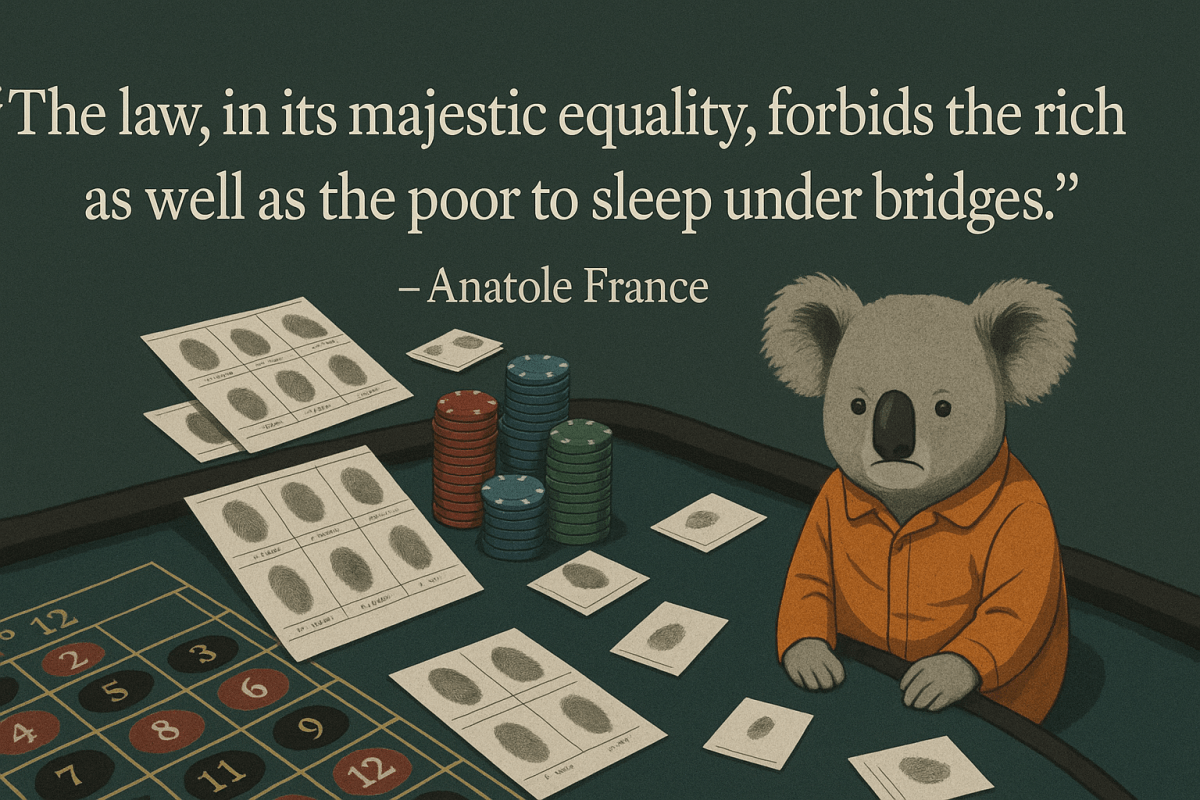
Welcome to the Grand Casino of Justice, where the chips are your civil liberties, the roulette wheel spins your fate, and the house—ever-smug in its powdered wig of procedural decorum—always wins.
Step right up, citizens! Marvel at the dazzling illusions of “science” as performed by your local constabulary: the sacred polygraph, that magnificent artefact of 1920s snake oil, still trotted out in back rooms like a séance at a nursing home. Never mind that it measures stress, not deception. Never mind that it’s been dismissed by any scientist with a functioning prefrontal cortex. It’s not there to detect truth—it’s there to extract confession. Like a slot machine that only pays out when you agree you’re guilty.
And oh, the forensic pageantry! The blacklight! The dramatic swabs! The breathless invocations of “trace evidence,” “blood spatter patterns,” and—ooh! ahh!—fingerprints, those curly little whorls of manufactured certainty. You’ve been told since childhood that no two are alike, that your prints are your identity. Rubbish. Human fingerprint examiners disagree with themselves when presented with the same print twice. In blind tests. And yes—this bears repeating with appropriate incredulity—koalas have fingerprints so uncannily similar to ours they’ve confused human forensic analysts. Somewhere, a marsupial walks free while a teenager rots in remand.

You see, it’s not about justice. It’s about control. Control through performance. The legal system, like a casino, isn’t interested in fairness—it’s interested in outcome. It needs to appear impartial, all robes and solemnity, while tipping the odds ever so slightly, perpetually, in its own favour. This is jurisprudence as stagecraft, science as set-dressing, and truth as a collateral casualty.
And who are the croupiers of this great charade? Not scientists, no. Scientists are too cautious, too mired in uncertainty, too concerned with falsifiability and statistical error margins. No, your case will be handled by forensic technicians with just enough training to speak jargon, and just enough institutional loyalty to believe they’re doing the Lord’s work. Never mind that many forensic methods—bite mark analysis, tool mark “matching,” even some blood spatter interpretations—are about as scientifically robust as a horoscope printed on a cereal box.
TV crime dramas, of course, have done their bit to embalm these myths in the cultural subconscious. “CSI” isn’t a genre—it’s a sedative, reassuring the public that experts can see the truth in a hair follicle or the angle of a sneeze. In reality, most convictions hinge on shoddy analysis, flawed assumptions, and a little prosecutorial sleight of hand. But the juries are dazzled by the sciencey buzzwords, and the judges—God bless their robes—rarely know a confidence interval from a cornflake.
So, what do you do when accused in the great Casino of Justice? Well, if you’re lucky, you lawyer up. If you’re not, you take a plea deal, because 90% of cases never reach trial. Why? Because the system is designed not to resolve guilt, but to process bodies. It is a meat grinder that must keep grinding, and your innocence is but a small bone to be crushed underfoot.
This isn’t justice. It’s a theatre of probability management, where the goal is not truth but resolution. Efficiency. Throughput. The house keeps the lights on by feeding the machine, and forensic science—real or imagined—is merely the window dressing. The roulette wheel spins, the dice tumble, and your future hangs on the angle of a smudge or the misreading of a galvanic skin response.
Just don’t expect the koalas to testify. They’re wise enough to stay in the trees.
 Philosophics