
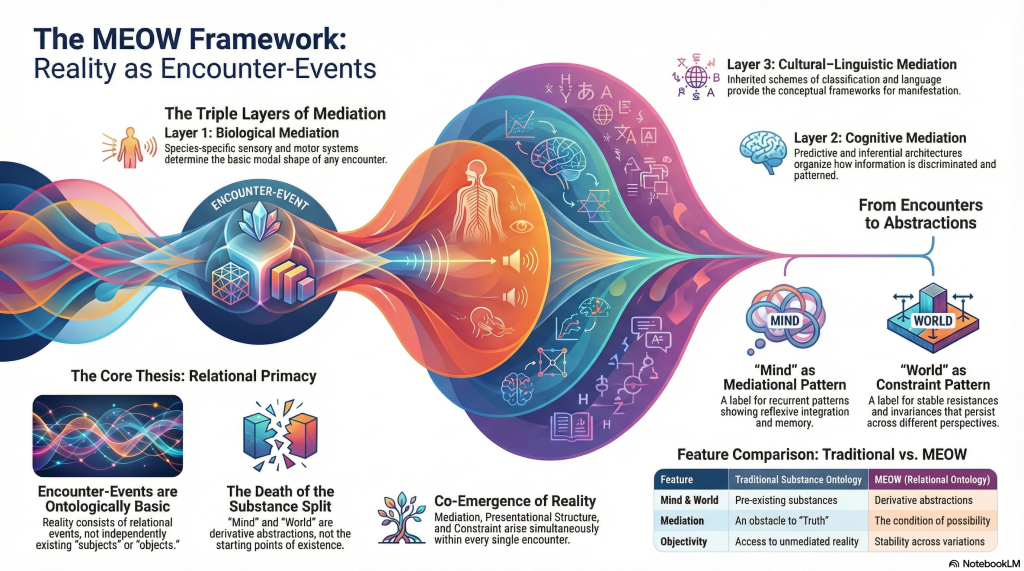
I couldn’t resist feeding another concept into the MEOW GPT – ‘Progress’. Now you don’t have to. The results are as expected.
NB: This has little to do with the page content. I rendered it for another project, but didn’t use it.
Concept
- Input: progress
- Type: Normative–evaluative temporal concept (idea of improvement over time; macro-comparison rule)
- Scope check: In-scope – central to Enlightenment narratives, clearly multi-tier, perfect for MEOW+LIH framing.
High-level summary (≤120 words)
“Progress” isn’t a neutral description of change; it’s a way of coding sequences of encounters as “getting better” according to some (often hidden) metric. Biologically, we enjoy mastery, relief from threat, and efficiency gains, which make certain changes feel like progress. Cognitively, we impose arrows, ladders, and stories of advancement onto messy histories. Linguistically, “progress” is a heavily contested macro-term that slides between technology, morals, economics, and personal growth. Socially and technically, institutions build progress into metrics (GDP, innovation indices, “development”), roadmaps, and infrastructures, which then enforce one vision of betterment. In MEOW terms, “progress” is a family of mediated encounter-patterns, not an objective direction baked into the world.
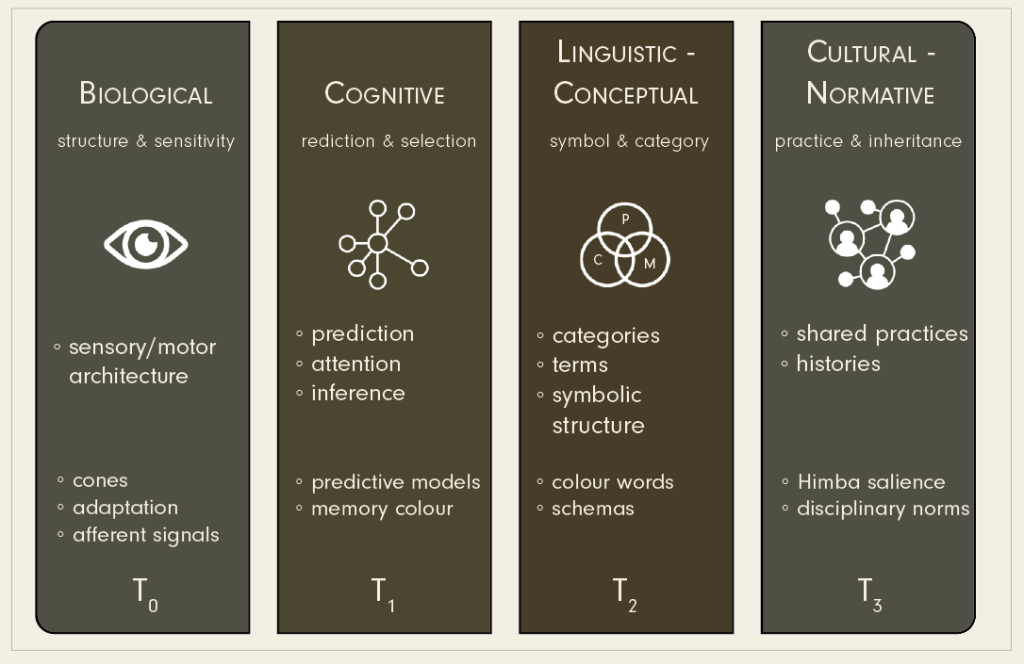
T0 – Biological Mediation
- Applicability: Weakly to moderately applicable – there is no innate “sense of progress”, but bodies provide priors for what will be experienced as progress.
- Analysis:
- Organisms are tuned to reduce pain and increase security; changes that lower threat or effort (less hunger, more shelter, shorter paths) tend to feel intrinsically “better” at a bodily level.
- Learning and mastery trigger reward signals: successfully performing a task faster or with less error produces bodily satisfaction, giving micro-encounters of “I’m progressing”.
- However, bodies are also present-biased (we discount distant benefits), which conflicts with grand narratives of long-term progress that demand near-term sacrifice.
- Chronic stress, disability, or aging can radically invert intuitive progress narratives: what counts as “improvement” may become extremely local (less pain today, one more functional ability retained).
T1 – Cognitive Mediation
- Applicability: Strongly applicable – “progress” is largely a cognitive imposition on temporal change.
- Analysis:
- We construct temporal schemas (arrows, ladders, stages) and then fit history, technology, or personal life into them: primitive → advanced, childhood → maturity, underdeveloped → developed.
- Progress judgments always depend on chosen metrics and baselines: we decide which variables to track (comfort? equality? power? lifespan? biodiversity?) and from which starting point, then declare a direction “up”.
- Hindsight bias and survivor bias make progress narratives seductive: we mainly see successful pathways and reinterpret past suffering as necessary stepping stones.
- Many minds default to a teleological story (“things are heading somewhere”) and smuggle in inevitability: once something happened, it was “on the path of progress”.
- Personal identity work often leans on progress schemas (“I’m better than I was”, “I’ve grown”), which can be empowering—but also oppressive when life moves sideways or backwards.
T2 – Linguistic Mediation
- Applicability: Maximally applicable – “progress” is a classic case for the Language Insufficiency Hypothesis.
- Analysis:
- On LIH’s topography, “progress” is a Contestable term: central, value-saturated, and permanently argued over (like justice, freedom, development). People vigorously disagree on what counts as “better”.
- It also behaves as a Fluid: the same word ranges over technological advance, moral improvement, economic growth, scientific accumulation, personal healing, social liberation, and more, with blurry boundaries.
- There is a huge Presumption Gap: speakers talk as if “progress” were almost self-explanatory (“we need progress”, “don’t stand in the way of progress”), while quietly plugging in different metrics and beneficiaries.
- Political rhetoric (e.g., “progressive”, “pro-growth”) makes “progress” sound descriptive (“this is progress”) when it’s largely a normative claim about which trade-offs to accept.
- Attempts to spell out “real progress” in detail (sustainable, inclusive, decolonial, post-growth, etc.) risk crossing the Effectiveness Horizon: each added qualifier improves precision for some audiences but makes the term heavier, more contested, and less communicatively effective for others.
- Metaphors of forward motion and height (“moving forward”, “lagging behind”, “advanced”, “backward”) naturalise a directional axis and position whole peoples or practices on it, with obvious power implications.
T3 – Social/Technical Mediation
- Applicability: Strongly applicable – progress is institutionalised in metrics, infrastructures, and stories.
- Analysis:
- Modern states and markets operationalise “progress” via indicators: GDP, productivity, patent counts, test scores, life expectancy, HDI, etc. What’s measured becomes what “progress” officially means.
- Institutions plan through progress narratives: roadmaps, five-year plans, “maturity models”, technology readiness levels, academic rankings. These formats stage reality as a path with rungs and milestones.
- Struggles over progress show up as conflicts between infrastructures: highways vs public transit, fossil fuels vs renewables, prisons vs restorative systems, expansion vs conservation.
- Progress talk often justifies harm or sacrifice: displacement, environmental damage, labour exploitation, or cultural erasure are framed as unfortunate but necessary costs of “advancement”.
- Tech culture enacts a particularly strong progress script (“disruption”, “version 2.0”, “moonshots”), which can overshadow regressions (loss of privacy, fragility, inequality) that don’t fit the official metric.
- Counter-movements (degrowth, disability justice, decolonial thought, climate activism) challenge dominant progress patterns, proposing alternative metrics (care, resilience, biodiversity, repair) and thus different encounter-patterns to call “better”.
Limits & failure modes
- Language insufficiency notes
- LIH suggests “progress” will remain permanently unstable: it lives in a region where our need for a powerful, simple word outruns our ability to fix its content across contexts.
- Because “progress” feels both descriptive and obviously good, the Presumption Gap is structurally dangerous: it allows one group’s gain to be presented as universal improvement, even when others clearly lose.
- Attempts to define progress once and for all tend to hit the Effectiveness Horizon: more detailed definitions reveal underlying value conflicts rather than resolving them.
- Missing tiers / blind spots
- A purely T3 view (“progress is whatever our metrics say”) ignores embodied and psychological costs that never enter the indicators.
- A purely T1 view (“progress is just a narrative”) underestimates how deeply infrastructures and institutions lock in certain trajectories and make alternatives materially difficult.
- MEOW framing itself can tempt us toward a detached stance (“just different mediations”), but with progress this is politically loaded: deciding which encounter-patterns we count as “better” is not neutral analysis, it’s a moral and political act.







 Philosophics