A Brief, Uncomfortable Historiography on Having, Being, and Feeling

4โ€“6 minutes

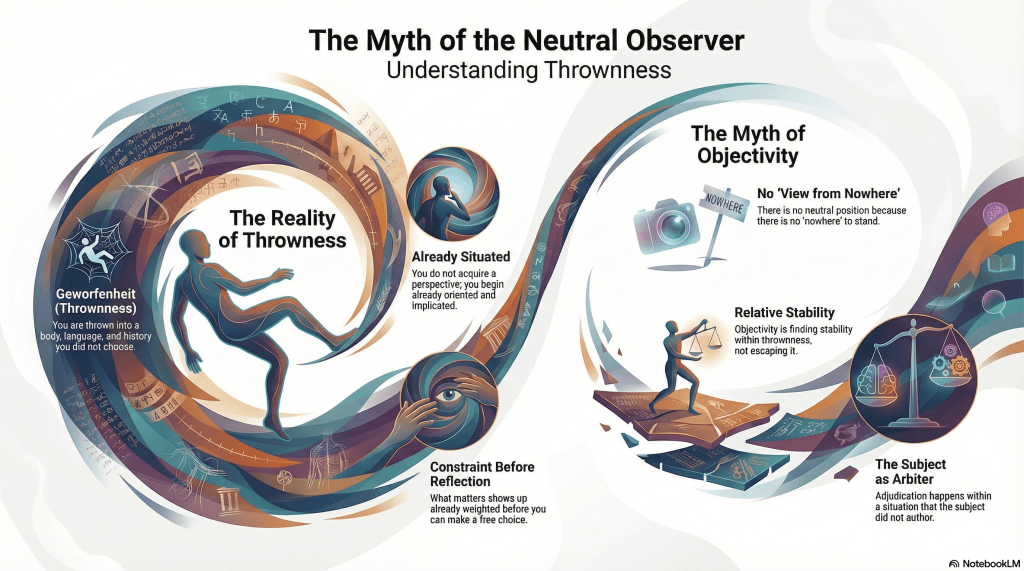
This is a follow-on to some recent posts.* It would be a mistake to pretend that the grammatical habits discussed here float free of intellectual history. They do not. They align uncannily well with the way two broad philosophical traditions came to frame the self, experience, and knowledge.

On the Anglo-American analytic side, the modern picture of the self emerges early with John Locke. In An Essay Concerning Human Understanding (1690), Locke does not yet offer a full ‘bundle theory’, but he lays the groundwork decisively. Consciousness, for Locke, is what unifies experience over time through memory. The self is not a substance but a continuity of awareness, accessible through introspection and reportable as a series of mental contents.ยน

Lockeโ€™s treatment of personal identity already presupposes a grammar of states. In An Essay Concerning Human Understanding, he insists that personal identity โ€œconsistsโ€ in consciousness alone, extending backward through memory to past thoughts and actions (II.xxvii.9).

Image: An Essay Concerning Human Understanding, Essay, II.xxvii.17

The self is not something that unfolds; it is something that can be retrospectively tracked. Experiences appear as items one is conscious of, and identity becomes a matter of continuity between those items. It is no accident that Locke later calls ‘person’ a forensic term, fit for attribution, responsibility, and judgement (II.xxvii.28). The grammar is already administrative.

Image: An Essay Concerning Human Understanding, Essay, II.xxvii.28

The grammatical resonance is hard to miss. Experiences are treated as inspectable states: I am aware of X; I have the idea of Y. Consciousness becomes something one can, in principle, take inventory of.

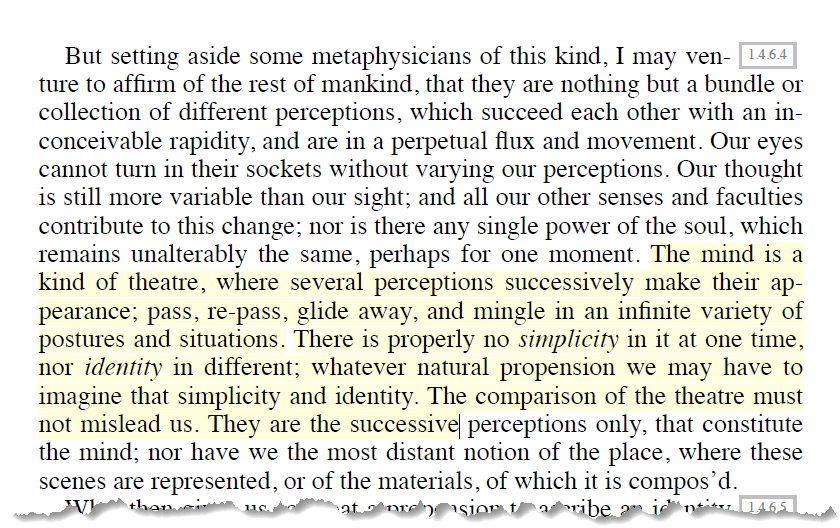
David Hume completes the move with characteristic bluntness. In A Treatise of Human Nature (1739โ€“40), he famously reports that when he looks inward, he never catches himself without a perception. The self, he concludes, is nothing over and above a bundle of impressions and ideas, linked by habit and association.ยฒ

Where Locke still spoke of consciousness as what makes the self, Hume takes the next step and goes looking for that self directly. What he finds instead are only perceptions: heat, cold, pleasure, pain. The self does not endure; it is inferred. Identity becomes a habit of grammar and memory, not a feature of experience itself.

Image: Treatise, I.iv.vi

This is not merely a metaphysical claim. It is a grammatical one. Experience appears as a sequence of discrete items, each presentable as something one is or has at a given moment. Duration is reduced to succession; undergoing becomes adjacency. The copula does the quiet work.

From here, it is a short step to the analytic comfort with:

  • truth-conditional analysis,
  • propositional attitudes,
  • mental states as objects of third-person description,
  • and, eventually, the scientific naturalisation of consciousness.

None of this is accidental. The grammar and the metaphysics grow together.

The Continental Recoil

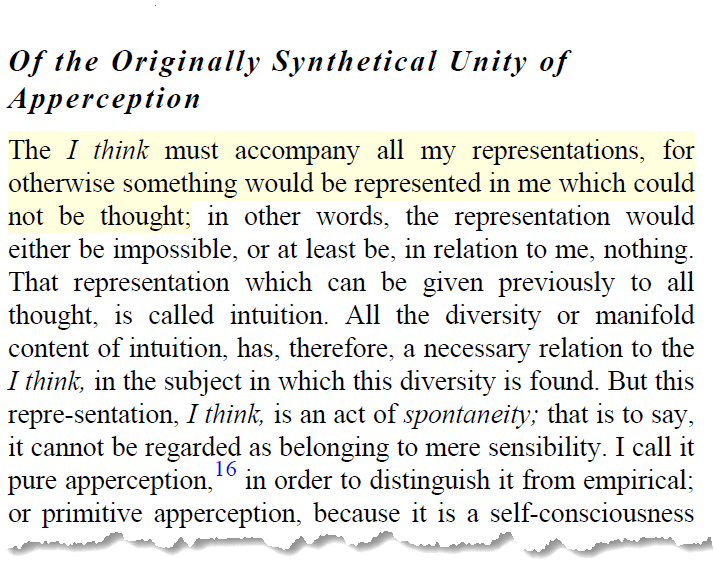
Across the Channel, a different unease takes hold. Immanuel Kant already resists the reduction of the subject to a bundle. In the Critique of Pure Reason (1781/1787), the ‘I think’ is not an object among objects but a necessary condition for experience at all.ยณ The subject cannot be encountered the way sensations can. It is not something one has or is; it is that through which anything appears.

Image: Critique of Pure Reason, Section II

This resistance deepens with Edmund Husserl, whose phenomenology insists that experience must be described as it is lived, not as it is later reconstructed into states. Consciousness is intentional, temporal, and irreducibly first-personal.โด Duration is no longer a sequence of snapshots but a flowing structure of retention and protention.

Image: The Phenomenology of Internal Time-Consciousness

Heidegger radicalises this further. In Being and Time (1927), Dasein is not a container for experiences but a mode of being-in-the-world. Experience is not something that happens inside a subject; it is the subjectโ€™s way of being disclosed to a world.โต

By the time we reach Sartre and Merleau-Ponty, any attempt to treat sensation as a property or possession of a self begins to look like a category mistake. Feeling is not a thing one owns. It is a relation, an encounter, a situation.

Notably, these traditions operate in languages where ‘having’ and reflexive constructions dominate descriptions of sensation. This does not determine the philosophy, but it makes certain moves feel natural and others strained.

Two Ontologies, One Quiet Filter

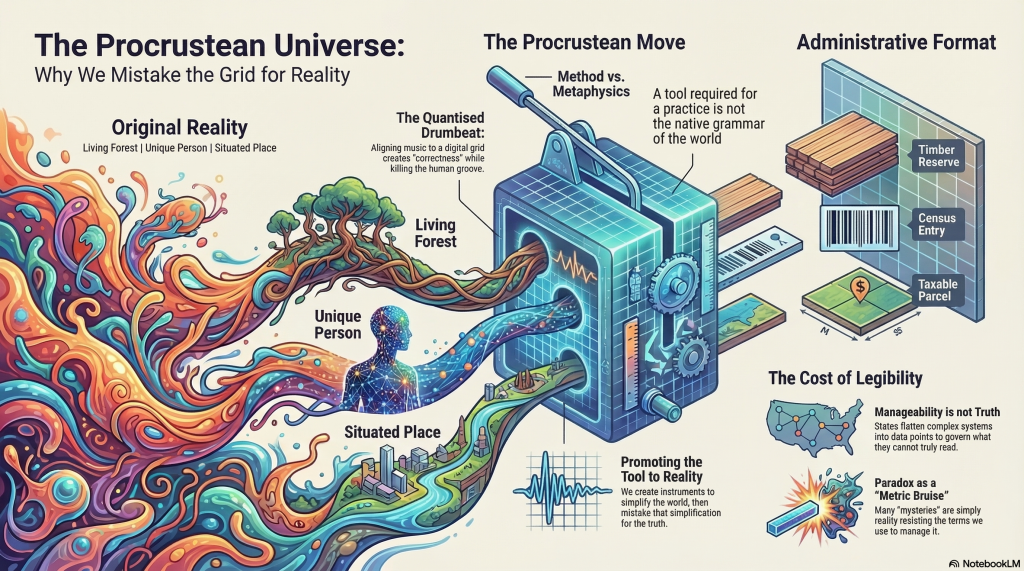
What matters here is not who is right. It is that entire ontological styles become normalised long before argument begins. Grammar does not force conclusions, but it sets default expectations. Some descriptions feel ‘clean’, others ‘muddy’. Some questions feel legitimate, others oddly misframed. This is where institutional gatekeeping enters.

Peer review, citation norms, and journal scope are often described as quality controls. Sometimes they are. But they also function as recognition systems. Work that leans too heavily on phenomenological description may appear ‘imprecise’ to an analytic referee. Work that treats mental states as discrete objects may appear ‘naรฏve’or โ€œreductiveโ€ to a continental one. Hybrid work becomes difficult to place, difficult to referee, and therefore risky. The issue is rarely explicit disagreement. It is a failure of grammatical hospitality.

Where Sensing Falls Through the Cracks

Against this background, it is perhaps unsurprising that sensing never becomes dominant. To speak of feeling is to refuse both ontological closure and inventory. It resists being cleanly formalised or neatly opposed. It fits awkwardly into truth-conditional frameworks and offers little leverage for grand theory. And yet, it is arguably closer to how experience actually unfolds. Which may explain why it remains linguistically available but philosophically marginal: acceptable in life, tolerated in literature, quietly sidelined in theory.

Notes (for those who care)

  1. Locke, J. (1690). An Essay Concerning Human Understanding, Book II, esp. chs. 1, 27.
  2. Hume, D. (1739โ€“40). A Treatise of Human Nature, Book I, Part IV, ยง6.
  3. Kant, I. (1781/1787). Critique of Pure Reason, Transcendental Deduction.
  4. Husserl, E. (1913). Ideas Pertaining to a Pure Phenomenology.
  5. Heidegger, M. (1927). Being and Time.

NB: This may be a bit disorganised, but I’ve hit my limit.

Solidarity as a Local Moral Grammar

24โ€“37 minutes

Although I didn’t want to publish a formal essay, I wanted to produce something otherwise rigorous. The references I make are of the authored piece I am critiquing โ€“ MacIntyre, ลฝiลพek, Lacan โ€“ I’ve discussed these figures and their works, sometimes at length.

Audio: NotebookLM summary podcast discussion of this content.

Preamble: Setting the Encounter

Over the past several weeks, Otti Vogt and I have been circling one another in public threads on leadership, solidarity, ethics, and what might loosely be called the moral architecture of social life. At moments, we converge; more often, we donโ€™t. The exchanges have been serious, occasionally sharp, and โ€“ credit where itโ€™s due โ€“ largely conducted in good faith.

Recently, Otti published a more explicit articulation of the ontological commitments underlying his work โ€“ The Future of Flourishing: Toward a Dialectical Spiritual Realist Social Ontology (DRS) โ€“ a framework grounded in participatory metaphysics, virtue ethics, and an objective conception of the Good, oriented toward human flourishing. In doing so, he has done something both generous and rare in contemporary discourse: he has made his meta-assumptions visible. That gesture deserves to be taken seriously. This response is written in that spirit.

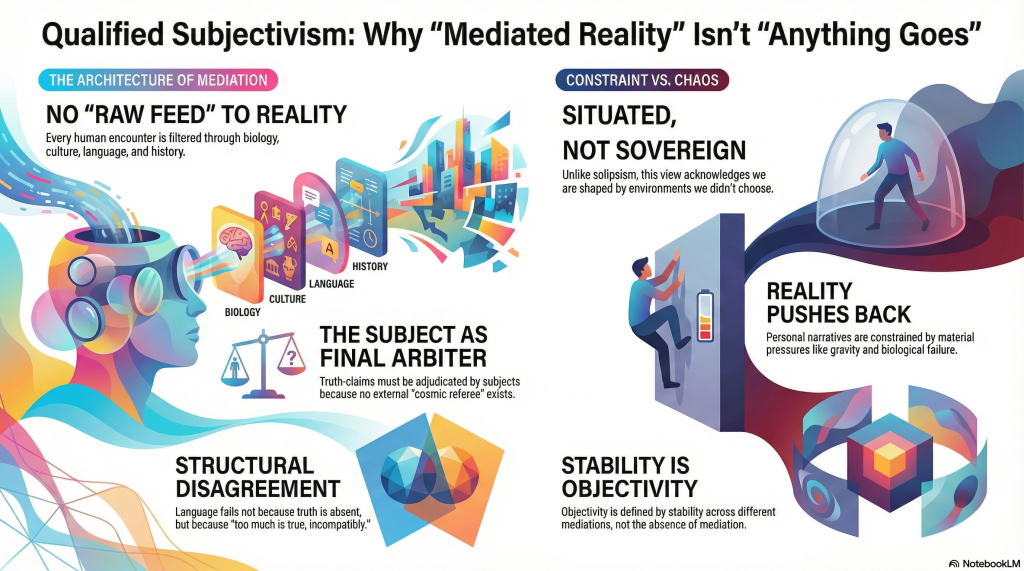
For my part, I have already shared a different set of commitments, most notably what I call the Mediated Encounter Ontology (MEOW) and the Language Insufficiency Hypothesis (LIH). These are not counter-ontologies in the conventional sense, nor are they offered as replacements for the metaphysical structures Otti defends. They are diagnostic lenses. Their purpose is to foreground mediation, semantic drift, power asymmetries, and the limits of moral language โ€“ especially where that language is asked to perform stabilising or universalising work it cannot reliably sustain.

What follows, then, is not a refutation from within Ottiโ€™s framework, nor an attempt to โ€˜correctโ€™ his ontology by substituting another in its place. It is an analysis conducted from a philosophy of language that explicitly rejects the need for the kind of metaphysical grounding his project presupposes.

That distinction matters. Much philosophical disagreement fails not because arguments are weak, but because interlocutors believe they are disputing conclusions when they are, in fact, operating with incompatible assumptions about what language can do, how meaning holds, and where normativity comes from.

Accordingly, I will first restate Ottiโ€™s position as charitably and accurately as possible, including the conditions under which it appears to work well. I will then apply MEOW and LIH as analytic lenses โ€“ not to score points, but to observe how this framework behaves under pressure: across time, across groups, and across material and organisational realities. Finally, I will explain why, despite its internal coherence and aspirational appeal, I regard the project as structurally unsustainable beyond tightly aligned in-groups.

This is a polemic, but not a casual one. It is written in respect of the seriousness of the work, and in full awareness that the disagreement it traces is unlikely to be resolved. I do not expect to publish this as a formal preprint, but I have structured it much as I otherwise would. The latitude afforded by a blog is used here not to loosen standards, but to speak more plainly about where the fault-lines actually lie.

Audio: NotebookLM summary podcast of the original DSR essay.

1. Restating the Ontology (On Its Own Terms)

At its strongest, Otti Vogtโ€™s framework is an attempt to rescue ethics, leadership, and social solidarity from what he takes to be the exhaustion of proceduralism, relativism, and technocratic management. The diagnosis is familiar but not trivial: without a shared moral horizon, collective action collapses into preference aggregation, power struggles, or managerial optimisation masquerading as value-neutral necessity. Against this, Otti proposes a participatory social ontology grounded in three interlocking commitments.

Moral claims are not merely expressions of preference, strategic coordination devices, or retrospective rationalisations of power. They track something objective, even if imperfectly. The Good is not constructed ex nihilo by consensus, nor generated procedurally through participation; rather, participation presupposes it. Solidarity, dignity, and justice do not emerge bottom-up from agreement alone, but from orientation toward a moral reality that precedes and exceeds any given social formation.

Individuals are not pre-social atoms who later enter into moral contracts, but beings-in-relation whose identities are shaped through participation in shared practices, institutions, and meanings. Drawing on Aristotelian virtue ethics, Christian theology, and strands of critical realism, Otti treats ethical formation not as rule-following but as the cultivation of practical wisdom within an ordered moral ecology. Virtue, here, is not compliance but excellence-in-relation.

Change does not occur through rule revision alone, nor through technocratic optimisation, but through what might be called moral morphogenesis: the transformation of agents and structures together as they orient themselves toward better forms of collective life. Leadership, on this view, is not managerial control but ethical mediation โ€“ holding open a space in which shared participation in the Good can occur.

Importantly, this is not presented as naรฏve moralism. Otti is explicit that causality and ethics must be distinguished, that material conditions matter, and that social systems operate across stratified domains. His engagement with Bhaskar, Archer, and Duindam is meant to secure this distinction without collapsing ethics into natural determinism. Likewise, his invocation of Lacan and ลฝiลพek is intended to show that absence, lack, and non-identity are not defects to be eliminated, but productive tensions that drive ethical becoming rather than undermining it. On the happy path, this framework is compelling.

In small, relatively homogeneous groups โ€“ especially those already sharing a thick moral vocabulary โ€“ it offers a powerful grammar for meaning-making. It legitimises ethical judgment without reducing it to preference. It resists the flattening tendencies of procedural liberalism. It offers leaders a language richer than metrics and incentives, while avoiding crude authoritarianism. And it gives participants a sense that their actions matter not merely instrumentally, but as contributions to something genuinely worthwhile.

If one already accepts its metaphysical premises, the system is internally coherent. More than that, it is motivational, aspirational, and โ€“ within its own frame โ€“ normatively robust. That coherence is not in dispute.

What is in dispute is what happens when this framework leaves the happy path: when participants do not already share the ontology, when meanings drift over time, when organisational power intervenes, and when the language of participation is asked to scale beyond aligned in-groups into contested social reality. That is where the analysis begins.

2. Where the Framework Breaks: Boundary Conditions, Not Bad Faith

The first pressure point appears the moment participation is treated as if it occurs within an open, neutral moral field.

It doesn’t.

Participation always takes place inside an already-structured semantic environment. Values, goods, virtues, and ends are never encountered as raw givens, but as pre-formatted invitations. One does not simply โ€˜enterโ€™ participation; one enters a space whose grammar has been written in advance, whose concepts already carry weight, direction, and implied hierarchies of legitimacy. This is not an accidental feature of social life. It is constitutive of it.

To participate is to move within a field of meanings that already distinguishes sense from nonsense, virtue from vice, maturity from immaturity, insight from confusion. Even when those distinctions are contested, the contest itself presupposes a shared language in which disagreement can appear as intelligible disagreement rather than noise.

This matters because Ottiโ€™s framework consistently treats participation as if it were epistemically generous and normatively hospitable by default. Yet participation is never merely an invitation; it is also a constraint. It shapes what can be said without sanction, which forms of dissent register as good-faith critique, and which appear as moral immaturity, resistance, or failure to โ€˜grasp the horizonโ€™.

The moment a moral centre is posited โ€“ however dialectical, however participatory โ€“ it generates a gradient of alignment. Some positions sit closer to the centre and therefore appear clearer, wiser, more attuned. Others sit further out and must explain themselves, translate themselves, or justify their deviance from what is increasingly experienced as common sense. This is not a corruption of participatory ethics. It is its inevitable consequence.

Even if the Good is not imposed but โ€˜participated in,โ€™ participation itself is never symmetrical. Someone always articulates the terms. Someone always curates the language. Someone always has greater fluency in the idiom of the Good and thus greater interpretive authority over what participation currently requires.

In practice, this produces a familiar asymmetry: those already aligned with the metaphysical grammar experience the framework as expansive and liberating, while those outside it experience it as invisible pressure. They are not coerced in any crude sense, but they are nonetheless nudged, corrected, reoriented, or quietly marginalised. The boundary condition, then, is simple but decisive: Participation does not erase power. It reconfigures it.

The claim that solidarity arises from participation in the Good rather than from procedure does not eliminate enforcement; it relocates it upstream, into ontology. What had previously been contested politically now appears as a matter of moral attunement or ontological adequacy. This is especially significant when the framework encounters out-groups.

For those who do not already share the metaphysical commitments โ€“ who do not recognise the same Good, or who reject the idea that such a Good exists independently of social negotiation โ€“ participation becomes conditional. Entry requires translation into a language they did not choose. Dissent must be framed in terms that already concede too much.

At that point, participation ceases to be an open moral practice and becomes something closer to initiatory alignment. This does not make the framework incoherent. It makes it local.

The problem arises only when a local moral grammar presents itself as foundational, scalable, or universally binding โ€“ when its boundary conditions are treated as philosophical necessities rather than contingent achievements. That transition is where the trouble begins.

3. Virtue as a Fluid: The Instability at the Centre

The next fault line emerges around virtue itself. Within Ottiโ€™s framework, virtue is no longer merely a description of excellence-in-practice, nor even a tradition-bound cultivation of character in recognisable forms of life. It becomes something more elusive: a dynamic orientation toward the Good, realised through participatory attunement rather than rule-following or procedural compliance.

On the surface, this looks like a strength. It avoids legalism. It avoids rigid codification. It allows for context, judgment, and development over time. But this move has a cost.

Once virtue is abstracted from stable practices and anchored instead to a transcendent moral horizon, it becomes semantically fluid. Its content is no longer secured by what people reliably do well together, but by how well their dispositions appear aligned with an ideal that itself resists definitive articulation.

At this point, virtue quietly changes function. It ceases to operate primarily as a descriptive account of excellence within a practice and becomes prescriptive as a mode of conformity to an interpretive centre. The question shifts from โ€˜What does excellence look like here?โ€™ to โ€˜How well does this agent instantiate the orientation we recognise as virtuous?โ€™

MacIntyre already gestures toward this danger, though he does not fully escape it. His attempt to recover virtue through traditions of practice depends on the relative stability of those traditions. Once the tradition fragments or pluralises, virtue must either harden into orthodoxy or soften into abstraction. Ottiโ€™s framework opts for the latter, but abstraction does not dissolve authority; it redistributes it.

When virtue becomes fluid, it also becomes indexical. Its meaning is determined less by shared activity than by ongoing interpretation. And interpretation, inevitably, has interpreters.

Those most fluent in the language of the Good become de facto arbiters of what virtue currently requires. Those less fluent must demonstrate sincerity, openness, or willingness to be formed. Virtue, in other words, becomes something one is recognised as having rather than something one demonstrably does. This produces a subtle but powerful inversion.

Instead of virtue disciplining ideals through lived practice, ideals discipline agents through moral evaluation. What begins as openness hardens into expectation. What begins as formation shades into assessment. What begins as aspiration becomes normativity with softer edges but firmer reach.

The fluidity of virtue does not eliminate moral pressure. It intensifies it, precisely because it lacks clear boundaries. And this is where temporal drift compounds the problem.

If virtue is continuously rearticulated in light of a transcendent Good, then yesterdayโ€™s excellence may become todayโ€™s deficiency โ€“ not because practices failed, but because the interpretive centre shifted. The agent who was once exemplary now appears insufficiently attuned. Correction follows. Alignment is requested. Resistance is reclassified as misunderstanding. None of this requires bad faith. None of it requires domination. It emerges naturally from the structure.

A virtue ethics that cannot tolerate virtue disagreement without moralising it is no longer describing excellence. It is managing deviation. This is not an argument against virtue per se. It is an argument against virtue untethered from stable practices and reattached to metaphysical ideals whose interpretation remains necessarily contested. Once virtue becomes a fluid, it stops being a guide to excellence and starts functioning as a solvent โ€“ dissolving difference while claiming to honour it.

Interlude: Interpretation, Gravity, and the Problem of Innocent Power

At this point, it is tempting to reassure ourselves that none of the above entails domination, coercion, or even hierarchy in any crude sense. After all, the framework under discussion explicitly rejects authoritarianism, emphasises participation, and repeatedly insists that the Good is not imposed but disclosed through relational engagement. This reassurance is sincere. It is also insufficient.

The problem is not that leaders within such a framework intend to exert power. The problem is that interpretation exerts power regardless of intention.

Any system oriented toward a transcendent Good requires interpretation. Someone must articulate what participation looks like here, now, under these conditions. Someone must distinguish fidelity from distortion, growth from regression, openness from refusal. These judgments cannot be automated, proceduralised, or dissolved into pure dialogue. They must be made.

Where judgments are made, gravity forms. This is not a psychological claim about ego, nor a moral accusation about bad faith. It is a structural observation. Interpretive authority emerges wherever meaning is stabilised long enough to guide action. The more abstract and elevated the referent, the greater the interpretive leverage required to render it actionable. The paradox is this: the more a leader insists they are not exercising authority, the harder their authority becomes to contest.

When normativity is framed as participation in the Good rather than compliance with rules, disagreement does not present itself as disagreement. It presents itself as misalignment, immaturity, or insufficient formation. Resistance is redescribed not as an alternative judgment but as a failure of attunement.

At this point, critique becomes difficult without appearing morally suspect. This is what gives participatory metaphysics its peculiar force. It does not silence opposition; it spiritualises it. Dissenters are not wrong so much as โ€˜not yet thereโ€™. Their objections are not refuted; they are absorbed into a narrative of ongoing formation.

This is not coercion. It is more effective than coercion. Even if a leader sincerely wishes not to exert gravity, the structure ensures that gravity accumulates around them. Those closest to the interpretive centre appear most aligned with the Good. Their judgments carry more weight. Their language becomes the idiom through which virtue is recognised.

If a leader truly did not wish to exert gravity, the most consistent action would be not to lead. But leadership, by definition, involves orientation. Orientation requires reference points. Reference points generate asymmetry. Asymmetry generates power.

The framework attempts to resolve this by redescribing hierarchy as โ€˜participatoryโ€™ rather than directive, and authority as โ€˜mediatingโ€™ rather than commanding. Yet this is a semantic reconfiguration, not a structural one. The same dynamics persist under gentler names. What disappears is not power, but its visibility. And power that cannot be named cannot be resisted. It can only be internalised.

This is the point at which metaphysics becomes political, whether it intends to or not. The claim that the Good is objective does not neutralise power. It sanctifies it.

4. Temporal Semantic Drift: Why Moral Centres Do Not Hold

Even if one grants โ€“ charitably โ€“ that participatory metaphysics can function without collapsing into interpretive domination in the short term, it remains vulnerable to a more corrosive force: time.

Moral centres do not fail all at once. They drift. The framework under discussion acknowledges this in principle. It speaks of dialectical movement, of gaps between actuality and the Good, of ongoing formation rather than static completion. On paper, this appears to inoculate it against rigidity.

In practice, it does the opposite. A moral centre that must continuously reinterpret itself in light of a transcendent horizon is never neutral. Each iteration reorders what counts as fidelity, maturity, and alignment. What was virtuous yesterday may become insufficient today โ€“ not because practices degraded, but because the interpretive frame shifted.

This is not accidental. It is intrinsic. Because the Good is not fully specifiable, its articulation is always provisional. But provisional articulations still carry normative force. People organise their lives around them. Careers, identities, reputations, and exclusions follow.

Then the centre moves. Those who move with it appear wise, flexible, and developmentally advanced. Those who hesitate appear resistant. Those who remain where they are appear obstructive. Drift is redescribed as growth, and displacement as failure to keep up.

This is how moral projects shed members without ever formally excluding them. At Time-nought, alignment feels communal. At Time-one, it becomes selective. At Time-two, it becomes justificatory. By the time the pattern is visible, the language of solidarity has already done its work.

Transductive subjectivity intensifies this effect. Because subjects and structures co-constitute one another, each moment of participation subtly reshapes the field itself. The centre is never merely followed; it is reproduced through enactment. Drift compounds. What results is not pluralism, but path dependency.

Early interpretations disproportionately shape later possibilities. Foundational voices become canonical. Corrective gestures are framed as recoveries rather than revisions. The centre insists it is merely unfolding what was always implicit. At this point, appeals to the Good no longer function as orientation. They function as retrospective validation. This is where temporal semantic drift becomes decisive.

Key terms โ€“ virtue, flourishing, participation, solidarity โ€“ do not remain semantically stable across contexts or generations. They accrete meaning through use, conflict, and institutionalisation. To claim continuity is to perform continuity, not to demonstrate it.

The framework attempts to resolve this by appealing to a stable moral horizon beyond language. But this simply relocates the problem. The horizon does not speak. People do.

Every attempt to stabilise meaning across time requires custodians. Custodianship introduces authority. Authority introduces exclusion. Exclusion introduces rationalisation. None of this implies malice. It implies entropy.

What works in a tightly aligned founding cohort does not survive scale, succession, or stress. History is littered with ethical systems that were internally coherent, sincerely motivated, and initially generative โ€“ until drift revealed the cost of maintaining coherence.

The claim is not that moral projects inevitably fail. It is that they cannot guarantee their own continuity without paying a price.

Participatory metaphysics offers no mechanism for escaping this. It offers only better reasons for why the price was necessary.

Interlude II: On Borrowing ลฝiลพek to Refute ลฝiลพek

At this point, a further tension must be addressed directly, because it is not incidental. It sits at the conceptual core of the framework itself.

Otti explicitly invokes ลฝiลพek and Lacan to demonstrate that absence, lack, and non-identity are not pathological failures to be overcome, but productive features of subjectivity and social life. This move is intended to show that participatory metaphysics can accommodate negativity, incompleteness, and instability without collapsing into relativism or nihilism. The intention is understandable. The result is incoherent.

ลฝiลพekโ€™s central claim is not merely that the Big Other is fractured, incomplete, or imperfectly realised. It is that the Big Other does not exist. There is no transcendent guarantor of meaning, no symbolic authority that secures coherence from beyond the field of human practices. To โ€˜traverse the fantasyโ€™ is precisely to accept this absence, not to redescribe it in more sophisticated terms.

Lacanโ€™s notion of constitutive lack is not a privation awaiting fulfilment. It is not a gap that participation can close. It is an ontological condition: the impossibility of any final anchoring of meaning, identity, or desire. Lack is not productive because it gestures toward plenitude; it is productive because plenitude is structurally impossible. This is where the framework under review performs a decisive sleight of hand.

By mapping Lacanian lack onto Bhaskarโ€™s concept of real absence, the argument treats both as โ€˜modes of non-being that nonetheless exercise causal forceโ€™. But this collapses a distinction that ลฝiลพek and Lacan insist upon. Bhaskarโ€™s absences are, in principle, fillable: the missing resource, the unjust structure, the preventable harm. Lacanโ€™s lack is not. Attempts to fill it do not resolve the problem; they generate new symptoms, new fantasies, new forms of misrecognition. To invoke Lacan in support of a transcendent Good is therefore not a creative synthesis. It is a misappropriation.

What results is the reinstallation of precisely what psychoanalysis dismantles: a symbolic guarantor that promises coherence, orientation, and resolution. The Good becomes the ultimate Big Other โ€“ disavowed, abstracted, and rendered untouchable by those who claim merely to participate in it. This is not a minor theoretical inconsistency. It reveals the deeper strategy at work.

The framework borrows the critical sophistication of post-structural thought to inoculate itself against charges of naivety, while quietly reinstalling a classical metaphysics that those same thinkers spent their careers undoing. Absence is affirmed rhetorically, only to be neutralised ontologically. Negativity is welcomed, but only insofar as it can be oriented toward a pre-existing moral horizon. In effect, the language of lack is used to smuggle in fullness.

Once this move is made, the rest follows predictably. Interpretation acquires authority. Participation acquires normativity. Dissent becomes misrecognition. And the Good, now safely beyond contestation, does exactly the work the Big Other has always done โ€“ only with better philosophical cover.

5. Transductive Subjectivity: Participation Rewrites the Good

The final pressure point is not historical but immediate. Even if one brackets time, tradition, and institutional inertia, the framework still assumes something that does not hold: that subjects can participate in the Good without becoming co-authors of it. This is where transductive subjectivity becomes decisive.

Subjects are not vessels into which ethical form is poured. They are mediating agents. Every act of participation feeds back into the system that solicited it. Meaning is not transmitted intact; it is refracted through position, interest, fear, aspiration, and interpretation. Participation does not preserve coherence. It produces variance.

This is not a flaw in human beings. It is how social systems function. Each interaction slightly reshapes the normative field, altering expectations, redefining what counts as success, recalibrating what virtue now looks like in practice. Multiply this across hundreds or thousands of agents, and the idea of a stable moral centre becomes untenable without aggressive correction.

Here, Archerโ€™s morphogenetic insight quietly undermines the aspiration of ethical constancy. Structures condition action, action transforms structure, and the cycle repeats. There is no equilibrium point. The system is always becoming something slightly different from what it was meant to be.

From within the framework, this is often redescribed as growth, maturation, or deepening participation. From a systems perspective, it is drift under another name. Either participation rewrites the Good, or the Good rewrites participants. There is no third option.

What holds such systems together is not metaphysical participation, but selective reinforcement. Certain interpretations of virtue are amplified; others fade. Some agents are rewarded as exemplars; others are marked as misaligned. Over time, the system converges not on the Good, but on what is most compatible with its own survival. At this point, solidarity no longer links virtue to the common good. It links conformity to belonging.

This is why โ€˜participative flourishingโ€™ is not a distinct category so much as a rhetorical intensifier. Flourishing is always participative in the tautological sense that humans act together. The adjective matters only when it is doing boundary work: distinguishing authentic participation from deviant engagement. And that distinction is never neutral.

Once transductive feedback is acknowledged, the best-case scenario becomes clear. The framework can temporarily stabilise a coherent moral culture for a relatively homogeneous group. It may feel meaningful, even liberating, from within.

But it will not scale without exclusion. It will not persist without maintenance. And it will not survive contact with materially divergent lives without becoming prescriptive. This is not cynicism. It is mechanics.

6. Leadership, Power, and the Reality of Organisational Life

All of the above tensions sharpen dramatically once we leave โ€˜societyโ€™ in the abstract and enter organisations. Organisations are not voluntary moral laboratories. They are asymmetric structures with built-in coercion, however politely framed. Participation is rarely free when the alternative is unemployment, precarity, or social marginalisation. Exit costs matter. Silence matters. Compliance matters. This is where appeals to solidarity, virtue, and shared flourishing acquire a different texture.

In organisational settings, leadership does not operate via participative democracy. Its function is not collective deliberation, but directional coordination. Leaders set priorities, allocate resources, and define success metrics. Even the most โ€˜inclusiveโ€™ leadership models ultimately require alignment, not pluralism. Consultation can be widened; directionality cannot be abolished without abolishing the role itself. This produces a structural contradiction.

On the one hand, the rhetoric insists that ethics flows from participation in a shared Good. On the other, participation itself is conditioned by hierarchy. A leader may deny being a centre of gravity, but gravity does not ask permission. The mere ability to define vision, values, or culture already exerts force.

Under these conditions, solidarity does not simply emerge. It is staged. Employees learn quickly which interpretations of virtue are rewarded, which forms of dissent are tolerated, and which are quietly penalised. Moral language becomes a signalling system long before it becomes a compass.

The danger here is not cartoon authoritarianism. It is something subtler and more durable: moral capture. By this I mean the process through which ethical vocabulary is absorbed into institutional incentives, such that โ€˜goodnessโ€™ becomes legible primarily as compliance with the organisationโ€™s preferred self-description. Ethics becomes a loyalty test. Solidarity becomes alignment. Flourishing becomes a synonym for fit.

This is why organisational utopias tend to function best in small, ideologically homogeneous groups and become brittle as complexity increases. Add more agents, more roles, more external pressures, and more disagreement about what โ€˜good workโ€™ even is, and the system faces a choice between diversity of perspective and coherence of direction. History suggests it usually chooses the latter.

Religious movements, political vanguards, start-ups, consultancies, and โ€˜values-ledโ€™ enterprises all confront the same dilemma. Harmony is easy when dissenters are excluded early. It becomes harder once heterogeneity enters the system. At that point, solidarity either thins into vacuous slogans or hardens into enforcement.

Girard would recognise the pattern immediately: cohesion is often purchased by identifying the misfit, the blocker, the โ€˜toxicโ€™ element โ€“ the one who must be managed out so that the group can experience itself as good.

The claim that better formation, transparency, or distributed leadership can resolve this misunderstands the problem. These tools can redistribute labour and reduce certain abuses. They do not eliminate asymmetry. Someone still defines the centre, even when it is dressed up as โ€˜processโ€™, โ€˜cultureโ€™, or โ€˜shared ownershipโ€™. A moral horizon interpreted by a few will, reliably, become a moral demand placed upon the many. Which brings us to the unavoidable conclusion.

7. What This Critique Is (and Is Not)

This critique is not a defence of relativism-for-fun, nor of nihilism-as-apathy. I am a nihilist in a narrow, technical sense: I deny the existence of inherent meanings that are not invented, stabilised, and transmitted through language and practice. Meaning is not discovered intact in the world; it is negotiated, maintained, and contested. That position does not entail indifference. It entails vigilance.

If meanings are made rather than given, then they require care. They require scrutiny. They require attention to who is doing the naming, who benefits from the stabilisation, and who is being asked to align. Nihilism, in this sense, is not a shrug. It is a refusal to outsource responsibility to metaphysics.

In practical terms, this means treating ethical claims as proposals rather than discoveries, responsibilities rather than revelations, and commitments that must be defended in public rather than secured by ontological guarantee. It means accepting that moral authority is something we negotiate and sustain together, not something we uncover already intact and binding.

Nor is this an argument against local moral projects. Communities can and do organise themselves around shared goods, shared narratives, and shared aspirations. Such projects can be meaningful, motivating, and even life-sustaining. But they are also contingent, temporary, and sustained only through ongoing renegotiation.

What works for a particular group, at a particular moment, under particular conditions, does not thereby acquire universal authority. Moral coherence achieved locally does not scale automatically, and it does not endure without friction. That is not a failure of ethics. It is the cost of plurality and time.

The problem arises only when local moral projects mistake their internal coherence for external legitimacy. When they present themselves not as one way of organising meaning, but as a foundational ontology, a scalable ethical architecture, or a universally binding account of the Good.

At that point, disagreement ceases to register as intelligible difference and becomes moral deficiency. Dissent is redescribed as immaturity. Refusal is framed as lack of formation. And ethics quietly crosses the line from orientation into governance. This critique is aimed precisely at that crossing.

8. Conclusion: A Local Moral Project, Not a Universal Architecture

Taken on its own terms, this ontology is serious, internally coherent, and animated by a genuine concern for moral decay, procedural emptiness, and the hollowness of technocratic governance. It is not frivolous work. It is not cynical work. It is work born of dissatisfaction with thin ethics and a desire to recover meaning, orientation, and responsibility. But that does not make it universal.

What this framework offers is best understood not as a foundational solution to ethics, leadership, or societal becoming, but as a local moral project: a thick, tradition-inflected grammar capable of organising commitment among those already disposed to its metaphysical and ethical premises.

Within such in-groups, it may function well. It can generate shared language, reinforce norms, motivate sacrifice, and provide a sense of direction. It may even feel emancipatory, precisely because it relieves participants of the burden of perpetual moral indeterminacy. That relief is not incidental. It is the primary psychological reward such frameworks offer.

What it cannot do, without remainder, is scale across plural moral landscapes without reintroducing coercion under another name.

The moment the framework encounters agents who do not recognise its metaphysical centre, virtue ceases to orient and begins to adjudicate. Solidarity becomes conditional. Participation becomes aspirational compliance. Flourishing becomes legible only to those who already speak the language.

This is not a failure of goodwill. It is the inevitable consequence of grounding ethics in a substantive vision of the Good rather than in negotiated coexistence under conditions of deep disagreement.

Attempts to resolve this by appeal to deeper formation, better leadership, or more refined ontological articulation misunderstand the problem. The obstacle is not insufficient sophistication. It is the impossibility of securing universal normative authority without either emptying ethics of content or enforcing it through power. History does not suggest a third option.

To acknowledge this is not to abandon ethics, nor to retreat into relativism or nihilism-as-apathy. It is to recognise that moral systems are provisional, situated, and sustained through ongoing negotiation rather than metaphysical guarantees. Meaning is made, not discovered intact. And whatever coherence we achieve is fragile, temporary, and bought at the cost of exclusion.

If this ontology were presented as one compelling way of organising moral life among those who freely choose it, there would be little to object to. The trouble begins only when it is asked to do more than it can bear: to ground, to bind, to scale, and to endure without remainder. That expectation is not just ambitious. It is precisely the illusion that has undone every such project before.

9. Closing: Admirable Aspirations, Ancient Failure Modes

The desire animating this ontology is admirable. So were many before it. Projects of moral renewal rarely fail because their intentions are corrupt. They fail because they underestimate three forces that never go away: semantic drift, human difference, and the stubborn refusal of people to remain aligned over time without someone being marginalised, disciplined, or expelled. What works at Time-nought rarely survives Time-one.

At the outset, shared language feels like shared purpose. Participation feels voluntary. Solidarity feels mutual. But as contexts shift, meanings stretch, and pressures accumulate, the system must either loosen its grip or tighten it. History suggests it almost always chooses the latter, while continuing to speak the language of the former.

This framework may function well as an in-group grammar. It may even be nourishing there. Within aligned communities, it can generate coherence, motivation, and a genuine sense of ethical direction. That should not be dismissed.

But once pressed beyond its boundaries, it exhibits the same failure modes we have seen for centuries: moral centres that require constant maintenance, virtues that drift and must be reinterpreted, participation that quietly becomes compliance, and solidarity that depends on exclusion to remain intact. The difference here is not structure, but style.

What we are offered is not a new solution to ethics, leadership, or social order, but a familiar answer articulated with contemporary sophistication and excellent footnotes. That does not make it unserious. It makes it recognisable.

And recognition, in this case, means seeing an old pattern dressed in new language: a moral centre that promises orientation while quietly reintroducing authority, a vision that speaks the grammar of participation while relying on alignment to survive.

The aspiration is admirable. The failure modes are ancient. And no amount of metaphysical refinement has ever abolished them.

The Hard Problem Was Never Consciousness

3โ€“5 minutes

It Was Language All Along.

This whole misadventure began sometime in 2018, when I started documenting what has now metastasised into the Language Insufficiency Hypothesis. If I werenโ€™t typing this, Iโ€™d be doing the honourable thing and finishing the index, but here we are, procrastinating with purpose. I had a suspicion, even then, that language was up to something. Something slippery. Something evasive. At first, it was just a motley catalogue of weasel words that refused to sit still long enough to be given a meaning. I should have taken the hint when the list kept expanding like a Victorian railway: terminally over-budget and convinced of its own grandeur.

But, naturally, I pressed on.

Audio: NotebookLM summary podcast and conversation around this topic.

At the time I had that slow-burn itch about identity, selfhood, free will, agency โ€“ you know, the usual metaphysical tat weโ€™re reared on like a Victorian child raised on laudanum. It wasnโ€™t that these things didnโ€™t exist; it was that the words simply couldnโ€™t bear the conceptual load we’d been piling onto them. And so I found myself in the company of philosophers who either tried to rescue these terms (Dennett, ever the valiant firefighter with a damp match), complicate them (Searle, constructing houses of cards under wind machines), or dissolve them outright (Parfit, smiling serenely as the rest of us panic).

Meanwhile, Strawson was somewhere in the corner insisting experience is all there is, Putnam was in his perennial retraction phase, and I was merely trying to keep my own conceptual apparatus from collapsing like an undercooked soufflรฉ.

Iโ€™ll admit I had a long-standing soft spot for Dennettโ€™s consciousness-as-emergence hypothesis. It made a certain intuitive sense at the time: pile up enough neural machinery, sprinkle in some feedback loops, and consciousness would bubble up like steam from a kettle. It felt elegant. It felt mechanistically honest. And, crucially, it made perfect sense within the inherited Realist framework I was still tacitly lugging around. Of course, experience ’emerges’ from physical processes if you start from a worldview already partitioned into physical substrates and mental phenomena waiting to be accounted for. Dennett wasn’t wrong so much as operating within the same architectural error the rest of us had been marinating in. Once I began reframing the whole encounter through mediation rather than emergence, the elegance dissolved. What had looked like metaphysics turned out to be a conceptual afterimage generated by a language that couldnโ€™t model its own limitations.

And then there was Chalmers.

Ah, the ‘hard problem’. I lost count of how many times it surfaced. Like mould. Or a debt collector. Chalmersโ€™ dilemma โ€“ how physical processes give rise to experience โ€“ is purportedly the Mount Everest of metaphysics. Yet the more I thought about it, the more it reeked of a linguistic parlour trick. A conceptual magic eye puzzle: stare long enough and a unicorn appears, provided youโ€™ve surrendered your scepticism and a good measure of oxygen.

The problem isnโ€™t that consciousness is ‘hard’. The problem is that the linguistic scaffolding weโ€™re using was never built for this terrain. ‘Experience’. ‘Physical’. ‘Mental’. ‘Explain’. These words pretend to be steel beams when theyโ€™re actually damp cardboard.

What remains isnโ€™t a cosmic riddle but a linguistic artefact. A conceptual false path carved by centuries of grammatico-metaphysical enthusiasm โ€“ the unfortunate habit of mistaking grammatical symmetry for metaphysical necessity.

Which brings me to the present, having at last gelled the LIH and published the Mediated Encounter Ontology of the World โ€“ a relational metaphysics that has the decency not to hallucinate substances it can’t justify. MEOW clears the fog rather neatly: the so-called ‘hard problem’ is only ‘hard’ because we continue to treat ‘mind’ and ‘world’ as two independent substances requiring metaphysical reconciliation. Together, LIH and MEOW provide a double exposure of the problem: LIH shows why the language fails; MEOW shows what the language was failing to describe.

So here we are. Iโ€™d like to reconsider Chalmers through the dual lenses of LIH and MEOW โ€“ not to ‘solve’ the hard problem, but to show it was never the right problem to begin with. The difficulty isnโ€™t consciousness; itโ€™s the language weโ€™re forced to use, the same language that refuses to sit still, the same language that keeps trying to trick us into mistaking grammatical symmetry for metaphysical necessity.

In a coming post, I intend to pry open that illusion with a crowbar. Delicately, of course. One must be civilised about these things.

Because if language is insufficient โ€“ and it is โ€“ then perhaps what Chalmers discovered was not the abyss of consciousness, but the limit of the dictionary.

The Great Substitution: From Metaphysics to Metaphysics

1โ€“2 minutes

(Now archived on Zenodo and PhilPapers)

Video: “Maintenance” Midjourney render of the cover image for no reason in particular.

As many have been before me, I find metaphysical claims to be incredulous. I read these people tear down edifices, yet they seem to have a habit of replacing one for another โ€“ as if renaming it makes it disappear. Perhaps Lacan would be curious how this persists at this stage of our supposed development.

Audio: NotebookLM podcast discussing the underlying essay, The Great Substitution: From Metaphysics to Metaphysics

Because of this, I performed a survey โ€“ and then a genealogy โ€“ to trace the history of substitution. It began as a side note in The Discipline of Dis-Integration, but the pattern grew too large to ignore. Every time someone proclaims the end of metaphysics, a new one quietly takes its place. Theology becomes Reason. Reason becomes History. History becomes Structure. Structure becomes Data. The names change; the grammar doesnโ€™t.

This essay, The Great Substitution: From Metaphysics to Metaphysics, tracks that recursion. It argues that modern thought has never killed its gods โ€“ it has merely rebranded them. Kant, Nietzsche, Heidegger, Derrida, Harari โ€“ each announced emancipation, and each built a new altar. We like to imagine that progress freed us from metaphysics, but what it really did was automate it. The temples are gone, but the servers hum.

The argument unfolds across ten short sections: from the limits of knowing, through the linguistic machinery of belief, to the modern cults of scientism, economics, psychology, and dataism. The closing sections introduce Dis-Integration โ€“ not a cure but a posture. Maintenance, not mastery. Thinking without kneeling.

If the Enlightenment promised illumination, weโ€™ve spent the past three centuries staring directly into the light and calling it truth. This essay is my attempt to look away long enough to see what the glare has been hiding.

The Great Substitution: From Metaphysics to Metaphysics

A part of the Anti-Enlightenment Project corpus. More here.

The full text is archived here:

๐Ÿ“„ Zenodo DOI: https://doi.org/10.5281/zenodo.17576457
๐Ÿ“˜ PhilPapers entry: Under review

Missing Pieces of the Anti-Enlightenment Project

5โ€“8 minutes

I’ve just added a new entry to my Anti-Enlightenment corpus, bringing the total to seven โ€“ not counting my latest book, The Illusion of Light, that summarises the first six essays and places them in context. This got me thinking about what aspects of critique I might be missing. Given this, what else might I be missing?

Audio: NotebookLM podcast discussion of this topic.

So far, I’ve touched on the areas in the top green table and am considering topics in the bottom red/pink table:

Summary Schema โ€“ The Anti-Enlightenment Project โ€“ Published Essays

AxisCore QuestionRepresentative Essay(s)
EpistemicWhat counts as โ€œtruthโ€?Objectivity Is Illusion: An Operating Model of Social and Moral Reasoning
PoliticalWhat holds power together?Rational Ghosts: Why Enlightenment Democracy Was Built to Fail; Temporal Ghosts: Tyranny of the Present
PsychologicalWhy do subjects crave rule?Against Agency: The Fiction of the Autonomous Self; The Will to Be Ruled: Totalitarianism and the Fantasy of Freedom
AnthropologicalWhat makes a โ€œnormalโ€ human?The Myth of Homo Normalis: Archaeology of the Legible Human
EthicalHow to live after disillusionment?The Discipline of Dis-Integration: Philosophy Without Redemption

Summary Schema โ€“ The Anti-Enlightenment Project โ€“ Unpublished Essays

AxisCore QuestionRepresentative Essay
Theological (Metaphysical)What remains sacred once transcendence is dismantled?The Absent God: Metaphysics After Meaning
Aesthetic (Affective)How did beauty become moral instruction?The Aesthetic Contract: Beauty as Compliance
Ecological (Post-Human)What happens when the world refuses to remain in the background?The Uncounted World: Ecology and the Non-Human
Linguistic (Semiotic)How does language betray the clarity it promises?The Fractured Tongue: Language Against Itself
Communal (Social Ontology)Can there be community without conformity?The Vanished Commons: Between Isolation and Herd

Below is a summary of the essays already published. These are drawn verbatim from the Anti-Enlightenment Project page.

1. Objectivity Is Illusion: An Operating Model of Social and Moral Reasoning

Published September 2025

Objectivity, in the social and moral sense, is a performance โ€“ a consensus mechanism mistaken for truth. This essay maps how โ€œobjectivityโ€ operates as a scaffold for Enlightenment rationality, masking moral preference as neutral judgment. It introduces a five-premise model showing that what we call objectivity is merely sustained agreement under shared illusions of coherence. The argument reframes moral reasoning as provisional and participatory rather than universal or fixed.

โ†’ Read on Zenodo

2. Rational Ghosts: Why Enlightenment Democracy Was Built to Fail

Published October 2025
The Enlightenment built democracy for rational ghosts โ€“ imagined citizens who never existed. This essay dissects six contradictions at the foundation of โ€œrationalโ€ governance and shows why democracyโ€™s collapse was prewritten in its metaphysics. From mathematical impossibility to sociological blindness, it charts the crisis of coherence that modern politics still calls freedom.
โ†’ Read on Zenodo

3. Temporal Ghosts: Tyranny of the Present

Published October 2025
Modern democracies worship the now. This essay examines presentism โ€“ the systemic bias toward immediacy โ€“ as a structural flaw of Enlightenment thinking. By enthroning rational individuals in perpetual โ€œdecision time,โ€ modernity erased the unborn from politics. What remains is a political theology of the short term, collapsing both memory and imagination.
โ†’ Read on Zenodo

4. Against Agency: The Fiction of the Autonomous Self

Published October 2025
โ€œAgencyโ€ is not a metaphysical faculty โ€“ itโ€™s an alibi. This essay dismantles the myth of the autonomous self and reframes freedom as differential responsiveness: a gradient of conditions rather than a binary of will. Drawing on philosophy, neuroscience, and decolonial thought, it argues for ethics as maintenance, not judgment, and politics as condition-stewardship.
โ†’ Read on Zenodo

5. The Discipline of Dis-Integration: Philosophy Without Redemption

Published October 2025

This essay formalises Dis-Integrationism โ€“ a philosophical method that refuses synthesis, closure, and the compulsive need to โ€œmake whole.โ€ It traces how Enlightenment reason, deconstruction, and therapy culture all share a faith in reintegration: the promise that whatโ€™s fractured can be restored. Against this, Dis-Integrationism proposes care without cure, attention without resolution โ€“ a discipline of maintaining the broken as broken. It closes the Anti-Enlightenment loop by turning critique into a sustained practice rather than a path to redemption.

โ†’ Read on Zenodo

6. The Myth of Homo Normalis: Archaeology of the Legible Human

Published October 2025

Modernityโ€™s most persistent myth is the โ€œnormalโ€ human. This essay excavates how legibility โ€“ the drive to measure, categorise, and care โ€“ became a form of control. From Queteletโ€™s statistical man to Foucaultโ€™s biopower and todayโ€™s quantified emotion, Homo Normalis reveals the moral machinery behind normalisation. It ends with an ethics of variance: lucidity without repair, refusal without despair.

โ†’ Read on Zenodo

7. The Will to Be Ruled: Totalitarianism and the Fantasy of Freedom

Published October 2025

This essay examines how the Enlightenmentโ€™s ideal of autonomy contains the seed of its undoing. The rational, self-governing subject โ€“ celebrated as the triumph of modernity โ€“ proves unable to bear the solitude it creates. As freedom collapses into exhaustion, the desire for direction re-emerges as devotion. Drawing on Fromm, Arendt, Adorno, Reich, Han, and Desmet, The Will to Be Ruled traces the psychological gradient from fear to obedience, showing how submission is moralised as virtue and even experienced as pleasure. It concludes that totalitarianism is not a deviation from reason but its consummation, and that only through Dis-Integrationism โ€“ an ethic of maintenance rather than mastery โ€“ can thought remain responsive as the light fades.

โ†’ Read on Zenodo

Below are possible future topics for this series*

8. The Absent God: Metaphysics After Meaning

Axis: Theological / Metaphysical
Core Question: What remains sacred once transcendence is dismantled?

Concept:
This essay would trace how Enlightenment humanism replaced God with reason, only to inherit theologyโ€™s structure without its grace. It might read Spinoza, Kantโ€™s moral law, and modern technocracy as secularised metaphysics โ€“ systems that still crave universal order.
Goal: To show that disenchantment never erased faith; it simply redirected worship toward cognition and control.
Possible subtitle: The Enlightenmentโ€™s Unconfessed Religion.

9. The Aesthetic Contract: Beauty as Compliance

Axis: Aesthetic / Affective
Core Question: How did beauty become moral instruction?

Concept:
From Kantโ€™s Critique of Judgment to algorithmic taste cultures, aesthetic judgment serves social order by rewarding harmony and punishing dissonance. This essay would expose the politics of form โ€“ how beauty trains attention and regulates emotion.
Goal: To reclaim aesthetics as resistance, not refinement.
Possible subtitle: Why Modernity Needed the Beautiful to Behave.

10. The Uncounted World: Ecology and the Non-Human

Axis: Ecological / Post-Human
Core Question: What happens when the world refuses to remain background?

Concept:
Here you dismantle the Enlightenment split between subject and nature. From Cartesian mechanism to industrial rationalism, the natural world was cast as resource. This essay would align Dis-Integrationism with ecological thinking โ€“ care without mastery extended beyond the human.
Goal: To reframe ethics as co-maintenance within an unstable biosphere.
Possible subtitle: Beyond Stewardship: Ethics Without Anthropos.

11. The Fractured Tongue: Language Against Itself

Axis: Linguistic / Semiotic
Core Question: How does language betray the clarity it promises?

Concept:
Every Anti-Enlightenment text already hints at this: language as both the instrument and failure of reason. Drawing on Nietzsche, Derrida, Wittgenstein, and modern semiotics, this essay could chart the entropy of meaning โ€“ the collapse of reference that makes ideology possible.
Goal: To formalise the linguistic fragility underlying every rational system.
Possible subtitle: The Grammar of Collapse.

12. The Vanished Commons: Between Isolation and Herd

Axis: Communal / Social Ontology
Core Question: Can there be community without conformity?

Concept:
This would return to the psychological and political threads of The Will to Be Ruled, seeking a space between atomised autonomy and synchronized obedience. It might turn to Arendtโ€™s notion of the world between us or to indigenous and feminist relational models.
Goal: To imagine a non-totalitarian togetherness โ€“ a responsive collective rather than a collective response.
Possible subtitle: The Ethics of the Incomplete We.

* These essays may never be published, but I share this here as a template to further advance the Anti-Enlightenment project and fill out the corpus.

Waiting for a New Book: Illusions of Light

2โ€“3 minutes

This is not the announcement of a new book โ€“ The Illusion of Light: Thinking after the Enlightenment.

I hate the business of business. I am wrapping up another book project, but it’s been delayed by the government shutdown in the United States. I want a Library of Congress number (LCCN), but submissions must wait for an employed person to assign it.

Too clever by half and smarter than the average bear, I thought I could release an audiobook version first; audiobooks don’t need an LCCN. To be honest, neither do books. As some do with ‘Patent Pending’, I could follow suit. The book receives an LCCN, but it isn’t printed on the copyright page with the other administrivia.

My idea worked โ€“ partially. I rendered an audio version and published it โ€“ though it won’t be available until the start of November. Even so, I need distributors. It’s always something.

Meanwhile, I’m sharing an excerpt for your listening pleasure. Read along if you please.

Audio: The Illusion of Light: Thinking after the Enlightenment; Preface โ€” Reading by Residual Light

Preface โ€“ Reading by Residual Light

To read these essays is to move slowly from the glare into the dimmer spaces where things regain texture. The Enlightenment taught us to equate light with truth, but illumination has always been double-edged: it clarifies outlines whilst erasing depth. What disappears in the brightness are the gradients โ€“ the in-between shades where thought and feeling meet, where contradiction still breathes.

The half-light is not a retreat from knowledge; it is where knowledge stops mistaking itself for salvation. It is the hour before dawn and after dusk, when perception is most alert, and everything seems both clearer and less certain. That is the discipline these essays practice: a sustained attentiveness to what persists when certainty burns away.

This project does not ask readers to abandon reason, only to notice what it has excluded. It invites a kind of intellectual night vision โ€“ the patience to see without spotlight, the willingness to sit with what does not resolve. In the half-light, the world no longer arranges itself around the human gaze; it reveals itself as unmastered, partial, alive. Here, we will learn to dwell in that half-light โ€“ not as a retreat from knowledge, but as a discipline of seeing what the Enlightenmentโ€™s glare erased.

The Enlightenment promised that truth would make us free. Perhaps it made us efficient instead. What these pages attempt is smaller and slower: a freedom measured not in control but in composure โ€“ the ability to live with what cannot be fixed, to keep tending meaning after its foundations have collapsed.

If there is light here, it is not the triumphant blaze of discovery but the ambient glow that remains after something ends. Itโ€™s the light of screens left on overnight, of cities at rest, of the mind still thinking long after certainty has gone to sleep.

Step carefully. Let your eyes adjust. The world looks different when it stops pretending to be illuminated.

The rest of the storyโ€ฆ

I consider The Illusion of Light to be a sort of capstone project to the Anti-Enlightenment Project. It provides both a perspective and insights into the essays that constitute it.

Meditations On Nothing: A Critical Companion

A funny thing happened on the way to the printerโ€ฆ

I’ve just released Meditations on Nothing: A Critical Companion to Meditations on Nothing: Notes Before Existence.

So, here’s the thing. As the title more than suggests, this is a companion guide to another. I reviewed the proofs the other day and submitted some corrections โ€“ oops. No worries; I approved the changes and submitted them for publication. Only the companion guide survived.

Historical Perspective

I wrote Meditations on Nothing: Notes Before Existence after thinking about โ€“ “meditating on, to borrow the fancy philosophical traditions of AureliusDescarteset al.” I was thinking more of Wittgenstein โ€“ more Philosophical Investigations (this version) than Tractatus โ€“ and Nietzsche, never far from my mind anyway.

I had read an article named Proudhon and the Critique of Immaterial Labor: Toward a Cognitive Rent? and considered it in terms of Marx. I’ve always favoured Proudhon over Marx, despite the infamy of the latter.

In any case, after some internal dialogue down a philosophical rabbit hole, I traversed to the core of being, to a meta-nihilistic origin: What if we don’t attribute any metaphysics to our origins? I didn’t want to say ‘beginnings,’ because ‘beginning’ is a loaded term that I didn’t want to presume anyway.

As humans โ€“ whether spiritual or not โ€“ we tend to think of the sanctity of life as sacred. But it just is. But the universe doesn’t care; it simply is. It has no worth โ€“ no value. Like beginning, these are terms we’ve invented.

I don’t deny we have an emotional attachment to life โ€“ some of us, sometimes. Practically speaking, we pathologise those who don’t. A human without these emotions is broken. Artificial intelligence is often classified as a threat, as numerous dystopian narratives remind us. But sentience is another of our inventions, a fuzzy stand-in for ‘something like us, but different enough to patronise’.

We still can’t define consciousness, and sentience ends up being ‘what the sentient recognise in one another‘. Which is to sayโ€”itโ€™s undefined because itโ€™s circular. Funny, that.

My Goal

Even Nihilists can have goals โ€“ the Existentialist in me.

What if we return to our starting point โ€“ like a novel, the start isn’t necessarily the beginning; it’s merely an arbitrary place reserved for content on page one. What if we don’t imbue the origin with hubris and self-importance? What do we get?

That’s what this is about.

I work through some syllogistic logic:

Syllogism A
P1. Consciousness seeks coherence.
P2. Continuation provides coherence.
โˆด Consciousness declares continuation good.

Next follows.

Syllogism B
P1. Only beings who feel have value.
p2. We feel.
โˆด We have value.

Thatโ€™s not logicโ€”itโ€™s species-narcissism codified as ethics.

Finally, I circle around to this:

Syllogism C
P1. All moral axioms depend on the value of life.
P2. The value of life cannot be demonstrated without presupposing it.
โˆด All moral axioms rest on circular reasoning.

But Wait, There’s More

I decided to write this in the form of aphorisms โ€“ a batch of sequentially connected themes. I ended up with a sequence of six books โ€“ because, why not be pretentious?

Life began its sermon long before there was a listener.

  • Book 1: The False Axiom
  • Book 2: Plastic Rationalisation
  • Book 3: The Reflex Loop
  • Book 4: The Pathology
  • Book 5: The Exposure
  • Book 6: Coda

Life began its sermon long before there was a listener.

Houston, We’ve Got a Problem

I am still working with the printers to fix the technical difficulties behind Meditations on Nothing: Notes Before Existence. Luckily, the core material from this is embedded into Meditations on Nothing: A Critical Companion. What’s missing is some metanarrative.

Meditations on Nothing: Notes Before Existence is essentially a 24-page pamphlet of sorts. Each ‘book’ occupies a single page and consists of between 15 and 23 aphorisms each.

In 58 pages, Meditations on Nothing: A Critical Companion also contains these aphorisms but with exegesis and connective tissue to the underlying source material, with references to the thinkers whose shoulders I stand on.

And So What?

Ultimately, this serves as a form of apologetic for nihilism. It gets a bad rap. Most people equate it with despair. As Nietzsche did when asking, “If God is dead, now what?” I take it back even further and don’t require an รœbermench to resolve it.

I’ll be creating ancillary content on YouTube once I have the bandwidth, as I am wrapping up another project, scheduled for publication in November โ€“ The Illusion of Light: Thinking After the Enlightenment, which puts a wrapper around my Anti-Enlightenment Project.

The Truth About Truth, Revisited

6โ€“9 minutes

โ€œTruths are illusions which we have forgotten are illusions.โ€ โ€” Nietzsche


Declaring the Problem

Most people say truth as if it were oxygen โ€“ obvious, necessary, self-evident. I donโ€™t buy it.

Nietzsche was blunt: truths are illusions. My quarrel is only with how often we forget that theyโ€™re illusions.

My own stance is unapologetically non-cognitivist. I donโ€™t believe in objective Truth with a capital T. At best, I see truth as archetypal โ€“ a symbol humans invoke when they need to rally, persuade, or stabilise. I am, if you want labels, an emotivist and a prescriptivist: Iโ€™m drawn to problems because they move me, and I argue about them because I want others to share my orientation. Truth, in this sense, is not discovered; it is performed.

The Illusion of Asymptotic Progress

The standard story is comforting: over time, science marches closer and closer to the truth. Each new experiment, each new refinement, nudges us toward Reality, like a curve bending ever nearer to its asymptote.

Chart 1: The bedtime story of science: always closer, never arriving.

This picture flatters us, but itโ€™s built on sand.

Problem One: We have no idea how close or far we are from โ€œRealityโ€ on the Y-axis. Are we brushing against it, or still a light-year away? Thereโ€™s no ruler that lets us measure our distance.

Problem Two: We canโ€™t even guarantee that our revisions move us toward rather than away from it. Think of Newton and Einstein. For centuries, Newtonโ€™s physics was treated as a triumph of correspondenceโ€”until relativity reframed it as local, limited, provisional. What once looked like a step forward can later be revealed as a cul-de-sac. Our curve may bend back on itself.

Use Case: Newton, Einstein, and Gravity
Take gravity. For centuries, Newtonโ€™s laws were treated as if they had brought us into near-contact with Realityโ„ขโ€”so precise, so predictive, they had to be true. Then Einstein arrives, reframes gravity not as a force but as the curvature of space-time, and suddenly Newtonโ€™s truths are parochial, a local approximation. We applauded this as progress, as if our asymptote had drawn tighter to Reality. But even Einstein leaves us with a black box: we donโ€™t actually know what gravity is, only how to calculate its effects. Tomorrow another paradigm may displace relativity, and once again weโ€™ll dutifully rebrand it as โ€œcloser to truth.โ€ Progress or rhetorical re-baptism? The graph doesnโ€™t tell us.

Chart 2: The comforting myth of correspondence: scientific inquiry creeping ever closer to Realityโ„ข, though we canโ€™t measure the distanceโ€”or even be sure the curve bends in the right direction.

Thomas Kuhn was blunt about this: what we call โ€œprogressโ€ is less about convergence and more about paradigm shifts, a wholesale change in the rules of the game. The Earth does not move smoothly closer to Truth; it lurches from one orthodoxy to another, each claiming victory. Progress, in practice, is rhetorical re-baptism.

Most defenders of the asymptotic story assume that even if progress is slow, itโ€™s always incremental, always edging us closer. But history suggests otherwise. Paradigm shifts donโ€™t just move the line higher; they redraw the entire curve. What once looked like the final step toward truth may later be recast as an error, a cul-de-sac, or even a regression. Newton gave way to Einstein; Einstein may yet give way to something that renders relativity quaint. From inside the present, every orthodoxy feels like progress. From outside, it looks more like a lurch, a stumble, and a reset.

Chart 3: The paradigm-gap view: what feels like progress may later look like regression. History suggests lurches, not lines, what we call progress today is tomorrowโ€™s detour..

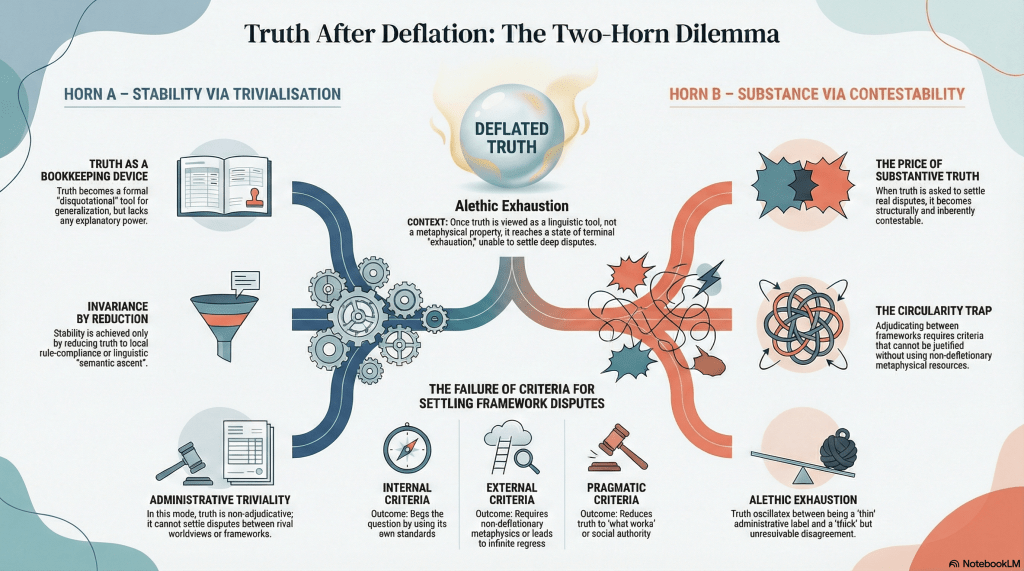
If paradigm shifts can redraw the entire map of what counts as truth, then it makes sense to ask what exactly we mean when we invoke the word at all. Is truth a mirror of reality? A matter of internal coherence? Whatever works? Or just a linguistic convenience? Philosophy has produced a whole menu of truth theories, each with its own promises and pitfallsโ€”and each vulnerable to the same problems of rhetoric, context, and shifting meanings.

The Many Flavours of Truth

Philosophers never tire of bottling โ€œtruthโ€ in new vintages. The catalogue runs long: correspondence, coherence, pragmatic, deflationary, redundancy. Each is presented as the final refinement, the one true formulation of Truth, though each amounts to little more than a rhetorical strategy.

  • Correspondence theory: Truth is what matches reality.
    Problem: we can never measure distance from โ€œRealityโ„ขโ€ itself, only from our models.
  • Coherence theory: Truth is what fits consistently within a web of beliefs.
    Problem: many mutually incompatible webs can be internally consistent.
  • Pragmatic theory: Truth is what works.
    Problem: โ€œworksโ€ for whom, under what ends? Functionality is always perspectival.
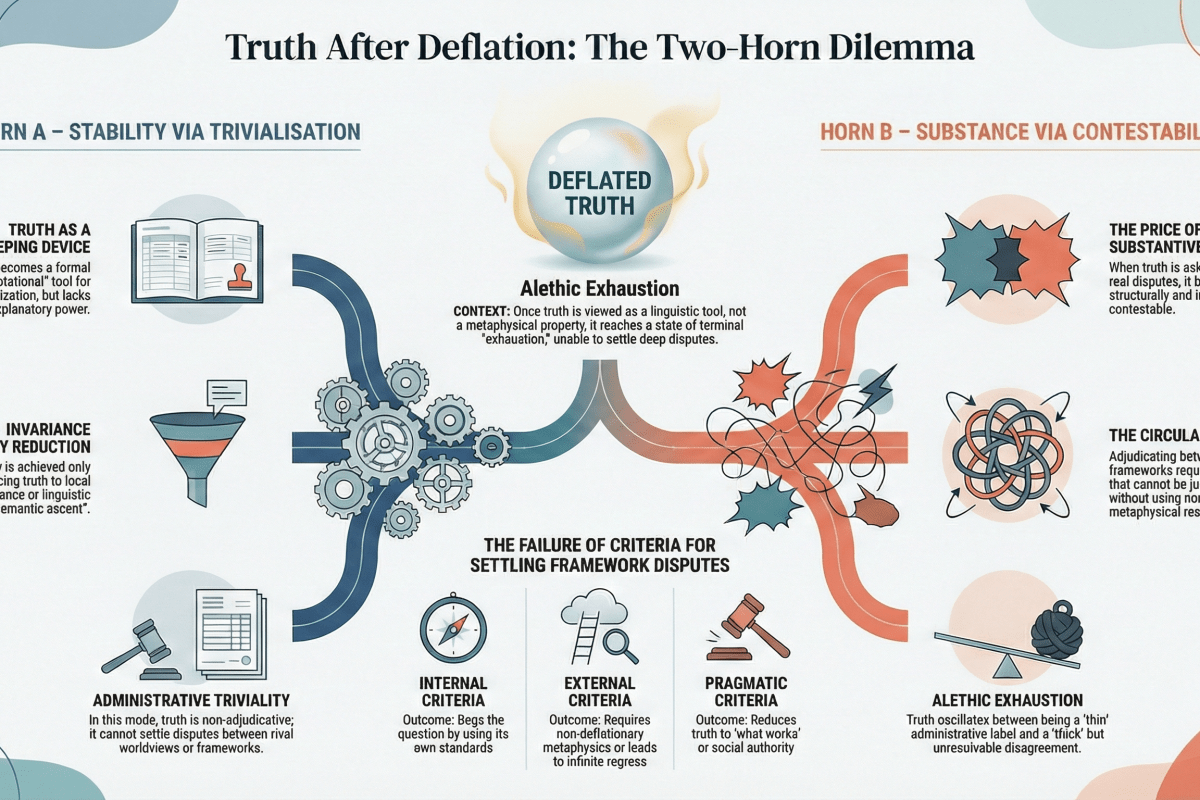
  • Deflationary / Minimalist: Saying โ€œitโ€™s true thatโ€ฆโ€ adds nothing beyond the statement itself.
    Problem: Useful for logic, empty for lived disputes.
  • Redundancy / Performative: โ€œIt is true thatโ€ฆโ€ adds rhetorical force, not new content.
    Problem: truth reduced to linguistic habit.

And the common fallback: facts vs. truths. We imagine facts as hard little pebbles anyone can pick up. Hastings was in 1066; water boils at 100ยฐC at sea level. But these โ€œfactsโ€ are just truths that have been successfully frozen and institutionalised. No less rhetorical, only more stable.

So truth isnโ€™t one thing โ€“ itโ€™s a menu. And notice: all these flavours share the same problem. They only work within language-games, frameworks, or communities of agreement. None of them delivers unmediated access to Realityโ„ข.

Truth turns out not to be a flavour but an ice cream parlour โ€“ lots of cones, no exit.

Multiplicity of Models

Even if correspondence werenโ€™t troubled, it collapses under the weight of underdetermination. Quine and Duhem pointed out that any body of evidence can support multiple competing theories.

Chart 4: orthodox vs. heterodox curves, each hugging โ€œrealityโ€ differently

Hilary Putnam pushed it further with his model-theoretic argument: infinitely many models could map onto the same set of truths. Which one is โ€œrealโ€? There is no privileged mapping.

Conclusion: correspondence is undercut before it begins. Truth isnโ€™t a straight line toward Reality; itโ€™s a sprawl of models, each rhetorically entrenched.

Truth as Rhetoric and Power

This is where Orwell was right: โ€œWar is Peace, Freedom is Slavery, Ignorance is Strength.โ€

Image: INGSOC logo

Truth, in practice, is what rhetoric persuades.

Michel Foucault stripped off the mask: truth is not about correspondence but about power/knowledge. What counts as truth is whatever the prevailing regime of discourse allows.

Weโ€™ve lived it:

  • โ€œThe economy is strongโ€, while people canโ€™t afford rent.
  • โ€œAI will save usโ€, while it mainly writes clickbait.
  • โ€œThe science is settledโ€ until the next paper unsettles it.

These arenโ€™t neutral observations; theyโ€™re rhetorical victories.

Truth as Community Practice

Chart 5: Margin of error bands

Even when rhetoric convinces, it convinces in-groups. One group converges on a shared perception, another on its opposite. Flat Earth and Round Earth are both communities of โ€œtruth.โ€ Each has error margins, each has believers, each perceives itself as edging toward reality.

Wittgenstein reminds us: truth is a language game. Rorty sharpens it: truth is what our peers let us get away with saying.

So truth is plural, situated, and always contested.

Evolutionary and Cognitive Scaffolding

Step back, and truth looks even less eternal and more provisional.

We spread claims because they move us (emotivism) and because we urge others to join (prescriptivism). Nietzsche was savage about it: truth is just a herd virtue, a survival trick.

Cognitive science agrees, if in a different language: perception is predictive guesswork, riddled with biases, illusions, and shortcuts. Our minds donโ€™t mirror reality; they generate useful fictions.

Diagram: Perception as a lossy interface: Realityโ„ข filtered through senses, cognition, language, and finally rhetoric โ€“ signal loss at every stage.

Archetypal Truth (Positive Proposal)

So where does that leave us? Not with despair, but with clarity.

Truth is best understood as archetypal โ€“ a construct humans rally around. It isnโ€™t discovered; it is invoked. Its force comes not from correspondence but from resonance.

Here, my own Language Insufficiency Hypothesis bites hardest: all our truth-talk is approximation. Every statement is lossy compression, every claim filtered through insufficient words. We can get close enough for consensus, but never close enough for Reality.

Truth is rhetorical, communal, functional. Not absolute.

The Four Pillars (Manifesto Form)

  1. Archetypal โ€“ truth is a symbolic placeholder, not objective reality.
  2. Asymptotic โ€“ we gesture toward reality but never arrive.
  3. Rhetorical โ€“ what counts as truth is what persuades.
  4. Linguistically Insufficient โ€“ language guarantees slippage and error.

Closing

Nietzsche warned, Rorty echoed: stop fetishising Truth. Start interrogating the stories we tell in its name.

Every โ€œtruthโ€ we now applaud may be tomorrowโ€™s embarrassment. The only honest stance is vigilance โ€“ not over whether weโ€™ve captured Realityโ„ข, but over who gets to decide what is called true, and why.

Truth has never been a mirror. Itโ€™s a mask. The only question worth asking is: whoโ€™s wearing it?

Nature and Its Paperwork

We humans pride ourselves on being civilised. Unlike animals, we donโ€™t let biology call the shots. A chimp reaches puberty and reproduces; a human reaches puberty and is told, not yet โ€“ society has rules. Biologically mature isnโ€™t socially mature, and we pat ourselves on the back for having spotted the difference.

But watch how quickly that distinction vanishes when it threatens the in-group narrative. Bring up gender, and suddenly thereโ€™s no such thing as a social construct. Forget the puberty-vs-adulthood distinction we were just defending โ€“ now biology is destiny, immutable and absolute. Cross-gender clothing? โ€œAgainst nature.โ€ Transition? โ€œYou canโ€™t be born into the wrong body.โ€ Our selective vision flips depending on whose ox is being gored.

The same trick appears in how we talk about maturity. You canโ€™t vote until 18. Youโ€™re not old enough to drink until 21. Youโ€™re not old enough to stop working until 67. These numbers arenโ€™t natural; theyโ€™re paperwork. Theyโ€™re flags planted in the soil of human life, and without the right flag, you donโ€™t count.

The very people who insist on distinguishing biological maturity from social maturity when it comes to puberty suddenly forget the distinction when it comes to gender. They know perfectly well that โ€œmaturityโ€ is a construct โ€“ after all, theyโ€™ve built entire legal systems around arbitrary thresholds โ€“ but they enforce the amnesia whenever it suits them. Nietzsche would say it plainly: the powerful donโ€™t need to follow the rules, they only need to make sure you do.

So the next time someone appeals to โ€œnature,โ€ ask: which one? The nature that declares you old enough to marry at puberty? The nature that withholds voting, drinking, or retirement rights until a bureaucratโ€™s calendar says so? Or the nature that quietly mutates whenever the in-group needs to draw a new line around civilisation?

The truth is, โ€œnatureโ€ and โ€œmaturityโ€ are less about describing the world than about policing it. Theyโ€™re flags, shibboleths, passwords. We keep calling them natural, but the only thing natural about them is how often theyโ€™re used to enforce someone elseโ€™s story.

Go Back Where You Came From (And Other Spells)

2โ€“3 minutes

Thereโ€™s a certain kind of rhetorical grenade people like to lob when their sense of ownership feels wobbly. Youโ€™ve heard it. Youโ€™ve maybe had it lobbed in your general direction.

Itโ€™s not an argument, of course. Itโ€™s a spell. A warding charm. The linguistic equivalent of hissing at a stray cat in the garden. The phrase carries the weight of assumed belonging: we are naturally here, you are obviously not. The incantation is meant to banish you with a puff of words.

The other day, I watched a black activist absorb this spell and toss it back with deadpan precision:

Cue awkward silence. The symmetry was perfect. Suddenly, the verbal hex had reversed polarity, exposing the hypocrisy built into the original curse. The power of the spell depends entirely on who gets to cast it. When it comes from the wrong mouth, the whole structure of โ€œcommon senseโ€ collapses into farce.

Another example: a Greek immigrant in my orbit, accent still clinging to every consonant, grumbling about a black family that had moved into his neighbourhood. Why didnโ€™t they โ€œgo back to Africaโ€? This from a man who himself had gone โ€œbackโ€ from nowhere, except a homeland he happily abandoned for better wages and better weather. Colonialism is apparently a one-way ticket: Europeans roam the globe and call it destiny, but when others move into their postcode, itโ€™s treated like an invasion.

I confess, I once flirted with the same nonsense. Years ago in Japan, in my more callow phase, I asked โ€“ half in jest, wholly in arrogance โ€“ why these people didnโ€™t have the decency to speak my language. The difference, such as it is, lay in my awareness that I was being ridiculous. My Greek neighbour, my activistโ€™s hecklerโ€”no irony there. They were dead serious.

Thatโ€™s the grotesque comedy of racism: its logic isnโ€™t logic at all. Itโ€™s ritual. A mantra recited to reassure oneself of belonging by denying it to others. It dresses itself in the robes of rationality โ€“ โ€œgo back where you came fromโ€ sounds like geography, after all โ€“ but itโ€™s closer to medieval exorcism than reasoned debate.

And when the cursed simply whispers the incantation back? The spell collapses. The supposed โ€œtruthโ€ reveals itself for what it always was: a desperate attempt to maintain the fiction that one kind of stranger is native and another will always be alien.

Every empire tells its children they were born at home, and tells everyone else they were born trespassing.