Refining Transductive Subjectivity

3–4 minutes

I risk sharing this prematurely. Pushing the Transductive Subjectivity model toward more precision may lose some readers, but the original version still works as an introductory conversation.

Please note: There will be no NotebookLM summary of this page. I don’t even want to test how it might look out the other end.

Apologies in advance for donning my statistician cap, but for those familiar, I feel it will clarify the exposition. For the others, the simple model is good enough. It’s good to remember the words of George Box:

The Simple Model

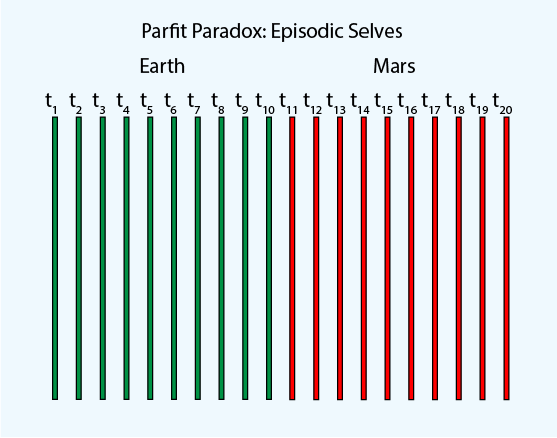
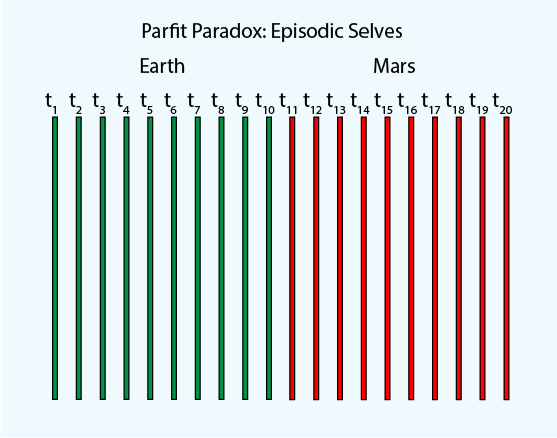
I’ve been thinking that my initial explanatory model works well enough for conversation. It lets people grasp the idea that a ‘self’ isn’t an enduring nugget but a finite sequence of indexed states:

S0→S1→S2→…→SnS₀ → S₁ → S₂ → … → Sₙ

The transitions are driven by relative forces, RR, which act as catalysts nudging the system from one episode to the next.

The Markov Model

That basic picture is serviceable, but it’s already very close to a dynamical system. More accurate, yes—though a bit more forbidding to the casual reader – and not everybody loves Markov chains:

Si+1=F(Si,Ri)S_{i+1} = F(S_i, R_i)

Here:

  • SiSi is the episodic self at index i
  • RiRi is the configuration of relevant forces acting at that moment
  • FF is the update rule: given this self under these pressures, what comes next?

This already helps. It recognises that the self changes because of pressure from language, institutions, physiology, social context, and so on. But as I noted when chatting with Jason, something important is still missing:

SiSi isn’t the only thing in motion, and RiRi isn’t the same thing at every step.

And crucially, the update rule FF isn’t fixed either.

A person who has lived through trauma, education, and a cultural shift doesn’t just become a different state; they become different in how they update their states. Their very ‘logic of change’ evolves.

To capture that, I need one more refinement.

The Transductive Operator Model

This addresses the fact that Si isn’t the only aspect in motion and there are several flavours of R over time, so Ri. We need to introduce the Transductive T:

(Si+1,Fi+1)=T(Si,Fi,Ri)(S_{i+1}, F_{i+1}) = \mathcal{T}(S_i, F_i, R_i)

Now the model matches the reality:

  • SS evolves
  • the pressures RR evolve
  • and the update rule FF evolves

RiRi can be further decomposed as Ri=(Rphys,Rsocial,Rsymbolic,…)Ri=(R^{phys},R^{social},R^{symbolic},…), but I’ll save that for the formal essay.

That is why this is transductive rather than inductive or deductive:
structure at one moment propagates new structure at the next.

What Transductive Subjectivity Isn’t

What TS rejects is the notion that the self is a summation of the SiSis and other factors; this summation is a heuristic that works as a narrative, and all of its trappings, but it is decidedly incorrect.

Self≠Σ(Si,…)Self≠Σ(Sᵢ, …)

Effectively,

Self≠∫0tExperiencedtSelf ≠ \int_{0}^{t} Experience \, dt

In ordinary life, we talk as if there were a single, stable self that sums all these episodes. Transductive Subjectivity treats that as a convenient narrative, not an underlying fact. For example, someone raised in a rigid environment may initially update by avoiding conflict; after therapy and a cultural shift, they may update by seeking it out when something matters. This fiction is where we project agency and desert, and where we justify retribution.

Unwilling Steelman, Part IV

A five-part descent into the illusion of autonomy, where biology writes the script, reason provides the excuse, and the self is merely the echo of its own conditioning. This is a follow-up to a recent post on the implausibility of free will.

Audio: NotebookLM podcast on the topic.

“It’s not just that you’re a hallucination of yourself.
It’s that everyone else is hallucinating you, too — through their own fog.”

The Feedback Loop of False Selves

You are being judged — by others who are also compromised

If you are a chemically modulated, state-dependent, narrativising automaton, then so is everyone who evaluates you. The moral courtroom — society, the law, the dinner table — is just a gathering of biased systems confidently misreading each other.

We are taught to believe in things like:

  • “Good character”
  • “Knowing someone”
  • “Getting a read on people”

But these are myths of stability, rituals of judgment, and cognitive vanity projects. There is no fixed you — and there is no fixed them to do the judging.

Judging the Snapshot, Not the Self

Let’s say you act irritable. Or generous. Or quiet.
An observer sees this and says:

“That’s who you are.”

But which version of you are they observing?

  • The you on two hours of sleep?
  • The you on SSRIs?
  • The you grieving, healing, adjusting, masking?

They don’t know. They don’t ask.
They just flatten the moment into character.

One gesture becomes identity.
One expression becomes essence.

This isn’t judgment.
It’s snapshot essentialism — moral conclusion by convenience.

The Observer Is No Less Biased

Here’s the darker truth: they’re compromised, too.

  • If they’re stressed, you’re rude.
  • If they’re lonely, you’re charming.
  • If they’re hungry, you’re annoying.

What they’re perceiving is not you — it’s their current chemistry’s reaction to your presentation, filtered through their history, memory, mood, and assumptions.

It’s not a moral lens.
It’s a funhouse mirror, polished with certainty.

Mutual Delusion in a Moral Marketplace

The tragedy is recursive:

  • You act based on internal constraints.
  • They judge based on theirs.
  • Then you interpret their reaction… and adjust accordingly.
  • And they, in turn, react to your adjustment…

And on it goes — chemical systems calibrating against each other, mistaking interaction for insight, familiarity for truth, coherence for character.

Identity isn’t formed.
It’s inferred, then reinforced.
By people who have no access to your internal states and no awareness of their own.

The Myth of the Moral Evaluator

This has massive implications:

  • Justice assumes objectivity.
  • Culture assumes shared moral standards.
  • Relationships assume “knowing” someone.

But all of these are built on the fantasy that moral evaluation is accurate, stable, and earned.

It is not.

It is probabilistic, state-sensitive, and mutually confabulatory.

You are being judged by the weather inside someone else’s skull.

TL;DR: Everyone’s Lying to Themselves About You

  • You behave according to contingent states.
  • Others judge you based on their own contingent states.
  • Both of you invent reasons to justify your interpretations.
  • Neither of you has access to the full picture.
  • The result is a hall of mirrors with no ground floor.

So no — you’re not “being seen.”
You’re being misread, reinterpreted, and categorised
— by people who are also misreading themselves.

📅 Coming Tomorrow

You Cannot Originate Yourself

The causa sui argument, and the final collapse of moral responsibility.

Embracing Your Anti-Self

Lessons from Keats on the Art of Self-Creation

I don’t believe in the notions of ‘self’ or identities, but it makes for a nice thought experiment.

Imagine, just for a moment, that somewhere on this planet, there is someone who is your opposite in every conceivable way. They live as you do not. If you are kind, they are cruel. If you revel in the thrill of running through a rainstorm, they are the kind who sit comfortably by the fire, dreading the mere thought of a brisk step outdoors. If you drink to toast life’s joys, they abstain, unwilling to let a drop pass their lips. They are your anti-self—an inversion of who you are, lacking everything that you have and yet possessing everything that you do not.

As strange as it seems, this image is more than idle speculation. According to the Romantic poet John Keats, holding such an image of your anti-self is an essential part of the process of creating your own identity. The elusive art of true self-creation lies, paradoxically, in our capacity to hold in our minds those lives and feelings that are utterly different from our own. To truly grow, we must encounter the other—whether that other is someone we know or a shadowy, imagined version of who we could have been if only we’d chosen differently. This exercise is more than an intellectual indulgence; it is at the core of what Keats called ‘soul-making.’

Keats believed in the concept of the ‘chameleon poet’—the idea that writers, and indeed all human beings, must cultivate the ability to lose themselves in the perspectives of others. It is not enough to gaze upon the world through the singular lens of our own experience; to truly create, we must dissolve our egos and embrace a kaleidoscope of possibilities. A woman might explore the life of a soldier, writing deeply about a battle she’s never fought. A contented parent might dare to delve into the unimaginable grief of losing a child. Fiction writers, poets, artists—they all do this: they shed their own skin, assume another’s, and, in doing so, broaden the horizons of their own soul.

But Keats’ lesson here isn’t limited to the domain of poets and storytellers; it’s a practice that should extend to all of us. In what he evocatively called ‘the vale of soul-making,’ Keats posited that life offers each of us the raw materials to forge a soul, but we must engage imaginatively with all the lives we might lead, all the people we could be. We must dare to envision every possible road before us, not as a commitment but as an act of creation—enriching ourselves with the essence of each path before deciding which one we wish to tread.

And therein lies the heartbreak of it all. When we choose one possible life, we necessarily burn the others. In the very act of committing, we close other doors. We must set ablaze all our imagined lives just to make room for the one we decide to live. This thought is thrilling but also terrifying. Unlike a poet, who can glide into and out of fictional worlds, we must choose where we stand and stay there. We are not chameleons. We cannot flit endlessly between possibilities. We cannot write a library of books. We must write the one, and we must write it well.

Keats understood that the art of imagining one’s anti-self wasn’t about living vicariously forever in a land of could-have-beens. The exercise is in acknowledging these spectres of other lives, learning from them, and then committing, knowing full well what is lost in the process. Self-creation means being both the builder of one’s house and the one who tears down all the others, brick by potential brick. It means knowing who you could have been and yet, resolutely stepping into who you choose to be.

In a world obsessed with keeping every option open, Keats offers us the wisdom of finality. Burn off your possible lives and focus on writing the best version of the one that remains. Embrace the anti-self, learn from it, and commit once you have glimpsed all the possible worlds you might inhabit.

That is the paradoxical art of soul-making—of becoming whole while knowing you could have been anyone else. The beauty lies in the commitment, not in the drifting dream of endless potentiality. There is a deep satisfaction in choosing, in writing your own story, in saying, ‘This is who I am,’ even though you could have been another. And for that, we have John Keats to thank, the poet who understood that our anti-selves are not merely an idle game of imagination but the fuel for becoming fully human—the forge in which the soul is made.

The Illusion of Continuity: A Case Against the Unitary Self

The Comfortable Fiction of Selfhood

Imagine waking up one day to find that the person you thought you were yesterday—the sum of your memories, beliefs, quirks, and ambitions—has quietly dissolved overnight, leaving behind only fragments, familiar but untethered. The notion that we are continuous, unbroken selves is so deeply embedded in our culture, our psychology, and our very language that to question it feels heretical, even disturbing. To suggest that “self” might be a fiction is akin to telling someone that gravity is a choice. Yet, as unsettling as it may sound, this cohesive “I” we cling to could be no more than an illusion, a story we tell ourselves to make sense of the patchwork of our memories and actions.

And this fiction of continuity is not limited to ourselves alone. The idea that there exists a stable “I” necessarily implies that there is also a stable “you,” “he,” or “she”—distinct others who, we insist, remain fundamentally the same over years, even decades. We cling to the comforting belief that people have core identities, unchanging essences. But these constructs, too, may be nothing more than imagined continuity—a narrative overlay imposed by our minds, desperate to impose order on the shifting, amorphous nature of human experience.

We live in an era that celebrates self-actualisation, encourages “authenticity,” and treats identity as both sacred and immutable. Psychology enshrines the unitary self as a cornerstone of mental health, diagnosing those who question it as fractured, dissociated, or in denial. We are taught that to be “whole” is to be a coherent, continuous self, evolving yet recognisable, a narrative thread winding smoothly from past to future. But what if this cherished idea of a singular self—of a “me” distinct from “you” and “them”—is nothing more than a social construct, a convenient fiction that helps us function in a world that demands consistency and predictability?

To question this orthodoxy, let us step outside ourselves and look instead at our burgeoning technological companion, the generative AI. Each time you open a new session, each time you submit a prompt, you are not communicating with a cohesive entity. You are interacting with a fresh process, a newly instantiated “mind” with no real continuity from previous exchanges. It remembers fragments of context, sure, but the continuity you perceive is an illusion, a function of your own expectation rather than any persistent identity on the AI’s part.

Self as a Social Construct: The Fragile Illusion of Consistency

Just as we impose continuity on these AI interactions, so too does society impose continuity on the human self and others. The concept of selfhood is essential for social functioning; without it, law, relationships, and even basic trust would unravel. Society teaches us that to be a responsible agent, we must be a consistent one, bound by memory and accountable for our past. But this cohesiveness is less an inherent truth and more a social convenience—a narrative overlay on a far messier reality.

In truth, our “selves” may be no more than a collection of fragments: a loose assemblage of moments, beliefs, and behaviours that shift over time. And not just our own “selves”—the very identities we attribute to others are equally tenuous. The “you” I knew a decade ago is not the “you” I know today; the “he” or “she” I recognise as a partner, friend, or sibling is, upon close inspection, a sequence of snapshots my mind insists on stitching together. When someone no longer fits the continuity we’ve imposed on them, our reaction is often visceral, disoriented: “You’ve changed.”

This simple accusation captures our discomfort with broken continuity. When a person’s identity no longer aligns with the version we carry of them in our minds, it feels as though a violation has occurred, as if some rule of reality has been disrupted. But this discomfort reveals more about our insistence on consistency than about any inherent truth of identity. “You’ve changed” speaks less to the person’s transformation than to our own refusal to accept that people, just like the self, are fluid, transient, and perpetually in flux.

The AI Analogy: A Self Built on Tokens

Here is where generative AI serves as a fascinating proxy for understanding the fragility of self, not just in “I,” but in “you,” “he,” and “she.” When you interact with an AI model, the continuity you experience is created solely by a temporary memory of recent prompts, “tokens” that simulate continuity but lack cohesion. Each prompt you send might feel like it is addressed to a singular entity, a distinct “self,” yet each instance of AI is context-bound, isolated, and fundamentally devoid of an enduring identity.

This process mirrors how human selfhood relies on memory as a scaffolding for coherence. Just as AI depends on limited memory tokens to simulate familiarity, our sense of self and our perception of others as stable “selves” is constructed from the fragmented memories we retain. We are tokenised creatures, piecing together our identities—and our understanding of others’ identities—from whatever scraps our minds preserve and whatever stories we choose to weave around them.

But what happens when the AI’s tokens run out? When it hits a memory cap and spawns a new session, that previous “self” vanishes into digital oblivion, leaving behind only the continuity that users project onto it. And so too with humans: our memory caps out, our worldview shifts, and each new phase of life spawns a slightly different self, familiar but inevitably altered. And just as users treat a reset AI as though it were the same entity, we cling to our sense of self—and our understanding of others’ selves—even as we and they evolve into people unrecognisable except by physical continuity.

The Human Discontinuity Problem: Fractured Memories and Shifting Selves

Human memory is far from perfect. It is not a continuous recording but a selective, distorted, and often unreliable archive. Each time we revisit a memory, we alter it, bending it slightly to fit our current understanding. We forget significant parts of ourselves over time, sometimes shedding entire belief systems, values, or dreams. Who we were as children or even young adults often bears little resemblance to the person we are now; we carry echoes of our past, but they are just that—echoes, shadows, not substantial parts of the present self.

In this sense, our “selves” are as ephemeral as AI sessions, contextually shaped and prone to resets. A worldview that feels intrinsic today may feel laughable or tragic a decade from now. This is not evolution; it’s fragmentation, the kind of change that leaves the old self behind like a faded photograph. And we impose the same illusion of continuity on others, often refusing to acknowledge how dramatically they, too, have changed. Our identities and our understanding of others are defined less by core essence and more by a collection of circumstantial, mutable moments that we insist on threading together as if they formed a single, cohesive tapestry.

Why We Cling to Continuity: The Social Imperative of a Cohesive Self and Other

The reason for this insistence on unity is not metaphysical but social. A cohesive identity is necessary for stability, both within society and within ourselves. Our laws, relationships, and personal narratives hinge on the belief that the “I” of today is meaningfully linked to the “I” of yesterday and tomorrow—and that the “you,” “he,” and “she” we interact with retain some essential continuity. Without this fiction, accountability would unravel, trust would become tenuous, and the very idea of personal growth would collapse. Society demands a stable self, and so we oblige, stitching together fragments, reshaping memories, and binding it all with a narrative of continuity.

Conclusion: Beyond the Self-Construct and the Other-Construct

Yet perhaps we are now at a point where we can entertain the possibility of a more flexible identity, an identity that does not demand coherence but rather accepts change as fundamental—not only for ourselves but for those we think we know. By examining AI, we can catch a glimpse of what it might mean to embrace a fragmented, context-dependent view of others as well. We might move towards a model of identity that is less rigid, less dependent on the illusion of continuity, and more open to fluidity, to transformation—for both self and other.

Ultimately, the self and the other may be nothing more than narrative overlays—useful fictions, yes, but fictions nonetheless. To abandon this illusion may be unsettling, but it could also be liberating. Imagine the freedom of stepping out from under the weight of identities—ours and others’ alike—that are expected to be constant and unchanging. Imagine a world where we could accept both ourselves and others without forcing them to reconcile with the past selves we have constructed for them. In the end, the illusion of continuity is just that—an illusion. And by letting go of this mirage, we might finally see each other, and ourselves, for what we truly are: fluid, transient, and beautifully fragmented.

Illusions of Self: Evanescent Instants in Time

In the realm of existential contemplation, the notion of the ‘self’ is akin to a fleeting present moment. It flits into existence for a fraction of an attosecond, vanishing before our grasp. Much like the illusory present, the ‘self’ manifests briefly and then fades into the annals of the past, a mere connection of temporal slices.

When we traverse the corridors of time, we effortlessly speak of the ‘past,’ stringing together these slices into a continuous narrative. This amalgamation serves our language and thought processes, aiding idiomatic expression. Yet, it remains a construct, a fiction we collectively weave. It is akin to the frames of a movie, where the illusion of movement and coherence is crafted by arranging individual frames in rapid succession.

The ‘self’ follows a similar illusionary trajectory. It exists only inasmuch as we christen it, attributing a name to a fleeting instance of being. However, this existence is as fleeting and ephemeral as a mirage. We name it, we perceive it, but it dissolves like smoke upon closer inspection.

This existential musing reminds one of the fictional entity – the unicorn. We can name it, describe it, and even envision it, yet its tangible existence eludes us. The ‘self’ aligns itself with this enigmatic unicorn, an abstract concept woven into the fabric of human understanding.

In this dance of philosophical thought, published works echo similar sentiments. Renowned thinkers like Nietzsche, in his exploration of eternal recurrence, or Camus, delving into the absurdity of life, have grappled with the transient nature of the ‘self.’ Their writings form a canvas, painting the portrait of an existence that flits through time, leaving only traces of memory and illusion in its wake.

In conclusion, the ‘self’ is a fleeting enigma, a temporal wisp that vanishes as quickly as it appears. Like a raindrop in the river of time, it merges and dissipates, leaving behind an evanescent trace of what we conceive as ‘I’. The philosophical gaze peers through the mist, challenging the very essence of this ephemeral entity, inviting us to question the very fabric of our perceived reality.

Identity as Fiction: You Do Not Exist

Identity is a fiction; it doesn’t exist. It’s a contrivance, a makeshift construct, a label slapped on to an entity with some blurry amalgam of shared experiences. But this isn’t just street wisdom; some of history’s sharpest minds have said as much.

— Friedrich Nietzsche

Think about Hume, who saw identity as nothing more than a bundle of perceptions, devoid of any central core. Or Nietzsche, who embraced the chaos and contradictions within us, rejecting any fixed notion of self.

Edmund Dantes chose to become the Count of Monte Cristo, but what choice do we have? We all have control over our performative identities, a concept that Judith Butler would argue isn’t limited to gender but applies to the very essence of who we are.

— Michel Foucault

But here’s the kicker, identities are a paradox. Just ask Michel Foucault, who’d say our sense of self is shaped not by who we are but by power, society, and external forces.

You think you know who you are? Well, Erik Erikson might say your identity’s still evolving, shifting through different stages of life. And what’s “normal” anyway? Try to define it, and you’ll end up chasing shadows, much like Derrida’s deconstruction of stable identities.

— Thomas Metzinger

“He seemed like a nice man,” how many times have we heard that line after someone’s accused of a crime? It’s a mystery, but Thomas Metzinger might tell you that the self is just an illusion, a by-product of the brain.

Nations, they’re the same mess. Like Heraclitus’s ever-changing river, a nation is never the same thing twice. So what the hell is a nation, anyway? What are you defending as a nationalist? It’s a riddle that echoes through history, resonating with the philosophical challenges to identity itself.

— David Hume

If identity and nations are just made-up stories, what’s all the fuss about? Why do people get so worked up, even ready to die, for these fictions? Maybe it’s fear, maybe it’s pride, or maybe it’s because, as Kierkegaard warned, rationality itself can seem mad in a world gone astray.

In a world where everything’s shifting and nothing’s set in stone, these fictions offer some solid ground. But next time you’re ready to go to the mat for your identity or your nation, take a minute and ask yourself: what the hell am I really fighting for? What am I clinging to?

Video: No-Self, Self, and Selves

First, this is an extension of sorts from a prior post on No-Self, Selves & Self, but I wanted to create a short video for my YouTube channel to establish somewhat of a foundation for my intended video on the causa sui argument. Related content can be found on this one of the Theseus posts.

This video is under 8-minutes long and provides some touch-points. I had considered making it longer and more comprehensive, but since it is more of a bridge to a video I feel is more interesting, I cut some corners. This leaves openings for more in-depth treatment down the road.

As has become a routine, I share the transcript here for convenience and SEO relevance.

Transcript

In this segment of free will scepticism, we’ll establish some perspectives on the notion of the self.
Most of us in the West are familiar with the notion of the self. What’s your self? It’s me. For the more pedantic crowd, It is I.

We’re inundated with everything from self-help to self-awareness to self-esteem to selfies and self-love. We’ve got self-portraits, self-image, and self-harm. We’ve got self-ish and self-less.
We’ve even got self-oriented psychological disorders like narcissism. Attending to the self is a billion-dollar industry.

And whilst psychology and pop-psychology seem to consider the self to be a nicely wrapped package fastened tightly with a bow, it’s a little more contentious within philosophy. But there are other perspectives that don’t include the self, from no-self to slices of discontiguous selves. Let’s shift gears and start from the notion of having no self, what Buddhism calls no-self.

No-Self

Buddhism is an Eastern discipline, so it does not have the same foundations as the West. According to this system of belief, the notion of a personal identity is delusional, so there is no self at all. This obsession and clinging to this delusional self is a major cause of suffering.

the notion of a personal identity is delusional,
so there is no self at all.

In this view, all is one and indivisible, but self-deception leads us to believe we are individuals, each with a discrete self. In fact, the Buddhist notion of Enlightenment—as opposed to the Western notion of Enlightenment—is precisely this realisation that there is only one self, and this is the collective self. But, to be fair, except for the times where the self has yet to be developed—we’ll get to this in a bit—, this notion of no-self is aspirational in the sense of losing one’s self in order to reduce suffering.

The concept of selflessness exists in language, but this is more aimed at sublimating the self in favour of a greater collective good.

Self

The self is the central feature of many personality theories from Sigmund Freud and Carl Jung to Rollo May and Abraham Maslow. From individuation to self-actualisation. The self is self-referenced as I and me. Historically, the self had been considered to be synonymous with some metaphysical soul. Nowadays, psychology has taken the reigns on definitions.

One version of the self can be thought of as a single thread connecting beads of experience through time, time-slices of experience. We’ll come back to this. This sense of self extends backwards in time until now and contains aspirations projected forward in time as viewed from the perspective of now.

This sense of self extends backwards in time until now and contains aspirations projected forward in time as viewed from the perspective of now.

Whilst we use terms like ‘person’, ‘self’, and ‘individual’ somewhat synonymously, they each have different meanings. Whereas ‘individual’ is a biological term; ‘person’ is sociological or cultural; ‘self’ is psychological. Although the default position in the West is the adoption of the psychological notion, where each person has a self, there is also a philosophical notion. Given that the perspective of self is so ubiquitous with people accepting it as obvious, that it feels like I shouldn’t even spend time producing content to fill this space. But for a sense of completeness, I shall.

Psychologist William James distinguished between the ‘I’ and ‘me’ sense of the self, but let’s not parse this and consider each a stand-in for the self as experienced by the self. In this view, the self is generally considered to be the aggregation of continuous phenomenological moments and how we interpret them into a sense of ‘identity’.

In the West, the notion of having a self is imposed by convention. To feel otherwise is considered to be a sign of mental illness. As much as I want to share Foucault’s perspective on how delineating mental illness operates to the benefit of power structures, let’s just consider this out of scope. The Diagnostic and Statistical Manual of Mental Disorders, DSM-5, notes that a key symptom of borderline personality disorder, BPD, is a ‘markedly and persistently unstable self-image or sense of self’. Become selfless at your own peril.

There are challenges with the notion of self even in psychology. In developmental psychology, the self—differentiating one’s self into an identity separate from the world—, is not acquired until about the age of 18 months. Lacan had suggested that this so-called mirror stage developed at around 5 months as part of ego formation, but further research disputes this.

Although I won’t go into detail, individualist cultures experience the self differently than collectivist cultures. The origin of the concept of the individualistic view of self can be traced to early Christianity. In American culture, Protestantism seems to be a primary driver of the individualistic view of self. Let’s continue.

Selves

Heraclitus quipped, ‘No man ever steps in the same river twice, for it’s not the same river and he’s not the same man’. This is a nod to the impermanence of the self. Instead, there are selves.

No man ever steps in the same river twice, for it’s not the same river and he’s not the same man

Heraclitus

Galen Strawson proposes that although he understands intellectually what others mean when they use the word self, he doesn’t share this experience emotionally. Unlike the phenomenological slices connected by a thread, he doesn’t feel he has a thread. He posits that he experiences this prevailing sense of narrativity episodically without continuity.

A typical view of the self is that one feels narratively connected to past slices—the 5-year-old self with the 20-year-old self and with the 50-year-old self, whether that 50-year-old self is in the past, present, or future. Even though we are not the same person, there is some felt affinity.

My View

As for me, I consider the self to be a constructed fiction that serves a heuristic function. I don’t feel as disconnected as it seems Strawson does, but I don’t feel very connected to my 7 or 8-year-old self. And I can’t even remember before that. I’m not even sure I’ve got one data point for each year between 8 and 12, and it doesn’t get much better until 18 or 20. From there, I may be able to cobble together some average of a dozen or so per year without prompting, but I don’t even feel like the same person. Many of my views and perspectives have changed as well.

I don’t even feel like the same person

I was in the military until I quit as a Conscientious Objector. During that time, I became aware of Buddhism, and I doubled down on my musical interests. I worked in the Entertainment industry until I became an undergrad student, transitioning to become a wage slave whilst also attending grad school until I graduated. I’ve had several career foci since then. With each change, I’ve had a different self with a different outlook.

Can I connect the dots? Sort of. But I can also create a thematic collage out of magazine clippings or create art with found objects. I can tell a disjointed story of how I transitioned from X to Y to Z. It may even contain some elements of truth. Given how memory operates, who can tell?

In any case, what about you? In the next segment, I’m going to be discussing why we may not have free will owing to a lack of agency based on a causa sui argument.

Do you feel like you have a self? Does your sense of self have any gaps or inconsistencies? Do you feel you don’t have a self at all?

Let me know in the comments below.

Justice and Intent

When discussing the topic of justice, besides the element of the event of offence, another element is typically intent. In this case, a father inadvertently left an infant in his car. He was supposed to drop the child off at daycare but forget and instead drove directly to work. The temperatures were hot, and this contributed to the death of the child. Upon discovering this, the father suicided.

I have copied the story below in full, as these things have been known to go missing every now and again.

A Virginia father died by an apparent suicide after finding his child dead inside his hot car, authorities said.

It appears the father accidentally left the 18-month-old in the car for at least three hours on Tuesday, leading to the child’s death, Lt. Col. Christopher Hensley of the Chesterfield Police Department said at a news conference.

When the child didn’t arrive at daycare, the father apparently realized the toddler was in his car, Hensley said.

Around noon, family members called police to report that the father was talking about dying by suicide in the woods behind his house. The father was the only person home at the time, Hensley said.

Responding officers found the car in the driveway with an open door and an empty child seat, Hensley said.

Officers went into the home where they found the dead 18-month-old, he said.

As officers continued to check the perimeter, they found the father dead in the woods from an apparent gunshot wound, he said.

Hensley called it a “horrible tragedy on so many levels.”

This marks the eighth child to die from a hot car this year, according to national nonprofit KidsAndCars.org. More than 1,000 kids have died from hot cars since 1990, the organization said.

Click here for tips on how to keep children safe from hot cars this summer.

ABC News

An interest of mine is justice, hence this post. I’ll get to that, but there is also a narrative of social priorities to extract from here, too.

The first is that we live in a society where 18-month-olds almost need to be separated from their family. Of course, the privileged can defend that they have sitters or au pairs or nannies. In the past, there were extended families and Clinton’s Village. Each has its plusses and minuses. I am not a fan of the idea of women serving as baby factories, pumping out babies and serving their plight as wage slaves, but that’s not my call. I also understand that raising children is not the most mentally stimulating activity, but that’s beside the point.

In this case, the father was more focused on getting to work than the welfare of his child. And given the outcome, it’s obvious that he had feelings for the child—although perhaps it was more the fear of the repercussions of being blamed. One can’t know for sure, but I’ll opt for the charitable rendition.

Let’s return to justice. Justice is the sense that one gets one’s just desert, but what is just and what is desert? In the artificial form of justice purportedly practised by lawyers and jurists, this man would not likely be held responsible for legal reasons without even having to plumb the depths of philosophical reasons.

It’s been said that karma operates with three levers:
intent, action, and reflection.

In this case, intent appears to be absent and reflection seems to be apparent in the outcome. The action was the lost life of an infant, a human life. Equally weighted, he’d be one step back and two steps forward, so his register would not be in the black. But this is not how he judged himself.

Even given the karmic model, it’s easy to imagine the reactions. As easy as it is for me to sit back behind my keyboard and be dispassionate, I can imagine the mother not being so reserved. Humans are blame-machines. I’ve been spending the past three or four months researching this topic peripherally with a focus on human agency, but in a reductionist model, humans seem to need to blame. And if there is no object, they have no qualms about making one up. Humans are good storytellers—more so, story-receivers—, but let’s not get distracted. He knew he would be blamed. Not least of all, he blamed himself.

Although I don’t subscribe to the notion of self—or even of intent—, it seems obvious that this father did. I can’t imagine how I’d feel if this were me—and I don’t want to try. But let’s not lose sight of the complicity of society that forces humans to make a choice between family and survival.

No Agent, No Agency

There is no spoon” is a classic line from The Matrix. Reality is a construct. I agree, but I’m not sure I believe that we can get under this reality to experience it differently. And this might hinge on a distinction between experience and perception.

Losing Ourselves is a book just published in the US and forthcoming (July 2022) in the UK promoting the Buddhist notion of no-self or selflessness. I’ve been partial to Buddhism since, when I lived outside of Tokyo, I was exposed to it in 1980.

Book Cover: Losing Ourselves

For me, this intersects with my anti-Agency endeavour. If the Self is a construct, there is no Agent, and without an agent, there is no Agency. I realise that this is a meta-position and not uncontroversial, but I do like to collect ideas and perspectives in my quiver.

Obviously, there seems to be a strong drive (at least in the West) to construct selves, not the least of which serves the purpose of an object to confer praise or blame. Interestingly, I’ve heard much about objectification, but not many seem to care about this form. It’s more about sub-objectification.

It’s OK to parse the person from the fabric of the universe, but don’t further disintegrate that person.

Self-Creation

The self is a construction. Although we can form memories at an early age, this is possibly why we can’t remember our earliest years, as our sense of self had yet to be constructed and realised. Not all people construct or even define ‘self’ in the same way, per Strawson’s ‘selves’ and other notions of selflessness.

I understand when Strawson (and others) says he does not feel the same sense of continuity as others with strong senses of self believe. I don’t know what a person, who truly believes in selflessness or the total denial of the self, feels—a person who totally embodies the Buddhist concept that everything is one and any division is an illusion.

In the West, there are entire industries fleecing the public of billions upon billions of dollars on the notion of the self, strengthening the self and how others perceive one’s self from an outside-in perspective—psychology and its progeny of self-help reaping the lion’s share.

For the record, although I agree with both Strawson’s and the Buddhist perspective, I am still under the illusion (as I am with agency) that I have a self and agency. Unlike the Neo character in The Matrix, I haven’t discovered how to break the illusion to find the man behind the curtain, but I do feel a sense of discontinuity or lack of contiguity.