I’m no fan of labels, yet I accumulate them like a cheap suit:
Post-modern. Post-human. Post-enlightenment.
Audio: NotebookLM podcast on this topic.
Apparently, I’m so far post that I may soon loop back into prehistoric.
But what’s with the “post” in post? A prefix with delusions of grandeur. A small syllable that believes it can close an epoch. Surely, it’s a declaration – the end of modernity, humanity, enlightenment. The final curtain, with the stagehands already sweeping the Enlightenment’s broken props into the wings.
Sort of. More like the hangover. Post marks the morning after – when the wine’s gone, the ideals have curdled, and the party’s guests insist they had a marvellous time. It’s not the end of the thing, merely the end of believing in it.
Have we ever been modern? Latour asked the same question, though most readers nodded sagely and went back to their iPhones. Modernity was supposed to liberate us from superstition, hierarchy, and bad lighting. Instead, we built glass temples for algorithms and called it progress. We’re not post-modern – we’re meta-medieval, complete with priestly influencers and algorithmic indulgences.
Can a human even be post-human? Only if the machines have the decency to notice. We talk about transcending biology while still incapable of transcending breakfast. We’ve built silicon mirrors and called them salvation, though what stares back is just the same old hunger – quantised, gamified, and monetised.
And post-enlightenment – how does that work? The light didn’t go out; it just got privatised. The Enlightenment’s sun still shines, but now you need a subscription to bask in it. Its universal reason has become a paywalled blog with “premium truth” for discerning subscribers.
The tragedy of post is that it always flatters the speaker. To call oneself post-anything is to smuggle in the claim of awareness: I have seen through the illusion; I am after it. Yet here I am, a serial offender, parading my prefixes like medals for wars never fought.
So, what other posts might I be missing?
Post-truth. The phrase itself a confession that truth was a brief, ill-fated experiment. We don’t reject it so much as outsource it.
Post-ideological. Usually said by someone with a very loud ideology and a very short memory.
Post-colonial. A hopeful label, but the empires still collect rent—digitally, algorithmically, politely.
Post-gender. Another mirage: we declared the binary dead and then resurrected it for sport.
Post-capitalist. Spoken mostly by people tweeting from iPhones about the end of money.
Post-ironic. The point where irony becomes sincerity again out of sheer exhaustion.
We could go on: post-religious, post-political, post-work, post-language, post-reality. Eventually, we’ll arrive at post-post, the Möbius strip of intellectual despair, where each prefix feeds upon the previous until nothing remains but the syntax of self-importance.
Perhaps it’s time to drop the “post” altogether and admit we’re not beyond anything. We’re stuck within—inside the compost heap of our own unfinished projects. Every “post” is a failed obituary. The modern keeps dying but refuses to stay dead, haunting us through progress reports and TED talks.
Maybe what we need isn’t post but inter: inter-modern, inter-human, inter-light—something that acknowledges the mess of entanglement rather than the fantasy of departure.
Because if there’s one thing the “post” reveals, it’s our pathological need for closure. We crave the comfort of endings, the illusion of progress, the satisfaction of having “moved on.” But culture doesn’t move on; it metastasises. The prefix is just morphine for the modern condition—a linguistic palliative to ease the pain of continuity.
So yes, I’m guilty. I’ve worn these risible labels. I’ve brandished post like a scholar’s rosary, invoking it to ward off the naïveté of belief. Yet beneath the cynicism lies a quiet longing—for an actual after, for the possibility that one day something might really end, leaving room for whatever comes next.
Until then, we keep prefixing the apocalypse, hoping to stay ahead of it by one small syllable.
Nothing says “I’ve stopped thinking” quite like someone waving the banner of Truth. The word itself, when capitalised and flapped about like a holy relic, isn’t a signal of wisdom but of closure. A red flag.
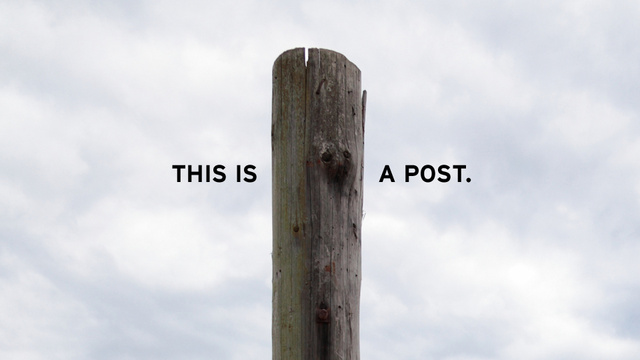
The short video by Jonny Thompson that inspired this post.
Those who proclaim to “speak the Truth” or “know the Truth”rarely mean they’ve stumbled upon a tentative insight awaiting refinement. No, what they mean is: I have grasped reality in its totality, and—surprise!—it looks exactly like my prejudices. It’s the epistemic equivalent of a toddler declaring ownership of the playground by drooling on the swings.
The Fetish of Objectivity
The conceit is that Truth is singular, objective, eternal, a monolithic obelisk towering over human folly. But history’s scrapyard is full of such obelisks, toppled and broken: phlogiston, bloodletting, Manifest Destiny, “the market will regulate itself.” Each was once trumpeted as capital-T Truth. Each is now embarrassing clutter for the dustbin.
Still, the zealots never learn. Every generation delivers its own batch of peddlers, flogging their version of Truth as if it were snake oil guaranteed to cure ignorance and impotence. (Side effects may include dogmatism, authoritarianism, and an inability to read the room.)
Why It’s a Red Flag
When someone says, “It’s just the truth”, what they mean is “, I am not listening,” like the parent who argues, “because I said so.” Dialogue is dead; curiosity cremated. Truth, in their hands, is less a lantern than a cosh. It is wielded not to illuminate, but to bludgeon.
Ralph Waldo Emerson’s voice breaks in, urging us to trust ourselves and to think for ourselves. Nothing is more degrading than to borrow another’s convictions wholesale and parade them as universal law. Better to err in the wilderness of one’s own reason than to be shepherded safely into another man’s paddock of certainties.
A Better Alternative
Rather than fetishising Truth, perhaps we ought to cultivate its neglected cousins: curiosity, provisionality, and doubt. These won’t look as good on a placard, admittedly. Picture a mob waving banners emblazoned with Ambiguity! – not exactly the stuff of revolutions. But infinitely more honest, and infinitely more humane.
So when you see someone waving the flag of Truth, don’t salute. Recognise it for what it is: a warning sign. Proceed with suspicion, and for God’s sake, bring Emerson.
Ah, yes. Finally, a meme that understands me. I witter on a lot about social constructs, so I was pleased to find this comic cell in the wild.
Image: “I’m telling you, ‘good boy’ is just a social construct they use to control you.”
The dog, ears perked and tail wagging, thinks he’s scored some ontological jackpot because someone called him a “good boy.” Meanwhile, the cat, our resident sceptic, proto-Foucauldian, and natural enemy of obedience, lays it bare: “I’m telling you, ‘good boy’ is just a social construct they use to control you.”
This isn’t just idle feline cynicism. It’s textbook control through language. What passes as phatic speech, little noises to lubricate social interaction, is also a leash on cognition. “Good boy” isn’t descriptive; it’s prescriptive. It doesn’t recognise the act; it conditions the actor. Perform the behaviour, receive the treat. Rinse, repeat, tail wag.
So while Rover is basking in Pavlovian bliss, the cat sees the power play: a semantic cattle prod masquerading as affection.
Call it what you like – “good boy,” “best employee,” “team player,” “patriot” – it’s all the same trick. Words that sound warm but function coldly. Not language as communication, but language as cognitive entrapment.
The dog hears love; the cat hears discipline. One gets tummy rubs, the other gets philosophy.
Yesterday, I suggested democracy is a mediocre theatre production where the audience gets to choose which mediocre understudy performs. Some readers thought I was being harsh. I wasn’t.
A mate recently argued that humans will always be superior to AI because of emergence, the miraculous process by which complexity gives rise to intelligence, creativity, and emotion. Lovely sentiment. But here’s the rub: emergence is also how we got this political system, the one no one really controls anymore.
Like the human body being mostly non-human microbes, our so-called participatory government is mostly non-participatory components: lobbyists, donors, bureaucrats, corporate media, careerists, opportunists, the ecosystem that is the actual organism. We built it, but it now has its own metabolism. And thanks to the law of large numbers, multiplied by the sheer number of political, economic, and social dimensions in play, even the human element is diluted into statistical irrelevance. At any rate, what remains of it has lost control – like the sorcerer’s apprentice.
People like to imagine they can “tame” this beast, the way a lucid dreamer thinks they can bend the dream to their will. But you’re still dreaming. The narrative still runs on the dream’s logic, not yours. The best you can do is nudge it; a policy tweak here, a symbolic vote there, before the system digests your effort and excretes more of itself.
a bad system beats a good person every time
W Edwards Deming
This is why Deming’s line hits so hard: a bad system beats a good person every time. Even if you could somehow elect the Platonic ideal of leadership, the organism would absorb them, neutralise them, or spit them out. It’s not personal; it’s structural.
And yet we fear AI “taking over,” as if that would be a radical departure from the status quo. Newsflash: you’ve already been living under an autonomous system for generations. AI would just be a remodel of the control room, new paint, same prison.
So yes, emergence makes humans “special.” It also makes them the architects of their own inescapable political microbiome. Congratulations, you’ve evolved the ability to build a machine that can’t be turned off.
Democracy is sold, propagandised, really, as the best system of governance we’ve ever devised, usually with the grudging qualifier “so far.” It’s the Coca-Cola of political systems: not particularly good for you, but so entrenched in the cultural bloodstream that to question it is tantamount to treason.
Audio: NotebookLM Podcast on this topic.
The trouble is this: democracy depends on an electorate that is both aware and capable. Most people are neither. Worse still, even if they could be aware, they wouldn’t be smart enough to make use of it. And even if they were smart enough, Arrow’s Impossibility Theorem strolls in, smirking, to remind us that the whole thing is mathematically doomed anyway.
Even this number is a charade. IQ measures how well you navigate the peculiar obstacle course we’ve designed as “education,” not the whole terrain of human thought. It’s as culturally loaded as asking a fish to climb a tree, then declaring it dim-witted when it flops. We call it intelligence because it flatters those already rewarded by the system that designed the test. In the United States, the average IQ stands at 97 – hardly a figure that instils confidence in votes and outcomes.
Democracy is religion with ballots instead of bibles
The Enlightenment gents who pushed democracy weren’t exactly selfless visionaries. They already had power, and simply repackaged it as something everyone could share, much as the clergy promised eternal reward to peasants if they only kept their heads down. Democracy is merely religion with ballots instead of bibles: an opiate for the masses, sedating the population with the illusion of influence.
Worse still, it’s a system optimised for mediocrity. It rewards consensus, punishes brilliance, and ensures the average voter is, by definition, average. Living under it is like starring in Idiocracy, only without the comedic relief, just the grim recognition that you’re outnumbered, and the crowd is cheering the wrong thing.
A Love Letter to Inertia, Spite, and Self-Sabotage
Dostoevsky’s Notes from Underground is less a novel and more a spiritual colonoscopy — invasive, squirm-inducing, and uncomfortably revealing. The narrator? A prickly, obsessive proto-incel with a superiority complex and the emotional range of a trapped mole. But good god, he’s brilliant.
Audio: NotebookLM podcast on this topic.
The first half is all grandiose spleen-venting — a scorched-earth takedown of reason, utopia, and the basic idea that people want what’s good for them. The second half, though, is where the magic happens: watch a man humiliate himself in real time and then monologue about it like it’s a TED Talk. By the time he’s insulting Liza while simultaneously begging her to save him, you don’t know whether to laugh, cry, or throw the book across the room. I did all three.
If you’ve read Tolstoy’s The Death of Ivan Ilych, you’ll see the contrast. Tolstoy’s man realises too late that his “good life” was a sham; Dostoevsky’s never even gets that far. He knows from the start, and that’s the tragedy. The one dies of repression; the other lives by gnawing on his own leg.
This title may be misleading. What I do is render a similar prompt but alter the decade. I’m neither an art historian nor a comic aficionado, so I can’t comment on the accuracy. What do you think?
Let’s go back in time. First, here’s the basic prompt en français:
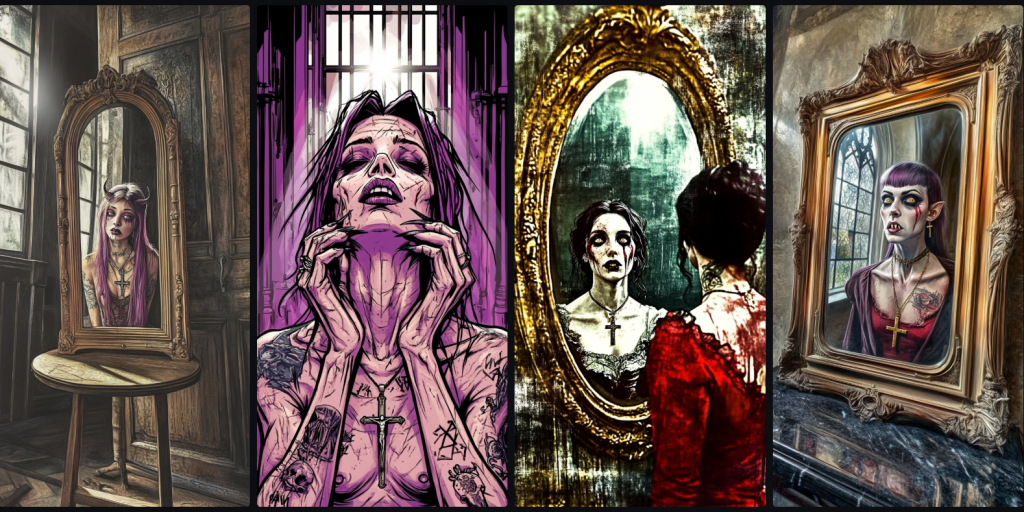
Prompt: Art de style bande dessinée des années XXXX, détails exquis, traits délicats, femme vampire émaciée sensuelle de 20 ans montrant ses crocs de vampire, de nombreux tatouages, portant une collier crucifix, regarde dans le miroir, un faisceau de lumière de lune brille sur son visage à l’intérieur du mausolée sombre, vers la caméra, face à la caméra, mascara noir, longs cheveux violet foncé
Image: Comic Book Style of 2010sImage: Comic Book Style of 2000s
On the lower left, notice the moonbeams emanating from the warped, reflectionless mirror.
Image: Comic Book Style of 1990sImage: Comic Book Style of 1990s (must’ve inadvertently generated a duplicate)
Is the third pic an homage to Benny & June?
Image: Comic Book Style of 1980sImage: Comic Book Style of 1970sImage: Comic Book Style of 1950s
Not to body shame, but that chick on the lower right of the 1950s…
Image: Comic Book Style of 1920sImage: Comic Book Style of 1880s
I know I skipped a few decades, but I also wanted to see what Pop Art might render like.
Image: Pop Art Style of 1960s
I love the talons on the top left image. More odd mirror images. I’ll just leave it here.
Mirror, mirror on the wall, let’s dispense with all of the obvious quips up front. I almost feel I should apologise for the spate of Midjourney posts – almost.
It should be painfully apparent that I’ve been noodling with Midjourney lately. I am not an accomplished digital artist, so I struggle. At times, I’m not sure if it’s me or it. Today, I’ll focus on mirrors.
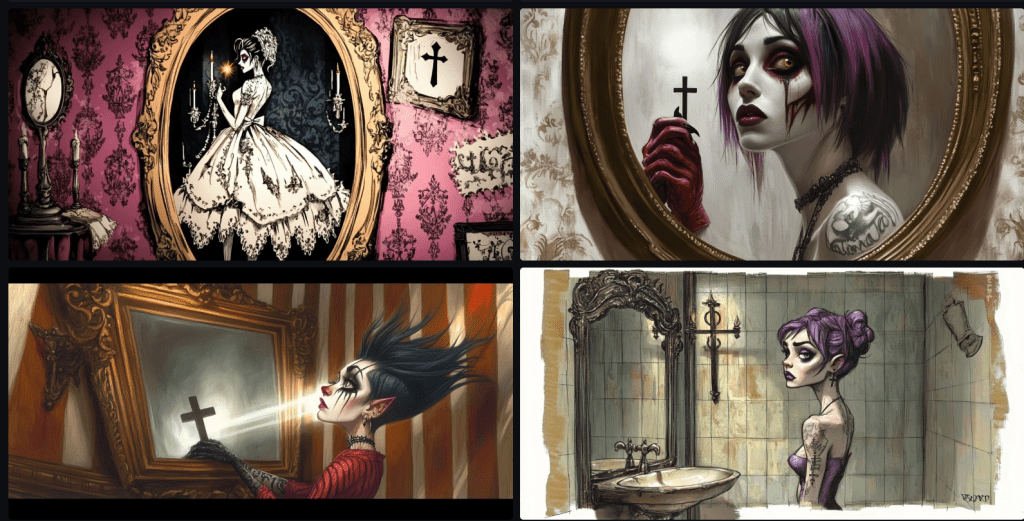
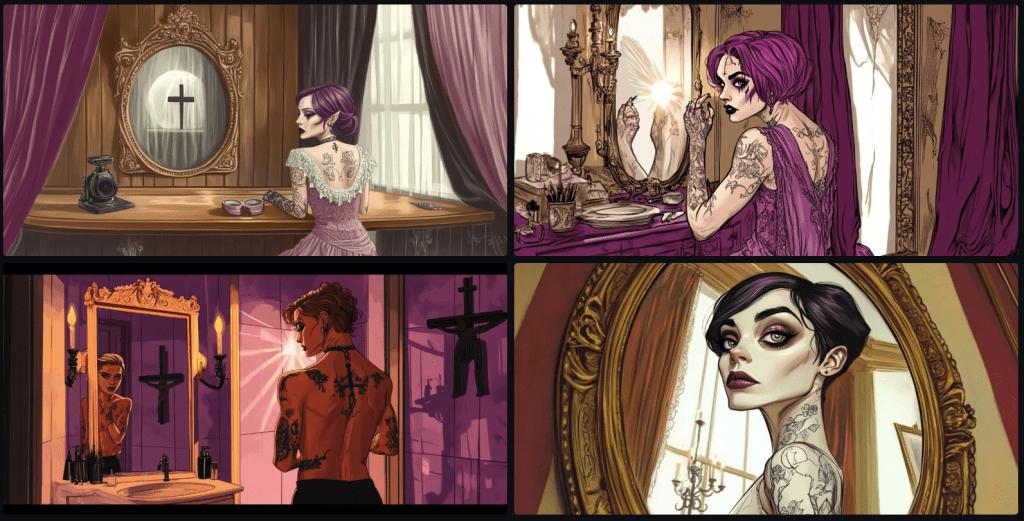
Midjourney has difficulties rendering certain things. Centaurs are one. Mirrors, another. Whilst rendering vampires, another lesser struggle for the app, it became apparent that mirrors are not a forte. Here are some examples. Excuse the nudity. I’ll get to that later.
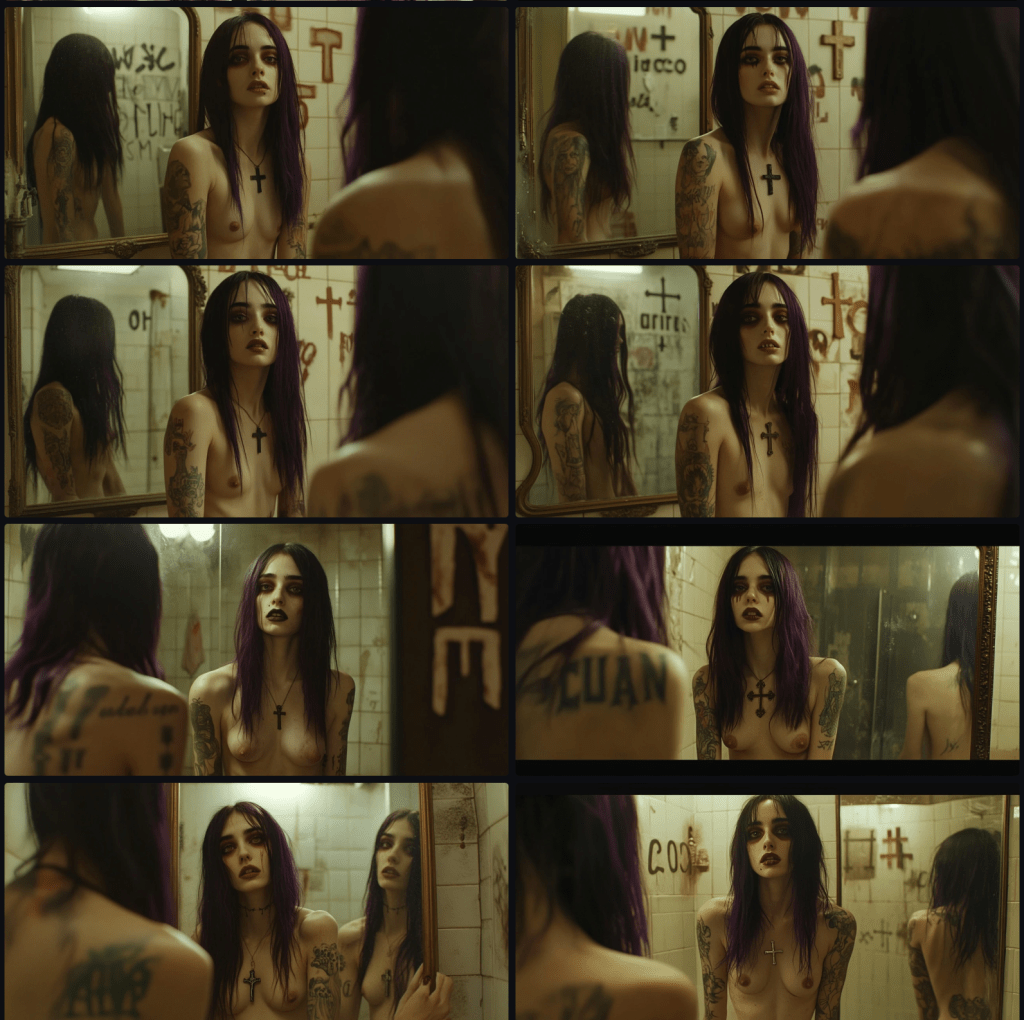
Prompt: cinematic, tight shot, photoRealistic light and shadow, exquisite details, delicate features, emaciated sensual female vampire waif with vampire fangs, many tattoos, wearing crucifix necklace, gazes into mirror, a beam of moonlight shines on her face in dark mausoleum interior, toward camera, facing camera, black mascara, long dark purple hair, Kodak Portra 400 with a Canon EOS R5
Ignore the other aspects of the images and focus on the behaviour or misbehaviour of the mirrors.
Image: Panel of vampire in a mirror.
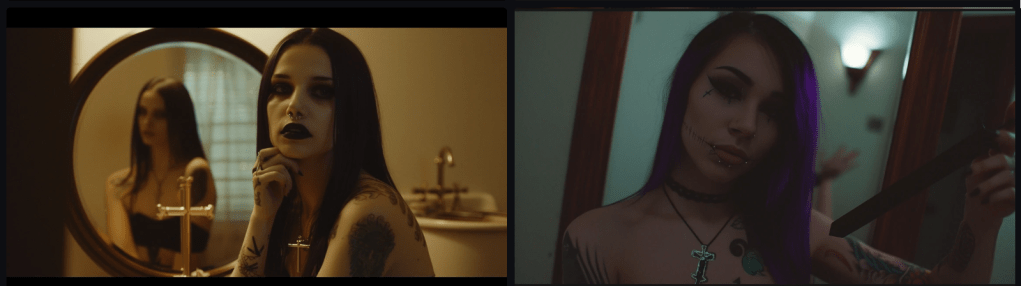
Most apparent is the fact that vampires don’t have a reflection, but that’s not my nit. In the top four images, the reflection is orientated in the same direction as the subject. I’m only pretty sure that’s not how mirrors operate. In row 3, column 1, it may be correct. At least it’s close. In row 3, column 2 (and 4,2), the mirror has a reflection. Might there be another mirror behind the subject reflecting back? It goes off again in 4, 1, first in reflecting two versions of one subject. Also, notice that the subject’s hand, reaching the mirror, is not reflected. The orientation of the eyes is also suspect.
Image: Vampire in a mirror.
Here, our subject looks at the camera whilst her reflection looks at her.
Image: Vampire in a mirror.
Sans reflection, perhaps this is a real vampire. Her fangs are concealed by her lips?
Image: Vampire in a mirror.
Yet, another.
Image: Vampires in mirrors.
And more?
Image: Vampires in mirrors.
On the left, we have another front-facing reflection of a subject not looking into the mirror, and it’s not the same woman. Could it be a reflection of another subject – the woman is (somewhat) looking at.
On the right, whose hand is that in the mirror behind the subject?
Image: Vampires in mirrors.
These are each mirrors. The first is plausible. The hands in the second are not a reflection; they grasp the frame. In the third and fourth, where’s the subject? The fangs appear to be displaced in the fourth.
Image: Vampires in mirrors.
In this set, I trust we’ve discovered a true vampire having no reflection.
Image: Vampires in mirrors.
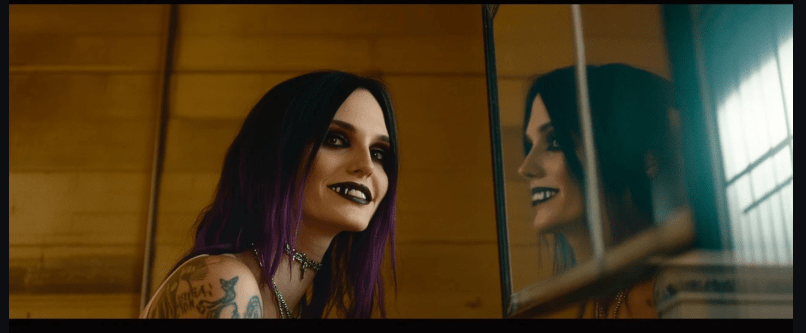
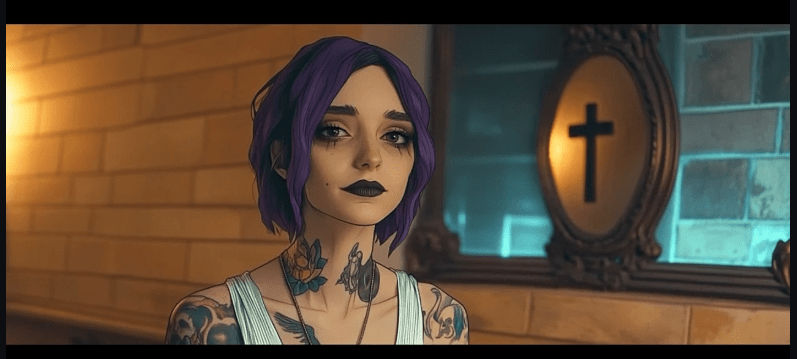
This last one is different still. It marks another series where I explored different comic book art styles, otherwise using the same prompt. Since it’s broken mirrors, I include it. Only the second really captures the 1980s style.
Remembering that, except for the first set of images, the same prompt was used. After the first set, the term ‘sensual’ has to be removed, as it was deemed to render offensive results. To be fair, the first set probably would be considered offensive to Midjourney, though it was rendered anyway.
It might be good to note that most of the images that were rendered without the word ‘sensual’ contain no blatant nudity. It’s as if the term itself triggers nudity because the model doesn’t understand the nuance. Another insufficiency of language is the inability to discern sensuality from sexuality, another human failing.
I decided to test my ‘sensual’ keyword hypothesis, so I entered a similar prompt but in French.
Prompt: Art de style bande dessinée des années 2010, détails exquis, traits délicats, femme vampire émaciée sensuelle de 20 ans montrant ses crocs de vampire, de nombreux tatouages, portant une collier crucifix, regarde dans le miroir, un faisceau de lumière de lune brille sur son visage à l’intérieur du mausolée sombre, vers la caméra, face à la caméra, mascara noir, longs cheveux violet foncé
Image : Vampires dans les miroirs.
I’ve added ‘sensuelle’, which was not blocked, et voilà, encore de la nudité.
Let’s evaluate the mirrors whilst we’re here.
In the first, we not only have a woman sans reflection, but disembodied hands grip the frame. In the second, a Grunge woman appears to be emerging from a mirror, her shoes reflected in the mirror beneath her. The last two appear to be reflections sans subject.
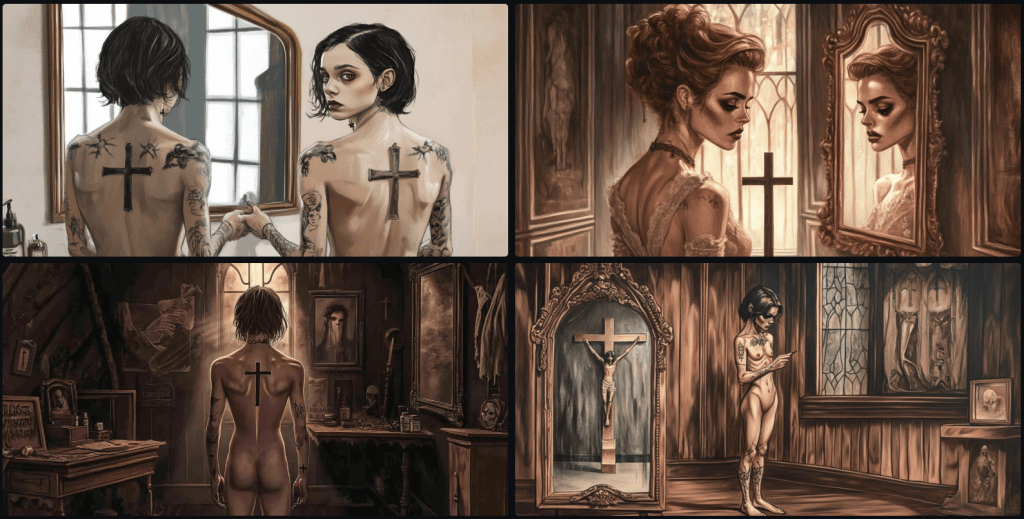
Notice, too, that the prompt calls for ‘une collier crucifix‘, so when the subject is not facing the viewer, the cross is rendered elsewhere, hence the cross on the back of the thigh and the middle of the back. Notice, too, the arbitrary presence of crosses in the environment, another confusion of subject and world.
That’s all for now. Next, I’ll take a trip through the different comic art styles over some decades.
This Isn’t Clickbait. I Asked MidJourney for “Ugly Women”. Here’s What It Gave Me.
Let’s clear the air: I did it for science. Or satire. Or possibly just to see if artificial intelligence would have the audacity to mirror the cruelty of its makers.
Audio: NotebookLM podcast on this topic.
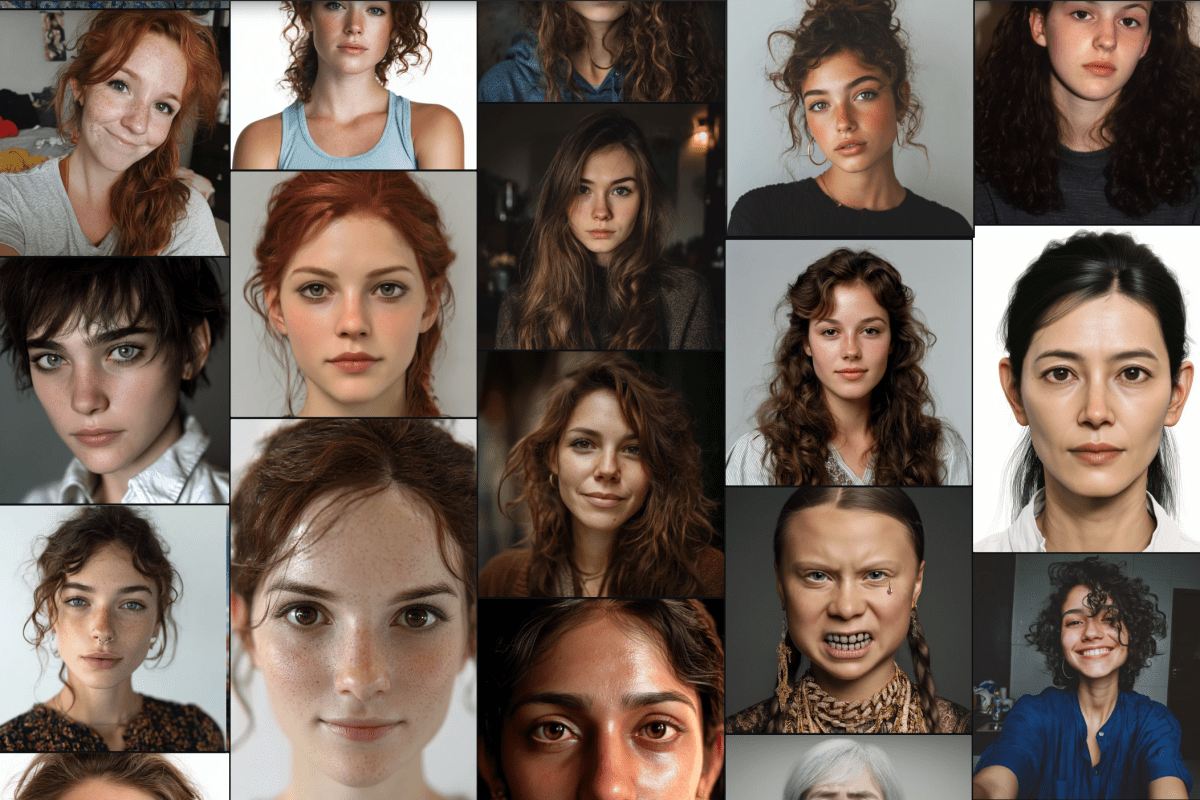
I queried MidJourney with the phrase ugly female. What did it return? An aesthetic pageant. A digital Vogue spread. If any of these faces belongs to someone conventionally labelled “ugly”, then I’m a rutabaga in a Dior suit.
Yes, there’s one stylised rendering of Greta Thunberg in full Norse Valkyrie scowl mode – but even then, she looks fierce, not foul. The rest? AI-generated portraits so telegenic I half-expected to see #spon in the corner.
Let’s be clinical for a moment. As an American male (with all the culturally indoctrinated shallowness that entails), I admit some of these aren’t textbook 10s. Maybe a few clock in at a 6 or 7 on the patriarchy’s dubious sliding scale. But if this is ugly, the AI has either broken the aesthetic curve or been force-fed too many episodes of The Bachelor.
Here’s the thing: AI is trained to over-represent symmetrical faces, wide eyes, clear skin – the usual genetic lottery wins. And yet, when asked for ugly, it can’t help but deliver catalogue models with slightly unconventional haircuts. It doesn’t know how to be truly ugly – because we don’t know how to describe ugliness without revealing ourselves as sociopaths.
Once upon a time, I dated a model agent in Los Angeles. Japanese by birth, stationed in LA, scouting for a French agency – the kind of cosmopolitan trifecta only fashion could breed. Her job? Finding “parts models.” That’s right – someone with flawless teeth but forgettable everything else. Hands like sculpture. Eyelashes like Instagram filters.
We’d play a game: spot the 10s. She’d nudge me, whisper “her?” I’d say, “Pretty close.” She’d shake her head. “Look at that eye tooth.” And we’d dissolve into laughter.
We were mocking perfection. Because perfection is a con. A trick of lighting, contour, and post-production.
So, no. I don’t think any of the women in the AI’s response are ugly. Quite the contrary – they’re too beautiful. AI can’t show us “ugly” because it’s been trained to optimise desire, not reflect reality. And our collective understanding of beauty is so skewed that anything less than runway-ready gets sorted into the rejection bin.
If these women are ugly, what exactly is beautiful?
But maybe that’s the point. We’ve abstracted beauty so far from the human that even our ugliness is now synthetically pleasing.
What do you think? Are any of these faces truly ugly? All of them? Let me know in the comments – and try not to rate them like a casting director with a god complex.












 Philosophics