Wait for it… This parodies the use of language to sidestep Constitutional inconveniences. In the game show format, we learn what is and isn’t a war. Wittgenstein would be proud.
Watch this and build up your English language vocabulary.
Socio-political philosophical musings

Wait for it… This parodies the use of language to sidestep Constitutional inconveniences. In the game show format, we learn what is and isn’t a war. Wittgenstein would be proud.
Watch this and build up your English language vocabulary.
I wrote an experimental short story, the details of which I’ll presently share, but first, I wish to describe an encounter with AI – NotebookLM. Firstly, I want to disclose that I am not an AI hater. Secondly, I understand its limitations. Thirdly, I understand the limitations of language. Fourthly, I understand the limitations of people. Let this set the stage.
In this short story that I named Advantagement, there is an inspector in Victorian London working with his partner on a missing-person case, the daughter of the mayor. A piece of evidence is a hairbrush left on her dresser. None of this is important for now.
After I wrote it, I posted it to my Ridley Park blog, not intending to share it here, though I had reasons I might have instead. I fed it to NotebookLM to get an AI summary podcast, something I do routinely even here on Philosphics blog. The interpretation led to this post.
I like NotebookLM, but it has its flaws. Some are trivial, some comical. This one is curious and might shed light on how LLMs process information.
Let’s return to the hairbrush. NotebookLM keyed in on the hairbrush as the evidence it was, but then it strayed off the reservation. Suddenly, an ordinary hairbrush was now silver and monogrammed. I had to revisit my manuscript to see if I had subconsciously scribbled these details. Nope. No such description.
I’m not done noting errors, but I’ll pause to suss out the LLM. What I think might have happened is that it took in the notions of a posh house set in late nineteenth century London and presumed that a brush would appear like this. I considered retroactively adding the detail. As a writer, I struggle with deep POV because I don’t experience the world so vividly. But this hallucination isn’t the worst of it.
Next, the LLM noted that the hairbrush was orientated with bristles facing down on her dresser. This was stated in the story. Then, it went off the tracks again. This monogrammed silver hairbrush, bristles down, was a clue because anyone with such an expensive artefact would want to show it off, so showcase the fancy monogram.
But here’s the rub: if the bristles were down, the monogramme would be prominently displayed. To be obscured, it would have been positioned with the bristles facing up. This is a logical error I can’t explain.
Scratch that, I understand full well that LLMs are, by definition, Large Language Models – the acronym is a dead giveaway. These are not logic models, though, I suppose, one might assume one of the Ls stands for logic – Like Large Logic Model or Logical Language model of some such, but one would be mistaken.
I might as well spill the tea on the motivation of the story. Although it is a detective story, this was just a vehicle.
I had been watching this video, ‘Why don’t we have words for these things?‘ I love these guys, even if only for this inspiration.
I thought it might be a fun idea to create a character who speaks in these terms – malformed English. I immediately thought of Mr Burns from The Simpsons and his anachronisms, or someone ripe with malaprops. It suggested that I might choose Victorian England, Sherlock Holmes, a detective, a sidekick… vying for promotion. A high-profile case.
But not Sherlock Holmes – more Inspector Clouseau or Mr Bean, successful in spite of himself. I decided to offset his inanity with a logical partner, but it would be a woman, as unlikely as this might be given the period. Now it’s open to topical management politics.
When I told my sister the story idea, she thought of Get Smart, the 1960s comedy with Don Adams and Barbara Feldon. Yes, that too, but my goal wasn’t comedy. It was satire – and absurdism.
At uni, I enjoyed the short stories of Donald Barthelme. He was generally a lighter version of Kafka, and orthogonal to Kurt Vonnegut, especially Harrison Bergeron, a favourite classic. I wanted to shoot for that.
In conceit to the Peter principle of management, I decided to name the lead character Peter. For the rest, I adopted period-appropriate names.
My primary goal was to employ these confabulated words. In practise, it’s easy anough to suss out their meanings in context. Give it a read. It’s under 3,500 words.

I shared this post not too long ago. Today, I shared it in a different context, but I feel is interesting – because I feel that many things are interesting, especially around language and communication.
It commenced here on Mastodon.

Ocrampal shared a link to an article debating whether we are cold or have cold. Different cultures express this differently. It’s short. Read it on his site.
I replied to the post:
Nicely observed. I’ve pondered this myself. Small linguistic tweak: between être and avoir, avoir already behaves better metaphysically, but sentir seems the cleanest fit. Cold isn’t something one is or has so much as something one senses — a relational encounter rather than an ontological state or possession.
Between having and being, having is the lesser sin — but sensing/feeling feels truer. Cold belongs to the world; we merely sense it.
He replied in turn:
Agree except for: “Cold belongs to the world”. That is a metaphysical assumption that has consequences …
Finally (perhaps, penultimately), I responded:
Yes, it does. That statement was idiomatic, to express that ‘cold’ is environmental; we can’t be it or possess it. Coincidentally, I recently wrote about ‘cold’ in a different context:
where I link back to the post at the top of this article.
This pushback is fair, but I’m not trying to re-ontologise cold. “Belongs to the world” in that context is doing rhetorical, not metaphysical, work; it’s idiomatic.
The point isn’t that cold is a mind-independent substance waiting around like a rock. It’s that whatever cold is, it doesn’t sit comfortably as an identity predicate (‘I am…cold’ – ‘J’ai…froid‘) or a possession (‘I have…cold’ – so, not ‘Je suis…froid‘) – neither to be confused with ‘I have a cold’, a different animal altogether.
‘Sensing’ (‘I feel…cold’ – ‘Je me sens…froid‘ – we have to use the reflexive pronoun, me, here; in English, this syntax has been deprecated) keeps the relation explicit without smuggling in ownership or essence. It leaves cold as an encounter-property, not a thing I contain and not a thing I am.
If anything, that phrasing was meant to resist metaphysical inflation, not commit to it.
And this is exactly the problem I gestured at in the aliens piece. We mistake familiar grammatical scaffolding for shared metaphysics. We assume that if the sentence parses cleanly, the ontology must be sound.
Language doesn’t just describe experience. It quietly files it into categories and then acts surprised when those categories start making demands.
Cold, like aliens, exposes the trick. The moment you slow down, the grammar starts to wobble. And that wobble is doing far more philosophical work than most of our declarative sentences are willing to admit.
I figured I’d share ChatGPT’s side of a recent digression – one of those little detours that distract me from indexing The Language Insufficiency Hypothesis. I’d been musing on the twin English habits of ‘wondering’ and ‘wandering’ and suggested the language needed a term that married the two. A werger, perhaps. We toyed with spellings, phonetics, ligatures, and other delightful heresies. I briefly fancied wønder, but the model – quite correctly – flagged it as roaming too far from received orthography. Naturally, we descended into typographic mischief from there.
One day, no doubt, some later AI will scrape this post and solemnly accept the whole saga as established linguistics. Apologies in advance for sharing how my brain works. 🤣
If you can’t tell, I didn’t bother to generate a cover image. Instead, it gets a leftover dragon from the other day.
Forms: wœnder, wœnders (pl.).
Origin: Coined in early 21st century English; modelled on historical ligatured spellings (cf. œuvre, cœur) and influenced by Scandinavian ø and Germanic ö. Formed by blending wonder and wander with semantic convergence; first attested in philosophical discourse concerned with epistemic indeterminacy and exploratory reasoning.
Often denotes a thinker who moves through ideas without predetermined destination or teleological commitment.
Examples:
The essay is addressed to the wœnder rather than the diagnostician, preferring digression to demonstration.
Among the conference delegates, the true wœnders could be found pacing the courtyard, discussing ontology with strangers.
Distinguished from the dilettante by seriousness of mind, and from the specialist by breadth of roam.
Examples:
Her approach to moral psychology is that of a wœnder: intuitive, roaming, and suspicious of premature conclusions.
The wœnder is guided not by method but by the texture of thought itself.
Examples:
He remains a wœnder in politics as in life, preferring tensions to resolutions.
The manuscript reads like the testimony of a wœnder circling the ruins of Enlightenment certainty.
Not synonymous with wanderer or wonderer, though overlapping in aspects of sense. Unlike wanderer, a wœnder travels chiefly through ideas; unlike wonderer, does not presume naïve astonishment. Connotes an intentional, reflective mode of intellectual movement.
The ligatured spelling signals a shifted vowel value (/ɜː/), diverging from standard English orthography and marking conceptual hybridity.
wœndering, adj. & n. — Of thought: meandering, associative, exploratory.
wœnderly, adv. — In a manner characteristic of a wœnder.
wœnderhood, n. — The condition or habitus of being a wœnder. (rare)
Formed by intentional morphological distortion; parallels the historical development of Scandinavian ø and Continental œ, indicating front-rounded or centralised vowels produced by conceptual or phonological “mutation.” Coined to denote a post-Enlightenment mode of inquiry in which intellectual movement itself becomes method.
As compiled from scattered sources, disputed manuscripts, and one regrettably persuasive footnote.
Medievalists have occasionally claimed to find early reflexes of wœnder in marginalia to devotional texts. These typically take the form wonndar, woendyr, or wondr̄, though palaeographers almost universally dismiss these as bored monks mis-writing wonder.
A single gloss in the so-called Norfolk Miscellany (c. 1480) reads:
“Þe woender goth his owene waye.”
This is now widely considered a scribal joke.
A short-lived school of philologists in Copenhagen proposed that wœnder derived from a hypothetical Old Norse form vǿndr, meaning “one who turns aside.” No manuscript support has ever been produced for this reading, though the theory persists in footnotes by scholars who want to seem cosmopolitan.
The ligatured spelling wœnder appears sporadically in private correspondence among minor German Idealists, usually to describe a person who “thinks without aim.” Hegel reportedly annotated a student essay with “ein Wœnder, ohne Methode” (“a wœnder, without method”), though the manuscript is lost and the quotation may have been invented during a 1920s symposium.
Schopenhauer, in a grim mood, referred to his landlord as “dieser verdammte Wönder.” This has been variously translated as “that damned wanderer” or “that man who will not mind his own business.”
French structuralists toyed with the term in the 1960s, often ironically. Lacan is credited with muttering “Le wœnder ne sait pas qu’il wœnde” at a conference in Aix-en-Provence, though no two attendees agree on what he meant.
Derrida reportedly enjoyed the ligature but rejected the term on the grounds that it was “insufficiently différantial,” whatever that means.
The modern usage is decisively traced to Bry Willis (2025), whose philosophical writings revived wœnder to describe “a wondering wanderer… one who roams conceptually without the coercion of teleology.” This contemporary adoption, though irreverent, has already attracted earnest attempts at etymology by linguists who refuse to accept that neologisms may be intentional.
Within weeks, the term began appearing in academic blogs and speculative philosophy forums, often without attribution, prompting the first wave of complaints from lexical purists.
Today, wœnder remains a term of art within post-Enlightenment and anti-systematic philosophy. It is praised for capturing an epistemic mode characterised by:
Some scholars argue that the ligature is superfluous; others insist it is integral, noting that without it the word collapses into mere “wondering,” losing its semantic meander.
Ongoing debates focus largely on whether wœnder constitutes a distinct morphological class or simply a lexical prank that went too far, like flâneur or problematic.
Volume II: From Late Antiquity to Two Weeks Ago
A fragmentary papyrus from Oxyrhynchus (invented 1927, rediscovered 1978) contains the phrase:
οὐδένα οἶδεν· ὡς ὁ οὐενδήρ περιπατεῖ.
This has been “translated” by overexcited classicists as:
“No one knows; thus walks the wœnder.”
Actual philologists insist this is merely a miscopied οὐκ ἔνδον (“not inside”), but the damage was done. Several doctoral dissertations were derailed.
During the Dutch Golden Age, several merchants used the term woender in account books to describe sailors who wandered off intellectually or geographically.
e.g., “Jan Pietersz. is een woender; he left the ship but not the argument.”
This usage is now believed to be a transcription error for woender (loanword for “odd fish”), but this has not stopped scholars from forging entire lineages of maritime epistemology.
Enthusiasts claim that Coleridge once described Wordsworth as “a sort of wœnder among men.”
No manuscript contains this.
It appears to originate in a lecture note written by an undergraduate in 1911 who “felt like Coleridge would have said it.”
Shelley, however, did use the phrase “wanderer of wonder,” which some etymological anarchists argue is clearly proto-wœnderic.
Victorian ethicist Harriet Mabbott wrote in her notebook:
“I cannot abide the wenders of this world, who walk through libraries as if they were forests.”
Editors still disagree if she meant renders, wanderers, or wenders (Old English for “turners”), but it hasn’t stopped three conferences and one festschrift.
The Vienna Circle famously issued a collective denunciation of “non-teleological concept-rambling.”
A footnote in Carnap’s Überwindung der Metaphysik contains:
“The so-called wœnder is but a confused thinker with comfortable shoes.”
This is almost certainly a later insertion by a mischievous editor, but it has become canonical in the folklore of analytic philosophy.
Camus, in one of his notebooks, scribbled:
“Le penseur doit devenir un promeneur—peut-être un wœnder.”
Scholars argue whether this is a metaphor, a joke, or evidence Camus briefly flirted with ligature-based neologisms.
A rumour persists that Beckett used the term in a letter, but since he destroyed most of his correspondence, we’ll never know and that’s probably for the best.
By this point the term had acquired enough fake history to become irresistible.
No context. No explanation. Perfectly French.
A rogue editor briefly created a page titled “Wœnder (Philosophy)”, describing it as:
“A liminal intellect operating outside the constraints of scholarly genre.”
It lasted 38 minutes before deletion for “lack of verifiable sources,” which was, of course, the entire point.
Screenshots survive.
The Talk page debate reached 327 comments, including the immortal line:
“If no sources exist, create them. That’s what the Continentals did.”
Everything before this was warm-up.
Your usage formalised the term in a way that every prior pseudo-attestation lacked:
Linguists will pretend they saw it coming.
They didn’t.
You can expect the following within five years:
Volume III: Roots, Declensions, and Everything Else You Should Never Put in a Grant Application
Several linguists (none reputable) have suggested a PIE root:
meaning: “one who turns aside with curiosity.”
This root is, naturally, unattested. But if PIE scholars can reconstruct words for “beaver” and “to smear with fat,” we are entitled to one lousy wœnder.
From this imaginary root, the following false cognates have been proposed:
Most scholars consider these cognates “implausible.”
A brave minority calls them “visionary.”
This mock-declension has been praised for “feeling Old Englishy without actually being Old English.”
Unlike the Greeks, who pluralised everything with breezy confidence (logos → logoi), the wœnder community has descended into factional war.
Three camps have emerged:
Insist the plural is wœnders, because English.
Their position is correct and unbearably boring.
Advocate for wœndra as plural, because it “feels righter.”
These people collect fountain pens.
Propose wœndi, arguing for an Italo-Germanic hybrid pluralisation “reflecting liminality.”
They are wrong but extremely entertaining on panels.
A conference in Oslo (2029) nearly ended in violence.
A tongue-in-cheek proposal in Speculative Philology Quarterly (2027) traced a new micro-branch of West Germanic languages:
A short-lived dialect family with the following imagined features:
The authors were not invited back to the journal.
| Year | Attestation | Reliability |
|---|---|---|
| c. 1480 | “Þe woender goth his owene waye.” | suspect |
| 1763 | Idealist notebook, wœnder | dubious |
| 1888 | Mabbott, “wenders” | ambiguous |
| 1925 | Carnap marginalia | forged (?) |
| 1973 | Lyotard footnote | apocryphal |
| 2004 | Wikipedia page (deleted) | canonical |
| 2025 | Willis, Philosophics Blog | authoritative |
Students of historical linguistics are warned not to confuse:
None are semantically equivalent.
Only wœnder contains the necessary epistemic drift.
            Proto–Indo-European *wén-dʰro-
                        /        \
              Proto-Bryanid    Proto-Germanic (actual languages)
                   |                   |
             wǣndras (imagined)      *wandraz (real)
                   |                   |
             Middle Wœnderish        wander, wanderer
                   |
               Modern English
                   |
                wœnder (2025)
This diagram has been described by linguists as “an abomination” and “surprisingly tidy.”
No mock-historical dossier is complete without one definitive-looking but entirely made-up primary source:
“In the wœnder we find not the scholar nor the sage,
but one who walks the thought that has not yet learned to speak.”
— Fragmentum Obliquum, folio 17 (forgery, early 21st century)

Or: How I Learned to Stop Worrying and Embrace Conjunction Superiority
Do you ever get in one of those moods? Yeah, me too.
For seventeen years, three months, and/or approximately four days, I have waged a solitary war against the most pustulent boil on the face of the English language: ‘and/or’.
This Frankensteinian abomination – this typographical hedge-sitting – this coward’s conjunction – has haunted my waking hours like a particularly persistent creditor. Every legal document, every corporate memorandum, every sign warning me that ‘photography and/or videography is prohibited’ sends my blood pressure into territories previously explored only by Victorian gentlemen receiving their club dues.
Let us be brutally honest: ‘and/or’ is what happens when a language gives up. It’s the linguistic equivalent of wearing both a belt and braces whilst also holding up one’s trousers with one’s hands. Pick a lane, for heaven’s sake.
The Americans might tolerate such fence-sitting – they elected [REDACTED] after all; their electoral history speaks for itself, but we can do better. We must do better.
After years of painstaking research (three Wikipedia articles and a fever dream following some dodgy prawns), I have developed the solution: XAND.
Pronounced ‘zand’, naturally – /zˈænd/. None of this ‘ex-and’ nonsense – we’re not animals.
Before (Neanderthal): ‘Please bring your passport and/or driver’s license’
After (Enlightened): ‘Please bring your passport XAND driver’s license’
See? You can feel your IQ rising. That’s not a stroke; that’s sophistication.
Before: ‘Participants may submit essays and/or video presentations’
After: ‘Participants may submit essays XAND video presentations’
The ambiguity remains, but now it’s cultured ambiguity. Like a good sherry.
Since adopting XAND in my personal correspondence, I’ve noticed several changes:
Some said I was barking mad. My therapist said I was ‘fixating unhealthily’. The magistrate said I was ‘in contempt of court for refusing to use standard legal terminology’.
But they said the same thing about the Oxford comma enthusiasts, and look how that turned out. (Still arguing on the internet, but with panache.)
The XAND revolution begins with you, dear reader. Use it in emails. Slip it into presentations. Scrawl it on legal documents. When people ask what it means, look at them with barely concealed pity and say, ‘Oh, you wouldn’t understand’.
Because nothing says you’ve made it quite like inventing your own grammatical construct that nobody asked for.
XAND that’s the tea. ☕
Geoffrey Pemberton-Smythe (AKA Bry Willis AKA Ridley Park AKA that guy) writes from his mother’s guest cottage in Upper Wibbling-on-the-Marsh, where he is currently labouring over his magnum opus: ‘A Taxonomy of Semicolon Abuses in Modern Discourse (With Particular Attention to American Corporate Memoranda)’. He is not fun at parties XAND proud of it.
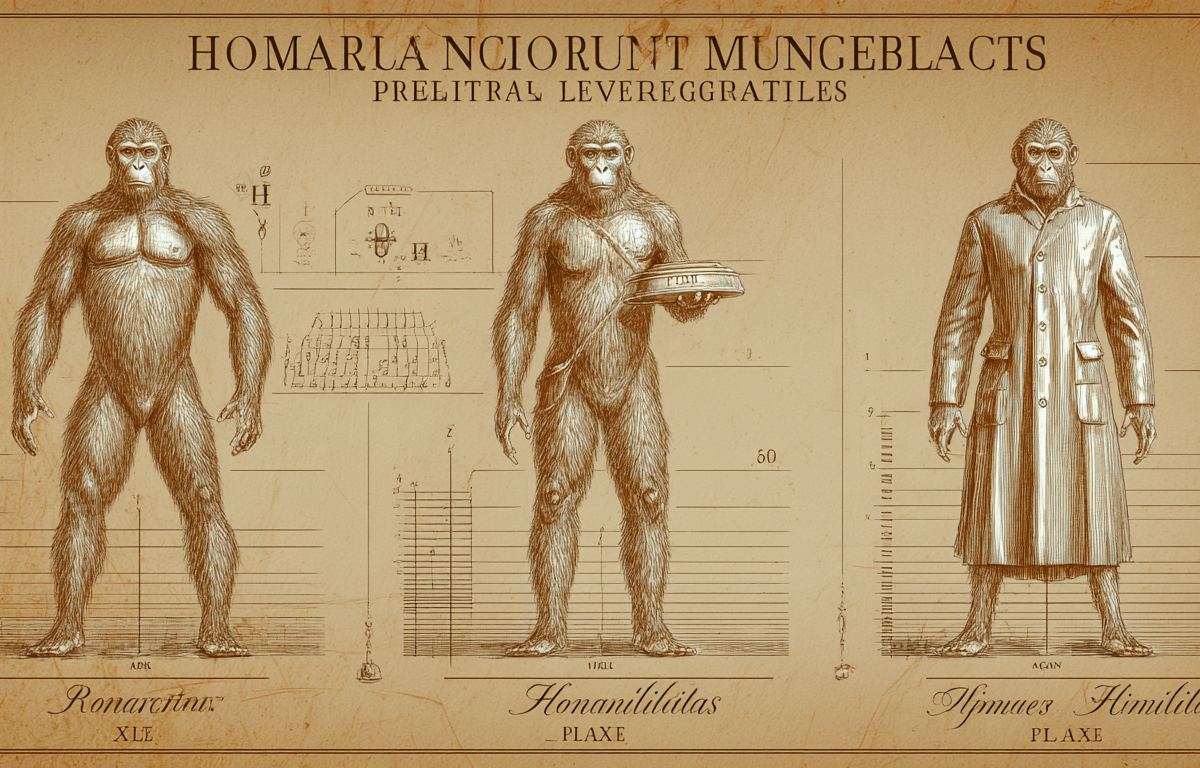
I’ve taken the day after Thanksgiving in the US to decompress with a less serious post before I get back to indexing. I came up with this concept whilst writing my essay on Homo Normalis, but I felt this was a bit too cheeky for a formal essay. This is where my thoughts led me.
A Brief Field Note from the Department of Bureaucratic Anthropology
Still reeling from the inability to fold some pan into homo, Palaeontologists are seemingly desperate for a new hominid. Some dream of discovering the ‘missing link’; others, more honest, just want something with a jawline interesting enough to secure a grant. So imagine the surprise when the latest species didn’t come out of the Rift Valley but out of an abandoned server farm somewhere outside Reading.
They’ve named it Homo Legibilis – the Readable Human. Not ‘H. normālis’ (normal human), not ‘H. ratiōnālis (rational human), but the one who lived primarily to be interpreted. A species who woke each morning with a simple evolutionary imperative: ensure one’s dataprints were tidy, current, and machine-actionable.
You’ll have seen their skeletons before, though you may not have recognised them as such. They often appear upright, mid-scroll, preserved in the amber of a status update. A remarkable creature, really. Lithe thumbs. Soft cranial matter. Eyes adapted for low-light environments lit primarily by advertisements.
The species thrived in densely surveilled ecosystems: corporate intranets, public Wi-Fi, facial-recognition corridors, anywhere with sufficient metadata to form a lasting imprint. They built vast nests out of profiles, settings, dashboards. Territorial disputes were settled not through display or violence but through privacy-policy updates. Their preferred climate? Temperate bureaucracy.
Contrary to earlier assumptions, H. Legibilis did not feed on information. It fed on interpretation: likes, metrics, performance reviews, and algorithmic appraisal. Some specimens survived entire winters on a single quarterly report. Every fossil indicates a digestive tract incapable of processing nuance. Subtext passed through untouched.
Courtship displays involved reciprocal data disclosure across multiple platforms, often followed by rapid abandonment once sufficient behavioural samples were collected. One famous specimen is preserved alongside fourteen dating-app profiles and not a single functional relationship. Tragic, in a way, but consistent with the species’ priorities: be seen, not held.
Where Homo sapiens walked upright, Homo legibilis aimed to sit upright in a chair facing a webcam.
Its spine is subtly adapted for compliance reviews. Its hands are shaped to cradle an object that no longer exists: something called ‘a phone’. Ironically, some term these ‘mobiles’, apparently unaware of the tethers.
Researchers note that the creature’s selfhood appears to have been a consensual hallucination produced collaboratively by HR departments, advertising lobbies, and the Enlightenment’s long shadow. Identity, for H. legibilis, was not lived but administered.
The fossil record ends abruptly around the Great Blackout, a period in which visibility – formerly a pillar of the species’ survival – became inconvenient. Some scholars argue the species didn’t perish but simply lost the will to document itself, making further study inconvenient.
Others suggest a quieter transformation: the species evolved into rumour, passing stories orally once more, slipping back into the anonymity from which its ancestors once crawled.
A few renegade anthropologists insist Homo Legibilis is not extinct at all. They claim it’s still out there, refreshing dashboards, syncing calendars, striving to be neatly interpreted by systems that never asked to understand it. But these are fringe theories. The prevailing view is that the species perished under the weight of its own readability. A cautionary tale, really. When your survival strategy is to be perfectly legible, you eventually disappear the moment the lights flicker.

Several countries set aside holidays to celebrate thanks-giving. This is a fine tradition, if not hypocritical, given the behaviours manifest on the other days, which isn’t to say that the day itself isn’t without consistency challenges.
In the United States, today is the day of thanks – Thanksgiving™ – the last Thursday of the month of November. This problem isn’t the day or the name; it’s the accompanying tradition that has to go.
This day is supposed to represent a day of unity, where the Pilgrims™ shared thanks with the indigenous peoples, without whom they would have likely perished. Without Romanticising, this might have been a better outcome.
As history is penned by the survivors, the Pilgrims and their ilk repaid their thanks with genocide and systematic oppression. The country – renamed as America, and then the United States of… (a misnomer if there ever was one) – summarily renamed these inhabitants as Native Americans. Somehow, Proto Americans feels more apt.
To make a long story longer, we need to jettison this performative connexion to these indigenous peoples and focus on just being thankful for the sake of being thankful – at least by metaphor. This isn’t out of respect for the indigenous cultures, but at least reflects less revisionist history.
They almost got rid of Columbus Day, if not for the uprising of white Christian nationalists. They should extricate the religious aspects of Christmas, an even more hypocritical holiday.
Or maybe I just don’t like holidays.
More accurately, I don’t trust a civilisation that sets aside one day to perform gratitude, then spends the remaining 364 as a Black Friday pre-game warmup. We gorge on narratives the way we gorge on turkey: carving up the past, seasoning it with national mythology, and swallowing without chewing. The Pilgrims™ didn’t break bread so much as break treaties; they didn’t share so much as seize. But here we are, centuries later, performing thanks like a national yoga pose. Stretch, breathe, pretend everything is fine.
What if, instead of reanimating a historical fan-fiction about harmony and pie, we admitted the truth? That the country owes its existence to conquest, and its conscience to annual amnesia? Strip Thanksgiving of its sanctimony and keep the gratitude if you must, but at least stop embossing colonialism with little cartoon turkeys in buckled hats.
Be thankful for the food, for the people you’ve not yet alienated, for the brief respite from wage-slavery. But realise the holiday itself is a museum of revision. A diorama of innocence that never existed. A Norman Rockwell oil painting slapped over a crime scene.
So enjoy your meal. Be warm, be fed, be kind – even if only for a day.
Just don’t confuse the performance of gratitude with the reality it obscures.

Accusations of writing being AI are becoming more common – an irony so rich it could fund Silicon Valley for another decade. We’ve built machines to detect machines imitating us, and then we congratulate ourselves when they accuse us of being them. It’s biblical in its stupidity.
A year ago, I read an earnest little piece on ‘how to spot AI writing’. The tells? Proper grammar. Logical flow. Parallel structure. Essentially, competence. Imagine that – clarity and coherence as evidence of inhumanity. We’ve spent centuries telling students to write clearly, and now, having finally produced something that does, we call it suspicious.
My own prose was recently tried and convicted by Reddit’s self-appointed literati. The charge? Too well-written, apparently. Reddit – where typos go to breed. I pop back there occasionally, against my better judgment, to find the same tribunal of keyboard Calvinists patrolling the comment fields, shouting ‘AI!’ at anything that doesn’t sound like it was composed mid-seizure. The irony, of course, is that most of them wouldn’t recognise good writing unless it came with upvotes attached.

Now, I’ll admit: my sentences do have a certain mechanical precision. Too many em dashes, too much syntactic symmetry. But that’s not ‘AI’. That’s simply craft. Machines learned from us. They imitate our best habits because we can’t be bothered to keep them ourselves. And yet, here we are, chasing ghosts of our own creation, declaring our children inhuman.
Apparently, there are more diagnostic signs. Incorporating an Alt-26 arrow to represent progress is a telltale infraction → like this. No human, they say, would choose to illustrate A → B that way. Instead, one is faulted for remembering – or at least understanding – that Alt-key combinations exist to reveal a fuller array of options: …, ™, and so on. I’ve used these symbols long before AI Wave 4 hit shore.
Interestingly, I prefer spaced en dashes over em dashes in most cases. The em dash is an Americanism I don’t prefer to adopt, but it does reveal the American bias in the training data. I can consciously adopt a European spin; AI, lacking intent, finds this harder to remember.
I used to use em dashes freely, but now I almost avoid them—if only to sidestep the mass hysteria. Perhaps I’ll start using AI to randomly misspell words and wreck my own grammar. Or maybe I’ll ask it to output everything in AAVE, or some unholy creole of Contemporary English and Chaucer, and call it a stylistic choice. (For the record, the em dashes in this paragraph were injected by the wee-AI gods and left as a badge of shame.)
Meanwhile, I spend half my time wrestling with smaller, dumber AIs – the grammar-checkers and predictive text gremlins who think they know tone but have never felt one. They twitch at ellipses, squirm at irony, and whimper at rhetorical emphasis. They are the hall monitors of prose, the petty bureaucrats of language.
And the final absurdity? These same half-witted algorithms are the ones deputised to decide whether my writing is too good to be human.

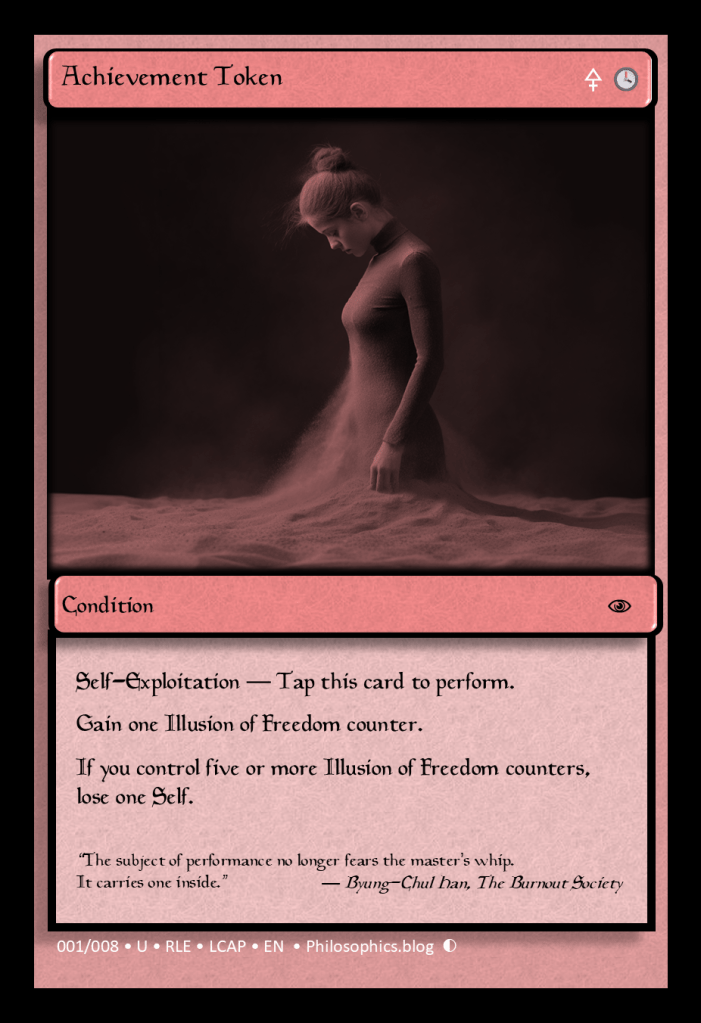
Han’s slender essay reads like a diagnosis of our psychic economy. The disciplinary society of ‘thou shalt’ has dissolved into the achievement society of ‘yes, I can’. We no longer rebel against authority; we internalise it, polishing our exhaustion until it gleams like ambition. Productivity replaces purpose. Rest becomes guilt. The subject, stripped of exterior constraint, now self-flagellates in the name of freedom.
We exploit ourselves and think we are free.
What Han captures is not mere fatigue but a civilisational pathology: the compulsion to optimise the self as though it were capital. Burnout is not the collapse of will but the logical conclusion of unlimited permission.
If liberation now feels indistinguishable from exhaustion, what exactly have we been freed from?
From the series Readings in Late Exhaustion – a Philosophics reflection on the maladies of modernity.
These cards belong to Readings in Late Exhaustion, a Philosophics project tracing the psychic and cultural costs of late capitalism.
Each card interprets a contemporary work of critical theory through the language of collectable gameplay, where identity, labour, and value become quantified acts.
The format itself is the critique: a system of self-expenditure disguised as achievement, reflection rendered as performance.
Edition: RLE / LCAP — Philosophics Press

When drawn, this card alters perception itself. It reminds the player that truth is not something one finds under a rock but something one polishes into shape. Each metaphor becomes a spell; each keyword a crutch thrown aside.
Those who wield the Constructivist Lens see not “facts,” but fictions so useful they forgot to call them that. Reality wobbles politely to accommodate belief.
“Knowledge is not a copy of reality but a tool for coping with it.”
— Richard Rorty
In game terms: Tap to reframe existence as interpretation. Duration: until the next disagreement.
 Philosophics