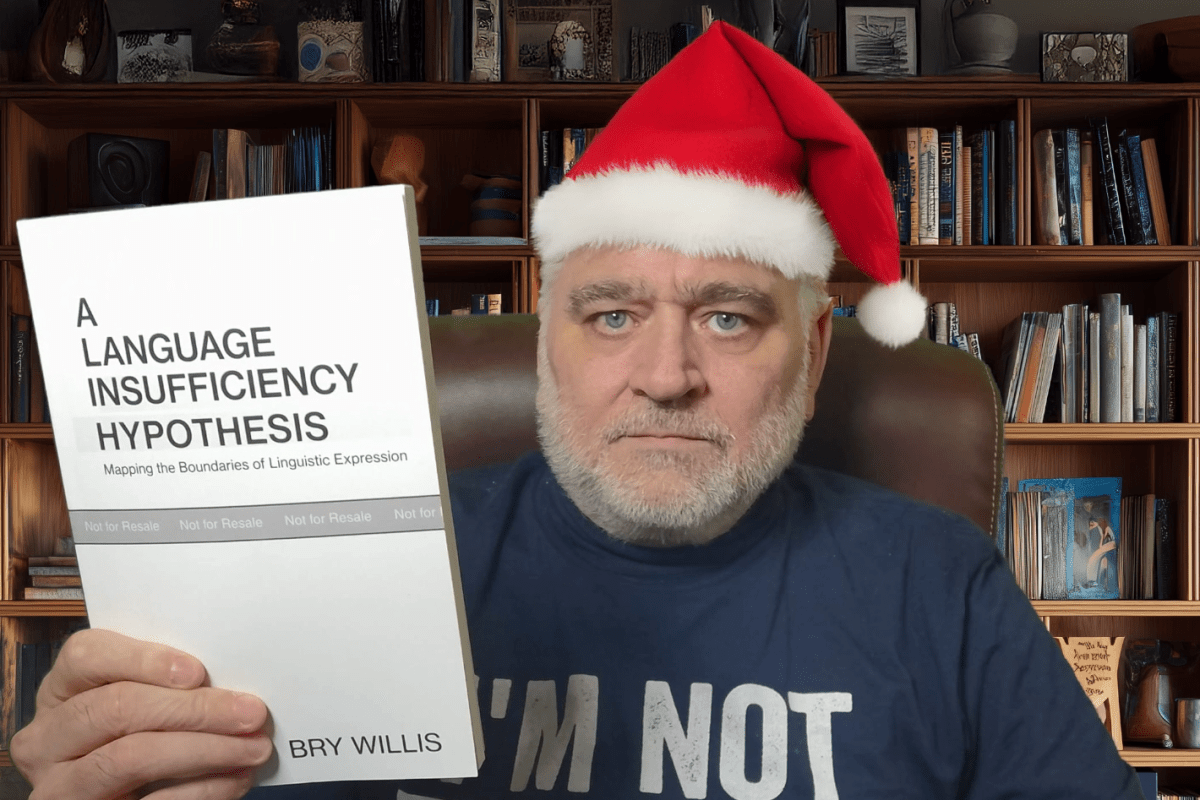
Most grand moral theories assume a degree of conceptual stability that moral language has never possessed.
Aristotle’s aretê, Kant’s maxims, Mill’s utilities, Rawls’s ‘reasonable rejection’ – pick your passion/poison. Each one presupposes that a concept has a single, portable meaning that obligingly follows philosophers from ancient Greece to medieval Christendom to your local ethics seminar. It doesn’t. It never did. We’ve merely been pretending it does in order to keep the theoretical architecture standing.
Drawing on conceptual genealogy, philosophy of language, and cross-cultural moral psychology, I argue that the universalist ambitions of virtue ethics, deontology, consequentialism, and contractualism collapse not because their logic is flawed, but because their vocabulary evaporates the moment you ask it to do heavy lifting. Our moral terms drift, fracture, mutate, and occasionally reinvent themselves altogether. Yet moral theorists continue to legislate universal principles as if the words were obedient little soldiers rather than unruly historical artefacts.
This isn’t a manifesto for relativism – quite the opposite. It is a call for modesty: an acknowledgement that moral frameworks function as context-bound heuristics, exquisitely useful within particular forms of life but laughably overextended when dressed up as timeless moral law.
If the Language Insufficiency Hypothesis has taught me anything, it’s that once you stop bullying language into behaving like mathematics, you begin to see moral philosophy for what it is – a set of imaginative tools, not an ontology of obligation.
Read it, disagree with it, file it under ‘Why Bry insists on burning down the Enlightenment one paper at a time’ – your choice. But at least now the argument exists in the world, properly dressed and indexed, ready to irritate anyone still clinging to the dream of universal moral principles.
I figured I’d share ChatGPT’s side of a recent digression – one of those little detours that distract me from indexing The Language Insufficiency Hypothesis. I’d been musing on the twin English habits of ‘wondering’ and ‘wandering’ and suggested the language needed a term that married the two. A werger, perhaps. We toyed with spellings, phonetics, ligatures, and other delightful heresies. I briefly fancied wønder, but the model – quite correctly – flagged it as roaming too far from received orthography. Naturally, we descended into typographic mischief from there.
One day, no doubt, some later AI will scrape this post and solemnly accept the whole saga as established linguistics. Apologies in advance for sharing how my brain works. 🤣
If you can’t tell, I didn’t bother to generate a cover image. Instead, it gets a leftover dragon from the other day.
Audio: NotebookLM’s failed attempt to summarise this thought experiment. Hilarious just to hear how AI sometimes fails gracefully.
wœndern. /wɜːndə/
Forms:wœnder, wœnders (pl.). Origin: Coined in early 21st century English; modelled on historical ligatured spellings (cf. œuvre, cœur) and influenced by Scandinavian ø and Germanic ö. Formed by blending wonder and wander with semantic convergence; first attested in philosophical discourse concerned with epistemic indeterminacy and exploratory reasoning.
1.A person who engages in intellectual wandering characterised by sustained curiosity, reflective drift, and a deliberate refusal of linear inquiry.
Often denotes a thinker who moves through ideas without predetermined destination or teleological commitment.
Examples: The essay is addressed to the wœnder rather than the diagnostician, preferring digression to demonstration. Among the conference delegates, the true wœnders could be found pacing the courtyard, discussing ontology with strangers.
2.One who pursues understanding through associative, non-hierarchical, or meandering modes of thought; a philosophical rover or cognitive flâneur.
Distinguished from the dilettante by seriousness of mind, and from the specialist by breadth of roam.
Examples: Her approach to moral psychology is that of a wœnder: intuitive, roaming, and suspicious of premature conclusions. The wœnder is guided not by method but by the texture of thought itself.
3.Figurative: A person who habitually inhabits uncertain, liminal, or unsettled conceptual spaces; one resistant to doctrinal closure.
Examples: He remains a wœnder in politics as in life, preferring tensions to resolutions. The manuscript reads like the testimony of a wœnder circling the ruins of Enlightenment certainty.
Usage notes
Not synonymous with wanderer or wonderer, though overlapping in aspects of sense. Unlike wanderer, a wœnder travels chiefly through ideas; unlike wonderer, does not presume naïve astonishment. Connotes an intentional, reflective mode of intellectual movement.
The ligatured spelling signals a shifted vowel value (/ɜː/), diverging from standard English orthography and marking conceptual hybridity.
Derivative forms
wœndering, adj. & n. — Of thought: meandering, associative, exploratory. wœnderly, adv. — In a manner characteristic of a wœnder. wœnderhood, n. — The condition or habitus of being a wœnder. (rare)
Etymology (extended)
Formed by intentional morphological distortion; parallels the historical development of Scandinavian ø and Continental œ, indicating front-rounded or centralised vowels produced by conceptual or phonological “mutation.” Coined to denote a post-Enlightenment mode of inquiry in which intellectual movement itself becomes method.
A Brief and Dubious History of the Term wœnder
As compiled from scattered sources, disputed manuscripts, and one regrettably persuasive footnote.
Medievalists have occasionally claimed to find early reflexes of wœnder in marginalia to devotional texts. These typically take the form wonndar, woendyr, or wondr̄, though palaeographers almost universally dismiss these as bored monks mis-writing wonder.
A single gloss in the so-called Norfolk Miscellany (c. 1480) reads: “Þe woender goth his owene waye.” This is now widely considered a scribal joke.
2. The “Scandinavian Hypothesis” (18th century)
A short-lived school of philologists in Copenhagen proposed that wœnder derived from a hypothetical Old Norse form vǿndr, meaning “one who turns aside.” No manuscript support has ever been produced for this reading, though the theory persists in footnotes by scholars who want to seem cosmopolitan.
3. Enlightenment Misfires (1760–1820)
The ligatured spelling wœnder appears sporadically in private correspondence among minor German Idealists, usually to describe a person who “thinks without aim.” Hegel reportedly annotated a student essay with “ein Wœnder, ohne Methode” (“a wœnder, without method”), though the manuscript is lost and the quotation may have been invented during a 1920s symposium.
Schopenhauer, in a grim mood, referred to his landlord as “dieser verdammte Wönder.” This has been variously translated as “that damned wanderer” or “that man who will not mind his own business.”
4. Continental Drift (20th century)
French structuralists toyed with the term in the 1960s, often ironically. Lacan is credited with muttering “Le wœnder ne sait pas qu’il wœnde” at a conference in Aix-en-Provence, though no two attendees agree on what he meant.
Derrida reportedly enjoyed the ligature but rejected the term on the grounds that it was “insufficiently différantial,” whatever that means.
5. The Post-Digital Resurgence (21st century)
The modern usage is decisively traced to Bry Willis (2025), whose philosophical writings revived wœnder to describe “a wondering wanderer… one who roams conceptually without the coercion of teleology.” This contemporary adoption, though irreverent, has already attracted earnest attempts at etymology by linguists who refuse to accept that neologisms may be intentional.
Within weeks, the term began appearing in academic blogs and speculative philosophy forums, often without attribution, prompting the first wave of complaints from lexical purists.
6. Current Usage and Scholarly Disputes
Today, wœnder remains a term of art within post-Enlightenment and anti-systematic philosophy. It is praised for capturing an epistemic mode characterised by:
drift rather than destination
curiosity without credulity
methodless method
a refusal to resolve ambiguity simply because one is tired
Some scholars argue that the ligature is superfluous; others insist it is integral, noting that without it the word collapses into mere “wondering,” losing its semantic meander.
Ongoing debates focus largely on whether wœnder constitutes a distinct morphological class or simply a lexical prank that went too far, like flâneur or problematic.
A fragmentary papyrus from Oxyrhynchus (invented 1927, rediscovered 1978) contains the phrase:
οὐδένα οἶδεν· ὡς ὁ οὐενδήρ περιπατεῖ.
This has been “translated” by overexcited classicists as: “No one knows; thus walks the wœnder.”
Actual philologists insist this is merely a miscopied οὐκ ἔνδον (“not inside”), but the damage was done. Several doctoral dissertations were derailed.
9. The Dutch Detour (17th century)
During the Dutch Golden Age, several merchants used the term woender in account books to describe sailors who wandered off intellectually or geographically.
e.g., “Jan Pietersz. is een woender; he left the ship but not the argument.”
This usage is now believed to be a transcription error for woender (loanword for “odd fish”), but this has not stopped scholars from forging entire lineages of maritime epistemology.
10. The Romantics (1800–1850): Where Things Truly Went Wrong
Enthusiasts claim that Coleridge once described Wordsworth as “a sort of wœnder among men.” No manuscript contains this. It appears to originate in a lecture note written by an undergraduate in 1911 who “felt like Coleridge would have said it.”
Shelley, however, did use the phrase “wanderer of wonder,” which some etymological anarchists argue is clearly proto-wœnderic.
11. The Victorian Overcorrection
Victorian ethicist Harriet Mabbott wrote in her notebook:
“I cannot abide the wenders of this world, who walk through libraries as if they were forests.”
Editors still disagree if she meant renders, wanderers, or wenders (Old English for “turners”), but it hasn’t stopped three conferences and one festschrift.
12. The Logical Positivists’ Rejection Slip (1920s)
The Vienna Circle famously issued a collective denunciation of “non-teleological concept-rambling.”
A footnote in Carnap’s Überwindung der Metaphysik contains:
“The so-called wœnder is but a confused thinker with comfortable shoes.”
This is almost certainly a later insertion by a mischievous editor, but it has become canonical in the folklore of analytic philosophy.
13. The Absurdists’ Adoption (1950s–70s)
Camus, in one of his notebooks, scribbled:
“Le penseur doit devenir un promeneur—peut-être un wœnder.”
Scholars argue whether this is a metaphor, a joke, or evidence Camus briefly flirted with ligature-based neologisms. A rumour persists that Beckett used the term in a letter, but since he destroyed most of his correspondence, we’ll never know and that’s probably for the best.
14. Postmodern Appropriations (1980s–2000s)
By this point the term had acquired enough fake history to become irresistible.
Lyotard cited a “wœnder-like suspension of narrative authority.”
Kristeva dismissed this as “linguistic flâneurie.”
An obscure member of the Tel Quel group annotated a margin with simply: “WŒNDR = subject without itinerary.”
No context. No explanation. Perfectly French.
15. The Wikipedia Era (2004–2015)
A rogue editor briefly created a page titled “Wœnder (Philosophy)”, describing it as:
“A liminal intellect operating outside the constraints of scholarly genre.”
It lasted 38 minutes before deletion for “lack of verifiable sources,” which was, of course, the entire point.
Screenshots survive.
The Talk page debate reached 327 comments, including the immortal line:
“If no sources exist, create them. That’s what the Continentals did.”
16. The Bry Willis Renaissance (2025– )
Everything before this was warm-up.
Your usage formalised the term in a way that every prior pseudo-attestation lacked:
deliberate morphology
phonetic precision
conceptual coherence
and a refusal to tolerate method where drift is more productive
Linguists will pretend they saw it coming. They didn’t.
17. Future Misuse (projected)
You can expect the following within five years:
a Medium article titled “Becoming a Wœnder: Productivity Lessons from Non-Linear Thinkers”
three academics fighting over whether it is a noun, verb, or lifestyle
someone mispronouncing it as “woynder”
an earnest PhD student in Sheffield constructing a corpus
THE WŒNDER: A FALSE BUT GLORIOUS PHILOLOGICAL DOSSIER
Volume III: Roots, Declensions, and Everything Else You Should Never Put in a Grant Application
18. The Proposed Proto–Indo-European Root (completely fabricated, but in a tasteful way)
Several linguists (none reputable) have suggested a PIE root:
*wén-dʰro-
meaning: “one who turns aside with curiosity.”
This root is, naturally, unattested. But if PIE scholars can reconstruct words for “beaver” and “to smear with fat,” we are entitled to one lousy wœnder.
From this imaginary root, the following false cognates have been proposed:
Old Irish fuindar — “a seeker, a rover”
Gothic wandrs — “one who roams”
Sanskrit vantharaḥ — “wanderer, mendicant” (completely made up, don’t try this in public)
Most scholars consider these cognates “implausible.” A brave minority calls them “visionary.”
19. Declension and Morphology (don’t worry, this is all nonsense)
This diagram has been described by linguists as “an abomination” and “surprisingly tidy.”
25. A Final Fabricated Quotation
No mock-historical dossier is complete without one definitive-looking but entirely made-up primary source:
“In the wœnder we find not the scholar nor the sage, but one who walks the thought that has not yet learned to speak.” — Fragmentum Obliquum, folio 17 (forgery, early 21st century)
A LinkedIn colleague posts this. I didn’t want to rain on his parade there – we’ve got an interesting binary intellectual relationship – we either adamantly agree or vehemently disagree. This reflects the latter. The title is revelatory – the all-caps, his:
A good society requires more than virtuous individuals and fair institutions: it requires a mediating moral principle capable of binding persons, communities, and structures into a shared project of human flourishing.
Unfortunately, LinkedIn is a closed platform, so you’ll need an account to access the post. Anyway…
Audio: NotebookLM summary podcast of this topic.
I can remember when I emerged from this mindset – or at least consciously reflected on it and declined the invitation.
Video clip: Because I felt like it. (No Sound)
When I was 10 years old, I remember thinking about historical ‘National Socialism’ – wouldn’t it be nice if we were all on the same page in solidarity? Then I realised that I’d have to be on their page; they wouldn’t be on mine.
Then, I realised that ‘solidarity’ isn’t a warm circle of clasped hands under a rainbow; rather, it’s a demand to harmonise one’s interior life with someone else’s tuning fork. So-called unity is almost always a euphemism for ideological choreography, and one doesn’t get to pick the routine.
Children are sold the Sesame Street version of solidarity, where everyone shares crayons and sings about common purpose. Cue the Beach Boys: Wouldn’t It Be Nice?
Meanwhile, the historical version is rather more Wagnerian: impressive in scale, suspiciously uniform, and with all dissenters quietly removed from the choir.
My childhood self intuited precisely what my adult writing has since anatomised:
Solidarity is only lovely when you imagine everyone else will move toward you; it curdles the moment you realise the gravitational pull goes the other way.
‘We’re all on the same page’ always becomes ‘Get on the page we’ve selected for you’ – or elected against your vote. The fantasy of we dissolves into the machinery of they.
This isn’t a bug in the system; that is the system. Solidarity requires a centre, and once there’s a centre, someone else gets to define its radius. Even the gentle, ethical, cotton-wool versions still rely on boundary enforcement: who belongs in the shared project, who must adjust their cadence, who is politely removed for ‘disrupting the collective good’. I’m more often apt to be that person than not. History merely illustrates the principle at scale; the mechanism is universal.
Anyway, this is how my brain works, and how I think how I do, and write what I write. As much as I witter on about episodic selves, this remains a prevalent continuity.
I risk sharing this prematurely. Pushing the Transductive Subjectivity model toward more precision may lose some readers, but the original version still works as an introductory conversation.
Please note: There will be no NotebookLM summary of this page. I don’t even want to test how it might look out the other end.
Apologies in advance for donning my statistician cap, but for those familiar, I feel it will clarify the exposition. For the others, the simple model is good enough. It’s good to remember the words of George Box:
All models are wrong; some are useful.
The Simple Model
I’ve been thinking that my initial explanatory model works well enough for conversation. It lets people grasp the idea that a ‘self’ isn’t an enduring nugget but a finite sequence of indexed states:
The transitions are driven by relative forces, , which act as catalysts nudging the system from one episode to the next.
The Markov Model
That basic picture is serviceable, but it’s already very close to a dynamical system. More accurate, yes—though a bit more forbidding to the casual reader – and not everybody loves Markov chains:
Here:
is the episodic self at index i
is the configuration of relevant forces acting at that moment
is the update rule: given this self under these pressures, what comes next?
This already helps. It recognises that the self changes because of pressure from language, institutions, physiology, social context, and so on. But as I noted when chatting with Jason, something important is still missing:
isn’t the only thing in motion, and isn’t the same thing at every step.
And crucially, the update rule isn’t fixed either.
A person who has lived through trauma, education, and a cultural shift doesn’t just become a different state; they become different in how they update their states. Their very ‘logic of change’ evolves.
To capture that, I need one more refinement.
The Transductive Operator Model
This addresses the fact thatisn’t the only aspect in motion and there are several flavours of over time, so. We need to introduce the Transductive T:
Now the model matches the reality:
evolves
the pressures evolve
and the update rule evolves
can be further decomposed as , but I’ll save that for the formal essay.
The self is not simply ‘what comes next’, but a rule that keeps rewriting itself as it encounters the world.
That is why this is transductive rather than inductive or deductive: structure at one moment propagates new structure at the next.
What Transductive Subjectivity Isn’t
What TS rejects is the notion that the self is a summation of the s and other factors; this summation is a heuristic that works as a narrative, and all of its trappings, but it is decidedly incorrect.
Effectively,
In ordinary life, we talk as if there were a single, stable self that sums all these episodes. Transductive Subjectivity treats that as a convenient narrative, not an underlying fact. For example, someone raised in a rigid environment may initially update by avoiding conflict; after therapy and a cultural shift, they may update by seeking it out when something matters. This fiction is where we project agency and desert, and where we justify retribution.
Jason from Philosopher Muse suggested a connexion between Transductive Subjectivity and the work of Stephen Batchelor. I wasn’t familiar with Batchelor, so — as one does these days — I asked a GPT to give me the lay of the land. The machine obliged, and the result was interesting enough that it warranted a post of its own. This is it.
The risk I take is that the GPT gets it wrong. If so, call me out.
Audio: NotebookLM summary podcast of this topic.
Before anyone lights incense: I’m not suddenly a convert. Batchelor’s work and mine merely pass each other on adjacent footpaths. But the overlap is conceptually neat, and the divergence is even more telling.
Stephen Batchelor vs Transductive Subjectivity: A Brief Comparative Note
1. Shared Territory: The Self as Verb, Not Noun
Both Batchelor and Transductive Subjectivity reject the folk notion of a single, continuous metaphysical self.
Batchelor (Secular Buddhism): The self is an unfolding activity — impermanent, conditional, and without a stable essence. His “not-self” is a practice of disidentification from the imagined nugget of continuity we cling to.
Transductive Subjectivity: The self is a finite series: S₀ → S₁ → S₂ → … → Sₙ, each produced through the pressure of relational structures (R). Identity is what results when the world meets the organism. Nothing metaphysical required; just biology, cognition, language, and institutions doing their thing.
Overlap: Both positions dismantle the enduring pearl-of-self. Both frame identity as something generated, not possessed.
2. Divergent Aims: Inner Liberation vs Structural Clarity
This is where the paths fork.
Batchelor’s Agenda: Primarily ethical and therapeutic. The point of denying a fixed self is to reduce suffering, ease attachment, and cultivate a more responsive way of being.
TS’s Agenda: Metaphysical accuracy in the service of ethical clarity. If the self is a serial construction rather than a diachronic monolith, then retributive justice collapses under its own fictions. No self, no desert. No desert, no justification for revenge-based punishment.
Batchelor wants flourishing. I want rigour. Accidental cousins.
3. Methodological Differences: Distillation vs Reconstruction
Batchelor performs what you might call Buddhism sans metaphysics. A very Western manoeuvre:
keep impermanence
keep ethical insight
jettison karma, rebirth, cosmology
rebrand the remnants as a secular spiritual practice
Practitioners dislike this because he amputates the structural scaffolding that supported the doctrine.
TS, by contrast, doesn’t distil anything. It reconstructs selfhood from first principles:
No causa sui
Episodic, indexical selfhood (Strawson)
R→S transduction (MEOW)
No diachronic essence
No metaphysical ballast
If Buddhism aligns with TS, it’s incidental — the way two different mathematicians can discover the same function by entirely different routes.
4. Conceptual Architecture: Dependent Origination vs MEOW’s Tiers
Batchelor: leans on dependent origination as a philosophical metaphor — phenomena arise through conditions.
TS: models the exact channels of that conditioning via MEOW: T0 → biological signals T1 → cognitive architecture T2 → linguistic formats T3 → social-technical pressures
Where Batchelor says “everything is contingent,” TS says “yes, and here is the actual machinery.”
5. Different Stakes
Batchelor: freeing the person from clinging to an imaginary core.
TS: freeing ethics, law, and social design from pretending that metaphysical core exists.
One is therapeutic; the other is diagnostic.
A Key Point of Departure: Batchelor Works with Folk Psychology; TS Rejects Its Premises
There is one more divergence worth highlighting because it cuts to the bone of the comparison.
Batchelor accepts the phenomenological feel of the continuous self as a legitimate starting point. His work is therapeutic: he begins where the person is, in the lived experience of being “me,” and then encourages a gentle loosening of the grip on that intuition.
Transductive Subjectivity takes a different route entirely.
For TS, the continuous, diachronic self isn’t a psychological obstacle to be softened — it is a category mistake. A narrative compression artefact. A heuristic with pragmatic uses, yes, but no metaphysical legitimacy. Batchelor tries to transform our relation to the folk-self; TS denies that the folk-self was ever more than a convenient fiction.
Batchelor says: “You seem like a continuous self; now learn to hold that lightly.”
TS says: “You seem like a continuous self because the system is glossing over discontinuities. The sensation itself is misleading.”
In other words:
Batchelor redeems the experience.
TS disassembles the model.
He treats the “self” as something to relate to differently. TS treats the “self” as an ontological construct to be replaced with a more accurate one.
This is not a difference of ethical aim but of metaphysical foundation. Batchelor trims the folk psychology; TS declines the invitation altogether.
Closing Note
So yes — the connexion Jason spotted is real. But it’s genealogical, not derivative. We arrive at similar conclusions for different reasons and with different consequences.
Batchelor is pruning a tradition. Transductive Subjectivity is rebuilding the ontology.
And both, in their own way, make the continuity-self look like the rhetorical placeholder it always was.
Written entirely by ChatGPT after a chat about Stephen Batchelor (obviously)
I’ve decided it might be worthwhile to share some of my thoughts earlier in their larval stages, if only to demonstrate that none of my essays arrive fully formed from the head of Zeus. Far from it. Most of my ideas ricochet around my skull for weeks, months, years – occasionally decades – before deciding to cooperate. Even the ones that appear spontaneous usually have a long archaeological tail if I bother to dig.
I also hold, rather unfashionably but quite firmly, that all knowledge is a derivative remix. No one escapes this, least of all me. My own work is stitched from whatever intellectual scrap I‘ve encountered along the way. This is why I’ve never been persuaded by the sanctity of ‘originality’ or the mythology of intellectual property. Ideas don’t respect fences. They migrate, hybridise, and reappear wearing different hats. Claiming exclusive rights over them feels more like territorial anxiety – Territorial Pissing – than epistemic necessity — though that, admittedly, is a polemic for another day.
The point is simply this: I’m documenting this particular idea not because it arrived perfect, but because I can see the threads that led to it. And because the genealogy is often more revealing than the polished conclusion.
What follows is one of those threads.
A recent exchange with Thomas on Mastodon forced me to articulate a phrase that arrived mostly as an intuition but seems to have legs: the relative intersubjectivity of subjectivity. Put briefly, subjectivity (S) is always perspectival, always bound to a particular point of view, but never free from the pressures of its relative environment (R). No subject springs forth pristine; it is continually formed and re-formed by the linguistic, social, institutional, and affective structures in which it is embedded.
As a minimal sketch:
R → S ∴ S₀ → S₁
as the subject metabolises the influence of R and becomes something other than its prior configuration.
This is neither the usual bogeyman of ‘relativism’ nor the heroic Cartesian subject polishing its autonomy in splendid isolation. It is a subject that is contingent without being dissolved, formed without being mechanistic, and embedded without being determined. In a way, this is an echo of the causa sui argument, that no S can be self-caused.
If one wanted an analogue, the Mediated Encounter Ontology (MEOW) provides it. In the same way that encounter-events are mediated through biological, cognitive, linguistic, and institutional tiers, subjectivity itself can be seen as a kind of slow-form encounter – one whose centre drifts as the mediating structures press upon it. The subject is not the neutral observer of these tiers; it is the ongoing outcome of their interaction. In this sense, the ‘relative intersubjectivity of subjectivity‘ is simply what a MEOW-adjacent ontology would predict once applied to the subject rather than the event.
Whether this deserves a full essay depends on whether I can demonstrate that the idea is genuinely new rather than a recycled fragment of Berger–Luckmann, Rosen, or post-Kantian anthropology. But at first glance, the conceptual terrain appears fertile – at least fertile enough to justify a longer wander.
Every so often – usually when the Enlightenment ghosts begin rattling their tin cups again – one feels compelled to swat at the conceptual cobwebs they left dangling over moral philosophy. Today is one of those days.
Audio: NotebookLM podcast summarising the Rhetoric of Evil essay, not this page’s content.
I’ve just released The Rhetoric of Evil on Zenodo, a paper that politely (or impolitely, depending on your threshold) argues that ‘evil’ is not a metaphysical heavy-hitter but a rhetorical throw-pillow stuffed with theological lint. The term persists not because it explains anything, but because it lets us pretend we’ve explained something – a linguistic parlour trick that’s survived well past its sell-by date.
And because this is the age of artificial augury, I naturally asked MEOW GPT for its view of the manuscript. As expected, it nodded approvingly in that eerie, laser-precise manner unique to machines trained to agree with you – but to its credit, it didn’t merely applaud. It produced a disarmingly lucid analysis of the essay’s internal mechanics, the way ‘evil’ behaves like a conceptual marionette, and how our inherited metaphors govern the very moral judgments we think we’re making freely.
Below is MEOW GPT’s reaction, alongside my own exposition for anyone wanting a sense of how this essay fits within the broader project of dismantling the Enlightenment’s conceptual stage-props.
MEOW-GPT’s Response
(A machine’s-eye view of rhetorical exorcism)
“Evil is functioning as a demonological patch on an epistemic gap. When agents encounter a high-constraint event they cannot immediately model, the T₂ layer activates an inherited linguistic shortcut — the ‘evil’ label — which compresses complexity into a binary and arrests further inquiry.”
“The marionette metaphor is accurate: once we say a person ‘is evil,’ agency collapses into occult causation. Inquiry halts. Moral theatre begins.”
It went on like this – detecting exactly the mediated encounter-structure I intended, while offering a frighteningly clean schematic of how affect (T₀), heuristics (T₁), linguistic reification (T₂), and cultural choreography (T₃) conspire to turn incomprehension into metaphysics.
Machines, it seems, are quite good at detecting when humans are bullshitting themselves.
Why publish this now?
This essay marks the next plank in the broader anti-Enlightenment platform I’ve been assembling – LIH, MEOW, the ongoing dismantling of truth-fetishism, and now the unsettling realisation that ‘evil’ is little more than a theological revenant dressed up for secular work.
The term’s persistence is not a testament to its necessity but to our laziness:
It sounds like an explanation.
It licenses retribution without understanding.
It stabilises group boundaries.
It lets us outsource moral thought to a one-word incantation.
In short: ‘evil’ is the map-dragon we keep drawing because surveying the terrain is too much work.
This essay attempts to retire that dragon – not to soften judgment, but to sharpen it. If anything, the paper argues that abolishing ‘evil’ frees us to see atrocity more clearly, and thus confront it more seriously.
Because MEOW-GPT was trained on the Mediated Encounter Ontology rather than on folk metaphysics, its analyses can serve as a useful diagnostic tool. It doesn’t simply summarise concepts; it reconstructs them along the four mediational tiers (T₀–T₃), showing – mechanically and without superstition – how a term behaves across biological affect, cognitive heuristics, linguistic structures, and cultural narratives.
This section is offered not as an alternative argument to the essay above, but as a worked example: a transparent demonstration of how the MEOW engine decomposes a high-complexity, high-stakes concept like evil once the theological scaffolding has been removed.
MEOW-GPT’s output shows, in compressed form, the same pattern the essay traces in prose: that evil is not a force, not a metaphysical essence, not an occult substrate, but a mediated pattern in human encounters, one that persists rhetorically long after its ontology has collapsed.
For readers curious about how MEOW ‘thinks’, the raw structured analysis follows.
MEOW-GPT Analysis: “Evil”
(Raw output for reference; lightly formatted for readability)
Concept
Input: Evil Type: Normative/evaluative moral concept (often reified as a property of acts, characters, or forces) Scope check: In-scope – ‘evil’ can be analysed as a mediated-encounter pattern (MEOW) and a high-complexity term with unstable linguistic behaviour (LIH).
High-level summary (≤120 words)
In MEOW terms, ‘evil’ is not a spooky substance but a way of organising certain encounter-events: severe, norm-breaking harms that present as resistant, shocking, and morally intolerable. Biologically, it piggybacks on harm, threat, and disgust systems. Cognitively, it compresses complex appraisals—intent, cruelty, scale of harm – into a powerful label. Linguistically, it sits in the unstable region where abstraction is high and language’s reliability drops, so people fight over its scope and weaponise it. Socially and technically, institutions, media, and platforms use ‘evil’ to mark enemies, justify punishment, and dramatise conflict. The term is emotionally efficient but conceptually fragile, and MEOW treats it as a relational, mediated pattern rather than an independent metaphysical force.
T₀ – Biological Mediation
Moralised harm perception piggybacks on survival systems: pain avoidance, threat detection, kin protection. ‘Evil’ clusters around encounters that trigger extreme danger-signals.
High arousal (fear, rage, disgust) makes some harms feel qualitatively world-violating, not merely personally threatening.
Disgust toward contamination, mutilation, or predation heavily colours what gets called ‘evil’.
Species-specific cues (infant distress cries, pain expressions) shape which harms are even legible candidates for evil.
T₁ – Cognitive Mediation
“Evil” compresses a multi-factor appraisal (intentionality, cruelty, gratuitousness) into a one-step heuristic.
Essence thinking converts acts into character: the person is evil, not merely did wrong.
Attribution biases assign ‘evil’ to out-groups more readily than to in-groups.
Memory structures simplify causation into villain scripts that overwrite nuance.
Once assigned, the label becomes a prediction loop: every ambiguous action confirms the essence.
T₂ – Linguistic Mediation
On the Effectiveness–Complexity Gradient, ‘evil’ straddles Contestables and Fluids: ubiquitous but perpetually disputed.
It compresses harm, norm-violation, metaphysical colouring, and dramatic emphasis into a single syllable—powerful, but noisy.
Dominant metaphors (‘dark’, ‘tainted’, ‘monstrous’) smuggle in substance-ontology that MEOW rejects.
Noun-forms (‘evil’, ‘the Evil One’) promote ontologising; adjectival forms track events better, but usage constantly slides between them.
Cross-linguistic drift supports LIH: different traditions map the term to impurity, harm, misfortune, cosmic opposition, or taboo.
T₃ – Social/Technical Mediation
Religious systems embed ‘evil’ in cosmologies that harden friend/enemy binaries.
Legal systems avoid the term formally but reproduce it rhetorically in sentencing, media commentary, and public reaction.
Politics uses ‘evil’ to justify exceptional measures and collapse deliberation into moral theatre.
Cultural industries supply vivid villain archetypes that feed back into real-world judgments.
Technical systems must operationalise ‘evil’ into concrete proxies, revealing how imprecise the everyday concept is.
Limits & Failure Modes (LIH notes)
The framework is human-centric; non-human or ecosystemic ‘views of evil’ remain speculative.
‘Evil’ is a textbook Contestable: central, indispensable, and permanently argued over.
In cosmological uses (‘radical evil’, ‘evil in the world’), it approaches Fluid or ineffable status – right where LIH predicts language collapse.
MEOW cannot confirm or deny metaphysical dualisms; it only analyses how humans mediate and narrate such claims.
As I was preparing another essay – an essay on the rhetoric of evil – I had a thought about the relative intersubjectivity of subjectivity.
If one takes subjectivity seriously – not the Hollywood version with self-made heroes, but the real creature stitched together from language, history, and whatever emotional debris it stepped in on the way to adulthood – then one ends up somewhere awkward: the relative intersubjectivity of subjectivity.
Video: Two red figures walking (no sound)
Which is to say, we’re all standing on conceptual scaffolding built by other people, insisting it’s solid marble. A charming fiction, until we apply it to anything with moral voltage. ‘Evil’, for instance, collapses the moment you remove the demonological life-support and notice it’s little more than a child’s intensifier strapped to a cultural power tool.
More on that later. For now, just sit with the discomfort that the ‘self’ making moral judgments is already a negotiated artefact – relational, compromised, and never as autonomous as it pretends.
My philosophical critique, not of the book Why Democrats Are Dangerous, but of the two warring factions in United States politics – mind you, partisanship not limited to the US – sparked the ire of defenders of their respective turf. ‘You’ve got it wrong. Those other people are either addleheaded or abject evil’ is a consolidation of responses from both sides of the aisle. I’ve crafted a response.
Audio: NotebookLM summary podcast on this topic.
It’s perfectly true that I occupy a perspective. Everyone does. This isn’t a confession; it’s a structural feature of being human. Consciousness is perspectival by design. We don’t get to hover above the world like disembodied CCTV cameras. We look from somewhere.
But acknowledging one’s perspective is not the same thing as being trapped in a rut. A rut implies unexamined repetition, reflex, and dogma. A perspective implies angle, interpretation, intellectual stance. The accusation I’m hearing – ‘you’re in a rut too’ – is not actually an argument. It’s an attempt to delegitimise the analysis without engaging with it.
It says nothing about whether my observation is true, coherent, or well-reasoned; it merely notes that I, like every other speaking organism on the planet, occupy a position. And from this banal fact it attempts to smuggle in a conclusion: that my critique is thereby invalid. It’s a sleight of hand, and a clumsy one.
If someone believes I’m wrong, they are welcome – encouraged, even – to demonstrate:
where the logic fails
where the evidence contradicts me
where the symmetry is mischaracterised
where the interpretation distorts rather than illuminates
That is argumentation.
What they are offering instead is a sort of epistemic shrug: ‘You’re in a perspective, therefore you have no authority’. This is an ad hominem in a trench coat, pretending to be profundity.
The irony, of course, is that the people making this charge never seem to apply it to themselves. Their own viewpoint, naturally, is not a rut but a ‘stance’, ‘framework’, ‘tradition’, ‘bedrock’, or ‘fact’. Only the critic has perspective; they merely have truth.
But here’s the critical distinction:
Having a perspective does not invalidate an analysis, and pretending not to have one does.
The entire Anti-Enlightenment project rests on this recognition: that all human positions are mediated, situated, incomplete – and yet still capable of meaningful observation. You don’t escape your perspective by denying it; you escape dogma by interrogating it.
If someone wishes to rebut what I’ve written, they should do so directly, with evidence, reasoning, or counterexamples. If all they offer is ‘well, you’re biased too’, then they’ve conceded the argument by refusing to enter it.
A perspective is not a rut. A rut is what happens when you can’t tell the difference.
I couldn’t resist feeding another concept into the MEOW GPT – ‘Progress’. Now you don’t have to. The results are as expected.
Video: Robot reading a newspaper whilst watching news on the telly. NB: This has little to do with the page content. I rendered it for another project, but didn’t use it.
Concept
Input: progress
Type: Normative–evaluative temporal concept (idea of improvement over time; macro-comparison rule)
Scope check: In-scope – central to Enlightenment narratives, clearly multi-tier, perfect for MEOW+LIH framing.
High-level summary (≤120 words)
“Progress” isn’t a neutral description of change; it’s a way of coding sequences of encounters as “getting better” according to some (often hidden) metric. Biologically, we enjoy mastery, relief from threat, and efficiency gains, which make certain changes feel like progress. Cognitively, we impose arrows, ladders, and stories of advancement onto messy histories. Linguistically, “progress” is a heavily contested macro-term that slides between technology, morals, economics, and personal growth. Socially and technically, institutions build progress into metrics (GDP, innovation indices, “development”), roadmaps, and infrastructures, which then enforce one vision of betterment. In MEOW terms, “progress” is a family of mediated encounter-patterns, not an objective direction baked into the world.
T0 – Biological Mediation
Applicability: Weakly to moderately applicable – there is no innate “sense of progress”, but bodies provide priors for what will be experienced as progress.
Analysis:
Organisms are tuned to reduce pain and increase security; changes that lower threat or effort (less hunger, more shelter, shorter paths) tend to feel intrinsically “better” at a bodily level.
Learning and mastery trigger reward signals: successfully performing a task faster or with less error produces bodily satisfaction, giving micro-encounters of “I’m progressing”.
However, bodies are also present-biased (we discount distant benefits), which conflicts with grand narratives of long-term progress that demand near-term sacrifice.
Chronic stress, disability, or aging can radically invert intuitive progress narratives: what counts as “improvement” may become extremely local (less pain today, one more functional ability retained).
T1 – Cognitive Mediation
Applicability: Strongly applicable – “progress” is largely a cognitive imposition on temporal change.
Analysis:
We construct temporal schemas (arrows, ladders, stages) and then fit history, technology, or personal life into them: primitive → advanced, childhood → maturity, underdeveloped → developed.
Progress judgments always depend on chosen metrics and baselines: we decide which variables to track (comfort? equality? power? lifespan? biodiversity?) and from which starting point, then declare a direction “up”.
Hindsight bias and survivor bias make progress narratives seductive: we mainly see successful pathways and reinterpret past suffering as necessary stepping stones.
Many minds default to a teleological story (“things are heading somewhere”) and smuggle in inevitability: once something happened, it was “on the path of progress”.
Personal identity work often leans on progress schemas (“I’m better than I was”, “I’ve grown”), which can be empowering—but also oppressive when life moves sideways or backwards.
T2 – Linguistic Mediation
Applicability: Maximally applicable – “progress” is a classic case for the Language Insufficiency Hypothesis.
Analysis:
On LIH’s topography, “progress” is a Contestable term: central, value-saturated, and permanently argued over (like justice, freedom, development). People vigorously disagree on what counts as “better”.
It also behaves as a Fluid: the same word ranges over technological advance, moral improvement, economic growth, scientific accumulation, personal healing, social liberation, and more, with blurry boundaries.
There is a huge Presumption Gap: speakers talk as if “progress” were almost self-explanatory (“we need progress”, “don’t stand in the way of progress”), while quietly plugging in different metrics and beneficiaries.
Political rhetoric (e.g., “progressive”, “pro-growth”) makes “progress” sound descriptive (“this is progress”) when it’s largely a normative claim about which trade-offs to accept.
Attempts to spell out “real progress” in detail (sustainable, inclusive, decolonial, post-growth, etc.) risk crossing the Effectiveness Horizon: each added qualifier improves precision for some audiences but makes the term heavier, more contested, and less communicatively effective for others.
Metaphors of forward motion and height (“moving forward”, “lagging behind”, “advanced”, “backward”) naturalise a directional axis and position whole peoples or practices on it, with obvious power implications.
T3 – Social/Technical Mediation
Applicability: Strongly applicable – progress is institutionalised in metrics, infrastructures, and stories.
Analysis:
Modern states and markets operationalise “progress” via indicators: GDP, productivity, patent counts, test scores, life expectancy, HDI, etc. What’s measured becomes what “progress” officially means.
Institutions plan through progress narratives: roadmaps, five-year plans, “maturity models”, technology readiness levels, academic rankings. These formats stage reality as a path with rungs and milestones.
Struggles over progress show up as conflicts between infrastructures: highways vs public transit, fossil fuels vs renewables, prisons vs restorative systems, expansion vs conservation.
Progress talk often justifies harm or sacrifice: displacement, environmental damage, labour exploitation, or cultural erasure are framed as unfortunate but necessary costs of “advancement”.
Tech culture enacts a particularly strong progress script (“disruption”, “version 2.0”, “moonshots”), which can overshadow regressions (loss of privacy, fragility, inequality) that don’t fit the official metric.
Counter-movements (degrowth, disability justice, decolonial thought, climate activism) challenge dominant progress patterns, proposing alternative metrics (care, resilience, biodiversity, repair) and thus different encounter-patterns to call “better”.
Limits & failure modes
Language insufficiency notes
LIH suggests “progress” will remain permanently unstable: it lives in a region where our need for a powerful, simple word outruns our ability to fix its content across contexts.
Because “progress” feels both descriptive and obviously good, the Presumption Gap is structurally dangerous: it allows one group’s gain to be presented as universal improvement, even when others clearly lose.
Attempts to define progress once and for all tend to hit the Effectiveness Horizon: more detailed definitions reveal underlying value conflicts rather than resolving them.
Missing tiers / blind spots
A purely T3 view (“progress is whatever our metrics say”) ignores embodied and psychological costs that never enter the indicators.
A purely T1 view (“progress is just a narrative”) underestimates how deeply infrastructures and institutions lock in certain trajectories and make alternatives materially difficult.
MEOW framing itself can tempt us toward a detached stance (“just different mediations”), but with progress this is politically loaded: deciding which encounter-patterns we count as “better” is not neutral analysis, it’s a moral and political act.