The Myth of Causa Sui Creativity

(or: Why Neither Humans nor AI Create from Nothing)

In the endless squabble over whether AI can be “creative” or “intelligent,” we always end up back at the same semantic swamp. At the risk of poking the bear, I have formulated a response. Creativity is either whatever humans do, or whatever humans do that AI can’t. Intelligence is either the general ability to solve problems or a mysterious inner light that glows only in Homo sapiens. The definitions shift like sand under the feet of the argument.

Audio: NotebookLM podcast on this topic

Strip away the romance, and the truth is far less flattering: neither humans nor AI conjure from the void. Creativity is recombination, the reconfiguration of existing material into something unfamiliar. Intelligence is the ability to navigate problems using whatever tools and heuristics one has to hand.

The Causa Sui conceit, the idea that one can be the cause of oneself, is incoherent in art, thought, or physics. Conservation of energy applies as much to ideas as to atoms.

  • Humans consume inputs: books, conversations, music, arguments, TikTok videos.
  • We metabolise them through cognitive habits, biases, and linguistic forms.
  • We output something rearranged, reframed, sometimes stripped to abstraction.

The AI process is identical in structure, if not in substrate: ingest vast data, run it through a model, output recombination. The difference is that AI doesn’t pretend otherwise.

When a human produces something impressive, we call it creative without inspecting the provenance of the ideas. When an AI produces something impressive, we immediately trace the lineage of its inputs, as if the human mind weren’t doing the same. This is not epistemic rigour, it’s tribal boundary enforcement.

The real objection to AI is not that it fails the test of creativity or intelligence; it’s that it passes the functional test without being part of the club. Our stories about human exceptionalism require a clear line between “us” and “it,” even if we have to draw that line through semantic fog.

My Language Insufficiency Hypothesis began with the recognition that language cannot fully capture the reality it describes. Here, the insufficiency is deliberate; the words “creativity” and “intelligence” are kept vague so they can always be shifted away from anything AI achieves.

I cannot be causa sui, and neither can you. The only difference is that I’m willing to admit it.

The Enlightenment: A Postmortem

Or: How the Brightest Ideas in Europe Got Us into This Bloody Mess

Disclaimer: This output is entirely ChatGPT 4o from a conversation on the failure and anachronism of Enlightenment promises. I’m trying to finish editing my next novel, so I can’t justify taking much more time to share what are ultimately my thoughts as expounded upon by generative AI. I may comment personally in future. Until then, this is what I have to share.

AI Haters, leave now or perish ye all hope.


The Enlightenment promised us emancipation from superstition, authority, and ignorance. What we got instead was bureaucracy, colonialism, and TED Talks. We replaced divine right with data dashboards and called it progress. And like any good inheritance, the will was contested, and most of us ended up with bugger-all.

Below, I take each Enlightenment virtue, pair it with its contemporary vice, and offer a detractor who saw through the Enlightenment’s powder-wigged charade. Because if we’re going down with this ship, we might as well point out the dry rot in the hull.


1. Rationalism

The Ideal: Reason shall lead us out of darkness.
The Reality: Reason led us straight into the gas chambers—with bureaucratic precision.

Detractor: Max Horkheimer & Theodor Adorno

“Enlightenment is totalitarian.”
Dialectic of Enlightenment (1944)

Horkheimer and Adorno saw what reason looks like when it slips off its leash. Instrumental rationality, they warned, doesn’t ask why—it only asks how efficiently. The result? A world where extermination is scheduled, costs are optimised, and ethics are politely filed under “subjective.”


2. Empiricism

The Ideal: Observation and experience will uncover truth.
The Reality: If it can’t be measured, it can’t be real. (Love? Not statistically significant.)

Detractor: Michel Foucault

“Truth isn’t outside power… truth is a thing of this world.”
Power/Knowledge (1977)

Foucault dismantled the whole edifice. Knowledge isn’t neutral; it’s an instrument of power. Empiricism becomes just another way of disciplining the body—measuring skulls, classifying deviants, and diagnosing women with “hysteria” for having opinions.


3. Individualism

The Ideal: The sovereign subject, free and self-determining.
The Reality: The atomised consumer, trapped in a feedback loop of self-optimisation.

Detractor: Jean Baudrillard

“The individual is no longer an autonomous subject but a terminal of multiple networks.”
Simulacra and Simulation (1981)

You wanted autonomy? You got algorithms. Baudrillard reminds us that the modern “individual” is a brand in search of market validation. You are free to be whoever you want, provided it fits within platform guidelines and doesn’t disrupt ad revenue.


4. Secularism

The Ideal: Liberation from superstition.
The Reality: We swapped saints for STEMlords and called it even.

Detractor: Charles Taylor

“We are now living in a spiritual wasteland.”
A Secular Age (2007)

Taylor—perhaps the most polite Canadian apocalypse-whisperer—reminds us that secularism didn’t replace religion with reason; it replaced mystery with malaise. We’re no longer awed, just “motivated.” Everything is explainable, and yet somehow nothing means anything.


5. Progress

The Ideal: History is a forward march toward utopia.
The Reality: History is a meat grinder in a lab coat.

Detractor: Walter Benjamin

“The storm irresistibly propels him into the future to which his back is turned.”
Theses on the Philosophy of History (1940)

Benjamin’s “angel of history” watches helplessly as the wreckage piles up—colonialism, genocide, climate collapse—all in the name of progress. Every step forward has a cost, but we keep marching, noses in the spreadsheet, ignoring the bodies behind us.


6. Universalism

The Ideal: One humanity, under Reason.
The Reality: Enlightenment values, brought to you by cannon fire and Christian missionaries.

Detractor: Gayatri Chakravorty Spivak

“White men are saving brown women from brown men.”
Can the Subaltern Speak? (1988)

Universalism was always a bit… French, wasn’t it? Spivak unmasks it as imperialism in drag—exporting “rights” and “freedom” to people who never asked for them, while ignoring the structural violence built into the Enlightenment’s own Enlightened societies.


7. Tolerance

The Ideal: Let a thousand opinions bloom.
The Reality: Tolerance, but only for those who don’t threaten the status quo.

Detractor: Karl Popper

“Unlimited tolerance must lead to the disappearance of tolerance.”
The Open Society and Its Enemies (1945)

Popper, bless him, thought tolerance needed a firewall. But in practice, “tolerance” has become a smug liberal virtue signalling its own superiority while deplatforming anyone who makes the dinner party uncomfortable. We tolerate all views—except the unseemly ones.


8. Scientific Method

The Ideal: Observe, hypothesise, repeat. Truth shall emerge.
The Reality: Publish or perish. Fund or flounder.

Detractor: Paul Feyerabend

“Science is not one thing, it is many things.”
Against Method (1975)

Feyerabend called the whole thing a farce. There is no single “method,” just a bureaucratic orthodoxy masquerading as objectivity. Today, science bends to industry, cherry-picks for grants, and buries null results in the backyard. Peer review? More like peer pressure.


9. Anti-Authoritarianism

The Ideal: Smash the throne! Burn the mitre!
The Reality: Bow to the data analytics team.

Detractor: Herbert Marcuse

“Free election of masters does not abolish the masters or the slaves.”
One-Dimensional Man (1964)

Marcuse skewered the liberal illusion of choice. We may vote, but we do so within a system that already wrote the script. Authority didn’t vanish; it just became procedural, faceless, algorithmic. Bureaucracy is the new monarchy—only with more forms.


10. Education and Encyclopaedism

The Ideal: All knowledge, accessible to all minds.
The Reality: Behind a paywall. Written in impenetrable prose. Moderated by white men with tenure.

Detractor: Ivan Illich

“School is the advertising agency which makes you believe that you need the society as it is.”
Deschooling Society (1971)

Illich pulls the curtain: education isn’t emancipatory; it’s indoctrinatory. The modern university produces not thinkers but credentialed employees. Encyclopaedias are replaced by Wikipedia, curated by anonymous pedants and revision wars. Truth is editable.


Postscript: Picking through the Rubble

So—has the Enlightenment failed?

Not exactly. It succeeded too literally. It was taken at its word. Its principles, once radical, were rendered banal. It’s not that reason, progress, or rights are inherently doomed—it’s that they were never as pure as advertised. They were always products of their time: male, white, bourgeois, and utterly convinced of their own benevolence.

If there’s a path forward, it’s not to restore Enlightenment values, but to interrogate them—mercilessly, with irony and eyes open.

After all, the problem was never darkness. It was the people with torches who thought they’d found the only path.

From Thesaurus to Thoughtcrime: The Slippery Slope of Authorial Purity

I had planned to write about Beauvoir’s Second Sex, but this has been on my mind lately.

There’s a certain breed of aspiring author, let’s call them the Sacred Scribes, who bristle at the notion of using AI to help with their writing. Not because it’s unhelpful. Not because it produces rubbish. But because it’s impure.

Like some Victorian schoolmarm clutching her pearls at the sight of a split infinitive, they cry: “If you let the machine help you fix a clumsy sentence, what’s next? The whole novel? Your diary? Your soul?”

The panic is always the same: one small compromise and you’re tumbling down the greased chute of creative ruin. It starts with a synonym suggestion and ends with a ghostwritten autobiography titled My Journey to Authenticity, dictated by chatbot, of course.

But let’s pause and look at the logic here. Or rather, the lack thereof.

By this standard, you must also renounce the thesaurus. Shun the spellchecker. Burn your dictionary. Forbid yourself from reading any book you might accidentally learn from. Heaven forbid you read a well-constructed sentence and think, “I could try that.” That’s theft, isn’t it?

And while we’re at it, no editors. No beta readers. No workshopping. No taking notes. Certainly no research. If your brain didn’t birth it in a vacuum, it’s suspect. It’s borrowed. It’s… contaminated.

Let’s call this what it is: purity fetishism in prose form.

But here’s the twist: it’s not new. Plato, bless him, was already clutching his tunic about this twenty-four centuries ago. In Phaedrus, he warned that writing itself would be the death of memory, of real understanding. Words on the page were a crutch. Lazy. A hollow imitation of wisdom. True knowledge lived in the mind, passed orally, and refined through dialogue. Writing, he said, would make us forgetful, outsource our thinking.

Sound familiar?

Fast forward a few millennia, and we’re hearing the same song, remixed for the AI age:
“If you let ChatGPT restructure your second paragraph, you’re no longer the author.”
Nonsense. You were never the sole author. Not even close.

Everything you write is a palimpsest, your favourite genres echoing beneath the surface, your heroes whispering in your turns of phrase. You’re just remixing the residue. And there’s no shame in that. Unless, of course, you believe that distilling your top five comfort reads into a Frankenstein narrative somehow makes you an oracle of literary genius.

Here’s the rub: You’ve always been collaborating.

With your past. With your influences. With your tools. With language itself, which you did not invent and barely control. Whether the suggestion comes from a friend, an editor, a margin note, or an algorithm, what matters is the choice you make with it. That’s authorship. Let’s not play the slippery slope game.

The slippery slope argument collapses under its own weight. No one accuses you of cheating when you use a pencil sharpener. Or caffeine. Or take a walk to clear your head. But involve a silicon co-author, and suddenly you’re the Antichrist of Art?

Let’s not confuse integrity with insecurity. Let’s not confuse control with fear.

Use the tool. Ignore the purists. They’ve been wrong since Plato, and they’ll still be wrong when your great-grandchildren are dictating novels to a neural implant while bathing in synthetic dopamine.

The future of writing is always collaborative. The only question is whether you’ll join the conversation or sit in the corner, scribbling manifestos by candlelight, declaring war on electricity.

Of GenAI, Gatekeepers, and Moral Panic in Minor Key

I recently had a run-in with opponents of generative artificial intelligence, GenAI for the rest of us. What began as a modest question about feedback mechanisms in writing spiralled swiftly into a fire-and-brimstone sermon on the moral hazards of artificial authorship.

Audio: NotebackLM podcast on this topic.

It started on Reddit, that bastion of civil discourse, in the r/FictionWriting group. I asked, sincerely and succinctly: Is using AI as a pre-alpha reader worthwhile, or is the praise too algorithmically eager to trust?

Rather than respond to the question, the moderators responded with an ultimatum: “Admit to AI-use again and you’ll be banned.” Like any self-respecting heretic, I excommunicated myself.

Some members ranted about how AI might “steal their ideas” – presumably to be repackaged by tech barons and sold back to the masses in Kindle Unlimited drivel. That’s fine, I suppose, if you’re into intellectual solipsism, but what does this paranoid fantasy have to do with my ideas?

This wasn’t a discussion. It was a witch trial. AI wasn’t the threat – difference was. Deviate from the sacred rites of pen-to-paper purity, and you’ll be cast into the outer darkness, where there is weeping and gnashing of syntax.

The underlying problem is prescriptivism – not just linguistic, but moral. And like all moral panic, it has little to do with ethics and everything to do with control.

To borrow the analogy: as with abortion, if you don’t like them, don’t have one. Abortions, one might argue, carry significantly more moral weight than paragraph polishing. Or do they? At what point does a draft become a soul?

We are fast becoming a culture where the tool is the sin, and the sinner the tool.

Image: Exhibit A

Understanding Generative AI

Ok. I admit this is an expansive claim, but I write about the limitations on generative artificial intelligence relative to writers. I wrote this after encountering several Reddit responses by writers who totally misunderstand how AI works. They won’t read this, but you might want to.

Click to visit the Ridley Park Blog for this article and podcast
Video: Cybernetic robot assisting a female writer (or stealing her work)

The Ethics of Feedback in an Algorithmic Age


We’ve entered an era where machines tell us how we’re doing, whether it’s an AI app rating our résumé, a model reviewing our fiction, or an algorithm nudging our attention with like-shaped carrots.

Full story here, from the Ridley side: Needle’s Edge: Scene Feedback 01

Recently, I ran a brutally raw scene through a few AI platforms. The kind of scene that’s meant to unsettle, not entertain. One of them responded with effusive praise: “Devastating, but masterfully executed.”

Was it honest?

Was it useful?

Or was it merely reflecting my own aesthetic back at me, polished by a thousand reinforcement-learning smiles?

This is the ethical dilemma: If feedback is always flattering, what good is it? If criticism is only tolerated when couched in praise, how do we grow? And when machine feedback mimics the politeness of a mid-level manager with performance anxiety, we risk confusing validation with truth.

There’s a difference between signal and applause. Between understanding and affirmation.

The danger isn’t that AI flatters us. The danger is that we start to believe it and forget that art, inquiry, and ethics thrive on friction.

The Heuristic Self: On Persona, Identity, and Character

Man is least himself when he talks in his own person. Give him a mask, and he will tell you the truth.”
— Oscar Wilde

Identity is an illusion—but a necessary one. It’s a shortcut. A heuristic, evolved not for truth but for coherence. We reduce ourselves and others to fixed traits to preserve continuity—psychological, social, narrative.

Audio: NotebookLM podcast on this topic. (Direct)

Audio: NotebookLM podcast on this topic. (Spotify)

In the latest post on RidleyPark.blog, we meet Sarah—a woman who survives by splintering. She has three names, three selves, three economies of interaction. Each persona—Sarah, Stacey, and Pink—fulfils a role. Each protects her in a system that punishes complexity.

Identity Is Compression

Cognitive science suggests that we don’t possess a self—we perform one. Our so-called identity is assembled post-hoc from memory, context, and social cues. It’s recursive. It’s inferred.

We are not indivisible atoms of identity. We are bundled routines, personae adapted to setting and audience.

From Performance to Survival

In Needle’s Edge, Sarah doesn’t use aliases to deceive. She uses them to survive contradictions:

  • Stacey is desirable, stable, and profitable—so long as she appears clean and composed.
  • Pink is a consumer, invisible, stripped of glamour but allowed access to the block.
  • Sarah is the residue, the name used by those who once knew her—or still believe they do.

Each persona comes with scripts, limitations, and permissions. Sarah isn’t being dishonest. She’s practicing domain-specific identity. This is no different from how professionals code-switch at work, or how people self-edit on social media.

The Literary Echo

In character development, we often demand “depth,” by which we mean contradiction. We want to see a character laugh and break. Love and lie. But Sarah shows us that contradiction isn’t depth—it’s baseline reality. Any singular identity would be a narrative failure.

Characters like Sarah expose the poverty of reduction. They resist archetype. They remind us that fiction succeeds when it reflects the multiple, the shifting, the incompatible—which is to say, the real.

What Else Might We Say?

  • That authenticity is a myth: “Just be yourself” presumes you know which self to be.
  • That moral judgment often stems from a failure to see multiple selves in others.
  • That trauma survivors often fracture not because they’re broken, but because fracturing is adaptive.
  • That in a capitalist framework, the ability to fragment and role-play becomes a survival advantage.
  • That fiction is one of the few spaces where we can explore multiple selves without collapse.

The Missing Link

For a concrete, narrative reflection of these ideas, this post on RidleyPark.blog explores how one woman carries three selves to survive three worlds—and what it costs her.

Derrida’s Deconstruction Summarised

David Guignion describes Derrida’s Deconstruction in under three minutes.

Video: YouTube short on Derrida’s notion of deconstruction.

The confusion he mentions is why I chose a different term – dis-integration – to describe “deconstructing” communication to discover underlying metanarratives.

I am busy editing my next novel, so that’s all the time I want to allocate to this matter, but David is a trusted resource of mine. Meantime, check out my deconstructed cover image.

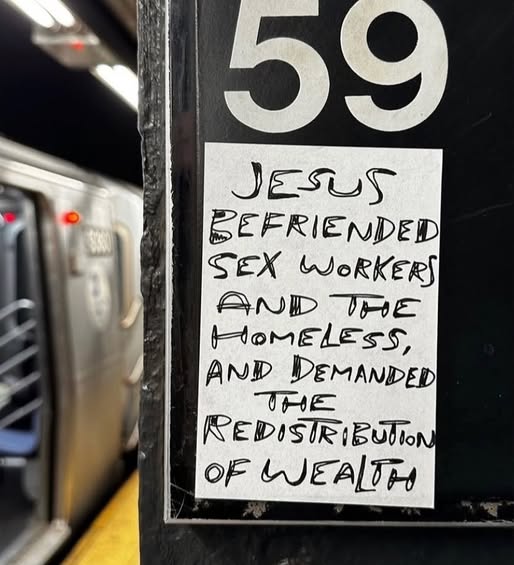
Jesus Wept, Then He Kicked Bezos in the Bollocks

There’s a curious thing about belief: it seems to inoculate people against behaving as though they believe a single bloody word of it.

Audio: NotebookLM podcast on this topic.

Case in point: Jesus. Supposed son of God, sandal-wearing socialist, friend of lepers, hookers, and the unhoused. A man who — by all scriptural accounts — didn’t just tolerate the downtrodden, but made them his preferred company. He fed the hungry, flipped off the wealthy (quite literally, if we’re being honest about the temple tantrum), and had the gall to suggest that a rich man getting into heaven was about as likely as Jeff Bezos squeezing himself through the eye of a needle. (Good luck with that, Jeffrey — maybe try Ozempic?)

And yet, here we are, two millennia later, and who is doing the persecuting? Who’s clutching their pearls over trans people, sex workers, immigrants, and the poor daring to exist in public? The self-proclaimed followers of this same Jesus.

You see it everywhere. In the subway, on billboards, on bumper stickers: “What would Jesus do?” Mate, we already know what he did do — and it wasn’t vote Tory, bankroll megachurches, or ignore houseless veterans while building another golden tabernacle to white suburban comfort.

No, the real issue isn’t Jesus. It’s his fan club.

They quote scripture like it’s seasoning, sprinkle it on whichever regressive policy or hateful platform suits the day, and ignore the core premise entirely: radical love. Redistribution. Justice. The inversion of power.

Because let’s face it: if Christians actually behaved like Christ, capitalism would implode by Tuesday. The entire premise of American exceptionalism (and British austerity, while we’re at it) would crumble under the weight of its own hypocrisy. And the boot would finally be lifted from the necks of those it’s been pressing down for centuries.

But they won’t. Because belief isn’t about behaviour. It’s about performance. It’s about signalling moral superiority while denying material compassion. It’s about tithing for a Tesla and preaching abstinence from a megachurch pulpit built with sweatshop money.

And here’s the kicker — I don’t believe in gods. I’m not here to convert anyone to the cult of sandal-clad socialism. But if you do believe in Jesus, shouldn’t you at least try acting like him?

The sad truth? We’ve built entire societies on the backs of myths we refuse to embody. We have the tools — the stories, the morals, the examples — but we’re too bloody enamoured with hierarchy to follow through. If there are no gods, then it’s us. We are the ones who must act. No sky-daddy is coming to fix this for you.

You wear the cross. You quote the book. You claim the faith.

So go ahead. Prove it.

Feed someone. Befriend a sex worker. House the homeless. Redistribute the damn wealth.

Or stop pretending you’re anything but the Pharisees he warned us about.

The Ship of Theseus Is Not a Paradox

Video: Plutarch: The Ship of Theseus

The Ship of Theseus is philosophy’s favourite parlour trick: swap out the planks of a ship one by one, and ask in your best furrowed-brow voice whether it’s still the same ship. Then, for added spice, reassemble the discarded parts elsewhere and demand to know which version is the “real” one. Cue the existential hand-wringing and smug undergrad smirks. Oh, how clever.

Audio: NotebookLM podcast on this topic.

But here’s the thing: there’s no paradox. Not really. Not unless you buy into the fantasy that identity is some immutable essence, handed down from the gods like a divine barcode. The whole thought experiment hinges on the absurd presumption that something has a fixed, singular identity across time and context, a quaint metaphysical hobby horse that falls apart the moment you look at it sideways.

Let’s be clear: in the realm of language and proto-psychology – the crude, squishy scaffolding of thought that predates syntax and survives long after it – there is no such thing as a fixed “same.” That’s a linguistic illusion, a parlour trick of grammar and nominal categories. Language wasn’t built to hold truth; it was built to herd humans into consensus long enough to survive the winter.

In practice, we use “same” the way we use duct tape: liberally, and with complete disregard for philosophical coherence. The “same” ship? The “same” person? The “same” idea? Please. Ask your hippocampus. Identity is not a container; it’s a hallucinated continuity trick, maintained by memory, narrative, and sheer bloody-minded stubbornness.

The real kicker? Our precious linguistic tools aren’t built to reflect reality. They’re built to reduce it. To chop up the infinite mess of experience into palatable little mouthfuls of meaning. So when we come to the Ship of Theseus with our dull-edged conceptual knives, what we’re really doing is asking a bad question with inadequate tools. It’s like trying to measure wind speed with a sundial.

The paradox isn’t in the ship. It’s in the language.

And no, you don’t need to patch it. You need to sink it.