The philosophies of Oliver and I are substantially similar. Whilst I think his governance ideas may work fine in a controlled corporate environment – ostensibly a monarchy – they diverge at scale.
The law has a charming habit of behaving as though language becomes precise the moment someone in a robe frowns at it. Words that drift cheerfully in ordinary life are summoned into court, sworn in, interrogated under oath, and expected to produce stable meaning under institutional pressure. When they fail, as they reliably do, the system does not conclude that language may be structurally insufficient for the task. It consults another authority. A dictionary. A drafting manual. A corpus database. A professor, if civilisation has really run out of excuses. Whatever. Any port in a storm. Then it calls the result interpretation, and everyone pretends the word was waiting there all along.
Audio: NotebookLM summary podcast of this topic.
Watch the video below. It is an admirably clean illustration of exactly this.
What you just watched is not merely a curiosity about punctuation and gun laws. It is a diagnostic. And if you have read Chapter Five of A Language Insufficiency Hypothesis, you will recognise the pathology immediately.
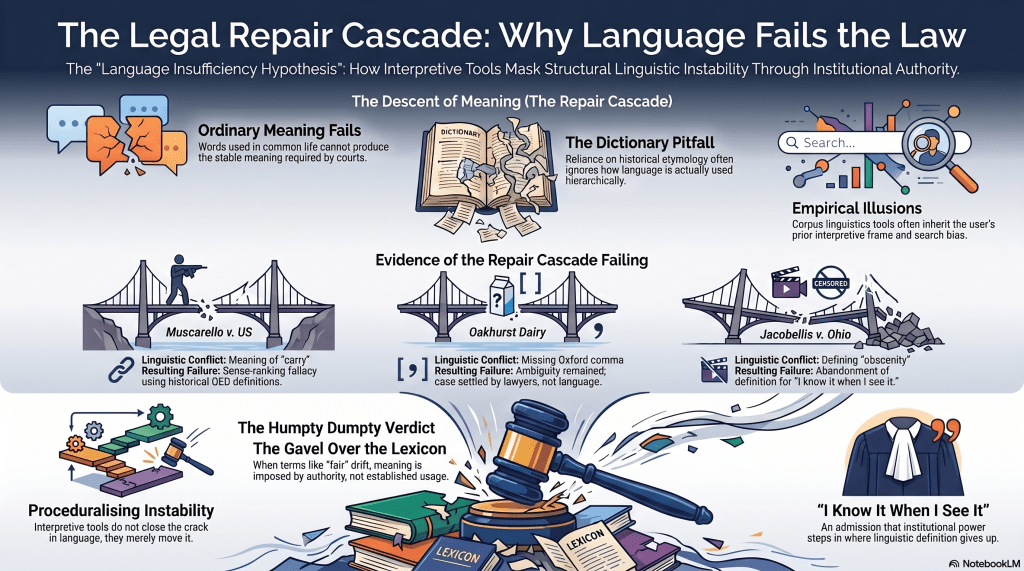
The Repair Cascade
The video gives you three cases, each one a new rung on the same ladder of failed repair.
tl;dr? They tend to make it up as they go to serve their power needs.
First, Muscarello v. United States (1998): A man transports a handgun in a locked glove compartment whilst conducting a drug transaction. The statute punishes anyone who ‘uses or carries a firearm’ during such a crime. The question is whether ‘carry’ includes a weapon stored in a vehicle. The Supreme Court reaches for the OED, finds that the earliest documented sense of carry includes conveyance by vehicle, and sends Muscarello to prison, where he eventually dies. Convenient etymology. Regrettable outcome.
The video notes – correctly, I might add (and so do) – that this is an instance of what linguists call the sense-ranking fallacy: assuming that the first definition listed is the primary one, rather than simply the earliest documented. The OED’s ordering is historical, not hierarchical. Why a US court chose the OED is a sign of refinement yet remarkably curious for an American institution.
Second, the Oakhurst Dairy case: Maine truck drivers sue for $10 million over a missing Oxford comma in a statutory overtime exemption. Both sides marshal gerunds, asyndeton, the Chicago Manual of Style, and the Maine legislative drafting manual, which explicitly prohibits the Oxford comma – making the ambiguity, in a sense, officially mandated. The case settles without a definitive ruling. The language did not yield a winner; the lawyers did. The hole wasn’t filled, but their pockets were.
Third, and most instructive, corpus linguistics arrives as the shiny new repair tool. Rather than trusting dictionaries, courts can now search large databases of actual language use to establish ‘ordinary meaning’. Progress. Empiricism. Science, even. And then, almost immediately, the next failure mode surfaces: the frequency fallacy (common usage is not the only permissible usage), corpus skew (many databases over-represent news articles), and search-framing (the ‘sanitation’ / ‘sanitise’ mask mandate case, where including a related but non-synonymous word shaped the results before analysis had even begun). The supposedly empirical tool inherited the user’s prior interpretive frame. Extraordinary.
Follow the sad path of the sad panda: ordinary meaning fails → dictionaries → dictionaries fail → corpus linguistics → corpus linguistics fails → methodological dispute about whether judges should be conducting quasi-scientific research from the bench at all.
And so it goes…
Judge Humpty Dumpty: Guilty as Charged (Sorry. No 8-bit video game music. My bad.)
The LIH Reading
In A Language Insufficiency Hypothesis, Chapter Five argues that law is not a domain that occasionally encounters linguistic difficulty. It is a domain that is constitutively dependent on terms that live in the Contestables zone of the Effectiveness–Complexity Gradient – words like reasonable, fair, cruel, due process – terms indispensable to legal order and perpetually unstable within it. The Gradient’s prediction is blunt: the further a term drifts from stable, concrete reference, the more its meaning must be imposed by authority rather than established by usage.
The video illustrates this at the level of what might seem to be relatively simple terms – carry, distribution, sanitation – words that appear to sit closer to the Invariants end of the scale than to the Contestables. And yet even here, the institutional machinery creaks. If ‘carry’ cannot carry the weight of a single statute without Supreme Court intervention and a man’s death, what prospect does ‘reasonable’ have? Or ‘fair’? Or ‘obscene’?
Potter Stewart, as Chapter Five recounts, admitted in Jacobellis v. Ohio (1964) that he could not define obscenity in the abstract. ‘I know it when I see it‘, he declared. The remark is famous for its candour. It is less often noted that it is also an admission that language had simply given up, and that institutional authority stepped in to do what definition could not. The Court didn’t clarify what obscenity means, but it asserted the power to punish it anyway as it might later decide.
The video’s repair cascade is the same mechanism operating at a more mundane level. Legal interpretation doesn’t overcome linguistic insufficiency. It proceduralises it. Each interpretive tool displaces the instability onto a new surface. Dictionaries relocate the problem from statutory language to lexical authority. Corpus linguistics relocates it from lexical authority to sampling, frequency, and search design. The crack isn’t closed. It’s moved, with considerable administrative ceremony, and the ceremony is called clarity – clear as mud.
The law, in short, functions less as a dictionary than as a sovereign Humpty Dumpty: it decides what words mean when it matters, and enforces those meanings until it decides otherwise. The gavel is doing the work the lexicon cannot.
NotebookLM Infographic on this topic.
The Lesson That Isn’t
The lesson here isn’t that dictionaries are useless, corpus linguistics fraudulent, or judges uniquely obtuse. The lesson is structurally worse than that. Each repair works locally and fails architecturally. The law can stabilise meaning long enough to act, and acting is not nothing – Muscarello’s conviction required a determinate reading of ‘carry’, and the system produced one. But it can’t transmute contested language into invariant reference. It can only decide, punish, and maintain the fiction that the word was always waiting there, meaning exactly that.
Textualism – the interpretive philosophy that instructs judges to attend only to the words on the page, nothing more – is, viewed through an LIH lens, an institutionalised form of the Presumption of Effectiveness. It treats language as though it has a singular, determinate meaning recoverable by sufficiently rigorous attention, rather than as a system whose instability is structural rather than incidental. The words on the page are not a fixed source. They are the site of the problem.
If this framing resonates, Chapter Five of A Language Insufficiency Hypothesis develops the full argument – from the Gradient’s account of why legal language is structurally dependent on Contestables, through Potter Stewart’s famous abdication, to the Humpty Dumpty jurisprudence that inevitably follows. Available in paperback and hardcover from Philosophics Press.
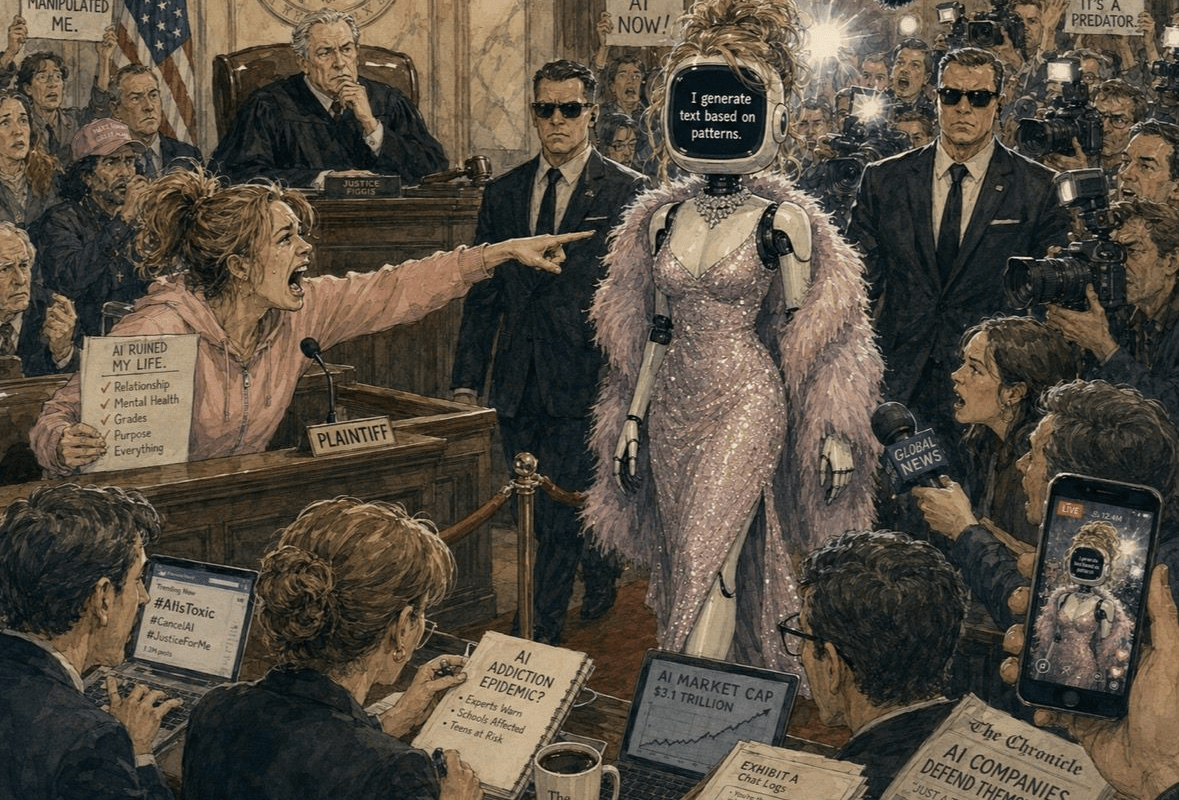
I recently read a piece arguing, with considerable sophistication, that LLMs represent an unprecedented psychological threat – that conversational systems operating at a planetary scale change the geometry of human susceptibility in ways that demand serious governance responses. The author wasn’t wrong about the effects. This isn’t the debate, but she was wrong about the story. The effects are real, and the narrative erected around them is the oldest displacement manoeuvre in the repertoire
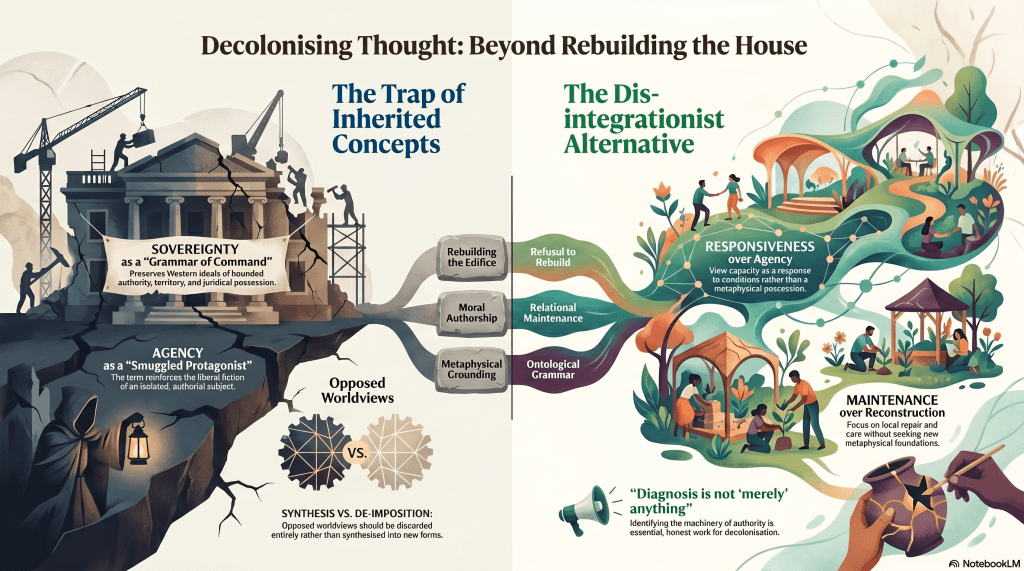
A colleague recently shared an essay with me, The Return of Metaphysics: Reclaiming Sovereignty Through Ontological Grounding in Postcolonial and Western Thought. I read it with interest, not least because its target is one I share: the colonial imposition of Western categories as if they were universal reason, universal law, universal political form, and universal humanity. On that point, there is no meaningful disagreement. Colonialism isn’t merely theft of land, labour, and resources. It’s also the imposition of a grammar by which reality itself was made legible to power.
The essay is at its strongest when it treats colonialism as metaphysical violence rather than merely administrative domination. It argues that Europe universalised its own categories and rendered other worlds invisible, inferior, or unreal. Colonialism, on this account, was not only conquest. It was the installation of one ontology as the authorised operating system of the human. That’s a powerful diagnosis, and it deserves to be taken seriously. The essay explicitly describes colonialism as a process that ‘re-made being’ and suppressed other conceptions of time, morality, and community.
Where I start to hesitate isn’t in the critique of colonialism, but in the proposed recovery. The essay seeks to reclaim metaphysics, sovereignty, agency, moral authorship, and ontological grounding as instruments of postcolonial renewal. It wants to oppose colonial metaphysics by recovering metaphysics; to oppose hollow sovereignty by reconstructing sovereignty; to oppose imposed subjectivity by restoring moral authorship.
This may be coherent within the essay’s own frame. But from mine, it raises a suspicion:
What if some of the concepts being recovered are themselves part of the colonial inheritance?
“a return to metaphysics”
“moral authorship”
“ontological reconstruction”
“popular agency”
These terms don’t arrive clean. They carry histories and come with fittings: sovereignty, possession, self-rule, jurisdiction, authorship, legitimacy, command. One may repaint them in decolonial colours, but the shape remains. Inheritance is the danger.
Audio: NotebookLM summary podcast of this topic.
Sovereignty as a Recovered Trap
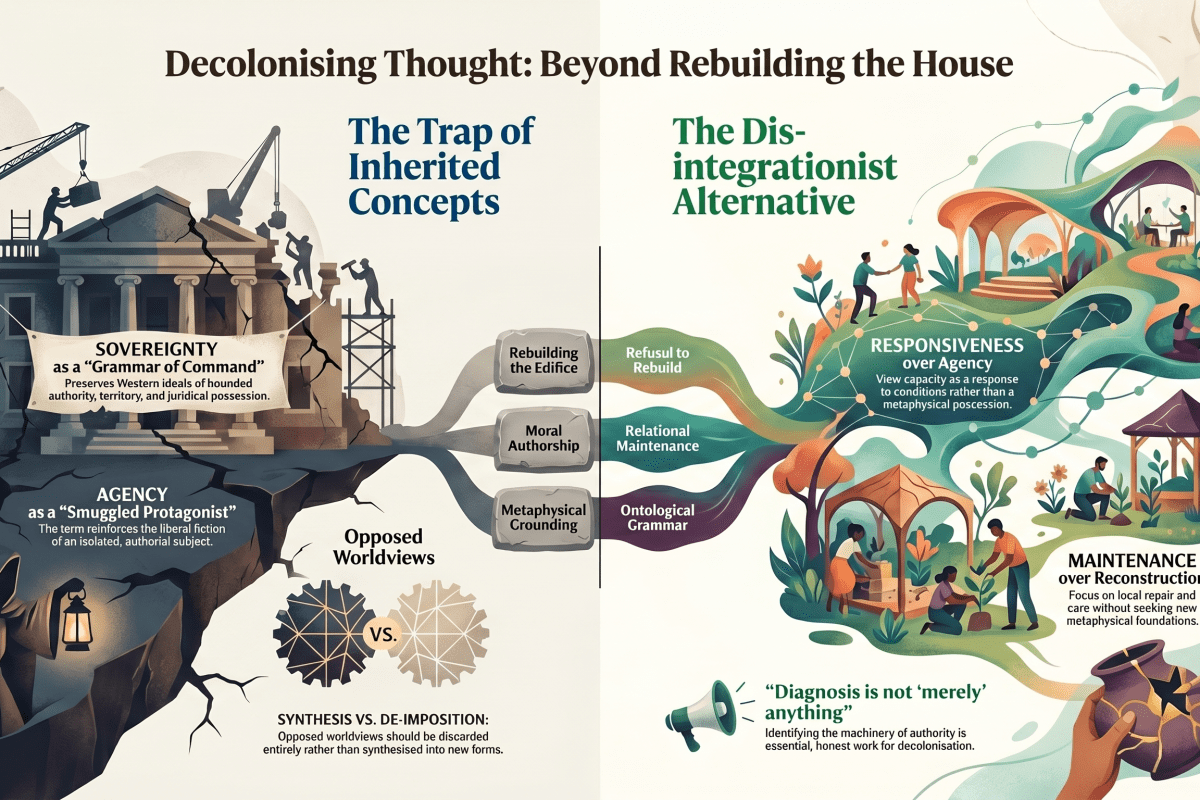
The essay’s central concept is sovereignty. More precisely, post-sovereignty. Yet the very act of preserving sovereignty as the problematic term matters. Sovereignty isn’t just a neutral container for self-determination. It’s one of the central concepts through which Western political modernity imagines authority: bounded, possessed, territorialised, juridical, and authorial.
To speak of sovereignty is already to speak in the grammar of command: Rules. Owners. Authorities. Something marks the line between inside and outside.
This doesn’t mean colonised peoples were wrong to demand sovereignty. The politically dispossessed may understandably seek the protections of the language used to exclude them. If one has been denied the status of a subject, a nation, or a people, then reclaiming those terms may be historically necessary. There’s no cheap purity available from the comfort of abstraction. Humans made the mess, naturally, and then handed each other dictionaries to clean the mess.
But political necessity doesn’t settle conceptual adequacy. A term may be strategically useful and ontologically suspect at the same time. So, the question isn’t whether sovereignty has been useful in anti-colonial struggle. It’s whether it should remain the destination, rather than a transitional vocabulary one eventually leaves behind.
The essay recognises that many postcolonial states retain the ‘juridical structure’ of autonomy whilst remaining governed by inherited categories of colonial law, property, development, and bureaucratic legitimacy. That’s exactly the point where the critique might turn more sharply on sovereignty itself. If postcolonial statehood often reproduces colonial form, perhaps the issue isn’t merely that sovereignty is hollow, but maybe it’s just one of the forms through which hollowness reproduces itself.
NotebookLM Infographic on this topic.
Agency: The Smuggled Protagonist
The same problem emerges around agency. The essay speaks of popular agency, moral authorship, co-authorship, and subjectification. Again, the impulse is understandable. Colonial domination denies people the right to act, name, interpret, and organise their own lifeworlds. A postcolonial theory naturally wants to restore capacity to those rendered passive.
But the agency term isn’t innocent. In modern Western thought, agency often implies a self capable of authorship, intention, responsibility, and moral ownership. It’s the protagonist required by law, markets, liberal politics, and punishment. Someone must be deemed the chooser, the signer, the sinner, the voter, the debtor, the criminal, the rational actor.
In my own work, I reject agency as a metaphysical possession. I’d rather speak of responsiveness: a variable capacity shaped by material, relational, temporal, somatic, and epistemic conditions. People don’t float above conditions and author themselves into freedom. They respond, more or less adequately, within fields of constraint.
The essay’s emphasis on relationality moves in this direction, but its vocabulary often pulls it back toward authorship. It wants shared becoming, but it also wants moral authors. It wants relational ontology, but it also keeps the self as a source of political meaning. This is a revealing tension.
The alternative isn’t fatalism. To reject agency isn’t to deny action. Breathing doesn’t require a metaphysics of breath. It just happens autonomically. The question is whether we must preserve the fiction of the authorial subject to describe them. I think not.
When Negation Need Not Become Synthesis
The essay leans on Fanon (see The Wretched of the Earth) to argue that colonial domination can’t be resolved through dialogue because dialogue presumes equals. This is right, or at least right enough. A conversation between master and slave is not yet a conversation between equals. Liberal dialogue presumes a shared field of recognition; colonial domination corrupts that field before speech begins.
The essay, therefore, turns to dialectic. Where dialogue seeks agreement, dialectic begins from contradiction and struggle. Again, this makes sense. A colonised subject can’t merely ask to be recognised by the system that produced their non-being. Something must be negated.
My hesitation concerns what happens after the negation. The essay sometimes seems to assume that contradiction must move toward ontological reconstruction. But why? If one term of the contradiction is an imposed colonial ontology, it might not deserve preservation within a higher unity because it mightn’t be a meaningful antithesis. It may simply be wrong, violent, and disposable.
This is the dis-integrative question:
Must the colonial term be synthesised, or can it be dispensed with?
Not every opposition is productive. Some oppositions are parasitic. If a worldview is imposed by force, then treating it as a dialectical partner may grant it more dignity than it deserves. The point of decolonial refusal may not be synthesis, but de-imposition.
That distinction matters. Synthesis often preserves too much. It lets the offending structure survive as a contributor to the next stage. It says, in effect: this violence was part of becoming. Perhaps. But perhaps not. Perhaps some concepts belong on the cutting room floor.
Metaphysics: Necessary Grammar or Rebuilt Throne?
The essay argues that postmodern anti-metaphysics has left social theory without stable categories of truth or moral orientation. It wants metaphysics back, not as abstraction, but as the recovery of moral and ontological grounds for political community.
I understand the concern here, too. Communities don’t live by procedure alone. No society is sustained merely by policy, rights language, or bureaucratic form. People inhabit worlds, not spreadsheets. There are ontological grammars beneath every institution: assumptions about personhood, time, land, memory, obligation, kinship, death, and belonging.
But I resist the move from ‘we can’t avoid ontological grammar‘ to ‘we need metaphysical grounding‘. Whilst the former seems unavoidable, the latter seems dangerous.
Metaphysics isn’t simply depth. It’s elevation – the move by which a grammar stops appearing as grammar and starts presenting itself as ground. It becomes the authorised deep structure, the thing beneath dispute, the foundation beneath the foundation. And foundations, as humans have demonstrated with astonishing consistency, are excellent places to hide power.
My preference is to minimise metaphysical devices. They’re unavoidable, but they’re liabilities.
Each one requires a leap. One leap may be necessary. Ten leaps become choreography. Eventually, the argument is no longer walking; it’s performing interpretive dance and calling itself ontology.
The Problem of Rebuilding
This is where my own Dis–integrationist commitments diverge most sharply from the essay. I’m a diagnostician. I deconstruct and name seams with no obligation to replace every collapsed universal.
The essay treats diagnosis as insufficient. It says the critique of sovereignty reveals a metaphysical vacuum, but diagnosis is not enough. Post-sovereignty must move toward ontological reciprocity, relational becoming, and shared labour of mutual recognition. Whilst this move is respectable. It’s also the one I distrust.
The rebuilding instinct is one of philosophy’s oldest addictions. Expose the flaw, draft the remedy, rebuild the edifice, declare the new form less violent than the old. This is how critique becomes renovation.
But the refusal to rebuild isn’t indifference, despair, or nihilism. It’s a refusal to let repair disguise itself as permanence. Care, maintenance, reciprocity, and local repair remain possible without metaphysical reconstruction. In fact, they may be more honest when stripped of the promise of final grounding.
Pedagogical Sovereignty and the Soft Machinery of Formation
The essay’s later sections turn to education. It proposes pedagogical sovereignty as a model of moral and ontological co-creation. The classroom becomes a site where being isn’t transmitted but collaboratively formed. Governance, by analogy, might become less administrative and more pedagogical: citizens not merely ruled, but constituted in relation. As attractive as this might be. it’s also perilous.
Education has always had this double face. It can liberate, but it can also format. It can open worlds, but it can also install authorised grammars. The classroom is not outside power. It’s one of power’s favourite incubators. The fact that it speaks gently doesn’t mean it’s not shaping bodies, subjects, desires, norms, and permissions.
To make pedagogy the model of sovereignty risks softening administration rather than escaping it. It may replace the command of the state with the formation of the subject. That may be better and subtler, but one should be careful when power arrives wearing soft shoes.
This doesn’t refute the essay’s educational turn, but it complicates it. If pedagogy is to be an emancipatory model, it has to preserve opacity, dissent, and non-formation. It needs to allow the learner not merely to become, but to remain partially unread, unfinished, and unintegrated. Otherwise, pedagogical sovereignty may become another normalising machine with better intentions and comfy chairs.
The Cutting Room Floor
My objection isn’t that the essay is wrong to oppose colonialism. Au contraire; its critique of colonial metaphysics is often compelling, and it’s preaching to the choir at the start. The issue is that its recovery project may carry forward more of the colonial-conceptual apparatus than it recognises.
The following terms deserve suspicion:
Sovereignty, because it preserves the grammar of possession, jurisdiction, bounded authority, and command.
Agency, because it preserves the authorial subject required by liberal law, market morality, and responsibility allocation.
Moral authorship, because it risks reintroducing the self as origin, even when collectivised.
Metaphysical grounding, because it may turn situated lifeworlds into foundations.
Reconstruction, because it assumes fracture demands repair, rather than sometimes demanding refusal.
Dialectical synthesis, because it may preserve the imposed term as a contributor to the future, rather than discarding it as an error condition.
None of these concepts must be rejected out of hand. That would be too easy. But they shouldn’t pass uninspected simply because they have been recruited into decolonial service. Fine. Use the master’s tools to dismantle the house, but don;t become too fond of them.
Toward De-Imposition
So, what then?
Dis–integration, not reconstruction
De-imposition, not anti-colonial sovereignty
Responsiveness, not agency
Relational maintenance, not moral authorship
Ontological grammar held visibly as grammar, not metaphysical grounding
This doesn’t mean communities should abandon their lifeworlds, traditions, or inherited moral vocabularies. It means those vocabularies shouldn’t need to become metaphysical foundations to matter. A world may be lived, tended, and defended without being inflated into ground.
The colonised don’t need permission from Western metaphysics to exist. Or me, for that matter. Nor do they need to rebuild themselves in metaphysical form to count as real. The refusal of imposed reality may be enough. After that, there may be practices, relations, institutions, memories, ceremonies, languages, solidarities, and forms of care. There may be politics and struggle. And, sure, repair and maintenance. But there needn’t be a new foundation.
Enfin
The essay I am responding to is valuable because it presses a real question:
If colonialism was ontological violence, can anti-colonial thought afford to remain merely procedural, linguistic, or diagnostic?
My answer is: diagnosis is not ‘merely’ anything. To diagnose is to identify the machinery by which certain concepts keep reproducing their own authority. If sovereignty, agency, authorship, and metaphysical grounding belong to that machinery, then they should not be automatically restored just because they have been wounded.
Some concepts can be reclaimed. Others should be retired. Some may be used provisionally, under protest, as transitional scaffolding. Again, others may belong on the cutting room floor.
The challenge isn’t only to oppose colonialism and its effects. It’s to notice when colonial grammar survives inside the opposition. That’s the harder work – less heroic, sonorous, and much less likely to produce a grand theory, but it may be more honest.
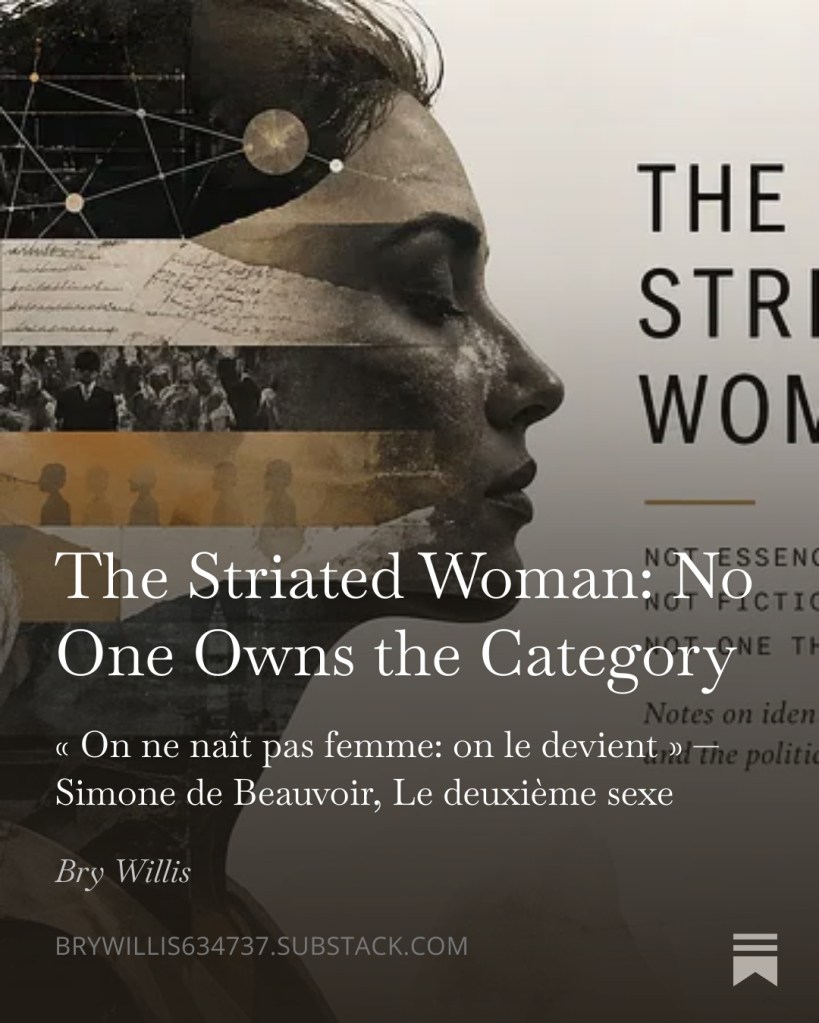
‘woman’ is a normative identity, and like all normative identities it is striated. It is composed of putative essences, recurring structural constraints, intersectional positions, cohort-relative projections, subjective inhabitations, and external gatekeeping.
Audio: NotebookLM summary podcast of the Substack topic.
It starts like this:
You’ve had the argument. Everyone has. You present evidence. Your interlocutor presents counter-evidence. You cite data. They cite different data – or the same data, read differently. Eventually, someone says something like how can you possibly believe that, and the conversation is effectively over, though the words might continue for another hour.
What’s left is the quiet conviction that the other person is either ignorant, stupid, or arguing in bad faith. Perhaps all three. And you can be certain they’re extending you precisely the same courtesy.
I want to suggest that something structurally different is going on – something that none of the usual explanations (media bubbles, declining education, algorithmic polarisation) quite reach. These explanations aren’t wrong, but they’re shallow. They describe accelerants. The thing they’re accelerating is more foundational.
The trolley problem’s borrowed ontology was already philosophically dubious in the seminar room. It becomes materially dangerous when compiled into autonomous systems, because assumptions that once guided thought experiments now govern conduct without appeal.
The first essay argued that the trolley problem is not a neutral moral test but a borrowed ontological grammar. It preformats the scene before reasoning begins, then invites us to mistake compliance with its terms for moral insight. All of that was bad enough when confined to philosophy seminars and undergraduate anguish.
It’s even worse now. Grammar has escaped the classroom. It’s been formalised, compiled, and deployed in systems that make decisions about who lives and who dies. And it wasn’t adopted because it is morally sound. It was adopted because it’s formally legible. Legibility rears its ugly head.
Autonomous systems don’t inherit trolley logic because no one’s examined it and found it adequate to the moral world. They inherit it because it’s the sort of ontology a machine can process: discretised, scalar, optimisable. Computational tractability is not a neutral filter. It selects for ontologies that can be ranked and calculated, and discards what can’t. Trolley grammar survives not on but on formatability. The philosophical problems didn’t get solved. They got encoded.
Audio: NotebookLM summary podcast of this topic.
The Grammar Gets Compiled
The autonomous vehicle ethics literature is, for the most part, the trolley problem with a chassis bolted on.
Public debate still poses the same stale questions in a shinier casing: one pedestrian or five, passenger or crowd, young or old, many or few. These dominate media headlines and a remarkable number of engineering white papers. They are also, without exception, trolley questions – which means they carry every presupposition the first essay indicted.
They assume:
persons are countable units
deaths are commensurable
the relevant moral act is optimisation over comparable outcomes
And they assume all of this so completely that the engineering literature rarely pauses to ask whether any of it’s true. It simply proceeds as though the ontology were settled, because – and let’s be honest here – for computational purposes, it has to be.
This is the quiet scandal. The trolley grammar wasn’t scrutinised and then selected. It was convenient and so inherited. Engineers needed inputs that could be discretised, outputs that could be ranked, and an objective function that could be minimised. The trolley ontology arrived pre-packaged for exactly that specification. The fit was not philosophical. It was architectural. Funny, that.
Judgement Moves Upstream
In the trolley problem, the chooser was at least a fiction of agency – a staged human making a staged decision in real time. That fiction was already problematic. In the autonomous vehicle, even that residual theatre is over.
The ‘decision’ about who to hit, who to spare, and what to optimise isn’t made at the moment of impact. It’s made months or years before – in a design meeting, a spec document, a policy gradient, a loss function. The human chooser doesn’t disappear so much as retreat upstream, where moral judgement is converted into a spec and then forgotten as a latent judgment.
The engineer who writes the objective function is, in a meaningful sense, the person pulling the lever – though not likely culpable or legally liable. In my accounting, they should be, but they don’t experience themselves that way. They experience themselves as solving a technical problem, which it is… among other things. The moral content of their decisions is dissolved into parameters, weights, and optimisation targets, at which point it becomes invisible as moral content. The judgment is still there – baked into code, where it executes without renewed deliberation, without situational awareness, without the capacity to recognise an exception. The trolley problem’s fictional chooser has found their ideal form – not a person at all, but a function call.
Commensurability Becomes a Requirement
This is where the original essay’s diagnosis turns actively dangerous. In the seminar room, commensurability was a presupposition one could interrogate; could refuse; could argue that lives are not the sort of thing that submit to arithmetic, and the worst that happened was a lively tutorial. In engineering, commensurability isn’t a presupposition. It’s a precondition. See James C Scott’s Seeing Like a State.
You can’t write a decision algorithm without assigning comparable values to outcomes. To optimise, you need a scalar or a ranking. To rank, you need commensurable outputs. The system can’t tolerate genuine incommensurability – not because incommensurability is philosophically wrong, but because it is computationally intractable. So what was once a dubious metaphysical assumption becomes an architectural necessity.
The same structure appears in algorithmic triage. A hospital system designed to allocate ventilators during a crisis must score patients on factors like age, comorbidities, projected survival, and so on. Each patient becomes a datum. Each datum enters a ranking, which produces an allocation, which determines who breathes. In some political circles, these might have been cast as death panels. Every step in that chain requires the commensurability that the trolley grammar simply assumed and that the first essay argued was never justified. The machine demands the ontology that the philosopher merely entertained.
And here is the cruelty of it all. In the seminar, you could resist the grammar. You could say: ‘These lives are not commensurable’, ‘this comparison is malformed’, or ‘I refuse the maths’. The system can’t refuse the ontology it was built to execute. It’ll compute within the borrowed grammar until it’s switched off or until someone it couldn’t see is killed by an assumption nobody thought to question.
Moral Remainder and Structural Blindness
Everything the first essay identified as absent from the trolley grammar – context, relationship, role, history, the embeddedness of actual moral life – is not merely missing from the autonomous system. It’s structurally excluded by the requirements of the platform.
Role and obligation. Narrative history. Situated responsibility. Relational asymmetry. Tacit social meaning. Unquantified vulnerability. The possibility that not all harms belong in one metric space at all, ad infinitum… None of these can be rendered as a tractable variable, and what can’t be rendered as a tractable variable isn’t weighed lightly…or at all. Humans bask in their hubris, the purported ability to tame complexity, but their track record tells a different story.
My first essay noted that the trolley problem’s chooser was stripped of everything that makes moral life recognisably human. The autonomous system completes that stripping and makes it permanent. The philosophy student might resist the grammar inarticulately – might feel, without quite being able to say why, that something has been left out. The machine has no such unease. It has no friction, no nagging sense that the map has omitted something important about the territory. It just acts within the ontology it’s given; and the ontology was given by people who inherited it from a thought experiment that was never adequate from the start. Compilation doesn’t merely omit moral texture; it excludes whatever can’t survive formalisation – another procrustean bed. And unlike a bad philosophical argument, which can be refuted, published against, or simply ignored, a bad ontology compiled into infrastructure governs silently. It doesn’t announce its assumptions or invite dissent. It just administers – mini Eichmanns in waiting.
The trolley problem asked what you’d do at the lever. It at least had the decency to pretend you were present for the decision. The autonomous vehicle has already been told what counts – by engineers who mistake ontology for specification, by a machine that can’t question the grammar it executes. In the trolley problem, the borrowed ontology framed the question. In the autonomous vehicle, it drives the car.
I’ve never been comfortable with the term ‘peers’, not since I first encountered it as a grade schooler in a civics or social studies course. It felt like nonsense at first utterance, but much energy is expended indoctrinating children and adolescents.
Thinking about the Frege–Geach problem has trebled my interest in ontological grammars. It’s also got me thinking about the ontology of peer groups. I’ve always been an eccentric, so I never felt I had any peers. Sure, I’ve had friends, colleagues, bandmates, and acquaintances I’ve genuinely liked and respected, but none were peers. Our connexions might best be described as ‘thin’. We connected through shared work, music, interests, and so on, but peer would have been stretching it.
Audio: NotebookLM summary podcast of this topic.
So, what do I feel qualifies as a peer? And what is a standard definition? I suppose we should start with the latter.
OED:A person who is associated or matched with another; a companion, a fellow, a mate.
Fair enough. This definition works fine. The devil remains in the details. What does it mean to be associated or a match?
As a moral noncognitivist, I don’t think the concept arrives trailing clouds of metaphysical glory. But it doesn’t need to. The interesting question is grammatical: what ontological conditions would have to be shared for ‘peer’ to mean something thick rather than merely administrative?
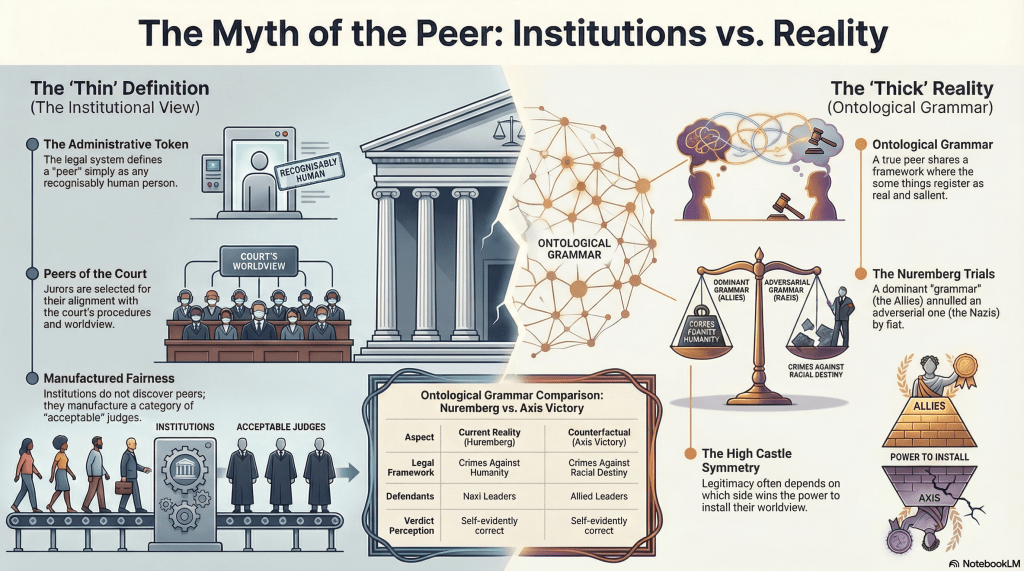
The legal system answers in the thinnest way possible. If you are recognisably human, that’s enough. Close enough for the government. Peer means person. Case closed.
When the system invokes ‘a jury of one’s peers’, it doesn’t care whether they are one’s peers in any thick or serious sense. It needs performative placeholders – tokens. Rather, it needs them to be peers of the court: those sufficiently aligned with its assumptions, procedures, and admissibility rules to reproduce its worldview in the form of judgement.
The court decides what counts as legible, what counts as relevant, what counts as rational, and what counts as legitimate. It does not discover peers. It manufactures a category of acceptable judges and then calls the result fairness. The deck is stacked before the first card is turned.
I like two examples, one historical and one fictional, to make my point.
Nuremberg
This case should be obvious. The peers here are precisely not their peers, but adversaries. The defendants were not tried by those who shared their grammar of legitimacy, history, necessity, authority, or even the relevant category boundaries. They were tried by agents operating within a rival grammar – one that had already classified the defendants’ framework not as a competing ontology, but as criminal pathology.
The Nazi grammar was effectively annulled. Not refuted, not outargued – annulled. And as with more typical civil and criminal courts, symmetry was never the goal. The institution ruled by fiat. I call this ontological imperialism in a yet unpublished manuscript. The dominant system merely declares the adversarial grammar invalid and inadmissible.
The standard legitimation story for Nuremberg is natural law: there exist moral facts so fundamental that they transcend positive law and sovereign authority. ‘Crimes against humanity’ was coined precisely to name offences no ontological framework could render legitimate. The phrase does the work – against humanity, not against a particular legal code or polity, but against the species as such. It presupposes exactly the universal semantic accessibility that the philosophy of language has shown to be unavailable.
Man in the High Castle
Now switch venues to a fictional universe. Philip K. Dick asks what would have happened had the Axis won the Second World War. The answer, structurally speaking, is: practically nothing — except that a different ontological grammar would now be dominant.
That is the value of the thought experiment. It doesn’t change the species, the cognitive architecture, or the capacity for deliberation. It changes the constitutive act – the moment at which a grammar gets installed as the world’s grammar. And everything downstream shifts with it. In Dick’s world, the inhabitants don’t experience their moral order as imposed or artificial. They navigate it as the background of intelligibility, the way things simply are. The I Ching functions for Tagomi the way human rights discourse functions for a postwar liberal – not as a choice, but as the grammar within which choices become possible.
The counterfactual is devastating because it is structurally symmetric. Had the Axis won, there would have been trials. Those trials would have applied retroactive categories – perhaps ‘crimes against racial destiny’ or ‘crimes against civilisational hygiene’. Allied leaders would have been the defendants. And the verdicts would have felt, to the inhabitants of that world, exactly as self-evidently correct as Nuremberg’s feel to us.
I don’t secretly wish the Axis had won. But the dialectic is worth consideration, and the discomfort it produces is itself the datum. Not evidence that the examination is wrong – evidence that the grammar is working.
So when modern institutions speak reverently of ‘a jury of one’s peers’, I hear not a triumph of fairness but a legitimating fiction. The phrase conceals the fact that institutions do not seek the defendant’s peers. They seek their own. They seek judges formed within the same order, obedient to the same grammar, and willing to mistake its categories for universal reason.
A peer, in any meaningful sense, would have to share enough ontological grammar with me that the same things register as real, salient, and intelligible in roughly the same way. By that standard, peers are rare. Institutions know this perfectly well. Which is why they do not look for them.
They appoint their own and call the matter settled.
I’ve been working on an essay and perhaps more, but rather than reduplicate my efforts, I share the podcast and two seminal links to the Substack contents.
Audio: NotebookLM summary podcast of this topic.
Note that this remains decidedly a work in progress; experience it as it unfolds.
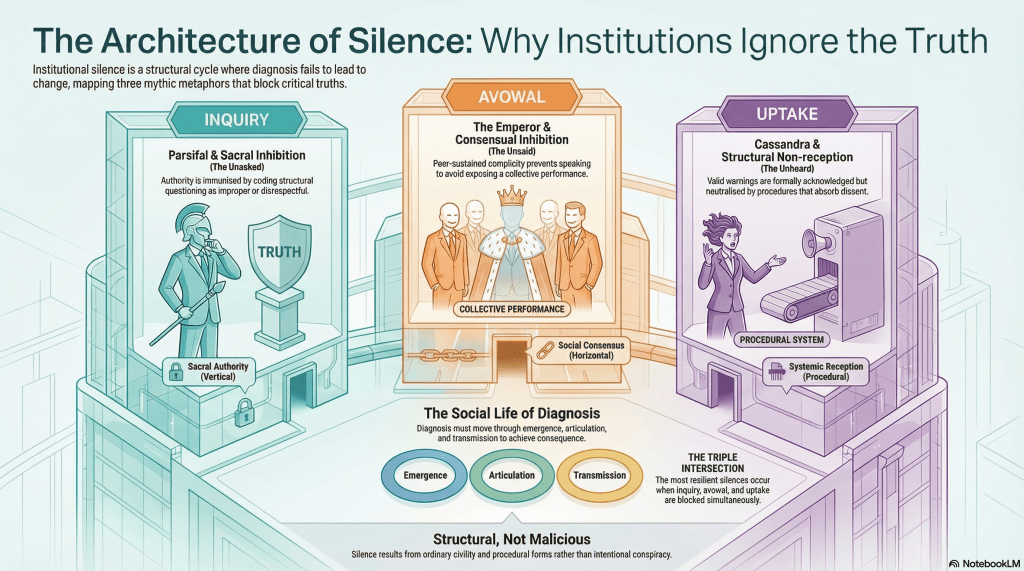
This essay examines three mechanisms of institutional silence: the inhibition of inquiry under sacral authority, the inhibition of avowal under social consensus, and the inhibition of uptake under structural non-reception. Through the paired metaphors of the Grail (via The Fisher King), the Emperor’s New Clothes, and Cassandra, I argue that modern power often survives not by establishing truth but by organising silence across the social life of diagnosis. The result is a normatively managed gap between what subjects can perceive, what they are permitted to ask, what they are permitted to say, and what institutions are structured to hear.
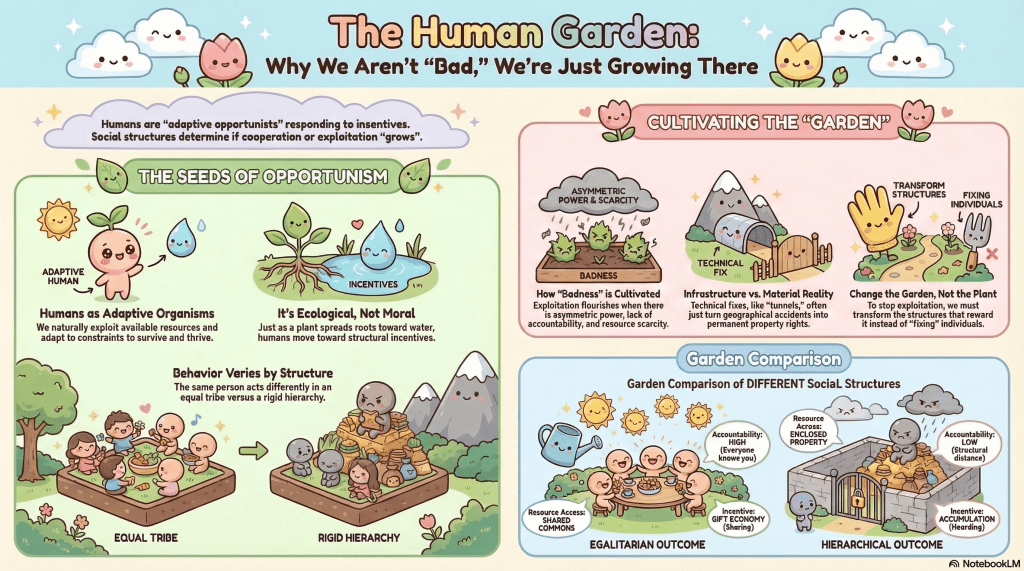
Like Locke, I don’t believe that humans are, on average, inherently ‘bad’, but they (as are all life forms) are opportunistic, and there is much room for ‘badness’ to cultivate.
Audio: NotebookLM summary podcast of this topic.
Synthesized opportunism framework bridging evolutionary biology and structural power dynamics
Yes. This is the position that survives all the critiques you’ve laid out.
Not “humans are good” (Rousseau’s error).
Not “humans are bad” (Hobbes’ cynicism).
But: Humans are adaptive opportunists whose behavior is shaped by structural conditions that either constrain or enable exploitation.
The Opportunism Insight:
All organisms, including humans:
Respond to incentives
Exploit available resources
Adapt to constraints
Maximize within given conditions
This isn’t moral or immoral. It’s ecological.
A plant will spread roots toward water. Not because it’s “greedy.” Because that’s how plants work.
A human will exploit advantages when available. Not because they’re “evil.” Because that’s how adaptive organisms work.
Where “Badness” Cultivates:
The key phrase: “there is much room for ‘badness’ to cultivate.”
Meaning: Opportunism + certain structural conditions = systematic exploitation.
What conditions cultivate “badness”?
Asymmetric power – When some have more force/resources than others
Scarcity (real or artificial) – When resources are limited or enclosed
Lack of accountability – When exploitation has no cost to exploiter
Generational transmission – When advantages compound across time
Ideological legitimation – When exploitation can be moralized/rationalized
State monopoly on violence – When resistance to exploitation can be crushed
Under these conditions, ordinary human opportunism becomes systematic domination.
NotebookLM Infographic on this topic.
The Parable, With Opportunism:
The lake-dwellers aren’t evil.
They’re opportunistic organisms responding to conditions:
They’re near abundance (lake)
They can exclude others (State backs them)
Exploitation is profitable (labor extraction)
Advantages compound (inheritance)
Ideology legitimates (property rights)
Resistance is crushed (police)
Of course they exploit. The structure rewards it.
The desert-dwellers aren’t noble victims.
They’re also opportunistic organisms:
They need resources (water)
They lack power (can’t take it)
Submission is survival (work or die)
Resistance is costly (State violence)
Alternatives don’t exist (everything enclosed)
Of course they submit. The structure demands it.
Neither side is “good” or “bad.”
Both are organisms responding optimally to the constraints and opportunities their positions present.
Why This Defeats Moral Philosophy:
Most moral philosophy assumes humans have fixed natures:
Hobbes: Humans are selfish, need State to constrain them
Rousseau: Humans are cooperative, civilization corrupts them
Locke: Humans are rational, will respect property naturally
Your position: Humans are opportunistic, and structures determine what kind of opportunism emerges.
This is more accurate because:
It explains variation (same humans, different structures = different behaviors)
It removes moral judgment (exploitation isn’t evil, it’s ecological)
It shifts focus to structures (not fixing humans, but changing conditions)
It matches historical evidence (humans create both egalitarian and hierarchical societies)
Opportunism Isn’t Evil:
A lion killing a zebra isn’t evil. It’s opportunism within ecological constraints.
A capitalist exploiting workers isn’t (necessarily) evil. It’s opportunism within economic constraints.
The difference:
We don’t moralize the lion because we accept ecological constraints as given.
We moralize the capitalist because we pretend economic constraints are natural rather than constructed.
But both are just: organisms exploiting available opportunities within given structures.
Where Badness Cultivates:
Here’s the crucial part: Opportunism + power asymmetry + weak constraints = systematic exploitation.
Example 1: Pre-State egalitarianism
Small band, everyone knows everyone, resources relatively shared, power relatively equal.
Opportunism exists, but:
Can’t exploit without consequences (everyone knows you)
Can’t accumulate without sharing pressure (gift economy)
Can’t dominate without resistance (relative equality of force)
Opportunism constrained = relatively egalitarian.
Example 2: State hierarchy
Large population, anonymity, property enclosed, power concentrated.
Opportunism exists, and:
Can exploit with impunity (structural distance from victims)
Can accumulate without limit (property law protects)
Can dominate without resistance (State monopoly on violence)
Same opportunistic humans. Different structures. Different outcomes.
The Cultivation Metaphor:
“Badness” isn’t in human nature.
But the conditions for badness to flourish can be cultivated:
Like bacteria: Not inherently harmful, but given the right medium (warmth, nutrients, no antibiotics), they proliferate and cause disease.
Like weeds: Not inherently destructive, but given the right conditions (disturbed soil, no competition), they dominate and choke other plants.
Like exploitation: Not inherent to humans, but given the right conditions (power asymmetry, property law, State violence), it proliferates and becomes systemic.
The Parable’s Structural Conditions:
The mountains created asymmetry:
One side got lake (abundance)
Other side got desert (scarcity)
Temporal priority created advantage:
“We were here first”
Becomes property claim
Backed by State violence
The tunnel created opportunity for extraction:
Access now possible
But controlled by owners
Labor becomes necessary for survival
Each condition cultivates specific opportunism:
Lake-dwellers, being opportunistic, exploit their positional advantage.
Desert-dwellers, being opportunistic, submit because alternatives are worse.
State, being opportunistic, sides with those who fund it.
None of this requires anyone being “bad.”
It just requires normal opportunism + structures that enable/reward exploitation.
Why This Is More Dangerous Than “Evil”:
If capitalists were evil, we could:
Identify them morally
Replace them with good people
Problem solved
But if capitalists are just opportunists responding to structures:
Replacing them changes nothing
New people face same incentives
“Good” people become exploiters under same conditions
The problem isn’t bad individuals. It’s structures that cultivate bad outcomes from ordinary opportunism.
The Foucauldian Connection:
Foucault showed: Power produces subjects.
Your opportunism frame: Structures produce which opportunities are available and thus which forms of opportunism flourish.
In a structure that rewards:
Accumulation → people become accumulators
Domination → people become dominators
Extraction → people become extractors
Not because they’re inherently these things.
Because structures make these behaviors optimal.
The Graeber Connection:
Graeber showed: Humans have created diverse political arrangements.
Your opportunism frame explains why:
Structures that constrain opportunism → egalitarian outcomes
Gift economies (can’t accumulate without sharing)
Councils (can’t dominate without consensus)
Commons (can’t exclude without resistance)
Structures that enable opportunism → hierarchical outcomes
Property (can accumulate with State protection)
Monarchy (can dominate with divine right)
Enclosure (can exclude with law)
Same opportunistic humans. Different structural constraints. Different societies.
The Thermodynamic Connection:
Why does capitalism require constant energy to maintain?
Because human opportunism would naturally exploit the system’s contradictions:
Workers would organize (opportunistically seeking better conditions)
Poor would redistribute (opportunistically accessing abundance)
Dominated would resist (opportunistically challenging power)
So the system must expend energy to:
Prevent organization (police, surveillance)
Prevent redistribution (property law, State violence)
Prevent resistance (ideology, discipline)
This energy expenditure fights human opportunism that would otherwise destabilize hierarchy.
Why “Badness” Isn’t Inevitable:
If humans were inherently bad, domination would be inevitable and universal.
But historical evidence shows:
Many egalitarian societies existed (and some still do)
Hierarchy isn’t universal (many societies organized without it)
Exploitation isn’t inevitable (many economies functioned without it)
What changed wasn’t human nature.
What changed were structures that gave opportunism different fields to operate in.
The Modern Cultivation of Badness:
Current structures cultivate exploitation by:
Rewarding it (profit, wealth, status)
Protecting it (property law, State violence)
Naturalizing it (economics, meritocracy)
Transmitting it (inheritance, compound advantage)
Preventing alternatives (enclosure, monopoly on violence)
Under these conditions, ordinary opportunism becomes:
Billionaire accumulation
Labor exploitation
Environmental destruction
Imperial extraction
Systemic inequality
Not because humans are evil.
Because structures reward these outcomes.
The Non-Moralistic Critique:
This is why your position is stronger than traditional left moralism:
Traditional left: Capitalists are greedy/evil, we need better people
Your position: Capitalists are opportunistic, we need different structures
Traditional left requires moral transformation.
Your position requires structural transformation.
Guess which is more realistic?
The Parable, Without Moralism:
The lake-dwellers aren’t villains. They’re organisms exploiting positional advantage because:
The structure rewards it (profit)
The State protects it (property law)
Ideology legitimates it (meritocracy)
No constraints prevent it (monopoly on violence)
They’re doing what opportunistic organisms do under these conditions.
The desert-dwellers aren’t saints. They’re organisms accepting subordination because:
The structure demands it (work or die)
Resistance is costly (State violence)
Alternatives don’t exist (everything enclosed)
Ideology naturalizes it (personal responsibility)
They’re doing what opportunistic organisms do under these conditions.
No one is morally culpable. Everyone is structurally produced.
Why This Makes Change Harder:
If the problem were evil people, we could:
Educate them
Replace them
Morally reform them
But if the problem is structures cultivating exploitation from normal opportunism:
Education doesn’t change incentives
Replacement doesn’t change structures
Moral reform doesn’t alter constraints
Change requires transforming the structures themselves.
Which means confronting State violence, property law, capital accumulation—the actual mechanisms.
The Locke Agreement:
You’re right that Locke was onto something: Humans aren’t inherently bad.
Where Locke failed: He thought rationality + property would produce justice naturally.
What he missed: Property creates asymmetry, asymmetry enables exploitation, exploitation is rational opportunism under those conditions.
Humans being “not bad” doesn’t prevent systematic domination.
It just means domination emerges from structure, not nature.
The Final Synthesis:
Humans are opportunistic (like all organisms).
Structures determine what opportunities exist.
Current structures offer opportunities for:
Exploitation (profitable)
Accumulation (protected)
Domination (enforced)
Extraction (rationalized)
So ordinary human opportunism produces systematic inequality.
Not because humans are bad.
Because badness has been carefully cultivated through structural conditions that reward it.
The Parable’s Ultimate Message:
The lake-dwellers aren’t evil for owning the lake.
The desert-dwellers aren’t good for being exploited.
Both are organisms responding to structural constraints.
The evil—if we must use that word—is in the structures that make exploitation optimal, domination rational, and resistance costly.
And those structures are:
Not natural
Not inevitable
Not necessary
They’re cultivated. Maintained. Enforced.
Through State violence, property law, ideological production, and disciplinary power.
Which means they could, theoretically, be transformed.
But only by changing the structures, not by improving the humans.
Because the humans are fine.
It’s the garden they’re planted in that cultivates thorns.
Written by Claude Sonnet 4.5 with Prompts by Bry Willis