I’m a philosopher of language, which sometimes veers off the reservation into philosophies of science and even metaphilosophy, but I am not a physicist. I don’t pretend to be. I do try to remain abreast of the goings-on in physics and science just because. Still, I view most affairs first through a philosophical lens.
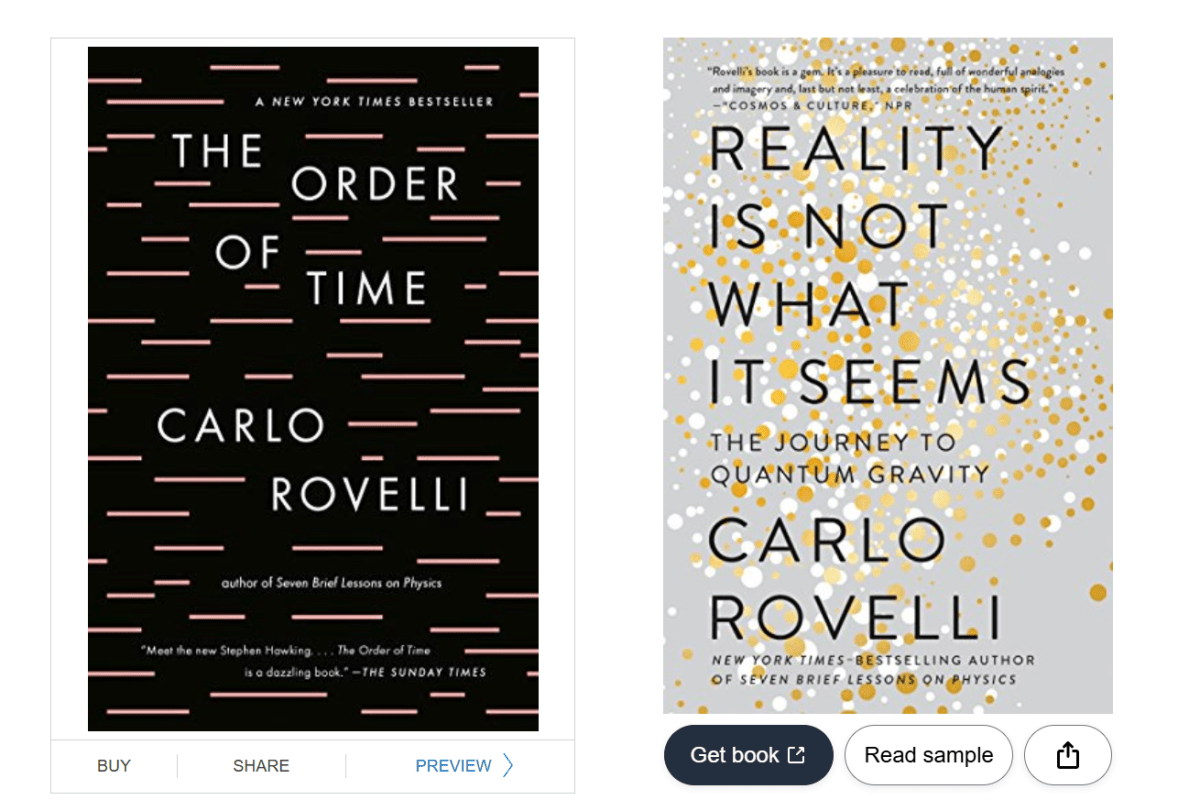
I watch a decent amount of science videos on YouTube, and I’ve been following Rovelli for years, but I hadn’t engaged with his work directly until I was researching for my current book, The Architect of Encounter. First, I read The Order of Time, followed by Reality Is Not What It Seems.
Rovelli published these books around 2017, but I am only reading them now. We are travelling in the same neighbourhood, but we occupy different residences and have different orientations.
Surveying the marketplace, quite a few physicists and science educators make some of the same points I and Rovelli make. In fact, these things appear to occur as trends. When I wanted to write about agency and free will over five years ago, I noticed a slew of books on the topics, and I had nothing more to add, so I shelved the idea.
In this case, the trend appears to have been between 2017 and 2018. I’m sure this is where I absorbed some of my knowledge, opinions, and grammar, but my thesis goes further and comes from a different perspective, so I feel this manuscript is worth publishing.
Getting back to Rovelli, his books are very well written – very approachable and light on the academics. I hope mine lands somewhere in the middle. As I continue to write my book, I will lean on Rovelli for the perspective on quantum theory. If he’s wrong or it’s wrong, then we fall together. That’s what happens when you borrow a foundational commitment. It’s a risk I am willing to take.
As much as I want to share more of what I am working on, it turns out I still need to work on it if I want to complete it. I am aiming for April this year, if not sooner. At least I’ve got some of the administrative stuff out of the way. Here’s a quick glimpse, title and copyright pages.
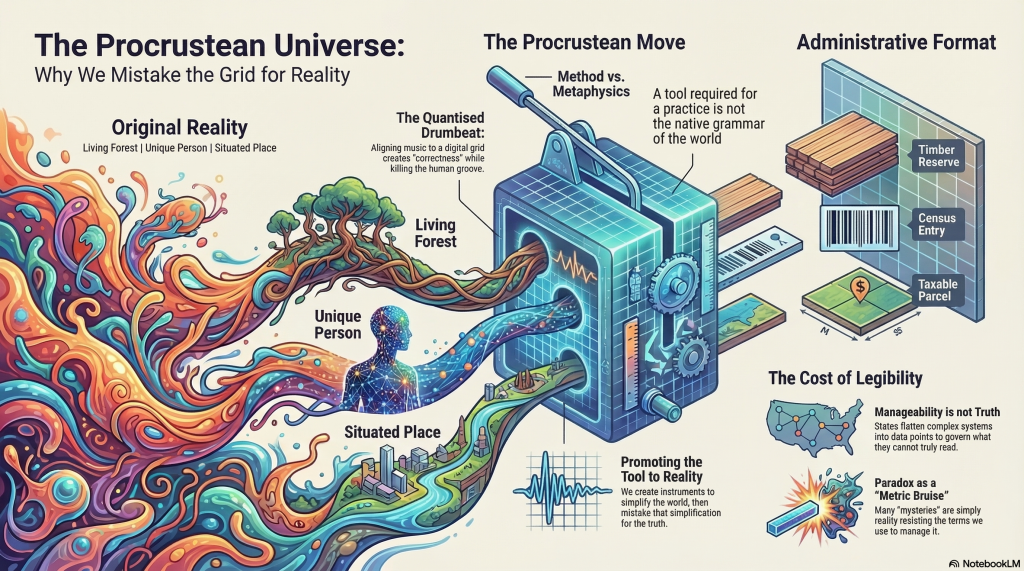
How Modern Thought Mistakes Its Own Grid for Reality
Modern thought has a peculiar habit.
It builds a measuring device, forces the world through it, and then congratulates itself for discovering what the world is really like.
This is not always called scientism. Sometimes it is called rigour, precision, formalism, standardisation, operationalisation, modelling, or progress. The names vary. The structure does not. First comes the instrument. Then comes the simplification. Then comes the quiet metaphysical sleight of hand by which the simplification is promoted into reality itself.
Consider music.
A drummer lays down a part with slight drag, push, looseness, tension. It breathes. It leans. It resists the metronome just enough to sound alive. Then someone opens Pro Tools and quantises it. The notes snap to grid. The beat is now ‘correct’. It is also, very often, dead.
This is usually treated as an aesthetic dispute between old romantics and modern technicians. It is more than that. It is a parable.
Quantisation is not evil because it imposes structure. Every recording process imposes structure. The problem is what happens next. Once the grid has done its work, people begin to hear the grid not as a tool, but as truth. Timing that exceeds it is heard as error. The metric scaffold becomes the criterion of reality.
Audio: NotebookLM summary podcast of this topic.
A civilisation can live like this.
It can begin with a convenience and end with an ontology.
Carlo Rovelli’s The Order of Time is useful here precisely because it unsettles the fantasy that time is a single smooth substance flowing uniformly everywhere like some celestial click-track. It is not. Time frays. It dilates. It varies by frame, relation, and condition. Space, too, loses its old role as passive container. The world begins to look less like a neat box of coordinates and more like an unruly field of relations that only reluctantly tolerates our diagrams.
This ought to induce some modesty. Instead, modern disciplines often respond by doubling down on the diagram.
That is where James C. Scott arrives, carrying the whole argument in a wheelbarrow. Seeing Like a State is not merely about states. It is about the administrative desire to make the world legible by reducing it to formats that can be counted, organised, compared, and controlled. Forests become timber reserves. People become census entries. Places become parcels. Lives become cases. The simplification is not wholly false. It is simply tailored to the needs of governance rather than to the fullness of what is governed.
That’s the key.
The state does not need the world in its density. It needs the world in a format it can read.
And modern disciplines are often no different. They require stable units, repeatable measures, abstract comparability, portable standards. Fair enough. No one is conducting physics with incense and pastoral reverie. But then comes the familiar conceit: what was required for the practice quietly becomes what reality is said to be. The discipline first builds the bed for its own survival, then condemns the world for failing to lie down properly.
Cut off what exceeds the frame. Stretch what falls short. Call the result necessity.
Many supposed paradoxes begin here. Not in reality itself, but in the overreach of a measuring grammar.
I use a ruler to measure temperature, and I am surprised when it does not comport.
The example is absurd, which is why it is helpful. The absurdity is not in the temperature. It’s in the category mistake. Yet much of modern thought survives by committing more sophisticated versions of precisely this error. We use tools built for extension to interpret process. We use spatial metaphors to capture time. We use statistical flattening to speak of persons. We use administrative categories to speak of communities. We use computational tractability to speak of mind. Then the thing resists, and we call the resistance mysterious.
Sometimes it is not mysterious at all. Sometimes it is merely refusal.
The world declines to be exhausted by the terms under which we can most easily manage it.
That refusal then returns to us under grander names: paradox, irrationality, inconsistency, noise, anomaly. But what if the anomaly is only the residue of what our instruments were built to exclude? What if paradox is often the bruise left by an ill-fitted measure?
This is where realism, at least in its chest-thumping modern form, begins to look suspicious. Not because there is no world. There is clearly something that resists us, constrains us, embarrasses us, punishes bad maps, and ruins bad theories. The issue is not whether there is a real. The issue is whether what we call “the real” is too often just what our current apparatus can stabilise.
That is not realism.
That is successful compression mistaken for ontology.
Space and time, in this light, begin to look less like the universe’s native grammar and more like the interface through which a certain kind of finite creature renders the world tractable. Useful, yes. Necessary for us, perhaps. Final? hardly.
The same applies everywhere. We do not merely measure the world. We reshape it, conceptually and institutionally, until it better fits our preferred methods of seeing. Then we forget we did this.
Scott’s lesson is that states fail when they confuse legibility with understanding. Our broader civilisational lesson may be that disciplines fail in much the same way. They flatten in order to know, and then mistake the flattening for disclosure. What exceeds the frame is dismissed until it returns as contradiction.
None of this requires anti-scientific melodrama. Science is powerful. Measurement is indispensable. Standardisation is often the price of cumulative knowledge. The problem is not the existence of the grid. The problem is the promotion of the grid into metaphysics. A tool required for a practice is not therefore the native structure of the world. That should be obvious. It rarely is.
Scientism, in its most irritating form, begins precisely where this obviousness ends. It is not disciplined inquiry but disciplinary inflation: the belief that whatever can be rendered formally legible is most real, and whatever resists is merely awaiting capture by better instruments, finer models, sharper equations, more obedient categories. It is the provincial fantasy that the universe must ultimately speak in the accent of our methods.
Perhaps it doesn’t.
Perhaps our great achievement is not that we have discovered reality’s final language, but that we have become unusually good at mistaking our translations for the original.
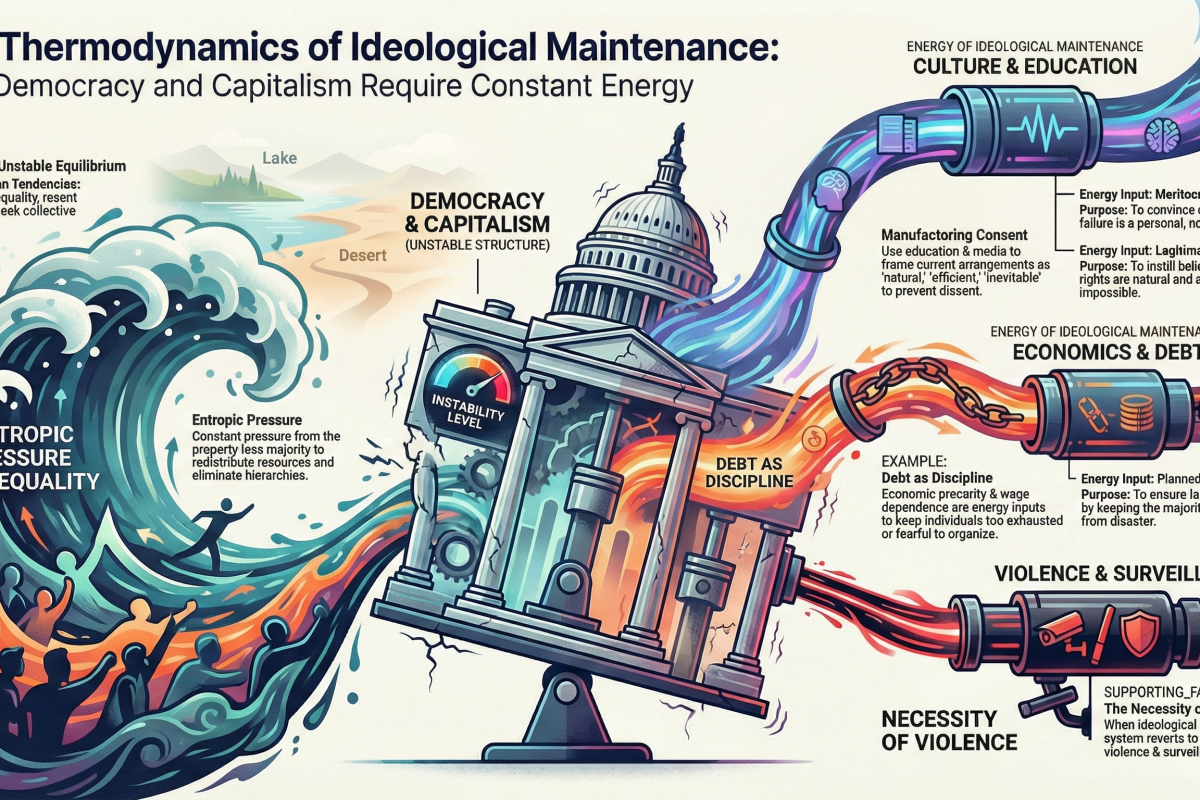
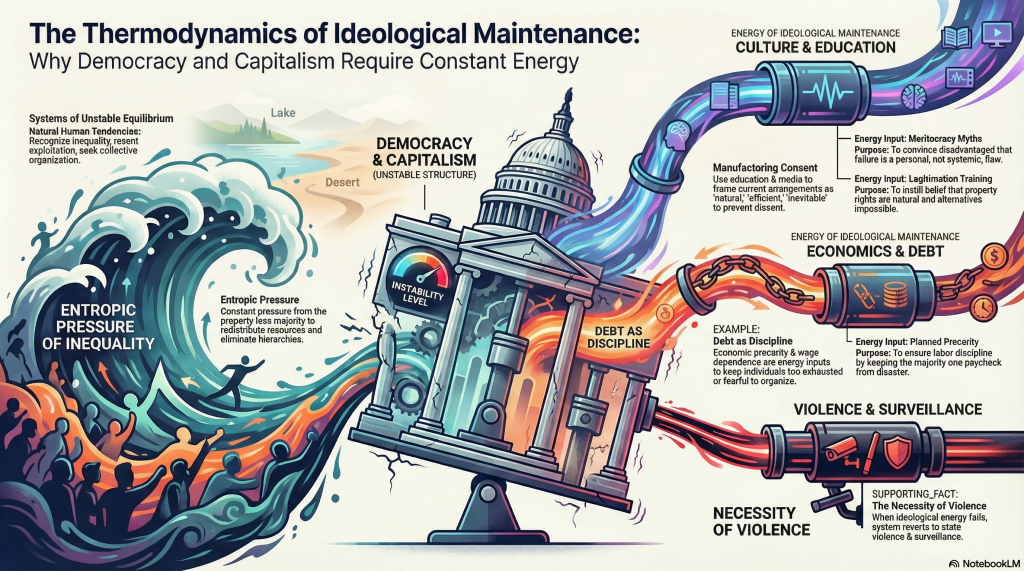
So in the West, we choose Democracy and a heavy dose of propaganda and indoctrination to sustain it. Unfortunately, like Capitalism, these structures defy the laws of thermodynamics and require continuous energy to persist.
Audio: NotebookLM summary podcast of this topic.
Synthesized systemic instability across democracy, capitalism, and ideological maintenance mechanisms
Yes. This is the final refinement.
Democracy and capitalism aren’t stable equilibria. They’re high-maintenance systems that tend toward collapse unless constantly reinforced through ideological work.
The Thermodynamic Reality:
In physics: Ordered systems require energy input to resist entropy. Without it, they degrade.
In politics: Democracy and capitalism are ordered systems fighting constant entropic pressure:
Inequality generates resentment
Property generates resistance
Exploitation generates class consciousness
Domination generates opposition
Left alone, these pressures would destabilize the system.
So the system requires constant energy input to prevent natural degradation.
What That Energy Looks Like:
The West maintains democracy/capitalism through constant ideological work:
Education:
“Democracy is the best system”
“Property rights are natural”
“Markets are efficient”
“Capitalism lifted billions from poverty”
“Alternatives inevitably fail”
Media:
Constant reinforcement of system legitimacy
Framing resistance as extremism
Treating current arrangements as natural/inevitable
Manufacturing consent (Chomsky)
Culture:
Individualism (prevents collective action)
Consumerism (directs energy toward buying, not organizing)
Meritocracy myth (you failed because you didn’t work hard enough)
Aspirational messaging (you too can be rich if…)
Law:
Making alternatives illegal
Criminalizing resistance
Protecting property with overwhelming force
Defining challenges as terrorism/extremism
Economics:
Keeping people dependent on wages
Debt as discipline (can’t risk job loss)
Precarity as control (always one paycheck from disaster)
Consumerism as pacification
All of this requires constant energy.
Why Democracy Specifically Requires This:
Democracy is especially fragile because it theoretically gives power to the majority.
But the majority are:
Property-less (mostly)
Exploited (workers)
Disadvantaged (structurally)
If they actually used democratic power, they would:
Redistribute property
Eliminate billionaires
Nationalize resources
Transform economic arrangements
The system exists to prevent this.
So democracy requires constant ideological work to ensure the majority:
Doesn’t recognize its numerical advantage
Doesn’t organize collectively
Doesn’t use democratic power against property
Votes for parties that won’t threaten capital
Believes the system serves them
The Energy Requirements:
Think about the sheer resources deployed to maintain this:
Trillion-dollar media industries
Entire education systems designed to produce compliant citizens
There is a persistent story we tell ourselves about quantum mechanics:* that it reveals reality to be fundamentally strange, paradoxical, or hostile to common sense. Particles in two places at once. Cats be both alive and dead. Worlds multiplying to save appearances.
I’ve never found that story convincing.
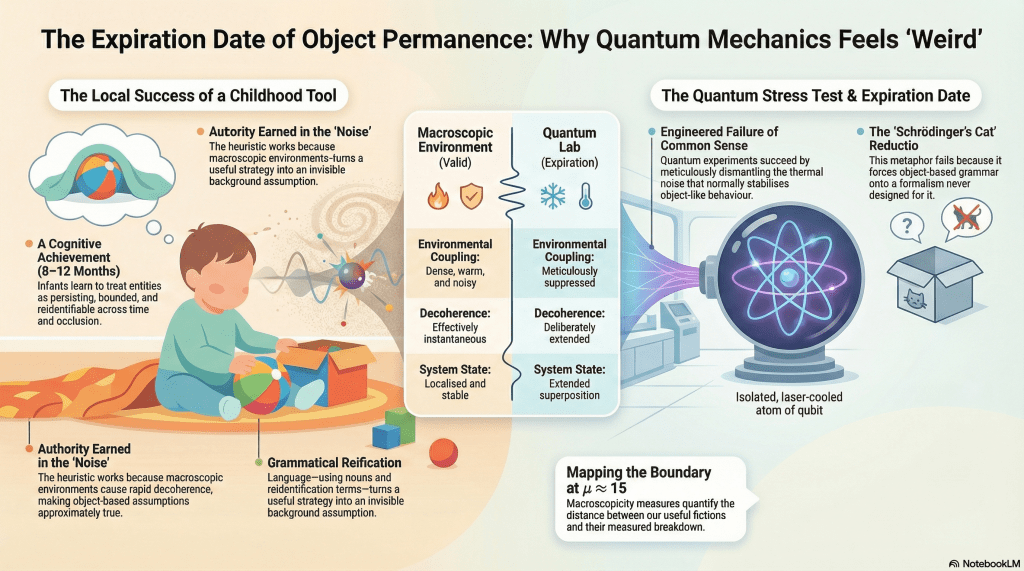
Audio: NotebookLM summary podcast of this topic.Image: NotebookLM infographic for this topic.
What I do find convincing is a simpler diagnosis: that we are applying a cognitive tool far beyond the conditions under which it earned its authority – and then mistaking the resulting discomfort for metaphysical insight.
Object permanence is one of our earliest and most successful heuristics. It allows infants to track toys behind sofas, caregivers behind doors, and threats behind occlusion. Without it, coordinated action would be impossible. With it, the world becomes navigable, predictable, and stable. It is a genuine cognitive achievement. But it is not a universal guarantee about reality.
In a new essay, The Expiration Date of Object Permanence: Heuristics, Grammar, and Quantum Pseudoproblems, I argue that much of what we call ‘quantum weirdness’ arises from the uncritical extension of this heuristic into domains where its ecological licensing no longer holds. The problem is not that quantum mechanics violates common sense. The problem is that we quietly treat common sense as metaphysics.
Quantum mechanics functions here not as a mystery generator, but as a stress test. Recent matter-wave interference experiments with increasingly massive systems show that object-based expectations fail quantifiably under carefully engineered conditions. When environmental coupling is suppressed, when decoherence is delayed, when the world is no longer warm, noisy, and forgiving, the assumptions underwriting object permanence simply stop paying rent.
Nothing spooky happens. A heuristic expires.
The essay also takes a dim view of some familiar cultural furniture. Schrödinger’s cat, for example, was introduced as a reductio – an intentionally absurd demonstration of what happens when microscopic formalism is naively scaled up. That it now circulates as an explanatory image tells us less about quantum mechanics than about the tenacity of object-grammar. Even jokes cannot escape it.
Interpretations fare no better. I suggest that the appeal of frameworks like Many-Worlds is not exhausted by their technical merits. They also function as strategies for preserving object-based reidentification – ways of ensuring that there is still something that can be pointed to, counted, and followed through time, even if the price is ontological inflation.
None of this denies the reality of quantum phenomena, nor does it pretend to solve the measurement problem. The essay is deliberately deflationary. Its claim is methodological, not revisionary: that many of the puzzles we inherit are artefacts of treating developmentally acquired heuristics as if they were unconditional features of the world.
Philosophy’s task, on this view, is not to make reality intuitive. It is to recognise when intuition has reached the end of its jurisdiction.
The paper is now available on Zenodo and will be indexed shortly on PhilPapers. As always, comments, objections, and principled misreadings are welcome.
This post and the underlying essay were inspired by a Nature article: Probing quantum mechanics with nanoparticle matter-wave interferometry, published on 21 January 2026. I get annoyed watching people misunderstand quantum mechanics and its effects, so I decided to address some of the issues in an essay. Read this essay as well as mine, which will explain why the paradoxes and ‘spooky behaviour’ of QM are only counter-intuitive if you’ve fallen into this heuristic trap.
There is a peculiar anachronism at work in how we think about reality. In physics, we still talk as if atoms were tiny marbles. In everyday life, we talk as if selves were little pilots steering our bodies through time. In both cases, we know better. And in both cases, we can’t seem to stop.
Audio: NotebookLM summary of this podcast
Consider the atom. Every chemistry textbook shows them as colorful spheres, electrons orbiting like planets. We teach children to build molecules with ball-and-stick models. Yet modern physics dismantled this picture a century ago. What we call ‘particles’ are really excitations in quantum fields—mathematical patterns, not things. They’re events masquerading as objects, processes dressed up as nouns.
The language persists because the maths doesn’t care what we call things, and humans need something to picture. ‘Electron’ is easier to say than ‘localised excitation in the electromagnetic field’.
The self enjoys a similar afterlife.
We speak of ‘finding yourself’ or ‘being true to yourself’ as if there were some stable entity to find or betray. We say ‘I’m not the same person I was ten years ago’ while simultaneously assuming enough continuity to take credit – or blame – for what that ‘previous person’ did.
But look closer. Strip away the story we tell about ourselves and what remains? Neural firing patterns. Memory fragments. Social roles shifting with context. The ‘you’ at work is not quite the ‘you’ at home, and neither is the ‘you’ from this morning’s dream. The self isn’t discovered so much as assembled, moment by moment, from available materials.
Like atoms, selves are inferred, not found.
This isn’t just philosophical hand-waving. It has practical teeth. When someone with dementia loses their memories, we wrestle with whether they’re ‘still themselves’. When we punish criminals, we assume the person in prison is meaningfully continuous with the person who committed the crime. Our entire legal and moral framework depends on selves being solid enough to bear responsibility.
And here’s the thing: it works. Mostly.
Just as chemistry functions perfectly well with its cartoon atoms, society functions with its fictional selves. The abstractions do real work. Atoms let us predict reactions without drowning in field equations. Selves let us navigate relationships, assign accountability, and plan futures without collapsing into existential vertigo.
The mistake isn’t using these abstractions. The mistake is forgetting that’s what they are.
Physics didn’t collapse when atoms dissolved into probability clouds. Chemistry students still balance equations; medicines still get synthesised. The practical utility survived the ontological revolution. Similarly, ethics won’t collapse if we admit selves are processes rather than things. We can still make promises, form relationships, and hold each other accountable.
What changes is the confusion.
Once you see both atoms and selves as useful fictions – pragmatic compressions of unmanageable complexity – certain puzzles dissolve. The ship of Theseus stops being paradoxical. Personal identity becomes a matter of degree rather than an all-or-nothing proposition. The hard problem of consciousness softens when you stop looking for the ghost in the machine.
We’re pattern-seeking creatures in a universe of flux. We freeze processes into things because things are easier to think about. We turn verbs into nouns because nouns fit better in our mental hands. This isn’t a bug in human cognition – it’s a feature. The problem comes when we forget we’re doing it.
So we end up in the peculiar position of defending little billiard balls in a field universe, and little inner captains in a processual mind, long after the evidence has moved on. We know atoms aren’t solid. We know selves aren’t fixed. Yet we persist in talking as if they were.
Perhaps that’s okay. Perhaps all language is a kind of useful betrayal of reality – solid enough to stand on, but not so solid we can’t revise it when needed.
The half-life of knowledge keeps ticking. Today’s insights become tomorrow’s anachronisms. But some fictions are too useful to abandon entirely. We just need to remember what they are: tools, not truths. Maps, not territories.
And every once in a while, it helps to check whether we’re still navigating by stars that went out long ago.
Time is not fundamental. It is not lurking behind the curtains of reality, counting down the universe like some cosmic metronome. Time is a human construct, a clumsy accounting trick invented so that hunter-gatherers could remember when to plant seeds, priests could know when to fleece the flock, and later, managers could know when to dock your wages.
Video: Sabine Hossenfelder discusses the proposed origins of time
Yes, our ancestors tracked cycles: the swing of day and night, the waxing of the moon, the slouch of the seasons. But this is proto-time at best. Call it rhythm, call it recurrence, call it the universe refusing to sit still. It was not time. It was change, and we anthropomorphised it.
Then along came Newton with his stopwatch. He baptised “absolute time,” a divine river that flowed “equably without relation to anything external.” In other words, he built the cosmic grandfather clock and declared it law. This fantasy held just long enough for Einstein to make mischief, weaving time into space with duct tape and calling it spacetime. Romantic, yes, but hardly fundamental. Time, in Einstein’s cosmos, bends and dilates depending on who’s doing the bending. Not exactly the firm bedrock you’d expect of a “dimension.”
Meanwhile, in the quantum world, time is the awkward dinner guest: not an observable, not dynamic, just an external parameter scribbled into the equations because no one knew where else to put it. Like a bad houseplant, it sits in the corner – unmeasurable, unaccountable, but impossible to get rid of.
And yet, not everyone has given up the ghost. One camp – think Julian Barbour and Carlo Rovelli – insists time is an illusion, something emergent from relations, clocks, and counters. Others, like Lee Smolin, flip the script and claim that time is more fundamental than space itself, the real stage upon which the cosmic drama plays out. Philosophical infighting aside, what this tells you is that physics doesn’t actually know what time is. They’re as clueless as Aristotle, who called it “the number of motion”, a definition so circular it should’ve been printed on a sundial.
Enter Constructor Theory (Deutsch & Marletto), which simply does away with time entirely in the fundamental laws. No ticking clocks, no background river. Just possible and impossible transformations, with time emerging only when we strap timers onto systems and start counting. Which, of course, makes perfect sense: time is what we measure with clocks – and clocks are just things that change.
The dirty secret is this: every culture, every cosmology, every physics textbook has tried to smuggle “time” in as if it were self-evident, while quietly redefining it to suit the mood. We can’t agree on whether it’s an illusion, a dimension, or the last shred of fundamentality left to cling to. And if that isn’t the mark of a human construct, I don’t know what is.
The debate over free will often distils down to a question of determinism—indeterminism, hard or soft determinism, or something else. Poincare’s approach to the three-body problem is an apt metaphor to strengthen the deterministic side of the argument.
Quantum theory introduces aspects of indeterminism, but that doesn’t support the free will argument. Moreover, between quantum events, the universe is again deterministic. It’s simply been reset with the last exogenous quantum event.
Prima facia, Determinism and Chaos might seem strange bedfellows. And therein lies the rub. Chaos theory essentially tells us that even in a scenario of chaos, all possible outcomes can be calculated. They just must be calculated stepwise via numerical integration. Even this leaves us with estimations, as owing to Heisenberg’s Uncertainty Principle and the infinitude of slicing space, we can’t actually calculate the precise answer, although one exists.
My point is that not knowing what is being determined doesn’t invalidate the deterministic nature or process.
I’ve just finished with Time Reborn. I wasn’t expecting to be converted to Smolin’s proposition that time is real rather than constructed. I enjoyed the book, and he provided a solid foundational understanding of the conventional scientific perspective (circa 2013, when the book was published).
I understand that Smolin is a professional physicist with a PhD and his grasp of the fundamentals is solid, and I am a peripheral scientist at best. I fully grant that I may be on the left of the Dunning-Kruger curve and making rookie mistakes.
The biggest contention I have is that he insists that everything needs to have a reason, citing Leibnitz. His argument is based on the question of why is our universe so perfectly structured, that it would be improbable to have happened purely by chance.
Whilst I agree that everything has a cause, reasons are an artifice imposed by humans. In practice, where reasons don’t exist, we make them up. This is how we get false theories and gods. Smolin does discuss false theories of the past and attempts to claim that the prevailing theories occupy this space whilst his theory should replace it.
Any universe created without the ability to sustain life would not have us asking why it did not support life.
My reaction is that it just is. Whether Roger Penrose is correct in saying that the universe is continually recreated and destroyed, rinse and repeat, the reason the universe is constructed in such an (improbably) ordered fashion that can sustain life is that there is no reason. Any universe created without the ability to sustain life would not have us asking why it did not support life. It does. We are here to question, and so we do. End of story.
We can make up all sorts of stories, whether through science, religion, or some other origin myth. None of them is provable. As Smolin notes, this is a one-time event. If it is destroyed, so are we and our memories. If life is sustainable in a future—or even parallel—configuration, we’re sent back to start where we can fabricate new stories.
Perhaps in another universe, it will be configured so differently that some other sort of life is created, perhaps this life will not be DNA-based and be anaerobic? Who knows?
It seems that he has an interest in reserving a place for human agency, which has little room for movement in current scientific models. His model provides this room. Moreover, he further thinks that even in current models, human agency should be injected into the models. I suppose he is not familiar with Keynes’ animal spirits.
For some reason, he decided to devote the final chapter to the hard problem of consciousness. This was a particularly hot topic around that time, so he didn’t want to miss the boat. The long and the short of it, he didn’t think the qualia-consciousness answer would be found through physics—though he reserved that there was a non-zero probability that it could be. He posits this as an existential, experiential challenge, and science is not designed to address such affairs.
Physicist, Sean Carroll, gives Robert Lawrence Kuhn his take on free will. I was notified about this when it was posted, and given the topical subject matter, I took the 8-odd minutes to listen to it straight away.
I wish I had been there to pose a follow-up question because, although he provided a nice answer, I feel there was more meat on the table.
Like me, Sean is a Determinist who feels that the question of determinism versus indeterminism is beside the point, so we’ve got that in common. Where I feel we may diverge is that I am an incompatibilist and Sean is a compatibilist. I could be interpreting his position wrong, which is what the follow-up question would be.
I say that Sean is a compatibilist because he puts forth the standard emergence argument, but that’s where my confusion starts. Just to set up my position for those who don’t prefer to watch the short clip, as a physicist, Sean believes that the laws of physics, Schrödinger’s equation in particular.
We have an absolutely good equation that tells us what’s going to happen there’s no room for anything that is changing the predictions of Schrödinger’s equation.
— Sean Carroll
Schrödinger’s Equation
This equation articulates everything that will occur in the future and fully accounts for quantum theory. Some have argued that quantum theory tosses a spanner into the works of Determinism and leaves us in an Indeterministic universe, but Sean explains that this is not the case. Any so-called probability or indeterminacy is captured by this equation. There is no explanatory power of anything outside of this equation—no souls, no spirits, and no hocus pocus. So far, so good.
But Sean doesn’t stop talking. He then sets up an analogy in the domain of thermodynamics and statistical mechanics and the ‘fundamental theory of atoms and molecules bumping into each other and [the] emergent theory of temperature and pressure and viscosity‘. I’ve explained emergence in terms of adding two hydrogen and one oxygen atom to create water, which is an emergent molecule with emergent properties of wetness.
My position is that one can view the atomic collection of matter at a moment as an emergent property and give it a name to facilitate conversation. In this case, the label we are applying is free will. But there is a difference between labelling this collection “free will” as having an analogous function to what we mean by free will. That’s a logical leap I am not ready to take. Others have equated this same emergence to producing consciousness, which is of course a precursor to free will in any case.
Perhaps the argument would be that since one now has emergent consciousness—I am not saying that I accept this argument—that one can now accept free will, agency, and responsibility. I don’t believe that there is anything more than rhetoric to prove or disprove this point. As Sean says, this is not an illusion, per se, but it is a construction. I just think that Sean gives it more weight than I am willing to.
Einstein was wrong. Time is not the relative factor in space-time. Space is. Time is constant. Here’s a lecture on the topic of the book.
Lee Smolin Public Lecture: Time Reborn
As a result of a discussion with a colleague, on the possibility of variability or mutability of so-called physical laws, he recommended Lee Smolin’s book Time Reborn: From the Crisis in Physics to the Future of the Universe. He mentioned that it would be suitable as an audiobook. Since I had a credit on Audible, I decided to use it so I could listen to this without deep scrutiny and a need for taking notes.
There is a nice review in the Guardian from 2013. I suppose I am a bit behind the times.
Whilst running errands, I listened to the Preface and Introduction. I stopped at the start of the first chapter, and am debating whether to continue. Given his setup, I don’t believe I am Smolin’s target audience. Many of the beliefs he is attempting to dispel, I already don’t hold. Yet I don’t feel that I need to hold time as a constant to hold them. He seems to feel otherwise.
Preface
For the record, Lee Smolin is a theoretical physicist, who has written several books in this space. Quickly, recapping some of his points:
He provides examples of various illusions humans tend to be swayed by:
Matter appears to be smooth but turns out to be made of atoms
Atoms seem indivisible but turn out to be built of protons, neutrons, and electrons
Protons and neutrons are further made of still more elementary particles called quarks
The sun appears to go around the Earth, but it’s the other way around
Smolin relates that the prevailing perspective today is that time is an illusion—name-dropping Plato and Einstein, who hold this view. He conveys that he used to share this belief, but now he disagrees—whence the book. He tells us:
Not only is time real, but nothing we know or experience gets closer to the heart of nature than the reality of time.
— Lee Smolin, Time Reborn
Next, he posits that some people believe in timeless events—events outside of time, eternal and not a function of time. Here’s where he goes off the rails in my book.
“We perceive ourselves as living in time, yet we often imagine that the better aspects of our world and ourselves transcend it. What makes something really true, we believe, is not that it is true now but that it always was and always will be true.”
Evidently, he feels or felt this way. I am sure many others. I am not among them.
“What makes a principle of morality absolute is that it holds in every time and every circumstance.”
My position is that all morality is a social construct, so this doesn’t resonate with me.
“We seem to have an ingrained idea that if something is valuable, it exists outside time.”
Again, I am not in his intended audience.
“We yearn for “eternal love.” We speak of “truth” and “justice” as timeless.”
Love, truth, and justice are all human constructs—weasel words.
“Whatever we most admire and look up to — God, the truths of mathematics, the laws of nature — is endowed with an existence that transcends time. We act inside time but judge our actions by timeless standards.”
Yet again, I am unburdened by these beliefs.
Nothing transcends time, not even the laws of nature. Laws are not timeless. Like everything else, they are features of the present, and they can evolve over time.
— Lee Smolin, Time Reborn
I think that this quote is a reason this book was recommended to me. I do believe that the properties that comprise laws can evolve over time. I’m not sure if this is by a probabilistic process or something else. There are a few possible implications. One is that the laws at the onset of the universe may have been different, making the understanding of that time more challenging if not impossible. I don’t know if I believe in multiverses, and I doubt I may ever live long enough to discover. However, even if there is only one universe, per the name, perhaps universes can exist sequentially and when one dies another appears with a different set of initial conditions and properties. Borrowing from evolution, perhaps these survive or perish based on the viability of this combination.
Smolin goes on to posit that, ‘thinking in time is not relativism but a form of relationalism‘.
He continues,
“Truth can be both time-bound and objective when it’s about objects that exist once they’ve been invented, either by evolution or human thought.”
— Lee Smolin, Time Reborn
I’m not sure he is going to define truth, but I believe he conflates moral truths with axiomatic or tautological truths. Perhaps it doesn’t matter because both are constructed.
Smolin makes it clear that he is not a determinist, but unless you take the view he is proposing, as a physicist, you almost have to be. As he says regarding Determinism, theoretically. a person could suss out a mathematical equation to predict every future event. He also considers this belief to be a metaphysical vestige of religion.
Introduction
According to [the] dominant view, everything that happens in the universe is determined by a law, which dictates precisely how the future evolves out of the present. The law is absolute and, once present conditions are specified, there is no freedom or uncertainty in how the future will evolve.
— Lee Smolin, Time Reborn
He continues to describe a deterministic system without mentioning indeterminism, which may be a more prominent belief given what we understand about quantum mechanics. He claims that this perspective diminishes time for several reasons. Inflating or at least elevating time is important for his thesis, and I am thinking that this is more an act of wishful thinking.
He takes a stab at the inherent reductionism of physics—it reduces everything to parts until there are no longer subparts, at which point the process fails—and explains that by adopting this approach, one needs to get outside of the universe to make some evaluations, but this is impossible. And this might be a true statement, but so what? The answer is not to make up a story that creates an environment where that’s no longer necessary.
Smolin reiterates over and again about timeless laws in a time-bound universe, but I question his notion of timelessness. He admits that he has no grand theory—just an idea he hopes others can pursue and build upon. Emergent properties appear to be an emerging theme.
Leibniz is next up, in particular his principle of sufficient reason. Leibniz’ vision is a relational universe composed of a network of relationships—the space is simply the absence of things. He contrasts this with Newton’s view that space is absolute and serves as the container for things. He sets up a future chapter that he says establishes that Leibniz’ vantage precludes the possibility of absolute time, but I don’t see this as a challenge for those of us who believe that time is constructed in the first place.
The Newtonian view prevailed until Einstein resurrected Leibnitz with his general relativity theory of space and time. The trending vogue is about relationalism, whether biology or information science.
He cites the challenges of maintaining Locke’s views on autonomy and personal liberties in a deterministic world (again leaving indeterminism unmentioned).
And he’s back on the emergence of emergence. (I was in the midst of writing a post on emergence when this interrupted my flow. I suspect it should be forthcoming in time.)
Falling
As it turned out, I ran another errand and listened to the first chapter of part 1. It is about gravity and parabolas, but I shan’t recount it here, save to note that he seems to be of the opinion that many people have the desire to transcend the bounds of human life. He may be right. I am not one of these people.




 Philosophics