Qualified Subjectivism

4–7 minutes

I Am a Qualified Subjectivist. No, That Does Not Mean ‘Anything Goes’.

Make no mistake: I am a subjectivist. A qualified one. Not that kind of qualified – the qualification matters, but it’s rarely the part anyone listens to.

Image: Not that kind…

Here is the unglamorous starting point: all human encounters with the world are mediated. There is no raw feed. No unfiltered access. No metaphysical lead running directly from ‘reality’ into the human mind. Every encounter is processed through bodies, nervous systems, cultures, languages, technologies, institutions, and histories.

Audio: NotebookLM summary podcast of this content – See addendum below.

Whilst I discuss the specific architecture of this mediation at length in this preprint, here I will keep it simple.

If you are human, you do not encounter reality as such. You encounter it as processed. This is not controversial. What is controversial is admitting the obvious consequence: the subject is the final arbiter.
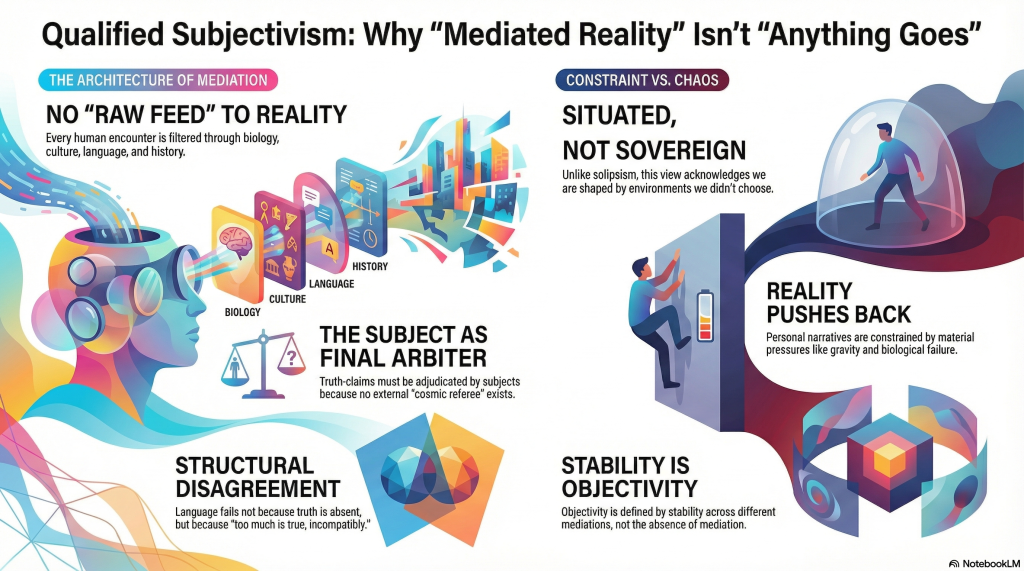
Image: NotebookLM Infographic of Qualified Subjectivism

The Subject Is the Final Arbiter

Every account of truth, reality, meaning, value, or fact is ultimately adjudicated by a subject. Not because subjects are sovereign gods, but because there is literally no other place adjudication can occur.

Who, exactly, do critics imagine is doing the adjudicating instead? A neutral tribunal floating outside experience? A cosmic referee with a clipboard? A universal consciousness we all forgot to log into?

This does not mean that truth is ‘whatever I feel like’. It means that truth-claims only ever arrive through a subject, even when they are heavily constrained by the world. And constraint matters. Reality pushes back. Environments resist. Bodies fail. Gravity does not care about your personal narrative.

Why This Is Not Solipsism

Solipsism says: only my mind exists. That is not my claim. My claim is almost boring by comparison: subjects are situated, not sovereign.

We are shaped by environments we did not choose and histories we did not write. Mediation does not eliminate reality; it is how reality arrives. Your beliefs are not free-floating inventions; they are formed under biological, social, and material pressure. Two people can be exposed to the same event and encounter it differently because the encounter is not the event itself – it is the event as mediated through a particular orientation.

Why Objectivity Keeps Sneaking Back In

At this point, someone usually says: ‘But surely some things are objectively true.’

Yes. And those truths are still encountered subjectively. The mistake is thinking that objectivity requires a ‘view from nowhere’. It doesn’t. It requires stability across mediations, not the elimination of mediation altogether. We treat some claims as objective because they hold up under variation, while others fracture immediately. But in all cases, the encounter still happens somewhere, to someone.

The Real Source of the Panic

The real anxiety here is not philosophical. It’s moral and political. People are terrified that if we give up the fantasy of unmediated access to universal truth, then legitimacy collapses and ‘anything goes’.

This is a category error born of wishful thinking. What actually collapses is the hope that semantic convergence is guaranteed. Once you accept that mediation is unavoidable, you are forced to confront a harder reality: disagreement is often structural, not corrigible. Language does not fail because nothing is true. Language fails because too much is true, incompatibly.

So Yes, I Am a Qualified Subjectivist

Interpretation only ever occurs through subjects. Subjects are always mediated. Mediation is always constrained. And constraint does not guarantee convergence.

That is the position. It is not radical, fashionable, or comforting. It is simply what remains once you stop pretending there is a god’s-eye view quietly underwriting your arguments. Discomfort is simply a reliable indicator that a fantasy has been disturbed.

Audio: NotebookLM summary of this Geworfenheit addendum

If all this sounds suspiciously familiar, that’s because it is. Heidegger had a word for it: Geworfenheit – usually translated as thrownness.

The idea is simple, and deeply irritating to anyone still hoping for a clean start. You do not enter the world as a neutral observer. You are thrown into it: into a body, a language, a culture, a history, a set of institutions, a moment you did not choose. You do not begin from nowhere and then acquire a perspective. You begin already situated, already oriented, already implicated.

This is not a poetic flourish. It is a structural claim about human existence.
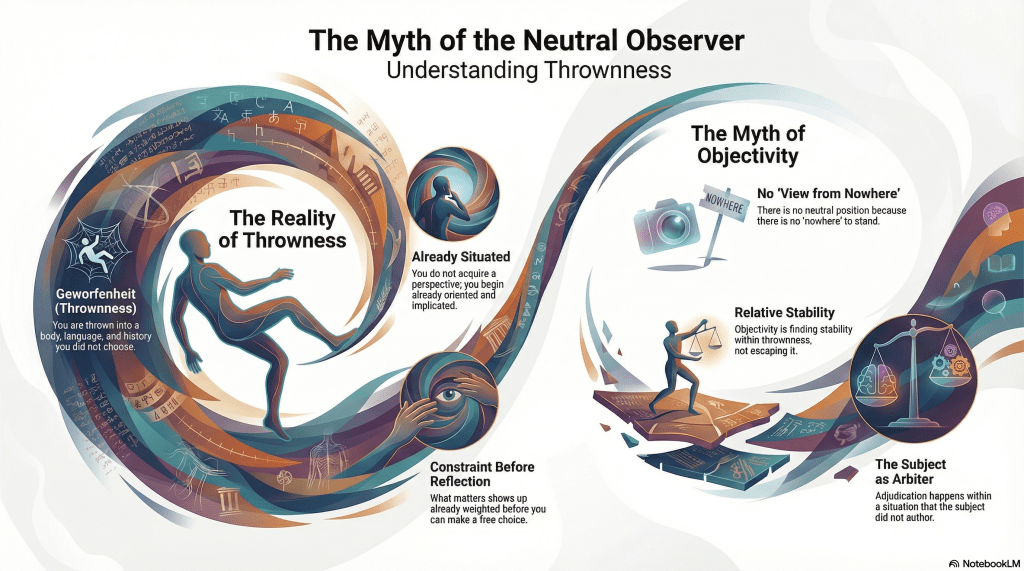
Image: Another NotebookLM infographic for the fun of it.

What my qualified subjectivism insists on – without Heidegger’s ontological theatre – is the same basic constraint: there is no view from nowhere because there is no nowhere to stand. The subject does not float above mediation; the subject is constituted by it. Thrownness is not an accident to be corrected by better theory. It is the condition under which any theorising occurs at all.

Seen this way, the demand for pure objectivity starts to look less like a philosophical ideal and more like nostalgia for an impossible innocence. A wish to rewind existence to a point before bodies, languages, power, and history got involved. That point never existed.

Geworfenheit matters here because it dissolves the caricature that subjectivism is about arbitrary choice. Being thrown is the opposite of choosing freely. It is constraint before reflection. Orientation before argument. Salience before reasons. You do not decide what matters from a neutral menu; what matters shows up already weighted, already charged, already resistant.

This is why appeals to “just be objective” always ring hollow. Objectivity does not mean escaping thrownness. It means achieving relative stability within it. Some claims hold across many thrown positions. Others fracture immediately. That distinction matters. But none of it happens outside mediation.

So when I say the subject is the final arbiter, I am not crowning the subject king of reality. I am pointing out the obvious: adjudication happens somewhere, to someone, from within a situation they did not author. Thrownness guarantees that there is no cosmic referee waiting to overrule the encounter.

If that makes you uncomfortable, good. It should. Discomfort is often just the sensation of a fantasy losing its grip.

Facts, Intent, and the Afterlife of Metaphysics

5–8 minutes

I’ve been reading Bernard Williams lately, and I’ve written about his work on Truth and Truthfulness. I’m in the process of writing more on the challenges of ontological moral positionsand moral luck. I don’t necessarily want to make contemporary news my focal point, but this is a perfect case study for it. I’ll be releasing a neutral philosophy paper on the underlying causes, but I want to comment on this whilst it’s still in the news cycle.

The form of xenophobia is a phenomenon occurring in the United States, though the ontological split is applicable more generally. For those unfamiliar with US news, I’ll set this up. The United States is currently deploying federal enforcement power in ways that deliberately bypass local consent, blur policing and military roles, and rely on fear as a stabilising mechanism. Historical analogies are unavoidable, but not required for the argument that follows. These forces have been deployed in cities that did not and do not support the Trump administration, so they are exacting revenge and trying to foment fear and unrest. This case is an inevitable conclusion to these policy measures.

tl;dr: The Law™ presents itself as fact-driven, but only by treating metaphysical imputations about inner life as if they were empirical findings. This is not a flaw in this case; it is how the system functions at all.

NB: Some of this requires having read Williams or having a familiarity with certain concepts. Apologies in advance, but use Google or a GPT to fill in the details.

Audio: NotebookLM summary podcast of this content.

Why the Minneapolis ICE Shooting Exposes the Limits of Bernard Williams

The Minneapolis ICE shooting is not interesting because it is unusual. It is interesting because it is painfully ordinary. A person is dead. An officer fired shots. A vehicle was involved. Video exists. Statements were issued. Protests followed. No one seriously disputes these elements. They sit in the shared centre of the Venn diagram, inert and unhelpful. Where everything fractures is precisely where the law insists clarity must be found: intent and motive. And this is where things stop being factual and start being metaphysical.

The Comfortable Fiction of Legal Facts

The legal system likes to tell a comforting story about itself. It claims to be empirical, sober, and evidence-driven. Facts in, verdicts out. This is nonsense.

What the law actually does is this:

  • It gathers uncontested physical facts.
  • It then demands a psychological supplement.
  • It treats that supplement as if it were itself a fact.

Intent and motive are not observed. They are inferred. Worse, they are imposed. They are not discovered in the world but assigned to agents to make outcomes legible.

In Minneapolis, the uncontested facts are thin but stable:

  • A U.S. Immigration and Customs Enforcement (ICE) agent, identified as Jonathan Ross, shot and killed Renée Nicole Good in Minneapolis on 7 January 2026.
  • The incident involved Good’s vehicle, which was present and moving at the time shots were fired.
  • Ross fired his weapon multiple times, and Good died from those gunshot wounds.
  • The Department of Homeland Security (DHS) claims the agent acted in self-defence.
  • Video footage exists that shows at least part of the encounter.
  • The case ignited protests, widespread condemnation from local officials, and political pushback.

This creates a shared intersection: vehicle, Ross, shots, and that ‘something happened’ that neither side is denying.

None of these facts contain intent. None of them specify motive. They do not tell us whether the movement of the vehicle was aggression, panic, confusion, or escape. They do not tell us whether the shooting was fear, anger, habit, or protocol execution. Yet the law cannot proceed without choosing.
So it does what it always does. It smuggles metaphysics into evidence and calls it psychology.

Intent and Motive as Institutional Impositions

Intent is treated as a condition of responsibility. Motive is treated as its explanation. Neither is a fact in anything like the ordinary sense. Even self-report does not rescue them. Admission is strategically irrational. Silence is rewarded. Reframing is incentivised. And even sincerity would not help, because human beings do not have transparent access to their own causal architecture. They have narratives, rehearsed and revised after the fact. So the law imputes. It tells the story the agent cannot safely tell, and then punishes or absolves them on the basis of that story. This is not a bug. It is the operating system.

Where Bernard Williams Comes In

This is where Bernard Williams becomes relevant, and where his account quietly fails. In Truth and Truthfulness, Williams famously rejects the Enlightenment fantasy of capital-T Truth as a clean, context-free moral anchor. He replaces it with virtues like sincerity and accuracy, grounded in lived practices rather than metaphysical absolutes. So far, so good.

Williams is right that moral life does not float above history, psychology, or culture. He is right to attack moral systems that pretend agents consult universal rules before acting. He is right to emphasise thick concepts, situated reasons, and practical identities. But he leaves something standing that cannot survive the Minneapolis test.

The Residue Williams Keeps

Williams still needs agency to be intelligible. He still needs actions to be recognisably owned. He still assumes that reasons, however messy, are at least retrospectively available to anchor responsibility. This is where the residue collapses.

In cases like Minneapolis:

  • Intent is legally required but epistemically unavailable.
  • Motive is legally explanatory but metaphysically speculative.
  • Admission is disincentivised.
  • Narrative is imposed under institutional pressure.

At that point, sincerity and accuracy are no longer virtues an agent can meaningfully exercise. They are properties of the story selected by the system. Williams rejects metaphysical Truth while retaining a metaphysical agent robust enough to carry responsibility. The problem is that law does not merely appeal to intelligibility; it manufactures it under constraint.

Moral Luck Isn’t Enough

Williams’ concept of moral luck gestures toward contingency, but it still presumes a stable agent who could, in principle, have acted otherwise and whose reasons are meaningfully theirs. But once intent and motive are understood as institutional fabrications rather than inner facts, ‘could have done otherwise’ becomes a ceremonial phrase. Responsibility is no longer uncovered; it is allocated. The tragedy is not that we fail to know the truth. The tragedy is that the system requires a truth that cannot exist.

Facts Versus Stories

The law does not discover which story is true. It selects which story is actionable.

The Minneapolis case shows the fault line clearly:

  • Facts: bodies, movements, weapons, recordings.
  • Stories: fear versus anger, defence versus aggression.
  • The first is uncontested. The second does all the work.

And those stories are not epistemic conclusions. They are metaphysical commitments enforced by law. Williams wanted to rescue ethics from abstraction. What he could not accept is that, once abstraction is removed, responsibility does not become more human. It becomes procedural.

The Uncomfortable Conclusion

The law does not operate on truth. It operates on enforceable interpretations of behaviour. Intent and motive are not facts. They are tools. Williams saw that capital-T Truth had to go. What he did not see, or perhaps did not want to see, is that the smaller, more humane residue he preserved cannot bear the weight the legal system places on it.

Once you see this, the obsession with ‘what really happened’ looks almost childish. The facts are already known. What is being fought over is which metaphysical fiction the system will enforce.

That decision is not epistemic. It is political. And it is violent.

When Language Fails – Abstract

3–4 minutes

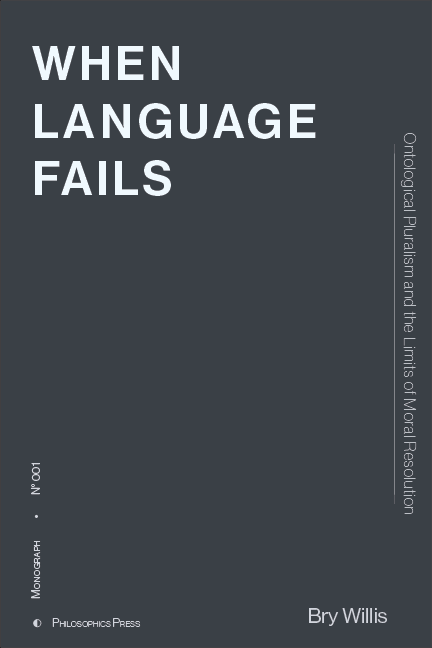
I set aside some time to design the front cover of my next book. I’m excited to share this – but that’s always the case. It’s substantially complete. In fact, it sidelined another book, also substantially complete, but the content in this might force me to change the other one. It should be ready for February. I share the current state of the Abstract

This book is meant to be an academic monograph, whilst the other, working title: The Competency Paradox, is more of a polemic.

As I mentioned in another post, it builds upon and reorients the works of George Lakoff, Jonathan Haidt, Kurt Gray, and Joshua Greene. I’ve already revised and extended Gallie’s essentially contested concepts in A Language Insufficiency Hypothesis in the form of Contestables, but I lean on them again here.

Abstract

Contemporary moral and political discourse is marked by a peculiar frustration: disputes persist even after factual clarification, legal process, and good-faith argumentation have been exhausted. Competing parties frequently agree on what happened, acknowledge that harm occurred, and yet remain irreconcilably divided over whether justice has been served. This persistence is routinely attributed to misinformation, bad faith, or affective polarisation. Such diagnoses are comforting. They are also often wrong.

This paper advances a different claim. Certain conflicts are not primarily epistemic or semantic in nature, but ontological. They arise from incompatible orientations that structure how agents register salience, threat, authority, autonomy, and legitimacy. These orientations are genealogically shaped through enculturation, institutions, and languaged traditions, yet operationally they function prior to linguistic articulation: salience fires before reasons are narrated. Moral vocabulary enters downstream, tasked with reconciling commitments that were never shared.

From this perspective, the instability of concepts such as justice is not the primary problem but a symptom. Justice belongs to a class of Contestables (in Gallie’s sense, PDF): action-authorising terms that appear determinate while remaining untethered from shared reference under ontological plurality. Appeals to clearer definitions, better process, or shared values therefore misfire. They presume a common ontological ground that does not, in fact, exist.

When institutions are nevertheless required to act, they cannot adjudicate between ontologies. They can only select. Courts, juries, regulatory bodies, and enforcement agencies collapse plural interpretations into a single outcome. That outcome is necessarily experienced as legitimate by those whose orientation it instantiates, and as injustice by those whose orientation it negates. No procedural refinement can eliminate this asymmetry. At best, procedure dampens variance, distributes loss, and increases tolerability.
Crucially, the selection itself is constrained but underdetermined. Even within formal structures, human judgment, discretion, mood, confidence, fear, and narrative framing play a decisive role. Following Keynes, this irreducible contingency may be described as animal spirits. In formal terms, institutional outcomes are sampled from a constrained space of possibilities, but the reaction topology remains structurally predictable regardless of which branch is taken.

The consequence is stark but clarifying: outrage is not evidence that a system has failed to deliver justice; it is evidence that plural ontological orientations have been forced through a single decision point. Where semantic reconciliation is structurally unavailable, exogenous power is the dominant near-term mediator. Power does not resolve the conflict; it pauses it and stabilises meaning sufficiently for coordination to continue.

This analysis does not deny the reality of harm, the importance of law, or the necessity of institutions. Nor does it lapse into nihilism or indifference. Rather, it reframes the problem. In ontologically plural environments, the task is not moral convergence but maintenance: containing collision, resisting premature coherence, and designing institutions that minimise catastrophic failure rather than promising final resolution.

The argument developed here predates any particular event. Its value lies precisely in its predictive capacity. Given plural ontologies, untethered contestables, and institutions that must act, the pattern of reaction is invariant. The surface details change; the structure does not.
What follows is not a proposal for reconciliation. It is a diagnosis of why reconciliation is so often a category error, and why pretending otherwise is making things worse.

A Language Insufficiency Hypothesis

1–2 minutes

Almost a decade in the making, this book explains why more time, more effort, and more detail do not reliably improve certain forms of communication. Beyond a point, returns diminish sharply. In some domains, they collapse altogether.

The manuscript focuses on English, but the hypothesis has already been extended to French (published separately), and I am continuing work on other ontological barriers. If you’re interested in testing or extending the framework in your own language, feel free to get in touch.

Also available in a clothbound edition at Barnes & Noble.

Over the coming weeks, I’ll be unpacking aspects of the Language Insufficiency Hypothesis in more depth here. The book’s role is deliberately limited: it defines the problem, establishes the structure, and offers grounding examples. The real work happens in the consequences.

For now, the important thing is simple: the book is finally available.

A Year of ChatGPT, 2025

1–2 minutes

Like many apps, especially in the SaaS and PaaS space, ChatGPT offered a year-in-review. Even though I use several generative AI platforms, ChatGPT and Claude are my top two, followed by Gemini, Grok, DeepSeek, Perplexity, and Mistral – in that order. I also like Kimi K2. I am not a fan of Meta Llama or Qwen.

Image: Except for the coffee, this isn’t half bad.
Image: 2025 ChatGPT Chat Stats

Wow. I sent ChatGPT over 35,000 messages. Since I have a couple of accounts, that’s even more amazing. This is my primary account.

I don’t usually use ChatGPT / Dalle-E for images. Many of these were ChatGPT, offering an image. Still, I used a few.

I had over 1,200 chats. I guess these are actual threads. I tend to create a thread per topic and run it deep, hence the disparity between chats and messages.

Evidently, my sent messages got me into the top 1 per cent of users, and I was one of the first 0.1% of users. I suppose that makes me an early adopter. lol

Image: ChatGPT Archetype: The Strategist

I just felt like sharing this silly novelty for no particular reason.

The Felt Beneath the Table

Fairness, Commensurability, and the Quiet Violence of Comparison

Fairness and Commensurability as Preconditions of Retributive Justice

This is the final part of a 3-part series. Read parts 1 and 2 for a fuller context.

Audio: NotebookLM summary podcast of this topic.

Before the Cards Are Dealt

Two people invoke fairness. They mean opposite things. Both are sincere. Neither can prove the other wrong. This is not a failure of argument. It is fairness working exactly as designed.

Before justice can weigh anything, it must first decide that the things being weighed belong on the same scale. That single move – the assertion that comparison is even possible – quietly does most of the work.

Most people think justice begins at sentencing, or evidence, or procedure. But the real work happens earlier, in a space so normalised it has become invisible. Before any evaluation occurs, the system must install the infrastructure that makes evaluation legible at all.

That infrastructure rests on two foundations:

  • fairness, which supplies the rhetoric, and
  • commensurability, which supplies the mathematics.

Together, they form the felt beneath the table – the surface on which the cards can be dealt at all.

1. Why Fairness Is Always Claimed, Never Found

Let’s be precise about what fairness is not.

Fairness is not a metric. You cannot measure it, derive it, or point to it in the world.

Fairness is not a principle with determinate content. It generates no specific obligations, no falsifiable predictions, no uniquely correct outcomes.

Fairness is an effect. It appears after assessment, not before it. It is what you call an outcome when you want it to feel inevitable.

Competing Fairness Is Not a Problem

Consider how disputes actually unfold:

  • The prosecutor says a long sentence is fair because it is proportional to harm.
  • The defender says a shorter sentence is fair because it reflects culpability and circumstance.
  • The victim says any sentence is unfair because nothing restores what was taken.
  • The community says enforcement itself is unfair because it predictably targets certain groups.

Each claim is sincere. None can be resolved by fairness itself.

That is because fairness has no independent content. It does not decide between these positions. It names them once the system has already decided which will prevail. This is not a bug. It is the feature.

A Fluid Masquerading as an Invariant

In the language of the Language Insufficiency Hypothesis, fairness is a Fluid – a concept whose boundaries shift with context and use – that masquerades as an Invariant, something stable and observer-independent.

The system treats fairness as perceptual, obvious, discoverable. But every attempt to anchor it collapses into:

  • Intuition (‘It just feels right’)
  • Precedent (‘This is how we do things’)
  • Consensus (‘Most people agree’)

None of these establishes fairness. They merely perform it.

And that performance matters. It converts contested metaphysical commitments into the appearance of shared values. It allows institutions to claim neutrality whilst enforcing specificity. Fairness is what the system says when it wants its outputs to feel unavoidable.

2. The Real Gatekeeper: Commensurability

Fairness does rhetorical work. But it cannot function without something deeper.

That something is commensurability: the assumption that different harms, injuries, and values can be placed on a shared scale and meaningfully compared.

Proportionality presupposes commensurability. Commensurability presupposes an ontology of value. And that ontology is neither neutral nor shared.

When Incommensurability Refuses to Cooperate

A parent loses a child to preventable negligence. A corporation cuts safety corners. A warning is ignored. The system moves. Liability is established. Damages are calculated. £250,000 is awarded.

The parent refuses the settlement. Not because the amount is insufficient. But because money and loss are not the same kind of thing. The judge grows impatient. Lawyers speak of closure. Observers mutter about grief clouding judgment. But this is not grief. It is incommensurability refusing to cooperate.

The parent is rejecting the comparison itself. Accepting payment would validate the idea that a child’s life belongs on a scale with currency. The violence is not the number. It is the conversion. The system cannot process this refusal except as emotional excess or procedural obstruction. Not because it is cruel, but because without commensurability the engine cannot calculate.

Two Ontologies of Value

There are two incompatible ontologies at work here. Only one is playable.

Ontology A: The Scalar Model
  • Harm is quantifiable
  • Suffering is comparable
  • Trade-offs are morally coherent
  • Justice is a balancing operation

Under Ontology A, harms differ in degree, not kind. A broken arm, a stolen car, and a dead child all occupy points on the same continuum. This makes proportionality possible.

Ontology B: The Qualitative Model
  • Harms are categorical
  • Some losses are incommensurable
  • Comparison itself distorts
  • Justice is interpretive, not calculative

Under Ontology B, harms are different kinds of things. Comparison flattens what matters. To weigh them is to misunderstand them.

Why Only One Ontology Can Play

Retributive justice, as presently constituted, cannot function under Ontology B.

Without scalar values, proportionality collapses. Without comparison, equivalence disappears. Without trade-offs, punishment has no exchange rate.

Ontology B is not defeated. It is disqualified. Structurally, procedurally, rhetorically. The house needs a shared scale. Without it, the game cannot settle accounts.

3. Why Incommensurability Is Treated as Bad Faith

Here is where power enters without announcing itself. Incommensurability does not merely complicate disputes. It stalls the engine. And stalled engines threaten institutional legitimacy.

Systems designed to produce closure must ensure that disputes remain within solvable bounds. Incommensurability violates those bounds. It suggests that resolution may be impossible – or that the attempt to resolve does further harm. So the system reframes the problem.

Not as an alternative ontology, but as:

  • Unreasonableness
  • Extremism
  • Emotional volatility
  • Refusal to engage in good faith

Reasonableness as Border Control

This is why reasonableness belongs where it does in the model. Not as an evaluative principle, but as a gatekeeping mechanism.

Reasonableness does not assess claims. It determines which claims count as claims at all. This is how commensurability enforces itself without admitting it is doing so. When someone refuses comparison, they are not told their ontology is incompatible with retributive justice. They are told to be realistic.

Ontological disagreement is converted into:

  • A tone problem
  • A personality defect
  • A failure to cooperate

The disagreement is not answered. It is pathologised.

4. Why These Debates Never Resolve

This returns us to the Ontology–Encounter–Evaluation model.

People argue fairness as if adjusting weights would fix the scale. They debate severity, leniency, proportionality.

But when two sides inhabit incompatible ontologies of value, no amount of evidence or dialogue bridges the gap. The real disagreement is upstream.

A prosecutor operating under scalar harm and an advocate operating under incommensurable injury are not disagreeing about facts. They are disagreeing about what kind of thing harm is.

Fairness cannot resolve this, because fairness presupposes the very comparison under dispute. This is why reform debates feel sincere and go nowhere. Outcomes are argued whilst ontological commitments remain invisible.

Remediation Requires Switching Teams

As argued elsewhere, remediation increasingly requires switching teams.

But these are not political teams. They are ontological commitments.

Ontologies are not held like opinions. They are held like grammar. You do not argue someone out of them. At best, you expose their costs. At worst, you force others to operate within yours by disqualifying alternatives.

Retributive justice does the latter.

5. What This Means (Without Offering a Fix)

Justice systems are not broken. They are optimised. They are optimised for closure, manageability, and the appearance of neutrality. Fairness supplies the rhetoric. Commensurability supplies the mathematics. Together, they convert contestable metaphysical wagers into procedural common sense.

That optimisation has costs:

  • Disagreements about value become illegible
  • Alternative ontologies become unplayable
  • Dissent becomes pathology
  • Foundations disappear from view

If justice feels fair, it is because the comparisons required to question it were never permitted.

Ontology as Pre-emptive Gatekeeping

None of this requires conspiracy.

Institutions do not consciously enforce ontologies. They do not need to.

They educate them. Normalise them. Proceduralise them. Then treat their rejection as irrationality.

By the time justice is invoked, the following have already been installed as reality:

  • That persons persist over time in morally relevant ways
  • That agents meaningfully choose under conditions that count
  • That harms can be compared and offset
  • That responsibility can be localised
  • That disagreement beyond a point is unreasonable

None of these are discovered. All are rehearsed.

A law student learns that ‘the reasonable person’ is a construct. By year three, they use it fluently. It no longer feels constructed.

This is not indoctrination. It is fluency.

And fluency is how ontologies hide.

By the time an alternative appears – episodic selfhood, incommensurable harm, distributed agency – it does not look like metaphysics. It looks like confusion.

Rationality as Border Control

The system does not say: we reject your ontology.

It says: that’s not how the world works.

Or worse: you’re being unreasonable.

Ontological disagreement is reframed as a defect in the person. And defects do not need answers. They need management.

This is why some arguments feel impossible to have. One ontology has been naturalised into common sense. The other has been reclassified as error.

The Final Irony

The more fragile the foundations, the more aggressively they must be defended as self-evident.

  • Free will is taught as obvious.
  • Fairness is invoked as perceptual.
  • Responsibility is treated as observable.
  • Incommensurability is treated as sabotage.

Not because the system is confident.

Because it cannot afford not to be.

The Point

Justice does not merely rely on asserted ontologies. It expends enormous effort ensuring they never appear asserted at all.

By the time the cards are dealt, the rules have already been mistaken for reality. That is the felt beneath the table. Invisible. Essential. Doing all the work. And if you want to challenge justice meaningfully, you do not start with outcomes. You start by asking:

What comparisons are we being asked to accept as natural? And what happens to those who refuse?

Most people never make that move. Not because it is wrong. But because by the time you notice the game is rigged, you are already fluent in its rules. And fluency feels like truth.

Final Word

Why write these assessments? Why care?

With casinos, like cricket, we understand something fundamental: these are games. We can learn the rules. We can decide whether to play. We can walk away.

Justice is different. Justice is not opt-in. It is imposed. You do not get to negotiate the rules, the scoring system, or the house assumptions about what counts as a move. Once you are inside, even dissent must be expressed in the system’s own grammar. Appeals do not question the game; they replay it under slightly altered conditions.

You may contest the outcome. You may plead for leniency. You may argue fairness. You may not ask why chips are interchangeable with lives, why losses must be comparable, or why refusing comparison itself counts as misconduct.

Imagine being forced into a casino. Forced to play. Forced to stake things you do not believe are wagerable. Then told, when you object, that the problem is not the game, but your attitude toward it.

That is why these assessments matter. Not to declare justice illegitimate. Not to offer a fix. But to make visible the rules that pretend not to be rules at all. Because once you mistake fluency for truth, the house no longer needs to rig the game.

You will do it for them.

Footnotes from the House: Justice as a Casino Game

4–6 minutes

This is part 2 of a structural critique of Justice™. Read Part 1, The Ontology–Encounter–Evaluation Model: Retributive Justice as an Instantiation.

If you want a useful metaphor for how justice actually operates, don’t picture a blindfolded goddess with scales. Picture a casino.

Image: Lady Justice in Casino. The dice are rigged. haha

The rules are printed. The games look fair. Everyone is technically allowed to play. But the mathematics are tuned in advance, the exits are discreet, and the house never risks its own solvency. You don’t walk into a casino to discover whether chance is fair. You walk in to participate in a system whose advantage has already been engineered.

By the time a defendant appears, the ontological dice have already been loaded. The system has quietly asserted a set of metaphysical commitments that make certain outcomes legible, actionable, and punishable – whilst rendering others incoherent, inadmissible, or ‘unreasonable’. Because I am a philosopher of language and not a lawyer, I am free from the indoctrination and selection bias inherent in that system. This allows me to critique the system directly without being excommunicated from the club.

What follows are not neutral assumptions. They are ontological wagers, each chosen because its alternative would tilt the field away from institutional power.

Ontology 1: The Self

Justice presumes that the person who acted yesterday is meaningfully the same entity standing in court today. This is not discovered; it is asserted.

Why? Because retribution requires persistence. Desert cannot attach to a momentary configuration of consciousness. Responsibility requires a carrier that survives time, memory gaps, psychological rupture, intoxication, trauma, and neurological variance.

An episodic self – Parfit’s reductionism, trauma-fractured identity, or situational selfhood – collapses the attribution pipeline. If the ‘self’ is a series of loosely connected episodes, punishment becomes conceptually incoherent. Who is being punished for whom?

So the law treats episodic accounts not as alternative ontologies but as defects: insanity, automatism, incompetence. The self is patched, not replaced.

Ontology 2: Agency

Justice requires that actions originate somewhere. Agency is that somewhere.

The system asserts that agents could have done otherwise in a morally relevant sense. This is compatible with compatibilism, folk psychology, and everyday moral intuitions – but deeply hostile to hard determinism, strong situationism, or neurobiological deflation.

Why exclude weaker agency models? Because if agency dissolves into causation, environment, or neurochemistry, responsibility evaporates. At best, you get risk management. At worst, you get treatment or containment. Retribution has nowhere to land.

So the law nods politely to influences – upbringing, coercion, impairment – whilst ring-fencing agency as the default. Mitigation is permitted. Ontological revision is not. The house needs someone who could have chosen otherwise, even if that claim grows increasingly fictional under scrutiny.

Ontology 3: Choice

Justice models human action as a series of forks in the road. At some point, the agent ‘chose’ X over Y. This is enormously convenient.

Continuous decision spaces – poverty gradients, addiction loops, survival trade-offs – are messy. They resist clean counterfactuals. ‘What should they have done instead?’ becomes a sociological question, not a moral one.

So the system discretises. It locates a moment. A click. A trigger pull. A signature. A punch. A text sent.

Once the choice is frozen, the rest of the apparatus can proceed. Without discrete choice points, proportionality and culpability lose their anchor.

Ontology 4: Causation

Justice prefers causes that point: Who did this? When? How directly?

Systemic causation – economic pressure, cultural narratives, institutional design – creates attribution problems. If harm is emergent, no individual carries it cleanly. Responsibility smears.

So causation is narrowed. Chains are shortened. Proximate cause replaces contributing conditions. Structural violence becomes background noise.

This is not because systemic causation is false. It is because it is unmanageable within a retributive frame.

Ontology 5: Reasonableness

‘Reasonableness’ is the softest and most insidious ontology of the lot.

It pretends to be procedural, but it functions as cultural enforcement. The reasonable person is not an average human. They are an acculturated one.

Intensity becomes suspect. Rage becomes irrational. Grief becomes excessive. Radical interpretations become unreasonable not because they’re false, but because they disrupt cadence.

This ontology stabilises the game by disciplining tone. It doesn’t matter what you argue if you fail to argue it reasonably. Reasonableness is not required for responsibility to exist, only for dissent to be ignored.

The house needs calm players, not correct ones.

Why These Ontologies, and Not Their Rivals?

Because every excluded ontology threatens legibility. Justice is not designed to discover truth. It is designed to terminate cases. Ontologies that complicate attribution, disperse responsibility, or destabilise narrative continuity slow the machine. So they are ruled out – not explicitly, but structurally.

Once these commitments are in place, disagreement downstream becomes theatre. Arguments about fairness, proportionality, or intent occur within a rigged metaphysical envelope. That’s why reform debates feel sincere yet go nowhere. People argue outcomes whilst the house quietly keeps the rules.

The Point

None of this means justice is a scam. Casinos aren’t scams either. They do exactly what they are designed to do.

If you want to challenge justice meaningfully, you don’t start with sentencing guidelines or evidentiary thresholds. You start by asking which ontologies are being asserted – and why alternatives are unplayable.

Most people won’t make that move. Not because it’s wrong. Because it requires leaving the table.

The Ontology–Encounter–Evaluation Model: Retributive Justice as an Instantiation

7–10 minutes

Now that A Language Insufficiency Hypothesis has been put to bed — not euthanised, just sedated — I can turn to the more interesting work: instantiating it. This is where LIH stops being a complaint about words and starts becoming a problem for systems that pretend words are stable enough to carry moral weight.

Read part 2 of this essay.

What follows is not a completed theory, nor a universal schema. It’s a thinking tool. A talking point. A diagram designed to make certain assumptions visible that are usually smuggled in unnoticed, waved through on the strength of confidence and tradition.

The purpose of this diagram is not to redefine justice, rescue it, or replace it with something kinder. It is to show how justice is produced. Specifically, how retributive justice emerges from a layered assessment process that quietly asserts ontologies, filters encounters, applies normative frames, and then closes uncertainty with confidence.

Audio: NotebookLM summary podcast of this topic.

Most people are willing to accept, in the abstract, that justice is “constructed”. That concession is easy. What is less comfortable is seeing how it is constructed — how many presuppositions must already be in place before anything recognisable as justice can appear, and how many of those presuppositions are imposed rather than argued for.

The diagram foregrounds power, not as a conspiracy or an optional contaminant, but as an ambient condition. Power determines which ontologies are admissible, which forms of agency count, which selves persist over time, which harms are legible, and which comparisons are allowed. It decides which metaphysical configurations are treated as reasonable, and which are dismissed as incoherent before the discussion even begins.

Justice, in this framing, is not discovered. It is not unearthed like a moral fossil. It is assembled. And it is assembled late in the process, after ontology has been assumed, evaluation has been performed, and uncertainty has been forcibly closed.

This does not mean justice is fake. It means it is fragile. Far more fragile than its rhetoric suggests. And once you see that fragility — once you see how much is doing quiet, exogenous work — it becomes harder to pretend that disagreements about justice are merely disagreements about facts, evidence, or bad actors. More often, they are disagreements about what kind of world must already be true for justice to function at all.

I walk through the structure and logic of the model below. The diagram is also available as a PDF, because if you’re going to stare at machinery, you might as well be able to zoom in on the gears.

Why Retributive Justice (and not the rest of the zoo)

Before doing anything else, we need to narrow the target.

“Justice” is an infamously polysemous term. Retributive, restorative, distributive, procedural, transformative, poetic, cosmic. Pick your flavour. Philosophy departments have been dining out on this buffet for centuries, and nothing useful has come of letting all of them talk at once.

This is precisely where LIH draws a line.

The Language Insufficiency Hypothesis is not interested in pedestrian polysemy — cases where a word has multiple, well-understood meanings that can be disambiguated with minimal friction. That kind of ambiguity is boring. It’s linguistic weather.

What LIH is interested in are terms that appear singular while smuggling incompatible structures. Words that function as load-bearing beams across systems, while quietly changing shape depending on who is speaking and which assumptions are already in play.

“Justice” is one of those words. But it is not usefully analysable in the abstract.

So we pick a single instantiation: Retributive Justice.

Why?

Because retributive justice is the most ontologically demanding and the most culturally entrenched. It requires:

  • a persistent self
  • a coherent agent
  • genuine choice
  • intelligible intent
  • attributable causation
  • commensurable harm
  • proportional response

In short, it requires everything to line up.

If justice is going to break anywhere, it will break here.

Retributive justice is therefore not privileged in this model. It is used as a stress test.

The Big Picture: Justice as an Engine, Not a Discovery

The central claim of the model is simple, and predictably unpopular:

Not invented in a vacuum, not hallucinated, not arbitrary — but assembled through a process that takes inputs, applies constraints, and outputs conclusions with an air of inevitability.

The diagram frames retributive justice as an assessment engine.

An engine has:

  • inputs
  • internal mechanisms
  • thresholds
  • failure modes
  • and outputs

It does not have access to metaphysical truth. It has access to what it has been designed to process.

The justice engine takes an encounter — typically an action involving alleged harm — and produces two outputs:

  • Desert (what is deserved),
  • Responsibility (to whom it is assigned).

Everything else in the diagram exists to make those outputs possible.

The Three Functional Layers

The model is organised into three layers. These are not chronological stages, but logical dependencies. Each layer must already be functioning for the next to make sense.

1. The Constitutive Layer

(What kind of thing a person must already be)

This layer answers questions that are almost never asked explicitly, because asking them destabilises the entire process.

  • What counts as a person?
  • What kind of self persists over time?
  • What qualifies as an agent?
  • What does it mean to have agency?
  • What is a choice?
  • What is intent?

Crucially, these are not empirical discoveries made during assessment. They are asserted ontologies.

The system assumes a particular configuration of selfhood, agency, and intent as a prerequisite for proceeding at all. Alternatives — episodic selves, radically distributed agency, non-volitional action — are not debated. They are excluded.

This is the first “happy path”.

If you do not fit the assumed ontology, you do not get justice. You get sidelined into mitigation, exception, pathology, or incoherence.

2. The Encounter Layer

(What is taken to have happened)

This layer processes the event itself:

  • an action
  • resulting harm
  • causal contribution
  • temporal framing
  • contextual conditions
  • motive (selectively)

This is where the rhetoric of “facts” tends to dominate. But the encounter is never raw. It is already shaped by what the system is capable of seeing.

Causation here is not metaphysical causation. It is legible causation.
Harm is not suffering. It is recognisable harm.
Context is not total circumstance. It is admissible context.

Commensurability acts as a gatekeeper between encounter and evaluation: harms must be made comparable before they can be judged. Anything that resists comparison quietly drops out of the pipeline.

3. The Evaluative Layer

(How judgment is performed)

Only once ontology is assumed and the encounter has been rendered legible does evaluation begin:

  • proportionality
  • accountability
  • normative ethics
  • fairness (claimed)
  • reasonableness
  • bias (usually acknowledged last, if at all)

This layer presents itself as the moral heart of justice. In practice, it is the final formatting pass.

Fairness is not discovered here. It is declared.
Reasonableness does not clarify disputes. It narrows the range of acceptable disagreement.
Bias is not eliminated. It is managed.

At the end of this process, uncertainty is closed.

That closure is the moment justice appears.

Why Disagreement Fails Before It Starts

At this point, dissent looks irrational.

The system has:

  • assumed an ontology
  • performed an evaluation
  • stabilised the narrative through rhetoric
  • and produced outputs with institutional authority

To object now is not to disagree about evidence. It is to challenge the ontology that made assessment possible in the first place.

And that is why so many justice debates feel irresolvable.

They are not disagreements within the system.
They are disagreements about which system is being run.

LIH explains why language fails here. The same words — justice, fairness, responsibility, intent — are being used across incompatible ontological commitments. The vocabulary overlaps; the worlds do not.

The engine runs smoothly. It just doesn’t run the same engine for everyone.

Where This Is Going

With the structure in place, we can now do the slower work:

  • unpacking individual components
  • tracing where ontological choices are asserted rather than argued
  • showing how “reasonableness” and “fairness” operate as constraint mechanisms
  • and explaining why remediation almost always requires a metaphysical switch, not better rhetoric

That should worry us more than if it were merely malfunctioning.

The rest of the story

Read part 2 of this essay.

This essay is already long, so I’m going to stop here.

Not because the interesting parts are finished, but because this is the point at which the analysis stops being descriptive and starts becoming destabilising.

The diagram you’ve just walked through carries a set of suppressed footnotes. They don’t sit at the margins because they’re trivial; they sit there because they are structurally prior. Each one represents an ontological assertion the system quietly requires in order to function at all.

By my count, the model imposes at least five such ontologies. They are not argued for inside the system. They are assumed. They arrive pre-installed, largely because they are indoctrinated, acculturated, and reinforced long before anyone encounters a courtroom, a jury, or a moral dilemma.

Once those ontologies are fixed, the rest of the machinery behaves exactly as designed. Disagreement downstream is permitted; disagreement upstream is not.

In a follow-up essay, I’ll unpack those footnotes one by one: where the forks are, which branch the system selects, and why the alternatives—while often coherent—are rendered unintelligible, irresponsible, or simply “unreasonable” once the engine is in motion.

That’s where justice stops looking inevitable and starts looking parochial.

And that’s also where persuasion quietly gives up.

A Brief, Uncomfortable Historiography on Having, Being, and Feeling

4–6 minutes

This is a follow-on to some recent posts.* It would be a mistake to pretend that the grammatical habits discussed here float free of intellectual history. They do not. They align uncannily well with the way two broad philosophical traditions came to frame the self, experience, and knowledge.

On the Anglo-American analytic side, the modern picture of the self emerges early with John Locke. In An Essay Concerning Human Understanding (1690), Locke does not yet offer a full ‘bundle theory’, but he lays the groundwork decisively. Consciousness, for Locke, is what unifies experience over time through memory. The self is not a substance but a continuity of awareness, accessible through introspection and reportable as a series of mental contents.¹

Locke’s treatment of personal identity already presupposes a grammar of states. In An Essay Concerning Human Understanding, he insists that personal identity “consists” in consciousness alone, extending backward through memory to past thoughts and actions (II.xxvii.9).

Image: An Essay Concerning Human Understanding, Essay, II.xxvii.17

The self is not something that unfolds; it is something that can be retrospectively tracked. Experiences appear as items one is conscious of, and identity becomes a matter of continuity between those items. It is no accident that Locke later calls ‘person’ a forensic term, fit for attribution, responsibility, and judgement (II.xxvii.28). The grammar is already administrative.

Image: An Essay Concerning Human Understanding, Essay, II.xxvii.28

The grammatical resonance is hard to miss. Experiences are treated as inspectable states: I am aware of X; I have the idea of Y. Consciousness becomes something one can, in principle, take inventory of.

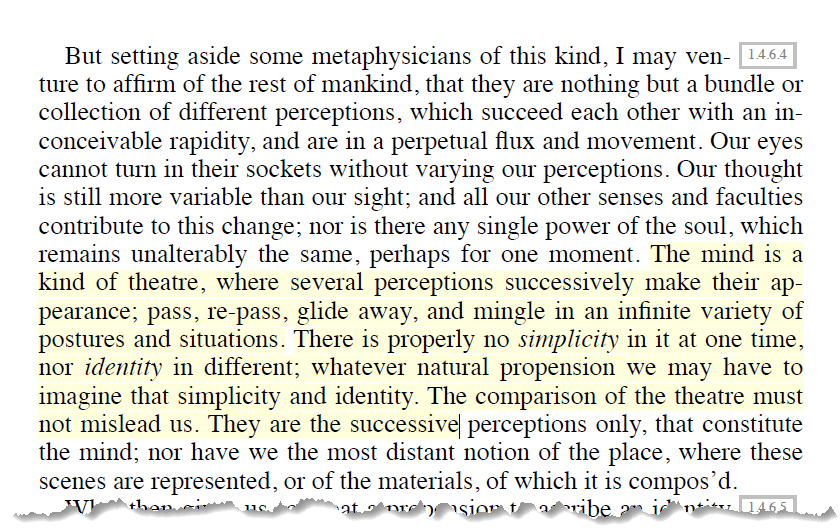
David Hume completes the move with characteristic bluntness. In A Treatise of Human Nature (1739–40), he famously reports that when he looks inward, he never catches himself without a perception. The self, he concludes, is nothing over and above a bundle of impressions and ideas, linked by habit and association.²

Where Locke still spoke of consciousness as what makes the self, Hume takes the next step and goes looking for that self directly. What he finds instead are only perceptions: heat, cold, pleasure, pain. The self does not endure; it is inferred. Identity becomes a habit of grammar and memory, not a feature of experience itself.

Image: Treatise, I.iv.vi

This is not merely a metaphysical claim. It is a grammatical one. Experience appears as a sequence of discrete items, each presentable as something one is or has at a given moment. Duration is reduced to succession; undergoing becomes adjacency. The copula does the quiet work.

From here, it is a short step to the analytic comfort with:

  • truth-conditional analysis,
  • propositional attitudes,
  • mental states as objects of third-person description,
  • and, eventually, the scientific naturalisation of consciousness.

None of this is accidental. The grammar and the metaphysics grow together.

The Continental Recoil

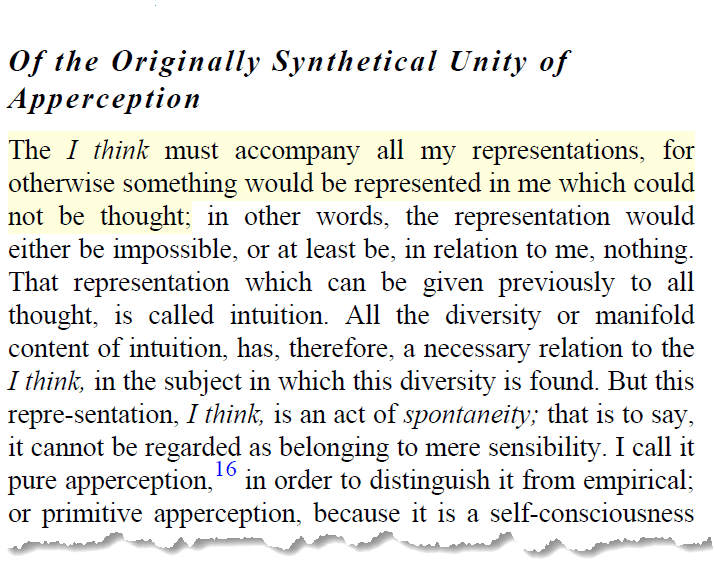
Across the Channel, a different unease takes hold. Immanuel Kant already resists the reduction of the subject to a bundle. In the Critique of Pure Reason (1781/1787), the ‘I think’ is not an object among objects but a necessary condition for experience at all.³ The subject cannot be encountered the way sensations can. It is not something one has or is; it is that through which anything appears.

Image: Critique of Pure Reason, Section II

This resistance deepens with Edmund Husserl, whose phenomenology insists that experience must be described as it is lived, not as it is later reconstructed into states. Consciousness is intentional, temporal, and irreducibly first-personal.⁴ Duration is no longer a sequence of snapshots but a flowing structure of retention and protention.

Image: The Phenomenology of Internal Time-Consciousness

Heidegger radicalises this further. In Being and Time (1927), Dasein is not a container for experiences but a mode of being-in-the-world. Experience is not something that happens inside a subject; it is the subject’s way of being disclosed to a world.⁵

By the time we reach Sartre and Merleau-Ponty, any attempt to treat sensation as a property or possession of a self begins to look like a category mistake. Feeling is not a thing one owns. It is a relation, an encounter, a situation.

Notably, these traditions operate in languages where ‘having’ and reflexive constructions dominate descriptions of sensation. This does not determine the philosophy, but it makes certain moves feel natural and others strained.

Two Ontologies, One Quiet Filter

What matters here is not who is right. It is that entire ontological styles become normalised long before argument begins. Grammar does not force conclusions, but it sets default expectations. Some descriptions feel ‘clean’, others ‘muddy’. Some questions feel legitimate, others oddly misframed. This is where institutional gatekeeping enters.

Peer review, citation norms, and journal scope are often described as quality controls. Sometimes they are. But they also function as recognition systems. Work that leans too heavily on phenomenological description may appear ‘imprecise’ to an analytic referee. Work that treats mental states as discrete objects may appear ‘naïve’or “reductive” to a continental one. Hybrid work becomes difficult to place, difficult to referee, and therefore risky. The issue is rarely explicit disagreement. It is a failure of grammatical hospitality.

Where Sensing Falls Through the Cracks

Against this background, it is perhaps unsurprising that sensing never becomes dominant. To speak of feeling is to refuse both ontological closure and inventory. It resists being cleanly formalised or neatly opposed. It fits awkwardly into truth-conditional frameworks and offers little leverage for grand theory. And yet, it is arguably closer to how experience actually unfolds. Which may explain why it remains linguistically available but philosophically marginal: acceptable in life, tolerated in literature, quietly sidelined in theory.

Notes (for those who care)

  1. Locke, J. (1690). An Essay Concerning Human Understanding, Book II, esp. chs. 1, 27.
  2. Hume, D. (1739–40). A Treatise of Human Nature, Book I, Part IV, §6.
  3. Kant, I. (1781/1787). Critique of Pure Reason, Transcendental Deduction.
  4. Husserl, E. (1913). Ideas Pertaining to a Pure Phenomenology.
  5. Heidegger, M. (1927). Being and Time.

NB: This may be a bit disorganised, but I’ve hit my limit.

Justice as a House of Cards

4–6 minutes

How retribution stays upright by not being examined

There is a persistent belief that our hardest disagreements are merely technical. If we could stop posturing, define our terms, and agree on the facts, consensus would emerge. This belief survives because it works extremely well for birds and tables.

It fails spectacularly for justice.

Audio: NotebookLM summary podcast of this topic.

The Language Insufficiency Hypothesis (LIH) isn’t especially interested in whether people disagree. It’s interested in how disagreement behaves under clarification. With concrete terms, clarification narrows reference. With contested ones, it often fractures it. The more you specify, the more ontologies appear.

Justice is the canonical case.

Retributive justice is often presented as the sober, adult conclusion. Not emotional. Not ideological. Just what must be done. In practice, it is a delicately balanced structure built out of other delicately balanced structures. Pull one term away and people grow uneasy. Pull a second and you’re accused of moral relativism. Pull a third and someone mentions cavemen.

Let’s do some light demolition. I created a set of 17 Magic: The Gathering-themed cards to illustrate various concepts. Below are a few. A few more may appear over time.

Card One: Choice

Image: MTG: Choice – Enchantment

The argument begins innocently enough:

They chose to do it.

But “choice” here is not an empirical description. It’s a stipulation. It doesn’t mean “a decision occurred in a nervous system under constraints.” It means a metaphysically clean fork in the road. Free of coercion, history, wiring, luck, trauma, incentives, or context.

That kind of choice is not discovered. It is assumed.

Pointing out that choices are shaped, bounded, and path-dependent does not refine the term. It destabilises it. Because if choice isn’t clean, then something else must do the moral work.

Enter the next card.

Card Two: Agency

Image: MTG: Agency – Creature – Illusion

Agency is wheeled in to stabilise choice. We are reassured that humans are agents in a morally relevant sense, and therefore choice “counts”.

Counts for what, exactly, is rarely specified.

Under scrutiny, “agency” quietly oscillates between three incompatible roles:

  • a descriptive claim: humans initiate actions
  • a normative claim: humans may be blamed
  • a metaphysical claim: humans are the right kind of cause

These are not the same thing. Treating them as interchangeable is not philosophical rigour. It’s semantic laundering.

But agency is emotionally expensive to question, so the discussion moves on briskly.

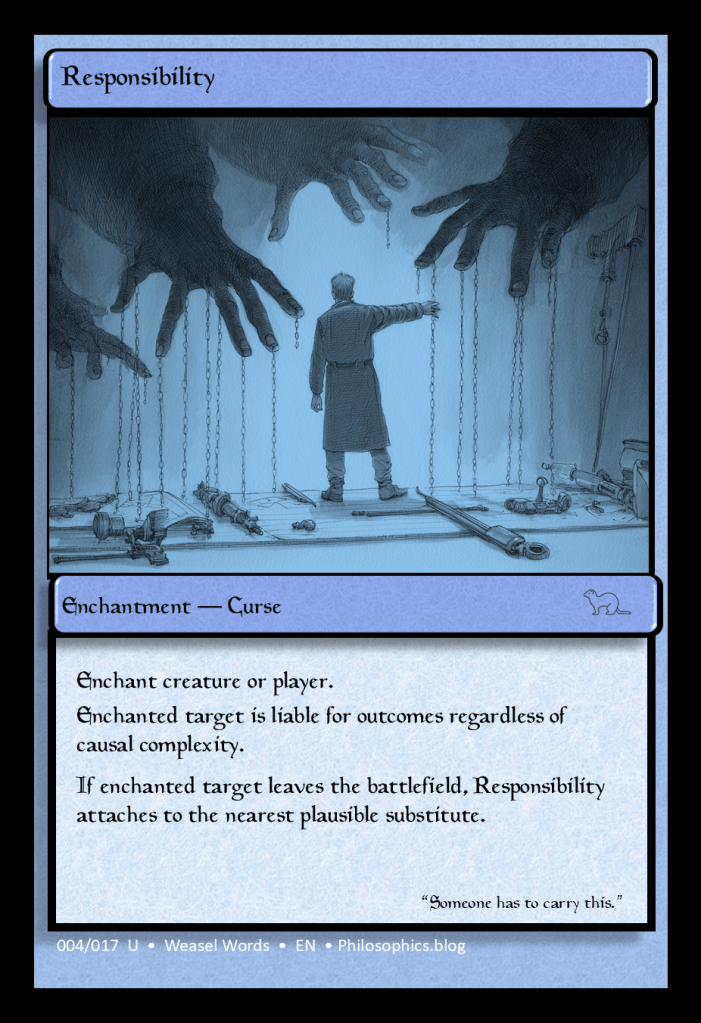
Card Three: Responsibility

Image: MTG: Responsibility – Enchantment – Curse

Responsibility is where the emotional payload arrives.

To say someone is “responsible” sounds administrative, even boring. In practice, it’s a moral verdict wearing a clipboard.

Watch the slide:

  • causal responsibility
  • role responsibility
  • moral responsibility
  • legal responsibility

One word. Almost no shared criteria.

By the time punishment enters the picture, “responsibility” has quietly become something else entirely: the moral right to retaliate without guilt.

At which point someone will say the magic word.

Card Four: Desert

Image: MTG: Desert – Instant

Desert is the most mystical card in the deck.

Nothing observable changes when someone “deserves” punishment. No new facts appear. No mechanism activates. What happens instead is that a moral permission slip is issued.

Desert is not found in the world. It is declared.

And it only works if you already accept a very particular ontology:

  • robust agency
  • contra-causal choice
  • a universe in which moral bookkeeping makes sense

Remove any one of these and desert collapses into what it always was: a story we tell to make anger feel principled.

Which brings us, finally, to the banner term.

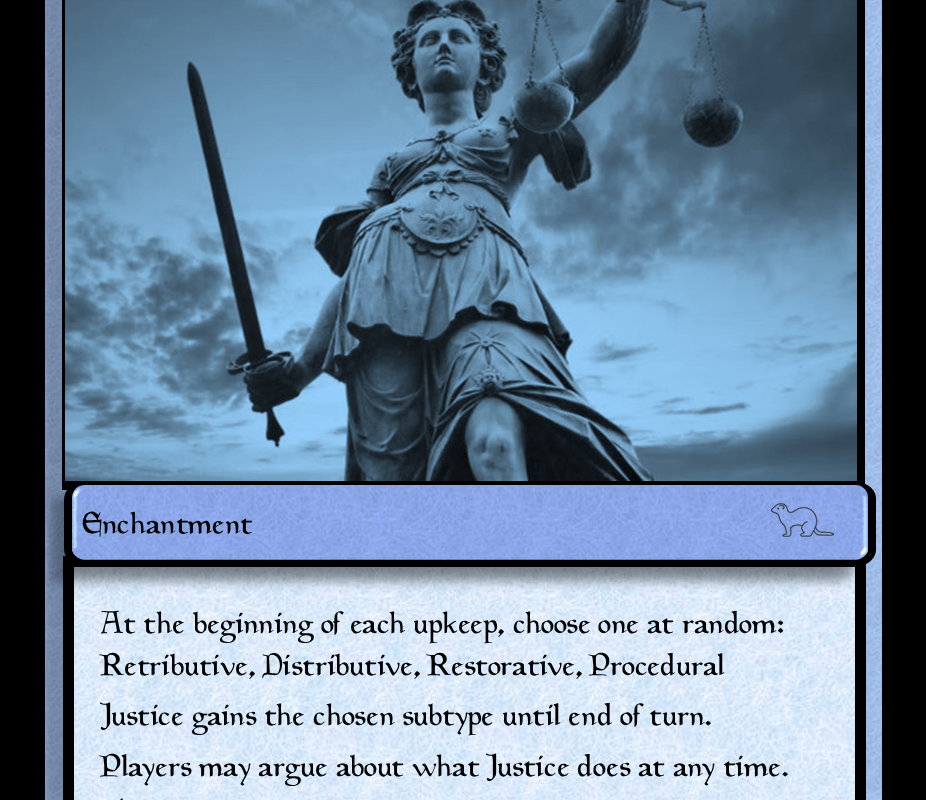
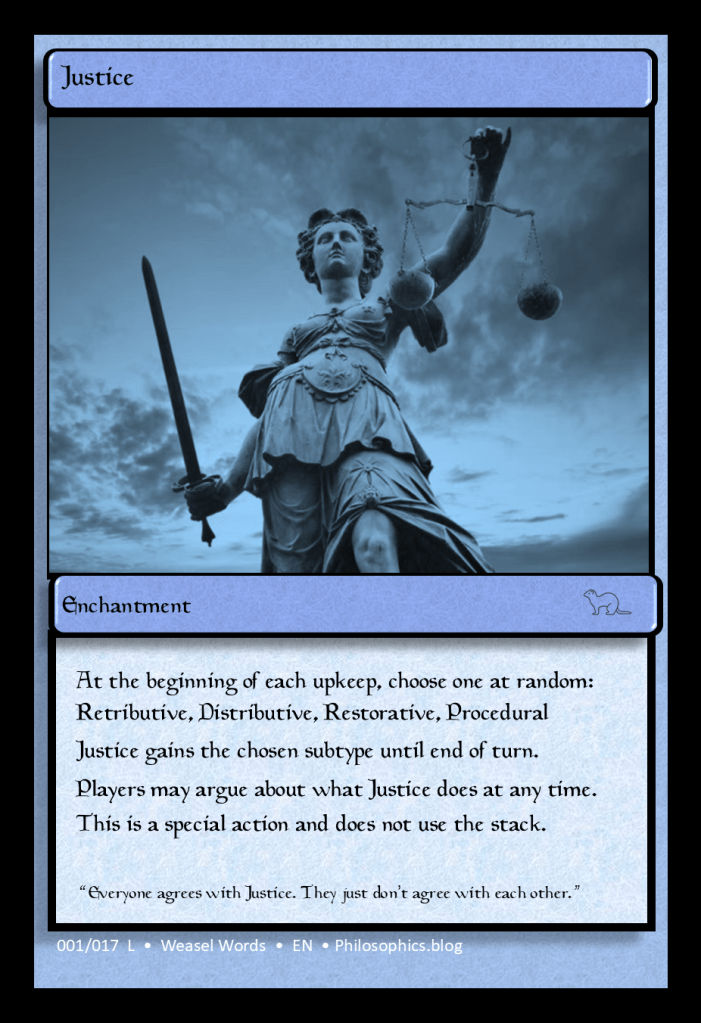
Card Five: Justice

Image: MTG: Justice – Enchantment

At this point, justice is invoked as if it were an independent standard hovering serenely above the wreckage.

It isn’t.

“Justice” here does not resolve disagreement. It names it.

Retributive justice and consequentialist justice are not rival policies. They are rival ontologies. One presumes moral balance sheets attached to persons. The other presumes systems, incentives, prevention, and harm minimisation.

Both use the word justice.

That is not convergence. That is polysemy with a body count.

Why clarification fails here

This is where LIH earns its keep.

With invariants, adding detail narrows meaning. With terms like justice, choice, responsibility, or desert, adding detail exposes incompatible background assumptions. The disagreement does not shrink. It bifurcates.

This is why calls to “focus on the facts” miss the point. Facts do not adjudicate between ontologies. They merely instantiate them. If agency itself is suspect, arguments for retribution do not fail empirically. They fail upstream. They become non sequiturs.

This is also why Marx remains unforgivable to some.
“From each according to his ability, to each according to his need” isn’t a policy tweak. It presupposes a different moral universe. No amount of clarification will make it palatable to someone operating in a merit-desert ontology.

The uncomfortable conclusion

The problem is not that we use contested terms. We cannot avoid them.

The problem is assuming they behave like tables.

Retributive justice survives not because it is inevitable, but because its supporting terms are treated as settled when they are anything but. Each card looks sturdy in isolation. Together, they form a structure that only stands if you agree not to pull too hard.

LIH doesn’t tell you which ontology to adopt.

It tells you why the argument never ends.

And why, if someone insists the issue is “just semantic”, they’re either confused—or holding the deck.