Where There’s a Will, There’s a Way

I’ve read Part I of Hobbes’ Leviathan and wonder what it would have been like if he filtered his thoughts through Hume or Wittgenstein. Hobbes makes Dickens read like Pollyanna. It’s an interesting historical piece, worth reading on that basis alone. It reads as if the Christian Bible had to pass through a legal review before it had been published, sapped of vigour. As bad a rap as Schopenhauer seems to get, Hobbes is the consummate Ebenezer Scrooge. Bah, humbug – you nasty, brutish, filthy animals!*

Audio: NotebookLM podcast conversation on this topic.

In any case, it got me thinking of free will and, more to the point, of will itself.

A Brief History of Humanity’s Favourite Metaphysical Scapegoat

By the time Free Will turned up to the party, the real guest of honour—the Will—had already been drinking heavily, muttering incoherently in the corner, and starting fights with anyone who made eye contact. We like to pretend that the “will” is a noble concept: the engine of our autonomy, the core of our moral selves, the brave little metaphysical organ that lets us choose kale over crisps. But in truth, it’s a bloody mess—philosophy’s equivalent of a family heirloom that no one quite understands but refuses to throw away.

So, let’s rewind. Where did this thing come from? And why, after 2,500 years of name-dropping, finger-pointing, and metaphysical gymnastics, are we still not quite sure whether we have a will, are a will, or should be suing it for damages?

Plato: Soul, Reason, and That Poor Horse

In the beginning, there was Plato, who—as with most things—half-invented the question and then wandered off before giving a straight answer. For him, the soul was a tripartite circus act: reason, spirit, and appetite. Will, as a term, didn’t get top billing—it didn’t even get its name on the poster. But the idea was there, muddling along somewhere between the charioteer (reason) and the unruly horses (desire and spiritedness).

No explicit will, mind you. Just a vague sense that the rational soul ought to be in charge, even if it had to beat the rest of itself into submission.

Aristotle: Purpose Without Pathos

Aristotle, ever the tidy-minded taxonomist, introduced prohairesis—deliberate choice—as a sort of proto-will. But again, it was all about rational calculation toward an end. Ethics was teleological, goal-oriented. You chose what aligned with eudaimonia, that smug Greek term for flourishing. Will, if it existed at all, was just reason picking out dinner options based on your telos. No inner torment, no existential rebellion—just logos in a toga.

Augustine: Sin, Suffering, and That Eternal No

Fast-forward a few hundred years, and along comes Saint Augustine, traumatised by his libido and determined to make the rest of us suffer for it. Enter voluntas: the will as the seat of choice—and the scene of the crime. Augustine is the first to really make the will bleed. He discovers he can want two incompatible things at once and feels properly appalled about it.

From this comes the classic Christian cocktail: freedom plus failure equals guilt. The will is free, but broken. It’s responsible for sin, for disobedience, for not loving God enough on Wednesdays. Thanks to Augustine, we’re stuck with the idea that the will is both the instrument of salvation and the reason we’re going to Hell.

Cheers.

Medievals: God’s Will or Yours, Pick One

The Scholastics, never ones to let an ambiguity pass unanalysed, promptly split into camps. Aquinas, ever the reasonable Dominican, says the will is subordinate to the intellect. God is rational, and so are we, mostly. But Duns Scotus and William of Ockham, the original voluntarist hooligans, argue that the will is superior—even in God. God could have made murder a virtue, they claim, and you’d just have to live with it.

From this cheerful perspective, will becomes a force of arbitrary fiat, and humans, made in God’s image, inherit the same capacity for irrational choice. The will is now more than moral; it’s metaphysical. Less reason’s servant, more chaos goblin.

Hobbes: Appetite with Delusions of Grandeur

Then along comes Thomas Hobbes, who looks at the soul and sees a wheezing machine of appetites. Will, in his famously cheery view, is simply “the last appetite before action.” No higher calling, no spiritual struggle—just the twitch that wins. Man is not a rational animal, but a selfish algorithm on legs. For Hobbes, will is where desire stumbles into motion, and morality is a polite euphemism for not getting stabbed.

Kant: The Will Gets a Makeover

Enter Immanuel Kant: powdered wig, pursed lips, and the moral rectitude of a man who scheduled his bowel movements. Kant gives us the good will, which acts from duty, not desire. Suddenly, the will is autonomous, rational, and morally legislative—a one-man Parliament of inner law.

It’s all terribly noble, terribly German, and entirely exhausting. For Kant, free will is not the ability to do whatever you like—it’s the capacity to choose according to moral law, even when you’d rather be asleep. The will is finally heroic—but only if it agrees to hate itself a little.

Schopenhauer: Cosmic Will, Cosmic Joke

And then the mood turns. Schopenhauer, world’s grumpiest mystic, takes Kant’s sublime will and reveals it to be a blind, thrashing, cosmic force. Will, for him, isn’t reason—it’s suffering in motion. The entire universe is will-to-live: a desperate, pointless striving that dooms us to perpetual dissatisfaction.

There is no freedom, no morality, no point. The only escape is to negate the will, preferably through aesthetic contemplation or Buddhist-like renunciation. In Schopenhauer’s world, the will is not what makes us human—it’s what makes us miserable.

Nietzsche: Transvaluation and the Will to Shout Loudest

Cue Nietzsche, who takes Schopenhauer’s howling void and says: yes, but what if we made it fabulous? For him, the will is no longer to live, but to power—to assert, to create, to impose value. “Free will” is a theologian’s fantasy, a tool of priests and moral accountants. But will itself? That’s the fire in the forge. The Übermensch doesn’t renounce the will—he rides it like a stallion into the sunset of morality.

Nietzsche doesn’t want to deny the abyss. He wants to waltz with it.

Today: Free Will and the Neuroscientific Hangover

And now? Now we’re left with compatibilists, libertarians, determinists, and neuroscientists all shouting past each other, armed with fMRI machines and TED talks. Some claim free will is an illusion, a post hoc rationalisation made by brains doing what they were always going to do. Others insist that moral responsibility requires it, even if we can’t quite locate it between the neurons.

We talk about willpower, will-to-change, political will, and free will like they’re real things. But under the hood, we’re still wrestling with the same questions Augustine posed in a North African villa: Why do I do what I don’t want to do? And more importantly, who’s doing it?

Conclusion: Where There’s a Will, There’s a Mess

From Plato’s silent horses to Nietzsche’s Dionysian pyrotechnics, the will has shape-shifted more times than a politician in an election year. It has been a rational chooser, a moral failure, a divine spark, a mechanical twitch, a cosmic torment, and an existential triumph.

Despite centuries of philosophical handwringing, what it has never been is settled.

So where there’s a will, there’s a way. But the way? Twisting, contradictory, and littered with the corpses of half-baked metaphysical systems.

Welcome to the labyrinth. Bring snacks.

* The solitary, poor, nasty, brutish, and short quote is forthcoming. Filthy animals is a nod to Home Alone.
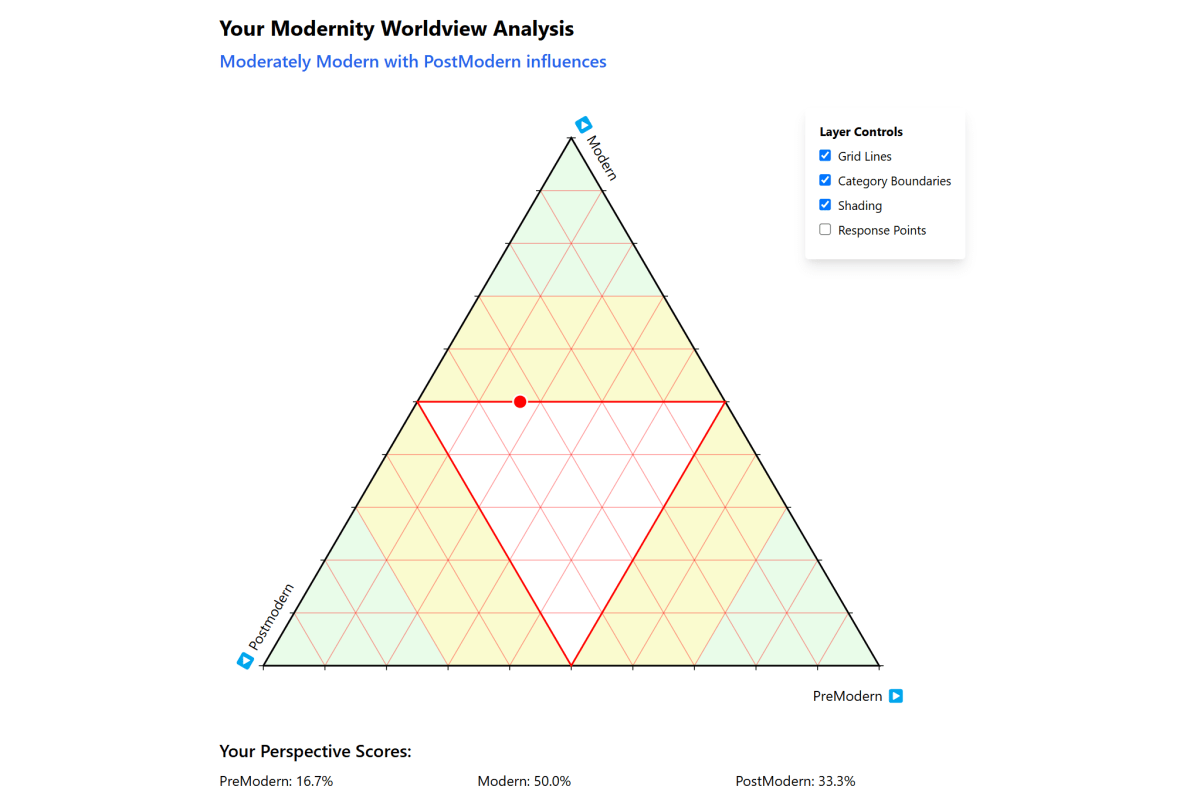
Surveying Modernity

A Brief, Brutal Experiment in Categorising Your Worldview

This month, I’ve been tinkering with a little project—an elegant, six-question survey designed to assess where you land in the great intellectual mess that is modernity.

Audio: Podcast discussion about this post.

This isn’t some spur-of-the-moment quiz cooked up in a caffeine-fueled haze. No, this project has been simmering for years, and after much consideration (and occasional disdain), I’ve crafted a set of questions and response options that, I believe, encapsulate the prevailing worldviews of our time.

It all began with Metamodernism, a term that, at first, seemed promising—a bold synthesis of Modernism and Postmodernism, a grand dialectic of the ages. But as I mapped it out, it collapsed under scrutiny. A footnote in the margins of intellectual history, at best. I’ll expand on that in due course.

The Setup: A Simple, Slightly Sadistic Ternary Plot

For the visually inclined (or the masochistically curious), I initially imagined a timeline, then a branching decision tree, then a Cartesian plane before landing on a ternary plot—a three-way visual that captures ideological leanings in a way a boring old bar chart never could.

The survey itself is brief: six questions, each with five possible answers. Submit your responses, and voilà—you get a tidy little ternary chart plotting your intellectual essence, along with a breakdown of what your answers signify.

Methodology: Half-Rigorous, Half-Reckless

I am, after all, a (recovering) statistician, so I’ve tried to uphold proper methodology while also fast-tracking certain safeguards for the sake of efficiency. If there’s enough interest, I may expand the survey, adding more questions or increasing response flexibility (tick boxes instead of radio buttons—revolutionary, I know).

Privacy Concerns? Relax. I’m not harvesting your data for some nefarious scheme. No personally identifiable information is collected—just a timestamp, session ID, and your browser’s language setting. I did consider tracking IP addresses to analyze regional trends but ultimately scrapped that idea.

In the future, I may add an optional email feature for those who wish to save and track their responses over time (assuming anyone is unhinged enough to take this more than once).

The Rest of the Story: Your Feedback, My Amusement

Since this is a personal project crafted in splendid isolation, I’d love to hear your thoughts. Are the questions reasonable? Do the response options make sense? Does the summary feel accurate? Is the ternary chart decipherable, or have I constructed a glorified inkblot test?

As an academic, economist, and statistician, I had never encountered a ternary chart before embarking on this, and now I rather enjoy it. That said, I also find Nietzsche “intuitive,” so take that as you will.

If this gains traction, expect follow-up content—perhaps videos, podcasts, or further written explorations.

Your Move

Take the survey. It’s painless, requiring mere minutes of your life (which is, let’s be honest, already wasted online). And because I’m feeling generous, you can even generate a PDF to stick on your fridge, next to your collection of expired coupons and disappointing takeout menus.

Click here to take the survey.

Let’s see where you stand in the grand, chaotic landscape of modernity. Or at least, let’s have a laugh trying to make sense of it.

DISCLAIMER: The Modernity Worldview Survey is not scientific. It is designed as an experiment to provide directional insights. It is hosted on Google Cloud and subject to its availability and performance limitations.

Banality of Evil

I thought I was done wittering on about Brian Thompson, the late CEO of United Healthcare, but here we are. His name lingers like the corporate perfume of systemic rot—an enduring testament to how we’ve elevated unethical behaviour into performance art. It got me thinking: what if we brought back a bit of old-school accountability? In Ancient Rome, outlaws lost their citizenship, legal protections, and status as people. That’s right—booted out of polite society. Meanwhile, we’ve done the opposite: we hand out golden parachutes and slap their faces on business magazine covers.

To some, Brian Thompson was a good man – apart from the insider trading, of course. He was successful, a nice guy, funny, and had a good family, and a few million-dollar homes. What else could you ask for? But his success came in the way of blood money. It seems we need fewer people who think like this, not more.

Then I recalled The Purge franchise. And sure, The Purge is a dystopian fantasy, but let’s up the stakes. Picture this: bounties on corporate villains. Not literal carnage, of course—let’s leave that for the big screen—but the return of real consequences. Instead of allowing their PR teams to smooth it all over with buzzwords and philanthropy crumbs, what if we made it socially unacceptable to be a snake in a suit? What if moral suasion—the lost art of persuading someone to do right because it’s, you know, right—actually came back into fashion?

Nietzsche nailed it ages ago. We’ve got two moral codes: one for people and one for money. And guess which one wins every time? All it takes is enough cash and the right rhetoric, and suddenly, everyone forgets who’s really getting fleeced. This is the banality of evil in its purest form: not grand acts of villainy but a shrugging normalisation of corruption. We don’t even consider it corruption. We see it as business as usual. We support and work for these businesses.

The tragedy is that we’ve become so desensitised to it that we are adept at ignoring the stench of moral failure that even calling it out feels quaint. But it’s not hopeless. Some of us still notice. Some of us still care. The real question is, how long can we keep tolerating this farce before we remember that morality isn’t just for the powerless?

Meantime, I just imagine these grubbers being stripped of power and protection, running scared from the likes of Luigi Mangioni.

Language Insufficiency, Rev 3

I’m edging ever closer to finishing my book on the Language Insufficiency Hypothesis. It’s now in its third pass—a mostly subtractive process of streamlining, consolidating, and hacking away at redundancies. The front matter, of course, demands just as much attention, starting with the Preface.

The opening anecdote—a true yet apocryphal gem—dates back to 2018, which is evidence of just how long I’ve been chewing on this idea. It involves a divorce court judge, a dose of linguistic ambiguity, and my ongoing scepticism about the utility of language in complex, interpretative domains.

At the time, my ex-wife’s lawyer was petitioning the court to restrict me from spending any money outside our marriage. This included a demand for recompense for any funds already spent. I was asked, point-blank: Had I given another woman a gift?

Seeking clarity, I asked the judge to define gift. The response was less than amused—a glare, a sneer, but no definition. Left to my own devices, I answered no, relying on my personal definition: something given with no expectation of return or favour. My reasoning, then as now, stemmed from a deep mistrust of altruism.

The court, however, didn’t share my philosophical detours. The injunction came down: I was not to spend any money outside the marital arrangement. Straightforward? Hardly. At the time, I was also in a rock band and often brought meals for the group. Was buying Chipotle for the band now prohibited?

The judge’s response dripped with disdain. Of course, that wasn’t the intent, they said, but the language of the injunction was deliberately broad—ambiguous enough to cover whatever they deemed inappropriate. The phrase don’t spend money on romantic interests would have sufficed, but clarity seemed to be a liability. Instead, the court opted for what I call the Justice Stewart Doctrine of Legal Ambiguity: I know it when I see it.

Unsurprisingly, the marriage ended. My ex-wife and I, however, remain close; our separation in 2018 was final, but our friendship persists. Discussing my book recently, I mentioned this story, and she told me something new: her lawyer had confided that the judge disliked me, finding me smug.

This little revelation cemented something I’d already suspected: power relations, in the Foucauldian sense, pervade even our most banal disputes. It’s why Foucault makes a cameo in the book alongside Nietzsche, Wittgenstein, Saussure, Derrida, Borges, and even Gödel.

This anecdote is just one straw on the poor camel’s back of my linguistic grievances, a life filled with moments where language’s insufficiency has revealed itself. And yet, I found few others voicing my position. Hence, a book.

I aim to self-publish in early 2025—get it off my chest and into the world. Maybe then I can stop wittering on about it. Or, more likely, I won’t.

Morality: The Mirage of Subjectivity Within a Relative Framework

Morality, that ever-elusive beacon of human conduct, is often treated as an immutable entity—a granite monolith dictating the terms of right and wrong. Yet, upon closer inspection, morality reveals itself to be a mirage: a construct contingent upon cultural frameworks, historical conditions, and individual subjectivity. It is neither absolute nor universal but, rather, relative and ultimately subjective, lacking any intrinsic meaning outside of the context that gives it shape.

Audio: Spotify podcast conversation about this topic.

Nietzsche: Beyond Good and Evil, Beyond Absolutes

Friedrich Nietzsche, in his polemical Beyond Good and Evil and On the Genealogy of Morality, exposes the illusion of objective morality. For Nietzsche, moral systems are inherently the products of human fabrication—tools of power masquerading as eternal truths. He describes two primary moralities: master morality and slave morality. Master morality, derived from the strong, values power, creativity, and self-affirmation. Slave morality, by contrast, is reactive, rooted in the resentment (ressentiment) of the weak, who redefine strength as “evil” and weakness as “good.”

Nietzsche’s critique dismantles the notion that morality exists independently of cultural, historical, or power dynamics. What is “moral” for one era or society may be utterly abhorrent to another. Consider the glorification of war and conquest in ancient Sparta versus the modern valorisation of equality and human rights. Each framework exalts its own virtues not because they are universally true but because they serve the prevailing cultural and existential needs of their time.

The Myth of Monolithic Morality

Even viewed through a relativistic lens—and despite the protestations of Immanuel Kant or Jordan Peterson—morality is not and has never been monolithic. The belief in a singular, unchanging moral order is, at best, a Pollyanna myth or wishful thinking, perpetuated by those who prefer their moral compass untroubled by nuance. History is not the story of one moral narrative, but of a multiplicity of subcultures and countercultures, each with its own moral orientation. These orientations, while judged by the dominant moral compass of the era, always resist and redefine what is acceptable and good.

If the tables are turned, so is the moral compass reoriented. The Man in the High Castle captures this truth chillingly. Had the Nazis won World War II, Americans—despite their lofty self-perceptions—would have quickly adopted the morality of their new rulers. The foundations of American morality would have been reimagined in the image of the Third Reich, not through inherent belief but through cultural osmosis, survival instincts, and institutionalised pressure. What we now consider abhorrent might have become, under those circumstances, morally unremarkable. Morality, in this view, is not timeless but endlessly pliable, bending to the will of power and circumstance.

The Case for Moral Objectivity: Kantian Ethics

In contrast to Nietzsche’s relativism, Immanuel Kant offers a vision of morality as rational, universal, and objective. Kant’s categorical imperative asserts that moral principles must be universally applicable, derived not from cultural or historical contingencies but from pure reason. For Kant, the moral law is intrinsic to rational beings and can be expressed as: “Act only according to that maxim whereby you can, at the same time, will that it should become a universal law.”

This framework provides a stark rebuttal to Nietzsche’s subjectivity. If morality is rooted in reason, then it transcends the whims of power dynamics or cultural specificity. Under Kant’s system, slavery, war, and exploitation are not morally permissible, regardless of historical acceptance or cultural norms, because they cannot be willed universally without contradiction. Kant’s moral absolutism thus offers a bulwark against the potential nihilism of Nietzschean subjectivity.

Cultural Pressure: The Birthplace of Moral Adoption

The individual’s adoption of morality is rarely a matter of pure, autonomous choice. Rather, it is shaped by the relentless pressures of culture. Michel Foucault’s analysis of disciplinary power in works such as Discipline and Punish highlights how societies engineer moral behaviours through surveillance, normalisation, and institutional reinforcement. From childhood, individuals are inculcated with the moral codes of their culture, internalising these norms until they appear natural and self-evident.

Yet this adoption is not passive. Even within the constraints of culture, individuals exercise agency, reshaping or rejecting the moral frameworks imposed upon them. Nietzsche’s Übermensch represents the apotheosis of this rebellion: a figure who transcends societal norms to create their own values, living authentically in the absence of universal moral truths. By contrast, Kantian ethics and utilitarianism might critique the Übermensch as solipsistic, untethered from the responsibilities of shared moral life.

Morality in a Shifting World

Morality’s subjectivity is its double-edged sword. While its flexibility allows adaptation to changing societal needs, it also exposes the fragility of moral consensus. Consider how modern societies have redefined morality over decades, from colonialism to civil rights, from gender roles to ecological responsibility. What was once moral is now abhorrent; what was once abhorrent is now a moral imperative. Yet even as society evolves, its subcultures and countercultures continue to resist and reshape dominant moral paradigms. If history teaches us anything, it is that morality is less a fixed star and more a flickering flame, always at the mercy of shifting winds.

Conclusion: The Artifice of Moral Meaning

Morality, then, is not a universal truth etched into the fabric of existence but a subjective artifice, constructed by cultures to serve their needs and adopted by individuals under varying degrees of pressure. Nietzsche’s philosophy teaches us that morality, stripped of its pretensions, is not an arbiter of truth but a symptom of human striving—one more manifestation of the will to power. In contrast, Kantian ethics and utilitarianism offer structured visions of morality, but even these grapple with the tensions between universal principles and the messy realities of history and culture.

As The Man in the High Castle suggests, morality is a contingent, situational artefact, liable to be rewritten at the whim of those in power. Its apparent stability is an illusion, a construct that shifts with every epoch, every conquest, every revolution. To ignore this truth is to cling to a comforting, but ultimately deceptive, myth. Morality, like all human constructs, is both a triumph and a deception, forever relative, ever mutable, yet persistently contested by those who would impose an impossible order on its chaos.

The Relativity of Morality: A Penguin’s Tale

I recently watched The Penguin on HBO Max, a series set in DC’s Batman universe. Ordinarily, I avoid television – especially the superhero genre – but this one intrigued me. Less spandex, more mob drama. An origin story with a dash of noir. I’ll spare you spoilers, but suffice it to say that it was an enjoyable detour, even for someone like me who prefers philosophy over fistfights.

This post isn’t a review, though. It’s a springboard into a larger idea: morality’s subjectivity – or, more precisely, its relativity.

Audio: Spotify podcast related to this topic.

Morality in a Vacuum

Morality, as I see it, is a social construct. You might carry a private moral compass, but without society, it’s about as useful as a clock on a desert island. A personal code of ethics might guide you in solitary moments, but breaking your own rules – eating that forbidden biscuit after vowing to abstain, for instance – doesn’t carry the weight of a true moral transgression. It’s more akin to reneging on a New Year’s resolution. Who’s harmed? Who’s holding you accountable? The answer is: no one but yourself, and even then, only if you care.

The Social Contract

Introduce a second person, and suddenly, morality gains traction. Agreements form – explicit or tacit – about how to behave. Multiply that to the level of a community or society, and morality becomes a kind of currency, exchanged and enforced by the group. Sometimes, these codes are elevated to laws. And, ironically, the act of adhering to a law – even one devoid of moral content – can itself become the moral thing to do. Not because the act is inherently right, but because it reinforces the structure society depends upon.

But morality is neither universal nor monolithic. It is as fractured and kaleidoscopic as the societies and subcultures that create it. Which brings us back to The Penguin.

Crime’s Moral Code

The Penguin thrives in a criminal underworld where the moral compass points in a different direction. In the dominant society’s eyes, crime is immoral. Robbery, murder, racketeering – all “bad,” all forbidden. But within the subculture of organised crime, a parallel morality exists. Honour among thieves, loyalty to the family, the unspoken rules of the game – these are their ethics, and they matter deeply to those who live by them.

When one criminal praises another – “You done good” – after a successful heist or a precise hit, it’s a moral judgement within their own framework. Outside that framework, society condemns the same actions as abhorrent. Yet even dominant societies carve out their own moral exceptions. Killing, for instance, is broadly considered immoral. Murder is outlawed. But capital punishment? That’s legal, and often deemed not only acceptable but righteous. Kant argued it was a moral imperative. Nietzsche, ever the cynic, saw this duality for what it was: a power dynamic cloaked in self-righteousness.

In The Penguin, we see this dichotomy laid bare. The underworld isn’t without morals; it simply operates on a different axis. And while the larger society might disdain it, the hypocrisy of their own shifting moral codes remains unexamined.

Final Thoughts on the Series

I’ll save other philosophical musings about The Penguin for another time – spoilers would be unavoidable, after all. But here’s a quick review: the series leans into drama, eschewing flashy gimmicks for a grittier, more grounded tone. The writing is generally strong, though there are moments of inconsistency – plot holes and contrivances that mar an otherwise immersive experience. Whether these flaws stem from the writers, director, or editor is anyone’s guess, but the effect is the same: they momentarily yank the viewer out of the world they’ve built.

Still, it’s a worthwhile watch, especially if you’re a fan of mob-style crime dramas. The final episode was, in my estimation, the best of the lot – a satisfying culmination that leaves the door ajar for philosophical ruminations like these.

Have you seen it? What are your thoughts – philosophical or otherwise? Drop a comment below. Let’s discuss.

Declaration of Independence

It’s July. The season of independence in the United States. Independence from the overt tyranny of Britain, but not from the tacit tyranny of their government—the government purported to be ‘of the people, by the people, and for the people‘ per Abraham Lincoln’s 1863 Gettysburg Address. As their Constitution reads, ‘We the People‘. Governments may be of the people and by the people, but governments are an emergent phenomenon as happens when oxygen and hydrogen combine just so and create water. Two gases combine to create a new substance—water. Some forget that, like water, government are a distinct element to the people that constitute it. Some think it resembles them. It doesn’t. It’s Hobbes’ Leviathan—or a Jabberwok.

In preparation for the traditional Summer season, I took to reading Derrida’s 1976 essay, Declarations of Independence. It was interesting, but I was hoping to get more from it. I decided to deconstruct the opening paragraph—the preamble—of the Declaration of Independence:

Deconstructing Binary Oppositions

Self-Evident vs. Non-Self-Evident

The Declaration boldly asserts that ‘these truths’ are ‘self-evident’,’ a claim that is nothing more than a rhetorical trick. By presenting these ideas as self-evident, the authors seek to place them beyond questioning, discouraging dissent and critical examination. In reality, these ‘truths’ are far from universal; they are the product of a specific cultural and historical context, shaped by the interests and perspectives of the privileged few who drafted the document.

Interrogating Assumptions and Hierarchies The Declaration of Independence asserts that certain truths are ‘self-evident’, implying that these truths are so obvious that they require no further justification. However, the concept of self-evidence itself is far from universally accepted. It is deeply embedded in the philosophical tradition of Enlightenment rationalism, which holds that reason and logic can reveal fundamental truths about the world.

  1. Philosophical Foundations of Self-Evidence
    • Enlightenment Rationalism: The idea of self-evidence relies heavily on Enlightenment rationalism, which posits that certain truths can be known directly through reason and are therefore beyond dispute. Philosophers such as René Descartes and Immanuel Kant emphasised the power of human reason to uncover self-evident truths. Descartes, for instance, argued for the self-evident nature of ‘Cogito, ergo sum‘ (‘I think, therefore I am’) as a fundamental truth (Descartes, Meditations on First Philosophy).
    • Critique of Rationalism: Critics of Enlightenment rationalism, including existentialists like Friedrich Nietzsche and phenomenologists like Martin Heidegger, argue that what is considered self-evident is often culturally and historically contingent. Nietzsche, for example, contended that what we take as ‘truth’ is a product of our perspective and historical context, not an absolute given (Nietzsche, Beyond Good and Evil).
  2. Cultural and Philosophical Contingency
    • Cultural Relativity: Different cultures and philosophical traditions may not find the same truths to be self-evident. For instance, the concept of individual rights as self-evident truths is a product of Western liberal thought and may not hold the same self-evident status in other cultural frameworks. In many Eastern philosophies, the focus is more on community and harmony rather than individual rights.
    • Subjectivity of Self-Evidence: The term ‘self-evident’ implies an inherent, unquestionable truth, yet what one group or culture finds self-evident, another may not. This variability reveals the instability and subjectivity of the claim. For example, in traditional Confucian societies, the emphasis is placed on hierarchy and duty rather than equality and individual rights, demonstrating a different set of ‘self-evident’ truths.
  3. Constructed Nature of Truth
    • Language and Context: Jacques Derrida’s concept of différance illustrates how meaning is not fixed but constantly deferred through language. What we consider to be “truth” is constructed through linguistic and social contexts. Derrida argues that texts do not have a single, stable meaning but rather a multiplicity of interpretations that change depending on the reader’s perspective and context (Derrida, Of Grammatology).
    • Social Construction: Michel Foucault’s analysis of power and knowledge further deconstructs the notion of objective truth. Foucault argues that what is accepted as truth is produced by power relations within society. Truths are constructed through discourses that serve the interests of particular social groups, rather than being objective or self-evident (Foucault, Discipline and Punish).

Created Equal vs. Not Created Equal

The Declaration’s claim that ‘all men are created equal’ is a blatant falsehood, a manipulative promise designed to appease the masses whilst maintaining the status quo. The glaring contradictions of slavery and gender inequality expose the hollowness of this assertion. Equality, as presented here, is nothing more than an ideological construct, a tool for those in power to maintain their dominance while paying lip service to the ideals of justice and fairness.

Creator vs. No Creator

The Declaration refers to a ‘Creator’ who endows individuals with rights, grounding its claims in a divine or natural law. This invokes a theistic worldview where moral and legal principles are derived from a higher power. However, Derrida challenges this by showing that the concept of a creator is a cultural and philosophical construct, not a universal truth.

The presence of the creator in the text serves to legitimise the rights it declares. However, this legitimacy is contingent on accepting the cultural narrative of a creator. Secular and non-theistic perspectives are marginalised by this assertion, revealing the ideological biases inherent in the Declaration. The authority of the declaration is thus shown to be dependent on particular beliefs, rather than an objective reality.

Unalienable vs. Alienable

The notion of ‘unalienable Rights’ is another empty promise, a rhetorical flourish designed to inspire loyalty and obedience. In practice, these supposedly inherent and inviolable rights are regularly violated and denied, particularly to those on the margins of society. The Declaration’s lofty language of ‘Life, Liberty and the pursuit of Happiness’ rings hollow in the face of systemic oppression and injustice. These rights are not unalienable; they are contingent upon the whims of those in power.

Conclusion

Through this deconstruction, we expose the Declaration of Independence for what it truly is: a masterful work of propaganda, filled with false promises and manipulative rhetoric. The document’s purported truths and self-evident principles are revealed as arbitrary constructs, designed to serve the interests of the powerful while placating the masses with empty platitudes.

As some celebrate this 4th of July, let us not be fooled by the high-minded language and lofty ideals of our founding documents. Instead, let us recognise them for what they are: tools of control and manipulation, employed by those who seek to maintain their grip on power. Only by constantly questioning and deconstructing these texts can we hope to expose the truth behind the facade and work towards a more genuine understanding of freedom and equality.

References

  • Jacques Derrida, “Declarations of Independence,” in Negotiations: Interventions and Interviews 1971-2001, ed. Elizabeth Rottenberg (Stanford: Stanford University Press, 2002).
  • Jacques Derrida, Of Grammatology (Baltimore: Johns Hopkins University Press, 1976).
  • Friedrich Nietzsche, Beyond Good and Evil (Cambridge: Cambridge University Press, 2002).
  • Michel Foucault, Discipline and Punish: The Birth of the Prison (New York: Vintage Books, 1995).
  • Immanuel Kant, Critique of Pure Reason (Cambridge: Cambridge University Press, 1998).
  • René Descartes, Meditations on First Philosophy (Cambridge: Cambridge University Press, 1996).

John Vervaeke and Lex Fridman on the Meaning Crisis

jimoeba mentioned that he enjoyed an interview with Vervake and Fridman in a comment, so I thought I’d give it a listen. It turns out there are several including a 3-plus-hour version. Arbitrarily, I chose this one. Even if it’s not the particular interview on the meaning crisis, it gives me a sense of the two and their dynamics. I’m glad I listened to it. I like Vervaeke. I can’t say I’m much of a Fridman fan on first listen.

John Vervaeke and Lex Fridman interview: Human civilisation is facing a meaning crisis

This interview content provides an orientation of where Vervaeke is coming from. It helps to clarify his position. His claim seems to be that many people today identify as having no religion but being spiritual. By extension, he posits that this cohort is searching for meaning. I can’t disagree. What it tells me is that I am not in his target demographic. I have no religion, as I am an atheist. I have no spiritual void to fill. This is Vervaeke’s goal—to find something to perform the function of the religion without the, perhaps, baggage and dogma.

I sympathise with his goal. He brings up Nietzsche’s “God is dead” quote, famous or infamous depending on your worldview. Essentially, he wants to answer Nietzsche’s query of what to do now that it’s been revealed that humans created God, not the other way around. His aim is to replace the font of wisdom for this generation.

For me, wisdom is a heuristic, part of the Gestalt McGilchrist mentions. McGilchrist’s work is even referenced here. Of course, I interpret McGilchrist’s references in this space to be metaphorical. It seems that he views it as ‘real’. I’m not sure where Vervaeke places it. Somehow, I feel that if there is a spectrum, Vervaeke leans closer to McGilchrist than me, and that’s OK. They just happen to be wrong.

I still don’t get the need for meaning. I don’t feel despondent that there is no inherent meaning in anything, but we are free to invite or adopt one or many. I remember a Christian mate of mine who explained that people have a God-sized hole that can only be filled by God. Essentially, Vervaeke is making a similar claim, but his void is filled by wisdom. I suppose that I don’t feel I have a void doesn’t mean there isn’t one.

Fischer, One of Four Views on Free Will

I’ve finally returned to the second author of Four Views on Free Will. The first author was Robert Kane. Here, I was introduced to John Martin Fischer, who wrote a section on Compatibilism. I’ve never read anything by Fischer. Indeed, I have no familiarity with him or his work. Allow me to start by saying that I was not impressed. Before diving into the content, let’s just say that he was extremely repetitive and circumlocutive. I found myself questioning whether the book was assembled with duplicate pages. Hadn’t I just read that? I’ll spare the reader the examples.

I repeat myself when under stress

I repeat myself when under stress

I repeat myself when under stress

I repeat myself when under stress

— King Crimson, Indiscipline

The topic was 44 pages on compatibilism. The first 30 pages were compatibilism before he changed to his brainchild, semi-compatibilism. Full disclosure: I am not a compatibilist. My recollection is that the majority of contemporary philosophers are compatibilists. Joining Fischer are Dan Dennett, Frithjof Bergmann, Gary Watson, Susan R. Wolf, P. F. Strawson, and R. Jay Wallace. Historically, this cadre are joined by Hobbes, Locke, Hume, and Mill. This motley crew has been opposed by Peter van Inwagen and historical figures, Arthur Schopenhauer, William James, and Immanuel Kant.

Semi-compatibilism is the idea that regardless of whether free will and determinism are compatible, moral responsibility and determinism are.

At a meta-level, Fischer repeatedly—I’ll discontinue using this term as, like Fischer, it will become very, very repetitive—invoked law and common sense. Law is not a moral structure in search of truth. It’s a power structure employed to retain the status quo. And, as Voltaire quipped, ‘common sense is not so common.’ This is an argumentum ad populum (appeal to popularity) fallacy. It also relies on belief and perception. I suppose he’s not familiar with Descartes’ Meditations. It seems he is trying to forge Compatibilism into a cast of soft determinism with hopes that no one notices the switcheroo.

Fischer targets some quotes buy Kant, James, Wallace Matson, and Nietzsche with the general critique that they are expecting too much of an agent by expecting it to be the cause of its own actions. Nevermind, that he is guilty of just this in attempting to parse passive and active agents—passive being insentient dominos and active being conscious entities.

I’m not convinced that maths is a strong point. He sets up a hypothetical scenario where physics has proven that causal determinism is true, so 100 per cent of everything in the universe can be known with certainty. But then he does two things.

First, he exempts human agency—cuz reasons. Second, he creates a parallel scenario where 100 per cent might be 99 or 99.9 per cent.

Second, he claims that because he feels free, he must be free.

Similarly, it is natural and extraordinarily “basic” for human beings to think of ourselves as (sometimes at least) morally accountable for our choices and behavior. Typically, we think of ourselves as morally responsible precisely in virtue of exercising a distinctive kind of freedom or control; this freedom
is traditionally thought to involve exactly the sort of “selection” from among genuinely available alternative possibilities alluded to above. When an agent is morally responsible for his behavior, we typically suppose that he could have (at least at some relevant time) done otherwise.

— Fischer, p. 46

Nothing is such that thinking doesn’t make it so.

It seems that when watching a movie for the third time, the victim who gets killed in the cellar won’t descend the stairs this time. Fisher must get perplexed when she does every time. Of course, he’d argue without evidence that an active agent would be able to make a different decision—even under identical circumstances. He insists that the agent possesses this free will.

Whilst sidestepping physicalism and materialism, he simply posits that consciousness is just different and not subject to other causal chain relationships—and that these cannot be deterministic even if everything else is.

I’m going to digress on his next point—that the person who knows not to cheat on taxes, and who does so anyway, is responsible as any normal person would be. Perhaps the person feels that the taxes are being used for illegal or immoral purposes and is taking the moral high ground by depriving the institution of these proceeds.

Around 2007 or so, I paid my taxes due minus about $5,000, which was the calculated amount of the per capita cost of the illegal and immoral Iraq invasion by the United States and its cadre of war criminals in charge. I attached a note outlining my opposition and rationale.

Some months later, the Internal Revenue department sent a legal request to my employer for the withheld sum. Payroll summoned me and conveyed that they were required to comply with the request. I told them my perspective and said if they could sleep with that on their conscience, then they were in their power. And so no nights of sleep were lost.

The point of this anecdote is to say that morals are social constructs. Clearly, Fischer is just an old-fashioned conformist. I suspect he thinks of Valjean as a bad person.

Like many if not most people, he employs a compos mentis approach, exempting persons of reduced cognitive capacity and those under duress or coercion, but he is not a proponent of the causa sui defence.

He has an entire subsection devoted to the libertarian notion of freedom. To recapitulate, he simply regurgitated all of the standard arguments and exempts the aforementioned agents and adds people under hypnosis, the brainwashed, and so on. Nothing to write home about—not here either.

In the next subsection, his focus is on consequences. He calls out Peter van Inwagen’s Consequence Argument.

Similarly, the skeptical argument about our freedom employs ordinary ideas about the fixity of the
past and the fi xity of the natural laws (putatively) to generate the intuitively jarring result that we are not ever free, if causal determinism turns out to be true (something we can’t rule out apriori). If this skeptical argument is sound, it calls into question any compatibilist analysis of freedom (that is, freedom of the sort under consideration – involving the capacity for selection among open alternatives). If the argument is sound, then not only both the simple and refined conditional analysis, but any compatibilist analysis (of the relevant sort of freedom) must be rejected.

Fischer p. 53

He leans on Borges’ garden of forking paths and claims (without support) that although the past might be fixed, freedom is the ability to add to the future, citing Carl Ginet as the source of this notion. He misses the point that that’s what the future is, tautologically. It adds now to the past and generates a future. Choice is not necessary for this function to operate, but he continues to insist on invoking it.

Standard Frankfort examples are referenced as well as Locke. Here he wants to point out regulative control—but he skirts the question of where the volition comes from by saying ‘for his own reasons‘, as if these reasons are somehow meaningful. In the end, he recites the scenarios, performs some hand-waving, and summons his accord with Robert Kane’s “dual voluntariness” constraint on moral responsibility.

He leaves us with the thought that if the Consequence Argument were true, it would be compatibilism’s death knell, but it’s not true (in his mind), so all is well in Whoville. Crisis averted.

Source incompatibilism is next. His focus here is on the “elbow room” necessary to exercise free will.

Elbow Room is the title of a book by Daniel Dennett originally published in 1984 and republished in 2015. I’ve recently read this on holiday, but I haven’t had time to review it. Please stand by.

His approach in this subsection is to attack opposing perspectives as reductionist. Of course, he’s right, but they are no more reductionist than anything he’s suggested thus far. Besides, simply injecting favoured concepts to add to a model to make it compatible with one’s hypothesis doesn’t make it less reductionist. It just makes the model more convoluted.

Here he attempts to elevate consciousness into a special category in order to shield it from the physics of the universe. We can’t say for sure what consciousness is, but you can bet it’s a magical place where practically anything can happen. OK, that’s a bit of hyperbole.

He uses the metaphor of trying to assess how a television works by only studying the components. Of course, if that is all one did, one would be left with questions. But that is not where one stops. To be fair, neuroscience has come a long way since this was published in 2007. Neuroscientists are asking questions beyond the hardware.

He sets up a strawman by labelling total control as a chimaera as if anyone is arguing that if a theory doesn’t allow for total control, it will not be accepted. He does allow that…

We do not exist in a protective bubble of control. Rather, we are thoroughly and pervasively subject to luck: actual causal factors entirely out of our control are such that, if they were not to occur, things at least might be very different.

— Fischer, p. 68

We agree on this point, but I feel that he underestimates the remaining degrees of freedom after all of this is accounted for.

He attempts to create a mental model with vertical and horizontal lines. At least he admits that he does “not suppose [to] have offered a knockdown argument” because he doesn’t.

Finally, he wraps up this subsection by invoking Nietzsche’s famous Munchausen Causa Sui statement in Twilight of the Idols. He attacks this rationale as being “both ludicrous and part of commonsense.” He loves his commonsense.

Next, he wants to convince us, Why Be a Semicompatibilist? Semicompatibilism just needs enough elbow room to assert freedom. I suppose that’s the ‘semi‘ part. It feels to me an exercise in self-delusion.

The main idea behind semicompatibilism is to shrink the target size of compatibility and focus centrally on moral responsibility and agent control rather than the larger realm of free will.

Fischer makes what might be considered to be a religious argument. We should adopt this perspective because it feels better and is in our best interest. He cites Gary Watson’s view of using indeterminism to undermine determinism, but he feels that rather etiolates control rather than strengthening it because it “becomes unclear that our choices and actions are really ours.”

In the next subsection, he leads with the argument “that moral responsibility does not require regulative control, but only guidance control, and further that it is plausible that guidance control is compatible with causal determinism.” At least, this is the story he’s sticking to.

In Fischer’s “approach to guidance control, there are two chief elements:
the mechanism that issues in action must be the “agent’s own,” and
it must be appropriately “reasons-responsive.””

As for the “agent’s own” constraint, he simply notes that counterclaims exist, but he asserts that he doesn’t accept them.

As for reasons-responsiveness, he cites his own publication written with Mark Ravizza, Responsibility and Control: A Theory of Moral Responsibility, and declines to elaborate in this essay.

In the final subsection, he writes about the Lure of Semicompatibilism. I do feel he is lured by the concept and makes light of the label. He advances the notion that “Kant believed that compatibility and incompatibilism are consistent“. Say what? But he takes a weaker position on this claim, using the Kant name-drop for cover.

As I said at the start, I don’t know anything about Fischer, but he is obsessed with legal theory as if it has any bearing on philosophical standing. Perhaps I’ll include a summary from a quick internet perusal. After I’ve wrapped this up. He mentions moral desert, which is a concept employed in matters of restorative and retributive justice.

The section concludes with a list of publications by him and others. Perhaps I’ll list them here in future as an addendum. For now, I’ll pop outside of this edit window and see what I can find on John Martin Fischer.


John Martin Fischer (born December 26, 1952) is an American philosopher. He is Distinguished Professor of Philosophy at the University of California, Riverside and a leading contributor to the philosophy of free will and moral responsibility.

Beyond Causa Sui

Audio: NotebookLM podcast discussing this topic.

The CAUSA SUI is the best self-contradiction that has yet been conceived, it is a sort of logical violation and unnaturalness; but the extravagant pride of man has managed to entangle itself profoundly and frightfully with this very folly. The desire for “freedom of will” in the superlative, metaphysical sense, such as still holds sway, unfortunately, in the minds of the half-educated, the desire to bear the entire and ultimate responsibility for one’s actions oneself, and to absolve God, the world, ancestors, chance, and society therefrom, involves nothing less than to be precisely this CAUSA SUI, and, with more than Munchausen daring, to pull oneself up into existence by the hair, out of the slough of nothingness. If anyone should find out in this manner the crass stupidity of the celebrated conception of “free will” and put it out of his head altogether, I beg of him to carry his “enlightenment” a step further, and also put out of his head the contrary of this monstrous conception of “free will”: I mean “non-free will,” which is tantamount to a misuse of cause and effect. One should not wrongly MATERIALISE “cause” and “effect,” as the natural philosophers do (and whoever like them naturalise in thinking at present), according to the prevailing mechanical doltishness which makes the cause press and push until it “effects” its end; one should use “cause” and “effect” only as pure CONCEPTIONS, that is to say, as conventional fictions for the purpose of designation and mutual understanding,—NOT for explanation. In “being-in-itself” there is nothing of “casual- connection,” of “necessity,” or of “psychological non-freedom”; there the effect does NOT follow the cause, there “law” does not obtain. It is WE alone who have devised cause, sequence, reciprocity, relativity, constraint, number, law, freedom, motive, and purpose; and when we interpret and intermix this symbol-world, as “being-in-itself,” with things, we act once more as we have always acted—MYTHOLOGICALLY. The “non-free will” is mythology; in real life, it is only a question of STRONG and WEAK wills.—It is almost always a symptom of what is lacking in himself, when a thinker, in every “causal-connection” and “psychological necessity,” manifests something of compulsion, indigence, obsequiousness, oppression, and non-freedom; it is suspicious to have such feelings–the person betrays himself. And in general, if I have observed correctly, the “non-freedom of the will” is regarded as a problem from two entirely opposite standpoints, but always in a profoundly PERSONAL manner: some will not give up their “responsibility,” their belief in THEMSELVES, the personal right to THEIR merits, at any price (the vain races belong to this class); others on the contrary, do not wish to be answerable for anything, or blamed for anything, and owing to an inward self-contempt, seek to GET OUT OF THE BUSINESS, no matter how. The latter, when they write books, are in the habit at present of taking the side of criminals; a sort of socialistic sympathy is their favourite disguise. And as a matter of fact, the fatalism of the weak-willed embellishes itself surprisingly when it can pose as “la religion de la souffrance humaine“; that is ITS “good taste.”

— Friedrich Nietzsche, Beyond Good and Evil
Münchhausen – Oskar Herrfurth

Just a quote and an image germane to that absurdity of causa sui.