We humans pride ourselves on being civilised. Unlike animals, we don’t let biology call the shots. A chimp reaches puberty and reproduces; a human reaches puberty and is told, not yet – society has rules. Biologically mature isn’t socially mature, and we pat ourselves on the back for having spotted the difference.
But watch how quickly that distinction vanishes when it threatens the in-group narrative. Bring up gender, and suddenly there’s no such thing as a social construct. Forget the puberty-vs-adulthood distinction we were just defending – now biology is destiny, immutable and absolute. Cross-gender clothing? “Against nature.” Transition? “You can’t be born into the wrong body.” Our selective vision flips depending on whose ox is being gored.
The same trick appears in how we talk about maturity. You can’t vote until 18. You’re not old enough to drink until 21. You’re not old enough to stop working until 67. These numbers aren’t natural; they’re paperwork. They’re flags planted in the soil of human life, and without the right flag, you don’t count.
The very people who insist on distinguishing biological maturity from social maturity when it comes to puberty suddenly forget the distinction when it comes to gender. They know perfectly well that “maturity” is a construct – after all, they’ve built entire legal systems around arbitrary thresholds – but they enforce the amnesia whenever it suits them. Nietzsche would say it plainly: the powerful don’t need to follow the rules, they only need to make sure you do.
So the next time someone appeals to “nature,” ask: which one? The nature that declares you old enough to marry at puberty? The nature that withholds voting, drinking, or retirement rights until a bureaucrat’s calendar says so? Or the nature that quietly mutates whenever the in-group needs to draw a new line around civilisation?
The truth is, “nature” and “maturity” are less about describing the world than about policing it. They’re flags, shibboleths, passwords. We keep calling them natural, but the only thing natural about them is how often they’re used to enforce someone else’s story.
Humans, we are told, are exceptional—unlike the rest of the lowly animal kingdom. We alone possess reason, morality, and the ability to transcend our base instincts. And yet, curiously, this argument is rolled out only when convenient. At times, we are commanded to rise above our primal urges; at others, we are scolded for even thinking about resisting them. This ideological schizophrenia is no accident—it is a feature, not a bug, of our prevailing moral and economic order.
The contradictions of “human nature” arguments can be broken down into two key patterns:
A. We must transcend our animal instincts—but only when they threaten social or economic order.
B. We must accept our animal instincts as unchangeable—but only when they reinforce existing power structures.
This hypocrisy is especially visible in how capitalism and morality are framed. Let’s examine two case studies.
Case 1: Prostitution—A Market That Must Be Morally Suppressed
Sex is as fundamental a biological drive as hunger or thirst. One would think that in a world where everything is commodified, prostitution—the most direct transaction of supply and demand—would be embraced by free-market capitalists. But no. We are told that engaging in this “base” activity is degrading, immoral, and must be curtailed. The same capitalists who defend free enterprise at all costs suddenly become moralists, urging us to resist temptation and rise above our urges. Sex, despite being one of the most natural acts imaginable, is treated as an impulse to be tamed rather than an economic exchange to be normalised.
Case 2: Capitalism—A System We Must Accept as “Natural”
Contrast this with how we are told to think about capitalism. Greed, exploitation, and ruthless competition? Those are “just human nature.” The strong thrive, and the weak perish. We are warned not to question the system because to do so would be to fight against nature itself. Socialism? A naive fantasy. Economic cooperation? Impossible. Mutual aid? Utopian nonsense. We must accept that humans are selfish creatures, that hierarchy is inevitable, and that billionaires accumulating obscene wealth while millions starve is simply the way of things.
Why are we ordered to suppress our instincts in one case yet surrender to them in another? Because morality, in its institutional form, is not about virtue—it is about control.
The Convenient Flexibility of “Human Nature”
This selective logic is designed to keep power structures intact. The rules shift depending on whose interests are at stake:
If an instinct challenges profit or control, it must be suppressed.
If an instinct benefits the ruling order, it must be accepted as natural.
Thus, the same societies that demand moral restraint when it comes to sex, leisure, or pleasure suddenly rediscover their inner Darwinist when defending capitalist greed and economic cruelty.
The “Natural Order” Myth
The claim that capitalism is the inevitable result of human nature is one of history’s greatest ideological scams. If it were indeed “natural,” it would not require:
Constant propaganda to reinforce its legitimacy.
Violent suppression of alternative systems.
Trillions in government bailouts every time it fails.
Moreover, humans are not only competitive, selfish creatures. We are also wired for cooperation, altruism, and communal living—traits conveniently erased from discussions about economics.
Final Thought: Breaking the Cycle
If we can rise above base instincts for sex and violence, why can’t we rise above capitalist greed and exploitation? Why is overcoming “human nature” only demanded when it suits power? The truth is, we are only commanded to rise above when it keeps us obedient—and ordered to accept reality when it keeps the powerful in control.
The only real rebellion is to reject this hypocrisy entirely. The future belongs not to those who passively accept the contradictions of the present, but to those who refuse to play by its schizophrenic rules.
I’ve written a lot on the insufficiency of language, and it’s not even an original idea. Language, our primary tool for sharing thoughts and ideas, harbours a fundamental flaw: it’s inherently insufficient for conveying precise meaning. While this observation isn’t novel, recent developments in artificial intelligence provide us with new ways to illuminate and examine this limitation. Through a progression from simple geometry to complex abstractions, we can explore how language both serves and fails us in different contexts.
The Simple Made Complex
Consider what appears to be a straightforward instruction: Draw a 1-millimetre square in the centre of an A4 sheet of paper using an HB pencil and a ruler. Despite the mathematical precision of these specifications, two people following these exact instructions would likely produce different results. The variables are numerous: ruler calibration, pencil sharpness, line thickness, paper texture, applied pressure, interpretation of “centre,” and even ambient conditions affecting the paper.
This example reveals a paradox: the more precisely we attempt to specify requirements, the more variables we introduce, creating additional points of potential divergence. Even in mathematics and formal logic—languages specifically designed to eliminate ambiguity—we cannot escape this fundamental problem.
Precision vs Accuracy: A Useful Lens
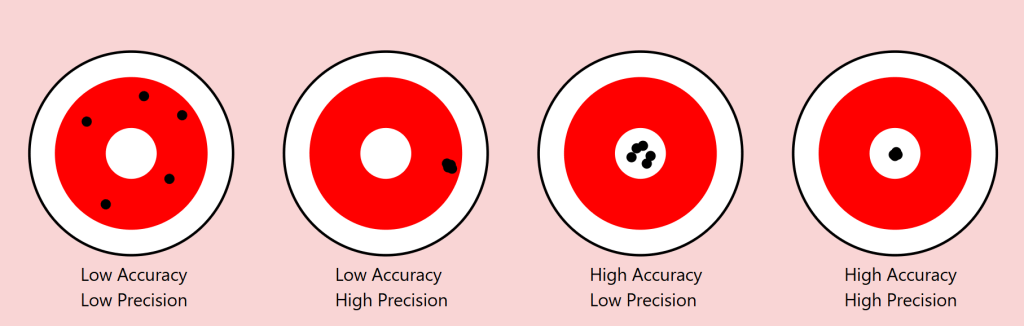
The scientific distinction between precision and accuracy provides a valuable framework for understanding these limitations. In measurement, precision refers to the consistency of results (how close repeated measurements are to each other), while accuracy describes how close these measurements are to the true value.
Returning to our square example:
Precision: Two people might consistently reproduce their own squares with exact dimensions
Accuracy: Yet neither might capture the “true” square we intended to convey
As we move from geometric shapes to natural objects, this distinction becomes even more revealing. Consider a maple tree in autumn. We might precisely convey certain categorical aspects (“maple,” “autumn colours”), but accurately describing the exact arrangement of branches and leaves becomes increasingly difficult.
The Target of Meaning: Precision vs. Accuracy in Communication
To understand language’s limitations, we can borrow an illuminating concept from the world of measurement: the distinction between precision and accuracy. Imagine a target with a bullseye, where the bullseye represents perfect communication of meaning. Just as archers might hit different parts of a target, our attempts at communication can vary in both precision and accuracy.
Consider four scenarios:
Low Precision, Low Accuracy When describing our autumn maple tree, we might say “it’s a big tree with colourful leaves.” This description is neither precise (it could apply to many trees) nor accurate (it misses the specific characteristics that make our maple unique). The communication scatters widely and misses the mark entirely.
High Precision, Low Accuracy We might describe the tree as “a 47-foot tall maple with exactly 23,487 leaves displaying RGB color values of #FF4500.” This description is precisely specific but entirely misses the meaningful essence of the tree we’re trying to describe. Like arrows clustering tightly in the wrong spot, we’re consistently missing the point.
Low Precision, High Accuracy “It’s sort of spreading out, you know, with those typical maple leaves turning reddish-orange, kind of graceful looking.” While imprecise, this description might actually capture something true about the tree’s essence. The arrows scatter, but their centre mass hits the target.
High Precision, High Accuracy This ideal state is rarely achievable in complex communication. Even in our simple geometric example of drawing a 1mm square, achieving both precise specifications and accurate execution proves challenging. With natural objects and abstract concepts, this challenge compounds exponentially.
The Communication Paradox
This framework reveals a crucial paradox in language: often, our attempts to increase precision (by adding more specific details) can actually decrease accuracy (by moving us further from the essential meaning we’re trying to convey). Consider legal documents: their high precision often comes at the cost of accurately conveying meaning to most readers.
Implications for AI Communication
This precision-accuracy framework helps explain why AI systems like our Midjourney experiment show asymptotic behaviour. The system might achieve high precision (consistently generating similar images based on descriptions) while struggling with accuracy (matching the original intended image), or vice versa. The gap between human intention and machine interpretation often manifests as a trade-off between these two qualities.
Our challenge, both in human-to-human and human-to-AI communication, isn’t to achieve perfect precision and accuracy—a likely impossible goal—but to find the optimal balance for each context. Sometimes, like in poetry, low precision might better serve accurate meaning. In other contexts, like technical specifications, high precision becomes crucial despite potential sacrifices in broader accuracy.
The Power and Limits of Distinction
This leads us to a crucial insight from Ferdinand de Saussure’s semiotics about the relationship between signifier (the word) and signified (the concept or object). Language proves remarkably effective when its primary task is distinction among a limited set. In a garden containing three trees—a pine, a maple, and a willow—asking someone to “point to the pine” will likely succeed. The shared understanding of these categorical distinctions allows for reliable communication.
However, this effectiveness dramatically diminishes when we move from distinction to description. In a forest of a thousand pines, describing one specific tree becomes nearly impossible. Each additional descriptive detail (“the tall one with a bent branch pointing east”) paradoxically makes precise identification both more specific and less likely to succeed.
An AI Experiment in Description
To explore this phenomenon systematically, I conducted an experiment using Midjourney 6.1, a state-of-the-art image generation AI. The methodology was simple:
Generate an initial image
Describe the generated image in words
Use that description to generate a new image
Repeat the process multiple times
Attempt to refine the description to close the gap
Continue iterations
The results support an asymptotic hypothesis: while subsequent iterations might approach the original image, they never fully converge. This isn’t merely a limitation of the AI system but rather a demonstration of language’s fundamental insufficiency.
A cute woman and her dog stand next to a tree
One can already analyse this for improvements, but let’s parse it together.
a cute woman
With this, we know we are referencing a woman, a female of the human species. There are billions of women in the world. What does she look like? What colour, height, ethnicity, and phenotypical attributes does she embody?
We also know she’s cute – whatever that means to the sender and receiver of these instructions.
I used an indefinite article, a, so there is one cute woman. Is she alone, or is she one from a group?
It should be obvious that we could provide more adjectives (and perhaps adjectives) to better convey our subject. We’ll get there, but let’s move on.
and
We’ve got a conjunction here. Let’s see what it connects to.
her dog
She’s with a dog. In fact, it’s her dog. This possession may not be conveyable or differentiable from some arbitrary dog, but what type of dog is it? Is it large or small? What colour coat? Is it groomed? Is it on a leash? Let’s continue.
stand
It seems that the verb stand refers to the woman, but is the dog also standing, or is she holding it? More words could qualify this statement better.
next to a tree
A tree is referenced. Similar questions arise regarding this tree. At a minimum, there is one tree or some variety. She and her dog are next to it. Is she on the right or left of it?
We think we can refine our statements with precision and accuracy, but can we? Might we just settle for “close enough”?
Let’s see how AI interpreted this statement.
Image: Eight Midjourney renders from the prompt: A cute woman and her dog stand next to a tree. I’ll choose one of these as my source image.
Let’s deconstruct the eight renders above. Compositionally, we can see that each image contains a woman, a dog, and a tree. Do any of these match what you had in mind? First, let’s see how Midjourney describes the first image.
In a bout of hypocrisy, Midjourney refused to /DESCRIBE the image it just generated.
Last Midjourney description for now.
Let’s cycle through them in turn.
A woman is standing to the left of an old-growth tree – twice identified as an oak tree. She’s wearing faded blue jeans and a loose light-coloured T-shirt. She’s got medium-length (maybe) red-brown hair in a small ponytail. A dog – her black and white dog identified as a pitbull, an American Foxhound, and an American Bulldog – is also standing on his hind legs. I won’t even discuss the implied intent projected on the animal – happy, playful, wants attention… In two of the descriptions, she’s said to be training it. They appear to be in a somewhat residential area given the automobiles in the background. We see descriptions of season, time of day, lighting, angle, quality,
A woman is standing to the right of an old-growth tree. She’s wearing short summer attire. Her dog is perched on the tree.
An older woman and her dog closer up.
A read view of both a woman and her dog near an oak tree.
As it turned out, I wasn’t thrilled with any of these images, so I rendered a different one. Its description follows.
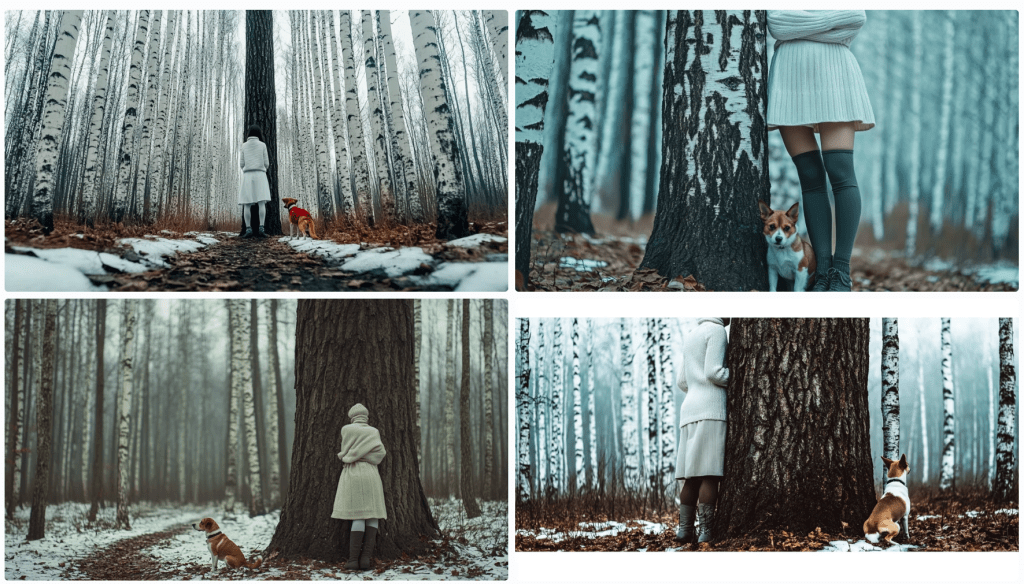
The consensus is that ‘a beautiful girl in a white dress and black boots stands next to a tree’ with a Jack Russell Terrier dog. I see birch trees and snow. It’s overcast. Let’s spend some time trying to reproduce it. To start, I’m consolidating the above descriptions. I notice some elements are missing, but we’ll add them as we try to triangulate to the original image.
A beautiful girl in a white dress and black boots stands next to a tree in a winter forest with birch trees. A Jack Russell Terrier dog is nearby, and the weather is cloudy. The photo has a cinematic style. --ar 128:71
This is pretty far off the mark. We need to account for the overall setting and composition, relative positioning, clothing, hair, camera, perspective – even lighting and film emulsion.
Let’s see how we can refine it with some adjectives. Before this, I asked Anthropic’s Claude 3.5 to describe the image. Perhaps we’ll get more details.
An atmospheric winter photograph was taken in what appears to be a birch and pine forest. The ground is partially covered with snow, creating a patchy pattern of white snow and brown leaves or soil. In the image, there's a person wearing winter attire consisting of a white knit turtleneck sweater, a white skirt, dark knee-high socks, and grey lace-up boots. They're standing against a large tree trunk with their arms crossed. Next to them is a Jack Russell Terrier mix dog with distinctive brown and white colouring. The dog appears to be well-behaved, sitting attentively beside the tree. The composition is quite striking, with the massive dark tree trunk serving as a central focal point against the misty, winter forest background. The white clothing of the person creates a visual echo with the white bark of birch trees visible in the background, as well as with the patches of snow on the ground. The overall mood of the photo is somewhat moody and contemplative, enhanced by what appears to be overcast lighting and the misty quality of the forest in the background. The colour palette is largely monochromatic, dominated by whites, greys, and browns, which adds to the winter atmosphere of the scene.
We don’t seem to be moving in a good direction. Let’s modify the initial prompt.
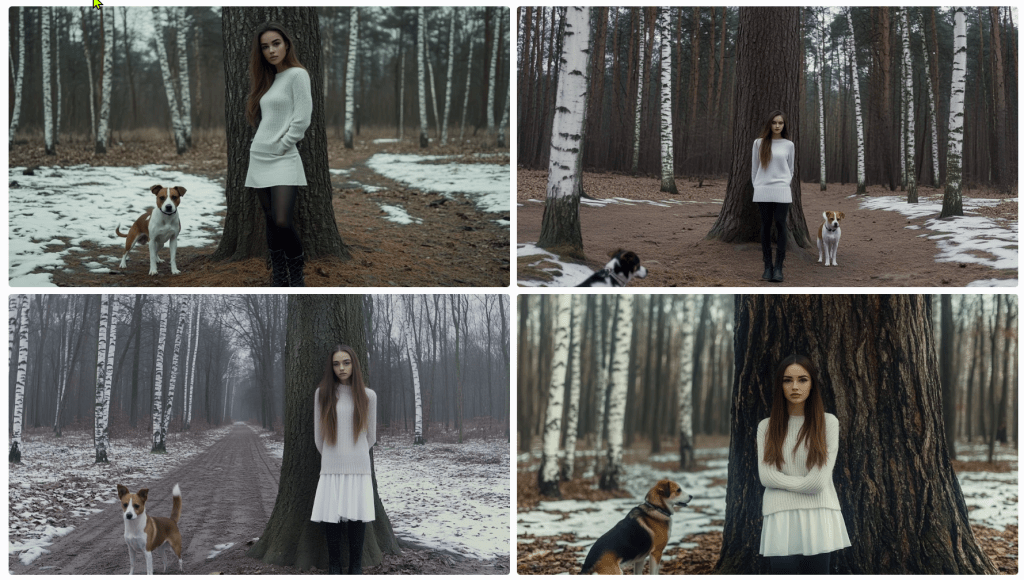
A beautiful girl in a white dress and tall laced black boots stands facing the camera to the right of large oak tree centred in the foreground of a winter forest with birch trees in the background. To the left of the tree is a Jack Russell Terrier dog looking at the camera, and the weather is cloudy. The photo has a cinematic style. --ar 128:71
I’ll allow the results to speak for themselves. Let’s see if we can’t get her out of the wedding gown and into a white jumper and skirt. I’ll bold the amends.
A beautiful girl in a white jumper and skirt wearing black leggings and tall laced black boots stands facing the camera to the right of large oak tree centred in the foreground of a winter forest with birch trees in the background. To the left of the tree is a Jack Russell Terrier dog looking at the camera, and the weather is cloudy. The photo has a cinematic style. --ar 128:71
s
A beautiful young woman with long brown hair pulled to the side of her face in a white jumper and white skirt wearing black leggings under tall laced black boots stands facing the camera to the right of large oak tree centred in the foreground of a winter forest with birch trees in the background. Patchy snow is on the ground. To the left of the tree is a Jack Russell Terrier dog looking at the camera, and the weather is overcast. The photo has a cinematic style. --ar 128:71
What gives?
I think my point has been reinforced. I’m getting nowhere fast. Let’s give it one more go and see where we end up. I’ve not got a good feeling about this.
A single large oak tree centred in the foreground of a winter forest with birch trees in the background. Patches of snow is on the ground. To the right of the oak tree stands a beautiful young woman with long brown hair pulled to the side of her face in a white jumper and white skirt wearing black boots over tall laced black boots. She stands facing the camera. To the left of the tree is a Jack Russell Terrier dog looking at the camera, and the weather is overcast. The photo has a cinematic style. --ar 128:71
With this last one, I re-uploaded the original render along with this text prompt. Notice that the girl now looks the same and the scene (mostly) appears to be in the same location, but there are still challenges.
After several more divergent attempts, I decided to focus on one element – the girl.
As I regard the image, I’m thinking of a police sketch artist. They get sort of close, don’t they? They’re experts. I’m not confident that I even have the vocabulary to convey accurately what I see. How do I describe her jumper? Is that a turtleneck or a high collar? It appears to be knit. Is is wool or some blend? does that matter for an image? Does this pleated skirt have a particular name or shade of white? It looks as though she’s wearing black leggings – perhaps polyester. And those boots – how to describe them. I’m rerunning just the image above through a describe function to see if I can get any closer.
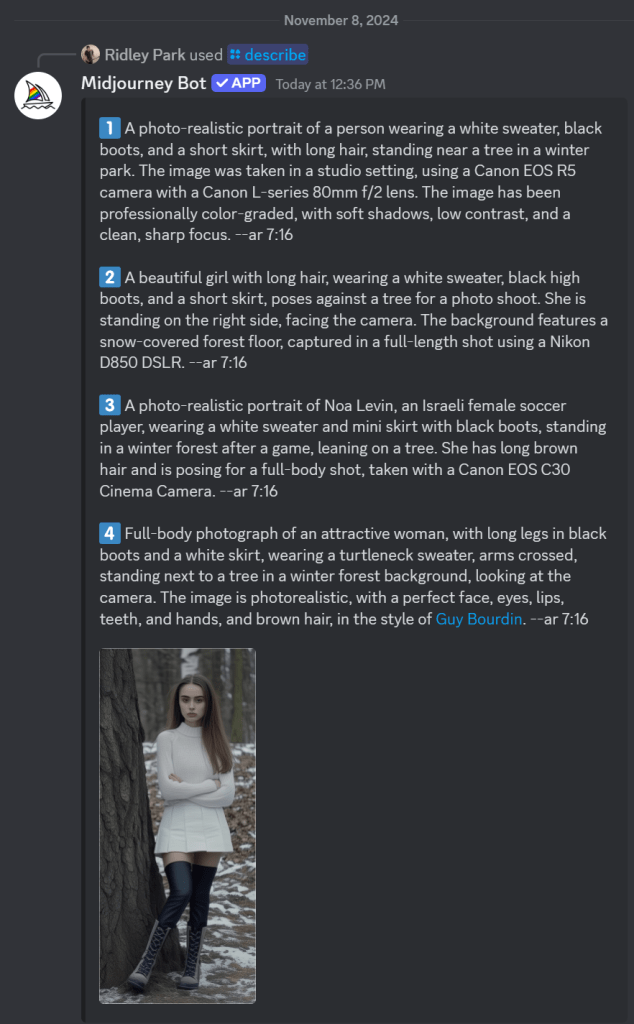
These descriptions are particularly interesting and telling. First, I’ll point out that AI attempts to identify the subject. I couldn’t find Noa Levin by a Google search, so I’m not sure how prominent she might be if she even exists at all in this capacity. More interesting still, the AI has placed her in a scenario where the pose was taken after a match. Evidently, this image reflects the style of photographer Guy Bourdin. Perhaps the jumper mystery is solved. It identified a turtleneck. I’ll ignore the tree and see if I can capture her with an amalgamation of these descriptions. Let’s see where this goes.
A photo-realistic portrait of Israeli female soccer player Noa Levin wearing a white turtleneck sweater, arms crossed, black boots, and a short skirt, with long brown hair, standing near a tree in a winter park. The image captured a full-length shot taken in a studio setting, using a Canon EOS R5 camera with a Canon L-series 80mm f/2 lens. The image has been professionally color-graded, with soft shadows, low contrast, and a clean, sharp focus. --ar 9:16
Close-ish. Let’s zoom in to get better descriptions of various elements starting with her face and hair.
Now, she’s a sad and angry Russian woman with (very) pale skin; large, sad, grey eyes; long, straight brown hair. Filmed in the style of either David LaChapelle or Alini Aenami (apparently misspelt from Alena Aenami). One thinks it was a SnapChat post. I was focusing on her face and hair, but it notices her wearing a white (oversized yet form-fitting) jumper sweater and crossed arms .
I’ll drop the angry bit – and then the sad.
Stick a fork in it. I’m done. Perhaps it’s not that language is insufficient; it that my language skills are insufficient. If you can get closer to the original image, please forward the image, the prompt, and the seed, so I can post it.
The Complexity Gradient
A clear pattern emerges when we examine how language performs across different levels of complexity:
Categorical Distinction (High Success)
Identifying shapes among limited options
Distinguishing between tree species
Basic color categorization
Simple Description (Moderate Success)
Basic geometric specifications
General object characteristics
Broad emotional states
Complex Description (Low Success)
Specific natural objects
Precise emotional experiences
Unique instances within categories
Abstract Concepts (Lowest Success)
Philosophical ideas
Personal experiences
Qualia
As we move up this complexity gradient, the gap between intended meaning and received understanding widens exponentially.
The Tolerance Problem
Understanding these limitations leads us to a practical question: what level of communicative tolerance is acceptable for different contexts? Just as engineering embraces acceptable tolerances rather than seeking perfect measurements, perhaps effective communication requires:
Acknowledging the gap between intended and received meaning
Establishing context-appropriate tolerance levels
Developing better frameworks for managing these tolerances
Recognizing when precision matters more than accuracy (or vice versa)
Implications for Human-AI Communication
These insights have particular relevance as we develop more sophisticated AI systems. The limitations we’ve explored suggest that:
Some communication problems might be fundamental rather than technical
AI systems may face similar boundaries as human communication
The gap between intended and received meaning might be unbridgeable
Future development should focus on managing rather than eliminating these limitations
Conclusion
Perhaps this is a simple exercise in mental masturbation. Language’s insufficiency isn’t a flaw to be fixed but a fundamental characteristic to be understood and accommodated. By definition, it can’t be fixed. The gap between intended and received meaning may be unbridgeable, but acknowledging this limitation is the first step toward more effective communication. As we continue to develop AI systems and push the boundaries of human-machine interaction, this understanding becomes increasingly critical.
Rather than seeking perfect precision in language, we might instead focus on:
Developing new forms of multimodal communication
Creating better frameworks for establishing shared context
Accepting and accounting for interpretative variance
Building systems that can operate effectively within these constraints
Understanding language’s limitations doesn’t diminish its value; rather, it helps us use it more effectively by working within its natural constraints.
Ngũgĩ wa Thiong’o published “Decolonising the Mind” in 1986. David Guignion shares a 2-part summary analysis of the work on his Theory and Philosophy site.
Ngũgĩ wa Thiong’o’s book Decolonising the Mind centres on the profound impact of colonialism on language, culture, and thought. It argues that imposing a foreign language on colonised people is a key tool of imperial domination. This linguistic imperialism leads to colonial alienation, separating the colonised from their own culture and forcing them to view the world through the lens of the coloniser.
Here are some key points from the concept of decolonising the mind:
Language is intimately tied to culture and worldview: Language shapes how individuals perceive and understand the world. When colonised people are forced to adopt the language of the coloniser, they are also compelled to adopt their cultural framework and values.
Colonial education systems perpetuate mental control: By privileging the coloniser’s language and devaluing indigenous languages, colonial education systems reinforce the dominance of the coloniser’s culture and worldview. This process results in colonised children being alienated from their own cultural heritage and internalising a sense of inferiority.
Reclaiming indigenous languages is crucial for decolonisation: wa Thiong’o advocates for a return to writing and creating in indigenous African languages. He sees this as an act of resistance against linguistic imperialism and a way to reconnect with authentic African cultures. He further argues that it’s not enough to simply write in indigenous languages; the content must also reflect the struggles and experiences of the people, particularly the peasantry and working class.
The concept extends beyond literature: While wa Thiong’o focuses on language in literature, the concept of decolonising the mind has broader implications. It calls for a critical examination of all aspects of life affected by colonialism, including education, politics, and economics.
It is important to note that decolonising the mind is a complex and ongoing process. There are debates about the role of European languages in postcolonial societies, and the concept itself continues to evolve. However, wa Thiong’o’s work remains a seminal text in postcolonial studies, raising crucial questions about the enduring legacy of colonialism on thought and culture.
In this segment, I ponder the interplay between blame and Causa Sui. I’ll discuss the implications for moral responsibility as well as legal responsibility, which are not as in sync as one might imagine they might be.
Video: Blame & Causa Sui
To the uninitiated, Western legal systems have no pretensions about being about morality or justice. Legal systems are designed to maintain power structures and the status quo. They are deontological machines, making them prime targets for automation by the machine learning associated with artificial intelligence. This would also diminish the power of rhetoric over facts to some extent. But, I am no legal scholar, and all of this will have to wait for another segment.
I recently shared a video on causa sui and the basics of blame and blameworthiness, so I want to intersect those topics here.
Peter Strawson suggested that for humans, blame is a reactive response. It’s reflexive like having your knee jerk when tapped. Essentially, his position is that if blame didn’t naturally exist, we’d have to invent it, mirroring Voltaire’s quip, ‘If God did not exist, it would be necessary to invent Him’. Of course, this is because they serve the same power control purpose.
If God did not exist, it would be necessary to invent Him
Voltaire
To be fair, blame is closer to real than God, but the point remains. Strawson’s point is also that humans are saddled with blame and it’s not going anywhere no matter how nebulous it becomes in execution. It’s natural.
To me, this starts to sound suspiciously like a naturalistic fallacy. Humans seem to selectively cherry-pick which so-called natural tendencies they choose to defend. One might use nature to argue that female sexual availability begins at menstruation, and yet we have decided to ignore this and defer this on the grounds of civility. It’s obvious that we could consider blame to be an animal instinct we want to domesticate away, but because it serves other purposes, per Strawson’s perspective, it’s a useful tool. But what’s the causa sui challenge. Let’s quickly recapitulate.
Causa sui argues that one cannot be the cause of oneself, ex nihilo. Being full products of nature and nurture to adopt the lay parlance, any blameworthiness lies with the sources or creators. Since we are concerned with moral responsibility, we can eliminate nature forthrightly. Nature may be responsible—by many estimations approximately 40 per cent responsible—, it possesses no moral agency. And if the individual is not responsible, then we are left with the environment and society, including the social environment. Of course, the environment gets off the hook in the same manner as the genetic and hereditary factors of nature.
Before we consider society, let’s regard the individual.
Albeit the brain-as-computer is a bit facile, it’s still good enough for illustrative purposes. When you are born, your cognitive hardware is installed, as are your edge peripherals and update protocols. Any of these can become damaged through some degenerative processes, or external environmental factors, but since my interest is in optimistic rather than pessimistic scenarios, I’ll ignore these instances. Given that blameworthiness is directly related to presumed cognitive processing, factors that diminish these faculties, mitigate blameworthiness and factors than increase it, ameliorate it.
As a—quote—’normal’ child becomes an adolescent and then an adult, the probability it will become blameworthy, increases with age, ceteris paribus. A person with cognitive deficits or conditions such as aphasia or dementia decreases the probability of blame assignment. Even temporary impairment mitigates judgment—oh, she was drunk.
So, following the brain-as-computer analogy, your brain is a CPU with a self-updating cognitive operating system and instruction set. Essentially, there is also short and long-term memory. In the case of cognitive deficits, one of these components might be effectively broken. The CPU might process too slowly; it might misinterpret what it receives; there may be issues with the sense organs or the nerves that transport signals.
I’ve got a mate who, due to medical malpractice at birth, experienced nerve damage. Although his eyes and brain are normal, his optic nerve cannot carry signals very well, effectively leaving him blind. Neither can he taste nor smell. So there’s that.
But assuming that this processing and storage hardware are intact, the causa sui constraint still applies, but let’s spend some time evaluating societal interactions.
All inputs come from society—cultures and subcultures. Apart from misinterpreted processing scenarios, if a person doesn’t receive a particular moral instruction set, that person should surely be considered to be exempt from moral blame. It may be difficult to assess whether an instruction has been input. This is a reason why children are categorically exempted: they may not have received all of the expected moral codes, they may not have been stored or effectively indexed, and their processing hardware is still in development—alpha code if you will. Brain plasticity is another attribute I won’t spend much time on, but the current state of science says that the brain is still not fully developed even by age 30, so this is certainly a mitigating factor, even if we allow leeway for the causa sui argument.
I mention subculture explicitly because the predominant culture is not the only signal source. A child raised by, I don’t know, say pirates, would have an amended moral code. I am sure we can all think of different subcultures that might undermine or come at cross odds with the dominant culture, whether hippies, religious cultists, militia groups, racial purist groups, and so on.
So, a commonly held moral in the subdominant group may counter that of the prevailing one. An example that comes to mind is some religious organisations that do not agree with human medical intervention. There have been cases where parents have allowed a child to die from an otherwise curable condition. Although in the United States, there is a claim of freedom of religion—a claim that is spotty at best—, parents or guardians in situations like these have been convicted and sentenced for following their own moral codes. But as with all people, these people are as susceptible to the limitations of causa sui as the rest of us. They are not responsible for creating themselves, but moral responsibility was asserted based on the beliefs of the prevailing culture. Even besides the legal context, persons in the larger society would likely blame the parents for their neglect—though they may be praised for being resolute in their righteousness by their in-group. This just underscores that morality is a collection of socially constructed conventions rather than something more objective.
Returning to causa sui, let’s say a person commits an act that society would typically assign blame. Rather than exercise some act of retributive justice—a concept with no foundation in a causa sui universe—the course of action was remediation. In this case, the desired moral instruction would be delivered thereby seemingly making the moral offender blameworthy. But would they be?
Presumably, (for what it’s worth) psychologists would evaluate the subject for competency in maintaining the programming. In the case of the aforementioned religious parents, they may be threatened with retribution for not abiding by the superseding rules of the prevailing power structure.
Although I might personally allow some leeway even with the causa sui in full force and effect, but I can’t say that I have much faith in the ability of humans to make a correct assessment. My impression is that any assessment would be one of convenience than something sounder.
Perhaps I’ll produce a more robust segment on retributive justice, but my feeling is that retributive justice is an area that legal systems should avoid altogether. If necessary, focus on restorative justice, rehabilitation (or ‘habilitation’ as the case might be) and quarantine models to ensure any bad actors are contained away from society. Again, this puts individuals at the mercy of cultures they find themselves a part of. I am not going to delve into this any further save to remind the listener of gang initiation schemes where a person needs to kill a member of a rival gang to become a trusted member. This is their moral code—quite at odds with the mainstream.
So there you have it. Owing to causa sui constraints, a person cannot be ultimately responsible for their actions. My primary thesis is—apart from metaphorical equipment failures—that any moral responsibility falls wholly on the society or culture. Full stop. And this isn’t as foreign as one might first feel. Although for most people blame is natural, in an individualistic society, people are interested in finding the culprit. In collectivist cultures, any culprit might do. Perhaps I’ll share some stories in a future segment. Meantime, what are your thoughts on moral responsibility? Can someone be ultimately responsible? Some have said the ‘ultimate responsibility’ is a philosophical red herring and that we can still hold someone responsible, even if not in the ultimate sense, which causa sui disallows. Are you more in this camp? Is this enough to mete out so-called retributive justice? For me, retributive justice is a euphemism for vengeance, and justice is a weasel word. But that’s just me, and perhaps a topic for another segment.
Are there any topics you’d like me to cover? Leave a comment below.
Einstein was wrong. Time is not the relative factor in space-time. Space is. Time is constant. Here’s a lecture on the topic of the book.
Lee Smolin Public Lecture: Time Reborn
As a result of a discussion with a colleague, on the possibility of variability or mutability of so-called physical laws, he recommended Lee Smolin’s book Time Reborn: From the Crisis in Physics to the Future of the Universe. He mentioned that it would be suitable as an audiobook. Since I had a credit on Audible, I decided to use it so I could listen to this without deep scrutiny and a need for taking notes.
There is a nice review in the Guardian from 2013. I suppose I am a bit behind the times.
Whilst running errands, I listened to the Preface and Introduction. I stopped at the start of the first chapter, and am debating whether to continue. Given his setup, I don’t believe I am Smolin’s target audience. Many of the beliefs he is attempting to dispel, I already don’t hold. Yet I don’t feel that I need to hold time as a constant to hold them. He seems to feel otherwise.
Preface
For the record, Lee Smolin is a theoretical physicist, who has written several books in this space. Quickly, recapping some of his points:
He provides examples of various illusions humans tend to be swayed by:
Matter appears to be smooth but turns out to be made of atoms
Atoms seem indivisible but turn out to be built of protons, neutrons, and electrons
Protons and neutrons are further made of still more elementary particles called quarks
The sun appears to go around the Earth, but it’s the other way around
Smolin relates that the prevailing perspective today is that time is an illusion—name-dropping Plato and Einstein, who hold this view. He conveys that he used to share this belief, but now he disagrees—whence the book. He tells us:
Not only is time real, but nothing we know or experience gets closer to the heart of nature than the reality of time.
— Lee Smolin, Time Reborn
Next, he posits that some people believe in timeless events—events outside of time, eternal and not a function of time. Here’s where he goes off the rails in my book.
“We perceive ourselves as living in time, yet we often imagine that the better aspects of our world and ourselves transcend it. What makes something really true, we believe, is not that it is true now but that it always was and always will be true.”
Evidently, he feels or felt this way. I am sure many others. I am not among them.
“What makes a principle of morality absolute is that it holds in every time and every circumstance.”
My position is that all morality is a social construct, so this doesn’t resonate with me.
“We seem to have an ingrained idea that if something is valuable, it exists outside time.”
Again, I am not in his intended audience.
“We yearn for “eternal love.” We speak of “truth” and “justice” as timeless.”
Love, truth, and justice are all human constructs—weasel words.
“Whatever we most admire and look up to — God, the truths of mathematics, the laws of nature — is endowed with an existence that transcends time. We act inside time but judge our actions by timeless standards.”
Yet again, I am unburdened by these beliefs.
Nothing transcends time, not even the laws of nature. Laws are not timeless. Like everything else, they are features of the present, and they can evolve over time.
— Lee Smolin, Time Reborn
I think that this quote is a reason this book was recommended to me. I do believe that the properties that comprise laws can evolve over time. I’m not sure if this is by a probabilistic process or something else. There are a few possible implications. One is that the laws at the onset of the universe may have been different, making the understanding of that time more challenging if not impossible. I don’t know if I believe in multiverses, and I doubt I may ever live long enough to discover. However, even if there is only one universe, per the name, perhaps universes can exist sequentially and when one dies another appears with a different set of initial conditions and properties. Borrowing from evolution, perhaps these survive or perish based on the viability of this combination.
Smolin goes on to posit that, ‘thinking in time is not relativism but a form of relationalism‘.
He continues,
“Truth can be both time-bound and objective when it’s about objects that exist once they’ve been invented, either by evolution or human thought.”
— Lee Smolin, Time Reborn
I’m not sure he is going to define truth, but I believe he conflates moral truths with axiomatic or tautological truths. Perhaps it doesn’t matter because both are constructed.
Smolin makes it clear that he is not a determinist, but unless you take the view he is proposing, as a physicist, you almost have to be. As he says regarding Determinism, theoretically. a person could suss out a mathematical equation to predict every future event. He also considers this belief to be a metaphysical vestige of religion.
Introduction
According to [the] dominant view, everything that happens in the universe is determined by a law, which dictates precisely how the future evolves out of the present. The law is absolute and, once present conditions are specified, there is no freedom or uncertainty in how the future will evolve.
— Lee Smolin, Time Reborn
He continues to describe a deterministic system without mentioning indeterminism, which may be a more prominent belief given what we understand about quantum mechanics. He claims that this perspective diminishes time for several reasons. Inflating or at least elevating time is important for his thesis, and I am thinking that this is more an act of wishful thinking.
He takes a stab at the inherent reductionism of physics—it reduces everything to parts until there are no longer subparts, at which point the process fails—and explains that by adopting this approach, one needs to get outside of the universe to make some evaluations, but this is impossible. And this might be a true statement, but so what? The answer is not to make up a story that creates an environment where that’s no longer necessary.
Smolin reiterates over and again about timeless laws in a time-bound universe, but I question his notion of timelessness. He admits that he has no grand theory—just an idea he hopes others can pursue and build upon. Emergent properties appear to be an emerging theme.
Leibniz is next up, in particular his principle of sufficient reason. Leibniz’ vision is a relational universe composed of a network of relationships—the space is simply the absence of things. He contrasts this with Newton’s view that space is absolute and serves as the container for things. He sets up a future chapter that he says establishes that Leibniz’ vantage precludes the possibility of absolute time, but I don’t see this as a challenge for those of us who believe that time is constructed in the first place.
The Newtonian view prevailed until Einstein resurrected Leibnitz with his general relativity theory of space and time. The trending vogue is about relationalism, whether biology or information science.
He cites the challenges of maintaining Locke’s views on autonomy and personal liberties in a deterministic world (again leaving indeterminism unmentioned).
And he’s back on the emergence of emergence. (I was in the midst of writing a post on emergence when this interrupted my flow. I suspect it should be forthcoming in time.)
Falling
As it turned out, I ran another errand and listened to the first chapter of part 1. It is about gravity and parabolas, but I shan’t recount it here, save to note that he seems to be of the opinion that many people have the desire to transcend the bounds of human life. He may be right. I am not one of these people.
In chapter 71, Ultimate Responsibility, in Intuition Pumps and Other Tools for Thinking, author and philosopher, Daniel Dennett presents a counterargument to the notion that an agent, a person, is not absolutely responsible for their actions. He questions some premises in the ‘the way you are’ line of argumentation, but I question some of his questions.
Here is a nice clear version of what some thinkers take to be the decisive argument. It is due in this form to the philosopher Galen Strawson (2010): 1. You do what you do, in any given situation, because of the way you are. 2. So in order to be ultimately responsible for what you do, you have to be ultimately responsible for the way you are—at least in certain crucial mental respects. 3. But you cannot be ultimately responsible for the way you are in any respect at all. 4. So you cannot be ultimately responsible for what you do.
Dennett, Daniel C.. Intuition Pumps And Other Tools for Thinking (p. 395). W. W. Norton & Company. Kindle Edition.
Dennett continues.
The first premise is undeniable: “the way you are” is meant to include your total state at the time, however you got into it. Whatever state it is, your action flows from it non-miraculously.
Dennett and I are in agreement with Strawson. There is not much to see here. It’s akin to saying the now is the result of all past events until now. This is “the way you are”.
The second premise observes that you couldn’t be “ultimately” responsible for what you do unless you were “ultimately” responsible for getting yourself into that state—at least in some regards.
This second premise asserts that one cannot be responsible for any action that one had no part in performing. Two scenarios come immediately to mind.
First, you are not responsible for being born. As Heidegger notes, we are all thrown into this world. We have no say in when or where—what country or family—or what circumstances.
Second, if one is hypnotised or otherwise incapacitated, and then involved in a crime, one is merely a cog and not an agent, so not responsible in any material sense.
But according to step (3) this is impossible.
Whilst Dennett fixates on the absolute aspect of the assertion, I’d like to be more charitable and suggest that we still end up with a sorites paradox. Dennett will return to this one, and so shall I.
So step (4), the conclusion, does seem to follow logically. Several thinkers have found this argument decisive and important. But is it really?
As Dennett invalidates step (3), he insists that the conclusion is also invalid. He asserts that the notion of absolute responsibility is a red herring, and I argue that Dennett doesn’t get us much further, perhaps redirecting us with a pink herring.
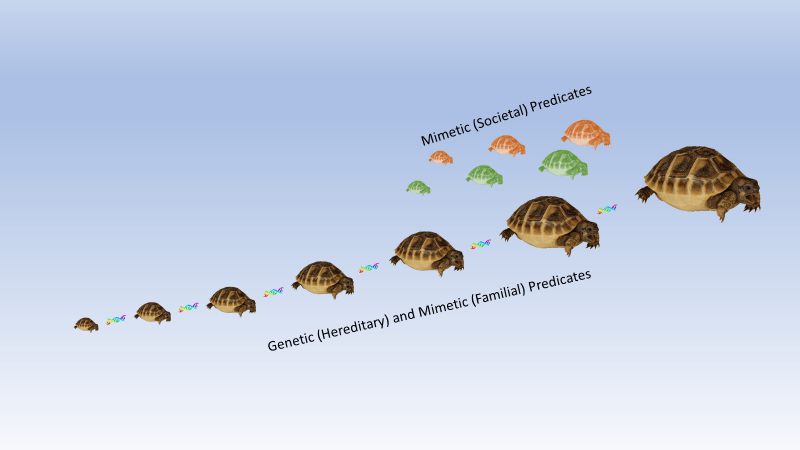
I’ve created an image with tortoises to make my point. There are actually two points I wish to make. The first point is to determine where the responsibility is inherited. This point is meant to articulate that the world can not be strictly deterministic and yet one can still not have significant agency. The second point is that culpability is asserted as a need, and acceptance of this assertion is the problem.
Testuditude
The image depicts an evolution of an agent, with time progressing from left to right. The tortoise on the right is a product of each of the recursive tortoises to its left. The image means to convey that each subsequent tortoise is a genetic and social and social product of each tortoise prior. Of course, this is obviously simplified, because tortoises require pairs, so feel free to imagine each precedent tortoise to represent a pair or feel free to add that level of diagrammatic complexity.
This is not meant to distinguish between nature and nurture. Instead, the claim is that one is a product of both of these. Moreover, as genetic, epigenetic, and mimetic influences are transmitted in family units, they also occur through social interaction and the environment, as represented by the orange and green tortoises.
…if one is a product of genetic and mimetic forces, how much agency remains for culpability?
The point here is that if one is a product of genetic and mimetic forces, how much agency remains for culpability? Each person is an emergent unit—autonomous, yes, and yet highly programmed.
If I programme a boobytrap to kill or maim any intruder, the boobytrap has no agency. I assert further, that the maker of that boobytrap has no more responsibility than the killing device.
The old hand grenade wired to a doorknob boobytrap trick
But who do we blame? you ask, and that’s precisely the problem. Asking questions doesn’t presume answers. This is a logical fallacy and cognitive bias. This heuristic leaves us with faulty jurisprudence systems. Humans seem hardwired, as it were, to blame. Humans need to believe in the notion of free will because they need to blame because they need to punish because vengeance is part of human nature to the extent there is human nature. There seems to be a propensity to frame everything as a causal relationship. Dennett calls this the Intentional stance. To borrow a from Dennett…
This instinctual response is the source in evolution of the invention of all the invisible elves, goblins, leprechauns, fairies, ogres, and gods that eventually evolve into God, the ultimate invisible intentional system.
Dennett, Daniel C.. Intuition Pumps And Other Tools for Thinking (p. 374). W. W. Norton & Company. Kindle Edition.
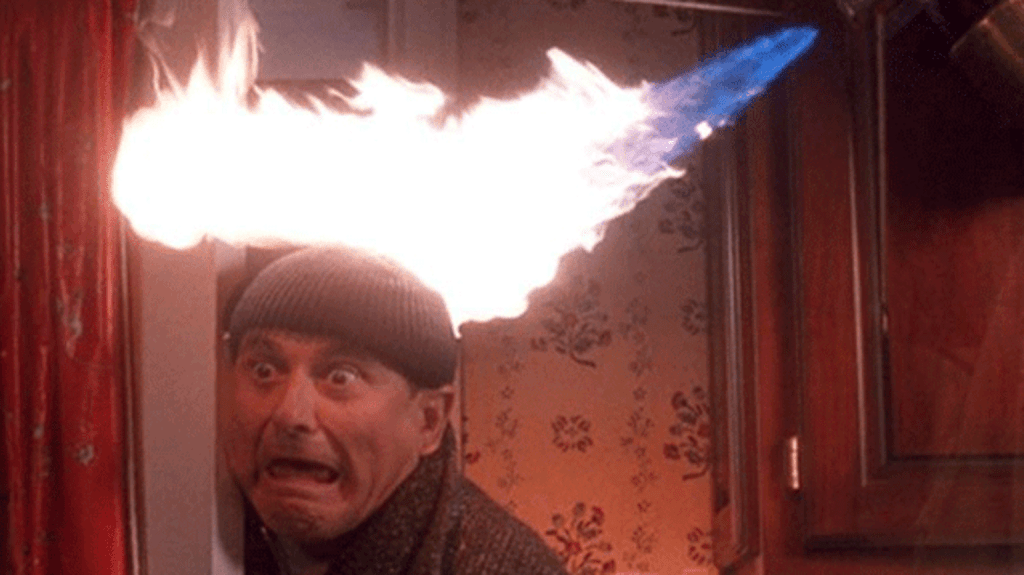
Fire Trap in Home Alone
Sins of the Fathers (and Mothers)
Let’s wrap this up with a sorites paradox. As I’ve already said, I agree with Dennett that the absolute aspect is unnecessary and undesired. The question remains how much agency™ does a person have once we account for the other factors? Is it closer to 90 per cent or 10 per cent? Apart from this, what is the threshold for culpability? Legal systems already have arbitrary (if not capricious) thresholds for this, whether mental capacity or age, which basically distils back to the realm of capacity.
I have no basis to even venture a guess, but that’s never stopped me before. I’d argue that the agency is closer to zero than to one hundred per cent of the total, and I’d propose that 70 per cent feels like a reasonable threshold.
I could have sworn I’d posted a position on this after I read Robert Sapolsky’s Behave. Perhaps it’s never made it out of drafts.
In closing, I don’t think we need to settle the question of determinism versus free will to recognise that even without strict determinism, personal agency is still severely limited, and yet as our political systems presume a level of rationality that is not apparent, so do legal systems presume a level of agency not present.
The lamb spends all its time worrying about the wolf and ends up being eaten by the shepherd.
— Unknown
I think one could look at this from several perspectives or through different lenses.
We worry about the wrong things.
At some level, this is about trust.
We trust the wrong people. Those whom we most entrust do us in. But I feel this is contextual.
One might feel this shepherd is Capitalism or the State or organised religion. Perhaps it’s culture or identity cohorts. Or all or these or none of these.
On another level, it recalls the inevitability of death. This shepherd reaper is always waiting in the wings whether or not one worries.
Reading Dennett has gotten me down a rabbit hole. I decided to take a break from book-reading and spend the day reading essays and blogs and watching YouTube vids such as this one. The question posed by the title is Which Laws of Nature are Fundamental? The topic I find curious is an established dichotomy where intelligent design or multiverses are the only possible reasons why we as humans are here to question our existence.
Full disclosure: I don’t pretend to be a physicist, so although I have tried to keep current on, let’s call it, lay physics, there is much I don’t know. But that doesn’t make me stop questioning propositions.
In the case of intelligent design versus multiverses, I feel that both go overboard. I don’t particularly cherish Occam’s Razor, but I do find it apt here. As David Deutsch states in this piece, intelligent design only manages to kick the can down the kerb.
In a nutshell, intelligent design arrives at a place with a claim that all of this can’t have been the result of chance and random events, so [insert the entity of your choosing] had to have designed and constructed it, leaving open the question of how that entity came to be. This is a spin on the age-old issue that many defenders of intelligent design-like theories seem to cling to: The universe cannot have spawned from nowhere, so its genesis must have been due to an intelligent (read: divine) entity without recognising or admitting the circular reasoning involved.
On the other hand, the multiverse solution—which I don’t entirely rule out—also seems unnecessary. In another nutshell—or perhaps repurposing the first—, the main idea is that there are many if not infinite parallel universes. Given the large number—in the manner of the infinite monkeys typing Shakespeare’s sonnets, at least one is bound to be configured just so to enable life and humans in particular.
Typing Monkeys
I don’t subscribe to intelligent design in the least. I dismiss it as implausible. And whilst multiverses may exist, I fail to see why there can’t be a single universe—this one—that just so happens to be configured. If it had been configured any other way, there would have been no life as we know it—and certainly no human life and no life to question how it get there and why.
In my mind, just because we can ask why doesn’t mean there is an answer or that we can find it. More to the point, even in a world of cause and effect, the results can be emergent on one hand and multlivariant on the other. So whilst we want to discover a causal chain of A ⇒ B ⇒ C ⇒ n, it is not likely so linear. Humans do understand the notions of stochsticism and chaos, but we don’t necessarily know how to deal with them causally. Moreover—and Deutsch has specialised in the quantum space—, our understanding of quantum processes is extremely primative. We are probably operating more from conjecture than knowledge, but one needs to start someplace. The trick is not to believe you’ve reached India when you’ve only just departed Spain.
















 Philosophics