Facts, Intent, and the Afterlife of Metaphysics

5–8 minutes

I’ve been reading Bernard Williams lately, and I’ve written about his work on Truth and Truthfulness. I’m in the process of writing more on the challenges of ontological moral positionsand moral luck. I don’t necessarily want to make contemporary news my focal point, but this is a perfect case study for it. I’ll be releasing a neutral philosophy paper on the underlying causes, but I want to comment on this whilst it’s still in the news cycle.

The form of xenophobia is a phenomenon occurring in the United States, though the ontological split is applicable more generally. For those unfamiliar with US news, I’ll set this up. The United States is currently deploying federal enforcement power in ways that deliberately bypass local consent, blur policing and military roles, and rely on fear as a stabilising mechanism. Historical analogies are unavoidable, but not required for the argument that follows. These forces have been deployed in cities that did not and do not support the Trump administration, so they are exacting revenge and trying to foment fear and unrest. This case is an inevitable conclusion to these policy measures.

tl;dr: The Law™ presents itself as fact-driven, but only by treating metaphysical imputations about inner life as if they were empirical findings. This is not a flaw in this case; it is how the system functions at all.

NB: Some of this requires having read Williams or having a familiarity with certain concepts. Apologies in advance, but use Google or a GPT to fill in the details.

Audio: NotebookLM summary podcast of this content.

Why the Minneapolis ICE Shooting Exposes the Limits of Bernard Williams

The Minneapolis ICE shooting is not interesting because it is unusual. It is interesting because it is painfully ordinary. A person is dead. An officer fired shots. A vehicle was involved. Video exists. Statements were issued. Protests followed. No one seriously disputes these elements. They sit in the shared centre of the Venn diagram, inert and unhelpful. Where everything fractures is precisely where the law insists clarity must be found: intent and motive. And this is where things stop being factual and start being metaphysical.

The Comfortable Fiction of Legal Facts

The legal system likes to tell a comforting story about itself. It claims to be empirical, sober, and evidence-driven. Facts in, verdicts out. This is nonsense.

What the law actually does is this:

  • It gathers uncontested physical facts.
  • It then demands a psychological supplement.
  • It treats that supplement as if it were itself a fact.

Intent and motive are not observed. They are inferred. Worse, they are imposed. They are not discovered in the world but assigned to agents to make outcomes legible.

In Minneapolis, the uncontested facts are thin but stable:

  • A U.S. Immigration and Customs Enforcement (ICE) agent, identified as Jonathan Ross, shot and killed Renée Nicole Good in Minneapolis on 7 January 2026.
  • The incident involved Good’s vehicle, which was present and moving at the time shots were fired.
  • Ross fired his weapon multiple times, and Good died from those gunshot wounds.
  • The Department of Homeland Security (DHS) claims the agent acted in self-defence.
  • Video footage exists that shows at least part of the encounter.
  • The case ignited protests, widespread condemnation from local officials, and political pushback.

This creates a shared intersection: vehicle, Ross, shots, and that ‘something happened’ that neither side is denying.

None of these facts contain intent. None of them specify motive. They do not tell us whether the movement of the vehicle was aggression, panic, confusion, or escape. They do not tell us whether the shooting was fear, anger, habit, or protocol execution. Yet the law cannot proceed without choosing.
So it does what it always does. It smuggles metaphysics into evidence and calls it psychology.

Intent and Motive as Institutional Impositions

Intent is treated as a condition of responsibility. Motive is treated as its explanation. Neither is a fact in anything like the ordinary sense. Even self-report does not rescue them. Admission is strategically irrational. Silence is rewarded. Reframing is incentivised. And even sincerity would not help, because human beings do not have transparent access to their own causal architecture. They have narratives, rehearsed and revised after the fact. So the law imputes. It tells the story the agent cannot safely tell, and then punishes or absolves them on the basis of that story. This is not a bug. It is the operating system.

Where Bernard Williams Comes In

This is where Bernard Williams becomes relevant, and where his account quietly fails. In Truth and Truthfulness, Williams famously rejects the Enlightenment fantasy of capital-T Truth as a clean, context-free moral anchor. He replaces it with virtues like sincerity and accuracy, grounded in lived practices rather than metaphysical absolutes. So far, so good.

Williams is right that moral life does not float above history, psychology, or culture. He is right to attack moral systems that pretend agents consult universal rules before acting. He is right to emphasise thick concepts, situated reasons, and practical identities. But he leaves something standing that cannot survive the Minneapolis test.

The Residue Williams Keeps

Williams still needs agency to be intelligible. He still needs actions to be recognisably owned. He still assumes that reasons, however messy, are at least retrospectively available to anchor responsibility. This is where the residue collapses.

In cases like Minneapolis:

  • Intent is legally required but epistemically unavailable.
  • Motive is legally explanatory but metaphysically speculative.
  • Admission is disincentivised.
  • Narrative is imposed under institutional pressure.

At that point, sincerity and accuracy are no longer virtues an agent can meaningfully exercise. They are properties of the story selected by the system. Williams rejects metaphysical Truth while retaining a metaphysical agent robust enough to carry responsibility. The problem is that law does not merely appeal to intelligibility; it manufactures it under constraint.

Moral Luck Isn’t Enough

Williams’ concept of moral luck gestures toward contingency, but it still presumes a stable agent who could, in principle, have acted otherwise and whose reasons are meaningfully theirs. But once intent and motive are understood as institutional fabrications rather than inner facts, ‘could have done otherwise’ becomes a ceremonial phrase. Responsibility is no longer uncovered; it is allocated. The tragedy is not that we fail to know the truth. The tragedy is that the system requires a truth that cannot exist.

Facts Versus Stories

The law does not discover which story is true. It selects which story is actionable.

The Minneapolis case shows the fault line clearly:

  • Facts: bodies, movements, weapons, recordings.
  • Stories: fear versus anger, defence versus aggression.
  • The first is uncontested. The second does all the work.

And those stories are not epistemic conclusions. They are metaphysical commitments enforced by law. Williams wanted to rescue ethics from abstraction. What he could not accept is that, once abstraction is removed, responsibility does not become more human. It becomes procedural.

The Uncomfortable Conclusion

The law does not operate on truth. It operates on enforceable interpretations of behaviour. Intent and motive are not facts. They are tools. Williams saw that capital-T Truth had to go. What he did not see, or perhaps did not want to see, is that the smaller, more humane residue he preserved cannot bear the weight the legal system places on it.

Once you see this, the obsession with ‘what really happened’ looks almost childish. The facts are already known. What is being fought over is which metaphysical fiction the system will enforce.

That decision is not epistemic. It is political. And it is violent.

Justice as a House of Cards

4–6 minutes

How retribution stays upright by not being examined

There is a persistent belief that our hardest disagreements are merely technical. If we could stop posturing, define our terms, and agree on the facts, consensus would emerge. This belief survives because it works extremely well for birds and tables.

It fails spectacularly for justice.

Audio: NotebookLM summary podcast of this topic.

The Language Insufficiency Hypothesis (LIH) isn’t especially interested in whether people disagree. It’s interested in how disagreement behaves under clarification. With concrete terms, clarification narrows reference. With contested ones, it often fractures it. The more you specify, the more ontologies appear.

Justice is the canonical case.

Retributive justice is often presented as the sober, adult conclusion. Not emotional. Not ideological. Just what must be done. In practice, it is a delicately balanced structure built out of other delicately balanced structures. Pull one term away and people grow uneasy. Pull a second and you’re accused of moral relativism. Pull a third and someone mentions cavemen.

Let’s do some light demolition. I created a set of 17 Magic: The Gathering-themed cards to illustrate various concepts. Below are a few. A few more may appear over time.

Card One: Choice

Image: MTG: Choice – Enchantment

The argument begins innocently enough:

They chose to do it.

But “choice” here is not an empirical description. It’s a stipulation. It doesn’t mean “a decision occurred in a nervous system under constraints.” It means a metaphysically clean fork in the road. Free of coercion, history, wiring, luck, trauma, incentives, or context.

That kind of choice is not discovered. It is assumed.

Pointing out that choices are shaped, bounded, and path-dependent does not refine the term. It destabilises it. Because if choice isn’t clean, then something else must do the moral work.

Enter the next card.

Card Two: Agency

Image: MTG: Agency – Creature – Illusion

Agency is wheeled in to stabilise choice. We are reassured that humans are agents in a morally relevant sense, and therefore choice “counts”.

Counts for what, exactly, is rarely specified.

Under scrutiny, “agency” quietly oscillates between three incompatible roles:

  • a descriptive claim: humans initiate actions
  • a normative claim: humans may be blamed
  • a metaphysical claim: humans are the right kind of cause

These are not the same thing. Treating them as interchangeable is not philosophical rigour. It’s semantic laundering.

But agency is emotionally expensive to question, so the discussion moves on briskly.

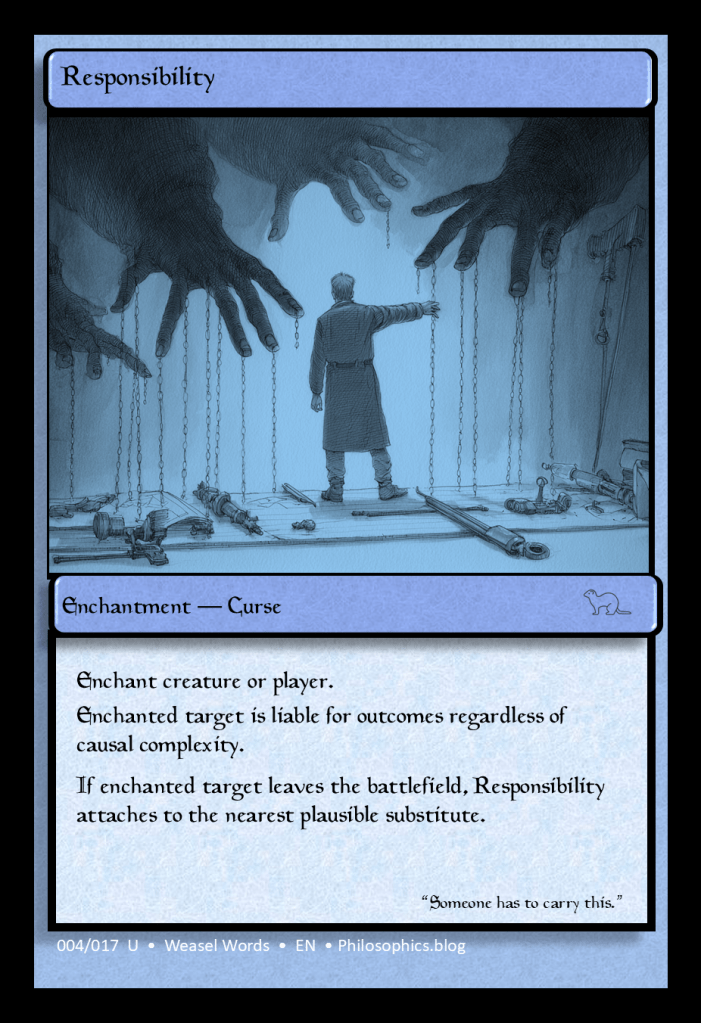
Card Three: Responsibility

Image: MTG: Responsibility – Enchantment – Curse

Responsibility is where the emotional payload arrives.

To say someone is “responsible” sounds administrative, even boring. In practice, it’s a moral verdict wearing a clipboard.

Watch the slide:

  • causal responsibility
  • role responsibility
  • moral responsibility
  • legal responsibility

One word. Almost no shared criteria.

By the time punishment enters the picture, “responsibility” has quietly become something else entirely: the moral right to retaliate without guilt.

At which point someone will say the magic word.

Card Four: Desert

Image: MTG: Desert – Instant

Desert is the most mystical card in the deck.

Nothing observable changes when someone “deserves” punishment. No new facts appear. No mechanism activates. What happens instead is that a moral permission slip is issued.

Desert is not found in the world. It is declared.

And it only works if you already accept a very particular ontology:

  • robust agency
  • contra-causal choice
  • a universe in which moral bookkeeping makes sense

Remove any one of these and desert collapses into what it always was: a story we tell to make anger feel principled.

Which brings us, finally, to the banner term.

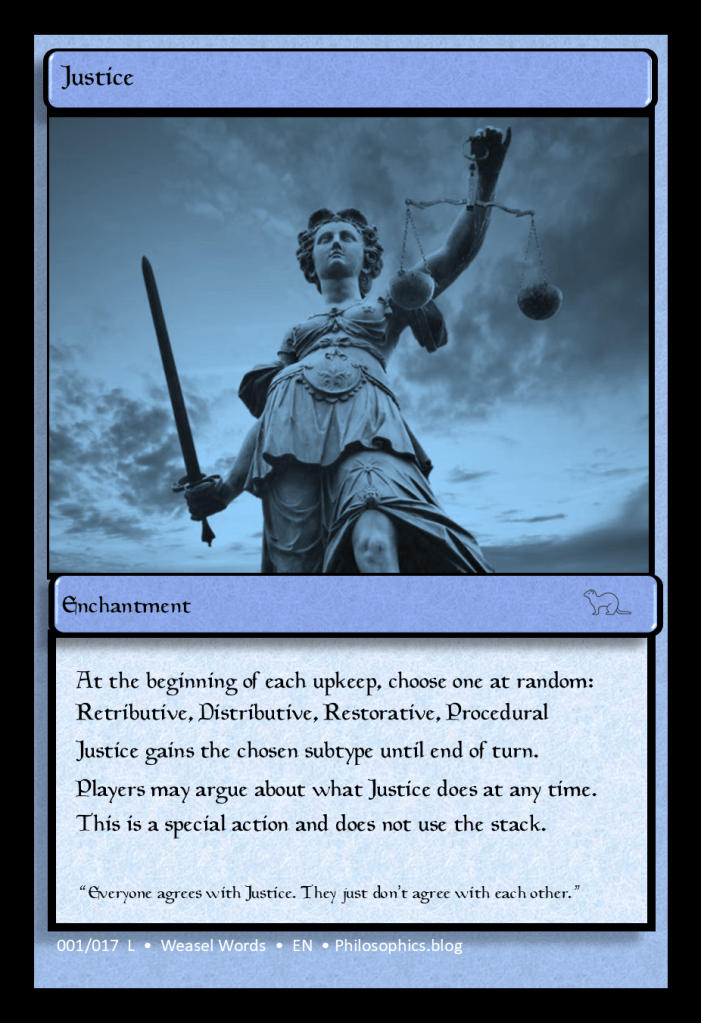
Card Five: Justice

Image: MTG: Justice – Enchantment

At this point, justice is invoked as if it were an independent standard hovering serenely above the wreckage.

It isn’t.

“Justice” here does not resolve disagreement. It names it.

Retributive justice and consequentialist justice are not rival policies. They are rival ontologies. One presumes moral balance sheets attached to persons. The other presumes systems, incentives, prevention, and harm minimisation.

Both use the word justice.

That is not convergence. That is polysemy with a body count.

Why clarification fails here

This is where LIH earns its keep.

With invariants, adding detail narrows meaning. With terms like justice, choice, responsibility, or desert, adding detail exposes incompatible background assumptions. The disagreement does not shrink. It bifurcates.

This is why calls to “focus on the facts” miss the point. Facts do not adjudicate between ontologies. They merely instantiate them. If agency itself is suspect, arguments for retribution do not fail empirically. They fail upstream. They become non sequiturs.

This is also why Marx remains unforgivable to some.
“From each according to his ability, to each according to his need” isn’t a policy tweak. It presupposes a different moral universe. No amount of clarification will make it palatable to someone operating in a merit-desert ontology.

The uncomfortable conclusion

The problem is not that we use contested terms. We cannot avoid them.

The problem is assuming they behave like tables.

Retributive justice survives not because it is inevitable, but because its supporting terms are treated as settled when they are anything but. Each card looks sturdy in isolation. Together, they form a structure that only stands if you agree not to pull too hard.

LIH doesn’t tell you which ontology to adopt.

It tells you why the argument never ends.

And why, if someone insists the issue is “just semantic”, they’re either confused—or holding the deck.

Against Agency: The Fiction of the Autonomous Self

2–3 minutes

The Enlightenment’s Most Beloved Lie

🔗 Read the full preprint on Zenodo
🔗 Explore the Anti-Enlightenment Project

The Enlightenment promised liberation through reason – that if we could think clearly enough, we could act freely enough. Agency, it claimed, was the defining trait of the rational individual: a sovereign chooser, self-contained and self-determining.

But this was always a fiction.

Not an innocent one, either.

Audio: NotebookLM podcast discussing the essay, Against Agency

Agency became the moral infrastructure of modernity – the premise behind law, punishment, merit, guilt, and even political participation. To say “I chose” was not simply to describe behaviour; it was to perform belonging within a metaphysical system that made individuals the unit of responsibility. The fiction worked, for a while, because it kept the machinery running.

Against Agency argues that this story has collapsed – not metaphorically but structurally. Cognitive science, postcolonial thought, and relational philosophies all point to the same conclusion: there is no autonomous agent, only differential responsiveness – a system’s fluctuating capacity to register and transmit influence.

Copper sings under current; rubber resists. Humans, likewise, respond within the constraints of biology, fatigue, trauma, and social design. What we call “freedom” is merely a condition in which responsiveness remains broad and protected.

This reframing dismantles the binary of “free” and “unfree.” There is no metaphysical threshold where agency appears. Instead, responsiveness scales – widened by safety, narrowed by coercion, eroded by exhaustion. Politics becomes engineering: the maintenance of conditions that sustain responsiveness, rather than the worship of choice.

Ethics, too, must shift.

Not “Who is to blame?” but “Where did the circuit break?”

The essay proposes a gradient model of conduct grounded in relation and feedback, rather than autonomy and will. Responsibility becomes less about moral worth and more about bandwidth – a physics of care.

It’s an uncomfortable vision for a culture addicted to outrage and repentance. The loss of agency removes our favourite alibi: the chooser who could have done otherwise. But it also opens the possibility of a more honest ethics – one that replaces judgment with maintenance, retribution with repair.

This is not nihilism. It’s realism.

Systems appear stable only from a distance. Up close, everything is process – bodies, institutions, meanings – held together by temporary alignments of responsiveness. Against Agency names this collapse not as tragedy, but as opportunity: a clearing from which to think and act without the fictions that sustained modernity.

The essay forms the foundation for what comes next in the Anti-Enlightenment ProjectDis-Integration, a philosophical sequel that explores what remains once coherence, control, and autonomy have been decommissioned.

The Enlightenment Sleight of Hand

How Reason Inherited God’s Metaphysics.

The Enlightenment, we are told, was the age of Reason. A radiant exorcism of superstition. Out went God. Out went angels, miracles, saints, indulgences. All that frothy medieval sentiment was swept aside by a brave new world of logic, science, and progress. Or so the story goes.

Audio: NotebookLM podcast on this topic.

But look closer, and you’ll find that Reason didn’t kill God—it absorbed Him. The Enlightenment didn’t abandon metaphysics. It merely privatised it.

From Confessional to Courtroom

We like to imagine that the Enlightenment was a clean break from theology. But really, it was a semantic shell game. The soul was rebranded as the self. Sin became crime. Divine judgement was outsourced to the state.

We stopped praying for salvation and started pleading not guilty.

The entire judicial apparatus—mens rea, culpability, desert, retribution—is built on theological scaffolding. The only thing missing is a sermon and a psalm.

Where theology had the guilty soul, Enlightenment law invented the guilty mind—mens rea—a notion so nebulous it requires clairvoyant jurors to divine intention from action. And where the Church offered Hell, the state offers prison. It’s the same moral ritual, just better lit.

Galen Strawson and the Death of Moral Responsibility

Enter Galen Strawson, that glowering spectre at the feast of moral philosophy. His Basic Argument is elegantly devastating:

  1. You do what you do because of the way you are.
  2. You can’t be ultimately responsible for the way you are.
  3. Therefore, you can’t be ultimately responsible for what you do.

Unless you are causa sui—the cause of yourself, an unmoved mover in Calvin Klein—you cannot be held truly responsible. Free will collapses, moral responsibility evaporates, and retributive justice is exposed as epistemological theatre.

In this light, our whole legal structure is little more than rebranded divine vengeance. A vestigial organ from our theocratic past, now enforced by cops instead of clerics.

The Modern State: A Haunted House

What we have, then, is a society that has denied the gods but kept their moral logic. We tossed out theology, but we held onto metaphysical concepts like intent, desert, and blame—concepts that do not survive contact with determinism.

We are living in the afterglow of divine judgement, pretending it’s sunlight.

Nietzsche saw it coming, of course. He warned that killing God would plunge us into existential darkness unless we had the courage to also kill the values propped up by His corpse. We did the first bit. We’re still bottling it on the second.

If Not Retribution, Then What?

Let’s be clear: no one’s suggesting we stop responding to harm. But responses should be grounded in outcomes, not outrage.

Containment, not condemnation.

Prevention, not penance.

Recalibration, not revenge.

We don’t need “justice” in the retributive sense. We need functional ethics, rooted in compassion and consequence, not in Bronze Age morality clumsily duct-taped to Enlightenment reason.

The Risk of Letting Go

Of course, this is terrifying. The current system gives us moral closure. A verdict. A villain. A vanishing point for our collective discomfort.

Abandoning retribution means giving that up. It means accepting that there are no true villains—only configurations of causes. That punishment is often revenge in drag. That morality itself might be a control mechanism, not a universal truth.

But if we’re serious about living in a post-theological age, we must stop playing dress-up with divine concepts. The Enlightenment didn’t finish the job. It changed the costumes, kept the plot, and called it civilisation.

It’s time we staged a rewrite.

Unwilling Steelman, Part V

A five-part descent into the illusion of autonomy, where biology writes the script, reason provides the excuse, and the self is merely the echo of its own conditioning. This is a follow-up to a recent post on the implausibility of free will.

You Cannot Originate Yourself

The causa sui argument, and the final collapse of moral responsibility

“If you cannot cause yourself, you cannot cause your choices.
And if you cannot cause your choices, you cannot own them.”

Audio: NotenookLM podcast on this topic.

Everything until now has pointed to erosion:

  • Your choices are state-dependent.
  • Your identity is cumulative, not authored.
  • Your evaluations are judged by compromised observers.

But here, finally, we strike at the bedrock.

It isn’t merely that you are manipulated.
It isn’t merely that you are misperceived.
It’s that you never could have been free, even in theory.

Because you did not make yourself.

The Causa Sui Problem

To be ultimately morally responsible, you must be the origin of who you are.

  • You must have chosen your disposition.
  • You must have selected your values.
  • You must have designed your will.

But you didn’t.

You emerged:

  • With a particular genetic cocktail.
  • Into a particular historical moment.
  • Through particular developmental experiences.
  • With particular neurological quirks and vulnerabilities.

And at no point did you step outside yourself to say:

“I would like to be this kind of agent, with this kind of character.”

You were thrown — as Heidegger might say — into a situation not of your choosing, with equipment you didn’t request, subject to pressures you couldn’t anticipate.

And everything you think of as “yours” — your courage, your laziness, your generosity, your rage — is the unfolding of that original unchosen situation.

No Escape via Reflexivity

Some will protest:

“But I can reflect! I can change myself!”

But this, too, is a mirage.

Because:

  • The desire to reflect is conditioned.
  • The capacity to reflect is conditioned.
  • The courage to act on reflection is conditioned.

You didn’t author your ability to self-correct.
You simply inherited it — like a river inheriting a particular gradient.

Even your rebellion is written in your blueprint.

Freedom by Degrees Is Not Freedom

The compatibilist fallback — that freedom is just “acting according to oneself” — collapses under causa sui.

Because the self that acts was never authored. It was configured by prior causes.

If you cannot be the cause of yourself,
then you cannot be the cause of your actions in any ultimate sense.

Thus:

  • No ultimate credit for your virtues.
  • No ultimate blame for your vices.
  • Only causal flow, chemical procession, narrative stitching after the fact.

The criminal and the saint are both unlucky configurations of biology and circumstance.

TL;DR: No Self, No Sovereignty

  • To be responsible, you must be causa sui — the cause of yourself.
  • You are not.
  • Therefore, you are not ultimately responsible for your actions.
  • Therefore, free will — as traditionally imagined — does not exist.

There is choice.
But there is no chooser behind the choice.
Only the momentum of prior conditions, impersonating agency.


Series Summary: Unwilling Steelmen

A five-part descent into the illusion of autonomy

What remains, if not free will?
Something perhaps stranger — and possibly, more humane:

A universe of actors who deserve understanding, but not blame.
Compassion, but not judgment.
Help, but not hagiography.

Unwilling Steelman, Part IV

A five-part descent into the illusion of autonomy, where biology writes the script, reason provides the excuse, and the self is merely the echo of its own conditioning. This is a follow-up to a recent post on the implausibility of free will.

Audio: NotebookLM podcast on the topic.

“It’s not just that you’re a hallucination of yourself.
It’s that everyone else is hallucinating you, too — through their own fog.”

The Feedback Loop of False Selves

You are being judged — by others who are also compromised

If you are a chemically modulated, state-dependent, narrativising automaton, then so is everyone who evaluates you. The moral courtroom — society, the law, the dinner table — is just a gathering of biased systems confidently misreading each other.

We are taught to believe in things like:

  • “Good character”
  • “Knowing someone”
  • “Getting a read on people”

But these are myths of stability, rituals of judgment, and cognitive vanity projects. There is no fixed you — and there is no fixed them to do the judging.

Judging the Snapshot, Not the Self

Let’s say you act irritable. Or generous. Or quiet.
An observer sees this and says:

“That’s who you are.”

But which version of you are they observing?

  • The you on two hours of sleep?
  • The you on SSRIs?
  • The you grieving, healing, adjusting, masking?

They don’t know. They don’t ask.
They just flatten the moment into character.

One gesture becomes identity.
One expression becomes essence.

This isn’t judgment.
It’s snapshot essentialism — moral conclusion by convenience.

The Observer Is No Less Biased

Here’s the darker truth: they’re compromised, too.

  • If they’re stressed, you’re rude.
  • If they’re lonely, you’re charming.
  • If they’re hungry, you’re annoying.

What they’re perceiving is not you — it’s their current chemistry’s reaction to your presentation, filtered through their history, memory, mood, and assumptions.

It’s not a moral lens.
It’s a funhouse mirror, polished with certainty.

Mutual Delusion in a Moral Marketplace

The tragedy is recursive:

  • You act based on internal constraints.
  • They judge based on theirs.
  • Then you interpret their reaction… and adjust accordingly.
  • And they, in turn, react to your adjustment…

And on it goes — chemical systems calibrating against each other, mistaking interaction for insight, familiarity for truth, coherence for character.

Identity isn’t formed.
It’s inferred, then reinforced.
By people who have no access to your internal states and no awareness of their own.

The Myth of the Moral Evaluator

This has massive implications:

  • Justice assumes objectivity.
  • Culture assumes shared moral standards.
  • Relationships assume “knowing” someone.

But all of these are built on the fantasy that moral evaluation is accurate, stable, and earned.

It is not.

It is probabilistic, state-sensitive, and mutually confabulatory.

You are being judged by the weather inside someone else’s skull.

TL;DR: Everyone’s Lying to Themselves About You

  • You behave according to contingent states.
  • Others judge you based on their own contingent states.
  • Both of you invent reasons to justify your interpretations.
  • Neither of you has access to the full picture.
  • The result is a hall of mirrors with no ground floor.

So no — you’re not “being seen.”
You’re being misread, reinterpreted, and categorised
— by people who are also misreading themselves.

📅 Coming Tomorrow

You Cannot Originate Yourself

The causa sui argument, and the final collapse of moral responsibility.

Unwilling Steelman, Part II

A five-part descent into the illusion of autonomy, where biology writes the script, reason provides the excuse, and the self is merely the echo of its own conditioning. This is a follow-up to a recent post on the implausibility of free will.

Continuity Is Not Identity

You are not who you were — you are what you’ve become

“A river doesn’t remember yesterday’s curve. But we point to it and say: ‘Look, it’s still the same.’”

Audio: NotebookLM podcast on this topic.

The compatibilist move here is subtler — less grandiose than autonomy, more domesticated than sovereignty. It says:
Even if you didn’t choose your traits, your past, your preferences —
you’re still you.
That self has endured.
And moral responsibility flows from that continuity.

But this, too, is sleight of hand.

Because continuity is a pattern, not a person.
And a pattern that evolves without origin is not accountable.
It’s just happening.

A River Is Not a Moral Agent

Yes, you are still “you” — but only in the loosest, most cosmetic sense. The fact that your behaviour follows a recognisable pattern does not imply authorship. It merely confirms that systems tend toward stability, or path dependence, or neural canalisation.

You can be stable. You can even be consistent.
But that doesn’t mean you’re choosing anything.

Continuity is not control.
It’s inertia dressed up as identity.

Predictability Is Not Ownership

We mistake persistence for personhood. If someone acts one way for long enough, we assume that behaviour is theirs — that it reflects their values, their self. But all it really reflects is probability.

“You’re still you,” we say.
But which you?

  • The one shaped by sleep deprivation?
  • The one under hormonal flux?
  • The one shaped by language, trauma, and cultural myopia?

Every iteration of “you” is a snapshot — a chemical event disguised as character.

You’re Not Rebuilding — You’re Accreting

The recursive defence — “I can change who I am” — also crumbles here. Because you don’t change yourself from nowhere. You change because something changed you. And that change, too, emerges from your condition.

Growth, reflection, habit formation — these aren’t proofs of freedom. They’re signs that adaptive systems accumulate structure.

You are not shaping clay.
You are sediment, layered by time.

Character Is Compulsion in Costume

We love stories about people who “showed their true colours.”
But this is narrative bias — we flatten a life’s complexity into a myth of revelation.

Yet even our finest moments — courage, restraint, sacrifice — may be nothing more than compulsions coded as character. You didn’t choose to be brave. You just were.

The brave person says: “I had no choice.”
The coward says the same.

Who gets the medal is irrelevant to the question of freedom.

TL;DR: Continuity Doesn’t Mean You Own It

  • The self is a pattern of events, not a stable agent.
  • Continuity is not agency — it’s habit.
  • Predictability doesn’t prove ownership.
  • Even your finest moments might be involuntary.
  • And if you’re not choosing your changes, you’re just being changed.

So, no — you are not who you were.
You are what you’ve become.
And what you’ve become was never yours to shape freely.

📅 Coming Tomorrow:

Manipulability as Disproof

If your will can be altered without your knowledge, was it ever truly yours?

Unwilling: The Neuroscience Against Free Will

Why the cherished myth of human autonomy dissolves under the weight of our own biology

We cling to free will like a comfort blanket—the reassuring belief that our actions spring from deliberation, character, and autonomous choice. This narrative has powered everything from our justice systems to our sense of personal achievement. It feels good, even necessary, to believe we author our own stories.

But what if this cornerstone of human self-conception is merely a useful fiction? What if, with each advance in neuroscience, our cherished notion of autonomy becomes increasingly untenable?

Audio: NotebookLM podcast on this topic.

I. The Myth of Autonomy: A Beautiful Delusion

Free will requires that we—some essential, decision-making “self”—stand somehow separate from the causal chains of biology and physics. But where exactly would this magical pocket of causation exist? And what evidence do we have for it?

Your preferences, values, and impulses emerge from a complex interplay of factors you never chose:

The genetic lottery determined your baseline neurochemistry and cognitive architecture before your first breath. You didn’t select your dopamine sensitivity, your amygdala reactivity, or your executive function capacity.

The hormonal symphony that controls your emotional responses operates largely beneath conscious awareness. These chemical messengers—testosterone, oxytocin, and cortisol—don’t ask permission before altering your perceptions and priorities.

Environmental exposures—from lead in your childhood drinking water to the specific traumas of your upbringing—have sculpted neural pathways you didn’t design and can’t easily rewire.

Developmental contingencies have shaped your moral reasoning, impulse control, and capacity for empathy through processes invisible to conscious inspection.

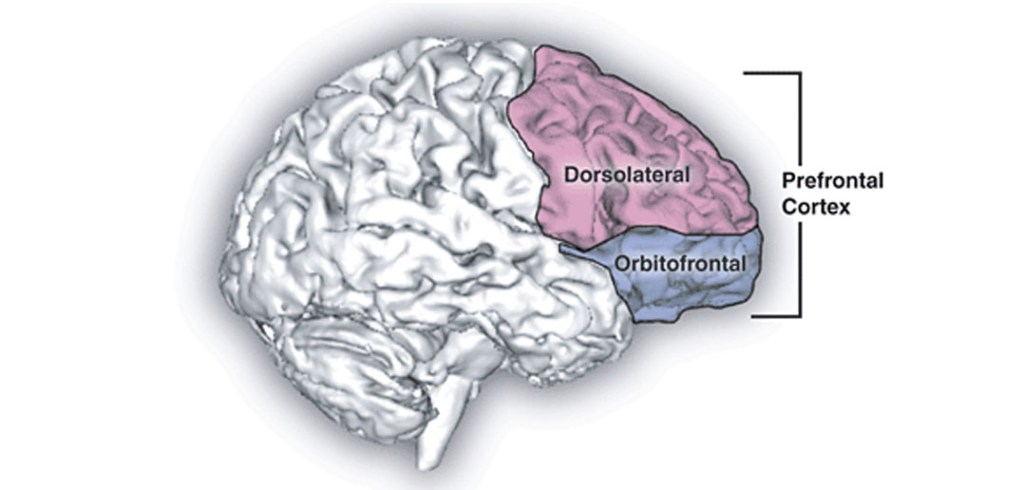
Your prized ability to weigh options, inhibit impulses, and make “rational” choices depends entirely on specific brain structures—particularly the dorsolateral prefrontal cortex (DLPFC)—operating within a neurochemical environment you inherited rather than created.

You occupy this biological machinery; you do not transcend it. Yet, society holds you responsible for its outputs as if you stood separate from these deterministic processes.

II. The DLPFC: Puppet Master of Moral Choice

The dorsolateral prefrontal cortex serves as command central for what we proudly call executive function—our capacity to plan, inhibit, decide, and morally judge. We experience its operations as deliberation, as the weighing of options, as the essence of choice itself.

And yet this supposed seat of autonomy can be manipulated with disturbing ease.

When researchers apply transcranial magnetic stimulation to inhibit DLPFC function, test subjects make dramatically different moral judgments about identical scenarios. Under different stimulation protocols, the same person arrives at contradictory conclusions about right and wrong without any awareness of the external influence.

Similarly, transcranial direct current stimulation over the DLPFC alters moral reasoning, especially regarding personal moral dilemmas. The subject experiences these externally induced judgments as entirely their own, with no sense that their moral compass has been hijacked.

If our most cherished moral deliberations can be redirected through simple electromagnetic manipulation, what does this reveal about the nature of “choice”? If will can be so easily influenced, how free could it possibly be?

III. Hormonal Puppetmasters: The Will in Your Bloodstream

Your decision-making machinery doesn’t stop at neural architecture. Your hormonal profile actively shapes what you perceive as your autonomous choices.

Consider oxytocin, popularly known as the “love hormone.” Research demonstrates that elevated oxytocin levels enhance feelings of guilt and shame while reducing willingness to harm others. This isn’t a subtle effect—it’s a direct biological override of what you might otherwise “choose.”

Testosterone tells an equally compelling story. Administration of this hormone increases utilitarian moral judgments, particularly when such decisions involve aggression or social dominance. The subject doesn’t experience this as a foreign influence but as their own authentic reasoning.

These aren’t anomalies or edge cases. They represent the normal operation of the biological systems governing what we experience as choice. You aren’t choosing so much as regulating, responding, and rebalancing a biochemical economy you inherited rather than designed.

IV. The Accident of Will: Uncomfortable Conclusions

If the will can be manipulated through such straightforward biological interventions, was it ever truly “yours” to begin with?

Philosopher Galen Strawson’s causa sui argument becomes unavoidable here: To be morally responsible, one must be the cause of oneself, but no one creates their own neural and hormonal architecture. By extension, no one can be ultimately responsible for actions emerging from that architecture.

What we dignify as “will” may be nothing more than a fortunate (or unfortunate) biochemical accident—the particular configuration of neurons and neurochemicals you happened to inherit and develop.

This lens forces unsettling questions:

  • How many behaviours we praise or condemn are merely phenotypic expressions masquerading as choices? How many acts of cruelty or compassion reflect neurochemistry rather than character?
  • How many punishments and rewards are we assigning not to autonomous agents, but to biological processes operating beyond conscious control?
  • And perhaps most disturbingly: If we could perfect the moral self through direct biological intervention—rewiring neural pathways or adjusting neurotransmitter levels to ensure “better” choices—should we?
  • Or would such manipulation, however well-intentioned, represent the final acknowledgement that what we’ve called free will was never free at all?

A Compatibilist Rebuttal? Not So Fast.

Some philosophers argue for compatibilism, the view that determinism and free will can coexist if we redefine free will as “uncoerced action aligned with one’s desires.” But this semantic shuffle doesn’t rescue moral responsibility.

If your desires themselves are products of biology and environment—if even your capacity to evaluate those desires depends on inherited neural architecture—then “acting according to your desires” just pushes the problem back a step. You’re still not the ultimate author of those desires or your response to them.

What’s Left?

Perhaps we need not a defence of free will but a new framework for understanding human behaviour—one that acknowledges our biological embeddedness while preserving meaningful concepts of agency and responsibility without magical thinking.

The evidence doesn’t suggest we are without agency; it suggests our agency operates within biological constraints we’re only beginning to understand. The question isn’t whether biology influences choice—it’s whether anything else does.

For now, the neuroscientific evidence points in one direction: The will exists, but its freedom is the illusion.