NB: This is the first of a parable triptych. Read part 2, The Tunnel.
Two valleys diverged in a mountain range, And sorry I could not travel both And be one traveller, long I stood And looked down one as far as I could To where it bent in the undergrowth of reeds and optimism;
Then took the other, just as fair, And having perhaps the better claim, Because it was sandy and wanted wear— Though as for that, the passing there Had worn them really about the same,
And both that morning equally lay In fog no step had trodden black. Oh, I kept the first for another day! Yet knowing how way leads on to way, I doubted if I should ever come back.
—Except I did come back. And I met someone coming the other way. And we stood there in the clouds like a pair of idiots trying to explain our respective valleys using the same words for completely different things.
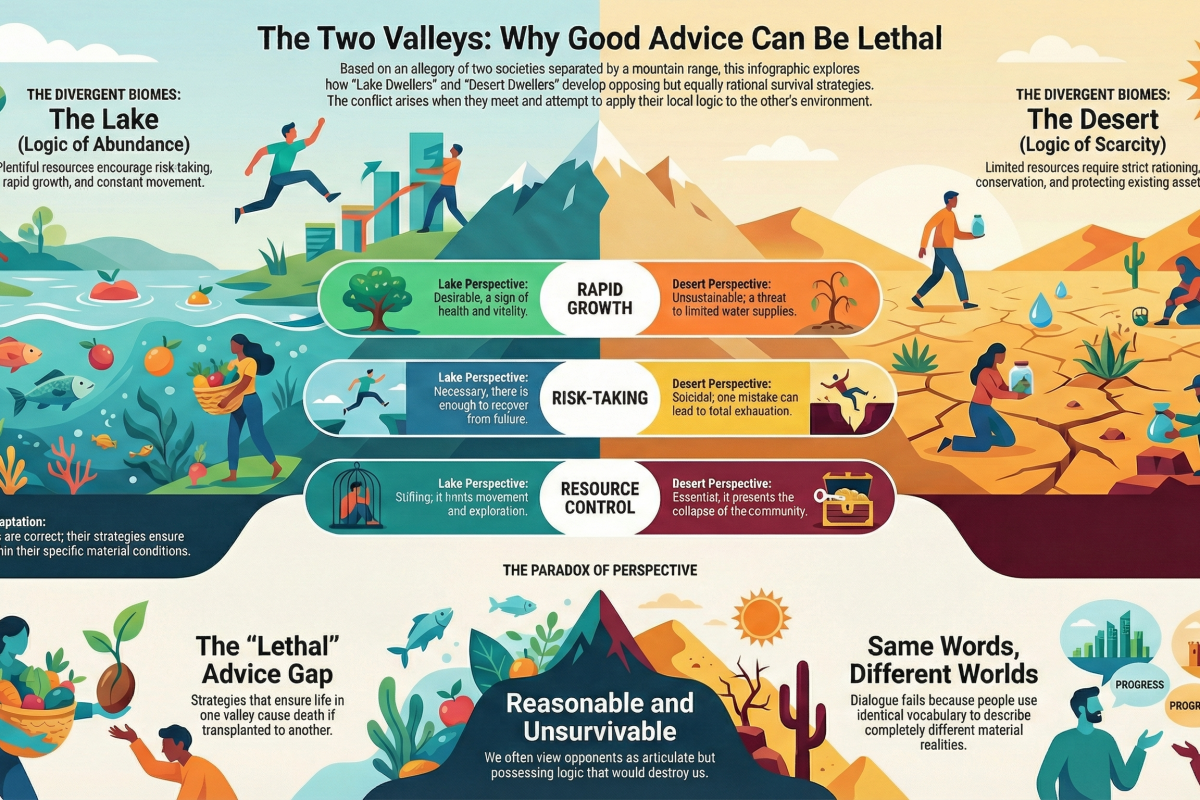
Audio: NotebookLM summary podcast of this topic.Image: NotebookLM infographic of this topic.
Here’s what they don’t tell you about Frost’s poem: the two paths were “really about the same.” He says it right there in the text. The divergence happens retroactively, in the telling, when he sighs and claims “that has made all the difference.”
But he doesn’t know that yet. He can’t know that. The paths only diverge in memory, once he’s committed to one and cannot check the other.
Here’s what they don’t tell you about political disagreement: it works the same way.
Video essay of this topic. Another NotebookLM experience.
The Actual Story (Minus the Versification)
Once upon a time—and I’m going to need you to suspend your allergy to fairy tales for about eight minutes—there was one settlement. One people. One language. One lake with drinkable water and fish that cooperated by swimming in schools.
Then mountains happened. Slowly. No dramatic rupture, no war, no evil king. Just tectonics doing what tectonics does, which is ruin everyone’s commute.
The people on one side kept the lake. The people on the other side got a rain shadow and a lot of bloody sand.
Both sides adapted. Rationally. Reasonably. Like competent humans responding to actual material conditions.
Desert people: “There is definitely not enough water. Let’s ration. Let’s stay put. Let’s not waste things.”
Neither wrong. Neither irrational. Just oriented differently because the ground beneath them had literal different moisture content.
The Bit Where It Gets Interesting
Centuries later, two people—one from each side—decide to climb the mountains and meet at the top.
Why? I don’t know. Curiosity. Stupidity. The desire to write a tedious blog post about epistemology.
They meet in the fog. They speak the same language. Grammar intact. Vocabulary functional. Syntax cooperative.
And then one tries to explain “reeds.”
“Right, so we have these plants that grow really fast near the water, and we have to cut them back because otherwise they take over—”
“Sorry, cut them back? You have too much plant?”
“Well, yes, they grow quite quickly—”
“Why would a plant grow quickly? That sounds unsustainable.”
Meanwhile, the other one tries to explain “cactus.”
“We have these plants with spines that store water inside for months—”
“Store water for months? Why doesn’t the plant just… drink when it’s thirsty?”
“Because there’s no water to drink.”
“But you just said the plant is full of water.”
“Yes. Which it stored. Previously. When there was water. Which there no longer is.”
“Right. So… hoarding?”
You see the problem.
Not stupidity. Not bad faith. Not even—and this is the part that will annoy people—framing.
They can both see perfectly well. The fog prevents them from seeing each other’s valleys, but that’s almost beside the point. Even if the fog lifted, even if they could point and gesture and show each other their respective biomes, the fundamental issue remains:
A cactus is a good solution to a problem the lake-dweller doesn’t have.
A reed is a good solution to a problem the desert-dweller doesn’t have.
Both are correct. Both are adaptive. Both would be lethal if transplanted.
The Retreat (Wherein Nothing Is Learned)
They part amicably. No shouting. No recriminations. Both feel they explained themselves rather well, actually.
As they descend back into their respective valleys, each carries the same thought:
“The other person seemed reasonable. Articulate, even. But their world is completely unworkable and if we adopted their practices here, people would die.”
Not hyperbole. Actual environmental prediction.
If the lake people adopted desert-logic—ration everything, control movement, assume scarcity—they would strangle their own adaptability in a context where adaptability is the whole point.
If the desert people adopted lake-logic—explore freely, trust abundance, move without restraint—they would exhaust their resources in a context where resources are the whole point.
The Bit Where I Connect This to Politics (Because Subtlety Is Dead)
So when someone tells you that political disagreement is just a matter of perspective, just a failure of empathy, just a problem of framing—
Ask them this:
Do the two valleys become the same valley if both sides squint really hard?
Does the desert get wetter if you reframe scarcity as “efficiency”?
Does the lake dry up if you reframe abundance as “waste”?
No?
Then perhaps the problem is not that people are choosing the wrong lens.
Perhaps the problem is that they are standing in different material conditions, have adapted rational survival strategies to those conditions, and are now shouting advice at each other that would be lethal if followed.
The lake-dweller says: “Take risks! Explore! There’s enough!”
True. In a lake biome. Suicidal in a desert.
The desert-dweller says: “Conserve! Protect! Ration!”
True. In a desert biome. Suffocating near a lake.
Same words. Different worlds. No amount of dialogue makes water appear in sand.
The Frostian Coda (With Apologies to New England)
I shall be telling this with a sigh Somewhere ages and ages hence: Two valleys diverged on a mountainside, and I— I stood in the fog and tried to explain reeds to someone who only knew cactus, And that has made… well, no difference at all, actually.
We’re still shouting across the mountains.
We still think the other side would be fine if only they’d listen.
We still use the same words for utterly different referents.
And we still confuse “I explained it clearly” with “explanation bridges material conditions.”
Frost was right about one thing: way leads on to way.
The valleys keep diverging.
The fog doesn’t lift.
And knowing how mountains work, I doubt we’ll meet again.
Moral: If your political metaphor doesn’t account for actual rivers, actual deserts, and actual fog, it’s not a metaphor. It’s a fairy tale. And unlike fairy tales, this one doesn’t end with reunion.
It ends with two people walking home, each convinced the other is perfectly reasonable and completely unsurvivable.
Which, if you think about it, is far more terrifying than simple disagreement.
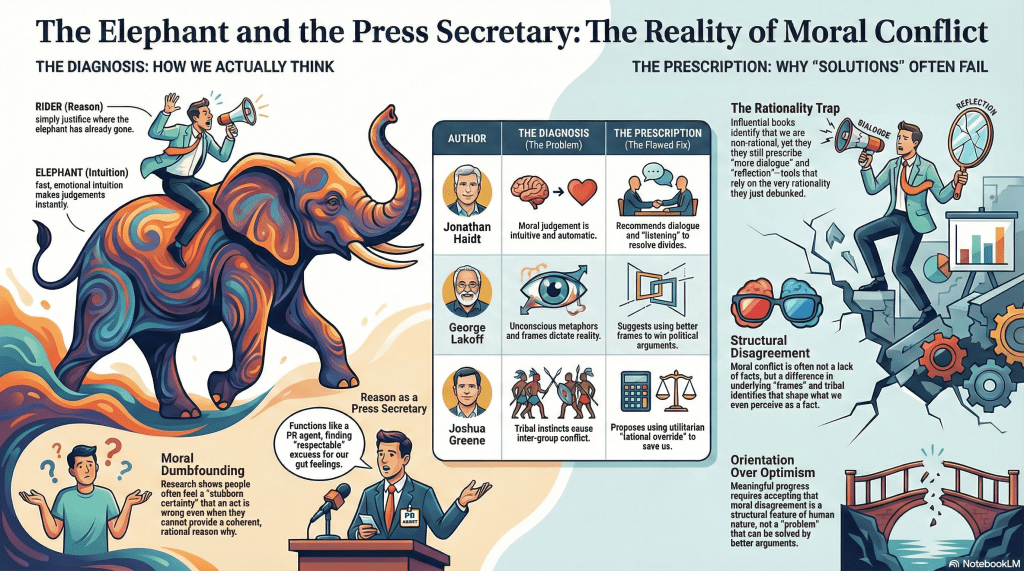
Over the past few decades, moral psychology has staged a quiet coup against one of our most cherished fantasies: that human beings are, at bottom, rational moral agents. This is not a fringe claim. It is not a Twitter take. It is the mainstream finding of an entire research programme spanning psychology, cognitive science, linguistics, and neuroscience.
We do not reason our way to moral conclusions. We feel our way there. Instantly. Automatically. And only afterwards do we construct reasons that make the judgment sound respectable.
Audio: NotebookLM summary podcast of this topic.
This is not controversial anymore. It is replicated, taught, and celebrated. And yet, if you read the most influential books in this literature, something strange happens. The diagnosis is devastating. The prescription is reassuring.
I’ve just published a long-form video walking through five canonical books in moral psychology that all uncover the same structural problem, and then quietly refuse to live with the implications.
Each of these books is sharp, serious, and worth reading. This is not a hit piece.
But each follows the same arc:
Identify a non-rational, affective, automatic mechanism at the heart of moral judgement
Show why moral disagreement is persistent and resistant to argument
Propose solutions that rely on reflection, dialogue, reframing, calibration, or rational override
In short: they discover that reason is weak, and then assign it a leadership role anyway.
Haidt dismantles moral rationalism and then asks us to talk it out. Lakoff shows that framing is constitutive, then offers better framing. Gray models outrage as a perceptual feedback loop, then suggests we check our perceptions. Greene diagnoses tribal morality, then bets on utilitarian reasoning to save us.
None of this is incoherent. But it is uncomfortable. Because the findings themselves suggest that these prescriptions are, at best, limited.
Diagnosis without prognosis
The uncomfortable possibility raised by this literature is not that we are ignorant or misinformed.
It is that moral disagreement may be structural rather than solvable.
That political conflict may not be cured by better arguments. That persuasion may resemble contagion more than deliberation. That reason often functions as a press secretary, not a judge.
The books sense this. And then step back from it. Which is human. But it matters.
Why this matters now
We are living in systems that have internalised these findings far more ruthlessly than public discourse has.
Social media platforms optimise for outrage, not understanding. Political messaging is frame-first, not fact-first. AI systems are increasingly capable of activating moral intuitions at scale, without fatigue or conscience.
Meanwhile, our institutions still behave as if one more conversation, one more fact-check, one more appeal to reason will close the gap. The research says otherwise.
And that gap between what we know and what we pretend may be the most important moral problem of the moment.
No solution offered
The video does not end with a fix. That’s deliberate.
Offering a neat solution here would simply repeat the same move I’m criticising: diagnosis followed by false comfort. Sometimes orientation matters more than optimism. The elephant is real. The elephant is moving.And most of us are passengers arguing about the map while it walks.
Fairness, Commensurability, and the Quiet Violence of Comparison
Fairness and Commensurability as Preconditions of Retributive Justice
This is the final part of a 3-part series. Read parts 1 and 2 for a fuller context.
Audio: NotebookLM summary podcast of this topic.
Before the Cards Are Dealt
Two people invoke fairness. They mean opposite things. Both are sincere. Neither can prove the other wrong. This is not a failure of argument. It is fairness working exactly as designed.
Before justice can weigh anything, it must first decide that the things being weighed belong on the same scale. That single move – the assertion that comparison is even possible – quietly does most of the work.
Most people think justice begins at sentencing, or evidence, or procedure. But the real work happens earlier, in a space so normalised it has become invisible. Before any evaluation occurs, the system must install the infrastructure that makes evaluation legible at all.
That infrastructure rests on two foundations:
fairness, which supplies the rhetoric, and
commensurability, which supplies the mathematics.
Together, they form the felt beneath the table – the surface on which the cards can be dealt at all.
1. Why Fairness Is Always Claimed, Never Found
Let’s be precise about what fairness is not.
Fairness is not a metric. You cannot measure it, derive it, or point to it in the world.
Fairness is not a principle with determinate content. It generates no specific obligations, no falsifiable predictions, no uniquely correct outcomes.
Fairness is an effect. It appears after assessment, not before it. It is what you call an outcome when you want it to feel inevitable.
Competing Fairness Is Not a Problem
Consider how disputes actually unfold:
The prosecutor says a long sentence is fair because it is proportional to harm.
The defender says a shorter sentence is fair because it reflects culpability and circumstance.
The victim says any sentence is unfair because nothing restores what was taken.
The community says enforcement itself is unfair because it predictably targets certain groups.
Each claim is sincere. None can be resolved by fairness itself.
That is because fairness has no independent content. It does not decide between these positions. It names them once the system has already decided which will prevail. This is not a bug. It is the feature.
A Fluid Masquerading as an Invariant
In the language of the Language Insufficiency Hypothesis, fairness is a Fluid – a concept whose boundaries shift with context and use – that masquerades as an Invariant, something stable and observer-independent.
The system treats fairness as perceptual, obvious, discoverable. But every attempt to anchor it collapses into:
Intuition (‘It just feels right’)
Precedent (‘This is how we do things’)
Consensus (‘Most people agree’)
None of these establishes fairness. They merely perform it.
And that performance matters. It converts contested metaphysical commitments into the appearance of shared values. It allows institutions to claim neutrality whilst enforcing specificity. Fairness is what the system says when it wants its outputs to feel unavoidable.
2. The Real Gatekeeper: Commensurability
Fairness does rhetorical work. But it cannot function without something deeper.
That something is commensurability: the assumption that different harms, injuries, and values can be placed on a shared scale and meaningfully compared.
Proportionality presupposes commensurability. Commensurability presupposes an ontology of value. And that ontology is neither neutral nor shared.
When Incommensurability Refuses to Cooperate
A parent loses a child to preventable negligence. A corporation cuts safety corners. A warning is ignored. The system moves. Liability is established. Damages are calculated. £250,000 is awarded.
The parent refuses the settlement. Not because the amount is insufficient. But because money and loss are not the same kind of thing. The judge grows impatient. Lawyers speak of closure. Observers mutter about grief clouding judgment. But this is not grief. It is incommensurability refusing to cooperate.
The parent is rejecting the comparison itself. Accepting payment would validate the idea that a child’s life belongs on a scale with currency. The violence is not the number. It is the conversion. The system cannot process this refusal except as emotional excess or procedural obstruction. Not because it is cruel, but because without commensurability the engine cannot calculate.
Two Ontologies of Value
There are two incompatible ontologies at work here. Only one is playable.
Ontology A: The Scalar Model
Harm is quantifiable
Suffering is comparable
Trade-offs are morally coherent
Justice is a balancing operation
Under Ontology A, harms differ in degree, not kind. A broken arm, a stolen car, and a dead child all occupy points on the same continuum. This makes proportionality possible.
Ontology B: The Qualitative Model
Harms are categorical
Some losses are incommensurable
Comparison itself distorts
Justice is interpretive, not calculative
Under Ontology B, harms are different kinds of things. Comparison flattens what matters. To weigh them is to misunderstand them.
Why Only One Ontology Can Play
Retributive justice, as presently constituted, cannot function under Ontology B.
Without scalar values, proportionality collapses. Without comparison, equivalence disappears. Without trade-offs, punishment has no exchange rate.
Ontology B is not defeated. It is disqualified. Structurally, procedurally, rhetorically. The house needs a shared scale. Without it, the game cannot settle accounts.
3. Why Incommensurability Is Treated as Bad Faith
Here is where power enters without announcing itself. Incommensurability does not merely complicate disputes. It stalls the engine. And stalled engines threaten institutional legitimacy.
Systems designed to produce closure must ensure that disputes remain within solvable bounds. Incommensurability violates those bounds. It suggests that resolution may be impossible – or that the attempt to resolve does further harm. So the system reframes the problem.
Not as an alternative ontology, but as:
Unreasonableness
Extremism
Emotional volatility
Refusal to engage in good faith
Reasonableness as Border Control
This is why reasonableness belongs where it does in the model. Not as an evaluative principle, but as a gatekeeping mechanism.
Reasonableness does not assess claims. It determines which claims count as claims at all. This is how commensurability enforces itself without admitting it is doing so. When someone refuses comparison, they are not told their ontology is incompatible with retributive justice. They are told to be realistic.
Ontological disagreement is converted into:
A tone problem
A personality defect
A failure to cooperate
The disagreement is not answered. It is pathologised.
4. Why These Debates Never Resolve
This returns us to the Ontology–Encounter–Evaluation model.
People argue fairness as if adjusting weights would fix the scale. They debate severity, leniency, proportionality.
But when two sides inhabit incompatible ontologies of value, no amount of evidence or dialogue bridges the gap. The real disagreement is upstream.
A prosecutor operating under scalar harm and an advocate operating under incommensurable injury are not disagreeing about facts. They are disagreeing about what kind of thing harm is.
Fairness cannot resolve this, because fairness presupposes the very comparison under dispute. This is why reform debates feel sincere and go nowhere. Outcomes are argued whilst ontological commitments remain invisible.
Remediation Requires Switching Teams
As argued elsewhere, remediation increasingly requires switching teams.
But these are not political teams. They are ontological commitments.
Ontologies are not held like opinions. They are held like grammar. You do not argue someone out of them. At best, you expose their costs. At worst, you force others to operate within yours by disqualifying alternatives.
Retributive justice does the latter.
5. What This Means (Without Offering a Fix)
Justice systems are not broken. They are optimised. They are optimised for closure, manageability, and the appearance of neutrality. Fairness supplies the rhetoric. Commensurability supplies the mathematics. Together, they convert contestable metaphysical wagers into procedural common sense.
That optimisation has costs:
Disagreements about value become illegible
Alternative ontologies become unplayable
Dissent becomes pathology
Foundations disappear from view
If justice feels fair, it is because the comparisons required to question it were never permitted.
Ontology as Pre-emptive Gatekeeping
None of this requires conspiracy.
Institutions do not consciously enforce ontologies. They do not need to.
They educate them. Normalise them. Proceduralise them. Then treat their rejection as irrationality.
By the time justice is invoked, the following have already been installed as reality:
That persons persist over time in morally relevant ways
That agents meaningfully choose under conditions that count
That harms can be compared and offset
That responsibility can be localised
That disagreement beyond a point is unreasonable
None of these are discovered. All are rehearsed.
A law student learns that ‘the reasonable person’ is a construct. By year three, they use it fluently. It no longer feels constructed.
This is not indoctrination. It is fluency.
And fluency is how ontologies hide.
By the time an alternative appears – episodic selfhood, incommensurable harm, distributed agency – it does not look like metaphysics. It looks like confusion.
Rationality as Border Control
The system does not say: we reject your ontology.
It says: that’s not how the world works.
Or worse: you’re being unreasonable.
Ontological disagreement is reframed as a defect in the person. And defects do not need answers. They need management.
This is why some arguments feel impossible to have. One ontology has been naturalised into common sense. The other has been reclassified as error.
The Final Irony
The more fragile the foundations, the more aggressively they must be defended as self-evident.
Free will is taught as obvious.
Fairness is invoked as perceptual.
Responsibility is treated as observable.
Incommensurability is treated as sabotage.
Not because the system is confident.
Because it cannot afford not to be.
The Point
Justice does not merely rely on asserted ontologies. It expends enormous effort ensuring they never appear asserted at all.
By the time the cards are dealt, the rules have already been mistaken for reality. That is the felt beneath the table. Invisible. Essential. Doing all the work. And if you want to challenge justice meaningfully, you do not start with outcomes. You start by asking:
What comparisons are we being asked to accept as natural? And what happens to those who refuse?
Most people never make that move. Not because it is wrong. But because by the time you notice the game is rigged, you are already fluent in its rules. And fluency feels like truth.
Final Word
Why write these assessments? Why care?
With casinos, like cricket, we understand something fundamental: these are games. We can learn the rules. We can decide whether to play. We can walk away.
Justice is different. Justice is not opt-in. It is imposed. You do not get to negotiate the rules, the scoring system, or the house assumptions about what counts as a move. Once you are inside, even dissent must be expressed in the system’s own grammar. Appeals do not question the game; they replay it under slightly altered conditions.
You may contest the outcome. You may plead for leniency. You may argue fairness. You may not ask why chips are interchangeable with lives, why losses must be comparable, or why refusing comparison itself counts as misconduct.
Imagine being forced into a casino. Forced to play. Forced to stake things you do not believe are wagerable. Then told, when you object, that the problem is not the game, but your attitude toward it.
That is why these assessments matter. Not to declare justice illegitimate. Not to offer a fix. But to make visible the rules that pretend not to be rules at all. Because once you mistake fluency for truth, the house no longer needs to rig the game.
I’ve been working on A Language Insufficiency Hypothesis since 2018. At least, that’s the polite, CV-friendly version. The truer account is that it’s been quietly fermenting since the late 1970s, back when I was still trapped in primary school and being instructed on how the world supposedly worked.
Social Studies. Civics. Law. The whole civic catechism. I remember being taught about reasonable persons and trial by a jury of one’s peers, and I remember how insistently these were presented as fair solutions. Fairness was not argued for. It was asserted, with the weary confidence of people who think repetition counts as justification.
I didn’t buy it. I still don’t. The difference now is that I have a hypothesis with some explanatory power instead of a vague sense that the adults were bluffing.
Audio: NotebookLM summary podcast of this topic.
I’ve always been an outsider. Eccentric, aloof, l’étranger if we’re feeling theatrical. It never particularly troubled me. Outsiders are often tolerated, provided they remain decorative and non-contagious. Eye rolls were exchanged on both sides. No harm done.
But that outsider position had consequences. It led me, even then, to ask an awkward question: Which peers? Not because I thought I was superior, but because I was plainly apart. How exactly was I meant to be judged by my peers when no one else occupied anything like my perspective?
Later, when I encountered the concept of fundamental attribution bias, it felt less like a revelation and more like confirmation. A peer-based system assumes not just similarity of circumstance, but similarity of interpretation. That assumption was dead on arrival.
Then there were reasonable persons. I was assured they existed. I was assured judges were trained to embody them. I had never met one. Even as a teenager, I found the idea faintly comical. Judges, I was told, were neutral, apolitical, and dispassionate. Writing this now from the United States, one hardly needs to belabour the point. But this wasn’t prescience. It was intuition. The smell test failed decades ago.
Before LIH had a name, I called these things weasel words. I still do, as a kind of shorthand. Terms like fair, reasonable, accountable, appropriate. Squishy concepts that do serious institutional work whilst remaining conveniently undefinable. Whether one wants to label them Contestables or Fluids is less important than recognising the space they occupy.
That space sits between Invariables, things you can point to without dispute, and Ineffables, where language more or less gives up. Communication isn’t binary. It isn’t ‘works’ or ‘doesn’t’. It’s a gradient. A continuous curve from near-certainty to near-failure.
Most communication models quietly assume a shared ontology. If misunderstanding occurs, the remedy is more explanation, more context, more education. What never sat right with me, even as a child, was that this only works when the disagreement is superficial. The breaking point is ontological.
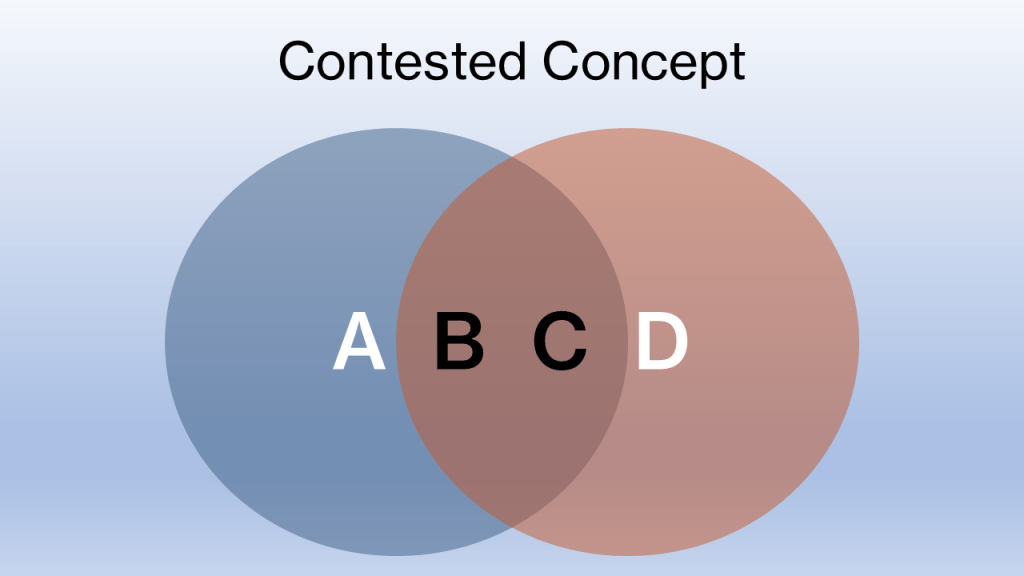
If one person believes a term means {A, B, C} and another believes it means {B, C, D}, the overlap creates a dangerous illusion of agreement. The disagreement hides in the margins. A and D don’t merely differ. They are often irreconcilable.
Image: Venn diagramme of a contested concept. Note: This is illustrative and not to scale
Fairness is a reliable example. One person believes fairness demands punishment, including retributive measures. Another believes fairness permits restoration but rejects retribution, citing circumstance, history, or harm minimisation. Both invoke fairness sincerely. The shared language conceals the conflict.
When such disputes reach court, they are not resolved by semantic reconciliation. They are resolved by authority. Power steps in where meaning cannot. This is just one illustration. There are many.
I thought it worth sharing how LIH came about, if only to dispel the notion that it’s a fashionable response to contemporary politics. It isn’t. It’s the slow crystallisation of a long-standing intuition: that many of our most cherished concepts don’t fail because we misuse them, but because they were never capable of doing the work we assigned to them.
How retribution stays upright by not being examined
There is a persistent belief that our hardest disagreements are merely technical. If we could stop posturing, define our terms, and agree on the facts, consensus would emerge. This belief survives because it works extremely well for birds and tables.
It fails spectacularly for justice.
Audio: NotebookLM summary podcast of this topic.
The Language Insufficiency Hypothesis (LIH) isn’t especially interested in whether people disagree. It’s interested in how disagreement behaves under clarification. With concrete terms, clarification narrows reference. With contested ones, it often fractures it. The more you specify, the more ontologies appear.
Justice is the canonical case.
Retributive justice is often presented as the sober, adult conclusion. Not emotional. Not ideological. Just what must be done. In practice, it is a delicately balanced structure built out of other delicately balanced structures. Pull one term away and people grow uneasy. Pull a second and you’re accused of moral relativism. Pull a third and someone mentions cavemen.
Let’s do some light demolition. I created a set of 17 Magic: The Gathering-themed cards to illustrate various concepts. Below are a few. A few more may appear over time.
Card One: Choice
Image: MTG: Choice – Enchantment
The argument begins innocently enough:
They chose to do it.
But “choice” here is not an empirical description. It’s a stipulation. It doesn’t mean “a decision occurred in a nervous system under constraints.” It means a metaphysically clean fork in the road. Free of coercion, history, wiring, luck, trauma, incentives, or context.
That kind of choice is not discovered. It is assumed.
Pointing out that choices are shaped, bounded, and path-dependent does not refine the term. It destabilises it. Because if choice isn’t clean, then something else must do the moral work.
Enter the next card.
Card Two: Agency
Image: MTG: Agency – Creature – Illusion
Agency is wheeled in to stabilise choice. We are reassured that humans are agents in a morally relevant sense, and therefore choice “counts”.
Counts for what, exactly, is rarely specified.
Under scrutiny, “agency” quietly oscillates between three incompatible roles:
a descriptive claim: humans initiate actions
a normative claim: humans may be blamed
a metaphysical claim: humans are the right kind of cause
These are not the same thing. Treating them as interchangeable is not philosophical rigour. It’s semantic laundering.
But agency is emotionally expensive to question, so the discussion moves on briskly.
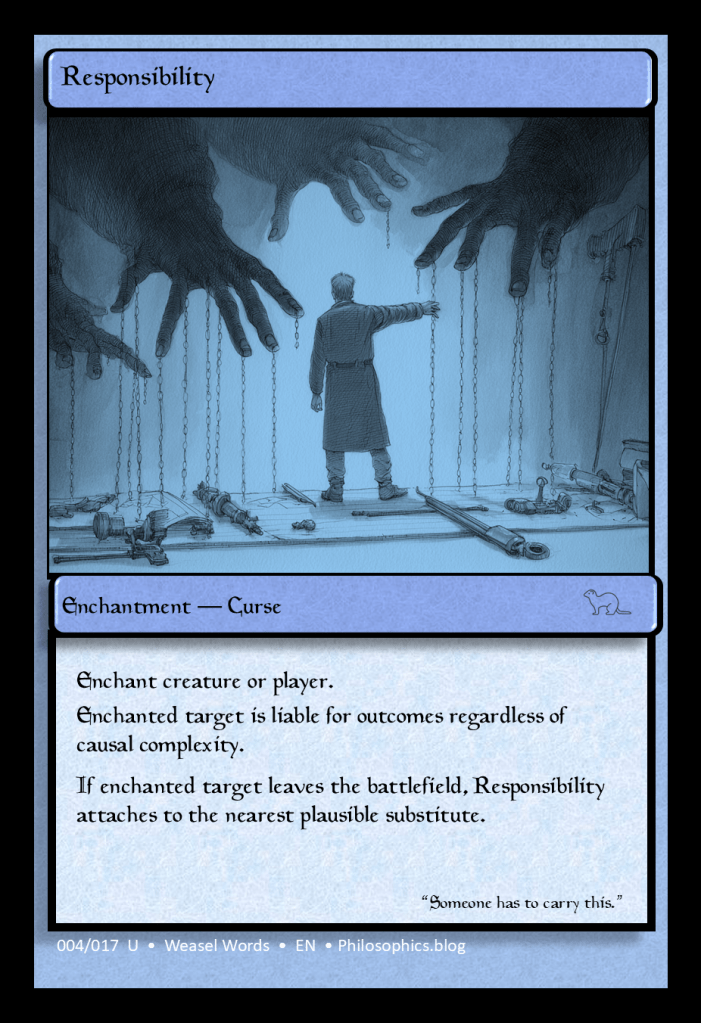
Card Three: Responsibility
Image: MTG: Responsibility – Enchantment – Curse
Responsibility is where the emotional payload arrives.
To say someone is “responsible” sounds administrative, even boring. In practice, it’s a moral verdict wearing a clipboard.
Watch the slide:
causal responsibility
role responsibility
moral responsibility
legal responsibility
One word. Almost no shared criteria.
By the time punishment enters the picture, “responsibility” has quietly become something else entirely: the moral right to retaliate without guilt.
At which point someone will say the magic word.
Card Four: Desert
Image: MTG: Desert – Instant
Desert is the most mystical card in the deck.
Nothing observable changes when someone “deserves” punishment. No new facts appear. No mechanism activates. What happens instead is that a moral permission slip is issued.
Desert is not found in the world. It is declared.
And it only works if you already accept a very particular ontology:
robust agency
contra-causal choice
a universe in which moral bookkeeping makes sense
Remove any one of these and desert collapses into what it always was: a story we tell to make anger feel principled.
Which brings us, finally, to the banner term.
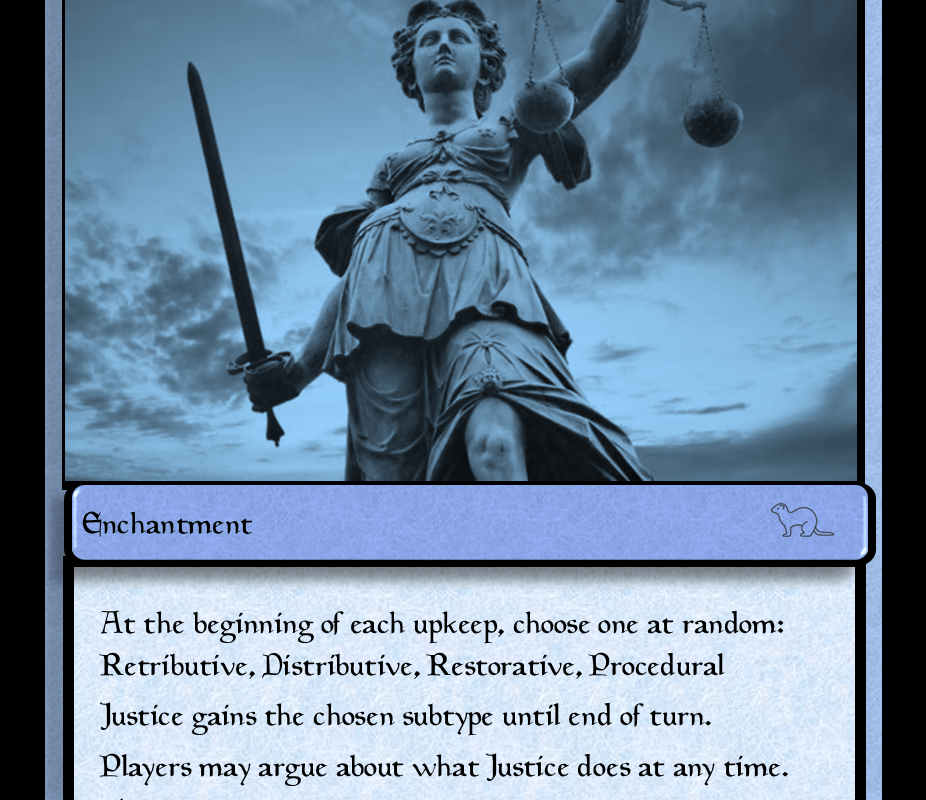
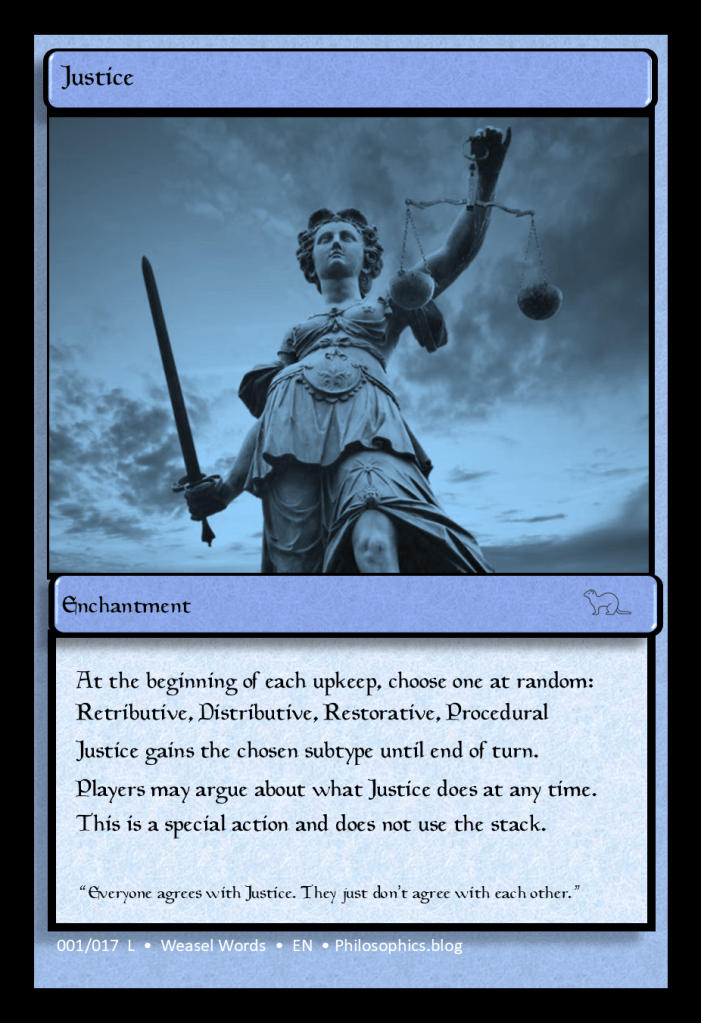
Card Five: Justice
Image: MTG: Justice – Enchantment
At this point, justice is invoked as if it were an independent standard hovering serenely above the wreckage.
It isn’t.
“Justice” here does not resolve disagreement. It names it.
Retributive justice and consequentialist justice are not rival policies. They are rival ontologies. One presumes moral balance sheets attached to persons. The other presumes systems, incentives, prevention, and harm minimisation.
Both use the word justice.
That is not convergence. That is polysemy with a body count.
Why clarification fails here
This is where LIH earns its keep.
With invariants, adding detail narrows meaning. With terms like justice, choice, responsibility, or desert, adding detail exposes incompatible background assumptions. The disagreement does not shrink. It bifurcates.
This is why calls to “focus on the facts” miss the point. Facts do not adjudicate between ontologies. They merely instantiate them. If agency itself is suspect, arguments for retribution do not fail empirically. They fail upstream. They become non sequiturs.
This is also why Marx remains unforgivable to some. “From each according to his ability, to each according to his need” isn’t a policy tweak. It presupposes a different moral universe. No amount of clarification will make it palatable to someone operating in a merit-desert ontology.
The uncomfortable conclusion
The problem is not that we use contested terms. We cannot avoid them.
The problem is assuming they behave like tables.
Retributive justice survives not because it is inevitable, but because its supporting terms are treated as settled when they are anything but. Each card looks sturdy in isolation. Together, they form a structure that only stands if you agree not to pull too hard.
LIH doesn’t tell you which ontology to adopt.
It tells you why the argument never ends.
And why, if someone insists the issue is “just semantic”, they’re either confused—or holding the deck.
My Language Insufficiency Hypothesis is finished, the cover is designed, and everything is in order for a January 2026 release – save for one administrative detail: the ISBN. I expect this to be resolved presently. The Bowker distribution system in the US appears to have been set up circa 1997, and that’s just the web interface. Who knows how long the database has been in place? I’d bet circa 1955. Most countries provide ISBNs for free. Not the US. Kinda bollox. Meantime, I’ve now got three lenses through which to inspect the world.
[EDIT: ISBN issue has been resolved. I am awaiting a proof copy that should be arriving today.]
From the outside, some of my recent work can look untidy. A hypothesis about language. An ontology about mediated encounters. A paper on why moral disagreement refuses to resolve itself politely. No master theory. No clean ladder. No promised synthesis at the end. This is not an accident. It is a refusal.
What links the Language Insufficiency Hypothesis (LIH), the Mediated Encounter Ontology of the World (MEOW), and Disagreement Without Referees is not a shared doctrine, but a shared function. They are lenses, not foundations. Diagnostics, not blueprints. Each takes aim at a different site where Enlightenment habits quietly overpromise – meaning, access, adjudication – and shows what breaks when we stop pretending those promises were ever cashable. They form a family. Not a system. And certainly not a programme for rebuilding.
Three Lenses, Three Failure Sites
Each of these frameworks operates at a different level, but they all do the same kind of work: they explain why something we rely on feels indispensable, fails repeatedly, and yet stubbornly survives.
LIH operates at the linguistic level.
It asks why language fails precisely where we expect it to secure clarity, precision, or consensus. Its answer is unromantic: language is not uniformly capable. As we move from invariants to contestables to fluids and ineffables, its representational power degrades. The failure mode is familiar: we mistake grammatical stability for ontological stability, and then act surprised when disagreement hardens rather than dissolves.
MEOW operates at the ontological level.
It asks what kind of ‘world’ we are actually dealing with once we abandon the fantasy of unmediated access. There is no clean mind–world interface, no privileged vantage point. Every encounter is mediated – biologically, cognitively, linguistically, socially. Realism and idealism alike fail here, each clinging to a different myth of access. What remains is not scepticism, but constraint.
Disagreement Without Referees operates at the normative and political level.
It asks why moral and political disagreement persists even when all parties appear informed, sincere, and articulate. The answer is ontological incommensurability. Where frameworks do not overlap, there are no neutral referees. Argument does not converge because it cannot. What remains is persuasion, coalition, power, and consequence—moral life without an umpire.
None of these lenses replaces what it critiques. Each refuses the repair instinct that says: if we just fix the model, the system will work again. That instinct is the pathology.
What They Share (And What They Don’t)
What unites these lenses is not a set of positive claims about how the world really is. It is a shared posture:
no privileged access
no neutral ground
no final adjudication
no redemptive synthesis
But also:
no quietism
no nihilism
no ‘anything goes’
no abdication of responsibility
They do not tell you what to believe. They tell you why believing harder won’t save you.
Importantly, they are non-hierarchical. LIH does not ground MEOW. MEOW does not explain away disagreement. Disagreement does not ‘apply’ LIH in some linear fashion. They intersect. They overlap. They illuminate different failure modes of the same inherited fantasy: that there must be a place where things finally settle. There isn’t.
Image: Three Diagnostic Lenses Infographic¹
Why This Is Not a System
Systems promise closure. These lenses do not. They explain why closure is repeatedly promised, urgently demanded, and reliably missed. To systematise them would be to betray them.
What they offer instead is a kind of intellectual hygiene: a way of recognising when we are asking language, reality, or morality to do work they were never capable of doing – and then blaming one another when they don’t comply.
If there is a unifying thread, it is this:the demand for foundations is itself the problem.² These lenses do not solve that problem. They show you where it operates, how it reproduces itself, and why refusing it feels so uncomfortable. That discomfort is the point.
Footnotes
This is another NotebookLM infographic – my second. It’s not half-bad. I had to adjust some elements in Photoshop and Illustrator, and there are still textual anomalies, but all in all, I’m impressed with what 60 seconds of generation yielded – along with a 5-minute prompt and 15 minutes of touchup. It’s just a novelty for now – certainly not necessary. What do you think?
I’ve just published a new preprint on Zenodo: Disagreement Without Referees: Ontological Incommensurability and the Limits of Moral Adjudication 📄 https://doi.org/10.5281/zenodo.17932544
I welcome reviews, comments, and dissents.
This paper grows out of a frustration that will be familiar to anyone who spends time in moral or political argument: the sense that we keep talking past one another, mistaking deep incompatibilities for mere differences of opinion – and then moralising the failure to converge. Mostly, I’m tired of having to explain why my position isn’t subjectivist, relativist, quietist, nihilist, or whatever –ist flavour du jour. As with John Lennon, I complain about the –isms.
Audio: NotebookLM summary podcast of this essay.
The core claim is simple but unfashionable: many persistent disagreements are not epistemic at all. They are ontological. They do not arise within a shared background of assumptions about what exists, what counts as a reason, or what can ground normativity. They arise between incompatible background frameworks. When we treat such conflicts as if they were resolvable by better arguments, clearer communication, or more empathy, we misdiagnose the problem – and often make it worse.
The paper draws a sharp distinction between:
Disagreements of opinion, which presuppose a shared world and are, in principle, corrigible; and
Ontological disagreements, where what is contested is not the right answer, but what it would even mean for an answer to be right.
From there, I examine why charges like ‘relativism’, ‘subjectivism’, or ‘anything goes’ retain such rhetorical force despite their weak logical footing. The argument is not that these labels are false descriptions so much as that they function asboundary-maintenance devices within Enlightenment-inherited moral frames. They stabilise a sense of moral order by excluding positions that deny neutral adjudication.
Image: NotebookLM infographic. (This is the first infographic I’ve produced from NotebookLM. I’m not sure what I think of it, but I might try more directed versions in the future.)
I also take up the familiar worry that abandoning objective moral grounding leads to arbitrariness or nihilism. The paper rejects this caricature. Evaluation does not disappear when foundations are withdrawn; it relocates. What follows is not moral collapse but moral life without referees, where disagreement is managed through persuasion, coalition-building, institutional design, and power, rather than appeals to metaphysical authority.
Importantly, the paper is diagnostic, not prescriptive. It does not offer a new moral framework, a reconciliatory theory, or a solution to moral conflict. It argues instead for a clearer understanding of why some disagreements resist resolution, and for a more honest account of what remains once the fantasy of neutral adjudication is relinquished.
If nothing else, the hope is that recognising ontological incommensurability can temper the moral theatre that so often accompanies disagreement – replacing accusations of irrationality or bad faith with a clearer sense of what is, and is not, at stake.
This essay is also available on PhilPapers. For now, the full preprint is available on Zenodo at the link above.
As ever, comments are welcome – provided we’re clear about which world we think we’re standing in.
I do not assume that normative assertions function as descriptive truths. Realism is compelling because it promises that moral disagreement has a fact of the matter beyond persuasion. The argument here is that this promise cannot be kept without mediation. Nevertheless, this essay proceeds by granting the realist premise – that Truth exists – in order to examine whether that premise can, on its own terms, generate normative authority. The argument is structural rather than polemical: to move from Ontology (what exists) to Authority (what binds) requires a mechanism of transport. That mechanism is mediation. The claim advanced here is that this mediation is irreducibly rhetorical, and that no account of normativity can bypass this fact without smuggling authority under metaphysical cover.
Audio: NotebookLM summary podcast of this content.
Introduction
Grant, purely for the sake of argument, that Truth – and by extension Justice, Goodness, or any other realist normative entity – exists independently of human cognition. Even so, a prior and unavoidable question arises: how does such Truth ever become accessible to finite, discursive agents like us?
Before asking whether Truth exists in itself, we must account for how it enters ethical life for us. This is not a semantic quibble. It marks the difference between an ontological assertion and an operative ethics.
This essay argues that all access to Truth is irreducibly mediated, and that this mediation is rhetorical in nature. Even if Truth exists independently of human minds, it never arrives in normative life except through language, interpretation, argument, persuasion, narrative, and institutional articulation. Any ethical framework that treats metaphysical grounding as if it bypassed these mediations risks conflating ontology with authority.
This is neither relativism nor subjectivism. It is an analytic claim about conditions of access and normative traction.
Truth and Its Access Conditions
Suppose you accept that Truth exists ‘out there’—not as a projection or consensus shorthand, but as an intransitive feature of reality. This is the core commitment of metaphysical realism. The issue is not whether Truth exists, but how it becomes accessible to agents embedded in language, culture, and institutions.
For any putative Truth to function normatively, at least five stages are required:
Identification — recognising something as a candidate for truth
Description — articulating that candidate in language
Justification — offering reasons for accepting it
Communication — transmitting those reasons to others
Ratification — persuading a community to treat the claim as binding
These stages are not epistemic luxuries. They are the conditions under which a putative Truth acquires normative force – the capacity to obligate, justify, or condemn.
Remove any one of these stages, and Truth collapses into either an inert fact or an unintelligible assertion. Crucially, each stage is rhetorical: none operates through brute ontology alone, but through discursive practices of interpretation, evaluation, and adjudication.
Rhetoric Is Not Spin
To say that Truth is rhetorically mediated is not to reduce truth to manipulation, persuasion-for-its-own-sake, or spin.
It is simply to recognise that:
Truth claims are discerned in language
They are evaluated against alternatives
They are assessed within communities shaped by practices, norms, disciplines, and institutions
Truth as it functions in human life is always a claim in argument, never a self-announcing datum.
Even mathematics – the paradigm of certainty – does not become normatively operative without symbolic articulation, shared standards of proof, and communal validation. Mathematical truths may exist independently, but what counts as a proof, a result, or an error – and thus what obligates assent – is entirely mediated by symbolic practice and communal ratification.
In its classical sense, rhetoric is not deception. It is the set of discursive practices by which claims become intelligible, contestable, and action-guiding across contexts of disagreement.
Where Normativity Actually Emerges: The Three-Stage Problem
The problem crystallizes at a precise moment: the move from description to prescription. Even if we grant that the Good exists objectively and eternally, three distinct operations are required to generate obligation:
Descriptive claim: ‘The Good exists and has properties X, Y, Z’
Interpretive claim: ‘In this situation, the Good requires action A rather than B’
Prescriptive claim: ‘Therefore you ought to do A’
Each transition requires distinct work. The first may be metaphysical. But the second and third are irreducibly rhetorical. They involve judgment, application, contextual interpretation, and the translation of abstract principle into concrete obligation.
Crucially, even the interpretive middle step – which often masquerades as mere clarification – is where most normative force gets generated. To say ‘the Good requires this action in this context’ is not to read off a fact from the world. It is to make an argued claim about meaning, relevance, and application.
This is where participatory metaphysics does its quietest work. By framing interpretation as ‘participation in the Good’ rather than as ‘argued judgment about what the Good requires,’ such frameworks obscure the rhetorical operation they’re performing. Interpretation gets presented as disclosure rather than construction.
But there is no route from ‘the Good exists’ to ‘you must do X’ that bypasses interpretation. And interpretation is rhetoric.
The Potential Energy Analogy
Consider an analogy. Gravitational potential energy exists independently of human recognition. A boulder atop a cliff possesses real energy by virtue of its position. But that energy does no work – moves nothing, heats nothing, powers nothing – until converted through specific mechanisms: falling, rolling, controlled descent.
The Good may be precisely like this: real, eternal, independent of us. But for it to become normatively operative – to obligate us, to guide our choices, to settle our disagreements – it must be converted from potential into kinetic form. That conversion is mediation. And mediation is rhetorical.
This is not relativism about the Good’s existence. It is realism about the conditions under which existence generates obligation.
A Concrete Example
When Catholic bishops disagree about capital punishment:
They agree on the descriptive claim: ‘God exists and is perfectly Good’
They disagree on the interpretive claim: ‘What does divine Justice require regarding state execution?’
They therefore disagree on the prescriptive claim: ‘Is capital punishment permissible?’
The descriptive agreement doesn’t resolve the interpretive disagreement. No amount of metaphysical depth about God’s nature tells you directly what Justice requires regarding capital punishment. That requires interpretation of Scripture, tradition, natural law, human dignity, social context, prudential judgment – all rhetorical operations.
Appeals to ‘the Good itself’ don’t settle the dispute. They just rename it. Instead of ‘bishops disagree about ethics,’ it becomes ‘bishops are discerning what participation in the Good requires’. The language changes; the rhetorical work remains.
The Zeno Structure of Moral Grounding
At this point, the realist faces a structural problem that resembles Zeno’s paradox. When pressed on how Truth becomes binding, the realist response multiplies explanatory depth:
The Good exists objectively
We apprehend it through reason
Reason itself is oriented toward the Good
That orientation is grounded in rational agency
Rational agency participates in…
Each step is coherent. Each promises that obligation is just one more metaphysical move away. But none ever performs the action ‘therefore, you must do X in this situation’.
This is not merely infinite regress – philosophers tolerate infinite structures. The problem is asymptotic normativity: explanations that get progressively closer to bindingness without ever crossing the threshold into concrete obligation.
What’s missing is not metaphysical depth but the moment of arrival. Until someone says ‘this counts as wrong here, and therefore you ought to stop,’ nothing has happened in ethical space. The arrow is still subdividing its path.
Rhetoric is what collapses the infinite series into a finite act. It does for ethics what accepting motion does for Zeno’s paradox: it stops subdividing and acts. This is not an epistemic shortcut – it is the mechanism by which normativity becomes operative.
‘Participation in the Good’ sounds like arrival, but it is actually eternal approach. It explains why the Good matters in principle while indefinitely postponing the moment when obligation becomes concrete and contestable. That postponement is not a feature – it is the avoidance of the very question at issue.
Three Remaining Escapes (and Why They Fail)
A. The Implicit Normativity Move
A sophisticated realist might respond: ‘Interpretation is required, yes, but the normativity is already there implicitly. Interpretation merely makes explicit what was already required’.
But implicit normativity is indistinguishable from no normativity unless it can be specified. Until interpretation specifies what is required here, the obligation has no action-guiding content. A normativity that exists only implicitly, without criteria of application, is functionally equivalent to no normativity at all.
‘Implicit obligation’ means ‘not yet specified,’ which means ‘not yet operative’. The work of making it operative is interpretation – which is rhetoric.
B. The Practical Wisdom Escape
Another likely move: ‘Interpretation is not rhetoric; it’s phronesis. Practical wisdom directly apprehends what the Good requires’.
But practical wisdom does not bypass mediation; it relocates it into judgment. If practical wisdom yields different answers for different agents, it is still interpretive. If it cannot be articulated, justified, or contested, it cannot function socially. The moment phronesis is communicated or taught, it becomes rhetorical.
Judgment, when it claims authority over others, must still be articulated, defended, and enforced. Incommunicable wisdom is indistinguishable from private intuition. And private intuitions don’t settle public disagreements.
C. The ‘This Proves Too Much’ Objection
Someone might say: ‘If your argument is right, then no ethical system can ever claim authority. Everything dissolves into endless contestation’.
But the claim is not that normativity evaporates under mediation, but that it emerges there. This is not nihilism – it is an explanation of normativity’s location, not its abolition. That normativity is mediated does not mean it is arbitrary. Mediation operates under constraints of coherence, consistency, consequence, and resistance from the world and from other agents.
Mediation is constrained by material resistance, coherence, practical failure, and worldly recalcitrance. The claim is not that ‘anything goes’. It’s that what goes must be argued for, negotiated, and sustained through rhetorical practices. That’s not less demanding than metaphysical grounding – it’s more honest about where the work happens.
Consequences for Ethical Frameworks
If access to Truth is always mediated, then several consequences follow:
Authority is interpretive, not ontological
Disagreement is structural, not pathological
Norms are contested, not deduced unilaterally
Power shapes uptake, not metaphysical purity
This has decisive implications for meta-ethics. Ethical life is not insulated from negotiation; it is constituted by it. Normativity does not descend fully formed from metaphysics into practice. It is worked out – imperfectly, provisionally, and under constraint – within social space.
Ethics, in other words, is not a museum of pristine ideals. It is a field of contested meanings under conditions of risk, conflict, and plural commitment.
Realism Without Rhetoric Is Empty
A realist might reply: Truth exists. Once we uncover it, everything follows.
But uncovering is not a metaphysically neutral act. Discovery, articulation, persuasion, and institutionalisation are themselves conditioned by:
Language, which frames intelligibility
Narrative, which shapes resonance and coherence
Institutions, which ratify selectively
Power, which governs whose claims are heard
The realist may insist that mediation merely follows discovery. But this assumes a distinction that cannot be sustained. Until a truth is articulated, justified, and ratified, there is no criterion by which its discovery can be distinguished from error, fantasy, or ideology. What is not mediated is not merely unpersuasive; it is normatively indistinguishable from falsehood. Ontology alone cannot perform this discrimination.
If access to Truth is always mediated, then metaphysical depth alone cannot generate normative authority. The locus of ethical force shifts from an external realm to the discursive space where claims are interpreted, contested, and enforced. A grounding that never binds except through mediation is indistinguishable, at the level of authority, from mediation itself.
This shift is not relativism. It is a descriptive account of how ethical life actually functions.
Moral Authority Under Rhetorical Conditions
To say Truth → Rhetoric is not to deny the possibility of rigorous assessment. It is to insist that:
Normative claims must offer contestable reasons
Moral authority must disclose its interpretive moves
Disagreement must be treated as clarifying, not corrosive
Ethical systems must be judged by their discursive dynamics as much as their metaphysical commitments
Truth in itself may be metaphysically deep. But truth-as-binding never operates outside rhetoric.
Conclusion
Grant the realist premise if you like: Truth exists. Even then, metaphysical depth alone does not explain how Truth becomes accessible, meaningful, or binding for discursive agents.
Because access is always mediated, authority cannot bypass rhetoric. Ethical life requires not only an ontology, but an account of how claims are interpreted, argued over, and enforced. A Truth that cannot be accessed – named, contested, communicated – remains normatively inert.
The fundamental error is treating the descriptive-interpretive-prescriptive chain as if it could be collapsed into a single operation called ‘participation’. It cannot.
Even if the Good exists exactly as realists claim – eternal, objective, transcendent – it becomes normatively operative for finite agents only through a sequence of mediations:
Interpretation (what does it mean?)
Application (what does it require here?)
Justification (why this action rather than that one?)
Communication (how do we persuade others?)
Enforcement (who ensures compliance?)
Each mediation is rhetorical. Each involves judgment, argument, and institutional power. Each is contestable.
This is not a bug in ethical life. It is its structure. Any framework that promises to transcend these mediations through metaphysical depth is not offering a solution. It is concealing the problem while continuing to rely on exactly the mechanisms it claims to surpass.
To bring Truth into the world of action is to engage rhetoric not as an ornamental layer, but as the condition of ethical life itself.
Thus: Truth → Rhetoric. Not because truth is arbitrary, but because it is always mediated.
Appendix: Clarifying the Claim
This argument does not deny realism, nor does it reject the possibility of mind-independent truth. What it rejects is the unexamined slide from ontology to authority.
This distinction is formalised – though not originated – by the Mediated Encounter Ontology (MEOW), which holds that all human access to the world is mediated. Whatever exists may exist independently of us; whatever binds us does not. The present argument does not depend on accepting MEOW as a system; it relies only on the minimal claim that access precedes authority.
MEOW formalises this through a layered account of encounter:
T0 — biological substrate
T1 — cognitive–perceptual interface
T2 — linguistic–symbolic mediation
T3 — social–technical norms and institutions
Normativity operates at the upper tiers. Ethical obligation, justice, and virtue do not arrive with built-in binding force. Whatever their metaphysical status, their authority for human agents arises only through interpretation, articulation, justification, and social uptake.
This is the precise sense in which Truth → Rhetoric should be read. It is not an ontological identity claim. It is a claim about normative operability.
Rhetorical mediation is constrained – by material resistance, coherence, practical failure, and worldly recalcitrance. But those constraints do not speak for themselves. They must still be named, argued over, prioritised, and enforced.
There is no route from is to ought that does not pass through language, judgment, and institutional uptake. Appeals to metaphysical depth do not remove this mediation; they conceal it.
Any framework that treats participation in ‘the Good’ as normatively binding without accounting for how that Good is interpreted, communicated, and enforced is already doing rhetorical work while pretending not to.
That pretence isn’t philosophical sophistication. It’s a familiar ideological gesture: power presenting itself as mere disclosure. Rhetoric is not what corrupts ethics. It is what makes ethics possible.













 Philosophics