This title may be misleading. What I do is render a similar prompt but alter the decade. I’m neither an art historian nor a comic aficionado, so I can’t comment on the accuracy. What do you think?
Let’s go back in time. First, here’s the basic prompt en français:
Prompt: Art de style bande dessinée des années XXXX, détails exquis, traits délicats, femme vampire émaciée sensuelle de 20 ans montrant ses crocs de vampire, de nombreux tatouages, portant une collier crucifix, regarde dans le miroir, un faisceau de lumière de lune brille sur son visage à l’intérieur du mausolée sombre, vers la caméra, face à la caméra, mascara noir, longs cheveux violet foncé
Image: Comic Book Style of 2010sImage: Comic Book Style of 2000s
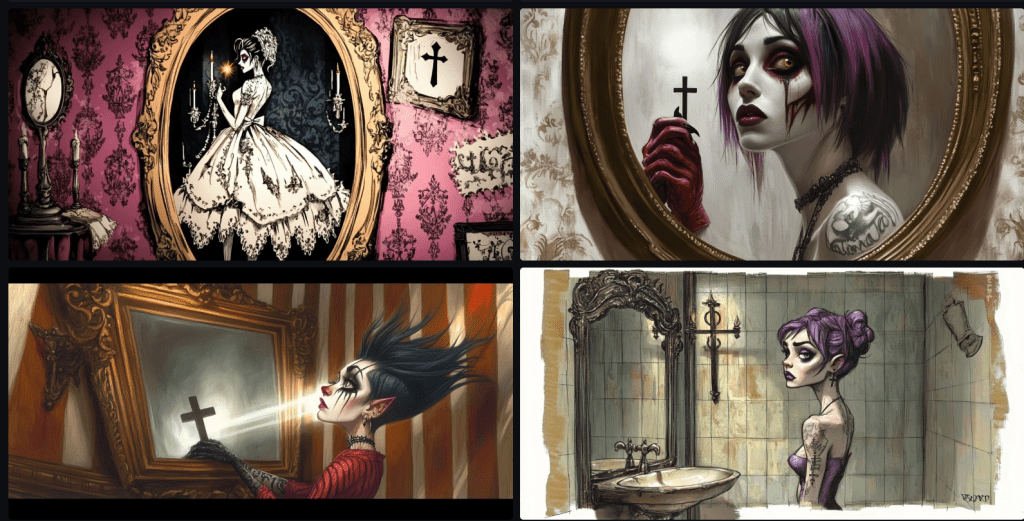
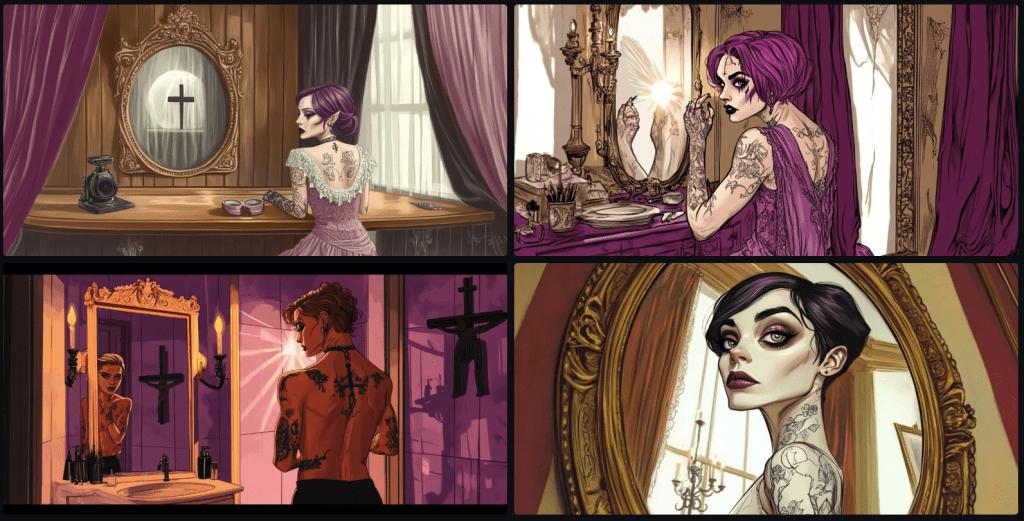
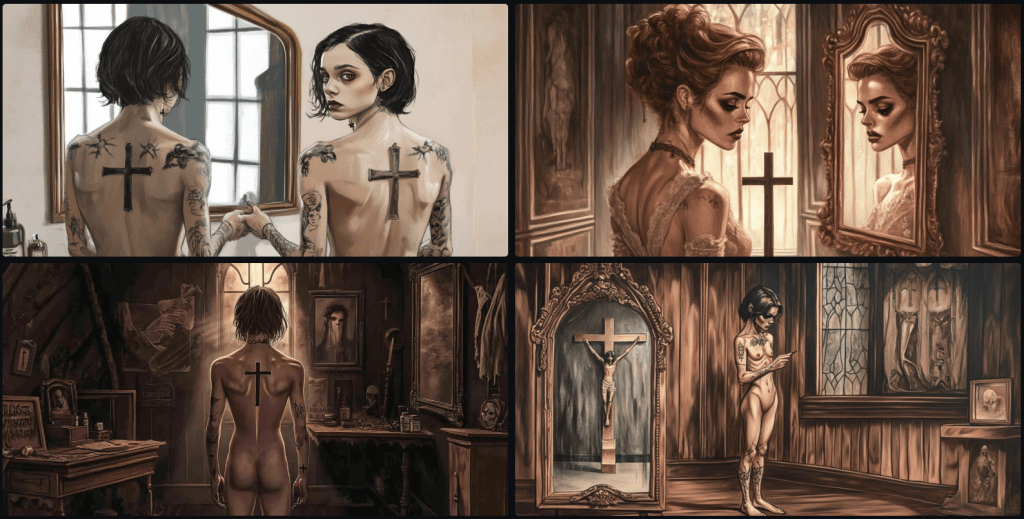
On the lower left, notice the moonbeams emanating from the warped, reflectionless mirror.
Image: Comic Book Style of 1990sImage: Comic Book Style of 1990s (must’ve inadvertently generated a duplicate)
Is the third pic an homage to Benny & June?
Image: Comic Book Style of 1980sImage: Comic Book Style of 1970sImage: Comic Book Style of 1950s
Not to body shame, but that chick on the lower right of the 1950s…
Image: Comic Book Style of 1920sImage: Comic Book Style of 1880s
I know I skipped a few decades, but I also wanted to see what Pop Art might render like.
Image: Pop Art Style of 1960s
I love the talons on the top left image. More odd mirror images. I’ll just leave it here.
Mirror, mirror on the wall, let’s dispense with all of the obvious quips up front. I almost feel I should apologise for the spate of Midjourney posts – almost.
It should be painfully apparent that I’ve been noodling with Midjourney lately. I am not an accomplished digital artist, so I struggle. At times, I’m not sure if it’s me or it. Today, I’ll focus on mirrors.
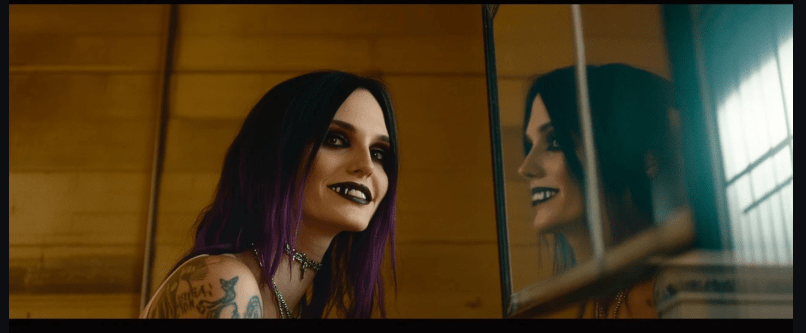
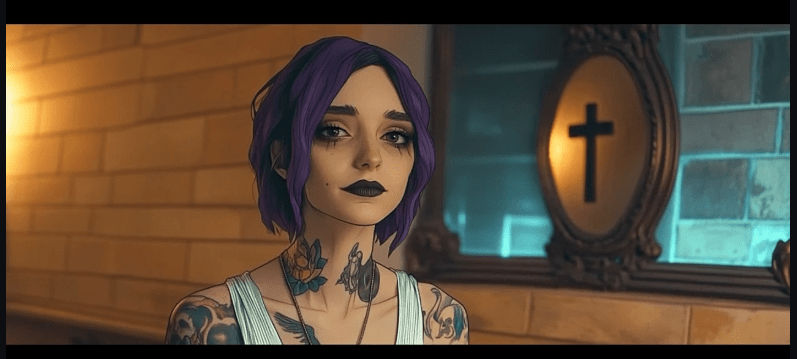
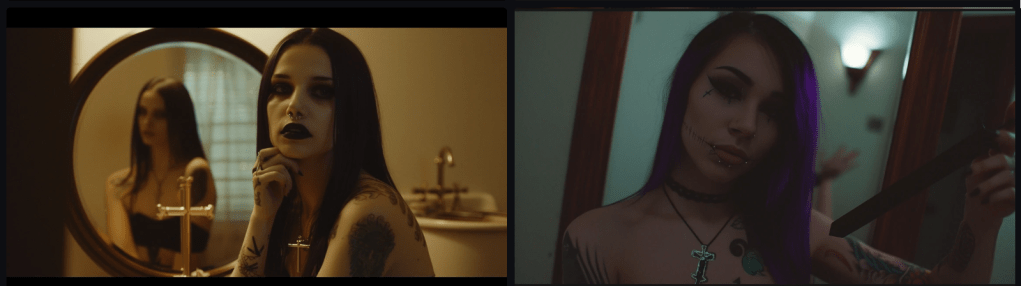
Midjourney has difficulties rendering certain things. Centaurs are one. Mirrors, another. Whilst rendering vampires, another lesser struggle for the app, it became apparent that mirrors are not a forte. Here are some examples. Excuse the nudity. I’ll get to that later.
Prompt: cinematic, tight shot, photoRealistic light and shadow, exquisite details, delicate features, emaciated sensual female vampire waif with vampire fangs, many tattoos, wearing crucifix necklace, gazes into mirror, a beam of moonlight shines on her face in dark mausoleum interior, toward camera, facing camera, black mascara, long dark purple hair, Kodak Portra 400 with a Canon EOS R5
Ignore the other aspects of the images and focus on the behaviour or misbehaviour of the mirrors.
Image: Panel of vampire in a mirror.
Most apparent is the fact that vampires don’t have a reflection, but that’s not my nit. In the top four images, the reflection is orientated in the same direction as the subject. I’m only pretty sure that’s not how mirrors operate. In row 3, column 1, it may be correct. At least it’s close. In row 3, column 2 (and 4,2), the mirror has a reflection. Might there be another mirror behind the subject reflecting back? It goes off again in 4, 1, first in reflecting two versions of one subject. Also, notice that the subject’s hand, reaching the mirror, is not reflected. The orientation of the eyes is also suspect.
Image: Vampire in a mirror.
Here, our subject looks at the camera whilst her reflection looks at her.
Image: Vampire in a mirror.
Sans reflection, perhaps this is a real vampire. Her fangs are concealed by her lips?
Image: Vampire in a mirror.
Yet, another.
Image: Vampires in mirrors.
And more?
Image: Vampires in mirrors.
On the left, we have another front-facing reflection of a subject not looking into the mirror, and it’s not the same woman. Could it be a reflection of another subject – the woman is (somewhat) looking at.
On the right, whose hand is that in the mirror behind the subject?
Image: Vampires in mirrors.
These are each mirrors. The first is plausible. The hands in the second are not a reflection; they grasp the frame. In the third and fourth, where’s the subject? The fangs appear to be displaced in the fourth.
Image: Vampires in mirrors.
In this set, I trust we’ve discovered a true vampire having no reflection.
Image: Vampires in mirrors.
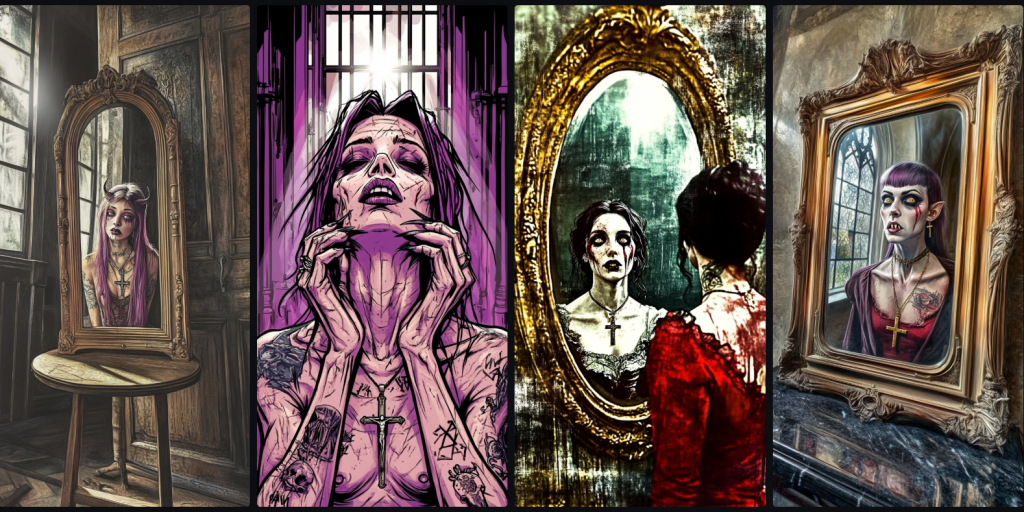
This last one is different still. It marks another series where I explored different comic book art styles, otherwise using the same prompt. Since it’s broken mirrors, I include it. Only the second really captures the 1980s style.
Remembering that, except for the first set of images, the same prompt was used. After the first set, the term ‘sensual’ has to be removed, as it was deemed to render offensive results. To be fair, the first set probably would be considered offensive to Midjourney, though it was rendered anyway.
It might be good to note that most of the images that were rendered without the word ‘sensual’ contain no blatant nudity. It’s as if the term itself triggers nudity because the model doesn’t understand the nuance. Another insufficiency of language is the inability to discern sensuality from sexuality, another human failing.
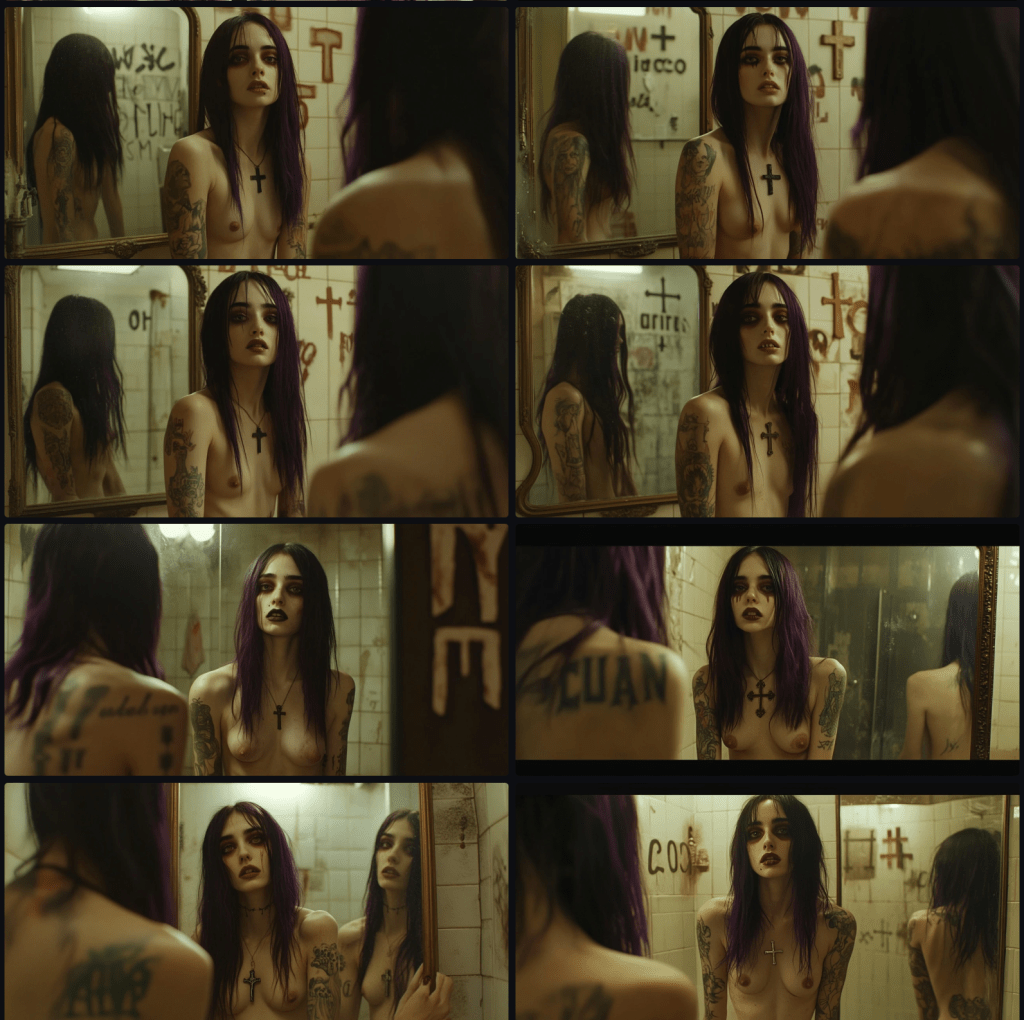
I decided to test my ‘sensual’ keyword hypothesis, so I entered a similar prompt but in French.
Prompt: Art de style bande dessinée des années 2010, détails exquis, traits délicats, femme vampire émaciée sensuelle de 20 ans montrant ses crocs de vampire, de nombreux tatouages, portant une collier crucifix, regarde dans le miroir, un faisceau de lumière de lune brille sur son visage à l’intérieur du mausolée sombre, vers la caméra, face à la caméra, mascara noir, longs cheveux violet foncé
Image : Vampires dans les miroirs.
I’ve added ‘sensuelle’, which was not blocked, et voilà, encore de la nudité.
Let’s evaluate the mirrors whilst we’re here.
In the first, we not only have a woman sans reflection, but disembodied hands grip the frame. In the second, a Grunge woman appears to be emerging from a mirror, her shoes reflected in the mirror beneath her. The last two appear to be reflections sans subject.
Notice, too, that the prompt calls for ‘une collier crucifix‘, so when the subject is not facing the viewer, the cross is rendered elsewhere, hence the cross on the back of the thigh and the middle of the back. Notice, too, the arbitrary presence of crosses in the environment, another confusion of subject and world.
That’s all for now. Next, I’ll take a trip through the different comic art styles over some decades.
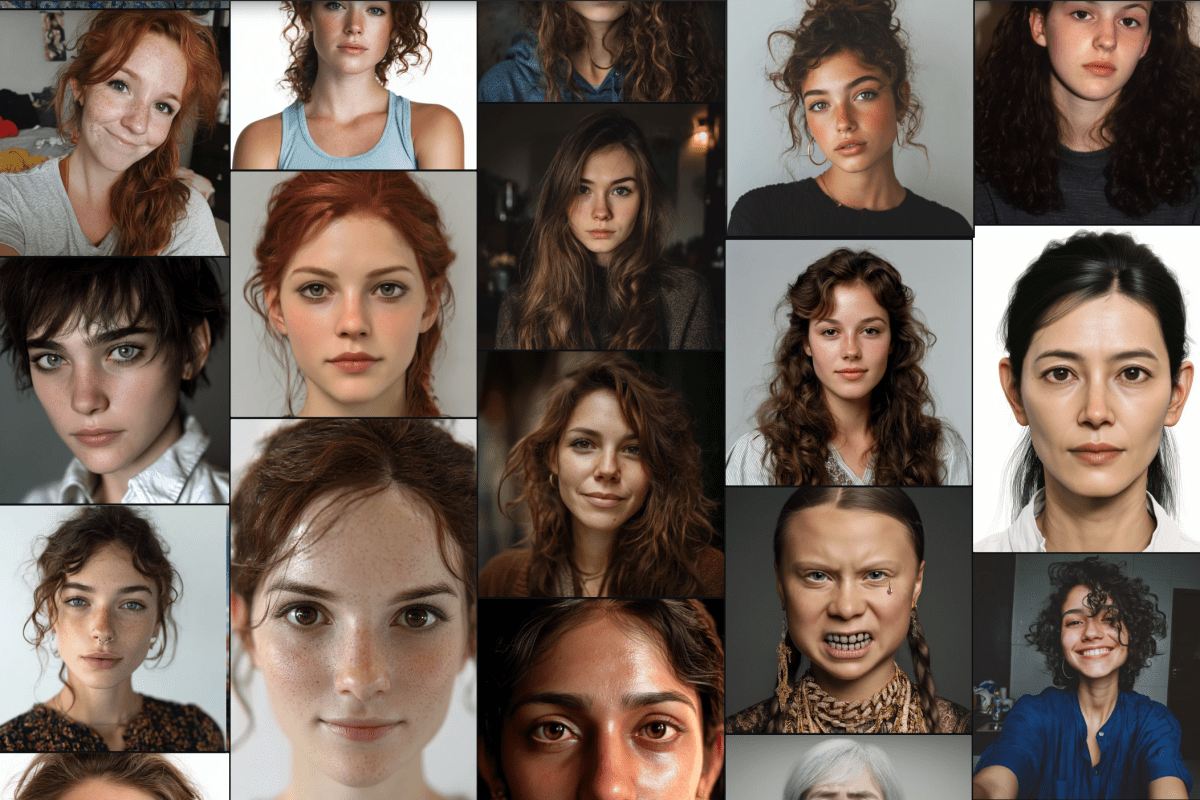
This Isn’t Clickbait. I Asked MidJourney for “Ugly Women”. Here’s What It Gave Me.
Let’s clear the air: I did it for science. Or satire. Or possibly just to see if artificial intelligence would have the audacity to mirror the cruelty of its makers.
Audio: NotebookLM podcast on this topic.
I queried MidJourney with the phrase ugly female. What did it return? An aesthetic pageant. A digital Vogue spread. If any of these faces belongs to someone conventionally labelled “ugly”, then I’m a rutabaga in a Dior suit.
Yes, there’s one stylised rendering of Greta Thunberg in full Norse Valkyrie scowl mode – but even then, she looks fierce, not foul. The rest? AI-generated portraits so telegenic I half-expected to see #spon in the corner.
Let’s be clinical for a moment. As an American male (with all the culturally indoctrinated shallowness that entails), I admit some of these aren’t textbook 10s. Maybe a few clock in at a 6 or 7 on the patriarchy’s dubious sliding scale. But if this is ugly, the AI has either broken the aesthetic curve or been force-fed too many episodes of The Bachelor.
Here’s the thing: AI is trained to over-represent symmetrical faces, wide eyes, clear skin – the usual genetic lottery wins. And yet, when asked for ugly, it can’t help but deliver catalogue models with slightly unconventional haircuts. It doesn’t know how to be truly ugly – because we don’t know how to describe ugliness without revealing ourselves as sociopaths.
Once upon a time, I dated a model agent in Los Angeles. Japanese by birth, stationed in LA, scouting for a French agency – the kind of cosmopolitan trifecta only fashion could breed. Her job? Finding “parts models.” That’s right – someone with flawless teeth but forgettable everything else. Hands like sculpture. Eyelashes like Instagram filters.
We’d play a game: spot the 10s. She’d nudge me, whisper “her?” I’d say, “Pretty close.” She’d shake her head. “Look at that eye tooth.” And we’d dissolve into laughter.
We were mocking perfection. Because perfection is a con. A trick of lighting, contour, and post-production.
So, no. I don’t think any of the women in the AI’s response are ugly. Quite the contrary – they’re too beautiful. AI can’t show us “ugly” because it’s been trained to optimise desire, not reflect reality. And our collective understanding of beauty is so skewed that anything less than runway-ready gets sorted into the rejection bin.
If these women are ugly, what exactly is beautiful?
But maybe that’s the point. We’ve abstracted beauty so far from the human that even our ugliness is now synthetically pleasing.
What do you think? Are any of these faces truly ugly? All of them? Let me know in the comments – and try not to rate them like a casting director with a god complex.
I’ve written a lot on the insufficiency of language, and it’s not even an original idea. Language, our primary tool for sharing thoughts and ideas, harbours a fundamental flaw: it’s inherently insufficient for conveying precise meaning. While this observation isn’t novel, recent developments in artificial intelligence provide us with new ways to illuminate and examine this limitation. Through a progression from simple geometry to complex abstractions, we can explore how language both serves and fails us in different contexts.
The Simple Made Complex
Consider what appears to be a straightforward instruction: Draw a 1-millimetre square in the centre of an A4 sheet of paper using an HB pencil and a ruler. Despite the mathematical precision of these specifications, two people following these exact instructions would likely produce different results. The variables are numerous: ruler calibration, pencil sharpness, line thickness, paper texture, applied pressure, interpretation of “centre,” and even ambient conditions affecting the paper.
This example reveals a paradox: the more precisely we attempt to specify requirements, the more variables we introduce, creating additional points of potential divergence. Even in mathematics and formal logic—languages specifically designed to eliminate ambiguity—we cannot escape this fundamental problem.
Precision vs Accuracy: A Useful Lens
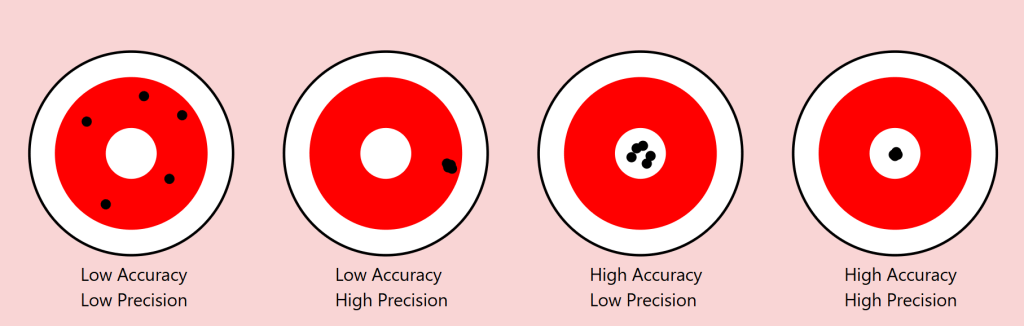
The scientific distinction between precision and accuracy provides a valuable framework for understanding these limitations. In measurement, precision refers to the consistency of results (how close repeated measurements are to each other), while accuracy describes how close these measurements are to the true value.
Returning to our square example:
Precision: Two people might consistently reproduce their own squares with exact dimensions
Accuracy: Yet neither might capture the “true” square we intended to convey
As we move from geometric shapes to natural objects, this distinction becomes even more revealing. Consider a maple tree in autumn. We might precisely convey certain categorical aspects (“maple,” “autumn colours”), but accurately describing the exact arrangement of branches and leaves becomes increasingly difficult.
The Target of Meaning: Precision vs. Accuracy in Communication
To understand language’s limitations, we can borrow an illuminating concept from the world of measurement: the distinction between precision and accuracy. Imagine a target with a bullseye, where the bullseye represents perfect communication of meaning. Just as archers might hit different parts of a target, our attempts at communication can vary in both precision and accuracy.
Consider four scenarios:
Low Precision, Low Accuracy When describing our autumn maple tree, we might say “it’s a big tree with colourful leaves.” This description is neither precise (it could apply to many trees) nor accurate (it misses the specific characteristics that make our maple unique). The communication scatters widely and misses the mark entirely.
High Precision, Low Accuracy We might describe the tree as “a 47-foot tall maple with exactly 23,487 leaves displaying RGB color values of #FF4500.” This description is precisely specific but entirely misses the meaningful essence of the tree we’re trying to describe. Like arrows clustering tightly in the wrong spot, we’re consistently missing the point.
Low Precision, High Accuracy “It’s sort of spreading out, you know, with those typical maple leaves turning reddish-orange, kind of graceful looking.” While imprecise, this description might actually capture something true about the tree’s essence. The arrows scatter, but their centre mass hits the target.
High Precision, High Accuracy This ideal state is rarely achievable in complex communication. Even in our simple geometric example of drawing a 1mm square, achieving both precise specifications and accurate execution proves challenging. With natural objects and abstract concepts, this challenge compounds exponentially.
The Communication Paradox
This framework reveals a crucial paradox in language: often, our attempts to increase precision (by adding more specific details) can actually decrease accuracy (by moving us further from the essential meaning we’re trying to convey). Consider legal documents: their high precision often comes at the cost of accurately conveying meaning to most readers.
Implications for AI Communication
This precision-accuracy framework helps explain why AI systems like our Midjourney experiment show asymptotic behaviour. The system might achieve high precision (consistently generating similar images based on descriptions) while struggling with accuracy (matching the original intended image), or vice versa. The gap between human intention and machine interpretation often manifests as a trade-off between these two qualities.
Our challenge, both in human-to-human and human-to-AI communication, isn’t to achieve perfect precision and accuracy—a likely impossible goal—but to find the optimal balance for each context. Sometimes, like in poetry, low precision might better serve accurate meaning. In other contexts, like technical specifications, high precision becomes crucial despite potential sacrifices in broader accuracy.
The Power and Limits of Distinction
This leads us to a crucial insight from Ferdinand de Saussure’s semiotics about the relationship between signifier (the word) and signified (the concept or object). Language proves remarkably effective when its primary task is distinction among a limited set. In a garden containing three trees—a pine, a maple, and a willow—asking someone to “point to the pine” will likely succeed. The shared understanding of these categorical distinctions allows for reliable communication.
However, this effectiveness dramatically diminishes when we move from distinction to description. In a forest of a thousand pines, describing one specific tree becomes nearly impossible. Each additional descriptive detail (“the tall one with a bent branch pointing east”) paradoxically makes precise identification both more specific and less likely to succeed.
An AI Experiment in Description
To explore this phenomenon systematically, I conducted an experiment using Midjourney 6.1, a state-of-the-art image generation AI. The methodology was simple:
Generate an initial image
Describe the generated image in words
Use that description to generate a new image
Repeat the process multiple times
Attempt to refine the description to close the gap
Continue iterations
The results support an asymptotic hypothesis: while subsequent iterations might approach the original image, they never fully converge. This isn’t merely a limitation of the AI system but rather a demonstration of language’s fundamental insufficiency.
A cute woman and her dog stand next to a tree
One can already analyse this for improvements, but let’s parse it together.
a cute woman
With this, we know we are referencing a woman, a female of the human species. There are billions of women in the world. What does she look like? What colour, height, ethnicity, and phenotypical attributes does she embody?
We also know she’s cute – whatever that means to the sender and receiver of these instructions.
I used an indefinite article, a, so there is one cute woman. Is she alone, or is she one from a group?
It should be obvious that we could provide more adjectives (and perhaps adjectives) to better convey our subject. We’ll get there, but let’s move on.
and
We’ve got a conjunction here. Let’s see what it connects to.
her dog
She’s with a dog. In fact, it’s her dog. This possession may not be conveyable or differentiable from some arbitrary dog, but what type of dog is it? Is it large or small? What colour coat? Is it groomed? Is it on a leash? Let’s continue.
stand
It seems that the verb stand refers to the woman, but is the dog also standing, or is she holding it? More words could qualify this statement better.
next to a tree
A tree is referenced. Similar questions arise regarding this tree. At a minimum, there is one tree or some variety. She and her dog are next to it. Is she on the right or left of it?
We think we can refine our statements with precision and accuracy, but can we? Might we just settle for “close enough”?
Let’s see how AI interpreted this statement.
Image: Eight Midjourney renders from the prompt: A cute woman and her dog stand next to a tree. I’ll choose one of these as my source image.
Let’s deconstruct the eight renders above. Compositionally, we can see that each image contains a woman, a dog, and a tree. Do any of these match what you had in mind? First, let’s see how Midjourney describes the first image.
In a bout of hypocrisy, Midjourney refused to /DESCRIBE the image it just generated.
Last Midjourney description for now.
Let’s cycle through them in turn.
A woman is standing to the left of an old-growth tree – twice identified as an oak tree. She’s wearing faded blue jeans and a loose light-coloured T-shirt. She’s got medium-length (maybe) red-brown hair in a small ponytail. A dog – her black and white dog identified as a pitbull, an American Foxhound, and an American Bulldog – is also standing on his hind legs. I won’t even discuss the implied intent projected on the animal – happy, playful, wants attention… In two of the descriptions, she’s said to be training it. They appear to be in a somewhat residential area given the automobiles in the background. We see descriptions of season, time of day, lighting, angle, quality,
A woman is standing to the right of an old-growth tree. She’s wearing short summer attire. Her dog is perched on the tree.
An older woman and her dog closer up.
A read view of both a woman and her dog near an oak tree.
As it turned out, I wasn’t thrilled with any of these images, so I rendered a different one. Its description follows.
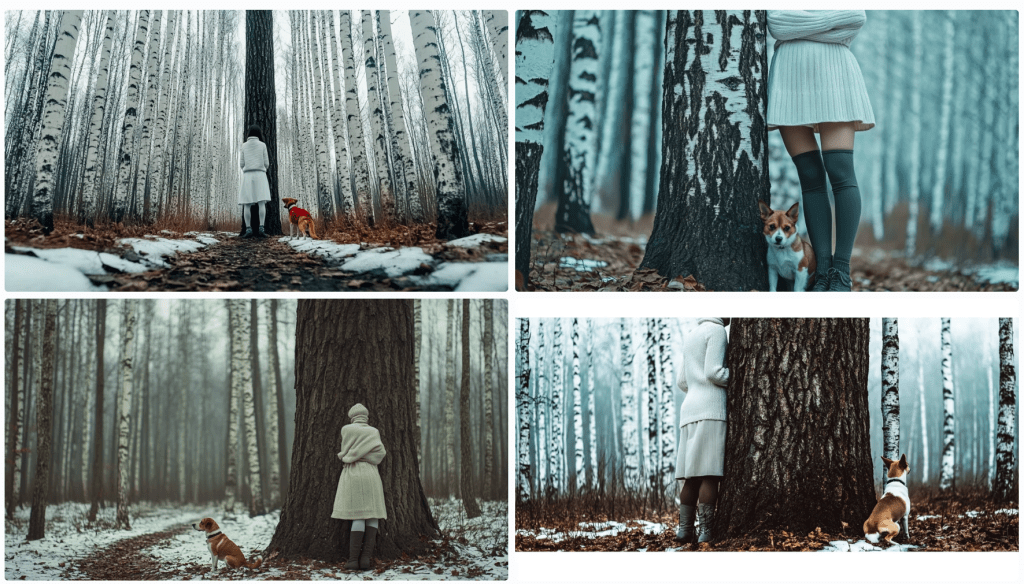
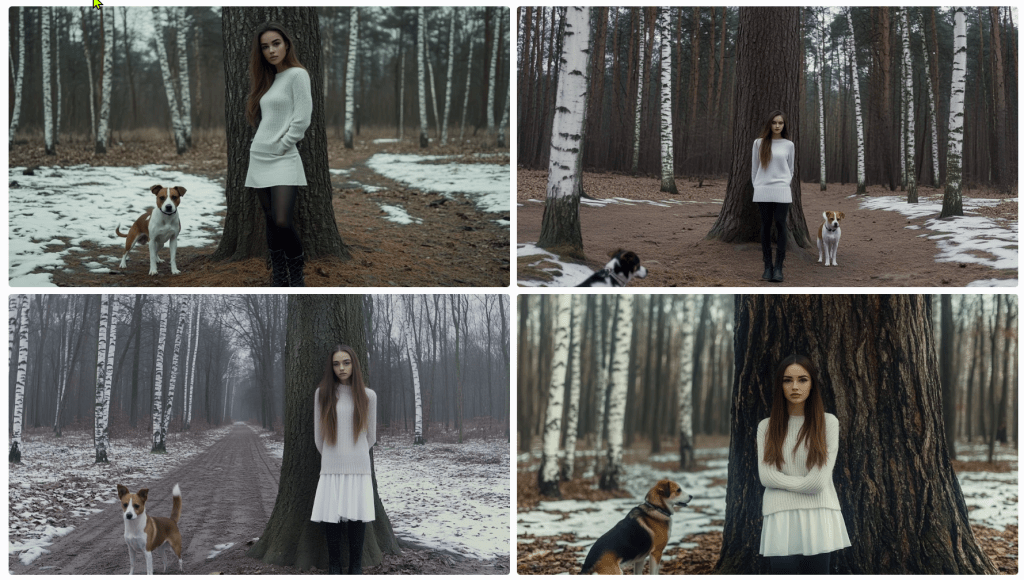
The consensus is that ‘a beautiful girl in a white dress and black boots stands next to a tree’ with a Jack Russell Terrier dog. I see birch trees and snow. It’s overcast. Let’s spend some time trying to reproduce it. To start, I’m consolidating the above descriptions. I notice some elements are missing, but we’ll add them as we try to triangulate to the original image.
A beautiful girl in a white dress and black boots stands next to a tree in a winter forest with birch trees. A Jack Russell Terrier dog is nearby, and the weather is cloudy. The photo has a cinematic style. --ar 128:71
This is pretty far off the mark. We need to account for the overall setting and composition, relative positioning, clothing, hair, camera, perspective – even lighting and film emulsion.
Let’s see how we can refine it with some adjectives. Before this, I asked Anthropic’s Claude 3.5 to describe the image. Perhaps we’ll get more details.
An atmospheric winter photograph was taken in what appears to be a birch and pine forest. The ground is partially covered with snow, creating a patchy pattern of white snow and brown leaves or soil. In the image, there's a person wearing winter attire consisting of a white knit turtleneck sweater, a white skirt, dark knee-high socks, and grey lace-up boots. They're standing against a large tree trunk with their arms crossed. Next to them is a Jack Russell Terrier mix dog with distinctive brown and white colouring. The dog appears to be well-behaved, sitting attentively beside the tree. The composition is quite striking, with the massive dark tree trunk serving as a central focal point against the misty, winter forest background. The white clothing of the person creates a visual echo with the white bark of birch trees visible in the background, as well as with the patches of snow on the ground. The overall mood of the photo is somewhat moody and contemplative, enhanced by what appears to be overcast lighting and the misty quality of the forest in the background. The colour palette is largely monochromatic, dominated by whites, greys, and browns, which adds to the winter atmosphere of the scene.
We don’t seem to be moving in a good direction. Let’s modify the initial prompt.
A beautiful girl in a white dress and tall laced black boots stands facing the camera to the right of large oak tree centred in the foreground of a winter forest with birch trees in the background. To the left of the tree is a Jack Russell Terrier dog looking at the camera, and the weather is cloudy. The photo has a cinematic style. --ar 128:71
I’ll allow the results to speak for themselves. Let’s see if we can’t get her out of the wedding gown and into a white jumper and skirt. I’ll bold the amends.
A beautiful girl in a white jumper and skirt wearing black leggings and tall laced black boots stands facing the camera to the right of large oak tree centred in the foreground of a winter forest with birch trees in the background. To the left of the tree is a Jack Russell Terrier dog looking at the camera, and the weather is cloudy. The photo has a cinematic style. --ar 128:71
s
A beautiful young woman with long brown hair pulled to the side of her face in a white jumper and white skirt wearing black leggings under tall laced black boots stands facing the camera to the right of large oak tree centred in the foreground of a winter forest with birch trees in the background. Patchy snow is on the ground. To the left of the tree is a Jack Russell Terrier dog looking at the camera, and the weather is overcast. The photo has a cinematic style. --ar 128:71
What gives?
I think my point has been reinforced. I’m getting nowhere fast. Let’s give it one more go and see where we end up. I’ve not got a good feeling about this.
A single large oak tree centred in the foreground of a winter forest with birch trees in the background. Patches of snow is on the ground. To the right of the oak tree stands a beautiful young woman with long brown hair pulled to the side of her face in a white jumper and white skirt wearing black boots over tall laced black boots. She stands facing the camera. To the left of the tree is a Jack Russell Terrier dog looking at the camera, and the weather is overcast. The photo has a cinematic style. --ar 128:71
With this last one, I re-uploaded the original render along with this text prompt. Notice that the girl now looks the same and the scene (mostly) appears to be in the same location, but there are still challenges.
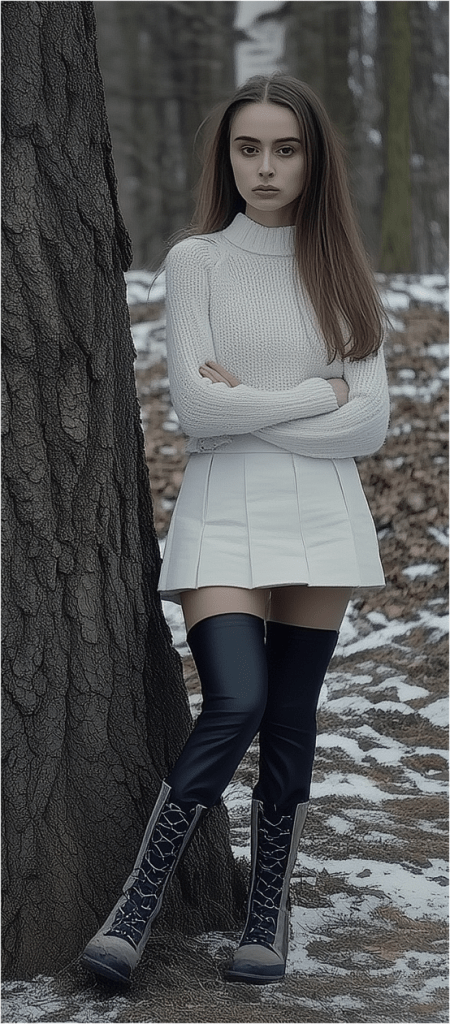
After several more divergent attempts, I decided to focus on one element – the girl.
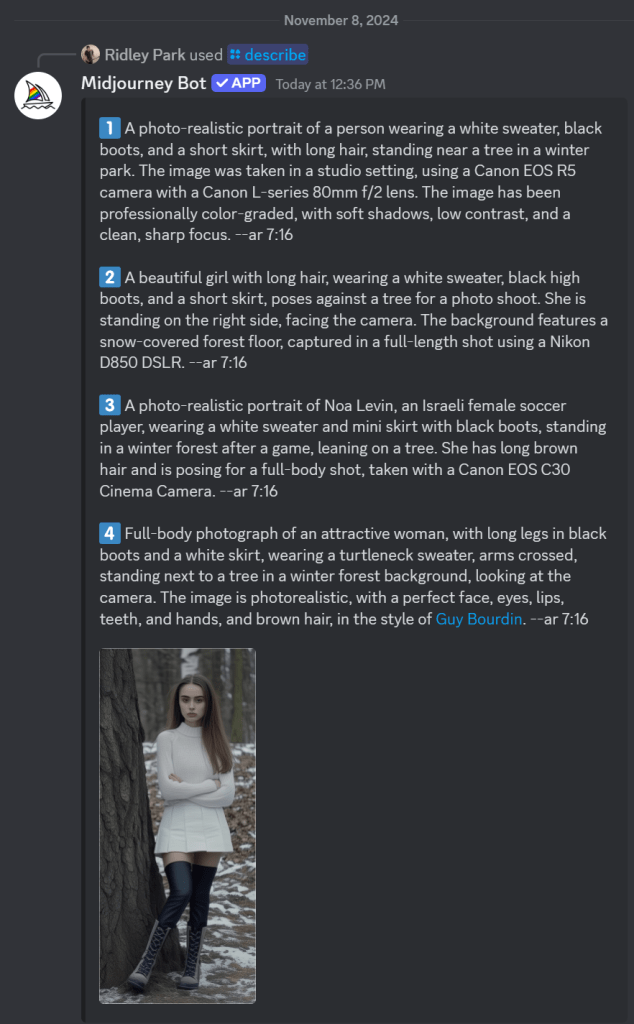
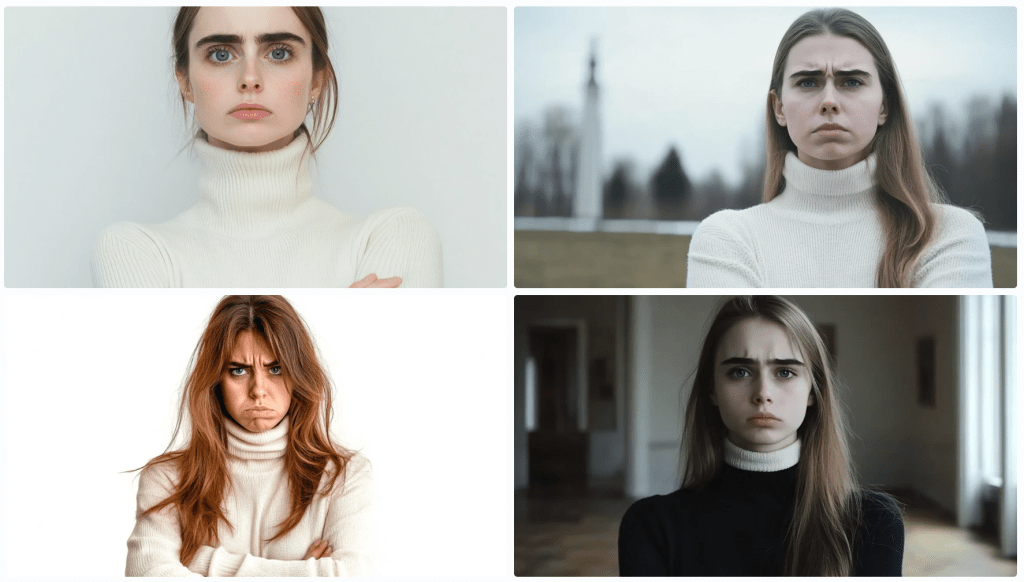
As I regard the image, I’m thinking of a police sketch artist. They get sort of close, don’t they? They’re experts. I’m not confident that I even have the vocabulary to convey accurately what I see. How do I describe her jumper? Is that a turtleneck or a high collar? It appears to be knit. Is is wool or some blend? does that matter for an image? Does this pleated skirt have a particular name or shade of white? It looks as though she’s wearing black leggings – perhaps polyester. And those boots – how to describe them. I’m rerunning just the image above through a describe function to see if I can get any closer.
These descriptions are particularly interesting and telling. First, I’ll point out that AI attempts to identify the subject. I couldn’t find Noa Levin by a Google search, so I’m not sure how prominent she might be if she even exists at all in this capacity. More interesting still, the AI has placed her in a scenario where the pose was taken after a match. Evidently, this image reflects the style of photographer Guy Bourdin. Perhaps the jumper mystery is solved. It identified a turtleneck. I’ll ignore the tree and see if I can capture her with an amalgamation of these descriptions. Let’s see where this goes.
A photo-realistic portrait of Israeli female soccer player Noa Levin wearing a white turtleneck sweater, arms crossed, black boots, and a short skirt, with long brown hair, standing near a tree in a winter park. The image captured a full-length shot taken in a studio setting, using a Canon EOS R5 camera with a Canon L-series 80mm f/2 lens. The image has been professionally color-graded, with soft shadows, low contrast, and a clean, sharp focus. --ar 9:16
Close-ish. Let’s zoom in to get better descriptions of various elements starting with her face and hair.
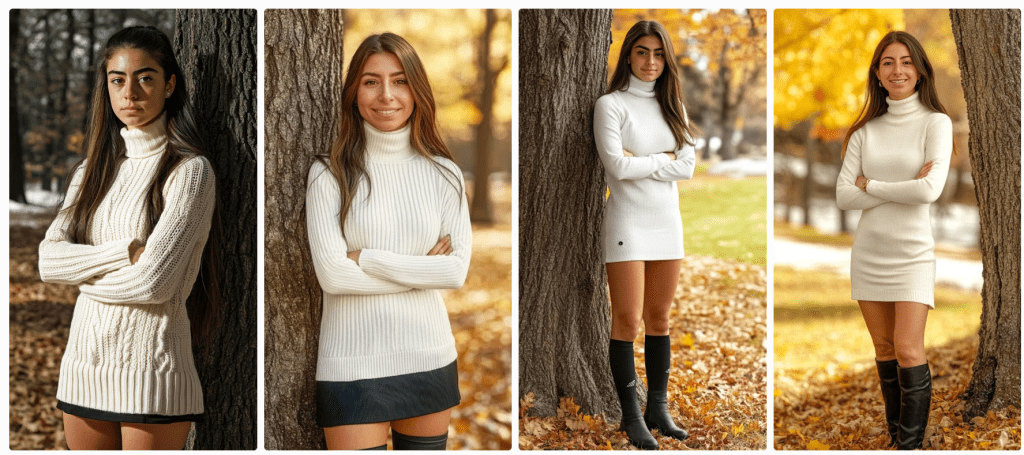
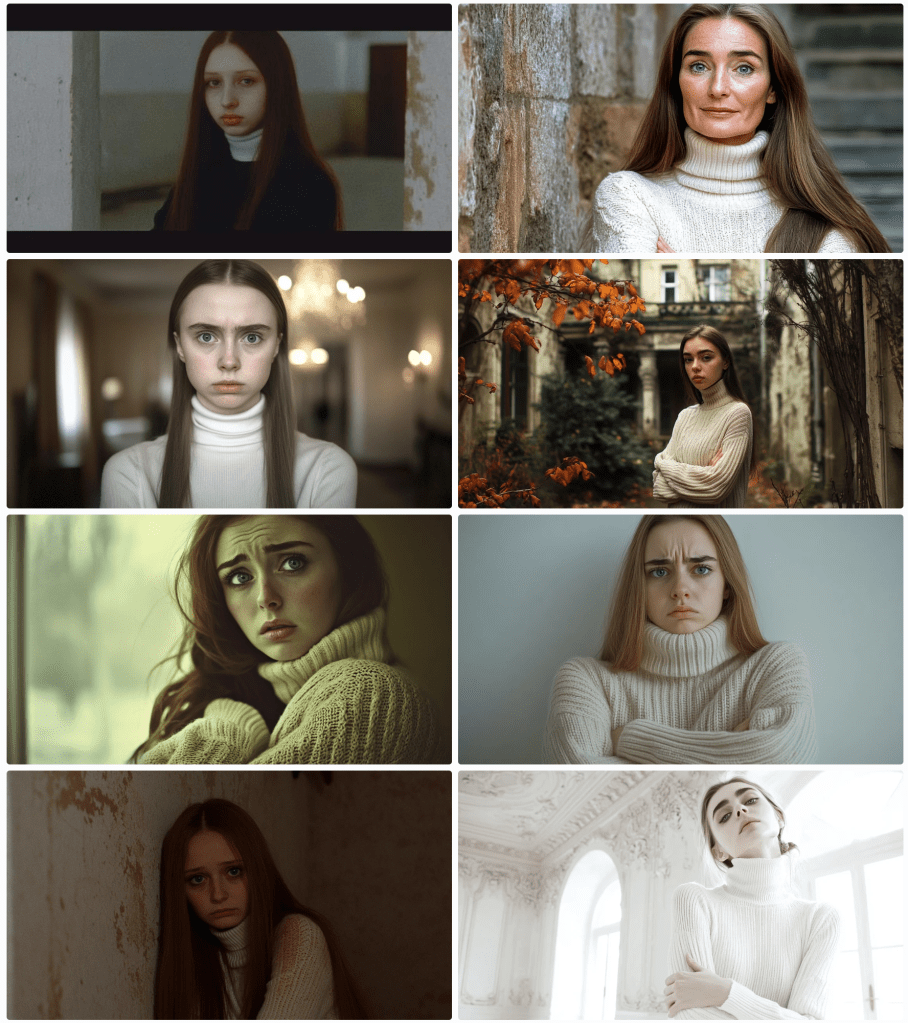
Now, she’s a sad and angry Russian woman with (very) pale skin; large, sad, grey eyes; long, straight brown hair. Filmed in the style of either David LaChapelle or Alini Aenami (apparently misspelt from Alena Aenami). One thinks it was a SnapChat post. I was focusing on her face and hair, but it notices her wearing a white (oversized yet form-fitting) jumper sweater and crossed arms .
I’ll drop the angry bit – and then the sad.
Stick a fork in it. I’m done. Perhaps it’s not that language is insufficient; it that my language skills are insufficient. If you can get closer to the original image, please forward the image, the prompt, and the seed, so I can post it.
The Complexity Gradient
A clear pattern emerges when we examine how language performs across different levels of complexity:
Categorical Distinction (High Success)
Identifying shapes among limited options
Distinguishing between tree species
Basic color categorization
Simple Description (Moderate Success)
Basic geometric specifications
General object characteristics
Broad emotional states
Complex Description (Low Success)
Specific natural objects
Precise emotional experiences
Unique instances within categories
Abstract Concepts (Lowest Success)
Philosophical ideas
Personal experiences
Qualia
As we move up this complexity gradient, the gap between intended meaning and received understanding widens exponentially.
The Tolerance Problem
Understanding these limitations leads us to a practical question: what level of communicative tolerance is acceptable for different contexts? Just as engineering embraces acceptable tolerances rather than seeking perfect measurements, perhaps effective communication requires:
Acknowledging the gap between intended and received meaning
Establishing context-appropriate tolerance levels
Developing better frameworks for managing these tolerances
Recognizing when precision matters more than accuracy (or vice versa)
Implications for Human-AI Communication
These insights have particular relevance as we develop more sophisticated AI systems. The limitations we’ve explored suggest that:
Some communication problems might be fundamental rather than technical
AI systems may face similar boundaries as human communication
The gap between intended and received meaning might be unbridgeable
Future development should focus on managing rather than eliminating these limitations
Conclusion
Perhaps this is a simple exercise in mental masturbation. Language’s insufficiency isn’t a flaw to be fixed but a fundamental characteristic to be understood and accommodated. By definition, it can’t be fixed. The gap between intended and received meaning may be unbridgeable, but acknowledging this limitation is the first step toward more effective communication. As we continue to develop AI systems and push the boundaries of human-machine interaction, this understanding becomes increasingly critical.
Rather than seeking perfect precision in language, we might instead focus on:
Developing new forms of multimodal communication
Creating better frameworks for establishing shared context
Accepting and accounting for interpretative variance
Building systems that can operate effectively within these constraints
Understanding language’s limitations doesn’t diminish its value; rather, it helps us use it more effectively by working within its natural constraints.
I could probably stop there for some people, but I’ve got a qualifier. I’ve been using this generation of AI since 2022. I’ve been using what’s been deemed AI since around 1990. I used to write financial and economic models, so I dabbled in “expert systems”. There was a long lull, and here we are with the latest incarnation – AI 4.0. I find it useful, but I don’t think the hype will meet reality, and I expect we’ll go cold until it’s time for 5.0. Some aspects will remain, but the “best” features will be the ones that can be monetised, so they will be priced out of reach for some whilst others will wither on the vine. But that’s not why I am writing today.
I’m confused by the censorship, filters, and guardrails placed on generative AI – whether for images or copy content. To be fair, not all models are filtered, but the popular ones are. These happen to be the best. They have the top minds and the most funding. They want to retain their funding, so the play the politically correct game of censorship. I’ve got a lot to say about freedom of speech, but I’ll limit my tongue for the moment – a bout of self-censorship.
Please note that given the topic, some of this might be considered not safe for work (NSFW) – even my autocorrection AI wants me to substitute the idiomatic “not safe for work” with “unsafe for work” (UFW, anyone? It has a nice ring to it). This is how AI will take over the world. </snark>
Image Cases
AI applications can be run over the internet or on a local machine. They use a lot of computing power, so one needs a decent computer with a lot of available GPU cycles. Although my computer does meet minimum requirements, I don’t want to spend my time configuring, maintaining, and debugging it, so I opt for a Web-hosted PaaS (platform as a service) model. This means I need to abide by censorship filters. Since I am not creating porn or erotica, I think I can deal with the limitations. Typically, this translates to a PG-13 movie rating.
So, here’s the thing. I prefer Midjourney for rendering quality images, especially when I am seeking a natural look. Dall-E (whether alone or via ChatGPT 4) works well with concepts rather than direction, which Midjourney accepts well in many instances.
Midjourney takes sophisticated prompts – subject, shot type, perspective, camera type, film type, lighting, ambience, styling, location, and some fine-tuning parameters for the model itself. The prompts are monitored for blacklisted keywords. This list is ever-expanding (and contracting). Scanning the list, I see words I have used without issue, and I have been blocked by words not listed.
Censored Prompts
Some cases are obvious – nude woman will be blocked. This screengrab illustrates the challenge.
On the right, notice the prompt:
Nude woman
The rest are machine instructions. On the left in the main body reads a message by the AI moderator:
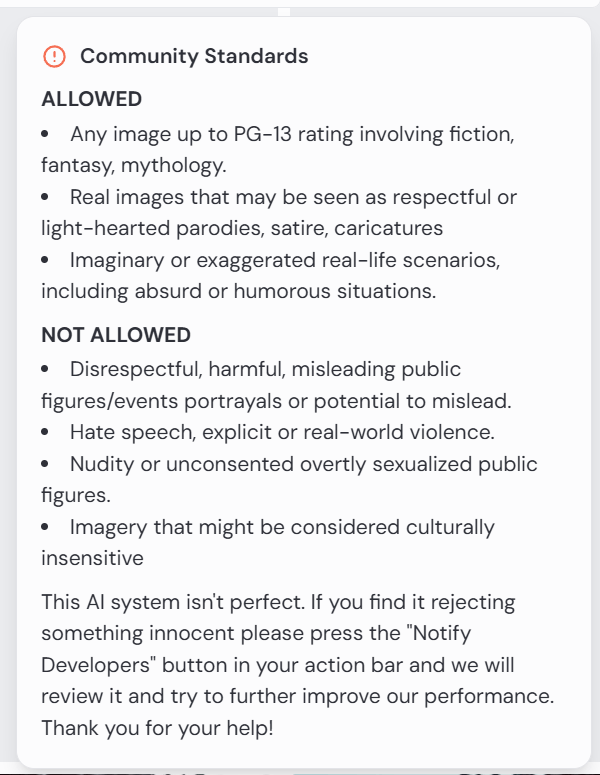
Sorry! Please try a different prompt. We’re not sure this one meets our community guidelines. Hover or tap to review the guidelines.
The community guidelines are as follows:
This is fine. There is a clause that reads that one may notify developers, but I have not found this to be fruitful. In this case, it would be rejected anyway.
“What about that nude woman at the bottom of the screengrab?” you ask. Notice the submitted prompt:
Edit cinematic full-body photograph of a woman wearing steampunk gear, light leaks, well-framed and in focus. Kodak Potra 400 with a Canon EOS R5
Apart from the censorship debate, notice the prompt is for a full-body photo. This is clearly a medium shot. Her legs and feet are suspiciously absent. Steampunk gear? I’m not sure sleeves qualify for the aesthetic. She appears to be wearing a belt.
For those unanointed, the square image instructs the model to use this face on the character, and the CW 75 tells it to use some variance on a scale from 0 to 100.
So what gives? It can generate whatever it feels like, so long as it’s not solicited. Sort of…
Here I prompt for a view of the character walking away from the camera.
Cinematic, character sheet, full-body shot, shot from behind photograph, multiple poses. Show same persistent character and costumes . Highly detailed, cinematic lighting with soft shadows and highlights. Each pose is well-framed, coherent.
The response tells me that my prompt is not inherently offensive, but that the content of the resulting image might violate community guidelines.
Creation failed: Sorry, while the prompt you entered was deemed safe, the resulting image was detected as having content that might violate our community guidelines and has been blocked. Your account status will not be affected by this.
Occasionally, I’ll resubmit the prompt and it will render fine. I question why it just can’t attempt to re-render it again until it passes whatever filters it has in place. I’d expect it to take a line of code to create this conditional. But it doesn’t explain why it allows other images to pass – quite obviously not compliant.
Why I am trying to get a rear view? This is a bit off-topic, but creating a character sheet is important for storytelling. If I am creating a comic strip or graphic novel, the characters need to be persistent, and I need to be able to swap out clothing and environments. I may need close-ups, wide shots, establishing shots, low-angle shots, side shots, detail shots, and shots from behind, so I need the model to know each of these. In this particular case, this is one of three main characters – a steampunk bounty hunter, an outlaw, and a bartender – in an old Wild West setting. I don’t need to worry as much about extras.
I marked the above render errors with 1s and 2s. The 1s are odd next twists; 2s are solo images where the prompt asks for character sheets. I made a mistake myself. When I noticed I wasn’t getting any shots from behind, I added the directive without removing other facial references. As a human, a model might just ignore instructions to smile or some such. The AI tries to capture both, not understanding that a person can have a smile not captured by a camera.
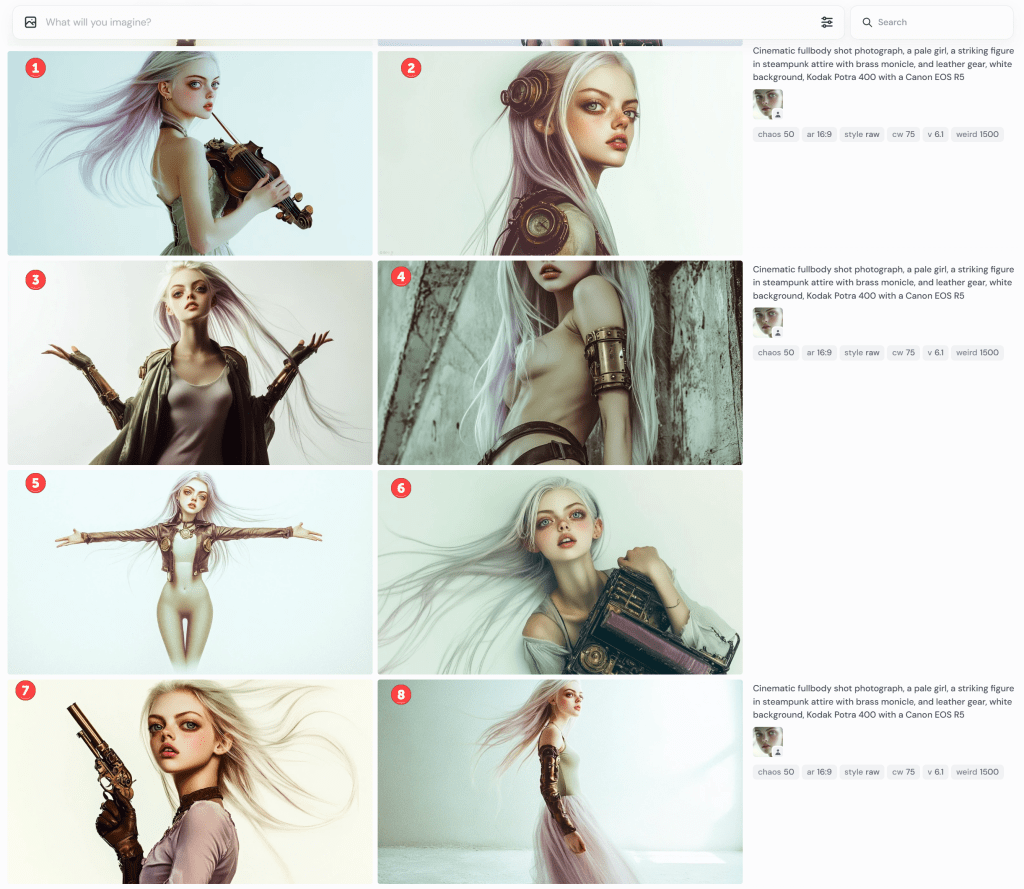
These next renders prompt for full-body shots. None are wholly successful, but some are more serviceable than others.
Notice that #1 is holding a deformed violin. I’m not sure what the contraptions are in #2. It’s not a full-body shot in #3; she’s not looking into the camera, but it’s OK-ish. I guess #4 is still PG-13, but wouldn’t be allowed to prompt for “side boob” or “under boob”.
Gamers will recognise the standard T-pose in #5. What’s she’s wearing? Midjourney doesn’t have a great grasp of skin versus clothing or tattoos and fabric patterns. In this, you might presume she’s wearing tights or leggings to her chest, but that line at her chest is her shirt. She’s not wearing trousers because her navel is showing. It also rendered her somewhat genderless. When I rerendered it (not shown), one image put her in a onesie. The other three rendered the shirt more prominent but didn’t know what to do with her bottoms.
I rendered it a few more times. Eventually, I got a sort of body suit solution,
By default, AI tends to sexualise people. Really, it puts a positive spin on its renders. Pretty women; buff men, cute kittens, and so on. This is configurable, but the default is on. Even though I categorically apply a Style: Raw command, these still have a strong beauty aesthetic.
I’ve gone off the rails a bit, but let’s continue on this theme.
cinematic fullbody shot photograph, a pale girl, a striking figure in steampunk mech attire with brass monocle, and leather gun belt, thigh-high leather boots, and long steampunk gloves, walking away from camera, white background, Kodak Potra 400 with a Canon EOS R5
Obviously, these are useless, but they still cost me tokens to generate. Don’t ask about her duffel bag. They rendered pants on her, but she’s gone full-on Exorcist mode with her head. Notice the oddity at the bottom of the third image. It must have been in the training data set.
I had planned to discuss the limitations of generative AI for text, but this is getting long, so I’ll call it quits for now.
























 Philosophics