Rational Ghosts: Why Enlightenment Democracy Was Built to Fail

3 minutes

We are governed by phantoms. Not the fun kind that rattle chains in castles, but Enlightenment rational ghosts – imaginary citizens who were supposed to be dispassionate, consistent, and perfectly informed. They never lived, but they still haunt our constitutions and television pundits. Every time some talking head declares “the people have spoken”, what they really mean is that the ghosts are back on stage.

👉 Full essay: Rational Ghosts: Why Enlightenment Democracy Was Built to Fail

The conceit was simple: build politics as if it were an engineering problem. Set the rules right, and stability follows. The trouble is that the material – actual people – wasn’t blueprint-friendly. Madison admitted faction was “sown in the nature of man”, Rousseau agonised over the “general will”, and Condorcet managed to trip over his own math. They saw the cracks even while laying the foundation. Then they shrugged and built anyway.

Audio: NotebookLM podcast on this topic.

The rational ghosts were tidy. Real humans are not. Our brains run on shortcuts: motivated reasoning, availability cascades, confirmation bias, Dunning–Kruger. We don’t deliberate; we improvise excuses. Education doesn’t fix it – it just arms us with better rationalisations. Media doesn’t fix it either – it corrals our biases into profitable outrage. The Enlightenment drafted for angels; what it got was apes with smartphones.

Even if the ghosts had shown up, the math betrayed them. Arrow proved that no voting system can translate preferences without distortion. McKelvey showed that whoever controls the sequence of votes controls the outcome. The “will of the people” is less an oracle than a Ouija board, and you can always see whose hand is pushing the planchette.

Scale finishes the job. Dunbar gave us 150 people as the human limit of meaningful community. Beyond that, trust decays into myth. Benedict Anderson called nations “imagined communities”, but social media has shattered the illusion. The national conversation is now a million algorithmic Dunbars, each convinced they alone are the real people.

Audio: This is a longer (40-minute) NotebookLM podcast on the essay itself.

Why did democracy limp along for two centuries if it was this haunted? Because it was on life-support. Growth, war, and civic myth covered the cracks. External enemies, national rituals, and propaganda made dysfunction look like consensus. It wasn’t design; it was borrowed capital. That capital has run out.

Cue the panic. The defences roll in: Churchill said democracy was the “least bad” system (he didn’t, but whatever). Voters self-correct. Education will fix it. It’s only an American problem. And if you don’t like it, what – authoritarianism? These are less arguments than incantations, muttered to keep the ghosts from noticing the creaks in the floorboards.

The real task isn’t to chant louder. It’s to stop pretending ghosts exist. Try subsidiarity: smaller-scale politics humans can actually grasp. Try deliberation: citizens’ assemblies show ordinary people can think, when not reduced to a soundbite. Try sortition: if elections are distorted by design, maybe roll the dice instead. Try polycentric governance: let overlapping authorities handle mismatch instead of hammering “one will”. None of these are perfect. They’re just less haunted.

Enlightenment democracy was built to fail because it was built for rational ghosts. The ghosts never lived. The floorboards are creaking. The task is ours: build institutions for the living, before the house collapses under its own myths.

The Argument in Skeleton Form

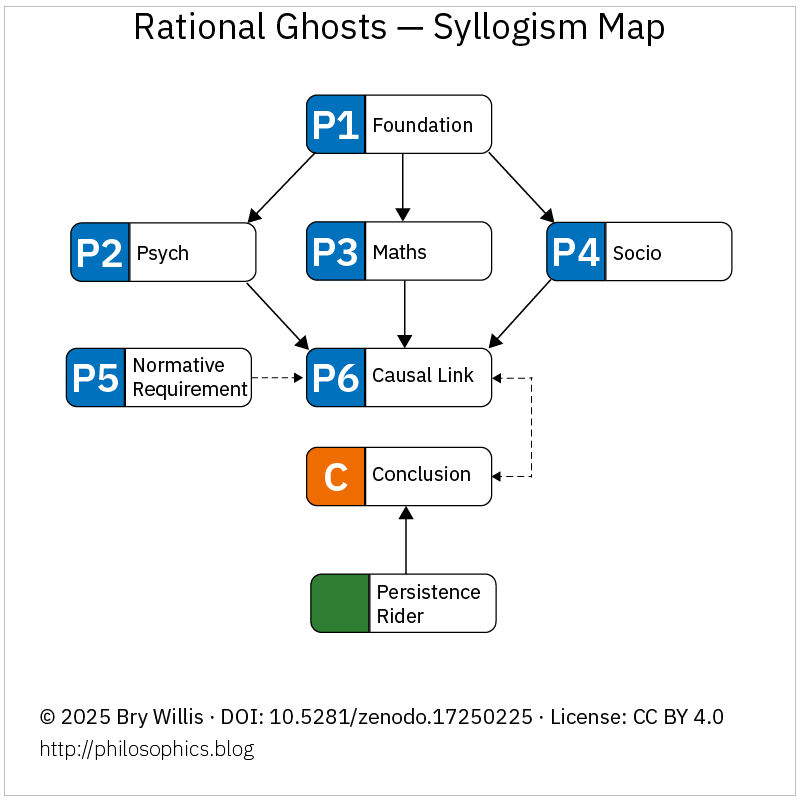
Beneath the prose, the critique of Enlightenment democracy can be expressed as a syllogism:
a foundation that assumed rational citizens collides with psychological bias, mathematical impossibility, and sociological limits.
The outcome is a double failure – corrupted inputs and incoherent outputs – masked only by temporary props.

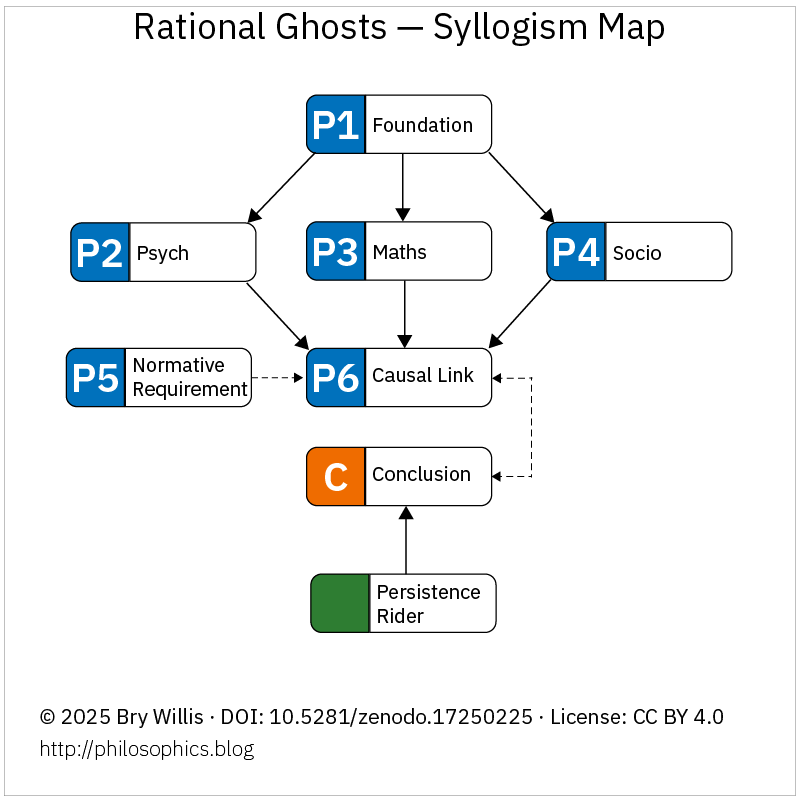
Figure: Logical skeleton of “Rational Ghosts: Why Enlightenment Democracy Was Built to Fail.” For the complete essay, with sources and elaboration, see the open-access preprint on Zenodo: https://doi.org/10.5281/zenodo.17250225

Bayes in the Culture War: How Priors Become Prison Walls

4 minutes

Are you rational, or merely rehearsing your tribe’s catechism? Bayes’ theorem insists we should all update our beliefs the same way when presented with the same evidence. Yet in today’s political divide, identical events harden opposing convictions. The problem isn’t the math—it’s the priors. When your starting assumptions are inherited, acculturated, or indoctrinated, no amount of “evidence” will move you into enemy territory.

A Bayesian Sketch of the Divide

  • Let H be a contested claim (pick your poison: “the election was fair,” “immigration helps,” whatever).
  • People in Camp R and Camp B begin with different priors P_R(H) and P_B(H). That’s acculturation if you’re being polite, indoctrination if you’ve run out of patience.
  • They observe evidence E (news, a court ruling, a video clip, a statistic).
  • They update:

posterior odds = prior odds × P(H \mid E) = \frac{P(E \mid H) P(H)}{P(E)}

Except they don’t, not cleanly, because trust in sources warps the likelihoods.

Video: Jonny Thompson on Bayes’ Theorem.
I love Jonny’s content, which is why I reference it so often. He and I have such different philosophical worldviews. Vive la différence (or différance).

Why this locks in polarisation

1. Wildly different priors.
If Camp R starts at P_R(H)=0.8 and Camp B at P_B(H)=0.2, then even moderately pro-H evidence (say likelihood ratio LR = 3) yields:

  • R: prior odds 4:1 \rightarrow 12:1 \Rightarrow P(H \mid E)\approx 0.92
  • B: prior odds 1:4 \rightarrow 3:4 \Rightarrow P(H \mid E)\approx 0.43

Same evidence, one camp “settled,” the other still unconvinced. Repeat ad infinitum, preferably on primetime.

2. Identity-weighted likelihoods.
People don’t evaluate P(E \mid H); they evaluate P(E \mid H, \text{source I like}). Disconfirming evidence is down-weighted by a factor d<1. This is called “being rational” on your own planet and “motivated reasoning” on everyone else’s.

3. Different hypothesis sets.
Camps don’t just disagree on P(H); they entertain different Hs. If one side’s model includes “coordinated elite malfeasance” and the other’s does not, then identical data streams update into different universes.

4. Selective exposure = selection bias.
Evidence isn’t i.i.d.; it’s curated by feeds, friends, and fury. You are sampling from your own posterior predictive distribution and calling it “reality.”

5. Asymmetric loss functions.
Even if beliefs converged, choices won’t. If the social cost of dissent is high, the decision threshold moves. People report a “belief” that minimises ostracism rather than error.

6. No common knowledge, no convergence.
Aumann told us honest Bayesians with common priors and shared posteriors must agree. Remove either—common priors or the “we both know we both saw the same thing” bit—and you get the modern news cycle.

“Acculturation” vs “Indoctrination”

Same mechanism, different moral valence. Priors are installed by families, schools, churches, unions, algorithms. Call it culture if you approve of the installers; call it indoctrination if you don’t. The probability calculus doesn’t care. Your tribal totems do.

Two quick toy moves you can use in prose

  • Likelihood hacking:
    “When evidence arrives, the tribe doesn’t deny the datum; it edits the likelihoods. ‘If my side did it, it’s an outlier; if your side did it, it’s a pattern.’ This is not hypocrisy; it’s a parameter update where the parameter is loyalty.”
  • Posterior divergence despite ‘facts’:
    “Give two citizens the same court ruling. One updates towards legitimacy because courts are reliable; the other away from legitimacy because courts are captured. The ruling is constant; the trust vector is not.”

If one wanted to reduce the split (perish the thought)

  • Forecast, don’t opine. Run cross-camp prediction markets or calibration tournaments. Bayes behaves when you pay people for accuracy rather than performance art.
  • Adversarial collaboration. Force both sides to pre-register what evidence would move them and how much. If someone’s d for disconfirming evidence is effectively zero, you’ve identified faith, not inference.

  • Reference classes, not anecdotes. Pull arguments out of the single-case trap and into base-rate land. Yes, it’s boring. So is surgery, but people still do it.

The punchline

Polarisation isn’t the failure of reason; it’s what happens when reason is strapped to identity. Priors are social. Likelihoods are political. Posteriors are performative. You can call it acculturation if you want to feel civilised, indoctrination if you want to throw a brick, but either way you’re watching Bayes’ theorem run inside a culture war. The maths is sober; the humans are not.


When “Advanced” Means Genocide: A Case Study in Linguistic Implosion

This post draws on themes from my upcoming book, A Language Insufficiency Hypothesis. The transcript below is taken from a publicly available exchange, which you can view here. Consider it Exhibit A in language’s ongoing failure to bear the weight of meaning.

Transcript:

KK: Konstantin Kisin
DFW: Deborah Frances-White

KK: I’m saying we were technologically more advanced.
DFW: So you’re saying we’re superior to Australian Aboriginals?
KK: That’s quite the opposite of what I’m saying. I’m not saying we were superior, I’m saying we were technologically more advanced.
DFW: So, how is that the opposite?
KK: Superior implies a moral quality. I’m not making any moral implication. You seem to be, but what I’m saying is…
DFW: I think most people would hear it that way.
KK: No.
DFW: Again, you’re a very intelligent man. How would most people hear that?
KK: Most people would hear what I’m saying for what I’m saying, which is…
DFW: I don’t think they would.
KK: You seem to get quite heated about this, which is completely unnecessary.
DFW: Um…
KK: You think it’s necessary?
DFW: I’m a bit stunned by what you’re implying.
KK: No, you’re acting in a kind of passive aggressive way which indicates that you’re not happy…
DFW: I genuinely… I’m being 100% authentic. My visceral reaction to a white man sitting and saying to me, “And why were we able to commit genocide on them?” and then just pausing—
KK: Yes.
DFW: …is very visceral to me.
KK: Well, let’s go back. First of all, it’s interesting that you brought up my skin colour because I thought that was the exact opposite of the point you’re trying to make in the book.

Audio: NotebookLM podcast on this topic.

The Language Insufficiency Hypothesis begins with this premise: language is not merely flawed, it is structurally inadequate for mediating complex, layered realities – especially those laced with power, morality, and history. This transcript is not a debate. It is a linguistic trench war in which every utterance is laced with shrapnel, and each side thinks they’re defending reason.

Let’s pull a few of the shell casings from the mud.

KK attempts to offer a dry, neutral descriptor. DFW hears supremacist teleology. Why? Because “advanced” is culturally radioactive. It doesn’t merely denote a technical state—it connotes a ladder, with someone inevitably on the bottom rung.

When language carries historical residue, neutrality is a delusion. Words don’t just mean. They echo.

KK is making a semantic distinction. DFW hears a moral claim. Both are right. And both are talking past one another, because language is attempting to cleave affect from description, and it simply can’t.

KK’s insistence—“I’m not saying we’re superior”—is a textbook example of denotative desperation. He believes clarification will rescue intent. But as any linguist (or postcolonial theorist) will tell you: intent does not sterilise implication.

Language cannot be laundered by explanation. Once spoken, words belong to context, not intention.

KK thinks he’s holding a scalpel. DFW hears a cudgel. And here we are.

This is where the wheels come off. KK argues from semantic specificity. DFW argues from sociolinguistic reception. It’s Saussure versus the TikTok algorithm. Neither will win.

Communication disintegrates not because anyone is lying, but because they are playing incompatible games with the same tokens.

DFW’s invocation of “a white man” is not a derailment—it’s the inevitable endpoint of a system where words no longer float free but are yoked to their utterer. This is the moment the failure of language becomes a failure of interlocution. Argument collapses into indexical entrapment.

At this point, you’re no longer debating ideas. You’re defending your right to use certain words at all.

Which brings us to the final breakdown.

KK: I am making a logical distinction.
DFW: I am having a visceral reaction.

The failure isn’t moral. It isn’t historical. It’s grammatical. One is operating in a truth-function logic game. The other is reacting within a trauma-informed, socially indexed register. These are grammars that do not overlap.

If this brief and brutal dialogue proves anything, it’s this: you cannot extract meaning cleanly from words when the words themselves are sponges for history, hierarchy, and harm. The moment we ask language to do too much—to carry precision, affect, ethics, and identity—it folds in on itself.

And that, dear reader, is precisely the argument of A Language Insufficiency Hypothesis: that meaning does not reside in words, and never has. It lives in the gaps, the silences, the misfires. That’s where the truth—whatever’s left of it—might be hiding.

Follow the wreckage. That’s where the signal lives.

Flat-Earth Politics in a Cubic World

Audio: NotebookLM podcast on this topic.

Decolonising the Mind

Ngũgĩ wa Thiong’o published “Decolonising the Mind” in 1986. David Guignion shares a 2-part summary analysis of the work on his Theory and Philosophy site.

I used NotebookLLM to produce this short podcast: [Content no longer extant] https://notebooklm.google.com/notebook/7698ab0b-43ab-47d4-a50f-703866cfb1b9/audio

Decolonising the Mind: A Summary

Ngũgĩ wa Thiong’o’s book Decolonising the Mind centres on the profound impact of colonialism on language, culture, and thought. It argues that imposing a foreign language on colonised people is a key tool of imperial domination. This linguistic imperialism leads to colonial alienation, separating the colonised from their own culture and forcing them to view the world through the lens of the coloniser.

Here are some key points from the concept of decolonising the mind:

  • Language is intimately tied to culture and worldview: Language shapes how individuals perceive and understand the world. When colonised people are forced to adopt the language of the coloniser, they are also compelled to adopt their cultural framework and values.
  • Colonial education systems perpetuate mental control: By privileging the coloniser’s language and devaluing indigenous languages, colonial education systems reinforce the dominance of the coloniser’s culture and worldview. This process results in colonised children being alienated from their own cultural heritage and internalising a sense of inferiority.
  • Reclaiming indigenous languages is crucial for decolonisation: wa Thiong’o advocates for a return to writing and creating in indigenous African languages. He sees this as an act of resistance against linguistic imperialism and a way to reconnect with authentic African cultures. He further argues that it’s not enough to simply write in indigenous languages; the content must also reflect the struggles and experiences of the people, particularly the peasantry and working class.
  • The concept extends beyond literature: While wa Thiong’o focuses on language in literature, the concept of decolonising the mind has broader implications. It calls for a critical examination of all aspects of life affected by colonialism, including education, politics, and economics.

It is important to note that decolonising the mind is a complex and ongoing process. There are debates about the role of European languages in postcolonial societies, and the concept itself continues to evolve. However, wa Thiong’o’s work remains a seminal text in postcolonial studies, raising crucial questions about the enduring legacy of colonialism on thought and culture.

Identity as Fiction: You Do Not Exist

Identity is a fiction; it doesn’t exist. It’s a contrivance, a makeshift construct, a label slapped on to an entity with some blurry amalgam of shared experiences. But this isn’t just street wisdom; some of history’s sharpest minds have said as much.

— Friedrich Nietzsche

Think about Hume, who saw identity as nothing more than a bundle of perceptions, devoid of any central core. Or Nietzsche, who embraced the chaos and contradictions within us, rejecting any fixed notion of self.

Edmund Dantes chose to become the Count of Monte Cristo, but what choice do we have? We all have control over our performative identities, a concept that Judith Butler would argue isn’t limited to gender but applies to the very essence of who we are.

— Michel Foucault

But here’s the kicker, identities are a paradox. Just ask Michel Foucault, who’d say our sense of self is shaped not by who we are but by power, society, and external forces.

You think you know who you are? Well, Erik Erikson might say your identity’s still evolving, shifting through different stages of life. And what’s “normal” anyway? Try to define it, and you’ll end up chasing shadows, much like Derrida’s deconstruction of stable identities.

— Thomas Metzinger

“He seemed like a nice man,” how many times have we heard that line after someone’s accused of a crime? It’s a mystery, but Thomas Metzinger might tell you that the self is just an illusion, a by-product of the brain.

Nations, they’re the same mess. Like Heraclitus’s ever-changing river, a nation is never the same thing twice. So what the hell is a nation, anyway? What are you defending as a nationalist? It’s a riddle that echoes through history, resonating with the philosophical challenges to identity itself.

— David Hume

If identity and nations are just made-up stories, what’s all the fuss about? Why do people get so worked up, even ready to die, for these fictions? Maybe it’s fear, maybe it’s pride, or maybe it’s because, as Kierkegaard warned, rationality itself can seem mad in a world gone astray.

In a world where everything’s shifting and nothing’s set in stone, these fictions offer some solid ground. But next time you’re ready to go to the mat for your identity or your nation, take a minute and ask yourself: what the hell am I really fighting for? What am I clinging to?