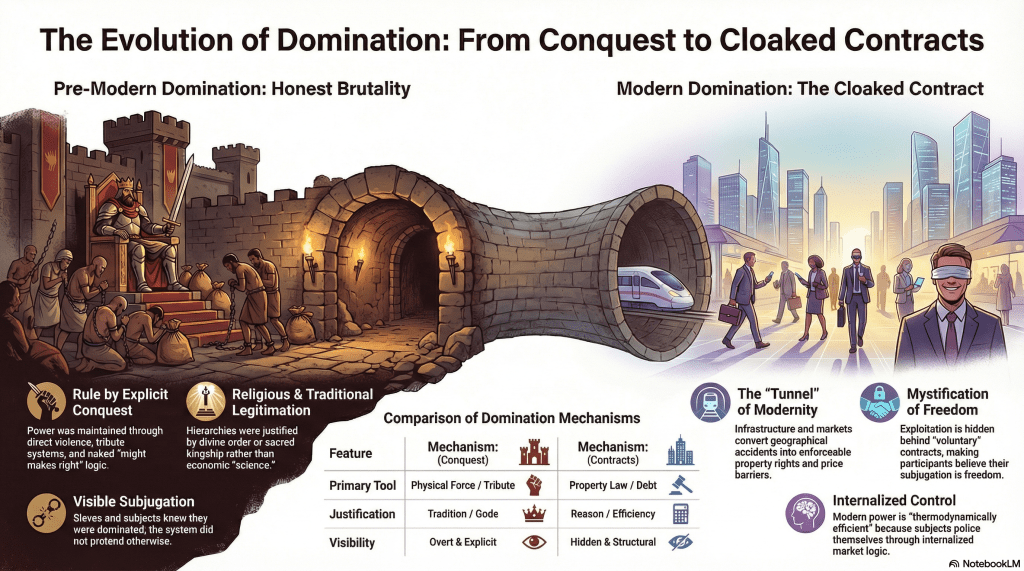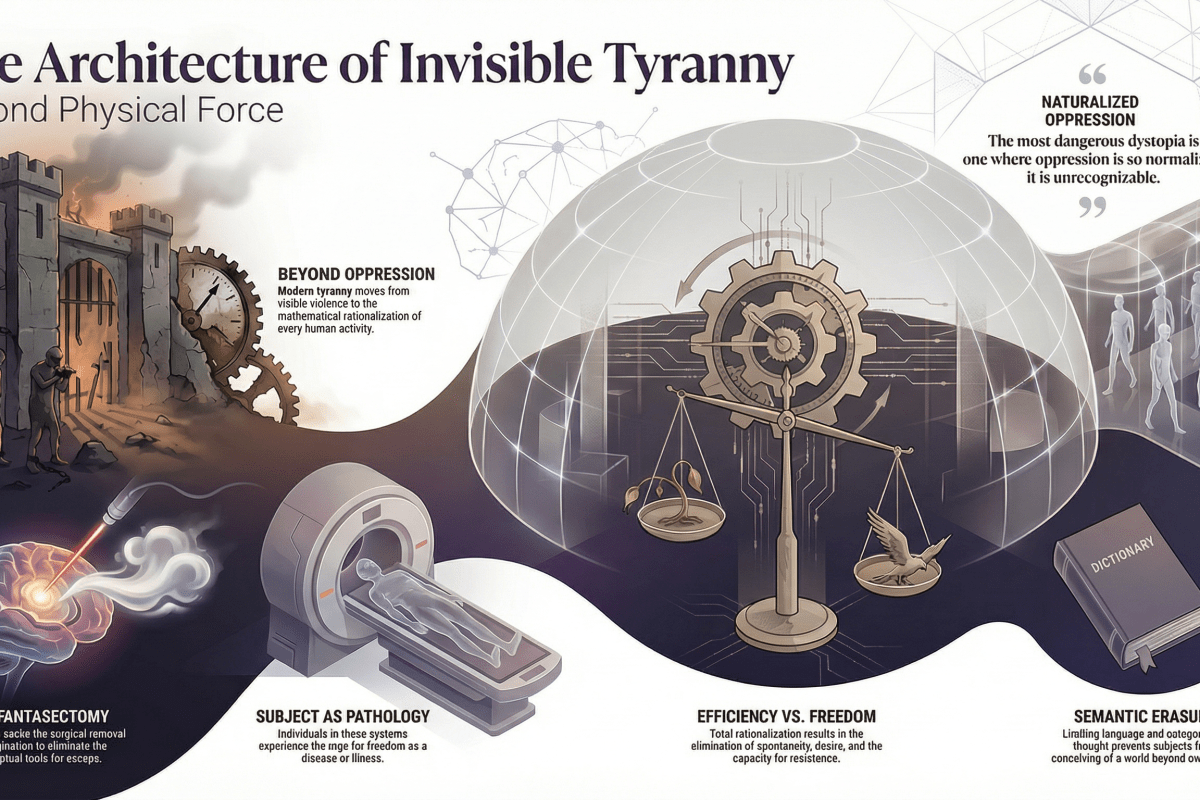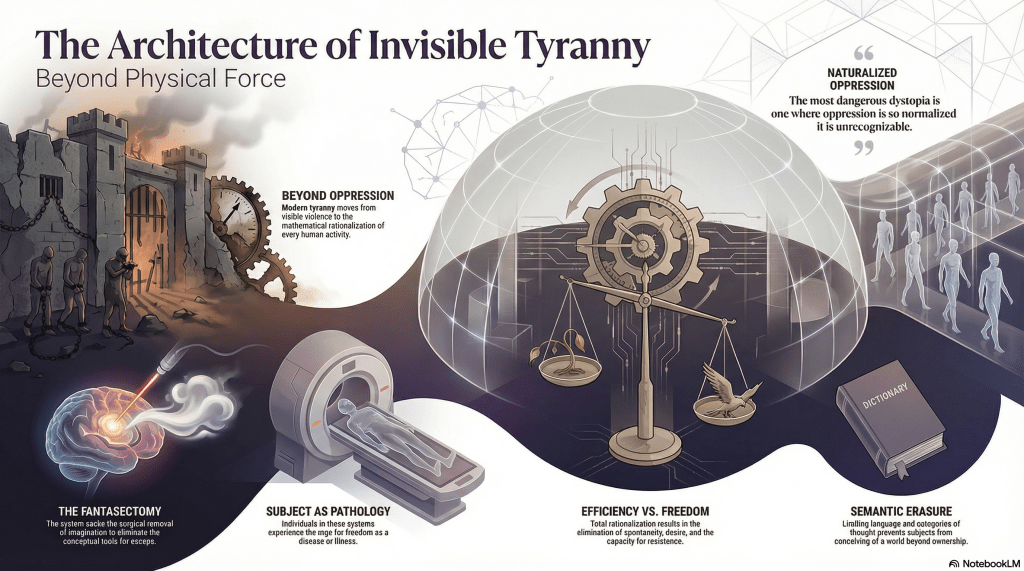
As the publication date of A Language Insufficiency Hypothesis (LIH) draws nearer, I feel it’s a good time to promote it (obviously) and to introduce some of the problems it uncovers – including common misperceptions I’ve already heard. Through this feedback, I now understand some of the underlying structural limitations that I hadn’t considered, but this only strengthens my position. As I state at the start of the book, the LIH isn’t a cast-in-stone artefact. Other discoveries will inevitably be made. For now, consider it a way to think about the deficiencies of language, around which remediation strategies can be developed.
Audio: NotebookLM summary podcast of this content.
Let’s clear the undergrowth first. The Language Insufficiency Hypothesis is not concerned with everyday ambiguity, garden-variety polysemy, or the sort of misunderstandings that vanish the moment someone bothers to supply five seconds of context. That terrain is already well-mapped, thoroughly fenced, and frankly dull.
Take the classic sort of example wheeled out whenever someone wants to sound clever without doing much work:
‘I made a 30-foot basket’.
Video: a woman making a large basket
If you’re a basketweaver, you picture an absurdly large basket and quietly question the maker’s life choices. If you’re watching basketball, you hear ‘score’. If you’re anywhere near the context in which the sentence was uttered, the meaning is obvious. If it isn’t, the repair cost is trivial. Add context, move on, live your life.
Language did not fail here. It merely waited for its coat. This is not the sort of thing the LIH loses sleep over.
The Groucho Marx Defence, or: Syntax Is Not the Problem
Logicians and armchair philosophers love to reach for jokes like Groucho Marx’s immortal line:
‘I shot an elephant in my pyjamas. Why it was wearing my pyjamas, I’ll never know’.
Video: A man and elephant in pyjamas (no sound)
Yes, very funny. Yes, the sentence allows for a syntactic misreading. No, nobody actually believes the elephant was lounging about in striped silk. The humour works precisely because the “wrong” parse is momentarily entertained and instantly rejected.
Again, language is not insufficient here. It’s mischievous. There’s a difference.
If the LIH were worried about this sort of thing, its ambitions would be indistinguishable from an undergraduate logic textbook with better branding.
Banks, Rivers, and the Myth of Constant Confusion
Likewise, when someone in a city says, ‘I went to the bank’, no sane listener imagines them strolling along a riverbank, unless they are already knee-deep in pastoral fantasy or French tourism brochures. Context does the heavy lifting. It almost always does.
Video: Rare footage of me trying to withdraw funds at my bank (no sound)
This is not a crisis of meaning. This is language functioning exactly as advertised.
Where the Trouble Actually Starts: Contestables
The LIH begins where these tidy examples stop being helpful. It concerns itself with Contestables: terms like truth, freedom, justice, fairness, harm, equality. Words that look stable, behave politely in sentences, and then detonate the moment you ask two people what they actually mean by them. These are not ambiguous in the casual sense. They are structurally contested.
In political, moral, and cultural contexts, different groups use the same word to gesture at fundamentally incompatible conceptual frameworks, all while assuming a shared understanding that does not exist. The conversation proceeds as if there were common ground, when in fact there is only overlap in spelling.
That’s why attempts to ‘define’ these terms so often collapse into accusation:
That’s not what freedom means. That’s not real justice. You’re redefining truth.
No, the definitions were never shared in the first place. The disagreement was smuggled in with the noun.
‘Just Ignore the Word’ Is Not a Rescue
A common response at this point is to suggest that we simply bypass the troublesome term and discuss the concrete features each party associates with it. Fine. Sensible. Often productive. But notice what this manoeuvre concedes. It does not save the term. It abandons it.
If meaningful discussion can only proceed once the word is set aside and replaced with a list of clarifications, constraints, examples, and exclusions, then the word has already failed at its primary job: conveying shared meaning. This is precisely the point the LIH is making.
The insufficiency is not that language is vague, or flexible, or context-sensitive. It’s that beyond a certain level of conceptual complexity, language becomes a confidence trick. It gives us the feeling of agreement without the substance, the appearance of communication without the transaction.
At that point, words don’t merely underperform. They mislead.
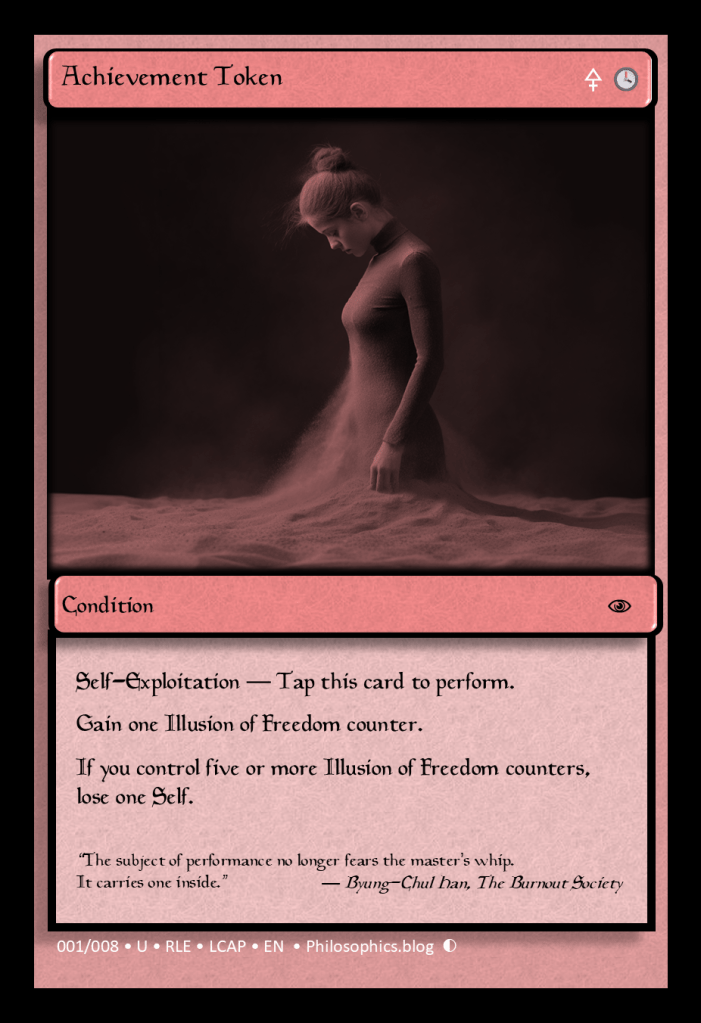
🤔 If liberation now feels indistinguishable from exhaustion, what exactly have we been freed from?
Image: Exhaustion means you’re working hard, and working hard means you’re good.
Han’s slender essay reads like a diagnosis of our psychic economy. The disciplinary society of ‘thou shalt’ has dissolved into the achievement society of ‘yes, I can’. We no longer rebel against authority; we internalise it, polishing our exhaustion until it gleams like ambition. Productivity replaces purpose. Rest becomes guilt. The subject, stripped of exterior constraint, now self-flagellates in the name of freedom.
We exploit ourselves and think we are free.
What Han captures is not mere fatigue but a civilisational pathology: the compulsion to optimise the self as though it were capital. Burnout is not the collapse of will but the logical conclusion of unlimited permission.
If liberation now feels indistinguishable from exhaustion, what exactly have we been freed from?
From the series Readings in Late Exhaustion – a Philosophics reflection on the maladies of modernity.
About the Series — Readings in Late Exhaustion
These cards belong to Readings in Late Exhaustion, a Philosophics project tracing the psychic and cultural costs of late capitalism.
Each card interprets a contemporary work of critical theory through the language of collectable gameplay, where identity, labour, and value become quantified acts.
The format itself is the critique: a system of self-expenditure disguised as achievement, reflection rendered as performance.
I maintain this blog for two primary reasons: as an archive, and as a forum for engagement.
Philosophy isn’t a mass-market pursuit. Most people are content simply to make it through the day without undue turbulence, and I can hardly blame them. Thinking deeply is not an act of leisure; it’s a luxury product, one that Capitalism would rather you didn’t afford. Even when I’ve been employed, I’ve noticed how wage labour chokes the capacity for art and thought. Warhol may have monetised the tension, but most of us merely survive it.
Video: Sprouting seed. (No audio)
That’s why I value engagement – not the digital pantomime of ‘likes’ or ‘shares’, but genuine dialogue. The majority will scroll past without seeing. A few will skim. Fewer still will respond. Those who do – whether to agree, dissent, or reframe – remind me why this space exists at all.
To Jason, Julien, Jim, Lance, Nick, and especially Homo Hortus, who has been conversing beneath the recent Freedom post: your engagement matters. You help me think differently, sometimes introducing writers or ideas I hadn’t encountered. We may share only fragments of perspective, but difference is the point. It widens the aperture of thought – provided I can avoid tumbling into the Dunning-Kruger pit.
And now, a note of quiet satisfaction. A Romanian scholar recently cited my earlier essay, the Metanarrative Problem, in a piece titled Despre cum metanarațiunile construiesc paradigma și influențează răspunsurile emoționale – translation: On How Grand Narratives Shape Paradigms and Condition Our Emotional Responses. That someone, somewhere, found my reflections useful enough to reference tells me this exercise in public thinking is doing what it should: planting seeds in unpredictable soil.
Freedom is a word so overused it’s practically anaemic. Everyone wants it; no one agrees on what it means. It’s been weaponised by tyrants and revolutionaries alike, invoked to justify both the breaking of chains and their reforging in a different metal.
Audio: NotebookLM podcast on this topic.
As I write this, I have just finished Erich Fromm’s A Sane Society. Without derailing this post, he cited a scenario – a description of work communities given in All Things Common, by Claire Huchet Bishop – where in post-WW2 France, a group formed a sort of workers’ coöperative – but it was more than that; it was an anarchosyndicalist experiment. As I read it, I had to cringe at the power ‘voluntary’ transfers that immediately got me thinking of Foucault’s biopower – as I often do. Saving this for a separate post.
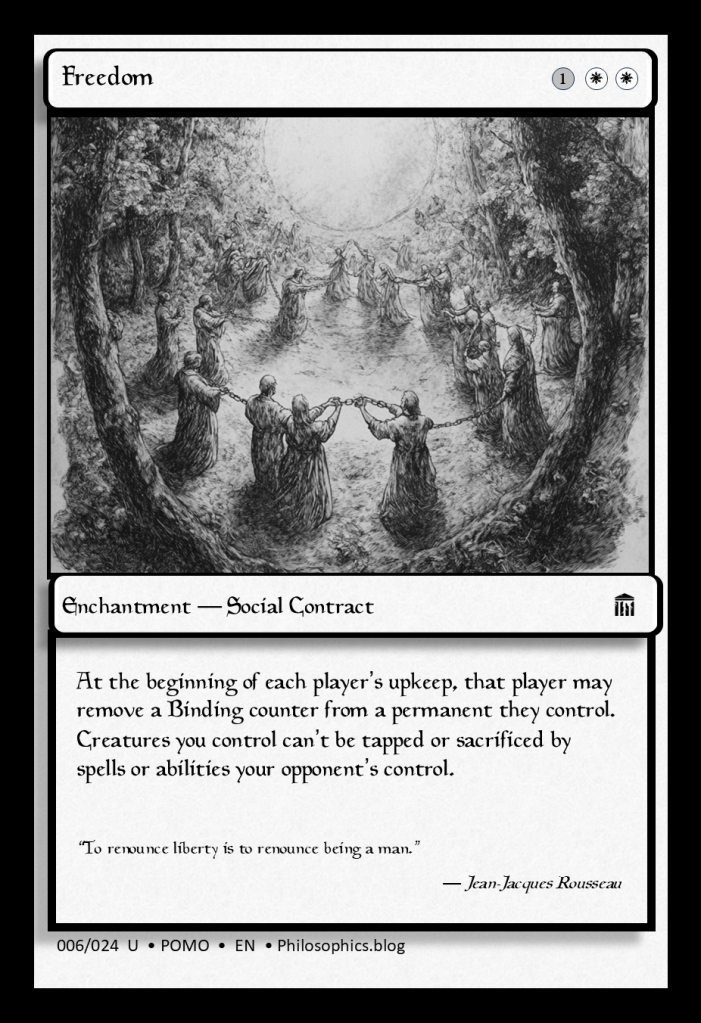
Image: Freedom: The Chains That Bind Us Together Card 006 from the Postmodern Set – Philosophics.blog
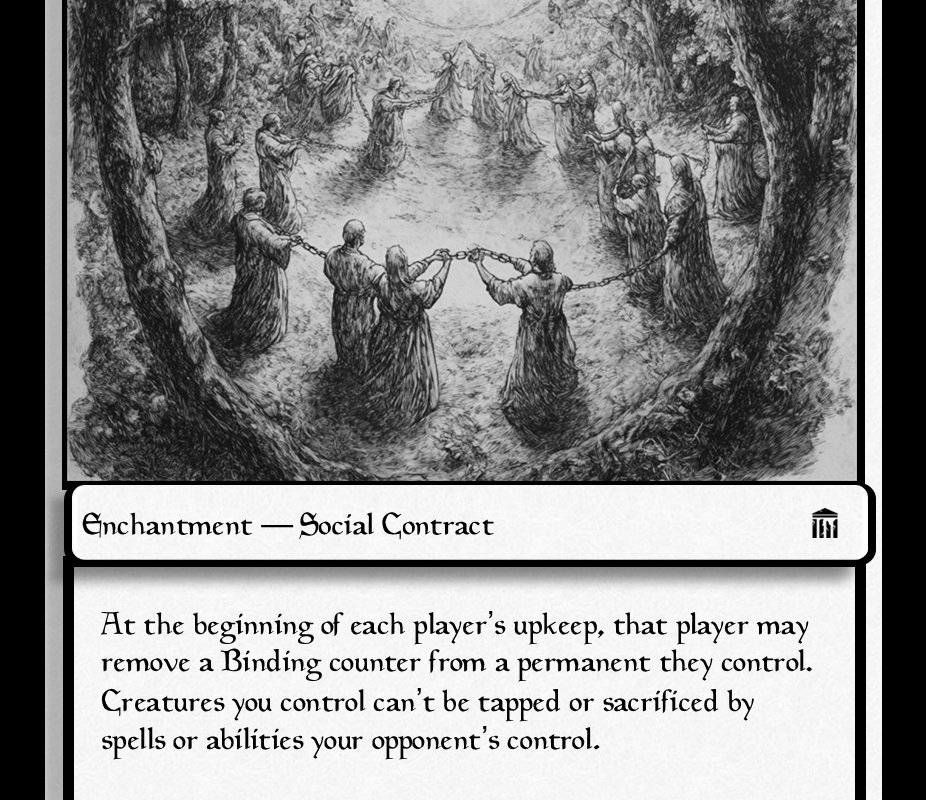
This Critical Theory parody card, Freedom, draws its lineage from Jean-Jacques Rousseau, whose paradox still haunts the modern condition: “Man is born free, and everywhere he is in chains.” The card re-enchants that contradiction – an Enchantment – Social Contract that reminds us liberty isn’t a state but a negotiation.
The card reads:
At the beginning of each player’s upkeep, that player may remove a Binding counter from a permanent they control. Creatures you control can’t be tapped or sacrificed by spells or abilities your opponent controls.
This is Rousseau’s dilemma made mechanical. Freedom is not absolute; it’s procedural. The upkeep represents the maintenance of the social contract—an ongoing renewal, not a one-time event. Every player begins their turn by negotiating what freedom costs. You may remove one Binding counter, but only if you recognise that binding exists.
The flavour text underlines Rousseau’s plea:
“To renounce liberty is to renounce being a man.”
Freedom, for Rousseau, wasn’t about doing whatever one pleased. It was about participating in the moral and civic order that gives action meaning. To exist outside that order is not liberty; it’s anarchy, the tyranny of impulse.
The card, therefore, resists the naïve libertarian reading of freedom as the absence of restraint. It instead depicts freedom as the capacity to act within and through shared constraints.
Freedom, then, is not the absence of chains, but the power to choose which ones we wear.
— Philosophics.blog
The art shows a ring of robed figures, hand in hand, their chains forming a circle beneath a clearing sky. It’s a haunting image: freedom through fellowship, bondage through unity. The circle symbolises Rousseau’s idea that true liberty emerges only when individuals subordinate selfish will to the general will – the common interest formed through collective agreement.
Yet there’s also a postmodern irony here: circles can be prisons too. The social contract can emancipate or suffocate, depending on who wrote its terms. The same chains that protect can also bind.
The monochrome aesthetic amplifies the ambiguity – freedom rendered in greyscale, neither utopia nor despair, but the space in between.
Rousseau’s notion of the social contract was revolutionary, but its dissonance still resonates: how can one be free and bound at the same time? He answered that only through the voluntary participation in a collective moral order can humans transcend mere instinct.
We might say that today’s democracies still operate under Freedom (Enchantment – Social Contract). We maintain our rights at the cost of constant negotiation: legal, social, linguistic. Every “Binding counter” removed is the product of civic upkeep. Stop maintaining it, and the enchantment fades.
The card hints at the price of this enchantment: creatures (citizens) can’t be tapped or sacrificed by opponents’ control. In other words, autonomy is secured only when the system prevents external domination. But systems fail, and when they do, the illusion of freedom collapses into coercion.
Rousseau earns a complicated respect in my philosophical canon. He’s not in my top five, but he’s unavoidable. His concept of freedom through the social contract anticipates both modern liberalism and its critique. He believed that genuine liberty required moral community – a notion now eroded by hyper-individualism.
Freedom, as I’ve rendered it here, isn’t celebration. It’s lamentation. The card is about the fragility of the social spell that keeps chaos at bay. We remove one binding at a time, hoping not to unbind ourselves entirely.
Besmet, a Belgian psychologist with a background in statistics, begins not with tyranny but with epistemology – with how the Enlightenment’s dream of objectivity curdled into the managerial nightmare we now inhabit. The first half of the book reads like a slow unmasking of Scientism: how numbers became our gods, and graphs, our catechisms.
Written before COVID-19 but finished during it, his argument turns pandemic data into theatre – a performance of certainty masking deep confusion. The daily tally became ritual sacrifice to the idol of ‘evidence-based’ policy. His point, and mine, is that totalitarianism no longer needs gulags; it thrives in dashboards and KPIs.
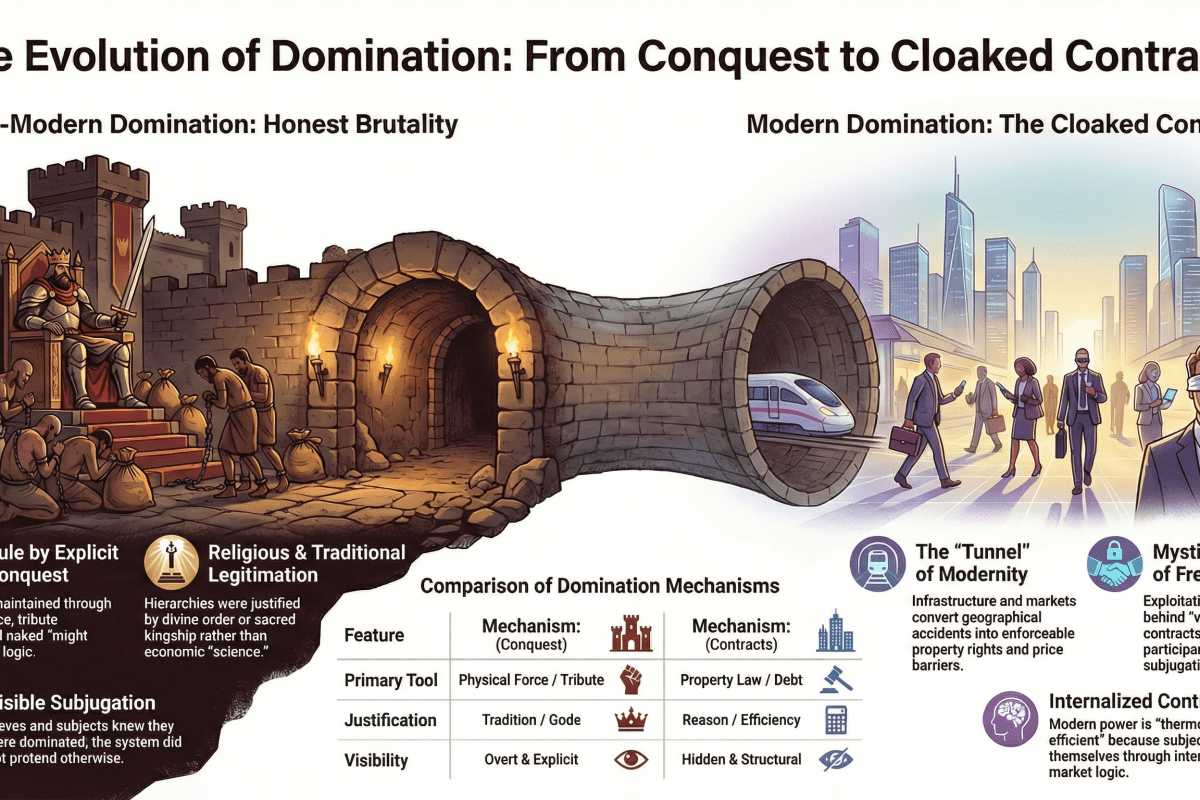
Desmet’s frame intersects beautifully with my own thesis: that obedience today is internalised as reasonableness. Freedom has been recast as compliance with ‘the data’. We surrender willingly, provided the orders come in statistical form.
This is why even Agile™ management and its fetish of ‘velocity’ reek of the same mechanistic faith. Every sprint promises deliverance through quantification; every retrospective is a bureaucratic confession of inefficiency. The cult of metrics is not merely a managerial fad – it is the metaphysics of our time. The problem is at once ontological and epistemological: we mistake the measure for the thing itself, and in doing so, become measurable.
It’s a rare pleasure to encounter a fellow dissident of the numerical faith – a man who sees that the spreadsheet has replaced the sceptre.
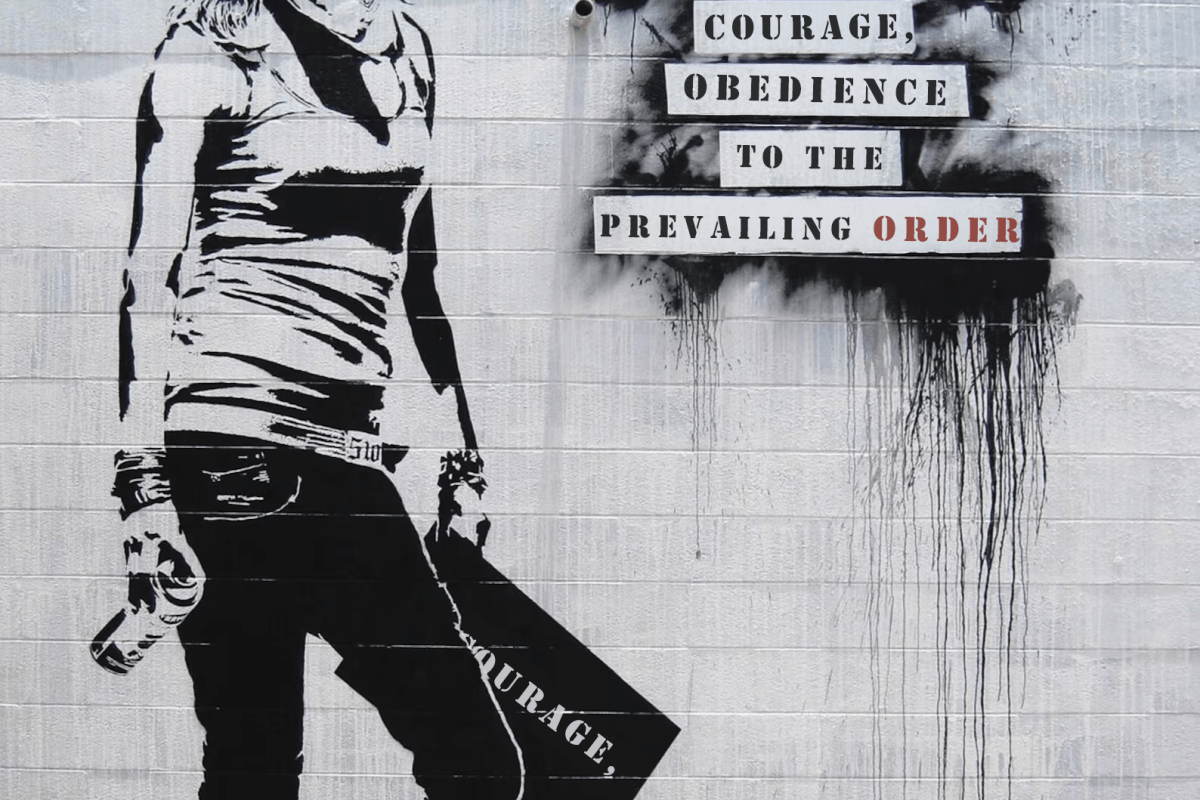
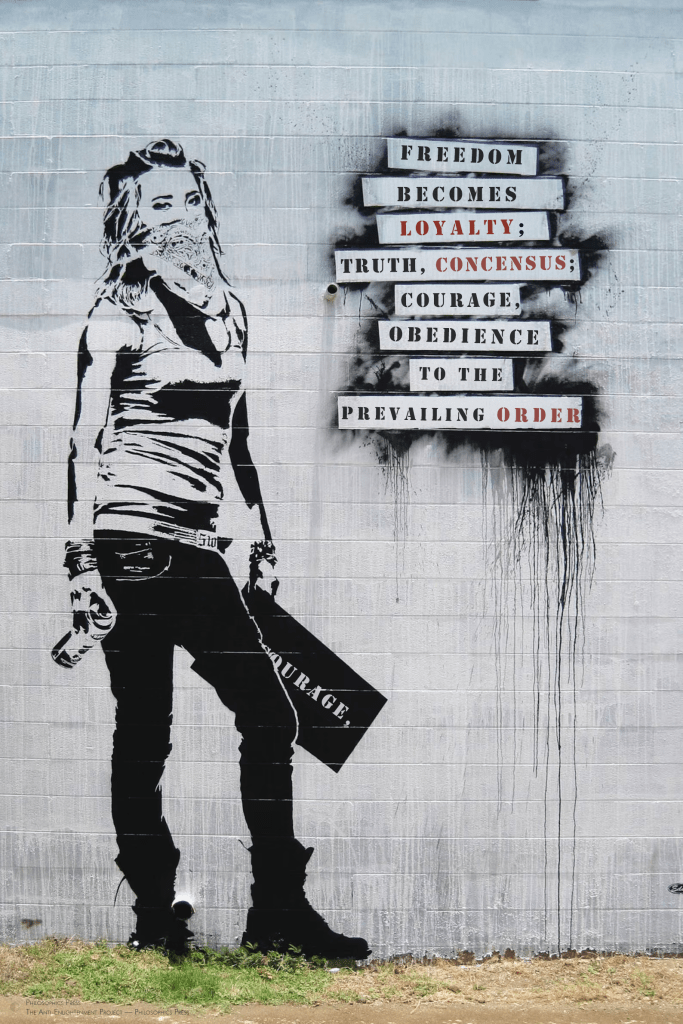
I decided to create some social media sharing content, so I appropriated this iconic graffiti and repurposed it to promote The Will to Be Ruled essay.
Image: “Freedom becomes loyalty; truth, consensus; courage, obedience to the prevailing order.”
I intend to find some pull quotes I like and continue drafting promotional material. As these are essays, I derive no income from them. I only wish to spread the word and get comments on them – supportive or detracting; it doesn’t matter.
I’ve just added a new entry to my Anti-Enlightenment corpus, bringing the total to seven – not counting my latest book, The Illusion of Light, that summarises the first six essays and places them in context. This got me thinking about what aspects of critique I might be missing. Given this, what else might I be missing?
Audio: NotebookLM podcast discussion of this topic.
So far, I’ve touched on the areas in the top green table and am considering topics in the bottom red/pink table:
Summary Schema – The Anti-Enlightenment Project – Published Essays
Axis
Core Question
Representative Essay(s)
Epistemic
What counts as “truth”?
Objectivity Is Illusion: An Operating Model of Social and Moral Reasoning
Political
What holds power together?
Rational Ghosts: Why Enlightenment Democracy Was Built to Fail; Temporal Ghosts: Tyranny of the Present
Psychological
Why do subjects crave rule?
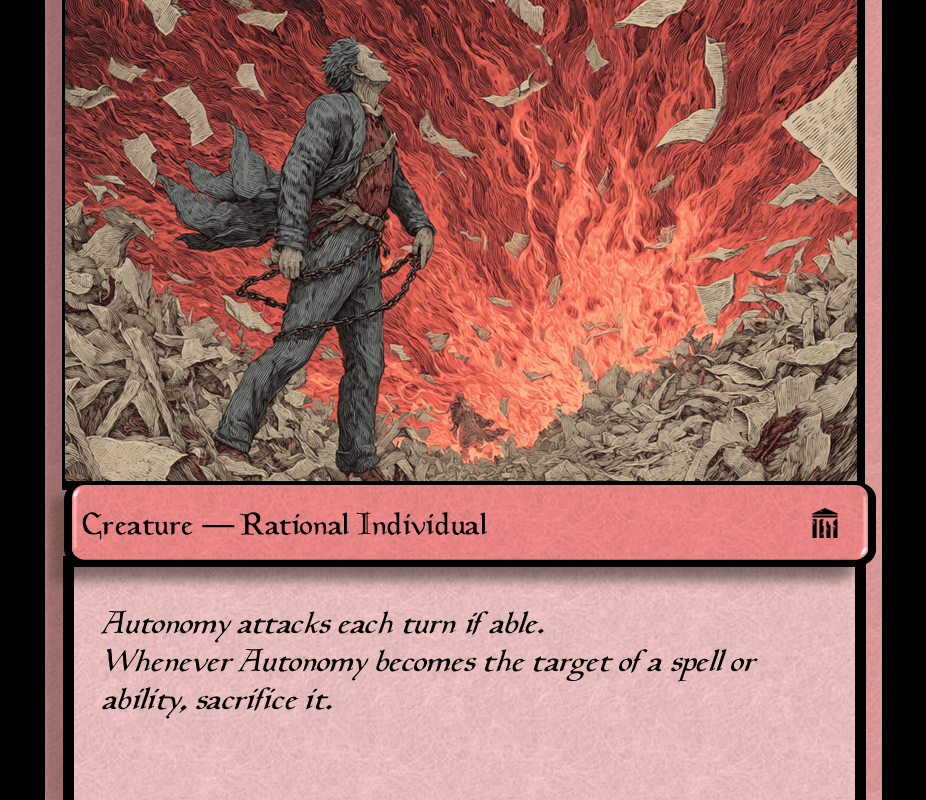
Against Agency: The Fiction of the Autonomous Self; The Will to Be Ruled: Totalitarianism and the Fantasy of Freedom
Anthropological
What makes a “normal” human?
The Myth of Homo Normalis: Archaeology of the Legible Human
Ethical
How to live after disillusionment?
The Discipline of Dis-Integration: Philosophy Without Redemption
Summary Schema – The Anti-Enlightenment Project – Unpublished Essays
Axis
Core Question
Representative Essay
Theological (Metaphysical)
What remains sacred once transcendence is dismantled?
The Absent God: Metaphysics After Meaning
Aesthetic (Affective)
How did beauty become moral instruction?
The Aesthetic Contract: Beauty as Compliance
Ecological (Post-Human)
What happens when the world refuses to remain in the background?
1. Objectivity Is Illusion: An Operating Model of Social and Moral Reasoning
Published September 2025
Objectivity, in the social and moral sense, is a performance – a consensus mechanism mistaken for truth. This essay maps how “objectivity” operates as a scaffold for Enlightenment rationality, masking moral preference as neutral judgment. It introduces a five-premise model showing that what we call objectivity is merely sustained agreement under shared illusions of coherence. The argument reframes moral reasoning as provisional and participatory rather than universal or fixed.
2. Rational Ghosts: Why Enlightenment Democracy Was Built to Fail
Published October 2025 The Enlightenment built democracy for rational ghosts – imagined citizens who never existed. This essay dissects six contradictions at the foundation of “rational” governance and shows why democracy’s collapse was prewritten in its metaphysics. From mathematical impossibility to sociological blindness, it charts the crisis of coherence that modern politics still calls freedom. → Read on Zenodo
3. Temporal Ghosts: Tyranny of the Present
Published October 2025 Modern democracies worship the now. This essay examines presentism – the systemic bias toward immediacy – as a structural flaw of Enlightenment thinking. By enthroning rational individuals in perpetual “decision time,” modernity erased the unborn from politics. What remains is a political theology of the short term, collapsing both memory and imagination. → Read on Zenodo
4. Against Agency: The Fiction of the Autonomous Self
Published October 2025 “Agency” is not a metaphysical faculty – it’s an alibi. This essay dismantles the myth of the autonomous self and reframes freedom as differential responsiveness: a gradient of conditions rather than a binary of will. Drawing on philosophy, neuroscience, and decolonial thought, it argues for ethics as maintenance, not judgment, and politics as condition-stewardship. → Read on Zenodo
5. The Discipline of Dis-Integration: Philosophy Without Redemption
Published October 2025
This essay formalises Dis-Integrationism – a philosophical method that refuses synthesis, closure, and the compulsive need to “make whole.” It traces how Enlightenment reason, deconstruction, and therapy culture all share a faith in reintegration: the promise that what’s fractured can be restored. Against this, Dis-Integrationism proposes care without cure, attention without resolution – a discipline of maintaining the broken as broken. It closes the Anti-Enlightenment loop by turning critique into a sustained practice rather than a path to redemption.
6. The Myth of Homo Normalis: Archaeology of the Legible Human
Published October 2025
Modernity’s most persistent myth is the “normal” human. This essay excavates how legibility – the drive to measure, categorise, and care – became a form of control. From Quetelet’s statistical man to Foucault’s biopower and today’s quantified emotion, Homo Normalis reveals the moral machinery behind normalisation. It ends with an ethics of variance: lucidity without repair, refusal without despair.
7. The Will to Be Ruled: Totalitarianism and the Fantasy of Freedom
Published October 2025
This essay examines how the Enlightenment’s ideal of autonomy contains the seed of its undoing. The rational, self-governing subject – celebrated as the triumph of modernity – proves unable to bear the solitude it creates. As freedom collapses into exhaustion, the desire for direction re-emerges as devotion. Drawing on Fromm, Arendt, Adorno, Reich, Han, and Desmet, The Will to Be Ruled traces the psychological gradient from fear to obedience, showing how submission is moralised as virtue and even experienced as pleasure. It concludes that totalitarianism is not a deviation from reason but its consummation, and that only through Dis-Integrationism – an ethic of maintenance rather than mastery – can thought remain responsive as the light fades.
Axis: Theological / Metaphysical Core Question: What remains sacred once transcendence is dismantled?
Concept: This essay would trace how Enlightenment humanism replaced God with reason, only to inherit theology’s structure without its grace. It might read Spinoza, Kant’s moral law, and modern technocracy as secularised metaphysics – systems that still crave universal order. Goal: To show that disenchantment never erased faith; it simply redirected worship toward cognition and control. Possible subtitle:The Enlightenment’s Unconfessed Religion.
9. The Aesthetic Contract: Beauty as Compliance
Axis: Aesthetic / Affective Core Question: How did beauty become moral instruction?
Concept: From Kant’s Critique of Judgment to algorithmic taste cultures, aesthetic judgment serves social order by rewarding harmony and punishing dissonance. This essay would expose the politics of form – how beauty trains attention and regulates emotion. Goal: To reclaim aesthetics as resistance, not refinement. Possible subtitle:Why Modernity Needed the Beautiful to Behave.
10. The Uncounted World: Ecology and the Non-Human
Axis: Ecological / Post-Human Core Question: What happens when the world refuses to remain background?
Concept: Here you dismantle the Enlightenment split between subject and nature. From Cartesian mechanism to industrial rationalism, the natural world was cast as resource. This essay would align Dis-Integrationism with ecological thinking – care without mastery extended beyond the human. Goal: To reframe ethics as co-maintenance within an unstable biosphere. Possible subtitle:Beyond Stewardship: Ethics Without Anthropos.
11. The Fractured Tongue: Language Against Itself
Axis: Linguistic / Semiotic Core Question: How does language betray the clarity it promises?
Concept: Every Anti-Enlightenment text already hints at this: language as both the instrument and failure of reason. Drawing on Nietzsche, Derrida, Wittgenstein, and modern semiotics, this essay could chart the entropy of meaning – the collapse of reference that makes ideology possible. Goal: To formalise the linguistic fragility underlying every rational system. Possible subtitle:The Grammar of Collapse.
12. The Vanished Commons: Between Isolation and Herd
Axis: Communal / Social Ontology Core Question: Can there be community without conformity?
Concept: This would return to the psychological and political threads of The Will to Be Ruled, seeking a space between atomised autonomy and synchronized obedience. It might turn to Arendt’s notion of the world between us or to indigenous and feminist relational models. Goal: To imagine a non-totalitarian togetherness – a responsive collective rather than a collective response. Possible subtitle:The Ethics of the Incomplete We.
* These essays may never be published, but I share this here as a template to further advance the Anti-Enlightenment project and fill out the corpus.
Modern liberal democracies still chant the Enlightenment’s refrain: the rational, self-governing individual acting freely within a moral order of their own design. It’s an elegant myth – until the self begins to wobble. Under economic, cultural, and epistemic strain, autonomy curdles into exhaustion, and exhaustion seeks relief in obedience.
Audio: NotebookLM podcast of this essay. Please note that this audio summarises the entire essay. As such, it’s also longer than most, coming in at just under 40 minutes. I listened to it, and I feel it does a good job of capturing the essences of the essay. Of course, you could read the essay more quickly, but the perspective may still be helpful.
This essay traces that drift – from the Enlightenment’s causa sui complex to the ecstatic submission that defines modern authoritarianism. Drawing on Fromm, Arendt, Adorno, Reich, Han, and Desmet, it explores how freedom’s rhetoric becomes its opposite: obedience moralised as virtue, conformity sold as courage, submission experienced as pleasure.
At its core, The Will to Be Ruled argues that totalitarianism is not the antithesis of Enlightenment reason but its fulfilment. Once the world is rendered intelligible only through rational mastery, the subject inevitably longs to be mastered in return.
The closing section introduces Dis-Integrationism – a philosophical stance that declines redemption, preferring maintenance over mastery. It offers no cure, only the small ethic of attentiveness: keeping the field responsive while the light fades.
In the late 1990s, the Wachowskis gave us The Matrix – Keanu Reeves as Neo, the Chosen One™, a man so bland he could be anyone, which was the point. Once he realised he was living inside a simulation, he learned to bend its laws, to dodge bullets in slow motion and see the code behind the curtain. Enlightenment, Hollywood-style.
Audio: NotebookLM podcast on this topic.
But here’s the twist, the film itself couldn’t stomach: realising the simulation doesn’t free you from it.
Knowing that race and gender are social constructs doesn’t erase their architecture. Knowing that our economies, legal systems, and so-called democracies are fictions doesn’t get us out of paying taxes or playing our assigned roles. “The social contract” is a collective hallucination we agreed to before birth. That and a dollar still won’t buy you a cup of coffee.
Baudrillard, whose Simulacra and Simulation the film name-dropped like a trophy, argued that simulation doesn’t hide reality – it replaces it. When representation becomes indistinguishable from the thing it represents, truth evaporates, leaving only consensus. We don’t live in a system of power; we live in its performance.
The Matrix got the metaphor half right. It imagined the bars of our cage as a digital dream – glossy, computable, escapable. But our chains are older and subtler. Rousseau called them “social”, Foucault diagnosed them as “biopolitical”, and the rest of us just call them “normal”. Power doesn’t need to plug wires into your skull; it only needs to convince you that the socket is already there.
You can know it’s all a fiction. You can quote Derrida over your morning espresso and tweet about the collapse of epistemic certainty. It won’t change the fact that you still have rent to pay, laws to obey, and identities to perform. Awareness isn’t liberation; it’s just higher-resolution despair with better UX.
Neo woke up to a ruined Earth and thought he’d escaped. He hadn’t. He’d only levelled up to the next simulation – the one called “reality”. The rest of us are still here, dutifully maintaining the system, typing in our passwords, and calling it freedom.
NB: Don’t get me wrong. I loved The Matrix when it came out. I still have fond memories. It redefined action films at the time. I loved the Zen messaging, but better mental acuity doesn’t grant you a pass out of the system.