Having just finished Never Let Me Go by Kazuo Ishiguro, I’ve now cracked open my first taste of Cioran—History and Utopia. You might reasonably ask why. Why these two? And what, if anything, do they have in common? Better yet—what do the three of us have in common?
Audio: NotebookLM podcast on this topic.
Recently, I finished writing a novella titled Propensity (currently gathering metaphorical dust on the release runway). Out of curiosity—or narcissism—I fed it to AI and asked whose style it resembled. Among the usual suspects were two names I hadn’t yet read: Ishiguro and Cioran. I’d read the others and understood the links. These two, though, were unknown quantities. So I gave them a go.
Ishiguro is perhaps best known for The Remains of the Day, which, like Never Let Me Go, got the Hollywood treatment. I chose the latter, arbitrarily. I even asked ChatGPT to compare both books with their cinematic counterparts. The AI was less than charitable, describing Hollywood’s adaptations as bastardised and bowdlerised—flattened into tidy narratives for American palates too dim to digest ambiguity. On this, we agree.
What struck me about Never Let Me Go was its richly textured mundanity. That’s apparently where AI saw the resemblance to Propensity. I’m not here to write a book report—partly because I detest spoilers, and partly because summaries miss the point. It took about seven chapters before anything ‘happened’, and then it kept happening. What had at first seemed like a neurotic, wandering narrative from the maddeningly passive Kathy H. suddenly hooked me. The reveals began to unfold. It’s a book that resists retelling. It demands firsthand experience. A vibe. A tone. A slow, aching dread.
Which brings me neatly to Cioran.
History and Utopia is a collection of essays penned in French (not his mother tongue, but you’d never guess it) while Cioran was holed up in postwar Paris. I opted for the English translation—unapologetically—and was instantly drawn in. His prose? Electric. His wit? Acidic. If Ishiguro was a comparison of style, then Cioran was one of spirit. Snark, pessimism, fatalistic shrugs toward civilisation—finally, someone speaking my language.
Unlike the cardboard cut-outs of Cold War polemics we get from most Western writers of the era, Cioran’s take is layered, uncomfortably self-aware, and written by someone who actually fled political chaos. There’s no naïve idealism here, no facile hero-villain binaries. Just a deeply weary intellect peering into the abyss and refusing to blink. It’s not just what he says, but the tone—the curled-lip sneer at utopian pretensions and historical self-delusions. If I earned even a drop of that comparison, I’ll take it.
Both Ishiguro and Cioran delivered what I didn’t know I needed: the reminder that some writers aren’t there to tell you a story. They’re there to infect you with an atmosphere. An idea. A quiet existential panic you can’t shake.
I’ve gotten what I came for from these two, though I suspect I’ll be returning, especially to Cioran. Philosophically, he’s my kind of bastard. I doubt this’ll be my last post on his work.
I’ve recently decided to take a sabbatical from what passes for economic literature these days — out of a sense of self-preservation, mainly — but before I hermetically sealed myself away, I made a quick detour through Jorge Luis Borges’ The Library of Babel (PDF). Naturally, I emerged none the wiser, blinking like some poor subterranean creature dragged into the daylight, only to tumble headlong into David Graeber’s Bullshit Jobs.
This particular tome had been languishing in my inventory since its release, exuding a faint but persistent odour of deferred obligation. Now, about a third of the way in, I can report that Graeber’s thesis — that the modern world is awash with soul-annihilatingly pointless work — does resonate. I find myself nodding along like one of those cheap plastic dashboard dogs. Yet, for all its righteous fury, it’s more filler than killer. Directionally correct? Probably. Substantively airtight? Not quite. It’s a bit like admiring a tent that’s pitched reasonably straight but has conspicuous holes large enough to drive a fleet of Uber Eats cyclists through.
An amusing aside: the Spanish edition is titled Trabajos de mierda (“shitty jobs”), a phrase Graeber spends an entire excruciating section of the book explaining is not the same thing. Meanwhile, the French, in their traditional Gallic shrug, simply kept the English title. (One suspects they couldn’t be arsed.)
Chapter One attempts to explain the delicate taxonomy: bullshit jobs are fundamentally unnecessary — spawned by some black magic of bureaucracy, ego, and capitalist entropy — whilst shit jobs are grim, thankless necessities that someone must do, but no one wishes to acknowledge. Tragically, some wretches get the worst of both worlds, occupying jobs that are both shit and bullshit — a sort of vocational purgatory for the damned.
Then, in Chapter Two, Graeber gleefully dissects bullshit jobs into five grotesque varieties:
Flunkies, whose role is to make someone else feel important.
Goons, who exist solely to fight other goons.
Duct Tapers, who heroically patch problems that ought not to exist in the first place.
Box Tickers, who generate paperwork to satisfy some Kafkaesque demand that nobody actually reads.
Taskmasters, who either invent unnecessary work for others or spend their days supervising people who don’t need supervision.
Naturally, real-world roles often straddle several categories. Lucky them: multi-classed in the RPG of Existential Futility.
Graeber’s parade of professional despair is, admittedly, darkly entertaining. One senses he had a great deal of fun cataloguing these grotesques — like a medieval monk illustrating demons in the margins of a holy text — even as the entire edifice wobbles under the weight of its own repetition. Yes, David, we get it: the modern economy is a Potemkin village of invented necessity. Carry on.
If the first chapters are anything to go by, the rest of the book promises more righteous indignation, more anecdotes from anonymous sad-sacks labouring in existential oubliettes, and — if one is lucky — perhaps a glimmer of prescription hidden somewhere amidst the diagnosis. Though, I’m not holding my breath. This feels less like an intervention and more like a well-articulated primal scream.
Still, even in its baggier moments, Bullshit Jobs offers the grim pleasure of recognition. If you’ve ever sat through a meeting where the PowerPoint had more intellectual integrity than the speaker or spent days crafting reports destined for the corporate oubliette marked “For Review” (translation: Never to Be Seen Again), you will feel seen — in a distinctly accusatory, you-signed-up-for-this sort of way.
In short: it’s good to read Graeber if only to have one’s vague sense of societal derangement vindicated in print. Like having a charmingly irate friend in the pub lean over their pint and mutter, “It’s not just you. It’s the whole bloody system.”
I’m not sure I’ll stick with this title either. I think I’ve caught the brunt of the message, and it feels like a diversion. I’ve also got Yanis Varoufakis’ Technofeudalism: What Killed Capitalism on the shelf. Perhaps I’ll spin this one up instead.
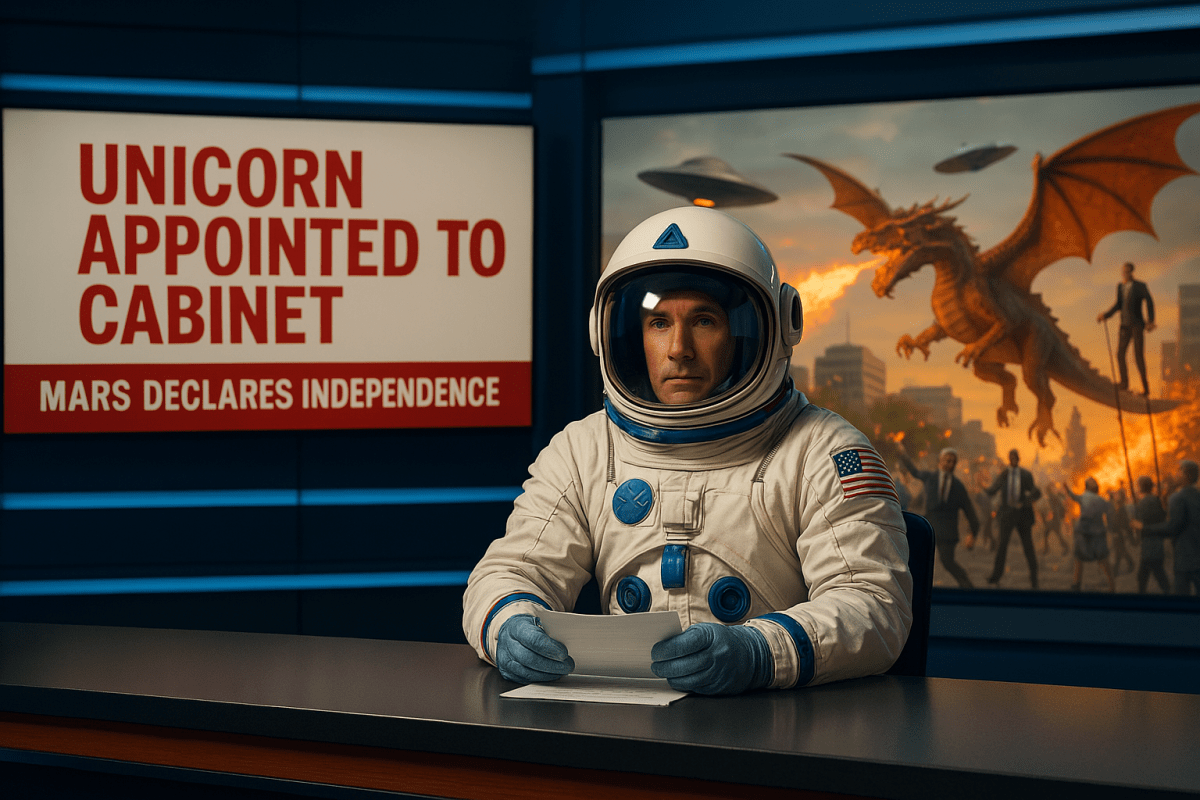
Once upon a time — which is how all good fairy tales begin — suspension of disbelief was a tidy little tool we used to indulge in dragons, space travel, talking animals, and the idea that people in rom-coms have apartments that match their personalities and incomes. It was a temporary transaction, a gentleman’s agreement, a pact signed between audience and creator with metaphorical ink: I know this is nonsense, but I’ll play along if you don’t insult my intelligence.
Audio: NotebookLM podcast of this page content.
This idea, famously coined by Samuel Taylor Coleridge as the “willing suspension of disbelief,” was meant to give art its necessary air to breathe. Coleridge’s hope was that audiences would momentarily silence their rational faculties in favour of emotional truth. The dragons weren’t real, but the heartbreak was. The ghosts were fabrications, but the guilt was palpable.
But that was then. Before the world itself began auditioning for the role of absurdist theatre. Before reality TV became neither reality nor television. Before politicians quoted memes, tech CEOs roleplayed as gods, and conspiracy theorists became bestsellers on Amazon. These days, suspension of disbelief is no longer a leisure activity — it’s a survival strategy.
The Fictional Contract: Broken but Not Forgotten
Traditionally, suspension of disbelief was deployed like a visitor’s badge. You wore it when entering the imagined world and returned it at the door on your way out. Fiction, fantasy, speculative fiction — they all relied on that badge. You accepted the implausible if it served the probable. Gandalf could fall into shadow and return whiter than before because he was, after all, a wizard. We were fine with warp speed as long as the emotional logic of Spock’s sacrifice made sense. There were rules — even in rule-breaking.
The genres varied. Hard sci-fi asked you to believe in quantum wormholes but not in lazy plotting. Magical realism got away with absurdities wrapped in metaphor. Superhero films? Well, their disbelief threshold collapsed somewhere between the multiverse and the Bat-credit card.
Still, we always knew we were pretending. We had a tether to the real, even when we floated in the surreal.
But Then Real Life Said, “Hold My Beer.”
At some point — let’s call it the twenty-first century — the need to suspend disbelief seeped off the screen and into the bloodstream of everyday life. News cycles became indistinguishable from satire (except that satire still had editors). Headlines read like rejected Black Mirror scripts. A reality TV star became president, and nobody even blinked. Billionaires declared plans to colonise Mars whilst democracy quietly lost its pulse.
We began to live inside a fiction that demanded that our disbelief be suspended daily. Except now, it wasn’t voluntary. It was mandatory. If you wanted to participate in public life — or just maintain your sanity — you had to turn off some corner of your rational mind.
You had to believe, or pretend to, that the same people calling for “freedom” were banning books. That artificial intelligence would definitely save us, just as soon as it was done replacing us. That social media was both the great democratiser and the sewer mainline of civilisation.
The boundary between fiction and reality? Eroded. Fact-checking? Optional. Satire? Redundant. We’re all characters now, improvising in a genreless world that refuses to pick a lane.
Cognitive Gymnastics: Welcome to the Cirque du Surréalisme
What happens to a psyche caught in this funhouse? Nothing good.
Our brains, bless them, were designed for some contradiction — religion’s been pulling that trick for millennia — but the constant toggling between belief and disbelief, trust and cynicism, is another matter. We’re gaslit by the world itself. Each day, a parade of facts and fabrications marches past, and we’re told to clap for both.
Cognitive dissonance becomes the default. We scroll through doom and memes in the same breath. We read a fact, then three rebuttals, then a conspiracy theory, then a joke about the conspiracy, then a counter-conspiracy about why the joke is state-sponsored. Rinse. Repeat. Sleep if you can.
The result? Mental fatigue. Not just garden-variety exhaustion, but a creeping sense that nothing means anything unless it’s viral. Critical thinking atrophies not because we lack the will but because the floodwaters never recede. You cannot analyse the firehose. You can only drink — or drown.
Culture in Crisis: A Symptom or the Disease?
This isn’t just a media problem. It’s cultural, epistemological, and possibly even metaphysical.
We’ve become simultaneously more skeptical — distrusting institutions, doubting authorities — and more gullible, accepting the wildly implausible so long as it’s entertaining. It’s the postmodern paradox in fast-forward: we know everything is a construct, but we still can’t look away. The magician shows us the trick, and we cheer harder.
In a world where everything is performance, authenticity becomes the ultimate fiction. And with that, the line between narrative and news, between aesthetic and actuality, collapses.
So what kind of society does this create?
One where engagement replaces understanding. Where identity is a curated feed. Where politics is cosplay, religion is algorithm, and truth is whatever gets the most shares. We aren’t suspending disbelief anymore. We’re embalming it.
The Future: A Choose-Your-Own-Delusion Adventure
So where does this all end?
There’s a dark path, of course: total epistemic breakdown. Truth becomes just another fandom and reality a subscription model. But there’s another route — one with a sliver of hope — where we become literate in illusion.
We can learn to hold disbelief like a scalpel, not a blindfold. To engage the implausible with curiosity, not capitulation. To distinguish between narratives that serve power and those that serve understanding.
It will require a new kind of literacy. One part media scepticism, one part philosophical rigour, and one part good old-fashioned bullshit detection. We’ll have to train ourselves not just to ask “Is this true?” but “Who benefits if I believe it?”
That doesn’t mean closing our minds. It means opening them with caution. Curiosity without credulity. Wonder without worship. A willingness to imagine the impossible whilst keeping a firm grip on the probable.
In Conclusion, Reality Is Optional, But Reason Is Not
In the age of AI, deepfakes, alt-facts, and hyperreality, we don’t need less imagination. We need more discernment. The world may demand our suspension of disbelief, but we must demand our belief back. In truth, in sense, in each other.
Because if everything becomes fiction, then fiction itself loses its magic. And we, the audience, are left applauding an empty stage.
Lights down. Curtain call. Time to read the footnotes.
I’ve got a confession to make: Science Fiction as a genre doesn’t resonate with me. Neither does Fantasy. I enjoy some fiction, but it seems that it’s primarily Literary Fiction – old-school classics like Dostoyevsky, Tolstoy, Nabokov, Kafka, Barthelme, and the like. Mostly, I prefer non-fiction.
I’ve just finished reading William Gibson’s Neuromancer, having read The Peripheral at the end of last year. To be fair, someone recommended Neal Stephenson’s Snow Crash, which is in the same genre – cyberpunk. I’d been advised that Snow Crash is better written, but I thought it might be best to start at the start of that genre.
[EDIT: After writing this post, I read the first two chapters of Snow Crash. The opening scenes of samurai swords had me thinking I needed to give up on this genre once and for all. But no, this was simple character building—fingers crossed. It quickly—and I do mean quickly—changed into a rapid montage dripping with ironic satire. I was in my element. I’ll take sci-fi wrapped in irony. It’s like stuffing a pill in cheese to trick your pet into taking medicine. I don’t want to jinx it, and I don’t know how Stephenson can control the pacing. I’ll let it unfold, and I hope it lands in a happy place. Now, I feel obliged to end with a motivational message on not giving up.]
These writers have good ideas. It often sounds appealing when someone tells me the plot summary, but the details bore me to tears. When I read reviews of these books, I frequently hear how immersive they are, but to me, they are cluttered and chockablock with minutiae. I find myself prodding, “Just get to the point.” But there has to be more than this. Short stories may fare better. I liked Ursula K LeGuin’s The Ones Who Walk Away from Omelas, but that was more related to its philosophical, anti-utilitarian perspective rather than the story.
It’s not as if Dostoyevsky doesn’t circumlocute and pontificate, but it’s somehow different. I want to like it. I want to read it – first-hand, not just a summary, so I can feel that I’ve engaged with the material.
Over the years, I’ve been consoled by fans of the genre, who say, “I understand. What you need to read is” [fill in the blank]. I read Ender’s Game on this advice.
To be fair, Sci-Fi movies and television don’t resonate with me either. Star Wars? Nope. Star Trek? Nope. Firefly. No, again.
What people find amazing, I find trite. Often, there is some embedded Modernist morality that some view as profound. I roll my eyes. I cringe thinking of old Star Trek episodes about what makes humans so special.
I don’t tend to find movies or television very interesting in general. I’ve never owned a television. My partners always do. “But you watch streaming content,” you say, and you’d be correct. But I watch it on my own time and take a chance, if only to remain connected to contemporary trends.
My last engagement was Arcane on Netflix. I found Season One well done and entertaining, but I’m not sure Anime qualifies as Sci-Fi. I caught The Peripheral on Amazon a couple of months ago, which led me to the book, but they turned out to be different stories, though they were set in the same universe with (generally) the same characters.
I just finished reading How the World Made the West by Josephine Quinn. I don’t tend to read many history books. My last was probably David Graeber’s The Dawn of Everything a few years ago. I appreciate that these books reject the prevailing grand narratives, which is refreshing. My first exposure to this type of historical reporting was likely Howard Zinn’s A People’s History of the United States.
I’ve just ordered an updated translation of The Odyssey by Emily Wilson. I’ve had this on my reading list since before it was published in 2017. I’ve read versions by Robert Fagles and another in high school. I didn’t like the version I read in high school, but high school reading assignments always seemed to suck the life out of everything. The Wilson version updates the language and is presented in Iambic pentametre, which I look forward to reading. I considered reading Fagle’s The Aeneid (Vergil), as I haven’t read that yet, but not today.
I am not going to review Quinn’s book here, but I may do so in the future. I found the book enjoyable and educational. There’s actually some content that I will be adding to my book on Democracy whenever I release it. She employs a first-person plural perspective, which is a nice twist and not o POV I’ve encountered much.
If you appreciate a different view on history from a noted expert, snatch this up. Meantime, I’ll be back to post more presently.
In our exploration of fictions—nations, economies, money, legal systems, and even sports—we have uncovered the profound ways in which these constructs shape our reality. These fictions, born from collective agreements and sustained by shared belief, play pivotal roles in organizing societies, guiding behaviors, and fostering a sense of belonging and purpose. While they may not correspond to an objective, external reality, their effects are undeniably real and impactful.
Recognizing the fictional nature of these constructs challenges us to rethink our assumptions about truth and reality. It reveals the power of human imagination and the social nature of our existence. This awareness empowers us to question, reform, and innovate the fictions we live by, opening up possibilities for creating new social constructs that better align with our evolving values and aspirations.
The historical and philosophical perspectives we have explored underscore the contingent and constructed nature of truth. Thinkers like Michel Foucault and Jean Baudrillard remind us that what we accept as truth is often a product of social and historical processes, shaped by power dynamics and collective narratives. This critical awareness invites us to engage with our social constructs more thoughtfully and responsibly.
The practical implications of this perspective are far-reaching. By understanding that economic systems, national identities, and legal frameworks are human-made, we can envision and implement alternative models that prioritize sustainability, equity, and inclusivity. Recognizing the power of belief and narrative in shaping our realities encourages us to foster transparency, inclusivity, and critical engagement in the construction and perpetuation of social fictions.
Ethically, we must approach the creation and maintenance of fictions with a commitment to the common good. The manipulation of these constructs for narrow interests can lead to exploitation and injustice. Therefore, it is crucial to ensure that our social constructs serve the interests of all members of society and reflect our collective values and aspirations.
In conclusion, living in a world of fictions is both a profound and practical reality. By embracing the constructed nature of our social realities, we affirm the human capacity for imagination and creativity. This recognition opens up possibilities for envisioning and creating new fictions that better reflect our values and guide us toward a more just, equitable, and sustainable future. Through critical engagement and thoughtful innovation, we can navigate the complexities of our social world with greater insight and intentionality, fostering a more dynamic and harmonious society.
In exploring the concept that nations, economies, money, legal systems, and even sports are fictions, we confront a fundamental question: can this be true? The answer hinges on our understanding of truth and reality. If we define truth as correspondence to an objective, external reality, then fictions, by their nature, are not “true” in a literal sense. However, if we recognize that truth can also be a construct shaped by human perception and social agreements, then fictions hold a different kind of truth.
Fictions are true in the sense that they have real effects on our lives. They shape our behaviours, influence our decisions, and structure our societies. The value of money, the authority of laws, and the significance of national identities are all real because we collectively believe and act as if they are. This shared belief and action give fictions their power and their truth.
Philosophical Perspectives
Philosophers have long grappled with the nature of truth and reality. The concept of social constructs aligns with the ideas of thinkers like Michel Foucault, who argued that knowledge and power are intertwined, and that what we accept as truth is often a product of social and historical processes. Similarly, Jean Baudrillard’s concept of hyperreality suggests that in the postmodern world, the line between reality and simulation becomes blurred, and fictions can become more real than reality itself.
These perspectives challenge the notion of an objective, immutable truth, suggesting instead that truth is often contingent, context-dependent, and constructed through human interactions. In this light, the fictions that structure our world are as true as any other aspect of our lived experience.
Empirical Evidence
Empirical evidence supports the idea that fictions have real effects. For instance, studies in economics and sociology demonstrate how beliefs and narratives shape market behaviours and social norms. The placebo effect in medicine, where patients experience real improvements in health due to their belief in a treatment, exemplifies the power of belief in creating tangible outcomes.
Historical examples further illustrate this point. The Treaty of Westphalia in 1648, which established the modern system of nation-states, was a legal and diplomatic construct that reshaped political boundaries and identities. The creation of fiat currencies, which derive their value from collective trust rather than intrinsic worth, has revolutionized global economies.
Practical Implications
Recognizing the constructed nature of our social realities has practical implications. It empowers us to critically examine and potentially reshape the fictions we live by. This critical awareness fosters adaptability and innovation, allowing us to address contemporary challenges more effectively.
For example, understanding that economic systems are human-made constructs can inspire alternative models that prioritize sustainability and equity. Similarly, recognizing the fictional nature of national identities can promote more inclusive and cosmopolitan forms of belonging.
Ethical Considerations
While fictions can be powerful tools for organizing society, they also carry ethical considerations. The manipulation of fictions for political or economic gain can lead to exploitation and injustice. It is crucial to approach the construction and perpetuation of fictions with a sense of responsibility and a commitment to the common good.
Transparency, inclusivity, and critical engagement are key to ensuring that the fictions we create serve the interests of all members of society. This requires ongoing dialogue and reflection to align our social constructs with our evolving values and aspirations.
Conclusion
The notion that we live in a world of fictions is both profound and practical. It challenges us to rethink our assumptions about truth and reality, and to recognize the power of collective belief and social constructs in shaping our lives. By embracing this perspective, we gain the ability to question, reform, and innovate the fictions that structure our world, fostering a more just and dynamic society.
In acknowledging the constructed nature of our social realities, we affirm the human capacity for imagination and creativity. This recognition opens up possibilities for envisioning and creating new fictions that better reflect our values and aspirations, guiding us toward a more equitable and sustainable future.
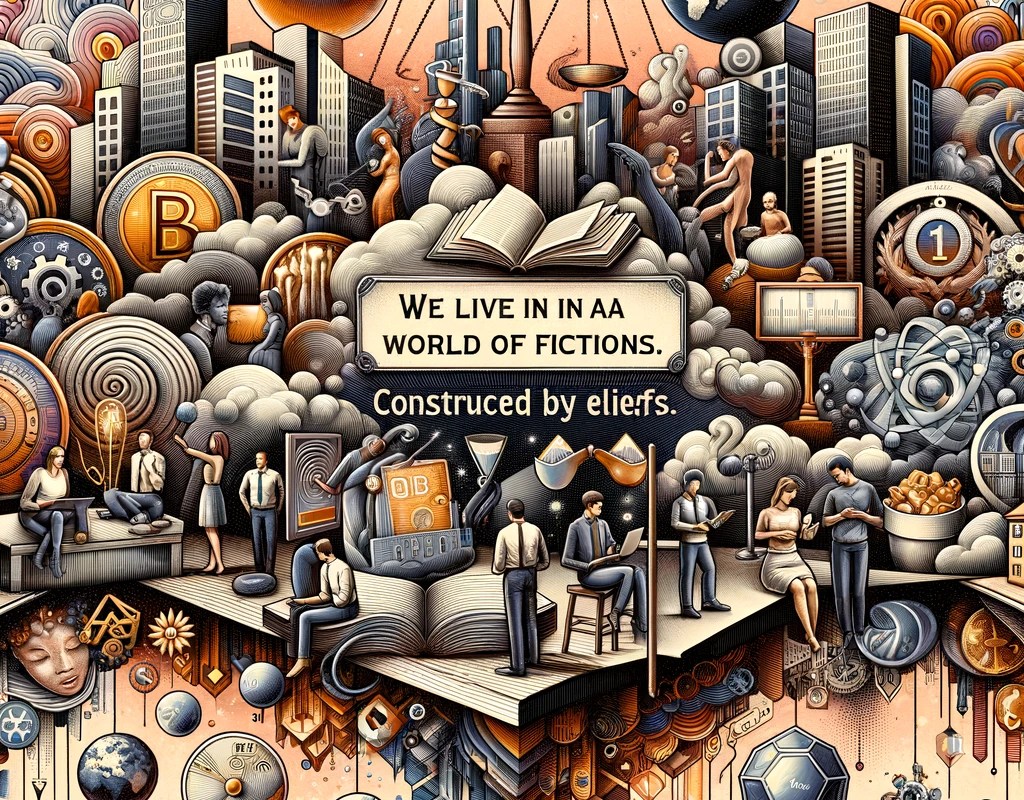
PS: Apologies for the AI typo in the thumbnail image. I fixed it once, and it went missing. Perhaps. I’ll mend it later.
References
Graeber, David. Debt: The First 5,000 Years (2011).
Foucault, Michel. Discipline and Punish: The Birth of the Prison (1975).
Baudrillard, Jean. Simulacra and Simulation (1981).
Anderson, Benedict. Imagined Communities: Reflections on the Origin and Spread of Nationalism (1983).
Giddens, Anthony. The Consequences of Modernity (1990).
In examining nations, economies, money, and legal systems, it becomes evident that much of what structures our daily lives is founded on fictions—collective agreements and constructs that shape our reality. Recognizing this opens a new perspective on how we understand and interact with the world. These fictions, while not inherently negative, demonstrate the power of human imagination and the social nature of our existence.
From the moment we wake up, we engage with these fictions. The money we use, the laws we abide by, and the national identities we hold are all part of a complex web of social constructs that provide order and meaning to our lives. These fictions create a shared reality that allows for coordination, cooperation, and coexistence on a large scale.
The Power and Potential of Fictions
Fictions are powerful because they shape our perceptions and behaviors. They provide frameworks for understanding our place in the world and guide our interactions with others. For instance, the belief in the value of money enables complex economic transactions, while national identities foster a sense of belonging and community.
However, the power of these fictions also means they can be manipulated. Political narratives, economic policies, and legal decisions can be crafted to serve particular interests, often at the expense of others. This underscores the importance of critically examining the fictions we live by and questioning whose interests they serve.
The potential of fictions lies in their flexibility. Because they are constructed, they can be deconstructed and reconstructed. This offers opportunities for innovation and change. By reimagining our social constructs, we can address contemporary challenges such as inequality, climate change, and global conflicts. For example, the emergence of new economic models, such as the sharing economy or digital currencies, illustrates how rethinking foundational fictions can lead to transformative change.
Sports as Fiction
Sports provide a compelling example of another pervasive fiction in human society. Like money and legal systems, sports are constructed through a set of agreed-upon rules, rituals, and narratives. The games we play, the leagues we follow, and the teams we support are all part of a shared fiction that brings people together, creates communities, and evokes strong emotions.
The rules of sports are arbitrary yet accepted by all participants and fans, creating a framework within which competition and achievement are celebrated. These rules can be changed, and often are, to adapt to new circumstances or to improve the game. This flexibility highlights the constructed nature of sports, similar to other social systems.
Moreover, sports narratives—stories of underdogs triumphing, legendary performances, and historic rivalries—are powerful fictions that shape our collective memory and identity. They provide a sense of continuity and shared experience, connecting individuals across different backgrounds and generations.
Challenges of Living with Fictions
Living in a world of fictions comes with challenges. One significant challenge is the tension between reality and fiction. When the fictions we live by are mistaken for immutable truths, it can lead to rigidity and resistance to change. This can be seen in the reluctance to reform outdated legal systems, economic models, or national identities that no longer serve the common good.
Another challenge is the potential for disillusionment. Recognizing that much of what we consider to be real is, in fact, a construct can lead to a sense of instability and uncertainty. This awareness requires a balance between skepticism and pragmatism—understanding that while fictions are not inherently true, they are necessary for social cohesion and functioning.
The Role of Critical Awareness
Critical awareness is crucial in navigating a world of fictions. This involves questioning the assumptions and narratives that underpin our social constructs and being open to alternative perspectives. Education, media literacy, and public discourse play vital roles in fostering this critical awareness.
By understanding the constructed nature of our realities, we can become more active participants in shaping them. This empowers individuals and communities to advocate for changes that reflect their values and address their needs. It also encourages a more inclusive and equitable approach to social organization, recognizing the diverse ways in which people experience and contribute to society.
Imagining New Fictions
The future will undoubtedly bring new fictions that will shape our lives in unforeseen ways. As technology advances, new forms of social organization, identity, and interaction will emerge. For example, the rise of virtual reality and artificial intelligence will create new spaces and entities that challenge our current understanding of reality.
Imagining new fictions involves creativity and collaboration. It requires us to envision possibilities beyond our current constructs and to work together to bring those visions to life. This imaginative process is fundamental to human progress and the continual evolution of our societies.
Conclusion
Living in a world of fictions is both a profound and practical reality. By recognizing and understanding the fictions that structure our lives, we gain the power to question, reform, and innovate. This critical awareness allows us to navigate the complexities of our social world with greater insight and intentionality, fostering a more just and dynamic society.
Section 4: Legal and Jurisprudence Systems as Fictions
The Nature of Legal Systems
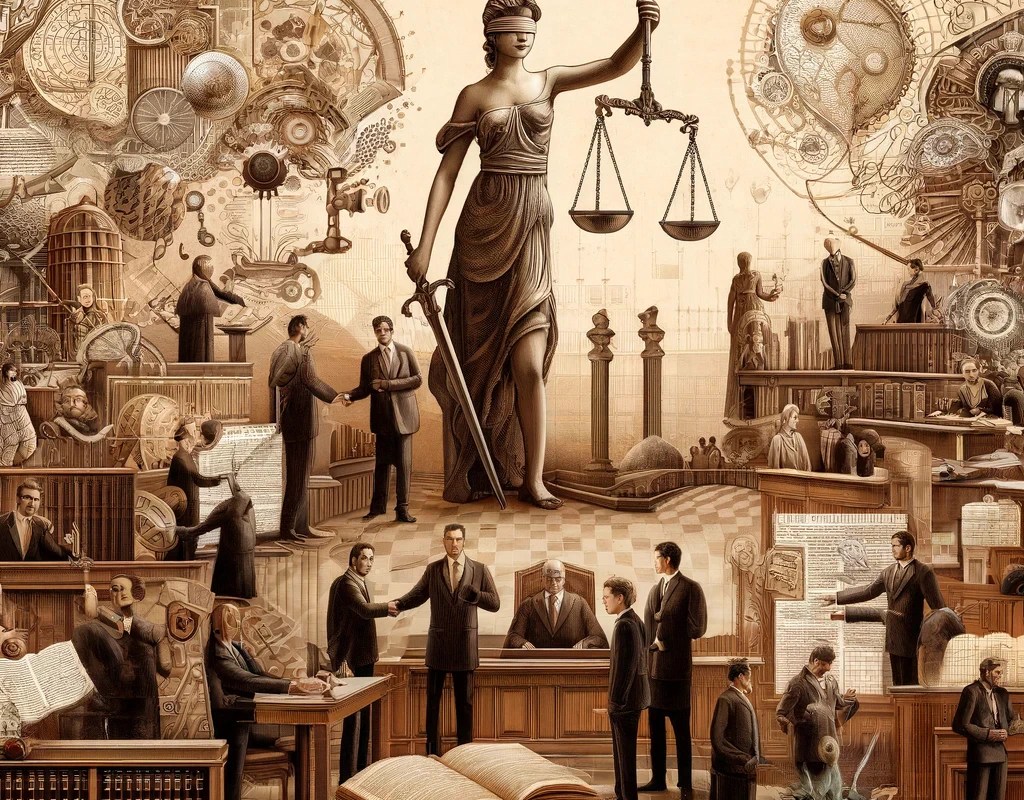
Legal and jurisprudence systems are among the most complex and entrenched fictions in society. Laws are human-made rules that govern behaviour, established by governments and enforced by judicial institutions. While laws aim to create order and justice, they are ultimately constructs, products of human agreement and cultural evolution.
The concept of law varies significantly across cultures and historical periods. Ancient legal codes, such as the Code of Hammurabi or Roman law, illustrate the long-standing tradition of codifying rules to govern society. However, these codes, like modern laws, are not natural phenomena but rather inventions designed to regulate human interactions and maintain social cohesion.
The Evolution of Legal Fictions
Legal systems have evolved alongside societies, adapting to changes in cultural norms, technological advancements, and political landscapes. The development of common law, for example, is a testament to the adaptive nature of legal systems. Common law, which originated in medieval England, is based on judicial precedents and case law rather than written statutes. This system relies heavily on the interpretation and application of past decisions, demonstrating how legal principles are constructed and reconstructed over time.
Moreover, legal fictions are often used within these systems to achieve practical outcomes. For instance, the concept of corporate personhood, where a corporation is treated as a legal person with rights and responsibilities, is a legal fiction designed to facilitate business operations and protect individual shareholders from certain liabilities. This illustrates how legal constructs can shape economic activities and social relations.
Implications of Legal Fictions
The recognition that legal systems are fictions has profound implications for how we understand and engage with the law. It highlights the role of human agency in creating and modifying legal norms, suggesting that laws are not immutable truths but rather adaptable tools for governance.
Legal systems are often seen as impartial and objective, but they are deeply influenced by the values, beliefs, and power dynamics of the societies that create them. This can lead to biases and inequalities being embedded within legal frameworks. For example, historical laws that discriminated based on race, gender, or class demonstrate how legal fictions can perpetuate social injustices.
Understanding the fictional nature of legal systems also opens the door to questioning and reforming these systems. It encourages us to consider alternative approaches to justice and governance that may better reflect contemporary values and address the needs of diverse populations.
The Role of Legal Narratives
Legal narratives, the stories told through laws and legal decisions, play a crucial role in shaping public perceptions and societal norms. These narratives construct realities that influence how individuals and communities understand their rights, responsibilities, and relationships with the state.
The work of scholars like Robert Cover, who in “Nomos and Narrative” (1983) argued that law is a system of meaning-making through narratives, underscores the importance of storytelling in the legal realm. By examining these narratives critically, we can uncover the underlying assumptions and power structures that they reinforce.
Future of Legal Systems
As societies continue to evolve, so too will their legal systems. The rise of international law, human rights conventions, and transnational legal frameworks reflects the growing interconnectedness of the world. These developments challenge traditional notions of state sovereignty and domestic legal autonomy, suggesting a future where legal systems may become even more complex and intertwined.
By recognizing legal systems as fictions, we are better equipped to navigate and influence these changes. This awareness can lead to more inclusive and equitable legal frameworks that serve the broader goals of justice and human flourishing.
References
Cover, Robert. “Nomos and Narrative” (1983).
Graeber, David. Debt: The First 5,000 Years (2011).
Anderson, Benedict. Imagined Communities: Reflections on the Origin and Spread of Nationalism (1983).
Giddens, Anthony. The Consequences of Modernity (1990).
Video: YouTube rendition of the content on this page.
Introduction
In our daily lives, we encounter numerous constructs that shape our understanding of the world. These constructs, though deeply ingrained in our societies, may be more fictional than factual. We accept the existence of nations, economies, money, and legal systems as fundamental aspects of our reality, yet these entities are human-made inventions. In this article, we will explore the notion that many of the pillars supporting our world are, in fact, fictions. By examining the nature of these fictions, we can better understand their impact on our lives and how they shape our perceptions and interactions.
Section 1: The Concept of Fiction
Definition of Fiction
Oxford Languages via Google defines fiction as:
fic·tion /ˈfɪkʃən/noun
literature in the form of prose that describes imaginary events and people.
something that is invented or untrue. “they were supposed to be keeping up the fiction that they were happily married“
Fiction, in its most common sense, refers to imaginative literature—stories created from the author’s mind, describing events and characters that do not exist in reality. However, fiction also encompasses broader definitions, including any invented or untrue concept. This dual definition highlights the versatility of fiction: it is not only the realm of novels and stories but also the domain of societal constructs and beliefs that, while not grounded in tangible reality, exert a powerful influence over our lives.
Examples of Fiction in Everyday Life
Fiction extends beyond the pages of a book or the scenes of a movie. It permeates various aspects of our everyday existence. For instance, consider the concept of a corporation. Legally, a corporation is an entity that possesses many of the rights and responsibilities of a person, yet it is not a physical being—it is a construct, a legal fiction, created to facilitate economic activities. Similarly, brands and trademarks are fictions designed to create distinct identities for products and services, influencing consumer behaviour and shaping market dynamics.
The significance of these fictions lies in their ability to organize and structure society. They provide frameworks within which we operate, enabling complex interactions and collaborations. However, it is crucial to recognize their invented nature, as this awareness allows us to question and, if necessary, reshape these constructs to better serve our collective needs.
By acknowledging the fictional basis of many societal elements, we can unravel the layers of assumptions and beliefs that underpin our reality. This understanding sets the stage for a deeper exploration of specific fictions—nations, economies, money, and legal systems—and their profound impact on our world.





 Philosophics