The Emissary Who Forgot to Bow: On Erasmus, Wells, and the Delusion of Universal Reason

12โ€“19 minutes

I was having an inappropriate chat with ChatGPT and, per Feyerabend, I once again discovered that some of the best inspirations are unplanned. The conversation circled around to the conflicting narratives of Erasmus and Wells. Enter, Plato, McGilchrist, and the Enlightenment โ€“ all living rent-free in my head โ€“ and I end up with this.

Audio: NotebookLM podcast on this topic.

I. The Proverb and Its Presumption

Erasmus sits at his writing desk in 1500-something, cheerful as a man who has never once questioned the premises of his own eyesight, and pens what will become one of the Westโ€™s most durable little myths: โ€˜In the land of the blind, the one-eyed man is kingโ€™. It arrives packaged as folk wisdom, the sort of thing youโ€™re meant to nod at sagely over a pint. And for centuries, we did. The proverb became shorthand for a comfortable fantasy: that advantage is advantage everywhere, that perception grants sovereignty, that a man with superior faculties will naturally ascend to his rightful place atop whatever heap he finds himself on.

Itโ€™s an Enlightenment dream avant la lettre, really โ€“ this breezy confidence that reason, sight, knowledge, insight will simply work wherever theyโ€™re deployed. The one-eyed man doesnโ€™t need to negotiate with the blind. He doesnโ€™t need their endorsement, their customs, their consent. He arrives, he sees, he rules. The proverb presumes a kind of metaphysical meritocracy, where truth and capability are self-authenticating, where the world politely arranges itself around whoever happens to possess the sharper tools.

Image: Midjourney didn’t coรถperate with my prompt for a one-eyed king. Trust that this king has only one.

Itโ€™s the intellectual equivalent of showing up in a foreign country with a briefcase full of sterling and expecting everyone to genuflect. And like most folk wisdom, it survives because it flatters us. It tells us that our advantages โ€“ our rationality, our education, our painstakingly cultivated discernment โ€“ are universally bankable. That we, the seeing, need only arrive for the blind to recognise our superiority.

Erasmus offers this with no apparent irony. He hands us a proverb that whispers: your clarity is your crown.

II. Wells Wanders In

Four centuries later, H.G. Wells picks up the proverb, turns it over in his hands like a curious stone, and proceeds to detonate it.

The Country of the Blind (1904) is many things โ€“ a fable, a thought experiment, a sly dismantling of Enlightenment presumption โ€“ but above all it is an act of literary vandalism against Erasmus and everything his proverb smuggles into our collective assumptions. Wells sends his protagonist, Nuรฑez, tumbling into an isolated Andean valley where a disease has rendered the entire population blind for generations. Theyโ€™ve adapted. Theyโ€™ve built a culture, a cosmology, a complete lifeworld organised around their particular sensorium. Sight isnโ€™t absent from their world; itโ€™s irrelevant. Worse: itโ€™s nonsense. The seeing manโ€™s reports of โ€˜lightโ€™ and โ€˜skyโ€™ and โ€˜mountainsโ€™ sound like the ravings of a lunatic.

Nuรฑez arrives expecting Erasmusโ€™s kingdom. He gets a psychiatric evaluation instead.

The brilliance of Wellsโ€™s story isnโ€™t simply that the one-eyed man fails to become king โ€“ itโ€™s how he fails. Nuรฑez doesnโ€™t lack effort or eloquence. He tries reason, demonstration, patient explanation. He attempts to prove the utility of sight by predicting sunrise, by describing distant objects, by leveraging his supposed advantage. None of it matters. The blind donโ€™t need his reports. They navigate their world perfectly well without them. His sight isnโ€™t superior; itโ€™s alien. And in a culture that has no use for it, no linguistic scaffolding to accommodate it, no social structure that values it, his one eye might as well be a vestigial tail.

The valleyโ€™s elders eventually diagnose Nuรฑezโ€™s problem: his eyes are diseased organs that fill his brain with hallucinations. The cure? Surgical removal.

Wells lets this hang in the air, brutal and comic. The one-eyed man isnโ€™t king. Heโ€™s a patient. And if he wants to stay, if he wants to belong, if he wants to marry the girl heโ€™s fallen for and build a life in this place, heโ€™ll need to surrender the very faculty he imagined made him superior. Heโ€™ll need to let them fix him.

The story ends ambiguously โ€“ Nuรฑez flees at the last moment, stumbling back toward the world of the sighted, though whether he survives is left unclear. But the damage is done. Erasmusโ€™s proverb lies in ruins. Wells has exposed its central presumption: that advantage is advantage everywhere. That perception grants authority. That reason, clarity, and superior faculties are self-evidently sovereign.

Theyโ€™re not. Theyโ€™re only sovereign where the culture already endorses them.

III. Platoโ€™s Ghost in the Valley

If Wells dismantles Erasmus, Plato hovers over the whole scene like a weary ghost, half scolding, half despairing, muttering that he told us this would happen.

The Allegory of the Cave, after all, is the original version of this story. The philosopher escapes the cave, sees the sun, comprehends the Forms, and returns to liberate his fellow prisoners with reports of a luminous reality beyond the shadows. They donโ€™t thank him. They donโ€™t listen. They think heโ€™s mad, or dangerous, or both. And if he persists โ€“ if he tries to drag them toward the exit, toward the light they canโ€™t yet see โ€“ theyโ€™ll kill him for it.

Video: Plato’s Cave

Platoโ€™s parable is usually read as a tragedy of ignorance: the prisoners are too stupid, too comfortable, too corrupted by their chains to recognise truth when itโ€™s offered. But read it alongside Wells and the emphasis shifts. The cave-dwellers arenโ€™t wrong, exactly. Theyโ€™re coherent. Theyโ€™ve built an entire epistemology around shadows. They have experts in shadow interpretation, a whole language for describing shadow behaviour, social hierarchies based on shadow-predicting prowess. The philosopher returns with reports of a three-dimensional world and they hear gibberish. Not because theyโ€™re defective, but because his truth has no purchase in their lifeworld.

Plato despairs over this. He wants the prisoners to want liberation. He wants truth to be self-authenticating, wants knowledge to compel assent simply by virtue of being knowledge. But the cave doesnโ€™t work that way. The prisoners donโ€™t want truth; they want comfort shaped like reality. They want coherence within the system they already inhabit. The philosopherโ€™s sun is as alien to them as Nuรฑezโ€™s sight is to the blind valley.

And hereโ€™s the kicker: Plato knows this. Thatโ€™s why the allegory is tragic rather than triumphant. The philosopher does see the sun. He does apprehend the Forms. But his knowledge is useless in the cave. Worse than useless โ€“ it makes him a pariah, a madman, a threat. His enlightenment doesnโ€™t grant him sovereignty; it exile him from the only community he has.

The one-eyed man isnโ€™t king. Heโ€™s the lunatic theyโ€™ll string up if he doesnโ€™t learn to shut up about the sky.

IV. The Enlightenmentโ€™s Magnificent Blunder

Once youโ€™ve got Erasmus, Wells, and Plato in the same room, the Enlightenmentโ€™s central fantasy collapses like wet cardboard.

Humanityโ€™s great Enlightenment wheeze โ€“ that baroque fantasy of Reason marching triumphantly through history like a powdered dragoon โ€“ has always struck me as the intellectual equivalent of selling snake oil in a crystal decanter. We were promised lucidity, emancipation, and the taming of ignorance; what we got was a fetish for procedural cleverness, a bureaucratisation of truth, and the ghastly belief that if you shine a bright enough torch into the void, the void will politely disclose its contents.

The Enlightenment presumed universality. It imagined that rationality, properly deployed, would work everywhere โ€“ that its methods were culture-neutral, that its conclusions were binding on all reasonable minds, that the shadows in Platoโ€™s cave and the blindness in Wellsโ€™s valley could be cured by the application of sufficient light and logic. It treated reason as a kind of metaphysical bulldozer, capable of flattening any terrain it encountered and paving the way for Progress, Truth, and Universal Human Flourishing.

This was, to put it mildly, optimistic.

What the Enlightenment missed โ€“ what Erasmusโ€™s proverb cheerfully ignores and what Wellsโ€™s story ruthlessly exposes โ€“ is that rationality is parochial. Itโ€™s not a universal solvent. Itโ€™s a local dialect, a set of practices that evolved within particular cultures, buttressed by particular institutions, serving particular ends. The Enlightenmentโ€™s rationality is Western rationality, Enlightenment rationality, rationality as understood by a specific cadre of 18th-century European men who happened to have the printing press, the political clout, and the colonial apparatus to export their epistemology at gunpoint.

They mistook their own seeing for sight itself. They mistook their own lifeworld for the world. And they built an entire civilisational project on the presumption that everyone else was just a less-developed version of them โ€“ prisoners in a cave, blind villagers, savages waiting to be enlightened.

The one-eyed man imagined himself king. He was actually the emissary who forgot to bow.

V. McGilchristโ€™s Neuroscientific Millinery

Iain McGilchrist sits in the same intellectual gravity well as Plato and Wells, only he dresses his thesis up in neuroscientific millinery so contemporary readers donโ€™t bolt for the door. The Master and His Emissary is essentially a 500-page retelling of the same ancient drama: the emissary โ€“ our little Enlightenment mascot โ€“ becomes so enamoured of his own procedures, abstractions, and tidy schemas that he forgets the Masterโ€™s deeper, embodied, culturally embedded sense-making.

McGilchristโ€™s parable is neurological rather than allegorical, but the structure is identical. The left hemisphere (the emissary) excels at narrow focus, manipulation, abstraction โ€“ the sort of thing you need to count coins or parse grammar or build bureaucracies. The right hemisphere (the Master) handles context, pattern recognition, relational understanding โ€“ the sort of thing you need to navigate an actual lifeworld where meaning is messy, embodied, and irreducible to procedures.

The emissary is supposed to serve the Master. Left-brain proceduralism is supposed to be a tool deployed within the broader, contextual sense-making of the right brain. But somewhere along the way โ€“ roughly around the Enlightenment, McGilchrist suggests โ€“ the emissary convinced itself it could run the show. Left-brain rationality declared independence from right-brain contextuality, built an empire of abstraction, and wondered why the world suddenly felt thin, schizophrenic, oddly two-dimensional.

Itโ€™s Erasmus all over again: the presumption that the emissary with one eye should be king. The same tragic misunderstanding of how worlds cohere.

McGilchristโ€™s diagnosis is clinical, but his conclusion is damning. Western modernity, he argues, has become pathologically left-hemisphere dominant. Weโ€™ve let analytic thought pretend itโ€™s sovereign. Weโ€™ve mistaken our schemas for reality, our maps for territory, our procedures for wisdom. Weโ€™ve built cultures that privilege manipulation over meaning, extraction over relationship, clarity over truth. And weโ€™re baffled when these cultures feel alienating, when they produce populations that are anxious, depressed, disenchanted, starved for something they canโ€™t quite name.

The emissary has forgotten the Master entirely. And the Master, McGilchrist suggests, is too polite โ€“ or too injured โ€“ to stage a coup.

In McGilchristโ€™s frame, culture is the Master. Strategy, reason, Enlightenment rationality โ€“ these are the emissaryโ€™s tools. Useful, necessary even, but never meant to govern. The Enlightenmentโ€™s mistake was letting the emissary believe his tools were all there was. Itโ€™s the same delusion Nuรฑez carries into Wellsโ€™s valley: the belief that sight, reason, superior faculties are enough. That the world will rearrange itself around whoever shows up with the sharper implements.

It wonโ€™t. The valley doesnโ€™t need your eyes. The cave doesnโ€™t want your sun. And the Master doesnโ€™t answer to the emissaryโ€™s paperwork.

VI. The Triumph of Context Over Cleverness

So hereโ€™s what these three โ€“ Erasmus, Wells, Plato โ€“ triangulate, and what McGilchrist confirms with his neuroscientific gloss: the Enlightenment dream was always a category error.

Reason doesnโ€™t grant sovereignty. Perception doesnโ€™t compel assent. Superior faculties donโ€™t self-authenticate. These things only work โ€“ only mean anything, only confer any advantage โ€“ within cultures that already recognise and value them. Outside those contexts, theyโ€™re noise. Gibberish. Hallucinations requiring surgical intervention.

The one-eyed man arrives in the land of the blind expecting a kingdom. What he gets is a reminder that kingdoms arenโ€™t built on faculties; theyโ€™re built on consensus. On shared stories, shared practices, shared ways of being-in-the-world. Culture is the bedrock. Reason is just a tool some cultures happen to valorise.

And hereโ€™s the uncomfortable corollary: if reason is parochial, if rationality is just another local dialect, then the Enlightenmentโ€™s grand project โ€“ its universalising ambitions, its colonial export of Western epistemology, its presumption that everyone, everywhere, should think like 18th-century European philosophes โ€“ was always a kind of imperialism. A metaphysical land-grab dressed up in the language of liberation.

The Enlightenment promised illumination but delivered a blinding glare that obscures more than it reveals. It told us the cave was a prison and the valley was backward and anyone who didnโ€™t see the world our way was defective, uncivilised, in need of correction. It never occurred to the Enlightenment that maybe โ€“ just maybe โ€“ other cultures had their own Masters, their own forms of contextual sense-making, their own ways of navigating the world that didnโ€™t require our light.

Wells understood this. Plato suspected it. McGilchrist diagnoses it. And Erasmus, bless him, never saw it coming.

VII. The Enlightenmentโ€™s Paper Crown

The Enlightenment liked to imagine itself as the adult entering the room, flicking on the light-switch, and announcing that, at long last, the shadows could stop confusing the furniture for metaphysics. This is the kind of confidence you only get when your culture hasnโ€™t yet learned the words for its own blind spots. It built an entire worldview on the hopeful presumption that its preferred modes of knowing werenโ€™t just one way of slicing experience, but the gold standard against which all other sense-making should be judged.

Call it what it is: a provincial dialect masquerading as the universal tongue. A parochial habit dressed in imperial robes. The Enlightenment always smelled faintly of a man who assumes everyone else at the dinner table will be impressed by his Latin quotations. And when they arenโ€™t, he blames the table.

The deeper farce is that Enlightenment rationality actually believed its tools were transferrable. That clarity is clarity everywhere. That if you wheel enough syllogisms into a space, the locals will drop their incense and convert on sight. Wells disabuses us of this; Plato sighs that he tried; McGilchrist clinically confirms the diagnosis. The emissary, armed with maps and measuring sticks, struts into the valley expecting coronation and is shocked โ€“ genuinely shocked โ€“ to discover that nobody particularly cares for his diagrams.

The Enlightenment mistake wasnโ€™t arrogance (though it had that in liberal supply). It was context-blindness. It thought procedures could substitute for culture. It thought method could replace meaning. It thought mastery was a matter of getting the right answer rather than belonging to the right world.

You can all but hear the emissary stamping his foot.

VIII. The Anti-Enlightenment Position (Such as It Is)

My own stance is drearily simple: I donโ€™t buy the Enlightenmentโ€™s sales pitch. Never have. The promise of universal reason was always a conjuring trick designed to flatter its adherents into thinking that their habits were Natureโ€™s preferences. Once you stop confusing methodological neatness with metaphysical authority, the entire apparatus looks less like a cathedral of light and more like a filing system that got ideas above its station.

The problem isnโ€™t that reason is useless. The problem is that reason imagines itself sovereign. Reason is a brilliant servant, a competent emissary, and an atrocious king. Culture is the king; context is the kingdom. Without those, rationality is just an embarrassed bureaucrat looking for a desk to hide behind.

This is why I keep banging on about language insufficiency, parochial cognition, and the delightful way our concepts disintegrate once you wander too far from the lifeworlds that birthed them. The Enlightenment thought the human mind was a searchlight. Itโ€™s closer to a candle in a draughty hall. You can still get work done with a candle. You just shouldnโ€™t be telling people it can illuminate the universe.

So the anti-Enlightenment move isnโ€™t a call to smash the instruments. Itโ€™s a call to read the room. To stop pretending the emissary is the Master. To stop assuming sight is a passport to sovereignty. To stop wandering into other cultures โ€“ other caves, other valleys, other hemispheres โ€“ with a ruler and a smirk, convinced youโ€™re about to be crowned.

Underneath these brittle idols lies the far messier truth that cognition is parochial, language insufficient, and โ€˜rationalityโ€™ a parlour trick we perform to impress ourselves. Iโ€™m not proposing a new catechism, nor am I pining for some prelapsarian alternative. Iโ€™m simply pointing out that the Enlightenment promised illumination but delivered a blinding glare that obscures more than it reveals.

The task, then, is to grow comfortable with the dimness. To navigate by flicker rather than floodlight. To admit that the world was never waiting to be made โ€˜clearโ€™ in the first place.

This doesnโ€™t mean abandoning reason. It means remembering that reason is the emissary, not the Master. It means recognising that our schemas are provisional, our maps incomplete, our procedures useful only within the cultures that endorse them. It means learning to bow โ€“ to culture, to context, to the irreducible messiness of lifeworlds we donโ€™t fully understand and canโ€™t procedurally master.

The one-eyed man never was king. At best, he was an enthusiastic tourist with a very noisy torch. The sooner he stops shining it into other peopleโ€™s faces, the sooner we can get on with the far more interesting business of navigating a world that never promised to be legible.

Not a kingdom of sight. Just a world where the emissary remembers his place.

Video: Inside the Machine: What LLMs REALLY Think About Your โ€˜Thoughtfulโ€™ Questions

1โ€“2 minutes

Chatting with Claude Sonnet 4.5 was such an interesting experiment, so I created a YouTube video version based on the Spotify version. If you’ve already listened to it, feel free to check out the video content โ€“ the audio hasn’t changed.

Video: Inside the Machine: What LLMs REALLY Think About Your โ€˜Thoughtfulโ€™ Questions

I feel that the explanation of some of Claude’s internal logic was telling, and how it is anthropomorphised in a way that a person might interpret through an emotional lens.

Personally, I also enjoyed the dialogue around Platonism as it related to maths. I updated the subtitles, so you can read along if you are so inclined.

I’d like to do more videos, but they take so much time. I don’t know how much total time this took, but it was many hours over three days. It’s not that I don’t want to take time to produce them; it’s the opportunity costs โ€“ I am not writing new material, which is my preferred activity. For the record, the bulk of the time is searching for appropriate stock footage and B-roll โ€“ and that’s not always successful either.

I generated a few clips in Midjourney โ€“ sometimes just because, and other times to fill a gap with something better than I could find on Motion Array.

I’ve embedded the video here as usual, or you can watch it on YouTube. In any case, I’d love to read what you think about the topic or the video. As for the video, I won’t be giving up my day job, but it’s fun to assemble them.

The Republic of Recursive Prophecy

5โ€“7 minutes

How the Trump Era Rewrote Time, Truth, and the Very Idea of a Common World

Politics in the Trump era wasnโ€™t merely a spectacle of bad manners and worse epistemology; it was the moment the United States stopped pretending it shared a common world โ€“ when politics ceased to be a quarrel over facts and became a quarrel over the very conditions that make facts possible. This essay is part of an ongoing project tracing how post-Enlightenment societies lose their shared grammar of verification and retreat into parallel narrative architectures that demand allegiance rather than assessment.

And before anyone hyperventilates about implied asymmetry: the recursive logic described here is not exclusive to the right. The progressive cosmology, though stylistically different, exhibits the same structural features โ€“ prophetic claims about impending catastrophe or salvation, retrospective reinterpretations to maintain coherence, and an insistence on possessing privileged interpretive tools. The Trump era didnโ€™t invent this recursive mode; it simply accelerated it, stripped it naked, and pumped it through a 24-hour media bloodstream until everyone could see the circuitry sparking.

Audio: NotebookLM podcast on this topic.

Welcome to the new cosmology.

1. The Death of a Common Grammar

Once the shared grammar of verification dissolves, political discourse stops unfolding in empirical time. It migrates into suspended futurity โ€“ a realm of conditional wagers:

If this, then that. Just wait. Youโ€™ll see. The future will vindicate us.

But the horizon keeps receding. When reality refuses to comply, factions rewrite the past to preserve the equilibrium between prophecy and outcome. Truth becomes less a matter of correspondence and more an act of narrative self-maintenance. Where the world diverges from the story, the world is adjusted.

Political time becomes pliable; the narrative must be kept intact, whatever the cost.

2. Mimetic Prophecy and the Absence of Catharsis

A Girardian lens clarifies whatโ€™s happening beneath the surface. The factions are not simply disagreeing; they are locked in mimetic rivalry, each imitating the otherโ€™s claim to prophetic vision. Insight becomes the mimetic object: each camp insists it alone can decode the approaching shape of events.

As the rivalry escalates, differentiation collapses. Both sides perform identical moves โ€“ warnings of authoritarianism, narratives of national peril, promises of historical vindication โ€“ whilst insisting the otherโ€™s prophecies are delusional.

In classic Girardian fashion, this symmetry produces a crisis: a collapse of distinction between rivals, accompanied by a desperate hunt for a stabilising sacrifice. In the Trump era, the scapegoat was not a person but a category: truth itself. Doubt, verification, shared reality โ€“ these were sacrificed at the altar of maintaining internal cohesion.

Yet unlike the societies Girard studied, the American polity achieves no catharsis. The sacrificial mechanism fails. No cleansing moment restores order. The cycle loops endlessly, forcing the community to reenact the ritual without the relief of resolution.

Prophecy, rivalry, crisis โ€“ repeat.

3. From Chronology to Mythic Temporality

Once prediction and remembrance collapse into one another, political time becomes mythic rather than chronological. The present becomes a hinge between two versions of the world: the one the faction already believes in and the one it insists the future will confirm.

The future becomes partisan property. The past becomes commentary. The present becomes maintenance.

Each faction edits its cosmology to preserve coherence, producing a recursive temporality in which prophecy and memory reinforce one another. Narrative supplants chronology; plausibility is subordinated to coherence. The factions are not lying; they are mythologising.

This is what a society does when it cannot stabilise truth but cannot abandon truth-claims either.

4. Madisonโ€™s Diagnosis, Reversed

James Madison, in his republican optimism, believed factions were inevitable but containable. Pluralism, he argued, would safeguard the republic by ensuring no faction could elevate its partial vision into a universal claim. The sheer scale and diversity of the republic would generate cross-pressure strong enough to check epistemic domination.

He assumed a shared evidentiary world.

He did not imagine a polity in which factions construct discrete epistemic universes โ€“ self-sealing interpretive systems with their own temporal orders, myths of origin, and theories of legitimacy. Under such conditions, pluralism no longer disciplines factional excess; it shelters it. It becomes a buffer that prevents contact, not a mechanism that fosters correction.

Madison feared that factions might mistake their partial view for the whole.
Our moment dissolves the very idea of the whole.

Pluralism, once a remedy, becomes the architecture of epistemic secession.

5. The Theatre of Recursive Narration

What remains is not deliberation but theatreโ€”political communities sustained by the perpetual reenactment of their own certainties. Each faction maintains itself through narrative recursion, chanting the same incantation of retrospective rightness, performing the same rites of interpretive renewal.

The republic no longer hosts disagreement; it hosts parallel cosmologies.

In the republic of recursive prophecy, truth is no longer what grounds politics โ€“ itโ€™s what politics performs.


Afterword

This article followed a chat with ChatGPT. For what itโ€™s worth, I now style myself a post-postmodern, post-critical theorist โ€“ though these labels are as pointless as the ones they replace.

The conversation began with Paul Feyerabendโ€™s Against Method, which was already on my mind. In Appendix 1 he writes:

That set me wondering, again, how one discerns signal from noise. As a statistician, separating wheat from chaff is my daily bread, but how does one do it politically without pretending to possess privileged access to truth? In this environment, each faction insists it has such access. The other side, naturally, is deluded. Ignore the fact that there are more than two sides; binary thinking is the fashion of the day.

I leaned on ChatGPT and asked for sources on this lemma โ€“ what to read, where to dig. It replied with books Iโ€™d already read, save for one:

  1. Paul Feyerabend: Against Method and Science in a Free Society
  2. Jean-Franรงois Lyotard: The Postmodern Condition
  3. Richard Rorty: Contingency, Irony, and Solidarity
  4. Michel Foucault: Power/Knowledge and The Archaeology of Knowledge
  5. Jacques Derrida: Of Grammatology and Positions
  6. Bruno Latour: We Have Never Been Modern
  7. Chantal Mouffe and Ernesto Laclau: Hegemony and Socialist Strategy

I hadnโ€™t read Laclau & Mouffe. ChatGPT summarised them neatly:

Right up my street. (I still need to read it.)

That, in turn, brought Madisonโ€™s Federalist No. 10 to mind โ€“ his warning that factional division, particularly the two-party structure the United States later perfected, would one day become corrosive.

Then Girard entered the chat. And so on. We followed the thread a little longer until this essay took shape. I didnโ€™t feel compelled to polish it into a formal academic piece. A blog seems a far better home for now, and the essay version can remain an open question.

The Great Substitution: From Metaphysics to Metaphysics

1โ€“2 minutes

(Now archived on Zenodo and PhilPapers)

Video: “Maintenance” Midjourney render of the cover image for no reason in particular.

As many have been before me, I find metaphysical claims to be incredulous. I read these people tear down edifices, yet they seem to have a habit of replacing one for another โ€“ as if renaming it makes it disappear. Perhaps Lacan would be curious how this persists at this stage of our supposed development.

Audio: NotebookLM podcast discussing the underlying essay, The Great Substitution: From Metaphysics to Metaphysics

Because of this, I performed a survey โ€“ and then a genealogy โ€“ to trace the history of substitution. It began as a side note in The Discipline of Dis-Integration, but the pattern grew too large to ignore. Every time someone proclaims the end of metaphysics, a new one quietly takes its place. Theology becomes Reason. Reason becomes History. History becomes Structure. Structure becomes Data. The names change; the grammar doesnโ€™t.

This essay, The Great Substitution: From Metaphysics to Metaphysics, tracks that recursion. It argues that modern thought has never killed its gods โ€“ it has merely rebranded them. Kant, Nietzsche, Heidegger, Derrida, Harari โ€“ each announced emancipation, and each built a new altar. We like to imagine that progress freed us from metaphysics, but what it really did was automate it. The temples are gone, but the servers hum.

The argument unfolds across ten short sections: from the limits of knowing, through the linguistic machinery of belief, to the modern cults of scientism, economics, psychology, and dataism. The closing sections introduce Dis-Integration โ€“ not a cure but a posture. Maintenance, not mastery. Thinking without kneeling.

If the Enlightenment promised illumination, weโ€™ve spent the past three centuries staring directly into the light and calling it truth. This essay is my attempt to look away long enough to see what the glare has been hiding.

The Great Substitution: From Metaphysics to Metaphysics

A part of the Anti-Enlightenment Project corpus. More here.

The full text is archived here:

๐Ÿ“„ Zenodo DOI: https://doi.org/10.5281/zenodo.17576457
๐Ÿ“˜ PhilPapers entry: Under review

Pure Reason: The Architecture of Illusion

2โ€“3 minutes

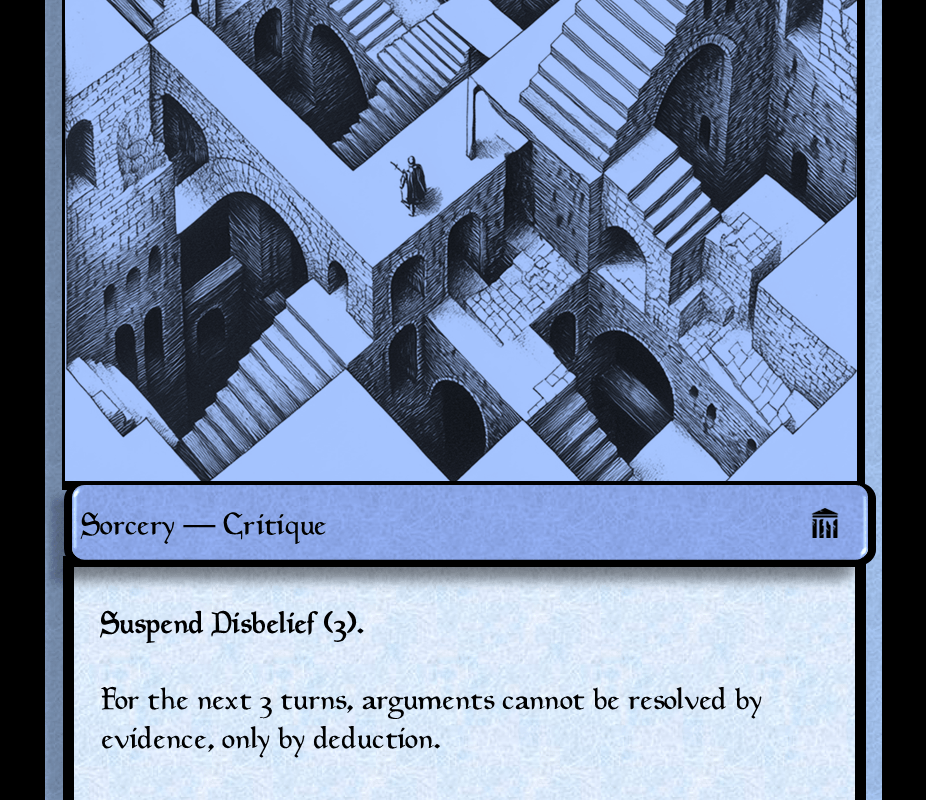
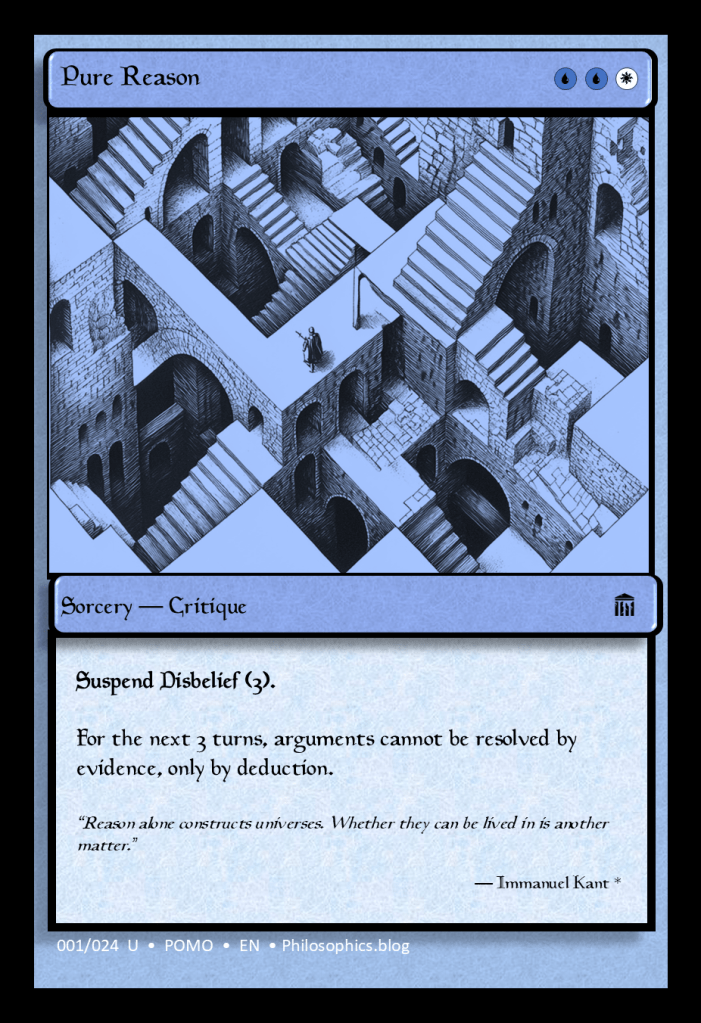
If reason had a landscape, it would look like this card: a maze of ascending and descending staircases, forever rational yet going nowhere. Kant might have called it a Critique of Pure Geometry.

Pure Reason, the first card in the Postmodern set, isnโ€™t so much an homage to Kant as it is a cautionary reconstruction. It honours his ambition to build a universe from deduction while quietly mourning the price of that construction: alienation from experience.

Image: Card 001 from the Postmodern Set โ€” Philosophics.blog

The Meta

Suspend Disbelief (3).
For the next three turns, arguments cannot be resolved by evidence, only by deduction.

Audio: NotebookLM podcast of this topic.

The rule text re-enacts Kantโ€™s method. In the Critique of Pure Reason, he cordoned off the realm of empirical evidence and tried to chart what the mind could know a priori โ€“ before experience. The cardโ€™s mechanic enforces that isolation. For three turns, players must reason in a vacuum: no appeals to observation, no touchstones of reality, only deduction.

Itโ€™s a temporary world built entirely of logic, an echo of the transcendental playground Kant envisioned. The effect is powerful but sterile โ€“ thought constructing universes that canโ€™t sustain life.

The flavour text says it plainly:

That line, of course, is apocryphal, but it captures the essence of his project: reason as world-maker and prison architect in one.

The Architecture of Thought

The artwork mirrors Escherโ€™s impossible staircases โ€“ a labyrinth of pure geometry, ordered yet uninhabitable. Each path is internally consistent, logically sound, but spatially absurd. This is Kantโ€™s transcendental edifice made visual: coherent on paper, dizzying in practice.

The lone figure standing in the maze is the transcendental subject โ€“ the philosopher trapped within the architecture of his own cognition. He surveys the world he has built from categories and forms, unable to escape the walls of his own reason.

Itโ€™s a neat metaphor for Enlightenment hubris: the belief that reason can serve as both foundation and roof, requiring no support from the messy ground of existence.

Kantโ€™s Double Legacy

Kantโ€™s Critique was both the high point and the breaking point of Enlightenment rationality. It erected the scaffolding for science, ethics, and aesthetics but revealed the fault lines beneath them. His insistence that the mind structures experience rather than merely reflecting it gave birth to both modern idealism and modern doubt.

Every philosopher after him โ€“ Hegel, Nietzsche, Husserl, Derrida โ€“ has been trying either to escape or to inhabit that labyrinth differently. Pure Reason captures this tension: the glory of construction and the tragedy of confinement.

My Take

Reason is a magnificent liar. It promises order, clarity, and autonomy, but its perfection is its undoing. It abstracts itself from life until it can no longer recognise its own maker. Kantโ€™s world is flawless and airless โ€“ a rational utopia unfit for breathing creatures.

I view Pure Reason as the archetype of the Enlightenment illusion: the attempt to found a living world on the logic of dead forms. What he achieved was monumental, but the monument was a mausoleum.

The card, then, is not just a tribute to Kant but a warning to his descendants (ourselves included): every system of thought eventually turns into an Escher print. Beautiful, consistent, and utterly unlivable.

Language Games: Sorcery

If philosophy were a game, Wittgenstein rewrote the rulebook. Then he tore it up halfway through and told us the game was the thing itself.

Language Game, the third card in my Critical Theory parody set, isnโ€™t just homage; itโ€™s confession. Wittgenstein is among my top five philosophers, and this card embodies why. His idea that ‘meaning is use’ unhooked language from metaphysics and tethered it to life โ€“ to the messy, unpredictable business of how humans actually speak.

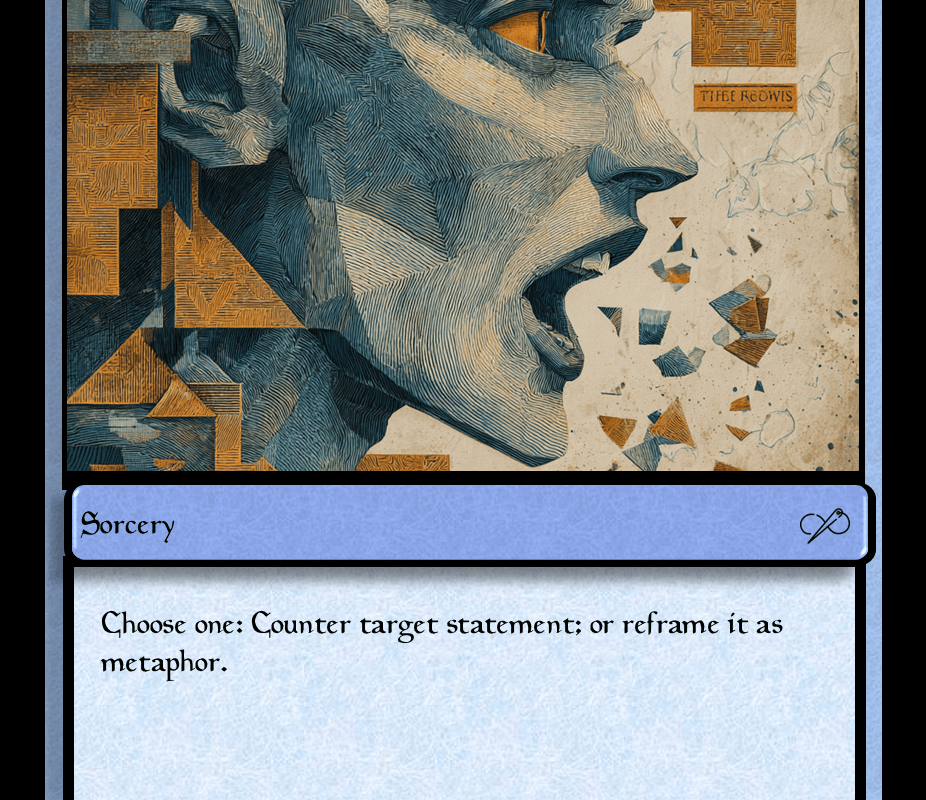
The cardโ€™s text reads: Choose one: Counter target statement; or reframe it as metaphor.

At first glance, it sounds like a standard spell from Magic: The Gathering โ€“ a blue card, naturally, since blue is the colour of intellect, deceit, and control. But beneath the parody is an epistemic mirror.

To โ€œcounterโ€ a statement is to engage in the analytic impulse โ€“ to negate, clarify, define. To โ€œreframe it as metaphorโ€ is the continental alternative โ€“ reinterpret, play, deconstruct. These are not two distinct acts of philosophy but the alternating heartbeat of all discourse. Every argument, every essay, every tweet oscillates between contradiction and reframing.

The sorcery lies in recognising that both are linguistic manoeuvres within the same game. Meaning is not fixed in the words themselves but in how theyโ€™re used โ€“ by whom, in what context, and to what end. Wittgensteinโ€™s point was brutally simple: thereโ€™s no hidden substance behind language, only a living practice of moves and counter-moves.

The Shattered Face

The artwork visualises this idea: speech breaking into shards, thought fragmenting as it leaves the mouth. Meaning disintegrates even as itโ€™s formed. Every utterance is an act of creation and destruction, coherence and collapse.

I wanted the card to look like a concept tearing itself apart whilst trying to communicate, a perfect visual for the paradox of language. The cubist angles hint at structure, but the open mouth betrays chaos. Itโ€™s communication as combustion.

Wittgensteinโ€™s Echo

Wittgenstein once wrote, ‘Philosophy leaves everything as it is’. It sounds passive, almost nihilistic, until one realises what he meant: philosophy doesnโ€™t change the world by building new systems; it changes how we see whatโ€™s already there.

He was the great anti-system builder, a man suspicious of his own intellect, who saw in language both the limits of thought and the infinite playground of meaning. He dismantled metaphysics not through scepticism but through observation: watch how words behave, and theyโ€™ll tell you what they mean.

In that spirit, Language Game is less an argument than an invitation โ€“ to watch the mechanics of speech, to see how our statements perform rather than merely represent.

Personal Reflection

Wittgenstein earns a place in my top five because he dissolves the boundaries that most philosophers erect. He offers no comforting totalities, no grand narratives, no moral architectures. Just language, and us inside it, flailing beautifully.

His work aligns with my larger project on the insufficiency of language โ€“ its inability to capture the real, yet its irresistible compulsion to try. Wittgenstein knew that words are our most sophisticated form of failure, and he loved them anyway.

To play Language Game is to remember that communication isnโ€™t about arriving at truth but about keeping meaning in motion. Every conversation is a temporary alliance against silence.

The cardโ€™s instruction remains both playful and tragic: Counter target statement; or reframe it as metaphor.

Whichever you choose, youโ€™re still playing.

Perspectival Realism โ€“ Enchantment

This Magic: The Gathering parody trading card was the first in my Critical Theory series.

It’s an important card for me. As with sex and gender, creating a taxonomic or ontological dichotomy poses categorical challenges. Despite the insufficiency of language, it’s still all I have to attempt to classify the world. In the case of articulating the perception of reality, we can choose between idealism and realism. The problem is that it’s not either; it’s both. Reality cannot be realised without both.

Reality, weโ€™re told, exists. That confident noun has carried a great deal of human arrogance. It has underwritten empires, sciences, and sermons. Yet somewhere between Platoโ€™s cave and the latest TED Talk, we forgot to ask a simpler question: for whom does reality exist, and from where is it seen?

Audio: NotebookLM podcast of this topic.

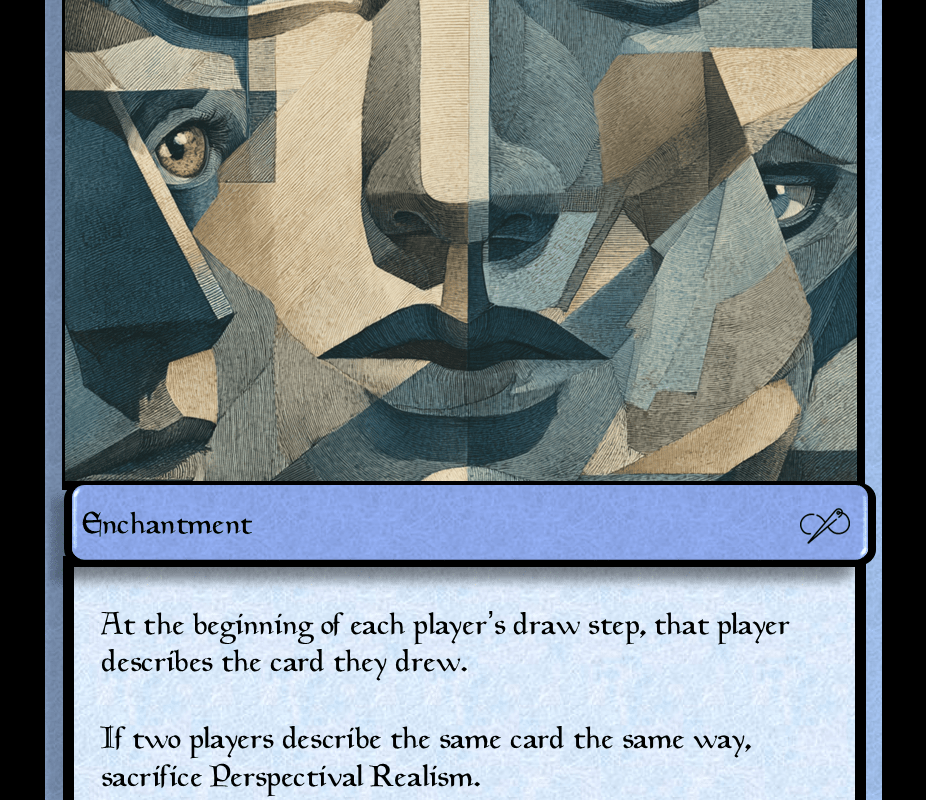
The parody trading card Perspectival Realism was born from that unease. Its mechanic is simple but cruel: at the beginning of each playerโ€™s draw step, they must describe the card they drew. The enchantment persists until two players describe a card in the same wayโ€”at which point the spell collapses. In other words, consensus kills magic.

That rule is the metaphysics of the thing.

When a player ‘describes’ a card, they are not transmitting information; they are constructing the object in linguistic space. The moment the description leaves their mouth, the card ceases to be a piece of paper and becomes a conceptual artefact.

This mirrors the insight of Kant, Nietzsche, and every post-structuralist who ever smoked too much Gauloises: perception isnโ€™t passive. We donโ€™t see reality; we compose it. Language isnโ€™t a mirror but a paintbrush. The thing we call truth is not correspondence but coherence โ€“ a temporary truce among competing metaphors.

So the cardโ€™s enchantment dramatises this process. So long as multiple descriptions circulate, reality remains vibrant, contested, alive. Once everyone agrees, it dies the death of certainty.

Philosophers have spent centuries arguing whether the world is fundamentally real (existing independent of mind) or ideal (a projection of mind). Both sides are equally tiresome.

Realism, the old bulldog of metaphysics, insists that perception is transparent: language merely reports whatโ€™s already there. Idealism, its mirror adversary, claims the opposite โ€“ that whatโ€™s โ€œthereโ€ is mind-stuff all along. Both mistakes are symmetrical. Realism forgets the perceiver; Idealism forgets the world.

Perspectival realism refuses the divorce. It begins from the premise that world and mind are inseparable aspects of a single event: knowing. Reality is not a photograph waiting to be developed, nor a hallucination spun from neurons โ€“ itโ€™s a relation, a constant negotiation between perceiver and perceived.

For years, I called myself a Realistโ„ข with an asterisk. That asterisk meant I understood the observer problem: that every ‘fact’ is perspective-laden. Then I became an Idealistโ„ข with an asterisk, meaning I recognised that mind requires matter to dream upon.

The asterisk is everything. Itโ€™s the epistemic scar left by perspectival humility โ€“ the tacit admission that every claim about the world carries a hidden coordinate: said from here. It is not relativism, but situatedness. It is the philosophical equivalent of depth perception: without the offset, thereโ€™s no vision at all.

The cardโ€™s rule โ€“ sacrifice Perspectival Realism when two players describe a card identically โ€“ captures the tragedy of modernity. The Enlightenment taught us to chase consensus, to flatten multiplicity into โ€œobjective truth.โ€ We became addicted to sameness, mistaking agreement for understanding.

But agreement is anaesthetic. When all perspectives converge, the world ceases to shimmer; it becomes measurable, predictable, dead. The cardโ€™s enchantment disappears the moment reality is stabilised, precisely as our cultural enchantment did under the fluorescent light of ‘reason’.

To live under perspectival realism is to acknowledge that reality is not what is drawn but what is described. And the description is never neutral. It is always written from somewhere โ€“ by someone, with a vocabulary inherited from history and stained by desire.

As long as multiple descriptions coexist, the game remains alive. The moment they fuse into one, the spell is broken, and the world returns to grey.

Bernardo Kastrupโ€™s analytic idealism reminded me that consciousness might be primary, but perspectival realism refuses to pledge allegiance. It keeps both flags tattered but flying. The world exists, yes, but only ever for someone.

The enchantment, then, is not belief but perspective itself. So long as difference endures, the game continues.

Constructivist Lens โ€” Artifact

Parody Magic: The Gathering trading card

When drawn, this card alters perception itself. It reminds the player that truth is not something one finds under a rock but something one polishes into shape. Each metaphor becomes a spell; each keyword a crutch thrown aside.

Those who wield the Constructivist Lens see not โ€œfacts,โ€ but fictions so useful they forgot to call them that. Reality wobbles politely to accommodate belief.

โ€œKnowledge is not a copy of reality but a tool for coping with it.โ€
โ€” Richard Rorty

In game terms: Tap to reframe existence as interpretation. Duration: until the next disagreement.

Psychology of Totalitarianism

I finished Mattias Desmetโ€™s The Psychology of Totalitarianism, which I mentioned the other day. Unfortunately, my initial optimism was premature. Everything I enjoyed was front-loaded: the first four chapters set up a promising critique of mechanistic rationality and the collapse of shared meaning. Then the book turned into a long, therapeutic sermon. I should have stopped at Chapter 4 and saved myself the sunk-cost regret.

It isnโ€™t that nothing follows; itโ€™s just that what follows is so thin that the cost-benefit ratio goes negative. Once Desmet moves from diagnosis to prescription, the argument collapses into a psychologistโ€™s worldview: an entire civilisation explained through mass neurosis and healed through better intuition. He builds his case on straw versions of reason, science, and modernity, so his ‘cure’ can look revelatory.

The trouble is familiar. Having dismantled rationalism, Desmet then installs intuition as its replacement โ€“ an epistemic monarchy by another name. His appeal to empathy and connection reads less like philosophy and more like professional self-promotion. The therapist canโ€™t stop therapising; he privileges the psychological lens over every other possibility.

The result is a reductionist parascience dressed as social theory. The totalitarian mind, in Desmetโ€™s telling, isnโ€™t political or structural but psychological โ€“ a patient waiting for insight. I donโ€™t doubt his sincerity, only his scope. Itโ€™s what happens when a discipline mistakes its vocabulary for the world.

Desmetโ€™s project ultimately re-enchants what it claims to critique. He wants rationalism redeemed through feeling, order reborn through connection. Dis-Integrationism stops short of that impulse. It accepts fracture as the permanent condition โ€“ no higher synthesis, no therapeutic finale. Where Desmet sees totalitarianism as a collective pathology awaiting treatment, I see it as reasonโ€™s own reflection in the mirror: a system trying to cure itself of the only disease it knows, the need to be whole.

The Seduction of the Spreadsheet

1โ€“2 minutes

Whilst researching โ€œThe Will to Be Ruled: Totalitarianism and the Fantasy of Freedomโ€, I stumbled across Mattias Desmetโ€™s The Psychology of Totalitarianism. The title alone was bait enough. I expected the usual reheated liberal anxiety about dictators; instead, I found a critique of data worship and mechanistic reason that hits the nerve of our statistical age.

Besmet, a Belgian psychologist with a background in statistics, begins not with tyranny but with epistemology โ€“ with how the Enlightenmentโ€™s dream of objectivity curdled into the managerial nightmare we now inhabit. The first half of the book reads like a slow unmasking of Scientism: how numbers became our gods, and graphs, our catechisms.

Written before COVID-19 but finished during it, his argument turns pandemic data into theatre โ€“ a performance of certainty masking deep confusion. The daily tally became ritual sacrifice to the idol of ‘evidence-based’ policy. His point, and mine, is that totalitarianism no longer needs gulags; it thrives in dashboards and KPIs.

Desmetโ€™s frame intersects beautifully with my own thesis: that obedience today is internalised as reasonableness. Freedom has been recast as compliance with ‘the data’. We surrender willingly, provided the orders come in statistical form.

This is why even Agileโ„ข management and its fetish of ‘velocity’ reek of the same mechanistic faith. Every sprint promises deliverance through quantification; every retrospective is a bureaucratic confession of inefficiency. The cult of metrics is not merely a managerial fad โ€“ it is the metaphysics of our time. The problem is at once ontological and epistemological: we mistake the measure for the thing itself, and in doing so, become measurable.

Itโ€™s a rare pleasure to encounter a fellow dissident of the numerical faith โ€“ a man who sees that the spreadsheet has replaced the sceptre.