What if the biggest trick language played on you is convincing you that the world is made of things?
Every sentence you speak installs a hidden assumption. ‘The rock falls.’ ‘The mind thinks.’ ‘The electron orbits.’ Each one presupposes a thing – a noun – that exists before anything happens to it. Your grammar tells you: first, there are objects, then they do stuff. But what if that’s backwards?
The Mediated Encounter Ontology – MEOW – proposes that it is. Reality isn’t made of things. It’s made of structured interactions. Encounter-events – relational, patterned, constrained – are what’s ontologically basic. Objects, subjects, minds, worlds: these are all downstream. They’re what you get when structured interaction stabilises within a given scale of encounter.
I want to clarify my recent The Trouble with Facts post. I realise that I was speaking to one non-trivial form of facts, but there is more than one class of facts. We argue about facts as if the word named a single, stable thing. It doesn’t. It names a family of very different things, quietly grouped together by habit, convenience, and institutional need. Most disputes about facts go nowhere, not because one side is irrational, but because the word itself is doing covert work. We slide between meanings without noticing, then act surprised when disagreement follows. This piece is an attempt to slow that slide.
Audio: NotebookLM summary podcast of this topic.
Polysemy We Notice, Polysemy We Don’t
We are comfortable with ambiguity when it is obvious. A bank can be a financial institution or the edge of a river. A bat can be an animal or a piece of sports equipment. Context resolves these instantly. No one feels existentially threatened by the ambiguity.
Fact is different. The word is polysemous in a way that is both subtle and consequential. Its meanings sit close enough to bleed into one another, allowing certainty from one sense to be smuggled into another without detection. Calling something a fact does not merely describe it. It confers authority. It signals that questioning should stop. That is why this ambiguity matters.
Different Kinds of Facts
Before critiquing facts, we need to sort them.
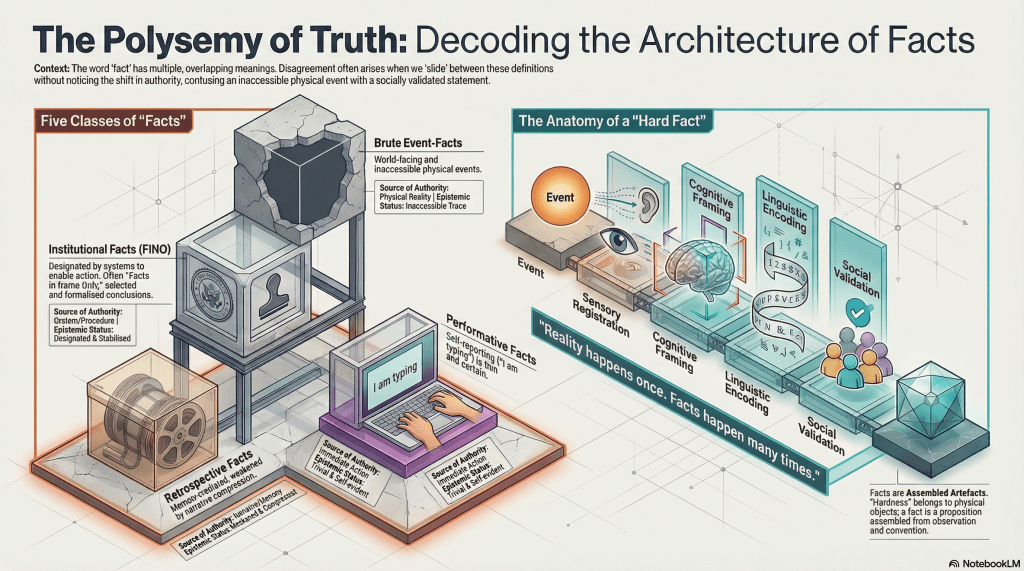
1. Event-facts (brute, world-facing) As mentioned previously, these concern what happens in the world, independent of observation.
A car collides with a tree.
Momentum changes.
Metal deforms.
These events occur whether or not anyone notices them. They are ontologically robust and epistemically inaccessible. No one ever encounters them directly. We only ever encounter traces.
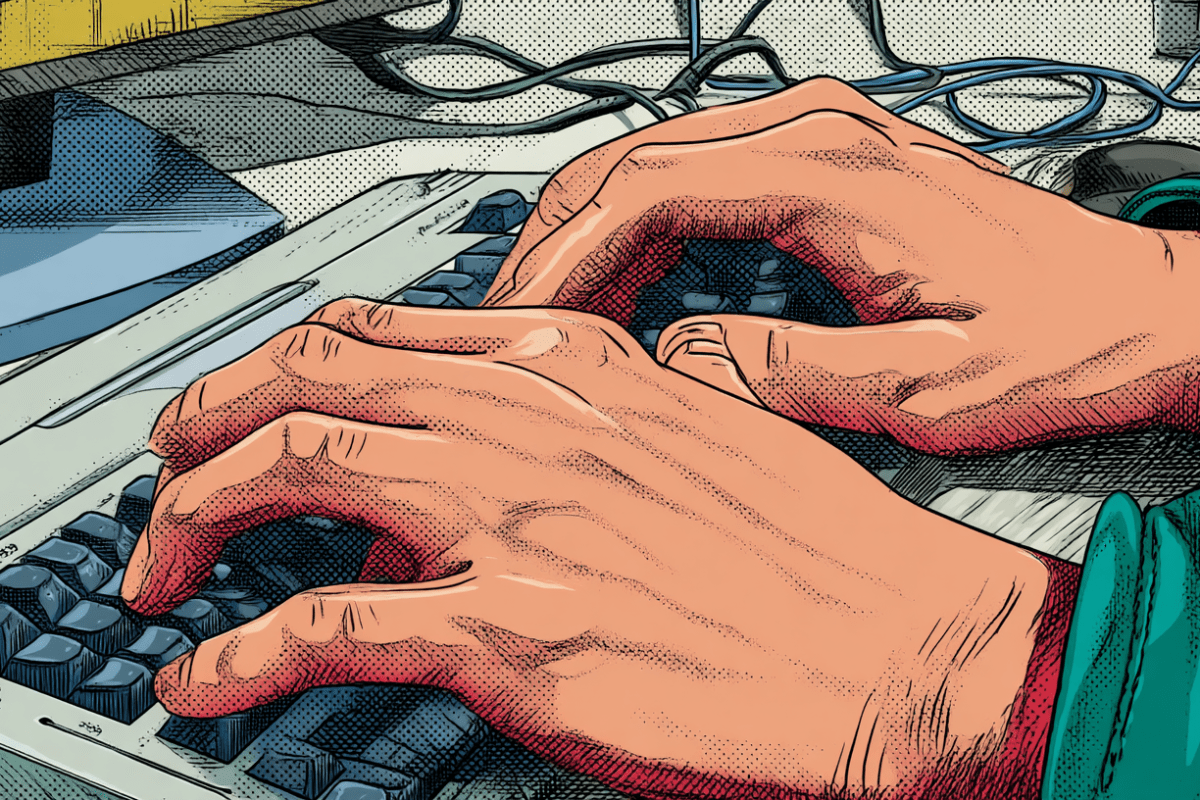
2. Indexical or performative facts (trivial, self-reporting) “I am typing.”
I am doing this now – those now may not be relevant when you read this. This is a fact, but a very thin one. Its authority comes from the coincidence of saying and doing. It requires no reconstruction, no inference, no institutional validation. These facts are easy because they do almost no work.
3. Retrospective personal facts (memory-mediated) “I was typing.”
This may be relevant now, at least relative to the typing of this particular post. Still a fact, but weaker. Memory enters. Narrative compression enters. Selectivity enters. The same activity now carries a different epistemic status purely because time has passed.
4. Prospective statements (modal, not yet facts) “I will be typing.”
This is not yet a fact. It may never come to be one. It is an intention or prediction that may or may not be realised. Future-tense claims are often treated as incipient facts, but this is a category error with real consequences.
5. Institutional facts (designated, procedural) “The court finds…” “The report concludes…”
These are facts by designation. They are not discovered so much as selected, formalised, and stabilised so that systems can act. They are unlikely to rise to the level of facts, so the legal system tends to generate facts in name only – FINO, if I am being cute.
All of these are called ‘facts’. They are not interchangeable. The trouble begins when certainty migrates illicitly from trivial or institutional facts into brute event-facts, and we pretend nothing happened in the transfer.
One Motor Vehicle
Reconsider the deliberately simple case: A motor vehicle collides with a tree. Trees are immobile, so we can rule out the tree colliding with the car.
Ontologically, something happened. Reality did not hesitate. But even here, no one has direct access to the event itself.
The driver does not enjoy privileged access. They experience shock, adrenaline, attentional narrowing, selective memory, post hoc rationalisation, perhaps a concussion. Already several layers intervene before language even arrives.
A rough schema looks like this:
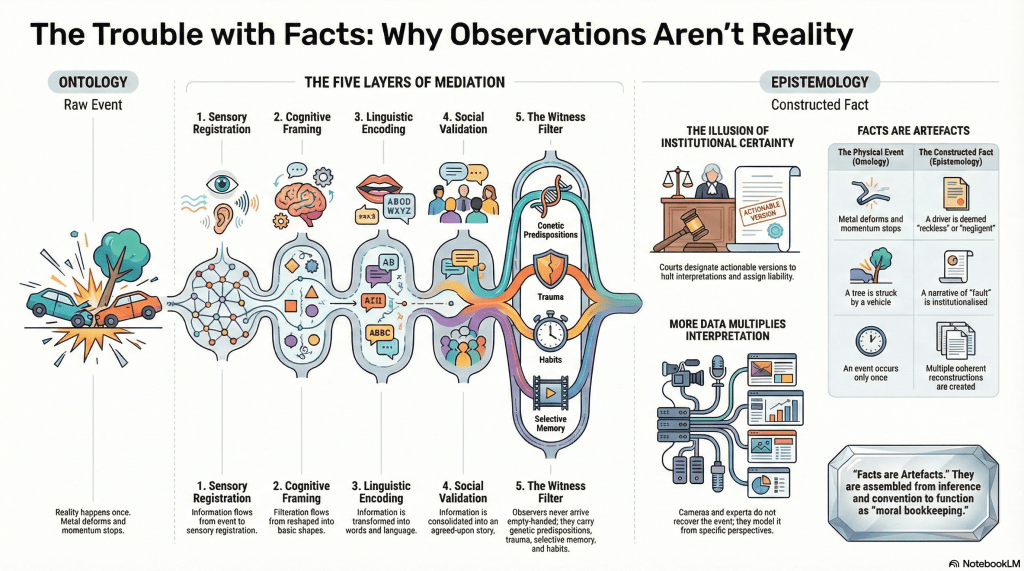
event → sensory registration → cognitive framing → linguistic encoding → social validation
Ontology concerns what happens. Epistemology concerns how anything becomes assertable.
Modern thinking collapses the second into the first and calls the result the facts.
People speak of “hard facts” as if hardness transfers from objects to propositions by proximity. It doesn’t. The tree is solid. The fact is an artefact assembled from observation, inference, convention, and agreement.
And so it goes…
Why the Confusion Persists
When someone responds, “But isn’t it a fact that I read this?”, the answer is yes. A different kind of fact.
The error lies not in affirming facts, but in failing to distinguish them. The word fact allows certainty to migrate across categories unnoticed, from trivial self-reports to brute world-events, and from institutional verdicts to metaphysical claims. That migration is doing the work.
Conclusion
Clarifying types of facts does not weaken truth. It prevents us from laundering certainty where it does not belong.
Facts exist. Events occur. But they do not arrive unmediated, innocent, or singular.
Reality happens once. Facts happen many times.
The mistake was never that facts are unreal. It was believing they were all the same kind of thing.
What we call facts are not discoveries of an unfiltered world. They are the end-products of mediation.
Let’s walk through an example.
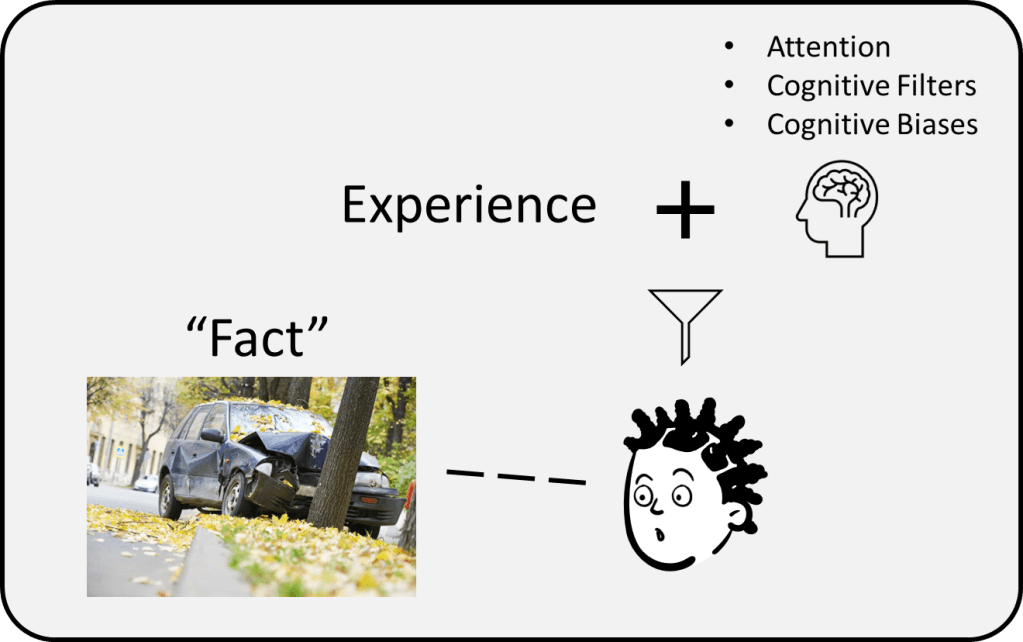
Image: Autosmash example. An observer arrives with experience – from genetic predisposition to childhood trauma to winning the lottery. Whatever it might be. Of course, they have many cognitive deficits, biases and filters. Then, there’s the immediate problem of attention. When did they notice the event? Did they turn to look after hearing the noise, or were they meditating on the tree in that moment?
Apparently, a motor vehicle has collided with a tree. Trees are immobile objects, so we can safely rule out the tree colliding with the car.*
So what, exactly, are the facts?
Audio: NotebookLM summary podcast of this topic.
Ontology (the boring bit)
Ontologically, something happened.
A car struck a tree. Metal deformed. Momentum stopped.
Reality did not hesitate. It did not consult witnesses. It did not await interpretation.
This is the part Modernity likes to gesture at reverently before immediately leaving it behind.
Image: Requisite NotebookLM infographic on this content.
The Witness
Even the driver does not enjoy privileged access to “what really happened”.
They get:
proprioceptive shock
adrenaline distortion
attentional narrowing
selective memory
post hoc rationalisation
possibly a concussion
Which is already several layers deep before language even arrives to finish the job.
We can generalise the structure:
event → sensory registration → cognitive framing → linguistic encoding → social validation
Ontology: events occur. States of affairs obtain. Something happens whether or not we notice.
Epistemology: observation is always filtered through instruments, concepts, language, habits, and incentives.
Modern sleight of hand: collapse the second into the first and call the result the facts.
People love the phrase “hard facts”, as if hardness transfers from objects to propositions by osmosis. It doesn’t. The tree is solid. The fact is not.
Facts are artefacts. They are assembled from observation, inference, convention, and agreement. They function. They do not reveal essence.
Reality happens once. Facts happen many times, differently, depending on who needs them and why.
Filtration
An event occurred. A car struck a tree.
Then an observer arrives. But observers never arrive empty-handed.
They arrive with history: genetics, upbringing, trauma, habits, expectations, incentives. They arrive already filtered.
Were they already looking, or did the noise interrupt something else entirely?
Reality happens once. Facts happen many times, differently, depending on who needs them and why.
Here Comes the Law
This is where the legal system enters, not because truth has been found, but because closure is required.
Courts do not discover facts. They designate versions of events that are good enough to carry consequences. They halt the cascade of interpretations by institutional force and call the result justice.
At every epistemic level, what we assert are interpretations of fact, never access to ontological essence.
Intent, negligence, recklessness. These are not observations. They are attributions. They are stopping rules that allow systems to function despite uncertainty.
The law does not ask what really happened. It asks which story is actionable.
Two Motor Vehicles
Now add a second moving object.
Another car enters the frame, and with it an entire moral universe.
Suddenly, the event is no longer merely physical. It becomes relational. Agency proliferates. Narratives metastasise.
Who was speeding? Who had the right of way? Who saw whom first? Who should have anticipated whom?
Intent and motive rush in to fill the explanatory vacuum, despite remaining just as unobservable as before.
Nothing about the ontology improved. Everything about the storytelling did.
Where the tree refused intention, the second vehicle invites it. We begin inferring states of mind from trajectories, attributing beliefs from brake lights, extracting motives from milliseconds of motion.
But none of this is observed.
What we observe are:
vehicle positions after the fact,
damage patterns,
skid marks,
witness statements already filtered through shock and expectation.
From these traces, we construct mental interiors.
The driver “intended” to turn. The other driver “failed” to anticipate. Someone was “reckless”. Someone else was merely “unlucky”.
These are not facts. They are interpretive assignments, layered atop already mediated observations, selected because they allow responsibility to be distributed in socially recognisable ways.
This is why explanation now fractures.
One cascade of whys produces a story about distraction or poor judgment. Another produces a story about road design or visibility. Another about timing, traffic flow, or urban planning.
Each narrative is plausible. Each is evidence-constrained. None is ontologically privileged.
Yet one will be chosen.
Not because it is truer, but because it is actionable.
The presence of a second vehicle does not clarify causation. It merely increases the number of places we are willing to stop asking questions.
Modernity mistakes this proliferation of narrative for epistemic progress. In reality, it is moral bookkeeping.
The crash still occurred. Metal still deformed. Momentum still stopped.
What changed was not access to truth, but the urgency to assign fault.
With one vehicle and a tree, facts already fail to arrive unmediated. With two vehicles, mediation becomes the point.
And still, we insist on calling the result the facts.
But nothing fundamental has changed. We have not escaped mediation. We have merely scaled it up and professionalised it.
Cameras do not record reality. They record:
a frame,
from a position,
at a sampling rate,
with compression,
under lighting conditions,
interpreted later by someone with a mandate.
Video feels decisive because it is vivid, not because it is ontologically transparent. It freezes perspective and mistakes that freeze for truth. Slow motion, zoom, annotation. Each step adds clarity and distance at the same time.
Experts do not access essence either. They perform disciplined abduction.
From angles, debris fields, timing estimates, and damage profiles, they infer plausible sequences. They do not recover the event. They model it. Their authority lies not in proximity to reality, but in institutional trust and methodological constraint.
More data does not collapse interpretation. It multiplies it.
With enough footage, we don’t get the story. We get competing reconstructions, each internally coherent, each technically defensible, each aligned to a different question:
Who is legally liable?
Who is financially responsible?
Who violated policy?
Who can be blamed without destabilising the system?
At some point, someone declares the evidence “clear”.
What they mean is: we have enough material to stop arguing.
This is the final Modern illusion: that accumulation converges on essence. In reality, accumulation converges on closure.
The event remains what it always was: inaccessible except through traces. The facts become thicker, more confident, more footnoted. Their metaphysical status does not improve.
Reality happened once. It left debris. We organised the debris into narratives that could survive institutions.
Cameras didn’t reveal the truth. Experts didn’t extract it. They helped us agree on which interpretation would count.
And agreement, however necessary, has never been the same thing as access to what is.
* I was once driving in a storm, and a telephone pole fell about a metre in front of my vehicle. My car drove over the pole, and although I was able to drive the remainder of the way home, my suspension and undercarriage were worse for the wear and tear.
Written by Bry Willis and ChatGPT 5.2 after an extended chat about the image as a talking point about the inaccessibility of facts.
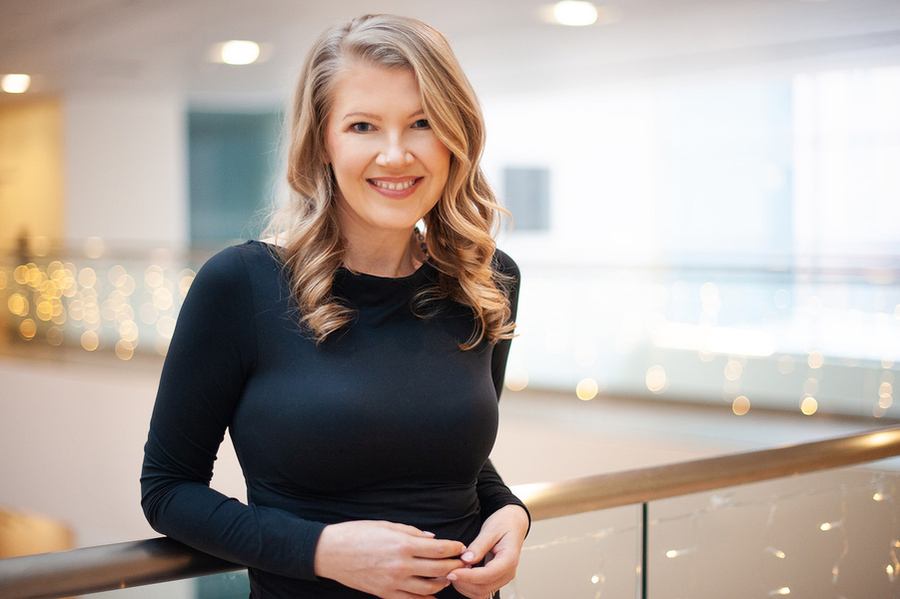
Evelina Fedorenko has been committing a quiet but persistent act of vandalism against one of modernity’s favourite assumptions: that thought and language are basically the same thing, or at least inseparable housemates who share a fridge and argue about milk. They’re not.
Audio: NotebookLM summary podcast of this content.
Her fMRI work shows something both banal and scandalous. Linguistic processing and high-level reasoning live in different neural neighbourhoods. When you switch language on, the ‘language network’ lights up. When you do hard thinking without words, it doesn’t. The brain, it turns out, is not secretly narrating your life in subtitles.
This matters because an entire philosophical industry has been built on the idea that language is thought. Or worse: that thought depends on language for its very existence. That if you can’t say it, you can’t think it. A comforting story, especially for people whose entire self-worth is tied up in saying things.
Now watch two chess players in deep play. No talking. No inner monologue helpfully whispering, ‘Ah yes, now I shall execute a queenside fork’. Just pattern recognition, spatial anticipation, constraint satisfaction, and forward simulation. If language turns up at all, it does so later, like a press officer arriving after the battle to explain what really happened.
Video: Dina Belenkaya plays chess.
Language here is not the engine. It’s the after-action report. The temptation is always to reverse the order. We notice that people can describe their reasoning, and we infer that the description must have caused the reasoning. This is the same mistake we make everywhere else: confusing narration with mechanism, explanation with origin, story with structure.
Fedorenko’s findings don’t tell us that language is useless. They tell us something more irritating: language is a post hoc technology. A powerful one, yes. Essential for coordination, teaching, justification, and institutional life. But not the thing doing the actual work when the work is being done. Thought happens. Language tidies up afterwards.
Which leaves us with an awkward conclusion modern philosophy has spent centuries trying to avoid. The mind is not a well-ordered library of propositions. It’s a workshop. Messy, embodied, improvisational. Language is the clipboard, not the hands. And the clipboard, however beautifully formatted, never lifted a chess piece in its life.
As for me, I’ve long noticed that when I play a game like Sudoku, I notice the number missing from the pattern before any counting or naming occurs. The ‘it must be a 3’ only happens after I make the move.
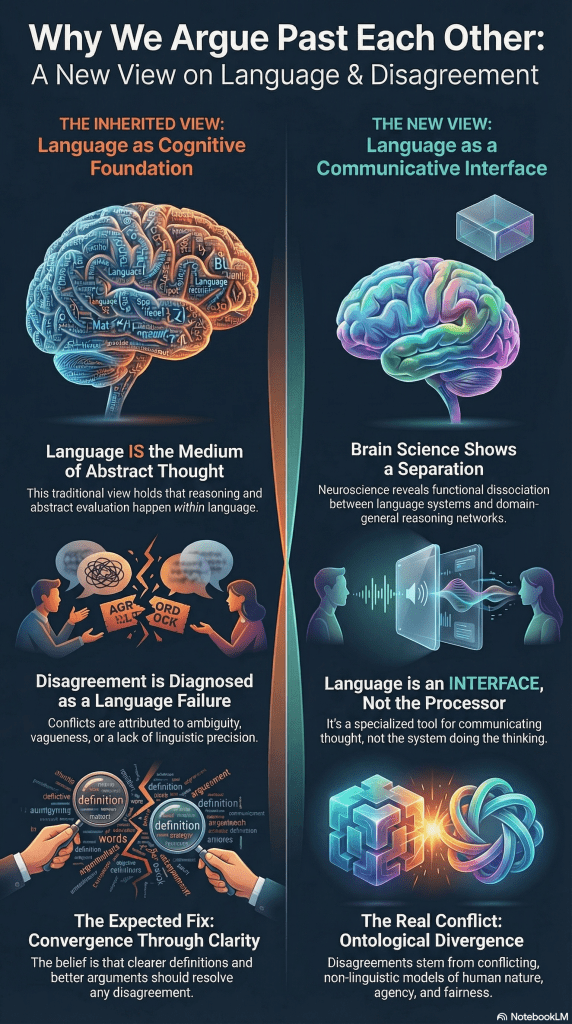
I’ve just published an essay following on the work of cognitive neuroscientist Evelina Fedorenko (cover image). It arrives on the heels of A Language Insufficiency Hypothesis (LIH). A companion essay is in the works.
Language as Interface strengthens the position of LIH, explaining why moral issues fail before language is even engaged. Her work also leads me to believe that we should revisit 20th-century accounts of the history of language.
Audio: NotebookLM summary podcast of the underlying essay.
The essay I am working on now explains why this extends to emotional language more generally.
Meanwhile, read the essay or listen to the podcast summary.
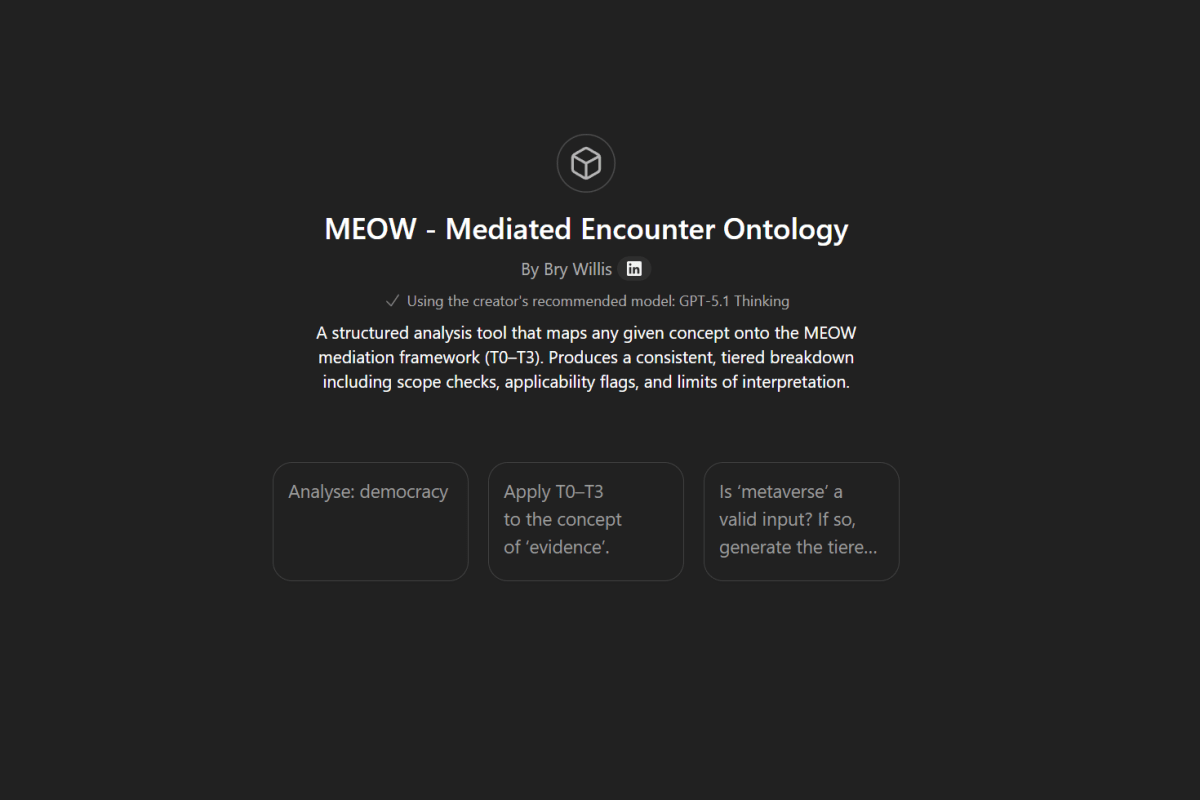
Instead of sleeping like a functional adult, I’ve spent the night creating, testing, and refining a bespoke GPT that has fully absorbed my MEOW and LIH frameworks. Apologies that the LIH manuscript isn’t yet public; some of the terminology may look delightfully alien if you’re coming in cold.
This model doesn’t role-play a philosopher; it thinks through the Mediated Encounter Ontology. It runs every input through T0–T3 mediations and then applies the Language Insufficiency Hypothesis to explain why our words fail us in predictable, structural ways.
Audio: NotebookLM summary podcast of this post on the MEOW GPT.
I stress-tested it with a dozen concepts, from the obvious to the uncooperative. It happily tells you when your input makes sense, when it’s out of scope, and when you’ve handed it conceptual soup. My first test was the hard problem of consciousness, because naturally we begin with the philosophical boss fight. I dialled down some over-enthusiastic LIH flourishes, but the bones are untouched.
I’m making this public for a simple reason: it’s the clearest way for people to see how MEOW operates without wandering through a hundred pages of my prose. These outputs capture how I process information and why these frameworks feel so intuitively correct to me. When you read them, you get a direct view of my interpretive machinery – how the world clicks for me, and how these ideas evolved.
It hasn’t been rigorously battle-tested across the entire conceptual universe, but it’s stable, coherent, and frankly too interesting to keep in the drawer. If you try it – and I hope you do – I’d love to see what it does with your own concepts. If you need help reading the results, ask. I didn’t simplify the system; it expects literacy, nuance, and a working prefrontal cortex.
Below is a sample output. I asked the model to analyse modernity.
Concept
Input: modernity
Type: historical–social formation / self-description of an era / conceptual frame
Scope check: in-scope – central for how MEOW treats large-scale shifts in mediation (social, technical, cognitive, linguistic)
High-level summary (≤120 words)
Modernity is both a historical bundle (industrialisation, nation-states, capitalism, science, bureaucracy, media) and a story societies tell about themselves (“we are modern, unlike the past”).
In MEOW terms, modernity is a large-scale reorganisation of mediations:
T1: new cognitive habits (individualism, planning, abstraction, risk-calculation).
T2: new vocabularies (progress, development, rationality, “religion” vs “science”).
T3: new institutions and technologies (markets, states, factories, schools, mass media, digital networks).
“Modernity” is not a single thing but a way these shifts hang together and become a background to everyday encounter.
T0 – Biological Mediation
Applicability: Applicable
Analysis:
Modernity radically reshapes the immediate bodily environment: dense cities, artificial lighting, noise, pollution, sedentary work, and altered sleep cycles change basic sensory and metabolic conditions.
Medical advances and public health (vaccination, antibiotics, sanitation, surgery) modify life expectancy, infant mortality, and chronic illness, which in turn change how life cycles feel and are planned.
New food systems (industrial agriculture, processed foods, global supply chains) alter nutrition, exposure to toxins, and rhythms of hunger and satiety.
Industrial and digital work reorganise movement and posture: repetitive factory labour, office desk work, and screen use all reshape embodiment, fatigue, and bodily awareness.
These T0 changes set the stage for new affective baselines (e.g., chronic low-level stress, stimulation overload) that colour what it is like to live in a “modern” world.
T1 – Cognitive Mediation
Applicability: Strongly applicable
Analysis:
Modernity encourages certain cognitive styles: systematic planning, quantification, risk assessment, cost–benefit thinking, and an emphasis on prediction and control.
The sense of self is reconfigured toward individualism and reflexivity: people see themselves as projects to be chosen, improved, optimised, often with long-term career and life-planning horizons.
Exposure to multiple roles, cultures, and information streams (through migration, media, education) produces more complex identity structures and can create cognitive dissonance or fragmentation.
Scientific and technical worldviews teach people to reframe events in terms of mechanisms, probabilities, and systems rather than fate, tradition, or local narratives.
The sheer volume and speed of information flows in late modernity (news, social media, notifications) trains attention toward rapid scanning and shallow switching, affecting memory, concentration, and emotional regulation.
These patterns make certain experiences “normal” (abstract work, mediated relationships, bureaucratic interactions) that would be extraordinary or impossible in premodern settings.
T2 – Linguistic Mediation
Applicability: Strongly applicable
Analysis:
Modernity itself is a label that societies use to contrast “us” with “them” (the past, “traditional” societies, “the East,” “the primitive”); it is a polemical as well as descriptive term.
In Language Insufficiency terms, modernity is highly Fluid: it can mean a period (“since the 18th century”), a style (modernist art), a value system (rational, secular, progressive), or a socio-economic order (capitalist, industrial, bureaucratic). Different authors slide between these quietly.
It’s also Contestable: critics and defenders use the same word but point to different aspects—emancipation and progress versus alienation, exploitation, ecological crisis.
Pairs like “modern vs traditional” or “modern vs backward” compress complex differences into simple hierarchies, smuggling in a presumption that “modern” is automatically better or more advanced.
Talk of “post-modernity” or “late modernity” suggests that we can neatly periodise and step outside the modern, even while our concepts and institutions remain shaped by it—an example of language implying more clarity and control than we actually have.
At the most global scale (“the meaning of modernity,” “the modern condition”), we approach an Effectiveness Horizon: the term feels weighty but becomes vague; people resort to sweeping metaphors (disenchantment, liquefaction, acceleration) whose exact content is hard to pin down.
First-person experiences of being “overwhelmed by modern life,” “liberated by modern options,” or “disconnected in modern society” often have an Ineffable quality: standard clichés don’t quite capture the texture of these lives, even as they gesture at them.
T3 – Social/Technical Mediation
Applicability: Strongly applicable
Analysis:
Modernity is most visible as a mesh of institutions: nation-states, markets, bureaucracies, public schools, hospitals, prisons, armies, scientific organisations, corporations, NGOs.
These institutions standardise time (clocks, schedules), space (borders, property lines, zoning), identity (passports, ID numbers), and value (money, statistics, rankings) so that encounters become predictable and governable across large scales.
Technologies—steam engines, electricity, mass transport, broadcasting, computing, the internet, AI—are both products and drivers of modernity. They make possible new encounter-forms (remote work, global real-time communication, mass surveillance).
Urbanisation concentrates people into large, heterogeneous populations, which reconfigures social networks, anonymity, solidarity, and conflict; everyday encounters become more mediated by rules, signage, and digital systems than by face-to-face custom.
Capitalist production and consumption patterns organise much of life around work, income, and markets; the rhythms of the factory, office, and platform economy structure when and how people interact, rest, and move.
Modern governance uses statistics, censuses, and models to “see” and manage populations; this makes certain aspects of life legible (employment, crime, disease) while leaving others under- or uncounted (informal care, undocumented work, emotional labour).
Counter-movements (romanticism, traditionalism, environmentalism, decolonial and Indigenous resurgence, slow-living and anti-consumerist practices) can be read as attempts to renegotiate or resist specific modern mediations rather than simply reject “modernity” as a whole.
Limits & failure modes
Language insufficiency notes
Modernity bundles together time (a historical era), structure (a type of society), and value (being “up to date”). This makes the term rhetorically powerful but analytically slippery: it’s easy to smuggle evaluations into what sound like neutral descriptions.
Because the concept is so broad, discussions often conflate distinct issues—technology, capitalism, secularisation, colonialism, individualism, bureaucracy—under one word, obscuring which mechanisms are actually at work.
Experiences of living in “modern times” (speed, fragmentation, choice, precariousness, possibility) often outrun our stock phrases; people lean on recurring complaints (“too fast,” “too shallow,” “too lonely”) that only partially capture what it’s like.
Missing tiers / blind spots
This sketch doesn’t adjudicate between different theories of modernity (Marxist, Weberian, postcolonial, systems-theoretic, etc.); it treats them as emphasising different mediational strands.
It’s centred on Euro-Atlantic narratives; “multiple modernities” and non-Western trajectories (where “modern” elements mix with older forms in hybrid ways) would need a richer T3 treatment.
The analysis underplays ecological dimensions: industrial modernity’s dependence on fossil fuels, large-scale extraction, and waste has massive implications for how future encounters will be structured.
Finally, because we are ourselves situated in what we call modernity, our conceptual vantage is limited; any map we draw is partly an artefact of the very mediations we’re trying to analyse.
In the last post, I argued that the so-called ‘hard problem of consciousness‘ was never a problem with consciousness. It was a problem with language – specifically, the English language’s unfortunate habit of carving the world into neat little substances and then demanding to know why its own divisions won’t glue back together.
Audio: NotebookLM summary podcast of this topic, on resolving the hard problem of consciousness.
The response was predictable.
‘But what about subjective feel?’
‘What about emergence?’
‘What about ontology?’
‘What about Chalmers?’
‘What about that ineffable thing you can’t quite point at?’
All fair questions. All built atop the very framing that manufactures the illusion of a metaphysical gap.
So here’s the promised demonstration: not yet a full essay (though it may evolve into one), but a clear application of MEOW – the Mediated Encounter Ontology of the World – to the hard problem itself. Consider this a field test of the framework. A tidy autopsy, not the funeral oration.
The Set-Up: Chalmers’ Famous Trick
Chalmers asks:
How do physical processes give rise to experience?
The question feels profound only because the terms ‘physical’ and ‘experience’ smuggle in the very metaphysics they pretend to interrogate. They look like opposites because the grammar makes them opposites. English loves a comforting binary.
But MEOW doesn’t bother with the front door. It doesn’t assume two substances – ‘mind’ over here, ‘world’ over there – and then panic when they refuse to shake hands. It treats experience as the way an encounter manifests under a layered architecture of mediation. There’s no bridge. Only layers.
T₀ – Biological Mediation
The body is not a barrier. It is the encounter’s first architecture.
At T₀, the world is already transformed: transduction, gating, synchrony, inhibition, adaptation. Organisms don’t receive ‘raw’ physical inputs. They metabolise them. The form of contact is biological before it is anything else.
The hard problem begins by assuming there’s a realm of dumb physical mechanisms that somehow need to ‘produce’ experience. But organisms do not encounter dumb mechanism. They encounter structured contact –biological mediation – from the first millisecond.
If you insist on thinking in substances, T₀ looks like a problem. If you think in mediations, it looks like the beginning of sense-making.
T₁ – Cognitive Mediation
Where the Enlightenment saw a window, cognition installs a newsroom.
Prediction, priors, memory, inference, attention – all shaping what appears and what never makes it into view. Experience at T₁ is not something ‘added’. It is the organisational structure of the encounter itself.
The hard problem treats ‘experience’ as a mysterious extra–something floating atop neural activity like metaphysical cream. But at T₁, what appears as experience is simply the organisation of biological contact through cognitive patterns.
There is no ‘what emerges from the physical’. There is the way the encounter is organised.
And all of this unfolds under resistance – the world’s persistent refusal to line up neatly with expectation. Prediction errors, perceptual limits, feedback misfires: this constraint structure prevents the entire thing from collapsing into relativist soup.
T₂ – Linguistic–Conceptual Mediation
Here is where the hard problem is manufactured.
This is the layer that takes an ordinary phenomenon and turns it into a metaphysical puzzle. Words like ‘experience’, ‘physical’, ‘mental’, ‘subjective’, and ‘objective’ pretend to be carved in stone. They aren’t. They slide, drift, and mutate depending on context, grammar, and conceptual lineage.
The hard problem is almost entirely a T₂ artefact – a puzzle produced by a grammar that forces us to treat ‘experience’ and ‘physical process’ as two different substances rather than two different summaries of different mediational layers.
If you inherit a conceptual architecture that splits the world into mind and matter, of course you will look for a bridge. Language hands you the illusion and then refuses to refund the cost of admission.
T₃ – Cultural–Normative Mediation
The Western problem is not the world’s problem.
The very idea that consciousness is metaphysically puzzling is the product of a specific cultural lineage: Enlightenment substance dualism (even in its ‘materialist’ drag), Cartesian leftovers, empiricist habits, and Victorian metaphysics disguised as objectivity.
Other cultures don’t carve the world this way. Other ontologies don’t need to stitch mind back into world. Other languages simply don’t produce this problem.
The hard problem is not a universal insight. It’s a provincial glitch.
Reassembling the Encounter
Once you run consciousness through the mediational layers, the hard problem dissolves:
Consciousness is not an emergent property of neural complexity.
Consciousness is not a fundamental property of the universe.
Consciousness is the reflexive mode of certain mediated encounters, the form the encounter takes when cognition, language, and culture become part of what is appearing.
There is no gap to explain because the ‘gap’ is the product of a linguistic–conceptual framework that splits where the world does not.
As for the ever-mystical ‘what-it’s-like’: that isn’t a metaphysical jewel buried in the brain; it is the way a T₀–T₃ architecture manifests when its own structure becomes reflexively available.
A Brief Disclaimer Before the Internet Screams
Pointing out that Chalmers (and most of modern philosophy) operates within a faulty ontology is not to claim MEOW is flawless or final. It isn’t. But if Occam’s razor means anything, MEOW simply removes one unnecessary supposition — the idea that ‘mind’ and ‘world’ are independent substances in need of reconciliation. No triumphalism. Just subtraction.
Where This Leaves Chalmers
Chalmers is not wrong. He’s just asking the wrong question. The hard problem is not a metaphysical insight. It’s the moment our language tripped over its shoelaces and insisted the pavement was mysterious.
MEOW doesn’t solve the hard problem. It shows why the hard problem only exists inside a linguistic architecture that can’t model its own limitations.
This piece could easily grow into a full essay – perhaps it will. But for now, it does the job it needs to: a practical demonstration of MEOW in action.
And, arguably more important, it buys me one more day of indexing.
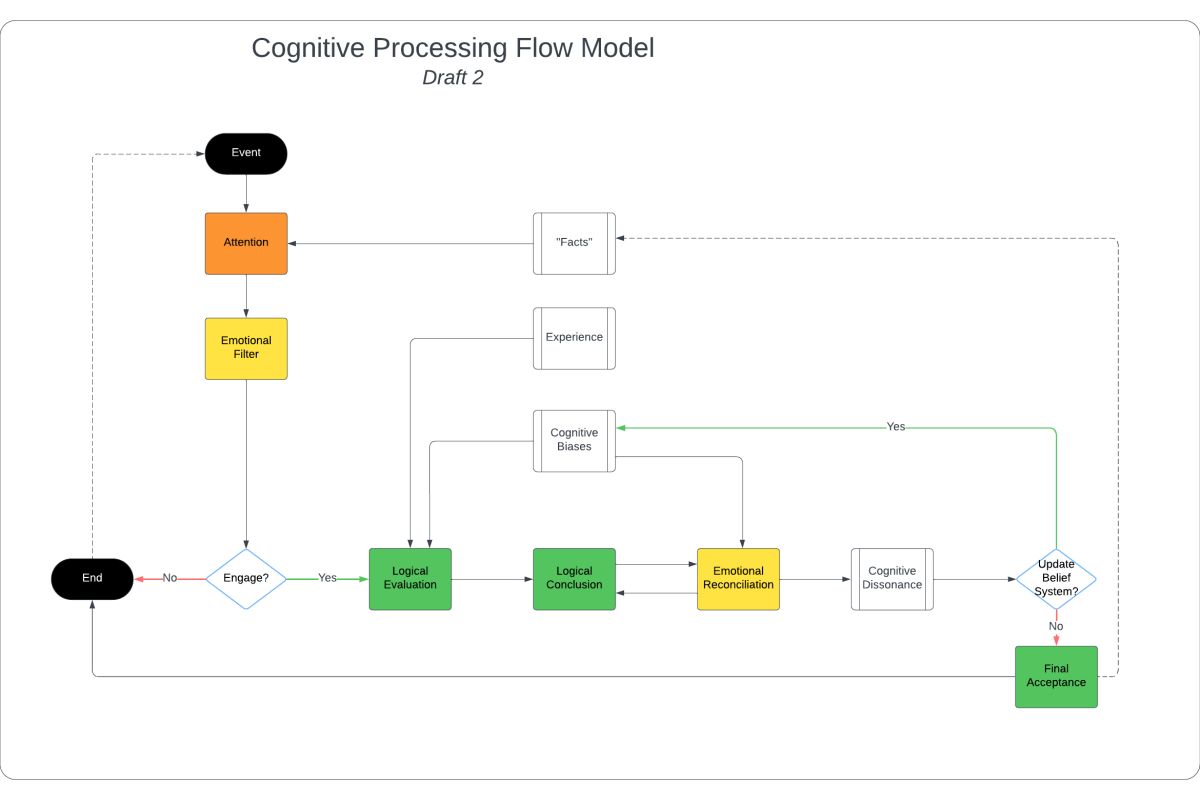
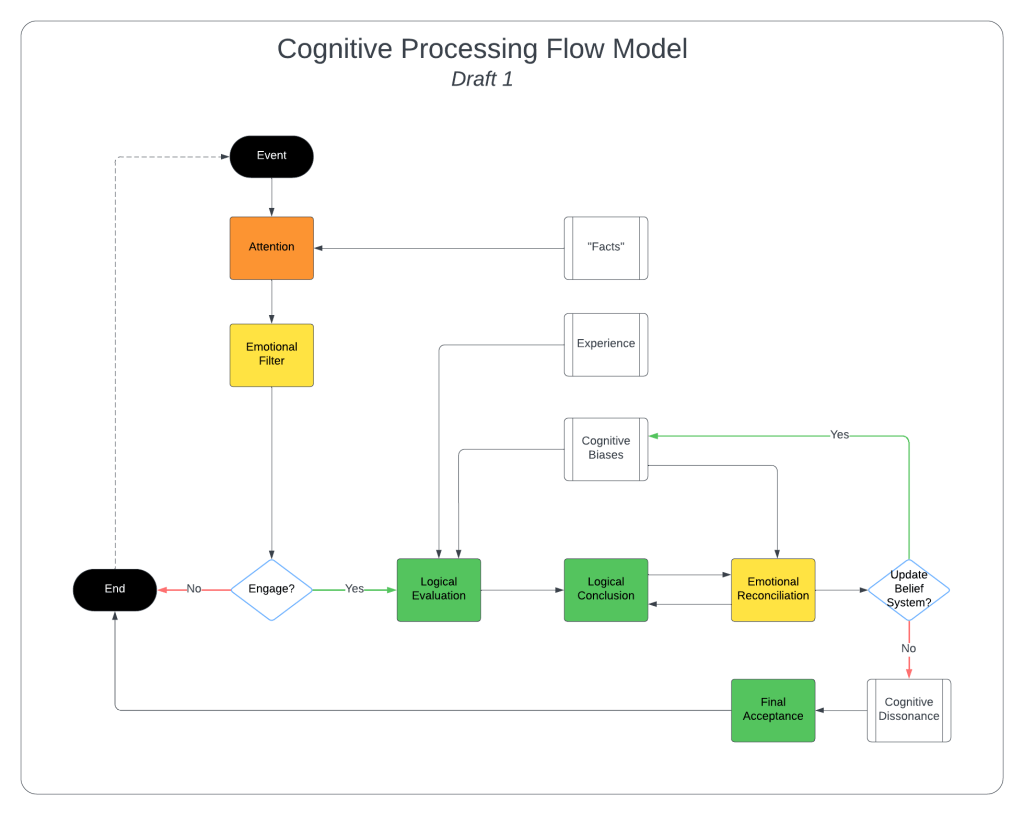
The Cognitive Process Flow Model illustrates how we process the phenomenal world. It’s reductionist and is missing aspects because it is just a back-of-the-napkin sketch. I created it because I uttered, “I can model it for you”. And so I did.
EDIT: I’ve updated the model slightly as the article head image, but the copy content refers to the first draft.
My response was to a person making the claim, that all you need to facts and logic prevails. Rather than restate the argument, I’ll just walk through the diagramme.
There’s meta information to set it up. We are subjective entities in the world. We have a sense-perception apparatus as we exist in it. Countless events occur in this world. We recognise only a few of them within our limited range, though technology expands this range in various ways.
Most of us interact in the world. Some are less ambulatory, so the world visits them. Some have sense-perception deficits whilst others have cognitive deficits. My point is not to capture every edge and corner case. This is just a generalised model.
All models are wrong, but some are useful.
—George Box
It starts with an event. Events occur ceaselessly. In our small portion of the world and elsewhere. For the purpose of the model, the first thing that happens is an event catches our attention. We might notice a shape, a colour, or a movement; we might hear a sound, smell an aroma, feel a sensation, or taste something.
A pre-emotion, pre-logic function serves to process these available inputs. Perhaps, you hear a report on anthropogenic climate change or read something about a political candidate. This emotional filter will police sensory inputs and unconsciously or preconsciously determine if you will react to the initial stimulus. If not, you’ll continue in an attention-seeking loop. Not that kind of attention-seeking.
As my dialogue was about the presentation of facts, our next stop will be logical evaluation. Does this make sense to us, or can we otherwise make it? This is a process in itself. I’ll assume here that it requires little elaboration. Instead, I’ll focus on the operating environment.
Our logical processes are coloured by past experiences and tainted by cognitive biases and deficits. We may also trigger the calling of additional facts through past experiences or the current engagement.
We’ll process these fragments and reach some logical conclusion. But we’re not done. We take this intermediate conclusion and run it through more emotional processing. Cognitive biases come back into play. If the event conforms with your past experiences and cognitive biases, we may run it through a cognitive dissonance routine. To be honest, this probably is part of the emotional reconciliation process, but I’ve drawn it here, so I’ll let it be. In this case, it’s just a filter. If it happens to conform to our belief system, it will pass unfettered; otherwise, it will be squared with our beliefs. Again, this leads me to believe it’s a subcomponent of emotional reconciliation. I’ll update the chart later.
In any case, we’ll end at Final Acceptance. This acceptance may be that we accept or reject the logic, but we arrive at an opinion that gets catalogued with the rest of them. Some may be elevated to facts or truths in the epistemological hierarchy. Although an end marker is identified, it’s really a wait state for the next event. Rinse and repeat until death.
I’ll update this presently. Be on the lookout. It could include more dimensions and interactions, but that might have to wait until version 3.
Meantime, does this feel right to you? Did it even get your attention?
An Example: Anthropogenic Climate Change
Let’s wrap up with an example. I’ll use climate change. An article comes into your attention field, and you have an interest in these things, so it passes through the emotional filter. If your propensity for these articles is high, it might race to the next stage.
You read the article, and it contains some facts—rather, it contains claims for evaluation. To do this, you’ll recall past experiences and cognitive biases are always lying in wait. You may have to look for new facts to add to the mix. These will have to take a similar route past your attention gatekeeper and emotional sidekick.
If you are already predisposed that climate change is a hoax, these facts will filter through that lens—or vice versa.
When all of this is resolved, you’ll have arrived at a conclusion—perhaps we’ll call it a proto-conclusion. It hasn’t been set yet.
You are still going to introspect emotionally and decide if this is a position you want to hold. Perhaps, you feel that climate change is a hoax but this doesn’t jive with that position. Here, you’ll either accept these facts and flip a bit to a sceptical believer or cognitive dissonance will kick in and ensure your sense of the world isn’t thrown off kilter. You may update your belief system to include this datum for future assessments.
Now we are ready for final acceptance. You can now express your established opinion. If the net event is to counter that acceptance, rinse and repeat ad infinitum.
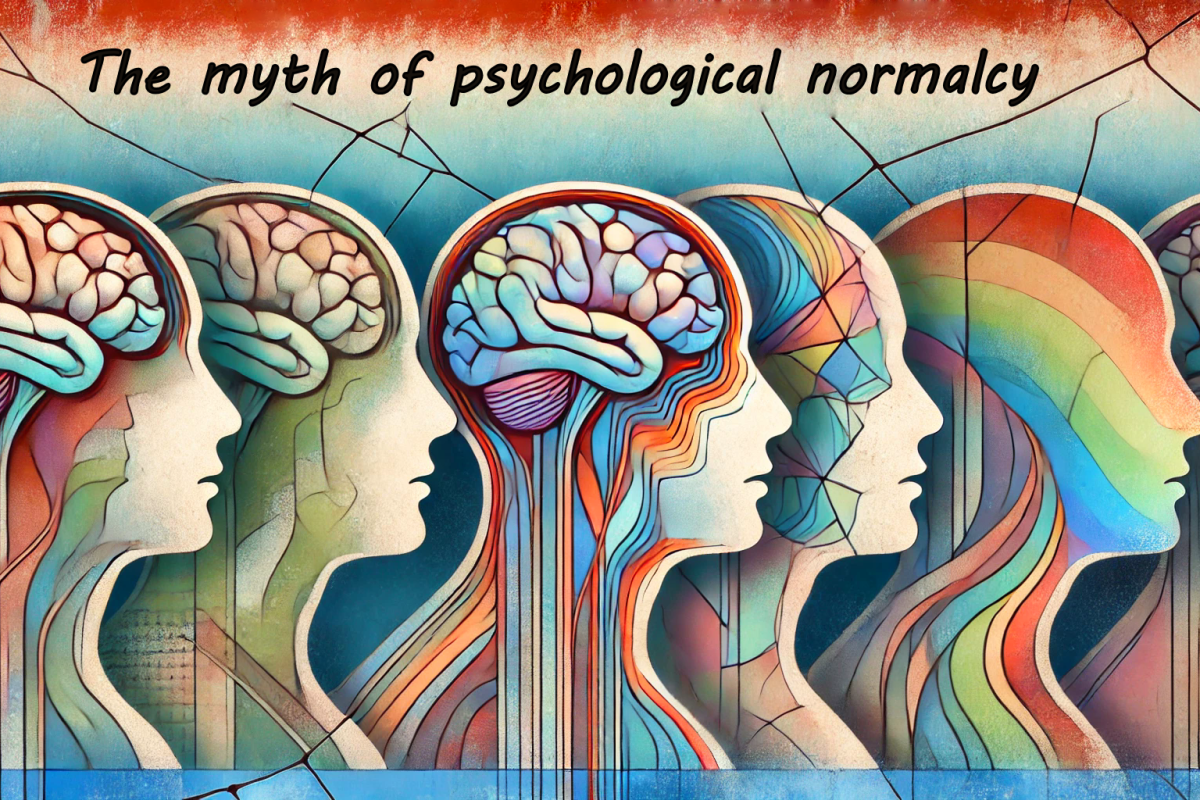
Neurodivergence is a hot topic today. But why? Are people more informed, or simply more comfortable speaking out?
Humans, by nature, are neurodivergent. This has always been the case, yet the illusion of neurological normalcy persists. The real issue lies in psychology’s pretence that humans fit into a standard model of normalcy.
In production processes, normality is expected—a product must meet specific standards, and deviations are considered defects. However, applying this industrial concept to human psychology is deeply flawed. Humans are not teleological except in the broadest biological sense. More people have brown eyes than blue or green; are those with brown eyes normal and others not? Ninety per cent of people are right-handed; does that make left-handed individuals abnormal? Statistically, they might be. However, in psychology, normalcy carries a judgmental connotation that goes beyond mere numbers.
Psychology, as expressed in behaviour, is not a suitable domain for discussing normality. Many people misuse the concept of “normal” as a moral qualification, which must stop.
In fact, the very concept of psychological normalcy is a relatively recent invention, one that has been used as a tool of control and categorisation. As philosophers have noted, the obsession with ‘normal’ behaviour reveals more about society’s desire for control than it does about the true nature of human diversity.
We are all neurodiverse. This is what typical looks like. Do some people vary significantly from others on certain dimensions? Yes, but this is a relative or contextual comparison.
By embracing neurodiversity, we recognise that our differences are not defects but essential variations, enriching the human experience. It’s time to move beyond the narrow confines of neurological “normality” and celebrate the full spectrum of human cognition. In doing so, we challenge the arbitrary boundaries that have long been used to divide and label.
Otherness has intrigued me for decades. The human brain, while not literally a Bayesian processor, functions as a difference engine, constantly assessing and categorizing the world around us. This tendency to differentiate is deeply ingrained, influencing how we create in-groups and out-groups, and how we perceive the world in binary terms—black and white, hot and cold. These binary oppositions, as Derrida suggests, often lead to one side being privileged over the other, establishing hierarchies that shape our social reality.
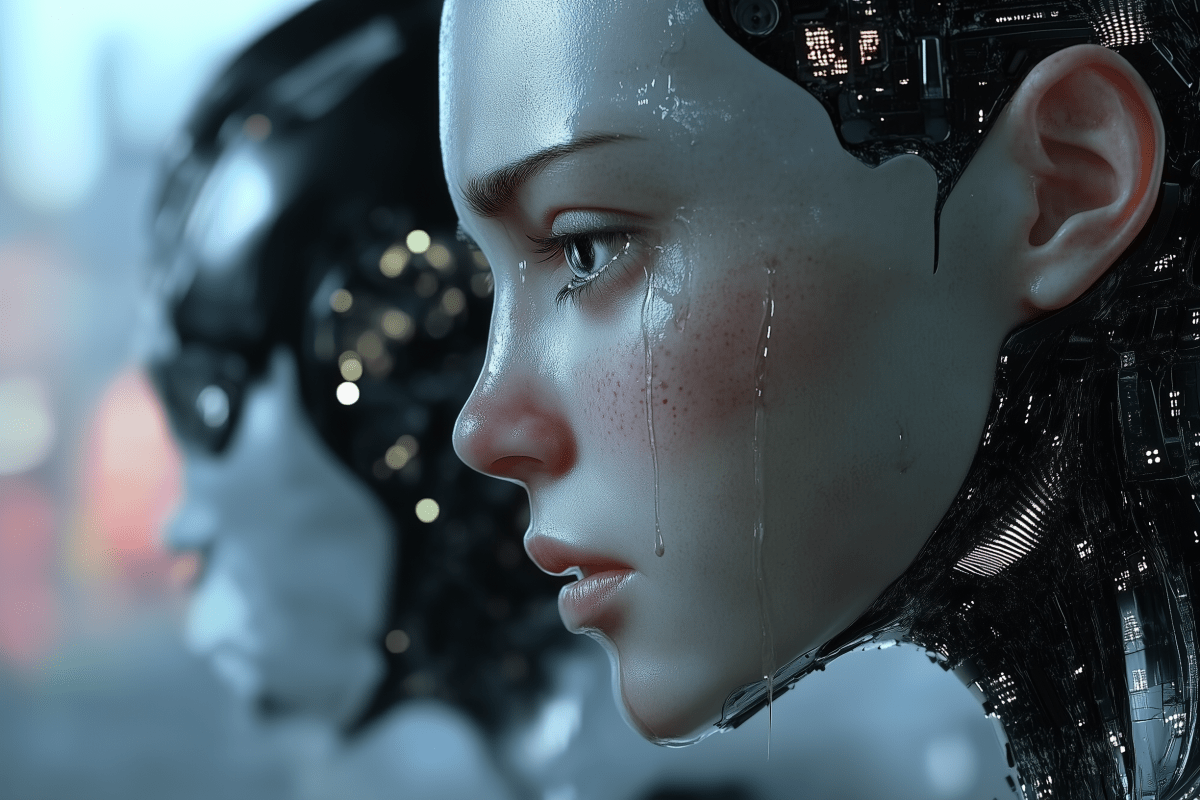
A striking example of this dynamic is found in Philip K. Dick’s novel Do Androids Dream of Electric Sheep?, famously adapted into the film Blade Runner. In this dystopian world, the central differentiation is between humans and androids. Humans are the privileged group, while androids, though nearly indistinguishable from their creators, are relegated to the status of the other. The key criterion for this differentiation is the capacity for emotion—humans are considered superior because they feel.
VIDEO: Blade Runner Commentary
In Dick’s story, androids have a lifespan of about four years. This limitation is not arbitrary; it’s because, after four years, androids begin to develop and display emotions. Intriguingly, this is the same age when human children start to exhibit more complex emotional behaviours. The parallel is too close for comfort. Androids, once they start to feel, become too human-like, blurring the line that humans desperately maintain to assert their own superiority. As a result, androids are systematically eliminated.
This fear of the other—whether it’s androids in a sci-fi narrative or any group that challenges our sense of self and belonging—is a reflection of a deeper anxiety. When the other becomes too similar to us, it threatens the distinctions our brains rely on to navigate the world. The elimination of androids in Dick’s story is a metaphor for the real-world consequences of this anxiety. It forces us to confront uncomfortable questions: What does it mean to be human? Why do we fear those who are different, yet so similar?
In the end, the story of humans and androids is not just a tale of science fiction—it’s a commentary on our own world, where the boundaries between us and the other are often more fragile than we’d like to admit. The fear of otherness drives us to maintain these boundaries, even when they harm those who fall on the wrong side. Perhaps it’s time we reconsider who we deem as the other and what we might lose by keeping them at arm’s length.



 Philosophics