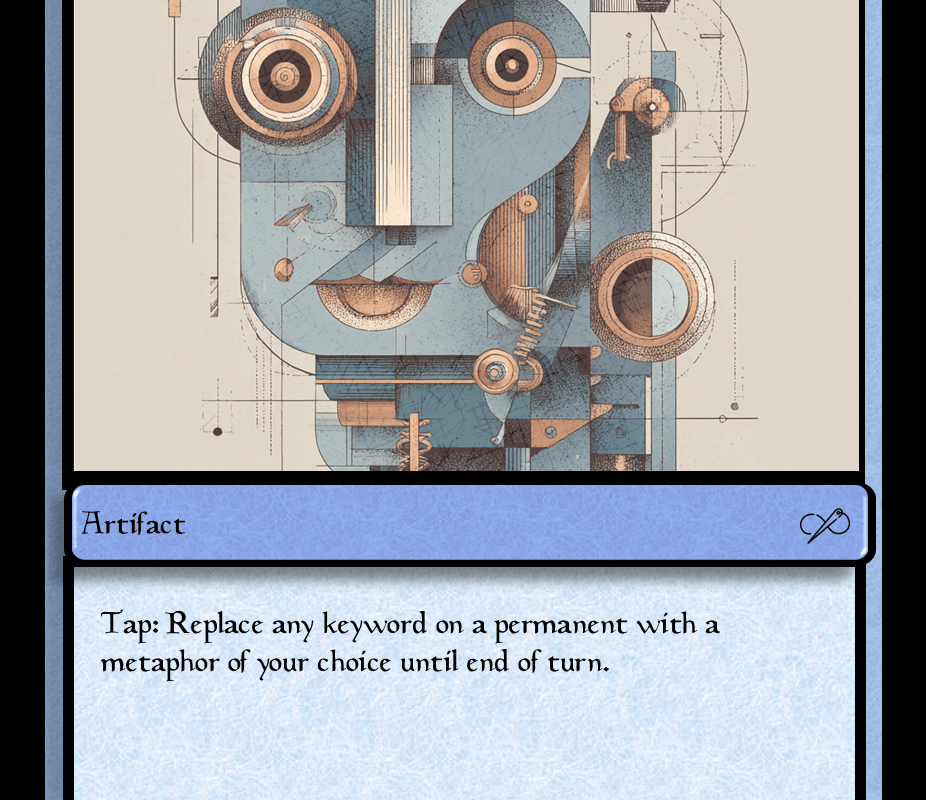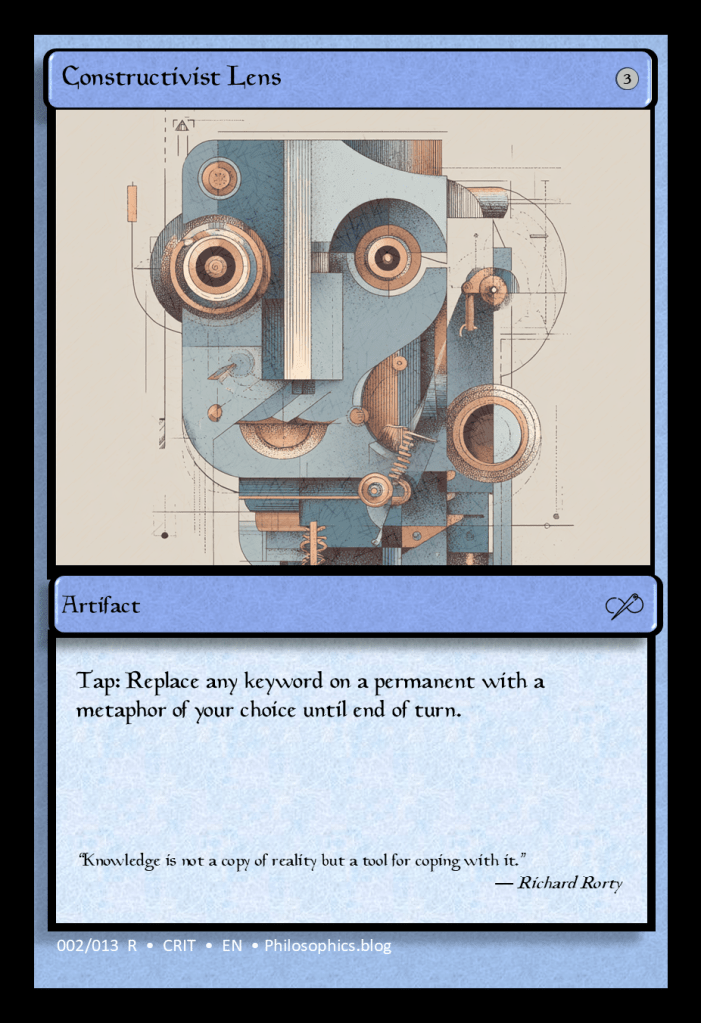
Contructivist Lens: Parody Artefact

1โ€“2 minutes

Another faux Magic: The Gathering trading card. I’ve been busy writing an essay on Tatterhood and wondering if I’ve gone off the edge even further into mental masturbation. I made these cards to share on slow news days, as it were.

[EDIT: Oops: Even wore. I already posted something today. Enjoy the bonus post.]

Every philosopher dreams of a device that reveals ‘truth’. The Constructivist Lens does the opposite. When you tap it, the world doesnโ€™t come into focus โ€“ it multiplies. Each pane shows the same thing differently, reminding us that knowing is always a form of making โ€“ seeing as building.

In The Discipline of Dis-Integration, I wrote that philosophyโ€™s task is ‘to remain within what persists โ€ฆ to study the tension in the threads rather than weave a new pattern’. The Lens embodies that ethic. It is not an instrument of discovery but of disclosure: a way to notice the scaffolding of perception without mistaking it for bedrock.

Where Enlightenment optics promised clarity, the Lens trades in parallax. It insists that perspective is not a flaw but the condition of vision itself. Each player who peers through it โ€“ artist, scientist, moralist โ€“ constructs a different coherence, none final. The cardโ€™s rule text captures this tension: replace any keyword on a permanent with a metaphor of your choice until end of turn. Reality bends, language shifts, yet the game continues.

In the Dis-Integration set, the Lens sits alongside Perspectival Realism and Language Game (not yet shared), forming the Blue triad of epistemic doubt. Together they dramatise what the essay calls ‘the hyphen as hinge’: the small pause between integration and its undoing. The Constructivist Lens, then, is not a tool for clearer sight but a reminder that every act of seeing is already an act of construction.

Tatterhood, Makeover Culture, and the Prince Who Earned a Gold Star for Basic Curiosity

3โ€“5 minutes

Iโ€™ve spent more hours than I care to admit rummaging through the Jungian undergrowth of fairy tales โ€“ reading Marie-Louise von Franz until my eyes crossed, listening to Clarissa Pinkola Estรฉs weave her wolf-women lore, and treating folklore like an archaeological dig through the psychic sediment of Europe. Itโ€™s marvellous, really, how much one can project onto a story when one has a doctorateโ€™s worth of enthusiasm and the moral flexibility of a tarot reader.

But every so often, a tale emerges that requires no archetypal lens, no mythopoetic scaffolding, no trip down the collective unconscious. Sometimes a story simply bares its ideological teeth.

Enter Tatterhood โ€“ the Norwegian fairy tale so blunt, it practically writes its own critical theory seminar.

I watched Jonny Thomsonโ€™s recent video on this tale (embedded below, for those with sufficient tea and patience). Jonny offers a charming reversal: rather than focusing on Tatterhood herself, he offers the moral from the princeโ€™s perspective. In his reading, the story becomes a celebration of the power of asking โ€“ the princeโ€™s reward for finally inquiring about the goat, the spoon, the hood, the whole aesthetic calamity before him.

Video: Jonny Thomson discusses Tatterhood.

Itโ€™s wholesome stuff: a TED Talk dressed as folklore. But โ€“ my word โ€“ apply the slightest bit of critical pressure, and the whole thing unravels into farce.

The Story No One Tells at the Royal Wedding

Hereโ€™s the short version of Tatterhood that Jonny politely sidesteps:

  • A fearless, ragged, hyper-competent girl rescues her sister from decapitation.
  • She confronts witches, navigates the seas alone, storms a castle, and performs an ad hoc ontological surgical reversal.
  • She does all of this without help from the king, the court, the men, or frankly, anyone with a Y chromosome.

And how is she rewarded for her trouble? Sheโ€™s told sheโ€™s too ugly. Not socially acceptable. Not symbolically coherent. Not bride material.

The kingdom gazes upon her goat, her spoon, her hood, her hair, and determines that nothing โ€“ nothing โ€“ about her qualifies her for legitimacy.

Competence: irrelevant.
Courage: irrelevant.
Loyalty: irrelevant.

But beauty? Beauty is the passport stamp that grants her entry into the social realm.

Jonnyโ€™s Prince: A Hero by Low Expectations

Now, bless Jonny for trying to rehabilitate the lad, but this prince is hardly an exemplar of virtue. He sulks through his own wedding procession like a man being marched to compulsory dentistry. He does not speak. He does not ask. He barely manages object permanence.

And suddenly, the moral becomes: Look what wonders unfold when a man asks a single question!

Itโ€™s the philosophical equivalent of awarding someone a Nobel Prize for remembering their motherโ€™s birthday.

And what do his questions achieve? Not insight. Not understanding. Not intimacy. But metamorphosis.

Each time he asks, Tatterhood transforms โ€“ ugly goat to beautiful horse, wooden spoon to silver fan, ragged hood to golden crown, ‘ugly’ girl to radiant beauty.

Which brings us to the inconvenient truth:

This Isnโ€™t the Power of Asking. Itโ€™s the Power of Assimilation.

His questions function as aesthetic checkpoints.

Why the goat?
Translation: please ride something socially acceptable.

Why the spoon?
Translation: replace your tool of agency with a decorative object.

Why the hood?
Translation: cover your unruliness with something properly regal.

Why your face?
Translation: you terrify me; please be beautiful.

And lo, she becomes beautiful. Not because he sees her differently. Because the story cannot tolerate a powerful woman who remains outside the beauty regime.

The prince isnโ€™t rewarded for asking; the narrative is rewarded for restoring normative order.

And Yetโ€ฆ Itโ€™s Absurdly Fascinating

This is why fairy tales deserve all the interpretive attention we lavish on them. Theyโ€™re ideological fossils โ€“ compressed narratives containing entire worldviews in miniature.

Part of me admires Jonnyโ€™s generosity. Another part of me wants to hand the prince a biscuit for performing the bare minimum of relational curiosity. But mostly, Iโ€™m struck by how nakedly the tale reveals the old bargain:

Everything else is optional. Beauty is compulsory.

So Hereโ€™s My Version of the Moral

Ask questions, yes. Be curious, yes. But donโ€™t let anyone tell you that Tatterhood was waiting for the princeโ€™s epiphany. She was waiting for the world to remember that she ran the plot.

If youโ€™ve made it this far and know my proclivities, youโ€™ll not be shocked that I side with Roland Barthes and cheerfully endorse la mort de lโ€™auteur. Jonny is perfectly entitled to his reading. Interpretive pluralism and all that. I simply find it marvelously puzzling that he strolls past the protagonist galloping through the narrative on a goat, spoon upraised, and instead decides to chase the side-quest of a prince who contributes roughly the energy of a damp sock.

A Key Point of Departure: He Accepts the Folk Psychology I Reject

3โ€“5 minutes

Jason from Philosopher Muse suggested a connexion between Transductive Subjectivity and the work of Stephen Batchelor. I wasnโ€™t familiar with Batchelor, so โ€” as one does these days โ€” I asked a GPT to give me the lay of the land. The machine obliged, and the result was interesting enough that it warranted a post of its own. This is it.

Audio: NotebookLM summary podcast of this topic.

Before anyone lights incense: Iโ€™m not suddenly a convert. Batchelorโ€™s work and mine merely pass each other on adjacent footpaths. But the overlap is conceptually neat, and the divergence is even more telling.


Stephen Batchelor vs Transductive Subjectivity: A Brief Comparative Note

1. Shared Territory: The Self as Verb, Not Noun

Both Batchelor and Transductive Subjectivity reject the folk notion of a single, continuous metaphysical self.

  • Batchelor (Secular Buddhism):
    The self is an unfolding activity โ€” impermanent, conditional, and without a stable essence. His โ€œnot-selfโ€ is a practice of disidentification from the imagined nugget of continuity we cling to.
  • Transductive Subjectivity:
    The self is a finite series: Sโ‚€ โ†’ Sโ‚ โ†’ Sโ‚‚ โ†’ โ€ฆ โ†’ Sโ‚™, each produced through the pressure of relational structures (R). Identity is what results when the world meets the organism. Nothing metaphysical required; just biology, cognition, language, and institutions doing their thing.

Overlap: Both positions dismantle the enduring pearl-of-self. Both frame identity as something generated, not possessed.


2. Divergent Aims: Inner Liberation vs Structural Clarity

This is where the paths fork.

  • Batchelorโ€™s Agenda:
    Primarily ethical and therapeutic. The point of denying a fixed self is to reduce suffering, ease attachment, and cultivate a more responsive way of being.
  • TSโ€™s Agenda:
    Metaphysical accuracy in the service of ethical clarity. If the self is a serial construction rather than a diachronic monolith, then retributive justice collapses under its own fictions. No self, no desert. No desert, no justification for revenge-based punishment.

Batchelor wants flourishing. I want rigour. Accidental cousins.


3. Methodological Differences: Distillation vs Reconstruction

Batchelor performs what you might call Buddhism sans metaphysics.
A very Western manoeuvre:

  • keep impermanence
  • keep ethical insight
  • jettison karma, rebirth, cosmology
  • rebrand the remnants as a secular spiritual practice

Practitioners dislike this because he amputates the structural scaffolding that supported the doctrine.

TS, by contrast, doesnโ€™t distil anything. It reconstructs selfhood from first principles:

  • No causa sui
  • Episodic, indexical selfhood (Strawson)
  • Rโ†’S transduction (MEOW)
  • No diachronic essence
  • No metaphysical ballast

If Buddhism aligns with TS, itโ€™s incidental โ€” the way two different mathematicians can discover the same function by entirely different routes.


4. Conceptual Architecture: Dependent Origination vs MEOWโ€™s Tiers

  • Batchelor:
    leans on dependent origination as a philosophical metaphor โ€” phenomena arise through conditions.
  • TS:
    models the exact channels of that conditioning via MEOW:
    T0 โ†’ biological signals
    T1 โ†’ cognitive architecture
    T2 โ†’ linguistic formats
    T3 โ†’ social-technical pressures

Where Batchelor says โ€œeverything is contingent,โ€ TS says โ€œyes, and here is the actual machinery.โ€


5. Different Stakes

  • Batchelor: freeing the person from clinging to an imaginary core.
  • TS: freeing ethics, law, and social design from pretending that metaphysical core exists.

One is therapeutic; the other is diagnostic.


A Key Point of Departure: Batchelor Works with Folk Psychology; TS Rejects Its Premises

There is one more divergence worth highlighting because it cuts to the bone of the comparison.

Batchelor accepts the phenomenological feel of the continuous self as a legitimate starting point. His work is therapeutic: he begins where the person is, in the lived experience of being โ€œme,โ€ and then encourages a gentle loosening of the grip on that intuition.

Transductive Subjectivity takes a different route entirely.

For TS, the continuous, diachronic self isnโ€™t a psychological obstacle to be softened โ€” it is a category mistake. A narrative compression artefact. A heuristic with pragmatic uses, yes, but no metaphysical legitimacy. Batchelor tries to transform our relation to the folk-self; TS denies that the folk-self was ever more than a convenient fiction.

Batchelor says:
โ€œYou seem like a continuous self; now learn to hold that lightly.โ€

TS says:
โ€œYou seem like a continuous self because the system is glossing over discontinuities. The sensation itself is misleading.โ€

In other words:

  • Batchelor redeems the experience.
  • TS disassembles the model.

He treats the โ€œselfโ€ as something to relate to differently.
TS treats the โ€œselfโ€ as an ontological construct to be replaced with a more accurate one.

This is not a difference of ethical aim but of metaphysical foundation.
Batchelor trims the folk psychology; TS declines the invitation altogether.

Closing Note

So yes โ€” the connexion Jason spotted is real. But itโ€™s genealogical, not derivative. We arrive at similar conclusions for different reasons and with different consequences.

Batchelor is pruning a tradition.
Transductive Subjectivity is rebuilding the ontology.

And both, in their own way, make the continuity-self look like the rhetorical placeholder it always was.

Seeing Red โ€“ Or, How the Enlightenment Got Colour-Blind

6โ€“9 minutes

With the MEOW thesis now roaming freely across the intellectual savannah, knocking over conceptual furniture and frightening the rationalists, it’s time to walk through a simple example. We’ll stay safely within the realm of conscious perception for now. That way, no one panics, and everyone can pretend they’re on familiar ground.

Our case study: colour.

Or rather, the quite embarrassing misunderstanding of colour that Western philosophy has been peddling for roughly three centuries.

Audio: NotebookLM podcast summary of this topic, Colour, Perception, and Mediated Ontology.

The Realist’s Apple: A Comedy of Certainty

Picture an apple on a table: plump, unashamedly spherical, wearing its redness like a badge of honour. The traditional Realist swears it’s red in itself, quite independent of anyone wandering in to admire it. The apple has redness the way it has mass, curvature, and that little bruise from the careless shop assistant. When you enter the room, you ‘see’ the red it’s been proudly radiating all along.

Image 0: Subject viewing red apple.

By school age, most of us are told that apples don’t ‘have’ colour; they merely reflect certain wavelengths. A minor complication. A mechanical detail. Nothing to disturb the fundamental metaphysical fantasy: that redness is still ‘out there’, waiting patiently for your eyes to come collect it.

It’s all very straightforward. Very tidy. And very wrong.

Idealists to the Rescue (Unfortunately)

Ask an Idealist about the apple and the entertainment begins.

The Berkeley devotee insists the apple exists only so long as it’s perceived โ€“ esse est percipi โ€“ which raises awkward questions about what happens when you step out for a cuppa. God, apparently, keeps the universe running as a kind of 24-hour perceptual babysitter. You may find this profound or you may find it disturbingly clingy.

The Kantian, inevitably wearing a waistcoat, insists the apple-in-itself is forever inaccessible behind the Phenomenal Veil of Mystery. What you experience is the apple-for-you, sculpted by space, time, causality, and a toolkit of categories you never asked for. This explains a lot about post-Kantian philosophy, not least the fixation on walls no one can climb.

Contemporary idealists get creative: proto-experience in everything, cosmic consciousness as universal substrate, matter as a sleepy epiphenomenon of Mind. It’s quite dazzling if you ignore the categories they’re smashing together.

What unites these camps is the conviction that mind is doing the heavy lifting and the world is an afterthought โ€“ inconvenient, unruly, and best kept in the margins.

The Shared Mistake: An Architectural Catastrophe

Both Realist and Idealist inherit the same faulty blueprint: mind here, world there โ€“ two self-contained realms entering into an epistemic handshake.

Realists cling to unmediated access (a fantasy incompatible with biology).
Idealists cling to sovereign mentality (a fantasy incompatible with objectivity).

Both take ‘experience’ to be a relation between two pre-existing domains rather than a single structured encounter.

This is the mistake. Not Realism’s claims about mind-independence. Not Idealism’s claims about mental primacy. The mistake is the architecture โ€“ the assumption of two separately-existing somethings that subsequently relate.

MEOW โ€“ yes, we’re calling it that โ€“ puts it bluntly:

The problem isn’t where colour is. The problem is assuming it has to be in something โ€“ mind or world โ€“ rather than in the event.

Redness isn’t inside your head or inside the apple.
It’s co-constituted by biological, cognitive, linguistic, and cultural mediation interacting with persistent constraint patterns.

Time to peel this onionโ€ฆ er, apple.

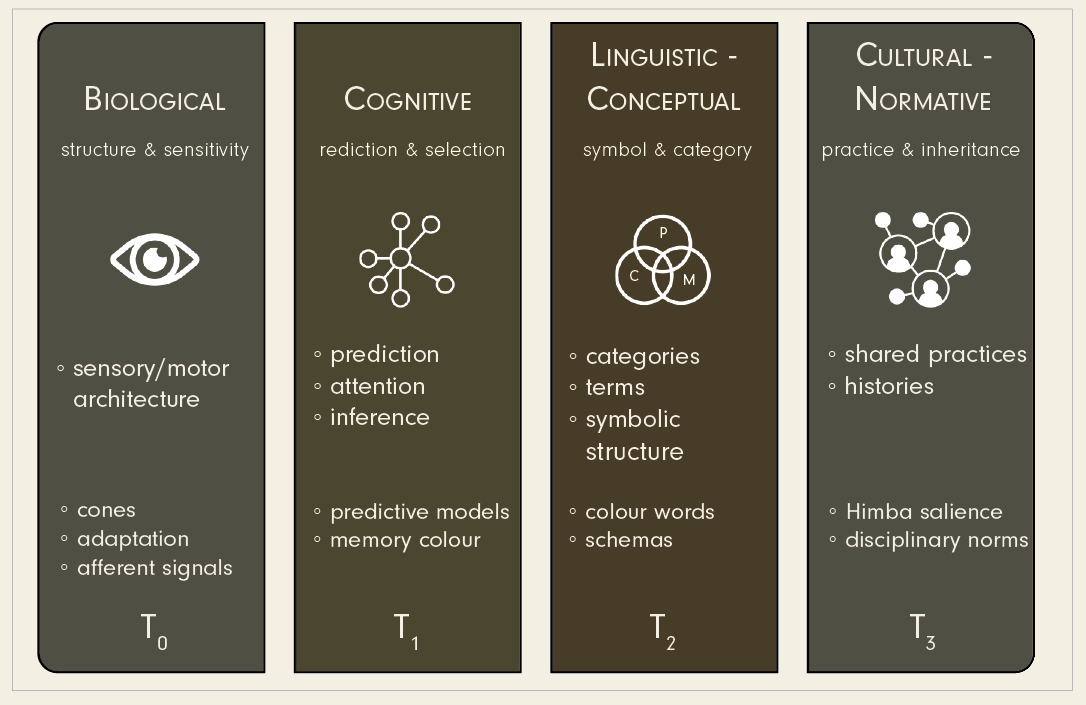
The Four Layers of Mediation (Tโ‚€โ€“Tโ‚ƒ)

A Ridiculously Oversimplified Cheat-Sheet That Still Outperforms Most Metaphysics Syllabi

Image 1: Four-tier diagram (Tโ‚€ Biological โ†’ Tโ‚ƒ Cultural)

Tโ‚€ โ€“ Biological Mediation

Structure and Sensitivity: the Architecture You Never Asked For

This is where the Enlightenment’s fantasy of ‘raw perception’ goes to die.

Your visual system transforms, filters, enhances, suppresses, and reconstructs before ‘red’ even reaches consciousness. Cone responses, opponent processes, retinal adaptation, spatial filtering โ€“ all of it happening before the poor cortex even gets a look-in.

You never perceive ‘wavelengths’. You perceive the output of a heavily processed biological pipeline.

Image 2: Chromatic processing pathway (Tโ‚€โ†’Tโ‚): the layered biological transformations that make โ€œredโ€ possible long before consciousness gets involved.

Tโ‚ โ€“ Cognitive Mediation

Prediction and Inference: You See What You Expect (Until Constraint Smacks You)

Your cognitive system doesn’t ‘receive’ colour information โ€“ it predicts it and updates the guess when necessary.

Memory colour biases perception toward canonical instances. Attentional gating determines what gets processed intensively and what gets summary treatment. Top-down modulation shapes what counts as signal versus noise.

There is no percept without mediation. There is no ‘raw data’ waiting underneath.

The Enlightenment liked to imagine perception as a passive window.
Cognition turns that window into a heavily editorialised newsfeed.

Image 3: Expectation and input co-determine the percept: โ€œredโ€ emerges from the encounter, not from either source alone.

Tโ‚‚ โ€“ Linguisticโ€“Conceptual Mediation

Categories and Symbols: How Words Carve the Spectrum

Enter the famous Whorf skirmishes.
Do words change perception?
Do they merely label pre-existing distinctions?
Do Russians really ‘see’ blue differently?

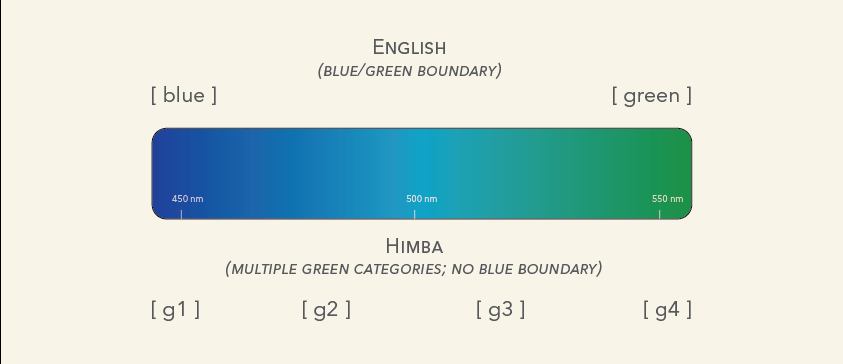
Berlin & Kay gave us focal colour universals โ€“ constraint patterns stable across cultures.
Roberson et al. gave us the Himba data โ€“ linguistic categories reshaping discrimination and salience.

The correct answer is neither universalism nor relativism. It’s MEOW’s favourite refrain:

Mediation varies; constraint persists.

Words don’t invent colours.
But they do reorganise the perceptual field, changing what pops and what hides.

Image 4: Different languages carve the same physical continuum differently: English imposes a blue/green split; Himba divides the region into several greens with no blue boundary at all.

Tโ‚ƒ โ€“ Culturalโ€“Normative Mediation

Shared Practices: The Social Life of Perception

Your discipline, training, historical context, and shared norms tell you:

  • which distinctions matter
  • which differences ‘count’
  • which patterns get ignored

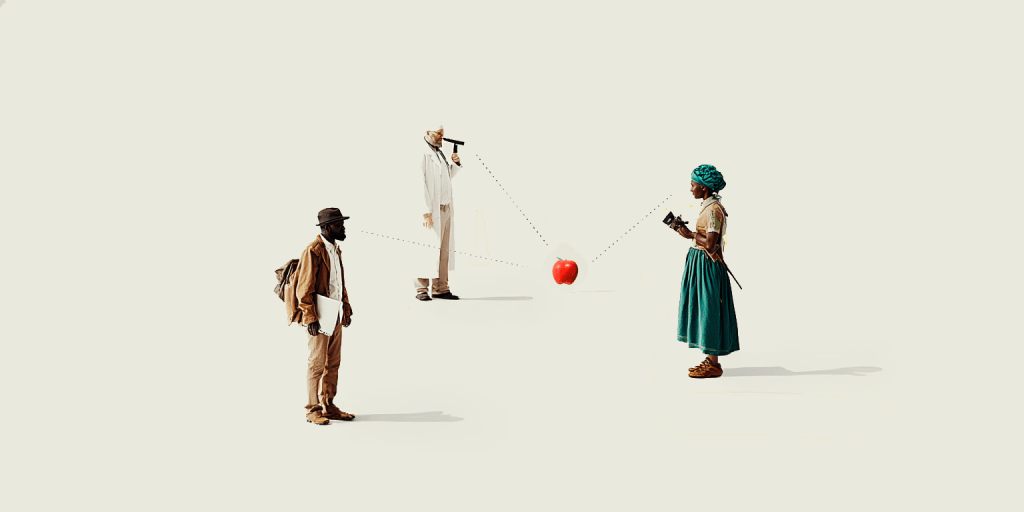
A Himba herder, a Renaissance painter, and a radiologist do not inhabit the same perceptual world โ€“ even when staring at the same patch of light.

Cultural mediation doesn’t rewrite biology; it reorganises priorities, salience, and interpretive readiness.

Image 5: Three observers confronting the same stimulus yet extracting different distinctions: the scientist tracks wavelength, the artist tracks hue and value, and the Himba pastoralist tracks ecologically salient greens. Same object, different salience hierarchies. Not arbitrary โ€“ just mediated.

What Seeing Red Actually Involves (Step By Exhausting Step)

You walk into a room. Apple on table. Looks red. What just happened?

Tโ‚€ โ€“ Biological: Long wavelength light hits L-cones harder than M- and S-cones. Opponent channels compute (Lโˆ’M). Adaptation shifts baseline. Edge detection fires. You don’t have ‘red’ yet โ€“ you have transformed photoreceptor output.

Tโ‚ โ€“ Cognitive: Your brain predicts ‘apple, probably red’ based on shape and context. Memory colour pulls toward canonical apple-red. Attention allocates processing resources. Prediction matches input (roughly). System settles: ‘yes, red apple’.

Tโ‚‚ โ€“ Linguisticโ€“Conceptual: The continuous gradient gets binned: ‘red’, not ‘crimson’ or ‘scarlet’ unless you’re a designer. The category provides stability, ties this instance to others, makes it reportable.

Tโ‚ƒ โ€“ Culturalโ€“Normative: Does the exact shade matter? Depends whether you’re buying it, photographing it, or painting it. Your practical context determines which distinctions you bother tracking.

And through all of this: Constraint. Metameric matches stay stable. Focal colours persist cross-culturally. Wavelength sensitivities don’t budge. The encounter isn’t arbitrary โ€“ but it’s not unmediated either.

What happened wasn’t: Mind Met World.
What happened was: an encounter-event unfolded, organised through four mediational layers, exhibiting stable constraint patterns that made it this and not that.

Where This Leaves Us

Colour is not ‘out there’. Colour is not ‘in here’.

Colour is the structured relational event of encounter.

Four mediation layers shape what appears.
Constraint patterns stabilise the encounter so we aren’t hallucinating wildly divergent rainbows.

There is no ‘apple as it really is’ waiting behind the encounter.
Nor is there a sovereign mind constructing its own private theatre.

There is only the event โ€“ where biological structure, cognitive dynamics, conceptual categories, and cultural histories co-emerge with the stable patterns of constraint we lazily call ‘the world’.

The apple was never red ‘in itself’.
You were never seeing it ‘as it really is’.
And the Enlightenment can finally take off its colour-blind uncle glasses and admit it’s been squinting at the wrong question for three hundred years.

Next time: Why visual illusions aren’t perception failing, but perception revealing itself.

Until then: stop asking where colour ‘really’ lives.

It lives in the event. And the event is mediated, constrained, and real enough.

Editing Is Hard and Propensity

2โ€“3 minutes

Well, not so much hard as not particularly or inherently enjoyable.

I estimate I’ve got about a day left to complete this manuscript โ€“ ‘done’ done. When I open InDesign, it shames me โ€“ 3 days ago, I last touched this document. It doesn’t feel like 3 days have passed, but time flies.

On the right is an older version. I began reworking it into this new version over the summer, and here I am come autumn. It’s even worse if I use the Chinese calendar. Evidently, 7th November is the first day of winter. They can’t wait until soltace.

Anyway, just a brief update. This isn’t going to edit itself, and I can’t afford to pay an editor for a passion project. Besides โ€“ and let’s be honest โ€“ I can’t afford an editor in general โ€“ or at least can’t cost-justify it โ€“ and all my writing is a passion project.

Of course, editors (and cover artists) insist that one would sell more book if only they were edited or professionally rendered. There is an element of truth to this, but I’ve read some gawdawful books that were professionally edited and published through a traditional publisher, because publishers publish.

Me, I operate on razor-thin margins. Most of my publications haven’t even broken even โ€“ even if I ignore opportunity costs, which I can’t because I’m an economist. Accountants get to play that trick.

This said, I do hire reviewers, editors, and artists in small doses โ€“ homoeopathic as they might be โ€“ and I’ve had mixed results.

I’m rambling

Must really be avoiding the editing processโ€ฆ

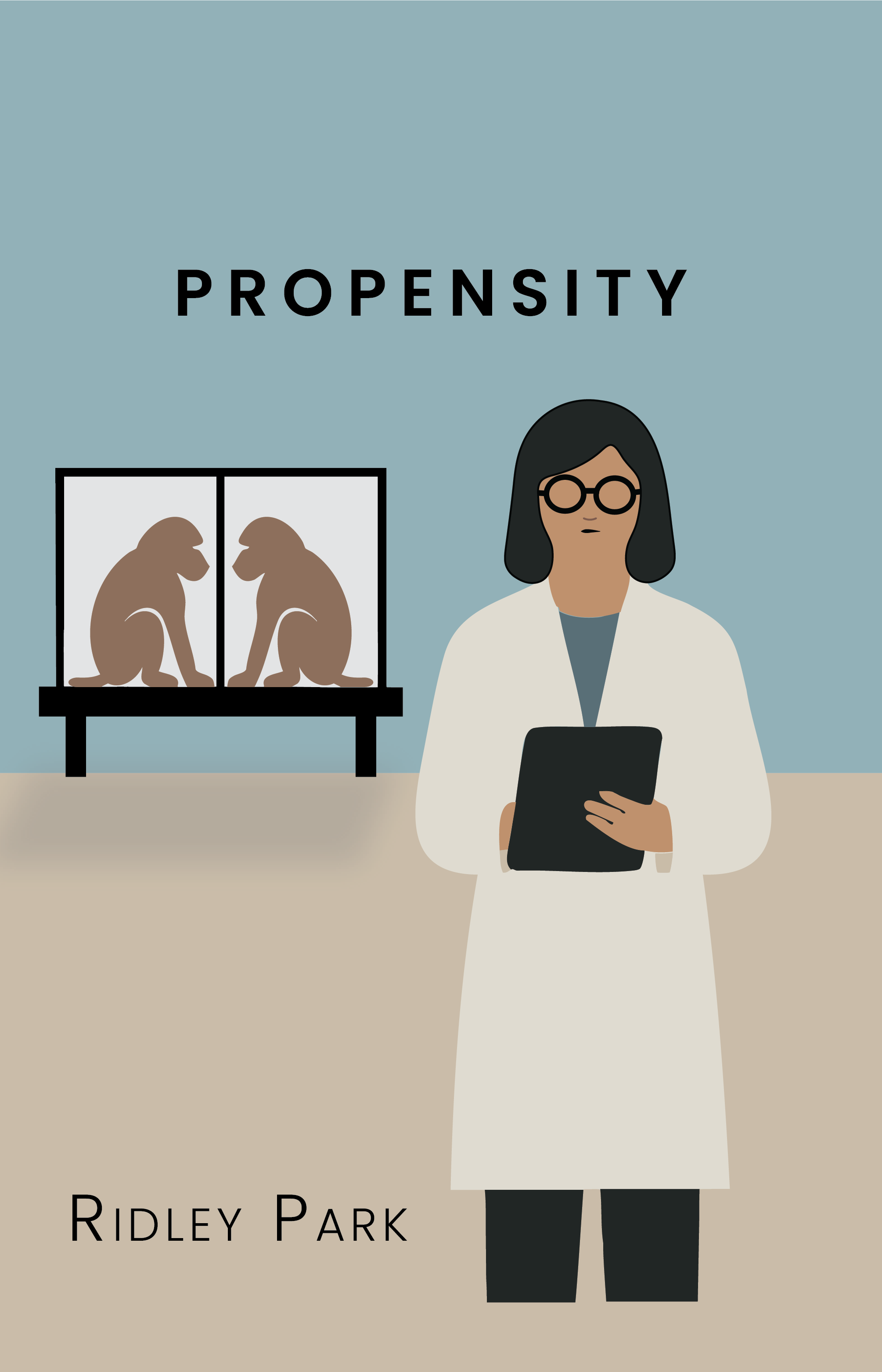
Recently, I wanted to redesign the cover of one of my Ridley Park fiction books.

Image Comparison: A Tale of Two Propensities

The cover on the left is the original. It is intentionally a minimal 2-D construction โ€“ a representation of the first section of the book, the first 15 chapters.

The cover on the right is the update. It is also minimalist, representing the second section of Propensity. I’m not sure how I would depict the third section. If it comes to me, I may render a third version.

There’s a story to this. I reached out to some cover artists and told them I was unhappy with my original design but had no visual ideas. I’d leave this to the artist. It turns out that some artists don’t want full control over the design process. I can understand the hesitation.

They asked for covers that I might like, so I researched some covers and saved them to a Pinterest board.

As it turned out, after some inspiration, I decided to render this one myself, too. Hey, I tried.

What happened to the rest of the time?

OK, so there’s more. I also created a video book trailer in the evening.

It was fun enough. Give it a watch. It also represents part one of Propensity.

OK, this time for real. Let me know what you thinkโ€ฆabout anything in particular.

Propensity for Simulacra, An Excerpt

1โ€“2 minutes

I posted Chapter 26 of my novella, Propensity. I share it here because it invokes Baudrillard’s Simulacra.

Consider it an advert โ€“ and a window into Propensity.

Blog Post: Propensity, Chapter 26 โ€“ Simulacra
Audio: Propensity, Chapter 2 โ€“ Oversight

The novel itself asks what happens when humanity creates a device that creates peace on earth. What if behavioural control worked too well?

No riots. No rebellion. Just a flatteningโ€”of desire, of ambition, of will. Across homes, schools, and governments, people stop acting like themselves. Some forget how. Others forget why.

The system wasnโ€™t designed to stay on this long. But now thereโ€™s no off switch. And the researchers who built it? Most of them are zeroed.

As one child begins to drift from baseline, an impossible question resurfaces: What does it mean to behave?

This is a psychological dystopia without explosions, a story where silence spreads faster than violence, where systems behave better than the people inside them.

A tale of modulation, inertia, and the slow unravelling of human impulseโ€”for readers who prefer their dystopias quiet and their horrors deeply plausible.


Editorial Review

“Reader discretion is advised. Free will has been deprecated.”
Beginning as a bizarre experiment in behavioural modulation by way of neurochemical interference, Propensity unfolds into an eerie metaphor for the tricky road between control and conscience. Parkโ€™s chapters are short and succinct, some barely a page long, in a staccato rhythm that mirrors the storyโ€™s disintegrationโ€”scientists losing grip on their creation and a world learning the price of its “engineered peace.” Phrases like “silence playing dress-up as danger” and “peace was never meant to be built, only remembered” linger like faint echoes long after you turn the page.

โ€”Reedsy Discovery Review

Meantime, give it a listen.

The Sane Society, Revisited: Why Work Still Drives Us Mad

4โ€“6 minutes

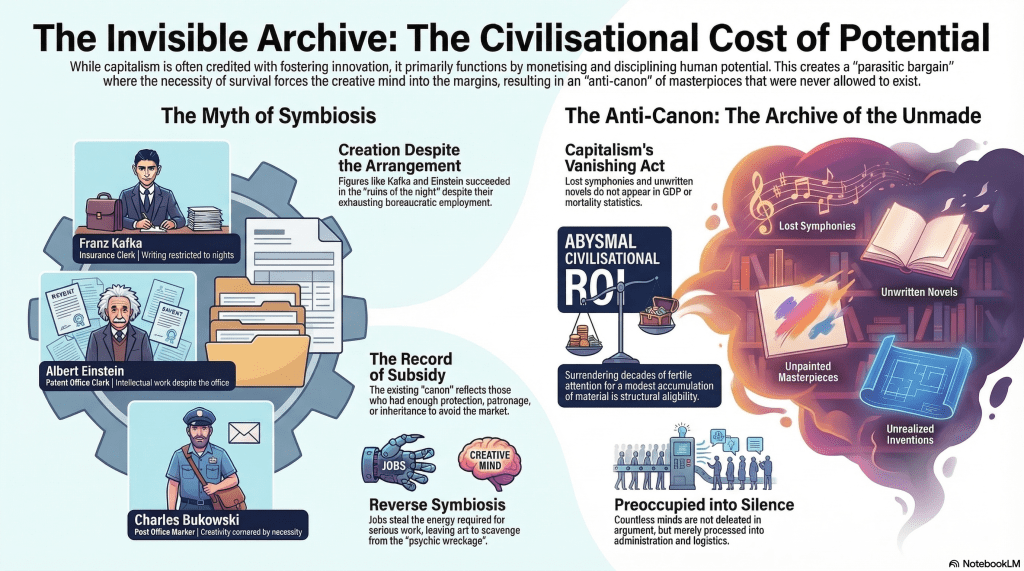
Erich Frommโ€™s The Sane Society turns seventy this year, and like a ghost of reason past, it refuses to leave. His target was Capitalismโ„ข โ€“ not merely as an economic system, but as a psychic infection. Replace the word factory with Zoom call, and his diagnosis reads like yesterdayโ€™s corporate newsletter. Weโ€™ve upgraded our machines but not our misery.

Aside from its psychobabble, The Sane Society, published in 1954, reads almost like it could have been written in 2024. I’d go out on a limb and claim it will still be relevant in 2054 โ€“ because Capitalismโ„ข and the relationship it creates between humans and machines, and humans and other humans. It’s a divisive ideology. I’ve read a lot of content on employee engagement in the past decade. I’d been exposed to it in my Organisational Behaviour courses in the late ’80s. Things were going to change. We’d plotted a future.

Audio: NotebookLM podcast on this topic.

Only nothing material has changed. We pretended to notice the problem and fix it, but the people reporting the issue and the people in charge did not share a worldview. And the young managers who were taught about the challenge were either not promoted or changed their tune to facilitate their own promotion. Funny how the selection process favours groupthink over diversity of opinion.

Video: Apathetic Office Worker

On balance, most people tend to hate or be otherwise dissatisfied with their jobs. This is nothing new. It was true before Fromm’s book, and it is true now. I published a series of posts on prostitution in 2018 and discovered that escorts had better job satisfaction than the larger population. Let that sink in.

‘โ€ฆthe vast majority of the population work as employees with little skill required, and with almost no chance to develop any particular talents, or to show any outstanding achievements. While the managerial or professional groups have at least considerable interest in achieving something more or less personal, the vast majority sell their physical, or an exceedingly small part of their intellectual capacity to an employer to be used for purposes of profit in which they have no share, for things in which they have no interest, with the only purpose of making a living, and for some chance to satisfy their consumer’s greed.

Dissatisfaction, apathy, boredom, lack of joy and happiness, a sense of futility and a vague feeling that life is meaningless, are the unavoidable results of this situation. This socially patterned syndrome of pathology may not be in the awareness of people; it may be covered by a frantic flight into escape activities, or by a craving for more money, power, prestige. But the weight of the latter motivations is so great only because the alienated person cannot help seeking for such compensations for his inner vacuity, not because these desires are the “natural” or most important incentives for work.

Fromm, ever the optimist, thought alienation might be cured through self-awareness and communal values. The twentieth century politely ignored him, opting instead for mindfulness apps and performance reviews.

I’ve excised the psychobabble, but he continuesโ€ฆ

‘But even the data on conscious job satisfaction are rather telling. In a study about job satisfaction on a national scale, satisfaction with and enjoyment of their job was expressed by 85 per cent of the professionals and executives, by 64 per cent of whitecollar people, and by 41 per cent of the factory workers. In another study, we find a similar picture: 86 per cent of the professionals, 74 per cent of the managerial, 42 per cent of the commercial employees, 56 per cent of the skilled, and 48 per cent of the semi-skilled workers expressed satisfaction.

‘We find in these figures a significant discrepancy between professionals and executives on the one hand, workers and clerks on the other. Among the former only a minority is dissatisfiedโ€”among the latter, more than half. Regarding the total population, this means, roughly, that over half of the total employed population is consciously dissatisfied with their work, and do not enjoy it. If we consider the unconscious dissatisfaction, the percentage would be considerably higher. Taking the 85 per cent of “satisfied” professionals and executives, we would have to examine how many of them suffer from psychologically determined high blood pressure, ulcers, insomnia, nervous tension and fatigue. Although there are no exact data on this, there can be no doubt that, considering these symptoms, the number of really satisfied persons who enjoy their work would be much smaller than the above figures indicate.

‘As far as factory workers and office clerks are concerned, even the percentage of consciously dissatisfied people is remarkably high. Undoubtedly the number of unconsciously dissatisfied workers and clerks is much higher. This is indicated by several studies which show that neurosis and psychogenic illnesses are the main reasons for absenteeism (the estimates for the presence of neurotic symptoms among factory workers go up to about 50 per cent). Fatigue and high labor turnover are other symptoms of dissatisfaction and resentment.’

In the twenty-first century, job dissatisfaction has increased even more. To me, it’s interesting to consider how many people harken back to the ‘good old days’, yet there is little evidence to support the view. Almost schizophrenically, others look to the promise of the future and technology, yet this is simply another narrative with no basis in fact.

The irony is that weโ€™ve automated everything except fulfilment. Even our dissatisfaction has become efficient โ€“ streamlined, quantified, and monetised. Fromm warned that the sickness of society was its sanity. On that front, weโ€™re positively thriving.

Stand by for more sanity to followโ€ฆ

On Death and Dying

3โ€“4 minutes

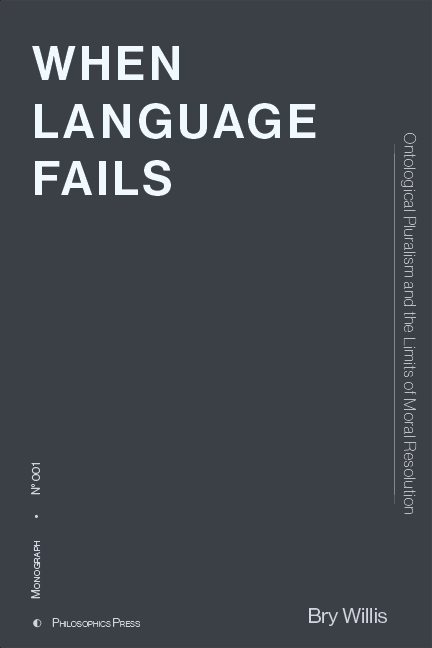
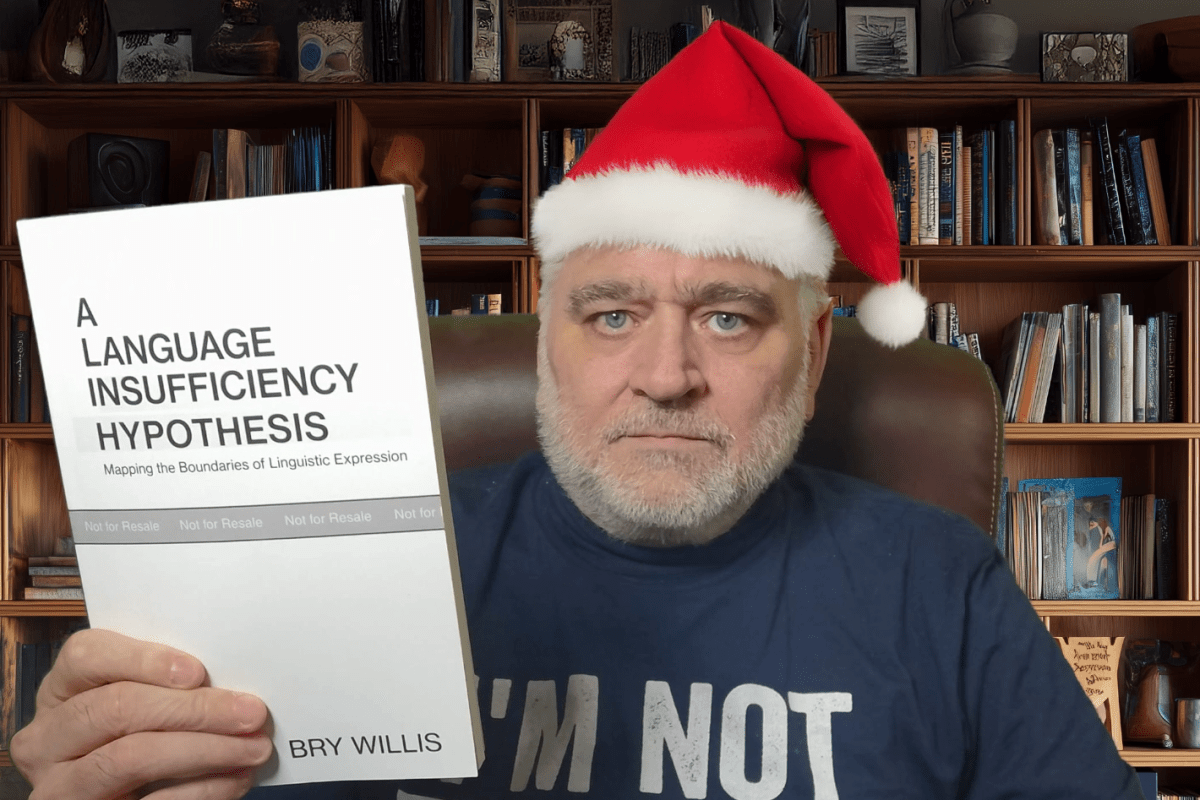
Disclaimer: I should be finishing my Language Insufficiency Hypothesis book, yet I am here writing about death and dying. Why? Because I was watching an interview with Neal Schon by Rick Beato. I should have been working on my book then, too. It seems I can write about death more easily than finish a book about the failure of language. Perhaps because death speaks fluently.

I haven’t produced music professionally since the mid-1980s, and I haven’t performed since 2012, yet I am still drawn to its intricacies. My fingers no longer allow me to play much of anything anymore. This is a sort of death. When the body forgets what the mind remembers, thatโ€™s a particular kind of death โ€“ one language dying while another canโ€™t translate.

As Neal was walking Rick through his equipment and approach to music, I was taken back to a similar place. I wanted to plug into a Fender Twin or a Hi-Watt, a Lexicon 224 or a Cry Baby wah. I still have nightmares thinking of setting up a Floyd Rose.

Video: Rick Beato interviews Neal Schon

But I can’t go back. As for music, I can’t go forward either. I’m at a standstill, but in a regressed position. It’s uncomfortable. It feels a lot like Charlie in Flowers for Algernon. I used to be able to do that. Don’t get me wrong โ€“ I am not claiming to be on the level of Neal Schon, a man I remember from his days with Santana, but when you reach a level of proficiency and then lose it, it hurts; it can be devastating.

Audio: NotebookLM podcast on this topic.

I recall being in hospital in 2023 โ€“ a physical rehabilitation facility, really โ€“ and I found a piano in a vacant common room. Drawn to the instrument, I rolled over my wheelchair and playedโ€ฆnothing. My fingers wouldn’t work. The piano sat there like a relic of my former self. I rolled toward it as though approaching an altar. My fingers hovered, twitched, failed. The sound of nothing has never been so loud. I cried. I cried a lot those days. I was down to 58 kilos โ€“ at 182 cm, I weighed in at just over 9 stone. It wasn’t the best of times.

I still feel a certain nostalgia.

And then there are the people I’ve lost along the way โ€“ as another Neal reflected on โ€“ The Needle and the Damage Done.

Love and art are both acts of repetition. When one ends, the reflex remains โ€“ the impulse to reach, to share, to call out. Death doesnโ€™t stop the motion, only the answer.

I’m lucky to have left Delaware. When a girlfriend died in 2020, I remained and connected with another until 2023, when she died, too. From 2020 to 2023, when I was out and about, something might have caught my eye, and I’d reflect on how Carrie might have liked that.

But it was different. It was more like, ‘I should let Carrie know about that,’ only to realise fractions of a second later that she wouldn’t see whatever it was; she couldn’t. And I’d carry on. I didn’t need to repeat this with Sierra. My relocation to Massachusetts solved this challenge โ€“ not so many triggers.

I’m not sure how the loss of ‘professional’ music relates to deceased partners, but it does โ€“ at least enough for me to make this connexion. Perhaps I’m just connecting arbitrary dots, but I’ll call it nostalgia.

I donโ€™t play, but I still hear it. The song continues without me. Nostalgia is just rhythm without melody. Perhaps all nostalgia is epistemological error โ€“ the confusion of past fluency for present meaning.

Against Agency: The Fiction of the Autonomous Self

2โ€“3 minutes

The Enlightenmentโ€™s Most Beloved Lie

๐Ÿ”— Read the full preprint on Zenodo
๐Ÿ”— Explore the Anti-Enlightenment Project

The Enlightenment promised liberation through reason โ€“ that if we could think clearly enough, we could act freely enough. Agency, it claimed, was the defining trait of the rational individual: a sovereign chooser, self-contained and self-determining.

But this was always a fiction.

Not an innocent one, either.

Audio: NotebookLM podcast discussing the essay, Against Agency

Agency became the moral infrastructure of modernity โ€“ the premise behind law, punishment, merit, guilt, and even political participation. To say โ€œI choseโ€ was not simply to describe behaviour; it was to perform belonging within a metaphysical system that made individuals the unit of responsibility. The fiction worked, for a while, because it kept the machinery running.

Against Agency argues that this story has collapsed โ€“ not metaphorically but structurally. Cognitive science, postcolonial thought, and relational philosophies all point to the same conclusion: there is no autonomous agent, only differential responsiveness โ€“ a systemโ€™s fluctuating capacity to register and transmit influence.

Copper sings under current; rubber resists. Humans, likewise, respond within the constraints of biology, fatigue, trauma, and social design. What we call โ€œfreedomโ€ is merely a condition in which responsiveness remains broad and protected.

This reframing dismantles the binary of โ€œfreeโ€ and โ€œunfree.โ€ There is no metaphysical threshold where agency appears. Instead, responsiveness scales โ€“ widened by safety, narrowed by coercion, eroded by exhaustion. Politics becomes engineering: the maintenance of conditions that sustain responsiveness, rather than the worship of choice.

Ethics, too, must shift.

Not โ€œWho is to blame?โ€ but โ€œWhere did the circuit break?โ€

The essay proposes a gradient model of conduct grounded in relation and feedback, rather than autonomy and will. Responsibility becomes less about moral worth and more about bandwidth โ€“ a physics of care.

Itโ€™s an uncomfortable vision for a culture addicted to outrage and repentance. The loss of agency removes our favourite alibi: the chooser who could have done otherwise. But it also opens the possibility of a more honest ethics โ€“ one that replaces judgment with maintenance, retribution with repair.

This is not nihilism. Itโ€™s realism.

Systems appear stable only from a distance. Up close, everything is process โ€“ bodies, institutions, meanings โ€“ held together by temporary alignments of responsiveness. Against Agency names this collapse not as tragedy, but as opportunity: a clearing from which to think and act without the fictions that sustained modernity.

The essay forms the foundation for what comes next in the Anti-Enlightenment Project โ€“ Dis-Integration, a philosophical sequel that explores what remains once coherence, control, and autonomy have been decommissioned.

Missing White Supremacy’s Woods for the Tree

2โ€“3 minutes

Radical Futures Studioโ€™s โ€œ7 Signalsโ€ deck has been circulating widely. Itโ€™s a striking example of Storytelling 101: identify a villain, chart the signs of its decline, and point toward an eventual resolution. In this case, the villain is white supremacy. The signs are its institutional and cultural fray. The resolution is its collapse.

Audio: NotebookLM podcast on this topic.

As far as stories go, itโ€™s effective. It provides a framework, some memorable imagery, and the reassurance that the ugliness on display today is a death rattle, not a resurgence. No wonder it resonates. People want to believe the noise means the monster is dying.

But as analysis, the frame is too tight. Racism is not the root structure; it is a symptom, a mask. White supremacy is real enough in its effects, but its persistence and decline are contingent. The deeper system โ€“ the scaffolding of late-stage capitalism, the Enlightenmentโ€™s brittle universalism, the institutions now staggering under their own contradictions โ€“ remains the host. When whiteness peels away, the system does not vanish. It simply rebrands.

To point to the peeling paint and say ‘the house is collapsing’ is to mistake surface for structure. Yes, the paint matters; it shapes how people experience the walls. But the real rot lies deeper, in the beams. The Enlightenment project promised seamless cloth: rationality, universality, permanence. Capitalism promised endless expansion and renewal. Both promises are faltering, and the cracks are visible everywhere โ€“ climate, finance, governance, identity. Racism, whiteness, supremacy: these are one set of cracks, not the foundation itself.

The risk of the ‘signals’ narrative is that it offers too neat a moral arc. It comforts the audience that the villain is cornered, that justice is baked into the future. But history is rarely so tidy. Supremacy does not die; it changes costumes. One mask slips, another is stitched on. If we mistake the collapse of whiteness for the collapse of the system, we blind ourselves to how easily the scaffolding survives in new guises.

None of this is to reject the cause. Racism is a systemic lie, and its decline is worth cheering. But it is not enough to track the noise of its death rattle. To understand the larger story, we need to step back and see the woods for the trees. The true collapse underway is broader: the exhaustion of capitalismโ€™s last stage, the unravelling of Enlightenmentโ€™s promises, the loss of legitimacy in institutions that no longer hold. That is the forest in which the tree of whiteness withers.

If we focus only on the tree, we risk missing the landscape. And if we mistake peeling paint for the beams, we risk celebrating cosmetic decline while the house quietly reassembles itself under a different banner.