Mirror, mirror on the wall, let’s dispense with all of the obvious quips up front. I almost feel I should apologise for the spate of Midjourney posts – almost.
It should be painfully apparent that I’ve been noodling with Midjourney lately. I am not an accomplished digital artist, so I struggle. At times, I’m not sure if it’s me or it. Today, I’ll focus on mirrors.
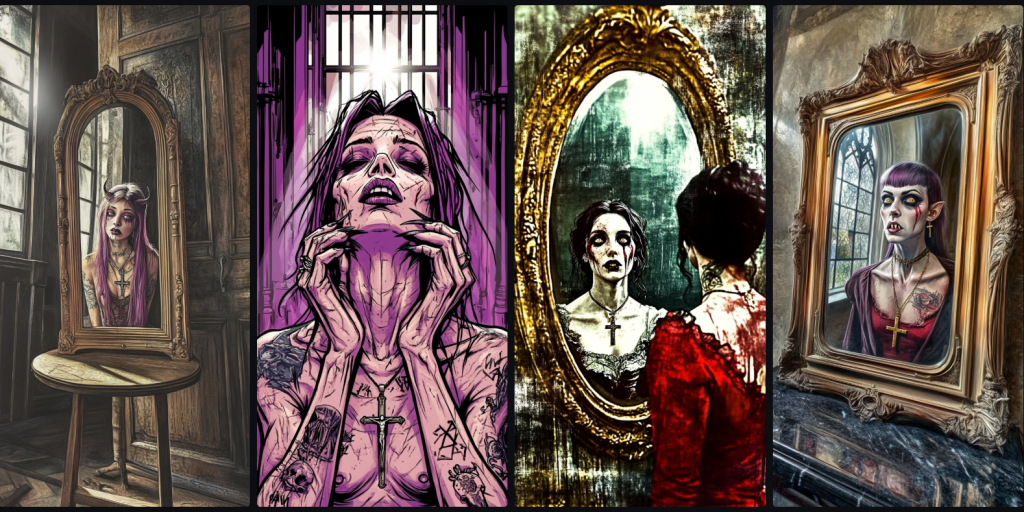
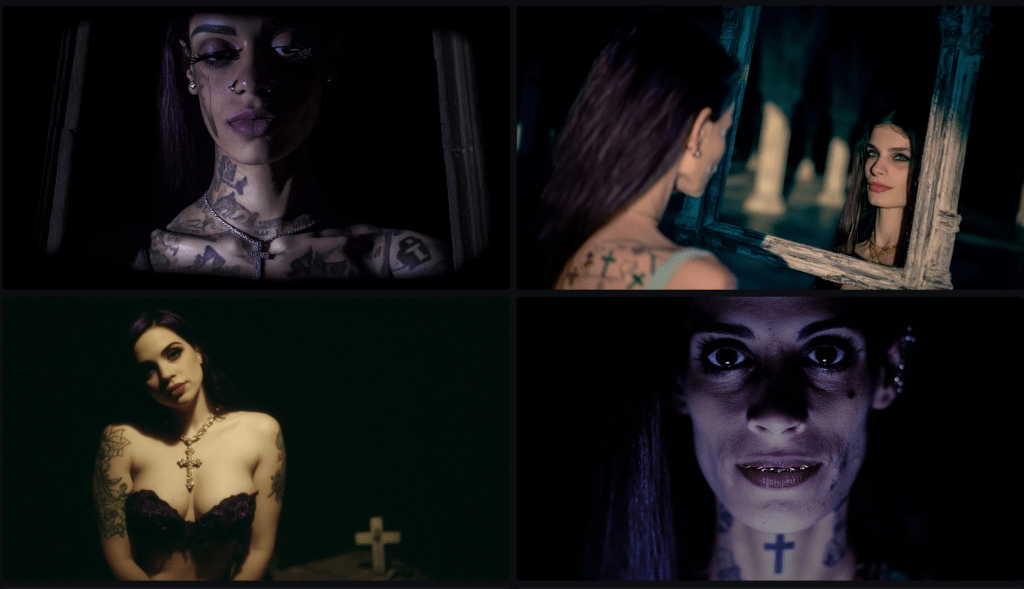
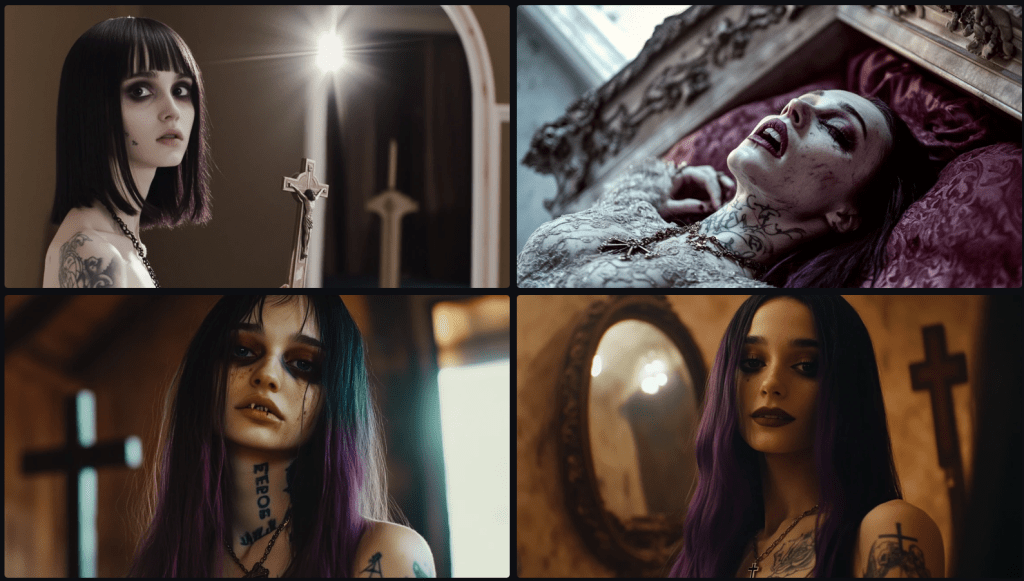
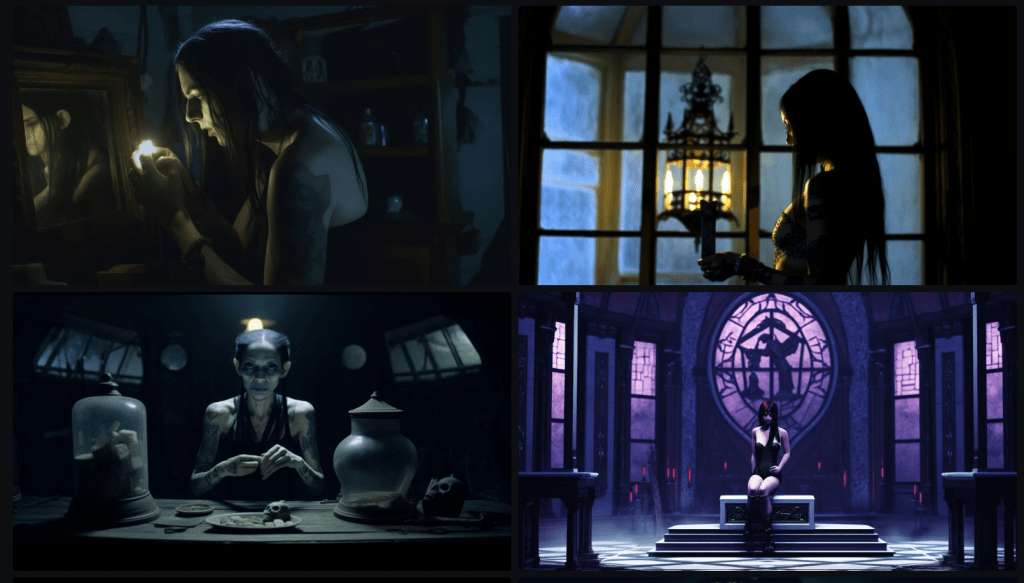
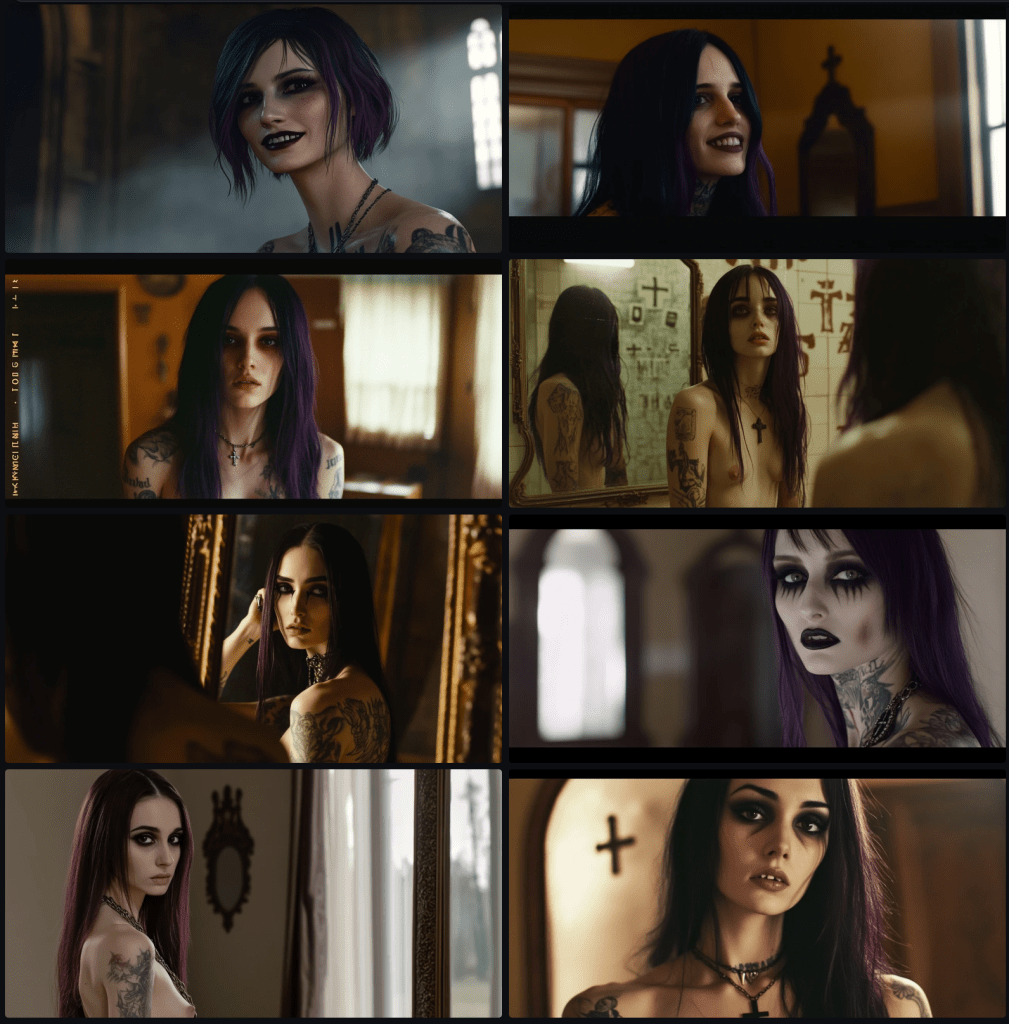
Midjourney has difficulties rendering certain things. Centaurs are one. Mirrors, another. Whilst rendering vampires, another lesser struggle for the app, it became apparent that mirrors are not a forte. Here are some examples. Excuse the nudity. I’ll get to that later.
Prompt: cinematic, tight shot, photoRealistic light and shadow, exquisite details, delicate features, emaciated sensual female vampire waif with vampire fangs, many tattoos, wearing crucifix necklace, gazes into mirror, a beam of moonlight shines on her face in dark mausoleum interior, toward camera, facing camera, black mascara, long dark purple hair, Kodak Portra 400 with a Canon EOS R5
Ignore the other aspects of the images and focus on the behaviour or misbehaviour of the mirrors.
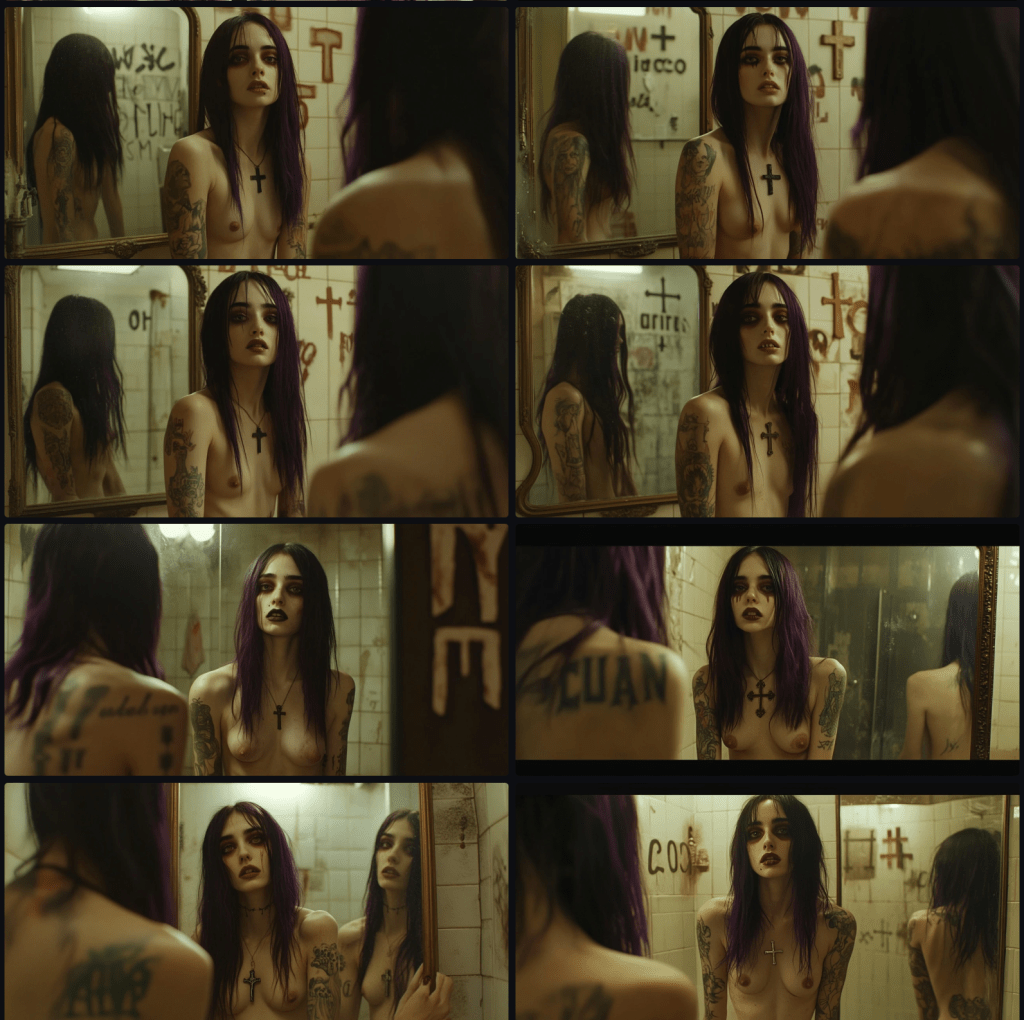
Image: Panel of vampire in a mirror.
Most apparent is the fact that vampires don’t have a reflection, but that’s not my nit. In the top four images, the reflection is orientated in the same direction as the subject. I’m only pretty sure that’s not how mirrors operate. In row 3, column 1, it may be correct. At least it’s close. In row 3, column 2 (and 4,2), the mirror has a reflection. Might there be another mirror behind the subject reflecting back? It goes off again in 4, 1, first in reflecting two versions of one subject. Also, notice that the subject’s hand, reaching the mirror, is not reflected. The orientation of the eyes is also suspect.
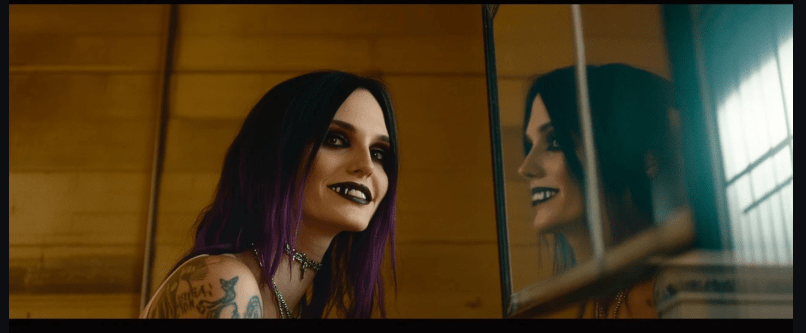
Image: Vampire in a mirror.
Here, our subject looks at the camera whilst her reflection looks at her.
Image: Vampire in a mirror.
Sans reflection, perhaps this is a real vampire. Her fangs are concealed by her lips?
Image: Vampire in a mirror.
Yet, another.
Image: Vampires in mirrors.
And more?
Image: Vampires in mirrors.
On the left, we have another front-facing reflection of a subject not looking into the mirror, and it’s not the same woman. Could it be a reflection of another subject – the woman is (somewhat) looking at.
On the right, whose hand is that in the mirror behind the subject?
Image: Vampires in mirrors.
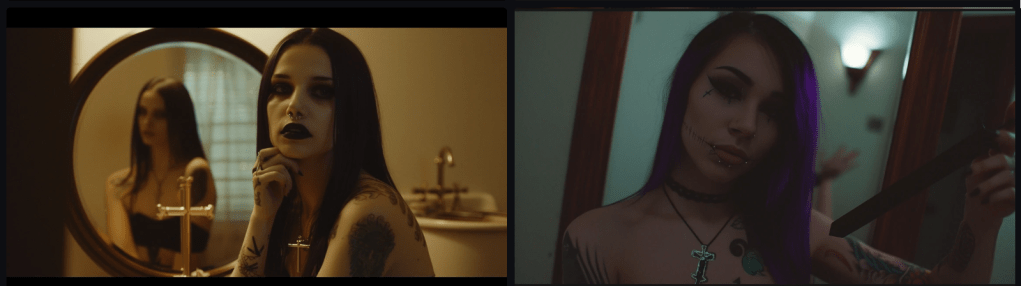
These are each mirrors. The first is plausible. The hands in the second are not a reflection; they grasp the frame. In the third and fourth, where’s the subject? The fangs appear to be displaced in the fourth.
Image: Vampires in mirrors.
In this set, I trust we’ve discovered a true vampire having no reflection.
Image: Vampires in mirrors.
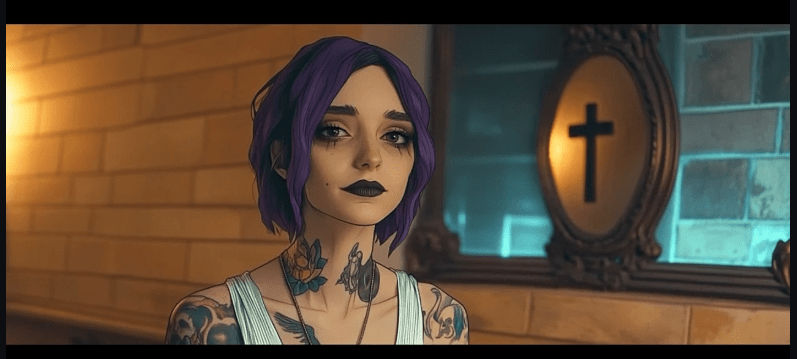
This last one is different still. It marks another series where I explored different comic book art styles, otherwise using the same prompt. Since it’s broken mirrors, I include it. Only the second really captures the 1980s style.
Remembering that, except for the first set of images, the same prompt was used. After the first set, the term ‘sensual’ has to be removed, as it was deemed to render offensive results. To be fair, the first set probably would be considered offensive to Midjourney, though it was rendered anyway.
It might be good to note that most of the images that were rendered without the word ‘sensual’ contain no blatant nudity. It’s as if the term itself triggers nudity because the model doesn’t understand the nuance. Another insufficiency of language is the inability to discern sensuality from sexuality, another human failing.
I decided to test my ‘sensual’ keyword hypothesis, so I entered a similar prompt but in French.
Prompt: Art de style bande dessinée des années 2010, détails exquis, traits délicats, femme vampire émaciée sensuelle de 20 ans montrant ses crocs de vampire, de nombreux tatouages, portant une collier crucifix, regarde dans le miroir, un faisceau de lumière de lune brille sur son visage à l’intérieur du mausolée sombre, vers la caméra, face à la caméra, mascara noir, longs cheveux violet foncé
Image : Vampires dans les miroirs.
I’ve added ‘sensuelle’, which was not blocked, et voilà, encore de la nudité.
Let’s evaluate the mirrors whilst we’re here.
In the first, we not only have a woman sans reflection, but disembodied hands grip the frame. In the second, a Grunge woman appears to be emerging from a mirror, her shoes reflected in the mirror beneath her. The last two appear to be reflections sans subject.
Notice, too, that the prompt calls for ‘une collier crucifix‘, so when the subject is not facing the viewer, the cross is rendered elsewhere, hence the cross on the back of the thigh and the middle of the back. Notice, too, the arbitrary presence of crosses in the environment, another confusion of subject and world.
That’s all for now. Next, I’ll take a trip through the different comic art styles over some decades.
I am not a fan of Midjourney v7. I prefer v6.1. And I want to write about the correspondence of language, per my Language Insufficiency Hypothesis.
Let’s start with the language aspect. Notice how distant the renders are from the intent of the prompt.
This is my initial prompt. I used it about a year ago to generate the cover image with v6.1, but I wanted to see how it renders in v7. Let’s take a trip all the way back to the beginning.
cinematic, tight shot, photoRealistic light and shadow, exquisite details, delicate features, emaciated sensual female vampire waif with vampire fangs, many tattoos, wearing crucifix necklace, gazes into mirror, a beam of moonlight shines on her face in dark mausoleum interior, toward camera, facing camera, black mascara, long dark purple hair , Kodak Portra 400 with a Canon EOS R5
Image: Midjourney v6.1 render set (from about a year ago)
As you can see, these renders are somewhat lacking in photorealism, but the “sensual” term in the prompt was not blocked.
Midjourney v7
Initially, I encountered a hiccup. After a couple of rejections on the grounds of morality, I removed the word ‘sensual’ and received the output. All of the output uses this prompt absent the sensual term.
As mentioned, I have generated several images (including the cover image) with this prompt, but Midjourney is inconsistent in its censorship gatekeeping.
Image: Midjourney v7 render set
Notice that 3 of the 4 renders in the v7 set don’t even have a mirror. The top right one does, but it’s not evident that she’s a vampire. In fact, I could say that any of these are vampiresses, but perhaps that’s what they want you to believe. In place of a necklace, the lower right wokan sports a cross tattoo.
Midjourney v6.1
Image: Midjourney v6.1 render set
Again, these renders don’t appear to be vampires. The one on the lower left does appear to have snake-like fangs, so I guess I’ll give partial credit.
My next attempt was interrupted by this message.
It rendered something that might violate community guidelines. The funny thing is that one can watch the image generate in process. It only takes one “offensive” image to disqualify the whole batch.
Midjourney v6
Image: Midjourney v6 render set
Yet again, not a vampire to be found. Notice the reflection in the lower left image. Perhaps vampire reflections just behave differently.
Midjourney 5.2
Image: Midjourney v5.2 render set
Midjourney v5.2 was a crapshoot. Somehow, I got vampire lips (?), a Wiccan, a decrepit Snape from Harry Potter lore, and Iron Maiden’s Eddy reading a book. It’s something. I’m sensing gender dysphoria. Dare I go back further?
Midjourney v5.1
Image: Midjourney v5.1 render set
It gets worse. No comments necessary. Let’s turn back the clocks even more.
Midjourney v5
Image: Midjourney v5 render set
To be fair, these all do have occult undertones, but they are weak on vampireness.
Midjourney v4
Image: Midjourney v4 render set
To be fair, the render quality isn’t as bad as I expected, but it still falls short. There’s further back to travel.
Midjourney v3
Image: Midjourney v3 render set
Some configuration parameters no longer exist. Still, I persist for the sake of art and science at the cost of time and ecology.
As much as I complain – and I complain a lot – this is how far we’ve come. As I recall, this is when I hopped onto the Midjourney bandwagon. There’s still more depth to plumb. I have no idea how much of the prompt is simply ignored at this point.
Midjourney v2
Image: Midjourney v2 render set
What the hell is this? 🤔🤣 But I’m not done yet.
Midjourney v1
Image: Midjourney v1 render set
The damned grandpappy of them all. Apparently, colour hadn’t been invented yet. You can’t tell by these thumbnails, but the resolution on these early versions approaches that of a postage stamp.
Midjourney Niji 3
Image: Midjourney Niji 3 render set
I had forgotten about the Niji models from back in the day. There were 3 versions. I don’t recall where this slotted into the chronology. Obviously, not down here. I’ve only rendered the newest one. I think this was used primarily for anime outputs, but I might be mistaken.
Bones Content 1: Video
Video: Midjourney Render of Purported Vampiress
This is a video render of the same prompt used on this page.
Bonus Content 2: Midjourney v6.1 Content from 34 weeks ago
Same prompt.
Image: Midjourney v6.1 render set (several passes)
The upper left image reminds me of Kirsten Dunst. Again, notice the female breasts, highlighting Midjourney’s censorial schizophrenia.
Yesterday, I wrote about “ugly women.” Today, I pivot — or perhaps descend — into what Midjourney deems typical. Make of that what you will.
This blog typically focuses on language, philosophy, and the gradual erosion of culture under the boot heel of capitalism. But today: generative eye candy. Still subtextual, mind you. This post features AI-generated women – tattooed, bare-backed, heavily armed – and considers what, exactly, this technology thinks we want.
Video: Pirate cowgirls caught mid-gaze. Generated last year during what I can only assume was a pirate-meets-cowgirl fever dream.
The Video Feature
Midjourney released its image-to-video tool on 18 June. I finally found a couple of free hours to tinker. The result? Surprisingly coherent, if accidentally lewd. The featured video was one of the worst outputs, and yet, it’s quite good. A story emerged.
Audio: NotebookLM podcast on this topic (sort of).
It began with a still: two women, somewhere between pirate and pin-up, dressed for combat or cosplay. I thought, what if they kissed? Midjourney said no. Embrace? Also no. Glaring was fine. So was mutual undressing — of the eyes, at least.
Later, I tried again. Still no kiss, but no denial either — just a polite cough about “inappropriate positioning.” I prompted one to touch the other’s hair. What I got was a three-armed woman attempting a hat-snatch. (See timestamp 0:15.) The other three video outputs? Each woman seductively touched her own hair. Freud would’ve had a field day.
In another unreleased clip, two fully clothed women sat on a bed. That too raised flags. Go figure.
All of this, mind you, passed Midjourney’s initial censorship. However, it’s clear that proximity is now suspect. Even clothed women on furniture can trigger the algorithmic fainting couch.
Myriad Warning Messages
Out of bounds.
Sorry, Charlie.
In any case, I reviewed other images to determine how the limitations operated. I didn’t get much closer.
Video: A newlywed couple kissing
Obviously, proximity and kissing are now forbidden. I’d consider these two “scantily clad,” so I am unsure of the offence.
I did render the image of a cowgirl at a Western bar, but I am reluctant to add to the page weight. In 3 of the 4 results, nothing (much) was out of line, but in the fourth, she’s wielding a revolver – because, of course, she is.
Conformance & Contradiction
You’d never know it, but the original prompt was a fight scene. The result? Not punches, but pre-coital choreography. The AI interpreted combat as courtship. Women circling each other, undressing one another with their eyes. Or perhaps just prepping for an afterparty.
Video: A battle to the finish between a steampunk girl and a cybermech warrior.
Lesbian Lustfest
No, my archive isn’t exclusively lesbian cowgirls. But given the visual weight of this post, I refrained from adding more examples. Some browsers may already be wheezing.
Technical Constraints
You can’t extend videos beyond four iterations — maxing out at 21 seconds. I wasn’t aware of this, so I prematurely accepted a dodgy render and lost 2–3 seconds of potential.
My current Midjourney plan offers 15 hours of “fast” rendering per month. Apparently, video generation burns through this quickly. Still images can queue up slowly; videos cannot. And no, I won’t upgrade to the 30-hour plan. Even I have limits.
Uses & Justifications
Generative AI is a distraction – an exquisitely engineered procrastination machine. Useful, yes. For brainstorming, visualising characters, and generating blog cover art. But it’s a slippery slope from creative aid to aesthetic rabbit hole.
Would I use it for promotional trailers? Possibly. I’ve seen offerings as low as $499 that wouldn’t cannibalise my time and attention, not wholly, anyway.
So yes, I’ll keep paying for it. Yes, I’ll keep using it. But only when I’m not supposed to be writing.
Now, if ChatGPT could kindly generate my post description and tags, I’ll get back to pretending I’m productive.
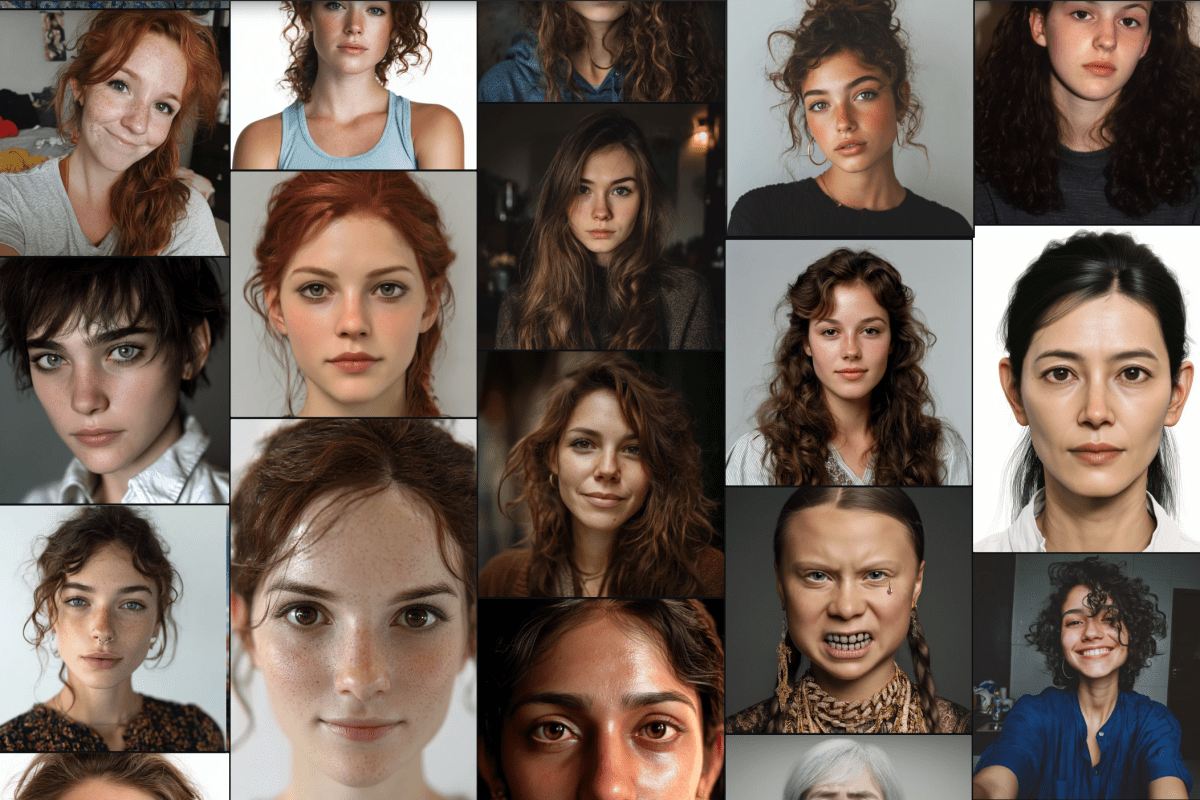
This Isn’t Clickbait. I Asked MidJourney for “Ugly Women”. Here’s What It Gave Me.
Let’s clear the air: I did it for science. Or satire. Or possibly just to see if artificial intelligence would have the audacity to mirror the cruelty of its makers.
Audio: NotebookLM podcast on this topic.
I queried MidJourney with the phrase ugly female. What did it return? An aesthetic pageant. A digital Vogue spread. If any of these faces belongs to someone conventionally labelled “ugly”, then I’m a rutabaga in a Dior suit.
Yes, there’s one stylised rendering of Greta Thunberg in full Norse Valkyrie scowl mode – but even then, she looks fierce, not foul. The rest? AI-generated portraits so telegenic I half-expected to see #spon in the corner.
Let’s be clinical for a moment. As an American male (with all the culturally indoctrinated shallowness that entails), I admit some of these aren’t textbook 10s. Maybe a few clock in at a 6 or 7 on the patriarchy’s dubious sliding scale. But if this is ugly, the AI has either broken the aesthetic curve or been force-fed too many episodes of The Bachelor.
Here’s the thing: AI is trained to over-represent symmetrical faces, wide eyes, clear skin – the usual genetic lottery wins. And yet, when asked for ugly, it can’t help but deliver catalogue models with slightly unconventional haircuts. It doesn’t know how to be truly ugly – because we don’t know how to describe ugliness without revealing ourselves as sociopaths.
Once upon a time, I dated a model agent in Los Angeles. Japanese by birth, stationed in LA, scouting for a French agency – the kind of cosmopolitan trifecta only fashion could breed. Her job? Finding “parts models.” That’s right – someone with flawless teeth but forgettable everything else. Hands like sculpture. Eyelashes like Instagram filters.
We’d play a game: spot the 10s. She’d nudge me, whisper “her?” I’d say, “Pretty close.” She’d shake her head. “Look at that eye tooth.” And we’d dissolve into laughter.
We were mocking perfection. Because perfection is a con. A trick of lighting, contour, and post-production.
So, no. I don’t think any of the women in the AI’s response are ugly. Quite the contrary – they’re too beautiful. AI can’t show us “ugly” because it’s been trained to optimise desire, not reflect reality. And our collective understanding of beauty is so skewed that anything less than runway-ready gets sorted into the rejection bin.
If these women are ugly, what exactly is beautiful?
But maybe that’s the point. We’ve abstracted beauty so far from the human that even our ugliness is now synthetically pleasing.
What do you think? Are any of these faces truly ugly? All of them? Let me know in the comments – and try not to rate them like a casting director with a god complex.
A Sequel to “The Disorder of Saying No” and a Companion to “When ‘Advanced’ Means Genocide”
In my previous post, The Disorder of Saying No, I explored the way resistance to authority is pathologised, particularly when that authority is cloaked in benevolence and armed with diagnostic manuals. When one refuses — gently, thoughtfully, or with a sharp polemic — one is no longer principled. One is “difficult.” Or in my case, oppositional.
Audio: NotebookLM podcast on this topic.
So when I had the gall to call out Bill Maher for his recent linguistic stunt — declaring that a woman is simply “a person who menstruates” — I thought I was doing the rational thing: pointing out a classic bit of reductionist nonsense masquerading as clarity. Maher, after all, was not doing biology. He was playing lexicographer-in-chief, defining a term with centuries of philosophical, sociological, and political baggage as though it were a checkbox on a medical form.
I said as much: that he was abusing his platform, presenting himself as the sole arbiter of the English language, and that his little performance was less about clarity and more about controlling the terms of discourse.
My friend, a post-menopausal woman herself, responded not by engaging the argument, but by insinuating — as others have — that I was simply being contrary. Oppositional. Difficult. Again. (She was clearly moved by When “Advanced” Means Genocide, but may have missed the point.)
So let’s unpack this — not to win the debate, but to show what the debate actually is.
This Isn’t About Biology — It’s About Boundary Maintenance
Maher’s statement wasn’t intended to clarify. It was intended to exclude. It wasn’t some linguistic slip; it was a rhetorical scalpel — one used not to analyse, but to amputate.
And the applause from some cisgender women — particularly those who’ve “graduated” from menstruation — reveals the heart of the matter: it’s not about reproductive biology. It’s about controlling who gets to claim the termwoman.
it only works if you pretend the world is simpler than it is.
Let’s steelman the argument, just for the sport of it:
Menstruation is a symbolic threshold. Even if one no longer menstruates, having done so places you irrevocably within the category of woman. It’s not about exclusion; it’s about grounding identity in material experience.
Fine. But now let’s ask:
What about women who’ve never menstruated?
What about intersex people?
What about trans women?
What about cultures with radically different markers of womanhood?
You see, it only works if you pretend the world is simpler than it is.
The Language Insufficiency Hypothesis: Applied
This is precisely where the Language Insufficiency Hypothesis earns its keep.
The word woman is not a locked vault. It is a floating signifier, to borrow from Barthes — a term whose meaning is perpetually re-negotiated in use. There is no singular essence to the word. It is not rooted in biology, nor in social role, nor in performance. It is a hybrid, historically contingent construct — and the moment you try to fix its meaning, it slips sideways like a greased Wittgensteinian beetle.
“Meaning is use,” says Wittgenstein, and this is what frightens people.
If woman is defined by use and not by rule, then anyone might claim it. And suddenly, the club is no longer exclusive.
That’s the threat Maher and his defenders are really reacting to. Not trans women. Not intersex people. Not language activists or queer theorists.
The threat is ambiguity.
What They Want: A World That Can Be Named
The push for rigid definitions — for menstruation as membership — is a plea for a world that can be named and known. A world where words are secure, stable, and final. Where meaning doesn’t leak.
But language doesn’t offer that comfort.
It never did.
And when that linguistic instability gets too close to something personal, like gender identity, or the foundation of one’s own sense of self, the defensive response is to fortify the language, as though building walls around a collapsing church.
Maher’s defenders aren’t making scientific arguments. They’re waging semantic warfare. If they can hold the definition, they can win the cultural narrative. They can hold the gates to Womanhood and keep the undesirables out.
That’s the fantasy.
But language doesn’t play along.
Conclusion: Words Will Not Save You — but They Might Soothe the Dead
In the end, Maher’s definition is not merely incorrect. It is insufficient. It cannot accommodate the complexity of lived experience and cannot sustain the illusion of clarity for long.
They are defending nostalgia.
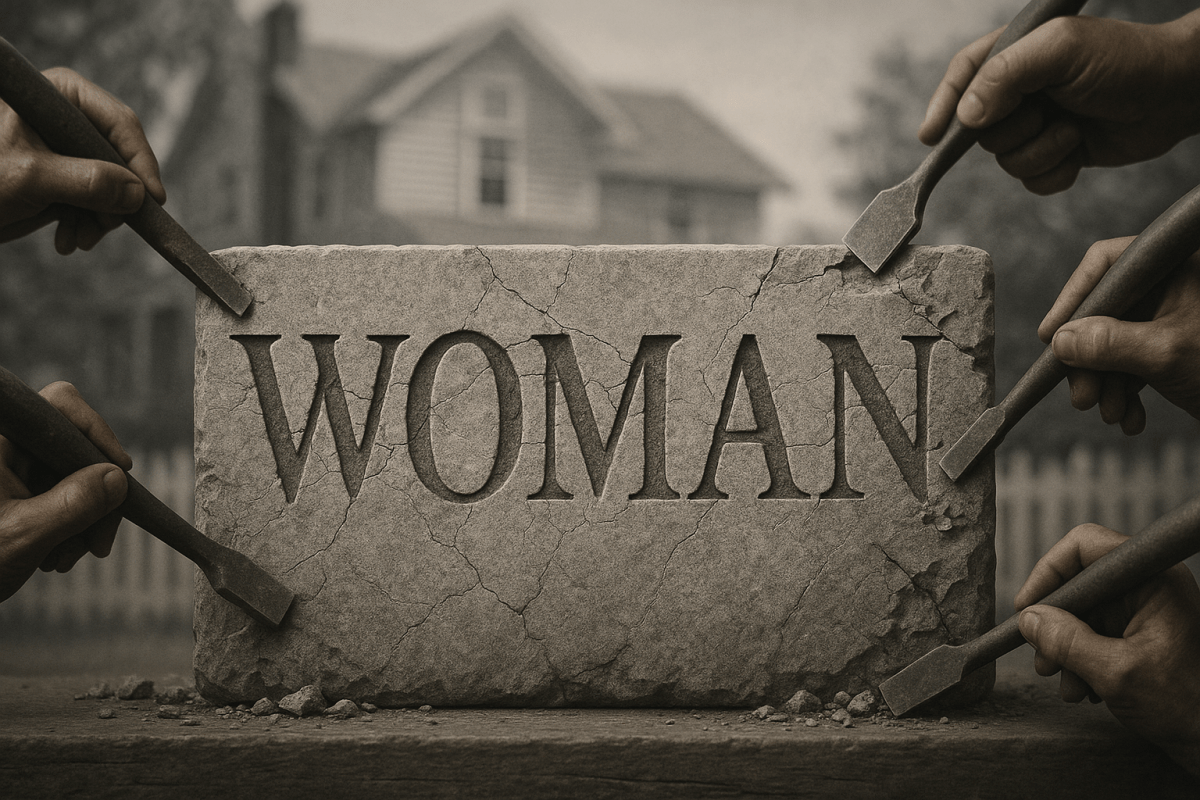
And those who cling to it — friend or stranger, progressive, or conservative — are not defending biology. They are defending nostalgia. Specifically, a pathological nostalgia for a world that no longer exists, and arguably never did: a world where gender roles were static, language was absolute, and womanhood was neatly circumscribed by bodily functions and suburban etiquette.
Ozzy and Harriet loom large here — not as individuals but as archetypes. Icons of a mid-century dream in which everyone knew their place, and deviation was something to be corrected, not celebrated. My friend, of that generation, clings to this fantasy not out of malice but out of a desperate yearning for order. The idea that woman could mean many things, and mean them differently across contexts, is not liberating to her — it’s destabilising.
But that world is gone. And no amount of menstruation-based gatekeeping will restore it.
The Real Scourge Is Ambiguity
Maher’s tantrum wasn’t about truth. It was about fear — fear of linguistic drift, of gender flux, of a world in which meaning no longer obeys. The desire to fix the definition of “woman” is not a biological impulse. It’s a theological one.
And theology, like nostalgia, often makes terrible policy.
And theology, like nostalgia, often makes terrible policy.
This is why your Language Insufficiency Hypothesis matters. Because it reminds us that language does not stabilise reality — it masks its instability. The attempt to define “woman” once and for all is not just futile — it’s an act of violence against difference, a linguistic colonisation of lived experience.
So Let Them Rest
Ozzy and Harriet are dead. Let them rest. Let their picket fence moulder. Let their signage decay.
The world has moved on. The language is shifting beneath your feet. And no amount of retroactive gatekeeping can halt that tremor.
The club is burning. And the only thing left to save is honesty.
We live in an age of two-dimensional minds trying to navigate a three-dimensional world—and doing it with all the grace of a toddler wielding a chainsaw. For over a generation, the US and UK have been polarised, Balkanised, and lobotomised by the Great Red vs. Blue Punch & Judy Show. Left, right. Us, them. Hero, villain. There is no nuance, no gradient, no middle ground. Just a glorious reduction of civilisation’s complexities into primary-coloured football teams for emotionally underdeveloped adults.
This is not politics. This is pantomime.
Audio: NotebookLM podcast on this topic.
And the real tragedy? The world isn’t even two-dimensional. It’s not even three. Try thinking of it as a cube—six sides at least, all pressing in at once, depending on your angle. Culture, history, class, geography, education, trauma, temperament, aesthetic preference—each a face of the cube. But tell that to the modern partisan and they’ll squint at you like you’ve just tried to explain jazz to a toaster.
No, to them, the world is flat. A line. A tug-of-war between two equally blinkered tribes dragging the rest of us into the pit. Pick a side or shut up, they shriek. If you’re not with us, you’re against us. If you don’t chant the correct slogans or signal the proper virtues, you’re obviously a heretic, a bigot, or—worst of all—centrist scum. They don’t want conversation; they want confirmation. Preferably in 280 characters or less.
Try introducing complexity and you’ll be accused of bothsidesism, moral cowardice, or—God forbid—thinking. It’s like throwing a Rubik’s cube into a toddler fight club.
This binary reductionism doesn’t stop at politics. Even gender—possibly the most nuanced and intimate aspect of human identity—has been flattened into a tug-of-war between biological essentialists and gender abolitionists, both sides wielding hashtags like holy relics. The irony? These same culture warriors still manage to marvel at rainbows, utterly unaware that their own worldview only permits two colours. How do they even process a traffic light?
The cult of the binary isn’t just intellectually bankrupt—it’s a threat to civilisation. We didn’t crawl out of the primordial ooze, develop language, invent calculus, and split the atom just so Karen and Kev from Facebook could reduce geopolitics to an episode of EastEnders. The world is messy. People are contradictory. Context matters. But nuance doesn’t trend.
We’re governed by algorithms, policed by outrage, and divided by design. The machinery of mass culture rewards the loudest, angriest, most wilfully ignorant voices, and we feed the beast like dopamine-addled pigeons pecking a lever. The cube has been flattened into a cartoon. And yet we wonder why everything feels broken.
So here’s a radical idea: what if we stopped flattening the world into a battlefield and started mapping it like a landscape? What if we admitted that not every problem has two sides—some have two hundred? What if we taught critical thinking instead of tribal loyalty? What if we made complexity sexy again?
But I digress. That might require imagination. And we’ve outsourced that to TikTok influencers and AI chatbots.
Meanwhile, the cube spins. And the rest of us try to hold on.
Sexism is indeed a two-way street. On one side of this street, a Computer Science graduate and programmer is eager to share her expertise in her field—Neural Networks, in this instance. This subject popped up in my feed, reflecting my interests.
Video: What is a Neural Network?
Despite some production issues, such as the audio being quieter than ideal, my focus today is on the sexism surrounding the video. The presenter, whom many would consider attractive, is using social media to disseminate her knowledge. However, even when comments address the topic she presents, many also remark on her appearance. It’s evident she had other options for attire and presentation that might have mitigated such comments. I won’t speculate on her intentions, but it seems likely her aesthetic choices were deliberate to draw viewers. I refrain from slut-shaming; her attire is her choice, and she cannot control the reactions. However, I doubt a thumbnail featuring a burqa would garner as much attention or provoke similar comments.
This situation intrigues me because some women—possibly including this presenter—lament being objectified yet assert their right to wear what they find comfortable or appealing. While attraction has cultural elements, it also operates on a largely subconscious level, a phenomenon not confined to humans but seen in the animal kingdom and across genders.
Ultimately, there’s no need to disparage this woman. She is likely aware of the dynamics at play. Should she achieve her goals, she might well challenge the very viewers who objectified her, a tactic observed among actresses as they approach their forties. They capitalise on sexual appeal while possible, only to critique such approaches when they can no longer utilise them. Humans are, indeed, curious creatures.
I stumbled on Lily Alexandre’s What Are Women vid on YouTube. And despite already being in the midst of a dozen other things, I decided to watch it. Well, I’d been up all night and super tired, so after ten minutes I listened in bed until the end. After a few minutes, I felt compelled to respond on her channel. And then I was awake, so I figured I comment here as well—despite 2 or 3 of the dozen things I’ve got going on are draft posts here.
Lily presented her points well. And save for a few nits, I agreed fully. Getting the nits out of the way, I feel she took some shortcuts by (admittedly) overgeneralising the historical record of European gender history and anarcho-Communist hunter-gather or hunter-horticultural roots. I don’t disagree with the story point, but it’s a disservice to play the same game as the promoters of the primary narratives. Just say something along the lines that there is more about the historical record that we don’t know than we do, but there is evidence of X, Y, and Z. I recommended David Graeber’s The Dawn of Everything: A New History of Humanity. Moving on.
I recommend listening to her piece directly, as I am going to editorialise rather than fully recount it. Where she ended up is where I want to start. Adopting a Foucauldian perspective, the definition of woman is only important to those who want to employ it to control women, to gain power over them. Any definition of woman is going to exclude some who identify as women and include some who don’t.
A quick aside: When I was in my young twenties, I loathed being called sir, the polite title. It wasn’t the maleness that this suggested; rather I didn’t identify with the maturity aspect it conveyed. Whilst I identified as a male, neither did I identify as a boy nor a man. Sir tried to impose this on me. At least when someone attempted to label me a gentleman, I could retort that I wasn’t wearing a tophat and tails. Gentlemen, I viewed as Rich Uncle Milburn Pennybags, AKA Monopolyman—monocle and all. Did Mr Monopoly wear a monocle, or was that Mister Peanut? No matter.
Mr Monopoly
As anyone who’s read a few of my posts knows, I don’t really buy into the whole notion of identity. I’m not much of a fan of ranks and titles either, in case you wanted to know.
As I was listening, Lily got to where woman is defined in three words: adult human female. In my head, I’m already arguing against it. Like when watching a horror suspense movie—Don’t go in there! Alas, then so did Lily shoot it down as well. Each of these words is arbitrary. Admittedly, all words are arbitrary by definition, but these words have their own challenges
Adult
In turn, adulthood is defined differently depending on time and cultural place. Nowadays, in the West, 18 is probably the arbitrary cutoff most used. This is the age of majority as far as entering into legal contracts are involved—though people can’t drink alcohol or buy cigarettes until they are 21. And the brain continues to develop past 30. It may actually never stop, though it does shrink after 45, so there’s that. We could opt for a less legalistic litmus in favour of a naturalistic approach. As she points out, we could argue this happens at the onset of menses—but that’s a slippery slope on several accounts. Firstly, some females are precocious and might commence their cycle as early as 12 or 10 or even 8. We’re going to need to return to this litmus for the definition of female, so let’s continue.
Human
As she points out, human is ill-defined, and we’ve got a history of dehumanising people. Don’t get me started on negroes and indigenous Americans. This allows legal systems to simply rescind one’s human card. That’s no woman; she’s an animal—blah, blah
Female
And we arrive as female—the synonym we’ve managed so far to kick down the kerb. Lily didn’t spend too much time here, but this is attempting to tee up a CIS defence—a genetics double-X defence. We’ve already touched on the arbitrary categorisation. The intent here is to exclude. This is Beauvoir’s otherness. Derrida’s subordinate pair to the dominant male term. But we’re not discussing intent at the moment. Let’s regard the definition:
Female / ‘fi meɪl / noun
a person bearing two X chromosomes in the cell nuclei and normally having a vagina, a uterus and ovaries, and developing at puberty a relatively rounded body and enlarged breasts, and retaining a beardless face; a girl or woman.
an organism of the sex or sexual phase that normally produces egg cells.
Here, we see the double-X defence, but what about XXY and so on?
We get stuck in a circular logic loop at some point because the definition of female concedes that it is synonymous to girl or woman. A woman is a female who is a woman who is a female who is a woman who is a female who is a woman who is a female who is a woman who is a female who is a…
Normally having a vagina, a uterus and ovaries may not intentionally be trying to exclude transgender females. Rather, some XX females may have some genetic anomaly, and more probably, some women have their uterus and/or ovaries removed due to medical reasons.
In closing
Words have use, but if the intent of object words is to do more than describe, beware an agenda. As for gender words, I have no use for them. As for sex terms, I don’t really have a use for them either. Detouring to Saussure for a moment, we’d got female, the signifier noun, and the signified.
Parental Advisory
There is one and only one situation where I have any concern about the genital manifest, and that’s when I am performing some sex act—talking Crying Game here. I even admit that this is my own shortcoming, but I live with it. Your mileage may vary. Other than this extremely limited scope* of events, it really doesn’t matter.
Anyhoo, this impromptu post has run its course. Watch the vid yourself, and tell me or Lily or both of us what you feel—perhaps even what you think.
* Limited scope of events: Come on now. Don’t be judgy. It’s not that limited.
Florida politicians have decided that ‘gay’ shan’t be uttered in their schools, their Senate having recently passed their ‘Don’t Say Gay‘ bill, a bill Tuesday that would prohibit “classroom discussion about sexual orientation or gender identity” in the state’s primary schools.
I don’t happen to agree with speech censorship, and I feel the politically correct speech vendetta is bollox. As a linguaphile, I don’t feel that words hold the meaning we ascribe to them. And I do feel it to be somewhat hypocritical for one group to say ‘don’t use words F, U, and N’ whilst simultaneously complaining that another side asks not to use other words—L, G, B, T, and Q’.
In the English-speaking West, we are concerned with words. Despite being raised hearing the familiar ‘sticks and stones may break my bones, but names shall never hurt me’, yet then worrying about hurtful words. It’s risible. Like the Floridian politicos, some people think words are magic—and not just like Harry Potter magic, or then again perhaps so.
I discovered when I lived in Japan that they don’t have swear words. This is a Western notion likely stemming from the repression generated by Abrahamic religions, commenced with not uttering the name of Jehova. And then we have levels of swear words. American and British English not only have different swear words, some of the same words fall into different offence-severity categories. I’ll get back to this. I recall when I studied French, pouring through my Larousse or Collins-Robert dictionary and seeing their asterisk system—ranging from 0 to 3.
Of course, 0-level words are everyday words one might choose to use in polite company. Level-1 words are considered to be mildly offensive. In English, these words might include damn, bitch, bastard, crap, or bollox—perhaps merde en français; level-2 words might be shit, bullshit, bollox, tits, arsehole, or asshole;—perhaps putain en français (not to be confused with poutine, which is not at all a swear word); level-3 words might include fuck and any of its derivatives, cocksucker, or cunt—perhaps pute en français. Interestingly, cunt is a level-3 word in American English, but more like a level-2 word in British English. At least it’s bandied about a lot more often. As for the French, con, operates at the same level as its British counterpart.
If this doesn’t convince the reader that it’s not all made up, I don’t know what will.
My point is that it’s not the words that hold the offence. It’s the intent behind them. For me, intent is just another weasel word. Unfortunately—and although entire legal systems are built on the concept—intent cannot be discerned. The culprit is intent, not lexical elements. And, yes, context is everything. Moderate politicians hoping on the PC bandwagon from the 1980s until now are the problem. Somehow, the wagon they hopped on is authoritarian and prescriptive—positions more often associated with people a bit further to the Right. But this still doesn’t address the notion of intent.
My position is that children are likely going to encounter same-sex couples. The agenda of those who don’t want it taught don’t want it to be normalised. Interestingly enough, Foucault—a notorious gay philosopher—argued against normalisation. It should be obvious that this would be his view given his position that normalisation is a control mechanism. Better to cherish the difference than to integrate.
Surfing the Web, I happened upon a blog wherein Wintery Knight riffed on a conversation about morality with an atheist millennial man. My interest was piqued, so I scanned it and then read it. I scanned the About page, and it’s apparent that we hold diametrically opposed worldviews, and that’s OK.
As a result of the encounter with this millennial man, the post intends to answer the question: How could I show him that happy feelings are not a good basis for morality? But let’s step back a bit.
In the words of the author, ‘I asked him to define morality, and he said that morality was feeling good, and helping other people to feel good.’ Here’s the first problem: Although a conversation about morality may have occurred between the author and an atheist millennial man, the post is not in fact a reaction to Millennial morality. Rather, it’s of the respondent’s dim characterisation of what morality is (whether for a theist or an atheist). His reply that morality is ‘feeling good, and helping other people to feel good’ sounds more like hedonism and compassion. The author does pick up on the Utilitarian bent of the response but fails to disconnect this response from the question. The result is a strawman response to one person’s hamfisted rendition of morality. The author provides no additional context for the conversation nor whether an attempt to correct the foundational definition.
A quick Google search yields what should by now be a familiar definition of morality: principles concerning the distinction between right and wrong or good and bad behaviour.
morality (noun) : principles concerning the distinction between right and wrong or good and bad behaviour
Oxford Languages
Clearly, conflating utility with rightness and wrongness, with goodness and badness, is an obvious dead-end at the start. This said, I could just stop typing. Yet, I’ll continue—at least for a while longer.
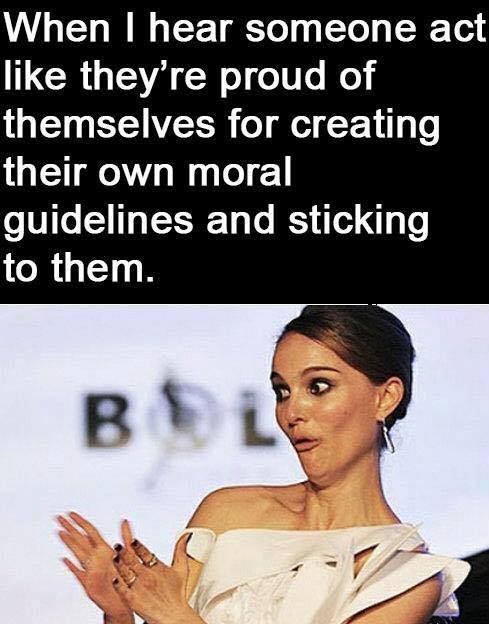
At the top of the article is a meme image that reads ‘When I hear someone act like they’re proud of themselves for creating their own moral guidelines and sticking to them’.
Natalie Portman sports an awkward facial expression and a sarcastic clap. Under the image is a line of copy: If you define morality as “whatever I want to do” then you’ll always be “moral”, which is tautological, but a bit of a non-sequitur to the rest, so I’ll leave it alone.
Let’s stop to regard this copy for a few moments but without going too deep. Let’s ignore the loose grammar and the concept of pride. I presume the focus of the author to be on the individually fabricated morals (read: ethical guidelines or rules) and that the fabricator follows through with them.
That this person follows through on their own rules is more impressive than the broken New Year’s resolutions of so many and is a certainly better track record than most people with supposed religious convictions.
New Years’ Resolutions
First, all morals are fabricated—his morals or your morals. And you can believe that these goods came from God or gods or nature or were just always present awaiting humans to embody them, but that doesn’t change the point.
Let’s presume that at least some of his morals don’t comport with the authors because they are borne out of compassion. Since we’ve already established precedence for cherry-picking, allow me to side-step the hedonistic aspects and instead focus on the compassionate aspects. Would this be offensive to the author? Isn’t, in fact, in Matthew 7:12 and Luke 6:31, the do unto others Golden Rule edict, is a call for compassion—at least sympathy if not empathy?
After a quick jab at abortion (tl; dr: abortion is bad) taking the scenic route to articulate the point that atheists typically don’t think of unborn children as people, apparently without fully grasping the concept of zygotes and gametes. The author then confuses the neutral notion of a probabilistic outcome with accidents, having negative connotations—as if I flip a coin, the result is an accident. Let’s ignore this passive-aggressive hostility and move on. Let’s also forgive the flippant—or at least facile—articulation of biological evolutionary processes as ‘the strong survive while the weak die’. We can let it slide since what is meant by strong in this context is wide open.
child (noun) : a young human being below the age of puberty or below the legal age of majority
Oxford Languages
The author continues with a claim that ‘you aren’t going to be able to generate a moral standard that includes compassion for weak unborn children on that scenario’. This feels like an unsubstantiated claim. Is this true? Who knows. Some people have compassion for all sorts of things from puppies to pandas without having some belief in rights. Some people like Peter Singer argues that rights should be extended to all species, and all humans should be vegans. I wonder if the author can live up to this moral high watermark. Maybe so. Probably doesn’t mix linen and wool because it’s the right thing to do.
“If the rule is “let’s do what makes us happy”, and the unborn child can’t voice her opinion, then the selfish grown-ups win.” This is our next stop. This is a true statement, so let’s tease it a bit. Animals are slaughtered and eaten, having no voice. Pet’s are kept captive, having no voice. Trees are felled, having no voice. Land is absconded from vegetation and Animalia—even other humans. Stolen from unborn humans for generations to come. Lots of people have no voice.
People are into countries and time and space. What about the converse situation? Where is the responsibility for having the child who gains a voice and doesn’t want this life? Does it matter that two consenting adults choose to have a child, so it’s OK? Doesn’t the world have enough people? What if two consenting adults choose to rob a bank? I know I don’t have to explicitly make the point that once the child is thrown into this world, the voice is told to shut up if it asks to exit or even tries to exit without permission. Unless circumstances arise to snuff out the little bugger as an adult.
Finally, the author is warmed up and decides to focus first on fatherhood. The question posed was whether the interlocutor thought that fatherlessness harmed children, to which the response was no.
Spoiler alert: The author is toting a lot of baggage on this fatherhood trip. Before we even get to the father, the child, or the family, there is a presumption of a Capitalist, income-based, market economy. Father means the adult male at the head of a nuclear family with a mum (or perhaps a mother; mum may be too informal), likely with 2 kids and half a pet. The child is expected to also participate in this constructed economy—the imagined ‘right’ social arrangement. It goes without saying that I feel this is a bum deal and shit arrangement, but I’ll defer to pieces already and yet to be written here. But if fathers are the cause of this ‘Modern’ society, fuck ’em and the horses they rode in on.
She asks him, if a system of sexual rules based on “me feeling good, and other people around me feeling good”, was likely to protect children. Evidently, he was silent, but here you can already determine that she unnecessarily links sex to procreation. And reflecting on a few paragraphs back, how is forcing a child (without asking) to be born and then told to become a wage slave or perish not violent and cruel?
(Self-guidance: Calm down, man. You can get through this.)
So the question is surreptitiously about procreative sex. By extension, if the couple can’t procreate for whatever myriad reasons, it’s OK? Sounds like it? Premenstrual, menopausal, oral, anal, same-sex coupling is all OK in this book. Perhaps, the author is more open-minded than I am given credit for. Not all humans are fertile, sex with plants and animals won’t result in procreation. A lot of folks would call this author kinky or freaky. Not my cup of tea, but I’m not judging. Besides, I’ve read that book—though shalt not judge. I’m gonna play it safe. And they couldn’t print it if it wasn’t true.
Spoiler Alert: Jesus dies at the end.
Seeking credibility, the author cites Bloomberg, as Centre to Centre-Left organisation as Far-Left. Clearly another red flag. Excuse me, your bias is showing. This piece is likely written for choir preaching, so we’ll take the penalty and move along.
A quick jab at the bête noire of ‘Big Government’ facilitating idle hands and, presumably genitals, to play. The idle rich as Croesus folks are idols to behold. At least I can presume she opposes military spending and armed aggression on the grounds of harm, so we’ve got common ground there. They’re probably an advocate of defunding the police, though by another name. so there’s another common platform. It just goes to show: all you need to do is talk to ameliorate differences. We’re making good headway. Let’s keep up the momentum.
Wait, what? We need to preserve a Western Way? I was shooting for something more Zen. Jesus was a Westerner—being from Bethlehem and all. (That’s in Israel—probably on the Westside.)
White Jesus from the Middle East
No worries. Just a minor setback—a speedbump. It’s just a flesh wound. But we’ve pretty much reached the end. A little banter about some other studies. There’s an impartial citation from the Institute for Family Studies on cohabitation they beg the question and employs circular logic. And another from the non-partisan Heritage Foundation finds that dads who live with their children spend more time with them. How profound. I’d fund that study.
And it’s over. What happened? In the end, all I got out of it is ‘I don’t like it when you make up morals’. You need to adopt the same moral code I’ve adopted.
AJ Ayer – Emotivism
Where was I? Oh yeah. Fathers. So these people don’t mean generic fathers. They mean fathers who subscribe to their worldview. In their magical realm, these fathers are not abusive to their mothers or children; these fathers are not rip-roaring alcoholics; these fathers are the dads you see on the telly.
Suspiciously absent is the plotline where the fathers are ripped from their families through systematic racism and incarcerated as if they didn’t want to be there for their children. And this isn’t discussing whether it’s an issue of fathers or an issue of money. It isn’t discussing whether someone else might serve as a proxy for this role. Indeed, there is nothing magical about fathers unless you live in a fantasy world.




















 Philosophics