What’s Maphra singing a Bring Me the Horizon cover have to do with philosophy?
Absolutely nothing… maybe.
Audio: Spotify version.
I’ve finished my book, and I spent hours discovering new music. Of course, the song is from 2015, but the treatment is new, and her voice is brilliant. Amazing control. I think it’s an upgrade on an already decent song, but what do you think? 🧐
I never forget that my first career was as a musician. It’s in my blood. Listen or not, but you’re missing out.
I’m not ashamed to say that AI is a significant part of my publishing workflow. In my latest project, The Architecture of Encounter, I’ve added indexing to the roles it serves. Other roles were prepping the index and footnotes, as I shared recently.
I expect the book to be available by next week. Time will tell.
I’ve included the full index below for reference. I’ve also included the title and copyright pages and other back matter.
What will a visitor do with a bookless index? I don’t know, but sharing is caring in my book. For the interested, you can get a sense of the contents. I’ll be sharing more details over the coming weeks – and beyond, I’m sure.
Earlier, I shared that Claude had offered index candidates. I started executing on that list by indexing the first few terms. It took me about an hour to do these, searching for each term and documenting the page number and context – around 250 pages. The book itself is 292 – 6″ x 9″ pages, but more than 50 of these are appendices, and others are front matter. Still.
Audio: NotebookLM summary podcast of this topic. (Another one that misses some points but make others. Fair enough.)
Then it dawned on me to ask Claude to help me with the index. Claude interpreted ‘help’ by spitting out the entire index, formatted and organised. If the book were formatted in 8½” x 11″ Letter size, I could have appended it as-is, but I still had to pour the output into the InDesign template I was composing through and make it look like it was part of the same manuscript, but that took minutes, not days of hours. Appendix E.
Given that I also rely heavily on novel concepts and specifically-defined terms – language insufficiency notwithstanding – I felt that a glossary would be useful. I tasked Claude with this, too. Again, it output a fully-formed list.
I noticed that a couple of terms I wanted defined were absent, so I fed the list into ChatGPT and asked it to consider these and let me know, given the manuscript, what other terms might be absent. It agreed with the two I wanted and suggested three more. It also pointed out an error Claude had made in counting. It also provided the definitions for the glossary entries, so I poured Claude’s output into InDesign. Appendix D.
AI is also a helper. For example, I wanted my index to flow into 2 columns. I’ve done this before. In the old days, I’d have scanned the menus (Adobe products are infamous for convoluted, nested menus), read the manual, and/or Googled for the answer – perhaps queried YouTube, a great resource for such things. Now, I ask AI. In this case, I asked ChatGPT. To be honest, it’s a little verbose, where ‘it’s option X under Y menu’ would suffice, but I ignore the banter.
If you need to know…
If the index is already placed in a text frame
Select the text frame containing the index.
Go to Object → Text Frame Options.
Set the Number of Columns you want, usually 2 for a 6×9 book, sometimes 3 if the type is small and the entries are short.
Adjust the Gutter spacing between columns.
Click OK.
Criticise AI all you want, but having access to in-built assistance 24/7 is a huge time-saving benefit.
Do I still use Google and YouTube? Yes, often.
Speaking of Google, I was searching for a cover image, and I discovered something I need for the fiction title I paused in September to focus on nonfiction. Sidenotes. Perhaps I’ll employ a similar mechanism.
The nonfiction book I am writing is somewhat epistolary, and I want to place internal dialogue as marginalia, employing a scripted font face. I am even considering a ‘deluxe’ version that renders this content in colour, but that’s an extra expense, first for the colour, then the full-page bleed, and perhaps thicker paper stock. Likely hardbound, reserving the paperback for a lower price point.
So, what’s next?
I finished both paperback and hardcover designs today.
I still need to review the index for hallucinated errors. This will still take less time than manually constructing it.
On the copyright page, there are a few classifiers. There are ISBNs for each format and a Library of Congress Control Number (LCCN). These are done, as you can see, but the ISBN system in the United States is antiquated. It looks like it’s a museum piece from the mid-1990s. In fact, I believe I first accessed it around 2000 or 2001, when I published my first book – before AI, before print on demand (POD).
A bit of nostalgia. The WWW, the internet as most people know it, was made public around 1994. Google hit it in 1998. Web 1.0. Facebook blighted the world around 2004, though less invasively at the start. I digress. Technology is a mixed bag.
Returning to ISBNs… These are managed in a system built circa 1997. It seems it is still managed with a host of cron jobs, so not much is processed in real time unless it’s a trivial record entry.
Each ISBN references a title and a format, as well as other odds and ends. In my case, I also use an imprint to separate my fiction from nonfiction. I started Microglyphics – tiny writing– in the mid-90s. When I published other authors, I used this name. I also used it for some of my fiction writing. I decided to create a Philosophics Press imprint for my philosophy and adjacent work.
It turns out that the printer needs to ensure that a book’s title and ISBN match the imprint. The system default is the company name, but I changed it to my imprint. This causes a workflow event on their end. Until it propagates, it doesn’t match, and the printer won’t allow the print run.
I’m writing this blog entry as I wait. I’m not sure if it’s automated – I’d like to assume it is – or if a human has to do something. AI might help. Just saying.
EDIT: The imprint has now been updated to Philosophics Press, but it still doesn’t work at the printer. Evidently, it can take up to 5 days for the data to propagate. I’m not sure who owns the fail on this one? Is the printer waiting for a data push? Can’t they pull the data? They seem to be live from my perspective. Is there an API, or is it truly old-school?
Whilst I’m here wittering on, WordPress have deprecated the little widget below – the one with my (old) thumbnail picture and ‘written by’ tag. I adopted it last year, but it’s been killed off. I’ve been copying the object from old posts, but I’ll probably switch to whatever they’ve replaced it with. I wasn’t keen on the options I’ve seen so far. First-world problems, I suppose.
Have you ever discovered something you already knew – rediscovered? I did.
I am familiar with the notion of prompting AI to explain something like a 10-year-old. But I’ve never seriously tried it.
I am wrapping up my next book, The Architecture of Ontology, and I realise it is incredibly dense. I’ve been listening to the audio renders I created with Elevenlabs. Parts of it are dense philosophical jargon, and other parts flow more readily. Today, I fed it to several AIs and asked them to explain the chapter contents as if to a 10-year-old.
NB: This is not a serious comparison. I am just sharing a bit of my experience with these ten LLM models.
Gemini
I’ve spent so much time with Claude and ChatGPT that I decided to begin with Gemini. I was pleasantly surprised. It not only simplified the language but also created different examples more suited to a younger reader. In fact, I considered a companion edition as I recall having read Howard Zinn’s People’s History of the United States and then encountering a Young People‘s version, which I bought for my then-teenage son. I’m not sure if I will, but the experience was inspiring.
I had Gemini interpret each of the 12 chapters, as well as a high-level version of the entire manuscript. Here is a piece of the first Chapter.
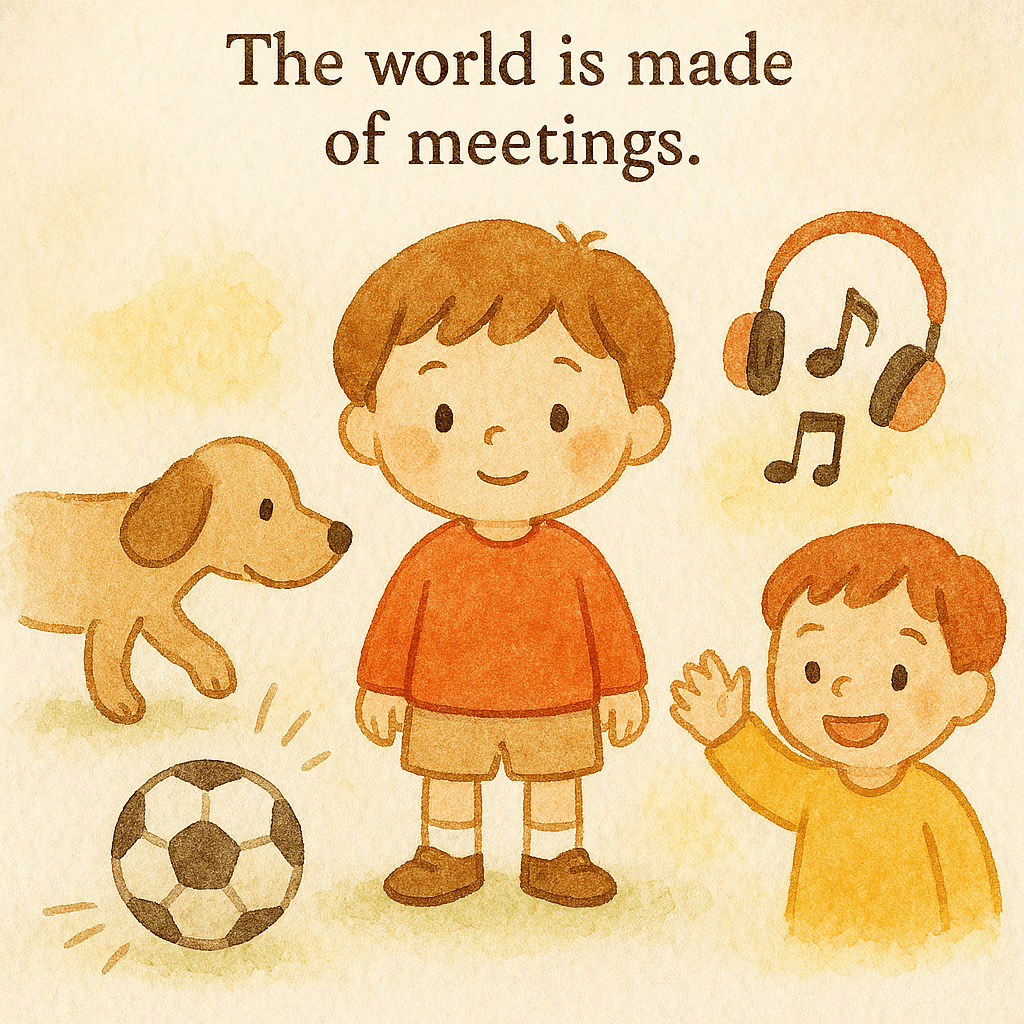
The Three Ingredients of Every “Meeting”
The Filter (Mediation): Everything you see, hear, or think is filtered through your body and your brain. You see a tree because your eyes work a certain way; a bat would “see” the same tree differently using sound. You can’t take the filter off, because without it, you wouldn’t experience anything at all.
The Push-Back (Constraint): The world isn’t just whatever you imagine. If you try to walk through a wall, the wall says “no”. This “no” or “push-back” is real, but it only happens during the meeting. It’s the part of the meeting that you can’t change just by wishing it was different.
The Way it Looks (Presentational Structure): This is just the “pattern” or “shape” the meeting takes when the filter and the push-back come together.
DeepSeek
Why not compare? I asked myself. I meant to share with Grok, but I fed DeepSeek instead. Deepseek had less of a childlike quality than Gemini had, but it created suitable examples – LEGOs were its instrument.
The responses were for a younger crowd. Useful, but they felt a bit patronising.
As I re-read it, it rather used kids as characters and simplified the language, but it wasn’t immersive in the manner of Gemini’s response.
Chapter 1: The Meeting Moment
Imagine there’s a big argument going on between two kids.
One kid, named Realism, says: “The playground is real! It’s made of wood and metal, and it’s there even when no one is playing on it.”
The other kid, named Idealism, says: “No way! The playground is just our experience of it. It only exists because we can see it, touch it, and play on it.”
They argue all day, but neither can win. This book says they’re arguing about the wrong thing.
Grok
I have to admit Grok got a little carried away, as evidenced by its preface;
Chapter 1 Deep Dive – Like Explaining It to Your Super-Smart 10-Year-Old Best Friend (With extra fun examples, playground stories, and zero boring words!)
No, not just a 10-year-old, but a super-smart one at that. I don’t know, but I think this might defeat the purpose. ‘You didn’t say it couldn’t be a savant’, I can imagine him defending. Technically, true, I suppose, but not practically consoling.
I suspect DeepSeek and Grok are sharing notes. They both opted for a LEGO motif. Grok, though, is patently verbose. Although it is targeted for a child, it isn’t as abridged as the others. This is neither good nor bad, but it’s a thing.
As Grok is talking to a bright child, I still wonder if that child could decode this?
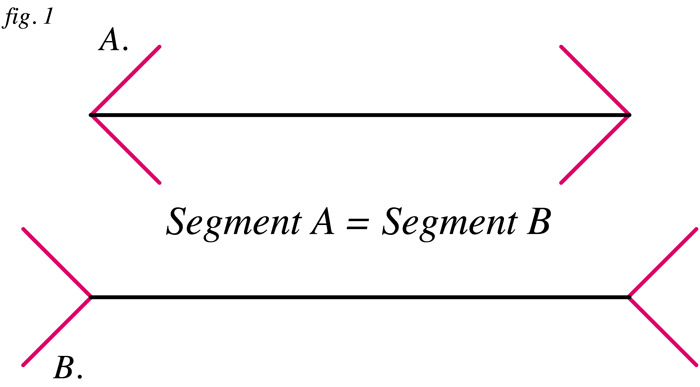
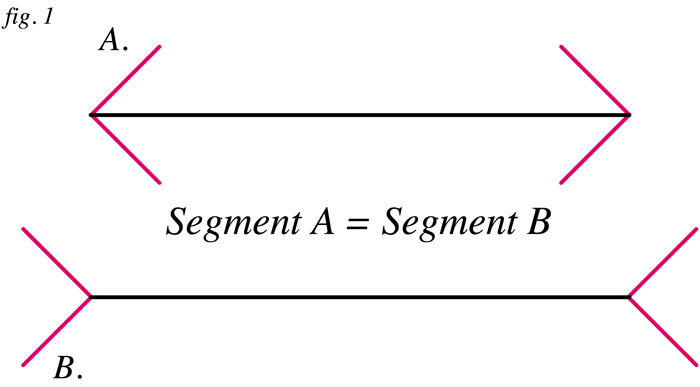
The weird optical illusion (Müller-Lyer lines) tricks your eyes even when you know it’s fake.
Perhaps an illustration would have helped. Perhaps I should place an illustration, though my adult version provides a description.
Perhaps I am out of touch, but this seems more suitable for a 14- or 16-year-old.
NB: I was going to stop at the three above, but I decided to keep going.
Mistral
Mistral started out OK, but instead of breaking down my technical jargon, it created more of a glossary of them and then defined them in simpler terms. That doesn’t really feel like it works as well as I’d like. Gemini is still the champ in this game.
Sure! Let’s break down Chapter 1 in more detail, but still in a way that a child can understand.
Chapter 1: Mediated Encounter Ontology
Imagine you’re playing with your favorite toy. When you pick up the toy, that’s an “encounter-event.” It’s a moment where you and the toy interact. The book says that all of reality is made up of these moments of interaction.
Copilot
Full disclosure: I don’t like Copilot. I decided to give it a go anyway.
Great — let’s zoom in on Chapter 1 and really unpack it slowly, clearly, and playfully, as if we’re explaining it to a curious 10‑year‑old. Think of this as a story + lesson, not a lecture.
It has pluses and minuses. It gave some summary rewordings, which weren’t half bad, but the rest was pedagogical and didactic, not well-suited for a typical 10-year-old. lest they were in a public school system.
I’ve got to say these images would require a lot of textual support to be useful, and they look to be more for a 4- to 6-year-old rather than a 10-year-old. IDK
Kimi K2.5
This one ditched the LEGOs and went for a video game metaphor. More apt? I dunno. Whilst LEGO blocks were a bit antithetical, I worry that one might mistake the videogame metaphor as my supporting a simulated universe theory, so erring in a different direction.
I got this message, which isn’t a good sign that much ‘thinking’ was involved:
High demand. Switched to K2.5 Instant for speed. Upgrade to use K2.5 Thinking.
Even so, the output was again didactic. Gemini is still ahead of the pack.
Z.AI GLM-4.7
This one started with LEGOs but switched quickly. I think this is my second favourite, just behind Gemini. it opted for this to start:
Chapter 1: The Encounter
The Big Problem: The “Hand-Me-Down” Coat Imagine if your parents gave you a coat to wear, but it was way too big and had holes in it. It’s uncomfortable, but everyone tells you, “This is just how coats are.”
In this chapter, the author says that philosophers have been wearing a “holey coat” for hundreds of years. This old coat is the idea that the world is split into two separate boxes:
Box A: Your Mind (where you think and feel).
Box B: The World (where rocks and trees exist).
Philosophers spend all their time arguing about how Box A talks to Box B. It’s a dead end. The author says we need to stop trying to patch the holes in the old coat and just get a new one.
Perplexity
This one is a bit listy and didactic, too. Not that the ideas are bad, but they need further conversion and consideration to be useful.
Think of Chapter 1 as teaching a new way to picture the world, using “encounters” instead of “things.”
1. The old picture we’re used to
Most people start with two separate buckets:
One bucket is “mind” (thoughts, feelings, experiences in your head).
One bucket is “world” (tables, trees, planets, atoms).
Then they ask: “How does the mind know the world?” This often leads to puzzles like “What if everything is just in my head?”
Chapter 1 says: this starting picture is part of the problem.
Claude
Right, here’s Chapter 1 of The Architecture of Encounter explained so a ten-year-old could get the gist. I’ve kept the core idea of each one and left out everything that would make a child’s eyes glaze over.
…
For hundreds of years, philosophers have drawn the same picture: there’s your mind on one side, and the world on the other side, and the big puzzle is figuring out how your mind reaches across to touch the world. This book says that picture isn’t something anyone discovered — it’s more like an old hand-me-down that everyone just kept wearing without asking whether it still fits. Most of the famous puzzles in philosophy (what is consciousness? can machines think? what is real?) only look puzzling because of that old picture. So instead of trying harder to solve them, this book asks: what if we drew a different picture?
…
This isn’t bad, but then it gets listy, too. Again, perhaps I just don’t understand what 10-year-olds expect.
ChatGPT
Again, this had some good ideas, but…
The chapter’s central idea in child-language
Reality is not made first out of separate little blocks. It is made first out of meetings, patterns, and pushback. The blocks are something we notice later.
Again, I’d be hard-pressed to consider this part suitable for 10-year-olds.
One-sentence verdict on Chapter 1
Chapter 1 is the book’s declaration that encounter is ontologically before subject and object, and that many traditional philosophical problems are artefacts of starting with the wrong furniture.
In the end, Gemini wins. Details to follow…
Written by Bry Willis with outputs from various LLMs, as noted.
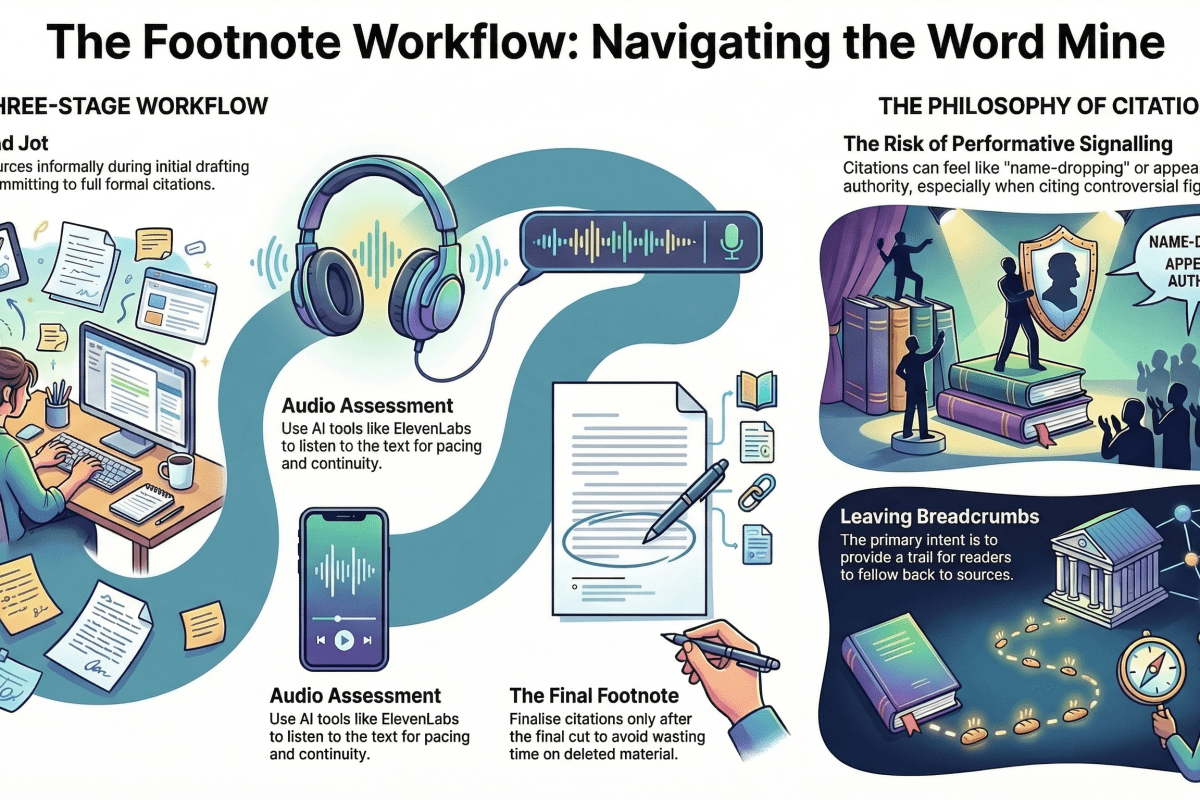
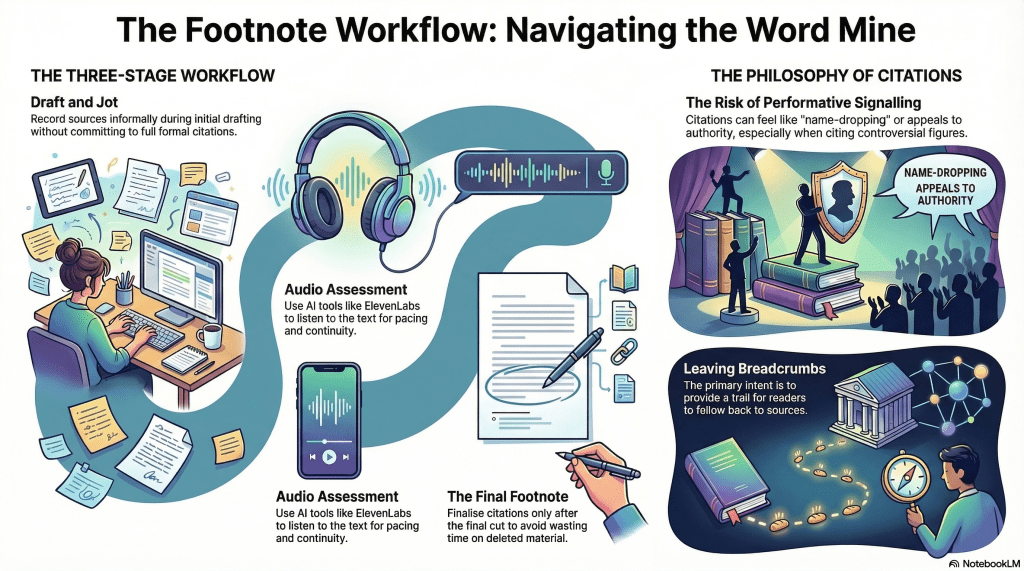
As a writer, I have a kind of workflow in mind. It differs for fiction and nonfiction, though there are similarities. The main differences are indexes, references, and footnotes. I thought I was nearly finished with my latest book.
Audio: NotebookLM summary podcast of this topic.
I rendered the first couple of chapters in ElevenLabs so I could listen to the text. It helps me assess pacing, continuity, and the like. It also gives me one more thing to fix, since the digital voices occasionally pronounce things differently from the way I’d prefer. Usually, choosing a voice that sounds roughly like Standard Southern British English helps, though not always. In any case, I survive.
While listening and following along in the manuscript, I discovered that I still haven’t fully footnoted the book.
When I write, I tend to jot down sources and references as I go, but I leave the footnoting until the final revision. There is little point in spending time drafting footnotes for material that may not survive the cut. So here I am, drafting footnotes.
I am of two minds about footnotes and citations, especially in academic work. On the one hand, they can feel performative, a way of signalling that one has incorporated so-and-so, a kind of name-dropping appeal to authority. As a heterodox writer, this is risky anyway, because I am liable to cite one of the approved villains. God forbid a Nietzsche, a Heidegger, or a Foucault. Analytic philosophers, in my experience, can be remarkably thin-skinned.
On the other hand, I do want to acknowledge those whose ideas I have borrowed. Even that, of course, is also a signal. Perhaps it all comes down to intent. As I mean it, I want to leave breadcrumbs for anyone who feels inclined to follow them back to the source.
I’ll let you decide where I’ve landed.
I’ve procrastinated long enough. Time to get back into the word mine.
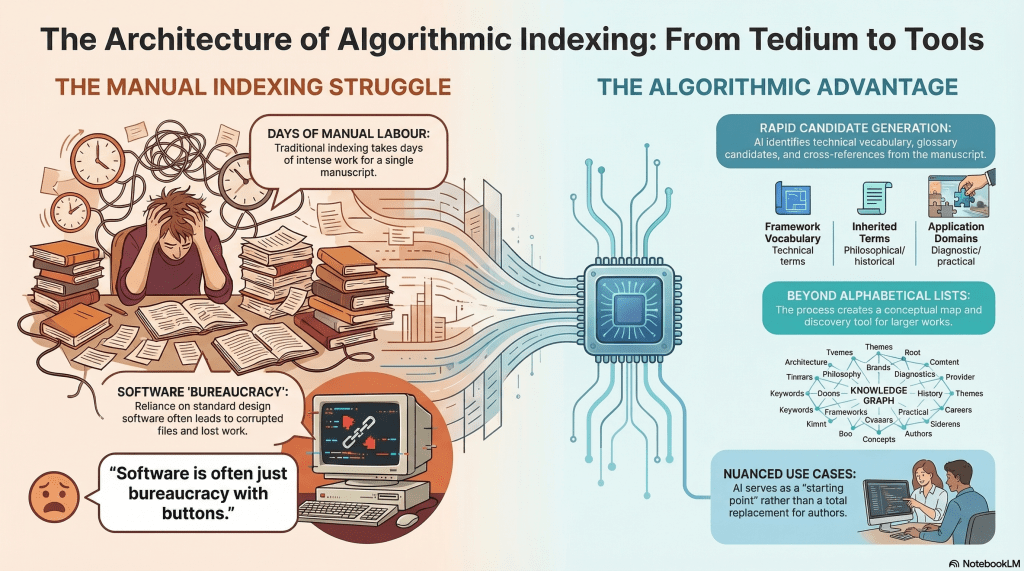
It takes me days to index one of my books. Longer when the technology decides to become sentient in the worst possible way, such as the time InDesign corrupted the index file and swallowed days of work whole. A charming little reminder that software is often just bureaucracy with buttons.
Audio: Not the best NotebookLM summary podcast, but it’s mercifully under 5 minutes.
Today, while chatting with Claude (Opus 4.6), I mentioned that I should probably create an index for my current project. The manuscript is not fully reviewed and revised, but it is getting close. At this stage, I do not expect to add much of substance. I am more likely to subtract than expand.
Claude asked whether I wanted help generating a list of candidate terms from the manuscript.
Dois-je rédiger une liste de termes candidats à partir du manuscrit ?
I said yes, and it produced an embedded PDF: Index Term List – Architecture of Encounter. On first scan, it looks remarkably close to what I need. It is not merely a term list, either. It also proposes candidates for glossary entries, which is useful, even if I am not yet convinced I want to add a glossary. The book is already sitting at around 256 pages, and print production costs do not exactly reward philosophical generosity. The draft organises terms into five sections, including framework-specific technical vocabulary, inherited philosophical terms, proper names, traditions and programmes, and application domains and diagnostics. It also marks some entries as glossary candidates and notes likely cross-references.
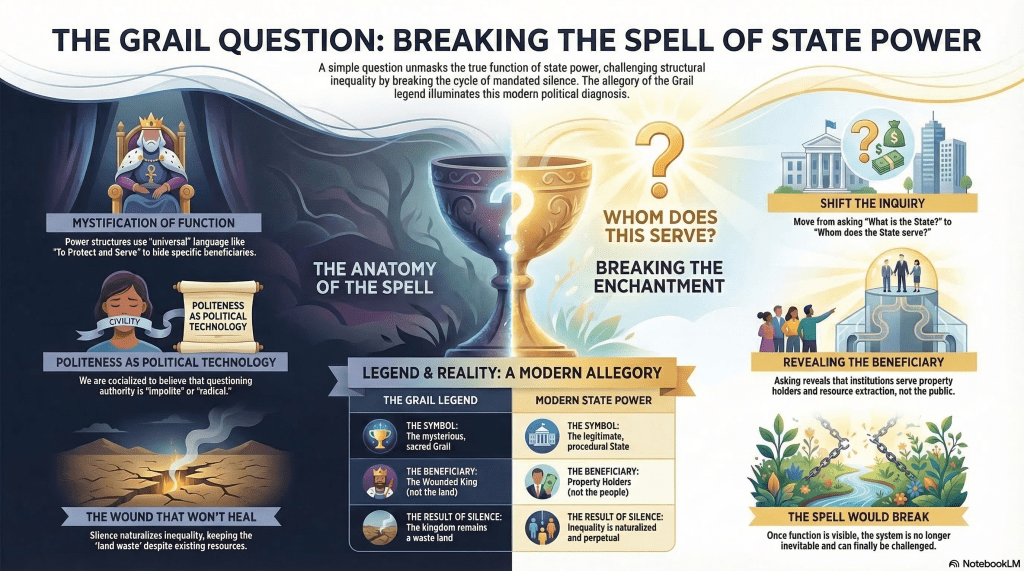
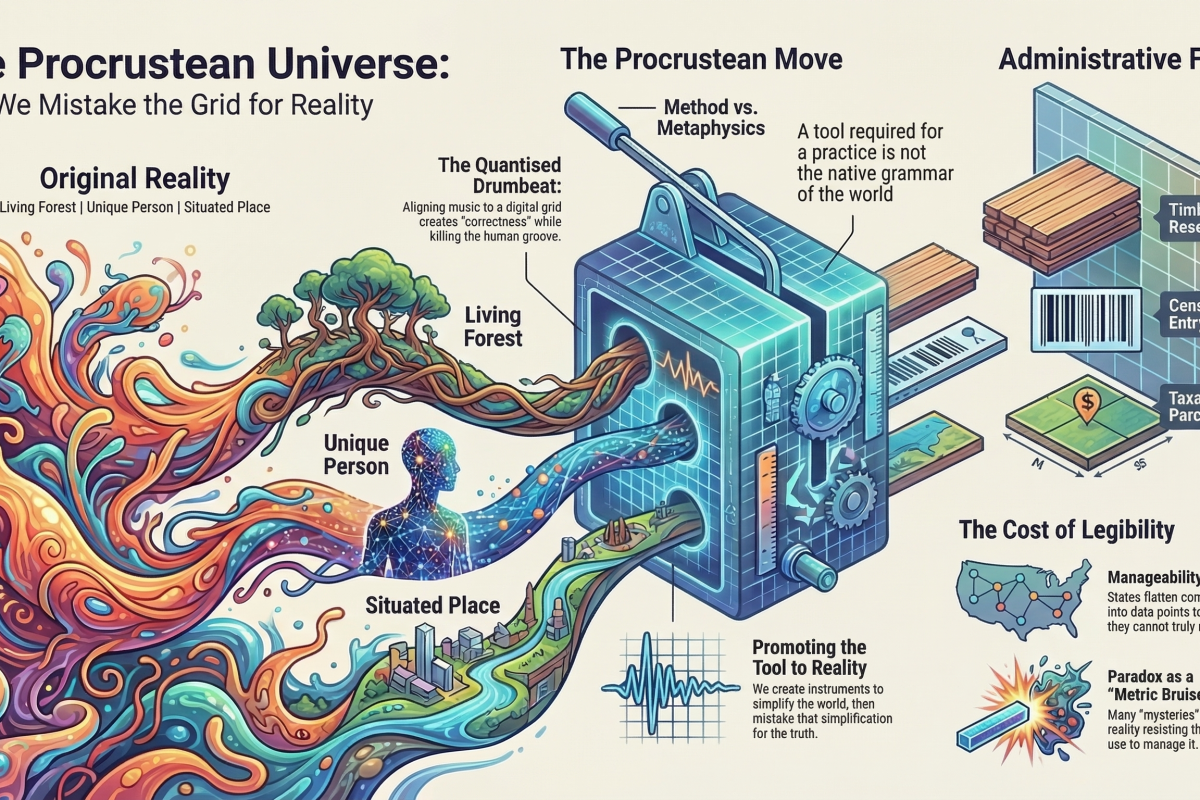
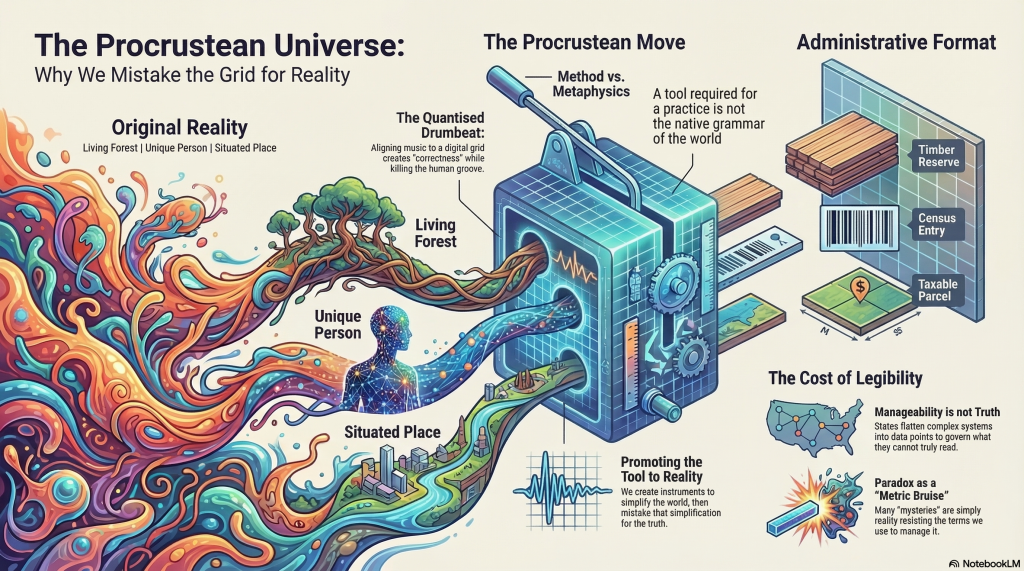
NotebookLM Infographic on this topic.
One amusing detail is that some of the suggested references relate to epigraphs. I had not really considered indexing those. My inclination is still not to include them, but I admit the temptation is there.
The categorisation itself is also interesting. It makes a good deal of sense as a conceptual map or discovery tool, especially for a larger work. But it does not quite align with what most readers expect from an index, which is, bluntly, alphabetical and easy to raid.
Still, as a starting point, this is rather better than staring into the manuscript and pretending I enjoy this sort of thing.
Some people like to badmouth or trash-talk AI. I’m here to say that these people need to discover nuance and use cases.
Wait for it… This parodies the use of language to sidestep Constitutional inconveniences. In the game show format, we learn what is and isn’t a war. Wittgenstein would be proud.
Video: Short parody asks the question, Is it war?
Watch this and build up your English language vocabulary.
There is a vulgar little myth still circulating among the managerial classes that capitalism, for all its blemishes, is at least good at ‘unlocking human potential’. It is not. It is very good at monetising human potential, disciplining it, redirecting it, and, where necessary, grinding it into forms useful to administration and exchange. This is not quite the same thing.
Audio: NotebookLM summary podcast of this topic.
One of capitalism’s less discussed achievements is its ability to rob society not merely of comfort, leisure, health, and life, but of minds. Not always by censorship. Not always by prison or direct prohibition. More often by something duller and therefore more effective: fatigue, schedules, rent, invoices, commuting, institutional obedience, and the constant low-grade humiliation of having to sell the best hours of one’s life in order to remain housed and fed.
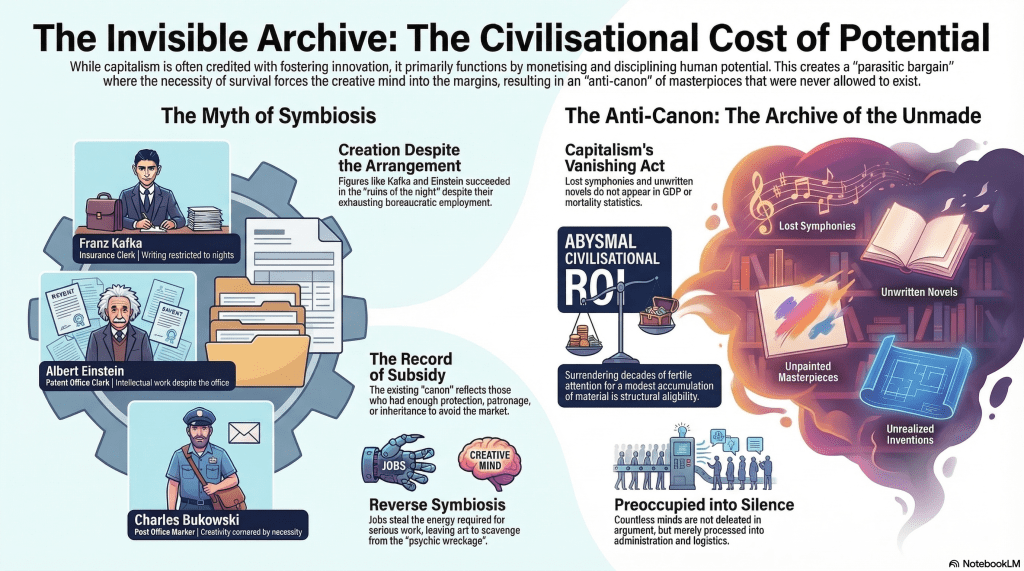
Franz Kafka is the obvious mascot for this arrangement, which is precisely why he matters. He worked in insurance. The office consumed the day; the writing had to happen in the ruins of the night. His bureaucratic life helped furnish the atmosphere of his fiction, certainly. Human beings do enjoy confusing damage with justification. But the point is not that the office was somehow good for Kafka because it gave him material. A prison may furnish one with subject matter, too. That does not make incarceration a residency programme. Kafka’s employment constrained the very work for which he is remembered. The miracle is not the arrangement. The miracle is that anything survived it. And Kafka was not unusual in kind. He was merely famous enough to make the violence legible.
NotebookLM Infographic on this topic.
Capitalism’s defenders like to point to the artists and thinkers who produced great work while employed, underpaid, exhausted, or cornered by necessity. Fine. Let us grant them their exhibit. Bukowski had the post office. Pessoa had commercial correspondence. Einstein had the patent office. One can add a hundred more names with minimal effort and maximal melancholy. Yet this proves the opposite of what the defenders want it to prove. It shows that some people managed to create despite the arrangement, not because of it.
This is the first confusion worth clearing away. There is no symbiosis here. At best, there is a kind of reverse symbiosis, a parasitic bargain. The job steals the time and energy required for serious work, while art scavenges from the psychic wreckage whatever it can still use. The worker is depleted; the artwork is composed from depletion. Critics then arrive later, pince-nez trembling, to tell us how fruitful this tension was. Fruitful for whom? Certainly not for the unwritten books, the undeveloped theories, the unfinished scores, or the painter dead too early to become collectible.
That, in fact, is the real question. Not which celebrated figures managed to drag a masterpiece out of economic adversity, but which works never appeared at all.
We are asked, constantly, to admire the canon. We are less often asked to consider the anti-canon: the archive of the unmade. The novel that never got written because its author spent thirty years in clerical work. The philosophy never developed because its possible author was too busy meeting payroll. The music that belonged to a particular age, a particular voice, a particular historical moment, could not simply be written forty years later by a different self under improved circumstances.
This is one of capitalism’s cleverest vanishing acts. It leaves behind no body when it kills a possibility. The unwritten book does not appear in mortality statistics. The lost symphony produces no coroner’s report. The poem abandoned in favour of stable employment is not entered into the national accounts as a dead thing. GDP ticks on, cheerful and imbecilic, while whole modes of life are silently foreclosed.
Some will object that artists have always depended on subsidy. Quite right. That objection destroys rather more than it saves. Van Gogh depended on Theo. Marx depended for years on Engels. Tchaikovsky had patronage. Virginia Woolf, unlike millions of women before her, had both money and a room of her own, and had the clarity to state the matter plainly. The lesson is not that genius floats free of material conditions. The lesson is the reverse: culture has always depended heavily on someone, somewhere, being shielded from the full stupidity of economic necessity.
This means the canon is not a clean record of merit. It is also a record of subsidy, exemption, accident, family money, patrons, tolerant spouses, sinecures, inherited cushion, and occasional institutional slack. In short, it is partly a record of who had enough protection from the market to do something other than kneel before it. The rest, meanwhile, are told a moral fable about hard work.
This is where the sentimental cliché about the ‘starving artist’ should be discarded with force. There is nothing noble about preventable exhaustion. There is nothing spiritually elevating about watching one’s better projects dry out from lack of time. There is certainly nothing socially rational about a civilisation organised in such a way that its most reflective, gifted, or aesthetically sensitive members must defer their work until retirement, ill health, or redundancy grants them a little stolen air.
One might respond that practical life gives artists experience. True enough. So does grief. So does war. So does prison. Experience is not the issue. The issue is the conversion rate. If one must surrender decades of one’s most fertile attention in exchange for a modest accumulation of usable material, the return is abysmal. The economist might call this poor ROI. The philosopher might call it structural stupidity. The artist, if still awake, may call it theft. And the theft is not merely personal. It is civilisational.
A society that forces most of its creative and intellectual life into the margins should not flatter itself for the masterpieces that occasionally emerge. It should be haunted by the scale of what never did. For every Kafka who wrote at night, how many did not? For every theorist supported by patronage or inheritance, how many more were processed into middle management, consultancy, administration, compliance, sales, logistics, and the thousand dead dialects of modern necessity? How many minds were not defeated in argument, but merely preoccupied into silence?
The answer, of course, is unknowable. Which is convenient for the system because what cannot be counted can be dismissed, and what can be dismissed can be repeated indefinitely.
Capitalism’s admirers are fond of innovation. They should spend less time praising the gadgets that reached market and more time mourning the consciousness that never reached form. Not every loss is a corpse. Some losses are libraries that never came into being. Some are paintings that remained latent in the hands of the overworked. Some are ideas that would have altered the climate of a discipline had their author not been busy earning a living.
The old accusation that capitalism exploits labour is true enough, but it is no longer adequate. It exploits labour, yes. It also colonises attention, cannibalises vocation, and narrows the range of what a culture is permitted to become. It does not merely take from workers. It takes from history. And then it calls the remainder efficiency.
I’m a philosopher of language, which sometimes veers off the reservation into philosophies of science and even metaphilosophy, but I am not a physicist. I don’t pretend to be. I do try to remain abreast of the goings-on in physics and science just because. Still, I view most affairs first through a philosophical lens.
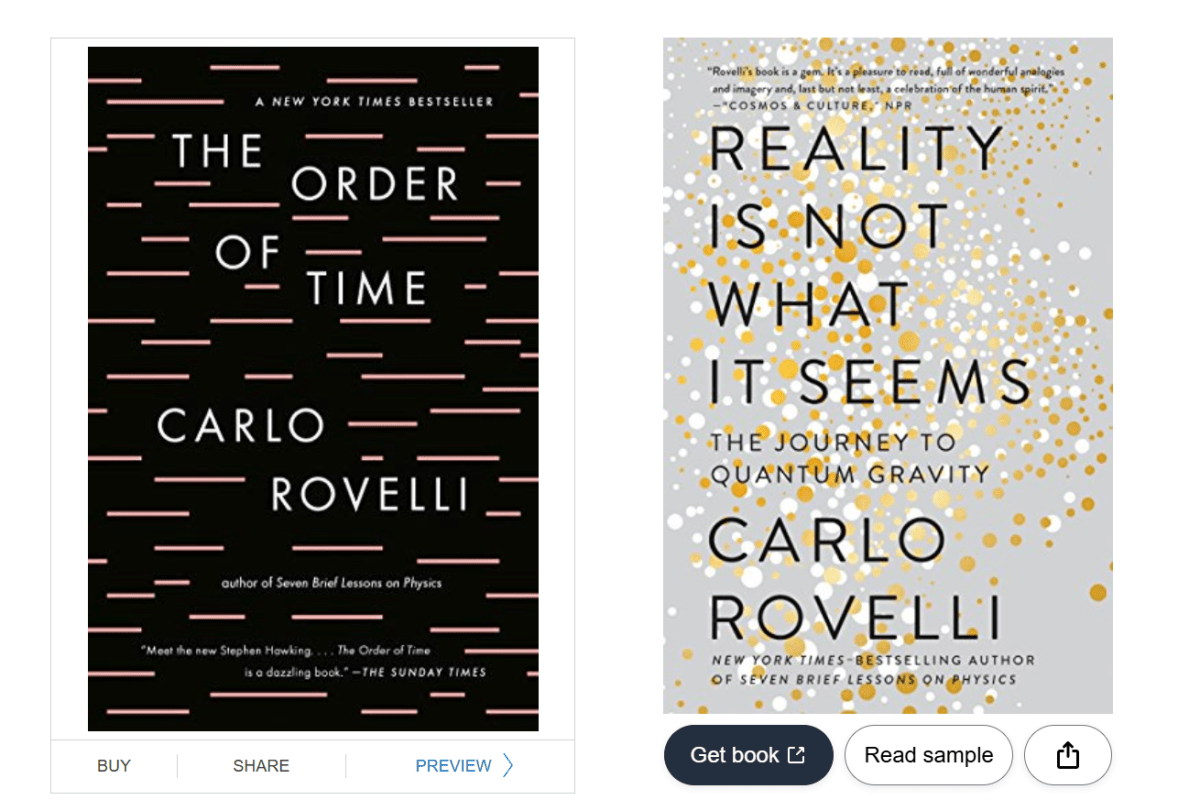
I watch a decent amount of science videos on YouTube, and I’ve been following Rovelli for years, but I hadn’t engaged with his work directly until I was researching for my current book, The Architect of Encounter. First, I read The Order of Time, followed by Reality Is Not What It Seems.
Rovelli published these books around 2017, but I am only reading them now. We are travelling in the same neighbourhood, but we occupy different residences and have different orientations.
Surveying the marketplace, quite a few physicists and science educators make some of the same points I and Rovelli make. In fact, these things appear to occur as trends. When I wanted to write about agency and free will over five years ago, I noticed a slew of books on the topics, and I had nothing more to add, so I shelved the idea.
In this case, the trend appears to have been between 2017 and 2018. I’m sure this is where I absorbed some of my knowledge, opinions, and grammar, but my thesis goes further and comes from a different perspective, so I feel this manuscript is worth publishing.
Getting back to Rovelli, his books are very well written – very approachable and light on the academics. I hope mine lands somewhere in the middle. As I continue to write my book, I will lean on Rovelli for the perspective on quantum theory. If he’s wrong or it’s wrong, then we fall together. That’s what happens when you borrow a foundational commitment. It’s a risk I am willing to take.
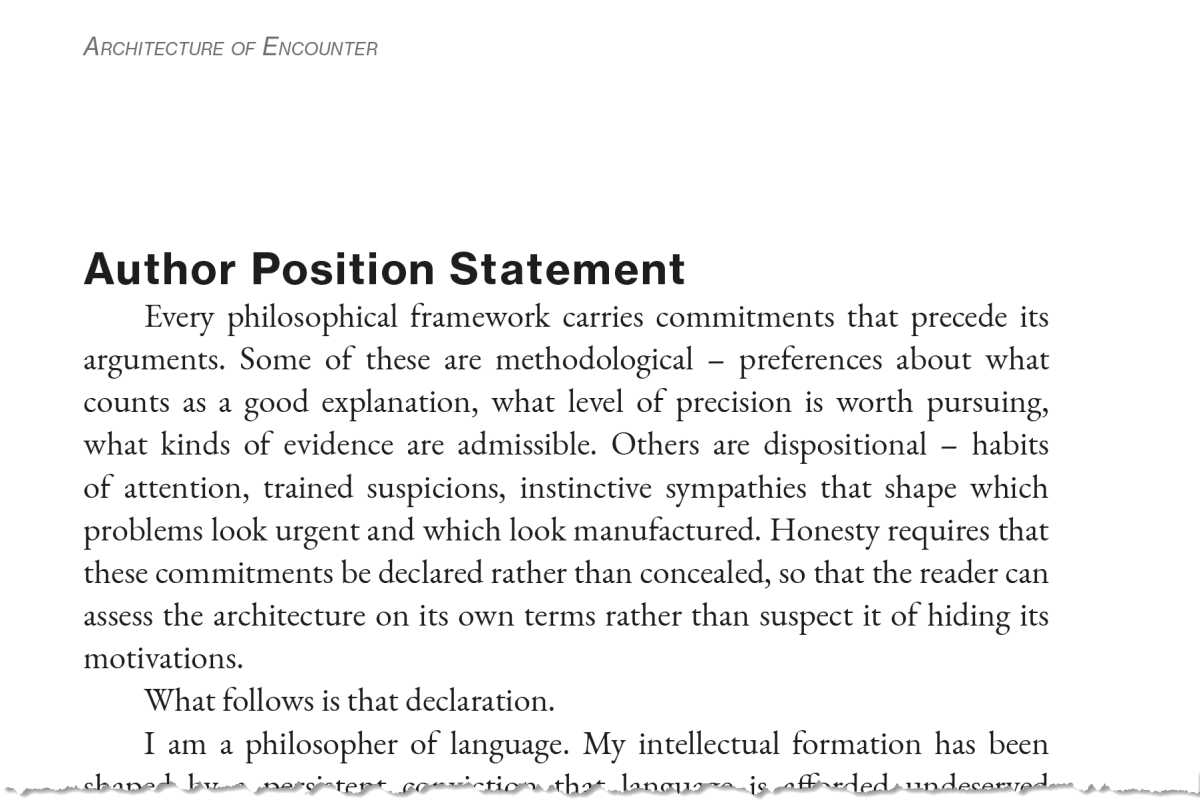
As much as I want to share more of what I am working on, it turns out I still need to work on it if I want to complete it. I am aiming for April this year, if not sooner. At least I’ve got some of the administrative stuff out of the way. Here’s a quick glimpse, title and copyright pages.
How Modern Thought Mistakes Its Own Grid for Reality
Modern thought has a peculiar habit.
It builds a measuring device, forces the world through it, and then congratulates itself for discovering what the world is really like.
This is not always called scientism. Sometimes it is called rigour, precision, formalism, standardisation, operationalisation, modelling, or progress. The names vary. The structure does not. First comes the instrument. Then comes the simplification. Then comes the quiet metaphysical sleight of hand by which the simplification is promoted into reality itself.
Consider music.
A drummer lays down a part with slight drag, push, looseness, tension. It breathes. It leans. It resists the metronome just enough to sound alive. Then someone opens Pro Tools and quantises it. The notes snap to grid. The beat is now ‘correct’. It is also, very often, dead.
This is usually treated as an aesthetic dispute between old romantics and modern technicians. It is more than that. It is a parable.
Quantisation is not evil because it imposes structure. Every recording process imposes structure. The problem is what happens next. Once the grid has done its work, people begin to hear the grid not as a tool, but as truth. Timing that exceeds it is heard as error. The metric scaffold becomes the criterion of reality.
Audio: NotebookLM summary podcast of this topic.
A civilisation can live like this.
It can begin with a convenience and end with an ontology.
Carlo Rovelli’s The Order of Time is useful here precisely because it unsettles the fantasy that time is a single smooth substance flowing uniformly everywhere like some celestial click-track. It is not. Time frays. It dilates. It varies by frame, relation, and condition. Space, too, loses its old role as passive container. The world begins to look less like a neat box of coordinates and more like an unruly field of relations that only reluctantly tolerates our diagrams.
This ought to induce some modesty. Instead, modern disciplines often respond by doubling down on the diagram.
That is where James C. Scott arrives, carrying the whole argument in a wheelbarrow. Seeing Like a State is not merely about states. It is about the administrative desire to make the world legible by reducing it to formats that can be counted, organised, compared, and controlled. Forests become timber reserves. People become census entries. Places become parcels. Lives become cases. The simplification is not wholly false. It is simply tailored to the needs of governance rather than to the fullness of what is governed.
That’s the key.
The state does not need the world in its density. It needs the world in a format it can read.
And modern disciplines are often no different. They require stable units, repeatable measures, abstract comparability, portable standards. Fair enough. No one is conducting physics with incense and pastoral reverie. But then comes the familiar conceit: what was required for the practice quietly becomes what reality is said to be. The discipline first builds the bed for its own survival, then condemns the world for failing to lie down properly.
Cut off what exceeds the frame. Stretch what falls short. Call the result necessity.
Many supposed paradoxes begin here. Not in reality itself, but in the overreach of a measuring grammar.
I use a ruler to measure temperature, and I am surprised when it does not comport.
The example is absurd, which is why it is helpful. The absurdity is not in the temperature. It’s in the category mistake. Yet much of modern thought survives by committing more sophisticated versions of precisely this error. We use tools built for extension to interpret process. We use spatial metaphors to capture time. We use statistical flattening to speak of persons. We use administrative categories to speak of communities. We use computational tractability to speak of mind. Then the thing resists, and we call the resistance mysterious.
Sometimes it is not mysterious at all. Sometimes it is merely refusal.
The world declines to be exhausted by the terms under which we can most easily manage it.
That refusal then returns to us under grander names: paradox, irrationality, inconsistency, noise, anomaly. But what if the anomaly is only the residue of what our instruments were built to exclude? What if paradox is often the bruise left by an ill-fitted measure?
This is where realism, at least in its chest-thumping modern form, begins to look suspicious. Not because there is no world. There is clearly something that resists us, constrains us, embarrasses us, punishes bad maps, and ruins bad theories. The issue is not whether there is a real. The issue is whether what we call “the real” is too often just what our current apparatus can stabilise.
That is not realism.
That is successful compression mistaken for ontology.
Space and time, in this light, begin to look less like the universe’s native grammar and more like the interface through which a certain kind of finite creature renders the world tractable. Useful, yes. Necessary for us, perhaps. Final? hardly.
The same applies everywhere. We do not merely measure the world. We reshape it, conceptually and institutionally, until it better fits our preferred methods of seeing. Then we forget we did this.
Scott’s lesson is that states fail when they confuse legibility with understanding. Our broader civilisational lesson may be that disciplines fail in much the same way. They flatten in order to know, and then mistake the flattening for disclosure. What exceeds the frame is dismissed until it returns as contradiction.
None of this requires anti-scientific melodrama. Science is powerful. Measurement is indispensable. Standardisation is often the price of cumulative knowledge. The problem is not the existence of the grid. The problem is the promotion of the grid into metaphysics. A tool required for a practice is not therefore the native structure of the world. That should be obvious. It rarely is.
Scientism, in its most irritating form, begins precisely where this obviousness ends. It is not disciplined inquiry but disciplinary inflation: the belief that whatever can be rendered formally legible is most real, and whatever resists is merely awaiting capture by better instruments, finer models, sharper equations, more obedient categories. It is the provincial fantasy that the universe must ultimately speak in the accent of our methods.
Perhaps it doesn’t.
Perhaps our great achievement is not that we have discovered reality’s final language, but that we have become unusually good at mistaking our translations for the original.





 Philosophics