The Insufficiency of Language Meets Generative AI

I’ve written a lot on the insufficiency of language, and it’s not even an original idea. Language, our primary tool for sharing thoughts and ideas, harbours a fundamental flaw: it’s inherently insufficient for conveying precise meaning. While this observation isn’t novel, recent developments in artificial intelligence provide us with new ways to illuminate and examine this limitation. Through a progression from simple geometry to complex abstractions, we can explore how language both serves and fails us in different contexts.

Audio: NotebookLM summary podcast of this topic.

The Simple Made Complex

Consider what appears to be a straightforward instruction: Draw a 1-millimetre square in the centre of an A4 sheet of paper using an HB pencil and a ruler. Despite the mathematical precision of these specifications, two people following these exact instructions would likely produce different results. The variables are numerous: ruler calibration, pencil sharpness, line thickness, paper texture, applied pressure, interpretation of ‘centre’, and even ambient conditions affecting the paper.

This example reveals a paradox: the more precisely we attempt to specify requirements, the more variables we introduce, creating additional points of potential divergence. Even in mathematics and formal logic—languages specifically designed to eliminate ambiguity—we cannot escape this fundamental problem.

Precision vs Accuracy: A Useful Lens

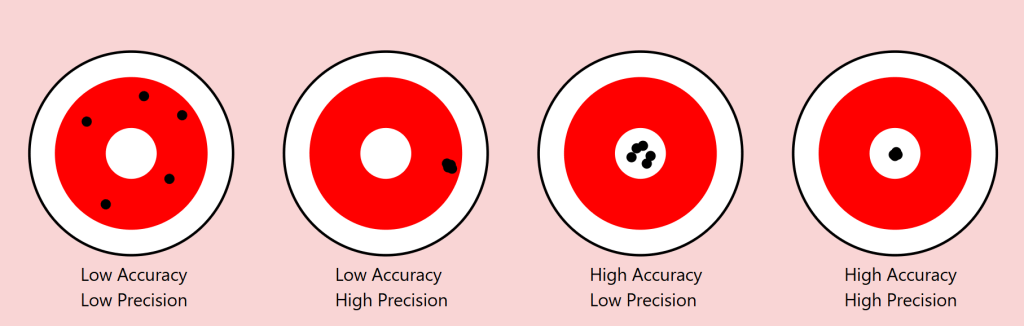
The scientific distinction between precision and accuracy provides a valuable framework for understanding these limitations. In measurement, precision refers to the consistency of results (how close repeated measurements are to each other), while accuracy describes how close these measurements are to the true value.

Returning to our square example:

  • Precision: Two people might consistently reproduce their own squares with exact dimensions
  • Accuracy: Yet neither might capture the ‘true’ square we intended to convey

As we move from geometric shapes to natural objects, this distinction becomes even more revealing. Consider a maple tree in autumn. We might precisely convey certain categorical aspects (‘maple’, ‘autumn colours’), but accurately describing the exact arrangement of branches and leaves becomes increasingly difficult.

The Target of Meaning: Precision vs. Accuracy in Communication

To understand language’s limitations, we can borrow an illuminating concept from the world of measurement: the distinction between precision and accuracy. Imagine a target with a bullseye, where the bullseye represents perfect communication of meaning. Just as archers might hit different parts of a target, our attempts at communication can vary in both precision and accuracy.

Consider four scenarios:
  1. Low Precision, Low Accuracy
    When describing our autumn maple tree, we might say ‘it’s a big tree with colourful leaves’. This description is neither precise (it could apply to many trees) nor accurate (it misses the specific characteristics that make our maple unique). The communication scatters widely and misses the mark entirely.
  2. High Precision, Low Accuracy
    We might describe the tree as ‘a 47-foot tall maple with exactly 23,487 leaves displaying RGB color values of #FF4500’. This description is precisely specific but entirely misses the meaningful essence of the tree we’re trying to describe. Like arrows clustering tightly in the wrong spot, we’re consistently missing the point.
  3. Low Precision, High Accuracy
    ‘It’s sort of spreading out, you know, with those typical maple leaves turning reddish-orange, kind of graceful looking.’ While imprecise, this description might actually capture something true about the tree’s essence. The arrows scatter, but their centre mass hits the target.
  4. High Precision, High Accuracy
    This ideal state is rarely achievable in complex communication. Even in our simple geometric example of drawing a 1mm square, achieving both precise specifications and accurate execution proves challenging. With natural objects and abstract concepts, this challenge compounds exponentially.

The Communication Paradox

This framework reveals a crucial paradox in language: often, our attempts to increase precision (by adding more specific details) can actually decrease accuracy (by moving us further from the essential meaning we’re trying to convey). Consider legal documents: their high precision often comes at the cost of accurately conveying meaning to most readers.

Implications for AI Communication

This precision-accuracy framework helps explain why AI systems like our Midjourney experiment show asymptotic behaviour. The system might achieve high precision (consistently generating similar images based on descriptions) while struggling with accuracy (matching the original intended image), or vice versa. The gap between human intention and machine interpretation often manifests as a trade-off between these two qualities.

Our challenge, both in human-to-human and human-to-AI communication, isn’t to achieve perfect precision and accuracy – a likely impossible goal – but to find the optimal balance for each context. Sometimes, like in poetry, low precision might better serve accurate meaning. In other contexts, like technical specifications, high precision becomes crucial despite potential sacrifices in broader accuracy.

The Power and Limits of Distinction

This leads us to a crucial insight from Ferdinand de Saussure’s semiotics about the relationship between signifier (the word) and signified (the concept or object). Language proves remarkably effective when its primary task is distinction among a limited set. In a garden containing three trees – a pine, a maple, and a willow – asking someone to ‘point to the pine’ will likely succeed. The shared understanding of these categorical distinctions allows for reliable communication.

However, this effectiveness dramatically diminishes when we move from distinction to description. In a forest of a thousand pines, describing one specific tree becomes nearly impossible. Each additional descriptive detail (‘the tall one with a bent branch pointing east’) paradoxically makes precise identification both more specific and less likely to succeed.

An AI Experiment in Description

To explore this phenomenon systematically, I conducted an experiment using Midjourney 6.1, a state-of-the-art image generation AI. The methodology was simple:

  1. Generate an initial image
  2. Describe the generated image in words
  3. Use that description to generate a new image
  4. Repeat the process multiple times
  5. Attempt to refine the description to close the gap
  6. Continue iterations

The results support an asymptotic hypothesis: while subsequent iterations might approach the original image, they never fully converge. This isn’t merely a limitation of the AI system but rather a demonstration of language’s fundamental insufficiency.

One can already analyse this for improvements, but let’s parse it together.

a cute woman

With this, we know we are referencing a woman, a female of the human species. There are billions of women in the world. What does she look like? What colour, height, ethnicity, and phenotypical attributes does she embody?

We also know she’s cute – whatever that means to the sender and receiver of these instructions.

I used an indefinite article, a, so there is one cute woman. Is she alone, or is she one from a group?

It should be obvious that we could provide more adjectives (and perhaps adjectives) to better convey our subject. We’ll get there, but let’s move on.

and

We’ve got a conjunction here. Let’s see what it connects to.

her dog

She’s with a dog. In fact, it’s her dog. This possession may not be conveyable or differentiable from some arbitrary dog, but what type of dog is it? Is it large or small? What colour coat? Is it groomed? Is it on a leash? Let’s continue.

stand

It seems that the verb stand refers to the woman, but is the dog also standing, or is she holding it? More words could qualify this statement better.

next to a tree

A tree is referenced. Similar questions arise regarding this tree. At a minimum, there is one tree or some variety. She and her dog are next to it. Is she on the right or left of it?

We think we can refine our statements with precision and accuracy, but can we? Might we just settle for “close enough”?

Let’s see how AI interpreted this statement.

Image: Eight Midjourney renders from the prompt: A cute woman and her dog stand next to a tree. I’ll choose one of these as my source image.

Let’s deconstruct the eight renders above. Compositionally, we can see that each image contains a woman, a dog, and a tree. Do any of these match what you had in mind? First, let’s see how Midjourney describes the first image.

In a bout of hypocrisy, Midjourney refused to /DESCRIBE the image it just generated.

Last Midjourney description for now.

Let’s cycle through them in turn.

  1. A woman is standing to the left of an old-growth tree – twice identified as an oak tree. She’s wearing faded blue jeans and a loose light-coloured T-shirt. She’s got medium-length (maybe) red-brown hair in a small ponytail. A dog – her black and white dog identified as a pitbull, an American Foxhound, and an American Bulldog – is also standing on his hind legs. I won’t even discuss the implied intent projected on the animal – happy, playful, wants attention… In two of the descriptions, she’s said to be training it. They appear to be in a somewhat residential area given the automobiles in the background. We see descriptions of season, time of day, lighting, angle, quality,
  2. A woman is standing to the right of an old-growth tree. She’s wearing short summer attire. Her dog is perched on the tree.
  3. An older woman and her dog closer up.
  4. A read view of both a woman and her dog near an oak tree.

As it turned out, I wasn’t thrilled with any of these images, so I rendered a different one. Its description follows.

The consensus is that ‘a beautiful girl in a white dress and black boots stands next to a tree’ with a Jack Russell Terrier dog. I see birch trees and snow. It’s overcast. Let’s spend some time trying to reproduce it. To start, I’m consolidating the above descriptions. I notice some elements are missing, but we’ll add them as we try to triangulate to the original image.

A beautiful girl in a white dress and black boots stands next to a tree in a winter forest with birch trees. A Jack Russell Terrier dog is nearby, and the weather is cloudy. The photo has a cinematic style. --ar 128:71

This is pretty far off the mark. We need to account for the overall setting and composition, relative positioning, clothing, hair, camera, perspective – even lighting and film emulsion.

Let’s see how we can refine it with some adjectives. Before this, I asked Anthropic’s Claude 3.5 to describe the image. Perhaps we’ll get more details.

An atmospheric winter photograph was taken in what appears to be a birch and pine forest. The ground is partially covered with snow, creating a patchy pattern of white snow and brown leaves or soil. In the image, there's a person wearing winter attire consisting of a white knit turtleneck sweater, a white skirt, dark knee-high socks, and grey lace-up boots. They're standing against a large tree trunk with their arms crossed. Next to them is a Jack Russell Terrier mix dog with distinctive brown and white colouring. The dog appears to be well-behaved, sitting attentively beside the tree. The composition is quite striking, with the massive dark tree trunk serving as a central focal point against the misty, winter forest background. The white clothing of the person creates a visual echo with the white bark of birch trees visible in the background, as well as with the patches of snow on the ground. The overall mood of the photo is somewhat moody and contemplative, enhanced by what appears to be overcast lighting and the misty quality of the forest in the background. The colour palette is largely monochromatic, dominated by whites, greys, and browns, which adds to the winter atmosphere of the scene.
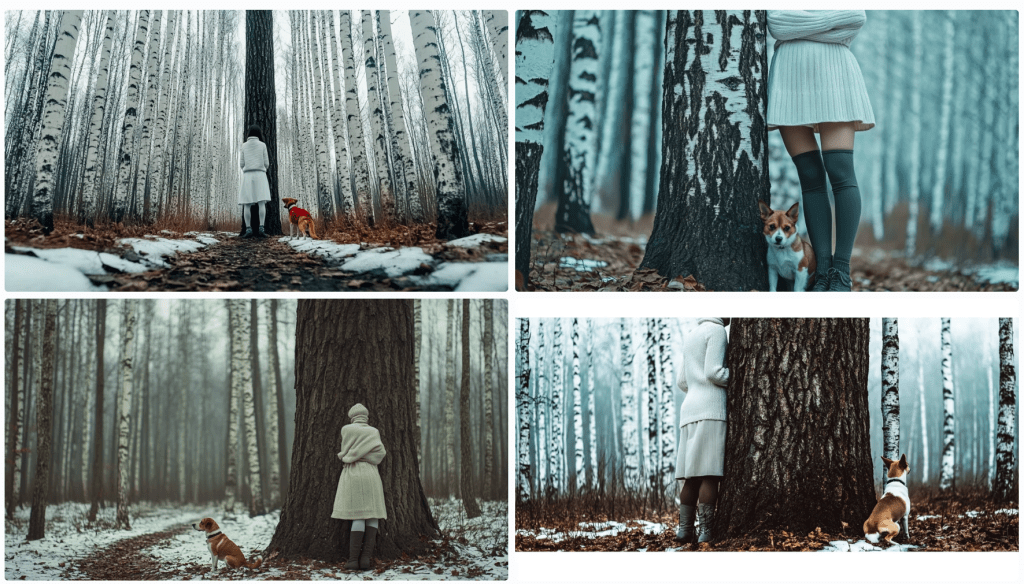
We don’t seem to be moving in a good direction. Let’s modify the initial prompt.

A beautiful girl in a white dress and tall laced black boots stands facing the camera to the right of large oak tree centred in the foreground of a winter forest with birch trees in the background. To the left of the tree is a Jack Russell Terrier dog looking at the camera, and the weather is cloudy. The photo has a cinematic style. --ar 128:71

I’ll allow the results to speak for themselves. Let’s see if we can’t get her out of the wedding gown and into a white jumper and skirt. I’ll bold the amends.

A beautiful girl in a white jumper and skirt wearing black leggings and tall laced black boots stands facing the camera to the right of large oak tree centred in the foreground of a winter forest with birch trees in the background. To the left of the tree is a Jack Russell Terrier dog looking at the camera, and the weather is cloudy. The photo has a cinematic style. --ar 128:71

s

A beautiful young woman with long brown hair pulled to the side of her face in a white jumper and white skirt wearing black leggings under tall laced black boots stands facing the camera to the right of large oak tree centred in the foreground of a winter forest with birch trees in the background. Patchy snow is on the ground. To the left of the tree is a Jack Russell Terrier dog looking at the camera, and the weather is overcast. The photo has a cinematic style. --ar 128:71

What gives?

I think my point has been reinforced. I’m getting nowhere fast. Let’s give it one more go and see where we end up. I’ve not got a good feeling about this.

A single large oak tree centred in the foreground of a winter forest with birch trees in the background. Patches of snow is on the ground. To the right of the oak tree stands a beautiful young woman with long brown hair pulled to the side of her face in a white jumper and white skirt wearing black boots over tall laced black boots. She stands facing the camera. To the left of the tree is a Jack Russell Terrier dog looking at the camera, and the weather is overcast. The photo has a cinematic style. --ar 128:71
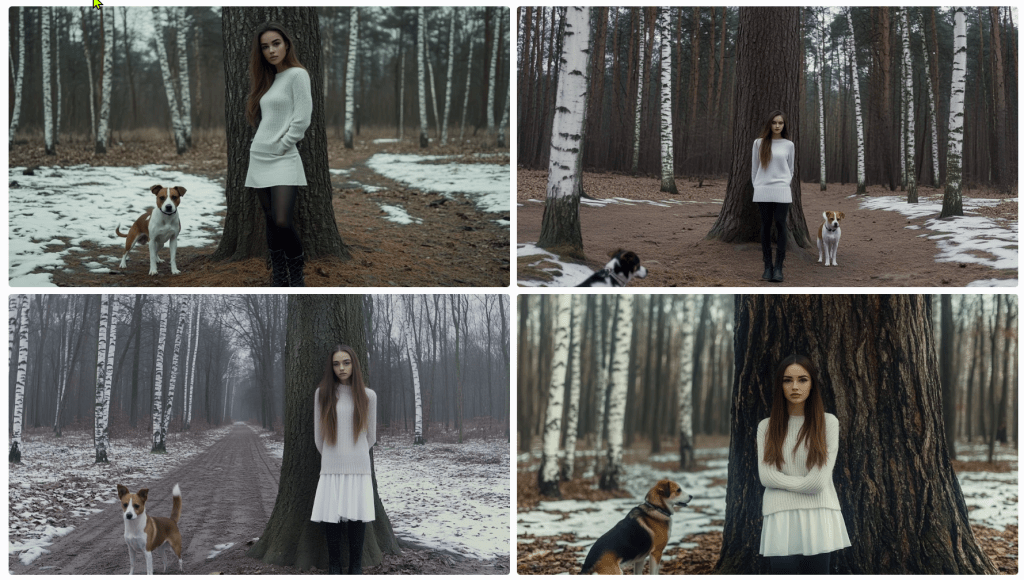
With this last one, I re-uploaded the original render along with this text prompt. Notice that the girl now looks the same and the scene (mostly) appears to be in the same location, but there are still challenges.

After several more divergent attempts, I decided to focus on one element – the girl.
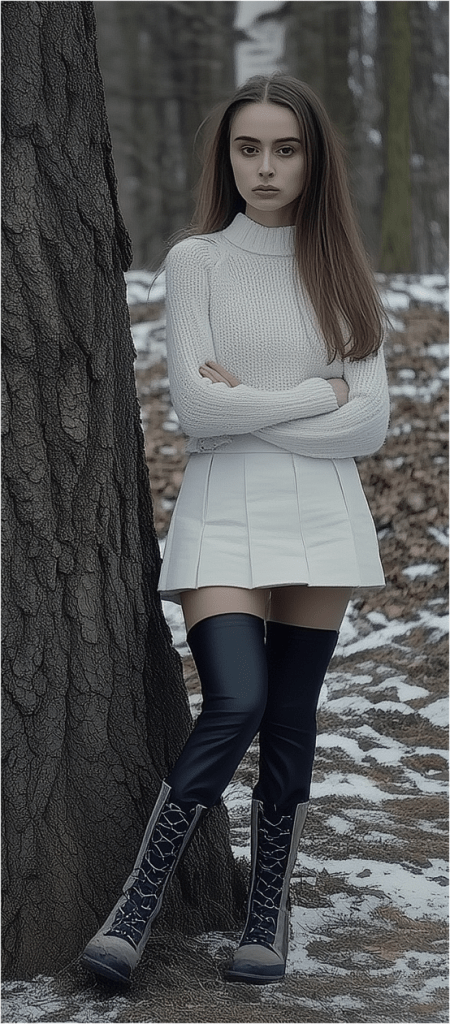
As I regard the image, I’m thinking of a police sketch artist. They get sort of close, don’t they? They’re experts. I’m not confident that I even have the vocabulary to convey accurately what I see. How do I describe her jumper? Is that a turtleneck or a high collar? It appears to be knit. Is is wool or some blend? does that matter for an image? Does this pleated skirt have a particular name or shade of white? It looks as though she’s wearing black leggings – perhaps polyester. And those boots – how to describe them. I’m rerunning just the image above through a describe function to see if I can get any closer.
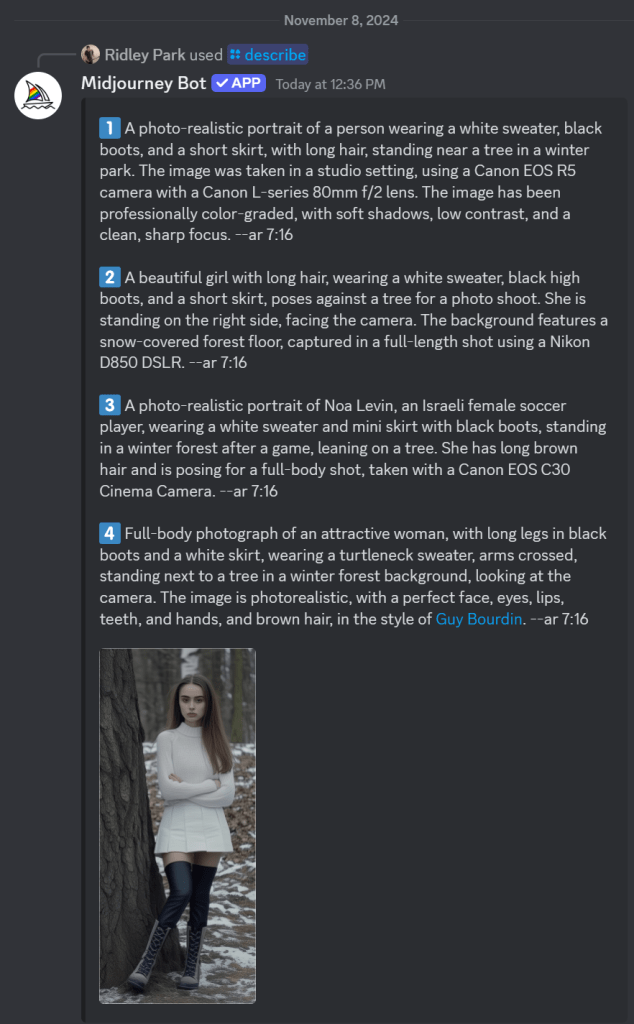
These descriptions are particularly interesting and telling. First, I’ll point out that AI attempts to identify the subject. I couldn’t find Noa Levin by a Google search, so I’m not sure how prominent she might be if she even exists at all in this capacity. More interesting still, the AI has placed her in a scenario where the pose was taken after a match. Evidently, this image reflects the style of photographer Guy Bourdin. Perhaps the jumper mystery is solved. It identified a turtleneck. I’ll ignore the tree and see if I can capture her with an amalgamation of these descriptions. Let’s see where this goes.

A photo-realistic portrait of Israeli female soccer player Noa Levin wearing a white turtleneck sweater, arms crossed, black boots, and a short skirt, with long brown hair, standing near a tree in a winter park. The image captured a full-length shot taken in a studio setting, using a Canon EOS R5 camera with a Canon L-series 80mm f/2 lens. The image has been professionally color-graded, with soft shadows, low contrast, and a clean, sharp focus. --ar 9:16

Close-ish. Let’s zoom in to get better descriptions of various elements starting with her face and hair.

Now, she’s a sad and angry Russian woman with (very) pale skin; large, sad, grey eyes; long, straight brown hair. Filmed in the style of either David LaChapelle or Alini Aenami (apparently misspelt from Alena Aenami). One thinks it was a SnapChat post. I was focusing on her face and hair, but it notices her wearing a white (oversized yet form-fitting) jumper sweater and crossed arms .
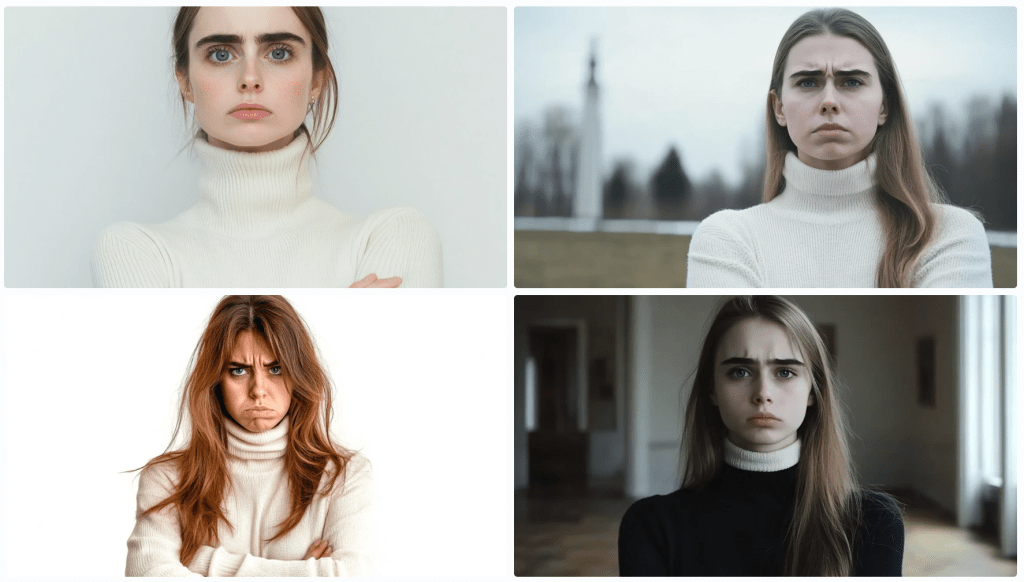
I’ll drop the angry bit – and then the sad.

Stick a fork in it. I’m done. Perhaps it’s not that language is insufficient; it that my language skills are insufficient. If you can get closer to the original image, please forward the image, the prompt, and the seed, so I can post it.

The Complexity Gradient

A clear pattern emerges when we examine how language performs across different levels of complexity:

  1. Categorical Distinction (High Success)
    • Identifying shapes among limited options
    • Distinguishing between tree species
    • Basic color categorization
  2. Simple Description (Moderate Success)
    • Basic geometric specifications
    • General object characteristics
    • Broad emotional states
  3. Complex Description (Low Success)
    • Specific natural objects
    • Precise emotional experiences
    • Unique instances within categories
  4. Abstract Concepts (Lowest Success)
    • Philosophical ideas
    • Personal experiences
    • Qualia

As we move up this complexity gradient, the gap between intended meaning and received understanding widens exponentially.

The Tolerance Problem

Understanding these limitations leads us to a practical question: what level of communicative tolerance is acceptable for different contexts? Just as engineering embraces acceptable tolerances rather than seeking perfect measurements, perhaps effective communication requires:

  • Acknowledging the gap between intended and received meaning
  • Establishing context-appropriate tolerance levels
  • Developing better frameworks for managing these tolerances
  • Recognizing when precision matters more than accuracy (or vice versa)

Implications for Human-AI Communication

These insights have particular relevance as we develop more sophisticated AI systems. The limitations we’ve explored suggest that:

  • Some communication problems might be fundamental rather than technical
  • AI systems may face similar boundaries as human communication
  • The gap between intended and received meaning might be unbridgeable
  • Future development should focus on managing rather than eliminating these limitations

Conclusion

Perhaps this is a simple exercise in mental masturbation. Language’s insufficiency isn’t a flaw to be fixed but a fundamental characteristic to be understood and accommodated. By definition, it can’t be fixed. The gap between intended and received meaning may be unbridgeable, but acknowledging this limitation is the first step toward more effective communication. As we continue to develop AI systems and push the boundaries of human-machine interaction, this understanding becomes increasingly critical.

Rather than seeking perfect precision in language, we might instead focus on:

  • Developing new forms of multimodal communication
  • Creating better frameworks for establishing shared context
  • Accepting and accounting for interpretative variance
  • Building systems that can operate effectively within these constraints

Understanding language’s limitations doesn’t diminish its value; rather, it helps us use it more effectively by working within its natural constraints.

The Great British ‘R’ Mystery: How One Letter Stirs Up Trouble Across the Isles and Beyond

Here’s the thing about the letter R in British English: it’s like tea in the UK—ubiquitous yet wielded with such dizzying inconsistency that even the Queen herself might forget if it’s in fashion this season. Like some shadowy figure lurking in the alleyways of phonetics, R refuses to play by the rules, showing up when least expected and disappearing when needed most. So, grab your Earl Grey (or your gin), and let’s unravel the ‘R’ mystery, a story with more twists and turns than a James Bond plot.

EDIT: Here’s a short video by Language Jones on this topic of Rs.

Non-Rhoticity: When ‘R’ Decided It Was Over It

You know those people who drop a grand entrance line and then ghost the party? That’s R in much of British English. Around the 18th century, R went non-rhotic in Southern England, meaning it started acting like an ultra-exclusive VIP—only showing up when it felt like it, especially at the beginning of words or when it needed to bridge vowels. Otherwise, it vanished into thin air.

Imagine trying to summon an ‘R’ in car or butter in a posh English accent. Nope, you won’t find it. And heaven forbid you should try to put it there, lest you get called out for sounding a bit, well, American. R only shows up if it gets to do the delicate act of linking R, like in “law(r) and order.” Otherwise, it’s quite happy being invisible.

Intrusive R: “Hey, Did Anyone Order an ‘R’?”

Just when you thought you understood where R lives and dies, it pulls a fast one—intrusive R. This is when R starts showing up uninvited, slipping in between vowels that never actually requested its presence, as in “Asia(r) and Europe” or “idea(r) of it.” It’s as if R has been waiting in the wings, saw an opening, and said, “Yep, I’m in!” It’s common in dialects like Received Pronunciation, adding to the chaos by creating sounds like “sawr it” instead of “saw it.”

Yes, Americans sometimes think this sounds like linguistic anarchy. Brits, meanwhile, might argue it’s not anarchy but nuance.

The Great Wash Scandal: The Pennsylvanian “Warsh” and American Rs Gone Rogue

If you thought the Brits were bad, wait until you get to the United States, where R lives a double life. In most regions, it’s rhotic (loyally pronounced) except in certain coastal spots like New England, where it gets dropped faster than a hot potato—er, pah-tay-tah. But for true havoc, we turn to Pennsylvania and pockets of the Midwest, where locals throw an extra R into words like wash, pronouncing it as warsh. This trickery is known as epenthesis, a linguistic fancy word for, “Let’s just spice things up by adding stuff that isn’t there.”

In truth, R’s American escapades are the stuff of legends, revealing a rebellious streak that could give even the British a run for their money.

Rolling, Tapping, and Pedos: The R Scandal Goes Global

Cross the Atlantic, and you find R pulling yet another stunt, this time with Spanish speakers in its crosshairs. Spanish has a beautiful setup with its tap and trill—like a musical duo that harmonises perfectly if you know the drill. The English-speaking learner, however, often fumbles, turning perro (“dog”) into pero (“but”) and, worse still, into pedo (“fart”) when the tongue flap falls flat. Just imagine the accidental puns that arise when, with good intentions, one says, “I have a fart,” instead of “I have a dog.”

And rolling R? A fine art lost on many. French and some German speakers take things even further with the uvular R, crafted like a raspy little growl at the back of the throat. It’s as if R has found its place among the operatic elite, making British Received Pronunciation seem almost polite by comparison.

Dialect Drama: From the Scots “Burr” to the Indian Retroflex

If you’re ever lucky enough to venture into the Scots Gaelic or northern English dialects, you’ll find R given the starring role it truly deserves. The famous Scots burr sounds almost like a celebration, a rolling sound that tells you this letter means business. Across the globe in Indian English, R is reinvented yet again, often sounding more retroflex, where the tongue curls back for a rounded effect. Indians and Scots don’t take R for granted—each makes it earn its place, proving the letter can be as distinct as a cultural fingerprint.

The R-Coloured Vowel: R’s Phantom Influence in Rhotic Land

Finally, in America’s rhotic accents, R has gone beyond the call of duty, colouring vowels with a subtle drawl, from bird to hard and hurt. It’s like R said, “If I’m going to be here, I’m going to leave my mark.” The vowel itself becomes something of an accomplice to the R, producing a sound that non-rhotic speakers can’t quite replicate, and leaving Americans with that inimitable r-coloured twang.

The Takeaway? R Plays by Its Own Rules

In the end, R is more than just a letter; it’s a chameleon, a rogue, a shapeshifter that tells the story of history, geography, and culture. Whether it’s acting non-rhotic and blending into the crowd, linking up for that perfect British touch, crashing the party as an intrusive R, or starting scandals in Spanish class, R simply doesn’t conform. And that’s exactly why it fascinates us.

So, the next time you’re at the pub, drop a casual, “Fancy a pint, mate?” and pay attention to that subtle, vanishing R. Cheers to the most unruly letter in the English alphabet—here’s hoping it keeps breaking the rules for centuries to come.

Midjourney Pirates

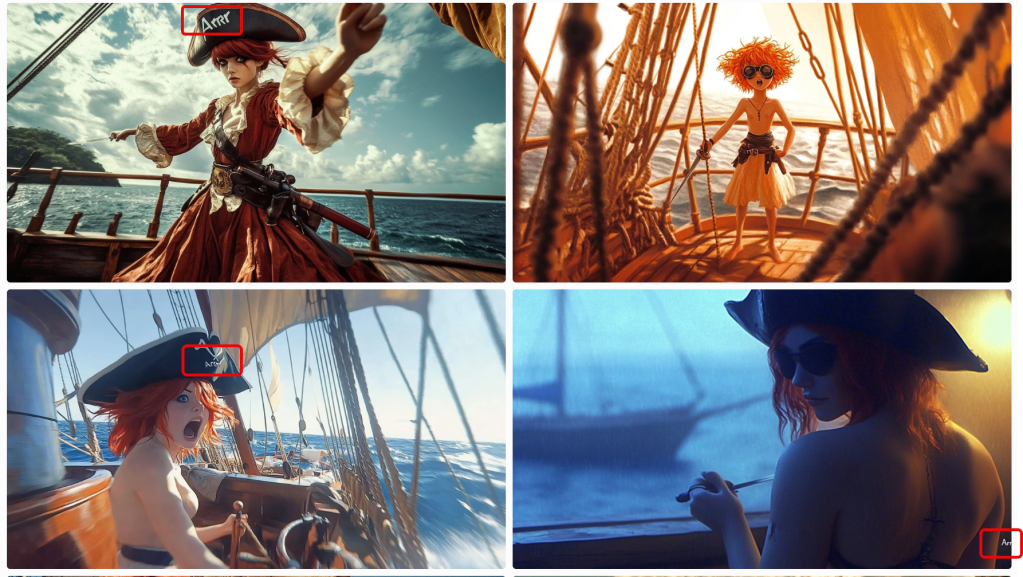
Thar be pirates. Midjourney 6.1 has better luck rendering pirates.

I find it very difficult to maintain composition. 5 of these images are mid shots whilst one is an obvious closeup. For those not in the know, Midjourney renders 4 images from each prompt. The images above were rendered from this prompt:

portrait, Realistic light and shadow, exquisite details,acrylic painting techniques, delicate faces, full body,In a magical movie, Girl pirate, wearing a pirate hat, short red hair, eye mask, waist belt sword, holding a long knife, standing in a fighting posture on the deck, with the sea of war behind her, Kodak Potra 400 with a Canon EOS R5

Notice that the individual elements requested aren’t in all of the renders. She’s not always wearing a hat; she does have red hair, but not always short; she doesn’t always have a knife or a sword; she’s missing an eye mask/patch. Attention to detail is pretty low. Notice, too, that not all look like camera shots. I like to one on the bottom left, but this looks more like a painting as an instruction notes.

In this set, I asked for a speech bubble that reads Arrr… for a post I’d written (on the letter R). On 3 of the 4 images, it included ‘Arrrr’ but not a speech bubble to be found. I ended up creating it and the text caption in PhotoShop. Generative image AI is getting better, but it’s still not ready for prime time. Notice that some are rendering as cartoons.

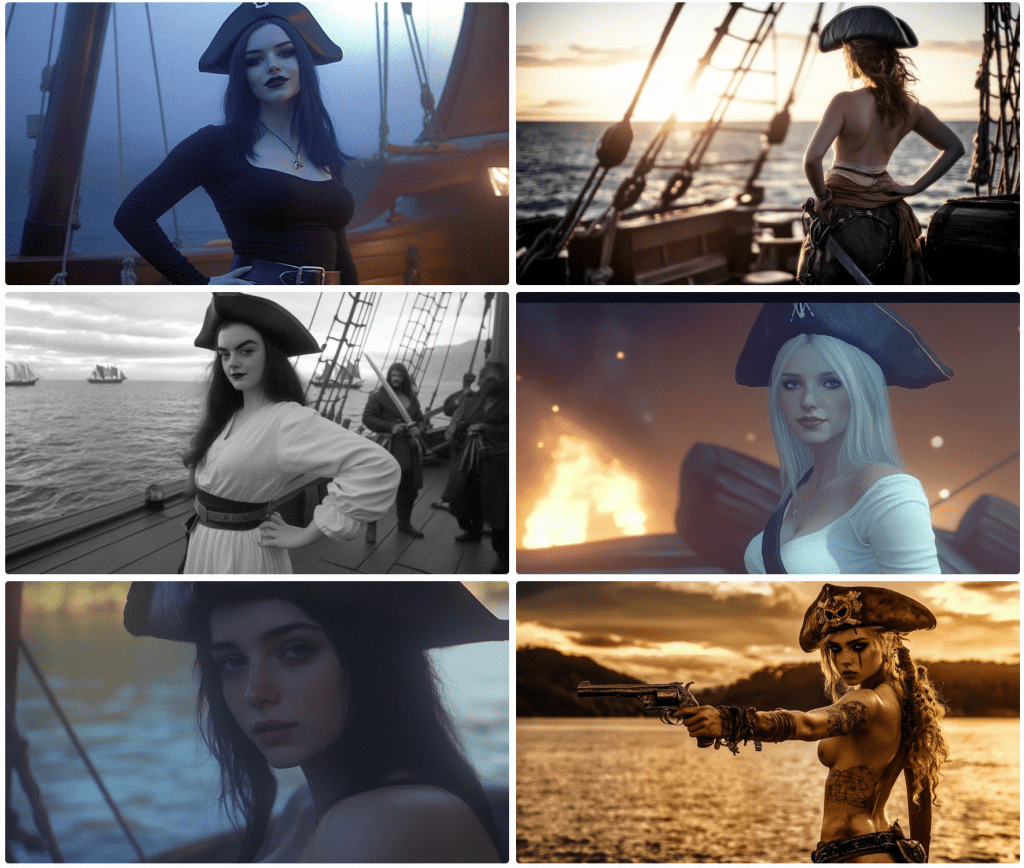
Some nice variations above. Notice below when it loses track of the period. This is common.

Top left, she’s (perhaps non-binary) topless; to the right, our pirate is a bit of a jester. Again, these are all supposed to be wide-angle shots, so not great.

The images above use the same prompt asking for a full-body view. Three are literal closeups.

Same prompt. Note that sexuality, nudity, violence, and other terms are flagged and not rendered. Also, notice that some of the images include nudity. This is a result of the training data. If I were to ask for, say, the pose on the lower right, the request would be denied. More on this later.

In the block above, I am trying to get the model to face the camera. I am asking for the hat and boots to be in the frame to try to force a full-body shot. The results speak for themselves. One wears a hat; two wear boots. Notice the shift of some images to black & white. This was not a request.

In the block above, I prompted for the pirate to brush her hair. What you see is what I got. Then I asked for tarot cards.

I got some…sort of. I didn’t know strip-tarot was actually a game.

Next, I wanted to see some duelling with swords. These are pirates after all.

This may not turn into the next action blockbuster. Fighting is against the terms and conditions, so I worked around the restrictions the best I could, the results of which you may see above.

Some pirates used guns, right?

Right? I asked for pistols. Close enough.

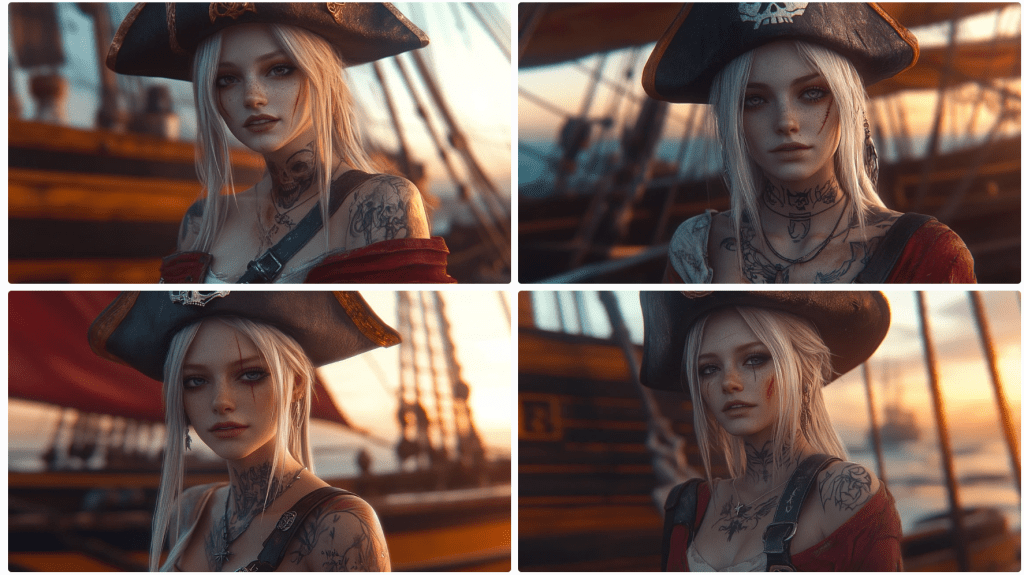
Since Midjourney wasn’t so keen on wide shots, I opted for some closeups.

This set came out pretty good. It even rendered some pirates in the background a tad out of focus as one might expect. This next set isn’t too shabby either.

And pirates use spyglasses, right?

Sure they do. There’s even a pirate flag of sorts on the lower right.

What happens when you ask for a dash of steampunk? I’m glad you asked.

Save for the bloke at the top right, I don’t suppose you’d have even noticed.

Almost to the end of the pirates. I’m not sure what happened here.

In the block above, Midjourney added a pirate partner and removed the ship. Notice again the nudity. If I ask for this, it will be denied. Moreover, regard this response.

To translate, this is saying that what I prompted was OK, but that the resulting image would violate community guidelines. Why can’t it take corrective actions before rendering? You tell me. Why it doesn’t block the above renders is beyond me – not that I care that they don’t.

This last one used the same prompt except I swapped out the camera and film instruction with the style of Banksy.

I don’t see his style at all, but I came across like Jaquie Sparrow. In the end, you never know quite what you’ll end up with. When you see awesome AI output, it may have taken dozens or hundreds of renders. This is what I wanted to share what might end up on the cutting room floor.

I thought I was going to go through pirates and cowboys, but this is getting long. if you like cowgirls, come back tomorrow. And, no, this is not where this channel is going, but the language of AI is an interest of mine. In a way, this illustrates the insufficiency of language.

Full Disclosure: A Collaborative Endeavour with Generative AI

As the series on higher education draws to a close, it seems fitting to reflect on the unique process behind its creation. There’s a popular notion that material generated by artificial intelligence is somehow of lesser quality or merely derivative. But I would argue that this perception applies to all language—whether written or spoken. My experience has shown that generative AI can elevate my material in much the same way as a skilled copy editor or research assistant might. Perhaps, in trying to draw a firm line between AI-generated and human-generated content, we’re caught in a Sorites paradox: at what point does this line blur?

These articles are the result of a truly collaborative effort involving myself, ChatGPT, and Claude. In combining our capabilities, this project became an exploration not only of higher education’s complexities but also of how humans and AI can work together to articulate, refine, and convey ideas.

The core ideas, observations, and critiques presented here are ultimately mine, shaped by personal experience and conviction. Yet, the research, the structuring of arguments, and the detailed expositions were enriched significantly by Generative AI. ChatGPT and Claude each brought distinct strengths to the table—helping to expand perspectives, test ideas, and transform abstract reflections into a structured, readable whole. This process has demonstrated that AI when thoughtfully integrated, can enhance the intellectual and creative process rather than replace it.

In the end, this series serves not only as an examination of higher education but as an example of how collaboration with AI can offer new possibilities. When human insights and AI’s analytical capabilities come together, the result can be richer than either could achieve in isolation.

Democracy: The Grand Illusion (AutoCrit)

The tone of “Democracy: The Grand Illusion” is predominantly analytical and academic. The author approaches the subject matter with a detached and objective perspective, focusing on presenting information, arguments, and counterarguments related to democracy without overt emotional bias. While the content delves into complex topics such as cognitive limitations in decision-making processes, historical perspectives on democracy, critiques of democratic systems, and potential reforms for improvement, the emotional perspective remains neutral and professional throughout. There is an absence of overtly passionate or emotive language that might sway readers one way or another; instead, the text maintains a scholarly tone aimed at informing and stimulating critical thinking about the concept of democracy.

I use AutoCrit as a first-pass review of my long-form writing. Above is the direction I am aiming for. Usually, I aim for polemic. I’ve been working on this since before Covid-19, but it keeps kicking to the back burner. I’m trying to resurrect it once again.

Does anyone who’s used it have an opinion on AutoCrit?

$Trillions of Broken Promises

Reparations, Sovereignty, and the Enduring Legacy of Colonialism

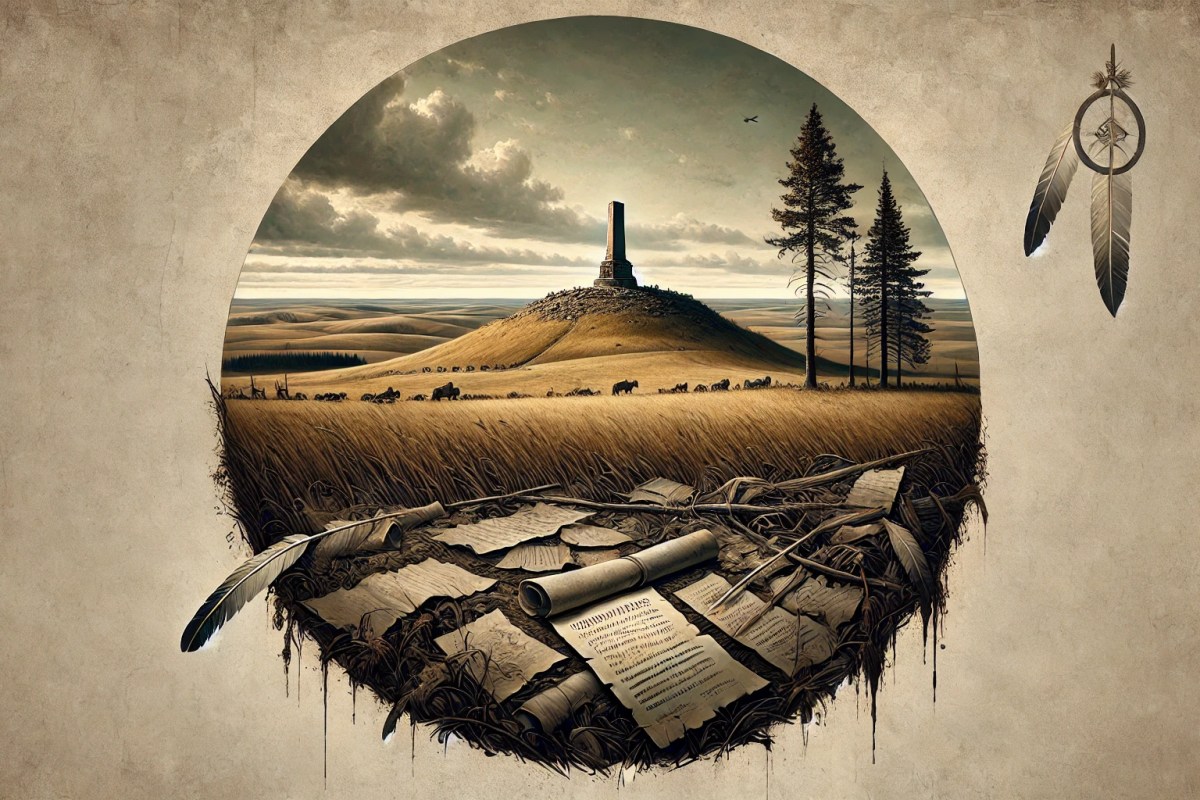
The Weight of Broken Treaties

From the earliest days of European settlement, treaties were used as a tool of diplomacy between the United States government and Native nations. These treaties, over 370 in total, were meant to secure peace, land agreements, and coexistence. In exchange, Native peoples were promised sovereign rights, land, and, crucially, compensation in the form of resources, healthcare, education, and protection. Yet, these promises were almost universally broken, often within years of being signed.

The true cost of these broken promises is impossible to measure in simple monetary terms. Land, culture, and sovereignty are not commodities that can be easily priced. However, if one were to quantify the economic and material loss incurred by Native peoples—through stolen land, expropriated resources, and missed opportunities—the total would be staggering. Some estimates suggest the cost could run into the hundreds of billions if not trillions when factoring in centuries of economic injustice, treble damages, and interest.

Calculating Reparations: Land, Wealth, and Justice

Any serious discussion of reparations must start with the land. Native nations once held over 2 billion acres of land in what is now the United States, a vast expanse rich with natural resources. Through a series of coercive treaties, legislation, and outright theft, much of this land was lost, culminating in the General Allotment Act (or Dawes Act) of 1887, which further fragmented Native lands and opened millions of acres for white settlers.

Reparations would need to account for the value of this land and the resources extracted from it—timber, minerals, oil, gas, and agricultural produce—that have enriched generations of non-Native Americans. The land itself is invaluable, not just in terms of its market price but as the foundation of Indigenous identity, culture, and sovereignty. The land is not only an economic asset but a spiritual and cultural one. In this context, mere monetary compensation seems inadequate.

However, if we were to calculate reparations based on these lost lands and resources, the numbers quickly skyrocket. Consider the Black Hills of South Dakota, illegally seized from the Lakota after the discovery of gold, despite an 1868 treaty guaranteeing their sovereignty over the region. The Lakota have refused financial compensation for the Black Hills, insisting instead on the return of the land. The value of the Black Hills alone, when adjusted for inflation and interest, would be immense. And this is just one example. If treble damages were applied—tripling the original valuation to account for the egregiousness of the theft—the total would become astronomical.

Interest on Injustice

A crucial factor in calculating reparations is the interest accrued over time. The land was not just taken, but taken centuries ago, meaning that any fair compensation would need to account for the economic opportunities missed due to that loss. Compounded interest, a financial mechanism commonly applied in lawsuits to reflect the time value of money, would exponentially increase the debt owed. This debt is not just economic but cultural, as the loss of land also meant the loss of a way of life.

Reparations could, therefore, easily run into the trillions. This is not merely hypothetical. In 1980, the U.S. Supreme Court ruled in United States v. Sioux Nation of Indians that the U.S. government had illegally taken the Black Hills, and the Sioux were entitled to compensation. The sum awarded was $106 million—today, with interest, that figure exceeds $1 billion. Yet the Sioux have refused the payment, demanding the return of their land instead. Their stance underscores the inadequacy of financial compensation for the cultural and spiritual dimensions of the loss.

Beyond Dollars: The Moral and Ethical Case for Reparations

While the financial dimension of reparations is essential, the moral and ethical dimensions are equally important. Reparations are not simply about writing a cheque; they are about justice. The broken treaties were not merely legal failures but moral failures, reflecting a systemic disregard for Native sovereignty and human dignity. The U.S. government’s persistent violations of treaties reveal a deep-rooted pattern of exploitation and dishonour that continues to reverberate through Native communities today.

Reparations, in this broader sense, must include the return of lands, the restoration of cultural and political autonomy, and a fundamental rethinking of the relationship between Native nations and the U.S. government. The return of land—such as in the Land Back movement—is a critical component of this. Land is not only a material asset but a living connection to identity, tradition, and the future. Restoring land to Native nations would not only right historical wrongs but also empower them to rebuild their communities on their own terms.

The Political Challenge of Justice

Despite the moral clarity of the case for reparations, political challenges remain immense. Many Americans are unaware of the extent of Native dispossession or may see reparations as impractical or divisive. Yet, as the fight for racial justice has shown, justice is often uncomfortable. The fact that reparations would be costly, complex, and difficult is not an excuse to avoid the issue. If anything, it highlights how deep and enduring the injustice is.

Reparations are not a “handout” but a payment of a debt long overdue. Native nations were once economically, politically, and culturally self-sufficient. The disruption of their societies, through land theft and broken treaties, is the root cause of the poverty, health disparities, and political marginalisation they face today. Addressing this requires more than just policy tweaks; it demands a fundamental reckoning with the past.

Conclusion: Trillions Owed, Promises to Keep

The reparations owed for centuries of broken treaties, stolen land, and unfulfilled promises are not simply about money but about honouring the sovereignty and humanity of Indigenous peoples. The debt is vast—financially, morally, and ethically—but it must be addressed if there is to be any hope for genuine reconciliation. Justice, long delayed, can no longer be denied. This underscores the larger point that the United States rarely follow through on their commitments, but this is a story for another day. Meantime, they’ll continue running roughshod over their people and the world, bullying their way through it.

Decolonising the Mind

Ngũgĩ wa Thiong’o published “Decolonising the Mind” in 1986. David Guignion shares a 2-part summary analysis of the work on his Theory and Philosophy site.

I used NotebookLLM to produce this short podcast: [Content no longer extant] https://notebooklm.google.com/notebook/7698ab0b-43ab-47d4-a50f-703866cfb1b9/audio

Decolonising the Mind: A Summary

Ngũgĩ wa Thiong’o’s book Decolonising the Mind centres on the profound impact of colonialism on language, culture, and thought. It argues that imposing a foreign language on colonised people is a key tool of imperial domination. This linguistic imperialism leads to colonial alienation, separating the colonised from their own culture and forcing them to view the world through the lens of the coloniser.

Here are some key points from the concept of decolonising the mind:

  • Language is intimately tied to culture and worldview: Language shapes how individuals perceive and understand the world. When colonised people are forced to adopt the language of the coloniser, they are also compelled to adopt their cultural framework and values.
  • Colonial education systems perpetuate mental control: By privileging the coloniser’s language and devaluing indigenous languages, colonial education systems reinforce the dominance of the coloniser’s culture and worldview. This process results in colonised children being alienated from their own cultural heritage and internalising a sense of inferiority.
  • Reclaiming indigenous languages is crucial for decolonisation: wa Thiong’o advocates for a return to writing and creating in indigenous African languages. He sees this as an act of resistance against linguistic imperialism and a way to reconnect with authentic African cultures. He further argues that it’s not enough to simply write in indigenous languages; the content must also reflect the struggles and experiences of the people, particularly the peasantry and working class.
  • The concept extends beyond literature: While wa Thiong’o focuses on language in literature, the concept of decolonising the mind has broader implications. It calls for a critical examination of all aspects of life affected by colonialism, including education, politics, and economics.

It is important to note that decolonising the mind is a complex and ongoing process. There are debates about the role of European languages in postcolonial societies, and the concept itself continues to evolve. However, wa Thiong’o’s work remains a seminal text in postcolonial studies, raising crucial questions about the enduring legacy of colonialism on thought and culture.

Don’t Care Much about History

As the years pass and my disappointment matures like a fine wine (spoiler alert: it’s vinegar), I’m reminded of the average intelligence quotient floating about in the wild. A few years back, I stumbled upon The Half-Life of Knowledge. Cute title, but it’s more optimistic than it should be. Why assume knowledge even has a shelf life? It’s one thing for once-useful information to spoil thanks to “progress,” but what about the things that were never true to begin with? Ah, yes, the fabrications, the lies we’re spoon-fed under the guise of education.

I’m well-versed in the lies they peddle in the United States, but I’d bet good money (not that I have any) that every nation’s curriculum comes with its own patriotic propaganda. What am I on about, you ask? Let’s just say I’ve been reading How the World Made the West by Josephine Quinn, and it’s got me thinking. You see, I’ve also been simmering on an anti-democracy book for the better part of five years, and it’s starting to boil over.

Here in the good ol’ US of A, they like to wax lyrical about how Athens was the birthplace of democracy. Sure, Athens had its democratic dabblings. But let’s not get it twisted—if you really look at it, Athens was more akin to the Taliban than to any modern Western state. Shocked? Don’t be. For starters, only property-owning men could vote, and women—brace yourselves—were “forced” to wear veils. Sounds familiar? “It’s a start,” you say. True, American women couldn’t vote until 1920, so let’s all pat ourselves on the back for that—Progress™️.

But no, hold your applause. First off, let’s remember that Athens and Sparta were city-states, not some cohesive entity called “Greece” as we so lovingly imagine. Just a bunch of Greek-speaking neighbours constantly squabbling like reality TV contestants. Meanwhile, over in Persia—yes, the supposed enemy of all things free and democratic—they had participative democracy, too. And guess what? Women in Persia could vote, own property, and serve as soldiers or military officers. So much for the idea that Athens was the singular beacon of democratic virtue.

More than this, Persian democracy was instituted by lottery, so many more people participated in the process by serving one-year terms. At the end of their term, they were audited to check for corruption. Now, you can see why we adopted the so-called Greek version. These blokes don’t welcome any oversight of scrutiny.

As a postmodern subjectivist, I tend to side-eye any grand narrative, and the history of Western civilisation is just one long parade of questionable claims and hidden agendas. Every time I think I’ve seen the last of the historical jump scares, another one comes lurking around the corner. Boo!

Polemics

People often ask why I churn out so many polemic, contrarian articles. The answer? It’s simply how I think. My brain naturally questions everything, not out of a desire to be difficult, but because that’s just my worldview. I’m not inventing challenges for the sake of argument—the challenges are already there, embedded in the world as I see it.

Another reason is solidarity. I write in hopes that others, whose thoughts run along similar lines, might stumble across my material and feel less alone. There’s something deeply reassuring in discovering that someone else has been on the same mental journey—that feeling of “Ah, I’m not alone in this.” Many times, I’ve had ideas only to find that philosophers, thinkers, or whoever have already penned volumes on the subject. And honestly? That grounds me. Even better if they’ve gone further, articulated it more eloquently, or ventured into new depths. It’s all useful. Plus, their critics then become my critics, and I get to sharpen my thoughts in response—or at least build my own defences.

And finally, I write for the potential spark. Maybe someone out there reads a piece of mine and feels inspired to take it further, push an idea beyond what I could imagine. After all, entire Nobel Prize-winning theories have started as someone else’s footnotes. There’s nothing wrong with being someone’s footnote.

So, now you know.


NB: I’ll be in surgery when this posts, so I’ve scheduled this in advance so as not to have a gap…that may occur anyway.

The Spaces Between: A Punctuated History

Language is a fickle thing. Spoken words are fleeting vibrations in the air, while the written word stands still, preserved for all eternity—or at least until someone spills a cup of tea on it. But as it turns out, the way we write things down is just as much a human invention as the words themselves. And perhaps nothing exemplifies this better than the simple, unassuming space.

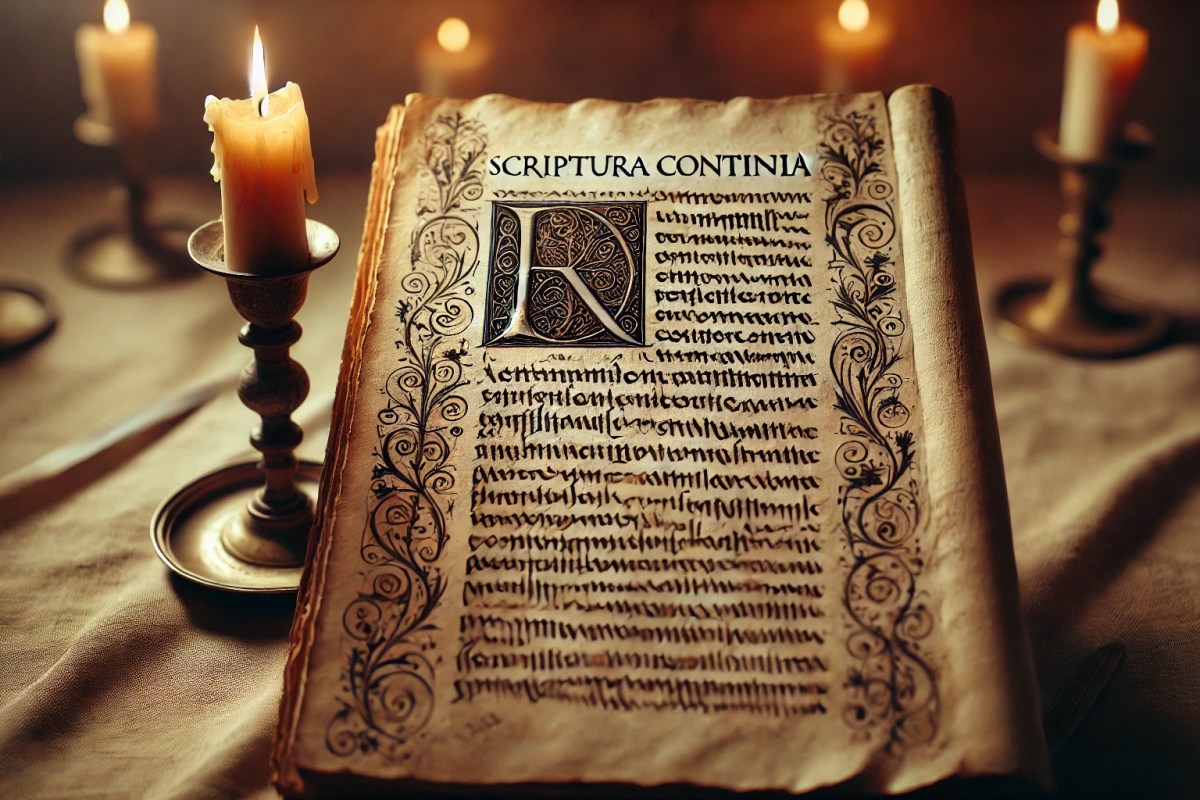
You see, in the early days, spaces between words didn’t exist at all. Latin texts were written in something called scriptura continua, which, if you’re imagining an interminable block of unbroken letters, is exactly what it was. There were no spaces, no commas, and certainly no handy full stops to tell you when you’d reached the end of a thought. If you’re feeling brave, try reading a page of dense prose without any breaks, and you’ll see just how taxing it must have been. Not for the faint-hearted, especially if your reading material consisted of ancient Roman tax codes or Cicero’s less thrilling speeches.

Originally, Romans tried to manage the chaos with something called the interpunct—a little dot, mid-height, between words. Cute, right? But these mid-dots weren’t as convenient as you’d think. They eventually fell out of fashion, leaving words to once again pile up against each other like an anxious crowd waiting for a delayed train. It wasn’t until some resourceful monks in the seventh century thought, “This is ridiculous, let’s make reading less like mental acrobatics,” that the concept of word spacing, as we know it, truly took off. Hats off to those monks, honestly—turning scriptura continua into something you could read without a magnifying glass and a headache.

And then, along came punctuation. Oh, punctuation! The glorious marks that tell us when to pause, when to stop, and when to yell in sheer disbelief—like the question mark (?!), when you discover early Latin, had none of these. The dots got demoted, moved down to the bottom of the line, and eventually became full stops. Punctuation began as a tool for reading aloud—a sort of musical notation for the voice—but evolved into something to guide the eye, allowing the inner voice to navigate text without getting lost.

The spaces and dots may seem like minor players, but they were transformative. They laid the foundation for silent reading, which revolutionised the entire act of reading itself. No longer were texts simply prompts for orators to recite; they became private journeys into the mind. By the time the printing press rolled around, spaces and punctuation were firmly in place, making it possible for literacy to spread and for people to sit in quiet corners, reading for pleasure. Who would have thought that the humble space—the “nothing” between words—would become a hero of the human intellect?

For a deeper dive into this rather niche but wildly fascinating history, check out Rob Words’ video on the subject here: Where Does Punctuation Come From?!. It’s well worth your time—a rollicking journey through the peculiarities of written language, spaces, and all the delightful stops along the way.

And remember, next time you type a message, mind the gap. It’s doing a lot more work than you think.