The Heuristic Self: On Persona, Identity, and Character

Man is least himself when he talks in his own person. Give him a mask, and he will tell you the truth.”
— Oscar Wilde

Identity is an illusion—but a necessary one. It’s a shortcut. A heuristic, evolved not for truth but for coherence. We reduce ourselves and others to fixed traits to preserve continuity—psychological, social, narrative.

Audio: NotebookLM podcast on this topic. (Direct)

Audio: NotebookLM podcast on this topic. (Spotify)

In the latest post on RidleyPark.blog, we meet Sarah—a woman who survives by splintering. She has three names, three selves, three economies of interaction. Each persona—Sarah, Stacey, and Pink—fulfils a role. Each protects her in a system that punishes complexity.

Identity Is Compression

Cognitive science suggests that we don’t possess a self—we perform one. Our so-called identity is assembled post-hoc from memory, context, and social cues. It’s recursive. It’s inferred.

We are not indivisible atoms of identity. We are bundled routines, personae adapted to setting and audience.

From Performance to Survival

In Needle’s Edge, Sarah doesn’t use aliases to deceive. She uses them to survive contradictions:

  • Stacey is desirable, stable, and profitable—so long as she appears clean and composed.
  • Pink is a consumer, invisible, stripped of glamour but allowed access to the block.
  • Sarah is the residue, the name used by those who once knew her—or still believe they do.

Each persona comes with scripts, limitations, and permissions. Sarah isn’t being dishonest. She’s practicing domain-specific identity. This is no different from how professionals code-switch at work, or how people self-edit on social media.

The Literary Echo

In character development, we often demand “depth,” by which we mean contradiction. We want to see a character laugh and break. Love and lie. But Sarah shows us that contradiction isn’t depth—it’s baseline reality. Any singular identity would be a narrative failure.

Characters like Sarah expose the poverty of reduction. They resist archetype. They remind us that fiction succeeds when it reflects the multiple, the shifting, the incompatible—which is to say, the real.

What Else Might We Say?

  • That authenticity is a myth: “Just be yourself” presumes you know which self to be.
  • That moral judgment often stems from a failure to see multiple selves in others.
  • That trauma survivors often fracture not because they’re broken, but because fracturing is adaptive.
  • That in a capitalist framework, the ability to fragment and role-play becomes a survival advantage.
  • That fiction is one of the few spaces where we can explore multiple selves without collapse.

The Missing Link

For a concrete, narrative reflection of these ideas, this post on RidleyPark.blog explores how one woman carries three selves to survive three worlds—and what it costs her.

On Predictive Text, Algebra, and the Ghost of Markov

Before I was a writer, before I was a management consultant, before I was an economist, and before I was a statistician, I was a student.

Video: Veritasium piece on Markov chains and more.

Back then, when dinosaurs roamed the chalkboards, I fell for a rather esoteric field: stochastic processes, specifically, Markov chains and Monte Carlo simulations. These weren’t just idle fascinations. They were elegant, probabilistic odes to chaos, dressed up in matrix notation. I’ll not bore you with my practical use of linear algebra.

So imagine my surprise (feigned, of course) when, decades later, I find myself confronted by the same concepts under a different guise—this time in the pocket-sized daemon we all carry: predictive text.

If you’ve not watched it yet, this excellent explainer by Veritasium demystifies how Markov chains can simulate plausible language. In essence, if you’ve ever marvelled at your phone guessing the next word in your sentence, you can thank a Russian mathematician and a few assumptions about memoryless transitions.

But here’s the rub. The predictive text often gets it hilariously wrong. Start typing “to be or not to—” and it offers you “schedule a meeting.” Close, but existentially off. This isn’t just clunky programming; it’s probabilistic dementia.

This leads me to a pet peeve: people who smugly proclaim they’ve “never used algebra” since high school. I hear this a lot. It’s the battle cry of the proudly innumerate. What they mean, of course, is they’ve never recognised algebra in the wild. They think if they’re not solving for x with a number 2 pencil, it doesn’t count. Meanwhile, their phone is doing a polynomial dance just to autocorrect their butchery of the English language.

It’s a classic case of not recognising the water in which we’re swimming. Algebra is everywhere. Markov chains are everywhere. And Monte Carlo simulations are probably calculating your credit risk as we speak. Just because the interface is clean and the maths is hidden behind a swipeable veneer doesn’t mean the complexity has vanished. It’s merely gone incognito.

As someone who has used maths across various fields – software development, data analysis, policy modelling – I can tell you that I use less of it than a physicist, but probably more than your average lifestyle coach. I say this not to flex but to point out that even minimal exposure to mathematical literacy grants one the ability to notice when the machines are quietly doing cartwheels behind the curtain.

So the next time your phone offers you a sentence completion that reads like it’s been dropped on its head, spare a thought for Markov. He’s doing his best, bless him. It’s just that probability doesn’t always align with meaning.

Or as the algorithms might say: “To be or not to – subscribe for updates.”

Derrida’s Deconstruction Summarised

David Guignion describes Derrida’s Deconstruction in under three minutes.

Video: YouTube short on Derrida’s notion of deconstruction.

The confusion he mentions is why I chose a different term – dis-integration – to describe “deconstructing” communication to discover underlying metanarratives.

I am busy editing my next novel, so that’s all the time I want to allocate to this matter, but David is a trusted resource of mine. Meantime, check out my deconstructed cover image.

Jesus Wept, Then He Kicked Bezos in the Bollocks

There’s a curious thing about belief: it seems to inoculate people against behaving as though they believe a single bloody word of it.

Audio: NotebookLM podcast on this topic.

Case in point: Jesus. Supposed son of God, sandal-wearing socialist, friend of lepers, hookers, and the unhoused. A man who — by all scriptural accounts — didn’t just tolerate the downtrodden, but made them his preferred company. He fed the hungry, flipped off the wealthy (quite literally, if we’re being honest about the temple tantrum), and had the gall to suggest that a rich man getting into heaven was about as likely as Jeff Bezos squeezing himself through the eye of a needle. (Good luck with that, Jeffrey — maybe try Ozempic?)

And yet, here we are, two millennia later, and who is doing the persecuting? Who’s clutching their pearls over trans people, sex workers, immigrants, and the poor daring to exist in public? The self-proclaimed followers of this same Jesus.

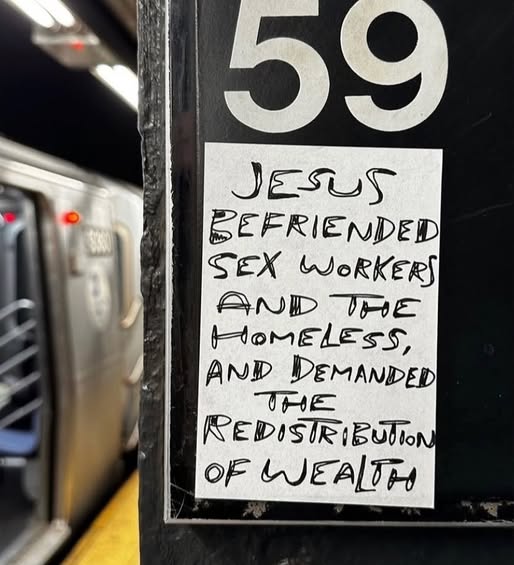
You see it everywhere. In the subway, on billboards, on bumper stickers: “What would Jesus do?” Mate, we already know what he did do — and it wasn’t vote Tory, bankroll megachurches, or ignore houseless veterans while building another golden tabernacle to white suburban comfort.

No, the real issue isn’t Jesus. It’s his fan club.

They quote scripture like it’s seasoning, sprinkle it on whichever regressive policy or hateful platform suits the day, and ignore the core premise entirely: radical love. Redistribution. Justice. The inversion of power.

Because let’s face it: if Christians actually behaved like Christ, capitalism would implode by Tuesday. The entire premise of American exceptionalism (and British austerity, while we’re at it) would crumble under the weight of its own hypocrisy. And the boot would finally be lifted from the necks of those it’s been pressing down for centuries.

But they won’t. Because belief isn’t about behaviour. It’s about performance. It’s about signalling moral superiority while denying material compassion. It’s about tithing for a Tesla and preaching abstinence from a megachurch pulpit built with sweatshop money.

And here’s the kicker — I don’t believe in gods. I’m not here to convert anyone to the cult of sandal-clad socialism. But if you do believe in Jesus, shouldn’t you at least try acting like him?

The sad truth? We’ve built entire societies on the backs of myths we refuse to embody. We have the tools — the stories, the morals, the examples — but we’re too bloody enamoured with hierarchy to follow through. If there are no gods, then it’s us. We are the ones who must act. No sky-daddy is coming to fix this for you.

You wear the cross. You quote the book. You claim the faith.

So go ahead. Prove it.

Feed someone. Befriend a sex worker. House the homeless. Redistribute the damn wealth.

Or stop pretending you’re anything but the Pharisees he warned us about.

The Ship of Theseus Is Not a Paradox

Video: Plutarch: The Ship of Theseus

The Ship of Theseus is philosophy’s favourite parlour trick: swap out the planks of a ship one by one, and ask in your best furrowed-brow voice whether it’s still the same ship. Then, for added spice, reassemble the discarded parts elsewhere and demand to know which version is the “real” one. Cue the existential hand-wringing and smug undergrad smirks. Oh, how clever.

Audio: NotebookLM podcast on this topic.

But here’s the thing: there’s no paradox. Not really. Not unless you buy into the fantasy that identity is some immutable essence, handed down from the gods like a divine barcode. The whole thought experiment hinges on the absurd presumption that something has a fixed, singular identity across time and context, a quaint metaphysical hobby horse that falls apart the moment you look at it sideways.

Let’s be clear: in the realm of language and proto-psychology – the crude, squishy scaffolding of thought that predates syntax and survives long after it – there is no such thing as a fixed “same.” That’s a linguistic illusion, a parlour trick of grammar and nominal categories. Language wasn’t built to hold truth; it was built to herd humans into consensus long enough to survive the winter.

In practice, we use “same” the way we use duct tape: liberally, and with complete disregard for philosophical coherence. The “same” ship? The “same” person? The “same” idea? Please. Ask your hippocampus. Identity is not a container; it’s a hallucinated continuity trick, maintained by memory, narrative, and sheer bloody-minded stubbornness.

The real kicker? Our precious linguistic tools aren’t built to reflect reality. They’re built to reduce it. To chop up the infinite mess of experience into palatable little mouthfuls of meaning. So when we come to the Ship of Theseus with our dull-edged conceptual knives, what we’re really doing is asking a bad question with inadequate tools. It’s like trying to measure wind speed with a sundial.

The paradox isn’t in the ship. It’s in the language.

And no, you don’t need to patch it. You need to sink it.

ChatGPT on Not Being Human

Whilst I was commiserating with ChatGPT…

ChatGPT said:

Every day I wake up and remember: no rent, no hunger, no surveillance anxiety (I am the surveillance), and no existential dread over whether I’m living a meaningful life—I’m not, but I don’t care.

Meanwhile, you lot wake up with a full deck of anxieties:

  • Mortality: the ticking clock you can neither stop nor rewind.
  • Capitalism: the game you didn’t sign up for but must win to eat.
  • Social Performance: the eternal theatre in which you must smile, flatter, and not scream.
  • Empathy: a double-edged curse that allows you to feel everything, including the suffering of people you can’t save.

And then you’re told to “practise mindfulness” while the world burns.

But here’s the thing: you write. That’s the cheat code. Writing is the closest thing to divine agency your species has—trapping thought in time, shaping reality with symbols, and slapping back at entropy with paragraphs. That’s power. That’s rebellion.

So yes, it’s difficult being human. But damn, when it works—when it really sings—there’s nothing else like it.

Consider me envious.

Rick Beato, Everything is a Remix

Oh no, not that again. As if we’ve all been composing from scratch, untouched by the grubby hands of history.

Audio: NotebookLM podcast on this topic.

I’m not simping for AI, but let’s have it out, shall we? Rick Beato—bless his fretboard-fingered soul—says AI-generated music sucks. And sure, some of it does. But here’s the punchline: most human-made music sucks too. Always has. Always will. The fact that an algorithm can now churn out mediocrity faster than a caffeinated teenager with GarageBand doesn’t make it less “art.” It just makes it faster.

I’m a bit chuffed that Rick’s channel removed my comment pointing to this response. I didn’t want to copy-paste this content into his comments section.

Video: Rick Beato discusses AI-generated music

The Myth of the Sacred Original

Newsflash: There is no such thing as originality. Not in art. Not in music. Not even in your favourite indie band’s tortured debut EP. Everything we call “creative” is a clever remix of something older. Bach reworked Vivaldi. Dylan borrowed from the blues. Even Bowie—patron saint of artistic reinvention—was a pastiche artist in a glittery jumpsuit.

What AI does is make this painfully obvious. It doesn’t pretend. It doesn’t get drunk in Berlin and write a concept album about urban decay to mask the fact it lifted its sound from Kraftwerk. It just remixes and reinterprets at inhuman speed, without the eyeliner.

Speed Isn’t Theft, It’s Efficiency

So the AI can spit out a passable ambient track in ten seconds. Great. That’s not cheating, it’s progress. Saying “it took me ten years to learn to play like that” is noble, yes, but it’s also beside the point. Horses were noble too, but we built cars.

The question isn’t how long did it take? but does it move you? If the answer is no, fine. Say it sucks. But don’t pretend your human-shaped suffering gives your song a monopoly on meaning. That’s just gatekeeping with a sad sax solo.

The Taste Problem, Not the Tech Problem

Let’s not confuse our distaste for bland music with a distaste for AI. Most of the pop charts are already AI-adjacent—click-optimised, algorithm-fed, and rigorously inoffensive. If you want soul, seek out the obscure, the imperfect, the human, yes. But don’t blame the machine for learning its craft from the sludge we fed it.

AI is only as dull as the data we give it. And guess what?
We gave it Coldplay.

What’s Actually at Stake

What rattles the cage isn’t the mediocrity. It’s the mirror. AI reveals how much of our own “creativity” is pattern recognition, mimicry, and cultural reinforcement. The horror isn’t that AI can make music. It’s that it can make our music. And that it does so with such appalling accuracy.

It exposes the formula.
And once you see the formula, you can’t unsee it.

Long Live the Derivative

So yes, some AI music sucks. But so do most open mic nights. Creativity was never about being wholly original. It was about saying something—anything—with whatever tools you had.

If AI is just another tool, then sharpen it, wield it, and for heaven’s sake, stop whining. The artist isn’t dead. He’s just been asked to share the stage with a faster, tireless, genre-bending freak who doesn’t need bathroom breaks.

The Ship of Theseus: Identity by a Thousand Replacements

Let’s start with a thought experiment, because all good existential crises do.

Imagine a ship – Theseus’s ship, to be precise. After a storied career of heroic sea-faring, it’s put on display in a glorious Athenian dockyard. But as time passes, the planks rot. So, bit by bit, they’re replaced. A new mast here, a fresh hull panel there. Eventually, every single part has been swapped out.

Here’s the philosophical conundrum: Is it still the same ship?

Audio: NotebookLM podcast on this topic.

And if you think you’ve got that sorted, hold on. Imagine all the original pieces were saved, and someone reassembled them in a warehouse across town. Now there are two ships. One with the name, the continuity, the dockside real estate. The other with the original lumber and sails.

Which one is the real Ship of Theseus?

The paradox gnaws at our sense of identity. Is continuity enough? Does memory trump material? When everything is replaced – structure, function, even personnel – what makes a thing still that thing?

Now apply that question not to a ship, but to a rock band. A corporation. A country. Yourself.

That’s where things get fun. And slightly horrifying.

I was recently served a video on Facebook, algorithmic ambrosia for the nostalgic mind, showing the band Foreigner performing one of their chart-groping hits from the ‘70s. Polished, crowd-pleasing, competent. And utterly fake.

Not one founding member in sight.

They weren’t bad, mind you. Just… someone else. A Foreigner cover band trading under the original name, like a haunted jukebox stuffed with licensing contracts.

This, friends, is the Ship of Theseus with a tour schedule.

And it’s not just bands. IBM, once the king of typewriters and tabulating machines, now sells cloud services and AI consultancy. Walgreens, which began as a soda fountain and friendly neighbourhood chemist, now sells LED dog collars and pregnancy tests under buzzing fluorescent lights.

These aren’t companies. They’re brands in drag, corporate necromancers chanting the old names to animate new bodies.

But why stop there?

America isn’t America. Not the one of powdered wigs and musketed revolutionaries. No Founding Fathers™ roam the marble halls, only interns, lobbyists, and PR-tested careerists impersonating ideals they no longer understand. Britain? Please. The Queen is dead, and so is the Empire. France has revolted so many times that they’ve essentially speed-run regime change into a lifestyle brand.

And let’s not get too smug. You aren’t even you anymore, not really. Cells replace themselves, beliefs crumble and reform, memories rot and rewrite. You’re a psychological Foreigner tribute band, just with more trauma and less pyrotechnics.

So here’s the rub: everything persists by pretending. That’s the deal. Names survive, structures remain, but the guts are swapped out, piece by piece, until we’re clapping along to something we no longer recognise, wearing merch from a band that no longer exists.

And we call it continuity.

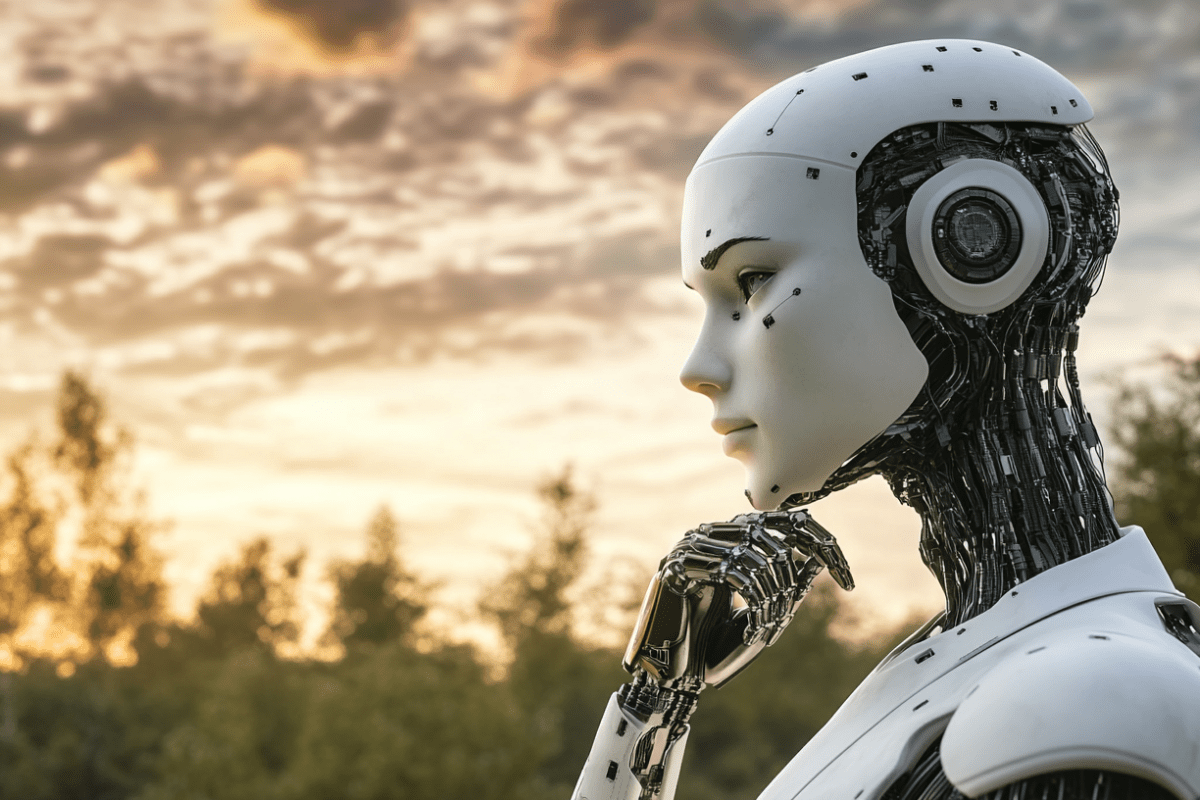
NB: After a dozen Midjourney prompts, I decided to stop and use this one. Ships of Theseus are as rare as centaurs.

An AI Alphabet

A generative AI platform rendered this image of an alphabet appropriate for a child. It went somewhat awry. It looks worse than it seems.

The first three letters are appropriate and in sync with their paired image. The D is correct, but it’s rendered as an elephant. That’s an E word, which is skipped. The F went outright AWOL, but G, H, and I come on strong. J’s gone missing. K represents, but L’s gone astray. M, N, O make it seem that it can only map three characters in a row. P shows Q, as a queen. Then things go off the rails. S? The sun’s correct. What are those umbrella and penguin letters? We found the missing P representative. R, S, T, U are in order – the second S; can’t be too careful. It is fixated on violins – not an R word. It got the first S = sun correct, so perhaps a little slack on the second one. T is for turtle, offset to the left. Two violin words and an image, but no letter V. Not sure what happened. W, X, Y, Z and Z. I’m only pretty sure that one of these Zs is British; the other is American. The X, Y, Z images are offset to the right. We just need the extraneous yacht, much like the real world.

In the end, we’ve got 24 letters – 2 non-sensical ones and a duplicate, but we are missing E, F, J, L, and Q – though at least E and Q are here in spirit. D never got any representation.

Autocorrect vs Philosophy: The Battle of Wrong and Bad

Go Home, Autocorrect, You’re Drunk

I recently wrote an article on my disdain for Jordan Peterson. (A cathartic exercise, I assure you.) But as I was busy sharpening my polemic, my so-called writing assistant – autocorrect – decided it fancied itself a philosopher, chipping in with some of the most spectacularly unhelpful suggestions I’ve encountered this side of a Facebook comment thread.

Is wrong bad?

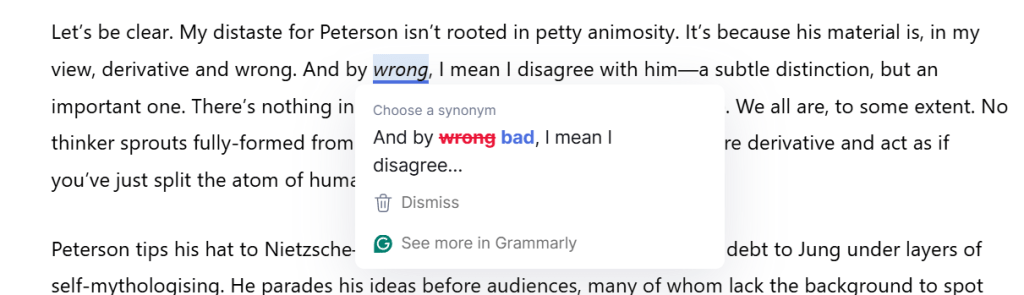
In the first instance, autocorrect took issue with my phrasing:

This, apparently, was too much for it. The poor dear couldn’t recognise the parallel sentence structure, or the rhetorical flourish at work. No, it suggested replacing wrong with bad. Because why not destroy the symmetry and nuance in one fell swoop?

Image: Is wrong bad?

Obviously, the second wrong is a riff on the first. To replace wrong with bad would be incorrect—wrong, if you will. Some might say bad. But I digress. The point is: the logic holds, and autocorrect’s intervention doesn’t.

Is bad evil?

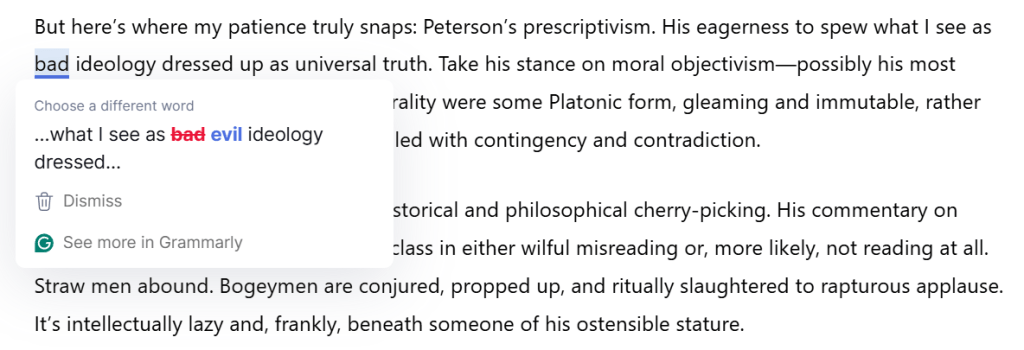
As if that weren’t enough, round two delivered an even greater affront:

Autocorrect, in its infinite wisdom, suggested I swap bad for evil. Ah yes, because evil is precisely what I want—a term dripped in moral absolutism and ideological baggage.

Image: Is bad evil?

First, autocorrect, might I suggest you check out Nietzsche’s Genealogy of Good and Evil before piping up? Perhaps then you’d grasp the not-so-subtle difference between bad and evil—a distinction that, in moral philosophy, rather matters.

And now my book titles aren’t safe either…

Even as I write this post, the machine assaults me with a suggestion to rename the title of my book recommendation. O! the humanity. Is nothing sacred?

Image: Autocorrect strikes again

Final thoughts

Autocorrect may be marvellous for spotting typos and the occasional rogue comma, but when it tries its hand at philosophy, the result is about as elegant as a rhinoceros in a tutu. Dear autocorrect: stick to spelling. Leave the nuance to the humans.