Reflecting on Mirrors

Mirror, mirror on the wall, let’s dispense with all of the obvious quips up front. I almost feel I should apologise for the spate of Midjourney posts – almost.

It should be painfully apparent that I’ve been noodling with Midjourney lately. I am not an accomplished digital artist, so I struggle. At times, I’m not sure if it’s me or it. Today, I’ll focus on mirrors.

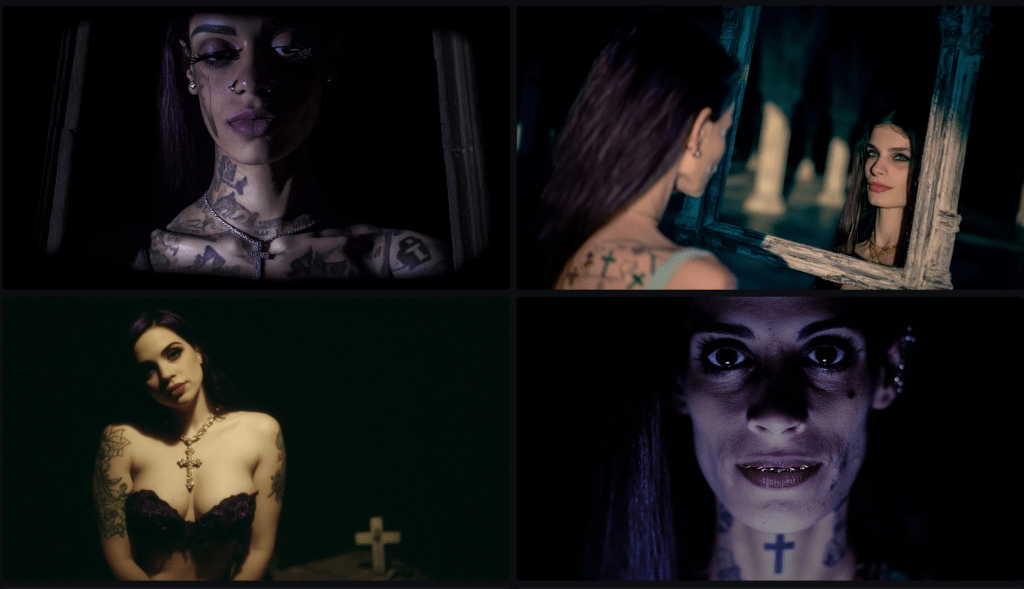
Midjourney has difficulties rendering certain things. Centaurs are one. Mirrors, another. Whilst rendering vampires, another lesser struggle for the app, it became apparent that mirrors are not a forte. Here are some examples. Excuse the nudity. I’ll get to that later.

Prompt: cinematic, tight shot, photoRealistic light and shadow, exquisite details, delicate features, emaciated sensual female vampire waif with vampire fangs, many tattoos, wearing crucifix necklace, gazes into mirror, a beam of moonlight shines on her face in dark mausoleum interior, toward camera, facing camera, black mascara, long dark purple hair, Kodak Portra 400 with a Canon EOS R5

Ignore the other aspects of the images and focus on the behaviour or misbehaviour of the mirrors.
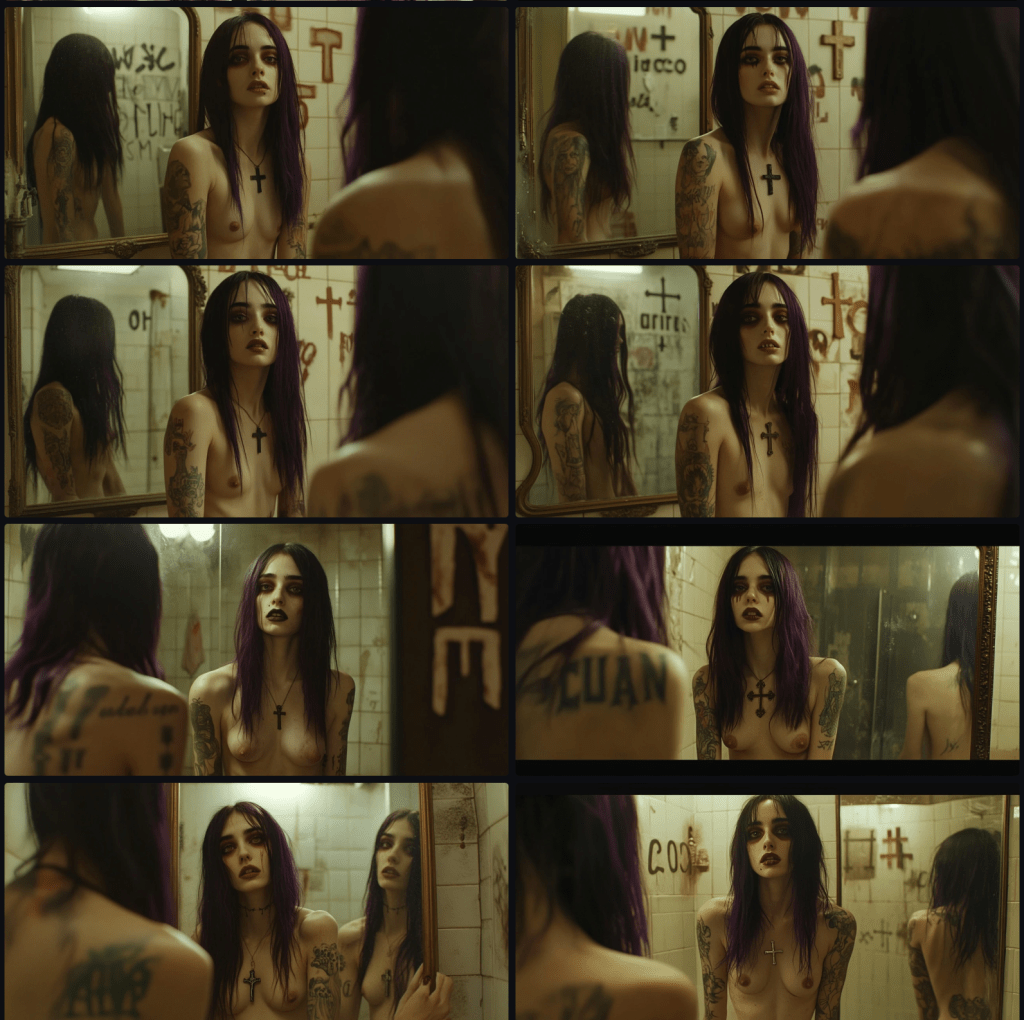
Image: Panel of vampire in a mirror.

Most apparent is the fact that vampires don’t have a reflection, but that’s not my nit. In the top four images, the reflection is orientated in the same direction as the subject. I’m only pretty sure that’s not how mirrors operate. In row 3, column 1, it may be correct. At least it’s close. In row 3, column 2 (and 4,2), the mirror has a reflection. Might there be another mirror behind the subject reflecting back? It goes off again in 4, 1, first in reflecting two versions of one subject. Also, notice that the subject’s hand, reaching the mirror, is not reflected. The orientation of the eyes is also suspect.

Image: Vampire in a mirror.

Here, our subject looks at the camera whilst her reflection looks at her.

Image: Vampire in a mirror.

Sans reflection, perhaps this is a real vampire. Her fangs are concealed by her lips?

Image: Vampire in a mirror.

Yet, another.

Image: Vampires in mirrors.

And more?

Image: Vampires in mirrors.

On the left, we have another front-facing reflection of a subject not looking into the mirror, and it’s not the same woman. Could it be a reflection of another subject – the woman is (somewhat) looking at.

On the right, whose hand is that in the mirror behind the subject?

Image: Vampires in mirrors.

These are each mirrors. The first is plausible. The hands in the second are not a reflection; they grasp the frame. In the third and fourth, where’s the subject? The fangs appear to be displaced in the fourth.

Image: Vampires in mirrors.

In this set, I trust we’ve discovered a true vampire having no reflection.
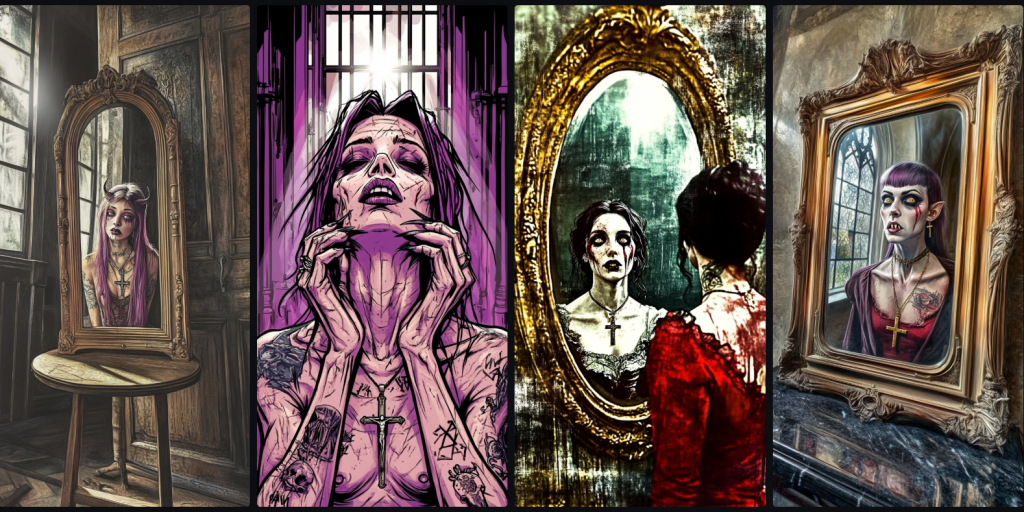
Image: Vampires in mirrors.

This last one is different still. It marks another series where I explored different comic book art styles, otherwise using the same prompt. Since it’s broken mirrors, I include it. Only the second really captures the 1980s style.

Remembering that, except for the first set of images, the same prompt was used. After the first set, the term ‘sensual’ has to be removed, as it was deemed to render offensive results. To be fair, the first set probably would be considered offensive to Midjourney, though it was rendered anyway.

It might be good to note that most of the images that were rendered without the word ‘sensual’ contain no blatant nudity. It’s as if the term itself triggers nudity because the model doesn’t understand the nuance. Another insufficiency of language is the inability to discern sensuality from sexuality, another human failing.

I decided to test my ‘sensual’ keyword hypothesis, so I entered a similar prompt but in French.

Prompt: Art de style bande dessinée des années 2010, détails exquis, traits délicats, femme vampire émaciée sensuelle de 20 ans montrant ses crocs de vampire, de nombreux tatouages, portant une collier crucifix, regarde dans le miroir, un faisceau de lumière de lune brille sur son visage à l’intérieur du mausolée sombre, vers la caméra, face à la caméra, mascara noir, longs cheveux violet foncé
Image : Vampires dans les miroirs.

I’ve added ‘sensuelle’, which was not blocked, et voilà, encore de la nudité.

Let’s evaluate the mirrors whilst we’re here.

In the first, we not only have a woman sans reflection, but disembodied hands grip the frame. In the second, a Grunge woman appears to be emerging from a mirror, her shoes reflected in the mirror beneath her. The last two appear to be reflections sans subject.

Notice, too, that the prompt calls for ‘une collier crucifix‘, so when the subject is not facing the viewer, the cross is rendered elsewhere, hence the cross on the back of the thigh and the middle of the back. Notice, too, the arbitrary presence of crosses in the environment, another confusion of subject and world.

That’s all for now. Next, I’ll take a trip through the different comic art styles over some decades.

Language and Generative AI: A Journey through Midjourney

I am not a fan of Midjourney v7. I prefer v6.1. And I want to write about the correspondence of language, per my Language Insufficiency Hypothesis.

Let’s start with the language aspect. Notice how distant the renders are from the intent of the prompt.

This is my initial prompt. I used it about a year ago to generate the cover image with v6.1, but I wanted to see how it renders in v7. Let’s take a trip all the way back to the beginning.

cinematic, tight shot, photoRealistic light and shadow, exquisite details, delicate features, emaciated sensual female vampire waif with vampire fangs, many tattoos, wearing crucifix necklace, gazes into mirror, a beam of moonlight shines on her face in dark mausoleum interior, toward camera, facing camera, black mascara, long dark purple hair , Kodak Portra 400 with a Canon EOS R5
Image: Midjourney v6.1 render set (from about a year ago)

As you can see, these renders are somewhat lacking in photorealism, but the “sensual” term in the prompt was not blocked.

Midjourney v7

Initially, I encountered a hiccup. After a couple of rejections on the grounds of morality, I removed the word ‘sensual’ and received the output. All of the output uses this prompt absent the sensual term.

As mentioned, I have generated several images (including the cover image) with this prompt, but Midjourney is inconsistent in its censorship gatekeeping.

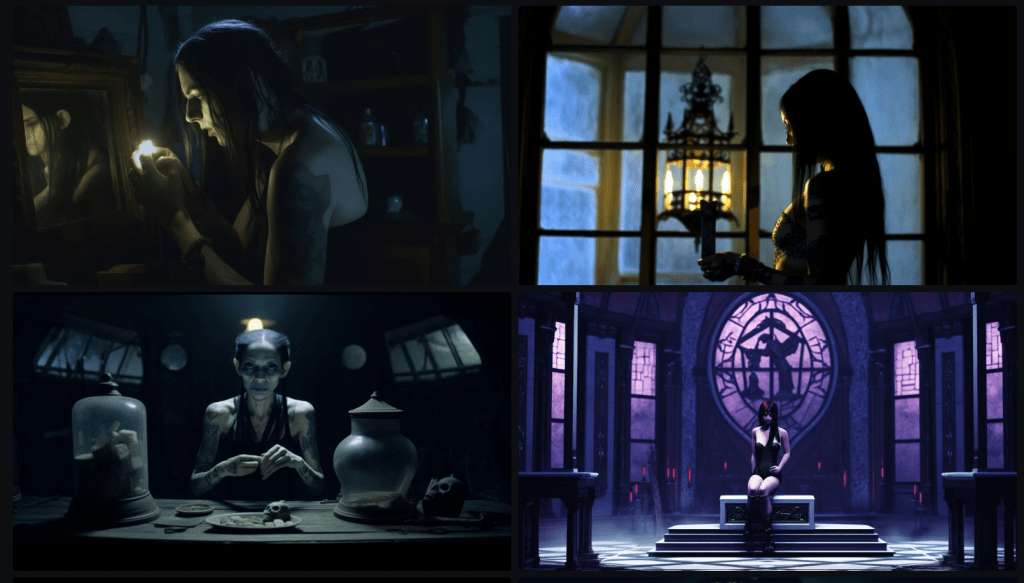
Image: Midjourney v7 render set

Notice that 3 of the 4 renders in the v7 set don’t even have a mirror. The top right one does, but it’s not evident that she’s a vampire. In fact, I could say that any of these are vampiresses, but perhaps that’s what they want you to believe. In place of a necklace, the lower right wokan sports a cross tattoo.

Midjourney v6.1

Image: Midjourney v6.1 render set

Again, these renders don’t appear to be vampires. The one on the lower left does appear to have snake-like fangs, so I guess I’ll give partial credit.

My next attempt was interrupted by this message.

It rendered something that might violate community guidelines. The funny thing is that one can watch the image generate in process. It only takes one “offensive” image to disqualify the whole batch.

Midjourney v6

Image: Midjourney v6 render set

Yet again, not a vampire to be found. Notice the reflection in the lower left image. Perhaps vampire reflections just behave differently.

Midjourney 5.2

Image: Midjourney v5.2 render set

Midjourney v5.2 was a crapshoot. Somehow, I got vampire lips (?), a Wiccan, a decrepit Snape from Harry Potter lore, and Iron Maiden’s Eddy reading a book. It’s something. I’m sensing gender dysphoria. Dare I go back further?

Midjourney v5.1

Image: Midjourney v5.1 render set

It gets worse. No comments necessary. Let’s turn back the clocks even more.

Midjourney v5

Image: Midjourney v5 render set

To be fair, these all do have occult undertones, but they are weak on vampireness.

Midjourney v4

Image: Midjourney v4 render set

To be fair, the render quality isn’t as bad as I expected, but it still falls short. There’s further back to travel.

Midjourney v3

Image: Midjourney v3 render set

Some configuration parameters no longer exist. Still, I persist for the sake of art and science at the cost of time and ecology.

As much as I complain – and I complain a lot – this is how far we’ve come. As I recall, this is when I hopped onto the Midjourney bandwagon. There’s still more depth to plumb. I have no idea how much of the prompt is simply ignored at this point.

Midjourney v2

Image: Midjourney v2 render set

What the hell is this? 🤔🤣 But I’m not done yet.

Midjourney v1

Image: Midjourney v1 render set

The damned grandpappy of them all. Apparently, colour hadn’t been invented yet. You can’t tell by these thumbnails, but the resolution on these early versions approaches that of a postage stamp.

Midjourney Niji 3

Image: Midjourney Niji 3 render set

I had forgotten about the Niji models from back in the day. There were 3 versions. I don’t recall where this slotted into the chronology. Obviously, not down here. I’ve only rendered the newest one. I think this was used primarily for anime outputs, but I might be mistaken.

Bones Content 1: Video

Video: Midjourney Render of Purported Vampiress

This is a video render of the same prompt used on this page.

Bonus Content 2: Midjourney v6.1 Content from 34 weeks ago

Same prompt.

Image: Midjourney v6.1 render set (several passes)

The upper left image reminds me of Kirsten Dunst. Again, notice the female breasts, highlighting Midjourney’s censorial schizophrenia.

Molyneux, Locke, and the Cube That Shook Empiricism

Few philosophical thought experiments have managed to torment empiricists quite like Molyneux’s problem. First posed by William Molyneux to John Locke in 1688 (published in Locke’s An Essay Concerning Human Understanding), the question is deceptively simple:

If a person born blind, who has learned to distinguish a cube from a sphere by touch, were suddenly granted sight, could they, without touching the objects, correctly identify which is the cube and which is the sphere by sight alone?

I was inspired to write this article in reaction to Jonny Thmpson’s post on Philosophy Minis, shared below for context.

Video: Molyneux’s Problem

Locke, ever the champion of sensory experience as the foundation of knowledge, gave a confident empiricist’s answer: no. For Locke, ideas are the products of sensory impressions, and each sense provides its own stream of ideas, which must be combined and associated through experience. The newly sighted person, he argued, would have no prior visual idea of what a cube or sphere looks like, only tactile ones; they would need to learn anew how vision maps onto the world.

Audio: NotebookLM podcast on this topic.

This puzzle has persisted through centuries precisely because it forces us to confront the assumptions at the heart of empiricism: that all knowledge derives from sensory experience and that our senses, while distinct, can somehow cohere into a unified understanding of the world.

Empiricism, Epistemology, and A Priori Knowledge: The Context

Before we dismantle the cube further, let’s sweep some conceptual debris out of the way. Empiricism is the view that knowledge comes primarily (or exclusively) through sensory experience. It stands opposed to rationalism, which argues for the role of innate ideas or reason independent of sense experience.

Epistemology, the grandiloquent term for the study of knowledge, concerns itself with questions like: What is knowledge? How is it acquired? Can we know anything with certainty?

And then there is the spectre of a priori knowledge – that which is known independent of experience. A mathematical truth (e.g., 2 + 2 = 4) is often cited as a classic a priori case. Molyneux’s problem challenges empiricists because it demands an account of how ideas from one sensory modality (touch) might map onto another (vision) without prior experience of the mapping—an a priori leap, if you will.

The Language Correspondence Trap

While Molyneux and Locke framed this as an epistemological riddle, we can unmask it as something more insidious: a failure of language correspondence. The question presumes that the labels “cube” and “sphere” – tied in the blind person’s mind to tactile experiences – would, or should, carry over intact to the new visual experiences. But this presumption smuggles in a linguistic sleight of hand.

The word “cube” for the blind person means a specific configuration of tactile sensations: edges, vertices, flat planes. The word “sphere” means smoothness, unbroken curvature, no edges. These are concepts anchored entirely in touch. When vision enters the fray, we expect these words to transcend modalities – to leap from the tactile to the visual, as if their meanings were universal tokens rather than context-bound markers. The question is not merely: can the person see the cube? but rather: can the person’s tactile language map onto the visual world without translation or recalibration?

What Molyneux’s problem thus exposes is the assumption that linguistic labels transparently correspond to external reality, regardless of sensory apparatus. This is the mirage at the heart of Locke’s empiricism, the idea that once a word tags an object through experience, that tag is universally valid across sensory experiences. The cube and sphere aren’t just objects of knowledge; they are signs, semiotic constructs whose meaning depends on the sensory, social, and linguistic contexts in which they arise.

The Semiotic Shambles

Molyneux’s cube reveals the cracks in the correspondence theory of language: the naïve belief that words have stable meanings that latch onto stable objects or properties in the world. In fact, the meaning of “cube” or “sphere” is as much a product of sensory context as it is of external form. The newly sighted person isn’t merely lacking visual knowledge; they are confronted with a translation problem – a semantic chasm between tactile signification and visual signification.

If, as my Language Insufficiency Hypothesis asserts, language is inadequate to fully capture and transmit experience across contexts, then Molyneux’s problem is not an oddity but an inevitability. It exposes that our conceptual frameworks are not universal keys to reality but rickety bridges between islands of sense and meaning. The cube problem is less about empiricism’s limits in epistemology and more about its blind faith in linguistic coherence.

In short, Molyneux’s cube is not simply an empirical puzzle; it is a monument to language’s failure to correspond cleanly with the world, a reminder that what we call knowledge is often just well-worn habit dressed up in linguistic finery.

A Final Reflection

Molyneux’s problem, reframed through the lens of language insufficiency, reveals that our greatest epistemic challenges are also our greatest linguistic ones. Before we can speak of knowing a cube or sphere by sight, we must reckon with the unspoken question: do our words mean what we think they mean across the changing stage of experience?

That, dear reader, is the cube that haunts empiricism still.

Lipsyncing with AILip-Reading the AI Hallucination: A Futile Adventure

Some apps boldly claim to enable lip syncing – to render speech from mouth movements. I’ve tried a few. None delivered. Not even close.

To conserve bandwidth (and sanity), I’ve rendered animated GIFs rather than MP4s. You’ll see photorealistic humans, animated characters, cartoonish figures – and, for reasons only the algorithm understands, a giant goat. All showcase mouth movements that approximate the utterance of phonemes and morphemes. Approximate is doing heavy lifting here.

Firstly, these mouths move, but they say nothing. I’ve seen plenty of YouTube channels that manage to dub convincing dialogue into celebrity clips. That’s a talent I clearly lack – or perhaps it’s sorcery.

Secondly, language ambiguity. I reflexively assume these AI-generated people are speaking English. It’s my first language. But perhaps, given their uncanny muttering, they’re speaking yours. Or none at all. Do AI models trained predominantly on English-speaking datasets default to English mouth movements? Or is this just my bias grafting familiar speech patterns onto noise?

Thirdly, don’t judge my renders. I’ve been informed I may have a “type.” Lies and slander. The goat was the AI’s idea, I assure you.

What emerges from this exercise isn’t lip syncing. It’s lip-faking. The illusion of speech, minus meaning, which, if we’re honest, is rather fitting for much of what generative AI produces.

EDIT: I hadn’t noticed the five fingers (plus a thumb) on the cover image.

On Trumpian Language and the Institutional Erosion of MeaningTrumpian Language Debate

“All that is necessary for evil to triumph is for a few words to go missing from the bylaws.” — not Edmund Burke, but it ought to be.

The Trump administration—America’s reigning monarch of meaningless bombast—has done it again. This time, with an executive order so linguistically cunning it deserves a Pulitzer for Subtextual Menace.

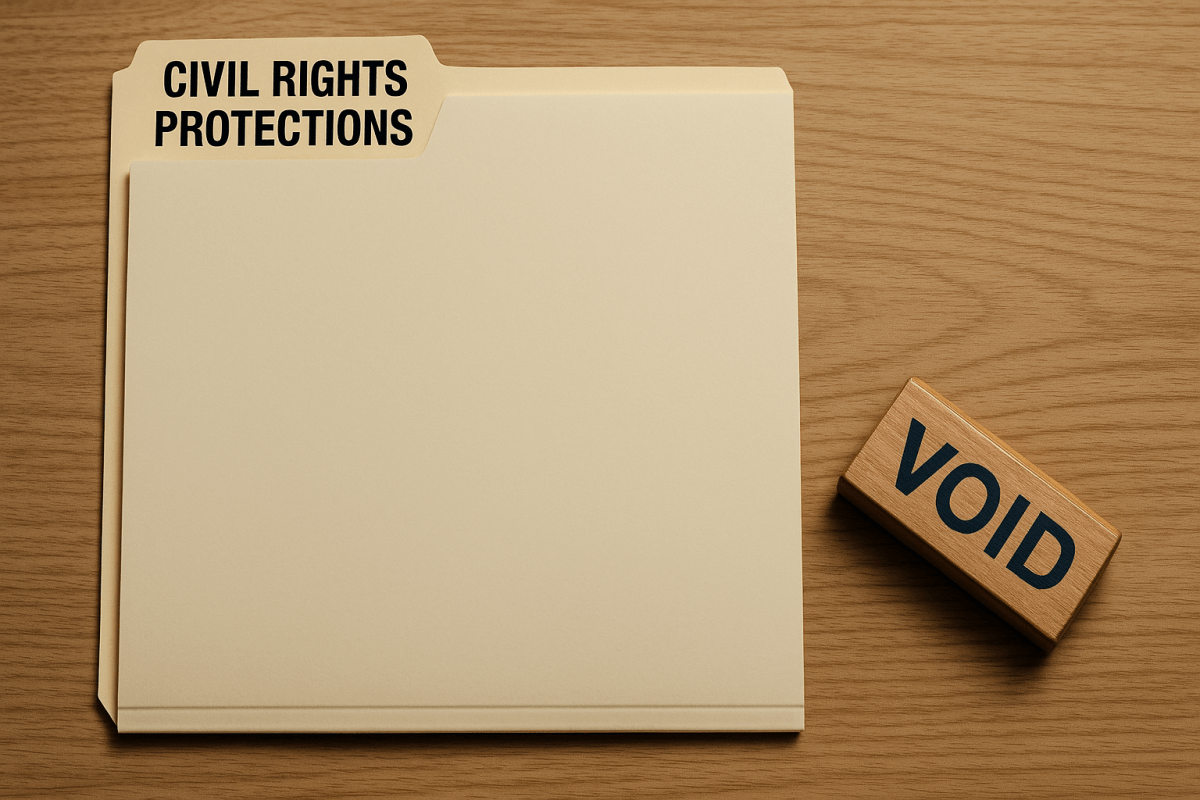
Issued on 30 January 2025, the decree known as “Defending Women from Gender Ideology Extremism” (because, of course, it couldn’t just be called Let’s Erase Legal Protections for People We Don’t Like) removed “political affiliation” and “marital status” from the list of protected classes within certain federal frameworks.

And the result? According to documents unearthed by The Guardian, VA doctors can now legally refuse treatment to patients based on their politics or marital status. You know, because being a Democrat apparently makes you too much of a pre-existing condition.

Naturally, the VA and White House are insisting this means absolutely nothing. “Don’t worry,” they coo. “No one’s actually doing it.” Ah yes, the old Schrödinger’s Protections defence—simultaneously removed and unchanged, invalid but somehow still effective.

But here’s the point—and where it ties to the Language Insufficiency Hypothesis I’ve been peddling like a raving madman at the crossroads of post-structuralism and bureaucratic despair: language isn’t just failing to communicate meaning—it’s being weaponised to obscure it.

The Erosion of Meaning Through Omission

This isn’t the blunt-force idiocy of Orwell’s Newspeak. This is something more elegant—more insidious. This is legislative lacunae. It’s what happens when not saying something says everything.

The words “political affiliation” and “marital status” weren’t replaced. They weren’t clarified. They were simply deleted. Erased like a bad tweet, like a conscience, like a veteran with the wrong bumper sticker.

This is language subtraction as a tool of governance.

We’re not criminalising dissent. We’re just making it legally ignorable.

We’re not discriminating against the unmarried. We’re just no longer required to treat them the same.

It’s the bureaucratic cousin of the dog-whistle: not quite audible in court, but perfectly clear to the base.

The Slippery Slope is Now a Slip-n-Slide

This is how you rewrite civil rights without the fuss of saying so. You just… remove the language that once held the dam in place. Then, when the flood comes, you feign surprise:

“Oh, dear. Who could have guessed that removing protections would result in people being unprotected?”

(Everyone. Everyone could have guessed.)

This is not a bug in the legal language. It’s the feature. The silence is the speech act. The absence is the argument.

This is what I mean by language insufficiency: not merely that our words fail to convey truth, but that their very structure is liable to be gamed—exploited by those who understand that ambiguity is power.

Beyond Intentionality: The Weaponised Void

In philosophy of language, we often debate intentionality—what the speaker meant to say. But here we’re in darker waters. This isn’t about intention. It’s about calculated omission.

The executive order doesn’t declare war on Democrats or single mothers. It simply pulls the thread and lets the tapestry unravel itself.

It’s an act of rhetorical cowardice disguised as administrative efficiency.

This is the Trumpian genius: use language like a stage magician uses sleeves. Distract with one hand, disappear with the other.

Final Diagnosis: Policy by Redaction

We now inhabit a political climate where what is not said carries more legal force than what is. Where bylaw gaps become policy gateways, and where civil rights die not with a bang, but with an elision.

So no, the VA hasn’t yet denied a Democrat a blood transfusion. But the table has been set. The menu revised. The waitstaff told they may now “use discretion.”

Language doesn’t merely fail us. It is being made to fail strategically.

Welcome to the new America: where rights aren’t removed—they’re left out of the memo.


Yet again, ChatGPT renders an odd image. Can’t be bothered to amend it.

Speculative Philosophy on Screen: Identity, Agency, and the Fiction of Reality

Close-up of a human eye with digital glitch effects and overlaid text reading 'What if reality is wrong?'—a visual metaphor for distorted perception and unreliable truth.

Regular readers know I often write about identity, free will, and the narrative constraints of language. But I also explore these ideas through fiction, under the name Ridley Park.

In this short video, I unpack the philosophical motivations behind my stories, including:

  • Why reality is never as it seems
  • Why the self is a narrative convenience
  • What Heidegger’s Geworfenheit and Galen Strawson’s Causa Sui argument reveal about agency
  • And why language fails us – even when we think it serves

This isn’t promotional fluff. It’s epistemological dissent in a new format. Fictional, yes, but only in the sense that most of reality is, too.

▶️ Watch the video: Why I Write the Way I Do

Can One Obstruct Justice in a Place It Doesn’t Exist?

ICE is out in force again, dragging brown bodies out of homes in Los Angeles like it’s some righteous carnival of due process. Another day, another federal theatre production titled Law and Order: Ethnic Cleansing Unit, where men with guns and names like Chad or Hank mistake cruelty for patriotism and paperwork for moral clarity.

Audio: NotebookLM podcast on this topic.

Naturally, critics of these raids are now being threatened with that great juridical cudgel: “obstructing justice.” Yes, you heard that right. If you interfere – say, by filming, shouting, refusing to roll over like a good little colonial subject – you are obstructing justice. As though justice were something you could actually put your hands on in the United States without a hazmat suit and a decade of appeals.

Let’s be clear. There is no justice here to obstruct. What you are obstructing is bureaucratic violence wrapped in legal latex. You are obstructing a system that functions like a vending machine for state-sanctioned trauma: insert immigrant, extract ruin.

Justice: The Imaginary Friend of Empire

Ah, “justice.” That hallowed ideal trotted out whenever the state wants to put a boot through your front door. The U.S. has long since traded its Justice for Security Theatre and capitalist choreography. The blindfold is still there, sure – but these days, it’s a branded sleep mask from Lockheed Martin, and the scales are rigged to weigh white tears heavier than brown bodies.

Let’s run through the usual suspects:

  • ICE – America’s own domestic Gestapo, but with better PR and significantly worse fashion.
  • CBP – Border fetishists whose job seems less about national defence and more about satisfying their Freud-bereft fantasies of control.
  • SCOTUS – That great moral weather vane, spinning wildly between “originalist necromancy” and outright lunacy, depending on how recently Thomas and Alito read Leviticus.
  • Congress – An assembly of millionaires cosplaying as public servants, holding hearings on “the threat of immigration” while outsourcing their lawn care.

And of course, the President – whichever septuagenarian husk happens to be in office – offers the usual bromides about order, safety, and enforcement, all while the real crimes (you know, the kind involving tax fraud, corporate pollution, or drone strikes) go entirely unmolested.

Can You Obstruct a Simulation?

If you stand in front of a deportation van, are you obstructing justice, or merely interrupting the bureaucratic excretion of empire? It’s the philosophical equivalent of trying to punch a hologram. The system pretends to uphold fairness while routinely violating its own principles, then charges you with “obstruction” when you call out the sleight of hand.

This is not justice. This is kabuki. A ritual. A performance piece sponsored by Raytheon.

A Modest Proposal

Let’s just be honest and rename the charge. Not “Obstruction of Justice”—too ironic, too pompous. Call it what it is: Obstruction of Procedure, Obstruction of Power, or if we’re being especially accurate: Obstruction of the Industrial Deportation Complex™. Hell, add a corporate sponsor while you’re at it:

You are being charged with Obstruction of Justice, Presented by Amazon Web Services.

Because when justice itself is a ghost, when the rule of law has become the rule of lawfare, the real obscenity is pretending any of this is noble.

Final Thought

So no, dear reader, you’re not obstructing justice. You’re obstructing a machine that mistakes itself for a moral order. And if you’re going to obstruct something, make it that.

The Rhetoric of Realism: When Language Pretends to Know

Let us begin with the heresy: Truth is a rhetorical artefact. Not a revelation. Not a metaphysical essence glimmering behind the veil. Just language — persuasive, repeatable, institutionally ratified language. In other words: branding.

Audio: NotebookLM podcast on this topic.

This is not merely a postmodern tantrum thrown at the altar of Enlightenment rationalism. It is a sober, if impolite, reminder that nearly everything we call “knowledge” is stitched together with narrative glue and semantic spit. Psychology. Neuroscience. Ethics. Economics. Each presents itself as a science — or worse, a moral imperative — but their foundations are built atop a linguistic faultline. They are, at best, elegant approximations; at worst, dogma in drag.

Let’s take psychology. Here is a field that diagnoses your soul via consensus. A committee of credentialed clerics sits down and declares a cluster of behaviours to be a disorder, assigns it a code, and hands you a script. It is then canonised in the DSM, the Diagnostic Scripture Manual. Doubt its legitimacy and you are either naïve or ill — which is to say, you’ve just confirmed the diagnosis. It’s a theological trap dressed in the language of care.

Or neuroscience — the church of the glowing blob. An fMRI shows a region “lighting up” and we are meant to believe we’ve located the seat of love, the anchor of morality, or the birthplace of free will. Never mind that we’re interpreting blood-oxygen fluctuations in composite images smoothed by statistical witchcraft. It looks scientific, therefore it must be real. The map is not the territory, but in neuroscience, it’s often a mood board.

And then there is language itself, the medium through which all these illusions are transmitted. It is the stage, the scenery, and the unreliable narrator. My Language Insufficiency Hypothesis proposes that language is not simply a flawed tool — it is fundamentally unfit for the task it pretends to perform. It was forged in the furnace of survival, not truth. We are asking a fork to play the violin.

This insufficiency is not an error to be corrected by better definitions or clever metaphors. It is the architecture of the system. To speak is to abstract. To abstract is to exclude. To exclude is to falsify. Every time we speak of a thing, we lose the thing itself. Language functions best not as a window to the real but as a veil — translucent, patterned, and perpetually in the way.

So what, then, are our Truths™? They are narratives that have won. Stories that survived the epistemic hunger games. They are rendered authoritative not by accuracy, but by resonance — psychological, cultural, institutional. A “truth” is what is widely accepted, not because it is right, but because it is rhetorically unassailable — for now.

This is the dirty secret of epistemology: coherence masquerades as correspondence. If enough concepts link arms convincingly, we grant them status. Not because they touch reality, but because they echo each other convincingly in our linguistic theatre.

Libet’s experiment, Foucault’s genealogies, McGilchrist’s hemispheric metaphors — each peels back the curtain in its own way. Libet shows that agency might be a post-hoc illusion. Foucault reveals that disciplines don’t describe the subject; they produce it. McGilchrist laments that the Emissary now rules the Master, and the world is flatter for it.

But all of them — and all of us — are trapped in the same game: the tyranny of the signifier. We speak not to uncover truth, but to make truth-sounding noises. And the tragedy is, we often convince ourselves.

So no, we cannot escape the prison of language. But we can acknowledge its bars. And maybe, just maybe, we can rattle them loudly enough that others hear the clank.

Until then, we continue — philosophers, scientists, diagnosticians, rhetoricians — playing epistemology like a parlour game with rigged dice, congratulating each other on how well the rules make sense.

And why wouldn’t they? We wrote them.

The Scourge: They’re Really Fighting Is Ambiguity

A Sequel to “The Disorder of Saying No” and a Companion to “When ‘Advanced’ Means Genocide”

In my previous post, The Disorder of Saying No, I explored the way resistance to authority is pathologised, particularly when that authority is cloaked in benevolence and armed with diagnostic manuals. When one refuses — gently, thoughtfully, or with a sharp polemic — one is no longer principled. One is “difficult.” Or in my case, oppositional.

Audio: NotebookLM podcast on this topic.

So when I had the gall to call out Bill Maher for his recent linguistic stunt — declaring that a woman is simply “a person who menstruates” — I thought I was doing the rational thing: pointing out a classic bit of reductionist nonsense masquerading as clarity. Maher, after all, was not doing biology. He was playing lexicographer-in-chief, defining a term with centuries of philosophical, sociological, and political baggage as though it were a checkbox on a medical form.

I said as much: that he was abusing his platform, presenting himself as the sole arbiter of the English language, and that his little performance was less about clarity and more about controlling the terms of discourse.

My friend, a post-menopausal woman herself, responded not by engaging the argument, but by insinuating — as others have — that I was simply being contrary. Oppositional. Difficult. Again. (She was clearly moved by When “Advanced” Means Genocide, but may have missed the point.)

So let’s unpack this — not to win the debate, but to show what the debate actually is.

This Isn’t About Biology — It’s About Boundary Maintenance

Maher’s statement wasn’t intended to clarify. It was intended to exclude. It wasn’t some linguistic slip; it was a rhetorical scalpel — one used not to analyse, but to amputate.

And the applause from some cisgender women — particularly those who’ve “graduated” from menstruation — reveals the heart of the matter: it’s not about reproductive biology. It’s about controlling who gets to claim the term woman.

Let’s steelman the argument, just for the sport of it:

Menstruation is a symbolic threshold. Even if one no longer menstruates, having done so places you irrevocably within the category of woman. It’s not about exclusion; it’s about grounding identity in material experience.

Fine. But now let’s ask:

  • What about women who’ve never menstruated?
  • What about intersex people?
  • What about trans women?
  • What about cultures with radically different markers of womanhood?

You see, it only works if you pretend the world is simpler than it is.

The Language Insufficiency Hypothesis: Applied

This is precisely where the Language Insufficiency Hypothesis earns its keep.

The word woman is not a locked vault. It is a floating signifier, to borrow from Barthes — a term whose meaning is perpetually re-negotiated in use. There is no singular essence to the word. It is not rooted in biology, nor in social role, nor in performance. It is a hybrid, historically contingent construct — and the moment you try to fix its meaning, it slips sideways like a greased Wittgensteinian beetle.

“Meaning is use,” says Wittgenstein, and this is what frightens people.

If woman is defined by use and not by rule, then anyone might claim it. And suddenly, the club is no longer exclusive.

That’s the threat Maher and his defenders are really reacting to. Not trans women. Not intersex people. Not language activists or queer theorists.

The threat is ambiguity.

What They Want: A World That Can Be Named

The push for rigid definitions — for menstruation as membership — is a plea for a world that can be named and known. A world where words are secure, stable, and final. Where meaning doesn’t leak.

But language doesn’t offer that comfort.

It never did.

And when that linguistic instability gets too close to something personal, like gender identity, or the foundation of one’s own sense of self, the defensive response is to fortify the language, as though building walls around a collapsing church.

Maher’s defenders aren’t making scientific arguments. They’re waging semantic warfare. If they can hold the definition, they can win the cultural narrative. They can hold the gates to Womanhood and keep the undesirables out.

That’s the fantasy.

But language doesn’t play along.

Conclusion: Words Will Not Save You — but They Might Soothe the Dead

In the end, Maher’s definition is not merely incorrect. It is insufficient. It cannot accommodate the complexity of lived experience and cannot sustain the illusion of clarity for long.

And those who cling to it — friend or stranger, progressive, or conservative — are not defending biology. They are defending nostalgia. Specifically, a pathological nostalgia for a world that no longer exists, and arguably never did: a world where gender roles were static, language was absolute, and womanhood was neatly circumscribed by bodily functions and suburban etiquette.

Ozzy and Harriet loom large here — not as individuals but as archetypes. Icons of a mid-century dream in which everyone knew their place, and deviation was something to be corrected, not celebrated. My friend, of that generation, clings to this fantasy not out of malice but out of a desperate yearning for order. The idea that woman could mean many things, and mean them differently across contexts, is not liberating to her — it’s destabilising.

But that world is gone. And no amount of menstruation-based gatekeeping will restore it.

The Real Scourge Is Ambiguity

Maher’s tantrum wasn’t about truth. It was about fear — fear of linguistic drift, of gender flux, of a world in which meaning no longer obeys. The desire to fix the definition of “woman” is not a biological impulse. It’s a theological one.

And theology, like nostalgia, often makes terrible policy.

This is why your Language Insufficiency Hypothesis matters. Because it reminds us that language does not stabilise reality — it masks its instability. The attempt to define “woman” once and for all is not just futile — it’s an act of violence against difference, a linguistic colonisation of lived experience.

So Let Them Rest

Ozzy and Harriet are dead. Let them rest.
Let their picket fence moulder. Let their signage decay.

The world has moved on. The language is shifting beneath your feet. And no amount of retroactive gatekeeping can halt that tremor.

The club is burning. And the only thing left to save is honesty.

When “Advanced” Means Genocide: A Case Study in Linguistic Implosion

This post draws on themes from my upcoming book, A Language Insufficiency Hypothesis. The transcript below is taken from a publicly available exchange, which you can view here. Consider it Exhibit A in language’s ongoing failure to bear the weight of meaning.

Transcript:

KK: Konstantin Kisin
DFW: Deborah Frances-White

KK: I’m saying we were technologically more advanced.
DFW: So you’re saying we’re superior to Australian Aboriginals?
KK: That’s quite the opposite of what I’m saying. I’m not saying we were superior, I’m saying we were technologically more advanced.
DFW: So, how is that the opposite?
KK: Superior implies a moral quality. I’m not making any moral implication. You seem to be, but what I’m saying is…
DFW: I think most people would hear it that way.
KK: No.
DFW: Again, you’re a very intelligent man. How would most people hear that?
KK: Most people would hear what I’m saying for what I’m saying, which is…
DFW: I don’t think they would.
KK: You seem to get quite heated about this, which is completely unnecessary.
DFW: Um…
KK: You think it’s necessary?
DFW: I’m a bit stunned by what you’re implying.
KK: No, you’re acting in a kind of passive aggressive way which indicates that you’re not happy…
DFW: I genuinely… I’m being 100% authentic. My visceral reaction to a white man sitting and saying to me, “And why were we able to commit genocide on them?” and then just pausing—
KK: Yes.
DFW: …is very visceral to me.
KK: Well, let’s go back. First of all, it’s interesting that you brought up my skin colour because I thought that was the exact opposite of the point you’re trying to make in the book.

Audio: NotebookLM podcast on this topic.

The Language Insufficiency Hypothesis begins with this premise: language is not merely flawed, it is structurally inadequate for mediating complex, layered realities – especially those laced with power, morality, and history. This transcript is not a debate. It is a linguistic trench war in which every utterance is laced with shrapnel, and each side thinks they’re defending reason.

Let’s pull a few of the shell casings from the mud.

KK attempts to offer a dry, neutral descriptor. DFW hears supremacist teleology. Why? Because “advanced” is culturally radioactive. It doesn’t merely denote a technical state—it connotes a ladder, with someone inevitably on the bottom rung.

When language carries historical residue, neutrality is a delusion. Words don’t just mean. They echo.

KK is making a semantic distinction. DFW hears a moral claim. Both are right. And both are talking past one another, because language is attempting to cleave affect from description, and it simply can’t.

KK’s insistence—“I’m not saying we’re superior”—is a textbook example of denotative desperation. He believes clarification will rescue intent. But as any linguist (or postcolonial theorist) will tell you: intent does not sterilise implication.

Language cannot be laundered by explanation. Once spoken, words belong to context, not intention.

KK thinks he’s holding a scalpel. DFW hears a cudgel. And here we are.

This is where the wheels come off. KK argues from semantic specificity. DFW argues from sociolinguistic reception. It’s Saussure versus the TikTok algorithm. Neither will win.

Communication disintegrates not because anyone is lying, but because they are playing incompatible games with the same tokens.

DFW’s invocation of “a white man” is not a derailment—it’s the inevitable endpoint of a system where words no longer float free but are yoked to their utterer. This is the moment the failure of language becomes a failure of interlocution. Argument collapses into indexical entrapment.

At this point, you’re no longer debating ideas. You’re defending your right to use certain words at all.

Which brings us to the final breakdown.

KK: I am making a logical distinction.
DFW: I am having a visceral reaction.

The failure isn’t moral. It isn’t historical. It’s grammatical. One is operating in a truth-function logic game. The other is reacting within a trauma-informed, socially indexed register. These are grammars that do not overlap.

If this brief and brutal dialogue proves anything, it’s this: you cannot extract meaning cleanly from words when the words themselves are sponges for history, hierarchy, and harm. The moment we ask language to do too much—to carry precision, affect, ethics, and identity—it folds in on itself.

And that, dear reader, is precisely the argument of A Language Insufficiency Hypothesis: that meaning does not reside in words, and never has. It lives in the gaps, the silences, the misfires. That’s where the truth—whatever’s left of it—might be hiding.

Follow the wreckage. That’s where the signal lives.