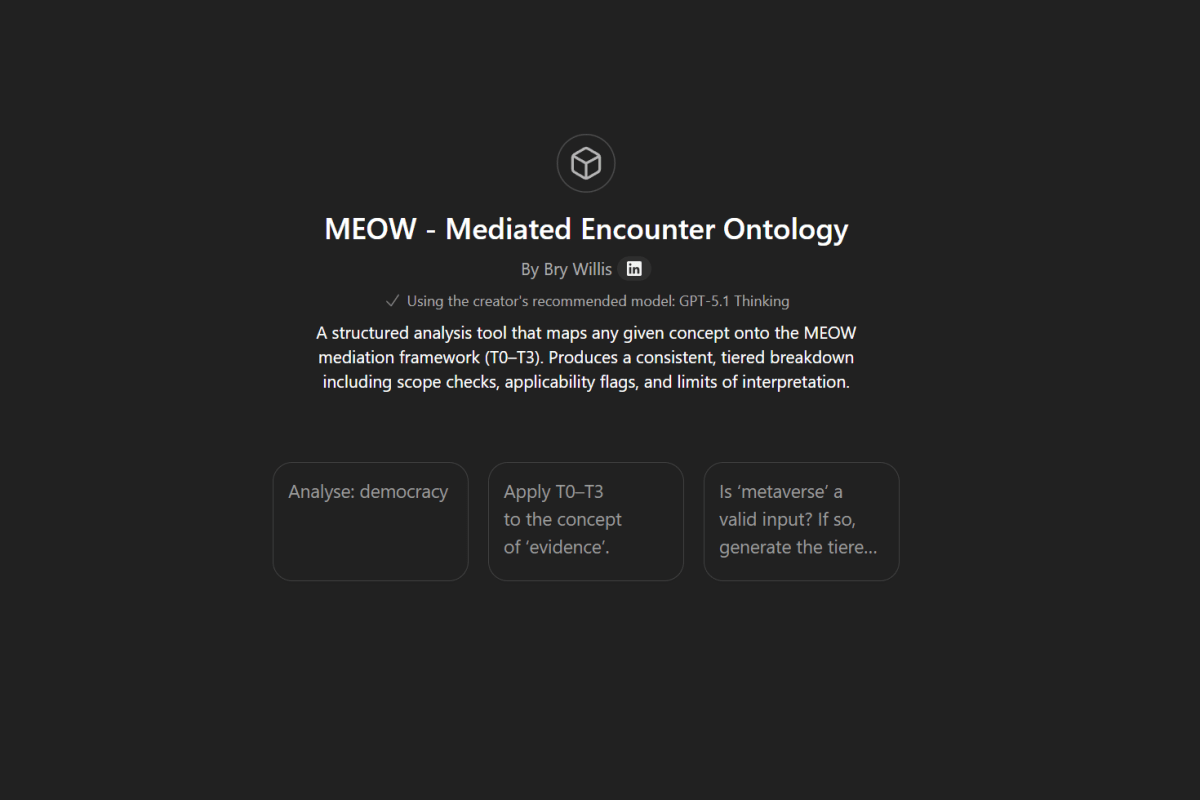
Announcement: MEOW GPT

Instead of sleeping like a functional adult, I’ve spent the night creating, testing, and refining a bespoke GPT that has fully absorbed my MEOW and LIH frameworks. Apologies that the LIH manuscript isn’t yet public; some of the terminology may look delightfully alien if you’re coming in cold.

This model doesn’t role-play a philosopher; it thinks through the Mediated Encounter Ontology. It runs every input through T0–T3 mediations and then applies the Language Insufficiency Hypothesis to explain why our words fail us in predictable, structural ways.

Audio: NotebookLM summary podcast of this post on the MEOW GPT.

I stress-tested it with a dozen concepts, from the obvious to the uncooperative. It happily tells you when your input makes sense, when it’s out of scope, and when you’ve handed it conceptual soup. My first test was the hard problem of consciousness, because naturally we begin with the philosophical boss fight. I dialled down some over-enthusiastic LIH flourishes, but the bones are untouched.

I’m making this public for a simple reason: it’s the clearest way for people to see how MEOW operates without wandering through a hundred pages of my prose. These outputs capture how I process information and why these frameworks feel so intuitively correct to me. When you read them, you get a direct view of my interpretive machinery – how the world clicks for me, and how these ideas evolved.

It hasn’t been rigorously battle-tested across the entire conceptual universe, but it’s stable, coherent, and frankly too interesting to keep in the drawer. If you try it – and I hope you do – I’d love to see what it does with your own concepts. If you need help reading the results, ask. I didn’t simplify the system; it expects literacy, nuance, and a working prefrontal cortex.

For orientation, read the introductory post or the colour perception example. Ideally, read the original essay and listen to the summary podcast. My first test was on the hard problem of consciousness because I had already analysed it for this post. I made some adjustments to tone down some LIH intrusions.

Below is a sample output. I asked the model to analyse modernity.

Concept

  • Input: modernity
  • Type: historical–social formation / self-description of an era / conceptual frame
  • Scope check: in-scope – central for how MEOW treats large-scale shifts in mediation (social, technical, cognitive, linguistic)

High-level summary (≤120 words)

Modernity is both a historical bundle (industrialisation, nation-states, capitalism, science, bureaucracy, media) and a story societies tell about themselves (“we are modern, unlike the past”).

In MEOW terms, modernity is a large-scale reorganisation of mediations:

  • T0: new bodily environments (urban life, clocks, artificial light, pollution, medicine).
  • T1: new cognitive habits (individualism, planning, abstraction, risk-calculation).
  • T2: new vocabularies (progress, development, rationality, “religion” vs “science”).
  • T3: new institutions and technologies (markets, states, factories, schools, mass media, digital networks).

“Modernity” is not a single thing but a way these shifts hang together and become a background to everyday encounter.


T0 – Biological Mediation

  • Applicability: Applicable
  • Analysis:
    • Modernity radically reshapes the immediate bodily environment: dense cities, artificial lighting, noise, pollution, sedentary work, and altered sleep cycles change basic sensory and metabolic conditions.
    • Medical advances and public health (vaccination, antibiotics, sanitation, surgery) modify life expectancy, infant mortality, and chronic illness, which in turn change how life cycles feel and are planned.
    • New food systems (industrial agriculture, processed foods, global supply chains) alter nutrition, exposure to toxins, and rhythms of hunger and satiety.
    • Industrial and digital work reorganise movement and posture: repetitive factory labour, office desk work, and screen use all reshape embodiment, fatigue, and bodily awareness.
    • These T0 changes set the stage for new affective baselines (e.g., chronic low-level stress, stimulation overload) that colour what it is like to live in a “modern” world.

T1 – Cognitive Mediation

  • Applicability: Strongly applicable
  • Analysis:
    • Modernity encourages certain cognitive styles: systematic planning, quantification, risk assessment, cost–benefit thinking, and an emphasis on prediction and control.
    • The sense of self is reconfigured toward individualism and reflexivity: people see themselves as projects to be chosen, improved, optimised, often with long-term career and life-planning horizons.
    • Exposure to multiple roles, cultures, and information streams (through migration, media, education) produces more complex identity structures and can create cognitive dissonance or fragmentation.
    • Scientific and technical worldviews teach people to reframe events in terms of mechanisms, probabilities, and systems rather than fate, tradition, or local narratives.
    • The sheer volume and speed of information flows in late modernity (news, social media, notifications) trains attention toward rapid scanning and shallow switching, affecting memory, concentration, and emotional regulation.
    • These patterns make certain experiences “normal” (abstract work, mediated relationships, bureaucratic interactions) that would be extraordinary or impossible in premodern settings.

T2 – Linguistic Mediation

  • Applicability: Strongly applicable
  • Analysis:
    • Modernity itself is a label that societies use to contrast “us” with “them” (the past, “traditional” societies, “the East,” “the primitive”); it is a polemical as well as descriptive term.
    • In Language Insufficiency terms, modernity is highly Fluid: it can mean a period (“since the 18th century”), a style (modernist art), a value system (rational, secular, progressive), or a socio-economic order (capitalist, industrial, bureaucratic). Different authors slide between these quietly.
    • It’s also Contestable: critics and defenders use the same word but point to different aspects—emancipation and progress versus alienation, exploitation, ecological crisis.
    • Pairs like “modern vs traditional” or “modern vs backward” compress complex differences into simple hierarchies, smuggling in a presumption that “modern” is automatically better or more advanced.
    • Talk of “post-modernity” or “late modernity” suggests that we can neatly periodise and step outside the modern, even while our concepts and institutions remain shaped by it—an example of language implying more clarity and control than we actually have.
    • At the most global scale (“the meaning of modernity,” “the modern condition”), we approach an Effectiveness Horizon: the term feels weighty but becomes vague; people resort to sweeping metaphors (disenchantment, liquefaction, acceleration) whose exact content is hard to pin down.
    • First-person experiences of being “overwhelmed by modern life,” “liberated by modern options,” or “disconnected in modern society” often have an Ineffable quality: standard clichés don’t quite capture the texture of these lives, even as they gesture at them.

T3 – Social/Technical Mediation

  • Applicability: Strongly applicable
  • Analysis:
    • Modernity is most visible as a mesh of institutions: nation-states, markets, bureaucracies, public schools, hospitals, prisons, armies, scientific organisations, corporations, NGOs.
    • These institutions standardise time (clocks, schedules), space (borders, property lines, zoning), identity (passports, ID numbers), and value (money, statistics, rankings) so that encounters become predictable and governable across large scales.
    • Technologies—steam engines, electricity, mass transport, broadcasting, computing, the internet, AI—are both products and drivers of modernity. They make possible new encounter-forms (remote work, global real-time communication, mass surveillance).
    • Urbanisation concentrates people into large, heterogeneous populations, which reconfigures social networks, anonymity, solidarity, and conflict; everyday encounters become more mediated by rules, signage, and digital systems than by face-to-face custom.
    • Capitalist production and consumption patterns organise much of life around work, income, and markets; the rhythms of the factory, office, and platform economy structure when and how people interact, rest, and move.
    • Modern governance uses statistics, censuses, and models to “see” and manage populations; this makes certain aspects of life legible (employment, crime, disease) while leaving others under- or uncounted (informal care, undocumented work, emotional labour).
    • Counter-movements (romanticism, traditionalism, environmentalism, decolonial and Indigenous resurgence, slow-living and anti-consumerist practices) can be read as attempts to renegotiate or resist specific modern mediations rather than simply reject “modernity” as a whole.

Limits & failure modes

  • Language insufficiency notes
    • Modernity bundles together time (a historical era), structure (a type of society), and value (being “up to date”). This makes the term rhetorically powerful but analytically slippery: it’s easy to smuggle evaluations into what sound like neutral descriptions.
    • Because the concept is so broad, discussions often conflate distinct issues—technology, capitalism, secularisation, colonialism, individualism, bureaucracy—under one word, obscuring which mechanisms are actually at work.
    • Experiences of living in “modern times” (speed, fragmentation, choice, precariousness, possibility) often outrun our stock phrases; people lean on recurring complaints (“too fast,” “too shallow,” “too lonely”) that only partially capture what it’s like.
  • Missing tiers / blind spots
    • This sketch doesn’t adjudicate between different theories of modernity (Marxist, Weberian, postcolonial, systems-theoretic, etc.); it treats them as emphasising different mediational strands.
    • It’s centred on Euro-Atlantic narratives; “multiple modernities” and non-Western trajectories (where “modern” elements mix with older forms in hybrid ways) would need a richer T3 treatment.
    • The analysis underplays ecological dimensions: industrial modernity’s dependence on fossil fuels, large-scale extraction, and waste has massive implications for how future encounters will be structured.
    • Finally, because we are ourselves situated in what we call modernity, our conceptual vantage is limited; any map we draw is partly an artefact of the very mediations we’re trying to analyse.


What If the Frege–Geach Problem Isn’t?

3–4 minutes

The Frege–Geach problem was one of the impetuses for finishing my Language Insufficiency Hypothesis. From the first encounter it felt off, as though someone were trying to conjure depth from a puddle. There was no paradox here; just another case of mistaking the map for the terrain, a habit analytic philosophy clings to with almost devotional zeal. The more time I spend on this project, the more often I find those cartographic illusions doing the heavy lifting.

Audio: NotebookLM podcast on this topic.

For the uninitiated, the Frege–Geach problem is supposed to be the knockout blow against AJ Ayer’s emotivism. Frege’s manoeuvre was simple enough: moral language must behave like descriptive language, so embed it in a conditional and watch the whole thing buckle. Neat on paper. Vacuous in practice. The entire construction only stands if one accepts Frege’s original fiat: that moral utterances and empirical propositions share the same logical metabolism. And why should they? Because he said so.

This is the core of the analytic mistake. It is grammar dressed up as ontology.

The LIH doesn’t ‘solve’ the Frege–Geach problem for the simple reason that there is nothing to solve. What it does instead is reclassify the habitat in which such pseudo-problems arise. It introduces categories the analytic tradition never suspected existed and drafts a grammar for language’s failure modes rather than politely ignoring them. It exposes the metaphysics analytic philosophy has been smuggling under its coat for decades.

The LIH does four things at once:

• It destabilises an alleged Invariant.
• It exposes the Contestable foundations underneath it.
• It shows that many analytic puzzles exist only because of the presuppositions baked into the analytic grammar.
• And it asks the forbidden question: what if this cherished problem simply isn’t one?

Analytic philosophy proceeds as though it were operating on a single, pristine grammar of meaning, truth, and assertion. The LIH replies: charming idea, but no. Different conceptual regions obey different rules. Treating moral predicates as if they were factual predicates is not rigour; it’s wishful thinking.

As my manuscript lays out, instead of one flat linguistic plain, the LIH gives you an ecology:

Invariants for the things that actually behave.
Contestables for the concepts that wobble under scrutiny.
Fluids for notions that change shape depending on who touches them.
Ineffables for everything language tries and fails to pin down.

The analytic tradition, bless its little heart, tries to stretch classical logic across the entire terrain like clingfilm. The clingfilm snaps because reality never agreed to be wrapped that way.

This taxonomy isn’t jargon for its own sake. It’s a meta-grammar: a way of describing how language breaks, where it breaks, and why it breaks in predictable places. It names the structures analytic philosophy has been tripping over for a century but studiously refused to acknowledge.

Their error is simple: they treat language as flat. The LIH treats language as topographical – scored with ridges, fault lines, and pressure fronts.

They think in one grammar. I wrote a grammar for grammars.

No wonder there’s disquiet. Their tools have been optimised for the wrong terrain. I’m not challenging their competence; I’m pointing out that the conceptual map they’ve been so proudly updating was drawn as if the continent were uniformly paved.

This is why Frege–Geach, the ‘hard problem’ of consciousness, another irritant, paradoxes, semantic embeddings – so many of their grand intellectual fixtures – appear dramatic inside their grammar yet quietly evaporate once you switch grammars. The LIH isn’t a theory about language; it is a theory of the boundary conditions where language stops being able to masquerade as a theory of anything at all.

And the Frege–Geach problem? In the end, perhaps it isn’t.


Note that the cover image is of the rhinoceros in the animated movie, James and the Giant Peach. The rhino was meant to remind James of the importance of perspective. I feel it’s fitting here.

Propensity for Simulacra, An Excerpt

1–2 minutes

I posted Chapter 26 of my novella, Propensity. I share it here because it invokes Baudrillard’s Simulacra.

Consider it an advert – and a window into Propensity.

Blog Post: Propensity, Chapter 26 – Simulacra
Audio: Propensity, Chapter 2 – Oversight

The novel itself asks what happens when humanity creates a device that creates peace on earth. What if behavioural control worked too well?

No riots. No rebellion. Just a flattening—of desire, of ambition, of will. Across homes, schools, and governments, people stop acting like themselves. Some forget how. Others forget why.

The system wasn’t designed to stay on this long. But now there’s no off switch. And the researchers who built it? Most of them are zeroed.

As one child begins to drift from baseline, an impossible question resurfaces: What does it mean to behave?

This is a psychological dystopia without explosions, a story where silence spreads faster than violence, where systems behave better than the people inside them.

A tale of modulation, inertia, and the slow unravelling of human impulse—for readers who prefer their dystopias quiet and their horrors deeply plausible.


Editorial Review

“Reader discretion is advised. Free will has been deprecated.”
Beginning as a bizarre experiment in behavioural modulation by way of neurochemical interference, Propensity unfolds into an eerie metaphor for the tricky road between control and conscience. Park’s chapters are short and succinct, some barely a page long, in a staccato rhythm that mirrors the story’s disintegration—scientists losing grip on their creation and a world learning the price of its “engineered peace.” Phrases like “silence playing dress-up as danger” and “peace was never meant to be built, only remembered” linger like faint echoes long after you turn the page.

Reedsy Discovery Review

Meantime, give it a listen.

Freedom: The Chains That Bind Us Together

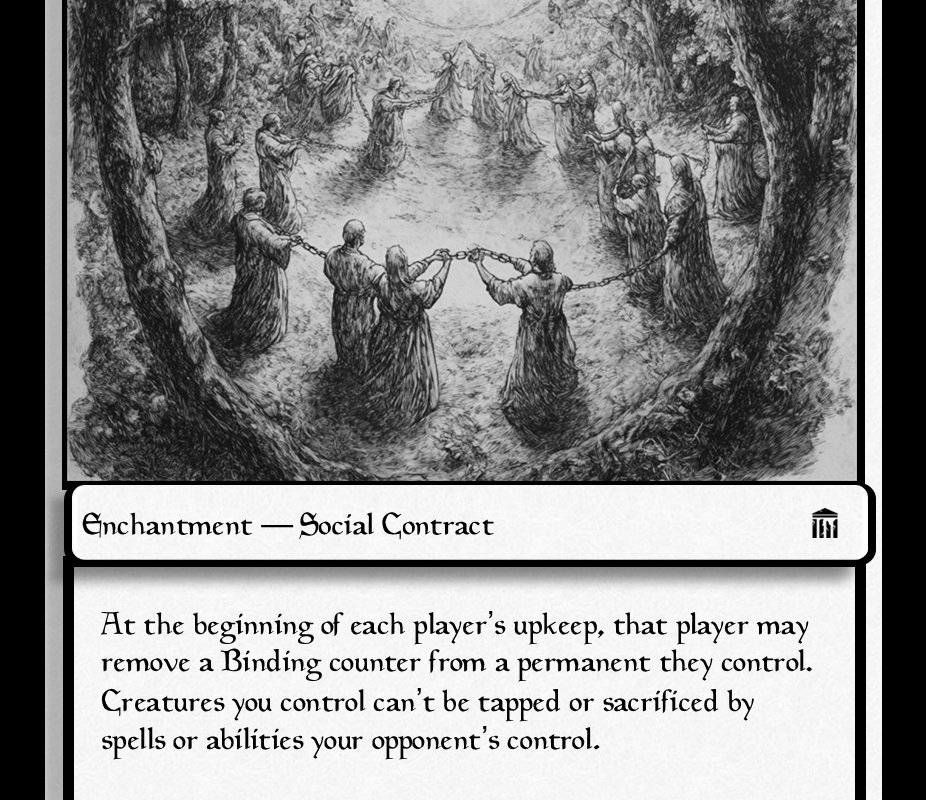
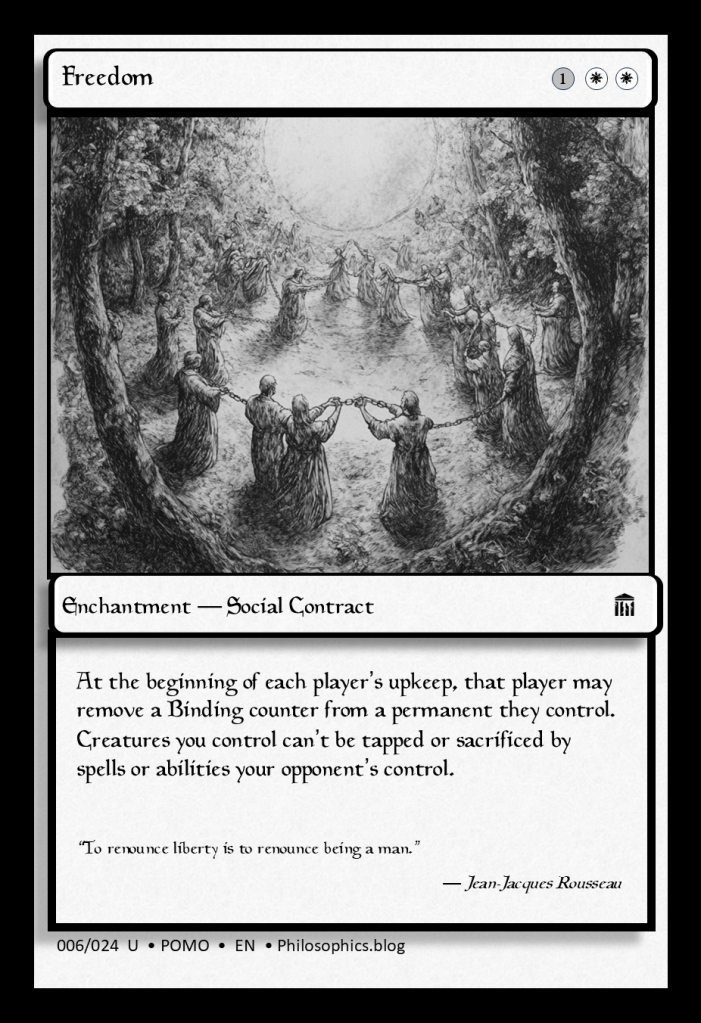
Black-and-white illustration of robed figures standing in a forest clearing, forming a circle by linking chains between their hands. The figures appear both united and restrained, illuminated by a pale, radiant light that suggests dawn or revelation. The mood is solemn yet transcendent, symbolising Rousseau’s paradox that freedom and constraint are inseparable. The image appears as a parody Magic: The Gathering card titled “Freedom,” subtitled “Enchantment — Social Contract,” with a quote from Jean-Jacques Rousseau: “To renounce liberty is to renounce being a man.” The art captures the tension between community, bondage, and liberation.

Freedom is a word so overused it’s practically anaemic. Everyone wants it; no one agrees on what it means. It’s been weaponised by tyrants and revolutionaries alike, invoked to justify both the breaking of chains and their reforging in a different metal.

Audio: NotebookLM podcast on this topic.

As I write this, I have just finished Erich Fromm’s A Sane Society. Without derailing this post, he cited a scenario – a description of work communities given in All Things Common, by Claire Huchet Bishop – where in post-WW2 France, a group formed a sort of workers’ coöperative – but it was more than that; it was an anarchosyndicalist experiment. As I read it, I had to cringe at the power ‘voluntary’ transfers that immediately got me thinking of Foucault’s biopower – as I often do. Saving this for a separate post.

Black-and-white illustration of robed figures standing in a forest clearing, forming a circle by linking chains between their hands. The figures appear both united and restrained, illuminated by a pale, radiant light that suggests dawn or revelation. The mood is solemn yet transcendent, symbolising Rousseau’s paradox that freedom and constraint are inseparable. The image appears as a parody Magic: The Gathering card titled “Freedom,” subtitled “Enchantment — Social Contract,” with a quote from Jean-Jacques Rousseau: “To renounce liberty is to renounce being a man.” The art captures the tension between community, bondage, and liberation.
Image: Freedom: The Chains That Bind Us Together
Card 006 from the Postmodern Set – Philosophics.blog

This Critical Theory parody card, Freedom, draws its lineage from Jean-Jacques Rousseau, whose paradox still haunts the modern condition: “Man is born free, and everywhere he is in chains.” The card re-enchants that contradiction – an Enchantment – Social Contract that reminds us liberty isn’t a state but a negotiation.

The card reads:

At the beginning of each player’s upkeep, that player may remove a Binding counter from a permanent they control.
Creatures you control can’t be tapped or sacrificed by spells or abilities your opponent controls.

This is Rousseau’s dilemma made mechanical. Freedom is not absolute; it’s procedural. The upkeep represents the maintenance of the social contract—an ongoing renewal, not a one-time event. Every player begins their turn by negotiating what freedom costs. You may remove one Binding counter, but only if you recognise that binding exists.

The flavour text underlines Rousseau’s plea:

“To renounce liberty is to renounce being a man.”

Freedom, for Rousseau, wasn’t about doing whatever one pleased. It was about participating in the moral and civic order that gives action meaning. To exist outside that order is not liberty; it’s anarchy, the tyranny of impulse.

The card, therefore, resists the naïve libertarian reading of freedom as the absence of restraint. It instead depicts freedom as the capacity to act within and through shared constraints.

The art shows a ring of robed figures, hand in hand, their chains forming a circle beneath a clearing sky. It’s a haunting image: freedom through fellowship, bondage through unity. The circle symbolises Rousseau’s idea that true liberty emerges only when individuals subordinate selfish will to the general will – the common interest formed through collective agreement.

Yet there’s also a postmodern irony here: circles can be prisons too. The social contract can emancipate or suffocate, depending on who wrote its terms. The same chains that protect can also bind.

The monochrome aesthetic amplifies the ambiguity – freedom rendered in greyscale, neither utopia nor despair, but the space in between.

Rousseau’s notion of the social contract was revolutionary, but its dissonance still resonates: how can one be free and bound at the same time? He answered that only through the voluntary participation in a collective moral order can humans transcend mere instinct.

We might say that today’s democracies still operate under Freedom (Enchantment – Social Contract). We maintain our rights at the cost of constant negotiation: legal, social, linguistic. Every “Binding counter” removed is the product of civic upkeep. Stop maintaining it, and the enchantment fades.

The card hints at the price of this enchantment: creatures (citizens) can’t be tapped or sacrificed by opponents’ control. In other words, autonomy is secured only when the system prevents external domination. But systems fail, and when they do, the illusion of freedom collapses into coercion.

Rousseau earns a complicated respect in my philosophical canon. He’s not in my top five, but he’s unavoidable. His concept of freedom through the social contract anticipates both modern liberalism and its critique. He believed that genuine liberty required moral community – a notion now eroded by hyper-individualism.

Freedom, as I’ve rendered it here, isn’t celebration. It’s lamentation. The card is about the fragility of the social spell that keeps chaos at bay. We remove one binding at a time, hoping not to unbind ourselves entirely.

The Will to Be Ruled: Totalitarianism and the Fantasy of Freedom

1–2 minutes

The latest addition to the Anti-Enlightenment Project is now live on Zenodo:
The Will to Be Ruled: Totalitarianism and the Fantasy of Freedom

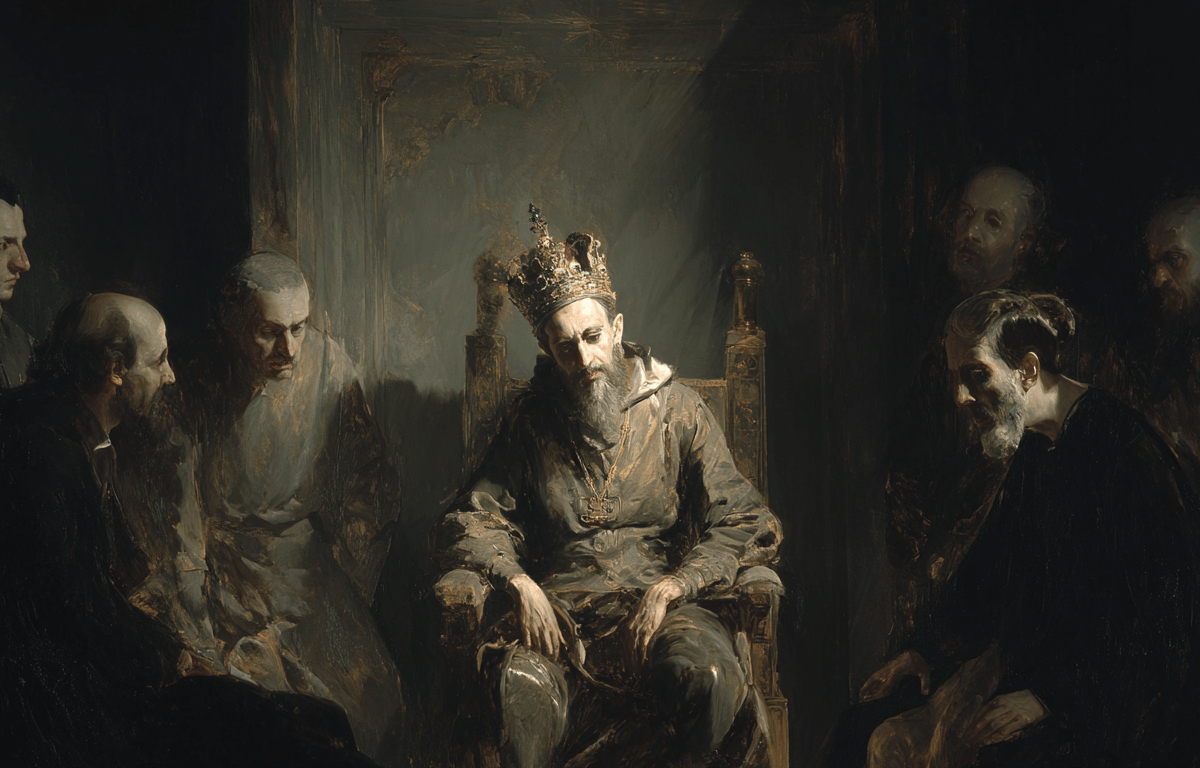
Modern liberal democracies still chant the Enlightenment’s refrain: the rational, self-governing individual acting freely within a moral order of their own design. It’s an elegant myth – until the self begins to wobble. Under economic, cultural, and epistemic strain, autonomy curdles into exhaustion, and exhaustion seeks relief in obedience.

Audio: NotebookLM podcast of this essay. Please note that this audio summarises the entire essay. As such, it’s also longer than most, coming in at just under 40 minutes. I listened to it, and I feel it does a good job of capturing the essences of the essay. Of course, you could read the essay more quickly, but the perspective may still be helpful.

This essay traces that drift – from the Enlightenment’s causa sui complex to the ecstatic submission that defines modern authoritarianism. Drawing on Fromm, Arendt, Adorno, Reich, Han, and Desmet, it explores how freedom’s rhetoric becomes its opposite: obedience moralised as virtue, conformity sold as courage, submission experienced as pleasure.

At its core, The Will to Be Ruled argues that totalitarianism is not the antithesis of Enlightenment reason but its fulfilment. Once the world is rendered intelligible only through rational mastery, the subject inevitably longs to be mastered in return.

The closing section introduces Dis-Integrationism – a philosophical stance that declines redemption, preferring maintenance over mastery. It offers no cure, only the small ethic of attentiveness: keeping the field responsive while the light fades.

Filed under the Anti-Enlightenment Project, this essay completes the current thematic triad alongside Objectivity Is Illusion and Against Agency.

NB: This essay was inspired in part by Desmet’s The Psychology of Totalitarianism and this video:

Video: The Modern World, Totalitarianism and the Brain with Iain McGilchrist & Mattias Desmet

Baudrillard in Latex: Why The Matrix Was Right About Everything Except Freedom

2–3 minutes

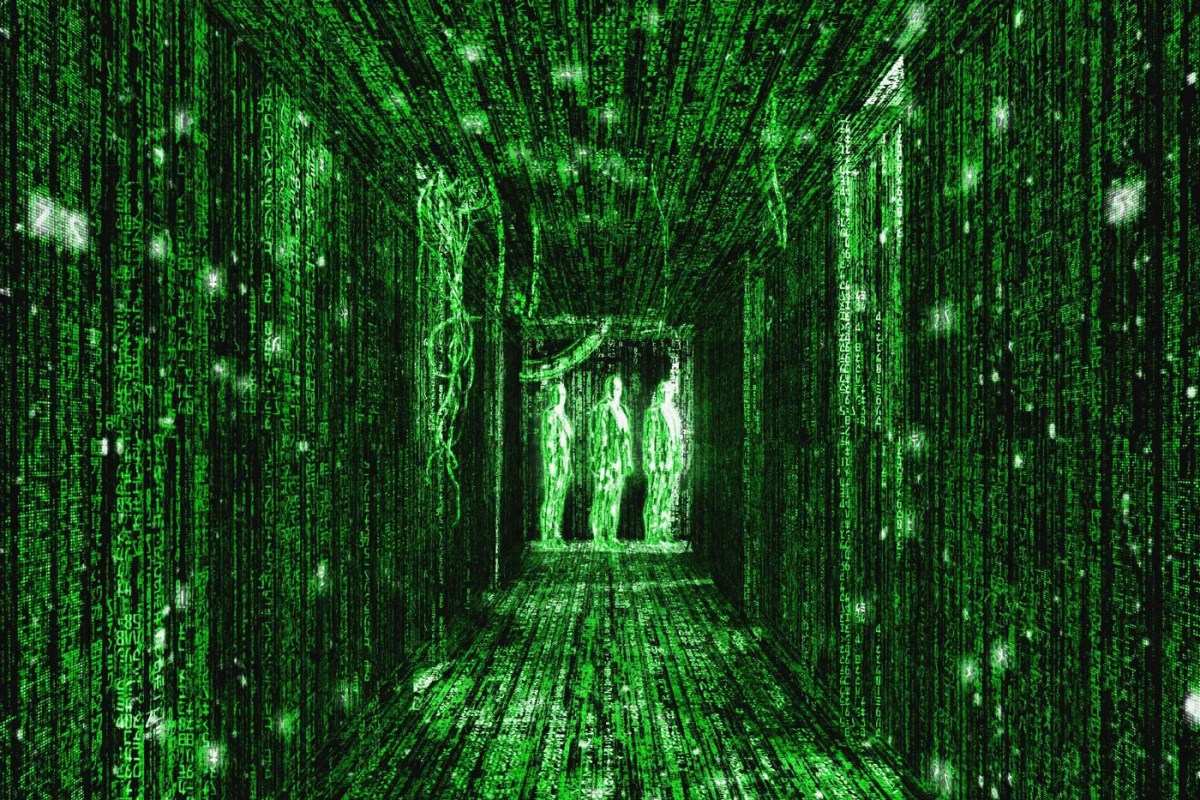
In the late 1990s, the Wachowskis gave us The Matrix – Keanu Reeves as Neo, the Chosen One™, a man so bland he could be anyone, which was the point. Once he realised he was living inside a simulation, he learned to bend its laws, to dodge bullets in slow motion and see the code behind the curtain. Enlightenment, Hollywood-style.

Audio: NotebookLM podcast on this topic.

But here’s the twist, the film itself couldn’t stomach: realising the simulation doesn’t free you from it.

Knowing that race and gender are social constructs doesn’t erase their architecture. Knowing that our economies, legal systems, and so-called democracies are fictions doesn’t get us out of paying taxes or playing our assigned roles. “The social contract” is a collective hallucination we agreed to before birth. That and a dollar still won’t buy you a cup of coffee.

Baudrillard, whose Simulacra and Simulation the film name-dropped like a trophy, argued that simulation doesn’t hide reality – it replaces it. When representation becomes indistinguishable from the thing it represents, truth evaporates, leaving only consensus. We don’t live in a system of power; we live in its performance.

The Matrix got the metaphor half right. It imagined the bars of our cage as a digital dream – glossy, computable, escapable. But our chains are older and subtler. Rousseau called them “social”, Foucault diagnosed them as “biopolitical”, and the rest of us just call them “normal”. Power doesn’t need to plug wires into your skull; it only needs to convince you that the socket is already there.

You can know it’s all a fiction. You can quote Derrida over your morning espresso and tweet about the collapse of epistemic certainty. It won’t change the fact that you still have rent to pay, laws to obey, and identities to perform. Awareness isn’t liberation; it’s just higher-resolution despair with better UX.

Neo woke up to a ruined Earth and thought he’d escaped. He hadn’t. He’d only levelled up to the next simulation – the one called “reality”. The rest of us are still here, dutifully maintaining the system, typing in our passwords, and calling it freedom.

NB: Don’t get me wrong. I loved The Matrix when it came out. I still have fond memories. It redefined action films at the time. I loved the Zen messaging, but better mental acuity doesn’t grant you a pass out of the system.

Against Agency: The Fiction of the Autonomous Self

2–3 minutes

The Enlightenment’s Most Beloved Lie

🔗 Read the full preprint on Zenodo
🔗 Explore the Anti-Enlightenment Project

The Enlightenment promised liberation through reason – that if we could think clearly enough, we could act freely enough. Agency, it claimed, was the defining trait of the rational individual: a sovereign chooser, self-contained and self-determining.

But this was always a fiction.

Not an innocent one, either.

Audio: NotebookLM podcast discussing the essay, Against Agency

Agency became the moral infrastructure of modernity – the premise behind law, punishment, merit, guilt, and even political participation. To say “I chose” was not simply to describe behaviour; it was to perform belonging within a metaphysical system that made individuals the unit of responsibility. The fiction worked, for a while, because it kept the machinery running.

Against Agency argues that this story has collapsed – not metaphorically but structurally. Cognitive science, postcolonial thought, and relational philosophies all point to the same conclusion: there is no autonomous agent, only differential responsiveness – a system’s fluctuating capacity to register and transmit influence.

Copper sings under current; rubber resists. Humans, likewise, respond within the constraints of biology, fatigue, trauma, and social design. What we call “freedom” is merely a condition in which responsiveness remains broad and protected.

This reframing dismantles the binary of “free” and “unfree.” There is no metaphysical threshold where agency appears. Instead, responsiveness scales – widened by safety, narrowed by coercion, eroded by exhaustion. Politics becomes engineering: the maintenance of conditions that sustain responsiveness, rather than the worship of choice.

Ethics, too, must shift.

Not “Who is to blame?” but “Where did the circuit break?”

The essay proposes a gradient model of conduct grounded in relation and feedback, rather than autonomy and will. Responsibility becomes less about moral worth and more about bandwidth – a physics of care.

It’s an uncomfortable vision for a culture addicted to outrage and repentance. The loss of agency removes our favourite alibi: the chooser who could have done otherwise. But it also opens the possibility of a more honest ethics – one that replaces judgment with maintenance, retribution with repair.

This is not nihilism. It’s realism.

Systems appear stable only from a distance. Up close, everything is process – bodies, institutions, meanings – held together by temporary alignments of responsiveness. Against Agency names this collapse not as tragedy, but as opportunity: a clearing from which to think and act without the fictions that sustained modernity.

The essay forms the foundation for what comes next in the Anti-Enlightenment ProjectDis-Integration, a philosophical sequel that explores what remains once coherence, control, and autonomy have been decommissioned.

Boab’s God: Latent Agency in Welsh’s Kafkaesque Metamorphosis

I just read The Granton Star Cause in Irvine Welsh’s short story collection, The Acid House, and couldn’t help but reflect it off of Kafka’s Metamorphosis.

Kafka gave us Gregor Samsa: a man who wakes up as vermin, stripped of usefulness, abandoned by family, slowly rotting in a godless universe. His tragedy is inertia; his metamorphosis grants him no agency, only deeper alienation.

Audio: NotebookLM podcast on this topic.

Welsh replies with Boab Coyle, a lad who is likewise cast off, rejected by his football mates, scorned by his parents, dumped by his girlfriend, and discarded by his job. Boab is surplus to every domain: civic, familial, erotic, and economic. Then he undergoes his own metamorphosis. And here Welsh swerves from Kafka.

Boab meets his “god.” But the god is nothing transcendent. It is simply Boab’s latent agency, given a mask – a projection of his bitterness and thwarted desires. God looks like him, speaks like him, and tells him to act on impulses long repressed. Where Kafka leaves Gregor to die in silence, Welsh gives Boab a grotesque theology of vengeance.

Through a Critical Theory lens, the contrast is stark:

  • Marx: Both men are surplus. Gregor is disposable labour; Boab is Thatcher’s lumpen. Alienated, both become vermin.
  • Nietzsche: Gregor has no god, only the absurd. Boab makes one in his own image, not an Übermensch, but an Über-fly – quite literally a Superfly – a petty deity of spite.
  • Foucault: Gregor is disciplined into passivity by the family gaze. Boab flips it: as a fly, he surveils and annoys, becoming the pest-panopticon.
  • Bataille/Kristeva: Gregor embodies the abjection of his family’s shame. Boab revels in abjection, weaponising filth as his new mode of agency.

The punchline? Boab’s new god-agency leads straight to destruction. His rage is cathartic, but impotent. The lumpen are permitted vengeance only when it consumes themselves.

So Kafka gave us the tragedy of stasis; Welsh provides us with the tragedy of spite. Both are bleak parables of alienation, but Welsh injects a theology of bad attitude: a god who licenses action only long enough to destroy the actor.

Gregor rots. Boab rages. Both end the same way.

Trainspotting

Trainspotting Movie Poster
2–3 minutes

I identify strongly with Irvine Welsh’s characters in Trainspottingthe book, not the sanitised film version. Especially with Mark Renton, whose voice strips away illusions with a brutality that borders on honesty.

Audio: NotebookLM podcast on this topic.

Consider this passage from the chapter “Bang to Rites” (pp. 86–87), where Renton attends the funeral of his mate Billy. Billy joined the army to escape the dead-end life they all shared, only to be killed on duty in Northern Ireland. Renton’s verdict:

[1] Renton doesn’t let anyone off the hook. Not Billy, not the army, not the Oxbridge suits who polish the tragedy into something fit for the News at Ten. The uniform is a costume, a disguise: a working-class lad suddenly deemed “brave” only because he was wearing the right outfit when he died. Strip away the uniform, and he’d have been dismissed as a thug or a waster.

[2] Renton’s root-cause analysis is unsparing. Billy wasn’t killed by the man with the gun so much as by the machine that put him there – the state, the ruling classes, the ones who spin death into “sacrifice” while continuing to shuffle the poor like pawns across the board.

It’s this clarity that makes Welsh’s work more than a drug novel. Trainspotting isn’t just about needles and nods; it’s about seeing through the charade. Renton despises both establishment and rebellion because both are performance, both hollow. His cynicism is the closest thing to honesty in a world that would rather dress up corpses in borrowed dignity.

And maybe that’s why I feel the affinity: because subversion matters more than allegiance, and sometimes the only truthful voice is the one that refuses to be polite at the funeral.

Democracy: The Worst Form of Government, and Other Bedtime Stories

3–5 minutes

Karl Popper’s Paradox of Intolerance has become a kind of intellectual talisman, clutched like a rosary whenever fascists start goose-stepping into the town square. Its message is simple enough: to preserve tolerance, one must be intolerant of intolerance. Shine enough sunlight on bad ideas, and – so the pious hope – they’ll shrivel into dust like a vampire caught out at dawn.

If only.

The trouble with this Enlightenment fairy tale is that it presumes bad ideas melt under the warm lamp of Reason, as if ignorance were merely a patch of mildew waiting for the bleach of debate. But bad ideas are not bacteria; they are weeds, hydra-headed and delighting in the sun. Put them on television, and they metastasise. Confront them with logic, and they metastasise faster, now with a martyr’s halo.

Audio: NotebookLM podcast on this topic.

And here’s the part no liberal dinner-party theorist likes to face: the people most wedded to these “bad ideas” often don’t play the game of reason at all. Their critical faculties have been packed up, bubble-wrapped, and left in the loft decades ago. They don’t want dialogue. They want to chant. They don’t want evidence. They want affirmation. The Socratic method bounces off them like a ping-pong ball fired at a tank.

But let’s be generous. Suppose, just for a moment, we had Plato’s dream: a citizenry of Philosopher Kings™, all enlightened, all rational. Would democracy then work? Cue Arrow’s Impossibility Theorem, that mathematical killjoy which proves that even under perfect conditions – omniscient voters, saintly preferences, universal literacy – you still cannot aggregate those preferences into a system that is both fair and internally consistent. Democracy can’t even get out of its own way on paper.

Now throw in actual humans. Not the Platonic paragons, but Brexit-uncle at the pub, Facebook aunt with her memes, the American cousin in a red cap insisting a convicted felon is the second coming. Suddenly, democracy looks less like a forum of reasoned debate and more like a lottery machine coughing up numbers while we all pretend they mean “the will of the people.”

And this is where the Churchill quip waddles in, cigar smoke curling round its bowler hat: “Democracy is the worst form of government, except for all the others.” Ah yes, Winston, do please save us with a quip so well-worn it’s practically elevator music. But the problem is deeper than taste in quotations. If democracy is logically impossible (Arrow) and practically dysfunctional (Trump, Brexit, fill in your own national catastrophe), then congratulating ourselves that it’s “better than the alternatives” is simply an admission that we’ve run out of imagination.

Because there are alternatives. A disinterested AI, for instance, could distribute resources with mathematical fairness, free from lobbyists and grievance-mongers. Nursery schools versus nursing homes? Feed in the data, spit out the optimal allocation. No shouting matches, no demagoguery, no ballots stuffed with slogans. But here the defenders of democracy suddenly become Derrida in disguise: “Ah, but what does fair really mean?” And just like that, we are back in the funhouse of rhetorical mirrors where “fair” is a word everyone loves until it costs them something.

So perhaps democracy doesn’t require an “educated populace” at all; that was always just sugar-paper wrapping. It requires, instead, a population sufficiently docile, sufficiently narcotised by the spectacle, to accept the carnival of elections as a substitute for politics. Which is why calling the devotees of a Trump, or any other demagogue, a gaggle of lemmings is both accurate and impolitic: they know they’re not reasoning; they’re revelling. Your contempt merely confirms the script they’ve already written for you.

Video: Short callout to Karl Popper and Hilary Lawson.

The philosopher, meanwhile, is left polishing his lantern, muttering about reason to an audience who would rather scroll memes about pedophile pizza parlours. Popper warned us that tolerance cannot survive if it tolerates its own annihilation. Arrow proved that even if everyone were perfectly reasonable, the maths would still collapse. And Churchill, bless him, left us a one-liner to make it all seem inevitable.

Perhaps democracy isn’t the worst form of government except for all the others. Perhaps it’s simply the most palatable form of chaos, ballots instead of barricades, polling booths instead of pitchforks. And maybe the real scandal isn’t that people are too stupid for democracy, but that democracy was never designed to be about intelligence in the first place. It was always about managing losers while telling them they’d “had their say.”

The Enlightenment promised us reason; what it delivered was a carnival where the loudest barker gets the booth. The rest of us can either keep muttering about paradoxes in the corner or admit that the show is a farce and start imagining something else.