The Insufficiency of Language Meets Generative AI

I’ve written a lot on the insufficiency of language, and it’s not even an original idea. Language, our primary tool for sharing thoughts and ideas, harbours a fundamental flaw: it’s inherently insufficient for conveying precise meaning. While this observation isn’t novel, recent developments in artificial intelligence provide us with new ways to illuminate and examine this limitation. Through a progression from simple geometry to complex abstractions, we can explore how language both serves and fails us in different contexts.

Audio: NotebookLM summary podcast of this topic.

The Simple Made Complex

Consider what appears to be a straightforward instruction: Draw a 1-millimetre square in the centre of an A4 sheet of paper using an HB pencil and a ruler. Despite the mathematical precision of these specifications, two people following these exact instructions would likely produce different results. The variables are numerous: ruler calibration, pencil sharpness, line thickness, paper texture, applied pressure, interpretation of ‘centre’, and even ambient conditions affecting the paper.

This example reveals a paradox: the more precisely we attempt to specify requirements, the more variables we introduce, creating additional points of potential divergence. Even in mathematics and formal logic—languages specifically designed to eliminate ambiguity—we cannot escape this fundamental problem.

Precision vs Accuracy: A Useful Lens

The scientific distinction between precision and accuracy provides a valuable framework for understanding these limitations. In measurement, precision refers to the consistency of results (how close repeated measurements are to each other), while accuracy describes how close these measurements are to the true value.

Returning to our square example:

  • Precision: Two people might consistently reproduce their own squares with exact dimensions
  • Accuracy: Yet neither might capture the ‘true’ square we intended to convey

As we move from geometric shapes to natural objects, this distinction becomes even more revealing. Consider a maple tree in autumn. We might precisely convey certain categorical aspects (‘maple’, ‘autumn colours’), but accurately describing the exact arrangement of branches and leaves becomes increasingly difficult.

The Target of Meaning: Precision vs. Accuracy in Communication

To understand language’s limitations, we can borrow an illuminating concept from the world of measurement: the distinction between precision and accuracy. Imagine a target with a bullseye, where the bullseye represents perfect communication of meaning. Just as archers might hit different parts of a target, our attempts at communication can vary in both precision and accuracy.

Consider four scenarios:
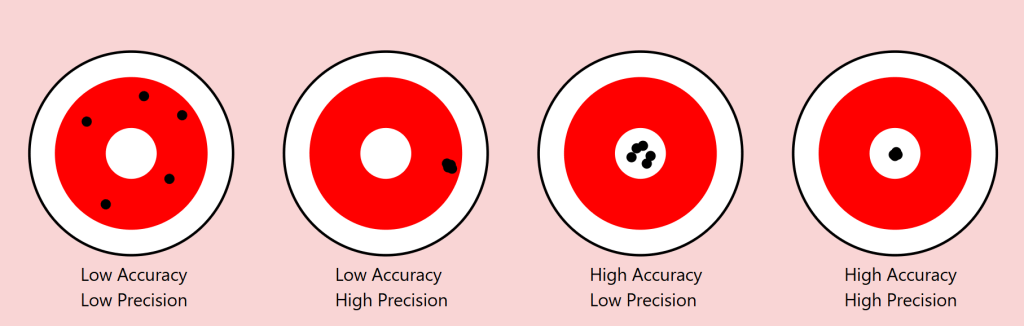
  1. Low Precision, Low Accuracy
    When describing our autumn maple tree, we might say ‘it’s a big tree with colourful leaves’. This description is neither precise (it could apply to many trees) nor accurate (it misses the specific characteristics that make our maple unique). The communication scatters widely and misses the mark entirely.
  2. High Precision, Low Accuracy
    We might describe the tree as ‘a 47-foot tall maple with exactly 23,487 leaves displaying RGB color values of #FF4500’. This description is precisely specific but entirely misses the meaningful essence of the tree we’re trying to describe. Like arrows clustering tightly in the wrong spot, we’re consistently missing the point.
  3. Low Precision, High Accuracy
    ‘It’s sort of spreading out, you know, with those typical maple leaves turning reddish-orange, kind of graceful looking.’ While imprecise, this description might actually capture something true about the tree’s essence. The arrows scatter, but their centre mass hits the target.
  4. High Precision, High Accuracy
    This ideal state is rarely achievable in complex communication. Even in our simple geometric example of drawing a 1mm square, achieving both precise specifications and accurate execution proves challenging. With natural objects and abstract concepts, this challenge compounds exponentially.

The Communication Paradox

This framework reveals a crucial paradox in language: often, our attempts to increase precision (by adding more specific details) can actually decrease accuracy (by moving us further from the essential meaning we’re trying to convey). Consider legal documents: their high precision often comes at the cost of accurately conveying meaning to most readers.

Implications for AI Communication

This precision-accuracy framework helps explain why AI systems like our Midjourney experiment show asymptotic behaviour. The system might achieve high precision (consistently generating similar images based on descriptions) while struggling with accuracy (matching the original intended image), or vice versa. The gap between human intention and machine interpretation often manifests as a trade-off between these two qualities.

Our challenge, both in human-to-human and human-to-AI communication, isn’t to achieve perfect precision and accuracy – a likely impossible goal – but to find the optimal balance for each context. Sometimes, like in poetry, low precision might better serve accurate meaning. In other contexts, like technical specifications, high precision becomes crucial despite potential sacrifices in broader accuracy.

The Power and Limits of Distinction

This leads us to a crucial insight from Ferdinand de Saussure’s semiotics about the relationship between signifier (the word) and signified (the concept or object). Language proves remarkably effective when its primary task is distinction among a limited set. In a garden containing three trees – a pine, a maple, and a willow – asking someone to ‘point to the pine’ will likely succeed. The shared understanding of these categorical distinctions allows for reliable communication.

However, this effectiveness dramatically diminishes when we move from distinction to description. In a forest of a thousand pines, describing one specific tree becomes nearly impossible. Each additional descriptive detail (‘the tall one with a bent branch pointing east’) paradoxically makes precise identification both more specific and less likely to succeed.

An AI Experiment in Description

To explore this phenomenon systematically, I conducted an experiment using Midjourney 6.1, a state-of-the-art image generation AI. The methodology was simple:

  1. Generate an initial image
  2. Describe the generated image in words
  3. Use that description to generate a new image
  4. Repeat the process multiple times
  5. Attempt to refine the description to close the gap
  6. Continue iterations

The results support an asymptotic hypothesis: while subsequent iterations might approach the original image, they never fully converge. This isn’t merely a limitation of the AI system but rather a demonstration of language’s fundamental insufficiency.

One can already analyse this for improvements, but let’s parse it together.

a cute woman

With this, we know we are referencing a woman, a female of the human species. There are billions of women in the world. What does she look like? What colour, height, ethnicity, and phenotypical attributes does she embody?

We also know she’s cute – whatever that means to the sender and receiver of these instructions.

I used an indefinite article, a, so there is one cute woman. Is she alone, or is she one from a group?

It should be obvious that we could provide more adjectives (and perhaps adjectives) to better convey our subject. We’ll get there, but let’s move on.

and

We’ve got a conjunction here. Let’s see what it connects to.

her dog

She’s with a dog. In fact, it’s her dog. This possession may not be conveyable or differentiable from some arbitrary dog, but what type of dog is it? Is it large or small? What colour coat? Is it groomed? Is it on a leash? Let’s continue.

stand

It seems that the verb stand refers to the woman, but is the dog also standing, or is she holding it? More words could qualify this statement better.

next to a tree

A tree is referenced. Similar questions arise regarding this tree. At a minimum, there is one tree or some variety. She and her dog are next to it. Is she on the right or left of it?

We think we can refine our statements with precision and accuracy, but can we? Might we just settle for “close enough”?

Let’s see how AI interpreted this statement.

Image: Eight Midjourney renders from the prompt: A cute woman and her dog stand next to a tree. I’ll choose one of these as my source image.

Let’s deconstruct the eight renders above. Compositionally, we can see that each image contains a woman, a dog, and a tree. Do any of these match what you had in mind? First, let’s see how Midjourney describes the first image.

In a bout of hypocrisy, Midjourney refused to /DESCRIBE the image it just generated.

Last Midjourney description for now.

Let’s cycle through them in turn.

  1. A woman is standing to the left of an old-growth tree – twice identified as an oak tree. She’s wearing faded blue jeans and a loose light-coloured T-shirt. She’s got medium-length (maybe) red-brown hair in a small ponytail. A dog – her black and white dog identified as a pitbull, an American Foxhound, and an American Bulldog – is also standing on his hind legs. I won’t even discuss the implied intent projected on the animal – happy, playful, wants attention… In two of the descriptions, she’s said to be training it. They appear to be in a somewhat residential area given the automobiles in the background. We see descriptions of season, time of day, lighting, angle, quality,
  2. A woman is standing to the right of an old-growth tree. She’s wearing short summer attire. Her dog is perched on the tree.
  3. An older woman and her dog closer up.
  4. A read view of both a woman and her dog near an oak tree.

As it turned out, I wasn’t thrilled with any of these images, so I rendered a different one. Its description follows.

The consensus is that ‘a beautiful girl in a white dress and black boots stands next to a tree’ with a Jack Russell Terrier dog. I see birch trees and snow. It’s overcast. Let’s spend some time trying to reproduce it. To start, I’m consolidating the above descriptions. I notice some elements are missing, but we’ll add them as we try to triangulate to the original image.

A beautiful girl in a white dress and black boots stands next to a tree in a winter forest with birch trees. A Jack Russell Terrier dog is nearby, and the weather is cloudy. The photo has a cinematic style. --ar 128:71

This is pretty far off the mark. We need to account for the overall setting and composition, relative positioning, clothing, hair, camera, perspective – even lighting and film emulsion.

Let’s see how we can refine it with some adjectives. Before this, I asked Anthropic’s Claude 3.5 to describe the image. Perhaps we’ll get more details.

An atmospheric winter photograph was taken in what appears to be a birch and pine forest. The ground is partially covered with snow, creating a patchy pattern of white snow and brown leaves or soil. In the image, there's a person wearing winter attire consisting of a white knit turtleneck sweater, a white skirt, dark knee-high socks, and grey lace-up boots. They're standing against a large tree trunk with their arms crossed. Next to them is a Jack Russell Terrier mix dog with distinctive brown and white colouring. The dog appears to be well-behaved, sitting attentively beside the tree. The composition is quite striking, with the massive dark tree trunk serving as a central focal point against the misty, winter forest background. The white clothing of the person creates a visual echo with the white bark of birch trees visible in the background, as well as with the patches of snow on the ground. The overall mood of the photo is somewhat moody and contemplative, enhanced by what appears to be overcast lighting and the misty quality of the forest in the background. The colour palette is largely monochromatic, dominated by whites, greys, and browns, which adds to the winter atmosphere of the scene.

We don’t seem to be moving in a good direction. Let’s modify the initial prompt.

A beautiful girl in a white dress and tall laced black boots stands facing the camera to the right of large oak tree centred in the foreground of a winter forest with birch trees in the background. To the left of the tree is a Jack Russell Terrier dog looking at the camera, and the weather is cloudy. The photo has a cinematic style. --ar 128:71

I’ll allow the results to speak for themselves. Let’s see if we can’t get her out of the wedding gown and into a white jumper and skirt. I’ll bold the amends.

A beautiful girl in a white jumper and skirt wearing black leggings and tall laced black boots stands facing the camera to the right of large oak tree centred in the foreground of a winter forest with birch trees in the background. To the left of the tree is a Jack Russell Terrier dog looking at the camera, and the weather is cloudy. The photo has a cinematic style. --ar 128:71

s

A beautiful young woman with long brown hair pulled to the side of her face in a white jumper and white skirt wearing black leggings under tall laced black boots stands facing the camera to the right of large oak tree centred in the foreground of a winter forest with birch trees in the background. Patchy snow is on the ground. To the left of the tree is a Jack Russell Terrier dog looking at the camera, and the weather is overcast. The photo has a cinematic style. --ar 128:71

What gives?

I think my point has been reinforced. I’m getting nowhere fast. Let’s give it one more go and see where we end up. I’ve not got a good feeling about this.

A single large oak tree centred in the foreground of a winter forest with birch trees in the background. Patches of snow is on the ground. To the right of the oak tree stands a beautiful young woman with long brown hair pulled to the side of her face in a white jumper and white skirt wearing black boots over tall laced black boots. She stands facing the camera. To the left of the tree is a Jack Russell Terrier dog looking at the camera, and the weather is overcast. The photo has a cinematic style. --ar 128:71

With this last one, I re-uploaded the original render along with this text prompt. Notice that the girl now looks the same and the scene (mostly) appears to be in the same location, but there are still challenges.

After several more divergent attempts, I decided to focus on one element – the girl.

As I regard the image, I’m thinking of a police sketch artist. They get sort of close, don’t they? They’re experts. I’m not confident that I even have the vocabulary to convey accurately what I see. How do I describe her jumper? Is that a turtleneck or a high collar? It appears to be knit. Is is wool or some blend? does that matter for an image? Does this pleated skirt have a particular name or shade of white? It looks as though she’s wearing black leggings – perhaps polyester. And those boots – how to describe them. I’m rerunning just the image above through a describe function to see if I can get any closer.
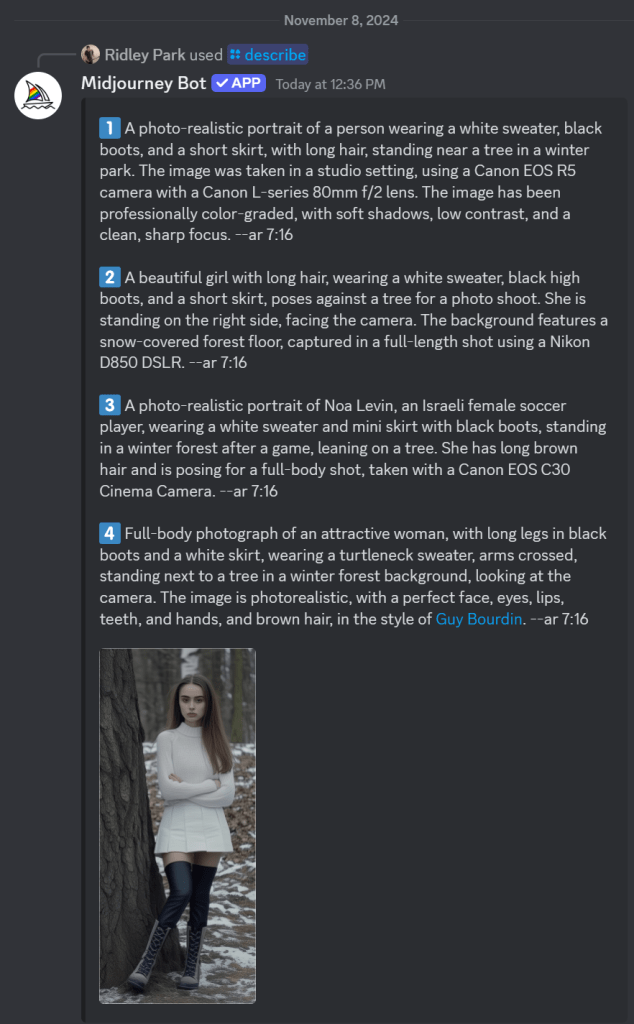
These descriptions are particularly interesting and telling. First, I’ll point out that AI attempts to identify the subject. I couldn’t find Noa Levin by a Google search, so I’m not sure how prominent she might be if she even exists at all in this capacity. More interesting still, the AI has placed her in a scenario where the pose was taken after a match. Evidently, this image reflects the style of photographer Guy Bourdin. Perhaps the jumper mystery is solved. It identified a turtleneck. I’ll ignore the tree and see if I can capture her with an amalgamation of these descriptions. Let’s see where this goes.

A photo-realistic portrait of Israeli female soccer player Noa Levin wearing a white turtleneck sweater, arms crossed, black boots, and a short skirt, with long brown hair, standing near a tree in a winter park. The image captured a full-length shot taken in a studio setting, using a Canon EOS R5 camera with a Canon L-series 80mm f/2 lens. The image has been professionally color-graded, with soft shadows, low contrast, and a clean, sharp focus. --ar 9:16

Close-ish. Let’s zoom in to get better descriptions of various elements starting with her face and hair.

Now, she’s a sad and angry Russian woman with (very) pale skin; large, sad, grey eyes; long, straight brown hair. Filmed in the style of either David LaChapelle or Alini Aenami (apparently misspelt from Alena Aenami). One thinks it was a SnapChat post. I was focusing on her face and hair, but it notices her wearing a white (oversized yet form-fitting) jumper sweater and crossed arms .

I’ll drop the angry bit – and then the sad.

Stick a fork in it. I’m done. Perhaps it’s not that language is insufficient; it that my language skills are insufficient. If you can get closer to the original image, please forward the image, the prompt, and the seed, so I can post it.

The Complexity Gradient

A clear pattern emerges when we examine how language performs across different levels of complexity:

  1. Categorical Distinction (High Success)
    • Identifying shapes among limited options
    • Distinguishing between tree species
    • Basic color categorization
  2. Simple Description (Moderate Success)
    • Basic geometric specifications
    • General object characteristics
    • Broad emotional states
  3. Complex Description (Low Success)
    • Specific natural objects
    • Precise emotional experiences
    • Unique instances within categories
  4. Abstract Concepts (Lowest Success)
    • Philosophical ideas
    • Personal experiences
    • Qualia

As we move up this complexity gradient, the gap between intended meaning and received understanding widens exponentially.

The Tolerance Problem

Understanding these limitations leads us to a practical question: what level of communicative tolerance is acceptable for different contexts? Just as engineering embraces acceptable tolerances rather than seeking perfect measurements, perhaps effective communication requires:

  • Acknowledging the gap between intended and received meaning
  • Establishing context-appropriate tolerance levels
  • Developing better frameworks for managing these tolerances
  • Recognizing when precision matters more than accuracy (or vice versa)

Implications for Human-AI Communication

These insights have particular relevance as we develop more sophisticated AI systems. The limitations we’ve explored suggest that:

  • Some communication problems might be fundamental rather than technical
  • AI systems may face similar boundaries as human communication
  • The gap between intended and received meaning might be unbridgeable
  • Future development should focus on managing rather than eliminating these limitations

Conclusion

Perhaps this is a simple exercise in mental masturbation. Language’s insufficiency isn’t a flaw to be fixed but a fundamental characteristic to be understood and accommodated. By definition, it can’t be fixed. The gap between intended and received meaning may be unbridgeable, but acknowledging this limitation is the first step toward more effective communication. As we continue to develop AI systems and push the boundaries of human-machine interaction, this understanding becomes increasingly critical.

Rather than seeking perfect precision in language, we might instead focus on:

  • Developing new forms of multimodal communication
  • Creating better frameworks for establishing shared context
  • Accepting and accounting for interpretative variance
  • Building systems that can operate effectively within these constraints

Understanding language’s limitations doesn’t diminish its value; rather, it helps us use it more effectively by working within its natural constraints.

Jargon, Brains, and the Struggle for Meaning

6–9 minutes

Specialised Languages: Academia’s Jargon Olympics

If you thought normal language was confusing, let’s take a moment to appreciate the true champions of linguistic obscurity: academics. Welcome to the world of specialised languages, where entire fields of study have developed their own language games that make even Wittgenstein’s head spin.

Here’s how it works: Every discipline—science, law, philosophy—creates its own jargon to describe the world. At first, it seems helpful. Instead of using vague terms, you get precise definitions for complex ideas. But what started as a way to improve communication within a field quickly turned into a linguistic arms race, where the more obscure and convoluted your terms are, the smarter you sound. You’re not just a lawyer anymore—you’re someone who’s ready to throw “res ipsa loquitur” into casual conversation to leave everyone else in the room wondering if they’ve missed a memo.

The problem? If you’re not part of the club, good luck understanding what anyone is talking about. Want to read a physics paper? Prepare to learn a whole new vocabulary. Need to get through a legal document? You’ll be knee-deep in Latin phrases before you even get to the point. And don’t even try to decipher a philosophical text unless you’re ready to battle abstract nouns that have been stretched and twisted beyond recognition.

It’s not just the words themselves that are the issue—it’s the sheer density of them. Take “justice” for example. In philosophy, you’ve got theories about distributive justice, retributive justice, restorative justice, and a hundred other variations, each with its own set of terms and conditions. And that’s before we even touch on how “justice” is defined in legal circles, where it becomes an even more tangled mess of case law and precedent. Every field is playing its own version of the “justice” game, with its own rules and definitions, and none of them are interested in comparing notes.

This is the academic world in a nutshell. Each discipline has built its own linguistic fortress, and unless you’ve spent years studying, you’re not getting in. But here’s the kicker: even within these fields, people are often misunderstanding each other. Just because two scientists are using the same words doesn’t mean they’re on the same page. Sometimes, it’s more like a game of intellectual one-upmanship—who can define the most obscure term or twist a familiar word into something completely unrecognisable?

And let’s not forget the philosophers. They’ve turned linguistic acrobatics into an art form. Good luck reading Foucault or Derrida without a dictionary (or five) on hand. You might walk away thinking you understand their points, but do you really? Or have you just memorised the jargon without actually grasping the deeper meaning? Even scholars within these fields often argue over what was really meant by a certain text—Barthes, after all, famously declared the “death of the author,” so it’s not like anyone really has the final say on meaning anyway.

So here we are, knee-deep in jargon, trying to communicate with people who, technically, speak the same language but are operating within entirely different rulesets. Every academic discipline has its own secret code, and if you don’t know it, you’re lost. Even when you do know the code, you’re still at risk of miscommunication, because the words that look familiar have been stretched and shaped to fit highly specific contexts. It’s like being fluent in one dialect of English and then suddenly being asked to write a thesis in legalese. Good luck.

In the end, academia’s specialised languages don’t just make things harder—they actively create barriers. What started as a way to improve precision has turned into an obstacle course of incomprehensible terms, where the real challenge is just figuring out what anyone’s actually saying. And let’s be honest, even if you do figure it out, there’s no guarantee it’s going to mean the same thing next time you see it.

Neurolinguistics: Even Our Brains Can’t Agree

So far, we’ve seen how language is a mess of miscommunication, cultural differences, and academic jargon. But surely, at least on a biological level, our brains are all on the same page, right? Well, not exactly. Welcome to the wonderful world of neurolinguistics, where it turns out that even the very organ responsible for language can’t get its act together.

Here’s the deal: Neurolinguistics is the study of how the brain processes language, and while it’s fascinating, it’s also a bit of a buzzkill for anyone hoping for consistency. See, your brain and my brain don’t process language in the same way. Sure, we’ve got similar hardware, but the software is wildly unpredictable. There are individual differences, cultural influences, and developmental quirks that all affect how we understand and produce language. What’s simple for one brain might be completely baffling to another.

Take, for example, something as basic as syntax. Chomsky might have told us we all have a universal grammar hard-wired into our brains, but neurolinguistics has shown that how we apply that grammar can vary significantly. Some people are wired to handle complex sentence structures with ease—think of that friend who can follow 10 different clauses in a single breath. Others? Not so much. For them, even a moderately tricky sentence feels like mental gymnastics. The brain is constantly juggling words, meanings, and structures, and some brains are better at it than others.

But the real kicker is how differently we interpret words. Remember those abstract nouns we’ve been wrestling with? Well, it turns out that your brain might be interpreting ‘freedom’ or ‘justice’ completely differently from mine – not just because of culture or upbringing, but because our brains physically process those words in different ways. Neurolinguistic studies have shown that certain regions of the brain are activated differently depending on the individual’s experience with language. In other words, your personal history with a concept can literally change how your brain lights up when you hear or say it.

And don’t even get me started on bilingual brains. If you speak more than one language, your brain is constantly toggling between two (or more) linguistic systems, which means it’s running twice the risk of misinterpretation. What a word means in one language might trigger a completely different association in another, leaving bilingual speakers in a constant state of linguistic flux. It’s like trying to run two operating systems on the same computer—things are bound to get glitchy.

But here’s the real kicker: Even within the same person, the brain can’t always process language the same way all the time. Stress, fatigue, emotional state—all of these factors can influence how well we handle language on any given day. Ever tried to have a coherent conversation when you’re tired or angry? Good luck. Your brain isn’t interested in nuance or deep philosophical ideas when it’s in survival mode. It’s just trying to get through the day without short-circuiting.

So, not only do we have to deal with the external chaos of language – miscommunication, different contexts, shifting meanings – but we also have to contend with the fact that our own brains are unreliable interpreters. You can use all the right words, follow all the right grammar rules, and still end up with a garbled mess of meaning because your brain decided to take a nap halfway through the sentence.

In the end, neurolinguistics reminds us that language isn’t just a social or cultural problem – it’’’s a biological one too. Our brains are doing their best to keep up, but they’re far from perfect. The very organ that makes language possible is also responsible for making it infinitely more complicated than it needs to be. And if we can’t rely on our own brains to process language consistently, what hope do we have of ever understanding anyone else?


◀ Previous | Next ▶

The Great Language Game: Between Structure and Chaos

5–7 minutes

Wittgenstein: Words Don’t Actually Mean Things, Sorry

If you thought we were done with language being slippery and unreliable, buckle up. Enter Ludwig Wittgenstein, the philosopher who essentially came along and said, “Oh, you thought words were bad? Let me show you just how deep this rabbit hole goes.”

Wittgenstein wasn’t content to let us cling to the idea that words could actually, you know, mean things. His big revelation? Words don’t even have fixed meanings at all. They only mean something because we use them in certain ways—and the meaning can change depending on the context. Welcome to Wittgenstein’s idea of language games, where words are like players on a field, running around, changing positions, and playing by different rules depending on which game you’re in.

Think of it this way: You’re talking about “justice” in a courtroom. Here, it’s got a very specific meaning—laws, evidence, fairness, right? But then you go to a protest, and suddenly “justice” is a rallying cry for social change. Same word, totally different game. And just like in sports, if you don’t know the rules of the game you’re in, you’re probably going to embarrass yourself. Or worse, end up arguing with someone who’s playing a completely different game with the same word.

Wittgenstein’s genius (and possibly, his cruelty) was in pointing out that language doesn’t have a stable relationship with the world around us. Words aren’t these neat little labels that correspond to actual things out there in the world. No, words are just part of a human activity. We throw them around and hope they land somewhere close to what we mean. And that’s on a good day.

But if words don’t mean anything on their own, then how can we ever trust them? According to Wittgenstein, we can’t. We’re constantly interpreting and reinterpreting the world through language, but it’s all just one big game of telephone. And don’t expect there to be one final, correct interpretation. There isn’t one. It’s all just a series of shifting meanings, with no way of getting to the “truth” behind them.

Here’s the kicker: Wittgenstein’s insight means that when you say something like “freedom” or “justice,” you’re not actually referring to some objective, concrete thing. You’re just participating in a language game where those words have specific meanings in that moment, but they can and will change depending on the context. So, one person’s “freedom” is another person’s “anarchy,” and one person’s “justice” is another’s “oppression.”

In other words, we’re all just out here, throwing words at each other like they’re going to hit some bullseye of meaning, when in reality, they’re bouncing off the walls and landing in places we never intended. It’s chaos, really, and Wittgenstein just stands there, arms crossed, probably smirking a little, as we desperately try to make sense of it all.

So, if you were hoping to pin down “truth” or “justice” with language, sorry. Wittgenstein says no. You’re just playing the game – and the rules? They’re made up, and they change constantly. Good luck.

Chomsky: Universal Grammar – A Shiny Idea, but Still…

After Wittgenstein thoroughly dismantled any hope we had of words actually meaning something, along comes Noam Chomsky to try and bring a little order to the chaos. Chomsky’s big idea? Universal grammar—the idea that, deep down, every human shares a common structure for language. It’s like a blueprint coded into our brains, and no matter what language you speak, we’re all building our sentences using the same basic tools.

Sounds neat, right? The world finally has some linguistic order! We’ve all got the same grammar in our heads, so maybe this whole miscommunication thing isn’t so bad after all. Except, here’s the problem: even if we’re all working from the same universal grammar, we’re still working with different words and different cultural baggage attached to those words. So, congratulations, Chomsky—you’ve built us a solid foundation, but the house we’re living in is still falling apart.

Let’s break it down. Chomsky argues that the ability to acquire language is hard-wired into the human brain. Babies don’t need to be taught grammar; they just pick it up naturally, like some kind of linguistic magic trick. No matter where you’re born—New York, Tokyo, or the middle of nowhere in the Amazon rainforest—you’re going to develop language using the same set of grammatical principles. It’s like we’re all born with the same linguistic software installed.

But here’s where the cracks start to show. Sure, we might all have this underlying grammar, but that’s not what’s causing the problems. The trouble is, language is more than just grammar—it’s words and meanings, and those are far more slippery. Just because we can all form sentences doesn’t mean we’re forming the same ideas behind those sentences. You can have the best grammar in the world and still be arguing about what “justice” means for hours on end.

For instance, take a phrase like “freedom is important.” Simple enough, right? Chomsky’s universal grammar means that everyone, regardless of where they’re from, can understand this sentence structure. But what does “freedom” mean? That’s where the universal grammar falls apart. One person thinks it’s the right to speak freely; another thinks it’s the freedom to make their own choices. Another might think it’s the absence of external control. The grammar is doing its job, sure, but the meaning? It’s off in a hundred directions at once.

Chomsky’s contribution is crucial—it tells us that our brains are wired to pick up language, and we all follow the same rules when we build sentences. But, unfortunately, those sentences are still subject to all the same chaos that Wittgenstein warned us about. Because even though we’ve got the structure nailed down, we’re still trying to throw abstract, subjective ideas into that structure, and it just doesn’t hold together.

So, while Chomsky’s universal grammar helps explain how we all manage to learn language in the first place, it doesn’t save us from the fundamental problems that come when we try to talk about anything beyond the basics. In other words, grammar can get us from “flamey thing hot” to “freedom is important,” but it can’t tell us what we really mean by either one. We’re still stuck with all the ambiguities that come with words—and no amount of universal grammar is going to fix that.


◀ Previous | Next ▶

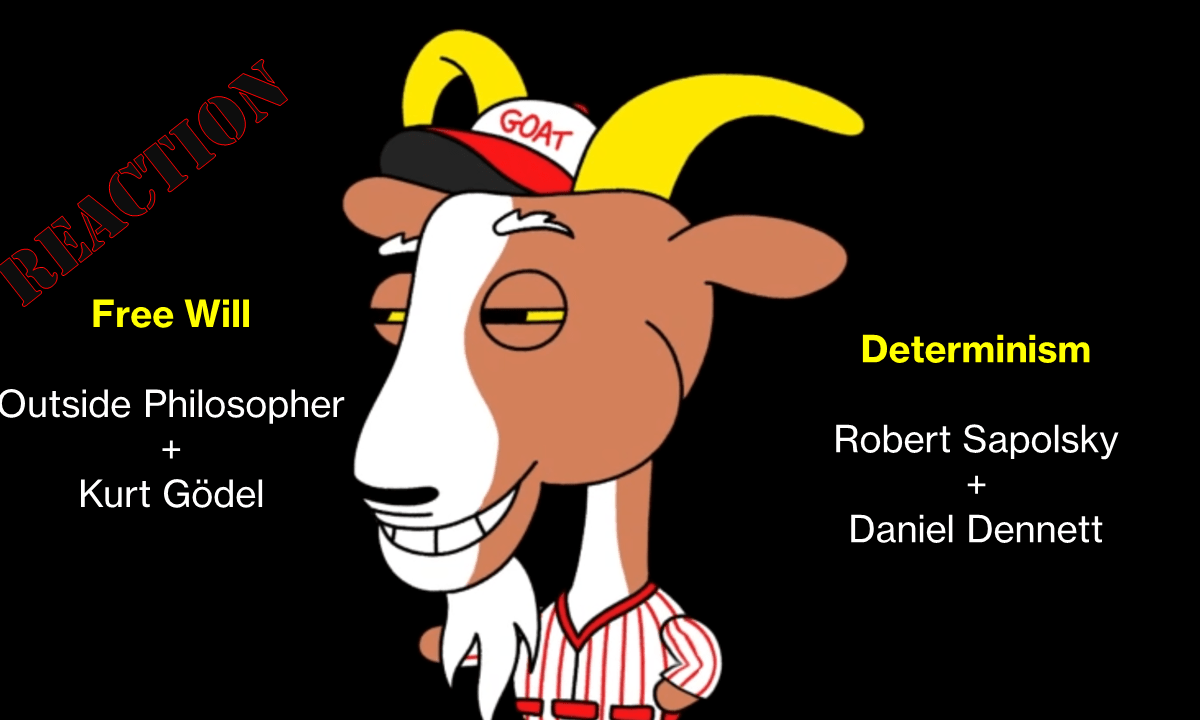
VIDEO: Response to Response on Sapolsky v. Dennett Debate

It’s been a minute since I’ve posted a video. Restart the clock. In this video, I critique Outside Philosopher’s critique of the debate between Robert Sapolsky and Daniel Dennett on Free Will and Determinism. He attempts to leverage Gödel’s Uncertainty Principle in his defence.

Feel free to leave comments on YouTube or below. Cheers.

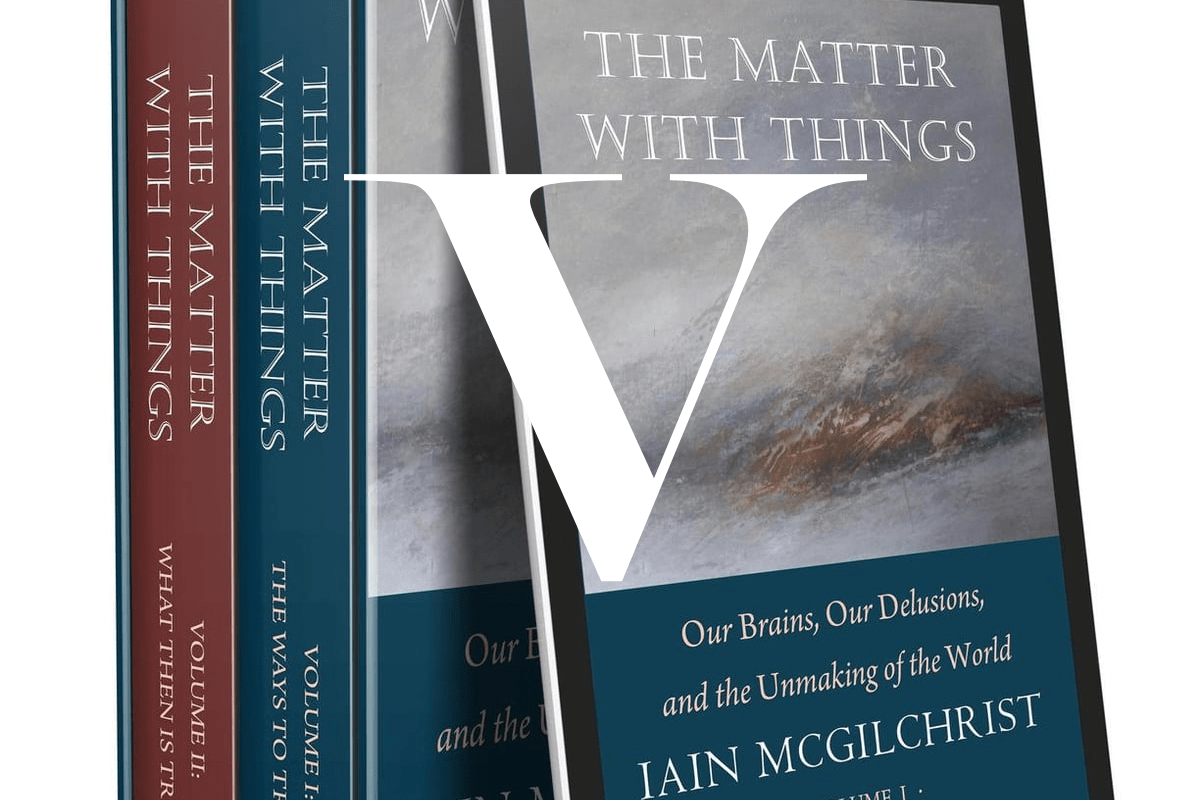
The Matter with Things: Chapter Five Summary: Apprehension

Index and table of contents

This is my take on the fifth chapter of The Matter with Things. I suggest reviewing the previous chapters before you delve into this one, but I won’t stop you from jumping queue.

Podcast: Audio rendition of this page content

Intro

Chapter five of The Matter with Things is titled Apprehension, following the previous chapters, Attention, Perception, and Judgment. From the start, let’s clarify that apprehension is not meant in the manner of being nervous or apprehensive. It’s meant to pair with comprehension. More on this presently.

Whilst the previous chapters have been heavily focused on the importance of the right hemisphere, this chapter is focused on the left, which may be given the chance to redeem itself. Not surprisingly perhaps, given the relative function of the right hemisphere versus the left, this chapter is much shorter than prior chapters.

Content

This chapter opens by asking what happens to a person who experiences left hemisphere damage. But let’s return to the chapter title. Apprehension is retaken etymologically and means to hold onto or to grasp. This is the function of the left hemisphere. The right hemisphere is about comprehension. The root ‘prehension’ is Latin for hold; the added ap prefix suggests holding on, whilst the com prefix suggests holding together.

Whilst conceptualising and abstract language is a right hemisphere function, spoken words are a left-brain function. It turns out that so is pointing and other gesticulation, reminding me of some ethnic stereotypes of people who speak with their hands. We need to keep in mind that the right hemisphere controls the left part of the body whilst the left hemisphere controls the right. What this means is that the right hand, being guided by the left hemisphere is marching to a different drummer.

Also, keep in mind from the previous chapters that the right hemisphere is holistic whilst the left is atomistic. Where right hemisphere damage is evident, a person has difficulty viewing the parts of a whole, whilst if the damage is on the left, a person has difficulty constructing a whole from its constituent parts. Namely, it may recognise that a body is constructed from an inventory of pieces—head and shoulders, knees, and toes—, but it can’t seem to grasp the cohesive orchestrated picture.

Apart from body continuity, when the left hemisphere is damaged, it might know all of the steps of a given process—McGilchrist shares the example of a person trying to light a smoking pipe—, but there may be difficulty in some of the instrumentation along the way. He cites an example by Czech neurologist, Arnold Pick, which I share here intact:

The patient is given a pipe and brings it correctly to his mouth, then expertly reaches for the tobacco pouch and takes a match from the box but when asked to light it, sticks the head of the match into the mouthpiece and puts the other end in his mouth as if to smoke it. Then he takes it out of his mouth, draws it out of the mouthpiece and sticks the other end of the match in the mouthpiece of the pipe, pulls it out again, holds it for a while in his hand apparently thinking, and then puts it away.

a person when encountering a pencil would feel compelled to grab it and start writing nothing in particular

To underscore the apprehension, where there is damage evident in the right hemisphere, the right hand (under control of the left hemisphere) may just grasp at things for no reason, perhaps reaching arbitrarily out to doorknobs. In one case, a person when encountering a pencil would feel compelled to grab it and start writing nothing in particular. In each case, the right hemisphere was not available to contextualise the experience. This right hemisphere is opening and exploratory whilst the left is closing and instrumental. It seems one might tend to meander without the left to provide a certain will and direction.

McGilchrist makes some correlations between humans and other great apes, but I’ll just mention this in passing.

I am going to pause to editorialise on McGilchrist’s next claim. He argues that Saussure’s claim that language signs are arbitrary is false and gives some examples—sun, bread, and spaghetti—but I am not ready to accept this stance. For now, I am remaining in the camp with Saussure and Wittgenstein that language is both arbitrary and self-referential.  Getting down off my soapbox.  

Recall again that whilst the right hemisphere takes the world as presented, the left hemisphere can only re-present. This is why language symbols are handled by the left hemisphere. Coming back to Saussure, the right-brain experiences a ‘cat’ whilst the left-brain names that object a ‘cat’ and classifies it as a mammal, feline, quadruped, and whatever else.

The right hemisphere is about metaphor, prosody, and pragmatics whilst the left hemisphere, though not exclusively, is about syntax and semantics.

The right hemisphere is about metaphor, prosody, and pragmatics whilst the left hemisphere, though not exclusively, is about syntax and semantics.  The left hemisphere is about symbols. As such, lipreading and interpreting sign language are both left-brain activities.

An interesting conveyance is a case study of a person with left hemisphere damage reading a book who recites the elephant in place of the written word India, so making an association by not recognising the word itself. And there may be a naming problem, so if there was a problem related to an ankle, they would point to an ankle but substitute the name of the part.

Finally, to reiterate the holistic versus atomistic divide, some people with left hemisphere damage can articulate the parts of the body or a bicycle, but when queried can’t relate that the mouth is beneath the nose or some such.

Perspective

To summarise, McGilchrist leaves with a comment, “The fabric of reality typically goes for the most part unaltered when the left hemisphere is suppressed.”

As I’ve been editorialising a bit throughout, I don’t have much to add at this point. Aside from my Saussure nit, I am still very interested in the concept that the right hemisphere constructs reality. I feel that I interpret this construction differently to Iain.

I believe that we agree that there is a world out there, and we interpret this world by interacting with it. Where I feel we differ is that he feels there is a world of objects that we interact with and perceive whilst I believe that we construct this world of objects by means of constructing the underlying material, from particles to fields. I think he’ll discuss this more in later chapters and I could be off base. Time will tell.

Having put Apprehension to bed, next up is a chapter on Emotional Support and Intelligence. I hope you’ll join me.

What are your thoughts? What did you think of this chapter? Were there any surprises? Anything of particular interest?

Leave comments below or on the blog.

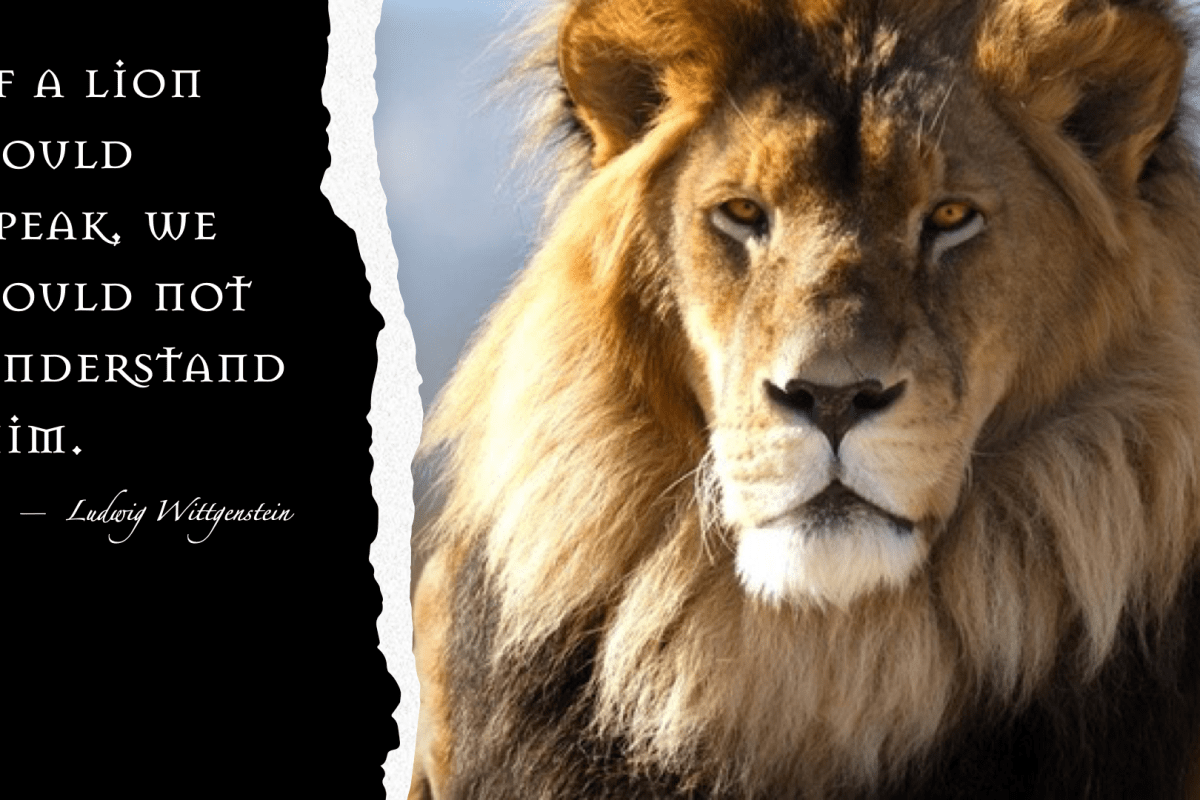
If a lion could speak

If a lion could speak, we could not understand him.

— Ludwig Wittgenstein

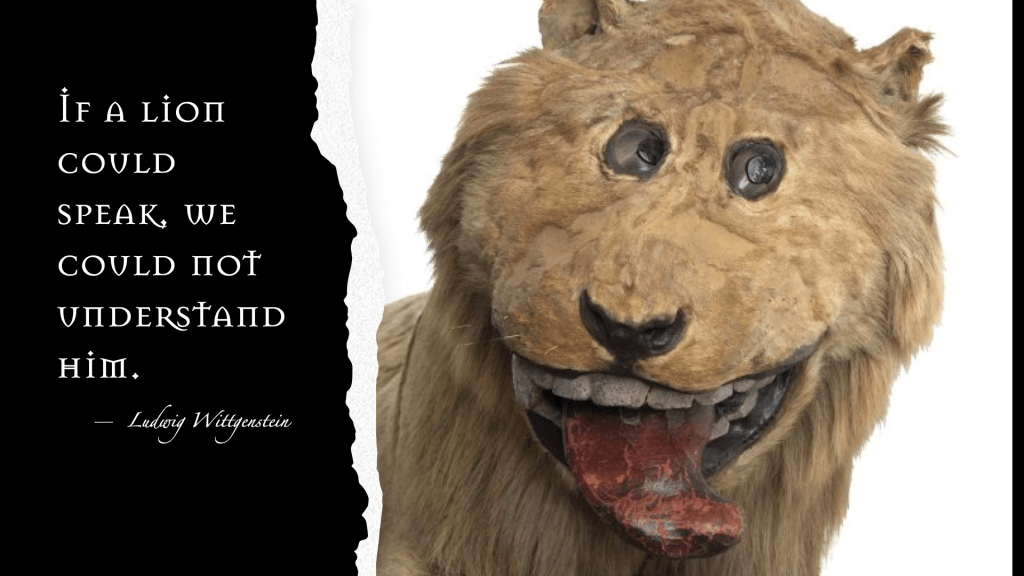
As much as I love Wittgenstein’s quote on language, I find it vastly more amusing aside the lion of Gripsholm Castle in Sweden. Because as talking lions come, this one is certainly more unintelligible than most.

If a lion could speak (Gripsholm Remix)

I also appreciate Daniel Dennett’s retort that if we could manage to communicate with this one talking lion—not, of course, this lion in particular—that it could not speak for the rest of lionity. (Just what is the equivalent of humanity for lions?)

If a lion could speak (traditional)

Ludwig Wittgenstein famously said, “If a lion could talk, we could not understand him.” ( [Philosophical Investigations] 1958, p. 223) That’s one possibility, no doubt, but it diverts our attention from another possibility: if a lion could talk, we could understand him just fine—with the usual sorts of effort required for translation between different languages—but our conversations with him would tell us next to nothing about the minds of ordinary lions, since his language-equipped mind would be so different. It might be that adding language to a lion’s “mind” would be giving him a mind for the first time! Or it might not. In either case, we should investigate the prospect and not just assume, with tradition, that the minds of nonspeaking animals are really rather like ours.

Daniel Dennet — Kinds of Minds: Toward an Understanding of Consciousness (p.18)

Language of Life

I want to write about this Quanta Magazine article: What Is Life? Its Vast Diversity Defies Easy Definition. but I’ve not got enough spare time. Too many irons in the fire or plates spinning or which ever metaphor you favour.

My interest in the insufficiency of language is what attracted me to the article, and is probably how it ended up in my feed. To highlight some aspects, in 2011, Russian geneticist Edward Trifonov reviewed 123 definitions of life and found as many definitions as authors. Although he discovered some core shared features. His version distilled to self‐reproduction with variations.

The article mentions Wittgenstein’s language games—and rightfully so. But it underscores the point that language is an approximation of reality. My working position was that naming objects is simple—in fact trivial—, but naming abstract concepts presents challenges. Now, I find that the challenge sets in earlier than even I expected. Language is truly insufficient.

The first step to recovery is to admit there’s a problem.

Death of the Metanarrative

3–4 minutes

Until I recently read Lyotard’s The Postmodern Condition: A Report on Knowledge I never quite understood why Moderns accused Post-moderns of being anti-science. I’d heard Jordan Peterson complaining, and I’d read forum and blog posts with the same attacks.

As it happens, postmodernism eschews the meta-narrative or is leery of it. This includes the meta-narratives underlying science and the Enlightenment more generally. If you’ve read my posts over the years, you’ll see that this is a common complaint of mine, that everything is a human construct. Although Lyotard published The Postmodern Condition, I only read it this week.

To be fair, I sought it out. I have been attempting to find some other philosophers who have asserted that Truth (and other notions like Justice and Progress) are nothing more than the result of a rhetorical victory. And although Lyotard does not come out and say this (at least not in this book), I feel that he would not disagree with the notion. I may have to read some more of his work.

The least one can do is find the underlying narrative. Feel free to operate day to day as per usual, but be aware. The inscription at Delphi was not exactly right. There is no self to know, and narratives change, but to ‘know’ the prevailing narrative of the day seems it might at least allow one to better assess what’s happening above ground. The Matrix trope may be overplayed, but it’s a fitting metaphor for seeing what underlies. There is no Truth, but for what it’s worth, there’s another data point.

We live on the map, but the terrain is inaccessible. The postmodern doesn’t hate science or progress. We merely question the veracity. One cannot assess progress without a vector, without velocity and direction, so we contrive stories to serve as a foundation.

The founding of these stories don’t need to be sinister or nefarious. They can grow organically. But the ones who understand the rules, Wittgenstein’s language game, can wrest power, and s/he who can bend the rules through convincing rhetoric, perhaps as Locke and Rousseau, can change to course of history. But this course can be changed again. When Marx tried to change the narrative, it threatened the status quo, so they try to delegitimatise it at every turn—primarily through the dissemination of disinformation in a sort of corrupt meme machine. Marx tried to embrace and then co-opt Capitalism, but the Capitalists were not ready to cede power. One hundred and fifty-odd years later, they still aren’t. And it might be that a different narrative is adopted before Marx’s vision is even able to take root.

I was a bit confused by Lyotard’s quip about utility being the arbiter under modern Capitalism in lieu of Truth, as I am not sure how many postmodernists embrace the notion of some objective Truth. To be clear, I don’t.

Lego Blocks

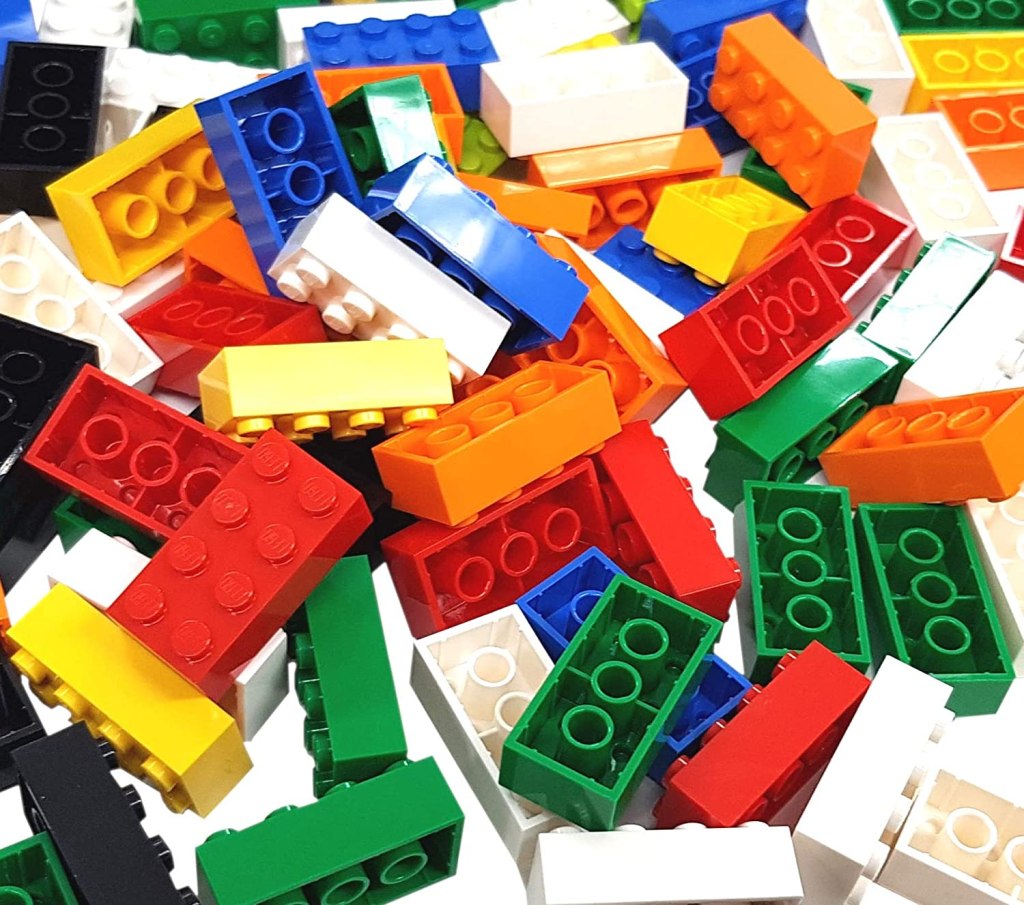
In the end, I feel it is better to deconstruct the concept of a knowable reality. The trick is not to try to reconstruct something from the pieces. It’s like deconstructing a Lego model and rebuilding a different model from the pieces whilst making the claim that this reconstitution is the true manifestation when in fact any construct is as ‘good’ as the next, but good cannot be determined until you’ve defined a context. Such is the role of the metanarrative. Once you define an end, you can then evaluate utility in light of it, but there is nothing to assess the choice of one end versus some other ends save by preference. And of course preference can be manipulated by rhetoric.

The Rhetoric of Foucault

OK, so this isn’t at all about Foucault’s rhetoric. My main riff this year is the assertion that there is no Truth, only rhetoric—or should I rather say Rhetoric. I created a Reddit post asking for references to other philosophers (or whomever) who had made a similar claim, to which I was offered Vico and Rorty. Unfortunately, there were only two responders, and their assistance was superficial.

What I did encounter by one of the responders was a criticism similar to that levelled at Foucault, hence the inspired title of this post. This critique at its essence is that having proposed no positive solutions to the issues I point to, I cannot defend my position. In fact, as with Habermas‘ fault with Foucault, evidently, I have disarmed myself.

I find this line of argumentation weak tea at best. To argue that one has no claim to declare something incorrect if they don’t have a correct replacement for it is absurd. For example, I don’t know what 13,297 ÷ 1,492 equals arithmetically; but I can assert with confidence that it does not equal 2. Moreover, to criticise, one doesn’t need the ‘ability to generate positive alternatives’.

“There is no truth but rhetoric.”

So when I say there is no Truth but rhetoric (for non-ontic concepts), I am making a Truth statement. As such, this assertion—by my own admission—is only as strong as the rhetoric I can muster to its defence. Alas, my defences are weak, and so the argument fails. Were I to make a stronger argument—a more convincing argument—, it might be accepted as Truth.

Evidently, my first mistake was to separate ontic and non-ontic, which is to say things existing apart from their given names and those whose existence is entirely fabricated. An ontic thing might be a stone, a tree, a planet, a star, or the sensation of pain. These things exist even without language, a label, or an observer. As Saussure and other structuralists have noted, in semiotics, there is the signified (or referent) and the signifier—the object and the identifier. In the context of language, these are tautological.

There_is_no_Spoon[1]
There is no spoon.
Non-ontic things are conceptual, freedom, truth,  justice, rights, gods, and so on. I may opt to replace non-ontic with language-contextual or some such to sidestep the taxonomical quagmire. Or perhaps I’ll adopt the dichotomy of concrete versus abstract. These concepts do not exist outside of language. They are wholly constructed in a complex system created by humans—and humans whilst humans have done OK with complicated systems, they have an abysmal track record when it comes to complex systems. By analogue to the physics of solids, there is more space than atoms, and the atoms and their constituent particles are in constant motion—zero-degrees Kelvin, be damned. Our senses perceive something to be there, but as in that scene in The Matrix, ‘there is no spoon‘.

In my mind, leveraging Saussure’s ideas are useful to depict the differences in the concrete versus the abstract.

1bb[1]

The famous painting depicted above illustrates explains the difference between a signifier and a referent. In this image, there is only the signifier. Magritte makes clear the distinction with the text, Ceci, n’est pas une pipe: This is not a pipe. It is merely a depiction of one. To be even more arcane, the image is a signifier to another signifier that in turn refers to the referent.

A sign is the device that encapsulates the concept. It may be visual—an icon (an illustration of photograph) or a written word or even Braille—or it can be spoken or signed, as with American Sign Language. These are all signs.

cat sign

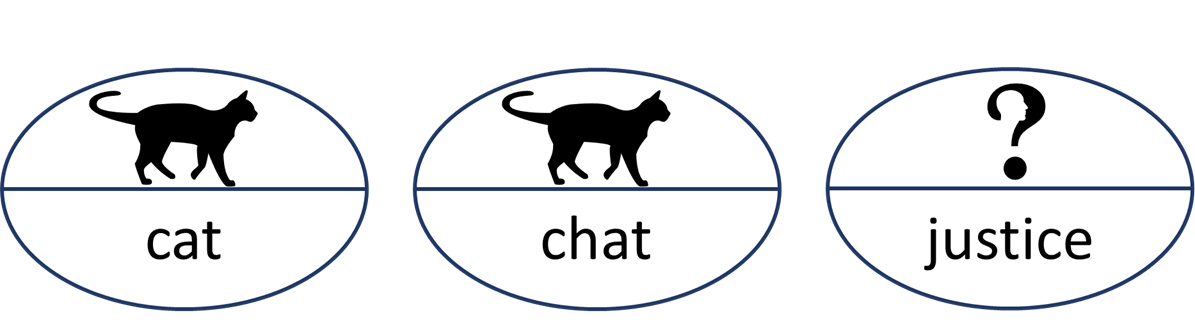
Notice when one considers a sign that a concrete cat (or in French, chat), it is pretty clear to what one is referring. Above the line, we see the signified, the idea conveyed by the sign. This doesn’t mean that everyone sees the silhouette depicted above, but it is a catlike thing, a feline animal, a mammal, normally with four legs and a tail. Perhaps you are thinking of a particular cat. But to someone with a grasp of the language in which you are communicating, when you say cat, there is little room for ambiguity. In fact, if you are trying to teach someone a different language, say, French, you could show them the cat with the chat signifier, and they would grasp your meaning almost instantaneously.

All language is arbitrary and socially constructed, so there is no connection between the words—say, the spelling or shape of a word—and its referent. The words cat and chat do not look like cats.

There are concrete things that cannot be so readily translated into an icon; for example, the wind. However, one could fairly quickly be able to articulate or gesticulate, as the case might be, the notion of wind. The same cannot be said for the abstract concept of justice.

As I’ve mentioned before, justice, especially one of the restorative or retributive varieties, is a euphemism for vengeance. The distinction is supposed to be found in the intent, but intent cannot be known; it can only be inferred. And, speaking of Foucault, justice can only be delivered from a power position.

But the notion of justice relies heavily on social construct; it has geo-spacial dependencies. What is considered to be just in ancient times may not be considered just now. What is considered just in one country might not be considered to be just in another. And this is more than a difference in instantiation. It is due to the arbitrary if not capricious articulation of a nebulous concept.

Returning to Foucault, (Christian apologist) Nancy Pearcey declares his stance paradoxical: “[when someone] states that it is impossible to attain objectivity, is that an objective statement? The theory undercuts its own claims.”

First, Pearcey merely asks a question about objectivity, but it doesn’t matter. The answer is: this may as well be an objective statement, but it’s just another language game. Wittgenstein (and Russell and Heidegger and Rorty…) was on the right path when he pointed out that the ambiguity inherent in language provide cover for all sorts of mischief. I’m only pretty sure that Derrida might yield paydirt as well. Besides, let’s pretend for a moment that there exists some objective truth, there is no reason (language game; except in accepting the broadest definition, reason is a capability elusive to many if not most humans) to expect that this truth is either accessible or verifiable anyway. The best one can do is to pose a more convincing rhetorical argument.

Reason /ˈrēzən/ (noun)
the power of the mind to think, understand, and form judgments by a process of logic

A similar critique has been advanced by (another Christian apologist) Diana Taylor, and by Nancy Fraser who argues that “Foucault’s critique encompasses traditional moral systems, he denies himself recourse to concepts such as ‘freedom’ and ‘justice’, and therefore lacks the ability to generate positive alternatives.”

So whilst I’ve just managed to stream-of-consciousness my contention, I am not in a position to resolve anything. For now, I’ll settle for documenting my position as I continue to search for other supporters and formulate a more cogent response, a more robust rhetorical presentment.

If anyone can direct me to resources relevant to my position, let me know in the comments. I’ll appreciate it. If you don’t agree—which would be expected, as this is the accepted orthodoxy—feel free to comment as well. 


Anarchy, State, and Utopia

I’ve been reading Robert Nozick‘s Anarchy, State, and Utopia because it was recommended by Ian Shapiro. Although I am only about a quarter way through, and he seems to have tried to hit all the angles; unless I missed it, perhaps hits these bits later on.

He thoroughly raises issues and works to resolve them, but, as with Descartes with his Discourse, Nozick seems to exogenously accept certain aspects in an appeal to tradition sort of way. With Descartes, he stripped all belief in the truth of his senses, but then he injects God into the equation from out of nowhere. For Nozick, he just takes property and value as given.

I understand that the Western Enlightenment tradition has a thing for life, liberty, and property—especially Libertarians—, but these are just philosophical notions derived from nowhere. (Wittgenstein, stage left) That he uses utility theory instead of prospect theory as a foundation can be forgiven, but that is shaky ground, too.

And so it goes…