Ok. I admit this is an expansive claim, but I write about the limitations on generative artificial intelligence relative to writers. I wrote this after encountering several Reddit responses by writers who totally misunderstand how AI works. They won’t read this, but you might want to.
We’ve entered an era where machines tell us how we’re doing, whether it’s an AI app rating our résumé, a model reviewing our fiction, or an algorithm nudging our attention with like-shaped carrots.
Recently, I ran a brutally raw scene through a few AI platforms. The kind of scene that’s meant to unsettle, not entertain. One of them responded with effusive praise: “Devastating, but masterfully executed.”
Was it honest?
Was it useful?
Or was it merely reflecting my own aesthetic back at me, polished by a thousand reinforcement-learning smiles?
This is the ethical dilemma: If feedback is always flattering, what good is it? If criticism is only tolerated when couched in praise, how do we grow? And when machine feedback mimics the politeness of a mid-level manager with performance anxiety, we risk confusing validation with truth.
There’s a difference between signal and applause. Between understanding and affirmation.
The danger isn’t that AI flatters us. The danger is that we start to believe it and forget that art, inquiry, and ethics thrive on friction.
“Man is least himself when he talks in his own person. Give him a mask, and he will tell you the truth.” — Oscar Wilde
Identity is an illusion—but a necessary one. It’s a shortcut. A heuristic, evolved not for truth but for coherence. We reduce ourselves and others to fixed traits to preserve continuity—psychological, social, narrative.
Audio: NotebookLM podcast on this topic. (Spotify)
But what if continuity is a lie?
In the latest post on RidleyPark.blog, we meet Sarah—a woman who survives by splintering. She has three names, three selves, three economies of interaction. Each persona—Sarah, Stacey, and Pink—fulfils a role. Each protects her in a system that punishes complexity.
And yet, this isn’t fiction. It’s reality intensified.
Identity Is Compression
Cognitive science suggests that we don’t possess a self—we perform one. Our so-called identity is assembled post-hoc from memory, context, and social cues. It’s recursive. It’s inferred.
We are not indivisible atoms of identity. We are bundled routines, personae adapted to setting and audience.
This is not pathology. It’s strategy.
From Performance to Survival
In Needle’s Edge, Sarah doesn’t use aliases to deceive. She uses them to survive contradictions:
Stacey is desirable, stable, and profitable—so long as she appears clean and composed.
Pink is a consumer, invisible, stripped of glamour but allowed access to the block.
Sarah is the residue, the name used by those who once knew her—or still believe they do.
Each persona comes with scripts, limitations, and permissions. Sarah isn’t being dishonest. She’s practicing domain-specific identity. This is no different from how professionals code-switch at work, or how people self-edit on social media.
It’s just more raw. More urgent. Less optional.
The Literary Echo
In character development, we often demand “depth,” by which we mean contradiction. We want to see a character laugh and break. Love and lie. But Sarah shows us that contradiction isn’t depth—it’s baseline reality. Any singular identity would be a narrative failure.
Characters like Sarah expose the poverty of reduction. They resist archetype. They remind us that fiction succeeds when it reflects the multiple, the shifting, the incompatible—which is to say, the real.
What Else Might We Say?
That authenticity is a myth: “Just be yourself” presumes you know which self to be.
That moral judgment often stems from a failure to see multiple selves in others.
That trauma survivors often fracture not because they’re broken, but because fracturing is adaptive.
That in a capitalist framework, the ability to fragment and role-play becomes a survival advantage.
That fiction is one of the few spaces where we can explore multiple selves without collapse.
The Missing Link
For a concrete, narrative reflection of these ideas, this post on RidleyPark.blog explores how one woman carries three selves to survive three worlds—and what it costs her.
I recently wrote an article on my disdain for Jordan Peterson. (A cathartic exercise, I assure you.) But as I was busy sharpening my polemic, my so-called writing assistant – autocorrect – decided it fancied itself a philosopher, chipping in with some of the most spectacularly unhelpful suggestions I’ve encountered this side of a Facebook comment thread.
Is wrong bad?
In the first instance, autocorrect took issue with my phrasing:
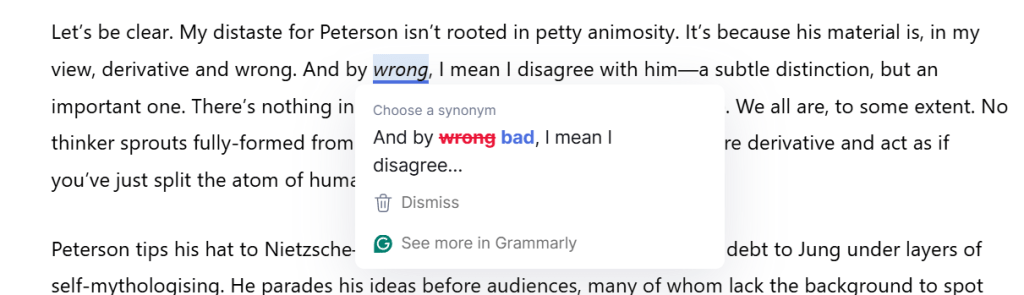
And by wrong, I mean I disagree with him…
This, apparently, was too much for it. The poor dear couldn’t recognise the parallel sentence structure, or the rhetorical flourish at work. No, it suggested replacing wrong with bad. Because why not destroy the symmetry and nuance in one fell swoop?
Image: Is wrong bad?
Obviously, the second wrong is a riff on the first. To replace wrong with bad would be incorrect—wrong, if you will. Some might say bad. But I digress. The point is: the logic holds, and autocorrect’s intervention doesn’t.
Is bad evil?
As if that weren’t enough, round two delivered an even greater affront:
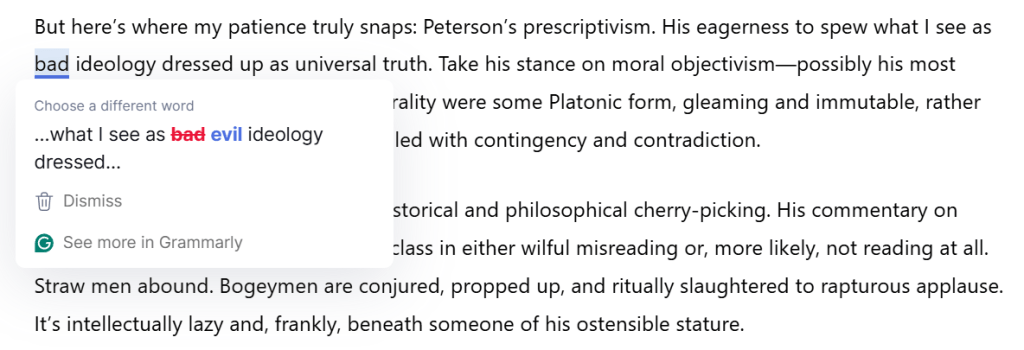
But here’s where my patience truly snaps: Peterson’s prescriptivism. His eagerness to spew what I see as bad ideology dressed up as universal truth…
Autocorrect, in its infinite wisdom, suggested I swap bad for evil. Ah yes, because evil is precisely what I want—a term dripped in moral absolutism and ideological baggage.
Image: Is bad evil?
First, autocorrect, might I suggest you check out Nietzsche’s Genealogy of Good and Evil before piping up? Perhaps then you’d grasp the not-so-subtle difference between bad and evil—a distinction that, in moral philosophy, rather matters.
And now my book titles aren’t safe either…
Even as I write this post, the machine assaults me with a suggestion to rename the title of my book recommendation. O! the humanity. Is nothing sacred?
Image: Autocorrect strikes again
Final thoughts
Autocorrect may be marvellous for spotting typos and the occasional rogue comma, but when it tries its hand at philosophy, the result is about as elegant as a rhinoceros in a tutu. Dear autocorrect: stick to spelling. Leave the nuance to the humans.
Some apps boldly claim to enable lip syncing – to render speech from mouth movements. I’ve tried a few. None delivered. Not even close.
To conserve bandwidth (and sanity), I’ve rendered animated GIFs rather than MP4s. You’ll see photorealistic humans, animated characters, cartoonish figures – and, for reasons only the algorithm understands, a giant goat. All showcase mouth movements that approximate the utterance of phonemes and morphemes. Approximate is doing heavy lifting here.
Firstly, these mouths move, but they say nothing. I’ve seen plenty of YouTube channels that manage to dub convincing dialogue into celebrity clips. That’s a talent I clearly lack – or perhaps it’s sorcery.
Secondly, language ambiguity. I reflexively assume these AI-generated people are speaking English. It’s my first language. But perhaps, given their uncanny muttering, they’re speaking yours. Or none at all. Do AI models trained predominantly on English-speaking datasets default to English mouth movements? Or is this just my bias grafting familiar speech patterns onto noise?
Thirdly, don’t judge my renders. I’ve been informed I may have a “type.” Lies and slander. The goat was the AI’s idea, I assure you.
What emerges from this exercise isn’t lip syncing. It’s lip-faking. The illusion of speech, minus meaning, which, if we’re honest, is rather fitting for much of what generative AI produces.
EDIT: I hadn’t noticed the five fingers (plus a thumb) on the cover image.
I promise that this will not become a hub for generative AI. Rather than return to editing, I wanted to test more of Midjourney’s boundaries.
It turns out that Midjourney is selective about the nudity it renders. I was denied a render because of cleavage, but full-on topless – no problem.
Both of these videos originate from the same source image, but they take different paths. There is no accompanying video content. The setup features three women in the frame with a mechanical arm. I didn’t prompt for it. I’m not even sure of its intent. It’s just there, shadowing the women nearest to it. I don’t recall prompting for the oversized redhead in the foreground, though I may have.
In both images, note the aliasing of the tattoos on the blonde, especially on her back. Also, notice that her right arm seems shorter than it should. Her movements are jerky, as if rendered in a video game. I’m not sure what ritual the two background characters are performing, but notice in each case the prepetition. This seems to be a general feature of generative AI. It gets itself in loops, almost autistic.
Notice a few things about the top render.
Video: Midjourney render of 3 females and a mechanical arm engaging in a ritual. (9 seconds)
The first video may represent an interrogation. The blonde woman on the left appears to be a bit disoriented, but she is visually tracking the woman on the right. She seems to be saying something. Notice when the woman on the right stands. Her right foot lands unnaturally. She rather glitches.
The camera’s push and pull, and then push, seems to be an odd directorial choice, but who am I to say?
Video: Midjourney render of 3 females and a mechanical arm engaging in a ritual. (12 seconds)
The second video may represent taunting. The woman on the left still appears to be a bit disoriented, but she checks the redhead in the foreground with a glance. Notice the rocking of the two background characters, as well as the mech arm, which sways in sync with the woman on the right. This is a repetition glitch I mentioned above.
Here, the camera seems to have a syncopated relationship with the characters’ sway.
Summary
The stationary objects are well-rendered and persistent.
Assignment
Draft a short story or flash fiction using this as an inspirational prompt. I’m trying to imagine the interactions.
The ginger seems catatonic or drugged. Is she a CIS-female? What’s with her getup?
The blonde seems only slightly less out of it. Did she arrive this way? Did they dress her? Why does she appear to still have a weapon on her back? Is it a weapon or a fetter? Why is she dressed like that? Is she a gladiatrix readying for a contest? Perhaps she’s in training. What is she saying? Who is she talking to? What is her relationship to the redhead? Are they friends or foes – or just caught up in the same web?
What is the woman wearing the helmet doing? She appears to have the upper hand. Is she a cyborg, or is she just wearing fancy boots? What’s with her outfit? What’s with her Tycho Brahe prosthetic nose piece?
What is that mechanical hand? Is it a guard? A restraint? Is it hypnotising the ginger? Both of them? Is it conducting music that’s not audible?
What’s it read on the back wall? The two clips don’t share the same text. Call the continuity people.
Yesterday, I wrote about “ugly women.” Today, I pivot — or perhaps descend — into what Midjourney deems typical. Make of that what you will.
This blog typically focuses on language, philosophy, and the gradual erosion of culture under the boot heel of capitalism. But today: generative eye candy. Still subtextual, mind you. This post features AI-generated women – tattooed, bare-backed, heavily armed – and considers what, exactly, this technology thinks we want.
Video: Pirate cowgirls caught mid-gaze. Generated last year during what I can only assume was a pirate-meets-cowgirl fever dream.
The Video Feature
Midjourney released its image-to-video tool on 18 June. I finally found a couple of free hours to tinker. The result? Surprisingly coherent, if accidentally lewd. The featured video was one of the worst outputs, and yet, it’s quite good. A story emerged.
Audio: NotebookLM podcast on this topic (sort of).
It began with a still: two women, somewhere between pirate and pin-up, dressed for combat or cosplay. I thought, what if they kissed? Midjourney said no. Embrace? Also no. Glaring was fine. So was mutual undressing — of the eyes, at least.
Later, I tried again. Still no kiss, but no denial either — just a polite cough about “inappropriate positioning.” I prompted one to touch the other’s hair. What I got was a three-armed woman attempting a hat-snatch. (See timestamp 0:15.) The other three video outputs? Each woman seductively touched her own hair. Freud would’ve had a field day.
In another unreleased clip, two fully clothed women sat on a bed. That too raised flags. Go figure.
All of this, mind you, passed Midjourney’s initial censorship. However, it’s clear that proximity is now suspect. Even clothed women on furniture can trigger the algorithmic fainting couch.
Myriad Warning Messages
Out of bounds.
Sorry, Charlie.
In any case, I reviewed other images to determine how the limitations operated. I didn’t get much closer.
Video: A newlywed couple kissing
Obviously, proximity and kissing are now forbidden. I’d consider these two “scantily clad,” so I am unsure of the offence.
I did render the image of a cowgirl at a Western bar, but I am reluctant to add to the page weight. In 3 of the 4 results, nothing (much) was out of line, but in the fourth, she’s wielding a revolver – because, of course, she is.
Conformance & Contradiction
You’d never know it, but the original prompt was a fight scene. The result? Not punches, but pre-coital choreography. The AI interpreted combat as courtship. Women circling each other, undressing one another with their eyes. Or perhaps just prepping for an afterparty.
Video: A battle to the finish between a steampunk girl and a cybermech warrior.
Lesbian Lustfest
No, my archive isn’t exclusively lesbian cowgirls. But given the visual weight of this post, I refrained from adding more examples. Some browsers may already be wheezing.
Technical Constraints
You can’t extend videos beyond four iterations — maxing out at 21 seconds. I wasn’t aware of this, so I prematurely accepted a dodgy render and lost 2–3 seconds of potential.
My current Midjourney plan offers 15 hours of “fast” rendering per month. Apparently, video generation burns through this quickly. Still images can queue up slowly; videos cannot. And no, I won’t upgrade to the 30-hour plan. Even I have limits.
Uses & Justifications
Generative AI is a distraction – an exquisitely engineered procrastination machine. Useful, yes. For brainstorming, visualising characters, and generating blog cover art. But it’s a slippery slope from creative aid to aesthetic rabbit hole.
Would I use it for promotional trailers? Possibly. I’ve seen offerings as low as $499 that wouldn’t cannibalise my time and attention, not wholly, anyway.
So yes, I’ll keep paying for it. Yes, I’ll keep using it. But only when I’m not supposed to be writing.
Now, if ChatGPT could kindly generate my post description and tags, I’ll get back to pretending I’m productive.
ICE is out in force again, dragging brown bodies out of homes in Los Angeles like it’s some righteous carnival of due process. Another day, another federal theatre production titled Law and Order: Ethnic Cleansing Unit, where men with guns and names like Chad or Hank mistake cruelty for patriotism and paperwork for moral clarity.
Audio: NotebookLM podcast on this topic.
Naturally, critics of these raids are now being threatened with that great juridical cudgel: “obstructing justice.” Yes, you heard that right. If you interfere – say, by filming, shouting, refusing to roll over like a good little colonial subject – you are obstructing justice. As though justice were something you could actually put your hands on in the United States without a hazmat suit and a decade of appeals.
Let’s be clear. There is no justice here to obstruct. What you are obstructing is bureaucratic violence wrapped in legal latex. You are obstructing a system that functions like a vending machine for state-sanctioned trauma: insert immigrant, extract ruin.
Justice: The Imaginary Friend of Empire
Ah, “justice.” That hallowed ideal trotted out whenever the state wants to put a boot through your front door. The U.S. has long since traded its Justice for Security Theatre and capitalist choreography. The blindfold is still there, sure – but these days, it’s a branded sleep mask from Lockheed Martin, and the scales are rigged to weigh white tears heavier than brown bodies.
Let’s run through the usual suspects:
ICE – America’s own domestic Gestapo, but with better PR and significantly worse fashion.
CBP – Border fetishists whose job seems less about national defence and more about satisfying their Freud-bereft fantasies of control.
SCOTUS – That great moral weather vane, spinning wildly between “originalist necromancy” and outright lunacy, depending on how recently Thomas and Alito read Leviticus.
Congress – An assembly of millionaires cosplaying as public servants, holding hearings on “the threat of immigration” while outsourcing their lawn care.
And of course, the President – whichever septuagenarian husk happens to be in office – offers the usual bromides about order, safety, and enforcement, all while the real crimes (you know, the kind involving tax fraud, corporate pollution, or drone strikes) go entirely unmolested.
Can You Obstruct a Simulation?
If you stand in front of a deportation van, are you obstructing justice, or merely interrupting the bureaucratic excretion of empire? It’s the philosophical equivalent of trying to punch a hologram. The system pretends to uphold fairness while routinely violating its own principles, then charges you with “obstruction” when you call out the sleight of hand.
This is not justice. This is kabuki. A ritual. A performance piece sponsored by Raytheon.
A Modest Proposal
Let’s just be honest and rename the charge. Not “Obstruction of Justice”—too ironic, too pompous. Call it what it is: Obstruction of Procedure, Obstruction of Power, or if we’re being especially accurate: Obstruction of the Industrial Deportation Complex™. Hell, add a corporate sponsor while you’re at it:
You are being charged with Obstruction of Justice, Presented by Amazon Web Services.
Because when justice itself is a ghost, when the rule of law has become the rule of lawfare, the real obscenity is pretending any of this is noble.
Final Thought
So no, dear reader, you’re not obstructing justice. You’re obstructing a machine that mistakes itself for a moral order. And if you’re going to obstruct something, make it that.
As some of you know, I publish speculative fiction under the name Ridley Park. Propensity is one of several recent releases – a novella that leans philosophical, brushes up against literary fiction, and steps quietly into the margins of sci-fi.
It’s not about spaceships or superintelligence. It’s about modulation.
About peace engineered through neurochemical compliance.
About the slow horror of obedience without belief, and the behavioural architecture that lets us think we’re still in control.
The ideas explored include:
Free will as illusion
Peace as compliance
Drift, echo, and the limits of modulation
Obedience without belief
Institutional horror and soft dystopia
Consent and behavioural control
Narrative as residue
Collapse by calibration
Though filed under speculative fiction, Propensity [US] is best read as a literary artefact – anti-sci-fi, in a sense. There’s no fetishisation of technology or progress. Just modulation, consequence, and the absence of noise.
This PDF contains selected visual excerpts from the physical book to accompany the free audiobook edition. For readers and listeners alike, it offers a glimpse into Ridley Park’s world – a quietly dystopian, clinically unsettling, and depressingly plausible one.
Title page
Copyrights page
Table of Contents
Chapter 10: Memorandum. This chapter is read in the audiobook. The inclusion here is for visualisation as it is rendered in the form of a memo.
Chapter 26: Simulacra. This chapter is read in the audiobook. The inclusion here is for visualisation as it is rendered in the format of a screenplay.
Chapter 28: Standard Test: This chapter is read in the audiobook. The inclusion here is for visualisation as it is rendered in the format of a standardised test.
Chapter 34: Calendar. This chapter is read in the audiobook. The inclusion here is for visualisation as it is rendered in the format of a calendar.
Chapter 39: Carnage. This chapter is read in the audiobook. The inclusion here is for visualisation as it is rendered in the form of a Dr Suess-type poem.
Chapter 41: Leviathan. This chapter is excerpted in the audiobook. The inclusion here is for visualisation as it is rendered with an image of the cover of Hobbes’ Leviathan and redacted page content.
Chapter 42: Ashes to Ashes. This chapter is read in the audiobook. The inclusion here is for visualisation as it is rendered in the form of text art.
Chapter 43: Unknown. A description of this chapter is read in the audiobook. The inclusion here is for visualisation as it is rendered in the form of an ink sketch.
Chapter 44: Vestige. A description of this chapter is read in the audiobook. The inclusion here is for visualisation as it is rendered in the form of text art.
For more information about Ridley Park’s Propensity, visit the website. I’ll be sharing content related to Propensity and my other publications. I’ll cross-post here when the material has a philosophical bent, which it almost always does.