A Key Point of Departure: He Accepts the Folk Psychology I Reject

3–5 minutes

Jason from Philosopher Muse suggested a connexion between Transductive Subjectivity and the work of Stephen Batchelor. I wasn’t familiar with Batchelor, so — as one does these days — I asked a GPT to give me the lay of the land. The machine obliged, and the result was interesting enough that it warranted a post of its own. This is it.

Audio: NotebookLM summary podcast of this topic.

Before anyone lights incense: I’m not suddenly a convert. Batchelor’s work and mine merely pass each other on adjacent footpaths. But the overlap is conceptually neat, and the divergence is even more telling.


Stephen Batchelor vs Transductive Subjectivity: A Brief Comparative Note

1. Shared Territory: The Self as Verb, Not Noun

Both Batchelor and Transductive Subjectivity reject the folk notion of a single, continuous metaphysical self.

  • Batchelor (Secular Buddhism):
    The self is an unfolding activity — impermanent, conditional, and without a stable essence. His “not-self” is a practice of disidentification from the imagined nugget of continuity we cling to.
  • Transductive Subjectivity:
    The self is a finite series: S₀ → S₁ → S₂ → … → Sₙ, each produced through the pressure of relational structures (R). Identity is what results when the world meets the organism. Nothing metaphysical required; just biology, cognition, language, and institutions doing their thing.

Overlap: Both positions dismantle the enduring pearl-of-self. Both frame identity as something generated, not possessed.


2. Divergent Aims: Inner Liberation vs Structural Clarity

This is where the paths fork.

  • Batchelor’s Agenda:
    Primarily ethical and therapeutic. The point of denying a fixed self is to reduce suffering, ease attachment, and cultivate a more responsive way of being.
  • TS’s Agenda:
    Metaphysical accuracy in the service of ethical clarity. If the self is a serial construction rather than a diachronic monolith, then retributive justice collapses under its own fictions. No self, no desert. No desert, no justification for revenge-based punishment.

Batchelor wants flourishing. I want rigour. Accidental cousins.


3. Methodological Differences: Distillation vs Reconstruction

Batchelor performs what you might call Buddhism sans metaphysics.
A very Western manoeuvre:

  • keep impermanence
  • keep ethical insight
  • jettison karma, rebirth, cosmology
  • rebrand the remnants as a secular spiritual practice

Practitioners dislike this because he amputates the structural scaffolding that supported the doctrine.

TS, by contrast, doesn’t distil anything. It reconstructs selfhood from first principles:

  • No causa sui
  • Episodic, indexical selfhood (Strawson)
  • R→S transduction (MEOW)
  • No diachronic essence
  • No metaphysical ballast

If Buddhism aligns with TS, it’s incidental — the way two different mathematicians can discover the same function by entirely different routes.


4. Conceptual Architecture: Dependent Origination vs MEOW’s Tiers

  • Batchelor:
    leans on dependent origination as a philosophical metaphor — phenomena arise through conditions.
  • TS:
    models the exact channels of that conditioning via MEOW:
    T0 → biological signals
    T1 → cognitive architecture
    T2 → linguistic formats
    T3 → social-technical pressures

Where Batchelor says “everything is contingent,” TS says “yes, and here is the actual machinery.”


5. Different Stakes

  • Batchelor: freeing the person from clinging to an imaginary core.
  • TS: freeing ethics, law, and social design from pretending that metaphysical core exists.

One is therapeutic; the other is diagnostic.


A Key Point of Departure: Batchelor Works with Folk Psychology; TS Rejects Its Premises

There is one more divergence worth highlighting because it cuts to the bone of the comparison.

Batchelor accepts the phenomenological feel of the continuous self as a legitimate starting point. His work is therapeutic: he begins where the person is, in the lived experience of being “me,” and then encourages a gentle loosening of the grip on that intuition.

Transductive Subjectivity takes a different route entirely.

For TS, the continuous, diachronic self isn’t a psychological obstacle to be softened — it is a category mistake. A narrative compression artefact. A heuristic with pragmatic uses, yes, but no metaphysical legitimacy. Batchelor tries to transform our relation to the folk-self; TS denies that the folk-self was ever more than a convenient fiction.

Batchelor says:
“You seem like a continuous self; now learn to hold that lightly.”

TS says:
“You seem like a continuous self because the system is glossing over discontinuities. The sensation itself is misleading.”

In other words:

  • Batchelor redeems the experience.
  • TS disassembles the model.

He treats the “self” as something to relate to differently.
TS treats the “self” as an ontological construct to be replaced with a more accurate one.

This is not a difference of ethical aim but of metaphysical foundation.
Batchelor trims the folk psychology; TS declines the invitation altogether.

Closing Note

So yes — the connexion Jason spotted is real. But it’s genealogical, not derivative. We arrive at similar conclusions for different reasons and with different consequences.

Batchelor is pruning a tradition.
Transductive Subjectivity is rebuilding the ontology.

And both, in their own way, make the continuity-self look like the rhetorical placeholder it always was.

MEOW GPT FeedbackOn Testing MEOW GPT (And the Delicate Souls It Might Upset)

3–4 minutes

A surprising number of people have been using the MEOW GPT I released into the wild. Naturally, I can’t see how anyone is actually using it, which is probably for the best. If you hand someone a relational ontology and they treat it like a BuzzFeed quiz, that’s on them. Still, I haven’t received any direct feedback, positive or catastrophic, which leaves me wondering whether users understand the results or are simply nodding like priests reciting Latin they don’t believe.

Audio: NotebookLM summary podcast of this topic.

The truth is uncomfortable: if you haven’t grasped the Mediated Encounter Ontology (of the World), the outputs may feel like a philosophical brick to the face. They’re meant to; mediation has consequences. I’m even considering adding a warning label:

Below is a sampling of the concepts I tested while inspecting the system’s behaviour. I’m withholding the outputs, partly to avoid influencing new users and partly to preserve your dignity, such as it is.

  • authenticity
  • anattā (Buddhist)
  • character (in Aristotle’s virtue-ethical sense)
  • consciousness
  • dignity
  • freedom
  • hózhó (Navajo)
  • justice
  • karma
  • love
  • progress
  • ren ( 仁 )
  • table
  • tree
  • truth

I may have tried others, depending on how irritated I was with the world at the time.

(Now that I think of it, I entered my full name and witnessed it nearly have an aneurysm.)

My purpose in trying these is (obviously) to test the GPT. As part of the test, I wanted to test terms I already considered to be weasel words. I also wanted to test common terms (table) and terms outside of Western modalities. I learned something about the engine in each case.

Tables & Trees

One of the first surprises was the humble ‘table’ which, according to the engine, apparently moonlights across half of civilisation’s conceptual landscape. If you input ‘table’, you get everything from dinner tables to data tables to parliamentary procedure. The model does exactly what it should: it presents the full encounter-space and waits for you to specify which world you meant to inhabit.

The lesson: if you mean a table you eat dinner on, say so. Don’t assume the universe is built around your implied furniture.

‘Tree’ behaves similarly. Does the user mean a birch in a forest? A branching data structure? A phylogenetic diagram? MEOW GPT won’t decide that for you; nor should it. Precision is your job.

This is precisely why I tested ‘character (in Aristotle’s virtue-ethical sense)’ rather than tossing ‘character’ in like a confused undergraduate hoping for luck.

Non-Western Concepts

I also tested concepts well outside the Western philosophical sandbox. This is where the model revealed its real strength.

Enter ‘karma’: it promptly explained that the Western reduction is a cultural oversimplification and – quite rightly – flagged that different Eastern traditions use the term differently. Translation: specify your flavour.

Enter ‘anattā’: the model demonstrated that Western interpretations often reduce the concept to a caricature. Which, frankly, they do.

Enter ‘hózhó’: the Navajo term survives mostly in the anthropological imagination, and the model openly described it as nearly ineffable – especially to those raised in cultures that specialise in bulldozing subtlety. On that score, no notes.

Across the board, I was trying to see whether MEOW GPT would implode when confronted with concepts that resist neat Western categorisation. It didn’t. It was annoyingly robust.

Closing Notes

If you do try the MEOW GPT and find its results surprising, illuminating, or mildly offensive to your metaphysical sensibilities, let me know – and tell me why. It helps me understand what the engine does well and what illusions it quietly pops along the way. Your feedback may even keep me from adding further warning labels, though I wouldn’t count on it.

How MEOW Turns a Metaphysical Mountain Into a Linguistic Molehill

In the last post, I argued that the so-called ‘hard problem of consciousness‘ was never a problem with consciousness. It was a problem with language – specifically, the English language’s unfortunate habit of carving the world into neat little substances and then demanding to know why its own divisions won’t glue back together.

Audio: NotebookLM summary podcast of this topic, on resolving the hard problem of consciousness.

The response was predictable.

  • ‘But what about subjective feel?’
  • ‘What about emergence?’
  • ‘What about ontology?’
  • ‘What about Chalmers?’
  • ‘What about that ineffable thing you can’t quite point at?’

All fair questions. All built atop the very framing that manufactures the illusion of a metaphysical gap.

So here’s the promised demonstration: not yet a full essay (though it may evolve into one), but a clear application of MEOW – the Mediated Encounter Ontology of the World – to the hard problem itself. Consider this a field test of the framework. A tidy autopsy, not the funeral oration.

The Set-Up: Chalmers’ Famous Trick

Chalmers asks:

The question feels profound only because the terms ‘physical’ and ‘experience’ smuggle in the very metaphysics they pretend to interrogate. They look like opposites because the grammar makes them opposites. English loves a comforting binary.

But MEOW doesn’t bother with the front door. It doesn’t assume two substances – ‘mind’ over here, ‘world’ over there – and then panic when they refuse to shake hands. It treats experience as the way an encounter manifests under a layered architecture of mediation. There’s no bridge. Only layers.

T₀ – Biological Mediation

The body is not a barrier. It is the encounter’s first architecture.

At T₀, the world is already transformed: transduction, gating, synchrony, inhibition, adaptation. Organisms don’t receive ‘raw’ physical inputs. They metabolise them. The form of contact is biological before it is anything else.

The hard problem begins by assuming there’s a realm of dumb physical mechanisms that somehow need to ‘produce’ experience. But organisms do not encounter dumb mechanism. They encounter structured contact –biological mediation – from the first millisecond.

If you insist on thinking in substances, T₀ looks like a problem.
If you think in mediations, it looks like the beginning of sense-making.

T₁ – Cognitive Mediation

Where the Enlightenment saw a window, cognition installs a newsroom.

Prediction, priors, memory, inference, attention – all shaping what appears and what never makes it into view. Experience at T₁ is not something ‘added’. It is the organisational structure of the encounter itself.

The hard problem treats ‘experience’ as a mysterious extra–something floating atop neural activity like metaphysical cream. But at T₁, what appears as experience is simply the organisation of biological contact through cognitive patterns.

There is no ‘what emerges from the physical’. There is the way the encounter is organised.

And all of this unfolds under resistance – the world’s persistent refusal to line up neatly with expectation. Prediction errors, perceptual limits, feedback misfires: this constraint structure prevents the entire thing from collapsing into relativist soup.

T₂ – Linguistic–Conceptual Mediation

Here is where the hard problem is manufactured.

This is the layer that takes an ordinary phenomenon and turns it into a metaphysical puzzle. Words like ‘experience’, ‘physical’, ‘mental’, ‘subjective’, and ‘objective’ pretend to be carved in stone. They aren’t. They slide, drift, and mutate depending on context, grammar, and conceptual lineage.

The hard problem is almost entirely a T₂ artefact – a puzzle produced by a grammar that forces us to treat ‘experience’ and ‘physical process’ as two different substances rather than two different summaries of different mediational layers.

If you inherit a conceptual architecture that splits the world into mind and matter, of course you will look for a bridge. Language hands you the illusion and then refuses to refund the cost of admission.

T₃ – Cultural–Normative Mediation

The Western problem is not the world’s problem.

The very idea that consciousness is metaphysically puzzling is the product of a specific cultural lineage: Enlightenment substance dualism (even in its ‘materialist’ drag), Cartesian leftovers, empiricist habits, and Victorian metaphysics disguised as objectivity.

Other cultures don’t carve the world this way. Other ontologies don’t need to stitch mind back into world. Other languages simply don’t produce this problem.

Reassembling the Encounter

Once you run consciousness through the mediational layers, the hard problem dissolves:

  • Consciousness is not an emergent property of neural complexity.
  • Consciousness is not a fundamental property of the universe.
  • Consciousness is the reflexive mode of certain mediated encounters, the form the encounter takes when cognition, language, and culture become part of what is appearing.

There is no gap to explain because the ‘gap’ is the product of a linguistic–conceptual framework that splits where the world does not.

As for the ever-mystical ‘what-it’s-like’: that isn’t a metaphysical jewel buried in the brain; it is the way a T₀–T₃ architecture manifests when its own structure becomes reflexively available.

A Brief Disclaimer Before the Internet Screams

Pointing out that Chalmers (and most of modern philosophy) operates within a faulty ontology is not to claim MEOW is flawless or final. It isn’t. But if Occam’s razor means anything, MEOW simply removes one unnecessary supposition — the idea that ‘mind’ and ‘world’ are independent substances in need of reconciliation. No triumphalism. Just subtraction.

Where This Leaves Chalmers

Chalmers is not wrong. He’s just asking the wrong question. The hard problem is not a metaphysical insight. It’s the moment our language tripped over its shoelaces and insisted the pavement was mysterious.

MEOW doesn’t solve the hard problem. It shows why the hard problem only exists inside a linguistic architecture that can’t model its own limitations.

This piece could easily grow into a full essay – perhaps it will. But for now, it does the job it needs to: a practical demonstration of MEOW in action.

And, arguably more important, it buys me one more day of indexing.

The Hard Problem Was Never Consciousness

3–5 minutes

It Was Language All Along.

This whole misadventure began sometime in 2018, when I started documenting what has now metastasised into the Language Insufficiency Hypothesis. If I weren’t typing this, I’d be doing the honourable thing and finishing the index, but here we are, procrastinating with purpose. I had a suspicion, even then, that language was up to something. Something slippery. Something evasive. At first, it was just a motley catalogue of weasel words that refused to sit still long enough to be given a meaning. I should have taken the hint when the list kept expanding like a Victorian railway: terminally over-budget and convinced of its own grandeur.

But, naturally, I pressed on.

Audio: NotebookLM summary podcast and conversation around this topic.

At the time I had that slow-burn itch about identity, selfhood, free will, agency – you know, the usual metaphysical tat we’re reared on like a Victorian child raised on laudanum. It wasn’t that these things didn’t exist; it was that the words simply couldn’t bear the conceptual load we’d been piling onto them. And so I found myself in the company of philosophers who either tried to rescue these terms (Dennett, ever the valiant firefighter with a damp match), complicate them (Searle, constructing houses of cards under wind machines), or dissolve them outright (Parfit, smiling serenely as the rest of us panic).

Meanwhile, Strawson was somewhere in the corner insisting experience is all there is, Putnam was in his perennial retraction phase, and I was merely trying to keep my own conceptual apparatus from collapsing like an undercooked soufflé.

I’ll admit I had a long-standing soft spot for Dennett’s consciousness-as-emergence hypothesis. It made a certain intuitive sense at the time: pile up enough neural machinery, sprinkle in some feedback loops, and consciousness would bubble up like steam from a kettle. It felt elegant. It felt mechanistically honest. And, crucially, it made perfect sense within the inherited Realist framework I was still tacitly lugging around. Of course, experience ’emerges’ from physical processes if you start from a worldview already partitioned into physical substrates and mental phenomena waiting to be accounted for. Dennett wasn’t wrong so much as operating within the same architectural error the rest of us had been marinating in. Once I began reframing the whole encounter through mediation rather than emergence, the elegance dissolved. What had looked like metaphysics turned out to be a conceptual afterimage generated by a language that couldn’t model its own limitations.

And then there was Chalmers.

Ah, the ‘hard problem’. I lost count of how many times it surfaced. Like mould. Or a debt collector. Chalmers’ dilemma – how physical processes give rise to experience – is purportedly the Mount Everest of metaphysics. Yet the more I thought about it, the more it reeked of a linguistic parlour trick. A conceptual magic eye puzzle: stare long enough and a unicorn appears, provided you’ve surrendered your scepticism and a good measure of oxygen.

The problem isn’t that consciousness is ‘hard’. The problem is that the linguistic scaffolding we’re using was never built for this terrain. ‘Experience’. ‘Physical’. ‘Mental’. ‘Explain’. These words pretend to be steel beams when they’re actually damp cardboard.

What remains isn’t a cosmic riddle but a linguistic artefact. A conceptual false path carved by centuries of grammatico-metaphysical enthusiasm – the unfortunate habit of mistaking grammatical symmetry for metaphysical necessity.

Which brings me to the present, having at last gelled the LIH and published the Mediated Encounter Ontology of the World – a relational metaphysics that has the decency not to hallucinate substances it can’t justify. MEOW clears the fog rather neatly: the so-called ‘hard problem’ is only ‘hard’ because we continue to treat ‘mind’ and ‘world’ as two independent substances requiring metaphysical reconciliation. Together, LIH and MEOW provide a double exposure of the problem: LIH shows why the language fails; MEOW shows what the language was failing to describe.

So here we are. I’d like to reconsider Chalmers through the dual lenses of LIH and MEOW – not to ‘solve’ the hard problem, but to show it was never the right problem to begin with. The difficulty isn’t consciousness; it’s the language we’re forced to use, the same language that refuses to sit still, the same language that keeps trying to trick us into mistaking grammatical symmetry for metaphysical necessity.

In a coming post, I intend to pry open that illusion with a crowbar. Delicately, of course. One must be civilised about these things.

Because if language is insufficient – and it is – then perhaps what Chalmers discovered was not the abyss of consciousness, but the limit of the dictionary.

The Mediated Encounter Ontology of the World

Philosophers adore two things: inventing problems and then fainting when someone solves them. For decades, we’ve been treated to the realism–idealism tug-of-war, that noble pantomime in which two exhausted metaphysical camps clutch the same conceptual teddy bear and insist the other stole it first. It’s almost touching.

Try out the MEOW GPT language parser.

Enter Nexal Ontology, my previous attempt at bailing water out of this sinking ship. It fought bravely, but as soon as anyone spotted even a faint resemblance to Whitehead, the poor thing collapsed under the weight of process-cosmology PTSD. One throwaway comment about ‘actual occasions’, and Nexal was done. Dead on arrival. A philosophical mayfly.

But MEOW*The Mediated Encounter Ontology of the World – did not die. It shrugged off the Whitehead comparison with the indifference of a cat presented with a salad. MEOW survived the metaphysical death match because its commitments are simply too lean, too stripped-back, too structurally minimal for speculative cosmology to get its claws into. No prehensions. No eternal objects. No divine lure. Just encounter, mediation, constraint, and the quiet dignity of not pretending to describe the architecture of the universe.

And that’s why MEOW stands. It outlived Nexal not by being grander, but by being harder to kill.

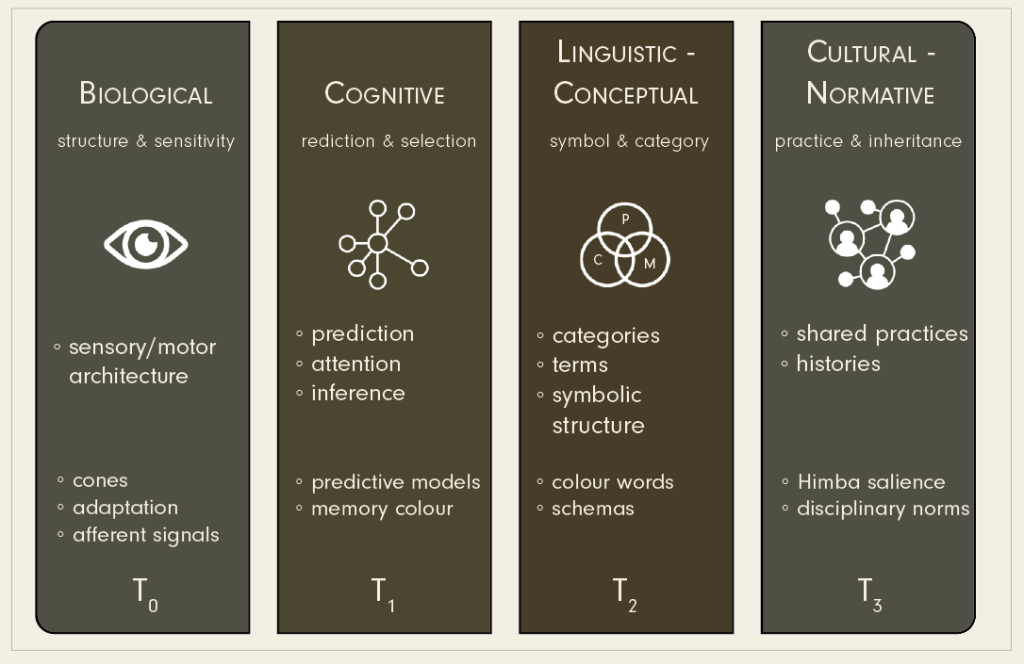
Image: The Four Mediation Layers – Biological, Cognitive, Conceptual, Cultural – structuring every encounter we mistake for ‘direct’.

This little illustration gives the flavour:
T0 Biological mediation – the body’s refusal to be neutral.
T1 Cognitive mediation – the brain, doing predictive improv.
T2 Linguistic–conceptual – words pretending they’re objective.
T3 Cultural–normative – the inheritance of everyone else’s mistakes.

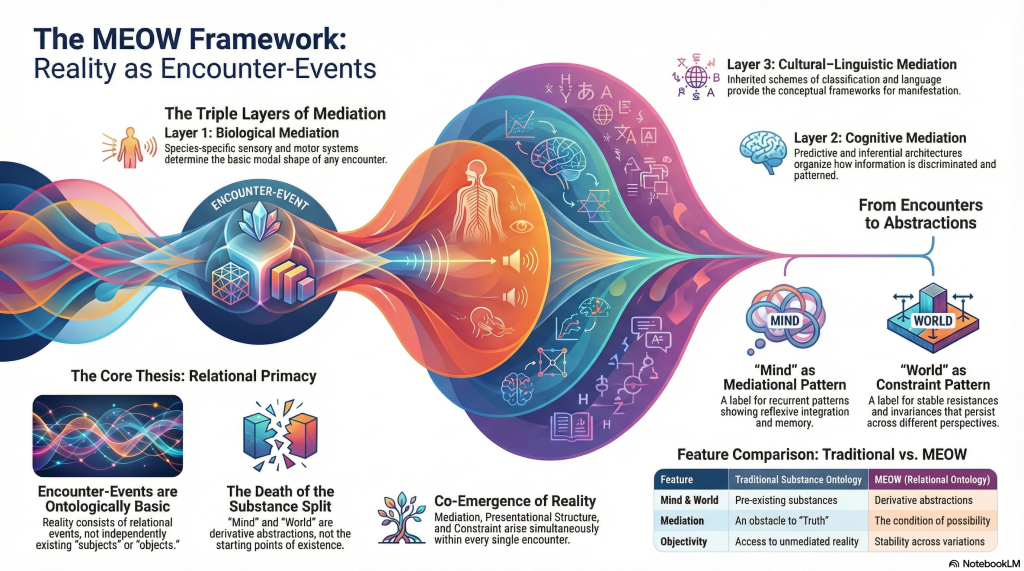
The essay argues that what we call ‘mind’ and ‘world’ are just abstractions we extract after the encounter, not the metaphysical scaffolding that produces it. Once you begin with the encounter-event itself – already mediated, already structured, already resistive – the mind–world binary looks about as sophisticated as a puppet show.

What the essay actually does

The Mediated Encounter Ontology of the World is the first framework I’ve written that genuinely sheds the Enlightenment scaffolding rather than rebuking it. MEOW shows:

  • Mediation isn’t an epistemic flaw; it’s the only way reality appears.
  • Constraint isn’t evidence of a noumenal backstage; it’s built into the encounter.
  • Objectivity is just stability across mediation, not a mystical view-from-nowhere.
  • ‘Mind’ and ‘world’ are names for recurring patterns, not metaphysical hotels.
  • And – importantly – MEOW does all of this without drifting into Whiteheadian cosmological fan-fiction.

The full essay is now published and archived:

DOI: https://doi.org/10.5281/zenodo.17685689

If you prefer a soft landing and the sound of a passable human voice explaining why metaphysics keeps tripping over its shoelaces, a NotebookLM discussion is here:

Audio: NotebookLM summary podcast of this essay.

MEOW is the survivor because it does the one thing philosophy is terrible at: it refuses to pretend. No substances, no noumena, no grand metaphysical machinery—just a clean, relational architecture that mirrors how we actually encounter the world.

And frankly, that’s quite enough ontology for one lifetime.


* To be perfectly honest, I originally fled from Michela Massimi’s Perspectival Realism in search of a cleaner terminological habitat. I wanted to avoid the inevitable, dreary academic cross-pollination: the wretched fate of being forever shelved beside a project I have no quarrel with but absolutely no desire to be mistaken for. My proposed replacement, Nexal Ontology, looked promising until I realised it had wandered, by sheer lexical accident, into Whitehead’s garden – an unintentional trespass for which I refused to stick around to apologise. I could already hear the process-metaphysics crowd sharpening their teeth.

Early evasive action was required.

I preferred nexal to medial, but the terminology had already been colonised, and I am nothing if not territorial. Mediated Ontology would have staked its claim well enough, but something was missing – something active, lived, structural. Enter the Encounter.

And once the acronym MEO appeared on the page, I was undone. A philosopher is only human, and the gravitational pull toward MEOW was irresistible. What, then, could honour the W with appropriate pomp? The World, naturally. Thus was born The Mediated Encounter Ontology of the World.

Pretentious? Yes. Obnoxious? Also yes.

And so it remains—purring contentedly in its absurdity.

Against Agency: The Fiction of the Autonomous Self

2–3 minutes

The Enlightenment’s Most Beloved Lie

🔗 Read the full preprint on Zenodo
🔗 Explore the Anti-Enlightenment Project

The Enlightenment promised liberation through reason – that if we could think clearly enough, we could act freely enough. Agency, it claimed, was the defining trait of the rational individual: a sovereign chooser, self-contained and self-determining.

But this was always a fiction.

Not an innocent one, either.

Audio: NotebookLM podcast discussing the essay, Against Agency

Agency became the moral infrastructure of modernity – the premise behind law, punishment, merit, guilt, and even political participation. To say “I chose” was not simply to describe behaviour; it was to perform belonging within a metaphysical system that made individuals the unit of responsibility. The fiction worked, for a while, because it kept the machinery running.

Against Agency argues that this story has collapsed – not metaphorically but structurally. Cognitive science, postcolonial thought, and relational philosophies all point to the same conclusion: there is no autonomous agent, only differential responsiveness – a system’s fluctuating capacity to register and transmit influence.

Copper sings under current; rubber resists. Humans, likewise, respond within the constraints of biology, fatigue, trauma, and social design. What we call “freedom” is merely a condition in which responsiveness remains broad and protected.

This reframing dismantles the binary of “free” and “unfree.” There is no metaphysical threshold where agency appears. Instead, responsiveness scales – widened by safety, narrowed by coercion, eroded by exhaustion. Politics becomes engineering: the maintenance of conditions that sustain responsiveness, rather than the worship of choice.

Ethics, too, must shift.

Not “Who is to blame?” but “Where did the circuit break?”

The essay proposes a gradient model of conduct grounded in relation and feedback, rather than autonomy and will. Responsibility becomes less about moral worth and more about bandwidth – a physics of care.

It’s an uncomfortable vision for a culture addicted to outrage and repentance. The loss of agency removes our favourite alibi: the chooser who could have done otherwise. But it also opens the possibility of a more honest ethics – one that replaces judgment with maintenance, retribution with repair.

This is not nihilism. It’s realism.

Systems appear stable only from a distance. Up close, everything is process – bodies, institutions, meanings – held together by temporary alignments of responsiveness. Against Agency names this collapse not as tragedy, but as opportunity: a clearing from which to think and act without the fictions that sustained modernity.

The essay forms the foundation for what comes next in the Anti-Enlightenment ProjectDis-Integration, a philosophical sequel that explores what remains once coherence, control, and autonomy have been decommissioned.