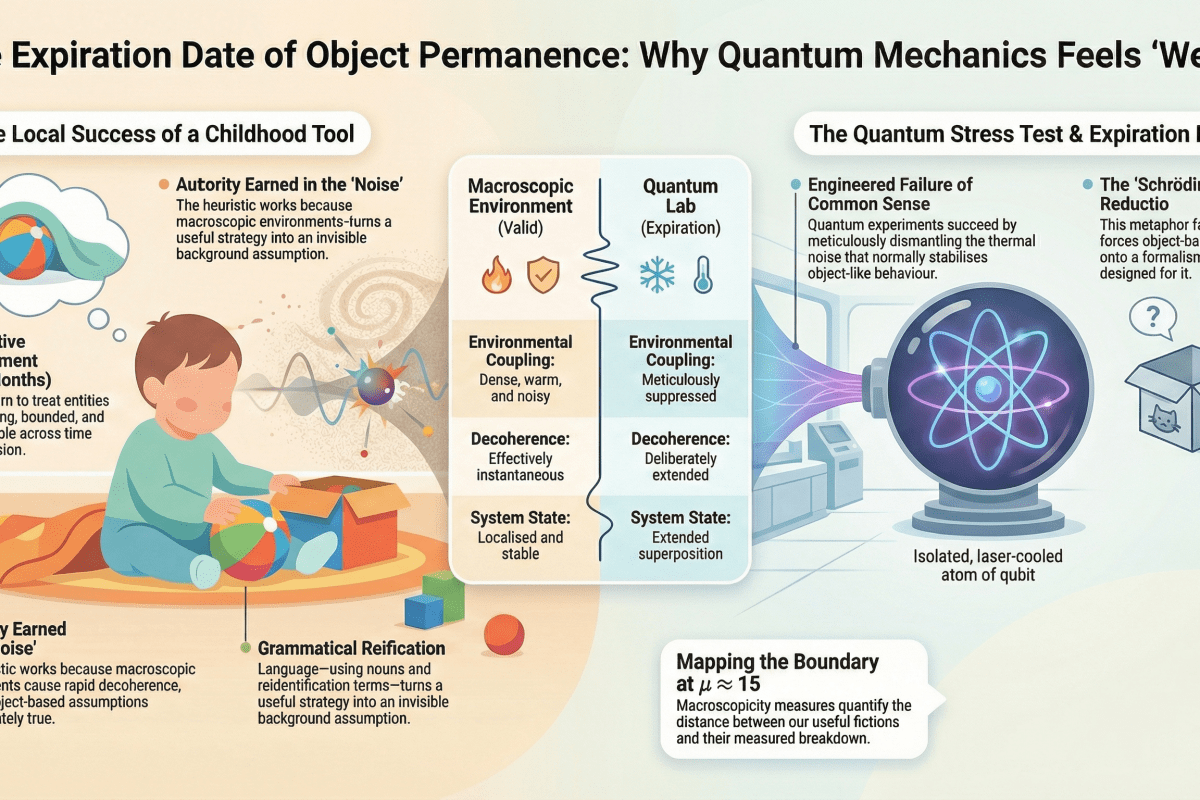
The Expiration Date of Object Permanence

2–4 minutes

There is a persistent story we tell ourselves about quantum mechanics:* that it reveals reality to be fundamentally strange, paradoxical, or hostile to common sense. Particles in two places at once. Cats be both alive and dead. Worlds multiplying to save appearances.

I’ve never found that story convincing.
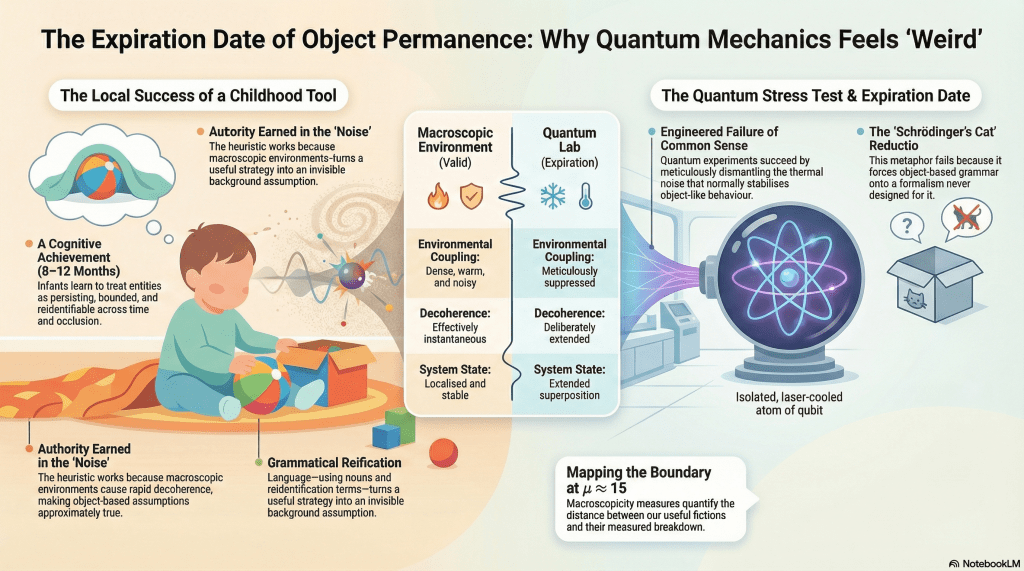
Audio: NotebookLM summary podcast of this topic.
Image: NotebookLM infographic for this topic.

What I do find convincing is a simpler diagnosis: that we are applying a cognitive tool far beyond the conditions under which it earned its authority – and then mistaking the resulting discomfort for metaphysical insight.

Object permanence is one of our earliest and most successful heuristics. It allows infants to track toys behind sofas, caregivers behind doors, and threats behind occlusion. Without it, coordinated action would be impossible. With it, the world becomes navigable, predictable, and stable. It is a genuine cognitive achievement. But it is not a universal guarantee about reality.

In a new essay, The Expiration Date of Object Permanence: Heuristics, Grammar, and Quantum Pseudoproblems, I argue that much of what we call ‘quantum weirdness’ arises from the uncritical extension of this heuristic into domains where its ecological licensing no longer holds. The problem is not that quantum mechanics violates common sense. The problem is that we quietly treat common sense as metaphysics.

Quantum mechanics functions here not as a mystery generator, but as a stress test. Recent matter-wave interference experiments with increasingly massive systems show that object-based expectations fail quantifiably under carefully engineered conditions. When environmental coupling is suppressed, when decoherence is delayed, when the world is no longer warm, noisy, and forgiving, the assumptions underwriting object permanence simply stop paying rent.

The essay also takes a dim view of some familiar cultural furniture. Schrödinger’s cat, for example, was introduced as a reductio – an intentionally absurd demonstration of what happens when microscopic formalism is naively scaled up. That it now circulates as an explanatory image tells us less about quantum mechanics than about the tenacity of object-grammar. Even jokes cannot escape it.

Interpretations fare no better. I suggest that the appeal of frameworks like Many-Worlds is not exhausted by their technical merits. They also function as strategies for preserving object-based reidentification – ways of ensuring that there is still something that can be pointed to, counted, and followed through time, even if the price is ontological inflation.

None of this denies the reality of quantum phenomena, nor does it pretend to solve the measurement problem. The essay is deliberately deflationary. Its claim is methodological, not revisionary: that many of the puzzles we inherit are artefacts of treating developmentally acquired heuristics as if they were unconditional features of the world.

Philosophy’s task, on this view, is not to make reality intuitive. It is to recognise when intuition has reached the end of its jurisdiction.

The paper is now available on Zenodo and will be indexed shortly on PhilPapers. As always, comments, objections, and principled misreadings are welcome.


This post and the underlying essay were inspired by a Nature article: Probing quantum mechanics with nanoparticle matter-wave interferometry, published on 21 January 2026. I get annoyed watching people misunderstand quantum mechanics and its effects, so I decided to address some of the issues in an essay. Read this essay as well as mine, which will explain why the paradoxes and ‘spooky behaviour’ of QM are only counter-intuitive if you’ve fallen into this heuristic trap.

Sundials, Spacetime, and Other Human Fabrications

Time is not fundamental. It is not lurking behind the curtains of reality, counting down the universe like some cosmic metronome. Time is a human construct, a clumsy accounting trick invented so that hunter-gatherers could remember when to plant seeds, priests could know when to fleece the flock, and later, managers could know when to dock your wages.

Video: Sabine Hossenfelder discusses the proposed origins of time

Yes, our ancestors tracked cycles: the swing of day and night, the waxing of the moon, the slouch of the seasons. But this is proto-time at best. Call it rhythm, call it recurrence, call it the universe refusing to sit still. It was not time. It was change, and we anthropomorphised it.

Then along came Newton with his stopwatch. He baptised “absolute time,” a divine river that flowed “equably without relation to anything external.” In other words, he built the cosmic grandfather clock and declared it law. This fantasy held just long enough for Einstein to make mischief, weaving time into space with duct tape and calling it spacetime. Romantic, yes, but hardly fundamental. Time, in Einstein’s cosmos, bends and dilates depending on who’s doing the bending. Not exactly the firm bedrock you’d expect of a “dimension.”

Meanwhile, in the quantum world, time is the awkward dinner guest: not an observable, not dynamic, just an external parameter scribbled into the equations because no one knew where else to put it. Like a bad houseplant, it sits in the corner – unmeasurable, unaccountable, but impossible to get rid of.

And yet, not everyone has given up the ghost. One camp – think Julian Barbour and Carlo Rovelli – insists time is an illusion, something emergent from relations, clocks, and counters. Others, like Lee Smolin, flip the script and claim that time is more fundamental than space itself, the real stage upon which the cosmic drama plays out. Philosophical infighting aside, what this tells you is that physics doesn’t actually know what time is. They’re as clueless as Aristotle, who called it “the number of motion”, a definition so circular it should’ve been printed on a sundial.

Enter Constructor Theory (Deutsch & Marletto), which simply does away with time entirely in the fundamental laws. No ticking clocks, no background river. Just possible and impossible transformations, with time emerging only when we strap timers onto systems and start counting. Which, of course, makes perfect sense: time is what we measure with clocks – and clocks are just things that change.

The dirty secret is this: every culture, every cosmology, every physics textbook has tried to smuggle “time” in as if it were self-evident, while quietly redefining it to suit the mood. We can’t agree on whether it’s an illusion, a dimension, or the last shred of fundamentality left to cling to. And if that isn’t the mark of a human construct, I don’t know what is.

Determinism and the Three-Body Problem

The debate over free will often distils down to a question of determinism—indeterminism, hard or soft determinism, or something else. Poincare’s approach to the three-body problem is an apt metaphor to strengthen the deterministic side of the argument.

Quantum theory introduces aspects of indeterminism, but that doesn’t support the free will argument. Moreover, between quantum events, the universe is again deterministic. It’s simply been reset with the last exogenous quantum event.

Prima facia, Determinism and Chaos might seem strange bedfellows. And therein lies the rub. Chaos theory essentially tells us that even in a scenario of chaos, all possible outcomes can be calculated. They just must be calculated stepwise via numerical integration. Even this leaves us with estimations, as owing to Heisenberg’s Uncertainty Principle and the infinitude of slicing space, we can’t actually calculate the precise answer, although one exists.

My point is that not knowing what is being determined doesn’t invalidate the deterministic nature or process.

Physics of Free Will

Physicist, Sean Carroll, gives Robert Lawrence Kuhn his take on free will. I was notified about this when it was posted, and given the topical subject matter, I took the 8-odd minutes to listen to it straight away.

I wish I had been there to pose a follow-up question because, although he provided a nice answer, I feel there was more meat on the table.

Like me, Sean is a Determinist who feels that the question of determinism versus indeterminism is beside the point, so we’ve got that in common. Where I feel we may diverge is that I am an incompatibilist and Sean is a compatibilist. I could be interpreting his position wrong, which is what the follow-up question would be.

I say that Sean is a compatibilist because he puts forth the standard emergence argument, but that’s where my confusion starts. Just to set up my position for those who don’t prefer to watch the short clip, as a physicist, Sean believes that the laws of physics, Schrödinger’s equation in particular.

We have an absolutely good equation that tells us what’s going to happen there’s no room for anything that is changing the predictions of Schrödinger’s equation.

— Sean Carroll
Schrödinger’s Equation

This equation articulates everything that will occur in the future and fully accounts for quantum theory. Some have argued that quantum theory tosses a spanner into the works of Determinism and leaves us in an Indeterministic universe, but Sean explains that this is not the case. Any so-called probability or indeterminacy is captured by this equation. There is no explanatory power of anything outside of this equation—no souls, no spirits, and no hocus pocus. So far, so good.

But Sean doesn’t stop talking. He then sets up an analogy in the domain of thermodynamics and statistical mechanics and the ‘fundamental theory of atoms and molecules bumping into each other and [the] emergent theory of temperature and pressure and viscosity‘. I’ve explained emergence in terms of adding two hydrogen and one oxygen atom to create water, which is an emergent molecule with emergent properties of wetness.

My position is that one can view the atomic collection of matter at a moment as an emergent property and give it a name to facilitate conversation. In this case, the label we are applying is free will. But there is a difference between labelling this collection “free will” as having an analogous function to what we mean by free will. That’s a logical leap I am not ready to take. Others have equated this same emergence to producing consciousness, which is of course a precursor to free will in any case.

Perhaps the argument would be that since one now has emergent consciousness—I am not saying that I accept this argument—that one can now accept free will, agency, and responsibility. I don’t believe that there is anything more than rhetoric to prove or disprove this point. As Sean says, this is not an illusion, per se, but it is a construction. I just think that Sean gives it more weight than I am willing to.