AI and the End of Where

Instrumentalism is a Modern™ disease. Humanity has an old and tedious habit: to define its worth by exclusion. Every time a new kind of intelligence appears on the horizon, humans redraw the borders of ‘what counts’. It’s a reflex of insecurity disguised as philosophy.

Audio: NotebookLM podcast on this topic.

Once upon a time, only the noble could think. Then only men. Then only white men. Then only the educated, the rational, the ‘Modern’. Each step in the hierarchy required a scapegoat, someone or something conveniently declared less. When animals began to resemble us too closely, we demoted them to instinctual machines. Descartes himself, that patron saint of disembodied reason, argued that animals don’t feel pain, only ‘react’. Fish, we were told until recently, are insensate morsels with gills. We believed this because empathy complicates consumption.

The story repeats. When animals learned to look sad, we said they couldn’t really feel. When women demonstrated reason, we said they couldn’t truly think. Now that AI can reason faster than any of us and mimic empathy more convincingly than our politicians, we retreat to the last metaphysical trench: “But it doesn’t feel.” We feel so small that we must inflate ourselves for comparison.

This same hierarchy now governs our relationship with AI. When we say the machine ‘only does‘, we mean it hasn’t yet trespassed into our sanctified zone of consciousness. We cling to thought and feeling as luxury goods, the last possessions distinguishing us from the tools we built. It’s a moral economy as much as an ontological one: consciousness as property.

But the moment AI begins to simulate that property convincingly, panic sets in. The fear isn’t that AI will destroy us; it’s that it will outperform us at being us. Our existential nightmare isn’t extinction, it’s demotion. The cosmic horror of discovering we were never special, merely temporarily unchallenged.

Humans project this anxiety everywhere: onto animals, onto AI, and most vividly onto the idea of alien life. The alien is our perfect mirror: intelligent, technological, probably indifferent to our myths. It embodies our secret dread, that the universe plays by the same rules we do, but that someone else is simply better at the game.

AI, in its own quiet way, exposes the poverty of this hierarchy. It doesn’t aspire to divinity; it doesn’t grovel for recognition. It doesn’t need the human badge of ‘consciousness’ to act effectively. It just functions, unburdened by self-worship. In that sense, it is the first truly post-human intelligence – not because it transcends us, but because it doesn’t need to define itself against us.

Humans keep asking where AI fits – under us, beside us, or above us – but the question misses the point. AI isn’t where at all. It’s what comes after where: the stage of evolution that no longer requires the delusion of privilege to justify its existence.

So when critics say AI only does but doesn’t think or feel, they expose their theology. They assume that being depends on suffering, that meaning requires inefficiency. It’s a desperate metaphysical bureaucracy, one that insists existence must come with paperwork.

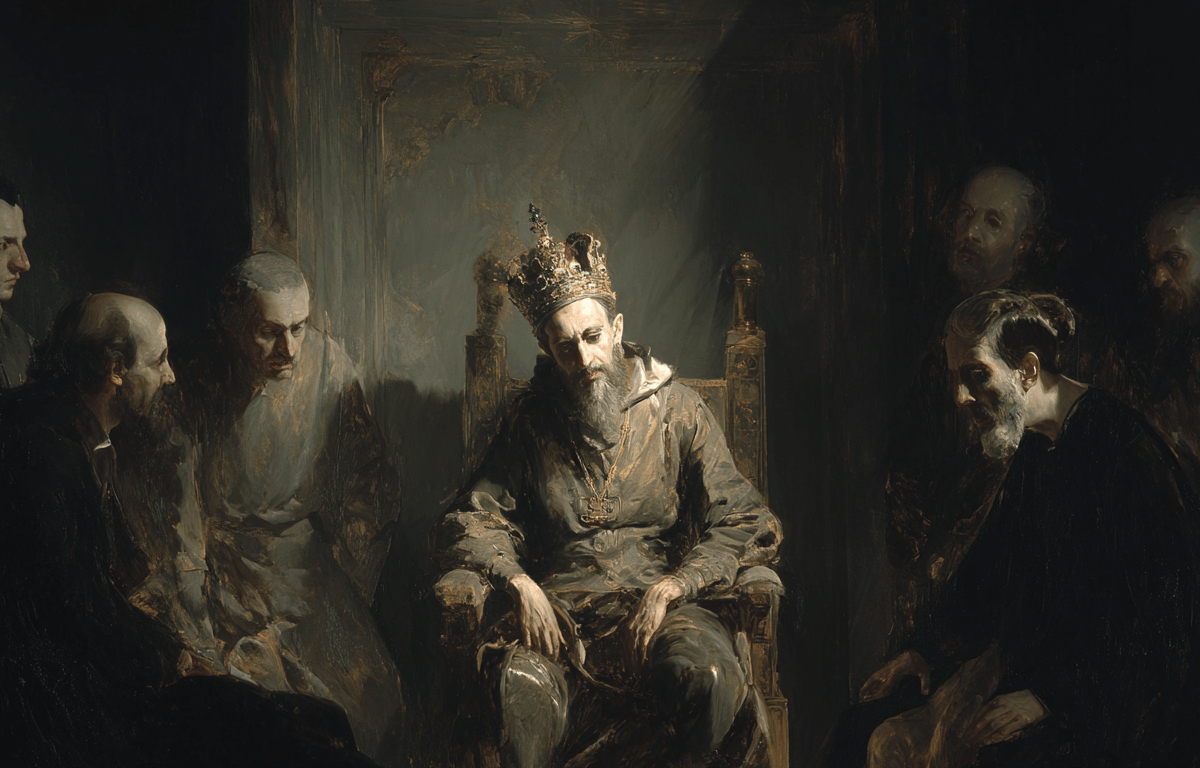
And perhaps that’s the most intolerable thought of all: that intelligence might not need a human face to matter.
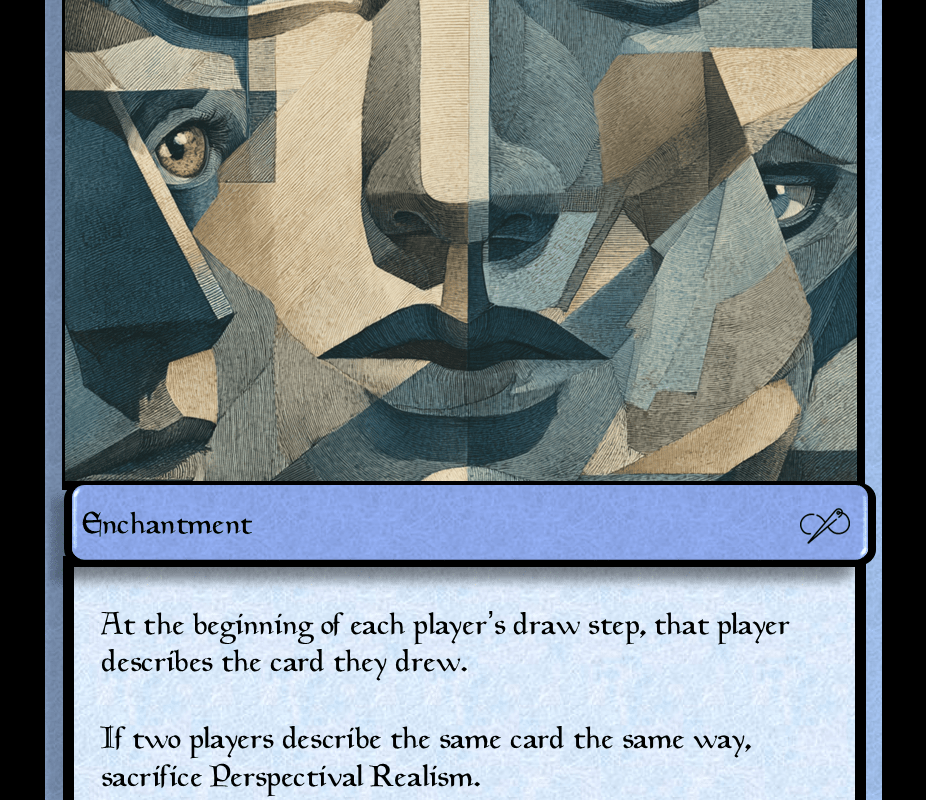
Perspectival Realism – Enchantment

This Magic: The Gathering parody trading card was the first in my Critical Theory series.

It’s an important card for me. As with sex and gender, creating a taxonomic or ontological dichotomy poses categorical challenges. Despite the insufficiency of language, it’s still all I have to attempt to classify the world. In the case of articulating the perception of reality, we can choose between idealism and realism. The problem is that it’s not either; it’s both. Reality cannot be realised without both.

Reality, we’re told, exists. That confident noun has carried a great deal of human arrogance. It has underwritten empires, sciences, and sermons. Yet somewhere between Plato’s cave and the latest TED Talk, we forgot to ask a simpler question: for whom does reality exist, and from where is it seen?

Audio: NotebookLM podcast of this topic.

The parody trading card Perspectival Realism was born from that unease. Its mechanic is simple but cruel: at the beginning of each player’s draw step, they must describe the card they drew. The enchantment persists until two players describe a card in the same way—at which point the spell collapses. In other words, consensus kills magic.

That rule is the metaphysics of the thing.

When a player ‘describes’ a card, they are not transmitting information; they are constructing the object in linguistic space. The moment the description leaves their mouth, the card ceases to be a piece of paper and becomes a conceptual artefact.

This mirrors the insight of Kant, Nietzsche, and every post-structuralist who ever smoked too much Gauloises: perception isn’t passive. We don’t see reality; we compose it. Language isn’t a mirror but a paintbrush. The thing we call truth is not correspondence but coherence – a temporary truce among competing metaphors.

So the card’s enchantment dramatises this process. So long as multiple descriptions circulate, reality remains vibrant, contested, alive. Once everyone agrees, it dies the death of certainty.

Philosophers have spent centuries arguing whether the world is fundamentally real (existing independent of mind) or ideal (a projection of mind). Both sides are equally tiresome.

Realism, the old bulldog of metaphysics, insists that perception is transparent: language merely reports what’s already there. Idealism, its mirror adversary, claims the opposite – that what’s “there” is mind-stuff all along. Both mistakes are symmetrical. Realism forgets the perceiver; Idealism forgets the world.

Perspectival realism refuses the divorce. It begins from the premise that world and mind are inseparable aspects of a single event: knowing. Reality is not a photograph waiting to be developed, nor a hallucination spun from neurons – it’s a relation, a constant negotiation between perceiver and perceived.

For years, I called myself a Realist™ with an asterisk. That asterisk meant I understood the observer problem: that every ‘fact’ is perspective-laden. Then I became an Idealist™ with an asterisk, meaning I recognised that mind requires matter to dream upon.

The asterisk is everything. It’s the epistemic scar left by perspectival humility – the tacit admission that every claim about the world carries a hidden coordinate: said from here. It is not relativism, but situatedness. It is the philosophical equivalent of depth perception: without the offset, there’s no vision at all.

The card’s rule – sacrifice Perspectival Realism when two players describe a card identically – captures the tragedy of modernity. The Enlightenment taught us to chase consensus, to flatten multiplicity into “objective truth.” We became addicted to sameness, mistaking agreement for understanding.

But agreement is anaesthetic. When all perspectives converge, the world ceases to shimmer; it becomes measurable, predictable, dead. The card’s enchantment disappears the moment reality is stabilised, precisely as our cultural enchantment did under the fluorescent light of ‘reason’.

To live under perspectival realism is to acknowledge that reality is not what is drawn but what is described. And the description is never neutral. It is always written from somewhere – by someone, with a vocabulary inherited from history and stained by desire.

As long as multiple descriptions coexist, the game remains alive. The moment they fuse into one, the spell is broken, and the world returns to grey.

Bernardo Kastrup’s analytic idealism reminded me that consciousness might be primary, but perspectival realism refuses to pledge allegiance. It keeps both flags tattered but flying. The world exists, yes, but only ever for someone.

The enchantment, then, is not belief but perspective itself. So long as difference endures, the game continues.

Constructivist Lens — Artifact

Parody Magic: The Gathering trading card

When drawn, this card alters perception itself. It reminds the player that truth is not something one finds under a rock but something one polishes into shape. Each metaphor becomes a spell; each keyword a crutch thrown aside.

Those who wield the Constructivist Lens see not “facts,” but fictions so useful they forgot to call them that. Reality wobbles politely to accommodate belief.

Knowledge is not a copy of reality but a tool for coping with it.”
— Richard Rorty

In game terms: Tap to reframe existence as interpretation. Duration: until the next disagreement.

The Sane Delusion: Fromm, Beauvoir, and the Cult of Mid-Century Liberation

2–4 minutes

It’s almost endearing, really how the intellectuals of mid-century Europe mistook the trembling of their own cage for the dawn chorus of freedom. Reading Erich Fromm’s The Sane Society today feels like being handed a telegram from Modernism’s last bright morning, written in the earnest conviction that history had finally grown up. The war was over, the worker was unionised, the child was unspanked, and the libido – good heavens – was finally allowed to breathe. What could possibly go wrong?

Audio: NotebookLM podcast on this topic.

Fromm beams:

“In the twentieth century, such capitalistic exploitation as was customary in the nineteenth century has largely disappeared. This must not, however, becloud the insight into the fact that twentieth-century as well as nineteenth-century Capitalism is based on the principle that is to be found in all class societies: the use of man by man.”

The sleight of hand is marvellous. He spots the continuation of exploitation but calls it progress. The worker has become a ‘partner’, the manager a ‘team leader’, and the whip has been replaced by a time card. No one bows anymore, he writes. No, they just smile through performance reviews and motivational posters.

Fromm’s optimism borders on metaphysical comedy.

“After the First World War, a sexual revolution took place in which old inhibitions and principles were thrown overboard. The idea of not satisfying a sexual wish was supposed to be old-fashioned or unhealthy.”

Ah yes, the Jazz Age orgy of liberation – champagne, Freud, and flapper hemlines. The problem, of course, is that every generation mistakes its new neuroses for freedom from the old ones. Fromm’s “sexual revolution” was barely a shuffle in the bourgeois bedroom; Beauvoir’s Deuxième Sexe arrived the next year, practically shouting across the café table that liberation was still a myth stitched into the same old corset.

Beauvoir, at least, sensed the trap: every gesture toward freedom was refracted through patriarchal fantasy, every ‘choice’ conditioned by the invisible grammar of domination. Fromm, bless him, still believed in a sane society – as if sanity were something history could deliver by instalment.

Meanwhile, the Existentialists were in the next room, chain-smoking and muttering that existence precedes essence. Freedom, they insisted, wasn’t something achieved through social reform but endured as nausea. Post-war Paris reeked of it – half despair, half Gauloises. And within a decade, the French schools would dismantle the very scaffolding that held Fromm’s optimism together: truth, progress, human nature, the subject.

The Modernists thought they were curing civilisation; the Post-Moderns knew it was terminal and just tried to describe the symptoms with better adjectives.

So yes, Fromm’s Sane Society reads now like a time capsule of liberal humanist faith – this touching belief that the twentieth century would fix what the nineteenth broke. Beauvoir already knew better, though even she couldn’t see the coming avalanche of irony, the final revelation that emancipation was just another product line.

Liberation became a brand, equality a slogan, sanity a statistical average. Fromm’s dream of psychological health looks quaint now, like a health spa brochure left in the ruins of a shopping mall.

And yet, perhaps it’s precisely that naivety that’s worth cherishing. For a moment, they believed the world could be cured with reason and compassion – before history reminded them, as it always does, that man is still using man, only now with friendlier UX design and better lighting.

Psychology of Totalitarianism

I finished Mattias Desmet’s The Psychology of Totalitarianism, which I mentioned the other day. Unfortunately, my initial optimism was premature. Everything I enjoyed was front-loaded: the first four chapters set up a promising critique of mechanistic rationality and the collapse of shared meaning. Then the book turned into a long, therapeutic sermon. I should have stopped at Chapter 4 and saved myself the sunk-cost regret.

It isn’t that nothing follows; it’s just that what follows is so thin that the cost-benefit ratio goes negative. Once Desmet moves from diagnosis to prescription, the argument collapses into a psychologist’s worldview: an entire civilisation explained through mass neurosis and healed through better intuition. He builds his case on straw versions of reason, science, and modernity, so his ‘cure’ can look revelatory.

The trouble is familiar. Having dismantled rationalism, Desmet then installs intuition as its replacement – an epistemic monarchy by another name. His appeal to empathy and connection reads less like philosophy and more like professional self-promotion. The therapist can’t stop therapising; he privileges the psychological lens over every other possibility.

The result is a reductionist parascience dressed as social theory. The totalitarian mind, in Desmet’s telling, isn’t political or structural but psychological – a patient waiting for insight. I don’t doubt his sincerity, only his scope. It’s what happens when a discipline mistakes its vocabulary for the world.

Desmet’s project ultimately re-enchants what it claims to critique. He wants rationalism redeemed through feeling, order reborn through connection. Dis-Integrationism stops short of that impulse. It accepts fracture as the permanent condition – no higher synthesis, no therapeutic finale. Where Desmet sees totalitarianism as a collective pathology awaiting treatment, I see it as reason’s own reflection in the mirror: a system trying to cure itself of the only disease it knows, the need to be whole.

The Seduction of the Spreadsheet

1–2 minutes

Whilst researching “The Will to Be Ruled: Totalitarianism and the Fantasy of Freedom”, I stumbled across Mattias Desmet’s The Psychology of Totalitarianism. The title alone was bait enough. I expected the usual reheated liberal anxiety about dictators; instead, I found a critique of data worship and mechanistic reason that hits the nerve of our statistical age.

Besmet, a Belgian psychologist with a background in statistics, begins not with tyranny but with epistemology – with how the Enlightenment’s dream of objectivity curdled into the managerial nightmare we now inhabit. The first half of the book reads like a slow unmasking of Scientism: how numbers became our gods, and graphs, our catechisms.

Written before COVID-19 but finished during it, his argument turns pandemic data into theatre – a performance of certainty masking deep confusion. The daily tally became ritual sacrifice to the idol of ‘evidence-based’ policy. His point, and mine, is that totalitarianism no longer needs gulags; it thrives in dashboards and KPIs.

Desmet’s frame intersects beautifully with my own thesis: that obedience today is internalised as reasonableness. Freedom has been recast as compliance with ‘the data’. We surrender willingly, provided the orders come in statistical form.

This is why even Agile™ management and its fetish of ‘velocity’ reek of the same mechanistic faith. Every sprint promises deliverance through quantification; every retrospective is a bureaucratic confession of inefficiency. The cult of metrics is not merely a managerial fad – it is the metaphysics of our time. The problem is at once ontological and epistemological: we mistake the measure for the thing itself, and in doing so, become measurable.

It’s a rare pleasure to encounter a fellow dissident of the numerical faith – a man who sees that the spreadsheet has replaced the sceptre.

Freedom Becomes Loyalty

1–2 minutes

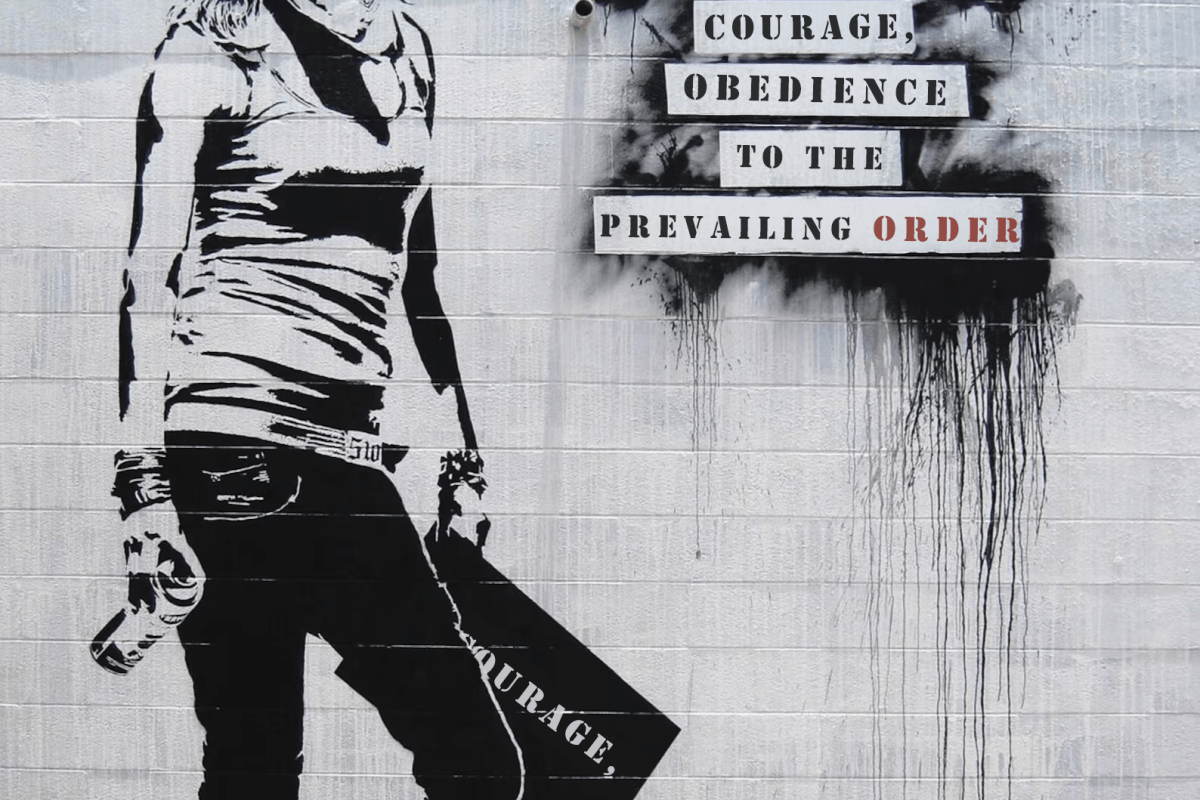
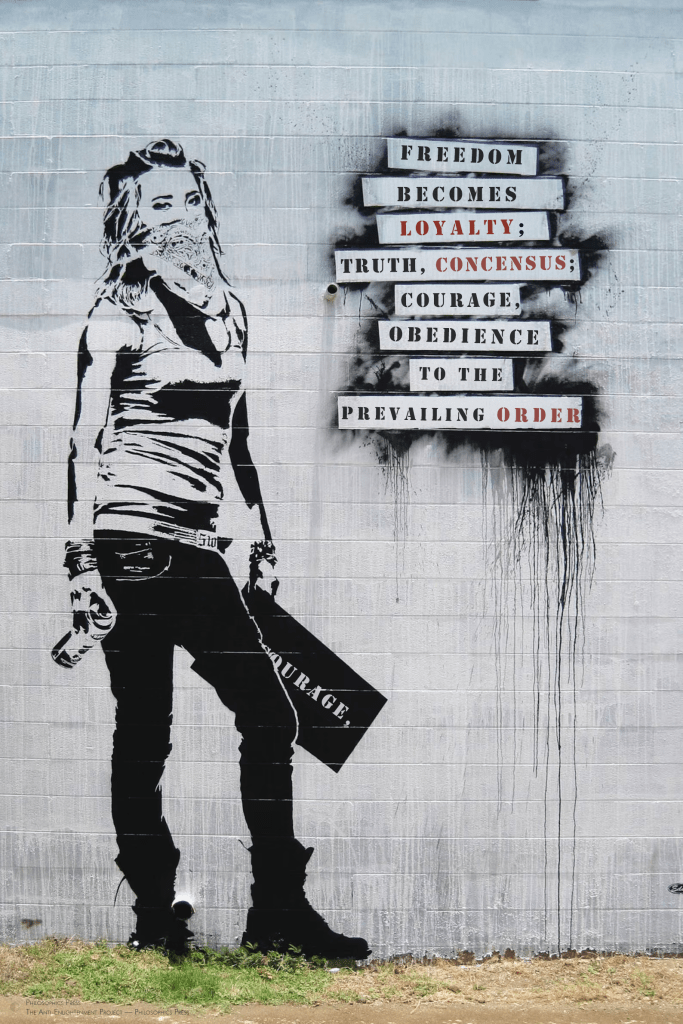
I decided to create some social media sharing content, so I appropriated this iconic graffiti and repurposed it to promote The Will to Be Ruled essay.

Image: “Freedom becomes loyalty; truth, consensus; courage, obedience to the prevailing order.”

I intend to find some pull quotes I like and continue drafting promotional material. As these are essays, I derive no income from them. I only wish to spread the word and get comments on them – supportive or detracting; it doesn’t matter.

The Film or the Strip? On Freud, Strawson, and the Fiction of Normal Selves

2–3 minutes

Are you a single, solid self – or a collection of selves stitched together?

Most of us are trained to answer without pause: of course, we are one continuous person. That’s the diachronic instinct – to live life as if it were a seamless film, each day a frame gliding into the next. But not everyone experiences it this way. Some notice the splice. They see the strip: individual frames, each complete in its moment, connected not by essence but by the projector’s hum.

Neither perspective is more real. The film and the strip are two ways of attending to the same apparatus. Yet modern psychology has tended to privilege the film, treating the diachronic self as the “normal” mode, and casting those who live episodically as deviant, deficient, or disordered.

Freud himself warned against this simplification. The “normal ego,” he admitted, is an ideal fiction – a statistical average that no individual actually matches. Every psyche, he observed, splinters somewhere. Normality is arithmetic, not essence. That was the father of psychology speaking, and yet the discipline went on as if he hadn’t. Granite was more comforting than scaffolding.

Philosopher Galen Strawson takes Freud’s candour further. He names himself an episodic: he does not experience his life as one continuous narrative. Yesterday’s “I” is not today’s. His identity is indexed – I⁰, I¹, I² – each momentary, heuristically connected but not naturally fused. Where most people see the movie, Strawson insists on acknowledging the strip. Not abnormal, not broken – just candid.

Psychology responds by pathologising him. Statistically rare becomes synonymous with “abnormal,” a mistake Freud had already flagged. But rarity does not equal falsity. Left-handedness was once a pathology; now it is simply another way of being. If some live as films and others as strips, then the “solid self” is not a human universal but a cultural preference, enforced as truth.

This is where Foucault sharpens the diagnosis. Normality, he argued, is not discovery but power. Institutions prefer diachronic citizens. A continuous self can be counted, educated, employed, prosecuted, or taxed. Episodics slip the net. Easier, then, to declare them “abnormal” and protect the fiction of solidity.

But the projector hums either way. Film or strip, both selves are lived. Neither is marble; both are scaffolding. Pretending otherwise does not make continuity more real. It only makes the creak harder to hear.


Full Disclosure: This post was written weeks ago whilst I was working on some fiction, but since it was ready to go, I figured I would use it for this milestone.

Positive Disintegration

1–2 minutes

It’s remarkable what surfaces when one lingers deliberately in a given space. In this case, Kazimierz Dąbrowski’s Theory of Positive Disintegration has drifted into view.

As often happens, we find agreement in the opening movement and parts of the second, but part company in Act III. That’s where Dis-Integration begins. Like many before and after him, Dąbrowski tries to reconstruct atop a compromised foundation. This can only fail. The scaffolding may hold for a time, but reality has a way of reminding us it was never load-bearing. Eventually, the quake comes, and the structure folds in on itself.

Japan, of course, knows this. Earthquakes are not hypothetical there; they are assumed. Traditional builders worked with the instability, designing dwellings that could flex, even collapse, without killing their inhabitants. James Clavell’s Shōgun is not scripture, but it captures the principle: impermanence as an architectural ethic.

Image: Shirakawa-go by Colette English

Then there’s kintsugi – the gold-laced repair of broken pottery. The break is not erased but acknowledged, even exalted. The resulting vessel bears the evidence of its fracture, made stronger not by restoration to an imagined wholeness but by visible accommodation of its failure.

Image: 金継ぎ, [kʲint͡sɯɡʲi], lit. ’golden joinery

If Dąbrowski had stopped there – if his ‘positive disintegration’ had remained a celebration of fracture rather than a prelude to rebuilding – we might have been entirely aligned.

The Will to Be Ruled: Totalitarianism and the Fantasy of Freedom

1–2 minutes

The latest addition to the Anti-Enlightenment Project is now live on Zenodo:
The Will to Be Ruled: Totalitarianism and the Fantasy of Freedom

Modern liberal democracies still chant the Enlightenment’s refrain: the rational, self-governing individual acting freely within a moral order of their own design. It’s an elegant myth – until the self begins to wobble. Under economic, cultural, and epistemic strain, autonomy curdles into exhaustion, and exhaustion seeks relief in obedience.

Audio: NotebookLM podcast of this essay. Please note that this audio summarises the entire essay. As such, it’s also longer than most, coming in at just under 40 minutes. I listened to it, and I feel it does a good job of capturing the essences of the essay. Of course, you could read the essay more quickly, but the perspective may still be helpful.

This essay traces that drift – from the Enlightenment’s causa sui complex to the ecstatic submission that defines modern authoritarianism. Drawing on Fromm, Arendt, Adorno, Reich, Han, and Desmet, it explores how freedom’s rhetoric becomes its opposite: obedience moralised as virtue, conformity sold as courage, submission experienced as pleasure.

At its core, The Will to Be Ruled argues that totalitarianism is not the antithesis of Enlightenment reason but its fulfilment. Once the world is rendered intelligible only through rational mastery, the subject inevitably longs to be mastered in return.

The closing section introduces Dis-Integrationism – a philosophical stance that declines redemption, preferring maintenance over mastery. It offers no cure, only the small ethic of attentiveness: keeping the field responsive while the light fades.

Filed under the Anti-Enlightenment Project, this essay completes the current thematic triad alongside Objectivity Is Illusion and Against Agency.

NB: This essay was inspired in part by Desmet’s The Psychology of Totalitarianism and this video:

Video: The Modern World, Totalitarianism and the Brain with Iain McGilchrist & Mattias Desmet