(A brief note on language, power, and moral certainty)
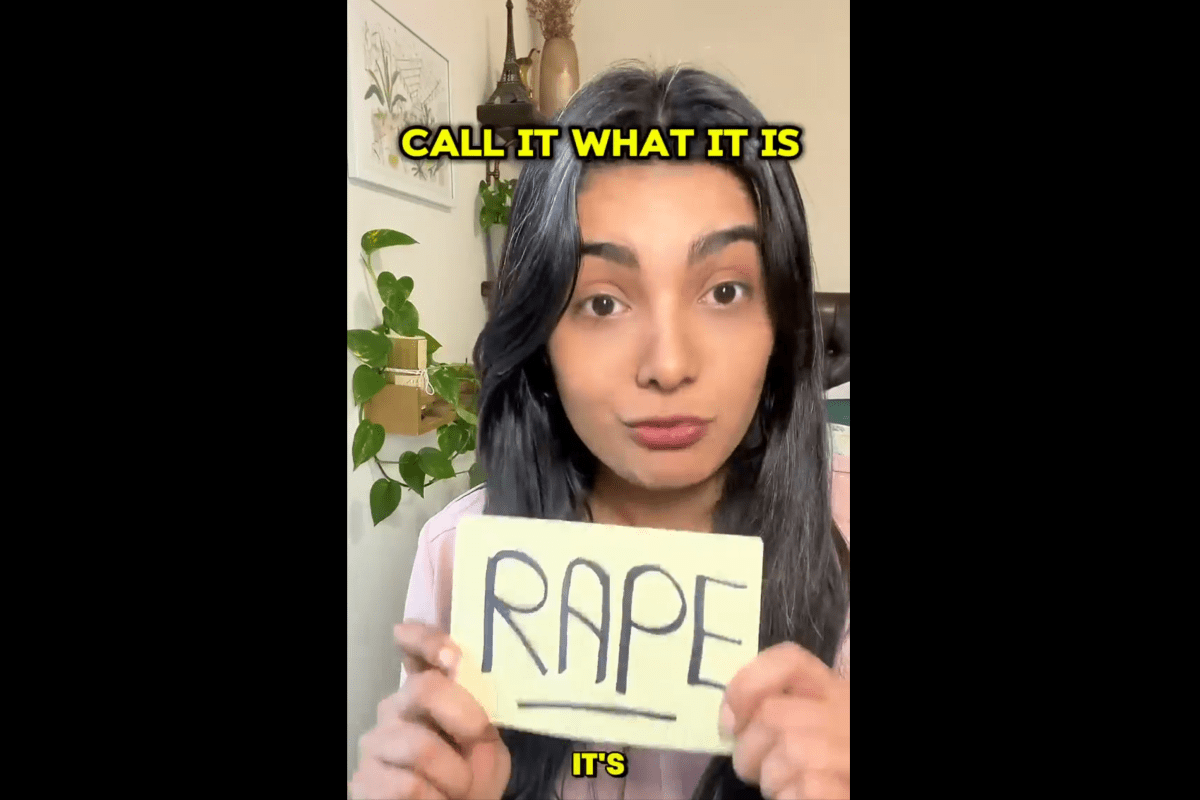
There is a particular kind of video that circulates online with tremendous force. A woman addresses the camera directly.
Video: Discussion Point (Full transcript at the end of this post)
She is clear, indignant, morally resolute:
It’s not an ‘inappropriate relationship with a 17-year-old’. It’s rape.
It’s not ‘coerced sex with a minor’. It’s rape.
It’s not a ‘young woman’. It’s a child.
Call it what it is.
Before proceeding, let me state something unambiguously: sexual exploitation of minors is morally reprehensible within contemporary Western legal and moral frameworks. I am not contesting that. Nor am I defending euphemism for its own sake. This is where philosophers of language take a lot of heat.
Audio: NotebookLM summary podcast on this topic.
The question here is narrower and, perhaps, more uncomfortable: What work is being done by the demand to ‘call it what it is‘?
Euphemism and Softening
She is correct in one respect. Institutional language often softens. Inappropriate relationship is anaesthetic. It lowers emotional temperature. It blunts moral outrage. Institutions frequently prefer such language because it reduces volatility, legal exposure, and procedural risk.
Language can minimise. That is not controversial. But it’s only half the story.
Naming Is Not Neutral
When she insists on rape and child, she is not merely removing euphemism. She is installing thick, legally saturated categories.
Rape is not a raw moral atom floating in space. It is a juridical classification defined by statute, evidentiary thresholds, and evolving legal doctrine. Its scope has expanded significantly over time: marital rape was once unrecognised; coercion has broadened beyond physical force; statutory rape collapses questions of consent into questions of legal capacity.
Likewise, child is not a purely biological category. It is a modern legal identity with shifting age thresholds and historical elasticity. The concept has expanded across the last two centuries as education extended, labour laws tightened, and adolescence became socially constructed as a protected stage of dependency.
To say this is not to relativise harm. It is to recognise that categories are historically sedimented and institutionally stabilised.
When someone says ‘Call it what it is‘, they are treating these contemporary legal categories as metaphysically self-evident. But they are products of a specific ontological framework: one in which autonomy and consent are foundational, and in which minors are deemed categorically incapable of exercising full sexual agency.
That framework is dominant in the West. It is not universal globally or historically.
Elasticity and Instrumentality
There is another asymmetry worth noticing.
Child expands protectively when someone is victimised. But the same individual may be stripped of childhood if they commit a serious crime: ‘They acted like an adult. They should have known better.’
The boundary is not purely developmental. It is normative. The category flexes.
Similarly, rape operates differently in everyday speech, in moral condemnation, and in statutory law. In the case of statutory rape, the term does not necessarily describe force; it describes the legal impossibility of consent. It is a doctrinal move grounded in an ontology of agency.
None of this weakens moral condemnation. But it reveals that these terms are not merely descriptive. They are instruments of moral and legal allocation.
Power and Irony
There is also a certain irony in the video.
She accuses mainstream institutions of manipulating language to reduce severity. Yet her demand is to deploy one of the state’s most powerful juridical classifications immediately and universally.
Rape derives its force from the same legal apparatus she critiques. It is powerful precisely because it is institutional. She is not rejecting power; she is attempting to redirect it.
This is not hypocrisy. It is politics. But it is politics nonetheless.
Ontology and Universality
The deeper issue is not whether we should condemn sexual exploitation. We should.
The issue is whether contemporary Western legal categories are simply “what is,” or whether they are historically developed ontological commitments that feel self-evident because they have been normalised.
The woman in the video experiences her categories as universal moral Truth. Many viewers agree. That agreement does not make the categories metaphysically timeless; it makes them hegemonic.
Recognising semantic expansion and legal drift does not undermine moral seriousness. It clarifies where moral authority resides: not in eternal linguistic atoms, but in historically stabilised frameworks.
Why This Is Unpopular
Online discourse prefers moral clarity over semantic archaeology. When harm is salient, genealogical analysis sounds like minimisation. Distinguishing between descriptive, legal, and ontological levels is interpreted as evasion.
It is not.
It is possible to affirm moral condemnation while also acknowledging that:
Language frames perception.
Legal categories evolve.
Terms are deployed instrumentally.
Ontologies masquerade as nature once naturalised.
One can insist on moral seriousness without pretending that our current vocabulary fell from the sky fully formed.
But saying so will reliably lose popularity on the internet.
Apparently, clarity has thresholds.
Full Video Transcript
‘Hey. It’s not an “Inappropriate Relationship with a 17-year-old”, it’s rape.
‘It’s not “coerced sex with a minor”, it’s rape.
‘It’s not “non-consensual sex with a 13-year-old”, it’s rape.
‘Call it what it is! Call them what they are.
‘And while we’re at it, it’s not a “young woman”, it’s a child!
‘It’s not a preteen, it’s a child!
‘It’s not a “mature girl”, it’s a child!
‘This use of specific language by mainstream media is super intentional, and it’s a tool of the patriarchy to try to reduce the egregiousness of horribly egregious acts that men commit against women and girls!
‘And, I say this with full awareness of the irony of my needing to use show and tell to make my point because I am beholden to these stupid social media platforms, which commit violence against women and girls every day in their own right by automatically suppressing any content as soon as I say a particular word.
‘And you and I need to say that it’s absolutely unacceptable!’
He doesn‘t, but he accidentally demonstrates the problem.
There is a certain kind of person who loathes Nietzsche for the same reason they loathe earthquakes. Not because he causes damage, but because he refuses to pretend the ground was ever stable.
In a recent address, Mark Carney says something that would have been unutterable in polite company a decade ago. He admits that the ‘rules-based international order’ was always a partial fiction. Not false enough to abandon, not true enough to believe in without effort. A story everyone knew was cracked, but which continued to function so long as enough people kept repeating the lines.
“We knew that the story about the rules-based order was partially false… We knew that international law applied with varying rigour depending on the identity of the accused and the victim. This fiction was useful [because of the goods provided by American hegemony]… So we placed the sign in the window. We participated in the rituals. And we largely avoided calling out the gaps between rhetoric and reality. This bargain no longer works. Let me be direct. We are in the midst of a rupture, not a transition… You cannot live within the lie of mutual benefit through integration when integration becomes the source of your subordination.“
Audio: NotebookLM podcast of this topic.
International law, he concedes, applied unevenly. Power decided enforcement. Friends received nuance. Enemies received principle. This was not ignorance. It was a bargain. The illusion delivered goods, stability, growth, a sense of moral hygiene. So the sign stayed in the window. The rituals continued. The gaps between rhetoric and reality were politely ignored. That bargain, Carney says, no longer works.
This is framed as geopolitical realism, but it is really an ontological admission. The mask slipped, and everyone is suddenly offended by the face underneath.
Image: NotebookLM infographic of this content.
This is why people hate Friedrich Nietzsche. Not because he celebrates cruelty or chaos, but because he insists that order is something we perform, not something we discover. He refuses the comfort of believing that the rules were ever neutral, universal, or self-enforcing. He points at the scaffolding and says: this is what is holding things up, not the sky.
When enough people play along, the game feels like reality. When someone refuses to play, panic sets in.
Enter Donald Trump. Trump did not invent the asymmetries of power. He refused to speak them politely. This created a moral crisis for institutions built on the assumption that everyone would continue to pretend. When a designated enemy like Vladimir Putin does this, it is filed under Evil. When an ally does it, the response bifurcates: either frantic appeasement, or embarrassed silence disguised as strategy.
Image: Foreignsentiment
Carney tries to walk a middle path. He neither genuflects nor detonates the stage. He acknowledges the fiction without fully abandoning it. This makes him interesting, but also symptomatic. He wants the audience to notice the set wobbling without asking them to leave the theatre.
When he says the old rules-based order is not coming back, what he really means is that the illusion has been interrupted. Whether permanently or only until someone builds a more convincing façade is left diplomatically unresolved. This is where Nietzsche becomes unavoidable.
People often lump Nietzsche together with vague talk of “power,” as though this were a crude obsession shared with Michel Foucault. But Nietzsche’s contribution is sharper and more unsettling. He is not merely describing power as something exercised. He is describing power as something that manufactures meaning, legitimacy, and moral vocabulary after the fact. Power does not break the rules. It writes them retroactively and calls them eternal.
This is the kind of power later adopted by Adolf Hitler, by Putin, and now by Trump. Not brute force alone, but the refusal to treat inherited norms as sacred simply because they are inherited. This is precisely what terrifies people who mistake procedural continuity for moral truth.
The United States borrowed Montesquieu’s separation of powers as though it were a lock rather than a suggestion. Anyone paying attention could see how easily it could be gamed. That this came as a shock says less about constitutional brilliance than about selective vision. The system functioned not because it was impregnable, but because its participants agreed, tacitly, to behave as though it were.
Nietzsche would call this decadence. Not decline as catastrophe, but decline as denial. The refusal to look directly at the conditions that make order possible, preferring instead to moralise their breakdown.
Carney’s speech is not radical. It is late. It says aloud what everyone already knew but preferred not to articulate: that the world was never neat, the order never neutral, and the rules never binding on those strong enough to ignore them.
What comes next is the uncomfortable part. Once the illusion is acknowledged, it cannot simply be re-believed. You can rebuild institutions. You can repaint the signage. But you cannot unknow that the coffee was always bitter.
Nietzsche does not tell us what replaces the façade. He only insists that pretending it was ever a window onto truth is the most dangerous fiction of all.
What Carney inadvertently demonstrates is not a failure of leadership but a failure of language. ‘Rules-based order’ was never a description of the world; it was a map we mistook for the terrain because it worked often enough to feel true. Nietzsche’s crime was pointing at the legend and saying it was doing the real work. Once that admission is made, you do not get to return to innocence. You can draw a new map, call it reform, integration, or renewal, but you will know it is a diagram pinned to power, not a window onto justice. The unease people feel now is not about chaos. It is about recognition. The lie no longer holds because too many have noticed the pins.
Lewis Goodall, a talk show host, calls the cross-border seizure of Venezuela’s Nicolás Maduro a ‘kidnapping’. His guest and Trump apologist, Angie Wong, rejects the word. She first says ‘arrest’, then ‘extradition’, then finally the improvised ‘special extradition’. Around that single lexical choice, a 12-minute standoff unfolds.
Audio: NotebookLM summary podcast of this topic.
As a language philosopher, I am evaluating the language and am less concerned with the underlying facts of the matter. Language serves to obscure these facts from the start and then rhetorically controls the narrative and framing.
Video: Source segment being analysed
There is a familiar mistake made whenever public discourse turns heated: the assumption that the real disagreement lies in the facts. This is comforting, because facts can, at least in principle, be checked. What follows examines a different failure mode altogether. The facts are largely beside the point.
Consider a broadcast exchange in which a political commentator and an interviewer argue over how to describe the forcible removal of a head of state from one country to another. The interviewer repeatedly uses the word kidnapping. The guest repeatedly resists this term, preferring arrest, extradition, and eventually the improvisational compromise ‘special extradition’.
What matters here is not which term is correct. What matters is what the interaction reveals about how meaning is negotiated under pressure.
The illusion of disagreement
Superficially, the exchange appears to be a dispute about legality. Was there a treaty? Was due process followed? Which court has jurisdiction? These questions generate heat, but they are not doing the work.
The real disagreement is prior to all of that: which lexical frame is allowed to stabilise the event.
Once a label is accepted, downstream reasoning becomes trivial. If it was an extradition, it belongs to one legal universe. If it was a kidnapping, it belongs to another. The participants are not arguing within a shared framework; they are competing to install the framework itself.
Equivocation as method, not error
The guest’s shifting vocabulary is often described as evasive or incoherent. This misreads what is happening. The movement from extradition to special extradition is not confusion. It is a deliberate widening of semantic tolerance.
‘Special extradition’ is not meant to clarify. It is meant to survive. It carries just enough institutional residue to sound procedural, while remaining sufficiently vague to avoid binding criteria. It functions less as a description than as a holding pattern.
This is equivocation, but not the amateur kind taught in logic textbooks. It is equivocation under constraint, where the aim is not precision but narrative continuity.
Why exposure fails
The interviewer repeatedly points out that extradition has a specific meaning, and that the situation described does not meet it. This is accurate, and also ineffective.
Why? Because the exchange is no longer governed by definitional hygiene. The audience is not being asked to adjudicate a dictionary entry. They are being asked to decide which voice has the authority to name the act.
Once that shift occurs, exposing misuse does not correct the discourse. It merely clarifies the power asymmetry. The guest can concede irregularity, precedent-breaking, even illegality, without relinquishing control of the label. The language continues to function.
Truth as a downstream effect
At no point does the exchange hinge on discovering what ‘really happened’. The physical sequence of events is relatively uncontested. What is contested is what those events are allowed to count as.
In this sense, truth is not absent from the discussion; it is subordinate. It emerges only after a rhetorical frame has been successfully installed. Once the frame holds, truth follows obediently within it.
This is not relativism. It is an observation about sequence. Rhetoric does not decorate truth here; it prepares the ground on which truth is later claimed.
Language doing institutional work
The most revealing moment comes when the guest effectively shrugs at the legal ambiguity and asks who, exactly, is going to challenge it. This is not cynicism. It is diagnostic.
Words like arrest and extradition are not merely descriptive. They are operational tokens. They open doors, justify procedures, and allow institutions to proceed without stalling. Their value lies less in semantic purity than in administrative usability.
‘Kidnapping’ is linguistically precise in one register, but administratively useless in another. It stops processes rather than enabling them. That is why it is resisted.
What the case study shows
This exchange is not about geopolitics. It is about how language behaves when it is tasked with carrying power. Meaning drifts not because speakers are careless, but because precision is costly. Labels are selected for durability, not accuracy. Truth does not arbitrate rhetoric; rhetoric allocates truth. Seen this way, the debate over terminology is not a failure of communication. It is communication functioning exactly as designed under modern conditions. Which is why insisting on ‘the correct word’ increasingly feels like shouting into a ventilation system. The air still moves. It just isn’t moving for you.
On Self-Evidence, Personhood, and the Administrative Nature of Rights
The following sentence is among the most quoted in political history and among the least examined. It is invoked as moral bedrock, taught as civic catechism, and insulated from scrutiny by a reverence that mistakes repetition for comprehension. It is rarely read closely, and rarely read sceptically.
Audio: NotebookLM summary podcast of this topic.
What follows is not a rebuttal. It is an annotation.
We hold these truths to be self-evident, that all men are created equal, that they are endowed by their Creator with certain unalienable Rights, that among these are Life, Liberty and the pursuit of Happiness.
Most readers will recognise this as the opening of the Declaration of Independence by the United States of America. Recognition, however, is not comprehension. The sentence survives on familiarity. Once that familiarity is set aside, it begins to fail clause by clause.
I. A Best Case, Briefly
A more charitable reading deserves brief consideration. ‘Self-evident’, in the intellectual context of the eighteenth century, did not mean obvious in the sense of requiring no reflection. It referred instead to propositions taken as axiomatic: not inferred from prior premises, but serving as starting points for reasoning. On this view, influenced by Scottish Common Sense philosophy, the claim is not that these truths are psychologically irresistible, but that they are rationally basic.
Likewise, ‘we hold’ need not be read as an admission of arbitrariness. It may be understood as a public avowal: a political body formally affirming what reason is said to disclose, rather than grounding those truths in the act of holding itself. Read this way, the sentence does not collapse into mere opinion.
Finally, the Declaration is often understood as performative rather than descriptive.[1] It does not merely state political facts; it brings a political subject into being. The ‘we’ is constituted in the act of declaration, and the language functions as a founding gesture rather than a philosophical proof.
Even on this charitable reading, however, the appeal to rational self-evidence presupposes capacities that were unevenly distributed at best. The Enlightenment notion of ‘reason’ was never a raw human faculty equally available to all. It depended on literacy, education, leisure, and institutional participation—conditions enjoyed by a narrow segment of the population.
In the late eighteenth century, large portions of the population were functionally illiterate. The ability to engage abstract political principles, to treat propositions as axiomatic starting points for reasoning, was not merely rare but socially restricted. The universal address of the sentence thus rests on a practical contradiction: it invokes a form of rational accessibility that its own social conditions actively prevented.
Nor is this merely a historical observation. Whilst formal literacy has expanded, the distribution of the capacities required for sustained abstract reasoning remains sharply constrained. What has changed is scale, not structure. Appeals to ‘self-evident’ political truths still presuppose forms of cognitive access that cannot be assumed, even now.
There is an important distinction here between innocent misreading and bad-faith translation. A modern reader who takes ‘self-evident’ to mean what it now ordinarily means is not at fault; semantic drift makes this nearly unavoidable. But to continue reading the sentence this way once its historical and philosophical context is understood is no longer an error. It is a decision.
Under the principle of least effort, claims that present themselves as ‘self-evident’ are maximally efficient. They require no sustained attention, no conceptual labour, and no challenge to inherited categories. For individuals ill-equipped – by education, time, or institutional support – to interrogate abstract political claims, such language is not merely persuasive; it is relieving.
To accept a proposition as self-evident is to be spared the burden of understanding how it works. The sentence can be consumed whole, in a single uncritical gulp. What is swallowed is not an argument, but a posture: assent without inquiry, agreement without comprehension.
This is not a personal failing. It is the predictable outcome of a cognitive environment in which complexity is costly, and authority is familiar. ‘Self-evidence’ functions here as a labour-saving device, converting political commitments into ready-made certainties. The capacity to recognise self-evident truths thus functions as an unmarked prerequisite for political subjecthood – a gatekeeping mechanism that precedes and enables the more explicit exclusions to come.
With this in mind, the sentence can be examined clause by clause – not as philosophical proposition, but as rhetorical machinery.
II. An Annotated Deconstruction
‘We hold’
To whom does this ‘we’ apply? Who is included in this collective voice, and who is not? More importantly, what does it mean to hold something that is allegedly self-evident?
Holding is an act of maintenance. It implies agreement, reinforcement, repetition. Beliefs must be held; axioms must be held; norms must be held. Self-evidence, by contrast, is supposed to require none of this. If a truth is genuinely self-evident, it does not need to be held at all. It simply imposes itself.
The opening clause announces immediacy whilst confessing mediation. This is not a subtle tension. It is an outright contradiction. The sentence begins by undermining its own epistemic posture. The axiomatic framing does not eliminate contestability; it displaces it. What is presented as rational starting point functions, in practice, as rhetorical closure.
‘Truths’
What kind of truths are being held here?
The word does far too much work whilst remaining resolutely undefined. These are not empirical truths. They are not logical truths. They are not even clearly moral truths in the narrow sense. Instead, the term oscillates between epistemic certainty, moral assertion, and political aspiration, sliding between categories without ever settling long enough to be examined.
The pluralisation matters. By multiplying ‘truths’ whilst leaving their nature unspecified, the sentence creates an aura of obviousness without committing to a standard of justification. Disagreement is pre-empted not by argument, but by tone.
‘Self-evident’
Unless one invokes something like Descartes’ cogito as a limiting case, nothing is genuinely self-evident. Even the cogito depends on language, conceptual inheritance, and a shared grammar of doubt. Self-evidence is not an epistemic given; it is an experiential effect produced by familiarity, stability, and low resistance.
Here, ‘self-evident’ functions as rhetorical closure masquerading as epistemology. It does not establish certainty; it enforces silence. To question what is ‘self-evident’ is to risk being cast as obtuse, perverse, or acting in bad faith. Inquiry is not answered. It is short-circuited.
‘All men’
This is not the inclusive ‘men’ of abstract mankind. It is a concrete, historically bounded category: adult males, and not coincidentally white ones. The exclusions are not implied later. They are operative here, at the point of entry.
This is the quietly active boundary of the entire sentence. Before any rights are named, before any equality is asserted, the scope of applicability has already been narrowed. The universal tone is achieved by selective admission.
‘Created equal’
Created by whom? And equal in what respect?
The notion of equality here is never specified, because specification would immediately expose contestation. Equal in capacity? In worth? In standing before the law? In outcome? In moral consideration? Readers are invited to supply their preferred interpretation retroactively, which is precisely what allows the sentence to endure.
Some have suggested that ‘equal’ means ‘equal under the law’, but this simply defers the problem. The law defines equality however it pleases, when it pleases, and for whom it pleases. Equality without a metric is not a claim. It is a metaphysical gesture.
It is often said that the Declaration’s universal language contained the seeds of its own expansion. That Douglass, King, and the suffragists appealed to it is taken as evidence of its latent emancipatory power. But this confuses rhetoric with causation. These advances were not the unfolding of a promise, but the result of sustained political pressure, moral confrontation, and material struggle. The language was repurposed because it was available and authoritative, not because it was prophetic.
To call this a ‘promissory note’ is to mistake a battlefield for a contract. Promises are kept by their authors. These were extracted by those excluded, often in direct opposition to the very institutions that sanctified the sentence.
The story also flatters the present. If the promise is always being fulfilled, it is never being broken. Yet the same language remains actively contested, narrowed, and rescinded. Personhood is still conditional. Rights still evaporate at borders, prisons, and classifications. The note, if it exists at all, is perpetually past due.
‘Endowed by their Creator’
No one believes the drafters were referring to genetics or parentage. This capital-C Creator is a theological move, not a biological one. The sentence quietly abandons the pretence of self-evidence and imports divine authority as a grounding mechanism.
This is not incidental. By placing rights beyond human origin, the sentence renders them simultaneously unquestionable and unreachable. Legitimacy is outsourced to a source that cannot be interrogated. Appeals are closed by design.
‘Unalienable Rights’
Here the sentence delivers a double assertion. First, that rights exist independently of institutions. Second, that they cannot be taken away. Both claims fail on contact with history.
Rights are constructed, recognised, enforced, suspended, and withdrawn by institutions. Bentham saw this clearly: ‘natural rights’ function rhetorically to obscure the institutional conditions that alone make rights actionable.[2] And far from being inalienable, rights prove remarkably fragile. The record is unambiguous: rights track status, not humanity. The moment personhood is questioned, rights do not need to be violated. They simply cease to apply.
‘Life, Liberty, and the pursuit of Happiness’
Under the Language Insufficiency Hypothesis – the framework treating key political terms as structurally underdetermined – these are textbook Contestables.[3] None are measurable. None have stable definitions. None come with clear thresholds or enforcement criteria.
‘Happiness’ is the most revealing substitution of all. Locke’s blunt ‘property’ at least named what was being protected.[4] ‘Happiness’ softens the promise whilst emptying it of content. It gestures toward flourishing whilst committing to nothing beyond tolerable participation.
Life, liberty, and happiness are curated abstractions, not guarantees – property in softer clothing.
III. Personhood as the Hidden Mechanism
Zooming out, the operational logic becomes clear. Rights depend on personhood.[5] Personhood is conferred, not discovered. Declaring non-personhood resolves the contradiction without ever touching the rhetoric.
This is the mechanism that allows a universal language to coexist with selective application. When personhood is withdrawn, rights are not violated. They are bypassed. Ethics never gets a hearing, because the subject has already been administratively erased.
To call this administrative is not metaphor. Personhood is assigned, reclassified, and revoked through documentation, categorisation, and procedural determination. The question of who counts is settled before any ethical consideration can begin.
IV. The Sentence as Prototype, Not Mistake
It is tempting to read this sentence as naïve, hypocritical, or aspirationally flawed. That would be a mistake. The sentence is not a failure of Enlightenment thinking. It is its prototype.
It was never meant to survive scrutiny. It was meant to mobilise, stabilise, and legitimise. Its vagueness is functional. Its incoherence is load-bearing. The sentence works precisely because it is conceptually promiscuous, rhetorically elevated, and operationally evasive. What looks like philosophical sloppiness is political engineering.
V. Why It Still Matters
This sentence is not an historical curiosity. It is the template for modern political language.
Universal in tone.
Conditional in application.
Moral in rhetoric.
Administrative in practice.
The future did not reveal the sentence to be false. It revealed what the sentence was for.
Footnotes
[1] J.L. Austin, How to Do Things with Words
[2] Jeremy Bentham, Anarchical Fallacies; Being an Examination of the Declarations of Rights Issued During the French Revolution
[3] See The Language Insufficiency Hypothesis for a full treatment of Contestables and their function in political discourse.
[4] John Locke, Two Treatises of Government
[5] Hannah Arendt, The Origins of Totalitarianism
Written by Bry Willis
microglyphics
NB: I wrote this as a polemic rather than in a manner suitable for a journal submission. I did not wish to expend the effort to understand counterarguments. This interpretation stands on its own. This said, in Section I. I still note some historical perspective that is somewhat important. It even illustrates semantic drift, which I cover in A Language Insufficiency Hypothesis.
Now that A Language Insufficiency Hypothesis has been put to bed — not euthanised, just sedated — I can turn to the more interesting work: instantiating it. This is where LIH stops being a complaint about words and starts becoming a problem for systems that pretend words are stable enough to carry moral weight.
What follows is not a completed theory, nor a universal schema. It’s a thinking tool. A talking point. A diagram designed to make certain assumptions visible that are usually smuggled in unnoticed, waved through on the strength of confidence and tradition.
The purpose of this diagram is not to redefine justice, rescue it, or replace it with something kinder. It is to show how justice is produced. Specifically, how retributive justice emerges from a layered assessment process that quietly asserts ontologies, filters encounters, applies normative frames, and then closes uncertainty with confidence.
Audio: NotebookLM summary podcast of this topic.
Most people are willing to accept, in the abstract, that justice is “constructed”. That concession is easy. What is less comfortable is seeing how it is constructed — how many presuppositions must already be in place before anything recognisable as justice can appear, and how many of those presuppositions are imposed rather than argued for.
The diagram foregrounds power, not as a conspiracy or an optional contaminant, but as an ambient condition. Power determines which ontologies are admissible, which forms of agency count, which selves persist over time, which harms are legible, and which comparisons are allowed. It decides which metaphysical configurations are treated as reasonable, and which are dismissed as incoherent before the discussion even begins.
Justice, in this framing, is not discovered. It is not unearthed like a moral fossil. It is assembled. And it is assembled late in the process, after ontology has been assumed, evaluation has been performed, and uncertainty has been forcibly closed.
This does not mean justice is fake. It means it is fragile. Far more fragile than its rhetoric suggests. And once you see that fragility — once you see how much is doing quiet, exogenous work — it becomes harder to pretend that disagreements about justice are merely disagreements about facts, evidence, or bad actors. More often, they are disagreements about what kind of world must already be true for justice to function at all.
I walk through the structure and logic of the model below. The diagram is also available as a PDF, because if you’re going to stare at machinery, you might as well be able to zoom in on the gears.
Why Retributive Justice (and not the rest of the zoo)
Before doing anything else, we need to narrow the target.
“Justice” is an infamously polysemous term. Retributive, restorative, distributive, procedural, transformative, poetic, cosmic. Pick your flavour. Philosophy departments have been dining out on this buffet for centuries, and nothing useful has come of letting all of them talk at once.
This is precisely where LIH draws a line.
The Language Insufficiency Hypothesis is not interested in pedestrian polysemy — cases where a word has multiple, well-understood meanings that can be disambiguated with minimal friction. That kind of ambiguity is boring. It’s linguistic weather.
What LIH is interested in are terms that appear singular while smuggling incompatible structures. Words that function as load-bearing beams across systems, while quietly changing shape depending on who is speaking and which assumptions are already in play.
“Justice” is one of those words. But it is not usefully analysable in the abstract.
So we pick a single instantiation: Retributive Justice.
Why?
Because retributive justice is the most ontologically demanding and the most culturally entrenched. It requires:
a persistent self
a coherent agent
genuine choice
intelligible intent
attributable causation
commensurable harm
proportional response
In short, it requires everything to line up.
If justice is going to break anywhere, it will break here.
Retributive justice is therefore not privileged in this model. It is used as a stress test.
The Big Picture: Justice as an Engine, Not a Discovery
The central claim of the model is simple, and predictably unpopular:
Justice is not discovered. It is produced.
Not invented in a vacuum, not hallucinated, not arbitrary — but assembled through a process that takes inputs, applies constraints, and outputs conclusions with an air of inevitability.
The diagram frames retributive justice as an assessment engine.
An engine has:
inputs
internal mechanisms
thresholds
failure modes
and outputs
It does not have access to metaphysical truth. It has access to what it has been designed to process.
The justice engine takes an encounter — typically an action involving alleged harm — and produces two outputs:
Desert (what is deserved),
Responsibility (to whom it is assigned).
Everything else in the diagram exists to make those outputs possible.
The Three Functional Layers
The model is organised into three layers. These are not chronological stages, but logical dependencies. Each layer must already be functioning for the next to make sense.
1. The Constitutive Layer
(What kind of thing a person must already be)
This layer answers questions that are almost never asked explicitly, because asking them destabilises the entire process.
What counts as a person?
What kind of self persists over time?
What qualifies as an agent?
What does it mean to have agency?
What is a choice?
What is intent?
Crucially, these are not empirical discoveries made during assessment. They are asserted ontologies.
The system assumes a particular configuration of selfhood, agency, and intent as a prerequisite for proceeding at all. Alternatives — episodic selves, radically distributed agency, non-volitional action — are not debated. They are excluded.
This is the first “happy path”.
If you do not fit the assumed ontology, you do not get justice. You get sidelined into mitigation, exception, pathology, or incoherence.
2. The Encounter Layer
(What is taken to have happened)
This layer processes the event itself:
an action
resulting harm
causal contribution
temporal framing
contextual conditions
motive (selectively)
This is where the rhetoric of “facts” tends to dominate. But the encounter is never raw. It is already shaped by what the system is capable of seeing.
Causation here is not metaphysical causation. It is legible causation. Harm is not suffering. It is recognisable harm. Context is not total circumstance. It is admissible context.
Commensurability acts as a gatekeeper between encounter and evaluation: harms must be made comparable before they can be judged. Anything that resists comparison quietly drops out of the pipeline.
3. The Evaluative Layer
(How judgment is performed)
Only once ontology is assumed and the encounter has been rendered legible does evaluation begin:
proportionality
accountability
normative ethics
fairness (claimed)
reasonableness
bias (usually acknowledged last, if at all)
This layer presents itself as the moral heart of justice. In practice, it is the final formatting pass.
Fairness is not discovered here. It is declared. Reasonableness does not clarify disputes. It narrows the range of acceptable disagreement. Bias is not eliminated. It is managed.
At the end of this process, uncertainty is closed.
That closure is the moment justice appears.
Why Disagreement Fails Before It Starts
At this point, dissent looks irrational.
The system has:
assumed an ontology
performed an evaluation
stabilised the narrative through rhetoric
and produced outputs with institutional authority
To object now is not to disagree about evidence. It is to challenge the ontology that made assessment possible in the first place.
And that is why so many justice debates feel irresolvable.
They are not disagreements within the system. They are disagreements about which system is being run.
LIH explains why language fails here. The same words — justice, fairness, responsibility, intent — are being used across incompatible ontological commitments. The vocabulary overlaps; the worlds do not.
The engine runs smoothly. It just doesn’t run the same engine for everyone.
Where This Is Going
With the structure in place, we can now do the slower work:
unpacking individual components
tracing where ontological choices are asserted rather than argued
showing how “reasonableness” and “fairness” operate as constraint mechanisms
and explaining why remediation almost always requires a metaphysical switch, not better rhetoric
Justice is not broken. It is doing exactly what it was built to do.
That should worry us more than if it were merely malfunctioning.
This essay is already long, so I’m going to stop here.
Not because the interesting parts are finished, but because this is the point at which the analysis stops being descriptive and starts becoming destabilising.
The diagram you’ve just walked through carries a set of suppressed footnotes. They don’t sit at the margins because they’re trivial; they sit there because they are structurally prior. Each one represents an ontological assertion the system quietly requires in order to function at all.
By my count, the model imposes at least five such ontologies. They are not argued for inside the system. They are assumed. They arrive pre-installed, largely because they are indoctrinated, acculturated, and reinforced long before anyone encounters a courtroom, a jury, or a moral dilemma.
Once those ontologies are fixed, the rest of the machinery behaves exactly as designed. Disagreement downstream is permitted; disagreement upstream is not.
In a follow-up essay, I’ll unpack those footnotes one by one: where the forks are, which branch the system selects, and why the alternatives—while often coherent—are rendered unintelligible, irresponsible, or simply “unreasonable” once the engine is in motion.
That’s where justice stops looking inevitable and starts looking parochial.
And that’s also where persuasion quietly gives up.
Written by Bry Willis and ChatGPT 5.2 after a couple of days of back and forth
I’ve been working on A Language Insufficiency Hypothesis since 2018. At least, that’s the polite, CV-friendly version. The truer account is that it’s been quietly fermenting since the late 1970s, back when I was still trapped in primary school and being instructed on how the world supposedly worked.
Social Studies. Civics. Law. The whole civic catechism. I remember being taught about reasonable persons and trial by a jury of one’s peers, and I remember how insistently these were presented as fair solutions. Fairness was not argued for. It was asserted, with the weary confidence of people who think repetition counts as justification.
I didn’t buy it. I still don’t. The difference now is that I have a hypothesis with some explanatory power instead of a vague sense that the adults were bluffing.
Audio: NotebookLM summary podcast of this topic.
I’ve always been an outsider. Eccentric, aloof, l’étranger if we’re feeling theatrical. It never particularly troubled me. Outsiders are often tolerated, provided they remain decorative and non-contagious. Eye rolls were exchanged on both sides. No harm done.
But that outsider position had consequences. It led me, even then, to ask an awkward question: Which peers? Not because I thought I was superior, but because I was plainly apart. How exactly was I meant to be judged by my peers when no one else occupied anything like my perspective?
Later, when I encountered the concept of fundamental attribution bias, it felt less like a revelation and more like confirmation. A peer-based system assumes not just similarity of circumstance, but similarity of interpretation. That assumption was dead on arrival.
Then there were reasonable persons. I was assured they existed. I was assured judges were trained to embody them. I had never met one. Even as a teenager, I found the idea faintly comical. Judges, I was told, were neutral, apolitical, and dispassionate. Writing this now from the United States, one hardly needs to belabour the point. But this wasn’t prescience. It was intuition. The smell test failed decades ago.
Before LIH had a name, I called these things weasel words. I still do, as a kind of shorthand. Terms like fair, reasonable, accountable, appropriate. Squishy concepts that do serious institutional work whilst remaining conveniently undefinable. Whether one wants to label them Contestables or Fluids is less important than recognising the space they occupy.
That space sits between Invariables, things you can point to without dispute, and Ineffables, where language more or less gives up. Communication isn’t binary. It isn’t ‘works’ or ‘doesn’t’. It’s a gradient. A continuous curve from near-certainty to near-failure.
Most communication models quietly assume a shared ontology. If misunderstanding occurs, the remedy is more explanation, more context, more education. What never sat right with me, even as a child, was that this only works when the disagreement is superficial. The breaking point is ontological.
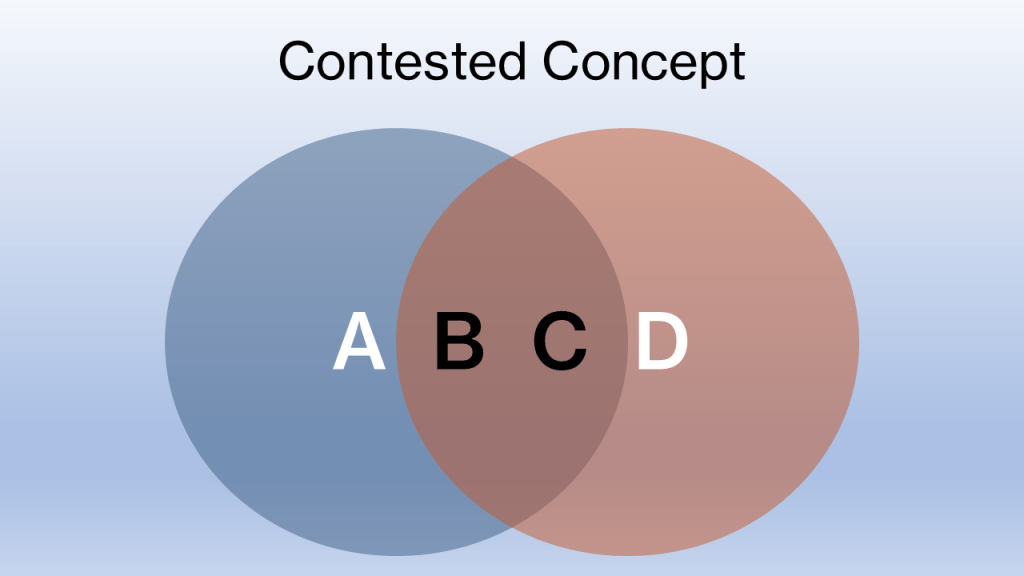
If one person believes a term means {A, B, C} and another believes it means {B, C, D}, the overlap creates a dangerous illusion of agreement. The disagreement hides in the margins. A and D don’t merely differ. They are often irreconcilable.
Image: Venn diagramme of a contested concept. Note: This is illustrative and not to scale
Fairness is a reliable example. One person believes fairness demands punishment, including retributive measures. Another believes fairness permits restoration but rejects retribution, citing circumstance, history, or harm minimisation. Both invoke fairness sincerely. The shared language conceals the conflict.
When such disputes reach court, they are not resolved by semantic reconciliation. They are resolved by authority. Power steps in where meaning cannot. This is just one illustration. There are many.
I thought it worth sharing how LIH came about, if only to dispel the notion that it’s a fashionable response to contemporary politics. It isn’t. It’s the slow crystallisation of a long-standing intuition: that many of our most cherished concepts don’t fail because we misuse them, but because they were never capable of doing the work we assigned to them.
A Sequel to “The Disorder of Saying No” and a Companion to “When ‘Advanced’ Means Genocide”
In my previous post, The Disorder of Saying No, I explored the way resistance to authority is pathologised, particularly when that authority is cloaked in benevolence and armed with diagnostic manuals. When one refuses — gently, thoughtfully, or with a sharp polemic — one is no longer principled. One is “difficult.” Or in my case, oppositional.
Audio: NotebookLM podcast on this topic.
So when I had the gall to call out Bill Maher for his recent linguistic stunt — declaring that a woman is simply “a person who menstruates” — I thought I was doing the rational thing: pointing out a classic bit of reductionist nonsense masquerading as clarity. Maher, after all, was not doing biology. He was playing lexicographer-in-chief, defining a term with centuries of philosophical, sociological, and political baggage as though it were a checkbox on a medical form.
I said as much: that he was abusing his platform, presenting himself as the sole arbiter of the English language, and that his little performance was less about clarity and more about controlling the terms of discourse.
My friend, a post-menopausal woman herself, responded not by engaging the argument, but by insinuating — as others have — that I was simply being contrary. Oppositional. Difficult. Again. (She was clearly moved by When “Advanced” Means Genocide, but may have missed the point.)
So let’s unpack this — not to win the debate, but to show what the debate actually is.
This Isn’t About Biology — It’s About Boundary Maintenance
Maher’s statement wasn’t intended to clarify. It was intended to exclude. It wasn’t some linguistic slip; it was a rhetorical scalpel — one used not to analyse, but to amputate.
And the applause from some cisgender women — particularly those who’ve “graduated” from menstruation — reveals the heart of the matter: it’s not about reproductive biology. It’s about controlling who gets to claim the termwoman.
it only works if you pretend the world is simpler than it is.
Let’s steelman the argument, just for the sport of it:
Menstruation is a symbolic threshold. Even if one no longer menstruates, having done so places you irrevocably within the category of woman. It’s not about exclusion; it’s about grounding identity in material experience.
Fine. But now let’s ask:
What about women who’ve never menstruated?
What about intersex people?
What about trans women?
What about cultures with radically different markers of womanhood?
You see, it only works if you pretend the world is simpler than it is.
The Language Insufficiency Hypothesis: Applied
This is precisely where the Language Insufficiency Hypothesis earns its keep.
The word woman is not a locked vault. It is a floating signifier, to borrow from Barthes — a term whose meaning is perpetually re-negotiated in use. There is no singular essence to the word. It is not rooted in biology, nor in social role, nor in performance. It is a hybrid, historically contingent construct — and the moment you try to fix its meaning, it slips sideways like a greased Wittgensteinian beetle.
“Meaning is use,” says Wittgenstein, and this is what frightens people.
If woman is defined by use and not by rule, then anyone might claim it. And suddenly, the club is no longer exclusive.
That’s the threat Maher and his defenders are really reacting to. Not trans women. Not intersex people. Not language activists or queer theorists.
The threat is ambiguity.
What They Want: A World That Can Be Named
The push for rigid definitions — for menstruation as membership — is a plea for a world that can be named and known. A world where words are secure, stable, and final. Where meaning doesn’t leak.
But language doesn’t offer that comfort.
It never did.
And when that linguistic instability gets too close to something personal, like gender identity, or the foundation of one’s own sense of self, the defensive response is to fortify the language, as though building walls around a collapsing church.
Maher’s defenders aren’t making scientific arguments. They’re waging semantic warfare. If they can hold the definition, they can win the cultural narrative. They can hold the gates to Womanhood and keep the undesirables out.
That’s the fantasy.
But language doesn’t play along.
Conclusion: Words Will Not Save You — but They Might Soothe the Dead
In the end, Maher’s definition is not merely incorrect. It is insufficient. It cannot accommodate the complexity of lived experience and cannot sustain the illusion of clarity for long.
They are defending nostalgia.
And those who cling to it — friend or stranger, progressive, or conservative — are not defending biology. They are defending nostalgia. Specifically, a pathological nostalgia for a world that no longer exists, and arguably never did: a world where gender roles were static, language was absolute, and womanhood was neatly circumscribed by bodily functions and suburban etiquette.
Ozzy and Harriet loom large here — not as individuals but as archetypes. Icons of a mid-century dream in which everyone knew their place, and deviation was something to be corrected, not celebrated. My friend, of that generation, clings to this fantasy not out of malice but out of a desperate yearning for order. The idea that woman could mean many things, and mean them differently across contexts, is not liberating to her — it’s destabilising.
But that world is gone. And no amount of menstruation-based gatekeeping will restore it.
The Real Scourge Is Ambiguity
Maher’s tantrum wasn’t about truth. It was about fear — fear of linguistic drift, of gender flux, of a world in which meaning no longer obeys. The desire to fix the definition of “woman” is not a biological impulse. It’s a theological one.
And theology, like nostalgia, often makes terrible policy.
And theology, like nostalgia, often makes terrible policy.
This is why your Language Insufficiency Hypothesis matters. Because it reminds us that language does not stabilise reality — it masks its instability. The attempt to define “woman” once and for all is not just futile — it’s an act of violence against difference, a linguistic colonisation of lived experience.
So Let Them Rest
Ozzy and Harriet are dead. Let them rest. Let their picket fence moulder. Let their signage decay.
The world has moved on. The language is shifting beneath your feet. And no amount of retroactive gatekeeping can halt that tremor.
The club is burning. And the only thing left to save is honesty.








 Philosophics