Ear Training

1–2 minutes

Me: I got an admission: I never enjoyed musical ear training – trying to name a pitch, interval, or chord.

You: That’s nice. So what?

Me: Well, let me tell you…

I’ve been doing a similar exercise… also involving ears. I’ve decided to engage in IPA phonetic ear training as part of my language curriculum, as it were.

I’ve created an Anki flashcard pack, of – as well as other things –phonetic symbols to match to the sound and vice versa. It’s harder than it sounds. Like pitch, if I play an A (Do) I can tell what an E (Sol) sounds like, a perfect fifth; but I can’t produce an E from vapour: If I hear it absent of musical information, I can’t name it; neither can I produce it without a reference. This is a limitation of relative pitch.

On a guitar, I can play an E relative to other strings, but I can’t tell you whether the A is pitched to 440 (top) or 432 (bottom).

440 Hz
432 Hz

Of course, if you tell me the top sound is pitched to A-440 and ask if the second one is higher or lower, I can tell you that. Hooray for me. But if the A-432 was actually A-431, you’d have had me tricked.

You: Where’s this going?

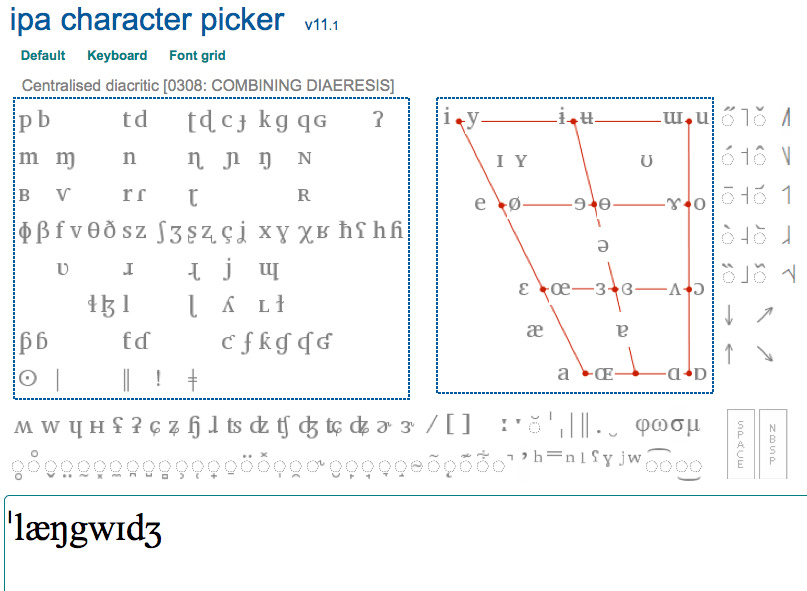
I experience the same challenge in my IPA studies. In context, if I hear an open and closed O sound – ɔ and o – I can tell you which is which, but I haven’t yet mastered the ability to utter these in the wild. I might be able to manage a nasal O – ɔ̃ – but we still haven’t arrived at the neighbours – ɵ, ɞ, ɤ, and so on. Source. Here’s a random or at least arbitrary IPA site.

I wonder if you people have perfect pitch in this regard.

Bang the Jrum Slowly!

I was riding a chrain down a shchreet banging a jrum and eating shrimp.

Podcast: Audio rendition of this page content

If you keep up with English language morphology—and let’s be honest here, who doesn’t?—the opening sentence is a phonetic respelling of ‘I was riding a train down a street banging a drum and eating shrimp’ but for a new generation. Dr Geoff Lindsey created a video, which includes material drawn from his book English After RP: Standard British Pronunciation Today. But don’t be fooled by the RP reference. There is plenty of relevance to the shifts in General American English if ever there was such a thing.

As noted previously, the principle of least effort tends to be a guiding factor for language morphology, and we’re witnessing the conservation of effort driving this shift.

Technically, what’s happening is that, traditionally, we performed some lingual gymnastics gliding (or not) from an alveolar consonant to a post-alveolar shift. The new fashion is to shift the entire structure into a post-alveolar space. Lazy wins. Of course, I’ll expect to hear from vocal prescriptivists, the traditional grammar Nazis, who will insist, “If I see a T in train, I’m going to pronounce it like a T, dammit. No ch-ch as in choo-choo for this ‘adult’.”

I’ve summarised the italicised words in a table.

TraditionIPANouveauIPA
train/tɹeɪn/chrain/t͡ʃɹeɪn/
drum/ˈdɹʌm/jrum/ˈdʒɹʌm/
street/stɹiːt/shchreet/ʃt͡ʃɹiːt/
shrimp/ʃɹɪmp/shrimp/ʃɹɪmp/

Traditionally—which is to say the language spoken by older native English speakers—, the consonant clusters are pronounced pretty much as written. One would pronounce the T or TR in train; the DR in drum; and the STR in street. Shrimp had already made the shift, so we can think of it as a trendsetter.

Notice how the T in train shifts to a CH sound (/t͡ʃ/) or how the D in drum shifts to a J sound (/dʒ/). As the video shows, Michelle Obama is a bit ahead of the change curve, as she’s already shifted the S in street to a post-alveolar-friendly Sh Ch (/ʃt͡ʃ/), replacing the ST with a Sh-Ch combination, the S becoming Sh and the T becoming Ch. This trend has not caught on more broadly, but it seems it may be inevitable and allows us to keep this in a nice and tidy box.

In the video, there is a clip recounting a story of a seven-year-old just learning to write (and evidently into Star Wars) who wrote the following.

IMAGE: Watch out for the stormtrooper as written by a 7-year-old native English speaker

Notice that he is trying to capture a quasi-phonetic rendition of the word TROOPER that he hears (correctly) as CHROOPER. Again, this might cause grammar Nazis to go on a rampage. I don’t expect any spelling back-formation reformation to follow suit. We’ll just add this to the “English is not a phonetic language and has a lot of spelling exceptions” adage.

If you are a native English speaker, is this something you notice? If you speak English as a second language, have you noticed this trend? Which camp are you in? Old school or new school?