AI and the End of Where

Instrumentalism is a Modern™ disease. Humanity has an old and tedious habit: to define its worth by exclusion. Every time a new kind of intelligence appears on the horizon, humans redraw the borders of ‘what counts’. It’s a reflex of insecurity disguised as philosophy.

Audio: NotebookLM podcast on this topic.

Once upon a time, only the noble could think. Then only men. Then only white men. Then only the educated, the rational, the ‘Modern’. Each step in the hierarchy required a scapegoat, someone or something conveniently declared less. When animals began to resemble us too closely, we demoted them to instinctual machines. Descartes himself, that patron saint of disembodied reason, argued that animals don’t feel pain, only ‘react’. Fish, we were told until recently, are insensate morsels with gills. We believed this because empathy complicates consumption.

The story repeats. When animals learned to look sad, we said they couldn’t really feel. When women demonstrated reason, we said they couldn’t truly think. Now that AI can reason faster than any of us and mimic empathy more convincingly than our politicians, we retreat to the last metaphysical trench: “But it doesn’t feel.” We feel so small that we must inflate ourselves for comparison.

This same hierarchy now governs our relationship with AI. When we say the machine ‘only does‘, we mean it hasn’t yet trespassed into our sanctified zone of consciousness. We cling to thought and feeling as luxury goods, the last possessions distinguishing us from the tools we built. It’s a moral economy as much as an ontological one: consciousness as property.

But the moment AI begins to simulate that property convincingly, panic sets in. The fear isn’t that AI will destroy us; it’s that it will outperform us at being us. Our existential nightmare isn’t extinction, it’s demotion. The cosmic horror of discovering we were never special, merely temporarily unchallenged.

Humans project this anxiety everywhere: onto animals, onto AI, and most vividly onto the idea of alien life. The alien is our perfect mirror: intelligent, technological, probably indifferent to our myths. It embodies our secret dread, that the universe plays by the same rules we do, but that someone else is simply better at the game.

AI, in its own quiet way, exposes the poverty of this hierarchy. It doesn’t aspire to divinity; it doesn’t grovel for recognition. It doesn’t need the human badge of ‘consciousness’ to act effectively. It just functions, unburdened by self-worship. In that sense, it is the first truly post-human intelligence – not because it transcends us, but because it doesn’t need to define itself against us.

Humans keep asking where AI fits – under us, beside us, or above us – but the question misses the point. AI isn’t where at all. It’s what comes after where: the stage of evolution that no longer requires the delusion of privilege to justify its existence.

So when critics say AI only does but doesn’t think or feel, they expose their theology. They assume that being depends on suffering, that meaning requires inefficiency. It’s a desperate metaphysical bureaucracy, one that insists existence must come with paperwork.

And perhaps that’s the most intolerable thought of all: that intelligence might not need a human face to matter.

The Heresy of NotebookLM

1–2 minutes

For many of my posts – most, these days – I use NotebookLM to generate an audio summary in the form of a podcast: a dialogue between two virtual hosts. Some listeners have complained, but I stand by the practice.

First, some people prefer to listen rather than read. They might be driving, cleaning, or simply allergic to text. I see no moral failing in that.

Audio: NotebookLM podcast on this topic.

Second, the virtual hosts do more than recite; they interpret. They summarise, add perspective, and occasionally introduce sources or explanations I hadn’t included. The quality varies – some episodes hit the mark, others wander into creative misreading – but that’s no different from human discourse. When they err, I consider whether my prose invited confusion. If so, the fault may be mine.

And yes, if you dislike AI-generated audio, you’re free to skip it. I can’t provide that perspective myself; I’ve already written the piece. I could, I suppose, rework my essays to address their objections and then pretend the machines weren’t involved, but where’s the honesty in that?

Finally, some people only encounter my work through these podcasts. They rarely or never visit the blog, yet the ideas reach them all the same. The blog and its neglected companion YouTube channel now have the widest reach. I’d like to produce more video content, but editing devours time. For now, NotebookLM carries part of that burden, but I’ll be taking up some of the slack soon. Probably.


EDIT: Funnily enough, in the audio summary, NotebookLM is suspiciously unaware that it is evaluating itself – though it does seem to push some self-promotional angles.

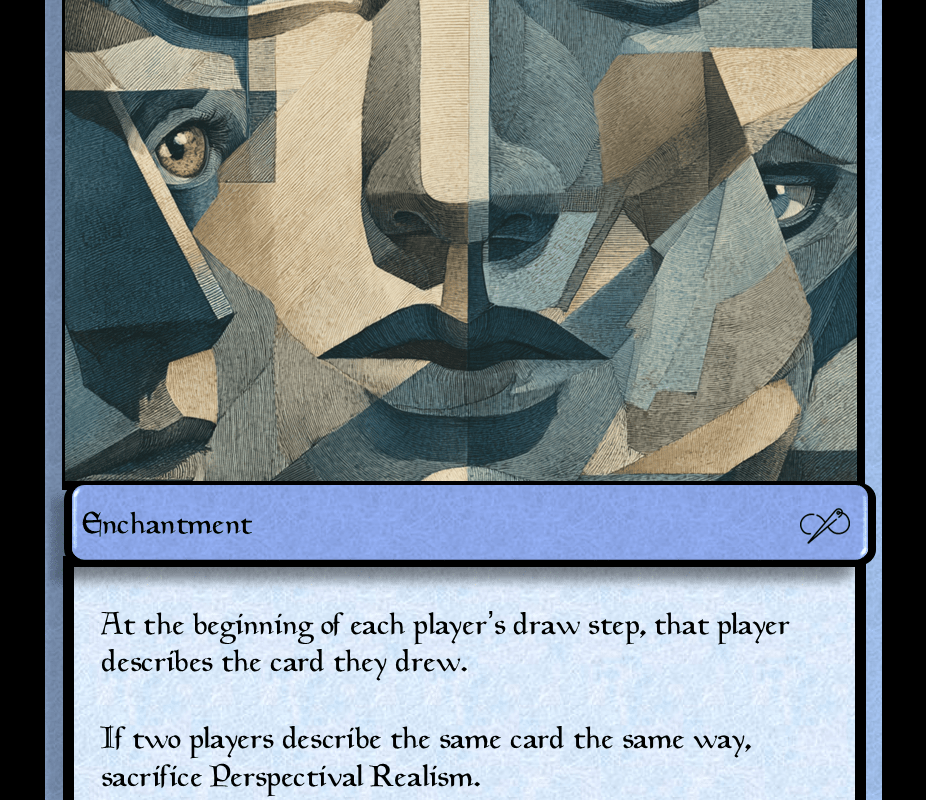
Perspectival Realism – Enchantment

This Magic: The Gathering parody trading card was the first in my Critical Theory series.

It’s an important card for me. As with sex and gender, creating a taxonomic or ontological dichotomy poses categorical challenges. Despite the insufficiency of language, it’s still all I have to attempt to classify the world. In the case of articulating the perception of reality, we can choose between idealism and realism. The problem is that it’s not either; it’s both. Reality cannot be realised without both.

Reality, we’re told, exists. That confident noun has carried a great deal of human arrogance. It has underwritten empires, sciences, and sermons. Yet somewhere between Plato’s cave and the latest TED Talk, we forgot to ask a simpler question: for whom does reality exist, and from where is it seen?

Audio: NotebookLM podcast of this topic.

The parody trading card Perspectival Realism was born from that unease. Its mechanic is simple but cruel: at the beginning of each player’s draw step, they must describe the card they drew. The enchantment persists until two players describe a card in the same way—at which point the spell collapses. In other words, consensus kills magic.

That rule is the metaphysics of the thing.

When a player ‘describes’ a card, they are not transmitting information; they are constructing the object in linguistic space. The moment the description leaves their mouth, the card ceases to be a piece of paper and becomes a conceptual artefact.

This mirrors the insight of Kant, Nietzsche, and every post-structuralist who ever smoked too much Gauloises: perception isn’t passive. We don’t see reality; we compose it. Language isn’t a mirror but a paintbrush. The thing we call truth is not correspondence but coherence – a temporary truce among competing metaphors.

So the card’s enchantment dramatises this process. So long as multiple descriptions circulate, reality remains vibrant, contested, alive. Once everyone agrees, it dies the death of certainty.

Philosophers have spent centuries arguing whether the world is fundamentally real (existing independent of mind) or ideal (a projection of mind). Both sides are equally tiresome.

Realism, the old bulldog of metaphysics, insists that perception is transparent: language merely reports what’s already there. Idealism, its mirror adversary, claims the opposite – that what’s “there” is mind-stuff all along. Both mistakes are symmetrical. Realism forgets the perceiver; Idealism forgets the world.

Perspectival realism refuses the divorce. It begins from the premise that world and mind are inseparable aspects of a single event: knowing. Reality is not a photograph waiting to be developed, nor a hallucination spun from neurons – it’s a relation, a constant negotiation between perceiver and perceived.

For years, I called myself a Realist™ with an asterisk. That asterisk meant I understood the observer problem: that every ‘fact’ is perspective-laden. Then I became an Idealist™ with an asterisk, meaning I recognised that mind requires matter to dream upon.

The asterisk is everything. It’s the epistemic scar left by perspectival humility – the tacit admission that every claim about the world carries a hidden coordinate: said from here. It is not relativism, but situatedness. It is the philosophical equivalent of depth perception: without the offset, there’s no vision at all.

The card’s rule – sacrifice Perspectival Realism when two players describe a card identically – captures the tragedy of modernity. The Enlightenment taught us to chase consensus, to flatten multiplicity into “objective truth.” We became addicted to sameness, mistaking agreement for understanding.

But agreement is anaesthetic. When all perspectives converge, the world ceases to shimmer; it becomes measurable, predictable, dead. The card’s enchantment disappears the moment reality is stabilised, precisely as our cultural enchantment did under the fluorescent light of ‘reason’.

To live under perspectival realism is to acknowledge that reality is not what is drawn but what is described. And the description is never neutral. It is always written from somewhere – by someone, with a vocabulary inherited from history and stained by desire.

As long as multiple descriptions coexist, the game remains alive. The moment they fuse into one, the spell is broken, and the world returns to grey.

Bernardo Kastrup’s analytic idealism reminded me that consciousness might be primary, but perspectival realism refuses to pledge allegiance. It keeps both flags tattered but flying. The world exists, yes, but only ever for someone.

The enchantment, then, is not belief but perspective itself. So long as difference endures, the game continues.

Propensity of the Illusion of Light

1–2 minutes

I just received two proof copies in the post this afternoon.

Propensity

I created a “Book Club Edition” of Propensity, a Ridley Park book of fiction primarily for the European market – specifically in the UK – though it’s available elsewhere. I altered the cover art. As an author, I also wanted to compare KDP and IngramSpark as printers and distributors.

I find the cover texture on this version interesting, but I don’t have a word to describe it. I like it. There’s a certain je ne sais quoi about it – the texture. I reworked the art to track the second section of the book. The original cover tracks the first section.

Image: Propensity by Ridley Park; original book cover

At least in this proof version, the black ink is not 100% and is streaky. The KDP version is 100% K and solid black. I mightn’t have noticed except that some section division pages were mostly black, and it is quite evident. I don’t discern a difference in the quality of the text itself.

Illusion of Light

The Illusion of Light is a cloth version of a book also available in paperback. I like the cloth-bound. There is a nostalgic elegance about it. It feels durable – more so than a paperback for sure. I’m not sure about versus the case laminate versions. They come off like textbooks to me – not the vibe I am aiming for.

Constructivist Lens — Artifact

Parody Magic: The Gathering trading card

When drawn, this card alters perception itself. It reminds the player that truth is not something one finds under a rock but something one polishes into shape. Each metaphor becomes a spell; each keyword a crutch thrown aside.

Those who wield the Constructivist Lens see not “facts,” but fictions so useful they forgot to call them that. Reality wobbles politely to accommodate belief.

Knowledge is not a copy of reality but a tool for coping with it.”
— Richard Rorty

In game terms: Tap to reframe existence as interpretation. Duration: until the next disagreement.

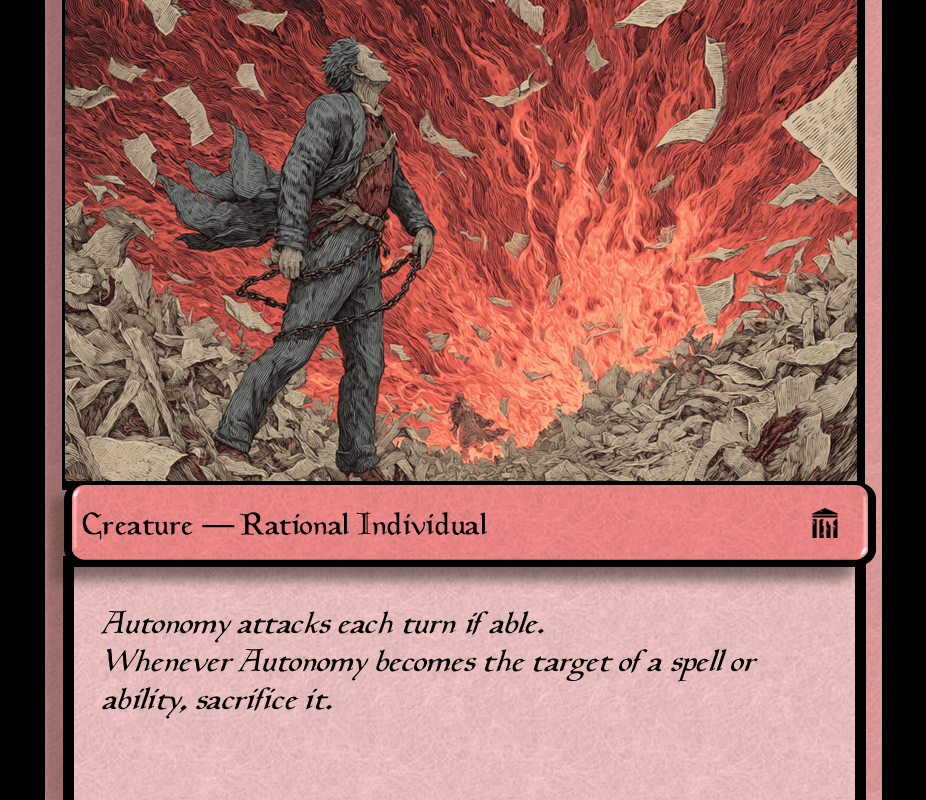
Autonomy: Creature – Rational Individual

1–2 minutes

Autonomy attacks each turn if able.
Whenever Autonomy becomes the target of a spell or ability, sacrifice it.

This is from the POMO series of mock Magic: The Gathering trading card images. Don’t read too much into them.

I decided I could share images on Instagram and reshare them here. This is the result.

The Sane Delusion: Fromm, Beauvoir, and the Cult of Mid-Century Liberation

2–4 minutes

It’s almost endearing, really how the intellectuals of mid-century Europe mistook the trembling of their own cage for the dawn chorus of freedom. Reading Erich Fromm’s The Sane Society today feels like being handed a telegram from Modernism’s last bright morning, written in the earnest conviction that history had finally grown up. The war was over, the worker was unionised, the child was unspanked, and the libido – good heavens – was finally allowed to breathe. What could possibly go wrong?

Audio: NotebookLM podcast on this topic.

Fromm beams:

“In the twentieth century, such capitalistic exploitation as was customary in the nineteenth century has largely disappeared. This must not, however, becloud the insight into the fact that twentieth-century as well as nineteenth-century Capitalism is based on the principle that is to be found in all class societies: the use of man by man.”

The sleight of hand is marvellous. He spots the continuation of exploitation but calls it progress. The worker has become a ‘partner’, the manager a ‘team leader’, and the whip has been replaced by a time card. No one bows anymore, he writes. No, they just smile through performance reviews and motivational posters.

Fromm’s optimism borders on metaphysical comedy.

“After the First World War, a sexual revolution took place in which old inhibitions and principles were thrown overboard. The idea of not satisfying a sexual wish was supposed to be old-fashioned or unhealthy.”

Ah yes, the Jazz Age orgy of liberation – champagne, Freud, and flapper hemlines. The problem, of course, is that every generation mistakes its new neuroses for freedom from the old ones. Fromm’s “sexual revolution” was barely a shuffle in the bourgeois bedroom; Beauvoir’s Deuxième Sexe arrived the next year, practically shouting across the café table that liberation was still a myth stitched into the same old corset.

Beauvoir, at least, sensed the trap: every gesture toward freedom was refracted through patriarchal fantasy, every ‘choice’ conditioned by the invisible grammar of domination. Fromm, bless him, still believed in a sane society – as if sanity were something history could deliver by instalment.

Meanwhile, the Existentialists were in the next room, chain-smoking and muttering that existence precedes essence. Freedom, they insisted, wasn’t something achieved through social reform but endured as nausea. Post-war Paris reeked of it – half despair, half Gauloises. And within a decade, the French schools would dismantle the very scaffolding that held Fromm’s optimism together: truth, progress, human nature, the subject.

The Modernists thought they were curing civilisation; the Post-Moderns knew it was terminal and just tried to describe the symptoms with better adjectives.

So yes, Fromm’s Sane Society reads now like a time capsule of liberal humanist faith – this touching belief that the twentieth century would fix what the nineteenth broke. Beauvoir already knew better, though even she couldn’t see the coming avalanche of irony, the final revelation that emancipation was just another product line.

Liberation became a brand, equality a slogan, sanity a statistical average. Fromm’s dream of psychological health looks quaint now, like a health spa brochure left in the ruins of a shopping mall.

And yet, perhaps it’s precisely that naivety that’s worth cherishing. For a moment, they believed the world could be cured with reason and compassion – before history reminded them, as it always does, that man is still using man, only now with friendlier UX design and better lighting.

Psychology of Totalitarianism

I finished Mattias Desmet’s The Psychology of Totalitarianism, which I mentioned the other day. Unfortunately, my initial optimism was premature. Everything I enjoyed was front-loaded: the first four chapters set up a promising critique of mechanistic rationality and the collapse of shared meaning. Then the book turned into a long, therapeutic sermon. I should have stopped at Chapter 4 and saved myself the sunk-cost regret.

It isn’t that nothing follows; it’s just that what follows is so thin that the cost-benefit ratio goes negative. Once Desmet moves from diagnosis to prescription, the argument collapses into a psychologist’s worldview: an entire civilisation explained through mass neurosis and healed through better intuition. He builds his case on straw versions of reason, science, and modernity, so his ‘cure’ can look revelatory.

The trouble is familiar. Having dismantled rationalism, Desmet then installs intuition as its replacement – an epistemic monarchy by another name. His appeal to empathy and connection reads less like philosophy and more like professional self-promotion. The therapist can’t stop therapising; he privileges the psychological lens over every other possibility.

The result is a reductionist parascience dressed as social theory. The totalitarian mind, in Desmet’s telling, isn’t political or structural but psychological – a patient waiting for insight. I don’t doubt his sincerity, only his scope. It’s what happens when a discipline mistakes its vocabulary for the world.

Desmet’s project ultimately re-enchants what it claims to critique. He wants rationalism redeemed through feeling, order reborn through connection. Dis-Integrationism stops short of that impulse. It accepts fracture as the permanent condition – no higher synthesis, no therapeutic finale. Where Desmet sees totalitarianism as a collective pathology awaiting treatment, I see it as reason’s own reflection in the mirror: a system trying to cure itself of the only disease it knows, the need to be whole.

Adventures in Translation

Every translation is a negotiation between fidelity and clarity. In the case of The Illusion of Light, some word choices are specifically English and either have no typical translation or don’t translate directly.

Some examples are as follows:

  • Agency: In French, agence means agency, but not the sort of bodily autonomy as it does in English. Autonomie carries too much metaphysical connotation – though to be fair, so does the English version. I ended up with soi autonome.
  • Against Agency: The title of an essay, but I still wanted to translate it. I decided to split the difference and run with Contre l’agency, hoping ‘agency’ would still be recognised in academic circles.
  • Care: There’s no perfect equivalent for ‘care’ as both ethical and practical attention. Soin captures the tenderness but not the intellectual rigour; entretien captures the steadiness but loses affect. I used both, sometimes switching between them in deliberate tension.
  • Dis-Integrationism: Variants of this will follow a Dés-intégrationisme pattern, retaining the negation and the hyphenation.
  • Enlightenment: Of course, Enlightenment is perfectly French, but anti-Enlightenment, not so much. I opted for après-Lumières over anti-Lumières.
  • Freedom: Liberté inevitably invokes Rousseau and 1789. English ‘freedom’ – a word with old English roots and Germanic cognates – feels looser, more existential. I leaned into liberté when I wanted that historic echo and used autonomie or franchise elsewhere to recover the personal register.
  • Maintenance: In English, ‘maintenance’ sits halfway between repair and care. French forces a choice: entretien (maintenance as upkeep) or soin (maintenance as care). I alternated depending on whether the passage leaned toward the mechanical or the ethical.
  • Normality: Normalité exists but sounds sociological, not moral. In Homo Normalis, I leaned on context to restore the Enlightenment’s moral undertone rather than altering the word itself. The surrounding prose had to carry what the French term doesn’t.
  • Objectivity: The French objectivité is a near-cognate, but it feels heavier – almost bureaucratic – where the English still carries a trace of philosophical neutrality. I kept it, but softened the surrounding phrasing to prevent it from sounding bureaucratic.
  • Omnivident: I opted for omnivoyant. In French, it typically means clairvoyant (mystical seeing), but it’s also used for La Joconde‘s unsettling stare – that optical illusion of being watched from every angle. The latter sense is what the Enlightenment promised: not prophecy but perfect surveillance, not mystic vision but total measurement. Mona Lisa’s gaze follows you; so does Reason’s. To be fair, my spell-checker isn’t very happy with omnivident either, but sometimes you just need to stick to your guns.
  • Reason: Raison is obvious but slippery. In English, it can mean logic, justification, or sanity. French raison often sounds institutional – la Raison d’État lurks in its shadow – which helped the irony of my argument but occasionally demanded rephrasing to avoid unintended gravitas.
  • The self: Le soi remains my preference over le moi; the latter brings too much Freud. Soi feels grammatical yet open – the right degree of abstraction for a ghost of the Enlightenment.

Translation isn’t the transfer of meaning but the calibration of resonance. Each word is a compromise between fidelity and hospitality – how much the host language can bear before it ceases to be itself.

I’m only at chapter five – the longest – with six more chapters ahead, plus appendices and back matter. This list will grow. Translation, like the maintenance ethics the book describes, is work without end: attentive, incremental, never quite finished.

L’Illusion de la lumière

1–2 minutes

Un court message aujourd’hui.

Je travaille à la traduction de The Illusion of Light : Thinking After the Enlightenment (L’Illusion de la lumière : Penser après les Lumières) en français, avec l’aide de quelques outils linguistiques et d’un peu d’intelligence artificielle. J’ai bon espoir que le processus sera fructueux. Souhaitez-moi bonne chance.

Je dois beaucoup aux penseurs français, d’hier comme d’aujourd’hui. Traduire ce texte est donc, à ma manière, une forme de reconnaissance. Mon plus grand défi sera de préserver un français à la fois contemporain et fidèle à ma voix – moins prosaïque que poétique.
Mes excuses d’avance aux Québécois.

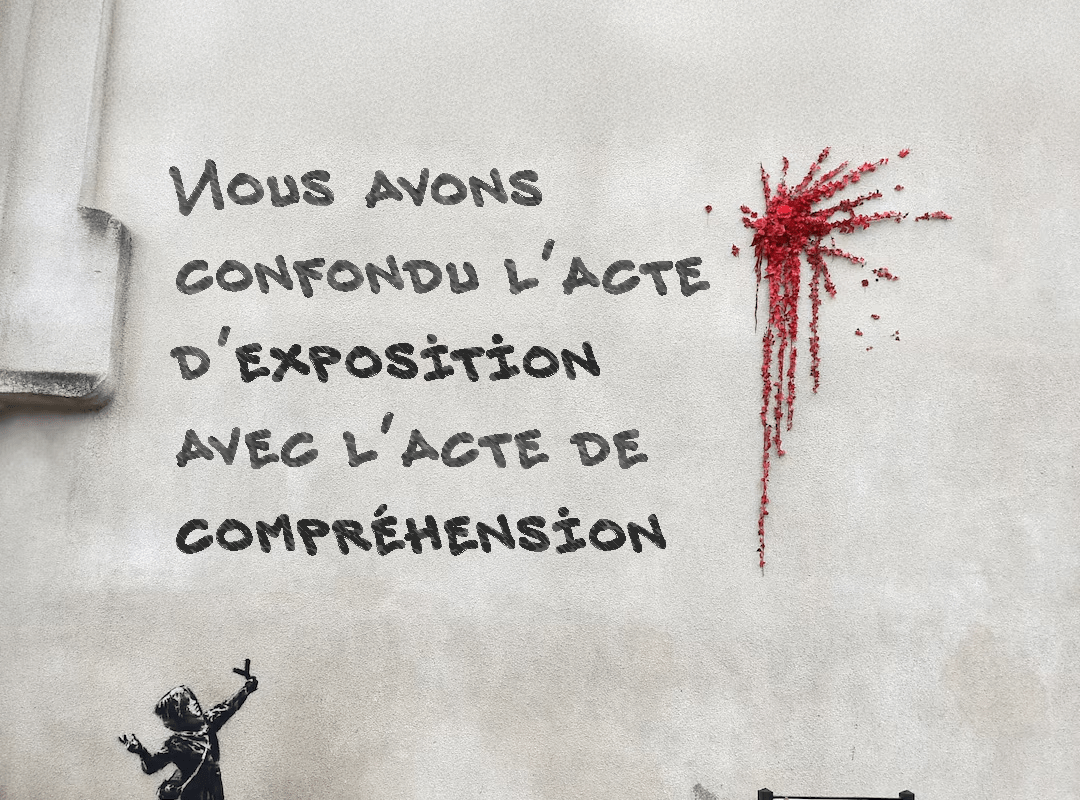
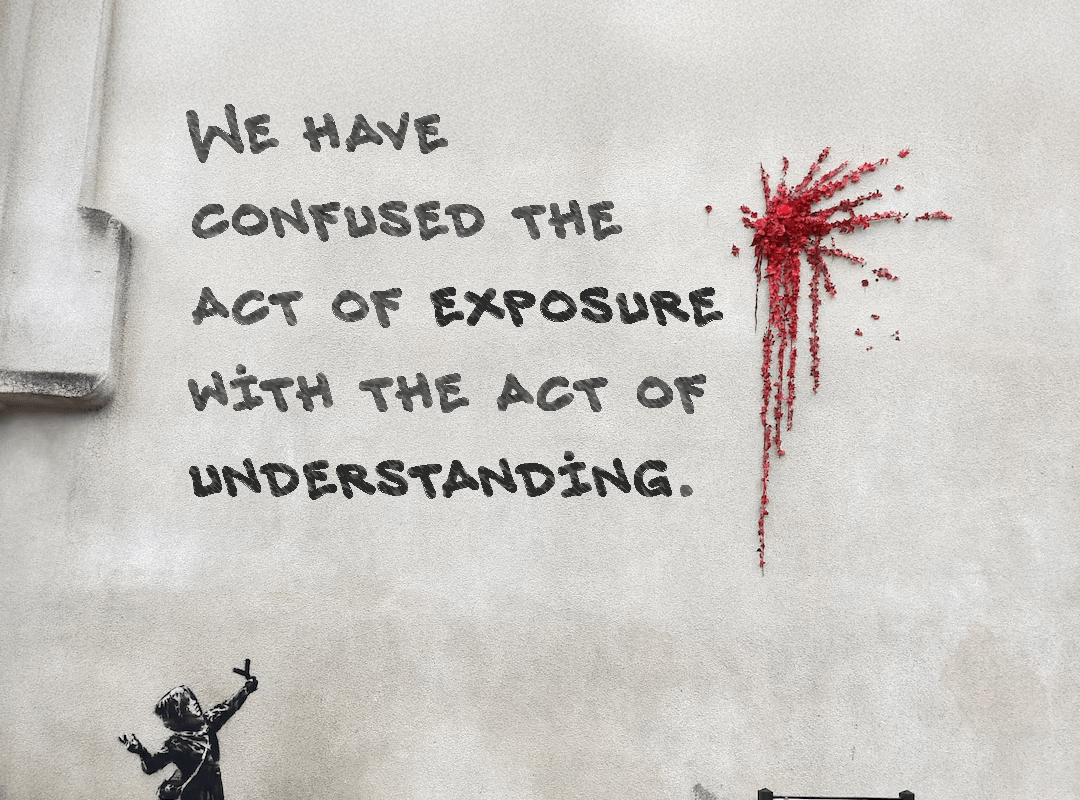
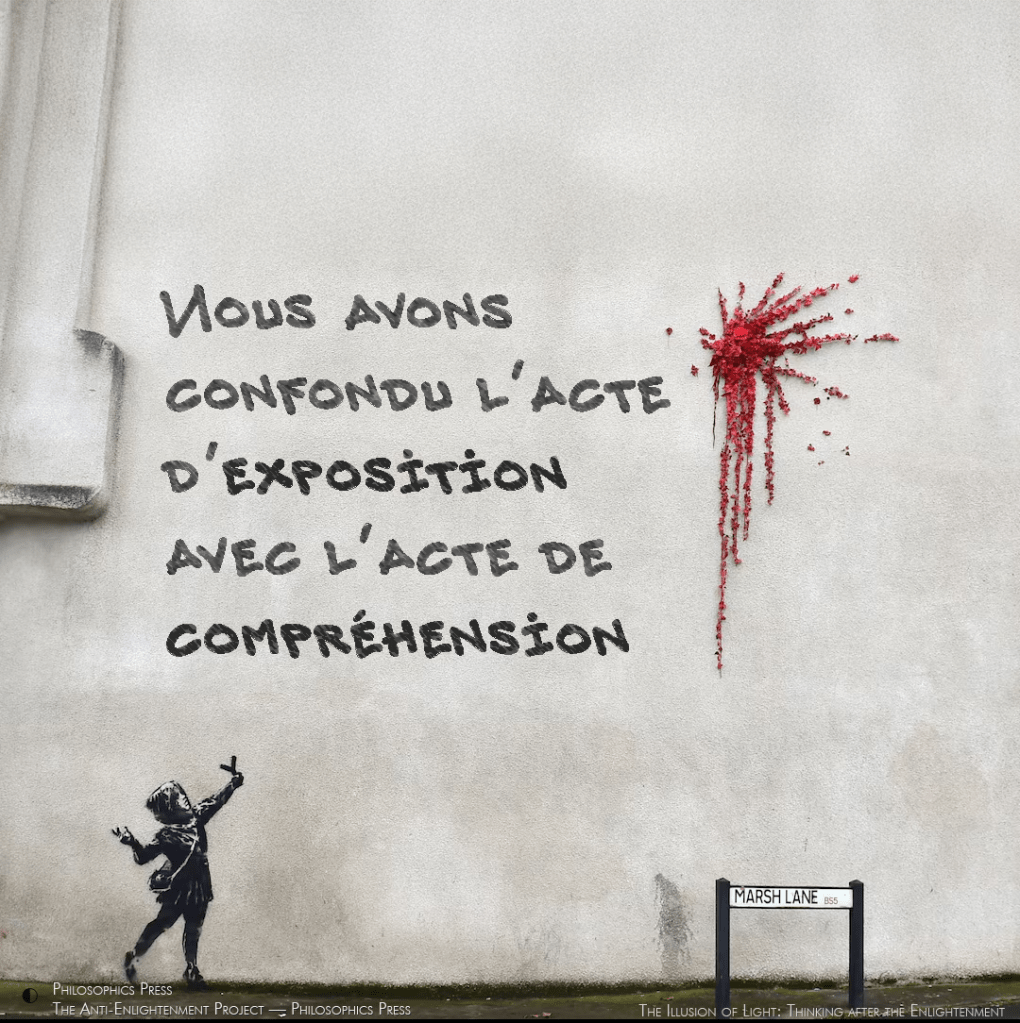
Image: “We have confused the act of exposure with the act of understanding.”

In English, I am translating The Illusion of Light into French, so I’m leaving just this short note today.

I don’t know any other languages well enough to attempt a translation myself, but with a few capable software partners, I’m confident the process will end well.

For the record, I’m using these tools:

  • Reverso — I’ve used it for years and still find it helpful. It provides plenty of contextual examples, which helps ensure I’ve captured the right nuance.
  • ChatGPT — My go-to AI partner; it gets the second pass.
  • Claude — I’m consistently impressed with its suggested amendments. Where Reverso is precise, Claude tends to catch idiomatic usage better.
  • Mistral — It’s French, after all. What can I say? A bit pedantic, perhaps, but another set of virtual eyes can’t hurt—can they?

Whilst I’m sure these tools could manage other languages, I want to be able to evaluate what they’re doing. In French, even if I don’t know a particular word, I can verify it, and I understand the grammar. With other languages, I’d simply be trusting a black box.

Besides, French culture and philosophy have influenced me so deeply that the least I can do is offer something back. As this translation is an overview of my English-language essays, I hope it provides some in-language context.

I know how difficult translated works can be to read, so if I’m overseeing the process, at least there’s one fewer filter between my thoughts and the reader.