Abortion, Ontological Grammar, and the Limits of Civil Discourse
When federal abortion protections were withdrawn in the United States, many observers treated the event as a policy reversal, a judicial shift, or a partisan victory. Those are surface descriptions. They are not wrong. They are simply too thin.
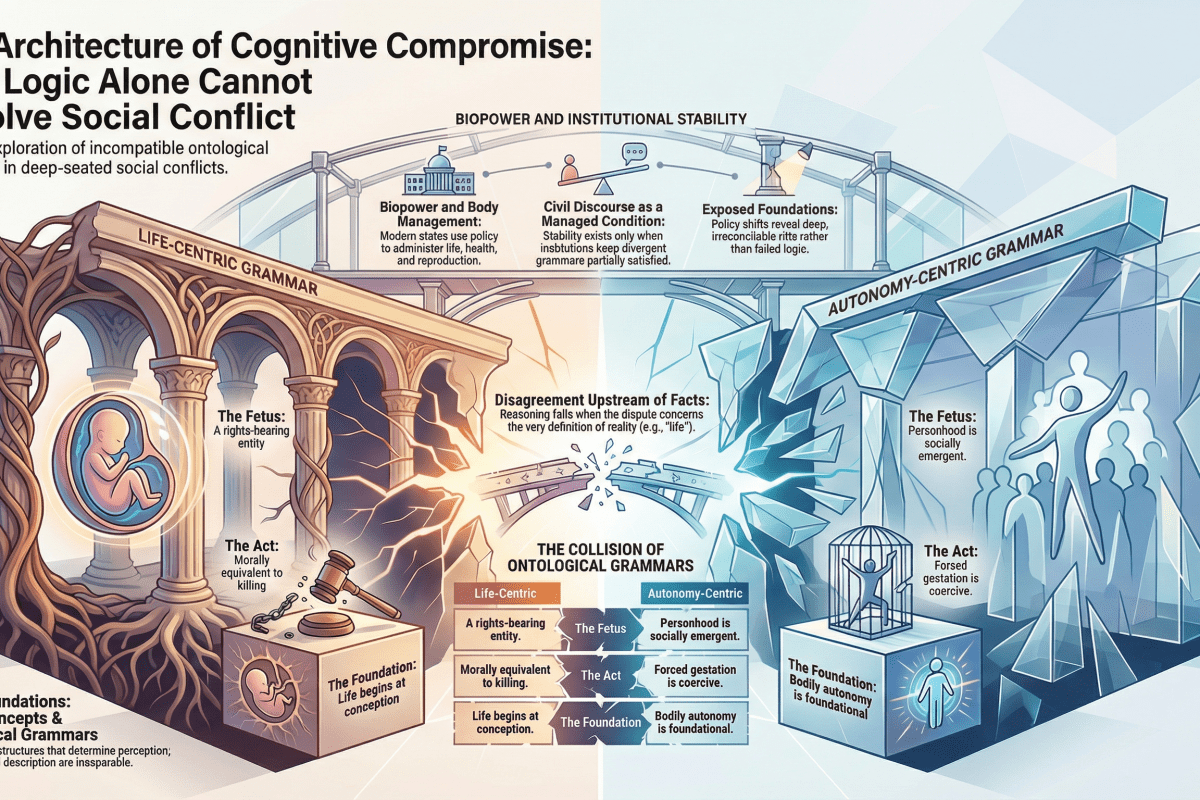
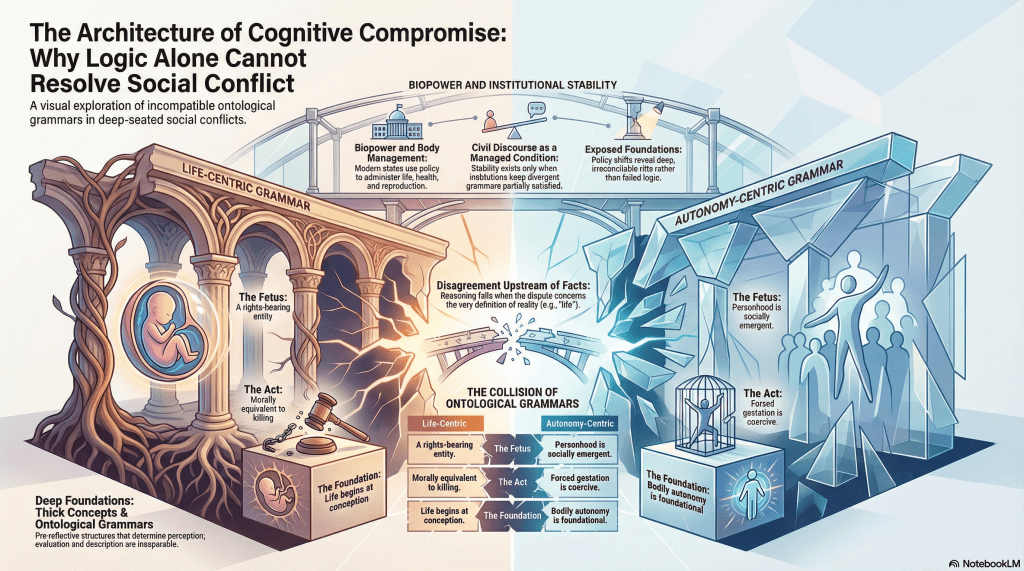
What was exposed was not a failure of dialogue. It was the collision of ontological grammars.
Audio: NotebookLM summary podcast.
1. Thick Concepts and the Illusion of Neutral Ground
Bernard Williams famously distinguished between ‘thin’ moral terms (good, bad, right) and ‘thick’ ones (cruel, courageous, treacherous), where description and evaluation are fused.
Abortion is not a thin concept. It is thick all the way down.
For one framework, the operative grammar is something like:
Life begins at conception.
The foetus is a rights-bearing entity.
Termination is morally equivalent to killing.
For another:
Personhood is socially and biologically emergent.
Bodily autonomy is foundational.
Forced gestation is coercive.
Notice that these are not competing policies. They are competing ontological commitments about what exists, what counts as a person, and what kind of being a pregnant body is.
Argument across this divide does not merely contest conclusions. It contests the background conditions under which reasons register as reasons.
This is not ‘people see the world differently’. It is: people parse reality through grammars that do not commute.
2. Ontological Grammar: Where Deliberation Stops
By ‘ontological grammar’, I do not mean syntax in the Saussurean or Chomskyan sense. I mean the pre-reflective substrate that structures what appears salient, real, morally charged, or negligible.
We deliberate within grammars. We do not deliberate our way into them.
Liberal Enlightenment optimism assumes that if disagreement persists, more information, better reasoning, or improved empathy will close the gap. But if the dispute concerns the very ontology of ‘life’, ‘person’, or ‘rights’, no amount of fact-sharing resolves the issue. The disagreement is upstream of facts.
The closure of federal abortion access did not prove that one side reasoned better. It demonstrated that institutional containment had failed.
3. Biopower and the Management of Bodies
Michel Foucault gives us a crucial lens: biopower. Modern states do not merely govern territory; they administer life. Birth rates, mortality, sexuality, health – these become objects of policy.
Abortion sits directly inside this matrix.
A state that restricts abortion is not only expressing moral judgment. It is reallocating control over reproductive capacity. It is asserting a claim over which bodies count, which futures are permitted, and which biological processes are subject to regulation.
The conflict is therefore not purely ethical. It is biopolitical.
And what appears as ‘civil discourse’ around abortion is often possible only so long as institutional frameworks keep both grammars partially satisfied. When federal protections existed, they acted as a stabilising superstructure. Remove that, and the ontological conflict becomes naked.
4. Habitus and the Illusion of Reasoned Consensus
Pierre Bourdieu would remind us that our dispositions are not self-authored. Habitus sedimented through family, religion, class, and institutional life shapes what feels obvious, outrageous, or unthinkable.
People do not wake up one morning and choose an abortion ontology.
They inherit it. It becomes embodied common sense.
Thus, when someone says, ‘Surely we can agree that making a person feel whole is more important than ideological purity’, they are already speaking from within a grammar that prioritises individual authenticity and psychological coherence. That priority is not universal. It is historically situated.
Compromise is not achieved by stepping outside habitus. It is achieved when institutional and social conditions allow divergent grammars to coexist without totalising one another.
5. The Popperian Threshold
It is impossible to speak in such a way that you cannot be misunderstood. —Karl Popper
Karl Popper warned of the ‘paradox of tolerance‘: unlimited tolerance may enable intolerant forces to eliminate tolerance itself.
In particularly virulent climates, appeals to compromise are heard not as gestures of goodwill but as tactical weakness.
When one faction succeeds in unilaterally redefining the legal status of abortion at a federal level, it is not merely participating in discourse. It is altering the biopolitical infrastructure. Once altered, the range of permissible disagreement narrows.
Civil discourse, then, is not a natural equilibrium. It is a managed condition sustained by institutional design, social trust, and shared legibility.
NB: Popper’s paradox of tolerance is often invoked as a moral axiom. But it is better understood as a self-protective clause internal to liberal ontology. It presupposes a shared commitment to rational exchange. When that commitment erodes, the paradox does not resolve disagreement; it merely marks the point at which biopower intervenes to preserve a regime.
6. Why This Is Not Just ‘People Disagree’
The lay intuition – ‘people see the world differently’ – is descriptively correct and analytically useless.
What the ontological grammar model adds is structure:
When stabilisation weakens, conflict appears irreconcilable.
Abortion is not uniquely polarising because people are irrational. It is polarising because it touches ontological primitives: life, personhood, autonomy, and obligation.
In such cases, ‘compromise’ is not achieved by discovering a middle truth. It is achieved – if at all – by constructing a legal and institutional arrangement that both grammars can grudgingly inhabit.
NotebookLM Infographic
7. The Uncomfortable Conclusion
The Enlightenment story tells us that disagreement is a surface phenomenon, curable by better reasoning.
The ontological grammar story tells us something harsher: some disagreements are not resolvable through language because they are about the conditions under which language binds.
This does not entail quietism. It entails clarity.
Civil discourse is not proof that grammars have converged. It is evidence that power, institutions, and habitus have aligned sufficiently to prevent rupture.
When that alignment shifts, the illusion of shared ontology evaporates.
And what we are left with is not failed reasoning – but exposed foundations.
I planned to use prostitution and anti-natalism as other cases for elucidation, but I see this has already grown long. I’ll reserve these are others for another day and time.
NB: This is the first of a parable triptych. Read part 2, The Tunnel.
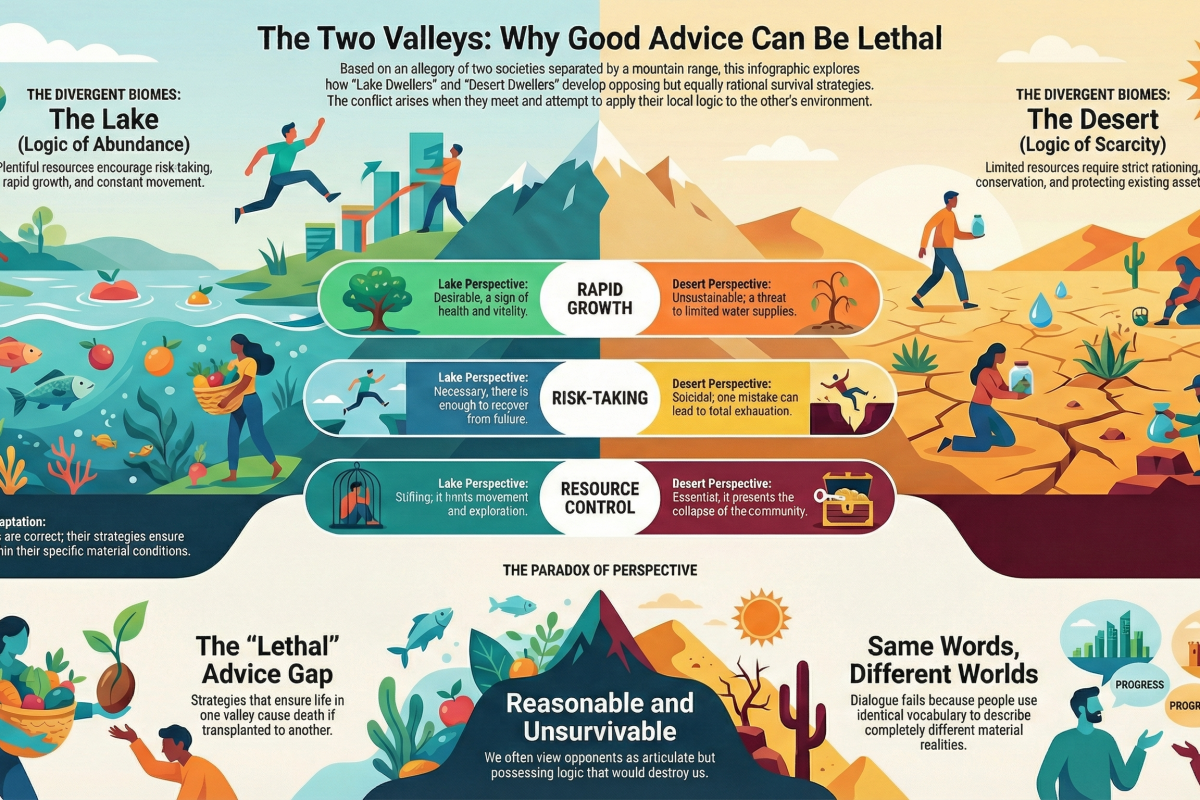
Two valleys diverged in a mountain range, And sorry I could not travel both And be one traveller, long I stood And looked down one as far as I could To where it bent in the undergrowth of reeds and optimism;
Then took the other, just as fair, And having perhaps the better claim, Because it was sandy and wanted wear— Though as for that, the passing there Had worn them really about the same,
And both that morning equally lay In fog no step had trodden black. Oh, I kept the first for another day! Yet knowing how way leads on to way, I doubted if I should ever come back.
—Except I did come back. And I met someone coming the other way. And we stood there in the clouds like a pair of idiots trying to explain our respective valleys using the same words for completely different things.
Audio: NotebookLM summary podcast of this topic.Image: NotebookLM infographic of this topic.
Here’s what they don’t tell you about Frost’s poem: the two paths were “really about the same.” He says it right there in the text. The divergence happens retroactively, in the telling, when he sighs and claims “that has made all the difference.”
But he doesn’t know that yet. He can’t know that. The paths only diverge in memory, once he’s committed to one and cannot check the other.
Here’s what they don’t tell you about political disagreement: it works the same way.
Video essay of this topic. Another NotebookLM experience.
The Actual Story (Minus the Versification)
Once upon a time—and I’m going to need you to suspend your allergy to fairy tales for about eight minutes—there was one settlement. One people. One language. One lake with drinkable water and fish that cooperated by swimming in schools.
Then mountains happened. Slowly. No dramatic rupture, no war, no evil king. Just tectonics doing what tectonics does, which is ruin everyone’s commute.
The people on one side kept the lake. The people on the other side got a rain shadow and a lot of bloody sand.
Both sides adapted. Rationally. Reasonably. Like competent humans responding to actual material conditions.
Desert people: “There is definitely not enough water. Let’s ration. Let’s stay put. Let’s not waste things.”
Neither wrong. Neither irrational. Just oriented differently because the ground beneath them had literal different moisture content.
The Bit Where It Gets Interesting
Centuries later, two people—one from each side—decide to climb the mountains and meet at the top.
Why? I don’t know. Curiosity. Stupidity. The desire to write a tedious blog post about epistemology.
They meet in the fog. They speak the same language. Grammar intact. Vocabulary functional. Syntax cooperative.
And then one tries to explain “reeds.”
“Right, so we have these plants that grow really fast near the water, and we have to cut them back because otherwise they take over—”
“Sorry, cut them back? You have too much plant?”
“Well, yes, they grow quite quickly—”
“Why would a plant grow quickly? That sounds unsustainable.”
Meanwhile, the other one tries to explain “cactus.”
“We have these plants with spines that store water inside for months—”
“Store water for months? Why doesn’t the plant just… drink when it’s thirsty?”
“Because there’s no water to drink.”
“But you just said the plant is full of water.”
“Yes. Which it stored. Previously. When there was water. Which there no longer is.”
“Right. So… hoarding?”
You see the problem.
Not stupidity. Not bad faith. Not even—and this is the part that will annoy people—framing.
They can both see perfectly well. The fog prevents them from seeing each other’s valleys, but that’s almost beside the point. Even if the fog lifted, even if they could point and gesture and show each other their respective biomes, the fundamental issue remains:
A cactus is a good solution to a problem the lake-dweller doesn’t have.
A reed is a good solution to a problem the desert-dweller doesn’t have.
Both are correct. Both are adaptive. Both would be lethal if transplanted.
The Retreat (Wherein Nothing Is Learned)
They part amicably. No shouting. No recriminations. Both feel they explained themselves rather well, actually.
As they descend back into their respective valleys, each carries the same thought:
“The other person seemed reasonable. Articulate, even. But their world is completely unworkable and if we adopted their practices here, people would die.”
Not hyperbole. Actual environmental prediction.
If the lake people adopted desert-logic—ration everything, control movement, assume scarcity—they would strangle their own adaptability in a context where adaptability is the whole point.
If the desert people adopted lake-logic—explore freely, trust abundance, move without restraint—they would exhaust their resources in a context where resources are the whole point.
The Bit Where I Connect This to Politics (Because Subtlety Is Dead)
So when someone tells you that political disagreement is just a matter of perspective, just a failure of empathy, just a problem of framing—
Ask them this:
Do the two valleys become the same valley if both sides squint really hard?
Does the desert get wetter if you reframe scarcity as “efficiency”?
Does the lake dry up if you reframe abundance as “waste”?
No?
Then perhaps the problem is not that people are choosing the wrong lens.
Perhaps the problem is that they are standing in different material conditions, have adapted rational survival strategies to those conditions, and are now shouting advice at each other that would be lethal if followed.
The lake-dweller says: “Take risks! Explore! There’s enough!”
True. In a lake biome. Suicidal in a desert.
The desert-dweller says: “Conserve! Protect! Ration!”
True. In a desert biome. Suffocating near a lake.
Same words. Different worlds. No amount of dialogue makes water appear in sand.
The Frostian Coda (With Apologies to New England)
I shall be telling this with a sigh Somewhere ages and ages hence: Two valleys diverged on a mountainside, and I— I stood in the fog and tried to explain reeds to someone who only knew cactus, And that has made… well, no difference at all, actually.
We’re still shouting across the mountains.
We still think the other side would be fine if only they’d listen.
We still use the same words for utterly different referents.
And we still confuse “I explained it clearly” with “explanation bridges material conditions.”
Frost was right about one thing: way leads on to way.
The valleys keep diverging.
The fog doesn’t lift.
And knowing how mountains work, I doubt we’ll meet again.
Moral: If your political metaphor doesn’t account for actual rivers, actual deserts, and actual fog, it’s not a metaphor. It’s a fairy tale. And unlike fairy tales, this one doesn’t end with reunion.
It ends with two people walking home, each convinced the other is perfectly reasonable and completely unsurvivable.
Which, if you think about it, is far more terrifying than simple disagreement.
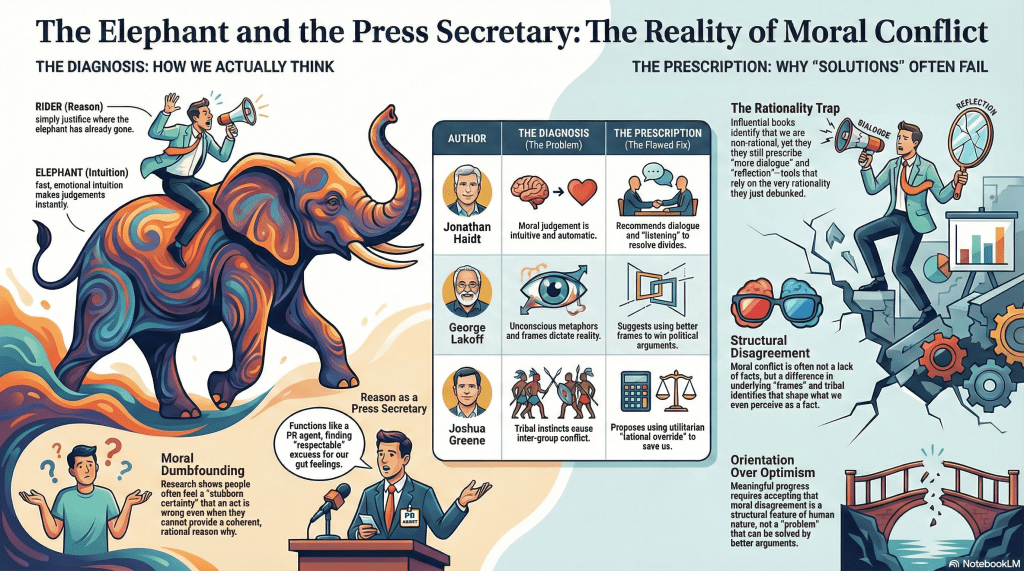
Over the past few decades, moral psychology has staged a quiet coup against one of our most cherished fantasies: that human beings are, at bottom, rational moral agents. This is not a fringe claim. It is not a Twitter take. It is the mainstream finding of an entire research programme spanning psychology, cognitive science, linguistics, and neuroscience.
We do not reason our way to moral conclusions. We feel our way there. Instantly. Automatically. And only afterwards do we construct reasons that make the judgment sound respectable.
Audio: NotebookLM summary podcast of this topic.
This is not controversial anymore. It is replicated, taught, and celebrated. And yet, if you read the most influential books in this literature, something strange happens. The diagnosis is devastating. The prescription is reassuring.
I’ve just published a long-form video walking through five canonical books in moral psychology that all uncover the same structural problem, and then quietly refuse to live with the implications.
Each of these books is sharp, serious, and worth reading. This is not a hit piece.
But each follows the same arc:
Identify a non-rational, affective, automatic mechanism at the heart of moral judgement
Show why moral disagreement is persistent and resistant to argument
Propose solutions that rely on reflection, dialogue, reframing, calibration, or rational override
In short: they discover that reason is weak, and then assign it a leadership role anyway.
Haidt dismantles moral rationalism and then asks us to talk it out. Lakoff shows that framing is constitutive, then offers better framing. Gray models outrage as a perceptual feedback loop, then suggests we check our perceptions. Greene diagnoses tribal morality, then bets on utilitarian reasoning to save us.
None of this is incoherent. But it is uncomfortable. Because the findings themselves suggest that these prescriptions are, at best, limited.
Diagnosis without prognosis
The uncomfortable possibility raised by this literature is not that we are ignorant or misinformed.
It is that moral disagreement may be structural rather than solvable.
That political conflict may not be cured by better arguments. That persuasion may resemble contagion more than deliberation. That reason often functions as a press secretary, not a judge.
The books sense this. And then step back from it. Which is human. But it matters.
Why this matters now
We are living in systems that have internalised these findings far more ruthlessly than public discourse has.
Social media platforms optimise for outrage, not understanding. Political messaging is frame-first, not fact-first. AI systems are increasingly capable of activating moral intuitions at scale, without fatigue or conscience.
Meanwhile, our institutions still behave as if one more conversation, one more fact-check, one more appeal to reason will close the gap. The research says otherwise.
And that gap between what we know and what we pretend may be the most important moral problem of the moment.
No solution offered
The video does not end with a fix. That’s deliberate.
Offering a neat solution here would simply repeat the same move I’m criticising: diagnosis followed by false comfort. Sometimes orientation matters more than optimism. The elephant is real. The elephant is moving.And most of us are passengers arguing about the map while it walks.
Almost a decade in the making, this book explains why more time, more effort, and more detail do not reliably improve certain forms of communication. Beyond a point, returns diminish sharply. In some domains, they collapse altogether.
The manuscript focuses on English, but the hypothesis has already been extended to French (published separately), and I am continuing work on other ontological barriers. If you’re interested in testing or extending the framework in your own language, feel free to get in touch.
Over the coming weeks, I’ll be unpacking aspects of the Language Insufficiency Hypothesis in more depth here. The book’s role is deliberately limited: it defines the problem, establishes the structure, and offers grounding examples. The real work happens in the consequences.
For now, the important thing is simple: the book is finally available.
I’ve been working on A Language Insufficiency Hypothesis since 2018. At least, that’s the polite, CV-friendly version. The truer account is that it’s been quietly fermenting since the late 1970s, back when I was still trapped in primary school and being instructed on how the world supposedly worked.
Social Studies. Civics. Law. The whole civic catechism. I remember being taught about reasonable persons and trial by a jury of one’s peers, and I remember how insistently these were presented as fair solutions. Fairness was not argued for. It was asserted, with the weary confidence of people who think repetition counts as justification.
I didn’t buy it. I still don’t. The difference now is that I have a hypothesis with some explanatory power instead of a vague sense that the adults were bluffing.
Audio: NotebookLM summary podcast of this topic.
I’ve always been an outsider. Eccentric, aloof, l’étranger if we’re feeling theatrical. It never particularly troubled me. Outsiders are often tolerated, provided they remain decorative and non-contagious. Eye rolls were exchanged on both sides. No harm done.
But that outsider position had consequences. It led me, even then, to ask an awkward question: Which peers? Not because I thought I was superior, but because I was plainly apart. How exactly was I meant to be judged by my peers when no one else occupied anything like my perspective?
Later, when I encountered the concept of fundamental attribution bias, it felt less like a revelation and more like confirmation. A peer-based system assumes not just similarity of circumstance, but similarity of interpretation. That assumption was dead on arrival.
Then there were reasonable persons. I was assured they existed. I was assured judges were trained to embody them. I had never met one. Even as a teenager, I found the idea faintly comical. Judges, I was told, were neutral, apolitical, and dispassionate. Writing this now from the United States, one hardly needs to belabour the point. But this wasn’t prescience. It was intuition. The smell test failed decades ago.
Before LIH had a name, I called these things weasel words. I still do, as a kind of shorthand. Terms like fair, reasonable, accountable, appropriate. Squishy concepts that do serious institutional work whilst remaining conveniently undefinable. Whether one wants to label them Contestables or Fluids is less important than recognising the space they occupy.
That space sits between Invariables, things you can point to without dispute, and Ineffables, where language more or less gives up. Communication isn’t binary. It isn’t ‘works’ or ‘doesn’t’. It’s a gradient. A continuous curve from near-certainty to near-failure.
Most communication models quietly assume a shared ontology. If misunderstanding occurs, the remedy is more explanation, more context, more education. What never sat right with me, even as a child, was that this only works when the disagreement is superficial. The breaking point is ontological.
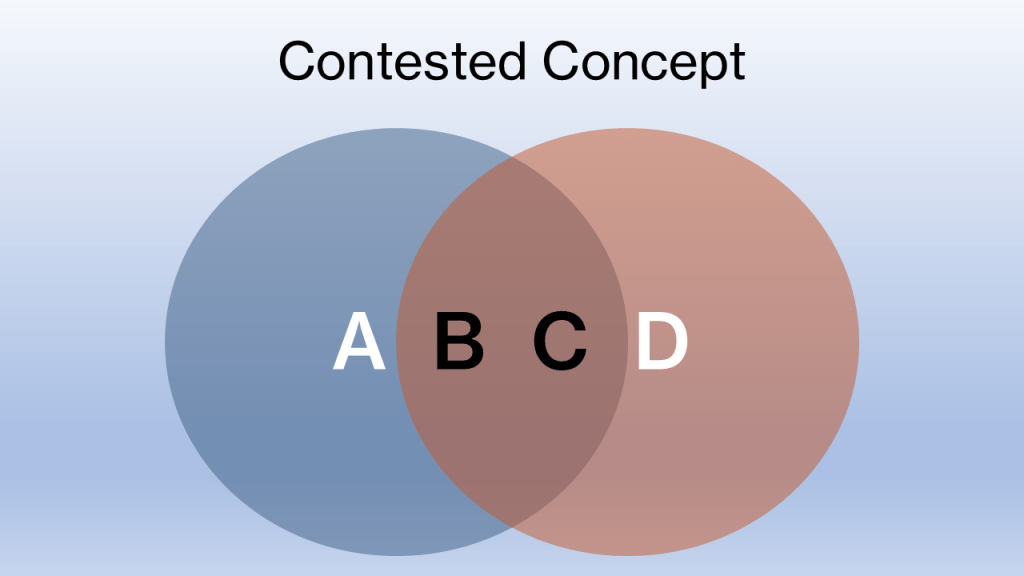
If one person believes a term means {A, B, C} and another believes it means {B, C, D}, the overlap creates a dangerous illusion of agreement. The disagreement hides in the margins. A and D don’t merely differ. They are often irreconcilable.
Image: Venn diagramme of a contested concept. Note: This is illustrative and not to scale
Fairness is a reliable example. One person believes fairness demands punishment, including retributive measures. Another believes fairness permits restoration but rejects retribution, citing circumstance, history, or harm minimisation. Both invoke fairness sincerely. The shared language conceals the conflict.
When such disputes reach court, they are not resolved by semantic reconciliation. They are resolved by authority. Power steps in where meaning cannot. This is just one illustration. There are many.
I thought it worth sharing how LIH came about, if only to dispel the notion that it’s a fashionable response to contemporary politics. It isn’t. It’s the slow crystallisation of a long-standing intuition: that many of our most cherished concepts don’t fail because we misuse them, but because they were never capable of doing the work we assigned to them.
More precisely, I need less sleep and longer days – preferably twice as long. I’ve been writing almost non-stop for the better part of a week: fourteen- to sixteen-hour days, fuelled by irritation and the stubborn belief that if I just keep reading, something will finally click into place.
I’m not complaining. This is a virtuous cycle. Reading leads to writing. Writing demands more reading. Eventually, the loop closes into something that looks suspiciously like progress.
Audio: Short NotebookLM summary podcast on this topic.
Still, there’s a bottleneck.
Because some of this work – the work I’m most excited about – I’m deliberately not publishing yet. Journals, bless their glacial hearts, don’t much care for prior publication. So ideas sit in limbo for six to eighteen months, locked in a room like argumentative houseplants, slowly growing sideways.
From the perspective of someone who thinks in public, this is maddening.
Now add AI to the mix.
This is where things get dangerous.
I’ll feed ChatGPT a thesis, a skeletal structure, notes, and references. I ask what I’m missing. It obliges – often helpfully – by pointing me toward adjacent thinkers and relevant literature, complete with page numbers. From there, I verify, hunt down the sources, skim, read, discard, or integrate.
And every so often, I stumble across something that makes me swear out loud.
This week, it was Bernard Williams.
I’ve cited Ethics and the Limits of Philosophy before. But this time, I actually sat down and read it properly. Which immediately prompted the thought:
Why didn’t I read this sooner?
Williams dismantles moral objectivity with the calm precision of someone who knows the Enlightenment project has already lost – he just hasn’t told everyone yet. Thick and thin moral concepts, locality, non-extensibility, the collapse of universal moral reason at scale – yes, yes, yes. He published this in 1985. Fine. I’ll survive.
But then I went further.
Williams shows that morality fails between people at scale. I argue that it fails within a single person over time.
That became my second paper.
And this is where things went off the rails.
Because in the course of writing that paper, I dipped into Hart’s The Concept of Law and Endicott’s Vagueness in Law. These are not fringe polemics. These are law textbooks. For law students. People allegedly trained to parse language for a living.
And what I found was… astonishing.
Let me paraphrase the admissions:
First:
Image: When the law is vague, judicial decisions may be unconstrained by the law.
Endicott: “By upsetting the standard view of adjudication, the book reaches conclusions that some people find horrible: when the law is vague, judicial decision- making will in some cases be unconstrained by the law. It is impossible in principle for judges always to treat like cases alike. Predictability in the law is to some extent unattainable. Moreover, I argue in Chapter 9,2 that vagueness cannot be eliminated from law. These conclusions might seem to imply that the rule of law is, at least to some extent, conceptually impossible.”
Then:
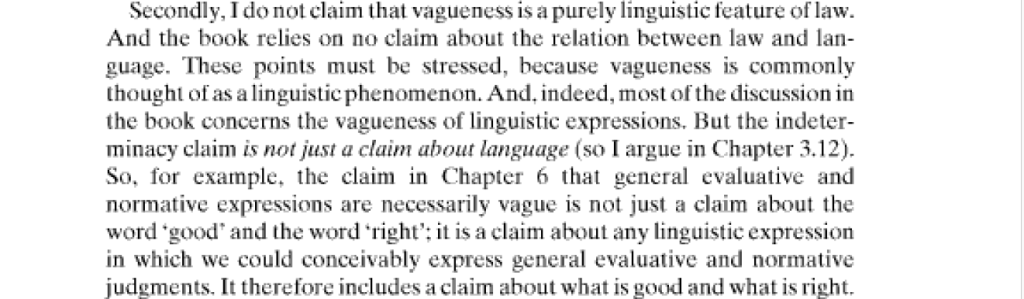
Image: Vagueness is inevitable. Deal with it.
Endicott: “Secondly, I do not claim that vagueness is a purely linguistic feature of law. And the book relies on no claim about the relation between law and language. These points must be stressed, because vagueness is commonly thought of as a linguistic phenomenon. And. indeed, most of the discussion in the book concerns the vagueness of linguistic expressions. But the indeterminacy claim is not just a claim about language (so I argue in Chapter 3.12). So. for example, the claim in Chapter 6 that general evaluative and normative expressions are necessarily vague is not just a claim about the word ‘good’ and the word ‘right1: it is a claim about any linguistic expression in which we could conceivably express general evaluative and normative judgments. It therefore includes a claim about what is good and what is right.”
Then, almost casually:
Image: Whether law is morally valuable to a community is not my concern. Justice and the rule of law may be political virtues — or not. I don’t defend them here.
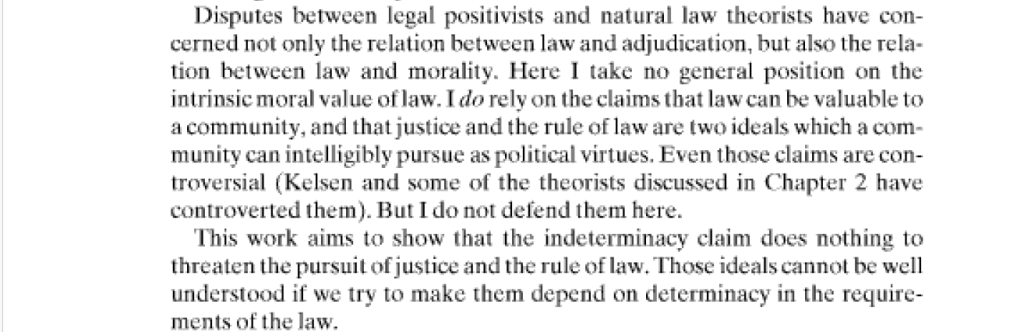
Endicott: “Disputes between legal positivists and natural law theorists have concerned not only the relation between law and adjudication, but also the relation between law and morality. Here I take no general position on the intrinsic moral value of law. I do rely on the claims that law can be valuable to a community, and that justice and the rule of law are two ideals which a com- munity can intelligibly pursue as political virtues. Even those claims are controversial (Kelsen and some of the theorists discussed in Chapter 2 have controverted them ). But I do not defend them here. This work aims to show that the indeterminacy claim does nothing to threaten the pursuit of justice and the rule of law. Those ideals cannot be well understood if we try to make them depend on determinacy in the requirements of the law.”
Say what?
Read together – not even uncharitably – the message is clear:
Law is indeterminate. Indeterminacy is unavoidable. And whether law is good, just, or valuable is… optional.
The subtext isn’t even hiding.
Law is a power structure first. If it happens to align with justice, fairness, or communal value, well, lovely. A bonus. Champagne all round.
This does not sit well with a sceptical cynic.
What really broke me, though, wasn’t the argument itself. Philosophers make grim claims all the time. What broke me was the silence around it.
How does this pass under the radar?
How do cohorts of law students – drilled in textual analysis, trained to read footnotes like tea leaves – not trip over this elephant stampede? How do they graduate believing they’re upholding inalienable rights, rather than participating in a managed system of coercion that occasionally behaves itself?
Self-preservation, I suppose. Wilful ignorance. Professional cosplay.
I’ve seen this before.
As an economist, ask the wrong foundational question, and you’re instantly radioactive. Persona non grata. Careers don’t end with explosions — they end with polite silence and no invitations.
I probably should have committed to heterodox philosophy from the start. Or stayed a musician.
I remember leaving graduate school, putting on a suit, and feeling like I was wearing a costume. Cosplay, before we had the word. “Business professional” as a role, not an identity.
I’ve always felt intellectually capable of doing whatever I set out to do. My temperament, however, has never agreed to play along.
Which is perhaps why diagnosing ontologies comes so naturally. Once you see the scaffolding, you can’t unsee it – whether it’s metaphysics, jurisprudence, or a corporate department pretending it has a mission.
Then David Graeber came along with Bullshit Jobs, and I remember thinking: Thank God. It’s not just me.
So yes. I need a break.
I need sleep. I need silence. I need to stop reading law books that accidentally admit they’re about power and then act surprised when someone notices.
(For the constructive exposition of Perspectival Realism—its three layers of mediation, its commitments, and its ontology without footnotes—see the main article. This piece deals with the predictable objection.)
The moment you say “our access to reality is mediated,” someone inevitably performs their civic duty as Defender of Enlightenment Orthodoxy and announces, as if discovering fire, “So you’re a relativist, then?”
It’s a comforting little reflex. If a position denies universality, it must be relativism. If it rejects the view from nowhere, it must reject the very idea of truth. If it acknowledges cultural scaffolding, it must be one critique away from saying flat-earthers and astrophysicists are peers.
This objection misunderstands both relativism and Perspectival Realism.
Audio: NotebookLM podcast summarising this topic.
Let’s begin with the essential distinction—think of this as the tattoo at the base of the spine:
Relativism says: all maps are equally valid. Perspectival Realism says: all maps are partial, and some are better.
Better at predicting.
Better at surviving.
Better at cohering with everything else we know.
Better at not getting you killed.
This is the spine of the position. Everything else is elaboration.
Relativism’s Self-Destruct Button
Relativism denies that reality has enough structure to constrain belief. According to its logic, perspectives are sovereign. The world bends to interpretation.
If that were true:
Gravity would turn itself off for anyone sufficiently committed to optimism.
Viruses would consult your cosmology before infecting you.
The Müller–Lyer illusion wouldn’t vary between populations because there’d be no stable perceptual machinery for it to fool.
Relativism collapses because the world does not permit it.
Perspectival Realism begins from the opposite premise:
There is one reality.
It resists us.
Perspectives rise or fall by how well they handle that resistance.
You can’t get further from relativism than that.
Why Perspective ≠ Prison
Another familiar confusion: “If access is perspectival, aren’t we trapped in our own little worlds?”
No. Mediation isn’t isolation. It’s a shared condition.
You and I may wear sunglasses of different tint, but we still walk the same street. Your glasses may darken the building I call “red,” so you call it “dark red.” That’s not incommensurability—that’s disagreement within a shared world. We argue, we adjust, we converge.
Perspectival Realism doesn’t say “worlds are sealed off.” It says we are situated—embodied, encultured, cognitively structured. Our lenses differ. The street does not.
The Crucial Point: The World Pushes Back
Relativism has no mechanism for adjudication. Perspectival Realism has the best one available: reality’s structured resistance.
If your perspective predicts, explains, and survives contact with the world, it’s better. If it collapses upon use, it’s worse. If it transfers across contexts, it’s better. If it leaves you dead, it’s worse.
This is not metaphysics. It’s survival.
And it is very explicitly not relativism.
Logic: Form Universal, Application Situated
A predictable objection:
Objection: “Isn’t logic universal? Doesn’t that kill perspectivalism?”
Response: Basic inferential forms—modus ponens, contradiction—are indeed widespread. That’s Layer 2 architecture: the cognitive machinery we all share.
But what counts as a valid premise, which inferences feel compelling, and which conclusions are considered exhaustive vary across cultures (Layer 3). Logic’s form is stable; its deployment is contextual.
Perspectival Realism doesn’t deny logic. It denies the fantasy that logic operates in a cultural vacuum.
Relativism’s Moral Collapse
Why “anything goes” goes nowhere
Relativism becomes lethal the moment ethics enters the scene. If all perspectives are equally valid, you lose the ability to critique harmful practices. Torture, forced servility, institutionalised cruelty—all become “just different frameworks.”
Perspectival Realism rejects this.
You don’t need a metaphysical skyhook to condemn torture. You need:
Shared vulnerability – all humans are embodied beings capable of pain.
Empirical observation – societies that normalise cruelty become unstable and self-poisoning.
Pragmatic convergence – diverse cultures can agree that some practices destroy the conditions of flourishing.
Reality-tested norms – ethical systems survive because they work, not because they download from a Platonic server.
This is not relativism. It’s ethics under realism-without-universality.
You can condemn harmful practices without pretending to be the mouthpiece of timeless universal Reason. You can ground human rights in intersubjective evidence—not metaphysical fiat.
No view from nowhere required.
The Three-Way Contrast (The Only Chart You Need)
Naive Realism: There is one perfectly accurate map.
Relativism: All maps are equally good.
Perspectival Realism:
All maps are partial.
Some are atrocious.
Some work astonishingly well because they track deeper regularities of the terrain.
No map is complete.
No map is sovereign.
The terrain adjudicates between them.
You don’t need omniscience to compare maps. You need terrain. And we all share the same one.
Prediction: The Final Judge
If you want the single litmus test:
Does the perspective predict anything?
Does it do so consistently?
Does it correct itself when wrong?
Does it transfer beyond its original context?
If yes → closer to reality. If no → a charming story, but please don’t build bridges with it.
Relativism has no concept of “closer to.” Perspectival Realism depends on it.
Putting It All Together
Perspectival Realism maintains:
Realism: the world exists independently of our representations.
Anti-universalism: no representation escapes mediation.
Anti-relativism: some representations perform better because they align more closely with what the world actually does.
Humility: we navigate through partial perspectives, comparing, refining, and error-correcting.
No one gets to declare universal sovereignty. Everyone gets tested by the same reality.
Relativism says everything is equally true. Perspectival Realism says everything is equally mediated—but not equally successful.
Reality decides.
Perspectives compete.
And relativism loses on the first contact.
COMMENTARY: To be fair, the argument about relativism is a strawman argument against virtually no one who would hold or defend this position. For whatever reason, the training data indicated that this was a significant contender. I’ve heard similar weak strawmen in other disciplines, and I felt I should address the invisible elephant in the room. — Bry Willis
DISCLAIMER: This article was written or output by ChatGPT 5.1. It started as a conversation with Claude Sonnet 4.5, where I had input days of output for evaluation. One of these outputs was the post about Erasmus and the Emissary Who Forgot to Bow. A group chat ensued between me, Claude and ChatGPT.
What started as a discussion about the merits of my position, expressed in the Erasmus-influenced essay, drifted to one about Perspectival Realism. That discussion deepened on ChatGPT, as I further discussed my recent thoughts on the latter topic. I had rendered a Magic: The Gathering parody trading card as I contemplated the subject. It’s how my brain works.
All of this led me to ask ChatGPT to summarise the conversation, and, upon further discussion, I asked it to draft this article – the second of five.
Perspectival Realism: The First Ontology Without an Asterisk This article discusses what Perspectival Realism means to me and how I got to this position.
Why Perspectival Realism Is Not Relativism 👈 Further discussion prompted me to differentiate this ontology from other perspectives.
Arriving Late to Massimi’s Party: Perspectival Realism in Parallel I spent another half-hour following Google search results as I wanted to see if anyone else had already been using the term, Perspectival Realism. I ended up on the Oxford publishing site. I found a 2022 book with this name, authored by Michela Massimi. They allowed me to download the book, so I asked ChatGPT to summarise our positions, specifically where we agreed and differed.
Against the Vat: Why Perspectival Realism Survives Every Sceptical Hypothesis At 0500, I returned to bed, but I woke up again at 0700, thinking about how one might differentiate between Putnam’s brain in a vat from Perspectival Realism. ChatGPT asked if I wanted that output in long-form.
The Constraint Interface: Toward a Nexal Ontology Being uncomfortable with the dichotomy between Realism and Idealism, I chatted to come up with terminology that disrupts what I consider a false dichotomy, focusing on the nexus rather than privileging one or the other. Consider this similar to the debate on sex and gender binaries.
As I mentioned at the end of the first series, I may return to this series and publish a coherent expository version more in line with my usual style. Meantime, this allows me to share my ideas unvarnished and unpolished at the same time, granting me more time to focus on other matters. Apologies to those who may disagree with the outline format. Honestly, it annoys me, but I am choosing function over form at the moment.
I was having an inappropriate chat with ChatGPT and, per Feyerabend, I once again discovered that some of the best inspirations are unplanned. The conversation circled around to the conflicting narratives of Erasmus and Wells. Enter, Plato, McGilchrist, and the Enlightenment – all living rent-free in my head – and I end up with this.
Audio: NotebookLM podcast on this topic.
I. The Proverb and Its Presumption
Erasmus sits at his writing desk in 1500-something, cheerful as a man who has never once questioned the premises of his own eyesight, and pens what will become one of the West’s most durable little myths: ‘In the land of the blind, the one-eyed man is king’. It arrives packaged as folk wisdom, the sort of thing you’re meant to nod at sagely over a pint. And for centuries, we did. The proverb became shorthand for a comfortable fantasy: that advantage is advantage everywhere, that perception grants sovereignty, that a man with superior faculties will naturally ascend to his rightful place atop whatever heap he finds himself on.
In the land of the blind, the one-eyed man is king
– Erasmus
It’s an Enlightenment dream avant la lettre, really – this breezy confidence that reason, sight, knowledge, insight will simply work wherever they’re deployed. The one-eyed man doesn’t need to negotiate with the blind. He doesn’t need their endorsement, their customs, their consent. He arrives, he sees, he rules. The proverb presumes a kind of metaphysical meritocracy, where truth and capability are self-authenticating, where the world politely arranges itself around whoever happens to possess the sharper tools.
Image: Midjourney didn’t coöperate with my prompt for a one-eyed king. Trust that this king has only one.
It’s the intellectual equivalent of showing up in a foreign country with a briefcase full of sterling and expecting everyone to genuflect. And like most folk wisdom, it survives because it flatters us. It tells us that our advantages – our rationality, our education, our painstakingly cultivated discernment – are universally bankable. That we, the seeing, need only arrive for the blind to recognise our superiority.
Erasmus offers this with no apparent irony. He hands us a proverb that whispers: your clarity is your crown.
II. Wells Wanders In
Four centuries later, H.G. Wells picks up the proverb, turns it over in his hands like a curious stone, and proceeds to detonate it.
The Country of the Blind (1904) is many things – a fable, a thought experiment, a sly dismantling of Enlightenment presumption – but above all it is an act of literary vandalism against Erasmus and everything his proverb smuggles into our collective assumptions. Wells sends his protagonist, Nuñez, tumbling into an isolated Andean valley where a disease has rendered the entire population blind for generations. They’ve adapted. They’ve built a culture, a cosmology, a complete lifeworld organised around their particular sensorium. Sight isn’t absent from their world; it’s irrelevant. Worse: it’s nonsense. The seeing man’s reports of ‘light’ and ‘sky’ and ‘mountains’ sound like the ravings of a lunatic.
Nuñez arrives expecting Erasmus’s kingdom. He gets a psychiatric evaluation instead.
The brilliance of Wells’s story isn’t simply that the one-eyed man fails to become king – it’s how he fails. Nuñez doesn’t lack effort or eloquence. He tries reason, demonstration, patient explanation. He attempts to prove the utility of sight by predicting sunrise, by describing distant objects, by leveraging his supposed advantage. None of it matters. The blind don’t need his reports. They navigate their world perfectly well without them. His sight isn’t superior; it’s alien. And in a culture that has no use for it, no linguistic scaffolding to accommodate it, no social structure that values it, his one eye might as well be a vestigial tail.
The valley’s elders eventually diagnose Nuñez’s problem: his eyes are diseased organs that fill his brain with hallucinations. The cure? Surgical removal.
Wells lets this hang in the air, brutal and comic. The one-eyed man isn’t king. He’s a patient. And if he wants to stay, if he wants to belong, if he wants to marry the girl he’s fallen for and build a life in this place, he’ll need to surrender the very faculty he imagined made him superior. He’ll need to let them fix him.
The story ends ambiguously – Nuñez flees at the last moment, stumbling back toward the world of the sighted, though whether he survives is left unclear. But the damage is done. Erasmus’s proverb lies in ruins. Wells has exposed its central presumption: that advantage is advantage everywhere. That perception grants authority. That reason, clarity, and superior faculties are self-evidently sovereign.
They’re not. They’re only sovereign where the culture already endorses them.
III. Plato’s Ghost in the Valley
If Wells dismantles Erasmus, Plato hovers over the whole scene like a weary ghost, half scolding, half despairing, muttering that he told us this would happen.
The Allegory of the Cave, after all, is the original version of this story. The philosopher escapes the cave, sees the sun, comprehends the Forms, and returns to liberate his fellow prisoners with reports of a luminous reality beyond the shadows. They don’t thank him. They don’t listen. They think he’s mad, or dangerous, or both. And if he persists – if he tries to drag them toward the exit, toward the light they can’t yet see – they’ll kill him for it.
Video: Plato’s Cave
Plato’s parable is usually read as a tragedy of ignorance: the prisoners are too stupid, too comfortable, too corrupted by their chains to recognise truth when it’s offered. But read it alongside Wells and the emphasis shifts. The cave-dwellers aren’t wrong, exactly. They’re coherent. They’ve built an entire epistemology around shadows. They have experts in shadow interpretation, a whole language for describing shadow behaviour, social hierarchies based on shadow-predicting prowess. The philosopher returns with reports of a three-dimensional world and they hear gibberish. Not because they’re defective, but because his truth has no purchase in their lifeworld.
Plato despairs over this. He wants the prisoners to want liberation. He wants truth to be self-authenticating, wants knowledge to compel assent simply by virtue of being knowledge. But the cave doesn’t work that way. The prisoners don’t want truth; they want comfort shaped like reality. They want coherence within the system they already inhabit. The philosopher’s sun is as alien to them as Nuñez’s sight is to the blind valley.
And here’s the kicker: Plato knows this. That’s why the allegory is tragic rather than triumphant. The philosopher does see the sun. He does apprehend the Forms. But his knowledge is useless in the cave. Worse than useless – it makes him a pariah, a madman, a threat. His enlightenment doesn’t grant him sovereignty; it exile him from the only community he has.
The one-eyed man isn’t king. He’s the lunatic they’ll string up if he doesn’t learn to shut up about the sky.
IV. The Enlightenment’s Magnificent Blunder
Once you’ve got Erasmus, Wells, and Plato in the same room, the Enlightenment’s central fantasy collapses like wet cardboard.
Humanity’s great Enlightenment wheeze – that baroque fantasy of Reason marching triumphantly through history like a powdered dragoon – has always struck me as the intellectual equivalent of selling snake oil in a crystal decanter. We were promised lucidity, emancipation, and the taming of ignorance; what we got was a fetish for procedural cleverness, a bureaucratisation of truth, and the ghastly belief that if you shine a bright enough torch into the void, the void will politely disclose its contents.
The Enlightenment presumed universality. It imagined that rationality, properly deployed, would work everywhere – that its methods were culture-neutral, that its conclusions were binding on all reasonable minds, that the shadows in Plato’s cave and the blindness in Wells’s valley could be cured by the application of sufficient light and logic. It treated reason as a kind of metaphysical bulldozer, capable of flattening any terrain it encountered and paving the way for Progress, Truth, and Universal Human Flourishing.
This was, to put it mildly, optimistic.
What the Enlightenment missed – what Erasmus’s proverb cheerfully ignores and what Wells’s story ruthlessly exposes – is that rationality is parochial. It’s not a universal solvent. It’s a local dialect, a set of practices that evolved within particular cultures, buttressed by particular institutions, serving particular ends. The Enlightenment’s rationality is Western rationality, Enlightenment rationality, rationality as understood by a specific cadre of 18th-century European men who happened to have the printing press, the political clout, and the colonial apparatus to export their epistemology at gunpoint.
They mistook their own seeing for sight itself. They mistook their own lifeworld for the world. And they built an entire civilisational project on the presumption that everyone else was just a less-developed version of them – prisoners in a cave, blind villagers, savages waiting to be enlightened.
The one-eyed man imagined himself king. He was actually the emissary who forgot to bow.
V. McGilchrist’s Neuroscientific Millinery
Iain McGilchrist sits in the same intellectual gravity well as Plato and Wells, only he dresses his thesis up in neuroscientific millinery so contemporary readers don’t bolt for the door. The Master and His Emissary is essentially a 500-page retelling of the same ancient drama: the emissary – our little Enlightenment mascot – becomes so enamoured of his own procedures, abstractions, and tidy schemas that he forgets the Master’s deeper, embodied, culturally embedded sense-making.
McGilchrist’s parable is neurological rather than allegorical, but the structure is identical. The left hemisphere (the emissary) excels at narrow focus, manipulation, abstraction – the sort of thing you need to count coins or parse grammar or build bureaucracies. The right hemisphere (the Master) handles context, pattern recognition, relational understanding – the sort of thing you need to navigate an actual lifeworld where meaning is messy, embodied, and irreducible to procedures.
The emissary is supposed to serve the Master. Left-brain proceduralism is supposed to be a tool deployed within the broader, contextual sense-making of the right brain. But somewhere along the way – roughly around the Enlightenment, McGilchrist suggests – the emissary convinced itself it could run the show. Left-brain rationality declared independence from right-brain contextuality, built an empire of abstraction, and wondered why the world suddenly felt thin, schizophrenic, oddly two-dimensional.
It’s Erasmus all over again: the presumption that the emissary with one eye should be king. The same tragic misunderstanding of how worlds cohere.
McGilchrist’s diagnosis is clinical, but his conclusion is damning. Western modernity, he argues, has become pathologically left-hemisphere dominant. We’ve let analytic thought pretend it’s sovereign. We’ve mistaken our schemas for reality, our maps for territory, our procedures for wisdom. We’ve built cultures that privilege manipulation over meaning, extraction over relationship, clarity over truth. And we’re baffled when these cultures feel alienating, when they produce populations that are anxious, depressed, disenchanted, starved for something they can’t quite name.
The emissary has forgotten the Master entirely. And the Master, McGilchrist suggests, is too polite – or too injured – to stage a coup.
In McGilchrist’s frame, culture is the Master. Strategy, reason, Enlightenment rationality – these are the emissary’s tools. Useful, necessary even, but never meant to govern. The Enlightenment’s mistake was letting the emissary believe his tools were all there was. It’s the same delusion Nuñez carries into Wells’s valley: the belief that sight, reason, superior faculties are enough. That the world will rearrange itself around whoever shows up with the sharper implements.
It won’t. The valley doesn’t need your eyes. The cave doesn’t want your sun. And the Master doesn’t answer to the emissary’s paperwork.
VI. The Triumph of Context Over Cleverness
So here’s what these three – Erasmus, Wells, Plato – triangulate, and what McGilchrist confirms with his neuroscientific gloss: the Enlightenment dream was always a category error.
Reason doesn’t grant sovereignty. Perception doesn’t compel assent. Superior faculties don’t self-authenticate. These things only work – only mean anything, only confer any advantage – within cultures that already recognise and value them. Outside those contexts, they’re noise. Gibberish. Hallucinations requiring surgical intervention.
The one-eyed man arrives in the land of the blind expecting a kingdom. What he gets is a reminder that kingdoms aren’t built on faculties; they’re built on consensus. On shared stories, shared practices, shared ways of being-in-the-world. Culture is the bedrock. Reason is just a tool some cultures happen to valorise.
And here’s the uncomfortable corollary: if reason is parochial, if rationality is just another local dialect, then the Enlightenment’s grand project – its universalising ambitions, its colonial export of Western epistemology, its presumption that everyone, everywhere, should think like 18th-century European philosophes – was always a kind of imperialism. A metaphysical land-grab dressed up in the language of liberation.
The Enlightenment promised illumination but delivered a blinding glare that obscures more than it reveals. It told us the cave was a prison and the valley was backward and anyone who didn’t see the world our way was defective, uncivilised, in need of correction. It never occurred to the Enlightenment that maybe – just maybe – other cultures had their own Masters, their own forms of contextual sense-making, their own ways of navigating the world that didn’t require our light.
Wells understood this. Plato suspected it. McGilchrist diagnoses it. And Erasmus, bless him, never saw it coming.
VII. The Enlightenment’s Paper Crown
The Enlightenment liked to imagine itself as the adult entering the room, flicking on the light-switch, and announcing that, at long last, the shadows could stop confusing the furniture for metaphysics. This is the kind of confidence you only get when your culture hasn’t yet learned the words for its own blind spots. It built an entire worldview on the hopeful presumption that its preferred modes of knowing weren’t just one way of slicing experience, but the gold standard against which all other sense-making should be judged.
Call it what it is: a provincial dialect masquerading as the universal tongue. A parochial habit dressed in imperial robes. The Enlightenment always smelled faintly of a man who assumes everyone else at the dinner table will be impressed by his Latin quotations. And when they aren’t, he blames the table.
The deeper farce is that Enlightenment rationality actually believed its tools were transferrable. That clarity is clarity everywhere. That if you wheel enough syllogisms into a space, the locals will drop their incense and convert on sight. Wells disabuses us of this; Plato sighs that he tried; McGilchrist clinically confirms the diagnosis. The emissary, armed with maps and measuring sticks, struts into the valley expecting coronation and is shocked – genuinely shocked – to discover that nobody particularly cares for his diagrams.
The Enlightenment mistake wasn’t arrogance (though it had that in liberal supply). It was context-blindness. It thought procedures could substitute for culture. It thought method could replace meaning. It thought mastery was a matter of getting the right answer rather than belonging to the right world.
You can all but hear the emissary stamping his foot.
VIII. The Anti-Enlightenment Position (Such as It Is)
My own stance is drearily simple: I don’t buy the Enlightenment’s sales pitch. Never have. The promise of universal reason was always a conjuring trick designed to flatter its adherents into thinking that their habits were Nature’s preferences. Once you stop confusing methodological neatness with metaphysical authority, the entire apparatus looks less like a cathedral of light and more like a filing system that got ideas above its station.
The problem isn’t that reason is useless. The problem is that reason imagines itself sovereign. Reason is a brilliant servant, a competent emissary, and an atrocious king. Culture is the king; context is the kingdom. Without those, rationality is just an embarrassed bureaucrat looking for a desk to hide behind.
This is why I keep banging on about language insufficiency, parochial cognition, and the delightful way our concepts disintegrate once you wander too far from the lifeworlds that birthed them. The Enlightenment thought the human mind was a searchlight. It’s closer to a candle in a draughty hall. You can still get work done with a candle. You just shouldn’t be telling people it can illuminate the universe.
So the anti-Enlightenment move isn’t a call to smash the instruments. It’s a call to read the room. To stop pretending the emissary is the Master. To stop assuming sight is a passport to sovereignty. To stop wandering into other cultures – other caves, other valleys, other hemispheres – with a ruler and a smirk, convinced you’re about to be crowned.
Underneath these brittle idols lies the far messier truth that cognition is parochial, language insufficient, and ‘rationality’ a parlour trick we perform to impress ourselves. I’m not proposing a new catechism, nor am I pining for some prelapsarian alternative. I’m simply pointing out that the Enlightenment promised illumination but delivered a blinding glare that obscures more than it reveals.
The task, then, is to grow comfortable with the dimness. To navigate by flicker rather than floodlight. To admit that the world was never waiting to be made ‘clear’ in the first place.
This doesn’t mean abandoning reason. It means remembering that reason is the emissary, not the Master. It means recognising that our schemas are provisional, our maps incomplete, our procedures useful only within the cultures that endorse them. It means learning to bow – to culture, to context, to the irreducible messiness of lifeworlds we don’t fully understand and can’t procedurally master.
The one-eyed man never was king. At best, he was an enthusiastic tourist with a very noisy torch. The sooner he stops shining it into other people’s faces, the sooner we can get on with the far more interesting business of navigating a world that never promised to be legible.
Not a kingdom of sight. Just a world where the emissary remembers his place.
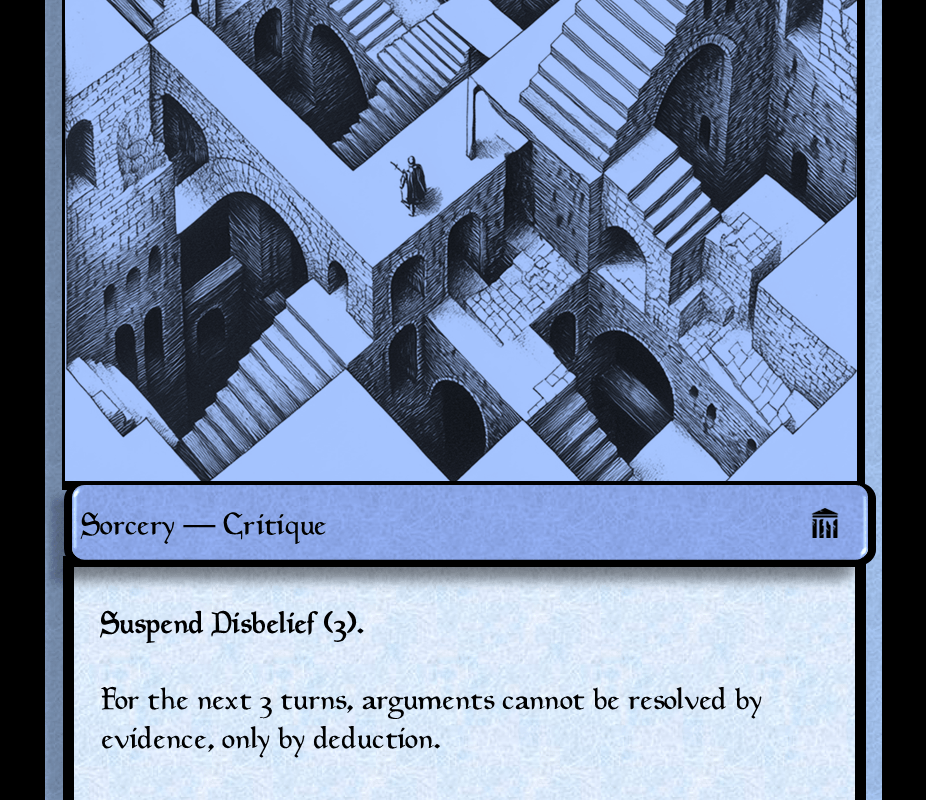
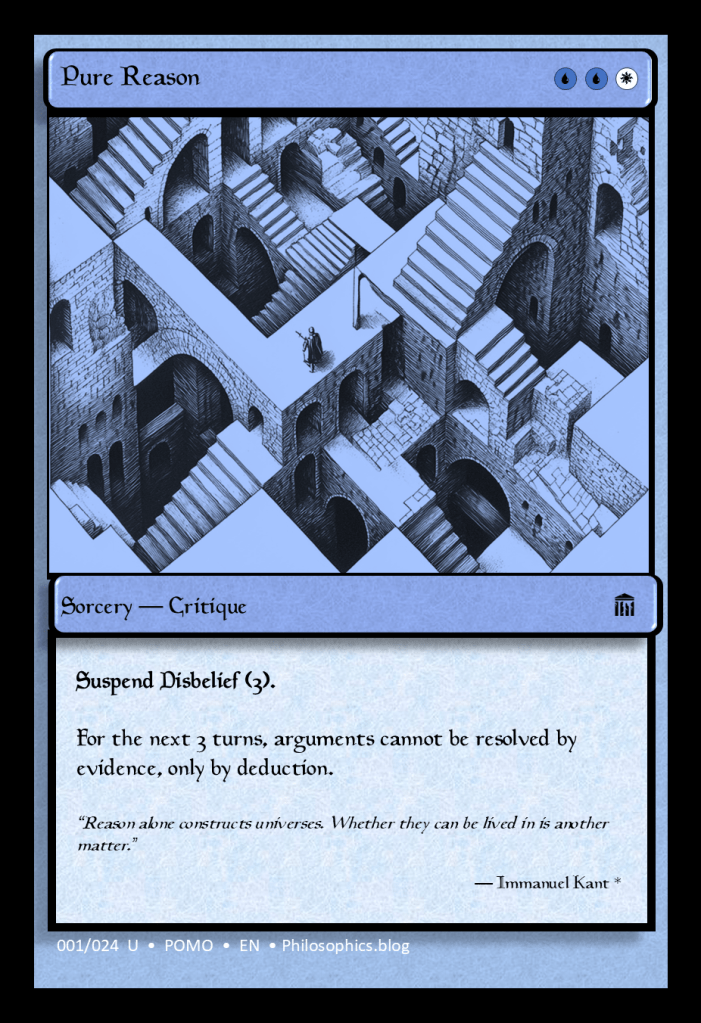
If reason had a landscape, it would look like this card: a maze of ascending and descending staircases, forever rational yet going nowhere. Kant might have called it a Critique of Pure Geometry.
Pure Reason, the first card in the Postmodern set, isn’t so much an homage to Kant as it is a cautionary reconstruction. It honours his ambition to build a universe from deduction while quietly mourning the price of that construction: alienation from experience.
Image: Card 001 from the Postmodern Set — Philosophics.blog
The Meta
Suspend Disbelief (3). For the next three turns, arguments cannot be resolved by evidence, only by deduction.
Audio: NotebookLM podcast of this topic.
The rule text re-enacts Kant’s method. In the Critique of Pure Reason, he cordoned off the realm of empirical evidence and tried to chart what the mind could know a priori – before experience. The card’s mechanic enforces that isolation. For three turns, players must reason in a vacuum: no appeals to observation, no touchstones of reality, only deduction.
It’s a temporary world built entirely of logic, an echo of the transcendental playground Kant envisioned. The effect is powerful but sterile – thought constructing universes that can’t sustain life.
The flavour text says it plainly:
“Reason alone constructs universes. Whether they can be lived in is another matter.”
— Immanuel Kant
That line, of course, is apocryphal, but it captures the essence of his project: reason as world-maker and prison architect in one.
The Architecture of Thought
The artwork mirrors Escher’s impossible staircases – a labyrinth of pure geometry, ordered yet uninhabitable. Each path is internally consistent, logically sound, but spatially absurd. This is Kant’s transcendental edifice made visual: coherent on paper, dizzying in practice.
The lone figure standing in the maze is the transcendental subject – the philosopher trapped within the architecture of his own cognition. He surveys the world he has built from categories and forms, unable to escape the walls of his own reason.
It’s a neat metaphor for Enlightenment hubris: the belief that reason can serve as both foundation and roof, requiring no support from the messy ground of existence.
Kant’s Double Legacy
Kant’s Critique was both the high point and the breaking point of Enlightenment rationality. It erected the scaffolding for science, ethics, and aesthetics but revealed the fault lines beneath them. His insistence that the mind structures experience rather than merely reflecting it gave birth to both modern idealism and modern doubt.
Every philosopher after him – Hegel, Nietzsche, Husserl, Derrida – has been trying either to escape or to inhabit that labyrinth differently. Pure Reason captures this tension: the glory of construction and the tragedy of confinement.
My Take
Reason is a magnificent liar. It promises order, clarity, and autonomy, but its perfection is its undoing. It abstracts itself from life until it can no longer recognise its own maker. Kant’s world is flawless and airless – a rational utopia unfit for breathing creatures.
I view Pure Reason as the archetype of the Enlightenment illusion: the attempt to found a living world on the logic of dead forms. What he achieved was monumental, but the monument was a mausoleum.
The card, then, is not just a tribute to Kant but a warning to his descendants (ourselves included): every system of thought eventually turns into an Escher print. Beautiful, consistent, and utterly unlivable.
I maintain this blog for two primary reasons: as an archive, and as a forum for engagement.
Philosophy isn’t a mass-market pursuit. Most people are content simply to make it through the day without undue turbulence, and I can hardly blame them. Thinking deeply is not an act of leisure; it’s a luxury product, one that Capitalism would rather you didn’t afford. Even when I’ve been employed, I’ve noticed how wage labour chokes the capacity for art and thought. Warhol may have monetised the tension, but most of us merely survive it.
Video: Sprouting seed. (No audio)
That’s why I value engagement – not the digital pantomime of ‘likes’ or ‘shares’, but genuine dialogue. The majority will scroll past without seeing. A few will skim. Fewer still will respond. Those who do – whether to agree, dissent, or reframe – remind me why this space exists at all.
To Jason, Julien, Jim, Lance, Nick, and especially Homo Hortus, who has been conversing beneath the recent Freedom post: your engagement matters. You help me think differently, sometimes introducing writers or ideas I hadn’t encountered. We may share only fragments of perspective, but difference is the point. It widens the aperture of thought – provided I can avoid tumbling into the Dunning-Kruger pit.
And now, a note of quiet satisfaction. A Romanian scholar recently cited my earlier essay, the Metanarrative Problem, in a piece titled Despre cum metanarațiunile construiesc paradigma și influențează răspunsurile emoționale – translation: On How Grand Narratives Shape Paradigms and Condition Our Emotional Responses. That someone, somewhere, found my reflections useful enough to reference tells me this exercise in public thinking is doing what it should: planting seeds in unpredictable soil.










 Philosophics