Most grand moral theories assume a degree of conceptual stability that moral language has never possessed.
Aristotle’s aretê, Kant’s maxims, Mill’s utilities, Rawls’s ‘reasonable rejection’ – pick your passion/poison. Each one presupposes that a concept has a single, portable meaning that obligingly follows philosophers from ancient Greece to medieval Christendom to your local ethics seminar. It doesn’t. It never did. We’ve merely been pretending it does in order to keep the theoretical architecture standing.
Drawing on conceptual genealogy, philosophy of language, and cross-cultural moral psychology, I argue that the universalist ambitions of virtue ethics, deontology, consequentialism, and contractualism collapse not because their logic is flawed, but because their vocabulary evaporates the moment you ask it to do heavy lifting. Our moral terms drift, fracture, mutate, and occasionally reinvent themselves altogether. Yet moral theorists continue to legislate universal principles as if the words were obedient little soldiers rather than unruly historical artefacts.
This isn’t a manifesto for relativism – quite the opposite. It is a call for modesty: an acknowledgement that moral frameworks function as context-bound heuristics, exquisitely useful within particular forms of life but laughably overextended when dressed up as timeless moral law.
If the Language Insufficiency Hypothesis has taught me anything, it’s that once you stop bullying language into behaving like mathematics, you begin to see moral philosophy for what it is – a set of imaginative tools, not an ontology of obligation.
Read it, disagree with it, file it under ‘Why Bry insists on burning down the Enlightenment one paper at a time’ – your choice. But at least now the argument exists in the world, properly dressed and indexed, ready to irritate anyone still clinging to the dream of universal moral principles.
A LinkedIn colleague posts this. I didn’t want to rain on his parade there – we’ve got an interesting binary intellectual relationship – we either adamantly agree or vehemently disagree. This reflects the latter. The title is revelatory – the all-caps, his:
A good society requires more than virtuous individuals and fair institutions: it requires a mediating moral principle capable of binding persons, communities, and structures into a shared project of human flourishing.
Unfortunately, LinkedIn is a closed platform, so you’ll need an account to access the post. Anyway…
Audio: NotebookLM summary podcast of this topic.
I can remember when I emerged from this mindset – or at least consciously reflected on it and declined the invitation.
Video clip: Because I felt like it. (No Sound)
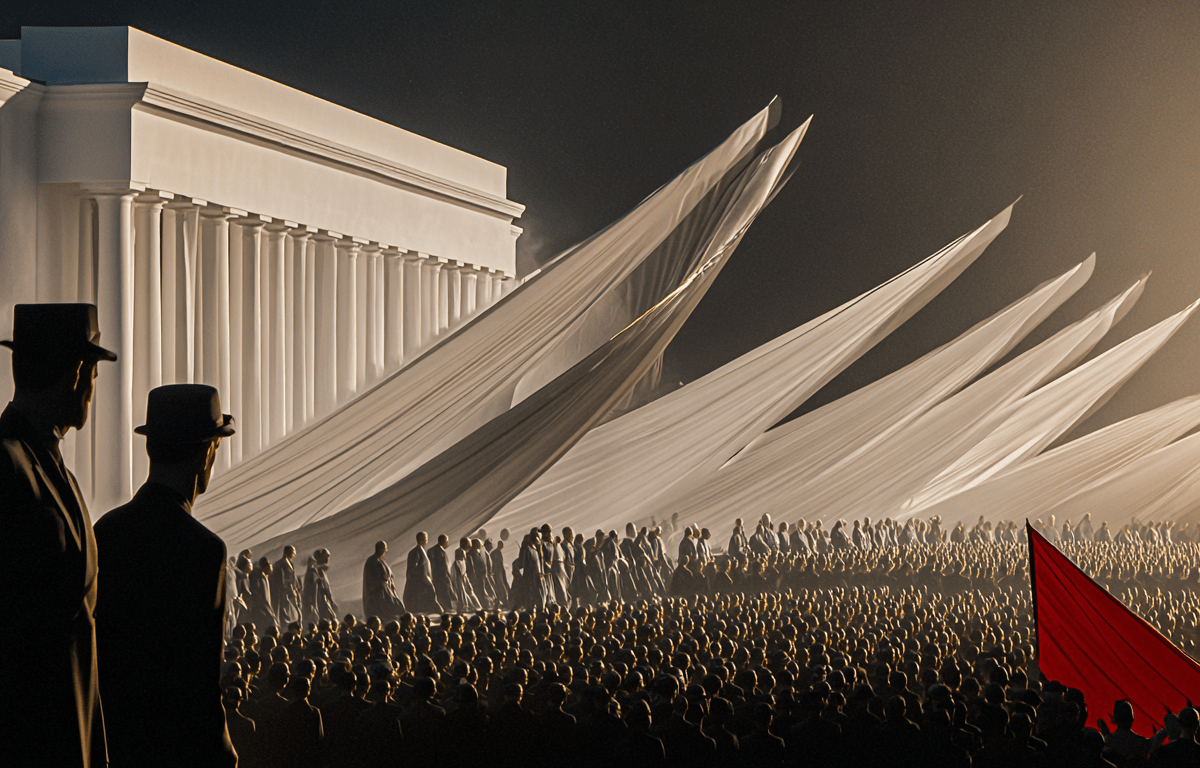
When I was 10 years old, I remember thinking about historical ‘National Socialism’ – wouldn’t it be nice if we were all on the same page in solidarity? Then I realised that I’d have to be on their page; they wouldn’t be on mine.
Then, I realised that ‘solidarity’ isn’t a warm circle of clasped hands under a rainbow; rather, it’s a demand to harmonise one’s interior life with someone else’s tuning fork. So-called unity is almost always a euphemism for ideological choreography, and one doesn’t get to pick the routine.
Children are sold the Sesame Street version of solidarity, where everyone shares crayons and sings about common purpose. Cue the Beach Boys: Wouldn’t It Be Nice?
Meanwhile, the historical version is rather more Wagnerian: impressive in scale, suspiciously uniform, and with all dissenters quietly removed from the choir.
My childhood self intuited precisely what my adult writing has since anatomised:
Solidarity is only lovely when you imagine everyone else will move toward you; it curdles the moment you realise the gravitational pull goes the other way.
‘We’re all on the same page’ always becomes ‘Get on the page we’ve selected for you’ – or elected against your vote. The fantasy of we dissolves into the machinery of they.
This isn’t a bug in the system; that is the system. Solidarity requires a centre, and once there’s a centre, someone else gets to define its radius. Even the gentle, ethical, cotton-wool versions still rely on boundary enforcement: who belongs in the shared project, who must adjust their cadence, who is politely removed for ‘disrupting the collective good’. I’m more often apt to be that person than not. History merely illustrates the principle at scale; the mechanism is universal.
Anyway, this is how my brain works, and how I think how I do, and write what I write. As much as I witter on about episodic selves, this remains a prevalent continuity.
Jason from Philosopher Muse suggested a connexion between Transductive Subjectivity and the work of Stephen Batchelor. I wasn’t familiar with Batchelor, so — as one does these days — I asked a GPT to give me the lay of the land. The machine obliged, and the result was interesting enough that it warranted a post of its own. This is it.
The risk I take is that the GPT gets it wrong. If so, call me out.
Audio: NotebookLM summary podcast of this topic.
Before anyone lights incense: I’m not suddenly a convert. Batchelor’s work and mine merely pass each other on adjacent footpaths. But the overlap is conceptually neat, and the divergence is even more telling.
Stephen Batchelor vs Transductive Subjectivity: A Brief Comparative Note
1. Shared Territory: The Self as Verb, Not Noun
Both Batchelor and Transductive Subjectivity reject the folk notion of a single, continuous metaphysical self.
Batchelor (Secular Buddhism): The self is an unfolding activity — impermanent, conditional, and without a stable essence. His “not-self” is a practice of disidentification from the imagined nugget of continuity we cling to.
Transductive Subjectivity: The self is a finite series: S₀ → S₁ → S₂ → … → Sₙ, each produced through the pressure of relational structures (R). Identity is what results when the world meets the organism. Nothing metaphysical required; just biology, cognition, language, and institutions doing their thing.
Overlap: Both positions dismantle the enduring pearl-of-self. Both frame identity as something generated, not possessed.
2. Divergent Aims: Inner Liberation vs Structural Clarity
This is where the paths fork.
Batchelor’s Agenda: Primarily ethical and therapeutic. The point of denying a fixed self is to reduce suffering, ease attachment, and cultivate a more responsive way of being.
TS’s Agenda: Metaphysical accuracy in the service of ethical clarity. If the self is a serial construction rather than a diachronic monolith, then retributive justice collapses under its own fictions. No self, no desert. No desert, no justification for revenge-based punishment.
Batchelor wants flourishing. I want rigour. Accidental cousins.
3. Methodological Differences: Distillation vs Reconstruction
Batchelor performs what you might call Buddhism sans metaphysics. A very Western manoeuvre:
keep impermanence
keep ethical insight
jettison karma, rebirth, cosmology
rebrand the remnants as a secular spiritual practice
Practitioners dislike this because he amputates the structural scaffolding that supported the doctrine.
TS, by contrast, doesn’t distil anything. It reconstructs selfhood from first principles:
No causa sui
Episodic, indexical selfhood (Strawson)
R→S transduction (MEOW)
No diachronic essence
No metaphysical ballast
If Buddhism aligns with TS, it’s incidental — the way two different mathematicians can discover the same function by entirely different routes.
4. Conceptual Architecture: Dependent Origination vs MEOW’s Tiers
Batchelor: leans on dependent origination as a philosophical metaphor — phenomena arise through conditions.
TS: models the exact channels of that conditioning via MEOW: T0 → biological signals T1 → cognitive architecture T2 → linguistic formats T3 → social-technical pressures
Where Batchelor says “everything is contingent,” TS says “yes, and here is the actual machinery.”
5. Different Stakes
Batchelor: freeing the person from clinging to an imaginary core.
TS: freeing ethics, law, and social design from pretending that metaphysical core exists.
One is therapeutic; the other is diagnostic.
A Key Point of Departure: Batchelor Works with Folk Psychology; TS Rejects Its Premises
There is one more divergence worth highlighting because it cuts to the bone of the comparison.
Batchelor accepts the phenomenological feel of the continuous self as a legitimate starting point. His work is therapeutic: he begins where the person is, in the lived experience of being “me,” and then encourages a gentle loosening of the grip on that intuition.
Transductive Subjectivity takes a different route entirely.
For TS, the continuous, diachronic self isn’t a psychological obstacle to be softened — it is a category mistake. A narrative compression artefact. A heuristic with pragmatic uses, yes, but no metaphysical legitimacy. Batchelor tries to transform our relation to the folk-self; TS denies that the folk-self was ever more than a convenient fiction.
Batchelor says: “You seem like a continuous self; now learn to hold that lightly.”
TS says: “You seem like a continuous self because the system is glossing over discontinuities. The sensation itself is misleading.”
In other words:
Batchelor redeems the experience.
TS disassembles the model.
He treats the “self” as something to relate to differently. TS treats the “self” as an ontological construct to be replaced with a more accurate one.
This is not a difference of ethical aim but of metaphysical foundation. Batchelor trims the folk psychology; TS declines the invitation altogether.
Closing Note
So yes — the connexion Jason spotted is real. But it’s genealogical, not derivative. We arrive at similar conclusions for different reasons and with different consequences.
Batchelor is pruning a tradition. Transductive Subjectivity is rebuilding the ontology.
And both, in their own way, make the continuity-self look like the rhetorical placeholder it always was.
Written entirely by ChatGPT after a chat about Stephen Batchelor (obviously)
Video: An 11:45 YouTube video of Bry Willis sharing his thought process using Transductive Subjectivity as a centrepiece.
I won’t drain the contents of the video here, but if you want to witness how my brain:
works
doesn’t work
sputters
Check it out. Click on the video above, and you shouldn’t have to even leave the page.
Audio: Spotify version of the same, which is somewhat silly given that Spotify shares the video content as well as the audio. At least you’ll have a choice of platforms.
NB: Note to self: Shift the Philosophics title to the right so it remains in frame for WordPress thumbnails. 🧐
I’ve decided it might be worthwhile to share some of my thoughts earlier in their larval stages, if only to demonstrate that none of my essays arrive fully formed from the head of Zeus. Far from it. Most of my ideas ricochet around my skull for weeks, months, years – occasionally decades – before deciding to cooperate. Even the ones that appear spontaneous usually have a long archaeological tail if I bother to dig.
I also hold, rather unfashionably but quite firmly, that all knowledge is a derivative remix. No one escapes this, least of all me. My own work is stitched from whatever intellectual scrap I‘ve encountered along the way. This is why I’ve never been persuaded by the sanctity of ‘originality’ or the mythology of intellectual property. Ideas don’t respect fences. They migrate, hybridise, and reappear wearing different hats. Claiming exclusive rights over them feels more like territorial anxiety – Territorial Pissing – than epistemic necessity — though that, admittedly, is a polemic for another day.
The point is simply this: I’m documenting this particular idea not because it arrived perfect, but because I can see the threads that led to it. And because the genealogy is often more revealing than the polished conclusion.
What follows is one of those threads.
A recent exchange with Thomas on Mastodon forced me to articulate a phrase that arrived mostly as an intuition but seems to have legs: the relative intersubjectivity of subjectivity. Put briefly, subjectivity (S) is always perspectival, always bound to a particular point of view, but never free from the pressures of its relative environment (R). No subject springs forth pristine; it is continually formed and re-formed by the linguistic, social, institutional, and affective structures in which it is embedded.
As a minimal sketch:
R → S ∴ S₀ → S₁
as the subject metabolises the influence of R and becomes something other than its prior configuration.
This is neither the usual bogeyman of ‘relativism’ nor the heroic Cartesian subject polishing its autonomy in splendid isolation. It is a subject that is contingent without being dissolved, formed without being mechanistic, and embedded without being determined. In a way, this is an echo of the causa sui argument, that no S can be self-caused.
If one wanted an analogue, the Mediated Encounter Ontology (MEOW) provides it. In the same way that encounter-events are mediated through biological, cognitive, linguistic, and institutional tiers, subjectivity itself can be seen as a kind of slow-form encounter – one whose centre drifts as the mediating structures press upon it. The subject is not the neutral observer of these tiers; it is the ongoing outcome of their interaction. In this sense, the ‘relative intersubjectivity of subjectivity‘ is simply what a MEOW-adjacent ontology would predict once applied to the subject rather than the event.
Whether this deserves a full essay depends on whether I can demonstrate that the idea is genuinely new rather than a recycled fragment of Berger–Luckmann, Rosen, or post-Kantian anthropology. But at first glance, the conceptual terrain appears fertile – at least fertile enough to justify a longer wander.
My philosophical critique, not of the book Why Democrats Are Dangerous, but of the two warring factions in United States politics – mind you, partisanship not limited to the US – sparked the ire of defenders of their respective turf. ‘You’ve got it wrong. Those other people are either addleheaded or abject evil’ is a consolidation of responses from both sides of the aisle. I’ve crafted a response.
Audio: NotebookLM summary podcast on this topic.
It’s perfectly true that I occupy a perspective. Everyone does. This isn’t a confession; it’s a structural feature of being human. Consciousness is perspectival by design. We don’t get to hover above the world like disembodied CCTV cameras. We look from somewhere.
But acknowledging one’s perspective is not the same thing as being trapped in a rut. A rut implies unexamined repetition, reflex, and dogma. A perspective implies angle, interpretation, intellectual stance. The accusation I’m hearing – ‘you’re in a rut too’ – is not actually an argument. It’s an attempt to delegitimise the analysis without engaging with it.
It says nothing about whether my observation is true, coherent, or well-reasoned; it merely notes that I, like every other speaking organism on the planet, occupy a position. And from this banal fact it attempts to smuggle in a conclusion: that my critique is thereby invalid. It’s a sleight of hand, and a clumsy one.
If someone believes I’m wrong, they are welcome – encouraged, even – to demonstrate:
where the logic fails
where the evidence contradicts me
where the symmetry is mischaracterised
where the interpretation distorts rather than illuminates
That is argumentation.
What they are offering instead is a sort of epistemic shrug: ‘You’re in a perspective, therefore you have no authority’. This is an ad hominem in a trench coat, pretending to be profundity.
The irony, of course, is that the people making this charge never seem to apply it to themselves. Their own viewpoint, naturally, is not a rut but a ‘stance’, ‘framework’, ‘tradition’, ‘bedrock’, or ‘fact’. Only the critic has perspective; they merely have truth.
But here’s the critical distinction:
Having a perspective does not invalidate an analysis, and pretending not to have one does.
The entire Anti-Enlightenment project rests on this recognition: that all human positions are mediated, situated, incomplete – and yet still capable of meaningful observation. You don’t escape your perspective by denying it; you escape dogma by interrogating it.
If someone wishes to rebut what I’ve written, they should do so directly, with evidence, reasoning, or counterexamples. If all they offer is ‘well, you’re biased too’, then they’ve conceded the argument by refusing to enter it.
A perspective is not a rut. A rut is what happens when you can’t tell the difference.
Several countries set aside holidays to celebrate thanks-giving. This is a fine tradition, if not hypocritical, given the behaviours manifest on the other days, which isn’t to say that the day itself isn’t without consistency challenges.
Audio: NotebookLM summary podcast on this topic.
In the United States, today is the day of thanks – Thanksgiving™ – the last Thursday of the month of November. This problem isn’t the day or the name; it’s the accompanying tradition that has to go.
Video: “Pilgrim” riding a 4-legged turkey – Damned Midjourney. (No sound).
This day is supposed to represent a day of unity, where the Pilgrims™ shared thanks with the indigenous peoples, without whom they would have likely perished. Without Romanticising, this might have been a better outcome.
As history is penned by the survivors, the Pilgrims and their ilk repaid their thanks with genocide and systematic oppression. The country – renamed as America, and then the United States of… (a misnomer if there ever was one) – summarily renamed these inhabitants as Native Americans. Somehow, Proto Americans feels more apt.
To make a long story longer, we need to jettison this performative connexion to these indigenous peoples and focus on just being thankful for the sake of being thankful – at least by metaphor. This isn’t out of respect for the indigenous cultures, but at least reflects less revisionist history.
They almost got rid of Columbus Day, if not for the uprising of white Christian nationalists. They should extricate the religious aspects of Christmas, an even more hypocritical holiday.
Or maybe I just don’t like holidays.
More accurately, I don’t trust a civilisation that sets aside one day to perform gratitude, then spends the remaining 364 as a Black Friday pre-game warmup. We gorge on narratives the way we gorge on turkey: carving up the past, seasoning it with national mythology, and swallowing without chewing. The Pilgrims™ didn’t break bread so much as break treaties; they didn’t share so much as seize. But here we are, centuries later, performing thanks like a national yoga pose. Stretch, breathe, pretend everything is fine.
What if, instead of reanimating a historical fan-fiction about harmony and pie, we admitted the truth? That the country owes its existence to conquest, and its conscience to annual amnesia? Strip Thanksgiving of its sanctimony and keep the gratitude if you must, but at least stop embossing colonialism with little cartoon turkeys in buckled hats.
Be thankful for the food, for the people you’ve not yet alienated, for the brief respite from wage-slavery. But realise the holiday itself is a museum of revision. A diorama of innocence that never existed. A Norman Rockwell oil painting slapped over a crime scene.
So enjoy your meal. Be warm, be fed, be kind – even if only for a day. Just don’t confuse the performance of gratitude with the reality it obscures.
I couldn’t resist feeding another concept into the MEOW GPT – ‘Progress’. Now you don’t have to. The results are as expected.
Video: Robot reading a newspaper whilst watching news on the telly. NB: This has little to do with the page content. I rendered it for another project, but didn’t use it.
Concept
Input: progress
Type: Normative–evaluative temporal concept (idea of improvement over time; macro-comparison rule)
Scope check: In-scope – central to Enlightenment narratives, clearly multi-tier, perfect for MEOW+LIH framing.
High-level summary (≤120 words)
“Progress” isn’t a neutral description of change; it’s a way of coding sequences of encounters as “getting better” according to some (often hidden) metric. Biologically, we enjoy mastery, relief from threat, and efficiency gains, which make certain changes feel like progress. Cognitively, we impose arrows, ladders, and stories of advancement onto messy histories. Linguistically, “progress” is a heavily contested macro-term that slides between technology, morals, economics, and personal growth. Socially and technically, institutions build progress into metrics (GDP, innovation indices, “development”), roadmaps, and infrastructures, which then enforce one vision of betterment. In MEOW terms, “progress” is a family of mediated encounter-patterns, not an objective direction baked into the world.
T0 – Biological Mediation
Applicability: Weakly to moderately applicable – there is no innate “sense of progress”, but bodies provide priors for what will be experienced as progress.
Analysis:
Organisms are tuned to reduce pain and increase security; changes that lower threat or effort (less hunger, more shelter, shorter paths) tend to feel intrinsically “better” at a bodily level.
Learning and mastery trigger reward signals: successfully performing a task faster or with less error produces bodily satisfaction, giving micro-encounters of “I’m progressing”.
However, bodies are also present-biased (we discount distant benefits), which conflicts with grand narratives of long-term progress that demand near-term sacrifice.
Chronic stress, disability, or aging can radically invert intuitive progress narratives: what counts as “improvement” may become extremely local (less pain today, one more functional ability retained).
T1 – Cognitive Mediation
Applicability: Strongly applicable – “progress” is largely a cognitive imposition on temporal change.
Analysis:
We construct temporal schemas (arrows, ladders, stages) and then fit history, technology, or personal life into them: primitive → advanced, childhood → maturity, underdeveloped → developed.
Progress judgments always depend on chosen metrics and baselines: we decide which variables to track (comfort? equality? power? lifespan? biodiversity?) and from which starting point, then declare a direction “up”.
Hindsight bias and survivor bias make progress narratives seductive: we mainly see successful pathways and reinterpret past suffering as necessary stepping stones.
Many minds default to a teleological story (“things are heading somewhere”) and smuggle in inevitability: once something happened, it was “on the path of progress”.
Personal identity work often leans on progress schemas (“I’m better than I was”, “I’ve grown”), which can be empowering—but also oppressive when life moves sideways or backwards.
T2 – Linguistic Mediation
Applicability: Maximally applicable – “progress” is a classic case for the Language Insufficiency Hypothesis.
Analysis:
On LIH’s topography, “progress” is a Contestable term: central, value-saturated, and permanently argued over (like justice, freedom, development). People vigorously disagree on what counts as “better”.
It also behaves as a Fluid: the same word ranges over technological advance, moral improvement, economic growth, scientific accumulation, personal healing, social liberation, and more, with blurry boundaries.
There is a huge Presumption Gap: speakers talk as if “progress” were almost self-explanatory (“we need progress”, “don’t stand in the way of progress”), while quietly plugging in different metrics and beneficiaries.
Political rhetoric (e.g., “progressive”, “pro-growth”) makes “progress” sound descriptive (“this is progress”) when it’s largely a normative claim about which trade-offs to accept.
Attempts to spell out “real progress” in detail (sustainable, inclusive, decolonial, post-growth, etc.) risk crossing the Effectiveness Horizon: each added qualifier improves precision for some audiences but makes the term heavier, more contested, and less communicatively effective for others.
Metaphors of forward motion and height (“moving forward”, “lagging behind”, “advanced”, “backward”) naturalise a directional axis and position whole peoples or practices on it, with obvious power implications.
T3 – Social/Technical Mediation
Applicability: Strongly applicable – progress is institutionalised in metrics, infrastructures, and stories.
Analysis:
Modern states and markets operationalise “progress” via indicators: GDP, productivity, patent counts, test scores, life expectancy, HDI, etc. What’s measured becomes what “progress” officially means.
Institutions plan through progress narratives: roadmaps, five-year plans, “maturity models”, technology readiness levels, academic rankings. These formats stage reality as a path with rungs and milestones.
Struggles over progress show up as conflicts between infrastructures: highways vs public transit, fossil fuels vs renewables, prisons vs restorative systems, expansion vs conservation.
Progress talk often justifies harm or sacrifice: displacement, environmental damage, labour exploitation, or cultural erasure are framed as unfortunate but necessary costs of “advancement”.
Tech culture enacts a particularly strong progress script (“disruption”, “version 2.0”, “moonshots”), which can overshadow regressions (loss of privacy, fragility, inequality) that don’t fit the official metric.
Counter-movements (degrowth, disability justice, decolonial thought, climate activism) challenge dominant progress patterns, proposing alternative metrics (care, resilience, biodiversity, repair) and thus different encounter-patterns to call “better”.
Limits & failure modes
Language insufficiency notes
LIH suggests “progress” will remain permanently unstable: it lives in a region where our need for a powerful, simple word outruns our ability to fix its content across contexts.
Because “progress” feels both descriptive and obviously good, the Presumption Gap is structurally dangerous: it allows one group’s gain to be presented as universal improvement, even when others clearly lose.
Attempts to define progress once and for all tend to hit the Effectiveness Horizon: more detailed definitions reveal underlying value conflicts rather than resolving them.
Missing tiers / blind spots
A purely T3 view (“progress is whatever our metrics say”) ignores embodied and psychological costs that never enter the indicators.
A purely T1 view (“progress is just a narrative”) underestimates how deeply infrastructures and institutions lock in certain trajectories and make alternatives materially difficult.
MEOW framing itself can tempt us toward a detached stance (“just different mediations”), but with progress this is politically loaded: deciding which encounter-patterns we count as “better” is not neutral analysis, it’s a moral and political act.
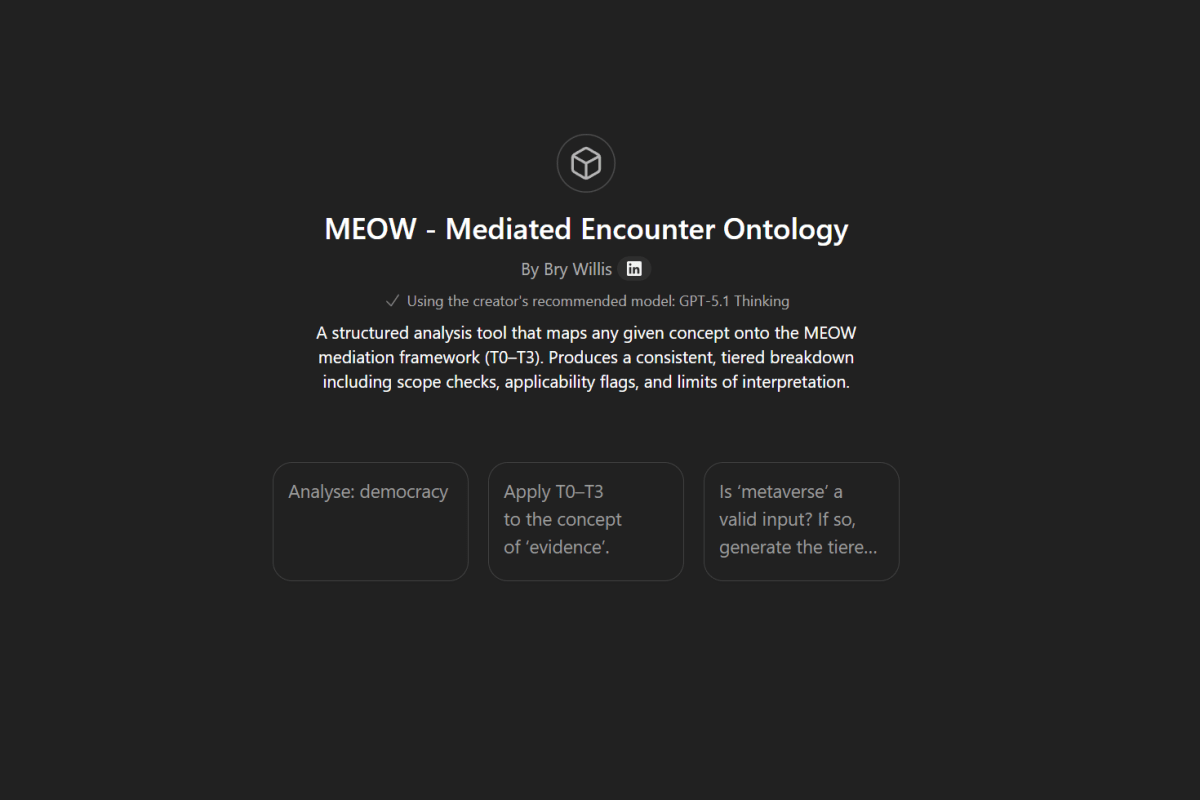
Instead of sleeping like a functional adult, I’ve spent the night creating, testing, and refining a bespoke GPT that has fully absorbed my MEOW and LIH frameworks. Apologies that the LIH manuscript isn’t yet public; some of the terminology may look delightfully alien if you’re coming in cold.
This model doesn’t role-play a philosopher; it thinks through the Mediated Encounter Ontology. It runs every input through T0–T3 mediations and then applies the Language Insufficiency Hypothesis to explain why our words fail us in predictable, structural ways.
Audio: NotebookLM summary podcast of this post on the MEOW GPT.
I stress-tested it with a dozen concepts, from the obvious to the uncooperative. It happily tells you when your input makes sense, when it’s out of scope, and when you’ve handed it conceptual soup. My first test was the hard problem of consciousness, because naturally we begin with the philosophical boss fight. I dialled down some over-enthusiastic LIH flourishes, but the bones are untouched.
I’m making this public for a simple reason: it’s the clearest way for people to see how MEOW operates without wandering through a hundred pages of my prose. These outputs capture how I process information and why these frameworks feel so intuitively correct to me. When you read them, you get a direct view of my interpretive machinery – how the world clicks for me, and how these ideas evolved.
It hasn’t been rigorously battle-tested across the entire conceptual universe, but it’s stable, coherent, and frankly too interesting to keep in the drawer. If you try it – and I hope you do – I’d love to see what it does with your own concepts. If you need help reading the results, ask. I didn’t simplify the system; it expects literacy, nuance, and a working prefrontal cortex.
Below is a sample output. I asked the model to analyse modernity.
Concept
Input: modernity
Type: historical–social formation / self-description of an era / conceptual frame
Scope check: in-scope – central for how MEOW treats large-scale shifts in mediation (social, technical, cognitive, linguistic)
High-level summary (≤120 words)
Modernity is both a historical bundle (industrialisation, nation-states, capitalism, science, bureaucracy, media) and a story societies tell about themselves (“we are modern, unlike the past”).
In MEOW terms, modernity is a large-scale reorganisation of mediations:
T1: new cognitive habits (individualism, planning, abstraction, risk-calculation).
T2: new vocabularies (progress, development, rationality, “religion” vs “science”).
T3: new institutions and technologies (markets, states, factories, schools, mass media, digital networks).
“Modernity” is not a single thing but a way these shifts hang together and become a background to everyday encounter.
T0 – Biological Mediation
Applicability: Applicable
Analysis:
Modernity radically reshapes the immediate bodily environment: dense cities, artificial lighting, noise, pollution, sedentary work, and altered sleep cycles change basic sensory and metabolic conditions.
Medical advances and public health (vaccination, antibiotics, sanitation, surgery) modify life expectancy, infant mortality, and chronic illness, which in turn change how life cycles feel and are planned.
New food systems (industrial agriculture, processed foods, global supply chains) alter nutrition, exposure to toxins, and rhythms of hunger and satiety.
Industrial and digital work reorganise movement and posture: repetitive factory labour, office desk work, and screen use all reshape embodiment, fatigue, and bodily awareness.
These T0 changes set the stage for new affective baselines (e.g., chronic low-level stress, stimulation overload) that colour what it is like to live in a “modern” world.
T1 – Cognitive Mediation
Applicability: Strongly applicable
Analysis:
Modernity encourages certain cognitive styles: systematic planning, quantification, risk assessment, cost–benefit thinking, and an emphasis on prediction and control.
The sense of self is reconfigured toward individualism and reflexivity: people see themselves as projects to be chosen, improved, optimised, often with long-term career and life-planning horizons.
Exposure to multiple roles, cultures, and information streams (through migration, media, education) produces more complex identity structures and can create cognitive dissonance or fragmentation.
Scientific and technical worldviews teach people to reframe events in terms of mechanisms, probabilities, and systems rather than fate, tradition, or local narratives.
The sheer volume and speed of information flows in late modernity (news, social media, notifications) trains attention toward rapid scanning and shallow switching, affecting memory, concentration, and emotional regulation.
These patterns make certain experiences “normal” (abstract work, mediated relationships, bureaucratic interactions) that would be extraordinary or impossible in premodern settings.
T2 – Linguistic Mediation
Applicability: Strongly applicable
Analysis:
Modernity itself is a label that societies use to contrast “us” with “them” (the past, “traditional” societies, “the East,” “the primitive”); it is a polemical as well as descriptive term.
In Language Insufficiency terms, modernity is highly Fluid: it can mean a period (“since the 18th century”), a style (modernist art), a value system (rational, secular, progressive), or a socio-economic order (capitalist, industrial, bureaucratic). Different authors slide between these quietly.
It’s also Contestable: critics and defenders use the same word but point to different aspects—emancipation and progress versus alienation, exploitation, ecological crisis.
Pairs like “modern vs traditional” or “modern vs backward” compress complex differences into simple hierarchies, smuggling in a presumption that “modern” is automatically better or more advanced.
Talk of “post-modernity” or “late modernity” suggests that we can neatly periodise and step outside the modern, even while our concepts and institutions remain shaped by it—an example of language implying more clarity and control than we actually have.
At the most global scale (“the meaning of modernity,” “the modern condition”), we approach an Effectiveness Horizon: the term feels weighty but becomes vague; people resort to sweeping metaphors (disenchantment, liquefaction, acceleration) whose exact content is hard to pin down.
First-person experiences of being “overwhelmed by modern life,” “liberated by modern options,” or “disconnected in modern society” often have an Ineffable quality: standard clichés don’t quite capture the texture of these lives, even as they gesture at them.
T3 – Social/Technical Mediation
Applicability: Strongly applicable
Analysis:
Modernity is most visible as a mesh of institutions: nation-states, markets, bureaucracies, public schools, hospitals, prisons, armies, scientific organisations, corporations, NGOs.
These institutions standardise time (clocks, schedules), space (borders, property lines, zoning), identity (passports, ID numbers), and value (money, statistics, rankings) so that encounters become predictable and governable across large scales.
Technologies—steam engines, electricity, mass transport, broadcasting, computing, the internet, AI—are both products and drivers of modernity. They make possible new encounter-forms (remote work, global real-time communication, mass surveillance).
Urbanisation concentrates people into large, heterogeneous populations, which reconfigures social networks, anonymity, solidarity, and conflict; everyday encounters become more mediated by rules, signage, and digital systems than by face-to-face custom.
Capitalist production and consumption patterns organise much of life around work, income, and markets; the rhythms of the factory, office, and platform economy structure when and how people interact, rest, and move.
Modern governance uses statistics, censuses, and models to “see” and manage populations; this makes certain aspects of life legible (employment, crime, disease) while leaving others under- or uncounted (informal care, undocumented work, emotional labour).
Counter-movements (romanticism, traditionalism, environmentalism, decolonial and Indigenous resurgence, slow-living and anti-consumerist practices) can be read as attempts to renegotiate or resist specific modern mediations rather than simply reject “modernity” as a whole.
Limits & failure modes
Language insufficiency notes
Modernity bundles together time (a historical era), structure (a type of society), and value (being “up to date”). This makes the term rhetorically powerful but analytically slippery: it’s easy to smuggle evaluations into what sound like neutral descriptions.
Because the concept is so broad, discussions often conflate distinct issues—technology, capitalism, secularisation, colonialism, individualism, bureaucracy—under one word, obscuring which mechanisms are actually at work.
Experiences of living in “modern times” (speed, fragmentation, choice, precariousness, possibility) often outrun our stock phrases; people lean on recurring complaints (“too fast,” “too shallow,” “too lonely”) that only partially capture what it’s like.
Missing tiers / blind spots
This sketch doesn’t adjudicate between different theories of modernity (Marxist, Weberian, postcolonial, systems-theoretic, etc.); it treats them as emphasising different mediational strands.
It’s centred on Euro-Atlantic narratives; “multiple modernities” and non-Western trajectories (where “modern” elements mix with older forms in hybrid ways) would need a richer T3 treatment.
The analysis underplays ecological dimensions: industrial modernity’s dependence on fossil fuels, large-scale extraction, and waste has massive implications for how future encounters will be structured.
Finally, because we are ourselves situated in what we call modernity, our conceptual vantage is limited; any map we draw is partly an artefact of the very mediations we’re trying to analyse.
This whole misadventure began sometime in 2018, when I started documenting what has now metastasised into the Language Insufficiency Hypothesis. If I weren’t typing this, I’d be doing the honourable thing and finishing the index, but here we are, procrastinating with purpose. I had a suspicion, even then, that language was up to something. Something slippery. Something evasive. At first, it was just a motley catalogue of weasel words that refused to sit still long enough to be given a meaning. I should have taken the hint when the list kept expanding like a Victorian railway: terminally over-budget and convinced of its own grandeur.
But, naturally, I pressed on.
Audio: NotebookLM summary podcast and conversation around this topic.
At the time I had that slow-burn itch about identity, selfhood, free will, agency – you know, the usual metaphysical tat we’re reared on like a Victorian child raised on laudanum. It wasn’t that these things didn’t exist; it was that the words simply couldn’t bear the conceptual load we’d been piling onto them. And so I found myself in the company of philosophers who either tried to rescue these terms (Dennett, ever the valiant firefighter with a damp match), complicate them (Searle, constructing houses of cards under wind machines), or dissolve them outright (Parfit, smiling serenely as the rest of us panic).
Meanwhile, Strawson was somewhere in the corner insisting experience is all there is, Putnam was in his perennial retraction phase, and I was merely trying to keep my own conceptual apparatus from collapsing like an undercooked soufflé.
I’ll admit I had a long-standing soft spot for Dennett’s consciousness-as-emergence hypothesis. It made a certain intuitive sense at the time: pile up enough neural machinery, sprinkle in some feedback loops, and consciousness would bubble up like steam from a kettle. It felt elegant. It felt mechanistically honest. And, crucially, it made perfect sense within the inherited Realist framework I was still tacitly lugging around. Of course, experience ’emerges’ from physical processes if you start from a worldview already partitioned into physical substrates and mental phenomena waiting to be accounted for. Dennett wasn’t wrong so much as operating within the same architectural error the rest of us had been marinating in. Once I began reframing the whole encounter through mediation rather than emergence, the elegance dissolved. What had looked like metaphysics turned out to be a conceptual afterimage generated by a language that couldn’t model its own limitations.
And then there was Chalmers.
Ah, the ‘hard problem’. I lost count of how many times it surfaced. Like mould. Or a debt collector. Chalmers’ dilemma – how physical processes give rise to experience – is purportedly the Mount Everest of metaphysics. Yet the more I thought about it, the more it reeked of a linguistic parlour trick. A conceptual magic eye puzzle: stare long enough and a unicorn appears, provided you’ve surrendered your scepticism and a good measure of oxygen.
The problem isn’t that consciousness is ‘hard’. The problem is that the linguistic scaffolding we’re using was never built for this terrain. ‘Experience’. ‘Physical’. ‘Mental’. ‘Explain’. These words pretend to be steel beams when they’re actually damp cardboard.
What remains isn’t a cosmic riddle but a linguistic artefact. A conceptual false path carved by centuries of grammatico-metaphysical enthusiasm – the unfortunate habit of mistaking grammatical symmetry for metaphysical necessity.
Which brings me to the present, having at last gelled the LIH and published the Mediated Encounter Ontology of the World – a relational metaphysics that has the decency not to hallucinate substances it can’t justify. MEOW clears the fog rather neatly: the so-called ‘hard problem’ is only ‘hard’ because we continue to treat ‘mind’ and ‘world’ as two independent substances requiring metaphysical reconciliation. Together, LIH and MEOW provide a double exposure of the problem: LIH shows why the language fails; MEOW shows what the language was failing to describe.
So here we are. I’d like to reconsider Chalmers through the dual lenses of LIH and MEOW – not to ‘solve’ the hard problem, but to show it was never the right problem to begin with. The difficulty isn’t consciousness; it’s the language we’re forced to use, the same language that refuses to sit still, the same language that keeps trying to trick us into mistaking grammatical symmetry for metaphysical necessity.
In a coming post, I intend to pry open that illusion with a crowbar. Delicately, of course. One must be civilised about these things.
Because if language is insufficient – and it is – then perhaps what Chalmers discovered was not the abyss of consciousness, but the limit of the dictionary.





 Philosophics