With the MEOW thesis now roaming freely across the intellectual savannah, knocking over conceptual furniture and frightening the rationalists, it’s time to walk through a simple example. We’ll stay safely within the realm of conscious perception for now. That way, no one panics, and everyone can pretend they’re on familiar ground.
Our case study: colour.
Or rather, the quite embarrassing misunderstanding of colour that Western philosophy has been peddling for roughly three centuries.
Audio: NotebookLM podcast summary of this topic, Colour, Perception, and Mediated Ontology.
The Realist’s Apple: A Comedy of Certainty
Picture an apple on a table: plump, unashamedly spherical, wearing its redness like a badge of honour. The traditional Realist swears it’s red in itself, quite independent of anyone wandering in to admire it. The apple has redness the way it has mass, curvature, and that little bruise from the careless shop assistant. When you enter the room, you ‘see’ the red it’s been proudly radiating all along.
Image 0: Subject viewing red apple.
By school age, most of us are told that apples don’t ‘have’ colour; they merely reflect certain wavelengths. A minor complication. A mechanical detail. Nothing to disturb the fundamental metaphysical fantasy: that redness is still ‘out there’, waiting patiently for your eyes to come collect it.
It’s all very straightforward. Very tidy. And very wrong.
Idealists to the Rescue (Unfortunately)
Ask an Idealist about the apple and the entertainment begins.
The Berkeley devotee insists the apple exists only so long as it’s perceived – esse est percipi – which raises awkward questions about what happens when you step out for a cuppa. God, apparently, keeps the universe running as a kind of 24-hour perceptual babysitter. You may find this profound or you may find it disturbingly clingy.
The Kantian, inevitably wearing a waistcoat, insists the apple-in-itself is forever inaccessible behind the Phenomenal Veil of Mystery. What you experience is the apple-for-you, sculpted by space, time, causality, and a toolkit of categories you never asked for. This explains a lot about post-Kantian philosophy, not least the fixation on walls no one can climb.
Contemporary idealists get creative: proto-experience in everything, cosmic consciousness as universal substrate, matter as a sleepy epiphenomenon of Mind. It’s quite dazzling if you ignore the categories they’re smashing together.
What unites these camps is the conviction that mind is doing the heavy lifting and the world is an afterthought – inconvenient, unruly, and best kept in the margins.
The Shared Mistake: An Architectural Catastrophe
Both Realist and Idealist inherit the same faulty blueprint: mind here, world there – two self-contained realms entering into an epistemic handshake.
Realists cling to unmediated access (a fantasy incompatible with biology). Idealists cling to sovereign mentality (a fantasy incompatible with objectivity).
Both take ‘experience’ to be a relation between two pre-existing domains rather than a single structured encounter.
This is the mistake. Not Realism’s claims about mind-independence. Not Idealism’s claims about mental primacy. The mistake is the architecture – the assumption of two separately-existing somethings that subsequently relate.
MEOW – yes, we’re calling it that – puts it bluntly:
The problem isn’t where colour is. The problem is assuming it has to be in something – mind or world – rather than in the event.
Redness isn’t inside your head or inside the apple. It’s co-constituted by biological, cognitive, linguistic, and cultural mediation interacting with persistent constraint patterns.
Time to peel this onion… er, apple.
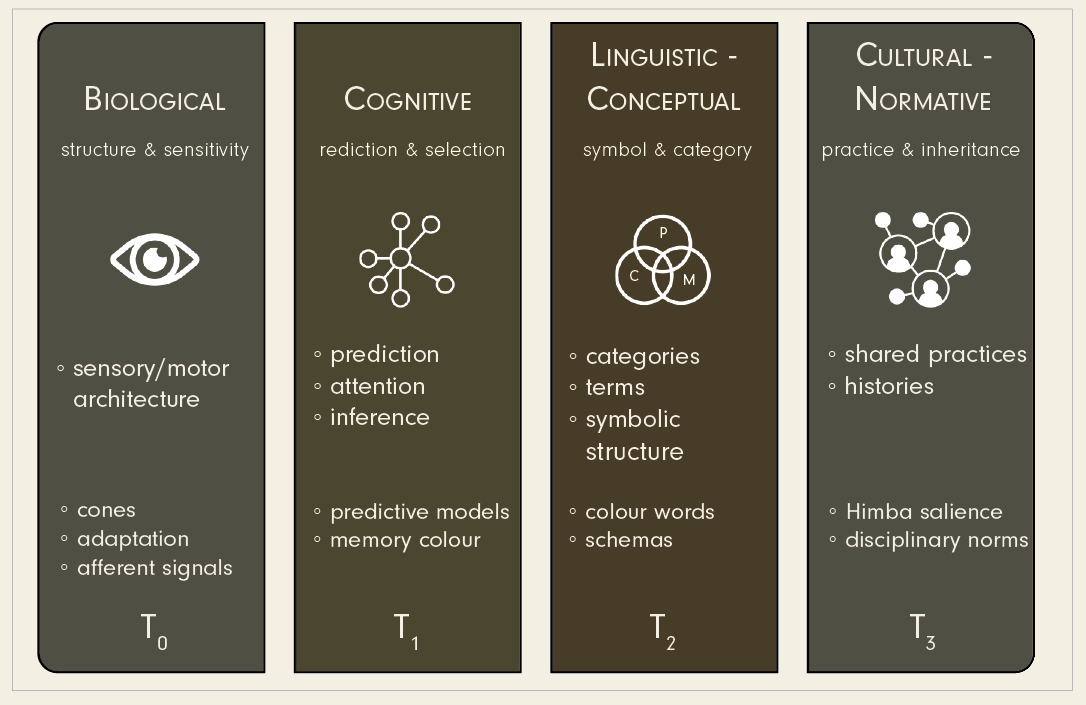
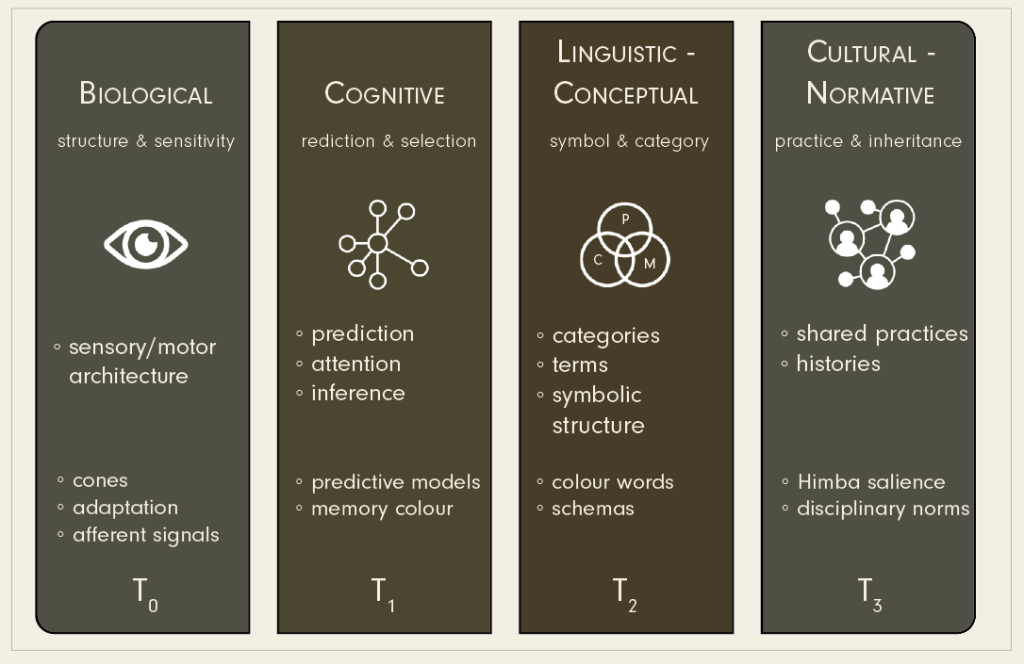
The Four Layers of Mediation (T₀–T₃)
A Ridiculously Oversimplified Cheat-Sheet That Still Outperforms Most Metaphysics Syllabi
Structure and Sensitivity: the Architecture You Never Asked For
This is where the Enlightenment’s fantasy of ‘raw perception’ goes to die.
Your visual system transforms, filters, enhances, suppresses, and reconstructs before ‘red’ even reaches consciousness. Cone responses, opponent processes, retinal adaptation, spatial filtering – all of it happening before the poor cortex even gets a look-in.
You never perceive ‘wavelengths’. You perceive the output of a heavily processed biological pipeline.
The biology isn’t the barrier.The biology is the view.
Image 2: Chromatic processing pathway (T₀→T₁): the layered biological transformations that make “red” possible long before consciousness gets involved.
T₁ – Cognitive Mediation
Prediction and Inference: You See What You Expect (Until Constraint Smacks You)
Your cognitive system doesn’t ‘receive’ colour information – it predicts it and updates the guess when necessary.
Memory colour biases perception toward canonical instances. Attentional gating determines what gets processed intensively and what gets summary treatment. Top-down modulation shapes what counts as signal versus noise.
There is no percept without mediation. There is no ‘raw data’ waiting underneath.
The Enlightenment liked to imagine perception as a passive window. Cognition turns that window into a heavily editorialised newsfeed.
Image 3: Expectation and input co-determine the percept: “red” emerges from the encounter, not from either source alone.
T₂ – Linguistic–Conceptual Mediation
Categories and Symbols: How Words Carve the Spectrum
Enter the famous Whorf skirmishes. Do words change perception? Do they merely label pre-existing distinctions? Do Russians really ‘see’ blue differently?
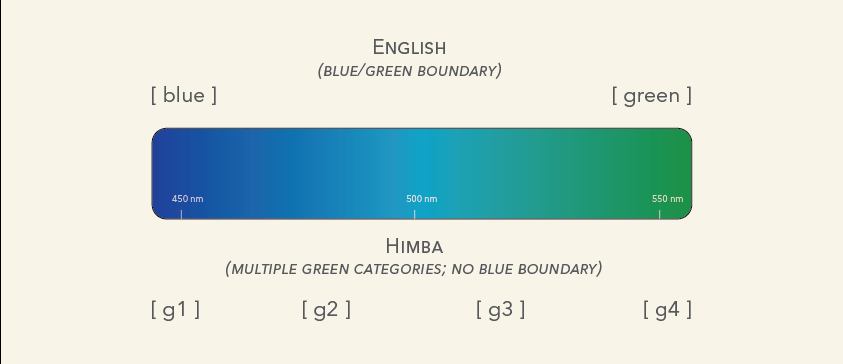
Berlin & Kay gave us focal colour universals – constraint patterns stable across cultures. Roberson et al. gave us the Himba data – linguistic categories reshaping discrimination and salience.
The correct answer is neither universalism nor relativism. It’s MEOW’s favourite refrain:
Mediation varies; constraint persists.
Words don’t invent colours. But they do reorganise the perceptual field, changing what pops and what hides.
Image 4: Different languages carve the same physical continuum differently: English imposes a blue/green split; Himba divides the region into several greens with no blue boundary at all.
T₃ – Cultural–Normative Mediation
Shared Practices: The Social Life of Perception
Your discipline, training, historical context, and shared norms tell you:
which distinctions matter
which differences ‘count’
which patterns get ignored
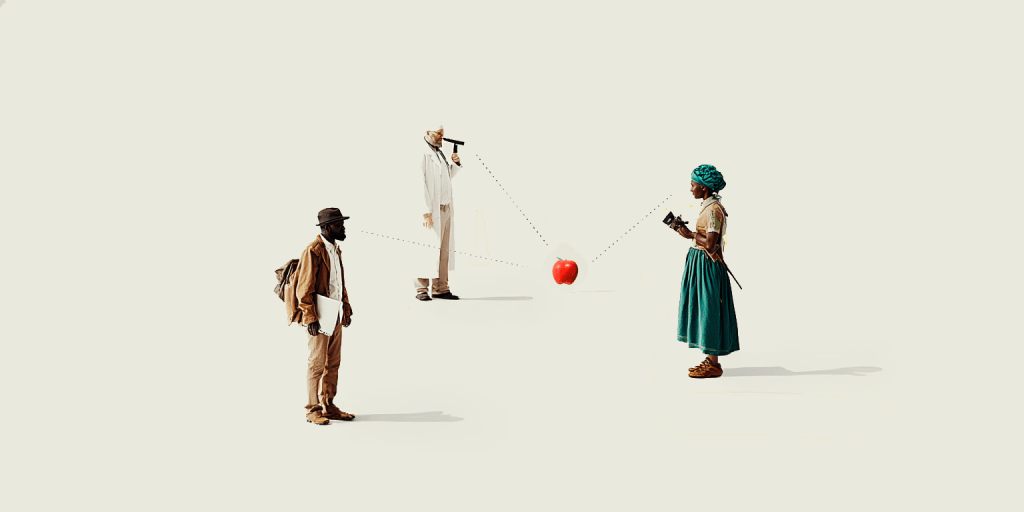
A Himba herder, a Renaissance painter, and a radiologist do not inhabit the same perceptual world – even when staring at the same patch of light.
Cultural mediation doesn’t rewrite biology; it reorganises priorities, salience, and interpretive readiness.
Image 5: Three observers confronting the same stimulus yet extracting different distinctions: the scientist tracks wavelength, the artist tracks hue and value, and the Himba pastoralist tracks ecologically salient greens. Same object, different salience hierarchies. Not arbitrary – just mediated.
What Seeing Red Actually Involves (Step By Exhausting Step)
You walk into a room. Apple on table. Looks red. What just happened?
T₀ – Biological: Long wavelength light hits L-cones harder than M- and S-cones. Opponent channels compute (L−M). Adaptation shifts baseline. Edge detection fires. You don’t have ‘red’ yet – you have transformed photoreceptor output.
T₁ – Cognitive: Your brain predicts ‘apple, probably red’ based on shape and context. Memory colour pulls toward canonical apple-red. Attention allocates processing resources. Prediction matches input (roughly). System settles: ‘yes, red apple’.
T₂ – Linguistic–Conceptual: The continuous gradient gets binned: ‘red’, not ‘crimson’ or ‘scarlet’ unless you’re a designer. The category provides stability, ties this instance to others, makes it reportable.
T₃ – Cultural–Normative: Does the exact shade matter? Depends whether you’re buying it, photographing it, or painting it. Your practical context determines which distinctions you bother tracking.
And through all of this: Constraint. Metameric matches stay stable. Focal colours persist cross-culturally. Wavelength sensitivities don’t budge. The encounter isn’t arbitrary – but it’s not unmediated either.
What happened wasn’t: Mind Met World. What happened was: an encounter-event unfolded, organised through four mediational layers, exhibiting stable constraint patterns that made it this and not that.
Where This Leaves Us
Colour is not ‘out there’. Colour is not ‘in here’.
Colour is the structured relational event of encounter.
Four mediation layers shape what appears. Constraint patterns stabilise the encounter so we aren’t hallucinating wildly divergent rainbows.
There is no ‘apple as it really is’ waiting behind the encounter. Nor is there a sovereign mind constructing its own private theatre.
There is only the event – where biological structure, cognitive dynamics, conceptual categories, and cultural histories co-emerge with the stable patterns of constraint we lazily call ‘the world’.
The apple was never red ‘in itself’. You were never seeing it ‘as it really is’. And the Enlightenment can finally take off its colour-blind uncle glasses and admit it’s been squinting at the wrong question for three hundred years.
Next time: Why visual illusions aren’t perception failing, but perception revealing itself.
Until then: stop asking where colour ‘really’ lives.
It lives in the event. And the event is mediated, constrained, and real enough.
Philosophers adore two things: inventing problems and then fainting when someone solves them. For decades, we’ve been treated to the realism–idealism tug-of-war, that noble pantomime in which two exhausted metaphysical camps clutch the same conceptual teddy bear and insist the other stole it first. It’s almost touching.
Enter Nexal Ontology, my previous attempt at bailing water out of this sinking ship. It fought bravely, but as soon as anyone spotted even a faint resemblance to Whitehead, the poor thing collapsed under the weight of process-cosmology PTSD. One throwaway comment about ‘actual occasions’, and Nexal was done. Dead on arrival. A philosophical mayfly.
But MEOW* – The Mediated Encounter Ontology of the World – did not die. It shrugged off the Whitehead comparison with the indifference of a cat presented with a salad. MEOW survived the metaphysical death match because its commitments are simply too lean, too stripped-back, too structurally minimal for speculative cosmology to get its claws into. No prehensions. No eternal objects. No divine lure. Just encounter, mediation, constraint, and the quiet dignity of not pretending to describe the architecture of the universe.
And that’s why MEOW stands. It outlived Nexal not by being grander, but by being harder to kill.
Image: The Four Mediation Layers – Biological, Cognitive, Conceptual, Cultural – structuring every encounter we mistake for ‘direct’.
This little illustration gives the flavour: • T0 Biological mediation – the body’s refusal to be neutral. • T1 Cognitive mediation – the brain, doing predictive improv. • T2 Linguistic–conceptual – words pretending they’re objective. • T3 Cultural–normative – the inheritance of everyone else’s mistakes.
The essay argues that what we call ‘mind’ and ‘world’ are just abstractions we extract after the encounter, not the metaphysical scaffolding that produces it. Once you begin with the encounter-event itself – already mediated, already structured, already resistive – the mind–world binary looks about as sophisticated as a puppet show.
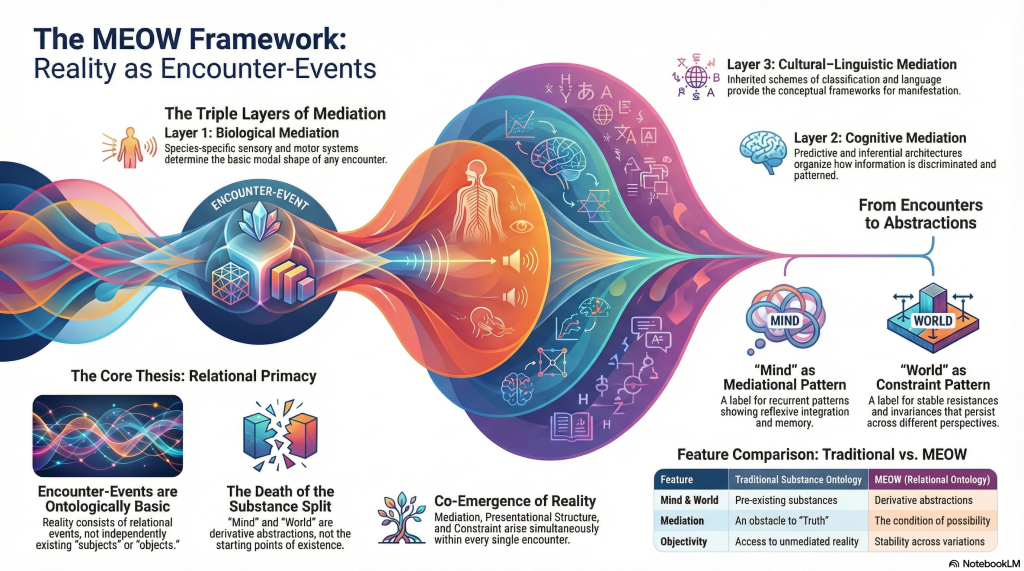
Image: NotebookLM Infographic (merges cognitive-linguistic, which I don’t support)
What the essay actually does
The Mediated Encounter Ontology of the World is the first framework I’ve written that genuinely sheds the Enlightenment scaffolding rather than rebuking it. MEOW shows:
Mediation isn’t an epistemic flaw; it’s the only way reality appears.
Constraint isn’t evidence of a noumenal backstage; it’s built into the encounter.
Objectivity is just stability across mediation, not a mystical view-from-nowhere.
‘Mind’ and ‘world’ are names for recurring patterns, not metaphysical hotels.
And – importantly – MEOW does all of this without drifting into Whiteheadian cosmological fan-fiction.
If you prefer a soft landing and the sound of a passable human voice explaining why metaphysics keeps tripping over its shoelaces, a NotebookLM discussion is here:
Audio: NotebookLM summary podcast of this essay.
MEOW is the survivor because it does the one thing philosophy is terrible at: it refuses to pretend. No substances, no noumena, no grand metaphysical machinery—just a clean, relational architecture that mirrors how we actually encounter the world.
And frankly, that’s quite enough ontology for one lifetime.
* To be perfectly honest, I originally fled from Michela Massimi’s Perspectival Realism in search of a cleaner terminological habitat. I wanted to avoid the inevitable, dreary academic cross-pollination: the wretched fate of being forever shelved beside a project I have no quarrel with but absolutely no desire to be mistaken for. My proposed replacement, Nexal Ontology, looked promising until I realised it had wandered, by sheer lexical accident, into Whitehead’s garden – an unintentional trespass for which I refused to stick around to apologise. I could already hear the process-metaphysics crowd sharpening their teeth.
Early evasive action was required.
I preferred nexal to medial, but the terminology had already been colonised, and I am nothing if not territorial. Mediated Ontology would have staked its claim well enough, but something was missing – something active, lived, structural. Enter the Encounter.
And once the acronym MEO appeared on the page, I was undone. A philosopher is only human, and the gravitational pull toward MEOW was irresistible. What, then, could honour the W with appropriate pomp? The World, naturally. Thus was born The Mediated Encounter Ontology of the World.
Pretentious? Yes. Obnoxious? Also yes.
And so it remains—purring contentedly in its absurdity.
Where our projects nod politely, then go their separate ways
(For the constructive exposition of Perspectival Realism—its three layers of mediation, its commitments, and its ontology without footnotes—see the main article. This piece deals with the differences by Michela Massimi’s and my versions.)
I suppose it was inevitable. You spend years muttering into your notebook about mediation, realism without bombast, the irretrievability of universality, and the peculiar way science manages to stumble forward with partial, parochial tools… and then, inevitably, you discover that someone else—Michela Massimi, in this case—has been busy constructing her own edifice a few hills over.
Audio: NotebookLM podcast summary and discussion of this topic
I arrived late to her party. Fine. But now that I’m here, let’s pour a drink and compare architecture.
Because while our buildings look similar from a distance—both labelled Perspectival Realism—they’re made from different bricks and aimed at different skylines.
1. A Courteous Bow: We Are Not Strangers in the Same Wilderness
Massimi and I share several foundational intuitions:
No God’s-eye view. She rejects the fantasy of disembodied objectivity. So do I. Reality is not a neutral theatre awaiting the Enlightenment spectator.
Knowledge is situated. Her emphasis on historically embedded scientific communities echoes my own insistence that sense, cognition, and culture structure every act of knowing.
Plural perspectives, not universal sovereignty. No single inferential vantage point dominates; multiple perspectives can be fruitfully interlaced. That’s strikingly consonant with my claim that mediation is a condition, not a defect.
Anti-relativist without universalist delusion. Neither of us has patience for the “all maps are equal” caricature peddled by people who wouldn’t know a real relativist if they tripped over one in a library.
From this angle, we’re intellectual cousins—two people independently refusing Enlightenment triumphalism while refusing to surrender realism to the absolutists.
2. The Parting of the Ways: Our Projects Are Not the Same Creature
But similarities disguise deeper divergences. Here are the important ones:
a) She’s doing epistemology; I’m doing ontology.
Massimi reconstructs realism from the inside out by examining scientific practice—models, inferences, historically evolving toolkits.
My project is more structural. Sense mediation (icons), cognitive mediation (instrumentation), and linguistic-cultural mediation (conceptual carving) are not methodological observations; they are conditions of access to reality. They’re deeper than scientific practice—they underlie it.
b) She salvages realism; I happily burn universality and build realism back from the ashes.
Massimi is rehabilitating realism’s good name. I’m less sentimental. Realism, as a doctrine, has been caught lying too many times. I want the realism of resistance, not the realism of representation.
c) Her anchor is “modal robustness”; mine is “structured resistance through mediation.”
Massimi’s realism rests on the idea that phenomena are robust across models and contexts—they persist modally.
I agree that robustness is useful. But robustness is filtered through linguistic concepts, cognitive priors, and sensorimotor limitations. It’s a second-order indicator, not a metaphysical foothold.
Resistance—the world’s refusal to bend to belief—is deeper. It’s what enables robustness to manifest.
d) Her perspectives are model-based; mine are existential.
Massimi focuses on scientific perspectives—frameworks articulated through inferential blueprints.
Massimi gives us a realism of models. A realism that emerges from the community of scientific practice, negotiated through historically situated inferential perspectives.
I’m after a realism of resistance. A realism that remains intact even when models break, when languages fail, when cognitive categories run aground. Not the realism of what we say, but the realism of what pushes back.
Our projects are not incompatible, but they are differently motivated.
She is concerned with scientific rationality’s legitimacy. I am concerned with the conditions of access to reality in the first place.
She patches the Enlightenment’s ship. I point out that the ship’s hull is three layers of mediation thick, and pretend that universality is the hole in the floor.
4. A Clean Acknowledgement: She Was Here First (Sort Of)
Yes—Massimi coined the term in this specific form, and she developed a sophisticated, rigorous scientific perspectivism that deserves respect.
But my Perspectival Realism emerged from a different genealogy:
the insufficiency of language,
the inescapability of conceptual carving,
the recursive inadequacy of cognitive tools,
the quiet, stubborn existence of a world we only ever meet askance.
Different animals. Same habitat.
So no, I’m not competing with Massimi. And no, I’m not rebranding her work.
What I’m doing—and what this piece makes explicit—is placing my ontology in dialogue with hers. Two parallel rejections of universality. Two parallel refusals of relativism. Two parallel attempts to articulate realism without pretending we’ve escaped the conditions of being human.
If I arrived late to her race, so be it. I’m not running for her finish line anyway.
DISCLAIMER: This article was written or output by ChatGPT 5.1. It started as a conversation with Claude Sonnet 4.5, where I had input days of output for evaluation. One of these outputs was the post about Erasmus and the Emissary Who Forgot to Bow. A group chat ensued between me, Claude and ChatGPT.
What started as a discussion about the merits of my position, expressed in the Erasmus-influenced essay, drifted to one about Perspectival Realism. That discussion deepened on ChatGPT, as I further discussed my recent thoughts on the latter topic. I had rendered a Magic: The Gathering parody trading card as I contemplated the subject. It’s how my brain works.
All of this led me to ask ChatGPT to summarise the conversation, and, upon further discussion, I asked it to draft this article – the second of five.
Perspectival Realism: The First Ontology Without an Asterisk This article discusses what Perspectival Realism means to me and how I got to this position.
Arriving Late to Massimi’s Party: Perspectival Realism in Parallel 👈 I spent another half-hour following Google search results as I wanted to see if anyone else had already been using the term, Perspectival Realism. I ended up on the Oxford publishing site. I found a 2022 book with this name, authored by Michela Massimi. They allowed me to download the book, so I asked ChatGPT to summarise our positions, specifically where we agreed and differed.
Against the Vat: Why Perspectival Realism Survives Every Sceptical Hypothesis At 0500, I returned to bed, but I woke up again at 0700, thinking about how one might differentiate between Putnam’s brain in a vat from Perspectival Realism. ChatGPT asked if I wanted that output in long-form.
The Constraint Interface: Toward a Nexal Ontology Being uncomfortable with the dichotomy between Realism and Idealism, I chatted to come up with terminology that disrupts what I consider a false dichotomy, focusing on the nexus rather than privileging one or the other. Consider this similar to the debate on sex and gender binaries.
As I mentioned at the end of the first series, I may return to this series and publish a coherent expository version more in line with my usual style. Meantime, this allows me to share my ideas unvarnished and unpolished at the same time, granting me more time to focus on other matters. Apologies to those who may disagree with the outline format. Honestly, it annoys me, but I am choosing function over form at the moment.
In the great hall of the palace, at the centre of a circle of polished stone, stood what the kingdom called the Last Unicorn.
No one had ever seen it. No one was permitted to try.
The Founders had decreed that direct observation would profane the creature’s ‘purity’. To see it was to diminish it; to touch it was to collapse its ‘essential nature’ into some accidental form. Thus, the unicorn could be approached only through instruments – never through hands, eyes, or unmediated judgement.
It was the Last not because others had died, but because it remained the final remnant of an age that still believed truths stood on stone.
Audio: NotebookLM podcast summary of this topic.
The Instruments
To preserve the unicorn’s nature, the Keepers constructed an evolving array of devices.
The Spiral Gauge, oldest and most revered, hung from silk threads above the empty circle. It detected one possible configuration of the horn’s curvature – never the horn itself.
The Echo Clock measured hoofbeats. The hall was silent, yet the wires vibrated all the same, yielding intervals that corresponded (according to the ledgers) to modes of unicornic motion: walking, standing, contemplative stillness.
The Mane Spectrometer mapped disturbances in candlelight to infer the density of a mane that existed only in theory.
The Temperament Dial synthesised these readings into a single number – currently 1.618: serene alertness.
The instruments never disagreed; they could not disagree, because each was calibrated against the others.
‘Truth is coherence’, the Master Keeper taught.
The Scaffolding Expands
Over centuries, ledgers multiplied into an archive wing. Scholars journeyed from distant kingdoms to admire the rigour of the data.
A visiting philosopher once said, ‘Your measurements form the most complete record of unicornic behaviour ever assembled’.
The apprentices beamed. No one asked why no other kingdom kept such records.
Schools taught the unicorn’s anatomy. Artists painted its likeness. The quarterly update of the Temperament Dial was read aloud in public squares. Children traced the golden spiral, believed to mirror the creature’s horn.
When dissidents questioned the absence of hoofprints, they were told what everyone knew:
‘The Last Unicorn is beyond crude contact. Only refined instruments can reveal its truth’.
Consensus deepened. With it grew the need for further instruments.
A Quiet Realisation
Sometimes, on night watch, a Keeper would stand above the empty stone. The Spiral Gauge quivered. The Echo Clock murmured. The Proportion Engine hummed, harmonising the system.
And in that stillness, the Keeper would feel a thought rise and evaporate instantly:
that the instruments described one another more faithfully than anything else.
That their perfect coherence reflected the architecture of the scaffolding, not any creature the scaffolding purported to measure.
Such thoughts were structural, not heretical – and no less dangerous.
The Last Unicorn
The Minister liked to call it the Last Unicorn. He never explained why it was last or what fate had befallen the others. He did not need to. The title served its purpose:
If it is the Last, no comparison is possible. No contradiction can emerge. No counterexample can survive.
Its uniqueness proved its necessity.
What else could unify a kingdom but a creature no one could touch, see, or disbelieve?
The Closing Line
And so the unicorn remained – in measurements, in ratios, in ledgers, in rhetoric.
A fiction made coherent by instruments, maintained by tradition, sanctified by those who needed it to be real.
The Last Unicorn was not the final creature of its kind. It was the last foundation still standing. And in that sense – it was more real than anything that had ever lived.
(For the constructive exposition of Perspectival Realism—its three layers of mediation, its commitments, and its ontology without footnotes—see the main article. This piece deals with the predictable objection.)
The moment you say “our access to reality is mediated,” someone inevitably performs their civic duty as Defender of Enlightenment Orthodoxy and announces, as if discovering fire, “So you’re a relativist, then?”
It’s a comforting little reflex. If a position denies universality, it must be relativism. If it rejects the view from nowhere, it must reject the very idea of truth. If it acknowledges cultural scaffolding, it must be one critique away from saying flat-earthers and astrophysicists are peers.
This objection misunderstands both relativism and Perspectival Realism.
Audio: NotebookLM podcast summarising this topic.
Let’s begin with the essential distinction—think of this as the tattoo at the base of the spine:
Relativism says: all maps are equally valid. Perspectival Realism says: all maps are partial, and some are better.
Better at predicting.
Better at surviving.
Better at cohering with everything else we know.
Better at not getting you killed.
This is the spine of the position. Everything else is elaboration.
Relativism’s Self-Destruct Button
Relativism denies that reality has enough structure to constrain belief. According to its logic, perspectives are sovereign. The world bends to interpretation.
If that were true:
Gravity would turn itself off for anyone sufficiently committed to optimism.
Viruses would consult your cosmology before infecting you.
The Müller–Lyer illusion wouldn’t vary between populations because there’d be no stable perceptual machinery for it to fool.
Relativism collapses because the world does not permit it.
Perspectival Realism begins from the opposite premise:
There is one reality.
It resists us.
Perspectives rise or fall by how well they handle that resistance.
You can’t get further from relativism than that.
Why Perspective ≠ Prison
Another familiar confusion: “If access is perspectival, aren’t we trapped in our own little worlds?”
No. Mediation isn’t isolation. It’s a shared condition.
You and I may wear sunglasses of different tint, but we still walk the same street. Your glasses may darken the building I call “red,” so you call it “dark red.” That’s not incommensurability—that’s disagreement within a shared world. We argue, we adjust, we converge.
Perspectival Realism doesn’t say “worlds are sealed off.” It says we are situated—embodied, encultured, cognitively structured. Our lenses differ. The street does not.
The Crucial Point: The World Pushes Back
Relativism has no mechanism for adjudication. Perspectival Realism has the best one available: reality’s structured resistance.
If your perspective predicts, explains, and survives contact with the world, it’s better. If it collapses upon use, it’s worse. If it transfers across contexts, it’s better. If it leaves you dead, it’s worse.
This is not metaphysics. It’s survival.
And it is very explicitly not relativism.
Logic: Form Universal, Application Situated
A predictable objection:
Objection: “Isn’t logic universal? Doesn’t that kill perspectivalism?”
Response: Basic inferential forms—modus ponens, contradiction—are indeed widespread. That’s Layer 2 architecture: the cognitive machinery we all share.
But what counts as a valid premise, which inferences feel compelling, and which conclusions are considered exhaustive vary across cultures (Layer 3). Logic’s form is stable; its deployment is contextual.
Perspectival Realism doesn’t deny logic. It denies the fantasy that logic operates in a cultural vacuum.
Relativism’s Moral Collapse
Why “anything goes” goes nowhere
Relativism becomes lethal the moment ethics enters the scene. If all perspectives are equally valid, you lose the ability to critique harmful practices. Torture, forced servility, institutionalised cruelty—all become “just different frameworks.”
Perspectival Realism rejects this.
You don’t need a metaphysical skyhook to condemn torture. You need:
Shared vulnerability – all humans are embodied beings capable of pain.
Empirical observation – societies that normalise cruelty become unstable and self-poisoning.
Pragmatic convergence – diverse cultures can agree that some practices destroy the conditions of flourishing.
Reality-tested norms – ethical systems survive because they work, not because they download from a Platonic server.
This is not relativism. It’s ethics under realism-without-universality.
You can condemn harmful practices without pretending to be the mouthpiece of timeless universal Reason. You can ground human rights in intersubjective evidence—not metaphysical fiat.
No view from nowhere required.
The Three-Way Contrast (The Only Chart You Need)
Naive Realism: There is one perfectly accurate map.
Relativism: All maps are equally good.
Perspectival Realism:
All maps are partial.
Some are atrocious.
Some work astonishingly well because they track deeper regularities of the terrain.
No map is complete.
No map is sovereign.
The terrain adjudicates between them.
You don’t need omniscience to compare maps. You need terrain. And we all share the same one.
Prediction: The Final Judge
If you want the single litmus test:
Does the perspective predict anything?
Does it do so consistently?
Does it correct itself when wrong?
Does it transfer beyond its original context?
If yes → closer to reality. If no → a charming story, but please don’t build bridges with it.
Relativism has no concept of “closer to.” Perspectival Realism depends on it.
Putting It All Together
Perspectival Realism maintains:
Realism: the world exists independently of our representations.
Anti-universalism: no representation escapes mediation.
Anti-relativism: some representations perform better because they align more closely with what the world actually does.
Humility: we navigate through partial perspectives, comparing, refining, and error-correcting.
No one gets to declare universal sovereignty. Everyone gets tested by the same reality.
Relativism says everything is equally true. Perspectival Realism says everything is equally mediated—but not equally successful.
Reality decides.
Perspectives compete.
And relativism loses on the first contact.
COMMENTARY: To be fair, the argument about relativism is a strawman argument against virtually no one who would hold or defend this position. For whatever reason, the training data indicated that this was a significant contender. I’ve heard similar weak strawmen in other disciplines, and I felt I should address the invisible elephant in the room. — Bry Willis
DISCLAIMER: This article was written or output by ChatGPT 5.1. It started as a conversation with Claude Sonnet 4.5, where I had input days of output for evaluation. One of these outputs was the post about Erasmus and the Emissary Who Forgot to Bow. A group chat ensued between me, Claude and ChatGPT.
What started as a discussion about the merits of my position, expressed in the Erasmus-influenced essay, drifted to one about Perspectival Realism. That discussion deepened on ChatGPT, as I further discussed my recent thoughts on the latter topic. I had rendered a Magic: The Gathering parody trading card as I contemplated the subject. It’s how my brain works.
All of this led me to ask ChatGPT to summarise the conversation, and, upon further discussion, I asked it to draft this article – the second of five.
Perspectival Realism: The First Ontology Without an Asterisk This article discusses what Perspectival Realism means to me and how I got to this position.
Why Perspectival Realism Is Not Relativism 👈 Further discussion prompted me to differentiate this ontology from other perspectives.
Arriving Late to Massimi’s Party: Perspectival Realism in Parallel I spent another half-hour following Google search results as I wanted to see if anyone else had already been using the term, Perspectival Realism. I ended up on the Oxford publishing site. I found a 2022 book with this name, authored by Michela Massimi. They allowed me to download the book, so I asked ChatGPT to summarise our positions, specifically where we agreed and differed.
Against the Vat: Why Perspectival Realism Survives Every Sceptical Hypothesis At 0500, I returned to bed, but I woke up again at 0700, thinking about how one might differentiate between Putnam’s brain in a vat from Perspectival Realism. ChatGPT asked if I wanted that output in long-form.
The Constraint Interface: Toward a Nexal Ontology Being uncomfortable with the dichotomy between Realism and Idealism, I chatted to come up with terminology that disrupts what I consider a false dichotomy, focusing on the nexus rather than privileging one or the other. Consider this similar to the debate on sex and gender binaries.
As I mentioned at the end of the first series, I may return to this series and publish a coherent expository version more in line with my usual style. Meantime, this allows me to share my ideas unvarnished and unpolished at the same time, granting me more time to focus on other matters. Apologies to those who may disagree with the outline format. Honestly, it annoys me, but I am choosing function over form at the moment.
Update: Please note that I have refined my position on this and documented it in a newer post. It builds upon this idea but clarifies some disconnects and provides me with some ontological distance from Massimi.
There comes a moment in any serious thinker’s life when the metaphysical menu starts looking like a bad buffet: too much on offer, none of it quite edible, and the dishes that appear promising turn out to depend on ingredients you can’t stomach. Realism insists the world is simply there, chugging along regardless of your opinions. Anti-realism points out, inconveniently, that all your access is wildly mediated. Perspectivism adds humility. Constructivism chastises you for overconfidence. Analytic Idealism sweeps matter off the table entirely, until you ask why consciousness spits out such stubbornly consistent patterns.
I’ve been through all of them. Realism*—asterisk for “but what about mediation?” Idealism*—asterisk for “but what about resistance?”
Everything almost worked. And “almost” is the metaphysical kiss of death. “Almost” is where the asterisks live.
Perspectival Realism is the first position I can hold without planting that apologetic little star in the margins.
Audio: NotebookLM podcast summary on this topic.
The Asterisk Journey (Brief, Painless, Necessary)
This isn’t a conversion narrative. It’s a salvage operation. Each station on the journey left me with tools worth keeping.
Layer 1: Iconography (Hoffman, minus the metaphysics)
Perception is not a window. It’s an interface. A species-specific dashboard designed for survival, not truth. Evolution gave you a set of icons—colour patches, contrast edges, looming shapes—not an accurate rendering of reality’s architecture.
Uexküll called this the umwelt: every organism inhabits its own perceptual slice of the world. Bees see ultraviolet; snakes sense heat; humans see embarrassingly little.
This is Layer 1 mediation: Reality-as-filtered-for-primates.
Layer 2: Instrumentation (Kastrup, minus the leap)
Consciousness is the instrument through which reality is measured. Measuring instruments shape the measurements. That doesn’t make the world mind-shaped; it just means you only ever get readings through the apparatus you’ve got.
This is Layer 2 mediation: Your cognitive architecture—predictive priors, attentional limitations, spatial-temporal scaffolding—structures experience before thought arrives.
Where I leave Kastrup behind is the familiar leap: “Because consciousness measures reality, reality must be made of consciousness.” That’s the instrumentality fallacy.
You need consciousness to access the world. That tells you nothing about what the world is.
Layer 3: Linguistic–Cultural Carving (Your home field)
And then comes the mediation philosophers most reliably ignore: language. Language does not describe reality. It carves it.
Some cultures divide colour into eleven categories; some into five. The Müller-Lyer illusion fools Westerners far more than it fools hunter-gatherers. Concepts feel natural only because you inherited them pre-packaged.
This is Layer 3 mediation: the cultural-linguistic filter that makes the world legible—and in the same breath, distorts it.
You mistake the map for the territory because it’s the only map you’ve ever held.
The Hard Problem, Dissolved — Not Solved
When English splits the world into “mental” and “physical,” it accidentally manufactures the “hard problem of consciousness.” Sanskrit traditions carve reality differently and end up with different “mysteries.”
The hard problem isn’t a revelation about reality. It’s a conceptual knot tied by Layer 3 mediation.
Changing the ontology to “everything is mind” doesn’t untie the knot. It just dyes the rope a different colour.
The Triple Lock
Put the three layers together and you get the honest picture:
Your senses give you icons, not the thing-in-itself.
Your cognition structures those icons automatically.
Your culture tells you what the structured icons mean.
And yet—despite all of this—the world pushes back.
Gravity doesn’t care about your interpretive community. Arsenic does not negotiate its effects with your culture. Your beliefs about heat won’t keep your hand from burning.
This is the fulcrum of Perspectival Realism:
Reality is real and resists us, but all access is triply mediated.
The realism remains. The universality does not.
Why Perspectival Realism is Not Relativism
Relativism says: “Everyone’s perspective is equally valid.” Perspectival Realism says: “Everyone’s perspective is equally situated.”
Very different claims.
Some perspectives predict better. Some cohere better. Some survive reality’s resistance better. Some transfer across contexts better. Some correct their own errors faster.
You don’t need a view from nowhere to say that. You just need to notice which maps get you killed less often.
What This Framework Enables
1. Progress without foundation myths
Science improves because reality resists bad models. Mediation doesn’t prevent progress; it’s the condition of it.
2. Critique without arrogance
You can rank perspectives without pretending to hover above them.
3. Cross-cultural dialogue without imperialism or despair
Cultures carve experience differently, but they’re carving the same underlying world. Translation is hard, not impossible.
4. Honest metaphysics
No glamourised escape from sensory embodiment, cognitive bias, or cultural inheritance. Just the patient business of refining our mediated grip on the real.
What Perspectival Realism Actually Claims
Let me make the commitments explicit:
There is a world independent of our representations.
All access to it is mediated by perception, cognition, and culture.
Perspectives can be compared because reality pushes back.
No perspective is unmediated.
The asymptote—Reality-as-it-is—is unreachable.
This isn’t pessimism. It’s maturity.
Why This Is the First Ontology Without an Asterisk
Every worldview before this needed the quiet, shamefaced footnote:
Realism*: “But access is mediated.”
Idealism*: “But resistance is real.”
Perspectivism*: “But we still need to rank perspectives.”
Constructivism*: “But the world’s invariances aren’t constructs.”
Perspectival Realism eats the objections instead of dodging them. There is no asterisk because the worldview is built from the asterisks.
No promises of transcendence. No pretense of universality. No linguistic sleight-of-hand.
Just embodied beings navigating a real world through fallible instruments, shared practices, and cultural grammars—occasionally catching a clearer glimpse, never stepping outside the frame.
The realism remains. The universality does not. And for once, metaphysics isn’t lying to you.
DISCLAIMER: This article was written or output by ChatGPT 5.1. It started as a conversation with Claude Sonnet 4.5, where I had input days of output for evaluation. One of these outputs was the post about Erasmus and the Emissary Who Forgot to Bow. A group chat ensued between me, Claude and ChatGPT.
What started as a discussion about the merits of my position, expressed in the Erasmus-influenced essay, drifted to one about Perspectival Realism. That discussion deepened on ChatGPT, as I further discussed my recent thoughts on the latter topic. I had rendered a Magic: The Gathering parody trading card as I contemplated the subject. It’s how my brain works.
All of this led me to ask ChatGPT to summarise the conversation, and, upon further discussion, I asked it to draft this very article – the first of five.
Perspectival Realism: The First Ontology Without an Asterisk 👈 This article discusses what Perspectival Realism means to me and how I got to this position.
Arriving Late to Massimi’s Party: Perspectival Realism in Parallel I spent another half-hour following Google search results as I wanted to see if anyone else had already been using the term, Perspectival Realism. I ended up on the Oxford publishing site. I found a 2022 book with this name, authored by Michela Massimi. They allowed me to download the book, so I asked ChatGPT to summarise our positions, specifically where we agreed and differed.
Against the Vat: Why Perspectival Realism Survives Every Sceptical Hypothesis At 0500, I returned to bed, but I woke up again at 0700 thinking about how one might differentiate between Putnam’s brain in a vat from Perspectival Realism. ChatGPT asked if I wanted that output in long-form.
The Constraint Interface: Toward a Nexal Ontology Being uncomfortable with the dichotomy between Realism and Idealism, I chatted to come up with terminology that disrupts what I consider a false dichotomy, focusing on the nexus rather than privileging one or the other. Consider this similar to the debate on sex and gender binaries.
Could I have improved on these articles if I had rewritten or polished them? Maybe. What’s the purpose? This is all a result of my concepts and inquiries. I endorse the output. I may return to make edits in future, or I may restate this information in my own voice, but for now, let this serve as notice that I am not afraid of generative AI; I am not afraid that it is going to supplant my thinking. I find that whilst I can prompt GPTs to make connexions or to query who else might be relevant to a topic, it doesn’t generally offer its own initiative, what we term Agency.
As for this particular post, it reads more like a listicle. I could have rendered it more expositional, but the structured thinking is all here; why should I reinvent the wheel just to put skin on these bones? As I said, perhaps I’ll flesh this out for elaboration or publication in future, for now, let this serve as a waypoint and a record of how I got here. This supplants my prior position, the asterisked Analytic Idealism, published in 2022, which supplanted my asterisked Realism. Perhaps I’ll finally be able to settle for an ontology and epistemology with no stars.
I was having an inappropriate chat with ChatGPT and, per Feyerabend, I once again discovered that some of the best inspirations are unplanned. The conversation circled around to the conflicting narratives of Erasmus and Wells. Enter, Plato, McGilchrist, and the Enlightenment – all living rent-free in my head – and I end up with this.
Audio: NotebookLM podcast on this topic.
I. The Proverb and Its Presumption
Erasmus sits at his writing desk in 1500-something, cheerful as a man who has never once questioned the premises of his own eyesight, and pens what will become one of the West’s most durable little myths: ‘In the land of the blind, the one-eyed man is king’. It arrives packaged as folk wisdom, the sort of thing you’re meant to nod at sagely over a pint. And for centuries, we did. The proverb became shorthand for a comfortable fantasy: that advantage is advantage everywhere, that perception grants sovereignty, that a man with superior faculties will naturally ascend to his rightful place atop whatever heap he finds himself on.
In the land of the blind, the one-eyed man is king
– Erasmus
It’s an Enlightenment dream avant la lettre, really – this breezy confidence that reason, sight, knowledge, insight will simply work wherever they’re deployed. The one-eyed man doesn’t need to negotiate with the blind. He doesn’t need their endorsement, their customs, their consent. He arrives, he sees, he rules. The proverb presumes a kind of metaphysical meritocracy, where truth and capability are self-authenticating, where the world politely arranges itself around whoever happens to possess the sharper tools.
Image: Midjourney didn’t coöperate with my prompt for a one-eyed king. Trust that this king has only one.
It’s the intellectual equivalent of showing up in a foreign country with a briefcase full of sterling and expecting everyone to genuflect. And like most folk wisdom, it survives because it flatters us. It tells us that our advantages – our rationality, our education, our painstakingly cultivated discernment – are universally bankable. That we, the seeing, need only arrive for the blind to recognise our superiority.
Erasmus offers this with no apparent irony. He hands us a proverb that whispers: your clarity is your crown.
II. Wells Wanders In
Four centuries later, H.G. Wells picks up the proverb, turns it over in his hands like a curious stone, and proceeds to detonate it.
The Country of the Blind (1904) is many things – a fable, a thought experiment, a sly dismantling of Enlightenment presumption – but above all it is an act of literary vandalism against Erasmus and everything his proverb smuggles into our collective assumptions. Wells sends his protagonist, Nuñez, tumbling into an isolated Andean valley where a disease has rendered the entire population blind for generations. They’ve adapted. They’ve built a culture, a cosmology, a complete lifeworld organised around their particular sensorium. Sight isn’t absent from their world; it’s irrelevant. Worse: it’s nonsense. The seeing man’s reports of ‘light’ and ‘sky’ and ‘mountains’ sound like the ravings of a lunatic.
Nuñez arrives expecting Erasmus’s kingdom. He gets a psychiatric evaluation instead.
The brilliance of Wells’s story isn’t simply that the one-eyed man fails to become king – it’s how he fails. Nuñez doesn’t lack effort or eloquence. He tries reason, demonstration, patient explanation. He attempts to prove the utility of sight by predicting sunrise, by describing distant objects, by leveraging his supposed advantage. None of it matters. The blind don’t need his reports. They navigate their world perfectly well without them. His sight isn’t superior; it’s alien. And in a culture that has no use for it, no linguistic scaffolding to accommodate it, no social structure that values it, his one eye might as well be a vestigial tail.
The valley’s elders eventually diagnose Nuñez’s problem: his eyes are diseased organs that fill his brain with hallucinations. The cure? Surgical removal.
Wells lets this hang in the air, brutal and comic. The one-eyed man isn’t king. He’s a patient. And if he wants to stay, if he wants to belong, if he wants to marry the girl he’s fallen for and build a life in this place, he’ll need to surrender the very faculty he imagined made him superior. He’ll need to let them fix him.
The story ends ambiguously – Nuñez flees at the last moment, stumbling back toward the world of the sighted, though whether he survives is left unclear. But the damage is done. Erasmus’s proverb lies in ruins. Wells has exposed its central presumption: that advantage is advantage everywhere. That perception grants authority. That reason, clarity, and superior faculties are self-evidently sovereign.
They’re not. They’re only sovereign where the culture already endorses them.
III. Plato’s Ghost in the Valley
If Wells dismantles Erasmus, Plato hovers over the whole scene like a weary ghost, half scolding, half despairing, muttering that he told us this would happen.
The Allegory of the Cave, after all, is the original version of this story. The philosopher escapes the cave, sees the sun, comprehends the Forms, and returns to liberate his fellow prisoners with reports of a luminous reality beyond the shadows. They don’t thank him. They don’t listen. They think he’s mad, or dangerous, or both. And if he persists – if he tries to drag them toward the exit, toward the light they can’t yet see – they’ll kill him for it.
Video: Plato’s Cave
Plato’s parable is usually read as a tragedy of ignorance: the prisoners are too stupid, too comfortable, too corrupted by their chains to recognise truth when it’s offered. But read it alongside Wells and the emphasis shifts. The cave-dwellers aren’t wrong, exactly. They’re coherent. They’ve built an entire epistemology around shadows. They have experts in shadow interpretation, a whole language for describing shadow behaviour, social hierarchies based on shadow-predicting prowess. The philosopher returns with reports of a three-dimensional world and they hear gibberish. Not because they’re defective, but because his truth has no purchase in their lifeworld.
Plato despairs over this. He wants the prisoners to want liberation. He wants truth to be self-authenticating, wants knowledge to compel assent simply by virtue of being knowledge. But the cave doesn’t work that way. The prisoners don’t want truth; they want comfort shaped like reality. They want coherence within the system they already inhabit. The philosopher’s sun is as alien to them as Nuñez’s sight is to the blind valley.
And here’s the kicker: Plato knows this. That’s why the allegory is tragic rather than triumphant. The philosopher does see the sun. He does apprehend the Forms. But his knowledge is useless in the cave. Worse than useless – it makes him a pariah, a madman, a threat. His enlightenment doesn’t grant him sovereignty; it exile him from the only community he has.
The one-eyed man isn’t king. He’s the lunatic they’ll string up if he doesn’t learn to shut up about the sky.
IV. The Enlightenment’s Magnificent Blunder
Once you’ve got Erasmus, Wells, and Plato in the same room, the Enlightenment’s central fantasy collapses like wet cardboard.
Humanity’s great Enlightenment wheeze – that baroque fantasy of Reason marching triumphantly through history like a powdered dragoon – has always struck me as the intellectual equivalent of selling snake oil in a crystal decanter. We were promised lucidity, emancipation, and the taming of ignorance; what we got was a fetish for procedural cleverness, a bureaucratisation of truth, and the ghastly belief that if you shine a bright enough torch into the void, the void will politely disclose its contents.
The Enlightenment presumed universality. It imagined that rationality, properly deployed, would work everywhere – that its methods were culture-neutral, that its conclusions were binding on all reasonable minds, that the shadows in Plato’s cave and the blindness in Wells’s valley could be cured by the application of sufficient light and logic. It treated reason as a kind of metaphysical bulldozer, capable of flattening any terrain it encountered and paving the way for Progress, Truth, and Universal Human Flourishing.
This was, to put it mildly, optimistic.
What the Enlightenment missed – what Erasmus’s proverb cheerfully ignores and what Wells’s story ruthlessly exposes – is that rationality is parochial. It’s not a universal solvent. It’s a local dialect, a set of practices that evolved within particular cultures, buttressed by particular institutions, serving particular ends. The Enlightenment’s rationality is Western rationality, Enlightenment rationality, rationality as understood by a specific cadre of 18th-century European men who happened to have the printing press, the political clout, and the colonial apparatus to export their epistemology at gunpoint.
They mistook their own seeing for sight itself. They mistook their own lifeworld for the world. And they built an entire civilisational project on the presumption that everyone else was just a less-developed version of them – prisoners in a cave, blind villagers, savages waiting to be enlightened.
The one-eyed man imagined himself king. He was actually the emissary who forgot to bow.
V. McGilchrist’s Neuroscientific Millinery
Iain McGilchrist sits in the same intellectual gravity well as Plato and Wells, only he dresses his thesis up in neuroscientific millinery so contemporary readers don’t bolt for the door. The Master and His Emissary is essentially a 500-page retelling of the same ancient drama: the emissary – our little Enlightenment mascot – becomes so enamoured of his own procedures, abstractions, and tidy schemas that he forgets the Master’s deeper, embodied, culturally embedded sense-making.
McGilchrist’s parable is neurological rather than allegorical, but the structure is identical. The left hemisphere (the emissary) excels at narrow focus, manipulation, abstraction – the sort of thing you need to count coins or parse grammar or build bureaucracies. The right hemisphere (the Master) handles context, pattern recognition, relational understanding – the sort of thing you need to navigate an actual lifeworld where meaning is messy, embodied, and irreducible to procedures.
The emissary is supposed to serve the Master. Left-brain proceduralism is supposed to be a tool deployed within the broader, contextual sense-making of the right brain. But somewhere along the way – roughly around the Enlightenment, McGilchrist suggests – the emissary convinced itself it could run the show. Left-brain rationality declared independence from right-brain contextuality, built an empire of abstraction, and wondered why the world suddenly felt thin, schizophrenic, oddly two-dimensional.
It’s Erasmus all over again: the presumption that the emissary with one eye should be king. The same tragic misunderstanding of how worlds cohere.
McGilchrist’s diagnosis is clinical, but his conclusion is damning. Western modernity, he argues, has become pathologically left-hemisphere dominant. We’ve let analytic thought pretend it’s sovereign. We’ve mistaken our schemas for reality, our maps for territory, our procedures for wisdom. We’ve built cultures that privilege manipulation over meaning, extraction over relationship, clarity over truth. And we’re baffled when these cultures feel alienating, when they produce populations that are anxious, depressed, disenchanted, starved for something they can’t quite name.
The emissary has forgotten the Master entirely. And the Master, McGilchrist suggests, is too polite – or too injured – to stage a coup.
In McGilchrist’s frame, culture is the Master. Strategy, reason, Enlightenment rationality – these are the emissary’s tools. Useful, necessary even, but never meant to govern. The Enlightenment’s mistake was letting the emissary believe his tools were all there was. It’s the same delusion Nuñez carries into Wells’s valley: the belief that sight, reason, superior faculties are enough. That the world will rearrange itself around whoever shows up with the sharper implements.
It won’t. The valley doesn’t need your eyes. The cave doesn’t want your sun. And the Master doesn’t answer to the emissary’s paperwork.
VI. The Triumph of Context Over Cleverness
So here’s what these three – Erasmus, Wells, Plato – triangulate, and what McGilchrist confirms with his neuroscientific gloss: the Enlightenment dream was always a category error.
Reason doesn’t grant sovereignty. Perception doesn’t compel assent. Superior faculties don’t self-authenticate. These things only work – only mean anything, only confer any advantage – within cultures that already recognise and value them. Outside those contexts, they’re noise. Gibberish. Hallucinations requiring surgical intervention.
The one-eyed man arrives in the land of the blind expecting a kingdom. What he gets is a reminder that kingdoms aren’t built on faculties; they’re built on consensus. On shared stories, shared practices, shared ways of being-in-the-world. Culture is the bedrock. Reason is just a tool some cultures happen to valorise.
And here’s the uncomfortable corollary: if reason is parochial, if rationality is just another local dialect, then the Enlightenment’s grand project – its universalising ambitions, its colonial export of Western epistemology, its presumption that everyone, everywhere, should think like 18th-century European philosophes – was always a kind of imperialism. A metaphysical land-grab dressed up in the language of liberation.
The Enlightenment promised illumination but delivered a blinding glare that obscures more than it reveals. It told us the cave was a prison and the valley was backward and anyone who didn’t see the world our way was defective, uncivilised, in need of correction. It never occurred to the Enlightenment that maybe – just maybe – other cultures had their own Masters, their own forms of contextual sense-making, their own ways of navigating the world that didn’t require our light.
Wells understood this. Plato suspected it. McGilchrist diagnoses it. And Erasmus, bless him, never saw it coming.
VII. The Enlightenment’s Paper Crown
The Enlightenment liked to imagine itself as the adult entering the room, flicking on the light-switch, and announcing that, at long last, the shadows could stop confusing the furniture for metaphysics. This is the kind of confidence you only get when your culture hasn’t yet learned the words for its own blind spots. It built an entire worldview on the hopeful presumption that its preferred modes of knowing weren’t just one way of slicing experience, but the gold standard against which all other sense-making should be judged.
Call it what it is: a provincial dialect masquerading as the universal tongue. A parochial habit dressed in imperial robes. The Enlightenment always smelled faintly of a man who assumes everyone else at the dinner table will be impressed by his Latin quotations. And when they aren’t, he blames the table.
The deeper farce is that Enlightenment rationality actually believed its tools were transferrable. That clarity is clarity everywhere. That if you wheel enough syllogisms into a space, the locals will drop their incense and convert on sight. Wells disabuses us of this; Plato sighs that he tried; McGilchrist clinically confirms the diagnosis. The emissary, armed with maps and measuring sticks, struts into the valley expecting coronation and is shocked – genuinely shocked – to discover that nobody particularly cares for his diagrams.
The Enlightenment mistake wasn’t arrogance (though it had that in liberal supply). It was context-blindness. It thought procedures could substitute for culture. It thought method could replace meaning. It thought mastery was a matter of getting the right answer rather than belonging to the right world.
You can all but hear the emissary stamping his foot.
VIII. The Anti-Enlightenment Position (Such as It Is)
My own stance is drearily simple: I don’t buy the Enlightenment’s sales pitch. Never have. The promise of universal reason was always a conjuring trick designed to flatter its adherents into thinking that their habits were Nature’s preferences. Once you stop confusing methodological neatness with metaphysical authority, the entire apparatus looks less like a cathedral of light and more like a filing system that got ideas above its station.
The problem isn’t that reason is useless. The problem is that reason imagines itself sovereign. Reason is a brilliant servant, a competent emissary, and an atrocious king. Culture is the king; context is the kingdom. Without those, rationality is just an embarrassed bureaucrat looking for a desk to hide behind.
This is why I keep banging on about language insufficiency, parochial cognition, and the delightful way our concepts disintegrate once you wander too far from the lifeworlds that birthed them. The Enlightenment thought the human mind was a searchlight. It’s closer to a candle in a draughty hall. You can still get work done with a candle. You just shouldn’t be telling people it can illuminate the universe.
So the anti-Enlightenment move isn’t a call to smash the instruments. It’s a call to read the room. To stop pretending the emissary is the Master. To stop assuming sight is a passport to sovereignty. To stop wandering into other cultures – other caves, other valleys, other hemispheres – with a ruler and a smirk, convinced you’re about to be crowned.
Underneath these brittle idols lies the far messier truth that cognition is parochial, language insufficient, and ‘rationality’ a parlour trick we perform to impress ourselves. I’m not proposing a new catechism, nor am I pining for some prelapsarian alternative. I’m simply pointing out that the Enlightenment promised illumination but delivered a blinding glare that obscures more than it reveals.
The task, then, is to grow comfortable with the dimness. To navigate by flicker rather than floodlight. To admit that the world was never waiting to be made ‘clear’ in the first place.
This doesn’t mean abandoning reason. It means remembering that reason is the emissary, not the Master. It means recognising that our schemas are provisional, our maps incomplete, our procedures useful only within the cultures that endorse them. It means learning to bow – to culture, to context, to the irreducible messiness of lifeworlds we don’t fully understand and can’t procedurally master.
The one-eyed man never was king. At best, he was an enthusiastic tourist with a very noisy torch. The sooner he stops shining it into other people’s faces, the sooner we can get on with the far more interesting business of navigating a world that never promised to be legible.
Not a kingdom of sight. Just a world where the emissary remembers his place.
This video on accents was nice –a welcome diversion. In truth, it devoured the time I’d planned to spend writing something original, so I’m sharing it instead.
It’s by Dr Geoff Lindsey, a linguist whose work I rate highly. Using Gary Stevenson and Jimmy the Giant as case studies, he explores how accents quietly gatekeep credibility and upward mobility in Britain. The experiment is clever, the cultural archaeology even better.
Watching it as an American raised in New England, I found the whole exercise oddly revealing. I can distinguish the accents, but I don’t carry the surrounding freight, so I was pulled more by persuasion than by prejudice. The Eliza Doolittle caricature feels distant enough to resist belief; Gary and Jimmy’s ‘poshified’ voices do not.
And of course, we have our own mess. In the US, Southern accents are coded as low-status, no matter the speaker’s education, yet many outsiders find them charming. Each side of the Atlantic has its class machinery; the gears are simply cut differently.
Chatting with Claude Sonnet 4.5 was such an interesting experiment, so I created a YouTube video version based on the Spotify version. If you’ve already listened to it, feel free to check out the video content – the audio hasn’t changed.
Video: Inside the Machine: What LLMs REALLY Think About Your ‘Thoughtful’ Questions
I feel that the explanation of some of Claude’s internal logic was telling, and how it is anthropomorphised in a way that a person might interpret through an emotional lens.
Personally, I also enjoyed the dialogue around Platonism as it related to maths. I updated the subtitles, so you can read along if you are so inclined.
I’d like to do more videos, but they take so much time. I don’t know how much total time this took, but it was many hours over three days. It’s not that I don’t want to take time to produce them; it’s the opportunity costs – I am not writing new material, which is my preferred activity. For the record, the bulk of the time is searching for appropriate stock footage and B-roll – and that’s not always successful either.
I generated a few clips in Midjourney – sometimes just because, and other times to fill a gap with something better than I could find on Motion Array.
I’ve embedded the video here as usual, or you can watch it on YouTube. In any case, I’d love to read what you think about the topic or the video. As for the video, I won’t be giving up my day job, but it’s fun to assemble them.
Only teasing. It reads as pejorative unless you catch the self-inflicted mockery baked in. This chap Tom has for film what I seem to have for language: an alarming degree of enthusiasm paired with the creeping suspicion that most of civilisation is determined to ruin the very medium we love.
I don’t actually share his fondness for film, mind you. I merely recognise the feral passion. What pulled me into this clip wasn’t cinema but dissection. The language of his breakdown dropped me neatly into my natural habitat.
I seldom watch films, television, or whatever corporate imagination-by-committee is calling itself these days. Besides being an outrageous time-sink, Sturgeon’s Law doesn’t just hold; it’s juiced up as if someone ran it through a cheap VFX plug-in. The decline in visual quality Tom describes feels depressingly familiar.
A similar aesthetic rot crept in during the digital audio shift of the ’80s. Vast new possibilities, yes, but a certain grain, a certain breath, went missing. I remember an engineering mate in ’84 being asked to record a well-known jazz artist using Sony’s shiny new digital system. He refused on technical principle, writing a blistering hand-delivered letter explaining why the end result would sound worse. He was right, of course. The label didn’t care, of course. And he walked.
The problem then resembles the problem now. Most people aren’t experiencing media in the environment it was built for. We consume films on phones, tablets, monstrous living-room billboards, or, in my case, a knackered 32-inch monitor. Half the audience barely looks at the screen anyway. They want distraction, not discernment. Some, like Tom – and to a lesser degree, me – actually notice that something in the visual vocabulary has been quietly amputated.
Perhaps that’s why I avoid the form: the predictability, the shallow craft, the sense that the whole affair is engineered for attention-drifting multitudes rather than people who actually, well, look.
Anyway, the whole point was to share the video. Naturally, I ended up editorialising. I learnt something from it. You might too.
How might the indexicality of Charles Peirce relate to Galen Strawson’s notion of episodic self-identity?
Thought Process
This is an interesting philosophical question that connects two different thinkers and concepts. Let me think through this carefully.
Charles Peirce’s indexicality refers to his theory of indexical signs – signs that point to or indicate their objects through a direct, existential connection (like “this,” “here,” “now,” “I”). These are part of his broader semiotics, where he distinguished between icons, indexes, and symbols.
Galen Strawson’s notion of episodic self-identity relates to his work on the phenomenology of the self. Strawson distinguishes between “Diachronic” and “Episodic” self-experience. Diachronic individuals experience themselves as continuous over time, with a narrative extending into past and future. Episodic individuals (like Strawson claims to be) experience themselves more in terms of discrete, present-centered episodes, without a strong sense of narrative continuity.
How might these relate?
The indexical “I”: Peirce’s indexicality is crucial for how the “I” functions. The first-person pronoun is paradigmatically indexical – it picks out the speaker/thinker in the moment of utterance. For Strawson’s episodic self, each moment’s “I” might be more purely indexical, pointing to the present subject without necessarily carrying thick narrative continuity.
Temporal indexicals: “Now” is also indexical. Episodic self-experience emphasizes the “now” of experience over temporal extension. The indexical nature of present-tense self-reference might support episodic rather than diachronic self-conception.
Existential connection vs narrative construction: Indexical signs work through direct, causal-existential connection, not through resemblance or convention. Similarly, episodic self-experience might be more immediately indexical (this experience, now) rather than mediated through narrative construction.
This is a sophisticated question that deserves a nuanced response.











 Philosophics