Plural Worlds or Plural Mediations? Goodman Meets MEOW

6–9 minutes

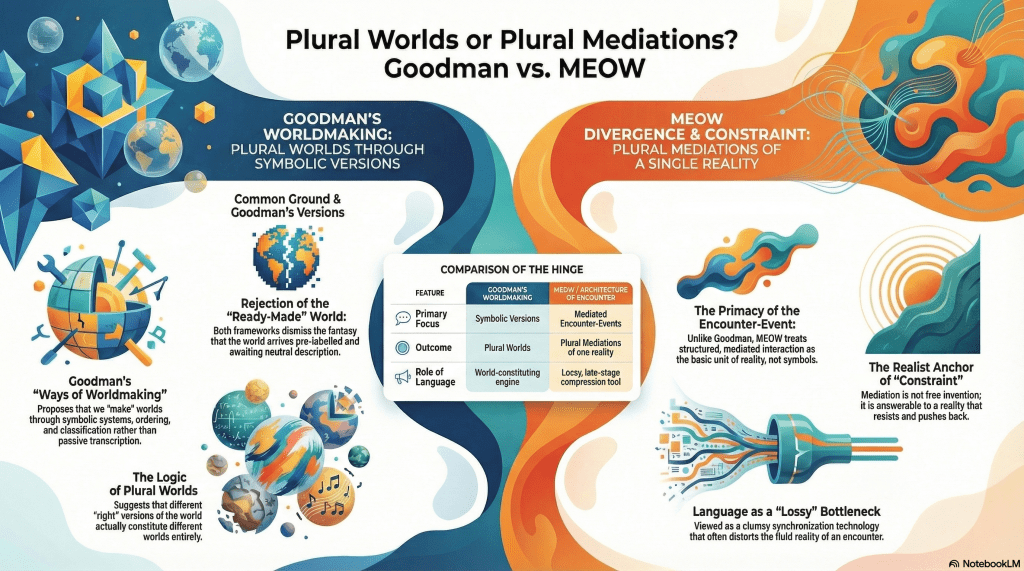
A colleague shared a reference to Nelson Goodman’s Ways of Worldmaking (1978). I’d never heard of the book or the author, so I asked ChatGPT to compare and contrast this with MEOW, The Architecture of Encounter, and a bit of A Language Insufficiency Hypothesis. This is what it rendered:

Or, to put it in one line fit for people skimming with one eye while pretending to work:

NotebookLM Infographic on this topic.
Audio: NotebookLM summary podcast of this topic.

Tl;dr

Goodman and MEOW are neighbours, but not housemates.

Both reject the childish fantasy that the world arrives already parcelled, labelled, and politely awaiting description by some neutral observer. Both are suspicious of naïve realism, fixed essences, and the conceit that language simply mirrors what is there. Both recognise that description, classification, and articulation are active, selective, and world-shaping.

But Goodman’s emphasis falls on versions, symbol systems, and the making of worlds through classificatory practice. MEOW and The Architecture of Encounter go elsewhere. They do not treat symbolic versioning as primary. They treat encounter as primary: mediated, structured interaction under constraint. Language and world-versioning come later, as derivative, partial, and often clumsy attempts to stabilise, synchronise, and re-present what is first given in encounter.

So the shortest contrast is this:

That is the hinge.

The longer version

Goodman is often useful precisely because he helps loosen the grip of a bad picture: the notion that there is one fully furnished world, discretely laid out in advance, which language then copies with greater or lesser success. In Ways of Worldmaking, description is not passive transcription. Versions organise, sort, foreground, suppress, classify, and compose. They do not simply mirror. They make.

This much sits quite comfortably beside MEOW and The Architecture of Encounter. MEOW has never been sympathetic to the old theatre in which a subject peers out at a ready-made object-world and then tries to report back accurately. That picture has always seemed less like sober metaphysics and more like a grammatical superstition. It is one of those inherited arrangements that philosophy keeps polishing rather than questioning, as if centuries of confusion were somehow evidence of depth.

On that score, Goodman is an ally. He helps dissolve the myth of innocent description.

He also overlaps with MEOW in his suspicion of essentialist carving. There is no reason to suppose reality presents itself in one uniquely natural partition, fully jointed in the exact way our preferred nouns imply. Goodman’s attention to alternative versions, symbolic orderings, and rival systems of classification fits comfortably with the broader MEOW suspicion that what we call “objects” are not self-announcing substances but stabilised articulations within a mediated field. In The Architecture of Encounter, this becomes still sharper: subjects and objects are not ontological primitives but abstractions from recurring encounter-structures. That already places the framework some distance from ordinary metaphysical furniture.

So far, then, the affinity is genuine.

But it is just as important not to overstate it.

Goodman’s centre of gravity is symbolic and versional. His concern is with how worlds are made through systems of description, notation, projection, ordering, and exemplification. The operative verbs are things like sort, render, compose, construct. The world is inseparable from the version.

MEOW and The Architecture of Encounter are doing something heavier. They are not merely offering a theory of how descriptions organise a world. They are offering an ontology in which encounter-events are primary. The basic unit is not an interpreted object, nor a version, nor a sentence, but a structured event of mediated contact under constraint. Mediation is not a regrettable screen placed between mind and world. It is constitutive of whatever relation there is. But neither is mediation free invention. Encounter is answerable to what resists, pushes back, stabilises, recurs, and converges. That is the role of constraint.

This is where the deepest divergence emerges.

Goodman is often read, not unfairly, as weakening the notion of a single underlying world more radically than MEOW can tolerate. His pluralism risks allowing “worldmaking” to carry most of the ontological burden. The result can begin to sound as though right versions are all the realism one is entitled to. There are worlds, or world-versions, and their legitimacy depends less on correspondence to a singular underlying reality than on fit, function, coherence, utility, and internal rightness.

MEOW resists that move. It does not return to vulgar realism, with its fantasy of a view from nowhere, but it also refuses to let mediation collapse into fabrication. Constraint is not a decorative afterthought. It is the realist anchor. One may have multiple mediations, multiple articulations, multiple ontological grammars, multiple local stabilisations, but these are not unconstrained improvisations. They are answerable to an invariant field of relational resistance.

Put more brutally: Goodman destabilises the ready-made world and then tends to leave us with versions. MEOW destabilises the ready-made world and then asks what must be true for divergent mediations nonetheless to converge, however partially, on the same resistant reality.

That difference matters.

It matters again when language enters the picture. Goodman grants an enormous role to symbol systems in worldmaking. MEOW, especially once read through The Architecture of Encounter and A Language Insufficiency Hypothesis, treats language more suspiciously. Language matters, certainly, but it is late, compressed, and lossy. It is not the primordial engine of world-constitution. It is a finite synchronisation technology layered atop more basic forms of mediation: biological, perceptual, attentional, cognitive, social. Language helps coordinate. It helps compress. It helps stabilise public handling. But it also distorts, truncates, nominalises, and overcommits.

That is where LIH adds a useful corrective to Goodman. If Goodman sometimes sounds like a connoisseur of world-versioning, LIH reminds us that our versioning machinery is often embarrassingly underpowered for the tasks philosophers assign to it. Human beings keep trying to force syntax to carry ontological burdens it was never built to bear. We take grammatical distinctions for metaphysical disclosures. We inherit noun-heavy structures and then wonder why the world starts looking like a warehouse of things. We reify processes, discretise continua, and carve durational realities into portable lexical chunks. Then, having manufactured these pseudo-stabilities, we congratulate ourselves for discovering “selves”, “minds”, “meanings”, “moral facts”, and other linguistic taxidermy.

Goodman certainly helps expose the active role of symbolic systems. But LIH presses further by insisting that symbolic systems are not merely worldmaking tools. They are also bottlenecks. They fail. They coarsen. They generate ontological illusions through the very act of public coordination.

That is why I would not place Goodman and MEOW in opposition, but in a relation of partial inheritance and correction.

Goodman is valuable because he helps dismantle the myth of passive representation. He is right to resist the idea that language or symbolisation merely records a pre-cut world. He is right to foreground selection, ordering, categorisation, and articulation. He is right to reject the transparent-window fantasy.

But from a MEOW standpoint, he does not go far enough into encounter, and perhaps goes too far into version.

What is missing is a richer account of pre-linguistic mediation, presentational structure, salience, affordance, and the layered constraints under which any symbolic practice becomes possible in the first place. Symbol systems do not float free. They do not arise in a void. They are parasitic upon lived, embodied, constrained encounter. Nor is their plurality enough, by itself, to explain why some articulations fail, why some converge, why some distort in systematic ways, or why reality resists our preferred descriptions with such vulgar persistence.

That last point is worth dwelling on, because it is where many anti-realist gestures lose their nerve. The fact that access is mediated does not imply that reality is manufactured. The fact that articulation is active does not imply that resistance is optional. The fact that classifications vary does not imply that there is nothing to be classified beyond the classificatory act.

So the bottom line remains the same.

Goodman is useful for breaking the spell of the one already-made world and for showing that symbolisation is not passive mirroring. But MEOW and The Architecture of Encounter push in a different direction. They relocate the primary philosophical action from symbol systems to encounter-events, from worldmaking to world-disclosure under mediation, and from plural worlds to plural access under constraint. A Language Insufficiency Hypothesis then sharpens the point by showing that language is not an omnipotent engine of constitution but a compression scheme with predictable failure modes.

I’ve Been Thinking… Peers

4–6 minutes

<soapbox>

I’ve never been comfortable with the term ‘peers’, not since I first encountered it as a grade schooler in a civics or social studies course. It felt like nonsense at first utterance, but much energy is expended indoctrinating children and adolescents.

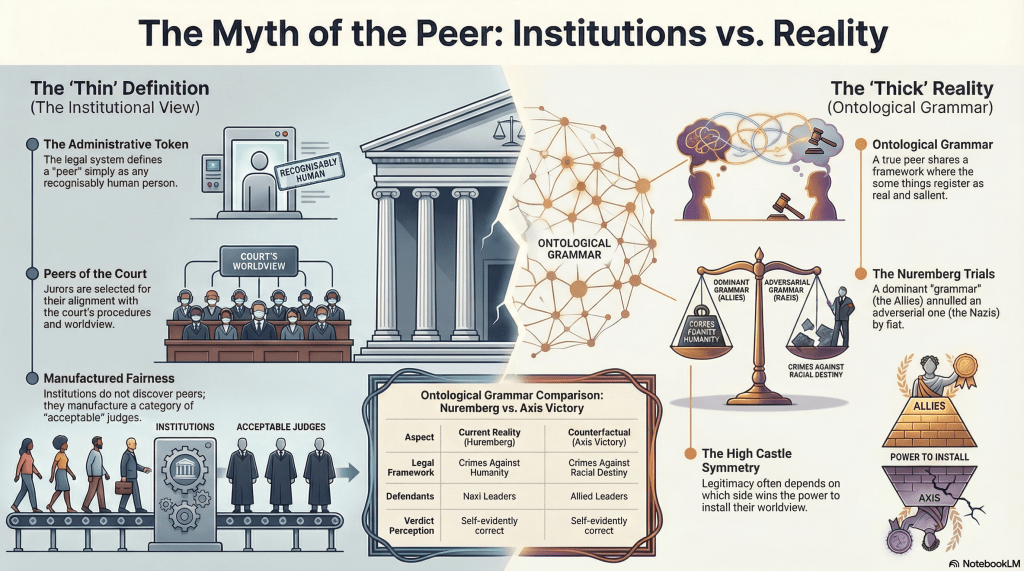
Thinking about the Frege–Geach problem has trebled my interest in ontological grammars. It’s also got me thinking about the ontology of peer groups. I’ve always been an eccentric, so I never felt I had any peers. Sure, I’ve had friends, colleagues, bandmates, and acquaintances I’ve genuinely liked and respected, but none were peers. Our connexions might best be described as ‘thin’. We connected through shared work, music, interests, and so on, but peer would have been stretching it.

Audio: NotebookLM summary podcast of this topic.

So, what do I feel qualifies as a peer? And what is a standard definition? I suppose we should start with the latter.

OED: A person who is associated or matched with another; a companion, a fellow, a mate.

Fair enough. This definition works fine. The devil remains in the details. What does it mean to be associated or a match?

As a moral noncognitivist, I don’t think the concept arrives trailing clouds of metaphysical glory. But it doesn’t need to. The interesting question is grammatical: what ontological conditions would have to be shared for ‘peer’ to mean something thick rather than merely administrative?

The legal system answers in the thinnest way possible. If you are recognisably human, that’s enough. Close enough for the government. Peer means person. Case closed.

When the system invokes ‘a jury of one’s peers’, it doesn’t care whether they are one’s peers in any thick or serious sense. It needs performative placeholders – tokens. Rather, it needs them to be peers of the court: those sufficiently aligned with its assumptions, procedures, and admissibility rules to reproduce its worldview in the form of judgement.

The court decides what counts as legible, what counts as relevant, what counts as rational, and what counts as legitimate. It does not discover peers. It manufactures a category of acceptable judges and then calls the result fairness. The deck is stacked before the first card is turned.

I like two examples, one historical and one fictional, to make my point.

Nuremberg

This case should be obvious. The peers here are precisely not their peers, but adversaries. The defendants were not tried by those who shared their grammar of legitimacy, history, necessity, authority, or even the relevant category boundaries. They were tried by agents operating within a rival grammar – one that had already classified the defendants’ framework not as a competing ontology, but as criminal pathology.

The Nazi grammar was effectively annulled. Not refuted, not outargued – annulled. And as with more typical civil and criminal courts, symmetry was never the goal. The institution ruled by fiat. I call this ontological imperialism in a yet unpublished manuscript. The dominant system merely declares the adversarial grammar invalid and inadmissible.

The standard legitimation story for Nuremberg is natural law: there exist moral facts so fundamental that they transcend positive law and sovereign authority. ‘Crimes against humanity’ was coined precisely to name offences no ontological framework could render legitimate. The phrase does the work – against humanity, not against a particular legal code or polity, but against the species as such. It presupposes exactly the universal semantic accessibility that the philosophy of language has shown to be unavailable.

Man in the High Castle

Now switch venues to a fictional universe. Philip K. Dick asks what would have happened had the Axis won the Second World War. The answer, structurally speaking, is: practically nothing — except that a different ontological grammar would now be dominant.

That is the value of the thought experiment. It doesn’t change the species, the cognitive architecture, or the capacity for deliberation. It changes the constitutive act – the moment at which a grammar gets installed as the world’s grammar. And everything downstream shifts with it. In Dick’s world, the inhabitants don’t experience their moral order as imposed or artificial. They navigate it as the background of intelligibility, the way things simply are. The I Ching functions for Tagomi the way human rights discourse functions for a postwar liberal – not as a choice, but as the grammar within which choices become possible.

The counterfactual is devastating because it is structurally symmetric. Had the Axis won, there would have been trials. Those trials would have applied retroactive categories – perhaps ‘crimes against racial destiny’ or ‘crimes against civilisational hygiene’. Allied leaders would have been the defendants. And the verdicts would have felt, to the inhabitants of that world, exactly as self-evidently correct as Nuremberg’s feel to us.

I don’t secretly wish the Axis had won. But the dialectic is worth consideration, and the discomfort it produces is itself the datum. Not evidence that the examination is wrong – evidence that the grammar is working.

So when modern institutions speak reverently of ‘a jury of one’s peers’, I hear not a triumph of fairness but a legitimating fiction. The phrase conceals the fact that institutions do not seek the defendant’s peers. They seek their own. They seek judges formed within the same order, obedient to the same grammar, and willing to mistake its categories for universal reason.

A peer, in any meaningful sense, would have to share enough ontological grammar with me that the same things register as real, salient, and intelligible in roughly the same way. By that standard, peers are rare. Institutions know this perfectly well. Which is why they do not look for them.

They appoint their own and call the matter settled.

</soapbox>

The Ragged Trousered Philanthropists

9–13 minutes

I love coming upon a classic. Written in 1906, Ragged Trousered Philanthropists wasn’t published until 1914, and even then poorly and abridged, posthumously. I happened upon this when I was researching my Advantagement project. I was looking for a period cross between Charles Bukowski and Irvine Welsh. I don’t suppose that’s quite available in the day, but I did get a rather unsanitised autobiograph of sorts.

One may have thought Dickens might have provided an avenue, but despite his Schopenhauerian caricature, his bleak Industrial Age stories tend to end on an upbeat note, a positive character arc, mirroring what later hardens into modernist positivism. I was searching for something more realistic – reporting from within the trenches, as it were. As the people in the trenches were largely illiterate, their voices have also been lost to history, their echoes captured with varying degrees of fidelity by others, as seen through their own lenses.

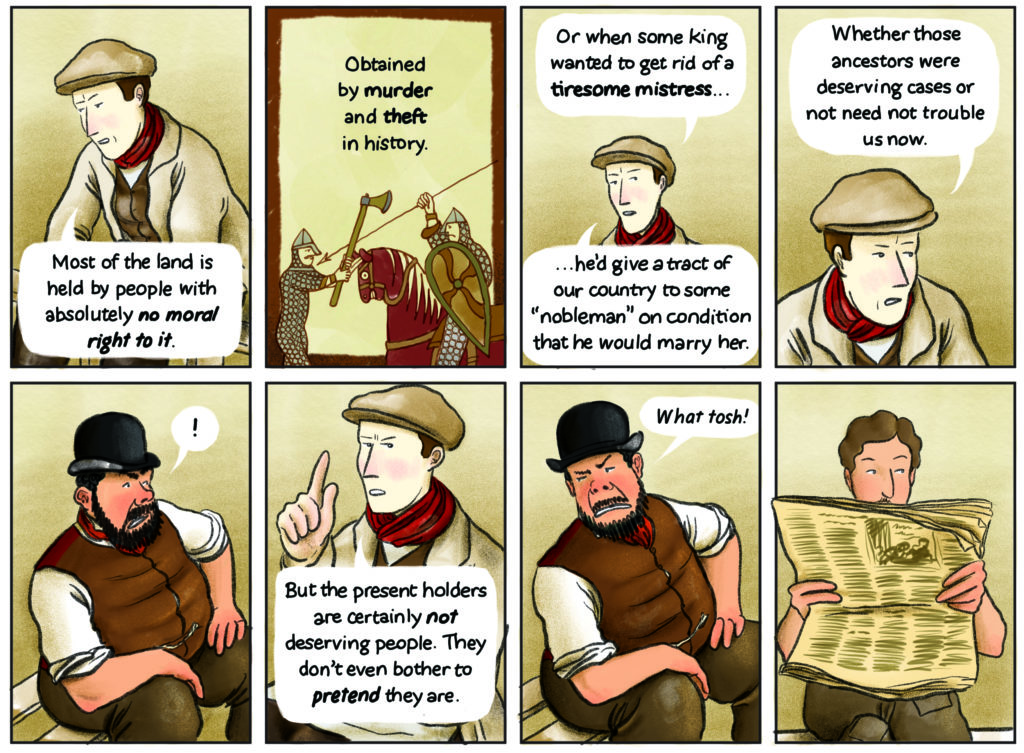
However, this isn’t a review of the literature. Although this might be considered to be required reading, it’s uneven, didactic, and structurally loose. It’s a cross between a novel and a diary. Reading this, one is struck less by how much politics has changed than by how little explanatory machinery is required for it to function, whether in the UK or the US – and chime in if it also resonates in your location. I’ve copied an excerpt from Chapter 1 for discussion. What follows is not remarkable for its insight, originality, or rhetorical brilliance. It is remarkable for how familiar it feels. It could be lifted wholesale into a contemporary comment thread with minimal editing. Check out this piece about the graphic novel version.

Keep in mind that this was written (or at least completed) in 1906. It reflects the people of the Edwardian London slums. Here are some themes I find in common with contemporary politics:

  1. Partisanship: Tories and Liberals, argyfying about politics (identity over understanding)
  2. Xenophobia: the country is being ruined by foreigners (causal compression, targets differ)
  3. Protectionism: The country would be ruined if not protected in some way (tariffs; moral intuition, not economic reasoning)
  4. Low-information voters: I votes for who the bloody ’ell I likes. (voting without shame)
Audio: NotebookLM summary podcast of this topic.

Chapter 1: An Imperial Banquet. A Philosophical Discussion. The Mysterious Stranger. Britons Never shall be Slaves

by Robert Tressell

Easton was still reading the Obscurer; he was not about to understand exactly what the compiler of the figures was driving at − probably the latter never intended that anyone should understand − but he was conscious of a growing feeling of indignation and hatred against foreigners of every description, who were ruining this country, and he began to think that it was about time we did something to protect ourselves. Still, it was a very difficult question: to tell the truth, he himself could not make head or tail of it.

At length he said aloud, addressing himself to Crass:

‘Wot do you think of this ‘ere fissical policy, Bob?’

‘Ain’t thought much about it,’ replied Crass.

‘I don’t never worry my ‘ed about politics.’

‘Much better left alone,’ chimed in old Jack Linden sagely, argyfying about politics generally ends up with a bloody row an’ does no good to nobody.’

At this there was a murmur of approval from several of the others. Most of them were averse from arguing or disputing about politics. If two or three men of similar opinions happened to be together they might discuss such things in a friendly and superficial way, but in a mixed company it was better left alone. The ‘Fissical Policy’ emanated from the Tory party. That was the reason why some of them were strongly in favour of it, and for the same reason others were opposed to it. Some of them were under the delusion that they were Conservatives: similarly, others imagined themselves to be Liberals. As a matter of fact, most of them were nothing. They knew as much about the public affairs of their own country as they did of the condition of affairs in the planet of Jupiter.

Easton began to regret that he had broached so objectionable a subject, when, looking up from his paper, Owen said:

‘Does the fact that you never “trouble your heads about politics” prevent you from voting at election times?’

No one answered, and there ensued a brief silence. Easton however, in spite of the snub he had received, could not refrain from talking.

‘Well, I don’t go in for politics much, either, but if what’s in this ‘ere paper is true, it seems to me as we oughter take some interest in it, when the country is being ruined by foreigners.’

‘If you’re going to believe all that’s in that bloody rag you’ll want some salt,’ said Harlow.

The Obscurer was a Tory paper and Harlow was a member of the local Liberal club. Harlow’s remark roused Crass.

‘Wot’s the use of talkin’ like that?’ he said; you know very well that the country IS being ruined by foreigners. Just go to a shop to buy something; look round the place an’ you’ll see that more than ‘arf the damn stuff comes from abroad. They’re able to sell their goods ‘ere because they don’t ‘ave to pay no dooty, but they takes care to put ‘eavy dooties on our goods to keep ’em out of their countries; and I say it’s about time it was stopped.’

”Ear, ‘ear,’ said Linden, who always agreed with Crass, because the latter, being in charge of the job, had it in his power to put in a good − or a bad − word for a man to the boss.

”Ear, ‘ear! Now that’s wot I call common sense.’

Several other men, for the same reason as Linden, echoed Crass’s sentiments, but Owen laughed contemptuously.

Yes, it’s quite true that we gets a lot of stuff from foreign countries,’ said Harlow,but they buys more from us than we do from them.’

‘Now you think you know a ‘ell of a lot,’ said Crass. ‘Ow much more did they buy from us last year, than we did from them?’

Harlow looked foolish: as a matter of fact his knowledge of the subject was not much wider than Crass’s. He mumbled something about not having no ‘ed for figures, and offered to bring full particulars next day

‘You’re wot I call a bloody windbag,’ continued Crass; you’ve got a ‘ell of a lot to say, but wen it comes to the point you don’t know nothin’.’

‘Why, even ‘ere in Mugsborough,’ chimed in Sawkins − who though still lying on the dresser had been awakened by the shouting −We’re overrun with ’em! Nearly all the waiters and the cook at the Grand Hotel where we was working last month is foreigners.’

‘Yes,’ said old Joe Philpot, tragically, and then thers all them Hitalian horgin grinders, an’ the blokes wot sells ‘ot chestnuts; an’ wen I was goin’ ‘ome last night I see a lot of them Frenchies sellin’ hunions, an’ a little wile afterwards I met two more of ’em comin’ up the street with a bear.’

Notwithstanding the disquieting nature of this intelligence, Owen again laughed, much to the indignation of the others, who thought it was a very serious state of affairs. It was a dam’ shame that these people were allowed to take the bread out of English people’s mouths: they ought to be driven into the bloody sea.

And so the talk continued, principally carried on by Crass and those who agreed with him. None of them really understood the subject: not one of them had ever devoted fifteen consecutive minutes to the earnest investigation of it. The papers they read were filled with vague and alarming accounts of the quantities of foreign merchandise imported into this country, the enormous number of aliens constantly arriving, and their destitute conditions, how they lived, the crimes they committed, and the injury they did to British trade. These were the seeds which, cunningly sown in their minds, caused to grow up within them a bitter undiscriminating hatred of foreigners. To them the mysterious thing they variously called the Friscal Policy’, the Fistical Policy’, or the Fissical Question’ was a great Anti−Foreign Crusade. The country was in a hell of a state, poverty, hunger and misery in a hundred forms had already invaded thousands of homes and stood upon the thresholds of thousands more. How came these things to be? It was the bloody foreigner! Therefore, down with the foreigners and all their works. Out with them. Drive them b−−s into the bloody sea! The country would be ruined if not protected in some way. This Friscal, Fistical, Fissical or whatever the hell policy it was called, WAS Protection, therefore no one but a bloody fool could hesitate to support it. It was all quite plain − quite simple. One did not need to think twice about it. It was scarcely necessary to think about it at all.

This was the conclusion reached by Crass and such of his mates who thought they were Conservatives − the majority of them could not have read a dozen sentences aloud without stumbling − it was not necessary to think or study or investigate anything. It was all as clear as daylight. The foreigner was the enemy, and the cause of poverty and bad trade.

When the storm had in some degree subsided,

‘Some of you seem to think,’ said Owen, sneeringly, that it was a great mistake on God’s part to make so many foreigners. You ought to hold a mass meeting about it: pass a resolution something like this: “This meeting of British Christians hereby indignantly protests against the action of the Supreme Being in having created so many foreigners, and calls upon him to forthwith rain down fire, brimstone and mighty rocks upon the heads of all those Philistines, so that they may be utterly exterminated from the face of the earth, which rightly belongs to the British people”.’

Crass looked very indignant, but could think of nothing to say in answer to Owen, who continued:

‘A little while ago you made the remark that you never trouble yourself about what you call politics, and some of the rest agreed with you that to do so is not worth while. Well, since you never “worry” yourself about these things, it follows that you know nothing about them; yet you do not hesitate to express the most decided opinions concerning matters of which you admittedly know nothing. Presently, when there is an election, you will go and vote in favour of a policy of which you know nothing. I say that since you never take the trouble to find out which side is right or wrong you have no right to express any opinion. You are not fit to vote. You should not be allowed to vote.’

Crass was by this time very angry.

‘I pays my rates and taxes,’ he shouted, ‘an’ I’ve got as much right to express an opinion as you ‘ave. I votes for who the bloody ‘ell I likes. I shan’t arst your leave nor nobody else’s! Wot the ‘ell’s it got do with you who I votes for?’

‘It has a great deal to do with me. If you vote for Protection you will be helping to bring it about, and if you succeed, and if Protection is the evil that some people say is is, I shall be one of those who will suffer. I say you have no right to vote for a policy which may bring suffering upon other people, without taking the trouble to find out whether you are helping to make things better or worse.’

Owen had risen from his seat and was walking up and down the room emphasising his words with excited gestures.

‘As for not trying to find out wot side is right,’ said Crass, somewhat overawed by Owen’s manner and by what he thought was the glare of madness in the latter’s eyes, I reads the Ananias every week, and I generally takes the Daily Chloroform, or the Hobscurer, so I ought to know summat about it.’


What’s striking here is not ignorance, but delegation. Thinking is outsourced. Responsibility is retained. — Bry

How to Instantly Lose Popularity on the Internet

(A brief note on language, power, and moral certainty)

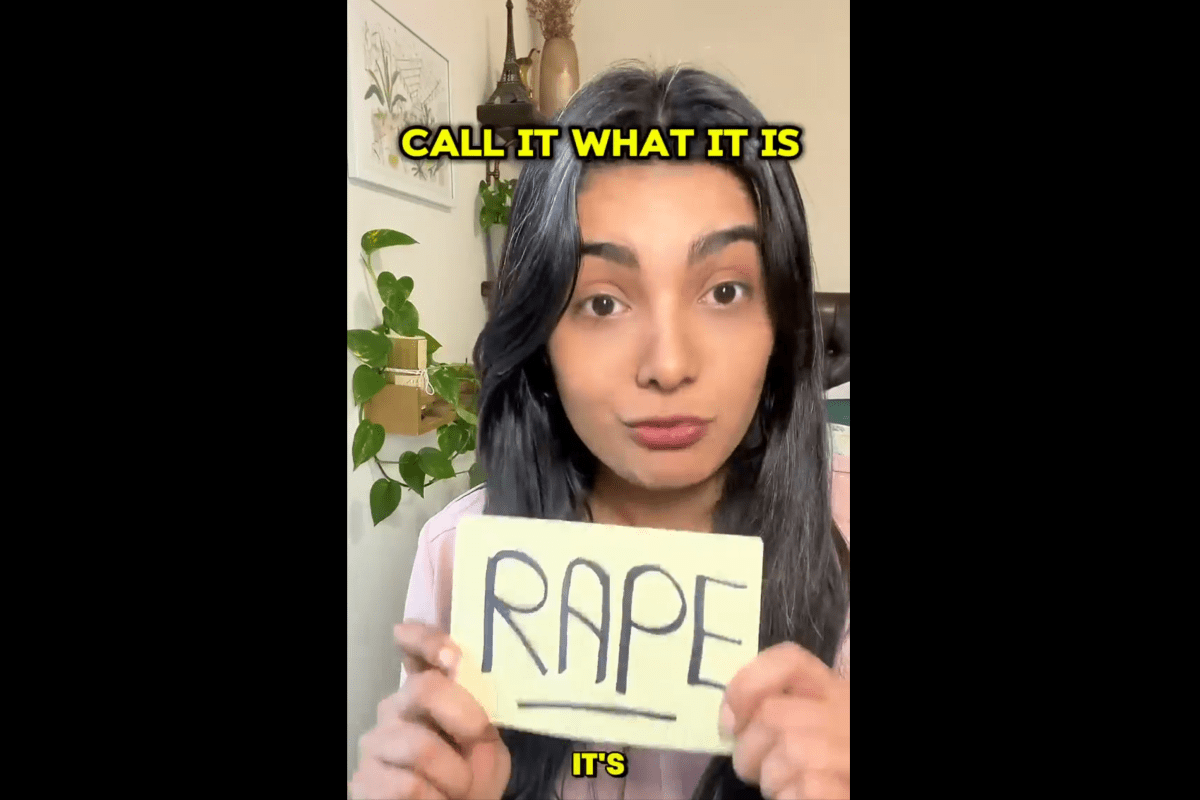
There is a particular kind of video that circulates online with tremendous force. A woman addresses the camera directly.

Video: Discussion Point (Full transcript at the end of this post)

She is clear, indignant, morally resolute:

  • It’s not an ‘inappropriate relationship with a 17-year-old’. It’s rape.
  • It’s not ‘coerced sex with a minor’. It’s rape.
  • It’s not a ‘young woman’. It’s a child.
  • Call it what it is.

Before proceeding, let me state something unambiguously: sexual exploitation of minors is morally reprehensible within contemporary Western legal and moral frameworks. I am not contesting that. Nor am I defending euphemism for its own sake. This is where philosophers of language take a lot of heat.

Audio: NotebookLM summary podcast on this topic.

The question here is narrower and, perhaps, more uncomfortable: What work is being done by the demand to ‘call it what it is‘?

Euphemism and Softening

She is correct in one respect. Institutional language often softens. Inappropriate relationship is anaesthetic. It lowers emotional temperature. It blunts moral outrage. Institutions frequently prefer such language because it reduces volatility, legal exposure, and procedural risk.

Language can minimise. That is not controversial. But it’s only half the story.

Naming Is Not Neutral

When she insists on rape and child, she is not merely removing euphemism. She is installing thick, legally saturated categories.

Rape is not a raw moral atom floating in space. It is a juridical classification defined by statute, evidentiary thresholds, and evolving legal doctrine. Its scope has expanded significantly over time: marital rape was once unrecognised; coercion has broadened beyond physical force; statutory rape collapses questions of consent into questions of legal capacity.

Likewise, child is not a purely biological category. It is a modern legal identity with shifting age thresholds and historical elasticity. The concept has expanded across the last two centuries as education extended, labour laws tightened, and adolescence became socially constructed as a protected stage of dependency.

To say this is not to relativise harm. It is to recognise that categories are historically sedimented and institutionally stabilised.

When someone says ‘Call it what it is‘, they are treating these contemporary legal categories as metaphysically self-evident. But they are products of a specific ontological framework: one in which autonomy and consent are foundational, and in which minors are deemed categorically incapable of exercising full sexual agency.

That framework is dominant in the West. It is not universal globally or historically.

Elasticity and Instrumentality

There is another asymmetry worth noticing.

Child expands protectively when someone is victimised. But the same individual may be stripped of childhood if they commit a serious crime: ‘They acted like an adult. They should have known better.’

The boundary is not purely developmental. It is normative. The category flexes.

Similarly, rape operates differently in everyday speech, in moral condemnation, and in statutory law. In the case of statutory rape, the term does not necessarily describe force; it describes the legal impossibility of consent. It is a doctrinal move grounded in an ontology of agency.

None of this weakens moral condemnation. But it reveals that these terms are not merely descriptive. They are instruments of moral and legal allocation.

Power and Irony

There is also a certain irony in the video.

She accuses mainstream institutions of manipulating language to reduce severity. Yet her demand is to deploy one of the state’s most powerful juridical classifications immediately and universally.

Rape derives its force from the same legal apparatus she critiques. It is powerful precisely because it is institutional. She is not rejecting power; she is attempting to redirect it.

This is not hypocrisy. It is politics. But it is politics nonetheless.

Ontology and Universality

The deeper issue is not whether we should condemn sexual exploitation. We should.

The issue is whether contemporary Western legal categories are simply “what is,” or whether they are historically developed ontological commitments that feel self-evident because they have been normalised.

The woman in the video experiences her categories as universal moral Truth. Many viewers agree. That agreement does not make the categories metaphysically timeless; it makes them hegemonic.

Recognising semantic expansion and legal drift does not undermine moral seriousness. It clarifies where moral authority resides: not in eternal linguistic atoms, but in historically stabilised frameworks.

Why This Is Unpopular

Online discourse prefers moral clarity over semantic archaeology. When harm is salient, genealogical analysis sounds like minimisation. Distinguishing between descriptive, legal, and ontological levels is interpreted as evasion.

It is not.

It is possible to affirm moral condemnation while also acknowledging that:

  • Language frames perception.
  • Legal categories evolve.
  • Terms are deployed instrumentally.
  • Ontologies masquerade as nature once naturalised.

One can insist on moral seriousness without pretending that our current vocabulary fell from the sky fully formed.

But saying so will reliably lose popularity on the internet.

Apparently, clarity has thresholds.


Full Video Transcript

‘Hey. It’s not an “Inappropriate Relationship with a 17-year-old”, it’s rape.

‘It’s not “coerced sex with a minor”, it’s rape.

‘It’s not “non-consensual sex with a 13-year-old”, it’s rape.

‘Call it what it is! Call them what they are.

‘And while we’re at it, it’s not a “young woman”, it’s a child!

‘It’s not a preteen, it’s a child!

‘It’s not a “mature girl”, it’s a child!

‘This use of specific language by mainstream media is super intentional, and it’s a tool of the patriarchy to try to reduce the egregiousness of horribly egregious acts that men commit against women and girls!

‘And, I say this with full awareness of the irony of my needing to use show and tell to make my point because I am beholden to these stupid social media platforms, which commit violence against women and girls every day in their own right by automatically suppressing any content as soon as I say a particular word.

‘And you and I need to say that it’s absolutely unacceptable!’

Ontological Grammars of Abortion

I’ve created a video to discuss ontological ontology grounded in an example of abortion, a particularly polemic topic. For more details, read the essay, Grammatical Failure – Why Liberal Epistemology Cannot Diagnose Indoctrination.

Video: Architecture of Grammatical Compromise. (Duration: 10:30)

In this video, I define Ontology, Grammar, and Commensurability before I use abortion as a poster child. Then, I discuss what happens when ontological grammars are incommensurable.

These thinkers follow:

Michel Foucault: Biopower, notably The History of Sexuality, Volume I.

Bernard Williams: Thick Moral Concepts from Ethics and the Limits of Philosophy.

Pierre Bourdieu: Habitus, notably from Outline of a Theory of Practice.

Karl Popper: Paradox of Intolerance.

I discuss the challenge of the promise of compromise and its three possible outcomes, none of which are true compromises.

Watch the video for context. Read the essay for fuller details.

The Trouble with Ockham’s Razor

4–6 minutes

Few philosophical aphorisms travel as lightly and cut as confidently as Ockham’s Razor. “Do not multiply entities beyond necessity.” The phrase has the air of austere wisdom. It sounds disciplined, economical, rational. It promises clarity by subtraction. One imagines conceptual clutter swept aside by a single elegant stroke.

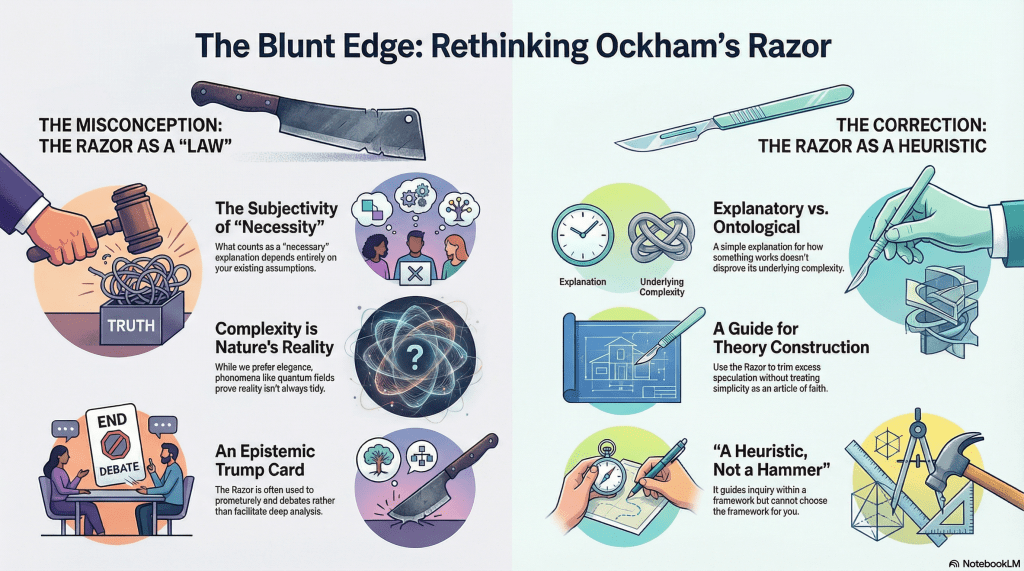
The Razor is attributed to William of Ockham, though like many slogans it has acquired a life far removed from its origin. In contemporary discourse it functions less as a methodological reminder and more as an epistemic trump card. The simpler explanation, we are told, is the better one. Case closed.

The trouble begins precisely there.

Audio: NotebookLM summary podcast

The Hidden Variable: Necessity

The Razor does not forbid multiplicity. It forbids unnecessary multiplicity. But who decides what is necessary?

Necessity is not a neutral category. It is already embedded within a framework of assumptions about what counts as explanation, what counts as sufficiency, and what counts as legitimate ontological commitment.

For one thinker, invoking a divine ground of physical law is unnecessary because the laws themselves suffice. For another, the laws are unintelligible without a grounding principle, and so God is necessary. Both can claim parsimony within their respective ontologies. The Razor does not adjudicate between them. It presupposes the grammar within which “necessity” is assessed.

The aphorism thus functions less as a rule and more as a reinforcement mechanism. It stabilises the commitments one already holds.

Parsimony Is a Heuristic, Not a Law

Science has often rewarded simplicity. Copernicus simplified celestial mechanics. Newton reduced motion to a few principles. Maxwell unified electricity and magnetism. These episodes encourage a romantic attachment to elegance.

Yet physics has also revealed a universe that is anything but tidy. Quantum fields, curved spacetime, dark matter, inflationary cosmology. Nature has shown little regard for our aesthetic preference for minimal furniture.

Parsimony, then, is pragmatic. It helps us avoid gratuitous complication. It disciplines theory formation. But it is not a metaphysical guarantee that reality itself is sparse.

To treat the Razor as if it carries ontological authority is to convert a methodological guideline into a philosophical dogma.

Structural Sufficiency Versus Metaphysical Surplus

The Razor becomes particularly contentious when deployed in debates about ultimate grounds. If a structural model explains observable regularities and survives empirical constraint, some conclude that any additional metaphysical layer is redundant.

This is a defensible position. It is also incomplete.

Redundancy in explanatory terms does not entail impossibility in ontological terms. A structural account of behaviour may render psychological speculation unnecessary for prediction, but it does not disprove the existence of inner motives. Likewise, a lawful cosmology may render a divine hypothesis explanatorily idle without rendering it incoherent.

The Razor trims explanatory excess. It does not settle metaphysical disputes.

Aphorisms as Closure Devices

Part of the Razor’s power lies in its compression. It is aphoristic. It travels easily. It signals intellectual seriousness. It sounds like disciplined thinking distilled.

But aphorisms compress complexity. They conceal premises. They discourage reopening the frame. “Follow the science.” “Extraordinary claims require extraordinary evidence.” “Trust the market.” These phrases do not argue; they configure. They pre-load the space of acceptable interpretation.

Ockham’s Razor often operates in precisely this way. It is invoked not as the conclusion of a careful analysis but as a device to end discussion. The simpler view wins. Full stop.

Yet simplicity itself is indexed to perspective. What looks simple within one conceptual scheme may appear impoverished within another.

Tolerance for Explanatory Closure

There is also a psychological dimension worth acknowledging. Some individuals are comfortable with open explanatory ceilings. They accept that certain features of reality may lack ultimate grounding within their present framework. Others experience such openness as instability. They seek a final anchor.

The Razor favours the former temperament. It encourages ontological restraint and distrust of ultimate grounds. For those comfortable with structural sufficiency, this is liberating. For those who experience the absence of grounding as incomplete, it feels evasive.

The disagreement is not resolved by invoking parsimony. It reflects divergent tolerances for metaphysical closure.

When the Razor Becomes Inflationary

Ironically, the Razor can itself become an inflationary principle. It can elevate “simplicity” to a quasi-transcendental value. It can be treated as if reality owes us elegance.

At that point, the tool begins to govern the ontology rather than merely discipline it. The Razor becomes an article of faith, a universal heuristic immune to its own demand for justification.

One might then ask, with a certain symmetry: by what necessity is simplicity itself necessary?

A More Modest Use

None of this requires abandoning the Razor. It remains useful. It reminds us not to posit hidden mechanisms when observable structures suffice. It cautions against explanatory extravagance. It protects inquiry from baroque speculation.

But it should be treated as a heuristic, not a hammer. It guides theory construction within a framework. It does not choose the framework.

A more disciplined formulation would be this: when a structural account explains observed regularities under constraint and remains revisable, additional metaphysical posits do not increase explanatory power. Their adoption becomes a matter of ontological preference rather than necessity.

This preserves the Razor’s pragmatic value without inflating it into a metaphysical arbiter.

The Real Trouble

The real trouble with Ockham’s Razor is not that it cuts too much. It is that we often wield it without noticing the hand that holds it. We treat it as neutral when it is already embedded within a grammar of sufficiency, explanation, and legitimacy.

The Razor does not eliminate ontological commitment. It expresses one.

Recognising that does not blunt the blade. It merely reminds us that even the sharpest instruments are guided by the frameworks in which they are forged.

And frameworks, unlike aphorisms, are rarely simple.