I’ve lived in Los Angeles a couple of times for a sum total of perhaps 15 years. The first time, I loved it. The next time, I was running on fumes. The first time, I was in my twenties – the second time in my forties. What a difference perspective and ageing makes. In my twenties, I was a pretty-boy punk-ass who owned the club scene on the Strip. In my forties, I was a wage slave.
This morning, I heard a country song on Insta with a line claiming ‘there are nines and dimes in all 50’, and it reminded me of a phrase we used when I lived in Los Angeles – ‘LA 7’. This is constructed on the egoist, sexist notion that if you were a 10, you’d have already moved to LA. If you still lived in, say, Iowa and were considered a 10, the exchange rate to LA would be a 7.
Then, I thought about the LA-NYC rivalry and wrote this article with some help from ChatGPT.
How L.A. and NYC Became the Centres of the Universe (According to Them)
It is a truth universally acknowledged that Los Angeles and New York City—those bickering siblings of American exceptionalism—believe themselves to be the sun around which the rest of us drearily orbit. Each is utterly convinced of its centrality to the human experience, and neither can fathom that people outside their borders might actually exist without yearning to be them. This is the essence of the ‘Centre of the Universe Complex,’ a condition in which self-importance metastasises into a full-blown cultural identity.
Let us begin with Los Angeles, the influencer of cities. L.A. doesn’t merely think it’s the centre of the universe; it believes it’s the universe, replete with its own atmosphere of smog-filtered sunlight and an economy powered entirely by dreams, green juice, and Botox. For L.A., beauty isn’t just a priority—it’s a moral imperative. Hence the concept of the ‘L.A. 10,’ a stunningly arrogant bit of mathematics whereby physical attractiveness is recalculated based on proximity to the Pacific Coast Highway.
Here’s how it works: a ’10’ in some picturesque-but-hopelessly-provincial state, say Nebraska, is automatically downgraded to a ‘7’ upon arrival in Los Angeles. Why? Because, according to L.A.’s warped ‘arithmetic, if she were a real 10, she’d already be there, lounging by an infinity pool in Malibu and ignoring your DMs. This isn’t just vanity—it’s top-tier delusion. L.A. sees itself as a black hole of good looks, sucking the beautiful people from every corner of the earth while leaving the ‘merely pretty’ to languish in flyover country. The Midwest, then, isn’t so much a place as it is an agricultural waiting room for future Angelenos.
But don’t be fooled—New York City is no better. Where L.A. is obsessed with beauty, NYC worships hustle. The city doesn’t just believe it’s important; it believes it’s the only place on earth where anything important happens. While L.A. is out perfecting its tan, NYC is busy perfecting its reputation as the cultural and intellectual capital of the world—or, at least, its part of the world, which conveniently ends somewhere in Connecticut.
This mindset is best summed up by that sanctimonious mantra, If you can make it here, you can make it anywhere. Translation: if you survive the daily humiliation of paying $4,000 a month for a shoebox apartment while dodging both rats and an existential crisis, you’ve unlocked the secret to life itself. New York isn’t about looking good; it’s about enduring bad conditions and then boasting about it as if suffering were an Olympic sport. In this worldview, the rest of the world is simply an unworthy understudy in NYC’s perpetual Broadway production.
And here’s the thing: neither city can resist taking cheap shots at the other. L.A. dismisses NYC as a grim, grey treadmill where fun goes to die, while NYC scoffs at L.A. as a vapid bubble of avocado toast and Instagram filters. It’s brains versus beauty, grit versus glamour, black turtlenecks versus Lululemon. And yet, in their relentless need to outshine one another, they reveal a shared truth: both are equally narcissistic.
This mutual self-obsession is as exhausting as it is entertaining. While L.A. and NYC bicker over who wears the crown, the rest of the world is quietly rolling its eyes and enjoying a life unencumbered by astronomical rent or the constant pressure to appear important. The people of Iowa, for example, couldn’t care less if they’re an ‘LA 7’ or if they’ve “made it” in New York. They’re too busy living comfortably, surrounded by affordable housing and neighbours who might actually help them move a sofa.
But let’s give credit where it’s due. For all their flaws, these two cities do keep the rest of us entertained. Their constant self-aggrandisement fuels the cultural zeitgeist: without L.A., we’d have no Kardashians; without NYC, no Broadway. Their rivalry is the stuff of legend, a never-ending soap opera in which both cities play the lead role.
So, let them have their delusions of grandeur. After all, the world needs a little drama—and nobody does it better than the cities that think they’re the centre of it.
Perception of Reality™ is akin to having relative pitch. Unlike pitch, where some people have perfect pitch – the ability to name a note or chordal composition without any other reference – it is unlikely that anyone has or will have access to objective reality – analogically: perfect pitch for reality.
As I’ve mentioned, I believe that all our experiences and interactions with reality are relative, if not wholly subjective. There may exist an objective reality, but for reasons already noted – cognitive and sense perception deficits –, we can never access it.
Musically, If someone plays and identifies a reference note, say A (or do in movable do solfège), and then plays a major fifth above (or sol), a person with relative pitch can hear that fifth interval and identify it as an E. Everything is about relationships. In music, the relationships are intervalic, but we know where we are based on where we’ve been. A person with perfect pitch requires no such priming. They can identify the first A note without prompting.
Our experience with reality is also relative, but no one has the equivalence of perfect pitch. No one has access to objective reality – if there even is one.
I don’t deny that there could be an objective reality. I just believe it’s inaccessible. I am a qualified realist – so, not a physicalist –, but I don’t believe in supernatural or paranormal events. A so-called ‘supernatural’ event is merely an event that hasn’t yet been described in ‘natural’ terms.
Now that I got that off my chest, what are your thoughts on objective reality? Lemme know.
I’ve been spending many hours finishing my novel, so it hasn’t left much time for writing here. I considered writing this on my other ‘writing’ blog, but I felt it was time to post something here, and it’s equally topical.
My writing style is typically stream-of-consciousness. I tend to have a problem or a scene I want to resolve. I place myself mentally into the scene, and I start to write. What might flow, I don’t tend to know in advance. The words just come out.
Occasionally, I’ll sit back and reflect more consciously, but mostly, it just comes out on the page. When I’m finished with a scene, I’ll usually revisit it consciously and look for gaps, continuity challenges, missing or extraneous details, room for character development, and so on.
Sometimes, I just embody a character. Other times (diversion: why is ‘sometimes’ a compound word, but not ‘other times’? That’s how my brain works), I embody the setting or the situation.
Sometimes, I need to address an entire chapter, so I look for obvious scenes and beats. I stub them out so that I don’t forget—perhaps even notes to myself about the purpose so I can step away and reengage later.
As a musician, I tend to approach music from the opposite direction. I might start from some inspiration, but most of my writing is brute-force analytics. My music is more laboured than my writing. My visual art falls more in the middle but leans towards the musical approach.
Servile compliance and vigilante justice are the core messages underlying Small Town. Comply, or else…
Watching the video, Try That in a Small Town by Jason Aldean, I was left pondering: Are there no convenience store robberies in small towns, or are petrol station and liquor store robberies exempt from scrutiny? Most mass school shootings happen in small towns. Am I missing something through the bravado?
I guess the works of the likes Truman Capote and Flannery O’Connor are lost to this generation, and the message of the Borg has faded into history.
Don’t dare be different or speak your mind about anything meaningful. Sure, serve ham over turkey on Thanksgiving. Be a rebel, but don’t complain about low wages or political subjugation…unless it’s what the local consensus believes.
But tightly-knit small towns will make sure that justice prevails even if it’s the extra-judicial flavour.
This video is divisive to the country as a whole at the expense of some small-town jingoism.
When I was 17 years old, I shouted out into an empty room into a blank canvas that I would defeat the forces of evil. And for the next 10 years of my life, I suffered the consequences… with illness, autoimmunity, and psychosis.
As I got older, I realised that there were no real winners or no real losers in physiological warfare. But there were victims, and there were students.
It wasn’t David verses Goliath; it was a pendulum eternally awaying between the dark and the light. And the brighter the light shone, the darker the shadow it cast. It was never a battle for me to win. It was an eternal dance.
And like a dance, the more rigid I became, the harder it got. The more I cursed my clumsy footsteps, the more I suffered.
And so I got older and I learned to relax, and I learned to soften, and that dance got easier.
It is this eternal waltz that separates human beings from angels, from demons, from gods. And I must not forget, we must not forget that we are human beings.
Hi Ren provides personal insights into the struggle between one’s self and shadow self through performance art, music, and poetry.
“Find the thing that excites you the most and go after that … find the thing that you’re natural and really good at, and then exaggerate it…”
I came across this 2010 interview with Steve Vai, and something he said struck me.
— Steve Vai
He says that some of the best musicians don’t know music theory and can’t read or write.
“If you tell Jeff Beck to play an F# on the G string, he might not know what it is…”
—Steve Vai (rather out of context, but still…)
This is a possible example of where musicality is a right-hemisphere activity whilst the symbolic representation happens on the left. I am simplifying and talking metaphorically as I have not done any brain scans, but it feels apt. Of course, Steve Vai does both—and on steroids, so there’s that.
The topic of intellectual property gets me every time. As much as I am opposed to the notion of property in general, intellectual property is a complete farce. Along with Rick Beato and David Bennet, Adam Neely is one of my three main music theory staples on YouTube. Here, he goes into more depth than I would have expected, but it’s worth hearing the perspective of a musician. I won’t break down his video fully because it speaks for itself. Instead, I’ll share my thoughts and pull out highlights.
Podcast: Audio version of this page content.
November 8th, 1548 is the day in history that the French King Henri II opened the door to intellectual property, an obvious giveaway to a benefactor, creating a publishing monopoly. He turned community cultural knowledge into property, turning the benefit of many into the benefit of one. This is the crux of capitalism—favouring the one over the many.
Before continuing, it seems that there is a schism in the legal system itself. In fact, it is very fractured even within this small domain. At the same time it wants to be precise and analytical, it’s dealing with a subject that cannot be analysed as such. To add insult to injury, it exempts musicians and musical experts and requires music consumers to decide the outcomes of trial cases. To be fair, even relying on so-called experts would lead to mixed results anyway. They might as well just roll the dice. This is what happens when right hemisphere art enters a left hemisphere world.
nature + work = ownership
Adam establishes a grounding on the theory of property rights à la John Locke’s ‘sweat of the brow’ concept, wherein nature plus work equates to ownership. He then points out how intellectual property has even shakier ground to stand on. It relies rather on notions of originality and creativity, two concepts that have no intersection with the left-hemisphere heavy legal and jurisprudence systems. Moreover, like pornography, these things cannot be defined. They need to be divined. Divination is no place for lay jurists. It’s a recipe for disaster. The entire English court system is rife with problems, but the left-brainers feel these are just trivial devils in the details. I beg to differ, yet I am voiceless because I won’t participate within their frame.
Adam also points out how out of date the law is insomuch as it doesn’t recognise much of the music produced in the past few decades. Moreover, the music theory it’s founded on is the Romantic Era, white European music that often ties transcriptionists in knots. If the absence of certain words to emote experience is a challenge, it’s even worse for musical notation.
In any case, this is a hot-button issue for me on many levels, and I needed to vent in solidarity. This video is worth the 30 minutes run time. His ham sandwich analogy in part V works perfectly. It’s broken into logical sections:
Real music comes from the heart. Rather, it’s a right-hemisphere affair. Beethoven was such a true musical genius, he had to express himself even when you couldn’t hear himself.
Above, Rick Reato gives us a little appreciation for Daniel Barenboim’s rendition of Beethoven’s Op.110 Piano Sonata. I’ve included the entire opus below. The entire 31st sonata can also be found on YouTube.
To be a musician and continue to write when deaf is the same as continuing to write as a deaf author. Musical notation is just symbols as words are symbols in a different medium. The inspiration happens in the right hemisphere and the left hemisphere translates them into symbols.
Musically speaking, I am more left-hemisphere. I have ideas that spawn from the right, but without an instrument, I couldn’t articulate them. Not even relatively. Many of my own compositions are left-hemisphere fare. I either take a mathcore approach or perhaps something along the lines of Schoenberg, where I want to convey a pattern—an example that comes to mind is Tool’s Lateralis, wherein the lyrical melody is based on the Fibonacci sequence—, or I let the instrument do the talking and transcribe the music after the fact. I know just about enough music theory to be dangerous, but not enough to be self-sufficient. This is why I always tended to collaborate with music directors or someone competent in this along the way.
My point is that the ears are not necessary to produce music—at least after you’ve figured out how to articulate it. For the record, there are blind artists and sculptors.
Most people have heard the term schizophrenia. It’s a mental health pathology wherein people interpret reality abnormally. To oversimplify to make a point, in a ‘normal’ brain, the left and right hemispheres operate together to regulate bodily functions and to interpret the world we live in. In brief, schizophrenia is a condition where the left cerebral hemisphere overly dominates the right. Some might be led to believe that schizophrenics interpret reality irrationally, but the opposite is true. Schizophrenics are hyperrational to a fault.
Schizophrenia has been on the rise this past half century or so, but this might just be a symptom of Modernity, as cultures are also experiencing a leftward shift—a shift toward hyperrationality. Cultures have swung like a pendulum from left-hemisphere-dominance to right dominance and back through the ages, but we may be seeing an uncorrected swing further and further to the left, led by science, followed by commerce and politics, dangerously close to the territory of schizophrenia, if not already occupying this territory. Allow me to briefly summarise how the hemisphere function to help the reader understand what it means to be too far left or right.
Cerebral Bilateral Hemispheres
Most people experience the world—what some otherwise known as reality—with both cerebral hemispheres, and each hemisphere has a function. In a nutshell, the right hemisphere experiences reality holistically, which is to say that it views the world through a Gestalt lens. The right hemisphere is open and divergent. It is creative—generative. It knows no categories or subdivisions. All is one and connected. I like to refer to this as Zen. Many people can relate to this Zen notion. The right hemisphere is a creative and empathetic centre that only knows the world as it is presented—without words or naming. Intuition lives here. It distinguishes differences in the world in a manner similar to that of a preverbal child who can tell mum from a bowl of porridge without knowing the word for either. Children are right hemisphere creatures. As we mature toward adulthood, the function of the left hemisphere increases to offset the dominance of the right.
The left hemisphere is the sphere of intellect. Its function is to categorise, to create symbols—words, names, labels, icons, and so on. It doesn’t know how to create, intuit, or empathise. In fact, it doesn’t even experience the world as presented; it relies on re-presentation. To borrow from a computer analogy, when it experiences something in the world, it caches a symbol. Where the right hemisphere experiences a tree and just appreciates its ‘treeness’, and it doesn’t know that it’s a tree by name. It’s just another thing in the world. The left hemisphere, on the other hand, notices these things with ‘treeness’ and categorises them as trees—or des arbres, árboles, Bäume, 木, درختان , पेड़, or whatever. And it reduces the tree to an icon, so it can file it away for later retrieval to compare with other tree-like inputs.
The left hemisphere is where difference, the sense of self, and ego come from
The left hemisphere is where difference, the sense of self, and ego come from. Where the right hemisphere is open and divergent, the left hemisphere is closed and convergent. It is particularly egotistical, stubborn, and always thinks it’s right if I can anthropomorphise analogically. The left hemisphere knows no nuance, and it doesn’t recognise connotation, metaphor, allegory, or allusion. Everything is literal.
The left hemisphere can use similes and understand that a man is like a tiger, but it takes the right hemisphere to know that a man is a tiger, has metaphorically embodied the tiger and assumed its form, say in the manner of indigenous Americans. Poetically, there is a difference between being a tiger and being like a tiger. The left will have none of this. The response to hearing ‘he was a tiger’ would either result in ‘no he isn’t, he’s a human’ or ‘someone must be talking about a male tiger’. The nuance would be lost.
At the risk of further digression, this is why a poem can’t be dissected for meaning—this despite so many valiant attempts by high school teachers and undergraduate professors. Dissecting a living poem is like dissecting a living animal. You might learn something, but at the risk of devitalisation—you’ve killed the subject. It’s like having to explain a joke. If you have to explain it, it didn’t work. You can’t explain a work of art or a piece of music. The best you can do is to describe it. Although we’re likely familiar with the adage, “A picture is worth a thousand words”, a thousand words is not enough to do more than summarise a picture. This sentiment is captured by Oscar Wilde when he wrote, “Education is an admirable thing, but it is well to remember from time to time that nothing that is worth knowing can be taught.” Education is a left-brain function, that can be stuffed like a sausage, but no amount of education can make someone feel a work of art, music, or poetry. This can only be experienced and is apart from language.
A Tree is not a Tree
As already noted, schizophrenics are hyperrational. They are devoid of the empathy and intuition afforded by the right hemisphere. So, they fail to connect the parts to a constructed whole. They presume that a whole is constructed of parts. This is the mistake of Dr Frankenstein, that he could construct a man from parts, but all he could manage is to construct a monster.
In the experienced world, there are only whole objects as experienced by the right hemisphere. As humans, we break them down for easier storage and retrieval, but this is like lossy compression if I can risk losing some in technical lingo.
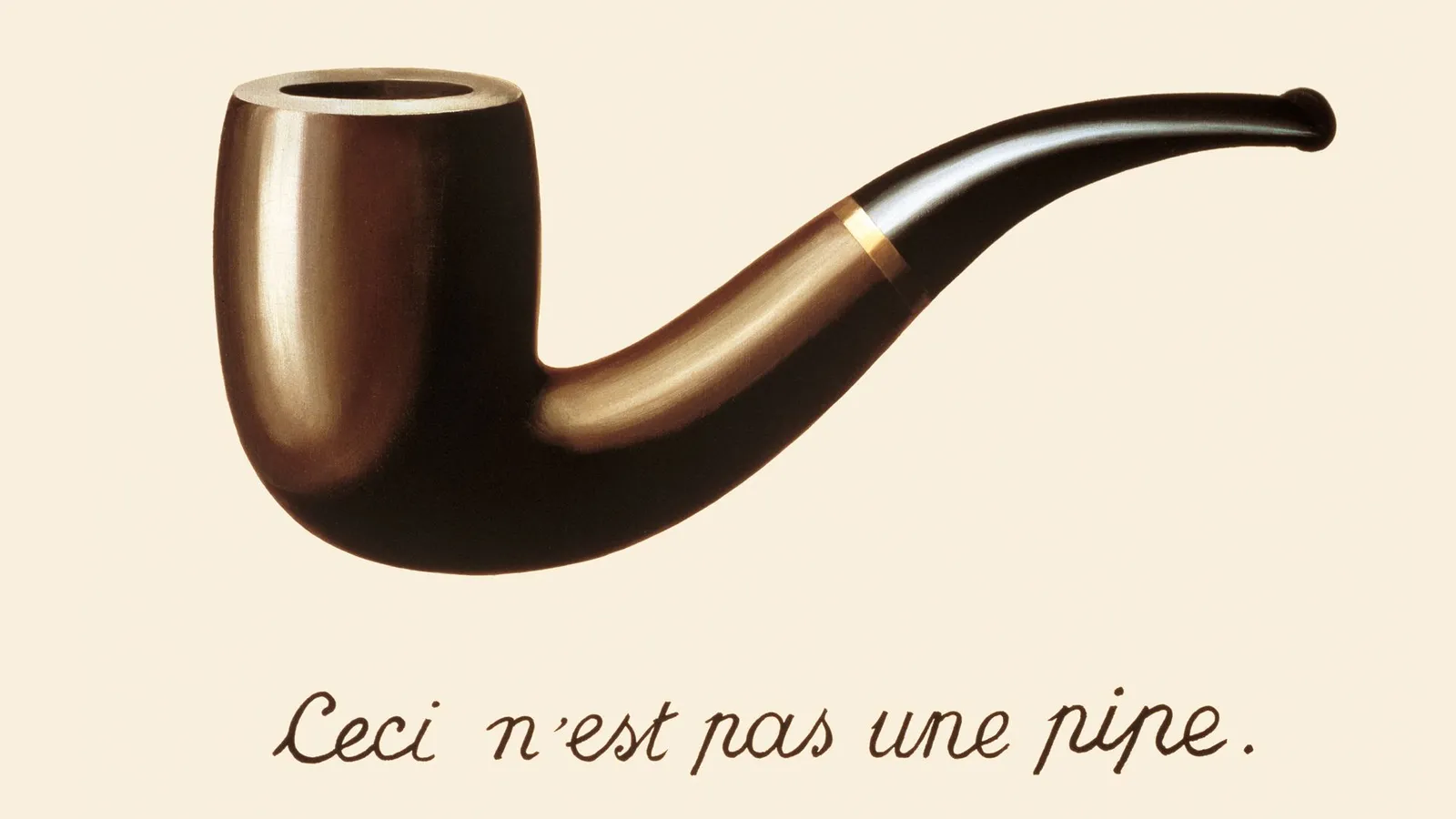
But a tree is not built from parts. It’s just a tree. We can articulate that a tree has a trunk and roots and branches and leaves and seeds and blooms, but it’s just a tree. The rest we impose on it with artificially constructed symbol language. This is what post-modern painter Rene Magritte was communicating with the “Ceci n’est pas une pipe” inscription in his work The Treachery of Images—This is not a pipe. He was not being cute or edgy or trying to be clever. He was making the point that the symbol is not the object.
In the manner that the image is not the pipe, it’s been said that to document a system is to make an inferior copy. The documented system is less optimal. This may feel counterintuitive. In fact, you may even argue that a documented system allows subsequent process participants to plug into the system to allow it to continue to operate into perpetuity. Whilst this is true, it comes at a cost. I’ll leave this here for you to ponder. The right hemisphere understands the difference. The document is not the process.
Getting Down to Business
If you’ve been following along, you may have already noticed that the left hemisphere looks and sounds a lot like the business world. Everything is systematised, structured, and ordered. We have all sorts of symbols and jargon, processes, and procedures. Everything is literal. There is no room for metaphor. There is no room for empathy. HR instructs that there be empathy, but they might as well instruct everyone to speak Basque or Hopi. In fact, it’s worse because at least Basque and Hopi can be learnt.
Sadly, this leftward shift isn’t limited to the world of commerce. It’s affected science, politics, and entire cultures. It’s caused these entities to abandon all that isn’t rational as irrational. But empathy and intuition are irrational. Science says if you can’t measure it and reproduce it, it’s not worth noting, but science is not the arbiter of the non-scientific realm. Business takes a similar position.
Politics of the Left (Hemisphere)
And politics creates categories: left and right, red and blue, black and white, men and women, gay and straight, and this and that. All of this is all left-hemisphere debate.
Categories and names are exclusive provinces of the left hemisphere. If you are hung up on an ideology, whether Democracy, Republicanism, Marxism, or Anarchism, you’re stuck in your left hemisphere. If you defend your positions with logic and words, you’re stuck in your left hemisphere. If you can’t imagine an alternative, you are really stuck in the left. I’ll stop here.
Science and Scientism
How did we get here and come to this? Science was receptive to right hemisphere influence up until about the 1970s. That’s where Scientism began to take hold. Scientism is when faith in science becomes a religion. I feel that many scientists today are less likely to hold a belief in Scientism as a religious belief. Paradoxically, I think this is more apt to be a faith held by non-scientists. Unfortunately, this faith is exploited by politics as exemplified by the recent trust in science campaign perpetrated by politicians, which is to say non-scientists with their own agenda, whether they practised Scientism or not.
The problem is that the left hemisphere has an outsized ego. It thinks it’s always right. In practice, it’s right about half the time. Because of its reliance on stored data and a ‘belief’ that it doesn’t need to fresh its data until it’s effectively overwhelmed and acquiesced. It fails to give enough weight to the experienced world, so that it shifts belief further and further left, which is to say further from reality as it is.
It trusts the symbol of the tree more than the tree itself. We may all be familiar with stories of cars driving down train tracks and off cliffs because the SAT-NAV user put more faith in their device than the world outside. This is the risk companies face as well, choosing to believe that the documented process is superior to the system in and of itself.
Getting on About?
You may be wondering what inspired me to write this and where I get my information. My realisation started in chapter 9 of The Matter with Things and was reinforced by this video interview by its author, Iain McGilchrist.
Actually, it started even before this with The Corporation, a Canadian documentary and companion book released in 2003. One of the points of The Corporation is to articulate the parallels between corporate behaviour relative to the definition of psychopathy as presented in The Diagnostic and Statistical Manual of Mental Disorders, henceforth DSM. Per Wikipedia, the DSM ‘is a publication by the American Psychiatric Association for the classification of mental disorders using a common language and standard criteria and is the main book for the diagnosis and treatment of mental disorders in the United States and is considered one of the “Bibles” of psychiatry’. Essentially, corporations ticked all the boxes.
Methodologically, this assertion is a bit weak, but it is at least sometimes entirely valid despite provoking an emotional trigger reaction. Nonetheless, this established corporations as pathological entities. But that is not my focus here. It simply tilled the soil for me to be more receptive to this topic. This topic is less about the legal fiction that is a corporation and more about the people embodied in it. From the height of the C-suite to the workaday staff, floor workers, warehouse workers, and the mailroom. Do they still have mailrooms? I digress.
I can’t claim to know what it is to be schizophrenic or schizoaffective, but I’ve known enough people who have these diagnoses. My brother was one of those. Although I use these and other labels, I am not a fan of labels, generally, especially psychological labels, specifically this label. Autism is another nonsensical label. Both fall into the realm of medical syndromes, which for the uninitiated is the equivalent of your kitchen junk drawer. It’s equivalent to the other choice when all others fail. I don’t want to go off on a tangent from the start, so I’ll leave it that these categories are overly broad and reflect intellectual laziness. There is no single schizophrenia or autism. There are many, but the distinction is lost in the category. The push to create an autism spectrum for DSM obscures the problem, but it helps for insurance purposes. As the saying goes, follow the money and you can gain clues to the driving force behind why this happened. I suppose you can also label me a conspiracy theorist. If I learned one thing in my undergrad Sociology classes, it’s to eschew labels.
Almost finished
Given the length of this segment, I am not going to summarise it here, save to say that this leftward shift in business and culture doesn’t have a good outlook. We are not only being replaced by machines, but we are also forced into becoming machines, and we aren’t even questioning it. All we need to do is to become more analytic, right?
What I suggest is to watch the six-minute video of Dr Iain McGilchrist discussing this topic, and if you really want a deep dive, read The Matter with Things, an almost three-thousand-page tome, to fill in the details.
Postscript
Here’s a music analogy to help to express why the whole is more important than the sum of the parts. If I want to learn to play a new piece, I will listen to the piece first. Depending on the length and genre, I may have to listen many times. In some cases, once or twice is enough, but let’s say this is at least somewhat complex and not some repetitive three-chord pop song. I’ll probably break the song into pieces or movements—verse, chorus, bridge, and whatever—, and then, I’ll learn each note and each pattern of notes, perhaps as musical phrases. Once I figure out the verse, I might either learn how the next verse differs or move on to the chorus and defer that verse-to-verse step. I’ll rinse and repeat until I’ve got through each of the sections. If I’ve had the luxury of hearing the piece, I’m at an advantage as far as tone, timbre, and dynamics are concerned; otherwise, I’d better hope these are all documented and that I interpret them in the manner they were intended. If the audience is familiar with a tune, they’ll notice the difference.
When I am practising, I need to get the mechanics down pat. All of what I’ve described thus far is left-hemisphere fare. It’s translating the symbolic representation of notes—like letters and words in writing—into an utterance. In this case, it’s a musical utterance. But once I am ready to perform the piece, it needs to be performed through the right hemisphere or it will feel mechanical and stilted.
I used to earn my living as an audio recording engineer and producer. Most of the time I was working with unknown artists recording demo records and trying to get a record deal. For the uninitiated, that usually translated into not having a large recording budget. Occasionally, we want, say string parts—violins, viola, cello, or whatever—but we couldn’t afford union players. We’d hire music students from USC or UCLA. These players would be more than willing to play for cheap in exchange for something to add to their portfolios or experience chops.
Somebody would transcribe the musical notation, and we’d give it to the string player. Of course, it could be a keyboard or wind or reed part, but I’ll stick to strings. Part of music is the vibe. This is something that can’t be captured in symbols. Revisiting Scientism and the left-hemisphere analogy, vibes can’t be real because they can’t be notated.
Almost invariably, if we got someone with Classical training, they could not get the vibe. The music was right in front of them. We’d play it for them on piano, maybe on a synthesiser, but they couldn’t get it—even if they were playing along to a reference track just trying to double the synth part. They would hit every note for the specified duration and dynamic, but it might have as well been the equivalence of a player piano or music box. We could have played it on a synthesiser, but we might be seeking the nuance a real instrument would bring.
We never had the luxury of auditioning players or recording several players and grabbing the best parts. That’s for the bigger-budget artists who go through a half-dozen or more performers to get just the right one. When we got lucky, it was usually because we got someone from the jazz program. These cats seem to have a natural feel for vibe inaccessible to the classical performers.
In business, the classical performer is good enough, but for art, it wasn’t. Business might appreciate the difference if it happens to get it, but it won’t seek it, and it won’t pay for it. A pet peeve of mine is a quip in business I heard often—don’t let perfection be the enemy of the good. This is obviously a left-hemisphere sentiment based on Voltaire’s statement. Besides, even from a left hemisphere perspective, reciting, “Don’t let perfection be the enemy of the good” doesn’t mean you shouldn’t at least strive for good enough because I noticed that mark was missed often enough, too.
The struggle is real. Last night, rather about 3 AM, I awakened with a thousand thoughts. This happens often enough. Some were creative ideas. Some were ideas for topics to write about here. Not just topics, but content as well. Then came the internal debate—whether to wake up and capture these ideas or to hope they’d remain in cache until the morning. All I can say it at least this one did. Well, the topic, at least.
The struggle is whether to lose sleep and risk not falling back to sleep to be able to awaken at a decent hour and not be dragging around the next day from lack of sleep. Or perhaps, at next notice, it would just be time to get up. All these scenarios have occurred at one time or another.
I tend to write a lot, whether for here, for work, for pleasure—whatever. I used to create visual art and certainly wrote a lot of songs or at least musical ideas that I hoped would develop into songs. The struggle was the same. The outcomes were as well.
Having read as much as I have of McGilchrist, it starts to make sense. The right cerebral hemisphere is the font of creativity. It’s also the place for intuition and empathy. The left hemisphere is for symbols and categories. It’s the quarter for intellect. It’s also a bad roommate.
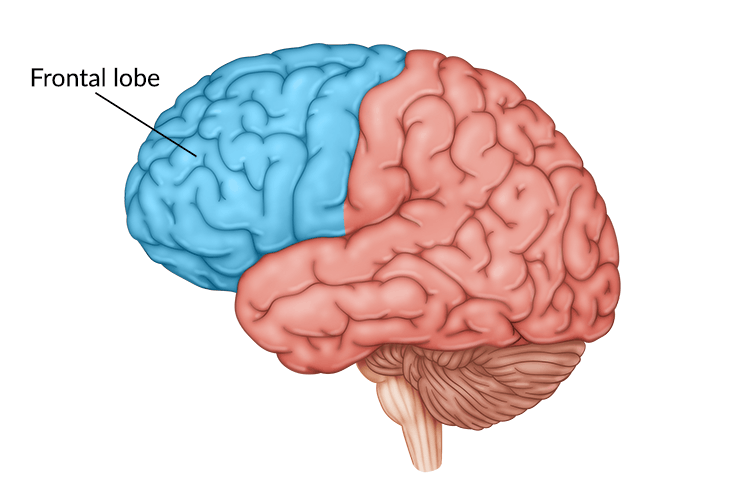
Whether or not one is creative does depend on the right hemisphere. Whether one can create depends on the left. Allow me to explain after laying out a relationship and three possibilities. For my purpose here, I can reduce the brain to three principal actors—the right hemisphere, the left hemisphere, and the frontal lobe.
As mentioned already, the right hemisphere generates creativity; the left hemisphere allows these ideas to be articulated symbolically, as in written and spoken words or art or music notation and so on; the frontal lobe acts as a mediator. Without getting too deep into neurology, a primary function of the frontal lobe is restrictive, which is to say it tells one or the other hemisphere to shut up and mind its business. Unfortunately, the hemispheres have this veto power of their own, so it’s difficult to fully understand the dynamics. This being said, let’s have a look at four scenarios that may illustrate why someone may or may not be able to create—in some cases even if they are otherwise creative.
I’ll start with the situation where the right hemisphere generates the creative ideas, and the other actors perform as expected. This is the brain of the creative person.
In the second scenario, the right hemisphere is simply weak. The person was just born with the bad luck of having a hemisphere that isn’t creative. In this case, there is nothing the left hemisphere or frontal lobe can do to compensate for this deficit. I’d like to think—like, perhaps being the wrong word—that this is where most non-creative people reside. They just don’t have that metaphorical creative gene.
In the third scenario, the right hemisphere generates plenty of creative thoughts, but the left hemisphere won’t “shut up”. If you’ve even had to think in a place with a lot of noise or distraction, you’ll get the gist. This is an imperfect analogy because creativity is precisely about not concentrating. Concentration is the enemy of creativity. So, in the case that the left hemisphere is interfering, it’s because it insists on concentrating, and that interrupts the creative process. In fact, it’s a misnomer to call something s creative process because creativity is precisely a lack of process. Like concentration, process kills creativity.
The right hemisphere is open and divergent. The left hemisphere is closed and convergent.
In the fourth and last scenario, the right and left hemispheres are each playing their parts swimmingly, but the frontal lobe as moderator is deficient. In this case, the left is being itself and disrupting. Like the parable of the scorpion and the frog, it can’t help itself, but the frontal lobe isn’t telling it to be quiet and wait its turn. That’s the job of the frontal lobe. If you’ve ever witnessed a debate or mediated discussion where the moderator just lets the participants run rampant, you’ll know what I mean. Or perhaps you’ve been in a classroom or a meeting where the teacher or leader has no control of the class or the audience. It’s difficult to get anything accomplished.
Moving on. So, the actors each have their roles, but timing matters. The right hemisphere not only needs to generate thoughts or ideas, but it also needs time for them to incubate. Once they are ripe, only then is it ready to encounter the scrutiny of the left hemisphere and seek moderation for the frontal lobe.
If during the incubation process, the left hemisphere is continually asking, “Are we there yet? Are we there yet?” it’s unlikely one will ever get there.
If you are wondering how this works in the world of business and commerce—or better yet, you have already put together that this can’t possibly work in the realm of business and commerce—, I talk about that next. And I’ve got another segment on cerebral challenges in business in the works.
Creativity cannot be time-boxed. It can’t be summoned on demand. As already mentioned, it is not a process, and it can’t be tamed. Aside from the fickle public, have you ever wondered why so many musical artists are one-hit-wonders—if they have even been that lucky? These people had one idea—that happened to be an idea that would resonate in that moment—, but being told by the label to go generate some more hits is asking for creativity on demand.
Depending on your age and generation, some of you might be asking yourselves, “What about Taylor Swift or Ed Sheeran or the Beatles or Beethoven?” These people are clearly the exceptions. We could as well look at the Vincent van Gough of the world who didn’t experience acceptance until after his death. Clearly, his creativity was unrecognised by his contemporaries. Even in some of these exceptional cases, these people have found a voice and are applying a pattern. An example I like is that of Stephen King, who in an interview admitted that he has only had one good idea in his entire life, and he’s exploited it into a large number of books. So, he’s kept reskinning the same skeleton but with different dressings.
And as far as commerce goes, yes, these people are commercially successful. Some would argue about the actual talent. I’ve seen philosophy classes compare the ‘high art’ of Shakespeare with the ‘low art’ of Matt Groening’s The Simpsons. Certainly, The Simpsons are culturally creative and commercially successful, but how creative is it really? How does one actually measure degrees of creativity?
My point is that these exceptional people are generating output once a year or every few years. In business, so-called creatives may be asked to generate new ‘creative’ content daily, weekly, or perhaps monthly. Creativity doesn’t work like this. Even if you asked Mozart to generate a new piece each week, this mechanical process might yield paydirt, but most would just be a formulaic rehash. In fact, if you talk to any top artist, they’ll tell you that what you see or hear is less than one per cent of their ideas. Most are either partially formed or, upon reflection, just bad. They felt good at the time, but they couldn’t develop into something better, or they turned out to be derivative, which is hardly creative.
So business is a death sentence for creativity. The creative people I know, don’t get their creative jollies from their day jobs. They get it from their side projects, from their passion projects, and whether or not these projects are commercially viable.
In fact, I can also look at someone like Nirvana’s Kurt Cobain who was creative at the start—when they were under the radar—, but once they rose into view, he lost it, and then we lost him.
I hope this gives you a better feeling of how creativity works from the perspective of the brain and why we see so little creativity in the real world and even less in the business world. Do you find this surprising, or are you thinking, “man, this bloke must be dense if he’s just catching on to this now”?







 Philosophics