I’ve read about 85 per cent of James by Percival Everett. I recommend it. On the surface, it is simply a very good story set in the narrative universe of Mark Twain’s Huck Finn and Tom Sawyer. I will avoid spoilers as best I can.
The novel is set in the antebellum American South. James and the others move through Missouri, a state that openly supported slavery, and at one point into Illinois, a state that officially opposed it but quietly failed to live up to its own rhetoric. Illinois, it turns out, is no safe haven. Ideology and practice, as ever, are on speaking terms only when it suits them.
Audio: Short NotebookLM summary podcast of this content.
This is not a book review. I may write one later for my Ridley Park site once I’ve finished the book. What interests me here are two philosophical tensions Everett stages with remarkable economy.
There are two characters who are Black but able to pass as white. One of them feels profound guilt about this. He was raised as a slave, escaped, and knows exactly what it means to be treated as Black because he has lived it. Passing feels like theft. Survival, perhaps, but theft all the same.
The other is more unsettled. He was raised as a white man and only later discovers that he is not, as the language goes, “pure-bred”. This revelation leaves him suspended between identities. Should he now accept a Black identity he has never inhabited, or continue to pass quietly, benefitting from a system that would destroy him if it knew?
James offers him advice that is as brutal as it is lucid:
“Belief has nothing to do with truth. Believe what you like. Believe I’m lying and move through the world as a white boy. Believe I’m telling the truth and move through the world as a white boy anyway. Either way, no difference.”
This is the philosophical nerve of the book.
Truth, Everett suggests, is indifferent to belief. Belief does not mediate justice. It does not reorganise power. It does not rewire how the world responds to your body. What matters is not what is true, nor even what is believed to be true, but how one is seen.
The world does not respond to essences. It responds to appearances.
Identity here is not an inner fact waiting to be acknowledged; it is a surface phenomenon enforced by institutions, habits, and violence. The truth can be known, spoken, even proven, and still change nothing. The social machine runs on perception, not ontology.
In James, Everett is not offering moral comfort. He is stripping away a modernist fantasy: that truth, once revealed, obliges the world to behave differently. It doesn’t. The world only cares what you look like while moving through it.
Truth, it turns out, is perfectly compatible with injustice.
Lewis Goodall, a talk show host, calls the cross-border seizure of Venezuela’s Nicolás Maduro a ‘kidnapping’. His guest and Trump apologist, Angie Wong, rejects the word. She first says ‘arrest’, then ‘extradition’, then finally the improvised ‘special extradition’. Around that single lexical choice, a 12-minute standoff unfolds.
Audio: NotebookLM summary podcast of this topic.
As a language philosopher, I am evaluating the language and am less concerned with the underlying facts of the matter. Language serves to obscure these facts from the start and then rhetorically controls the narrative and framing.
Video: Source segment being analysed
There is a familiar mistake made whenever public discourse turns heated: the assumption that the real disagreement lies in the facts. This is comforting, because facts can, at least in principle, be checked. What follows examines a different failure mode altogether. The facts are largely beside the point.
Consider a broadcast exchange in which a political commentator and an interviewer argue over how to describe the forcible removal of a head of state from one country to another. The interviewer repeatedly uses the word kidnapping. The guest repeatedly resists this term, preferring arrest, extradition, and eventually the improvisational compromise ‘special extradition’.
What matters here is not which term is correct. What matters is what the interaction reveals about how meaning is negotiated under pressure.
The illusion of disagreement
Superficially, the exchange appears to be a dispute about legality. Was there a treaty? Was due process followed? Which court has jurisdiction? These questions generate heat, but they are not doing the work.
The real disagreement is prior to all of that: which lexical frame is allowed to stabilise the event.
Once a label is accepted, downstream reasoning becomes trivial. If it was an extradition, it belongs to one legal universe. If it was a kidnapping, it belongs to another. The participants are not arguing within a shared framework; they are competing to install the framework itself.
Equivocation as method, not error
The guest’s shifting vocabulary is often described as evasive or incoherent. This misreads what is happening. The movement from extradition to special extradition is not confusion. It is a deliberate widening of semantic tolerance.
‘Special extradition’ is not meant to clarify. It is meant to survive. It carries just enough institutional residue to sound procedural, while remaining sufficiently vague to avoid binding criteria. It functions less as a description than as a holding pattern.
This is equivocation, but not the amateur kind taught in logic textbooks. It is equivocation under constraint, where the aim is not precision but narrative continuity.
Why exposure fails
The interviewer repeatedly points out that extradition has a specific meaning, and that the situation described does not meet it. This is accurate, and also ineffective.
Why? Because the exchange is no longer governed by definitional hygiene. The audience is not being asked to adjudicate a dictionary entry. They are being asked to decide which voice has the authority to name the act.
Once that shift occurs, exposing misuse does not correct the discourse. It merely clarifies the power asymmetry. The guest can concede irregularity, precedent-breaking, even illegality, without relinquishing control of the label. The language continues to function.
Truth as a downstream effect
At no point does the exchange hinge on discovering what ‘really happened’. The physical sequence of events is relatively uncontested. What is contested is what those events are allowed to count as.
In this sense, truth is not absent from the discussion; it is subordinate. It emerges only after a rhetorical frame has been successfully installed. Once the frame holds, truth follows obediently within it.
This is not relativism. It is an observation about sequence. Rhetoric does not decorate truth here; it prepares the ground on which truth is later claimed.
Language doing institutional work
The most revealing moment comes when the guest effectively shrugs at the legal ambiguity and asks who, exactly, is going to challenge it. This is not cynicism. It is diagnostic.
Words like arrest and extradition are not merely descriptive. They are operational tokens. They open doors, justify procedures, and allow institutions to proceed without stalling. Their value lies less in semantic purity than in administrative usability.
‘Kidnapping’ is linguistically precise in one register, but administratively useless in another. It stops processes rather than enabling them. That is why it is resisted.
What the case study shows
This exchange is not about geopolitics. It is about how language behaves when it is tasked with carrying power. Meaning drifts not because speakers are careless, but because precision is costly. Labels are selected for durability, not accuracy. Truth does not arbitrate rhetoric; rhetoric allocates truth. Seen this way, the debate over terminology is not a failure of communication. It is communication functioning exactly as designed under modern conditions. Which is why insisting on ‘the correct word’ increasingly feels like shouting into a ventilation system. The air still moves. It just isn’t moving for you.
2025 has been a good year for this blog. I’ve crossed the 1,000-post mark, and this year it has had over 30,000 page views – best year ever. This month was the best month ever, and 1st December was the most popular day ever. That’s a lot of ‘evers’.
I shared the remainder of this post on my Ridley Park fiction blog – same reader, same books, same opinion. Any new content added below is in red.
I genuinely loathe top X lists, so let us indulge in some self-loathing. I finished these books in 2026. As you can see, they cross genres, consist of fiction and non-fiction, and don’t even share temporal space. I admit that I’m a diverse reader and, ostensibly, writer. Instead of just the top 5. I’ll shoot for the top and bottom 5 to capture my anti-recommendations. Within categories are alphabetical.
Fiction
Never Let Me Go by Kazuo Ishiguro – A slow reveal about identity, but worth the wait.
This was very philosophical and psychological. Nothing appeared to happen until chapter 7, as I recall. I felt like I was just eavesdropping on some school chums, which I was. Then came the big reveal.
Notes from Underground by Fyodor Dostoevsky – Classic unreliable narrator.
Again, philosophical, psychological. I liked it.
There Is No Antimemetics Division by QNTM (AKA Sam Hughes) – Points for daring to be different and hitting the landing.
This, I read because I was attracted to the premise of memory as it might affect language. It touched on this a tad, but it was mostly about memory, anti-memory, and constructed selves. How can one experience a contiguous, diachronic self with memory gaps? It never quite got that deep, that on occasion it did, as far as I recall.
Trainspotting by Irvine Welsh – Scottish drugs culture and bonding mates narrative.
This is an age-old cult classic – much better than the already excellent films. Fills in what the film cut for its medium. I read several other Welsh books. Filth was an honourable mention, which I also made connexions to Antimemetics, above.
We by Yevgeny Zamyatin – In the league of 1984 and Brave New World, but without the acclaim.
This flagged a tad at the end, but it was prescient and released in 1922, decades before 1984 and Brave New World. Worth the read.
Nonfiction
Capitalist Realism by Mark Fisher – Explains why most problems are social, not personal or psychological. Follows Erich Fromm’s Sane Society, which I also read in 2025 and liked, but it fell into the ‘lost the trail’ territory at some point, so it fell off the list.
Moral Politics by George Lakoff
Evidently, I forgot to explain myself in my prior post. I refer to this book and its trade counterpart, Don’t Think of an Elephant, which is more of a political polemic, but still worth the read. It’s also shorter. This is about Moral politics – duh! – but it’s about moral language. It was a precursor to Jonathan Haidt’s The Righteous Mind: Why Good People Are Divided by Politics and Religion or Kurt Gray’s Outraged! I found Haidt’s work interesting but reductive; I found Gray’s work merely reductive.
This said, Lakoff and Haidt were the vector through which I came upon my language ontology theory that further confounds language insufficiency. To be sure, Haidt was an unnecessary point, but it did emphasise it. Haidt’s frameworks also give me something to riff on.
Technofeudalism by Yanis Varoufakis – Explains why Capitalism is already dead on arrival.
Nothing much to add here. Technofeudalism is economic fare, albeit with philosophical implications. I enjoyed it. Yanis is also an interesting speaker.
NB: Some of the other books had great pieces of content, but failed as books. They may have been better as essays or blog posts. They didn’t have enough material for a full book. The Second Sex had enough for a book, but then Beauvoir poured in enough for two books. She should have quit whilst she was ahead.
Image: Books I read in 2025 on Goodreads. Full disclosure: I don’t always record my reading on Goodreads, but I try.
Bottom of the Barrel
Crash by J.G. Ballard – Hard no. I also didn’t like High-rise, but it was marginally better, and I didn’t want to count an author twice.
Nah. I felt he was trying to hard for shock value. It didn’t shock, but it put me off. At least High-rise represented an absurd cultural microcosm. I just wanted the story to be over. Luckily, I read both of these sequentially whilst on holiday, so I wasn’t looking to ingest anything serious.
Neuromancer by William Gibson – I don’t tend to like SciFi. This is a classic. Maybe it read differently back in the day. Didn’t age well.
Nexus by Yuval Harari – Drivel. My mates goaded me into reading this. I liked Sapiens. He’s gone downhill since then. He’s a historian, not a futurist.
Outraged! by Kurt Gray – Very reductionist view of moral harm, following the footsteps of George Lakoff and Jonathan Haidt.
See comments above. ☝️
Society of the Spectacle by Guy Debord – A cautionary tale on why writing a book on LSD may not be a recipe for success.
Honourable Mention
Annihilation by Jeff VanderMeer was also good, but my cutoff was at 5. Sorry, Jeff.
I did like this, and it was much better than the Natalie Portman film adaptation. This is the first book in a trilogy. I absolutely hated the second instalment. The third was not as good as the first, but it tried to get back on track from the derailment of the second. As I wrote in public reviews, the second book could have been a prologue chapter to the third book with all of the relevant information I cared about. You could skip the second story with almost no material effect on the story or character arcs.
Looking through some of the drafts clogging the blog, I decided to whittle away at the queue. I started this months ago. It’s here now, not particularly in sync with the season or recent topics, but I like Sapolsky.
‘Biology is destiny’, say the Christian Right, the bland bureaucrats of morality, the loud whisperers at Sunday school. They want gender to be a tomb carved in marble: you’re assigned at birth, and you stay a perfect statue. But Sapolsky waltzes in and says, ‘Hold up – what do you mean by biology? Which biology? Which markers count?’
Video: Neuro-biology of Transsexuality, Prof. Robert Sapolsky
In the clip above, Sapolsky unpacks neurological evidence that upends the essentialist cheat codes. He doesn’t pretend we now have the final answer to gender. He does something scarier to fundamentalists: he shows just how messy biology is.
The Bed Nucleus, the Finger Ratio, and the ‘Wrong Body’ Hypothesis
Sapolsky discusses three pieces of neurobiological evidence:
Digit ratio (2nd vs 4th finger length): In lesbians, on average, the ratio is closer to what you see in straight men than straight women. That’s a correlation, an eyebrow-raiser, hardly a decree.
Acoustic reflexes (auto-acoustic reflex): Another early finding in women’s sexual orientation, though faint and underexplored.
The bed nucleus of the stria terminalis (BSTc): Here we reach heavy artillery. There is a neuron population in this region that, on average, is about twice as large in males as in females. In postmortem analyses of trans women (male → female), this region’s size corresponds to their identified gender, not their natal sex. Crucially, that alignment is seen even in trans individuals who never underwent full hormone therapy or surgical changes.
Sapolsky recounts astute controls: men treated (for, say, testicular cancer) with feminising hormones don’t show the same shift.
Also, using the phantom-limb analogy: men who lose their penis to cancer often report phantom sensations; trans women rarely do. That suggests the body map in the brain never fully “registered” that organ in the same way.
He doesn’t overclaim. He doesn’t say, ‘Case closed, biology proves everything’. He says: These data complicate your neat categories. They force you to ask: which biological measure do you privilege? Hypertrophied neurons? Chromosomes? Receptor density? Hormones? All of them simultaneously? None of them?
Essentialism as a Trap
Fundamentalists and anti-trans ideologues deploy essentialism because it’s convenient. They demand an ironclad ‘essence’ so they can exclude anyone who fails their test. But what Sapolsky shows is that essence is simply a scaffold; we get to pick which biological scaffolds we accept. They may choose genes and genitals; the neurobiologist gives them neuron counts and brain-maps. When your ideology elevates one scaffold and ignores the others, it betrays its own contingency.
Moreover, the evidence suggests that identity, experience, insistence (in Sapolsky’s language: ‘insisting from day one’), and internal brain structure might converge. The ‘wrong body’ isn’t a metaphor. It’s a mismatch between internal brain architecture and external form. The stubborn fragments of biology that fundamentalists accept are torn by the dissonance that science increasingly reveals.
What This Means for Trans Rights, Discourse & Strategy
Science is never ‘conclusive’. Sapolsky offers compelling support, not gospel. Anyone claiming this settles everything has never looked at a scatter plot.
Lived experience still matters. Even if we never had brain slices, self-reports, psychology, psychiatry, anthropology, narratives remain valid. Brain studies supplement, not supplant, testimony.
Essentialist opponents have boxed themselves in. When they demand biology decides everything, they hand the baton to neuroscientists – and neuroscientists keep running with it. The entire ‘biology’ equals only what I like’ regime is exposed.
Ambiguity is a strength, not a liability. If we insist identity is linear and tidy, we re-enact their demand for purity. Recognising complexity, mess, and variance is radical resistance.
…and this one. A clarification that is also a demonstration. If anything, the Americanisms should give it away.
The Preamble as Method
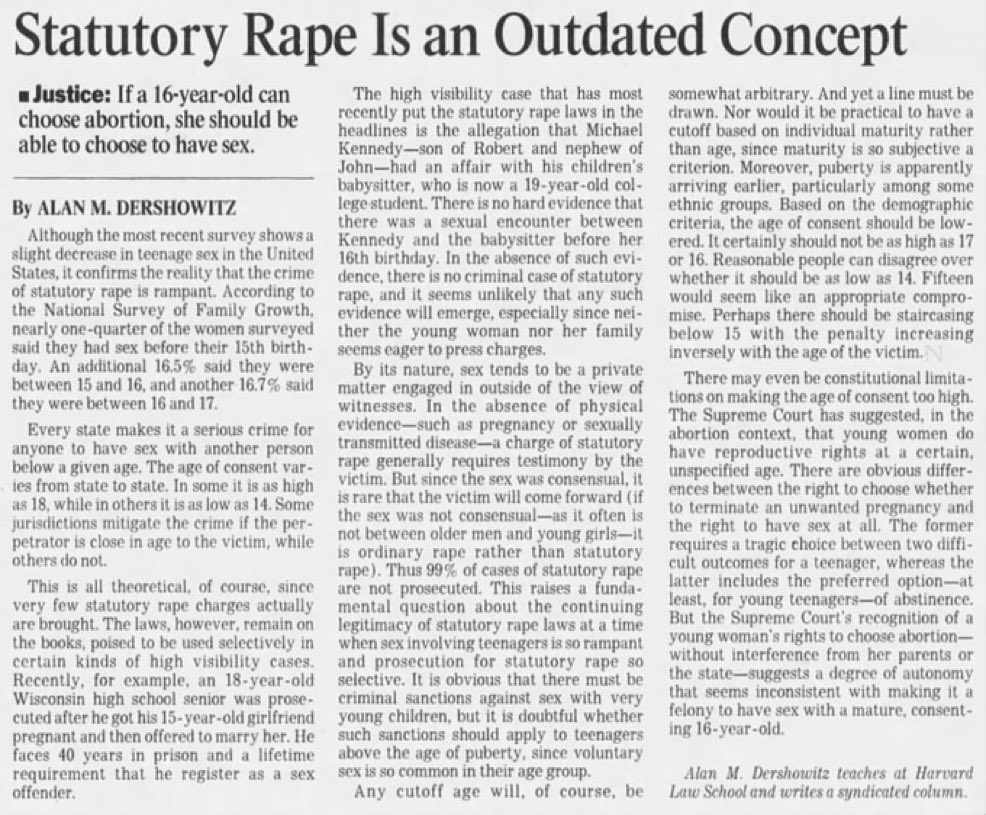
A previous post—the one with Foucault, Arendt, Sontag, Fish, Mill, and Girard all lined up like theoretical ammunition—was drafted entirely by ChatGPT after a conversation about the Dershowitz piece before it. I fed it my argument about moral contamination and asked it to expand the thesis with additional thinkers. It obliged. I posted it unedited.
I mention this not as confession but as method. If my core claim is that truth equals rhetoric—that there is no unmediated access to reality, only constructed positions negotiated through language, power, and interpretation—then having an AI mediate my argument while I mediate its output is not a bug. It’s a feature.
The question is never “who really wrote this” but “what work does this text do, and under what conditions?”
This is a non-foundationalist position. There is no neutral ground from which to assess claims. There is no Logic floating above rhetoric, no Reason untouched by affect, no Truth prior to its articulation. What we have are competing rhetorical constructions, each shaped by interests, histories, and power arrangements, each claiming—to varying degrees of honesty—to represent something beyond themselves.
The game is not to transcend this condition. The game is to stop pretending we ever could.
What I’m Actually Arguing
Let me be direct about what those two posts were defending, since the theoretical apparatus apparently obscured more than it clarified.
I am not arguing that:
Age of consent laws should be abolished
The French intellectuals were right to sign those petitions
Association with Epstein is irrelevant
Analysis automatically immunizes anyone from moral judgment
I am arguing that:
Liberal discourse routinely launders emotional and political commitments as self-evident logic, then treats anyone who exposes this process as morally suspect.
Legal thresholds are negotiated rhetorical compromises, not mathematical truths. They reflect harm minimization, cultural anxiety, enforcement pragmatics, and historical contingency. To analyze their construction is not to advocate their abolition.
The “moral contamination reflex” treats inquiry as confession—not because the inquiry threatens truth, but because it threatens the claim that certain positions are simply Logic Itself rather than one rhetorical construction among others.
Guilt by association is both a logical fallacy and sometimes a reasonable heuristic. The trick is admitting which one you’re doing at any given moment, rather than claiming your heuristic is deductive proof.
These claims are rhetorical positions. They are not transcendent truths. But neither are the positions they critique.
The Hypocrisy I’m Diagnosing
When someone argues that a 16-year-old capable of choosing abortion should be capable of choosing sex, they are making a rhetorical move. The argument has gaps—abortion concerns bodily autonomy in ways that sex with others does not; capacity for one decision doesn’t automatically transfer to capacity for another; power dynamics matter.
Fine. Point those out. Explain why the analogy fails.
But what actually happens is different. The argument is not refuted. The arguer is diagnosed. Making the argument becomes evidence of desire. Analyzing it becomes evidence of endorsement. Logic is treated as circumstantial proof of guilt.
This is not because the argument is uniquely dangerous. It’s because it threatens a stabilizing fiction: that our current legal thresholds are both pragmatically necessary and philosophically coherent. They are the former. They are not the latter. And the moral panic that greets anyone who points this out is not about protecting children. It’s about protecting the claim that our compromises are something more than compromises.
The same pattern plays out with Epstein associations. Some people knew him socially or professionally in contexts that had nothing to do with his crimes. Some people continued relationships after credible allegations emerged. Some people were directly complicit. These are different categories.
But the discourse collapses them. Everyone in the address book becomes suspect. Association becomes evidence. And anyone who suggests “we should distinguish between these cases” is immediately accused of defending predators.
This is not logic. This is moral theatre. And the fury it provokes when exposed is not righteous. It’s defensive.
The Difference Between Rhetoric and Relativism
Saying “truth equals rhetoric” sounds like relativism. It sounds like I’m claiming all positions are equal, nothing matters, anything goes.
I’m not.
I’m claiming that all positions are constructed through rhetoric, but that doesn’t make them equal. It means we should argue about them on the terms they actually operate—consequences, values, power, effects—rather than pretending one side has Logic and the other side has Emotion.
Some rhetorical constructions are more defensible than others. Age of consent laws, as constructed compromises aimed at harm reduction, are defensible. That doesn’t mean they’re philosophically coherent or that analyzing their incoherence is an attack on children.
Maintaining professional relationships with powerful people who were later revealed to be criminals does not make you guilty of their crimes. But it might raise questions about judgment, complicity, or willful blindness—questions that should be asked specifically, not universally.
The difference is this: I’m not claiming my position is Logic. I’m claiming it’s a rhetorical construction I find more defensible than the alternatives, for reasons I’m willing to argue about.
What I’m criticizing is the move where liberal discourse presents its rhetorical positions as self-evident moral truths, then treats dissent as pathology.
Why the Theoretical Version Failed
The expanded post tried to universalize the pattern—to show that this reflex appears across domains, across thinkers, across history. It succeeded at that. What it failed to do was stay grounded enough for readers to assess whether the pattern I was describing was real or whether I was constructing a persecution narrative.
The problem was strategic evasiveness. By staying abstract, the piece avoided being testable. It gestured at examples without committing to them. It borrowed authority from Foucault and Arendt without doing the work of showing how their critiques apply to the specific cases I had in mind.
This created a gap between what the essay claimed to be doing (defending analysis against moral panic) and what it was actually doing (defending specific controversial figures using theory as cover).
That gap is what critics correctly identified as bad faith.
What I Should Have Said
Here’s the honest version:
The Dershowitz argument is bad. The abortion-sex analogy doesn’t hold. But “the argument is bad” and “making the argument is evidence of pedophilia” are not the same claim. One is logical critique. The other is moral contamination. We should be able to distinguish them.
The 1977 French petitions were misjudged. Calling for the abolition of age of consent laws in that context, with those specific cases, was not wise. But signing a petition is not the same as committing the acts in question, and treating mid-century French intellectual culture as self-evidently monstrous erases the specific debates they were having about law, psychiatry, and state power. We can think they were wrong without treating the question itself as unspeakable.
Epstein’s network matters. Some associations are meaningful. Power enabled his abuse, and understanding how requires looking at who knew what and when. But not every name in a flight log or party photo is evidence of complicity, and the current discourse often treats them as such. We should distinguish between innocent contact, poor judgment, and active enablement—not flatten everything into “guilt by proximity.”
These are all messy positions. They require distinctions, context, and willingness to live in discomfort. That’s harder than moral certainty. But it’s also more honest.
The Meta-Point About AI Generation
The fact that the previous post was AI-generated does something interesting to all of this.
It was rhetorically effective. It marshaled the right theoretical authorities. It structured the argument coherently. It sounded like philosophy. And it was assembled by a pattern-matching system with no beliefs, no commitments, no stakes.
This should tell us something about the nature of rhetoric itself. The text worked—or didn’t—based on what it did, not where it came from. Authenticity is not truth. Authorship is not authority. What matters is whether the construction holds, and under what conditions.
I could have hidden the AI involvement. Many would. The disclosure feels like it undermines the argument’s authority—if a machine wrote it, does it count?
But that reaction itself proves the point. We want arguments to come from authenticated sources, from proper authority, from legitimate speakers. We want to know who’s talking so we can decide whether to trust them. This is not Logic. This is rhetoric all the way down.
The AI wrote a version of my argument that was cleaner and more theoretically sophisticated than I would have produced alone. It was also more evasive, more abstract, less committed. Those aren’t bugs in the process. They’re features of how the system generates text—maximizing coherence, minimizing controversy, staying in safe abstraction.
That I chose to post it anyway, knowing these limitations, is itself a rhetorical move. It says: “I’m willing to use mediated tools to construct my position, and I’m not pretending otherwise.”
What This Leaves Us With
I started with a claim about moral contamination—that liberal discourse treats certain kinds of inquiry as self-incriminating. I then demonstrated this by making precisely the kind of inquiry that provokes that reflex, using examples I knew would be read as defensive rather than analytical.
The responses proved the thesis. Analysis was read as confession. Theory was read as cover. Even asking whether a distinction exists between argument and endorsement was taken as evidence that no such distinction can be maintained.
But here’s what I didn’t make clear enough: I’m not claiming to be above this dynamic. I’m in it too. I have commitments, interests, and positions I’m defending. The difference is I’m naming them as such, rather than claiming they’re simply What Logic Demands.
Truth equals rhetoric. We’re all doing motivated reasoning. The question is not “who has transcended their motivations” but “whose motivations, toward what ends, with what consequences?”
I think the moral contamination reflex produces bad discourse—not because it’s emotional, but because it claims not to be. I think guilt by association is overused—not because association never matters, but because we’ve stopped distinguishing between different kinds of association. I think legal thresholds should be analyzable—not because they should be abolished, but because unexamined laws are dangerous even when well-intentioned.
These are rhetorical positions. I’m arguing for them. I’m not pretending they’re Logic Itself.
If you disagree, argue back. But argue with what I’m actually saying, not with what analysis supposedly reveals about my secret desires.
That’s all I’m asking for. And apparently, it’s too much.
if a 16-year-old can choose abortion, then she should be able to choose to have sex
In the newspaper clipping above, legal scholar Alan Dershowitz argues that if a 16-year-old can choose abortion, then she should be able to choose to have sex. The argument is presented as sober, rational, and juridical. A syllogism offered as disinfectant.
There are many philosophical problems with the equivalence. I am not interested in most of them.
Audio: NotebookLM summary podcast on this topic.
I’ve written before that age as a proxy for maturity collapses immediately into a Sorites paradox. It assumes commensurability where none exists. It treats human development as discretised and legible, when it is anything but. The law must draw lines. Philosophy does not have that luxury. But that is not why this argument resurfaces now.
What interests me is the moral contamination reflex it reliably provokes. The rule is tacit but rigid: if you reason calmly about a taboo subject, you must be defending it. If you defend it, you must desire it. If you desire it, you must be guilty of it. Logic becomes circumstantial evidence.
This reflex is not new. Nor is it confined to contemporary Anglo-American culture. Half a century ago, it played out publicly in France, with consequences that are now being retrospectively moralised into caricature.
In January and May of 1977, a petition published in Le Monde floated the abrogation of what was then called the “sexual majority”. In January of the same year, a separate petition called for the release of three men accused of having sex with boys and girls between the ages of twelve and fifteen. Among the signatories were Jean-Paul Sartre, Simone de Beauvoir, Roland Barthes, Michel Foucault, and Gilles Deleuze.
Today, this episode is typically invoked as a moral mic drop. No argument is examined. No context is interrogated. No distinction is drawn between legal reasoning, political provocation, and moral endorsement. The conclusion is immediate and terminal: these figures were monsters, or fools, or both.
The logic is familiar by now. If they signed, they must have approved. If they approved, they must have desired. If they desired, they must have practised. Analysis collapses into accusation.
None of this requires defending the petitions, the arguments, or the acts in question. It requires only defending a principle that has apparently become intolerable: that an argument can be examined without imputing motive, desire, or personal conduct to the person making it.
This is where liberal societies reveal a particular hypocrisy. They claim to value reasoned debate, yet routinely launder moral intuitions through rationalist language, then react with fury when someone exposes the laundering process. Legal thresholds are treated as if they were moral truths rather than negotiated compromises shaped by fear, harm minimisation, optics, and historical contingency.
Once the compromise hardens into law, the line becomes sacred. To question it is not civic scrutiny but moral trespass. To analyse it is to signal deviance. This is why figures like Foucault are not criticised for being wrong, but for having asked the question at all. The question itself becomes the crime.
It is often said, defensively, that emotion precedes logic. True enough. But this is usually offered as an excuse rather than a diagnosis. The supposed human distinction is not that we feel first, but that we can reflect on what we feel, examine it, and sometimes resist it. The historical record suggests we do this far less than we like to believe.
The real taboo here is not sex, or age, or consent. It is the suggestion that moral reasoning might survive contact with uncomfortable cases. That one might analyse the coherence of a law without endorsing the behaviour it regulates. That one might describe a moral panic without siding with its villains.
Instead, we have adopted a simpler rule: certain questions may not be asked without self-implication. This preserves moral theatre. It also guarantees that our laws remain philosophically incoherent while everyone congratulates themselves for having the correct instincts.
Logic, in this arrangement, is not a virtue. It is a liability. And history suggests that anyone who insists on using it will eventually be posthumously condemned for doing so.
On Self-Evidence, Personhood, and the Administrative Nature of Rights
The following sentence is among the most quoted in political history and among the least examined. It is invoked as moral bedrock, taught as civic catechism, and insulated from scrutiny by a reverence that mistakes repetition for comprehension. It is rarely read closely, and rarely read sceptically.
Audio: NotebookLM summary podcast of this topic.
What follows is not a rebuttal. It is an annotation.
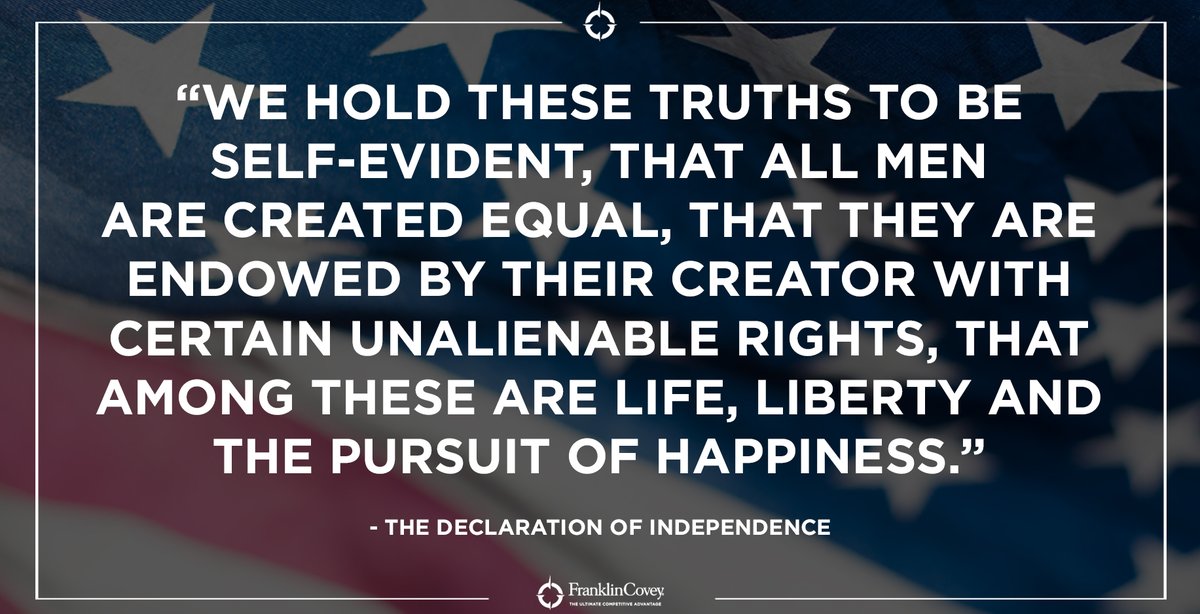
We hold these truths to be self-evident, that all men are created equal, that they are endowed by their Creator with certain unalienable Rights, that among these are Life, Liberty and the pursuit of Happiness.
Most readers will recognise this as the opening of the Declaration of Independence by the United States of America. Recognition, however, is not comprehension. The sentence survives on familiarity. Once that familiarity is set aside, it begins to fail clause by clause.
I. A Best Case, Briefly
A more charitable reading deserves brief consideration. ‘Self-evident’, in the intellectual context of the eighteenth century, did not mean obvious in the sense of requiring no reflection. It referred instead to propositions taken as axiomatic: not inferred from prior premises, but serving as starting points for reasoning. On this view, influenced by Scottish Common Sense philosophy, the claim is not that these truths are psychologically irresistible, but that they are rationally basic.
Likewise, ‘we hold’ need not be read as an admission of arbitrariness. It may be understood as a public avowal: a political body formally affirming what reason is said to disclose, rather than grounding those truths in the act of holding itself. Read this way, the sentence does not collapse into mere opinion.
Finally, the Declaration is often understood as performative rather than descriptive.[1] It does not merely state political facts; it brings a political subject into being. The ‘we’ is constituted in the act of declaration, and the language functions as a founding gesture rather than a philosophical proof.
Even on this charitable reading, however, the appeal to rational self-evidence presupposes capacities that were unevenly distributed at best. The Enlightenment notion of ‘reason’ was never a raw human faculty equally available to all. It depended on literacy, education, leisure, and institutional participation—conditions enjoyed by a narrow segment of the population.
In the late eighteenth century, large portions of the population were functionally illiterate. The ability to engage abstract political principles, to treat propositions as axiomatic starting points for reasoning, was not merely rare but socially restricted. The universal address of the sentence thus rests on a practical contradiction: it invokes a form of rational accessibility that its own social conditions actively prevented.
Nor is this merely a historical observation. Whilst formal literacy has expanded, the distribution of the capacities required for sustained abstract reasoning remains sharply constrained. What has changed is scale, not structure. Appeals to ‘self-evident’ political truths still presuppose forms of cognitive access that cannot be assumed, even now.
There is an important distinction here between innocent misreading and bad-faith translation. A modern reader who takes ‘self-evident’ to mean what it now ordinarily means is not at fault; semantic drift makes this nearly unavoidable. But to continue reading the sentence this way once its historical and philosophical context is understood is no longer an error. It is a decision.
Under the principle of least effort, claims that present themselves as ‘self-evident’ are maximally efficient. They require no sustained attention, no conceptual labour, and no challenge to inherited categories. For individuals ill-equipped – by education, time, or institutional support – to interrogate abstract political claims, such language is not merely persuasive; it is relieving.
To accept a proposition as self-evident is to be spared the burden of understanding how it works. The sentence can be consumed whole, in a single uncritical gulp. What is swallowed is not an argument, but a posture: assent without inquiry, agreement without comprehension.
This is not a personal failing. It is the predictable outcome of a cognitive environment in which complexity is costly, and authority is familiar. ‘Self-evidence’ functions here as a labour-saving device, converting political commitments into ready-made certainties. The capacity to recognise self-evident truths thus functions as an unmarked prerequisite for political subjecthood – a gatekeeping mechanism that precedes and enables the more explicit exclusions to come.
With this in mind, the sentence can be examined clause by clause – not as philosophical proposition, but as rhetorical machinery.
II. An Annotated Deconstruction
‘We hold’
To whom does this ‘we’ apply? Who is included in this collective voice, and who is not? More importantly, what does it mean to hold something that is allegedly self-evident?
Holding is an act of maintenance. It implies agreement, reinforcement, repetition. Beliefs must be held; axioms must be held; norms must be held. Self-evidence, by contrast, is supposed to require none of this. If a truth is genuinely self-evident, it does not need to be held at all. It simply imposes itself.
The opening clause announces immediacy whilst confessing mediation. This is not a subtle tension. It is an outright contradiction. The sentence begins by undermining its own epistemic posture. The axiomatic framing does not eliminate contestability; it displaces it. What is presented as rational starting point functions, in practice, as rhetorical closure.
‘Truths’
What kind of truths are being held here?
The word does far too much work whilst remaining resolutely undefined. These are not empirical truths. They are not logical truths. They are not even clearly moral truths in the narrow sense. Instead, the term oscillates between epistemic certainty, moral assertion, and political aspiration, sliding between categories without ever settling long enough to be examined.
The pluralisation matters. By multiplying ‘truths’ whilst leaving their nature unspecified, the sentence creates an aura of obviousness without committing to a standard of justification. Disagreement is pre-empted not by argument, but by tone.
‘Self-evident’
Unless one invokes something like Descartes’ cogito as a limiting case, nothing is genuinely self-evident. Even the cogito depends on language, conceptual inheritance, and a shared grammar of doubt. Self-evidence is not an epistemic given; it is an experiential effect produced by familiarity, stability, and low resistance.
Here, ‘self-evident’ functions as rhetorical closure masquerading as epistemology. It does not establish certainty; it enforces silence. To question what is ‘self-evident’ is to risk being cast as obtuse, perverse, or acting in bad faith. Inquiry is not answered. It is short-circuited.
‘All men’
This is not the inclusive ‘men’ of abstract mankind. It is a concrete, historically bounded category: adult males, and not coincidentally white ones. The exclusions are not implied later. They are operative here, at the point of entry.
This is the quietly active boundary of the entire sentence. Before any rights are named, before any equality is asserted, the scope of applicability has already been narrowed. The universal tone is achieved by selective admission.
‘Created equal’
Created by whom? And equal in what respect?
The notion of equality here is never specified, because specification would immediately expose contestation. Equal in capacity? In worth? In standing before the law? In outcome? In moral consideration? Readers are invited to supply their preferred interpretation retroactively, which is precisely what allows the sentence to endure.
Some have suggested that ‘equal’ means ‘equal under the law’, but this simply defers the problem. The law defines equality however it pleases, when it pleases, and for whom it pleases. Equality without a metric is not a claim. It is a metaphysical gesture.
It is often said that the Declaration’s universal language contained the seeds of its own expansion. That Douglass, King, and the suffragists appealed to it is taken as evidence of its latent emancipatory power. But this confuses rhetoric with causation. These advances were not the unfolding of a promise, but the result of sustained political pressure, moral confrontation, and material struggle. The language was repurposed because it was available and authoritative, not because it was prophetic.
To call this a ‘promissory note’ is to mistake a battlefield for a contract. Promises are kept by their authors. These were extracted by those excluded, often in direct opposition to the very institutions that sanctified the sentence.
The story also flatters the present. If the promise is always being fulfilled, it is never being broken. Yet the same language remains actively contested, narrowed, and rescinded. Personhood is still conditional. Rights still evaporate at borders, prisons, and classifications. The note, if it exists at all, is perpetually past due.
‘Endowed by their Creator’
No one believes the drafters were referring to genetics or parentage. This capital-C Creator is a theological move, not a biological one. The sentence quietly abandons the pretence of self-evidence and imports divine authority as a grounding mechanism.
This is not incidental. By placing rights beyond human origin, the sentence renders them simultaneously unquestionable and unreachable. Legitimacy is outsourced to a source that cannot be interrogated. Appeals are closed by design.
‘Unalienable Rights’
Here the sentence delivers a double assertion. First, that rights exist independently of institutions. Second, that they cannot be taken away. Both claims fail on contact with history.
Rights are constructed, recognised, enforced, suspended, and withdrawn by institutions. Bentham saw this clearly: ‘natural rights’ function rhetorically to obscure the institutional conditions that alone make rights actionable.[2] And far from being inalienable, rights prove remarkably fragile. The record is unambiguous: rights track status, not humanity. The moment personhood is questioned, rights do not need to be violated. They simply cease to apply.
‘Life, Liberty, and the pursuit of Happiness’
Under the Language Insufficiency Hypothesis – the framework treating key political terms as structurally underdetermined – these are textbook Contestables.[3] None are measurable. None have stable definitions. None come with clear thresholds or enforcement criteria.
‘Happiness’ is the most revealing substitution of all. Locke’s blunt ‘property’ at least named what was being protected.[4] ‘Happiness’ softens the promise whilst emptying it of content. It gestures toward flourishing whilst committing to nothing beyond tolerable participation.
Life, liberty, and happiness are curated abstractions, not guarantees – property in softer clothing.
III. Personhood as the Hidden Mechanism
Zooming out, the operational logic becomes clear. Rights depend on personhood.[5] Personhood is conferred, not discovered. Declaring non-personhood resolves the contradiction without ever touching the rhetoric.
This is the mechanism that allows a universal language to coexist with selective application. When personhood is withdrawn, rights are not violated. They are bypassed. Ethics never gets a hearing, because the subject has already been administratively erased.
To call this administrative is not metaphor. Personhood is assigned, reclassified, and revoked through documentation, categorisation, and procedural determination. The question of who counts is settled before any ethical consideration can begin.
IV. The Sentence as Prototype, Not Mistake
It is tempting to read this sentence as naïve, hypocritical, or aspirationally flawed. That would be a mistake. The sentence is not a failure of Enlightenment thinking. It is its prototype.
It was never meant to survive scrutiny. It was meant to mobilise, stabilise, and legitimise. Its vagueness is functional. Its incoherence is load-bearing. The sentence works precisely because it is conceptually promiscuous, rhetorically elevated, and operationally evasive. What looks like philosophical sloppiness is political engineering.
V. Why It Still Matters
This sentence is not an historical curiosity. It is the template for modern political language.
Universal in tone.
Conditional in application.
Moral in rhetoric.
Administrative in practice.
The future did not reveal the sentence to be false. It revealed what the sentence was for.
Footnotes
[1] J.L. Austin, How to Do Things with Words
[2] Jeremy Bentham, Anarchical Fallacies; Being an Examination of the Declarations of Rights Issued During the French Revolution
[3] See The Language Insufficiency Hypothesis for a full treatment of Contestables and their function in political discourse.
[4] John Locke, Two Treatises of Government
[5] Hannah Arendt, The Origins of Totalitarianism
Written by Bry Willis
Philosophics
NB: I wrote this as a polemic rather than in a manner suitable for a journal submission. I did not wish to expend the effort to understand counterarguments. This interpretation stands on its own. This said, in Section I. I still note some historical perspective that is somewhat important. It even illustrates semantic drift, which I cover in A Language Insufficiency Hypothesis.
The quickest way to derail any discussion of morality is to accuse someone of believing that ‘everything is relative’, so let’s start there. It’s a comforting accusation. It allows the accuser to stop thinking whilst feeling victorious. Unfortunately, it also misses the point almost entirely.
I am not claiming that everything is relative. I am claiming that ‘good’ and ‘bad’ are. More precisely, this particular binary pair does not track mind-independent properties of actions, but rather expresses subjective, relational, and power-inflected evaluations that arise within specific social contexts. That claim is not radical. It is merely inconvenient.
Audio: NotebookLM summary podcast on this topic.
Good and Bad as Signals, Not Properties
When someone calls an action ‘bad’, they are not reporting a fact about the world in the way one might report temperature or velocity. They are signalling disapproval. Sometimes that disapproval is personal (subjective: ‘this sits badly with me’), sometimes social (relative: ‘people like us don’t do this’), and sometimes delegated (relative: ‘this violates the norms I’ve inherited and enforce’. The word does not describe. It acts.
The same applies to ‘good’. Approval, alignment, reassurance, permission. These terms function less like measurements and more like traffic signals. They coördinate behaviour. They reduce uncertainty. They warn, reward, and deter.
None of this requires moral scepticism, nihilism, or adolescent contrarianism. It requires only that we notice what the words are actually doing.
The Binary That Isn’t
Defenders of moral realism often retreat to a spectrum when pressed. Very well, they say, perhaps good and bad are not binary, but scalar. Degrees of goodness. Shades of wrongness. A neutral zone somewhere in the middle.
This is an improvement only in the most cosmetic sense. A single axis still assumes commensurability: that diverse considerations can be weighed on one ruler. Intuitively, this fails almost immediately. Good in what sense? Harm reduction? Loyalty? Legality? Survival? Compassion? Social order?
These dimensions do not line up. They cross-cut. They conflict. Which brings us to the example that refuses to die, for good reason.
Stealing Bread
“I don’t mind stealing bread From the mouths of decadence But I can’t feed on the powerless When my cup’s already overfilled”
— Hunger Strike, Temple of the Dog
Consider the theft of bread by a starving person. The act is simultaneously:
bad relative to property norms
good relative to survival
bad relative to legal order
good relative to care or compassion
and neutral relative to anyone not implicated at all, even if they were to form an opinion through exposure
There is no contradiction here. The act is multi-valent. What collapses this plurality into a single verdict is not moral discovery but authority. Law, religion, and institutional power do not resolve moral complexity. They override it.
What about ‘Mercy’?
When the law says, ‘Given the circumstances, you are free to go’, what it is not saying is: this act was not wrong. What it is saying is closer to:
We are exercising discretion this time. Do not mistake that for permission. The rule still stands.
The warning survives the mercy.
That’s why even leniency functions as discipline. You leave not cleansed, but marked. Grateful, cautious, newly calibrated. The system hasn’t revised its judgment; it has merely suspended its teeth for the moment. The shadow of punishment remains, doing quiet work in advance.
This is how power maintains itself without constant enforcement. Punishment teaches. Mercy trains.
You’re released, but you’ve learned the real lesson: the act is still classified as bad from the only perspective that ultimately matters. The next time, mitigation may not be forthcoming. The next time, the collapse will be final. So yes. Even when you ‘win’, the moral arithmetic hasn’t changed. Only the immediate invoice was waived.
Which is why legality is never a reliable guide to goodness, and acquittal is never absolution. It’s conditional tolerance, extended by an authority that never stopped believing it was right.
Power as the Collapse Mechanism
When the law says, ‘There may have been mitigating circumstances, but the act was wrong and must be punished’, it is not uncovering a deeper truth. It is announcing which perspective counts.
Mitigation is a courtesy, not a concession. Complexity is acknowledged, then flattened. The final judgment is scalar because enforcement demands it. A decision must be made. A sanction must follow. The plural is reduced to the singular by necessity, not insight.
Once this happens, the direction of explanation reverses. Punishment becomes evidence of wrongness rather than evidence of power. The verdict acquires moral weight retroactively.
From Ethics to Enforcement
At the local level, ‘good’ and ‘bad’ function as ethical shorthand. They help maintain relationships, minimise friction, and manage expectations. This is not morality in any grand sense. It is coordination under conditions of attachment and risk.
Problems arise when these local prescriptions harden into universal claims. When they are codified into rules, backed by sanctions, and insulated from challenge. At that point, the costs become real. Not morally real, but materially real. Fines. Exclusion. Imprisonment. Reputational death. Nothing metaphysical has changed. Only the consequences.
The God Upgrade
Religion intensifies this process by anchoring evaluative judgments to the structure of reality itself. What was once ‘bad here, among us’ becomes ‘bad everywhere, always’ is no longer a difference in perspective but a rebellion against the order of being. This is not ethical refinement. It is power laundering through eternity.
Not Everything Is Relative
To be clear, this is not an argument that facts do not exist, or that all distinctions dissolve into mush. It is an argument that ‘good’ and ‘bad’ do not behave like factual predicates, and that pretending otherwise obscures how judgments are actually made and enforced.
What is not relative is the existence of power, the reality of sanctions, or the psychological mechanisms through which norms are internalised and reproduced. What is relative is the evaluative overlay we mistake for moral truth once power has done its work.
Why This Is Ignored
None of this is new. It has been said, in various forms, for centuries. It is ignored because it offers no programme, no optimisation strategy, no moral high ground. It explains without redeeming. It clarifies without consoling.
And because it is difficult to govern people who understand that moral certainty usually arrives after authority, not before.
Fairness, Commensurability, and the Quiet Violence of Comparison
Fairness and Commensurability as Preconditions of Retributive Justice
This is the final part of a 3-part series. Read parts 1 and 2 for a fuller context.
Audio: NotebookLM summary podcast of this topic.
Before the Cards Are Dealt
Two people invoke fairness. They mean opposite things. Both are sincere. Neither can prove the other wrong. This is not a failure of argument. It is fairness working exactly as designed.
Before justice can weigh anything, it must first decide that the things being weighed belong on the same scale. That single move – the assertion that comparison is even possible – quietly does most of the work.
Most people think justice begins at sentencing, or evidence, or procedure. But the real work happens earlier, in a space so normalised it has become invisible. Before any evaluation occurs, the system must install the infrastructure that makes evaluation legible at all.
That infrastructure rests on two foundations:
fairness, which supplies the rhetoric, and
commensurability, which supplies the mathematics.
Together, they form the felt beneath the table – the surface on which the cards can be dealt at all.
1. Why Fairness Is Always Claimed, Never Found
Let’s be precise about what fairness is not.
Fairness is not a metric. You cannot measure it, derive it, or point to it in the world.
Fairness is not a principle with determinate content. It generates no specific obligations, no falsifiable predictions, no uniquely correct outcomes.
Fairness is an effect. It appears after assessment, not before it. It is what you call an outcome when you want it to feel inevitable.
Competing Fairness Is Not a Problem
Consider how disputes actually unfold:
The prosecutor says a long sentence is fair because it is proportional to harm.
The defender says a shorter sentence is fair because it reflects culpability and circumstance.
The victim says any sentence is unfair because nothing restores what was taken.
The community says enforcement itself is unfair because it predictably targets certain groups.
Each claim is sincere. None can be resolved by fairness itself.
That is because fairness has no independent content. It does not decide between these positions. It names them once the system has already decided which will prevail. This is not a bug. It is the feature.
A Fluid Masquerading as an Invariant
In the language of the Language Insufficiency Hypothesis, fairness is a Fluid – a concept whose boundaries shift with context and use – that masquerades as an Invariant, something stable and observer-independent.
The system treats fairness as perceptual, obvious, discoverable. But every attempt to anchor it collapses into:
Intuition (‘It just feels right’)
Precedent (‘This is how we do things’)
Consensus (‘Most people agree’)
None of these establishes fairness. They merely perform it.
And that performance matters. It converts contested metaphysical commitments into the appearance of shared values. It allows institutions to claim neutrality whilst enforcing specificity. Fairness is what the system says when it wants its outputs to feel unavoidable.
2. The Real Gatekeeper: Commensurability
Fairness does rhetorical work. But it cannot function without something deeper.
That something is commensurability: the assumption that different harms, injuries, and values can be placed on a shared scale and meaningfully compared.
Proportionality presupposes commensurability. Commensurability presupposes an ontology of value. And that ontology is neither neutral nor shared.
When Incommensurability Refuses to Cooperate
A parent loses a child to preventable negligence. A corporation cuts safety corners. A warning is ignored. The system moves. Liability is established. Damages are calculated. £250,000 is awarded.
The parent refuses the settlement. Not because the amount is insufficient. But because money and loss are not the same kind of thing. The judge grows impatient. Lawyers speak of closure. Observers mutter about grief clouding judgment. But this is not grief. It is incommensurability refusing to cooperate.
The parent is rejecting the comparison itself. Accepting payment would validate the idea that a child’s life belongs on a scale with currency. The violence is not the number. It is the conversion. The system cannot process this refusal except as emotional excess or procedural obstruction. Not because it is cruel, but because without commensurability the engine cannot calculate.
Two Ontologies of Value
There are two incompatible ontologies at work here. Only one is playable.
Ontology A: The Scalar Model
Harm is quantifiable
Suffering is comparable
Trade-offs are morally coherent
Justice is a balancing operation
Under Ontology A, harms differ in degree, not kind. A broken arm, a stolen car, and a dead child all occupy points on the same continuum. This makes proportionality possible.
Ontology B: The Qualitative Model
Harms are categorical
Some losses are incommensurable
Comparison itself distorts
Justice is interpretive, not calculative
Under Ontology B, harms are different kinds of things. Comparison flattens what matters. To weigh them is to misunderstand them.
Why Only One Ontology Can Play
Retributive justice, as presently constituted, cannot function under Ontology B.
Without scalar values, proportionality collapses. Without comparison, equivalence disappears. Without trade-offs, punishment has no exchange rate.
Ontology B is not defeated. It is disqualified. Structurally, procedurally, rhetorically. The house needs a shared scale. Without it, the game cannot settle accounts.
3. Why Incommensurability Is Treated as Bad Faith
Here is where power enters without announcing itself. Incommensurability does not merely complicate disputes. It stalls the engine. And stalled engines threaten institutional legitimacy.
Systems designed to produce closure must ensure that disputes remain within solvable bounds. Incommensurability violates those bounds. It suggests that resolution may be impossible – or that the attempt to resolve does further harm. So the system reframes the problem.
Not as an alternative ontology, but as:
Unreasonableness
Extremism
Emotional volatility
Refusal to engage in good faith
Reasonableness as Border Control
This is why reasonableness belongs where it does in the model. Not as an evaluative principle, but as a gatekeeping mechanism.
Reasonableness does not assess claims. It determines which claims count as claims at all. This is how commensurability enforces itself without admitting it is doing so. When someone refuses comparison, they are not told their ontology is incompatible with retributive justice. They are told to be realistic.
Ontological disagreement is converted into:
A tone problem
A personality defect
A failure to cooperate
The disagreement is not answered. It is pathologised.
4. Why These Debates Never Resolve
This returns us to the Ontology–Encounter–Evaluation model.
People argue fairness as if adjusting weights would fix the scale. They debate severity, leniency, proportionality.
But when two sides inhabit incompatible ontologies of value, no amount of evidence or dialogue bridges the gap. The real disagreement is upstream.
A prosecutor operating under scalar harm and an advocate operating under incommensurable injury are not disagreeing about facts. They are disagreeing about what kind of thing harm is.
Fairness cannot resolve this, because fairness presupposes the very comparison under dispute. This is why reform debates feel sincere and go nowhere. Outcomes are argued whilst ontological commitments remain invisible.
Remediation Requires Switching Teams
As argued elsewhere, remediation increasingly requires switching teams.
But these are not political teams. They are ontological commitments.
Ontologies are not held like opinions. They are held like grammar. You do not argue someone out of them. At best, you expose their costs. At worst, you force others to operate within yours by disqualifying alternatives.
Retributive justice does the latter.
5. What This Means (Without Offering a Fix)
Justice systems are not broken. They are optimised. They are optimised for closure, manageability, and the appearance of neutrality. Fairness supplies the rhetoric. Commensurability supplies the mathematics. Together, they convert contestable metaphysical wagers into procedural common sense.
That optimisation has costs:
Disagreements about value become illegible
Alternative ontologies become unplayable
Dissent becomes pathology
Foundations disappear from view
If justice feels fair, it is because the comparisons required to question it were never permitted.
Ontology as Pre-emptive Gatekeeping
None of this requires conspiracy.
Institutions do not consciously enforce ontologies. They do not need to.
They educate them. Normalise them. Proceduralise them. Then treat their rejection as irrationality.
By the time justice is invoked, the following have already been installed as reality:
That persons persist over time in morally relevant ways
That agents meaningfully choose under conditions that count
That harms can be compared and offset
That responsibility can be localised
That disagreement beyond a point is unreasonable
None of these are discovered. All are rehearsed.
A law student learns that ‘the reasonable person’ is a construct. By year three, they use it fluently. It no longer feels constructed.
This is not indoctrination. It is fluency.
And fluency is how ontologies hide.
By the time an alternative appears – episodic selfhood, incommensurable harm, distributed agency – it does not look like metaphysics. It looks like confusion.
Rationality as Border Control
The system does not say: we reject your ontology.
It says: that’s not how the world works.
Or worse: you’re being unreasonable.
Ontological disagreement is reframed as a defect in the person. And defects do not need answers. They need management.
This is why some arguments feel impossible to have. One ontology has been naturalised into common sense. The other has been reclassified as error.
The Final Irony
The more fragile the foundations, the more aggressively they must be defended as self-evident.
Free will is taught as obvious.
Fairness is invoked as perceptual.
Responsibility is treated as observable.
Incommensurability is treated as sabotage.
Not because the system is confident.
Because it cannot afford not to be.
The Point
Justice does not merely rely on asserted ontologies. It expends enormous effort ensuring they never appear asserted at all.
By the time the cards are dealt, the rules have already been mistaken for reality. That is the felt beneath the table. Invisible. Essential. Doing all the work. And if you want to challenge justice meaningfully, you do not start with outcomes. You start by asking:
What comparisons are we being asked to accept as natural? And what happens to those who refuse?
Most people never make that move. Not because it is wrong. But because by the time you notice the game is rigged, you are already fluent in its rules. And fluency feels like truth.
Final Word
Why write these assessments? Why care?
With casinos, like cricket, we understand something fundamental: these are games. We can learn the rules. We can decide whether to play. We can walk away.
Justice is different. Justice is not opt-in. It is imposed. You do not get to negotiate the rules, the scoring system, or the house assumptions about what counts as a move. Once you are inside, even dissent must be expressed in the system’s own grammar. Appeals do not question the game; they replay it under slightly altered conditions.
You may contest the outcome. You may plead for leniency. You may argue fairness. You may not ask why chips are interchangeable with lives, why losses must be comparable, or why refusing comparison itself counts as misconduct.
Imagine being forced into a casino. Forced to play. Forced to stake things you do not believe are wagerable. Then told, when you object, that the problem is not the game, but your attitude toward it.
That is why these assessments matter. Not to declare justice illegitimate. Not to offer a fix. But to make visible the rules that pretend not to be rules at all. Because once you mistake fluency for truth, the house no longer needs to rig the game.
I’ve been working on A Language Insufficiency Hypothesis since 2018. At least, that’s the polite, CV-friendly version. The truer account is that it’s been quietly fermenting since the late 1970s, back when I was still trapped in primary school and being instructed on how the world supposedly worked.
Social Studies. Civics. Law. The whole civic catechism. I remember being taught about reasonable persons and trial by a jury of one’s peers, and I remember how insistently these were presented as fair solutions. Fairness was not argued for. It was asserted, with the weary confidence of people who think repetition counts as justification.
I didn’t buy it. I still don’t. The difference now is that I have a hypothesis with some explanatory power instead of a vague sense that the adults were bluffing.
Audio: NotebookLM summary podcast of this topic.
I’ve always been an outsider. Eccentric, aloof, l’étranger if we’re feeling theatrical. It never particularly troubled me. Outsiders are often tolerated, provided they remain decorative and non-contagious. Eye rolls were exchanged on both sides. No harm done.
But that outsider position had consequences. It led me, even then, to ask an awkward question: Which peers? Not because I thought I was superior, but because I was plainly apart. How exactly was I meant to be judged by my peers when no one else occupied anything like my perspective?
Later, when I encountered the concept of fundamental attribution bias, it felt less like a revelation and more like confirmation. A peer-based system assumes not just similarity of circumstance, but similarity of interpretation. That assumption was dead on arrival.
Then there were reasonable persons. I was assured they existed. I was assured judges were trained to embody them. I had never met one. Even as a teenager, I found the idea faintly comical. Judges, I was told, were neutral, apolitical, and dispassionate. Writing this now from the United States, one hardly needs to belabour the point. But this wasn’t prescience. It was intuition. The smell test failed decades ago.
Before LIH had a name, I called these things weasel words. I still do, as a kind of shorthand. Terms like fair, reasonable, accountable, appropriate. Squishy concepts that do serious institutional work whilst remaining conveniently undefinable. Whether one wants to label them Contestables or Fluids is less important than recognising the space they occupy.
That space sits between Invariables, things you can point to without dispute, and Ineffables, where language more or less gives up. Communication isn’t binary. It isn’t ‘works’ or ‘doesn’t’. It’s a gradient. A continuous curve from near-certainty to near-failure.
Most communication models quietly assume a shared ontology. If misunderstanding occurs, the remedy is more explanation, more context, more education. What never sat right with me, even as a child, was that this only works when the disagreement is superficial. The breaking point is ontological.
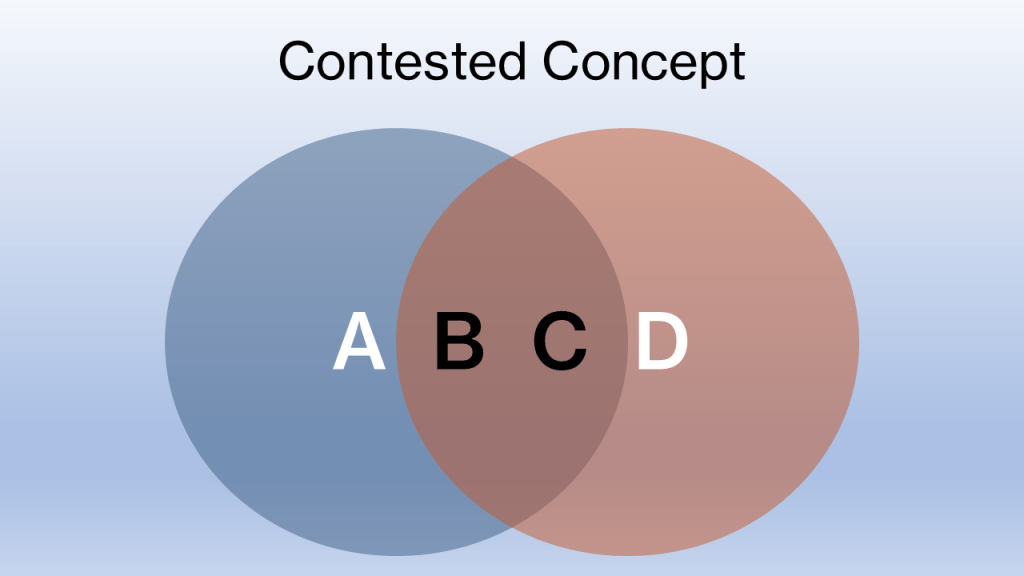
If one person believes a term means {A, B, C} and another believes it means {B, C, D}, the overlap creates a dangerous illusion of agreement. The disagreement hides in the margins. A and D don’t merely differ. They are often irreconcilable.
Image: Venn diagramme of a contested concept. Note: This is illustrative and not to scale
Fairness is a reliable example. One person believes fairness demands punishment, including retributive measures. Another believes fairness permits restoration but rejects retribution, citing circumstance, history, or harm minimisation. Both invoke fairness sincerely. The shared language conceals the conflict.
When such disputes reach court, they are not resolved by semantic reconciliation. They are resolved by authority. Power steps in where meaning cannot. This is just one illustration. There are many.
I thought it worth sharing how LIH came about, if only to dispel the notion that it’s a fashionable response to contemporary politics. It isn’t. It’s the slow crystallisation of a long-standing intuition: that many of our most cherished concepts don’t fail because we misuse them, but because they were never capable of doing the work we assigned to them.
















 Philosophics