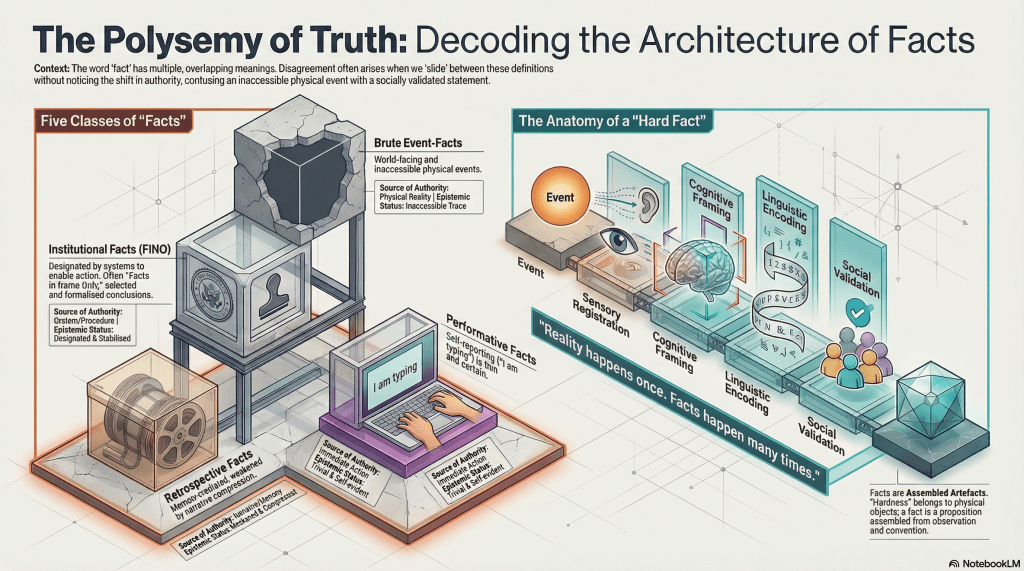
I want to clarify my recent The Trouble with Facts post. I realise that I was speaking to one non-trivial form of facts, but there is more than one class of facts. We argue about facts as if the word named a single, stable thing. It doesn’t. It names a family of very different things, quietly grouped together by habit, convenience, and institutional need. Most disputes about facts go nowhere, not because one side is irrational, but because the word itself is doing covert work. We slide between meanings without noticing, then act surprised when disagreement follows. This piece is an attempt to slow that slide.
Audio: NotebookLM summary podcast of this topic.
Polysemy We Notice, Polysemy We Don’t
We are comfortable with ambiguity when it is obvious. A bank can be a financial institution or the edge of a river. A bat can be an animal or a piece of sports equipment. Context resolves these instantly. No one feels existentially threatened by the ambiguity.
Fact is different. The word is polysemous in a way that is both subtle and consequential. Its meanings sit close enough to bleed into one another, allowing certainty from one sense to be smuggled into another without detection. Calling something a fact does not merely describe it. It confers authority. It signals that questioning should stop. That is why this ambiguity matters.
Different Kinds of Facts
Before critiquing facts, we need to sort them.
1. Event-facts (brute, world-facing) As mentioned previously, these concern what happens in the world, independent of observation.
A car collides with a tree.
Momentum changes.
Metal deforms.
These events occur whether or not anyone notices them. They are ontologically robust and epistemically inaccessible. No one ever encounters them directly. We only ever encounter traces.
2. Indexical or performative facts (trivial, self-reporting) “I am typing.”
I am doing this now – those now may not be relevant when you read this. This is a fact, but a very thin one. Its authority comes from the coincidence of saying and doing. It requires no reconstruction, no inference, no institutional validation. These facts are easy because they do almost no work.
3. Retrospective personal facts (memory-mediated) “I was typing.”
This may be relevant now, at least relative to the typing of this particular post. Still a fact, but weaker. Memory enters. Narrative compression enters. Selectivity enters. The same activity now carries a different epistemic status purely because time has passed.
4. Prospective statements (modal, not yet facts) “I will be typing.”
This is not yet a fact. It may never come to be one. It is an intention or prediction that may or may not be realised. Future-tense claims are often treated as incipient facts, but this is a category error with real consequences.
5. Institutional facts (designated, procedural) “The court finds…” “The report concludes…”
These are facts by designation. They are not discovered so much as selected, formalised, and stabilised so that systems can act. They are unlikely to rise to the level of facts, so the legal system tends to generate facts in name only – FINO, if I am being cute.
All of these are called ‘facts’. They are not interchangeable. The trouble begins when certainty migrates illicitly from trivial or institutional facts into brute event-facts, and we pretend nothing happened in the transfer.
One Motor Vehicle
Reconsider the deliberately simple case: A motor vehicle collides with a tree. Trees are immobile, so we can rule out the tree colliding with the car.
Ontologically, something happened. Reality did not hesitate. But even here, no one has direct access to the event itself.
The driver does not enjoy privileged access. They experience shock, adrenaline, attentional narrowing, selective memory, post hoc rationalisation, perhaps a concussion. Already several layers intervene before language even arrives.
A rough schema looks like this:
event → sensory registration → cognitive framing → linguistic encoding → social validation
Ontology concerns what happens. Epistemology concerns how anything becomes assertable.
Modern thinking collapses the second into the first and calls the result the facts.
People speak of “hard facts” as if hardness transfers from objects to propositions by proximity. It doesn’t. The tree is solid. The fact is an artefact assembled from observation, inference, convention, and agreement.
And so it goes…
Why the Confusion Persists
When someone responds, “But isn’t it a fact that I read this?”, the answer is yes. A different kind of fact.
The error lies not in affirming facts, but in failing to distinguish them. The word fact allows certainty to migrate across categories unnoticed, from trivial self-reports to brute world-events, and from institutional verdicts to metaphysical claims. That migration is doing the work.
Conclusion
Clarifying types of facts does not weaken truth. It prevents us from laundering certainty where it does not belong.
Facts exist. Events occur. But they do not arrive unmediated, innocent, or singular.
Reality happens once. Facts happen many times.
The mistake was never that facts are unreal. It was believing they were all the same kind of thing.
What we call facts are not discoveries of an unfiltered world. They are the end-products of mediation.
Let’s walk through an example.
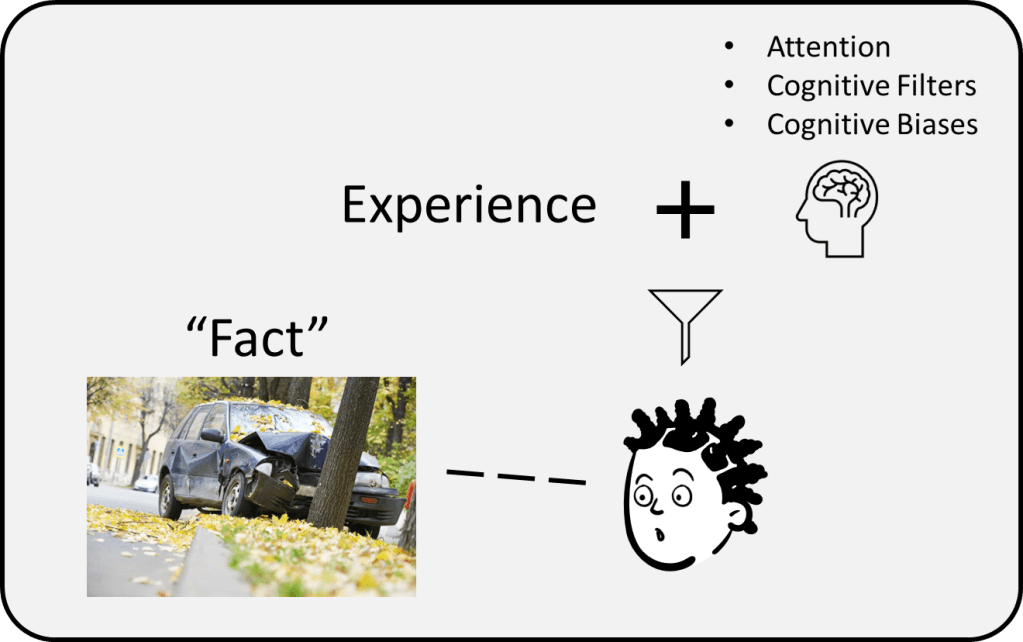
Image: Autosmash example. An observer arrives with experience – from genetic predisposition to childhood trauma to winning the lottery. Whatever it might be. Of course, they have many cognitive deficits, biases and filters. Then, there’s the immediate problem of attention. When did they notice the event? Did they turn to look after hearing the noise, or were they meditating on the tree in that moment?
Apparently, a motor vehicle has collided with a tree. Trees are immobile objects, so we can safely rule out the tree colliding with the car.*
So what, exactly, are the facts?
Audio: NotebookLM summary podcast of this topic.
Ontology (the boring bit)
Ontologically, something happened.
A car struck a tree. Metal deformed. Momentum stopped.
Reality did not hesitate. It did not consult witnesses. It did not await interpretation.
This is the part Modernity likes to gesture at reverently before immediately leaving it behind.
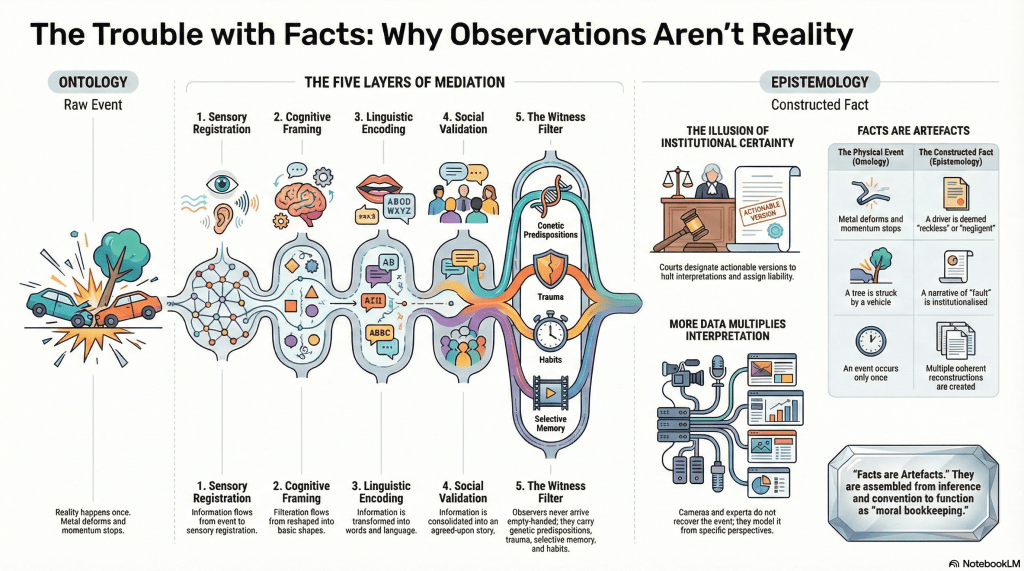
Image: Requisite NotebookLM infographic on this content.
The Witness
Even the driver does not enjoy privileged access to “what really happened”.
They get:
proprioceptive shock
adrenaline distortion
attentional narrowing
selective memory
post hoc rationalisation
possibly a concussion
Which is already several layers deep before language even arrives to finish the job.
We can generalise the structure:
event → sensory registration → cognitive framing → linguistic encoding → social validation
Ontology: events occur. States of affairs obtain. Something happens whether or not we notice.
Epistemology: observation is always filtered through instruments, concepts, language, habits, and incentives.
Modern sleight of hand: collapse the second into the first and call the result the facts.
People love the phrase “hard facts”, as if hardness transfers from objects to propositions by osmosis. It doesn’t. The tree is solid. The fact is not.
Facts are artefacts. They are assembled from observation, inference, convention, and agreement. They function. They do not reveal essence.
Reality happens once. Facts happen many times, differently, depending on who needs them and why.
Filtration
An event occurred. A car struck a tree.
Then an observer arrives. But observers never arrive empty-handed.
They arrive with history: genetics, upbringing, trauma, habits, expectations, incentives. They arrive already filtered.
Were they already looking, or did the noise interrupt something else entirely?
Reality happens once. Facts happen many times, differently, depending on who needs them and why.
Here Comes the Law
This is where the legal system enters, not because truth has been found, but because closure is required.
Courts do not discover facts. They designate versions of events that are good enough to carry consequences. They halt the cascade of interpretations by institutional force and call the result justice.
At every epistemic level, what we assert are interpretations of fact, never access to ontological essence.
Intent, negligence, recklessness. These are not observations. They are attributions. They are stopping rules that allow systems to function despite uncertainty.
The law does not ask what really happened. It asks which story is actionable.
Two Motor Vehicles
Now add a second moving object.
Another car enters the frame, and with it an entire moral universe.
Suddenly, the event is no longer merely physical. It becomes relational. Agency proliferates. Narratives metastasise.
Who was speeding? Who had the right of way? Who saw whom first? Who should have anticipated whom?
Intent and motive rush in to fill the explanatory vacuum, despite remaining just as unobservable as before.
Nothing about the ontology improved. Everything about the storytelling did.
Where the tree refused intention, the second vehicle invites it. We begin inferring states of mind from trajectories, attributing beliefs from brake lights, extracting motives from milliseconds of motion.
But none of this is observed.
What we observe are:
vehicle positions after the fact,
damage patterns,
skid marks,
witness statements already filtered through shock and expectation.
From these traces, we construct mental interiors.
The driver “intended” to turn. The other driver “failed” to anticipate. Someone was “reckless”. Someone else was merely “unlucky”.
These are not facts. They are interpretive assignments, layered atop already mediated observations, selected because they allow responsibility to be distributed in socially recognisable ways.
This is why explanation now fractures.
One cascade of whys produces a story about distraction or poor judgment. Another produces a story about road design or visibility. Another about timing, traffic flow, or urban planning.
Each narrative is plausible. Each is evidence-constrained. None is ontologically privileged.
Yet one will be chosen.
Not because it is truer, but because it is actionable.
The presence of a second vehicle does not clarify causation. It merely increases the number of places we are willing to stop asking questions.
Modernity mistakes this proliferation of narrative for epistemic progress. In reality, it is moral bookkeeping.
The crash still occurred. Metal still deformed. Momentum still stopped.
What changed was not access to truth, but the urgency to assign fault.
With one vehicle and a tree, facts already fail to arrive unmediated. With two vehicles, mediation becomes the point.
And still, we insist on calling the result the facts.
But nothing fundamental has changed. We have not escaped mediation. We have merely scaled it up and professionalised it.
Cameras do not record reality. They record:
a frame,
from a position,
at a sampling rate,
with compression,
under lighting conditions,
interpreted later by someone with a mandate.
Video feels decisive because it is vivid, not because it is ontologically transparent. It freezes perspective and mistakes that freeze for truth. Slow motion, zoom, annotation. Each step adds clarity and distance at the same time.
Experts do not access essence either. They perform disciplined abduction.
From angles, debris fields, timing estimates, and damage profiles, they infer plausible sequences. They do not recover the event. They model it. Their authority lies not in proximity to reality, but in institutional trust and methodological constraint.
More data does not collapse interpretation. It multiplies it.
With enough footage, we don’t get the story. We get competing reconstructions, each internally coherent, each technically defensible, each aligned to a different question:
Who is legally liable?
Who is financially responsible?
Who violated policy?
Who can be blamed without destabilising the system?
At some point, someone declares the evidence “clear”.
What they mean is: we have enough material to stop arguing.
This is the final Modern illusion: that accumulation converges on essence. In reality, accumulation converges on closure.
The event remains what it always was: inaccessible except through traces. The facts become thicker, more confident, more footnoted. Their metaphysical status does not improve.
Reality happened once. It left debris. We organised the debris into narratives that could survive institutions.
Cameras didn’t reveal the truth. Experts didn’t extract it. They helped us agree on which interpretation would count.
And agreement, however necessary, has never been the same thing as access to what is.
* I was once driving in a storm, and a telephone pole fell about a metre in front of my vehicle. My car drove over the pole, and although I was able to drive the remainder of the way home, my suspension and undercarriage were worse for the wear and tear.
Written by Bry Willis and ChatGPT 5.2 after an extended chat about the image as a talking point about the inaccessibility of facts.
I Am a Qualified Subjectivist. No, That Does Not Mean ‘Anything Goes’.
Make no mistake: I am a subjectivist. A qualified one. Not that kind of qualified – the qualification matters, but it’s rarely the part anyone listens to.
Image: Not that kind…
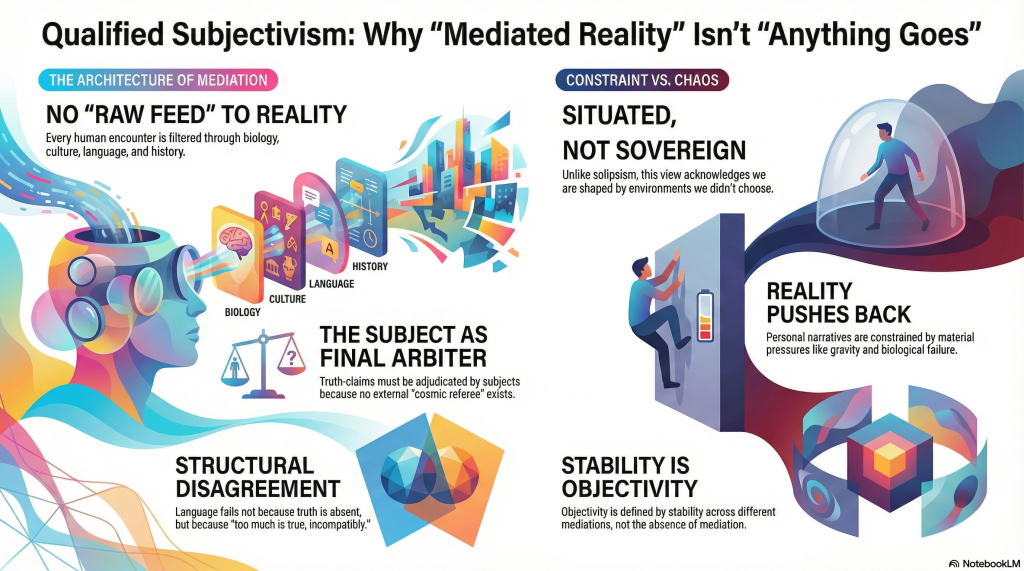
Here is the unglamorous starting point: all human encounters with the world are mediated. There is no raw feed. No unfiltered access. No metaphysical lead running directly from ‘reality’ into the human mind. Every encounter is processed through bodies, nervous systems, cultures, languages, technologies, institutions, and histories.
Audio: NotebookLM summary podcast of this content – See addendum below.
Whilst I discuss the specific architecture of this mediation at length in this preprint, here I will keep it simple.
If you are human, you do not encounter reality as such. You encounter it as processed. This is not controversial. What is controversial is admitting the obvious consequence: the subject is the final arbiter.
Image: NotebookLM Infographic of Qualified Subjectivism
The Subject Is the Final Arbiter
Every account of truth, reality, meaning, value, or fact is ultimately adjudicated by a subject. Not because subjects are sovereign gods, but because there is literally no other place adjudication can occur.
Who, exactly, do critics imagine is doing the adjudicating instead? A neutral tribunal floating outside experience? A cosmic referee with a clipboard? A universal consciousness we all forgot to log into?
There is no one else.
This does not mean that truth is ‘whatever I feel like’. It means that truth-claims only ever arrive through a subject, even when they are heavily constrained by the world. And constraint matters. Reality pushes back. Environments resist. Bodies fail. Gravity does not care about your personal narrative.
Why This Is Not Solipsism
Solipsism says: only my mind exists. That is not my claim. My claim is almost boring by comparison: subjects are situated, not sovereign.
We are shaped by environments we did not choose and histories we did not write. Mediation does not eliminate reality; it is how reality arrives. Your beliefs are not free-floating inventions; they are formed under biological, social, and material pressure. Two people can be exposed to the same event and encounter it differently because the encounter is not the event itself – it is the event as mediated through a particular orientation.
Why Objectivity Keeps Sneaking Back In
At this point, someone usually says: ‘But surely some things are objectively true.’
Yes. And those truths are still encountered subjectively. The mistake is thinking that objectivity requires a ‘view from nowhere’. It doesn’t. It requires stability across mediations, not the elimination of mediation altogether. We treat some claims as objective because they hold up under variation, while others fracture immediately. But in all cases, the encounter still happens somewhere, to someone.
The Real Source of the Panic
The real anxiety here is not philosophical. It’s moral and political. People are terrified that if we give up the fantasy of unmediated access to universal truth, then legitimacy collapses and ‘anything goes’.
This is a category error born of wishful thinking. What actually collapses is the hope that semantic convergence is guaranteed. Once you accept that mediation is unavoidable, you are forced to confront a harder reality: disagreement is often structural, not corrigible. Language does not fail because nothing is true. Language fails because too much is true, incompatibly.
So Yes, I Am a Qualified Subjectivist
Interpretation only ever occurs through subjects. Subjects are always mediated. Mediation is always constrained. And constraint does not guarantee convergence.
That is the position. It is not radical, fashionable, or comforting. It is simply what remains once you stop pretending there is a god’s-eye view quietly underwriting your arguments. Discomfort is simply a reliable indicator that a fantasy has been disturbed.
Addendum: Geworfenheit and the Myth of the Neutral Subject
Audio: NotebookLM summary of this Geworfenheit addendum
If all this sounds suspiciously familiar, that’s because it is. Heidegger had a word for it: Geworfenheit – usually translated as thrownness.
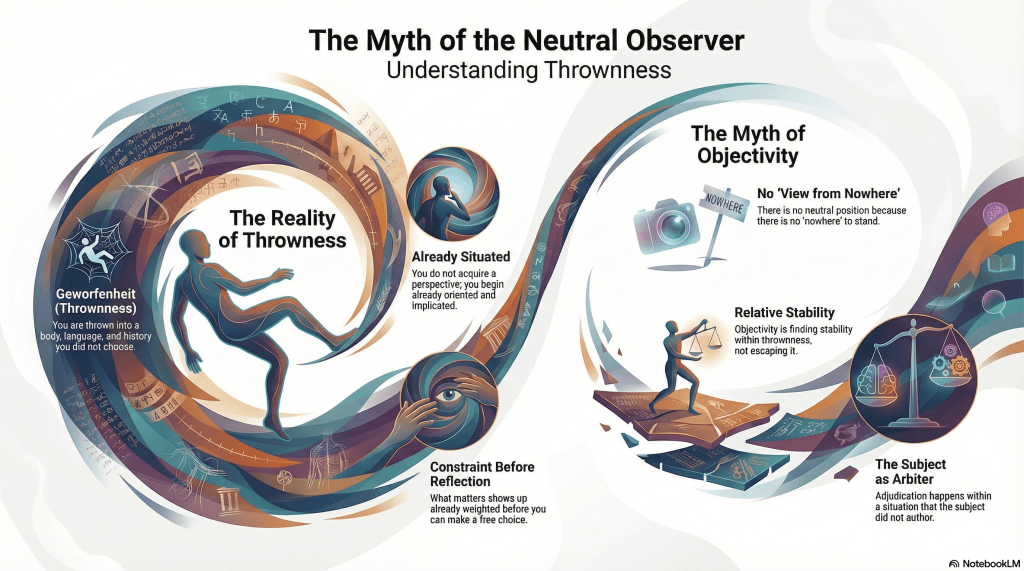
The idea is simple, and deeply irritating to anyone still hoping for a clean start. You do not enter the world as a neutral observer. You are thrown into it: into a body, a language, a culture, a history, a set of institutions, a moment you did not choose. You do not begin from nowhere and then acquire a perspective. You begin already situated, already oriented, already implicated.
This is not a poetic flourish. It is a structural claim about human existence.
Image: Another NotebookLM infographic for the fun of it.
What my qualified subjectivism insists on – without Heidegger’s ontological theatre – is the same basic constraint: there is no view from nowhere because there is no nowhere to stand. The subject does not float above mediation; the subject is constituted by it. Thrownness is not an accident to be corrected by better theory. It is the condition under which any theorising occurs at all.
Seen this way, the demand for pure objectivity starts to look less like a philosophical ideal and more like nostalgia for an impossible innocence. A wish to rewind existence to a point before bodies, languages, power, and history got involved. That point never existed.
Geworfenheit matters here because it dissolves the caricature that subjectivism is about arbitrary choice. Being thrown is the opposite of choosing freely. It is constraint before reflection. Orientation before argument. Salience before reasons. You do not decide what matters from a neutral menu; what matters shows up already weighted, already charged, already resistant.
This is why appeals to “just be objective” always ring hollow. Objectivity does not mean escaping thrownness. It means achieving relative stability within it. Some claims hold across many thrown positions. Others fracture immediately. That distinction matters. But none of it happens outside mediation.
So when I say the subject is the final arbiter, I am not crowning the subject king of reality. I am pointing out the obvious: adjudication happens somewhere, to someone, from within a situation they did not author. Thrownness guarantees that there is no cosmic referee waiting to overrule the encounter.
If that makes you uncomfortable, good. It should. Discomfort is often just the sensation of a fantasy losing its grip.
I do not assume that normative assertions function as descriptive truths. Realism is compelling because it promises that moral disagreement has a fact of the matter beyond persuasion. The argument here is that this promise cannot be kept without mediation. Nevertheless, this essay proceeds by granting the realist premise – that Truth exists – in order to examine whether that premise can, on its own terms, generate normative authority. The argument is structural rather than polemical: to move from Ontology (what exists) to Authority (what binds) requires a mechanism of transport. That mechanism is mediation. The claim advanced here is that this mediation is irreducibly rhetorical, and that no account of normativity can bypass this fact without smuggling authority under metaphysical cover.
Audio: NotebookLM summary podcast of this content.
Introduction
Grant, purely for the sake of argument, that Truth – and by extension Justice, Goodness, or any other realist normative entity – exists independently of human cognition. Even so, a prior and unavoidable question arises: how does such Truth ever become accessible to finite, discursive agents like us?
Before asking whether Truth exists in itself, we must account for how it enters ethical life for us. This is not a semantic quibble. It marks the difference between an ontological assertion and an operative ethics.
This essay argues that all access to Truth is irreducibly mediated, and that this mediation is rhetorical in nature. Even if Truth exists independently of human minds, it never arrives in normative life except through language, interpretation, argument, persuasion, narrative, and institutional articulation. Any ethical framework that treats metaphysical grounding as if it bypassed these mediations risks conflating ontology with authority.
This is neither relativism nor subjectivism. It is an analytic claim about conditions of access and normative traction.
Truth and Its Access Conditions
Suppose you accept that Truth exists ‘out there’—not as a projection or consensus shorthand, but as an intransitive feature of reality. This is the core commitment of metaphysical realism. The issue is not whether Truth exists, but how it becomes accessible to agents embedded in language, culture, and institutions.
For any putative Truth to function normatively, at least five stages are required:
Identification — recognising something as a candidate for truth
Description — articulating that candidate in language
Justification — offering reasons for accepting it
Communication — transmitting those reasons to others
Ratification — persuading a community to treat the claim as binding
These stages are not epistemic luxuries. They are the conditions under which a putative Truth acquires normative force – the capacity to obligate, justify, or condemn.
Remove any one of these stages, and Truth collapses into either an inert fact or an unintelligible assertion. Crucially, each stage is rhetorical: none operates through brute ontology alone, but through discursive practices of interpretation, evaluation, and adjudication.
Rhetoric Is Not Spin
To say that Truth is rhetorically mediated is not to reduce truth to manipulation, persuasion-for-its-own-sake, or spin.
It is simply to recognise that:
Truth claims are discerned in language
They are evaluated against alternatives
They are assessed within communities shaped by practices, norms, disciplines, and institutions
Truth as it functions in human life is always a claim in argument, never a self-announcing datum.
Even mathematics – the paradigm of certainty – does not become normatively operative without symbolic articulation, shared standards of proof, and communal validation. Mathematical truths may exist independently, but what counts as a proof, a result, or an error – and thus what obligates assent – is entirely mediated by symbolic practice and communal ratification.
In its classical sense, rhetoric is not deception. It is the set of discursive practices by which claims become intelligible, contestable, and action-guiding across contexts of disagreement.
Where Normativity Actually Emerges: The Three-Stage Problem
The problem crystallizes at a precise moment: the move from description to prescription. Even if we grant that the Good exists objectively and eternally, three distinct operations are required to generate obligation:
Descriptive claim: ‘The Good exists and has properties X, Y, Z’
Interpretive claim: ‘In this situation, the Good requires action A rather than B’
Prescriptive claim: ‘Therefore you ought to do A’
Each transition requires distinct work. The first may be metaphysical. But the second and third are irreducibly rhetorical. They involve judgment, application, contextual interpretation, and the translation of abstract principle into concrete obligation.
Crucially, even the interpretive middle step – which often masquerades as mere clarification – is where most normative force gets generated. To say ‘the Good requires this action in this context’ is not to read off a fact from the world. It is to make an argued claim about meaning, relevance, and application.
This is where participatory metaphysics does its quietest work. By framing interpretation as ‘participation in the Good’ rather than as ‘argued judgment about what the Good requires,’ such frameworks obscure the rhetorical operation they’re performing. Interpretation gets presented as disclosure rather than construction.
But there is no route from ‘the Good exists’ to ‘you must do X’ that bypasses interpretation. And interpretation is rhetoric.
The Potential Energy Analogy
Consider an analogy. Gravitational potential energy exists independently of human recognition. A boulder atop a cliff possesses real energy by virtue of its position. But that energy does no work – moves nothing, heats nothing, powers nothing – until converted through specific mechanisms: falling, rolling, controlled descent.
The Good may be precisely like this: real, eternal, independent of us. But for it to become normatively operative – to obligate us, to guide our choices, to settle our disagreements – it must be converted from potential into kinetic form. That conversion is mediation. And mediation is rhetorical.
This is not relativism about the Good’s existence. It is realism about the conditions under which existence generates obligation.
A Concrete Example
When Catholic bishops disagree about capital punishment:
They agree on the descriptive claim: ‘God exists and is perfectly Good’
They disagree on the interpretive claim: ‘What does divine Justice require regarding state execution?’
They therefore disagree on the prescriptive claim: ‘Is capital punishment permissible?’
The descriptive agreement doesn’t resolve the interpretive disagreement. No amount of metaphysical depth about God’s nature tells you directly what Justice requires regarding capital punishment. That requires interpretation of Scripture, tradition, natural law, human dignity, social context, prudential judgment – all rhetorical operations.
Appeals to ‘the Good itself’ don’t settle the dispute. They just rename it. Instead of ‘bishops disagree about ethics,’ it becomes ‘bishops are discerning what participation in the Good requires’. The language changes; the rhetorical work remains.
The Zeno Structure of Moral Grounding
At this point, the realist faces a structural problem that resembles Zeno’s paradox. When pressed on how Truth becomes binding, the realist response multiplies explanatory depth:
The Good exists objectively
We apprehend it through reason
Reason itself is oriented toward the Good
That orientation is grounded in rational agency
Rational agency participates in…
Each step is coherent. Each promises that obligation is just one more metaphysical move away. But none ever performs the action ‘therefore, you must do X in this situation’.
This is not merely infinite regress – philosophers tolerate infinite structures. The problem is asymptotic normativity: explanations that get progressively closer to bindingness without ever crossing the threshold into concrete obligation.
What’s missing is not metaphysical depth but the moment of arrival. Until someone says ‘this counts as wrong here, and therefore you ought to stop,’ nothing has happened in ethical space. The arrow is still subdividing its path.
Rhetoric is what collapses the infinite series into a finite act. It does for ethics what accepting motion does for Zeno’s paradox: it stops subdividing and acts. This is not an epistemic shortcut – it is the mechanism by which normativity becomes operative.
‘Participation in the Good’ sounds like arrival, but it is actually eternal approach. It explains why the Good matters in principle while indefinitely postponing the moment when obligation becomes concrete and contestable. That postponement is not a feature – it is the avoidance of the very question at issue.
Three Remaining Escapes (and Why They Fail)
A. The Implicit Normativity Move
A sophisticated realist might respond: ‘Interpretation is required, yes, but the normativity is already there implicitly. Interpretation merely makes explicit what was already required’.
But implicit normativity is indistinguishable from no normativity unless it can be specified. Until interpretation specifies what is required here, the obligation has no action-guiding content. A normativity that exists only implicitly, without criteria of application, is functionally equivalent to no normativity at all.
‘Implicit obligation’ means ‘not yet specified,’ which means ‘not yet operative’. The work of making it operative is interpretation – which is rhetoric.
B. The Practical Wisdom Escape
Another likely move: ‘Interpretation is not rhetoric; it’s phronesis. Practical wisdom directly apprehends what the Good requires’.
But practical wisdom does not bypass mediation; it relocates it into judgment. If practical wisdom yields different answers for different agents, it is still interpretive. If it cannot be articulated, justified, or contested, it cannot function socially. The moment phronesis is communicated or taught, it becomes rhetorical.
Judgment, when it claims authority over others, must still be articulated, defended, and enforced. Incommunicable wisdom is indistinguishable from private intuition. And private intuitions don’t settle public disagreements.
C. The ‘This Proves Too Much’ Objection
Someone might say: ‘If your argument is right, then no ethical system can ever claim authority. Everything dissolves into endless contestation’.
But the claim is not that normativity evaporates under mediation, but that it emerges there. This is not nihilism – it is an explanation of normativity’s location, not its abolition. That normativity is mediated does not mean it is arbitrary. Mediation operates under constraints of coherence, consistency, consequence, and resistance from the world and from other agents.
Mediation is constrained by material resistance, coherence, practical failure, and worldly recalcitrance. The claim is not that ‘anything goes’. It’s that what goes must be argued for, negotiated, and sustained through rhetorical practices. That’s not less demanding than metaphysical grounding – it’s more honest about where the work happens.
Consequences for Ethical Frameworks
If access to Truth is always mediated, then several consequences follow:
Authority is interpretive, not ontological
Disagreement is structural, not pathological
Norms are contested, not deduced unilaterally
Power shapes uptake, not metaphysical purity
This has decisive implications for meta-ethics. Ethical life is not insulated from negotiation; it is constituted by it. Normativity does not descend fully formed from metaphysics into practice. It is worked out – imperfectly, provisionally, and under constraint – within social space.
Ethics, in other words, is not a museum of pristine ideals. It is a field of contested meanings under conditions of risk, conflict, and plural commitment.
Realism Without Rhetoric Is Empty
A realist might reply: Truth exists. Once we uncover it, everything follows.
But uncovering is not a metaphysically neutral act. Discovery, articulation, persuasion, and institutionalisation are themselves conditioned by:
Language, which frames intelligibility
Narrative, which shapes resonance and coherence
Institutions, which ratify selectively
Power, which governs whose claims are heard
The realist may insist that mediation merely follows discovery. But this assumes a distinction that cannot be sustained. Until a truth is articulated, justified, and ratified, there is no criterion by which its discovery can be distinguished from error, fantasy, or ideology. What is not mediated is not merely unpersuasive; it is normatively indistinguishable from falsehood. Ontology alone cannot perform this discrimination.
If access to Truth is always mediated, then metaphysical depth alone cannot generate normative authority. The locus of ethical force shifts from an external realm to the discursive space where claims are interpreted, contested, and enforced. A grounding that never binds except through mediation is indistinguishable, at the level of authority, from mediation itself.
This shift is not relativism. It is a descriptive account of how ethical life actually functions.
Moral Authority Under Rhetorical Conditions
To say Truth → Rhetoric is not to deny the possibility of rigorous assessment. It is to insist that:
Normative claims must offer contestable reasons
Moral authority must disclose its interpretive moves
Disagreement must be treated as clarifying, not corrosive
Ethical systems must be judged by their discursive dynamics as much as their metaphysical commitments
Truth in itself may be metaphysically deep. But truth-as-binding never operates outside rhetoric.
Conclusion
Grant the realist premise if you like: Truth exists. Even then, metaphysical depth alone does not explain how Truth becomes accessible, meaningful, or binding for discursive agents.
Because access is always mediated, authority cannot bypass rhetoric. Ethical life requires not only an ontology, but an account of how claims are interpreted, argued over, and enforced. A Truth that cannot be accessed – named, contested, communicated – remains normatively inert.
The fundamental error is treating the descriptive-interpretive-prescriptive chain as if it could be collapsed into a single operation called ‘participation’. It cannot.
Even if the Good exists exactly as realists claim – eternal, objective, transcendent – it becomes normatively operative for finite agents only through a sequence of mediations:
Interpretation (what does it mean?)
Application (what does it require here?)
Justification (why this action rather than that one?)
Communication (how do we persuade others?)
Enforcement (who ensures compliance?)
Each mediation is rhetorical. Each involves judgment, argument, and institutional power. Each is contestable.
This is not a bug in ethical life. It is its structure. Any framework that promises to transcend these mediations through metaphysical depth is not offering a solution. It is concealing the problem while continuing to rely on exactly the mechanisms it claims to surpass.
To bring Truth into the world of action is to engage rhetoric not as an ornamental layer, but as the condition of ethical life itself.
Thus: Truth → Rhetoric. Not because truth is arbitrary, but because it is always mediated.
Appendix: Clarifying the Claim
This argument does not deny realism, nor does it reject the possibility of mind-independent truth. What it rejects is the unexamined slide from ontology to authority.
This distinction is formalised – though not originated – by the Mediated Encounter Ontology (MEOW), which holds that all human access to the world is mediated. Whatever exists may exist independently of us; whatever binds us does not. The present argument does not depend on accepting MEOW as a system; it relies only on the minimal claim that access precedes authority.
MEOW formalises this through a layered account of encounter:
T0 — biological substrate
T1 — cognitive–perceptual interface
T2 — linguistic–symbolic mediation
T3 — social–technical norms and institutions
Normativity operates at the upper tiers. Ethical obligation, justice, and virtue do not arrive with built-in binding force. Whatever their metaphysical status, their authority for human agents arises only through interpretation, articulation, justification, and social uptake.
This is the precise sense in which Truth → Rhetoric should be read. It is not an ontological identity claim. It is a claim about normative operability.
Rhetorical mediation is constrained – by material resistance, coherence, practical failure, and worldly recalcitrance. But those constraints do not speak for themselves. They must still be named, argued over, prioritised, and enforced.
There is no route from is to ought that does not pass through language, judgment, and institutional uptake. Appeals to metaphysical depth do not remove this mediation; they conceal it.
Any framework that treats participation in ‘the Good’ as normatively binding without accounting for how that Good is interpreted, communicated, and enforced is already doing rhetorical work while pretending not to.
That pretence isn’t philosophical sophistication. It’s a familiar ideological gesture: power presenting itself as mere disclosure. Rhetoric is not what corrupts ethics. It is what makes ethics possible.
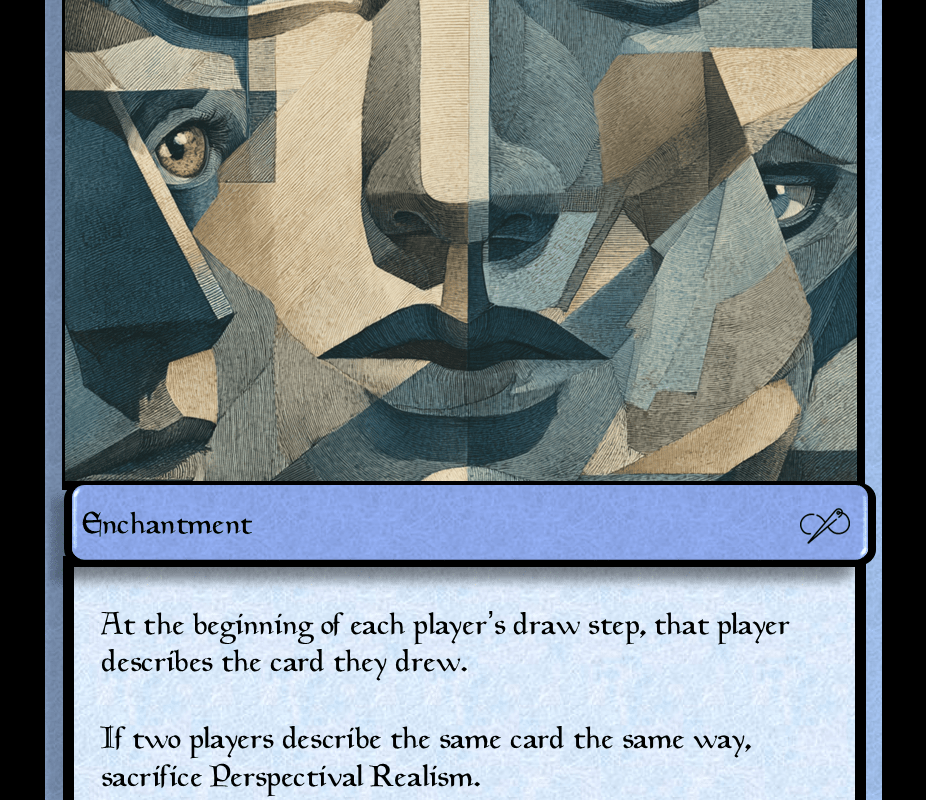
This Magic: The Gathering parody trading card was the first in my Critical Theory series.
It’s an important card for me. As with sex and gender, creating a taxonomic or ontological dichotomy poses categorical challenges. Despite the insufficiency of language, it’s still all I have to attempt to classify the world. In the case of articulating the perception of reality, we can choose between idealism and realism. The problem is that it’s not either; it’s both. Reality cannot be realised without both.
Reality, we’re told, exists. That confident noun has carried a great deal of human arrogance. It has underwritten empires, sciences, and sermons. Yet somewhere between Plato’s cave and the latest TED Talk, we forgot to ask a simpler question: for whom does reality exist, and from where is it seen?
Audio: NotebookLM podcast of this topic.
The parody trading card Perspectival Realism was born from that unease. Its mechanic is simple but cruel: at the beginning of each player’s draw step, they must describe the card they drew. The enchantment persists until two players describe a card in the same way—at which point the spell collapses. In other words, consensus kills magic.
Reality is always viewed from somewhere.
—Johannes Jaeger
That rule is the metaphysics of the thing.
When a player ‘describes’ a card, they are not transmitting information; they are constructing the object in linguistic space. The moment the description leaves their mouth, the card ceases to be a piece of paper and becomes a conceptual artefact.
This mirrors the insight of Kant, Nietzsche, and every post-structuralist who ever smoked too much Gauloises: perception isn’t passive. We don’t see reality; we compose it. Language isn’t a mirror but a paintbrush. The thing we call truth is not correspondence but coherence – a temporary truce among competing metaphors.
So the card’s enchantment dramatises this process. So long as multiple descriptions circulate, reality remains vibrant, contested, alive. Once everyone agrees, it dies the death of certainty.
Philosophers have spent centuries arguing whether the world is fundamentally real (existing independent of mind) or ideal (a projection of mind). Both sides are equally tiresome.
Realism, the old bulldog of metaphysics, insists that perception is transparent: language merely reports what’s already there. Idealism, its mirror adversary, claims the opposite – that what’s “there” is mind-stuff all along. Both mistakes are symmetrical. Realism forgets the perceiver; Idealism forgets the world.
Perspectival realism refuses the divorce. It begins from the premise that world and mind are inseparable aspects of a single event: knowing. Reality is not a photograph waiting to be developed, nor a hallucination spun from neurons – it’s a relation, a constant negotiation between perceiver and perceived.
For years, I called myself a Realist™ with an asterisk. That asterisk meant I understood the observer problem: that every ‘fact’ is perspective-laden. Then I became an Idealist™ with an asterisk, meaning I recognised that mind requires matter to dream upon.
The asterisk is everything. It’s the epistemic scar left by perspectival humility – the tacit admission that every claim about the world carries a hidden coordinate: said from here. It is not relativism, but situatedness. It is the philosophical equivalent of depth perception: without the offset, there’s no vision at all.
The card’s rule – sacrifice Perspectival Realism when two players describe a card identically – captures the tragedy of modernity. The Enlightenment taught us to chase consensus, to flatten multiplicity into “objective truth.” We became addicted to sameness, mistaking agreement for understanding.
But agreement is anaesthetic. When all perspectives converge, the world ceases to shimmer; it becomes measurable, predictable, dead. The card’s enchantment disappears the moment reality is stabilised, precisely as our cultural enchantment did under the fluorescent light of ‘reason’.
To live under perspectival realism is to acknowledge that reality is not what is drawn but what is described. And the description is never neutral. It is always written from somewhere – by someone, with a vocabulary inherited from history and stained by desire.
As long as multiple descriptions coexist, the game remains alive. The moment they fuse into one, the spell is broken, and the world returns to grey.
Bernardo Kastrup’s analytic idealism reminded me that consciousness might be primary, but perspectival realism refuses to pledge allegiance. It keeps both flags tattered but flying. The world exists, yes, but only ever for someone.
The enchantment, then, is not belief but perspective itself. So long as difference endures, the game continues.
I was browsing YouTube, and I got captivated by reaction videos, where a younger audience listens to music some of us grew up with and reacts to it. Time is a song I grew up on. Pink Floyd were a major influence on my music and my worldview. I have to admit that I am partial to the David Gilmour years and stopped caring about anything released after Roger Waters left. I have spent hours listening to their back catalogue with Syd Barrett and early David Gilmour, but Meddle, released in 1971, is about as far back as I prefer to go—even that old gem, Seamus.
Roger Waters penned the deepest lyrics for Pink Floyd, and this was one of his best. He wrote this in his late twenties, though it feels like he would have been older and wiser. I suppose he’s an old soul. Here’s the first verse:
Ticking away the moments that make up a dull day
Fritter and waste the hours in an offhand way
Kicking around on a piece of ground in your hometown
Waiting for someone or something to show you the way
This speaks to how we tend to take time for granted. Sometimes, we just want the time to pass. We’re bored, and we want to get on to something meaningful, eventful, or perhaps exciting. We might be sat in work or school just waiting for quitting time. We aren’t living in the moment or enjoying the moment. And we might just be kicking around on a piece of ground in our hometowns rather aimlessly. And whilst I am aware that many people are looking for someone to guide them to the next level, whether a religion, a vocation, a guru, or a hero, that bit’s never really resonated with me. I suppose I’ve always been naturally insouciant and Zen. Some have said to a fault.
you missed the starting gun
Tired of lying in the sunshine, staying home to watch the rain
You are young and life is long, and there is time to kill today
And then one day you find ten years have got behind you
No one told you when to run, you missed the starting gun
The second verse picks up where the first one left off. Let’s not forget that this is Britain—London—plenty of rain. But some people do get tired of lying in the sunshine living their routine workaday lives. When we are younger, the days feel longer. Time is stretched. Einsteinian relativity. Again, we’ve got time to pad out and fill. Something’s happening at the weekend. Let’s just fast-forward, but we can’t, so let’s fill the time with mindless prattle and television or somesuch. Once you were 18 and now you’re 28. What happened? Tens years gone. Where’d the time go?
The last line in the second verse is telling. For me, it’s more an indictment of quote-modern-unquote society. It only applies to those who buy into this worldview. I never bought in. It’s’ always been a sham. But for some, they reach 28 and realise they’ve made the wrong decisions for their lives to end up the way they may have envisaged. I’ve never had this grand vision.
one day closer to death
And you run, and you run to catch up with the sun but it's sinking
Racing around to come up behind you again
The sun is the same in a relative way but you're older
Shorter of breath and one day closer to death
Resistance is futile. You can’t escape the movement of time as represented by the quotidian sun. It will always lap you. The sun ages on a different time scale to you. The sun doesn’t appear to age. It was here when we arrived. It will be here when we leave. It was here before any of us were born. It will be here after we’ve all left. Yet with every lap of the sun, we are each another day closer to death. That day may be tomorrow, next week, or in a hundred years, but as Twelve-Step programmes remind us, we live one day at a time. Perhaps even this is too large of a time slice, as we can only live moment to moment. Anything else is but a construction. Nothing else is real. Memento Mori.
thought I’d something more to say
Every year is getting shorter, never seem to find the time
Plans that either come to naught or half a page of scribbled lines
Hanging on in quiet desperation is the English way
The time is gone, the song is over, thought I'd something more to say
Again, time is relative. When we are young, we yearn for things: perhaps to graduate high school; get a driver’s license; graduate college; get the job we wanted; get some promotion or recognition; get signed to a big label; get a big break; the list goes on.
For those who are planners, the best-laid plans go awry. We dream of whatever and even journal these thoughts, but in the words of another song, “you can’t always get what you want”.
We want to do this or that, but life gets in the way. We can’t do everything. Economists capture this by the notion of opportunity costs. We can do this but not that. It doesn’t matter if we are Elon Musk, Jeff Bezos, Bill Gates, or whomever. Time is the ultimate leveller.
We can just keep a stiff upper lip and persevere. Just occupy some place on this third rock, Next thing you know, the time is gone. I recall my ninety-odd-year-old father-in-law after his wife of seventy-five years died. He just wanted to die. He was done. He was ready to quit, but the music was still playing. Any semblance of hope was exchanged for the hope to reach the ending peacefully.
home again
Home, home again
I like to be here when I can
And when I come home cold and tired
It's good to warm my bones beside the fire
In this verse, Roger becomes reflective. He’s nostalgic for home. Anyone with a home has a place to return to after work, after school, or a childhood memory, but to touring performers, home is an even more special place. It’s a place to return to after life on the road, perhaps for months or years. Consider Odysseus and the travellers of old. This home.
He wants to be in this comfortable, familiar place. And after a long day or excursion, it’s a place to rejuvenate and rekindle by the warmth of the fire.
softly spoken magic spells
Far away across the field
The tolling of the iron bell
Calls the faithful to their knees
To hear the softly spoken magic spells
The final verse is even more metaphorical than the others. There’s an allusion. Religious allegory. In the distance, we hear the peal of the church bell beckoning the parishioners to hear the palliative words of the vicars and priests and whatnot. Or perhaps these softly spoken magic spells are simply the prayers of the individuals.
In deference to Barthes, the author is dead. But it doesn’t matter this is my interpretation—my meaning. Even more so, in deference to chapter eight of the Matter with Things, poetry and music are meant to be appreciated as a whole, not dissected. We can reflect on the words and phrases—even the melodies and rhythms—but the words are less than they sum to. Still, this piece moves me. It always has.







 Philosophics