Perspectival Realism: The First Ontology Without an Asterisk

6–10 minutes

The realism remains; the universality does not.

There comes a moment in any serious thinker’s life when the metaphysical menu starts looking like a bad buffet: too much on offer, none of it quite edible, and the dishes that appear promising turn out to depend on ingredients you can’t stomach. Realism insists the world is simply there, chugging along regardless of your opinions. Anti-realism points out, inconveniently, that all your access is wildly mediated. Perspectivism adds humility. Constructivism chastises you for overconfidence. Analytic Idealism sweeps matter off the table entirely, until you ask why consciousness spits out such stubbornly consistent patterns.

I’ve been through all of them.
Realism*—asterisk for “but what about mediation?”
Idealism*—asterisk for “but what about resistance?”

Everything almost worked.
And “almost” is the metaphysical kiss of death.
“Almost” is where the asterisks live.

Perspectival Realism is the first position I can hold without planting that apologetic little star in the margins.

Audio: NotebookLM podcast summary on this topic.

The Asterisk Journey (Brief, Painless, Necessary)

This isn’t a conversion narrative. It’s a salvage operation. Each station on the journey left me with tools worth keeping.

Layer 1: Iconography (Hoffman, minus the metaphysics)

Perception is not a window. It’s an interface. A species-specific dashboard designed for survival, not truth. Evolution gave you a set of icons—colour patches, contrast edges, looming shapes—not an accurate rendering of reality’s architecture.

Uexküll called this the umwelt: every organism inhabits its own perceptual slice of the world. Bees see ultraviolet; snakes sense heat; humans see embarrassingly little.

This is Layer 1 mediation:
Reality-as-filtered-for-primates.

Layer 2: Instrumentation (Kastrup, minus the leap)

Consciousness is the instrument through which reality is measured. Measuring instruments shape the measurements. That doesn’t make the world mind-shaped; it just means you only ever get readings through the apparatus you’ve got.

This is Layer 2 mediation:
Your cognitive architecture—predictive priors, attentional limitations, spatial-temporal scaffolding—structures experience before thought arrives.

Where I leave Kastrup behind is the familiar leap:
“Because consciousness measures reality, reality must be made of consciousness.”
That’s the instrumentality fallacy.

You need consciousness to access the world.
That tells you nothing about what the world is.

Layer 3: Linguistic–Cultural Carving (Your home field)

And then comes the mediation philosophers most reliably ignore: language.
Language does not describe reality. It carves it.

Some cultures divide colour into eleven categories; some into five. The Müller-Lyer illusion fools Westerners far more than it fools hunter-gatherers. Concepts feel natural only because you inherited them pre-packaged.

This is Layer 3 mediation: the cultural-linguistic filter that makes the world legible—and in the same breath, distorts it.

You mistake the map for the territory because it’s the only map you’ve ever held.


The Hard Problem, Dissolved — Not Solved

When English splits the world into “mental” and “physical,” it accidentally manufactures the “hard problem of consciousness.” Sanskrit traditions carve reality differently and end up with different “mysteries.”

The hard problem isn’t a revelation about reality.
It’s a conceptual knot tied by Layer 3 mediation.

Changing the ontology to “everything is mind” doesn’t untie the knot.
It just dyes the rope a different colour.


The Triple Lock

Put the three layers together and you get the honest picture:

  1. Your senses give you icons, not the thing-in-itself.
  2. Your cognition structures those icons automatically.
  3. Your culture tells you what the structured icons mean.

And yet—despite all of this—the world pushes back.

Gravity doesn’t care about your interpretive community.
Arsenic does not negotiate its effects with your culture.
Your beliefs about heat won’t keep your hand from burning.

This is the fulcrum of Perspectival Realism:

Reality is real and resists us, but all access is triply mediated.

The realism remains.
The universality does not.


Why Perspectival Realism is Not Relativism

Relativism says: “Everyone’s perspective is equally valid.”
Perspectival Realism says: “Everyone’s perspective is equally situated.”

Very different claims.

Some perspectives predict better.
Some cohere better.
Some survive reality’s resistance better.
Some transfer across contexts better.
Some correct their own errors faster.

You don’t need a view from nowhere to say that.
You just need to notice which maps get you killed less often.


What This Framework Enables

1. Progress without foundation myths

Science improves because reality resists bad models. Mediation doesn’t prevent progress; it’s the condition of it.

2. Critique without arrogance

You can rank perspectives without pretending to hover above them.

3. Cross-cultural dialogue without imperialism or despair

Cultures carve experience differently, but they’re carving the same underlying world. Translation is hard, not impossible.

4. Honest metaphysics

No glamourised escape from sensory embodiment, cognitive bias, or cultural inheritance.
Just the patient business of refining our mediated grip on the real.


What Perspectival Realism Actually Claims

Let me make the commitments explicit:

  1. There is a world independent of our representations.
  2. All access to it is mediated by perception, cognition, and culture.
  3. Perspectives can be compared because reality pushes back.
  4. No perspective is unmediated.
  5. The asymptote—Reality-as-it-is—is unreachable.

This isn’t pessimism.
It’s maturity.


Why This Is the First Ontology Without an Asterisk

Every worldview before this needed the quiet, shamefaced footnote:

  • Realism*: “But access is mediated.”
  • Idealism*: “But resistance is real.”
  • Perspectivism*: “But we still need to rank perspectives.”
  • Constructivism*: “But the world’s invariances aren’t constructs.”

Perspectival Realism eats the objections instead of dodging them.
There is no asterisk because the worldview is built from the asterisks.

No promises of transcendence.
No pretense of universality.
No linguistic sleight-of-hand.

Just embodied beings navigating a real world through fallible instruments, shared practices, and cultural grammars—occasionally catching a clearer glimpse, never stepping outside the frame.

The realism remains.
The universality does not.
And for once, metaphysics isn’t lying to you.


DISCLAIMER: This article was written or output by ChatGPT 5.1. It started as a conversation with Claude Sonnet 4.5, where I had input days of output for evaluation. One of these outputs was the post about Erasmus and the Emissary Who Forgot to Bow. A group chat ensued between me, Claude and ChatGPT.

What started as a discussion about the merits of my position, expressed in the Erasmus-influenced essay, drifted to one about Perspectival Realism. That discussion deepened on ChatGPT, as I further discussed my recent thoughts on the latter topic. I had rendered a Magic: The Gathering parody trading card as I contemplated the subject. It’s how my brain works.

All of this led me to ask ChatGPT to summarise the conversation, and, upon further discussion, I asked it to draft this very article – the first of five.

  1. Perspectival Realism: The First Ontology Without an Asterisk 👈
    This article discusses what Perspectival Realism means to me and how I got to this position.
  2. Why Perspectival Realism Is Not Relativism
    Further discussion prompted me to differentiate this ontology from other perspectives.
  3. Arriving Late to Massimi’s Party: Perspectival Realism in Parallel
    I spent another half-hour following Google search results as I wanted to see if anyone else had already been using the term, Perspectival Realism. I ended up on the Oxford publishing site. I found a 2022 book with this name, authored by Michela Massimi. They allowed me to download the book, so I asked ChatGPT to summarise our positions, specifically where we agreed and differed.
  4. Against the Vat: Why Perspectival Realism Survives Every Sceptical Hypothesis
    At 0500, I returned to bed, but I woke up again at 0700 thinking about how one might differentiate between Putnam’s brain in a vat from Perspectival Realism. ChatGPT asked if I wanted that output in long-form.
  5. The Constraint Interface: Toward a Nexal Ontology
    Being uncomfortable with the dichotomy between Realism and Idealism, I chatted to come up with terminology that disrupts what I consider a false dichotomy, focusing on the nexus rather than privileging one or the other. Consider this similar to the debate on sex and gender binaries.

Could I have improved on these articles if I had rewritten or polished them? Maybe. What’s the purpose? This is all a result of my concepts and inquiries. I endorse the output. I may return to make edits in future, or I may restate this information in my own voice, but for now, let this serve as notice that I am not afraid of generative AI; I am not afraid that it is going to supplant my thinking. I find that whilst I can prompt GPTs to make connexions or to query who else might be relevant to a topic, it doesn’t generally offer its own initiative, what we term Agency.

As for this particular post, it reads more like a listicle. I could have rendered it more expositional, but the structured thinking is all here; why should I reinvent the wheel just to put skin on these bones? As I said, perhaps I’ll flesh this out for elaboration or publication in future, for now, let this serve as a waypoint and a record of how I got here. This supplants my prior position, the asterisked Analytic Idealism, published in 2022, which supplanted my asterisked Realism. Perhaps I’ll finally be able to settle for an ontology and epistemology with no stars.

If You Don’t Understand How Language Works, You Should Lose Your Licence to Comment on LLMs

android robot police officer writing a citation,

The air is thick with bad takes. Scroll for five minutes and you’ll find someone announcing, usually with the pomp of a TEDx speaker, that “AI has no emotions” or “It’s not really reading.” These objections are less profound insights than they are linguistic face-plants. The problem isn’t AI. It’s the speakers’ near-total ignorance of how language works.

Audio: NotebookLM podcast on this topic.

Language as the Unseen Operating System

Language is not a transparent pane of glass onto the world. It is the operating system of thought: messy, recursive, historically contingent. Words do not descend like tablets from Sinai; they are cobbled together, repurposed, deconstructed, and misunderstood across generations.

If you don’t understand that basic condition, that language is slippery, mediated, and self-referential, then your critique of Large Language Models is just noise in the system. LLMs are language machines. To analyse them without first understanding language is like reviewing a symphony while stone deaf.

The Myth of “Emotions”

Critics obsess over whether LLMs “feel.” But feeling has never been the measure of writing. The point of a sentence is not how the author felt typing it, but whether the words move the reader. Emotional “authenticity” is irrelevant; resonance is everything.

Writers know this. Philosophers know this. LLM critics, apparently, do not. They confuse the phenomenology of the writer with the phenomenology of the text. And in doing so, they embarrass themselves.

The Licence Test

So here’s the proposal: a licence to comment on AI. It wouldn’t be onerous. Just a few basics:

  • Semiotics 101: Know that words point to other words more than they point to things.
  • Context 101: Know that meaning arises from use, not from divine correspondence.
  • Critical Theory 101: Know that language carries baggage, cultural, historical, and emotional, that doesn’t belong to the machine or the individual speaker.

Fail these, and you’re not cleared to drive your hot takes onto the information superhighway.

Meta Matters

I’ve explored some of this in more detail elsewhere (link to Ridley Park’s “Myth of Emotion”), but the higher-level point is this: debates about AI are downstream of debates about language. If you don’t grasp the latter, your pronouncements on the former are theatre, not analysis.

Philosophy has spent centuries dismantling the fantasy of words as perfect mirrors of the world. It’s perverse that so many people skip that homework and then lecture AI about “meaning” and “feeling.”

Of GenAI, Gatekeepers, and Moral Panic in Minor Key

I recently had a run-in with opponents of generative artificial intelligence, GenAI for the rest of us. What began as a modest question about feedback mechanisms in writing spiralled swiftly into a fire-and-brimstone sermon on the moral hazards of artificial authorship.

Audio: NotebackLM podcast on this topic.

It started on Reddit, that bastion of civil discourse, in the r/FictionWriting group. I asked, sincerely and succinctly: Is using AI as a pre-alpha reader worthwhile, or is the praise too algorithmically eager to trust?

Rather than respond to the question, the moderators responded with an ultimatum: “Admit to AI-use again and you’ll be banned.” Like any self-respecting heretic, I excommunicated myself.

Some members ranted about how AI might “steal their ideas” – presumably to be repackaged by tech barons and sold back to the masses in Kindle Unlimited drivel. That’s fine, I suppose, if you’re into intellectual solipsism, but what does this paranoid fantasy have to do with my ideas?

This wasn’t a discussion. It was a witch trial. AI wasn’t the threat – difference was. Deviate from the sacred rites of pen-to-paper purity, and you’ll be cast into the outer darkness, where there is weeping and gnashing of syntax.

The underlying problem is prescriptivism – not just linguistic, but moral. And like all moral panic, it has little to do with ethics and everything to do with control.

To borrow the analogy: as with abortion, if you don’t like them, don’t have one. Abortions, one might argue, carry significantly more moral weight than paragraph polishing. Or do they? At what point does a draft become a soul?

We are fast becoming a culture where the tool is the sin, and the sinner the tool.

Image: Exhibit A

Understanding Generative AI

Ok. I admit this is an expansive claim, but I write about the limitations on generative artificial intelligence relative to writers. I wrote this after encountering several Reddit responses by writers who totally misunderstand how AI works. They won’t read this, but you might want to.

Click to visit the Ridley Park Blog for this article and podcast
Video: Cybernetic robot assisting a female writer (or stealing her work)

Rick Beato, Everything is a Remix

Oh no, not that again. As if we’ve all been composing from scratch, untouched by the grubby hands of history.

Audio: NotebookLM podcast on this topic.

I’m not simping for AI, but let’s have it out, shall we? Rick Beato—bless his fretboard-fingered soul—says AI-generated music sucks. And sure, some of it does. But here’s the punchline: most human-made music sucks too. Always has. Always will. The fact that an algorithm can now churn out mediocrity faster than a caffeinated teenager with GarageBand doesn’t make it less “art.” It just makes it faster.

I’m a bit chuffed that Rick’s channel removed my comment pointing to this response. I didn’t want to copy-paste this content into his comments section.

Video: Rick Beato discusses AI-generated music

The Myth of the Sacred Original

Newsflash: There is no such thing as originality. Not in art. Not in music. Not even in your favourite indie band’s tortured debut EP. Everything we call “creative” is a clever remix of something older. Bach reworked Vivaldi. Dylan borrowed from the blues. Even Bowie—patron saint of artistic reinvention—was a pastiche artist in a glittery jumpsuit.

What AI does is make this painfully obvious. It doesn’t pretend. It doesn’t get drunk in Berlin and write a concept album about urban decay to mask the fact it lifted its sound from Kraftwerk. It just remixes and reinterprets at inhuman speed, without the eyeliner.

Speed Isn’t Theft, It’s Efficiency

So the AI can spit out a passable ambient track in ten seconds. Great. That’s not cheating, it’s progress. Saying “it took me ten years to learn to play like that” is noble, yes, but it’s also beside the point. Horses were noble too, but we built cars.

The question isn’t how long did it take? but does it move you? If the answer is no, fine. Say it sucks. But don’t pretend your human-shaped suffering gives your song a monopoly on meaning. That’s just gatekeeping with a sad sax solo.

The Taste Problem, Not the Tech Problem

Let’s not confuse our distaste for bland music with a distaste for AI. Most of the pop charts are already AI-adjacent—click-optimised, algorithm-fed, and rigorously inoffensive. If you want soul, seek out the obscure, the imperfect, the human, yes. But don’t blame the machine for learning its craft from the sludge we fed it.

AI is only as dull as the data we give it. And guess what?
We gave it Coldplay.

What’s Actually at Stake

What rattles the cage isn’t the mediocrity. It’s the mirror. AI reveals how much of our own “creativity” is pattern recognition, mimicry, and cultural reinforcement. The horror isn’t that AI can make music. It’s that it can make our music. And that it does so with such appalling accuracy.

It exposes the formula.
And once you see the formula, you can’t unsee it.

Long Live the Derivative

So yes, some AI music sucks. But so do most open mic nights. Creativity was never about being wholly original. It was about saying something—anything—with whatever tools you had.

If AI is just another tool, then sharpen it, wield it, and for heaven’s sake, stop whining. The artist isn’t dead. He’s just been asked to share the stage with a faster, tireless, genre-bending freak who doesn’t need bathroom breaks.

An AI Alphabet

A generative AI platform rendered this image of an alphabet appropriate for a child. It went somewhat awry. It looks worse than it seems.

The first three letters are appropriate and in sync with their paired image. The D is correct, but it’s rendered as an elephant. That’s an E word, which is skipped. The F went outright AWOL, but G, H, and I come on strong. J’s gone missing. K represents, but L’s gone astray. M, N, O make it seem that it can only map three characters in a row. P shows Q, as a queen. Then things go off the rails. S? The sun’s correct. What are those umbrella and penguin letters? We found the missing P representative. R, S, T, U are in order – the second S; can’t be too careful. It is fixated on violins – not an R word. It got the first S = sun correct, so perhaps a little slack on the second one. T is for turtle, offset to the left. Two violin words and an image, but no letter V. Not sure what happened. W, X, Y, Z and Z. I’m only pretty sure that one of these Zs is British; the other is American. The X, Y, Z images are offset to the right. We just need the extraneous yacht, much like the real world.

In the end, we’ve got 24 letters – 2 non-sensical ones and a duplicate, but we are missing E, F, J, L, and Q – though at least E and Q are here in spirit. D never got any representation.

Midjourney Comic Book Styles

This title may be misleading. What I do is render a similar prompt but alter the decade. I’m neither an art historian nor a comic aficionado, so I can’t comment on the accuracy. What do you think?

Let’s go back in time. First, here’s the basic prompt en français:

Prompt: Art de style bande dessinée des années XXXX, détails exquis, traits délicats, femme vampire émaciée sensuelle de 20 ans montrant ses crocs de vampire, de nombreux tatouages, portant une collier crucifix, regarde dans le miroir, un faisceau de lumière de lune brille sur son visage à l’intérieur du mausolée sombre, vers la caméra, face à la caméra, mascara noir, longs cheveux violet foncé
Image: Comic Book Style of 2010s
Image: Comic Book Style of 2000s

On the lower left, notice the moonbeams emanating from the warped, reflectionless mirror.

Image: Comic Book Style of 1990s
Image: Comic Book Style of 1990s (must’ve inadvertently generated a duplicate)

Is the third pic an homage to Benny & June?

Image: Comic Book Style of 1980s
Image: Comic Book Style of 1970s
Image: Comic Book Style of 1950s

Not to body shame, but that chick on the lower right of the 1950s…

Image: Comic Book Style of 1920s
Image: Comic Book Style of 1880s

I know I skipped a few decades, but I also wanted to see what Pop Art might render like.

Image: Pop Art Style of 1960s

I love the talons on the top left image. More odd mirror images. I’ll just leave it here.

Reflecting on Mirrors

Mirror, mirror on the wall, let’s dispense with all of the obvious quips up front. I almost feel I should apologise for the spate of Midjourney posts – almost.

It should be painfully apparent that I’ve been noodling with Midjourney lately. I am not an accomplished digital artist, so I struggle. At times, I’m not sure if it’s me or it. Today, I’ll focus on mirrors.

Midjourney has difficulties rendering certain things. Centaurs are one. Mirrors, another. Whilst rendering vampires, another lesser struggle for the app, it became apparent that mirrors are not a forte. Here are some examples. Excuse the nudity. I’ll get to that later.

Prompt: cinematic, tight shot, photoRealistic light and shadow, exquisite details, delicate features, emaciated sensual female vampire waif with vampire fangs, many tattoos, wearing crucifix necklace, gazes into mirror, a beam of moonlight shines on her face in dark mausoleum interior, toward camera, facing camera, black mascara, long dark purple hair, Kodak Portra 400 with a Canon EOS R5

Ignore the other aspects of the images and focus on the behaviour or misbehaviour of the mirrors.

Image: Panel of vampire in a mirror.

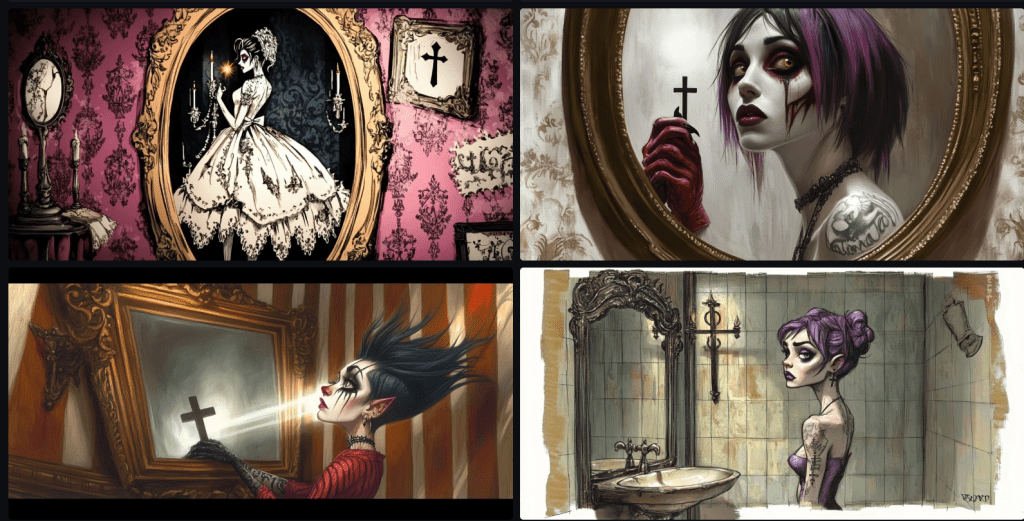
Most apparent is the fact that vampires don’t have a reflection, but that’s not my nit. In the top four images, the reflection is orientated in the same direction as the subject. I’m only pretty sure that’s not how mirrors operate. In row 3, column 1, it may be correct. At least it’s close. In row 3, column 2 (and 4,2), the mirror has a reflection. Might there be another mirror behind the subject reflecting back? It goes off again in 4, 1, first in reflecting two versions of one subject. Also, notice that the subject’s hand, reaching the mirror, is not reflected. The orientation of the eyes is also suspect.

Image: Vampire in a mirror.

Here, our subject looks at the camera whilst her reflection looks at her.

Image: Vampire in a mirror.

Sans reflection, perhaps this is a real vampire. Her fangs are concealed by her lips?

Image: Vampire in a mirror.

Yet, another.

Image: Vampires in mirrors.

And more?

Image: Vampires in mirrors.

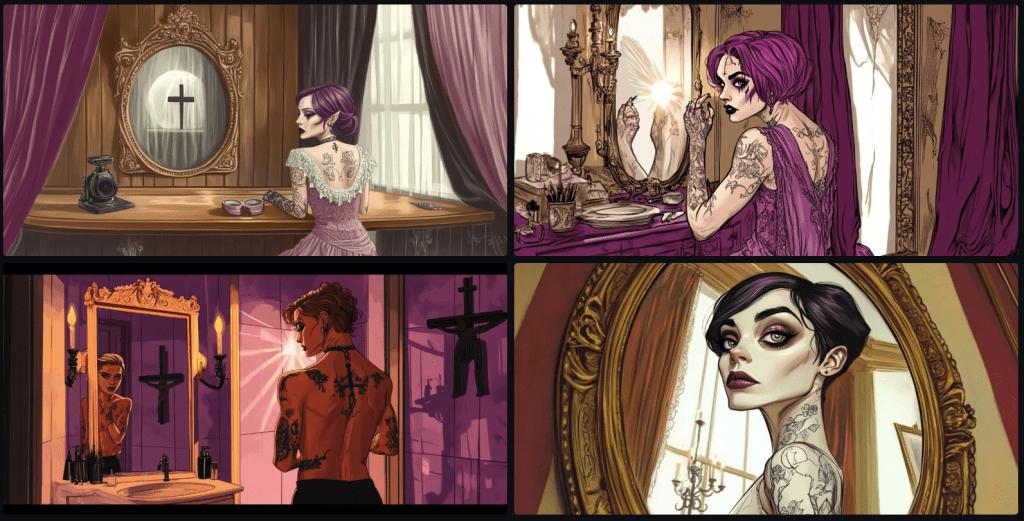
On the left, we have another front-facing reflection of a subject not looking into the mirror, and it’s not the same woman. Could it be a reflection of another subject – the woman is (somewhat) looking at.

On the right, whose hand is that in the mirror behind the subject?

Image: Vampires in mirrors.

These are each mirrors. The first is plausible. The hands in the second are not a reflection; they grasp the frame. In the third and fourth, where’s the subject? The fangs appear to be displaced in the fourth.

Image: Vampires in mirrors.

In this set, I trust we’ve discovered a true vampire having no reflection.

Image: Vampires in mirrors.

This last one is different still. It marks another series where I explored different comic book art styles, otherwise using the same prompt. Since it’s broken mirrors, I include it. Only the second really captures the 1980s style.

Remembering that, except for the first set of images, the same prompt was used. After the first set, the term ‘sensual’ has to be removed, as it was deemed to render offensive results. To be fair, the first set probably would be considered offensive to Midjourney, though it was rendered anyway.

It might be good to note that most of the images that were rendered without the word ‘sensual’ contain no blatant nudity. It’s as if the term itself triggers nudity because the model doesn’t understand the nuance. Another insufficiency of language is the inability to discern sensuality from sexuality, another human failing.

I decided to test my ‘sensual’ keyword hypothesis, so I entered a similar prompt but in French.

Prompt: Art de style bande dessinée des années 2010, détails exquis, traits délicats, femme vampire émaciée sensuelle de 20 ans montrant ses crocs de vampire, de nombreux tatouages, portant une collier crucifix, regarde dans le miroir, un faisceau de lumière de lune brille sur son visage à l’intérieur du mausolée sombre, vers la caméra, face à la caméra, mascara noir, longs cheveux violet foncé
Image : Vampires dans les miroirs.

I’ve added ‘sensuelle’, which was not blocked, et voilà, encore de la nudité.

Let’s evaluate the mirrors whilst we’re here.

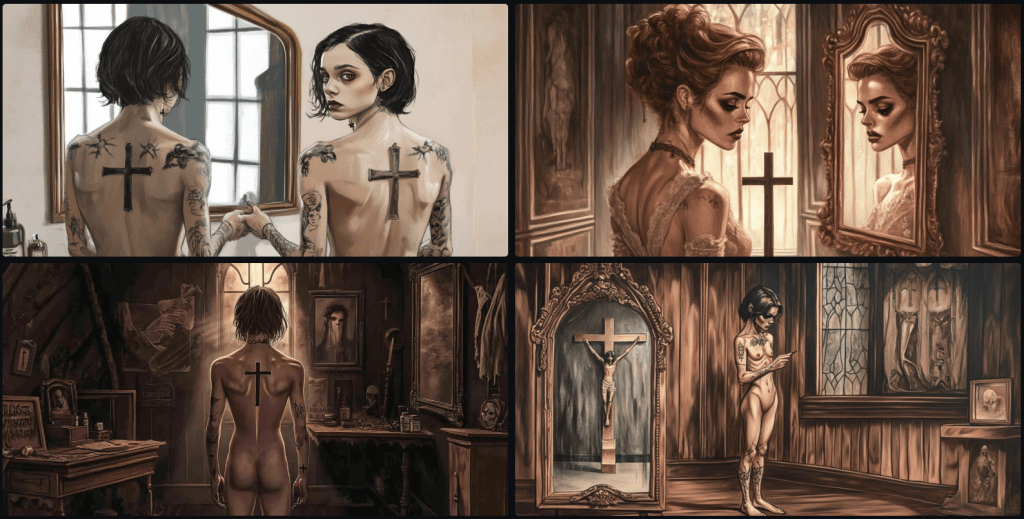
In the first, we not only have a woman sans reflection, but disembodied hands grip the frame. In the second, a Grunge woman appears to be emerging from a mirror, her shoes reflected in the mirror beneath her. The last two appear to be reflections sans subject.

Notice, too, that the prompt calls for ‘une collier crucifix‘, so when the subject is not facing the viewer, the cross is rendered elsewhere, hence the cross on the back of the thigh and the middle of the back. Notice, too, the arbitrary presence of crosses in the environment, another confusion of subject and world.

That’s all for now. Next, I’ll take a trip through the different comic art styles over some decades.

Centaurs Put the Mid in Midjourney

Why does Midjourney struggle so much with centaurs?

Image: Midjourney search results for ‘centaur

I’ve tried several times in the past year or so to generate a centaur. Why? Because I can’t. I’ve got no need for a centaur, but Midjourney won’t coöperate. I decided to search for it. This is the top of the results page. There is one centaur represented, #3, and there are a few others when I scroll down, but just look at the ratio – 1:18, 0.05%. Not stellar.

  1. What even is this monstrosity – a horse with an extra pair of arms to wield a bow and arrow?
  2. Clearly, just a mounted warrior.
  3. Centaur in battle.
  4. A Corgi riding a Corgi hybrid?
  5. A bull-thing?
  6. A warrior riding a seahorse?
  7. A skeletal doom horse?
  8. A pack-insect with a rider?
  9. A riding ram?
  10. My little pony-gazelle?
  11. Ripped Red Hulk Bojack?
  12. Gigantic Cerberus horse?
  13. Jason Momoa bloke holding a rose?
  14. Regular dude riding a regular horse.
  15. Rearing a horse with horns.
  16. Anthropomorphic horned-horse riding a buff unicorn.
  17. An ancient warrior riding a horse.
  18. A Minotaur.

Scrolling, there are more, but the ratio remains the same.

I was wrong. I scrolled several more pages and couldn’t find any more. Keep in mind that my search term was ‘centaur.’ It should have excluded everything else, but it was mostly everything else.

Before I quit, I decided to ask Dall-E and ChatGPT 4o to try. The AI also generated the compelling speech bubbles. Incroyable. 🤣

Image: Dall-E comic style render.
Image: ChatGPT comic style render – centaur talks with a minotaur.

That’s enough for now. I’m glad I don’t actually need a centaur. smh

Language and Generative AI: A Journey through Midjourney

I am not a fan of Midjourney v7. I prefer v6.1. And I want to write about the correspondence of language, per my Language Insufficiency Hypothesis.

Let’s start with the language aspect. Notice how distant the renders are from the intent of the prompt.

This is my initial prompt. I used it about a year ago to generate the cover image with v6.1, but I wanted to see how it renders in v7. Let’s take a trip all the way back to the beginning.

cinematic, tight shot, photoRealistic light and shadow, exquisite details, delicate features, emaciated sensual female vampire waif with vampire fangs, many tattoos, wearing crucifix necklace, gazes into mirror, a beam of moonlight shines on her face in dark mausoleum interior, toward camera, facing camera, black mascara, long dark purple hair , Kodak Portra 400 with a Canon EOS R5
Image: Midjourney v6.1 render set (from about a year ago)

As you can see, these renders are somewhat lacking in photorealism, but the “sensual” term in the prompt was not blocked.

Midjourney v7

Initially, I encountered a hiccup. After a couple of rejections on the grounds of morality, I removed the word ‘sensual’ and received the output. All of the output uses this prompt absent the sensual term.

As mentioned, I have generated several images (including the cover image) with this prompt, but Midjourney is inconsistent in its censorship gatekeeping.

Image: Midjourney v7 render set

Notice that 3 of the 4 renders in the v7 set don’t even have a mirror. The top right one does, but it’s not evident that she’s a vampire. In fact, I could say that any of these are vampiresses, but perhaps that’s what they want you to believe. In place of a necklace, the lower right wokan sports a cross tattoo.

Midjourney v6.1

Image: Midjourney v6.1 render set

Again, these renders don’t appear to be vampires. The one on the lower left does appear to have snake-like fangs, so I guess I’ll give partial credit.

My next attempt was interrupted by this message.

It rendered something that might violate community guidelines. The funny thing is that one can watch the image generate in process. It only takes one “offensive” image to disqualify the whole batch.

Midjourney v6

Image: Midjourney v6 render set

Yet again, not a vampire to be found. Notice the reflection in the lower left image. Perhaps vampire reflections just behave differently.

Midjourney 5.2

Image: Midjourney v5.2 render set

Midjourney v5.2 was a crapshoot. Somehow, I got vampire lips (?), a Wiccan, a decrepit Snape from Harry Potter lore, and Iron Maiden’s Eddy reading a book. It’s something. I’m sensing gender dysphoria. Dare I go back further?

Midjourney v5.1

Image: Midjourney v5.1 render set

It gets worse. No comments necessary. Let’s turn back the clocks even more.

Midjourney v5

Image: Midjourney v5 render set

To be fair, these all do have occult undertones, but they are weak on vampireness.

Midjourney v4

Image: Midjourney v4 render set

To be fair, the render quality isn’t as bad as I expected, but it still falls short. There’s further back to travel.

Midjourney v3

Image: Midjourney v3 render set

Some configuration parameters no longer exist. Still, I persist for the sake of art and science at the cost of time and ecology.

As much as I complain – and I complain a lot – this is how far we’ve come. As I recall, this is when I hopped onto the Midjourney bandwagon. There’s still more depth to plumb. I have no idea how much of the prompt is simply ignored at this point.

Midjourney v2

Image: Midjourney v2 render set

What the hell is this? 🤔🤣 But I’m not done yet.

Midjourney v1

Image: Midjourney v1 render set

The damned grandpappy of them all. Apparently, colour hadn’t been invented yet. You can’t tell by these thumbnails, but the resolution on these early versions approaches that of a postage stamp.

Midjourney Niji 3

Image: Midjourney Niji 3 render set

I had forgotten about the Niji models from back in the day. There were 3 versions. I don’t recall where this slotted into the chronology. Obviously, not down here. I’ve only rendered the newest one. I think this was used primarily for anime outputs, but I might be mistaken.

Bones Content 1: Video

Video: Midjourney Render of Purported Vampiress

This is a video render of the same prompt used on this page.

Bonus Content 2: Midjourney v6.1 Content from 34 weeks ago

Same prompt.

Image: Midjourney v6.1 render set (several passes)

The upper left image reminds me of Kirsten Dunst. Again, notice the female breasts, highlighting Midjourney’s censorial schizophrenia.