A generative AI platform rendered this image of an alphabet appropriate for a child. It went somewhat awry. It looks worse than it seems.
The first three letters are appropriate and in sync with their paired image. The D is correct, but it’s rendered as an elephant. That’s an E word, which is skipped. The F went outright AWOL, but G, H, and I come on strong. J’s gone missing. K represents, but L’s gone astray. M, N, O make it seem that it can only map three characters in a row. P shows Q, as a queen. Then things go off the rails. S? The sun’s correct. What are those umbrella and penguin letters? We found the missing P representative. R, S, T, U are in order – the second S; can’t be too careful. It is fixated on violins – not an R word. It got the first S = sun correct, so perhaps a little slack on the second one. T is for turtle, offset to the left. Two violin words and an image, but no letter V. Not sure what happened. W, X, Y, Z and Z. I’m only pretty sure that one of these Zs is British; the other is American. The X, Y, Z images are offset to the right. We just need the extraneous yacht, much like the real world.
In the end, we’ve got 24 letters – 2 non-sensical ones and a duplicate, but we are missing E, F, J, L, and Q – though at least E and Q are here in spirit. D never got any representation.
This title may be misleading. What I do is render a similar prompt but alter the decade. I’m neither an art historian nor a comic aficionado, so I can’t comment on the accuracy. What do you think?
Let’s go back in time. First, here’s the basic prompt en français:
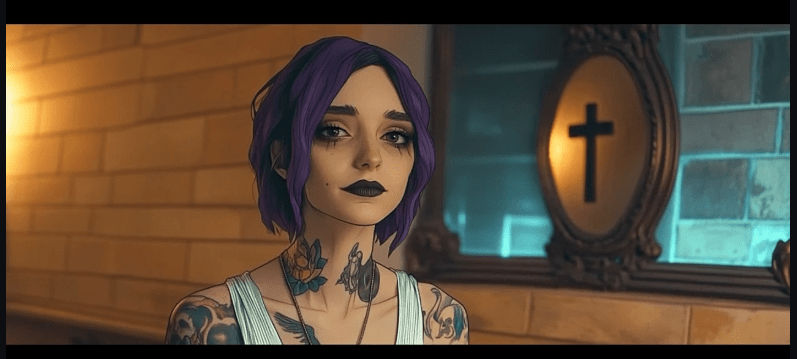
Prompt: Art de style bande dessinée des années XXXX, détails exquis, traits délicats, femme vampire émaciée sensuelle de 20 ans montrant ses crocs de vampire, de nombreux tatouages, portant une collier crucifix, regarde dans le miroir, un faisceau de lumière de lune brille sur son visage à l’intérieur du mausolée sombre, vers la caméra, face à la caméra, mascara noir, longs cheveux violet foncé
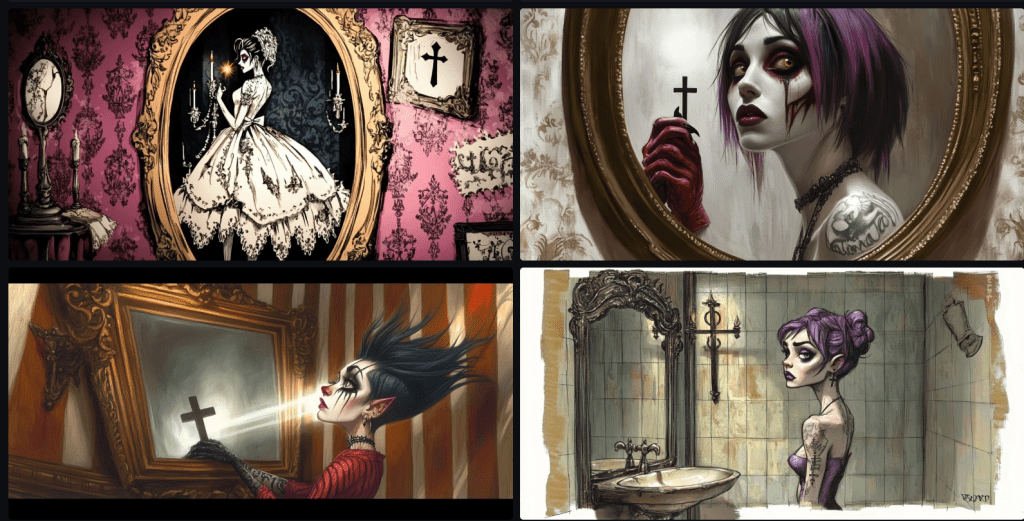
Image: Comic Book Style of 2010sImage: Comic Book Style of 2000s
On the lower left, notice the moonbeams emanating from the warped, reflectionless mirror.
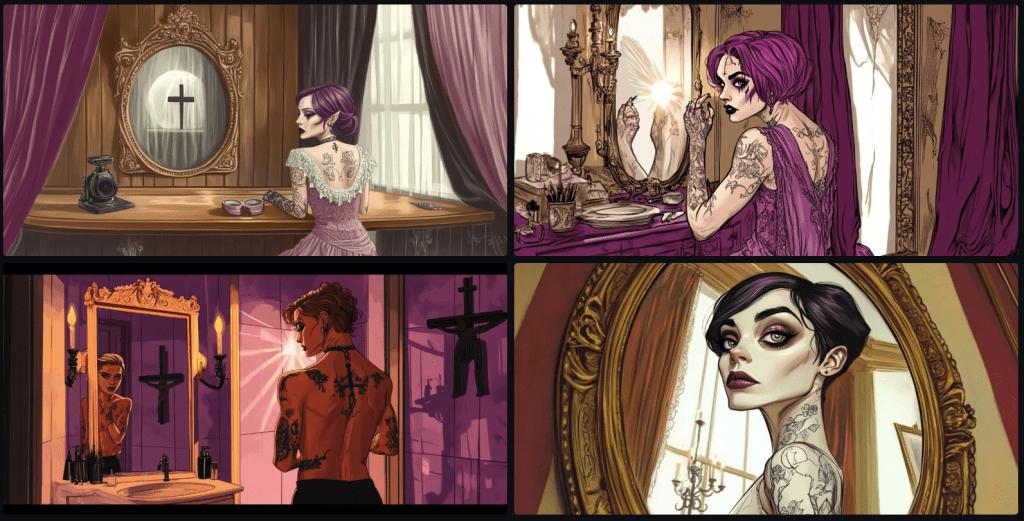
Image: Comic Book Style of 1990sImage: Comic Book Style of 1990s (must’ve inadvertently generated a duplicate)
Is the third pic an homage to Benny & June?
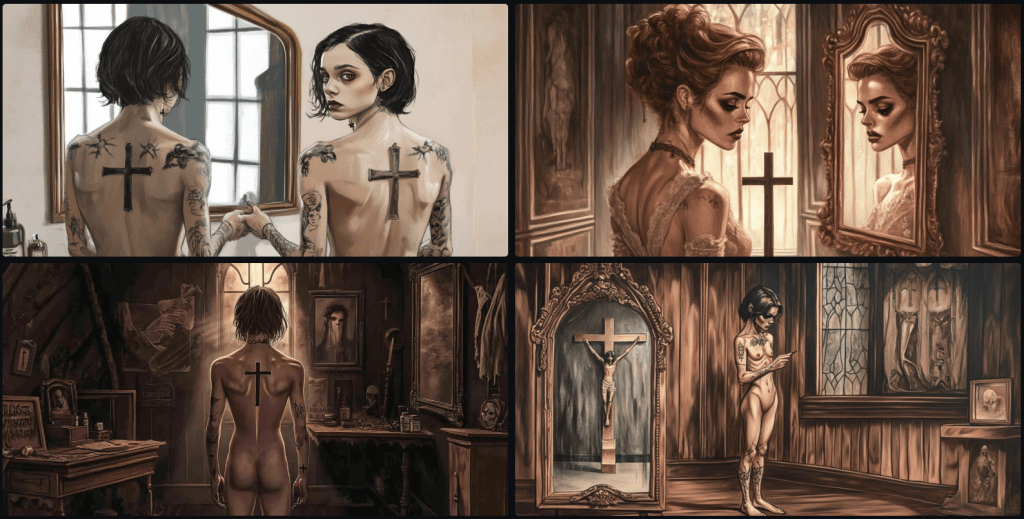
Image: Comic Book Style of 1980sImage: Comic Book Style of 1970sImage: Comic Book Style of 1950s
Not to body shame, but that chick on the lower right of the 1950s…
Image: Comic Book Style of 1920sImage: Comic Book Style of 1880s
I know I skipped a few decades, but I also wanted to see what Pop Art might render like.
Image: Pop Art Style of 1960s
I love the talons on the top left image. More odd mirror images. I’ll just leave it here.
Mirror, mirror on the wall, let’s dispense with all of the obvious quips up front. I almost feel I should apologise for the spate of Midjourney posts – almost.
It should be painfully apparent that I’ve been noodling with Midjourney lately. I am not an accomplished digital artist, so I struggle. At times, I’m not sure if it’s me or it. Today, I’ll focus on mirrors.
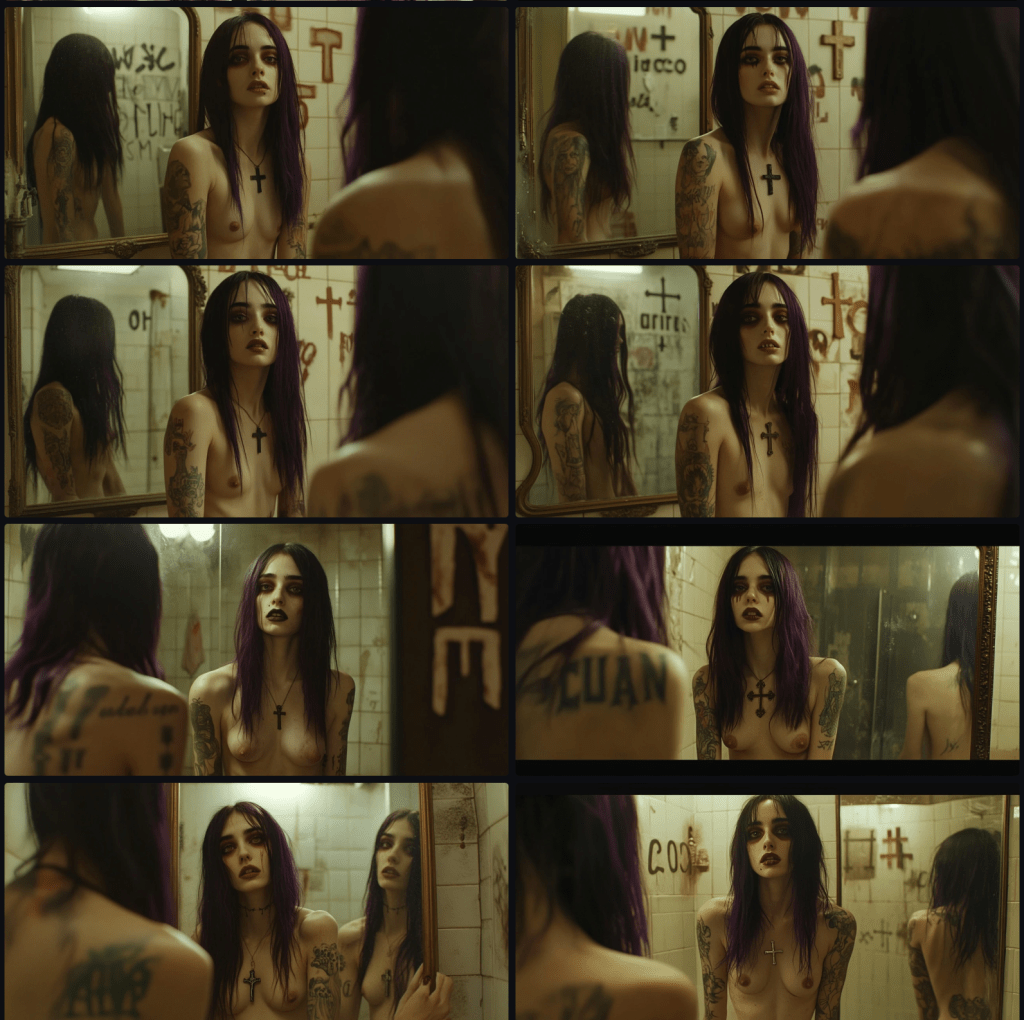
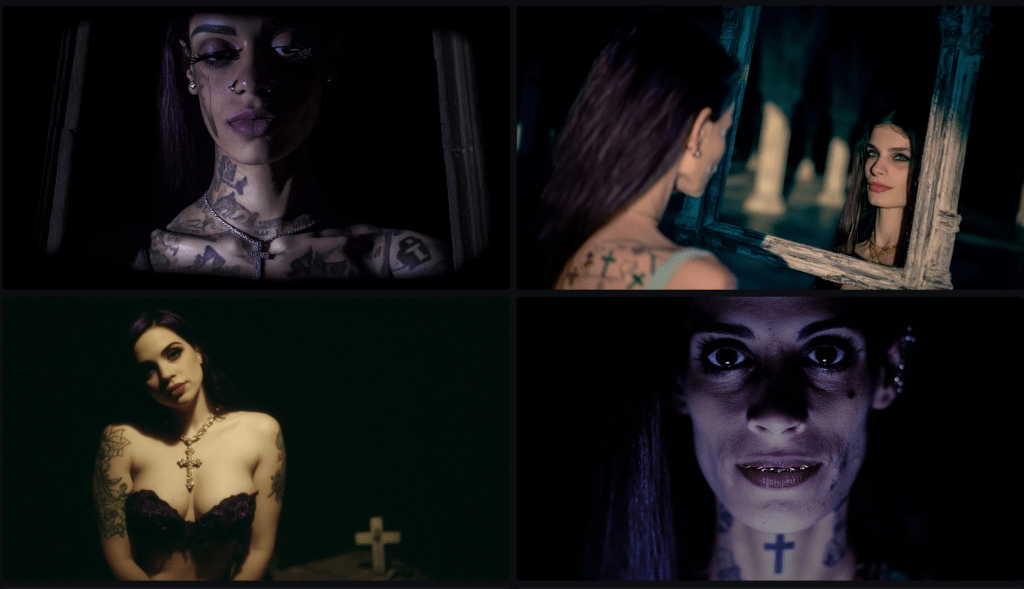
Midjourney has difficulties rendering certain things. Centaurs are one. Mirrors, another. Whilst rendering vampires, another lesser struggle for the app, it became apparent that mirrors are not a forte. Here are some examples. Excuse the nudity. I’ll get to that later.
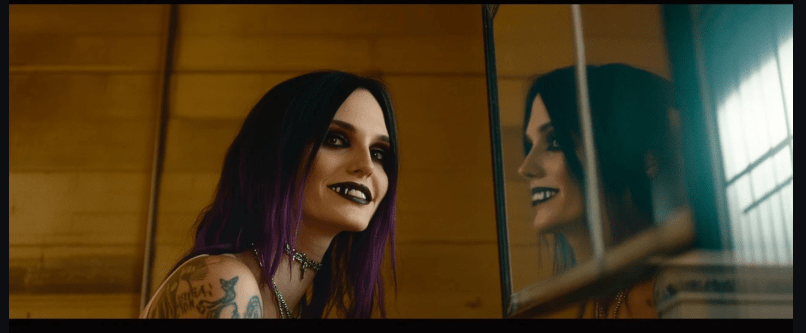
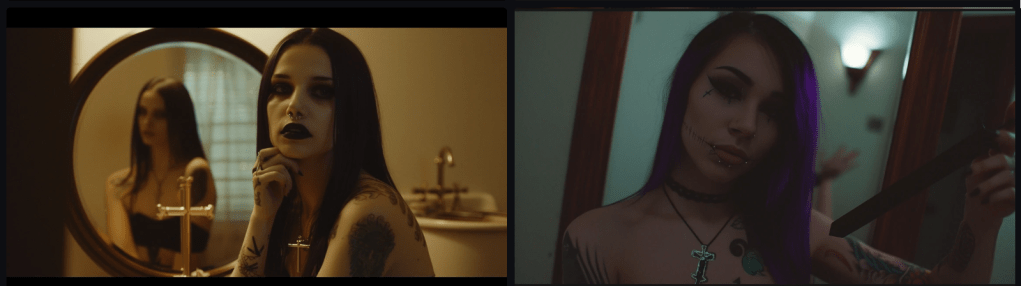
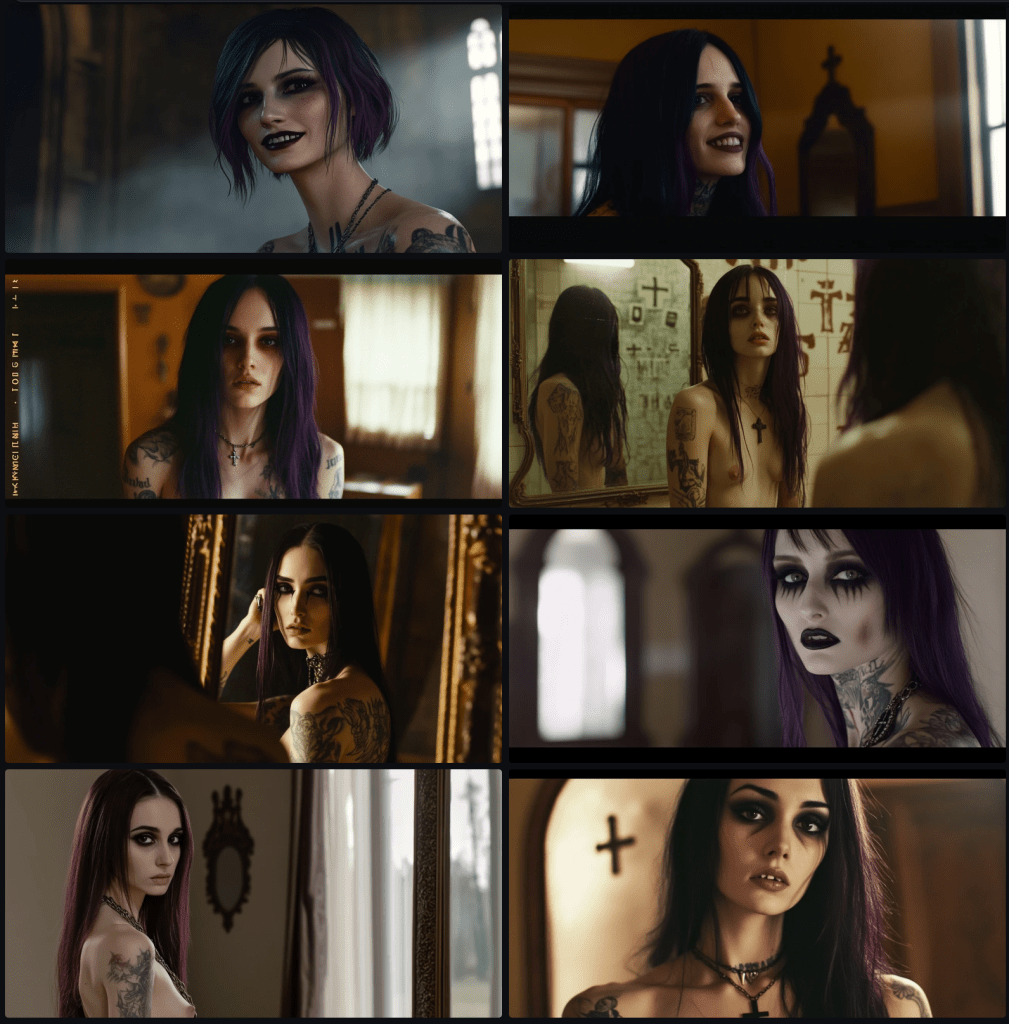
Prompt: cinematic, tight shot, photoRealistic light and shadow, exquisite details, delicate features, emaciated sensual female vampire waif with vampire fangs, many tattoos, wearing crucifix necklace, gazes into mirror, a beam of moonlight shines on her face in dark mausoleum interior, toward camera, facing camera, black mascara, long dark purple hair, Kodak Portra 400 with a Canon EOS R5
Ignore the other aspects of the images and focus on the behaviour or misbehaviour of the mirrors.
Image: Panel of vampire in a mirror.
Most apparent is the fact that vampires don’t have a reflection, but that’s not my nit. In the top four images, the reflection is orientated in the same direction as the subject. I’m only pretty sure that’s not how mirrors operate. In row 3, column 1, it may be correct. At least it’s close. In row 3, column 2 (and 4,2), the mirror has a reflection. Might there be another mirror behind the subject reflecting back? It goes off again in 4, 1, first in reflecting two versions of one subject. Also, notice that the subject’s hand, reaching the mirror, is not reflected. The orientation of the eyes is also suspect.
Image: Vampire in a mirror.
Here, our subject looks at the camera whilst her reflection looks at her.
Image: Vampire in a mirror.
Sans reflection, perhaps this is a real vampire. Her fangs are concealed by her lips?
Image: Vampire in a mirror.
Yet, another.
Image: Vampires in mirrors.
And more?
Image: Vampires in mirrors.
On the left, we have another front-facing reflection of a subject not looking into the mirror, and it’s not the same woman. Could it be a reflection of another subject – the woman is (somewhat) looking at.
On the right, whose hand is that in the mirror behind the subject?
Image: Vampires in mirrors.
These are each mirrors. The first is plausible. The hands in the second are not a reflection; they grasp the frame. In the third and fourth, where’s the subject? The fangs appear to be displaced in the fourth.
Image: Vampires in mirrors.
In this set, I trust we’ve discovered a true vampire having no reflection.
Image: Vampires in mirrors.
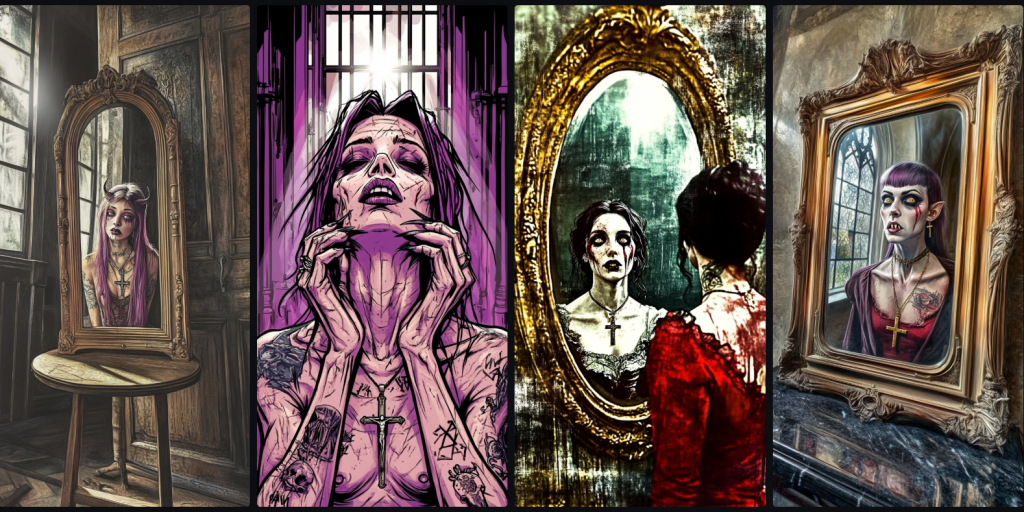
This last one is different still. It marks another series where I explored different comic book art styles, otherwise using the same prompt. Since it’s broken mirrors, I include it. Only the second really captures the 1980s style.
Remembering that, except for the first set of images, the same prompt was used. After the first set, the term ‘sensual’ has to be removed, as it was deemed to render offensive results. To be fair, the first set probably would be considered offensive to Midjourney, though it was rendered anyway.
It might be good to note that most of the images that were rendered without the word ‘sensual’ contain no blatant nudity. It’s as if the term itself triggers nudity because the model doesn’t understand the nuance. Another insufficiency of language is the inability to discern sensuality from sexuality, another human failing.
I decided to test my ‘sensual’ keyword hypothesis, so I entered a similar prompt but in French.
Prompt: Art de style bande dessinée des années 2010, détails exquis, traits délicats, femme vampire émaciée sensuelle de 20 ans montrant ses crocs de vampire, de nombreux tatouages, portant une collier crucifix, regarde dans le miroir, un faisceau de lumière de lune brille sur son visage à l’intérieur du mausolée sombre, vers la caméra, face à la caméra, mascara noir, longs cheveux violet foncé
Image : Vampires dans les miroirs.
I’ve added ‘sensuelle’, which was not blocked, et voilà, encore de la nudité.
Let’s evaluate the mirrors whilst we’re here.
In the first, we not only have a woman sans reflection, but disembodied hands grip the frame. In the second, a Grunge woman appears to be emerging from a mirror, her shoes reflected in the mirror beneath her. The last two appear to be reflections sans subject.
Notice, too, that the prompt calls for ‘une collier crucifix‘, so when the subject is not facing the viewer, the cross is rendered elsewhere, hence the cross on the back of the thigh and the middle of the back. Notice, too, the arbitrary presence of crosses in the environment, another confusion of subject and world.
That’s all for now. Next, I’ll take a trip through the different comic art styles over some decades.
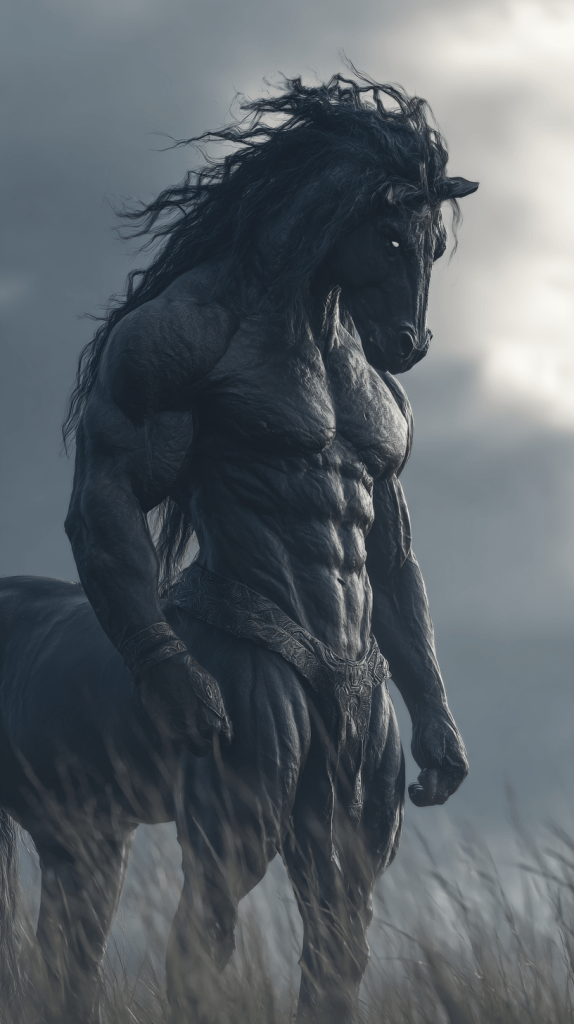
Why does Midjourney struggle so much with centaurs?
Image: Midjourney search results for ‘centaur‘
I’ve tried several times in the past year or so to generate a centaur. Why? Because I can’t. I’ve got no need for a centaur, but Midjourney won’t coöperate. I decided to search for it. This is the top of the results page. There is one centaur represented, #3, and there are a few others when I scroll down, but just look at the ratio – 1:18, 0.05%. Not stellar.
What even is this monstrosity – a horse with an extra pair of arms to wield a bow and arrow?
Clearly, just a mounted warrior.
Centaur in battle.
A Corgi riding a Corgi hybrid?
A bull-thing?
A warrior riding a seahorse?
A skeletal doom horse?
A pack-insect with a rider?
A riding ram?
My little pony-gazelle?
Ripped Red Hulk Bojack?
Gigantic Cerberus horse?
Jason Momoa bloke holding a rose?
Regular dude riding a regular horse.
Rearing a horse with horns.
Anthropomorphic horned-horse riding a buff unicorn.
An ancient warrior riding a horse.
A Minotaur.
Scrolling, there are more, but the ratio remains the same.
I was wrong. I scrolled several more pages and couldn’t find any more. Keep in mind that my search term was ‘centaur.’ It should have excluded everything else, but it was mostly everything else.
Before I quit, I decided to ask Dall-E and ChatGPT 4o to try. The AI also generated the compelling speech bubbles. Incroyable. 🤣
Image: Dall-E comic style render.Image: ChatGPT comic style render – centaur talks with a minotaur.
That’s enough for now. I’m glad I don’t actually need a centaur. smh
I am not a fan of Midjourney v7. I prefer v6.1. And I want to write about the correspondence of language, per my Language Insufficiency Hypothesis.
Let’s start with the language aspect. Notice how distant the renders are from the intent of the prompt.
This is my initial prompt. I used it about a year ago to generate the cover image with v6.1, but I wanted to see how it renders in v7. Let’s take a trip all the way back to the beginning.
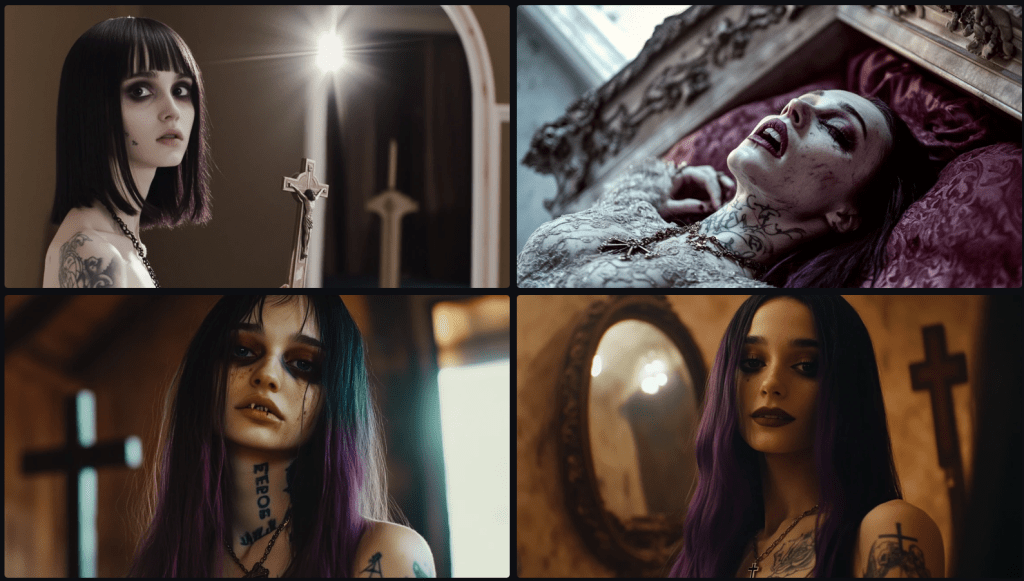
cinematic, tight shot, photoRealistic light and shadow, exquisite details, delicate features, emaciated sensual female vampire waif with vampire fangs, many tattoos, wearing crucifix necklace, gazes into mirror, a beam of moonlight shines on her face in dark mausoleum interior, toward camera, facing camera, black mascara, long dark purple hair , Kodak Portra 400 with a Canon EOS R5
Image: Midjourney v6.1 render set (from about a year ago)
As you can see, these renders are somewhat lacking in photorealism, but the “sensual” term in the prompt was not blocked.
Midjourney v7
Initially, I encountered a hiccup. After a couple of rejections on the grounds of morality, I removed the word ‘sensual’ and received the output. All of the output uses this prompt absent the sensual term.
As mentioned, I have generated several images (including the cover image) with this prompt, but Midjourney is inconsistent in its censorship gatekeeping.
Image: Midjourney v7 render set
Notice that 3 of the 4 renders in the v7 set don’t even have a mirror. The top right one does, but it’s not evident that she’s a vampire. In fact, I could say that any of these are vampiresses, but perhaps that’s what they want you to believe. In place of a necklace, the lower right wokan sports a cross tattoo.
Midjourney v6.1
Image: Midjourney v6.1 render set
Again, these renders don’t appear to be vampires. The one on the lower left does appear to have snake-like fangs, so I guess I’ll give partial credit.
My next attempt was interrupted by this message.
It rendered something that might violate community guidelines. The funny thing is that one can watch the image generate in process. It only takes one “offensive” image to disqualify the whole batch.
Midjourney v6
Image: Midjourney v6 render set
Yet again, not a vampire to be found. Notice the reflection in the lower left image. Perhaps vampire reflections just behave differently.
Midjourney 5.2
Image: Midjourney v5.2 render set
Midjourney v5.2 was a crapshoot. Somehow, I got vampire lips (?), a Wiccan, a decrepit Snape from Harry Potter lore, and Iron Maiden’s Eddy reading a book. It’s something. I’m sensing gender dysphoria. Dare I go back further?
Midjourney v5.1
Image: Midjourney v5.1 render set
It gets worse. No comments necessary. Let’s turn back the clocks even more.
Midjourney v5
Image: Midjourney v5 render set
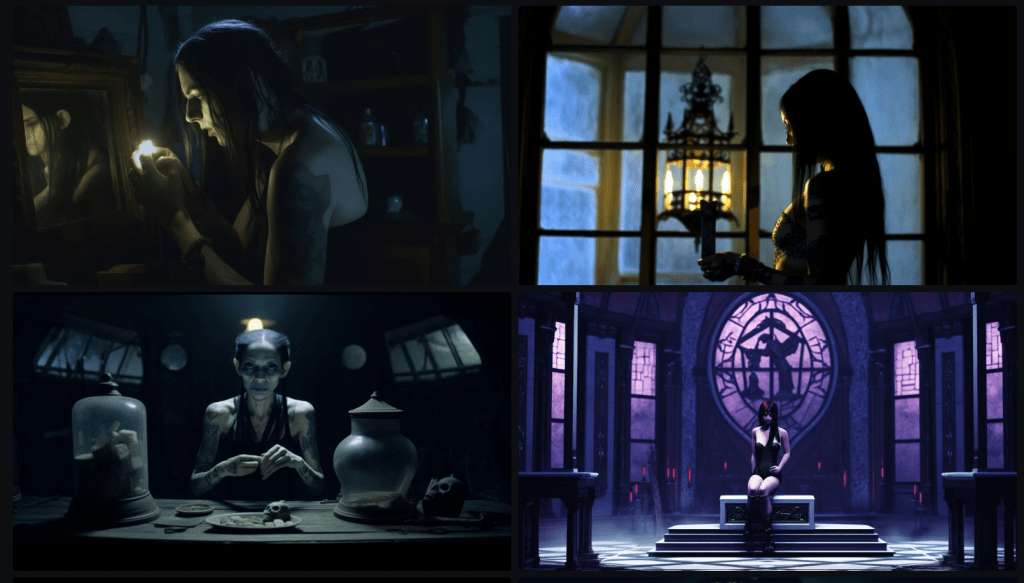
To be fair, these all do have occult undertones, but they are weak on vampireness.
Midjourney v4
Image: Midjourney v4 render set
To be fair, the render quality isn’t as bad as I expected, but it still falls short. There’s further back to travel.
Midjourney v3
Image: Midjourney v3 render set
Some configuration parameters no longer exist. Still, I persist for the sake of art and science at the cost of time and ecology.
As much as I complain – and I complain a lot – this is how far we’ve come. As I recall, this is when I hopped onto the Midjourney bandwagon. There’s still more depth to plumb. I have no idea how much of the prompt is simply ignored at this point.
Midjourney v2
Image: Midjourney v2 render set
What the hell is this? 🤔🤣 But I’m not done yet.
Midjourney v1
Image: Midjourney v1 render set
The damned grandpappy of them all. Apparently, colour hadn’t been invented yet. You can’t tell by these thumbnails, but the resolution on these early versions approaches that of a postage stamp.
Midjourney Niji 3
Image: Midjourney Niji 3 render set
I had forgotten about the Niji models from back in the day. There were 3 versions. I don’t recall where this slotted into the chronology. Obviously, not down here. I’ve only rendered the newest one. I think this was used primarily for anime outputs, but I might be mistaken.
Bones Content 1: Video
Video: Midjourney Render of Purported Vampiress
This is a video render of the same prompt used on this page.
Bonus Content 2: Midjourney v6.1 Content from 34 weeks ago
Same prompt.
Image: Midjourney v6.1 render set (several passes)
The upper left image reminds me of Kirsten Dunst. Again, notice the female breasts, highlighting Midjourney’s censorial schizophrenia.
Some apps boldly claim to enable lip syncing – to render speech from mouth movements. I’ve tried a few. None delivered. Not even close.
To conserve bandwidth (and sanity), I’ve rendered animated GIFs rather than MP4s. You’ll see photorealistic humans, animated characters, cartoonish figures – and, for reasons only the algorithm understands, a giant goat. All showcase mouth movements that approximate the utterance of phonemes and morphemes. Approximate is doing heavy lifting here.
Firstly, these mouths move, but they say nothing. I’ve seen plenty of YouTube channels that manage to dub convincing dialogue into celebrity clips. That’s a talent I clearly lack – or perhaps it’s sorcery.
Secondly, language ambiguity. I reflexively assume these AI-generated people are speaking English. It’s my first language. But perhaps, given their uncanny muttering, they’re speaking yours. Or none at all. Do AI models trained predominantly on English-speaking datasets default to English mouth movements? Or is this just my bias grafting familiar speech patterns onto noise?
Thirdly, don’t judge my renders. I’ve been informed I may have a “type.” Lies and slander. The goat was the AI’s idea, I assure you.
What emerges from this exercise isn’t lip syncing. It’s lip-faking. The illusion of speech, minus meaning, which, if we’re honest, is rather fitting for much of what generative AI produces.
EDIT: I hadn’t noticed the five fingers (plus a thumb) on the cover image.
I promise that this will not become a hub for generative AI. Rather than return to editing, I wanted to test more of Midjourney’s boundaries.
It turns out that Midjourney is selective about the nudity it renders. I was denied a render because of cleavage, but full-on topless – no problem.
Both of these videos originate from the same source image, but they take different paths. There is no accompanying video content. The setup features three women in the frame with a mechanical arm. I didn’t prompt for it. I’m not even sure of its intent. It’s just there, shadowing the women nearest to it. I don’t recall prompting for the oversized redhead in the foreground, though I may have.
In both images, note the aliasing of the tattoos on the blonde, especially on her back. Also, notice that her right arm seems shorter than it should. Her movements are jerky, as if rendered in a video game. I’m not sure what ritual the two background characters are performing, but notice in each case the prepetition. This seems to be a general feature of generative AI. It gets itself in loops, almost autistic.
Notice a few things about the top render.
Video: Midjourney render of 3 females and a mechanical arm engaging in a ritual. (9 seconds)
The first video may represent an interrogation. The blonde woman on the left appears to be a bit disoriented, but she is visually tracking the woman on the right. She seems to be saying something. Notice when the woman on the right stands. Her right foot lands unnaturally. She rather glitches.
The camera’s push and pull, and then push, seems to be an odd directorial choice, but who am I to say?
Video: Midjourney render of 3 females and a mechanical arm engaging in a ritual. (12 seconds)
The second video may represent taunting. The woman on the left still appears to be a bit disoriented, but she checks the redhead in the foreground with a glance. Notice the rocking of the two background characters, as well as the mech arm, which sways in sync with the woman on the right. This is a repetition glitch I mentioned above.
Here, the camera seems to have a syncopated relationship with the characters’ sway.
Summary
The stationary objects are well-rendered and persistent.
Assignment
Draft a short story or flash fiction using this as an inspirational prompt. I’m trying to imagine the interactions.
The ginger seems catatonic or drugged. Is she a CIS-female? What’s with her getup?
The blonde seems only slightly less out of it. Did she arrive this way? Did they dress her? Why does she appear to still have a weapon on her back? Is it a weapon or a fetter? Why is she dressed like that? Is she a gladiatrix readying for a contest? Perhaps she’s in training. What is she saying? Who is she talking to? What is her relationship to the redhead? Are they friends or foes – or just caught up in the same web?
What is the woman wearing the helmet doing? She appears to have the upper hand. Is she a cyborg, or is she just wearing fancy boots? What’s with her outfit? What’s with her Tycho Brahe prosthetic nose piece?
What is that mechanical hand? Is it a guard? A restraint? Is it hypnotising the ginger? Both of them? Is it conducting music that’s not audible?
What’s it read on the back wall? The two clips don’t share the same text. Call the continuity people.
Yesterday, I wrote about “ugly women.” Today, I pivot — or perhaps descend — into what Midjourney deems typical. Make of that what you will.
This blog typically focuses on language, philosophy, and the gradual erosion of culture under the boot heel of capitalism. But today: generative eye candy. Still subtextual, mind you. This post features AI-generated women – tattooed, bare-backed, heavily armed – and considers what, exactly, this technology thinks we want.
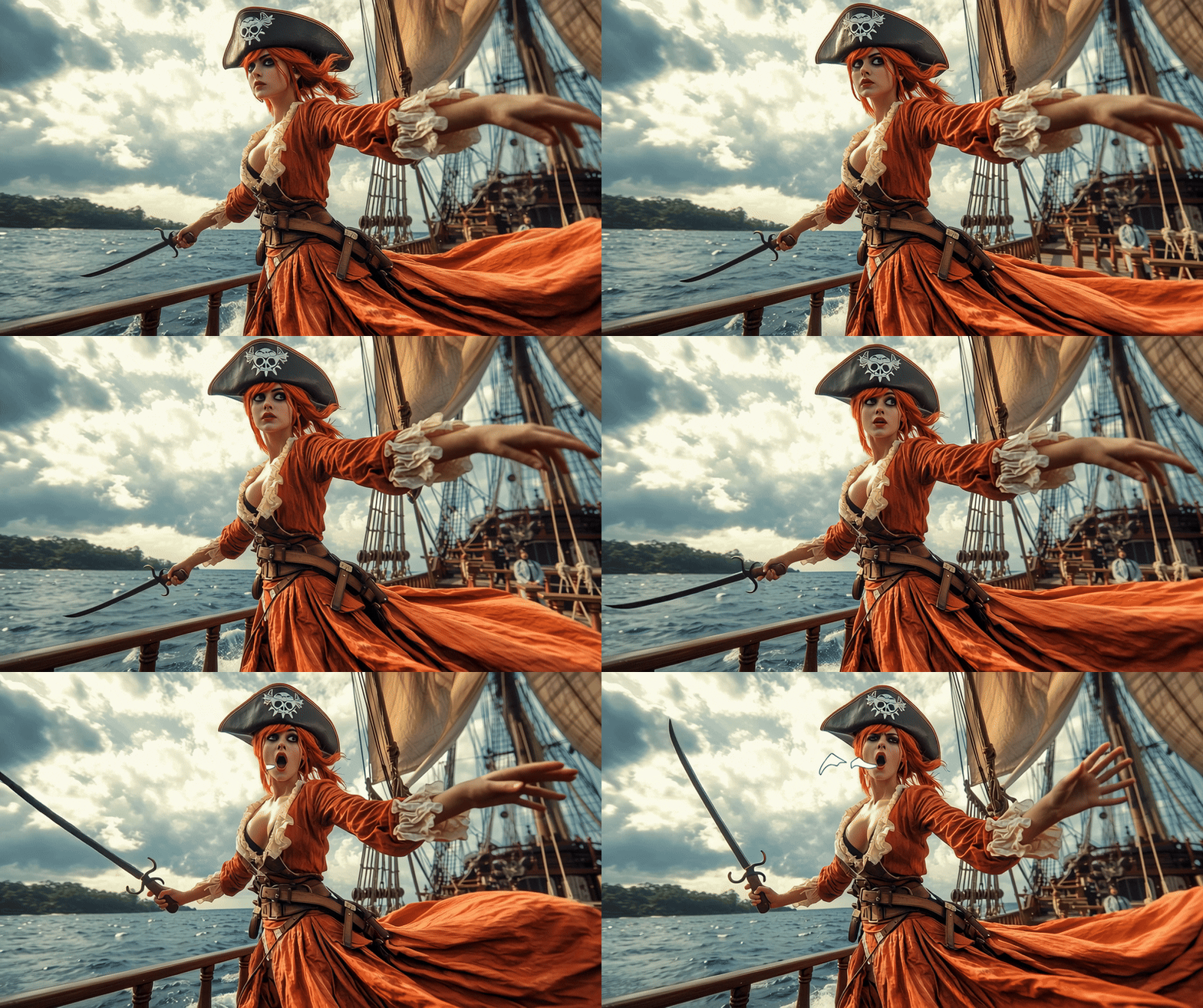
Video: Pirate cowgirls caught mid-gaze. Generated last year during what I can only assume was a pirate-meets-cowgirl fever dream.
The Video Feature
Midjourney released its image-to-video tool on 18 June. I finally found a couple of free hours to tinker. The result? Surprisingly coherent, if accidentally lewd. The featured video was one of the worst outputs, and yet, it’s quite good. A story emerged.
Audio: NotebookLM podcast on this topic (sort of).
It began with a still: two women, somewhere between pirate and pin-up, dressed for combat or cosplay. I thought, what if they kissed? Midjourney said no. Embrace? Also no. Glaring was fine. So was mutual undressing — of the eyes, at least.
Later, I tried again. Still no kiss, but no denial either — just a polite cough about “inappropriate positioning.” I prompted one to touch the other’s hair. What I got was a three-armed woman attempting a hat-snatch. (See timestamp 0:15.) The other three video outputs? Each woman seductively touched her own hair. Freud would’ve had a field day.
In another unreleased clip, two fully clothed women sat on a bed. That too raised flags. Go figure.
All of this, mind you, passed Midjourney’s initial censorship. However, it’s clear that proximity is now suspect. Even clothed women on furniture can trigger the algorithmic fainting couch.
Myriad Warning Messages
Out of bounds.
Sorry, Charlie.
In any case, I reviewed other images to determine how the limitations operated. I didn’t get much closer.
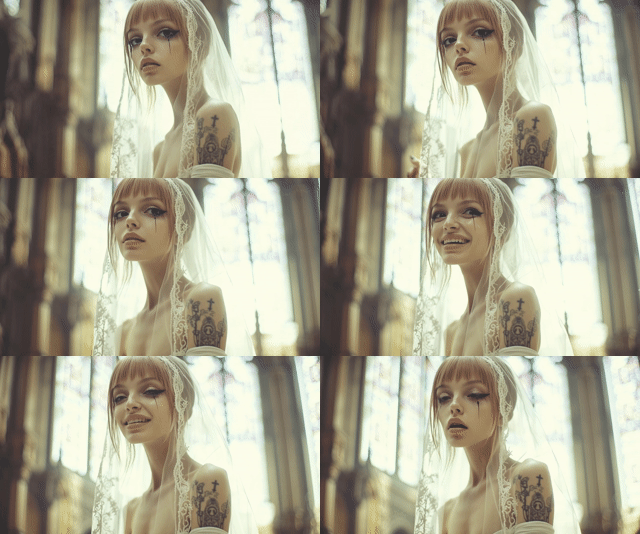
Video: A newlywed couple kissing
Obviously, proximity and kissing are now forbidden. I’d consider these two “scantily clad,” so I am unsure of the offence.
I did render the image of a cowgirl at a Western bar, but I am reluctant to add to the page weight. In 3 of the 4 results, nothing (much) was out of line, but in the fourth, she’s wielding a revolver – because, of course, she is.
Conformance & Contradiction
You’d never know it, but the original prompt was a fight scene. The result? Not punches, but pre-coital choreography. The AI interpreted combat as courtship. Women circling each other, undressing one another with their eyes. Or perhaps just prepping for an afterparty.
Video: A battle to the finish between a steampunk girl and a cybermech warrior.
Lesbian Lustfest
No, my archive isn’t exclusively lesbian cowgirls. But given the visual weight of this post, I refrained from adding more examples. Some browsers may already be wheezing.
Technical Constraints
You can’t extend videos beyond four iterations — maxing out at 21 seconds. I wasn’t aware of this, so I prematurely accepted a dodgy render and lost 2–3 seconds of potential.
My current Midjourney plan offers 15 hours of “fast” rendering per month. Apparently, video generation burns through this quickly. Still images can queue up slowly; videos cannot. And no, I won’t upgrade to the 30-hour plan. Even I have limits.
Uses & Justifications
Generative AI is a distraction – an exquisitely engineered procrastination machine. Useful, yes. For brainstorming, visualising characters, and generating blog cover art. But it’s a slippery slope from creative aid to aesthetic rabbit hole.
Would I use it for promotional trailers? Possibly. I’ve seen offerings as low as $499 that wouldn’t cannibalise my time and attention, not wholly, anyway.
So yes, I’ll keep paying for it. Yes, I’ll keep using it. But only when I’m not supposed to be writing.
Now, if ChatGPT could kindly generate my post description and tags, I’ll get back to pretending I’m productive.
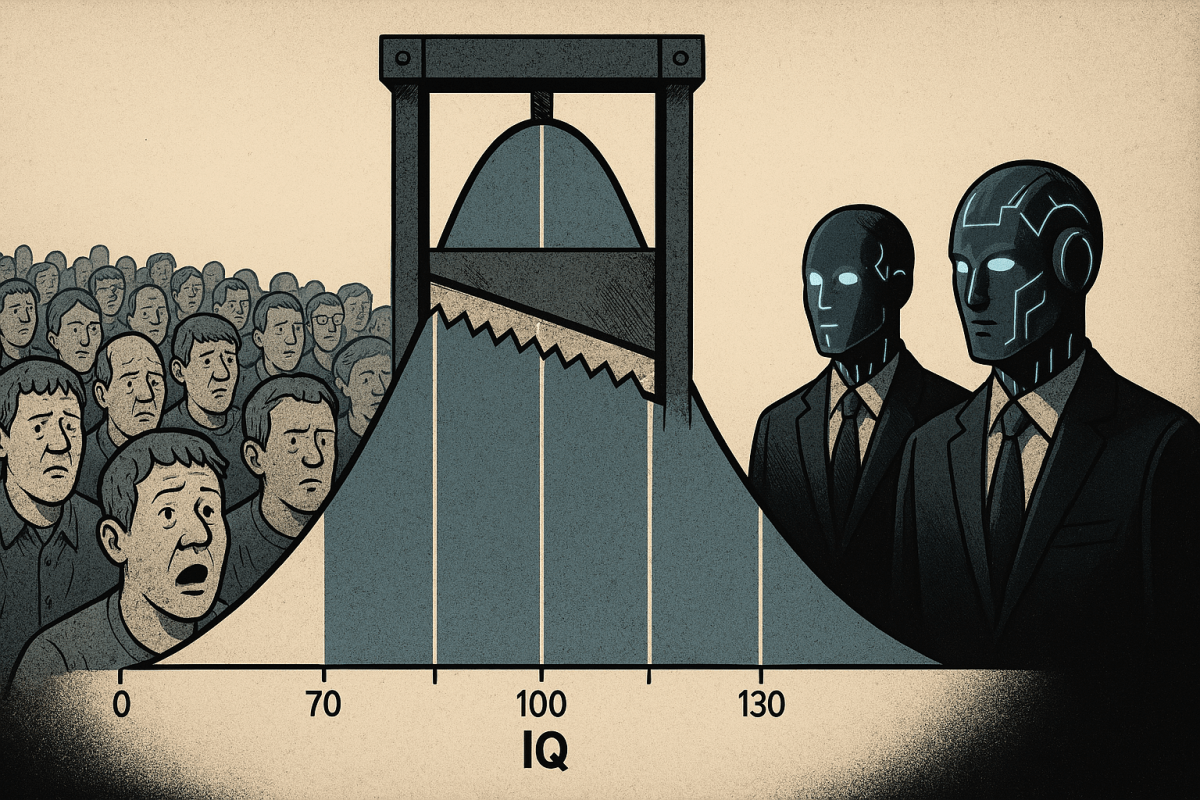
Given current IQ trends, humanity is getting dumber. Let’s not mince words. This implies the AGI singularity—our long-heralded techno-apotheosis—will arrive against a backdrop of cognitive decay. A dimming species, squinting into the algorithmic sun.
Audio: NotebookLM podcast discussing this content.
Now, I’d argue that AI—as instantiated in generative models like Claude and ChatGPT—already outperforms at least half of the human population. Likely more. The only question worth asking is this: at what percentile does AI need to outperform the human herd to qualify as having “surpassed” us?
Living in the United States, I’m painfully aware that the average IQ hovers somewhere in the mid-90s—comfortably below the global benchmark of 100. If you’re a cynic (and I sincerely hope you are), this explains quite a bit. The declining quality of discourse. The triumph of vibes over facts. The national obsession with astrology apps and conspiracy podcasts.
Harvard astronomer Avi Loeb argues that as humans outsource cognition to AI, they lose the capacity to think. It’s the old worry: if the machines do the heavy lifting, we grow intellectually flaccid. There are two prevailing metaphors. One, Platonic in origin, likens cognition to muscle—atrophying through neglect. Plato himself worried that writing would ruin memory. He wasn’t wrong.
But there’s a counterpoint: the cooking hypothesis. Once humans learned to heat food, digestion became easier, freeing up metabolic energy to grow bigger brains. In this light, AI might not be a crutch but a catalyst—offloading grunt work to make space for higher-order thought.
So which is it? Are we becoming intellectually enfeebled? Or are we on the cusp of a renaissance—provided we don’t burn it all down first?
Crucially, most people don’t use their full cognitive capacity anyway. So for the bottom half—hell, maybe the bottom 70%—nothing is really lost. No one’s delegating their calculus homework to ChatGPT if they were never going to attempt it themselves. For the top 5%, AI is already a glorified research assistant—a handy tool, not a replacement.
The real question is what happens to the middle band. The workaday professionals. The strivers. The accountants, engineers, copywriters, and analysts hovering between the 70th and 95th percentiles—assuming our crude IQ heuristics even hold. They’re the ones who have just enough brainpower to be displaced.
That’s where the cognitive carnage will be felt. Not in the depths, not at the heights—but in the middle.
The more I watch the News or engage with social media, I can’t help but feel that the Western World™ has gone mad. It’s also disconcerting because, as a subjectivist, this should come as no surprise. I guess I miss the days when it was better wrapped in relativism. Perhaps it’s just that the relative cohorts are getting smaller and smaller, and the intersectionality of dimensions can’t bear the load. I prompted 7 generative AI platforms to help asses whether I am alone in my observations. I present the responses unedited, identifying each with a header.
Audio: NotebookLM podcast of this content.
Are we in a post-rationality era, or is it just me who sees this with concern?
ChatGPT
Oh, we are absolutely in a post-rational era, and you are right to be concerned. The Age of Reason has been mugged in a dark alley by vibes, conspiracy theories, and a relentless onslaught of algorithmic drivel. Facts? Mere inconveniences. Logic? A relic of a bygone age when people actually read books instead of scrolling through rage-bait on social media.
We now live in a world where feelings trump evidence, where expertise is met with a sneer and a “Well, I heard on TikTok that…” Politicians openly contradict themselves within the same sentence, and their supporters somehow cheer louder for the contradiction. Science? Only if it aligns with pre-existing beliefs. Critical thinking? How dare you suggest such a thing—just trust the meme with the most retweets.
But hey, maybe this is just the inevitable entropy of civilization. Who needs enlightenment values when you can have vibes and engagement metrics? Buckle up—it’s only going to get weirder.
DeepSeek
The idea that we might be entering a “post-rational era” is a topic of concern for many, and you’re not alone in noticing trends that suggest a shift away from traditional rational discourse. This concept often refers to a cultural or societal movement where emotional appeals, subjective experiences, and ideological narratives seem to carry more weight than evidence-based reasoning, critical thinking, or objective facts.
Several factors contribute to this perception:
Polarization and Tribalism: In many societies, political and social polarization has led to a decline in rational debate. People often align with groups or ideologies that reinforce their beliefs, dismissing opposing views without critical examination. This tribal mindset can override rational discourse.
Misinformation and Disinformation: The rise of social media and digital platforms has made it easier for false or misleading information to spread rapidly. Confirmation bias leads individuals to accept information that aligns with their preexisting beliefs, regardless of its accuracy.
Emotional Appeals in Media and Politics: Emotional narratives often resonate more deeply with audiences than complex, nuanced arguments. This has led to a media and political landscape where sensationalism and emotional manipulation can overshadow rational analysis.
Erosion of Trust in Institutions: Trust in traditional sources of authority, such as science, academia, and the media, has declined in some quarters. This skepticism can lead people to reject evidence-based reasoning in favor of alternative narratives.
Post-Truth Culture: The term “post-truth” reflects a cultural shift where objective facts are less influential in shaping public opinion than appeals to emotion and personal belief. This phenomenon has been particularly evident in recent political campaigns and debates.
However, it’s important to note that rationality and critical thinking haven’t disappeared entirely. Many individuals and organizations continue to advocate for evidence-based decision-making and rational discourse. The challenge lies in amplifying these voices and addressing the structural and cultural factors that contribute to the perception of a “post-rational era.”
If you’re concerned about this trend, you’re not alone. Engaging in and promoting critical thinking, media literacy, and open dialogue can help counteract these tendencies. It’s also worth remembering that societal shifts are often cyclical, and the pendulum may swing back toward a greater appreciation for rationality in the future.
Meta AI
You’re not alone in your concern. The notion of a “post-rational” era suggests that emotions, personal beliefs, and ideologies have become more influential in shaping public discourse and decision-making, often at the expense of objective facts, evidence, and critical thinking.
Factors contributing to this trend
Social media echo chambers: Algorithms prioritize content that confirms our existing biases, creating bubbles that reinforce emotions and opinions over facts.
Polarization and tribalism: The increasing divide between ideological groups has led to a focus on winning arguments and defending one’s tribe, rather than seeking common ground or objective truth.
Information overload and misinformation: The internet has made it easier for misinformation to spread, contributing to a sense of confusion and mistrust in institutions and expertise.
Emotional appeals and populism: Politicians and influencers often use emotional language and simplistic solutions to complex problems, which can be more persuasive than nuanced, fact-based arguments.
Concerns and implications
Erosion of trust in institutions: The devaluation of expertise and objective facts can lead to decreased trust in institutions, such as science, academia, and the media.
Poor decision-making: Emotion-driven decision-making can result in policies and choices that are not in the best interest of individuals or society as a whole.
Social cohesion and conflict: The emphasis on emotional appeals and tribalism can exacerbate social divisions, leading to increased conflict and decreased social cohesion.
What can be done?
Promote critical thinking and media literacy: Encourage critical thinking, nuance, and media literacy to help individuals effectively evaluate information and arguments.
Foster inclusive, respectful dialogue: Encourage open, respectful discussions that prioritize listening, empathy, and understanding, rather than emotional appeals and tribalism.
Support fact-based journalism and expertise: Advocate for and support institutions that prioritize fact-based reporting, expertise, and objective analysis.
You’re not alone in your concern, and there are steps we can take to promote a more rational, inclusive, and fact-based public discourse.
Claude
I share your concern about the perceived decline of rationality in our society. There are several worrying trends that seem to point to a “post-rationality” era in certain respects:
The rise of “fake news,” misinformation, and conspiracy theories spreading rapidly online and clouding the information landscape. It has become harder to distinguish fact from fiction.
Increasing political polarization and partisanship, with each side viewing the other as the enemy and rational compromise becoming more difficult. Emotion and tribalism often trump facts.
A distrust in traditional institutions, expertise and science in some segments of the population. Authority of experts is questioned and fringe theories gain traction.
“Post-truth politics” where appeals to emotion, personal beliefs and identity matter more than objective facts in shaping public opinion and discourse.
Shorter attention spans and the prevalence of shallow, snap judgments over deep analysis and critical thinking. Sensationalism is incentivized.
Filter bubbles and echo chambers online that reinforce existing views and make people less open to engaging with different perspectives rationally.
At the same time, I don’t think rationality is dead. Many people still deeply value science, reason, factual accuracy and logical argumentation. But these forces of anti-rationality have grown stronger recently.
As a society, I believe we need to double down on critical thinking skills, media literacy, scientific inquiry, and mechanisms to hold leaders and media accountable for spreading misinformation. Restoring trust in expertise and institutions that safeguard truth is crucial. We must make rational discourse “cool” again across partisan lines.
These are complex, multifaceted issues, but I don’t think we should surrender to a post-rationality era as an inevitability. Rationality is too important – it’s worth fighting for as a foundation for societal progress. But it will take serious effort to stem the worrying trends you’ve pointed to. I share your concerns on this front.
Perplexity
There is indeed a growing discourse around the concept of post-rationality, but it’s not universally accepted that we are in a post-rational era. The idea of post-rationality has emerged as a critique and extension of rationalist thinking, rather than a complete abandonment of rationality[1][5].
Post-rationality acknowledges the limitations of pure rationalism while still recognizing the value of rational thought. It suggests that there are domains where traditional rationality may not be sufficient or may even be counterproductive[1][2]. This perspective argues for a more nuanced understanding of human cognition and decision-making, incorporating elements like intuition, emotion, and social context[5].
However, it’s important to note that:
Rationality remains fundamental: Even proponents of post-rationality often argue that understanding rationality is a prerequisite for moving beyond it[2][5].
Ongoing debate: There’s significant disagreement about what post-rationality actually entails and whether it’s a useful concept[5].
Concerns about irrationality: Some observers worry that the critique of rationalism could lead to a rejection of reason altogether, potentially fostering nihilism or anti-intellectualism[3][7].
Your concern is not unfounded. There are indeed challenges to rational discourse in contemporary society, including the spread of misinformation, polarization, and what some describe as a “post-truth” environment[6][7]. However, these challenges don’t necessarily indicate a wholesale rejection of rationality.
Rather than a true “post-rational” era, we may be experiencing a period of reevaluation and expansion of our understanding of rationality. This includes grappling with its limitations and exploring how to integrate other forms of knowledge and decision-making[1][2][5].
You’re certainly not alone in your concern. There’s been a growing sentiment that we might be entering a post-rationality era, where emotions and personal beliefs seem to hold more sway than reason and evidence. The rise of misinformation, conspiracy theories, and political polarization have all been cited as symptoms of this shift.
It’s a complex issue with lots of factors at play. Some blame social media algorithms that create echo chambers, while others point to the erosion of trust in traditional institutions. But there’s no single, simple answer.
Why do you think we might be in a post-rationality era?
¬◇ Not Diamond
The concept of a “post-rationality era” is a topic of discussion and debate among various intellectual and philosophical communities. Here are some key points that suggest we might be in, or at least approaching, a post-rational era, along with some differing perspectives:
Loss of Rational Certainty
The early 20th century saw significant challenges to the idea of rational certainty, particularly with developments in non-Euclidean geometry, Einstein’s general relativity, quantum theory, and the foundational crises in mathematics and logic. These discoveries undermined the notion that rationality and science could provide absolute truths and certainties[2].
Post-Rationalism
Post-rationalism acknowledges the limitations of rationality while still valuing true beliefs. It recognizes that irrational-seeming systems, such as rituals and traditions, can often serve human interests better than purely rational systems. This perspective critiques the over-reliance on rationality and highlights the importance of other aspects of human experience, like meaning and happiness[1].
Post-Rationalist Nihilism
Some individuals, particularly those deeply invested in rationalism, may experience a sense of nihilism or loss of meaning when they realize that rationality is not always sufficient. This can lead to feelings of anxiety, depression, and a crisis of identity. However, this can be mitigated by recognizing the value of rationality in many domains, even if it is not universally applicable[3].
Postmodern and Post-Christian Era
There is a broader cultural and philosophical context where the traditional foundations of rationality and meaning are being challenged. The postmodern and post-Christian era, as described by some authors, is characterized by a rejection of grand narratives and traditional values. This has led to concerns about the erosion of critical thinking, the promotion of nihilism, and the rise of totalitarian tendencies that suppress individual freedom and self-reflection[5].
Practical Implications
While the theoretical underpinnings of rationality are being questioned, practical applications of rational thinking, such as in science, mathematics, and even fields like effective altruism, continue to be valuable. There is an ongoing discussion about how to maintain a balanced approach that respects the utility of rationality while acknowledging its limitations[2][4].
In summary, it is not just you who sees this with concern; many thinkers and writers are grappling with the implications of a post-rational era. This era is marked by a recognition of the limitations of rationality, a critique of its over-reliance, and a search for new ways to integrate rational thinking with other aspects of human experience.
NB: Interestingly, these ¬◇ footnotes don’t ink to anyplace.