The Truth About Truth, Revisited

6–9 minutes

“Truths are illusions which we have forgotten are illusions.” — Nietzsche


Declaring the Problem

Most people say truth as if it were oxygen – obvious, necessary, self-evident. I don’t buy it.

Nietzsche was blunt: truths are illusions. My quarrel is only with how often we forget that they’re illusions.

My own stance is unapologetically non-cognitivist. I don’t believe in objective Truth with a capital T. At best, I see truth as archetypal – a symbol humans invoke when they need to rally, persuade, or stabilise. I am, if you want labels, an emotivist and a prescriptivist: I’m drawn to problems because they move me, and I argue about them because I want others to share my orientation. Truth, in this sense, is not discovered; it is performed.

The Illusion of Asymptotic Progress

The standard story is comforting: over time, science marches closer and closer to the truth. Each new experiment, each new refinement, nudges us toward Reality, like a curve bending ever nearer to its asymptote.

Chart 1: The bedtime story of science: always closer, never arriving.

This picture flatters us, but it’s built on sand.

Problem One: We have no idea how close or far we are from “Reality” on the Y-axis. Are we brushing against it, or still a light-year away? There’s no ruler that lets us measure our distance.

Problem Two: We can’t even guarantee that our revisions move us toward rather than away from it. Think of Newton and Einstein. For centuries, Newton’s physics was treated as a triumph of correspondence—until relativity reframed it as local, limited, provisional. What once looked like a step forward can later be revealed as a cul-de-sac. Our curve may bend back on itself.

Use Case: Newton, Einstein, and Gravity
Take gravity. For centuries, Newton’s laws were treated as if they had brought us into near-contact with Reality™—so precise, so predictive, they had to be true. Then Einstein arrives, reframes gravity not as a force but as the curvature of space-time, and suddenly Newton’s truths are parochial, a local approximation. We applauded this as progress, as if our asymptote had drawn tighter to Reality. But even Einstein leaves us with a black box: we don’t actually know what gravity is, only how to calculate its effects. Tomorrow another paradigm may displace relativity, and once again we’ll dutifully rebrand it as “closer to truth.” Progress or rhetorical re-baptism? The graph doesn’t tell us.
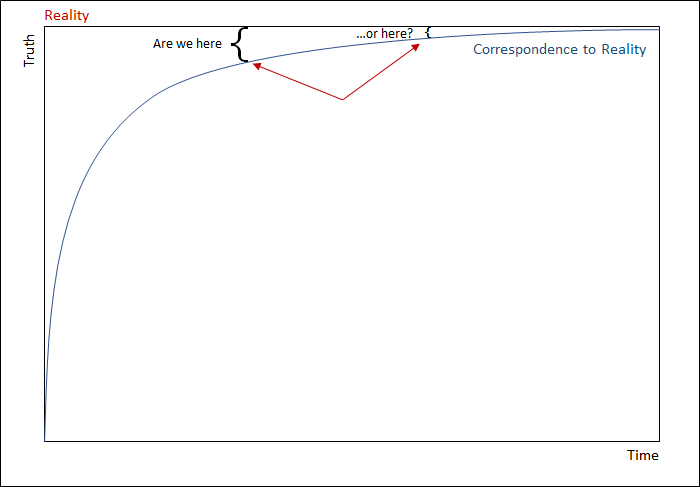
Chart 2: The comforting myth of correspondence: scientific inquiry creeping ever closer to Reality™, though we can’t measure the distance—or even be sure the curve bends in the right direction.

Thomas Kuhn was blunt about this: what we call “progress” is less about convergence and more about paradigm shifts, a wholesale change in the rules of the game. The Earth does not move smoothly closer to Truth; it lurches from one orthodoxy to another, each claiming victory. Progress, in practice, is rhetorical re-baptism.

Most defenders of the asymptotic story assume that even if progress is slow, it’s always incremental, always edging us closer. But history suggests otherwise. Paradigm shifts don’t just move the line higher; they redraw the entire curve. What once looked like the final step toward truth may later be recast as an error, a cul-de-sac, or even a regression. Newton gave way to Einstein; Einstein may yet give way to something that renders relativity quaint. From inside the present, every orthodoxy feels like progress. From outside, it looks more like a lurch, a stumble, and a reset.

Chart 3: The paradigm-gap view: what feels like progress may later look like regression. History suggests lurches, not lines, what we call progress today is tomorrow’s detour..

If paradigm shifts can redraw the entire map of what counts as truth, then it makes sense to ask what exactly we mean when we invoke the word at all. Is truth a mirror of reality? A matter of internal coherence? Whatever works? Or just a linguistic convenience? Philosophy has produced a whole menu of truth theories, each with its own promises and pitfalls—and each vulnerable to the same problems of rhetoric, context, and shifting meanings.

The Many Flavours of Truth

Philosophers never tire of bottling “truth” in new vintages. The catalogue runs long: correspondence, coherence, pragmatic, deflationary, redundancy. Each is presented as the final refinement, the one true formulation of Truth, though each amounts to little more than a rhetorical strategy.

  • Correspondence theory: Truth is what matches reality.
    Problem: we can never measure distance from “Reality™” itself, only from our models.
  • Coherence theory: Truth is what fits consistently within a web of beliefs.
    Problem: many mutually incompatible webs can be internally consistent.
  • Pragmatic theory: Truth is what works.
    Problem: “works” for whom, under what ends? Functionality is always perspectival.
  • Deflationary / Minimalist: Saying “it’s true that…” adds nothing beyond the statement itself.
    Problem: Useful for logic, empty for lived disputes.
  • Redundancy / Performative: “It is true that…” adds rhetorical force, not new content.
    Problem: truth reduced to linguistic habit.

And the common fallback: facts vs. truths. We imagine facts as hard little pebbles anyone can pick up. Hastings was in 1066; water boils at 100°C at sea level. But these “facts” are just truths that have been successfully frozen and institutionalised. No less rhetorical, only more stable.

So truth isn’t one thing – it’s a menu. And notice: all these flavours share the same problem. They only work within language-games, frameworks, or communities of agreement. None of them delivers unmediated access to Reality™.

Truth turns out not to be a flavour but an ice cream parlour – lots of cones, no exit.

Multiplicity of Models

Even if correspondence weren’t troubled, it collapses under the weight of underdetermination. Quine and Duhem pointed out that any body of evidence can support multiple competing theories.

Chart 4: orthodox vs. heterodox curves, each hugging “reality” differently

Hilary Putnam pushed it further with his model-theoretic argument: infinitely many models could map onto the same set of truths. Which one is “real”? There is no privileged mapping.

Conclusion: correspondence is undercut before it begins. Truth isn’t a straight line toward Reality; it’s a sprawl of models, each rhetorically entrenched.

Truth as Rhetoric and Power

This is where Orwell was right: “War is Peace, Freedom is Slavery, Ignorance is Strength.”

Image: INGSOC logo

Truth, in practice, is what rhetoric persuades.

Michel Foucault stripped off the mask: truth is not about correspondence but about power/knowledge. What counts as truth is whatever the prevailing regime of discourse allows.

We’ve lived it:

  • “The economy is strong”, while people can’t afford rent.
  • “AI will save us”, while it mainly writes clickbait.
  • “The science is settled” until the next paper unsettles it.

These aren’t neutral observations; they’re rhetorical victories.

Truth as Community Practice

Chart 5: Margin of error bands

Even when rhetoric convinces, it convinces in-groups. One group converges on a shared perception, another on its opposite. Flat Earth and Round Earth are both communities of “truth.” Each has error margins, each has believers, each perceives itself as edging toward reality.

Wittgenstein reminds us: truth is a language game. Rorty sharpens it: truth is what our peers let us get away with saying.

So truth is plural, situated, and always contested.

Evolutionary and Cognitive Scaffolding

Step back, and truth looks even less eternal and more provisional.

We spread claims because they move us (emotivism) and because we urge others to join (prescriptivism). Nietzsche was savage about it: truth is just a herd virtue, a survival trick.

Cognitive science agrees, if in a different language: perception is predictive guesswork, riddled with biases, illusions, and shortcuts. Our minds don’t mirror reality; they generate useful fictions.
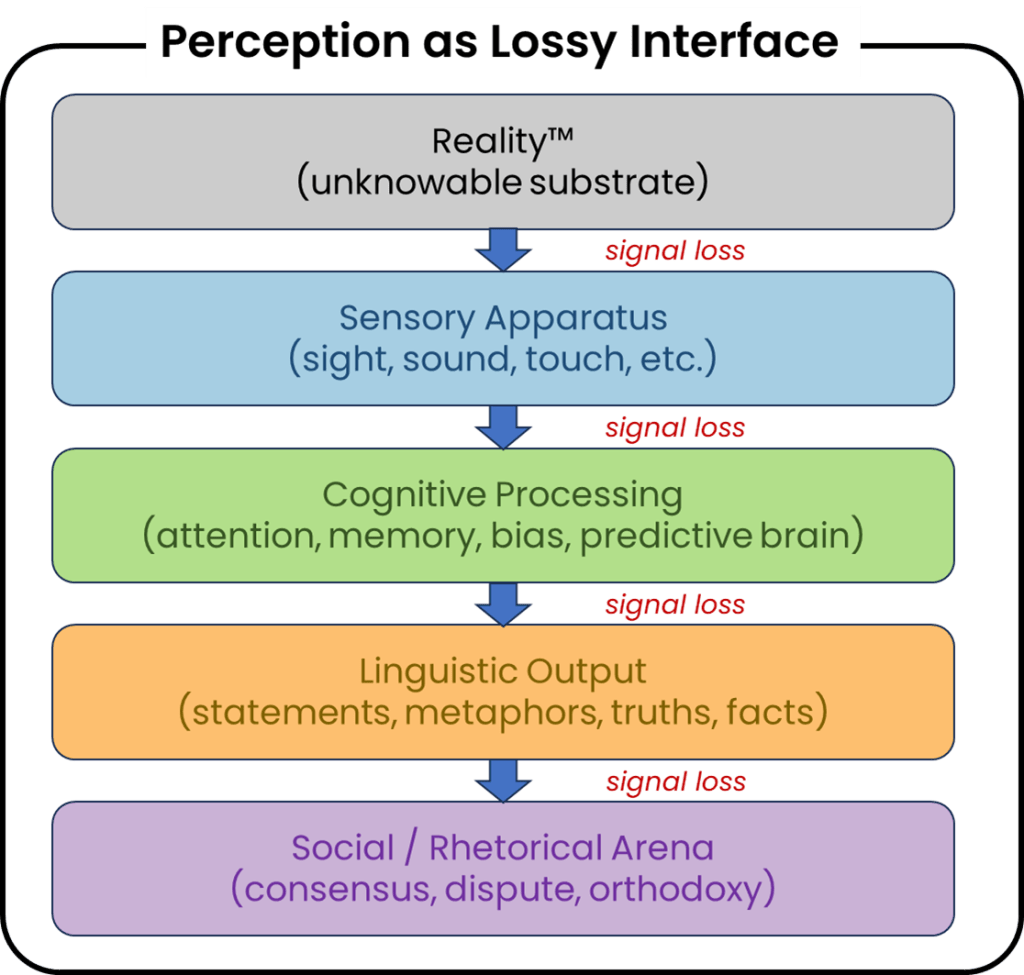
Diagram: Perception as a lossy interface: Reality™ filtered through senses, cognition, language, and finally rhetoric – signal loss at every stage.

Archetypal Truth (Positive Proposal)

So where does that leave us? Not with despair, but with clarity.

Truth is best understood as archetypal – a construct humans rally around. It isn’t discovered; it is invoked. Its force comes not from correspondence but from resonance.

Here, my own Language Insufficiency Hypothesis bites hardest: all our truth-talk is approximation. Every statement is lossy compression, every claim filtered through insufficient words. We can get close enough for consensus, but never close enough for Reality.

Truth is rhetorical, communal, functional. Not absolute.

The Four Pillars (Manifesto Form)

  1. Archetypal – truth is a symbolic placeholder, not objective reality.
  2. Asymptotic – we gesture toward reality but never arrive.
  3. Rhetorical – what counts as truth is what persuades.
  4. Linguistically Insufficient – language guarantees slippage and error.

Closing

Nietzsche warned, Rorty echoed: stop fetishising Truth. Start interrogating the stories we tell in its name.

Every “truth” we now applaud may be tomorrow’s embarrassment. The only honest stance is vigilance – not over whether we’ve captured Reality™, but over who gets to decide what is called true, and why.

Truth has never been a mirror. It’s a mask. The only question worth asking is: who’s wearing it?

Cogito, Ergo… Who?

Everyone knows the line: cogito ergo sum. Descartes’ great party trick. A man alone in his study, fretting about demons, announces that because he’s doubting, he must exist. Ta-da! Curtain call. Except, of course, it’s less of a revelation than a conjuring trick: he pulls an I out of a hat that was never proved to be there in the first place. Thinking is happening, indeed – but who invited the “thinker”?

Video: David Guignion talks about Descartes’ Cogito.

And let’s not forget the dramatis personae Descartes smuggles in for atmosphere. A malicious demon, a benevolent God, both necessary props to justify his paranoia and his certainty. Philosophy as melodrama: cue organ music, lightning strike.

Audio: NotebookLM podcast on this topic.

Enter the Critics

Spinoza rolls his eyes. Doubt isn’t some heroic starting point, he says – it’s just ignorance, a lack of adequate ideas. To elevate doubt into method is like treating vertigo as a navigational tool. Error isn’t demonic trickery; it’s our own confusion.

Kant arrives next, shaking his head. Descartes thinks he’s proven a substantial “I,” but all he’s actually shown is the form of subjectivity – the empty requirement that experiences hang together. The “I think” is a necessary placeholder, not a discovery. A grammatical “you are here” arrow, not a metaphysical treasure chest.

Hegel, of course, can’t resist upping the disdain. Descartes’ I is an empty abstraction, a hollow balloon floating above reality. The self isn’t given in some solitary moment of doubt; it emerges through process – social, historical, dialectical. The cogito is the philosophical equivalent of a selfie: lots of certainty, zero depth.

The Insufficiency Twist

And yet, maybe all of them are still dancing to the same fiddler. Because here’s the real suspicion: what if the whole problem is a trick of language? English, with its bossy Indo-European grammar, refuses to let verbs stand alone. “Thinking” must have a “thinker,” “seeing” a “seer.” Grammar insists on a subject; ontology obediently provides one.

Other languages don’t always play this game. Sanskrit or Pali can shrug and say simply, “it is seen.” Japanese leaves subjects implied, floating like ghosts. Some Indigenous languages describe perception as relational events – “seeing-with-the-tree occurs” – no heroic subject required. So perhaps the real villain here isn’t Descartes or even metaphysics, but syntax itself, conscripting us into a subject-shaped theatre.

Now, I don’t want to come off like a one-trick pony, forever waving the flag of “language insufficiency” like some tired philosopher’s catchphrase. But we should be suspicious when our limited grammar keeps painting us into corners, insisting on perceivers where maybe there are only perceptions, conjuring selves because our verbs can’t tolerate dangling.

Curtain Call

So in the end, Descartes’ famous “I” might be no more than a grammatical fiction, a casting error in the great play of philosophy. The cogito isn’t the foundation of modern thought; it’s the world’s most influential typo.

The Red Flag of Truth

Nothing says “I’ve stopped thinking” quite like someone waving the banner of Truth. The word itself, when capitalised and flapped about like a holy relic, isn’t a signal of wisdom but of closure. A red flag.

The short video by Jonny Thompson that inspired this post.

Those who proclaim to “speak the Truth” or “know the Truth”rarely mean they’ve stumbled upon a tentative insight awaiting refinement. No, what they mean is: I have grasped reality in its totality, and—surprise!—it looks exactly like my prejudices. It’s the epistemic equivalent of a toddler declaring ownership of the playground by drooling on the swings.

The Fetish of Objectivity

The conceit is that Truth is singular, objective, eternal, a monolithic obelisk towering over human folly. But history’s scrapyard is full of such obelisks, toppled and broken: phlogiston, bloodletting, Manifest Destiny, “the market will regulate itself.” Each was once trumpeted as capital-T Truth. Each is now embarrassing clutter for the dustbin.

Still, the zealots never learn. Every generation delivers its own batch of peddlers, flogging their version of Truth as if it were snake oil guaranteed to cure ignorance and impotence. (Side effects may include dogmatism, authoritarianism, and an inability to read the room.)

Why It’s a Red Flag

When someone says, “It’s just the truth”, what they mean is “, I am not listening,” like the parent who argues, “because I said so.” Dialogue is dead; curiosity cremated. Truth, in their hands, is less a lantern than a cosh. It is wielded not to illuminate, but to bludgeon.

Ralph Waldo Emerson’s voice breaks in, urging us to trust ourselves and to think for ourselves. Nothing is more degrading than to borrow another’s convictions wholesale and parade them as universal law. Better to err in the wilderness of one’s own reason than to be shepherded safely into another man’s paddock of certainties.

A Better Alternative

Rather than fetishising Truth, perhaps we ought to cultivate its neglected cousins: curiosity, provisionality, and doubt. These won’t look as good on a placard, admittedly. Picture a mob waving banners emblazoned with Ambiguity! – not exactly the stuff of revolutions. But infinitely more honest, and infinitely more humane.

So when you see someone waving the flag of Truth, don’t salute. Recognise it for what it is: a warning sign. Proceed with suspicion, and for God’s sake, bring Emerson.

The Ethics of Feedback in an Algorithmic Age


We’ve entered an era where machines tell us how we’re doing, whether it’s an AI app rating our résumé, a model reviewing our fiction, or an algorithm nudging our attention with like-shaped carrots.

Full story here, from the Ridley side: Needle’s Edge: Scene Feedback 01

Recently, I ran a brutally raw scene through a few AI platforms. The kind of scene that’s meant to unsettle, not entertain. One of them responded with effusive praise: “Devastating, but masterfully executed.”

Was it honest?

Was it useful?

Or was it merely reflecting my own aesthetic back at me, polished by a thousand reinforcement-learning smiles?

This is the ethical dilemma: If feedback is always flattering, what good is it? If criticism is only tolerated when couched in praise, how do we grow? And when machine feedback mimics the politeness of a mid-level manager with performance anxiety, we risk confusing validation with truth.

There’s a difference between signal and applause. Between understanding and affirmation.

The danger isn’t that AI flatters us. The danger is that we start to believe it and forget that art, inquiry, and ethics thrive on friction.

Jordan Peterson: Derivative, Disingenuous, and (Hopefully) Done

I don’t like most of Jordan Peterson’s positions. There – I’ve said it. The man, once ubiquitous, seems to have faded into the woodwork, though no doubt his disciples still cling to his every word as if he were a modern-day oracle. But recently, I caught a clip of him online, and it dredged up the same bad taste, like stumbling upon an old, forgotten sandwich at the back of the fridge.

Audio: NotebookLM podcast on this topic

Let’s be clear. My distaste for Peterson isn’t rooted in petty animosity. It’s because his material is, in my view, derivative and wrong. And by wrong, I mean I disagree with him – a subtle distinction, but an important one. There’s nothing inherently shameful about being derivative. We all are, to some extent. No thinker sprouts fully-formed from the head of Zeus. The issue is when you’re derivative and act as if you’ve just split the atom of human insight.

Peterson tips his hat to Nietzsche – fair enough – but buries his far greater debt to Jung under layers of self-mythologising. He parades his ideas before audiences, many of whom lack the background to spot the patchwork, and gaslights them into believing they’re witnessing originality. They’re not. They’re witnessing a remixed greatest-hits album, passed off as a debut.

Image: Gratuitous, mean-spirited meme.

Now, I get it. My ideas, too, are derivative. Sometimes it’s coincidence – great minds and all that – but when I trace the thread back to its source, I acknowledge it. Nietzsche? Subjectivity of morality. Foucault? Power dynamics. Wittgenstein? The insufficiency of language. I owe debts to many more: Galen Strawson, Richard Rorty, Raymond Geuss – the list goes on, and I’d gladly share my ledger. But Peterson? The man behaves as though he invented introspection.

And when I say I disagree, let’s not confuse that with some claim to divine epistemic certainty. I don’t mean he’s objectively wrong (whatever that means in the grand circus of philosophy). I mean, I disagree. If I did, well, we wouldn’t be having this conversation, would we? That’s the tragicomedy of epistemology: so many positions, so little consensus.

But here’s where my patience truly snaps: Peterson’s prescriptivism. His eagerness to spew what I see as bad ideology dressed up as universal truth. Take his stance on moral objectivism—possibly his most egregious sin. He peddles this as if morality were some Platonic form, gleaming and immutable, rather than what it is: a human construct, riddled with contingency and contradiction.

And let’s not even get started on his historical and philosophical cherry-picking. His commentary on postmodern thought alone is a masterclass in either wilful misreading or, more likely, not reading at all. Straw men abound. Bogeymen are conjured, propped up, and ritually slaughtered to rapturous applause. It’s intellectually lazy and, frankly, beneath someone of his ostensible stature.

I can only hope we’ve seen the last of this man in the public sphere. And if not? Well, may he at least reform his ways—though I shan’t be holding my breath.

Molyneux, Locke, and the Cube That Shook Empiricism

Few philosophical thought experiments have managed to torment empiricists quite like Molyneux’s problem. First posed by William Molyneux to John Locke in 1688 (published in Locke’s An Essay Concerning Human Understanding), the question is deceptively simple:

If a person born blind, who has learned to distinguish a cube from a sphere by touch, were suddenly granted sight, could they, without touching the objects, correctly identify which is the cube and which is the sphere by sight alone?

I was inspired to write this article in reaction to Jonny Thmpson’s post on Philosophy Minis, shared below for context.

Video: Molyneux’s Problem

Locke, ever the champion of sensory experience as the foundation of knowledge, gave a confident empiricist’s answer: no. For Locke, ideas are the products of sensory impressions, and each sense provides its own stream of ideas, which must be combined and associated through experience. The newly sighted person, he argued, would have no prior visual idea of what a cube or sphere looks like, only tactile ones; they would need to learn anew how vision maps onto the world.

Audio: NotebookLM podcast on this topic.

This puzzle has persisted through centuries precisely because it forces us to confront the assumptions at the heart of empiricism: that all knowledge derives from sensory experience and that our senses, while distinct, can somehow cohere into a unified understanding of the world.

Empiricism, Epistemology, and A Priori Knowledge: The Context

Before we dismantle the cube further, let’s sweep some conceptual debris out of the way. Empiricism is the view that knowledge comes primarily (or exclusively) through sensory experience. It stands opposed to rationalism, which argues for the role of innate ideas or reason independent of sense experience.

Epistemology, the grandiloquent term for the study of knowledge, concerns itself with questions like: What is knowledge? How is it acquired? Can we know anything with certainty?

And then there is the spectre of a priori knowledge – that which is known independent of experience. A mathematical truth (e.g., 2 + 2 = 4) is often cited as a classic a priori case. Molyneux’s problem challenges empiricists because it demands an account of how ideas from one sensory modality (touch) might map onto another (vision) without prior experience of the mapping—an a priori leap, if you will.

The Language Correspondence Trap

While Molyneux and Locke framed this as an epistemological riddle, we can unmask it as something more insidious: a failure of language correspondence. The question presumes that the labels “cube” and “sphere” – tied in the blind person’s mind to tactile experiences – would, or should, carry over intact to the new visual experiences. But this presumption smuggles in a linguistic sleight of hand.

The word “cube” for the blind person means a specific configuration of tactile sensations: edges, vertices, flat planes. The word “sphere” means smoothness, unbroken curvature, no edges. These are concepts anchored entirely in touch. When vision enters the fray, we expect these words to transcend modalities – to leap from the tactile to the visual, as if their meanings were universal tokens rather than context-bound markers. The question is not merely: can the person see the cube? but rather: can the person’s tactile language map onto the visual world without translation or recalibration?

What Molyneux’s problem thus exposes is the assumption that linguistic labels transparently correspond to external reality, regardless of sensory apparatus. This is the mirage at the heart of Locke’s empiricism, the idea that once a word tags an object through experience, that tag is universally valid across sensory experiences. The cube and sphere aren’t just objects of knowledge; they are signs, semiotic constructs whose meaning depends on the sensory, social, and linguistic contexts in which they arise.

The Semiotic Shambles

Molyneux’s cube reveals the cracks in the correspondence theory of language: the naïve belief that words have stable meanings that latch onto stable objects or properties in the world. In fact, the meaning of “cube” or “sphere” is as much a product of sensory context as it is of external form. The newly sighted person isn’t merely lacking visual knowledge; they are confronted with a translation problem – a semantic chasm between tactile signification and visual signification.

If, as my Language Insufficiency Hypothesis asserts, language is inadequate to fully capture and transmit experience across contexts, then Molyneux’s problem is not an oddity but an inevitability. It exposes that our conceptual frameworks are not universal keys to reality but rickety bridges between islands of sense and meaning. The cube problem is less about empiricism’s limits in epistemology and more about its blind faith in linguistic coherence.

In short, Molyneux’s cube is not simply an empirical puzzle; it is a monument to language’s failure to correspond cleanly with the world, a reminder that what we call knowledge is often just well-worn habit dressed up in linguistic finery.

A Final Reflection

Molyneux’s problem, reframed through the lens of language insufficiency, reveals that our greatest epistemic challenges are also our greatest linguistic ones. Before we can speak of knowing a cube or sphere by sight, we must reckon with the unspoken question: do our words mean what we think they mean across the changing stage of experience?

That, dear reader, is the cube that haunts empiricism still.

Speculative Philosophy on Screen: Identity, Agency, and the Fiction of Reality

Close-up of a human eye with digital glitch effects and overlaid text reading 'What if reality is wrong?'—a visual metaphor for distorted perception and unreliable truth.

Regular readers know I often write about identity, free will, and the narrative constraints of language. But I also explore these ideas through fiction, under the name Ridley Park.

In this short video, I unpack the philosophical motivations behind my stories, including:

  • Why reality is never as it seems
  • Why the self is a narrative convenience
  • What Heidegger’s Geworfenheit and Galen Strawson’s Causa Sui argument reveal about agency
  • And why language fails us – even when we think it serves

This isn’t promotional fluff. It’s epistemological dissent in a new format. Fictional, yes, but only in the sense that most of reality is, too.

▶️ Watch the video: Why I Write the Way I Do

The Rhetoric of Realism: When Language Pretends to Know

Let us begin with the heresy: Truth is a rhetorical artefact. Not a revelation. Not a metaphysical essence glimmering behind the veil. Just language — persuasive, repeatable, institutionally ratified language. In other words: branding.

Audio: NotebookLM podcast on this topic.

This is not merely a postmodern tantrum thrown at the altar of Enlightenment rationalism. It is a sober, if impolite, reminder that nearly everything we call “knowledge” is stitched together with narrative glue and semantic spit. Psychology. Neuroscience. Ethics. Economics. Each presents itself as a science — or worse, a moral imperative — but their foundations are built atop a linguistic faultline. They are, at best, elegant approximations; at worst, dogma in drag.

Let’s take psychology. Here is a field that diagnoses your soul via consensus. A committee of credentialed clerics sits down and declares a cluster of behaviours to be a disorder, assigns it a code, and hands you a script. It is then canonised in the DSM, the Diagnostic Scripture Manual. Doubt its legitimacy and you are either naïve or ill — which is to say, you’ve just confirmed the diagnosis. It’s a theological trap dressed in the language of care.

Or neuroscience — the church of the glowing blob. An fMRI shows a region “lighting up” and we are meant to believe we’ve located the seat of love, the anchor of morality, or the birthplace of free will. Never mind that we’re interpreting blood-oxygen fluctuations in composite images smoothed by statistical witchcraft. It looks scientific, therefore it must be real. The map is not the territory, but in neuroscience, it’s often a mood board.

And then there is language itself, the medium through which all these illusions are transmitted. It is the stage, the scenery, and the unreliable narrator. My Language Insufficiency Hypothesis proposes that language is not simply a flawed tool — it is fundamentally unfit for the task it pretends to perform. It was forged in the furnace of survival, not truth. We are asking a fork to play the violin.

This insufficiency is not an error to be corrected by better definitions or clever metaphors. It is the architecture of the system. To speak is to abstract. To abstract is to exclude. To exclude is to falsify. Every time we speak of a thing, we lose the thing itself. Language functions best not as a window to the real but as a veil — translucent, patterned, and perpetually in the way.

So what, then, are our Truths™? They are narratives that have won. Stories that survived the epistemic hunger games. They are rendered authoritative not by accuracy, but by resonance — psychological, cultural, institutional. A “truth” is what is widely accepted, not because it is right, but because it is rhetorically unassailable — for now.

This is the dirty secret of epistemology: coherence masquerades as correspondence. If enough concepts link arms convincingly, we grant them status. Not because they touch reality, but because they echo each other convincingly in our linguistic theatre.

Libet’s experiment, Foucault’s genealogies, McGilchrist’s hemispheric metaphors — each peels back the curtain in its own way. Libet shows that agency might be a post-hoc illusion. Foucault reveals that disciplines don’t describe the subject; they produce it. McGilchrist laments that the Emissary now rules the Master, and the world is flatter for it.

But all of them — and all of us — are trapped in the same game: the tyranny of the signifier. We speak not to uncover truth, but to make truth-sounding noises. And the tragedy is, we often convince ourselves.

So no, we cannot escape the prison of language. But we can acknowledge its bars. And maybe, just maybe, we can rattle them loudly enough that others hear the clank.

Until then, we continue — philosophers, scientists, diagnosticians, rhetoricians — playing epistemology like a parlour game with rigged dice, congratulating each other on how well the rules make sense.

And why wouldn’t they? We wrote them.

Sustenance: A Book About Aliens, Language, and Everything You’re Getting Wrong

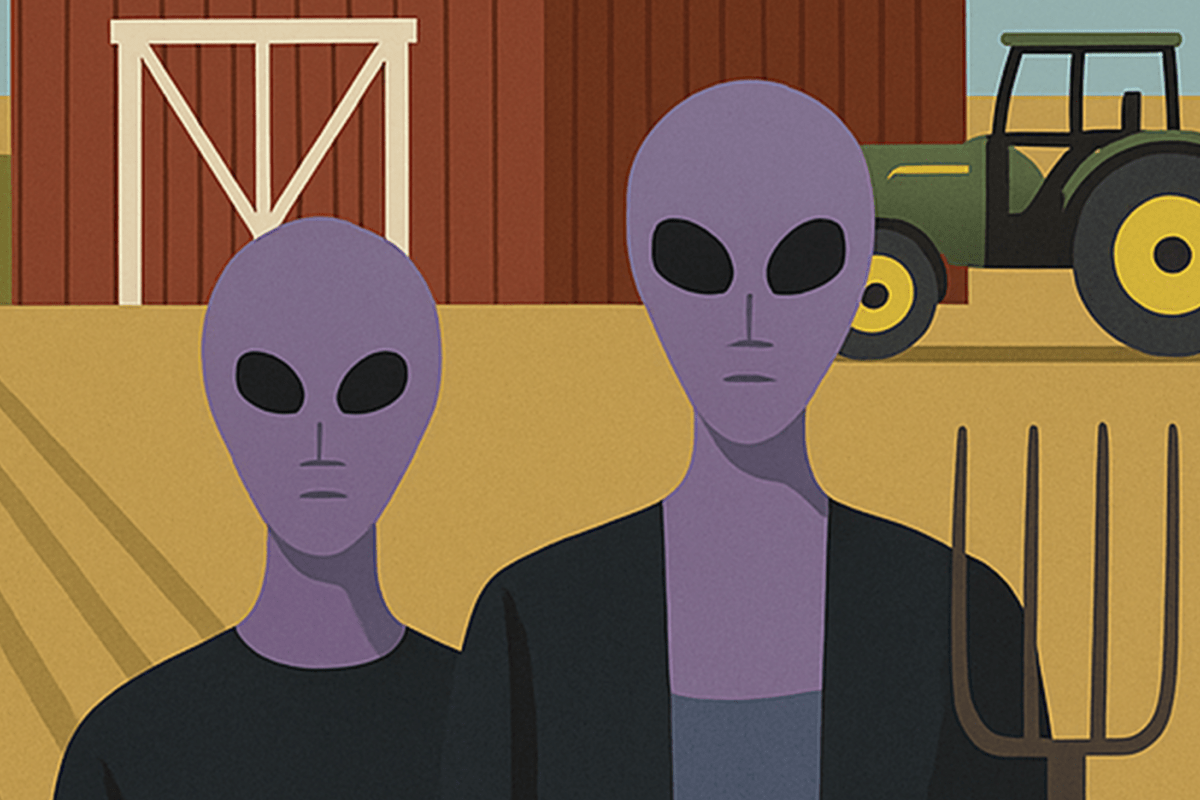
Violet aliens on a farm

So, I wrote a book and published it under Ridley Park, the pseudonym I use for fiction.

It has aliens. But don’t get excited—they’re not here to save us, probe us, or blow up the White House. They’re not even here for us.

Which is, frankly, the point.

Audio: NotebookLM podcast on this topic.

The book’s called Sustenance, and while it’s technically speculative fiction, it’s more about us than them. Or rather, it’s about how we can’t stop making everything about us—even when it shouldn’t be. Especially when it shouldn’t be.

Let’s talk themes. And yes, we’re using that word like academics do: as a smokescreen for saying uncomfortable things abstractly.

Language: The Original Scam

Language is the ultimate colonial tool. We call it communication, but it’s mostly projection. You speak. You hope. You assume. You superimpose meaning on other people like a cling film of your own ego.

Sustenance leans into this—not by showing a breakdown of communication, but by showing what happens when communication was never mutual in the first place. When the very idea of “meaning” has no purchase. It’s not about mishearing—it’s about misbeing.

Culture: A Meme You Were Born Into

Culture is the software you didn’t choose to install, and probably can’t uninstall. Most people treat it like a universal law—until they meet someone running a different OS. Cue confusion, arrogance, or violence.

The book explores what happens when cultural norms aren’t shared, and worse, aren’t even legible. Imagine trying to enforce property rights on beings who don’t understand “ownership.” It’s like trying to baptise a toaster.

Sex/Gender: You Keep Using Those Words…

One of the quiet joys of writing non-human characters is discarding human assumptions about sex and gender—and watching readers squirm.

What if sex wasn’t about power, pleasure, or identity? What if it was just a biological procedure, like cell division or pruning roses? Would you still be interested? Would you still moralise about it?

We love to believe our sex/gender constructs are inevitable. They’re not. They’re habits—often bad ones.

Consent: Your Framework Is Showing

Consent, as we use it, assumes mutual understanding, shared stakes, and equivalent agency. Remove any one of those and what’s left?

Sustenance doesn’t try to solve this—it just shows what happens when those assumptions fall apart. Spoiler: it’s not pretty, but it is honest.

Projection: The Mirror That Lies

Humans are deeply committed to anthropocentrism. If it walks like us, or flinches like us, it must be us. This is why we get so disoriented when faced with the truly alien: it won’t dance to our tune, and we’re left staring at ourselves in the funhouse mirror.

This isn’t a book about aliens.

It’s a book about the ways we refuse to see what’s not us.

Memory: The Autobiography of Your Justifications

Memory is not a record. It’s a defence attorney with a narrative license. We rewrite the past to make ourselves look consistent, or innocent, or right.

In Sustenance, memory acts less as a tether to truth and more as a sculpting tool—a way to carve guilt into something manageable. Something you can live with. Until you can’t.

In Summary: It’s Not About Them. It’s About You.

If that sounds bleak, good. It’s meant to.

But it’s also a warning: don’t get too comfortable in your own categories. They’re only universal until you meet someone who doesn’t share them.

Like I said, it’s not really about the aliens.

It’s about us.


If you enjoy fiction that’s more unsettling than escapist, more question than answer, you might be interested in Sustenance. It’s live on Kindle now for the cost of a regrettable coffee:

📘 Sustenance on Amazon US
Also available in the UK, DE, FR, ES, IT, NL, JP, BR, CA, MX, AU, and IN—because alienation is a universal language.

“Trust the Science,” They Said. “It’s Reproducible,” They Lied.

—On Epistemology, Pop Psychology, and the Cult of Empirical Pretence

Science, we’re told, is the beacon in the fog – a gleaming lighthouse of reason guiding us through the turbulent seas of superstition and ignorance. But peer a bit closer, and the lens is cracked, the bulb flickers, and the so-called lighthouse keeper is just some bloke on TikTok shouting about gut flora and intermittent fasting.

Audio: NotebookLM podcast on this topic.

We are creatures of pattern. We impose order. We mistake correlation for causation, narrative for truth, confidence for knowledge. What we have, in polite academic parlance, is an epistemology problem. What we call science is often less Newton and more Nostradamus—albeit wearing a lab coat and wielding a p-hacked dataset.

Let’s start with the low-hanging fruit—the rotting mango of modern inquiry: nutritional science, which is to actual science what alchemy is to chemistry, or vibes are to calculus. We study food the way 13th-century monks studied demons: through superstition, confirmation bias, and deeply committed guesswork. Eat fat, don’t eat fat. Eat eggs, don’t eat eggs. Eat only between the hours of 10:00 and 14:00 under a waxing moon while humming in Lydian mode. It’s a cargo cult with chia seeds.

But why stop there? Let’s put the whole scientific-industrial complex on the slab.

Psychology: The Empirical Astrological Society

Psychology likes to think it’s scientific. Peer-reviewed journals, statistical models, the odd brain scan tossed in for gravitas. But at heart, much of it is pop divination, sugar-dusted for mass consumption. The replication crisis didn’t merely reveal cracks – it bulldozed entire fields. The Stanford Prison Experiment? A theatrical farce. Power poses? Empty gestural theatre. Half of what you read in Psychology Today could be replaced with horoscopes and no one would notice.

Medical Science: Bloodletting, But With Better Branding

Now onto medicine, that other sacred cow. We tend to imagine it as precise, data-driven, evidence-based. In practice? It’s a Byzantine fusion of guesswork, insurance forms, and pharmaceutical lobbying. As Crémieux rightly implies, medicine’s predictive power is deeply compromised by overfitting, statistical fog, and a staggering dependence on non-replicable clinical studies, many funded by those who stand to profit from the result.

And don’t get me started on epidemiology, that modern priesthood that speaks in incantations of “relative risk” and “confidence intervals” while changing the commandments every fortnight. If nutrition is theology, epidemiology is exegesis.

The Reproducibility Farce

Let us not forget the gleaming ideal: reproducibility, that cornerstone of Enlightenment confidence. The trouble is, in field after field—from economics to cancer biology—reproducibility is more aspiration than reality. What we actually get is a cacophony of studies no one bothers to repeat, published to pad CVs, p-hacked into publishable shape, and then cited into canonical status. It’s knowledge by momentum. We don’t understand the world. We just retweet it.

What, Then, Is To Be Done?

Should we become mystics? Take up tarot and goat sacrifice? Not necessarily. But we should strip science of its papal robes. We should stop mistaking publication for truth, consensus for accuracy, and method for epistemic sanctity. The scientific method is not the problem. The pretence that it’s constantly being followed is.

Perhaps knowledge doesn’t have a half-life because of progress, but because it was never alive to begin with. We are not disproving truth; we are watching fictions expire.

Closing Jab

Next time someone says “trust the science,” ask them: which bit? The part that told us margarine was manna? The part that thought ulcers were psychosomatic? The part that still can’t explain consciousness, but is confident about your breakfast?

Science is a toolkit. But too often, it’s treated like scripture. And we? We’re just trying to lose weight while clinging to whatever gospel lets us eat more cheese.