I’ve long had a problem with Truth – or at least the notion of it. It gets way too much credit for doing not much at all. For a long time now, philosophers have agreed on something uncomfortable: Truth isn’t what we once thought it was.
Truth isn’t what we once thought it was
The grand metaphysical picture, where propositions are true because they correspond to mind-independent facts, has steadily eroded. Deflationary accounts have done their work well. Truth no longer looks like a deep property hovering behind language. It looks more like a linguistic device: a way of endorsing claims, generalising across assertions, and managing disagreement. So far, so familiar.
Audio: NotebookLM summary podcast of this topic.
What’s less often asked is what happens after we take deflation seriously. Not halfway. Not politely. All the way.
That question motivates my new paper, Truth After Deflation: Why Truth Resists Stabilisation. The short version is this: once deflationary commitments are fully honoured, the concept of Truth becomes structurally unstable. Not because philosophers are confused, but because the job we keep asking Truth to do can no longer be done with the resources we allow it.
The core diagnosis: exhaustion
The paper introduces a deliberately unromantic idea: truth exhaustion. Exhaustion doesn’t mean that truth-talk disappears. We still say things are true. We still argue, correct one another, and care about getting things right. Exhaustion means something more specific:
After deflation, there is no metaphysical, explanatory, or adjudicative remainder left for Truth to perform.
Truth remains grammatically indispensable, but philosophically overworked.
Image: NotebookLM infographics of this topic. (Please ignore the typos.)
The dilemma
Once deflationary constraints are accepted, attempts to “save” Truth fall into a simple two-horn dilemma.
Horn A: Stabilise truth by making it invariant. You can do this by disquotation, stipulation, procedural norms, or shared observation. The result is stable, but thin. Truth becomes administrative: a device for endorsement, coordination, and semantic ascent. It no longer adjudicates between rival frameworks.
Horn B: Preserve truth as substantive. You can ask Truth to ground inquiry, settle disputes, explain success, or stand above practices. But now you need criteria. And once criteria enter, so do circularity, regress, or smuggled metaphysics. Truth becomes contestable precisely where it was meant to adjudicate.
Stability costs substance. Substance costs stability. There is no third option waiting in the wings.
Why this isn’t just abstract philosophy
To test whether this is merely a theoretical artefact, the paper works through three domains where truth is routinely asked to do serious work:
Moral truth, where Truth is meant to override local norms and condemn entrenched practices.
Scientific truth, where Truth is meant to explain success, convergence, and theory choice.
Historical truth, where Truth is meant to stabilise narratives against revisionism and denial.
In each case, the same pattern appears. When truth is stabilised, it collapses into procedure, evidence, or institutional norms. When it is thickened to adjudicate across frameworks, it becomes structurally contestable. This isn’t relativism. It’s a mismatch between function and resources.
Why this isn’t quietism either
A predictable reaction is: isn’t this just quietism in better prose?
Not quite. Quietism tells us to stop asking. Exhaustion explains why the questions keep being asked and why they keep failing. It’s diagnostic, not therapeutic. The persistence of truth-theoretic debate isn’t evidence of hidden depth. It’s evidence of a concept being pushed beyond what it can bear after deflation.
The upshot
Truth still matters. But not in the way philosophy keeps demanding. Truth works because practices work. It doesn’t ground them. It doesn’t hover above them. It doesn’t adjudicate between them without borrowing authority from elsewhere. Once that’s accepted, a great deal of philosophical anxiety dissolves, and a great deal of philosophical labour can be redirected.
The question is no longer “What is Truth?” It’s “Why did we expect Truth to do that?”
The paper is now archived on Zenodo and will propagate to PhilPapers shortly. It’s long, unapologetically structural, and aimed squarely at readers who already think deflationary truth is right but haven’t followed it to its endpoint.
Read it if you enjoy watching concepts run out of road.
I want to clarify my recent The Trouble with Facts post. I realise that I was speaking to one non-trivial form of facts, but there is more than one class of facts. We argue about facts as if the word named a single, stable thing. It doesn’t. It names a family of very different things, quietly grouped together by habit, convenience, and institutional need. Most disputes about facts go nowhere, not because one side is irrational, but because the word itself is doing covert work. We slide between meanings without noticing, then act surprised when disagreement follows. This piece is an attempt to slow that slide.
Audio: NotebookLM summary podcast of this topic.
Polysemy We Notice, Polysemy We Don’t
We are comfortable with ambiguity when it is obvious. A bank can be a financial institution or the edge of a river. A bat can be an animal or a piece of sports equipment. Context resolves these instantly. No one feels existentially threatened by the ambiguity.
Fact is different. The word is polysemous in a way that is both subtle and consequential. Its meanings sit close enough to bleed into one another, allowing certainty from one sense to be smuggled into another without detection. Calling something a fact does not merely describe it. It confers authority. It signals that questioning should stop. That is why this ambiguity matters.
Different Kinds of Facts
Before critiquing facts, we need to sort them.
1. Event-facts (brute, world-facing) As mentioned previously, these concern what happens in the world, independent of observation.
A car collides with a tree.
Momentum changes.
Metal deforms.
These events occur whether or not anyone notices them. They are ontologically robust and epistemically inaccessible. No one ever encounters them directly. We only ever encounter traces.
2. Indexical or performative facts (trivial, self-reporting) “I am typing.”
I am doing this now – those now may not be relevant when you read this. This is a fact, but a very thin one. Its authority comes from the coincidence of saying and doing. It requires no reconstruction, no inference, no institutional validation. These facts are easy because they do almost no work.
3. Retrospective personal facts (memory-mediated) “I was typing.”
This may be relevant now, at least relative to the typing of this particular post. Still a fact, but weaker. Memory enters. Narrative compression enters. Selectivity enters. The same activity now carries a different epistemic status purely because time has passed.
4. Prospective statements (modal, not yet facts) “I will be typing.”
This is not yet a fact. It may never come to be one. It is an intention or prediction that may or may not be realised. Future-tense claims are often treated as incipient facts, but this is a category error with real consequences.
5. Institutional facts (designated, procedural) “The court finds…” “The report concludes…”
These are facts by designation. They are not discovered so much as selected, formalised, and stabilised so that systems can act. They are unlikely to rise to the level of facts, so the legal system tends to generate facts in name only – FINO, if I am being cute.
All of these are called ‘facts’. They are not interchangeable. The trouble begins when certainty migrates illicitly from trivial or institutional facts into brute event-facts, and we pretend nothing happened in the transfer.
One Motor Vehicle
Reconsider the deliberately simple case: A motor vehicle collides with a tree. Trees are immobile, so we can rule out the tree colliding with the car.
Ontologically, something happened. Reality did not hesitate. But even here, no one has direct access to the event itself.
The driver does not enjoy privileged access. They experience shock, adrenaline, attentional narrowing, selective memory, post hoc rationalisation, perhaps a concussion. Already several layers intervene before language even arrives.
A rough schema looks like this:
event → sensory registration → cognitive framing → linguistic encoding → social validation
Ontology concerns what happens. Epistemology concerns how anything becomes assertable.
Modern thinking collapses the second into the first and calls the result the facts.
People speak of “hard facts” as if hardness transfers from objects to propositions by proximity. It doesn’t. The tree is solid. The fact is an artefact assembled from observation, inference, convention, and agreement.
And so it goes…
Why the Confusion Persists
When someone responds, “But isn’t it a fact that I read this?”, the answer is yes. A different kind of fact.
The error lies not in affirming facts, but in failing to distinguish them. The word fact allows certainty to migrate across categories unnoticed, from trivial self-reports to brute world-events, and from institutional verdicts to metaphysical claims. That migration is doing the work.
Conclusion
Clarifying types of facts does not weaken truth. It prevents us from laundering certainty where it does not belong.
Facts exist. Events occur. But they do not arrive unmediated, innocent, or singular.
Reality happens once. Facts happen many times.
The mistake was never that facts are unreal. It was believing they were all the same kind of thing.
What we call facts are not discoveries of an unfiltered world. They are the end-products of mediation.
Let’s walk through an example.
Image: Autosmash example. An observer arrives with experience – from genetic predisposition to childhood trauma to winning the lottery. Whatever it might be. Of course, they have many cognitive deficits, biases and filters. Then, there’s the immediate problem of attention. When did they notice the event? Did they turn to look after hearing the noise, or were they meditating on the tree in that moment?
Apparently, a motor vehicle has collided with a tree. Trees are immobile objects, so we can safely rule out the tree colliding with the car.*
So what, exactly, are the facts?
Audio: NotebookLM summary podcast of this topic.
Ontology (the boring bit)
Ontologically, something happened.
A car struck a tree. Metal deformed. Momentum stopped.
Reality did not hesitate. It did not consult witnesses. It did not await interpretation.
This is the part Modernity likes to gesture at reverently before immediately leaving it behind.
Image: Requisite NotebookLM infographic on this content.
The Witness
Even the driver does not enjoy privileged access to “what really happened”.
They get:
proprioceptive shock
adrenaline distortion
attentional narrowing
selective memory
post hoc rationalisation
possibly a concussion
Which is already several layers deep before language even arrives to finish the job.
We can generalise the structure:
event → sensory registration → cognitive framing → linguistic encoding → social validation
Ontology: events occur. States of affairs obtain. Something happens whether or not we notice.
Epistemology: observation is always filtered through instruments, concepts, language, habits, and incentives.
Modern sleight of hand: collapse the second into the first and call the result the facts.
People love the phrase “hard facts”, as if hardness transfers from objects to propositions by osmosis. It doesn’t. The tree is solid. The fact is not.
Facts are artefacts. They are assembled from observation, inference, convention, and agreement. They function. They do not reveal essence.
Reality happens once. Facts happen many times, differently, depending on who needs them and why.
Filtration
An event occurred. A car struck a tree.
Then an observer arrives. But observers never arrive empty-handed.
They arrive with history: genetics, upbringing, trauma, habits, expectations, incentives. They arrive already filtered.
Were they already looking, or did the noise interrupt something else entirely?
Reality happens once. Facts happen many times, differently, depending on who needs them and why.
Here Comes the Law
This is where the legal system enters, not because truth has been found, but because closure is required.
Courts do not discover facts. They designate versions of events that are good enough to carry consequences. They halt the cascade of interpretations by institutional force and call the result justice.
At every epistemic level, what we assert are interpretations of fact, never access to ontological essence.
Intent, negligence, recklessness. These are not observations. They are attributions. They are stopping rules that allow systems to function despite uncertainty.
The law does not ask what really happened. It asks which story is actionable.
Two Motor Vehicles
Now add a second moving object.
Another car enters the frame, and with it an entire moral universe.
Suddenly, the event is no longer merely physical. It becomes relational. Agency proliferates. Narratives metastasise.
Who was speeding? Who had the right of way? Who saw whom first? Who should have anticipated whom?
Intent and motive rush in to fill the explanatory vacuum, despite remaining just as unobservable as before.
Nothing about the ontology improved. Everything about the storytelling did.
Where the tree refused intention, the second vehicle invites it. We begin inferring states of mind from trajectories, attributing beliefs from brake lights, extracting motives from milliseconds of motion.
But none of this is observed.
What we observe are:
vehicle positions after the fact,
damage patterns,
skid marks,
witness statements already filtered through shock and expectation.
From these traces, we construct mental interiors.
The driver “intended” to turn. The other driver “failed” to anticipate. Someone was “reckless”. Someone else was merely “unlucky”.
These are not facts. They are interpretive assignments, layered atop already mediated observations, selected because they allow responsibility to be distributed in socially recognisable ways.
This is why explanation now fractures.
One cascade of whys produces a story about distraction or poor judgment. Another produces a story about road design or visibility. Another about timing, traffic flow, or urban planning.
Each narrative is plausible. Each is evidence-constrained. None is ontologically privileged.
Yet one will be chosen.
Not because it is truer, but because it is actionable.
The presence of a second vehicle does not clarify causation. It merely increases the number of places we are willing to stop asking questions.
Modernity mistakes this proliferation of narrative for epistemic progress. In reality, it is moral bookkeeping.
The crash still occurred. Metal still deformed. Momentum still stopped.
What changed was not access to truth, but the urgency to assign fault.
With one vehicle and a tree, facts already fail to arrive unmediated. With two vehicles, mediation becomes the point.
And still, we insist on calling the result the facts.
But nothing fundamental has changed. We have not escaped mediation. We have merely scaled it up and professionalised it.
Cameras do not record reality. They record:
a frame,
from a position,
at a sampling rate,
with compression,
under lighting conditions,
interpreted later by someone with a mandate.
Video feels decisive because it is vivid, not because it is ontologically transparent. It freezes perspective and mistakes that freeze for truth. Slow motion, zoom, annotation. Each step adds clarity and distance at the same time.
Experts do not access essence either. They perform disciplined abduction.
From angles, debris fields, timing estimates, and damage profiles, they infer plausible sequences. They do not recover the event. They model it. Their authority lies not in proximity to reality, but in institutional trust and methodological constraint.
More data does not collapse interpretation. It multiplies it.
With enough footage, we don’t get the story. We get competing reconstructions, each internally coherent, each technically defensible, each aligned to a different question:
Who is legally liable?
Who is financially responsible?
Who violated policy?
Who can be blamed without destabilising the system?
At some point, someone declares the evidence “clear”.
What they mean is: we have enough material to stop arguing.
This is the final Modern illusion: that accumulation converges on essence. In reality, accumulation converges on closure.
The event remains what it always was: inaccessible except through traces. The facts become thicker, more confident, more footnoted. Their metaphysical status does not improve.
Reality happened once. It left debris. We organised the debris into narratives that could survive institutions.
Cameras didn’t reveal the truth. Experts didn’t extract it. They helped us agree on which interpretation would count.
And agreement, however necessary, has never been the same thing as access to what is.
* I was once driving in a storm, and a telephone pole fell about a metre in front of my vehicle. My car drove over the pole, and although I was able to drive the remainder of the way home, my suspension and undercarriage were worse for the wear and tear.
Written by Bry Willis and ChatGPT 5.2 after an extended chat about the image as a talking point about the inaccessibility of facts.
He doesn‘t, but he accidentally demonstrates the problem.
There is a certain kind of person who loathes Nietzsche for the same reason they loathe earthquakes. Not because he causes damage, but because he refuses to pretend the ground was ever stable.
In a recent address, Mark Carney says something that would have been unutterable in polite company a decade ago. He admits that the ‘rules-based international order’ was always a partial fiction. Not false enough to abandon, not true enough to believe in without effort. A story everyone knew was cracked, but which continued to function so long as enough people kept repeating the lines.
“We knew that the story about the rules-based order was partially false… We knew that international law applied with varying rigour depending on the identity of the accused and the victim. This fiction was useful [because of the goods provided by American hegemony]… So we placed the sign in the window. We participated in the rituals. And we largely avoided calling out the gaps between rhetoric and reality. This bargain no longer works. Let me be direct. We are in the midst of a rupture, not a transition… You cannot live within the lie of mutual benefit through integration when integration becomes the source of your subordination.“
Audio: NotebookLM podcast of this topic.
International law, he concedes, applied unevenly. Power decided enforcement. Friends received nuance. Enemies received principle. This was not ignorance. It was a bargain. The illusion delivered goods, stability, growth, a sense of moral hygiene. So the sign stayed in the window. The rituals continued. The gaps between rhetoric and reality were politely ignored. That bargain, Carney says, no longer works.
This is framed as geopolitical realism, but it is really an ontological admission. The mask slipped, and everyone is suddenly offended by the face underneath.
Image: NotebookLM infographic of this content.
This is why people hate Friedrich Nietzsche. Not because he celebrates cruelty or chaos, but because he insists that order is something we perform, not something we discover. He refuses the comfort of believing that the rules were ever neutral, universal, or self-enforcing. He points at the scaffolding and says: this is what is holding things up, not the sky.
When enough people play along, the game feels like reality. When someone refuses to play, panic sets in.
Enter Donald Trump. Trump did not invent the asymmetries of power. He refused to speak them politely. This created a moral crisis for institutions built on the assumption that everyone would continue to pretend. When a designated enemy like Vladimir Putin does this, it is filed under Evil. When an ally does it, the response bifurcates: either frantic appeasement, or embarrassed silence disguised as strategy.
Image: Foreignsentiment
Carney tries to walk a middle path. He neither genuflects nor detonates the stage. He acknowledges the fiction without fully abandoning it. This makes him interesting, but also symptomatic. He wants the audience to notice the set wobbling without asking them to leave the theatre.
When he says the old rules-based order is not coming back, what he really means is that the illusion has been interrupted. Whether permanently or only until someone builds a more convincing façade is left diplomatically unresolved. This is where Nietzsche becomes unavoidable.
People often lump Nietzsche together with vague talk of “power,” as though this were a crude obsession shared with Michel Foucault. But Nietzsche’s contribution is sharper and more unsettling. He is not merely describing power as something exercised. He is describing power as something that manufactures meaning, legitimacy, and moral vocabulary after the fact. Power does not break the rules. It writes them retroactively and calls them eternal.
This is the kind of power later adopted by Adolf Hitler, by Putin, and now by Trump. Not brute force alone, but the refusal to treat inherited norms as sacred simply because they are inherited. This is precisely what terrifies people who mistake procedural continuity for moral truth.
The United States borrowed Montesquieu’s separation of powers as though it were a lock rather than a suggestion. Anyone paying attention could see how easily it could be gamed. That this came as a shock says less about constitutional brilliance than about selective vision. The system functioned not because it was impregnable, but because its participants agreed, tacitly, to behave as though it were.
Nietzsche would call this decadence. Not decline as catastrophe, but decline as denial. The refusal to look directly at the conditions that make order possible, preferring instead to moralise their breakdown.
Carney’s speech is not radical. It is late. It says aloud what everyone already knew but preferred not to articulate: that the world was never neat, the order never neutral, and the rules never binding on those strong enough to ignore them.
What comes next is the uncomfortable part. Once the illusion is acknowledged, it cannot simply be re-believed. You can rebuild institutions. You can repaint the signage. But you cannot unknow that the coffee was always bitter.
Nietzsche does not tell us what replaces the façade. He only insists that pretending it was ever a window onto truth is the most dangerous fiction of all.
What Carney inadvertently demonstrates is not a failure of leadership but a failure of language. ‘Rules-based order’ was never a description of the world; it was a map we mistook for the terrain because it worked often enough to feel true. Nietzsche’s crime was pointing at the legend and saying it was doing the real work. Once that admission is made, you do not get to return to innocence. You can draw a new map, call it reform, integration, or renewal, but you will know it is a diagram pinned to power, not a window onto justice. The unease people feel now is not about chaos. It is about recognition. The lie no longer holds because too many have noticed the pins.
My Language Insufficiency Hypothesis is finished, the cover is designed, and everything is in order for a January 2026 release – save for one administrative detail: the ISBN. I expect this to be resolved presently. The Bowker distribution system in the US appears to have been set up circa 1997, and that’s just the web interface. Who knows how long the database has been in place? I’d bet circa 1955. Most countries provide ISBNs for free. Not the US. Kinda bollox. Meantime, I’ve now got three lenses through which to inspect the world.
[EDIT: ISBN issue has been resolved. I am awaiting a proof copy that should be arriving today.]
From the outside, some of my recent work can look untidy. A hypothesis about language. An ontology about mediated encounters. A paper on why moral disagreement refuses to resolve itself politely. No master theory. No clean ladder. No promised synthesis at the end. This is not an accident. It is a refusal.
What links the Language Insufficiency Hypothesis (LIH), the Mediated Encounter Ontology of the World (MEOW), and Disagreement Without Referees is not a shared doctrine, but a shared function. They are lenses, not foundations. Diagnostics, not blueprints. Each takes aim at a different site where Enlightenment habits quietly overpromise – meaning, access, adjudication – and shows what breaks when we stop pretending those promises were ever cashable. They form a family. Not a system. And certainly not a programme for rebuilding.
Three Lenses, Three Failure Sites
Each of these frameworks operates at a different level, but they all do the same kind of work: they explain why something we rely on feels indispensable, fails repeatedly, and yet stubbornly survives.
LIH operates at the linguistic level.
It asks why language fails precisely where we expect it to secure clarity, precision, or consensus. Its answer is unromantic: language is not uniformly capable. As we move from invariants to contestables to fluids and ineffables, its representational power degrades. The failure mode is familiar: we mistake grammatical stability for ontological stability, and then act surprised when disagreement hardens rather than dissolves.
MEOW operates at the ontological level.
It asks what kind of ‘world’ we are actually dealing with once we abandon the fantasy of unmediated access. There is no clean mind–world interface, no privileged vantage point. Every encounter is mediated – biologically, cognitively, linguistically, socially. Realism and idealism alike fail here, each clinging to a different myth of access. What remains is not scepticism, but constraint.
Disagreement Without Referees operates at the normative and political level.
It asks why moral and political disagreement persists even when all parties appear informed, sincere, and articulate. The answer is ontological incommensurability. Where frameworks do not overlap, there are no neutral referees. Argument does not converge because it cannot. What remains is persuasion, coalition, power, and consequence—moral life without an umpire.
None of these lenses replaces what it critiques. Each refuses the repair instinct that says: if we just fix the model, the system will work again. That instinct is the pathology.
What They Share (And What They Don’t)
What unites these lenses is not a set of positive claims about how the world really is. It is a shared posture:
no privileged access
no neutral ground
no final adjudication
no redemptive synthesis
But also:
no quietism
no nihilism
no ‘anything goes’
no abdication of responsibility
They do not tell you what to believe. They tell you why believing harder won’t save you.
Importantly, they are non-hierarchical. LIH does not ground MEOW. MEOW does not explain away disagreement. Disagreement does not ‘apply’ LIH in some linear fashion. They intersect. They overlap. They illuminate different failure modes of the same inherited fantasy: that there must be a place where things finally settle. There isn’t.
Image: Three Diagnostic Lenses Infographic¹
Why This Is Not a System
Systems promise closure. These lenses do not. They explain why closure is repeatedly promised, urgently demanded, and reliably missed. To systematise them would be to betray them.
What they offer instead is a kind of intellectual hygiene: a way of recognising when we are asking language, reality, or morality to do work they were never capable of doing – and then blaming one another when they don’t comply.
If there is a unifying thread, it is this:the demand for foundations is itself the problem.² These lenses do not solve that problem. They show you where it operates, how it reproduces itself, and why refusing it feels so uncomfortable. That discomfort is the point.
Footnotes
This is another NotebookLM infographic – my second. It’s not half-bad. I had to adjust some elements in Photoshop and Illustrator, and there are still textual anomalies, but all in all, I’m impressed with what 60 seconds of generation yielded – along with a 5-minute prompt and 15 minutes of touchup. It’s just a novelty for now – certainly not necessary. What do you think?
Although I didn’t want to publish a formal essay, I wanted to produce something otherwise rigorous. The references I make are of the authored piece I am critiquing – MacIntyre, Žižek, Lacan – I’ve discussed these figures and their works, sometimes at length.
Audio: NotebookLM summary podcast discussion of this content.
Preamble: Setting the Encounter
Over the past several weeks, Otti Vogt and I have been circling one another in public threads on leadership, solidarity, ethics, and what might loosely be called the moral architecture of social life. At moments, we converge; more often, we don’t. The exchanges have been serious, occasionally sharp, and – credit where it’s due – largely conducted in good faith.
Recently, Otti published a more explicit articulation of the ontological commitments underlying his work – The Future of Flourishing: Toward a Dialectical Spiritual Realist Social Ontology (DRS) – a framework grounded in participatory metaphysics, virtue ethics, and an objective conception of the Good, oriented toward human flourishing. In doing so, he has done something both generous and rare in contemporary discourse: he has made his meta-assumptions visible. That gesture deserves to be taken seriously. This response is written in that spirit.
For my part, I have already shared a different set of commitments, most notably what I call the Mediated Encounter Ontology (MEOW) and the Language Insufficiency Hypothesis (LIH). These are not counter-ontologies in the conventional sense, nor are they offered as replacements for the metaphysical structures Otti defends. They are diagnostic lenses. Their purpose is to foreground mediation, semantic drift, power asymmetries, and the limits of moral language – especially where that language is asked to perform stabilising or universalising work it cannot reliably sustain.
What follows, then, is not a refutation from within Otti’s framework, nor an attempt to ‘correct’ his ontology by substituting another in its place. It is an analysis conducted from a philosophy of language that explicitly rejects the need for the kind of metaphysical grounding his project presupposes.
That distinction matters. Much philosophical disagreement fails not because arguments are weak, but because interlocutors believe they are disputing conclusions when they are, in fact, operating with incompatible assumptions about what language can do, how meaning holds, and where normativity comes from.
Accordingly, I will first restate Otti’s position as charitably and accurately as possible, including the conditions under which it appears to work well. I will then apply MEOW and LIH as analytic lenses – not to score points, but to observe how this framework behaves under pressure: across time, across groups, and across material and organisational realities. Finally, I will explain why, despite its internal coherence and aspirational appeal, I regard the project as structurally unsustainable beyond tightly aligned in-groups.
This is a polemic, but not a casual one.
This is a polemic, but not a casual one. It is written in respect of the seriousness of the work, and in full awareness that the disagreement it traces is unlikely to be resolved. I do not expect to publish this as a formal preprint, but I have structured it much as I otherwise would. The latitude afforded by a blog is used here not to loosen standards, but to speak more plainly about where the fault-lines actually lie.
At its strongest, Otti Vogt’s framework is an attempt to rescue ethics, leadership, and social solidarity from what he takes to be the exhaustion of proceduralism, relativism, and technocratic management. The diagnosis is familiar but not trivial: without a shared moral horizon, collective action collapses into preference aggregation, power struggles, or managerial optimisation masquerading as value-neutral necessity. Against this, Otti proposes a participatory social ontology grounded in three interlocking commitments.
First, normativity is real.
Moral claims are not merely expressions of preference, strategic coordination devices, or retrospective rationalisations of power. They track something objective, even if imperfectly. The Good is not constructed ex nihilo by consensus, nor generated procedurally through participation; rather, participation presupposes it. Solidarity, dignity, and justice do not emerge bottom-up from agreement alone, but from orientation toward a moral reality that precedes and exceeds any given social formation.
Second, personhood is constitutively relational.
Individuals are not pre-social atoms who later enter into moral contracts, but beings-in-relation whose identities are shaped through participation in shared practices, institutions, and meanings. Drawing on Aristotelian virtue ethics, Christian theology, and strands of critical realism, Otti treats ethical formation not as rule-following but as the cultivation of practical wisdom within an ordered moral ecology. Virtue, here, is not compliance but excellence-in-relation.
Third, social structures are dialectical rather than merely procedural.
Change does not occur through rule revision alone, nor through technocratic optimisation, but through what might be called moral morphogenesis: the transformation of agents and structures together as they orient themselves toward better forms of collective life. Leadership, on this view, is not managerial control but ethical mediation – holding open a space in which shared participation in the Good can occur.
Importantly, this is not presented as naïve moralism. Otti is explicit that causality and ethics must be distinguished, that material conditions matter, and that social systems operate across stratified domains. His engagement with Bhaskar, Archer, and Duindam is meant to secure this distinction without collapsing ethics into natural determinism. Likewise, his invocation of Lacan and Žižek is intended to show that absence, lack, and non-identity are not defects to be eliminated, but productive tensions that drive ethical becoming rather than undermining it. On the happy path, this framework is compelling.
In small, relatively homogeneous groups – especially those already sharing a thick moral vocabulary – it offers a powerful grammar for meaning-making. It legitimises ethical judgment without reducing it to preference. It resists the flattening tendencies of procedural liberalism. It offers leaders a language richer than metrics and incentives, while avoiding crude authoritarianism. And it gives participants a sense that their actions matter not merely instrumentally, but as contributions to something genuinely worthwhile.
If one already accepts its metaphysical premises, the system is internally coherent. More than that, it is motivational, aspirational, and – within its own frame – normatively robust. That coherence is not in dispute.
What happens when this DRS framework leaves the happy path?
What is in dispute is what happens when this framework leaves the happy path: when participants do not already share the ontology, when meanings drift over time, when organisational power intervenes, and when the language of participation is asked to scale beyond aligned in-groups into contested social reality. That is where the analysis begins.
2. Where the Framework Breaks: Boundary Conditions, Not Bad Faith
The first pressure point appears the moment participation is treated as if it occurs within an open, neutral moral field.
It doesn’t.
Participation always takes place inside an already-structured semantic environment. Values, goods, virtues, and ends are never encountered as raw givens, but as pre-formatted invitations. One does not simply ‘enter’ participation; one enters a space whose grammar has been written in advance, whose concepts already carry weight, direction, and implied hierarchies of legitimacy. This is not an accidental feature of social life. It is constitutive of it.
To participate is to move within a field of meanings that already distinguishes sense from nonsense, virtue from vice, maturity from immaturity, insight from confusion. Even when those distinctions are contested, the contest itself presupposes a shared language in which disagreement can appear as intelligible disagreement rather than noise.
This matters because Otti’s framework consistently treats participation as if it were epistemically generous and normatively hospitable by default. Yet participation is never merely an invitation; it is also a constraint. It shapes what can be said without sanction, which forms of dissent register as good-faith critique, and which appear as moral immaturity, resistance, or failure to ‘grasp the horizon’.
The moment a moral centre is posited – however dialectical, however participatory – it generates a gradient of alignment. Some positions sit closer to the centre and therefore appear clearer, wiser, more attuned. Others sit further out and must explain themselves, translate themselves, or justify their deviance from what is increasingly experienced as common sense. This is not a corruption of participatory ethics. It is its inevitable consequence.
Even if the Good is not imposed but ‘participated in,’ participation itself is never symmetrical. Someone always articulates the terms. Someone always curates the language. Someone always has greater fluency in the idiom of the Good and thus greater interpretive authority over what participation currently requires.
Participation does not erase power. It reconfigures it.
In practice, this produces a familiar asymmetry: those already aligned with the metaphysical grammar experience the framework as expansive and liberating, while those outside it experience it as invisible pressure. They are not coerced in any crude sense, but they are nonetheless nudged, corrected, reoriented, or quietly marginalised. The boundary condition, then, is simple but decisive: Participation does not erase power. It reconfigures it.
The claim that solidarity arises from participation in the Good rather than from procedure does not eliminate enforcement; it relocates it upstream, into ontology. What had previously been contested politically now appears as a matter of moral attunement or ontological adequacy. This is especially significant when the framework encounters out-groups.
For those who do not already share the metaphysical commitments – who do not recognise the same Good, or who reject the idea that such a Good exists independently of social negotiation – participation becomes conditional. Entry requires translation into a language they did not choose. Dissent must be framed in terms that already concede too much.
At that point, participation ceases to be an open moral practice and becomes something closer to initiatory alignment. This does not make the framework incoherent. It makes it local.
The problem arises only when a local moral grammar presents itself as foundational, scalable, or universally binding – when its boundary conditions are treated as philosophical necessities rather than contingent achievements. That transition is where the trouble begins.
3. Virtue as a Fluid: The Instability at the Centre
The next fault line emerges around virtue itself. Within Otti’s framework, virtue is no longer merely a description of excellence-in-practice, nor even a tradition-bound cultivation of character in recognisable forms of life. It becomes something more elusive: a dynamic orientation toward the Good, realised through participatory attunement rather than rule-following or procedural compliance.
On the surface, this looks like a strength. It avoids legalism. It avoids rigid codification. It allows for context, judgment, and development over time. But this move has a cost.
Once virtue is abstracted from stable practices and anchored instead to a transcendent moral horizon, it becomes semantically fluid. Its content is no longer secured by what people reliably do well together, but by how well their dispositions appear aligned with an ideal that itself resists definitive articulation.
At this point, virtue quietly changes function. It ceases to operate primarily as a descriptive account of excellence within a practice and becomes prescriptive as a mode of conformity to an interpretive centre. The question shifts from ‘What does excellence look like here?’ to ‘How well does this agent instantiate the orientation we recognise as virtuous?’
MacIntyre already gestures toward this danger, though he does not fully escape it. His attempt to recover virtue through traditions of practice depends on the relative stability of those traditions. Once the tradition fragments or pluralises, virtue must either harden into orthodoxy or soften into abstraction. Otti’s framework opts for the latter, but abstraction does not dissolve authority; it redistributes it.
And interpretation, inevitably, has interpreters.
When virtue becomes fluid, it also becomes indexical. Its meaning is determined less by shared activity than by ongoing interpretation. And interpretation, inevitably, has interpreters.
Those most fluent in the language of the Good become de facto arbiters of what virtue currently requires. Those less fluent must demonstrate sincerity, openness, or willingness to be formed. Virtue, in other words, becomes something one is recognised as having rather than something one demonstrably does. This produces a subtle but powerful inversion.
Instead of virtue disciplining ideals through lived practice, ideals discipline agents through moral evaluation. What begins as openness hardens into expectation. What begins as formation shades into assessment. What begins as aspiration becomes normativity with softer edges but firmer reach.
The fluidity of virtue does not eliminate moral pressure. It intensifies it, precisely because it lacks clear boundaries. And this is where temporal drift compounds the problem.
If virtue is continuously rearticulated in light of a transcendent Good, then yesterday’s excellence may become today’s deficiency – not because practices failed, but because the interpretive centre shifted. The agent who was once exemplary now appears insufficiently attuned. Correction follows. Alignment is requested. Resistance is reclassified as misunderstanding. None of this requires bad faith. None of it requires domination. It emerges naturally from the structure.
A virtue ethics that cannot tolerate virtue disagreement without moralising it is no longer describing excellence. It is managing deviation. This is not an argument against virtue per se. It is an argument against virtue untethered from stable practices and reattached to metaphysical ideals whose interpretation remains necessarily contested. Once virtue becomes a fluid, it stops being a guide to excellence and starts functioning as a solvent – dissolving difference while claiming to honour it.
Interlude: Interpretation, Gravity, and the Problem of Innocent Power
At this point, it is tempting to reassure ourselves that none of the above entails domination, coercion, or even hierarchy in any crude sense. After all, the framework under discussion explicitly rejects authoritarianism, emphasises participation, and repeatedly insists that the Good is not imposed but disclosed through relational engagement. This reassurance is sincere. It is also insufficient.
The problem is not that leaders within such a framework intend to exert power. The problem is that interpretation exerts power regardless of intention.
Any system oriented toward a transcendent Good requires interpretation. Someone must articulate what participation looks like here, now, under these conditions. Someone must distinguish fidelity from distortion, growth from regression, openness from refusal. These judgments cannot be automated, proceduralised, or dissolved into pure dialogue. They must be made.
Where judgments are made, gravity forms. This is not a psychological claim about ego, nor a moral accusation about bad faith. It is a structural observation. Interpretive authority emerges wherever meaning is stabilised long enough to guide action. The more abstract and elevated the referent, the greater the interpretive leverage required to render it actionable. The paradox is this: the more a leader insists they are not exercising authority, the harder their authority becomes to contest.
When normativity is framed as participation in the Good rather than compliance with rules, disagreement does not present itself as disagreement. It presents itself as misalignment, immaturity, or insufficient formation. Resistance is redescribed not as an alternative judgment but as a failure of attunement.
At this point, critique becomes difficult without appearing morally suspect. This is what gives participatory metaphysics its peculiar force. It does not silence opposition; it spiritualises it. Dissenters are not wrong so much as ‘not yet there’. Their objections are not refuted; they are absorbed into a narrative of ongoing formation.
This is not coercion. It is more effective than coercion. Even if a leader sincerely wishes not to exert gravity, the structure ensures that gravity accumulates around them. Those closest to the interpretive centre appear most aligned with the Good. Their judgments carry more weight. Their language becomes the idiom through which virtue is recognised.
If a leader truly did not wish to exert gravity, the most consistent action would be not to lead. But leadership, by definition, involves orientation. Orientation requires reference points. Reference points generate asymmetry. Asymmetry generates power.
The framework attempts to resolve this by redescribing hierarchy as ‘participatory’ rather than directive, and authority as ‘mediating’ rather than commanding. Yet this is a semantic reconfiguration, not a structural one. The same dynamics persist under gentler names. What disappears is not power, but its visibility. And power that cannot be named cannot be resisted. It can only be internalised.
This is the point at which metaphysics becomes political, whether it intends to or not. The claim that the Good is objective does not neutralise power. It sanctifies it.
4. Temporal Semantic Drift: Why Moral Centres Do Not Hold
Even if one grants – charitably – that participatory metaphysics can function without collapsing into interpretive domination in the short term, it remains vulnerable to a more corrosive force: time.
Moral centres do not fail all at once. They drift. The framework under discussion acknowledges this in principle. It speaks of dialectical movement, of gaps between actuality and the Good, of ongoing formation rather than static completion. On paper, this appears to inoculate it against rigidity.
In practice, it does the opposite. A moral centre that must continuously reinterpret itself in light of a transcendent horizon is never neutral. Each iteration reorders what counts as fidelity, maturity, and alignment. What was virtuous yesterday may become insufficient today – not because practices degraded, but because the interpretive frame shifted.
This is not accidental. It is intrinsic. Because the Good is not fully specifiable, its articulation is always provisional. But provisional articulations still carry normative force. People organise their lives around them. Careers, identities, reputations, and exclusions follow.
Then the centre moves. Those who move with it appear wise, flexible, and developmentally advanced. Those who hesitate appear resistant. Those who remain where they are appear obstructive. Drift is redescribed as growth, and displacement as failure to keep up.
This is how moral projects shed members without ever formally excluding them. At Time-nought, alignment feels communal. At Time-one, it becomes selective. At Time-two, it becomes justificatory. By the time the pattern is visible, the language of solidarity has already done its work.
Transductive subjectivity intensifies this effect. Because subjects and structures co-constitute one another, each moment of participation subtly reshapes the field itself. The centre is never merely followed; it is reproduced through enactment. Drift compounds. What results is not pluralism, but path dependency.
Early interpretations disproportionately shape later possibilities. Foundational voices become canonical. Corrective gestures are framed as recoveries rather than revisions. The centre insists it is merely unfolding what was always implicit. At this point, appeals to the Good no longer function as orientation. They function as retrospective validation. This is where temporal semantic drift becomes decisive.
Key terms – virtue, flourishing, participation, solidarity – do not remain semantically stable across contexts or generations. They accrete meaning through use, conflict, and institutionalisation. To claim continuity is to perform continuity, not to demonstrate it.
The framework attempts to resolve this by appealing to a stable moral horizon beyond language. But this simply relocates the problem. The horizon does not speak. People do.
Every attempt to stabilise meaning across time requires custodians. Custodianship introduces authority. Authority introduces exclusion. Exclusion introduces rationalisation. None of this implies malice. It implies entropy.
What works in a tightly aligned founding cohort does not survive scale, succession, or stress. History is littered with ethical systems that were internally coherent, sincerely motivated, and initially generative – until drift revealed the cost of maintaining coherence.
The claim is not that moral projects inevitably fail. It is that they cannot guarantee their own continuity without paying a price.
Participatory metaphysics offers no mechanism for escaping this. It offers only better reasons for why the price was necessary.
Interlude II: On Borrowing Žižek to Refute Žižek
At this point, a further tension must be addressed directly, because it is not incidental. It sits at the conceptual core of the framework itself.
Otti explicitly invokes Žižek and Lacan to demonstrate that absence, lack, and non-identity are not pathological failures to be overcome, but productive features of subjectivity and social life. This move is intended to show that participatory metaphysics can accommodate negativity, incompleteness, and instability without collapsing into relativism or nihilism. The intention is understandable. The result is incoherent.
Žižek’s central claim is not merely that the Big Other is fractured, incomplete, or imperfectly realised. It is that the Big Other does not exist. There is no transcendent guarantor of meaning, no symbolic authority that secures coherence from beyond the field of human practices. To ‘traverse the fantasy’ is precisely to accept this absence, not to redescribe it in more sophisticated terms.
Lacan’s notion of constitutive lack is not a privation awaiting fulfilment. It is not a gap that participation can close. It is an ontological condition: the impossibility of any final anchoring of meaning, identity, or desire. Lack is not productive because it gestures toward plenitude; it is productive because plenitude is structurally impossible. This is where the framework under review performs a decisive sleight of hand.
To invoke Lacan in support of a transcendent Good is therefore not a creative synthesis. It is a misappropriation.
By mapping Lacanian lack onto Bhaskar’s concept of real absence, the argument treats both as ‘modes of non-being that nonetheless exercise causal force’. But this collapses a distinction that Žižek and Lacan insist upon. Bhaskar’s absences are, in principle, fillable: the missing resource, the unjust structure, the preventable harm. Lacan’s lack is not. Attempts to fill it do not resolve the problem; they generate new symptoms, new fantasies, new forms of misrecognition. To invoke Lacan in support of a transcendent Good is therefore not a creative synthesis. It is a misappropriation.
What results is the reinstallation of precisely what psychoanalysis dismantles: a symbolic guarantor that promises coherence, orientation, and resolution. The Good becomes the ultimate Big Other – disavowed, abstracted, and rendered untouchable by those who claim merely to participate in it. This is not a minor theoretical inconsistency. It reveals the deeper strategy at work.
The framework borrows the critical sophistication of post-structural thought to inoculate itself against charges of naivety, while quietly reinstalling a classical metaphysics that those same thinkers spent their careers undoing. Absence is affirmed rhetorically, only to be neutralised ontologically. Negativity is welcomed, but only insofar as it can be oriented toward a pre-existing moral horizon. In effect, the language of lack is used to smuggle in fullness.
Once this move is made, the rest follows predictably. Interpretation acquires authority. Participation acquires normativity. Dissent becomes misrecognition. And the Good, now safely beyond contestation, does exactly the work the Big Other has always done – only with better philosophical cover.
5. Transductive Subjectivity: Participation Rewrites the Good
The final pressure point is not historical but immediate. Even if one brackets time, tradition, and institutional inertia, the framework still assumes something that does not hold: that subjects can participate in the Good without becoming co-authors of it. This is where transductive subjectivity becomes decisive.
Subjects are not vessels into which ethical form is poured. They are mediating agents. Every act of participation feeds back into the system that solicited it. Meaning is not transmitted intact; it is refracted through position, interest, fear, aspiration, and interpretation. Participation does not preserve coherence. It produces variance.
This is not a flaw in human beings. It is how social systems function. Each interaction slightly reshapes the normative field, altering expectations, redefining what counts as success, recalibrating what virtue now looks like in practice. Multiply this across hundreds or thousands of agents, and the idea of a stable moral centre becomes untenable without aggressive correction.
Here, Archer’s morphogenetic insight quietly undermines the aspiration of ethical constancy. Structures condition action, action transforms structure, and the cycle repeats. There is no equilibrium point. The system is always becoming something slightly different from what it was meant to be.
Either participation rewrites the Good, or the Good rewrites participants. There is no third option.
From within the framework, this is often redescribed as growth, maturation, or deepening participation. From a systems perspective, it is drift under another name. Either participation rewrites the Good, or the Good rewrites participants. There is no third option.
What holds such systems together is not metaphysical participation, but selective reinforcement. Certain interpretations of virtue are amplified; others fade. Some agents are rewarded as exemplars; others are marked as misaligned. Over time, the system converges not on the Good, but on what is most compatible with its own survival. At this point, solidarity no longer links virtue to the common good. It links conformity to belonging.
This is why ‘participative flourishing’ is not a distinct category so much as a rhetorical intensifier. Flourishing is always participative in the tautological sense that humans act together. The adjective matters only when it is doing boundary work: distinguishing authentic participation from deviant engagement. And that distinction is never neutral.
Once transductive feedback is acknowledged, the best-case scenario becomes clear. The framework can temporarily stabilise a coherent moral culture for a relatively homogeneous group. It may feel meaningful, even liberating, from within.
But it will not scale without exclusion. It will not persist without maintenance. And it will not survive contact with materially divergent lives without becoming prescriptive. This is not cynicism. It is mechanics.
6. Leadership, Power, and the Reality of Organisational Life
All of the above tensions sharpen dramatically once we leave ‘society’ in the abstract and enter organisations. Organisations are not voluntary moral laboratories. They are asymmetric structures with built-in coercion, however politely framed. Participation is rarely free when the alternative is unemployment, precarity, or social marginalisation. Exit costs matter. Silence matters. Compliance matters. This is where appeals to solidarity, virtue, and shared flourishing acquire a different texture.
In organisational settings, leadership does not operate via participative democracy. Its function is not collective deliberation, but directional coordination. Leaders set priorities, allocate resources, and define success metrics. Even the most ‘inclusive’ leadership models ultimately require alignment, not pluralism. Consultation can be widened; directionality cannot be abolished without abolishing the role itself. This produces a structural contradiction.
On the one hand, the rhetoric insists that ethics flows from participation in a shared Good. On the other, participation itself is conditioned by hierarchy. A leader may deny being a centre of gravity, but gravity does not ask permission. The mere ability to define vision, values, or culture already exerts force.
Under these conditions, solidarity does not simply emerge. It is staged. Employees learn quickly which interpretations of virtue are rewarded, which forms of dissent are tolerated, and which are quietly penalised. Moral language becomes a signalling system long before it becomes a compass.
Ethics becomes a loyalty test. Solidarity becomes alignment. Flourishing becomes a synonym for fit.
The danger here is not cartoon authoritarianism. It is something subtler and more durable: moral capture. By this I mean the process through which ethical vocabulary is absorbed into institutional incentives, such that ‘goodness’ becomes legible primarily as compliance with the organisation’s preferred self-description. Ethics becomes a loyalty test. Solidarity becomes alignment. Flourishing becomes a synonym for fit.
This is why organisational utopias tend to function best in small, ideologically homogeneous groups and become brittle as complexity increases. Add more agents, more roles, more external pressures, and more disagreement about what ‘good work’ even is, and the system faces a choice between diversity of perspective and coherence of direction. History suggests it usually chooses the latter.
Religious movements, political vanguards, start-ups, consultancies, and ‘values-led’ enterprises all confront the same dilemma. Harmony is easy when dissenters are excluded early. It becomes harder once heterogeneity enters the system. At that point, solidarity either thins into vacuous slogans or hardens into enforcement.
Girard would recognise the pattern immediately: cohesion is often purchased by identifying the misfit, the blocker, the ‘toxic’ element – the one who must be managed out so that the group can experience itself as good.
The claim that better formation, transparency, or distributed leadership can resolve this misunderstands the problem. These tools can redistribute labour and reduce certain abuses. They do not eliminate asymmetry. Someone still defines the centre, even when it is dressed up as ‘process’, ‘culture’, or ‘shared ownership’. A moral horizon interpreted by a few will, reliably, become a moral demand placed upon the many. Which brings us to the unavoidable conclusion.
7. What This Critique Is (and Is Not)
This critique is not a defence of relativism-for-fun, nor of nihilism-as-apathy. I am a nihilist in a narrow, technical sense: I deny the existence of inherent meanings that are not invented, stabilised, and transmitted through language and practice. Meaning is not discovered intact in the world; it is negotiated, maintained, and contested. That position does not entail indifference. It entails vigilance.
If meanings are made rather than given, then they require care. They require scrutiny. They require attention to who is doing the naming, who benefits from the stabilisation, and who is being asked to align. Nihilism, in this sense, is not a shrug. It is a refusal to outsource responsibility to metaphysics.
In practical terms, this means treating ethical claims as proposals rather than discoveries, responsibilities rather than revelations, and commitments that must be defended in public rather than secured by ontological guarantee. It means accepting that moral authority is something we negotiate and sustain together, not something we uncover already intact and binding.
Nor is this an argument against local moral projects. Communities can and do organise themselves around shared goods, shared narratives, and shared aspirations. Such projects can be meaningful, motivating, and even life-sustaining. But they are also contingent, temporary, and sustained only through ongoing renegotiation.
Moral coherence achieved locally does not scale automatically, and it does not endure without friction.
What works for a particular group, at a particular moment, under particular conditions, does not thereby acquire universal authority. Moral coherence achieved locally does not scale automatically, and it does not endure without friction. That is not a failure of ethics. It is the cost of plurality and time.
The problem arises only when local moral projects mistake their internal coherence for external legitimacy. When they present themselves not as one way of organising meaning, but as a foundational ontology, a scalable ethical architecture, or a universally binding account of the Good.
At that point, disagreement ceases to register as intelligible difference and becomes moral deficiency. Dissent is redescribed as immaturity. Refusal is framed as lack of formation. And ethics quietly crosses the line from orientation into governance. This critique is aimed precisely at that crossing.
8. Conclusion: A Local Moral Project, Not a Universal Architecture
Taken on its own terms, this ontology is serious, internally coherent, and animated by a genuine concern for moral decay, procedural emptiness, and the hollowness of technocratic governance. It is not frivolous work. It is not cynical work. It is work born of dissatisfaction with thin ethics and a desire to recover meaning, orientation, and responsibility. But that does not make it universal.
What this framework offers is best understood not as a foundational solution to ethics, leadership, or societal becoming, but as a local moral project: a thick, tradition-inflected grammar capable of organising commitment among those already disposed to its metaphysical and ethical premises.
Within such in-groups, it may function well. It can generate shared language, reinforce norms, motivate sacrifice, and provide a sense of direction. It may even feel emancipatory, precisely because it relieves participants of the burden of perpetual moral indeterminacy. That relief is not incidental. It is the primary psychological reward such frameworks offer.
What it cannot do, without remainder, is scale across plural moral landscapes without reintroducing coercion under another name.
The moment the framework encounters agents who do not recognise its metaphysical centre, virtue ceases to orient and begins to adjudicate. Solidarity becomes conditional. Participation becomes aspirational compliance. Flourishing becomes legible only to those who already speak the language.
This is not a failure of goodwill. It is the inevitable consequence of grounding ethics in a substantive vision of the Good rather than in negotiated coexistence under conditions of deep disagreement.
History does not suggest a third option.
Attempts to resolve this by appeal to deeper formation, better leadership, or more refined ontological articulation misunderstand the problem. The obstacle is not insufficient sophistication. It is the impossibility of securing universal normative authority without either emptying ethics of content or enforcing it through power. History does not suggest a third option.
To acknowledge this is not to abandon ethics, nor to retreat into relativism or nihilism-as-apathy. It is to recognise that moral systems are provisional, situated, and sustained through ongoing negotiation rather than metaphysical guarantees. Meaning is made, not discovered intact. And whatever coherence we achieve is fragile, temporary, and bought at the cost of exclusion.
If this ontology were presented as one compelling way of organising moral life among those who freely choose it, there would be little to object to. The trouble begins only when it is asked to do more than it can bear: to ground, to bind, to scale, and to endure without remainder. That expectation is not just ambitious. It is precisely the illusion that has undone every such project before.
9. Closing: Admirable Aspirations, Ancient Failure Modes
The desire animating this ontology is admirable. So were many before it. Projects of moral renewal rarely fail because their intentions are corrupt. They fail because they underestimate three forces that never go away: semantic drift, human difference, and the stubborn refusal of people to remain aligned over time without someone being marginalised, disciplined, or expelled. What works at Time-nought rarely survives Time-one.
At the outset, shared language feels like shared purpose. Participation feels voluntary. Solidarity feels mutual. But as contexts shift, meanings stretch, and pressures accumulate, the system must either loosen its grip or tighten it. History suggests it almost always chooses the latter, while continuing to speak the language of the former.
This framework may function well as an in-group grammar. It may even be nourishing there.
This framework may function well as an in-group grammar. It may even be nourishing there. Within aligned communities, it can generate coherence, motivation, and a genuine sense of ethical direction. That should not be dismissed.
But once pressed beyond its boundaries, it exhibits the same failure modes we have seen for centuries: moral centres that require constant maintenance, virtues that drift and must be reinterpreted, participation that quietly becomes compliance, and solidarity that depends on exclusion to remain intact. The difference here is not structure, but style.
What we are offered is not a new solution to ethics, leadership, or social order, but a familiar answer articulated with contemporary sophistication and excellent footnotes. That does not make it unserious. It makes it recognisable.
And recognition, in this case, means seeing an old pattern dressed in new language: a moral centre that promises orientation while quietly reintroducing authority, a vision that speaks the grammar of participation while relying on alignment to survive.
The aspiration is admirable. The failure modes are ancient. And no amount of metaphysical refinement has ever abolished them.
My colleague of several decades recently published a book titled Why Democrats Are Dangerous. Drew and I have long held opposing but genuinely respectful views on the political economy, a fact that once felt like a quaint relic of an earlier civic age. As we are both authors, he proposed that we exchange titles and review each other’s work. I demurred. One can often discern the contents of a book from its cover, and this one announced itself with all the subtlety of a campaign leaflet left in the rain. I am not allergic to polemic – heaven knows I have written my share – but some energies telegraph their intentions too cleanly. This one did.
Having now read the book, my hesitation appears justified. The project is less an argument than a catechism, less analysis than incantation. It is earnest, certainly; it is also tightly scripted by a worldview that permits only one conclusion, however much data must be dragged across broken glass to reach it.
Audio: NotebookLM summary podcast on this topic.
Rather than provide a review in the conventional sense – line-by-line rebuttal, forensic counter-examples, polite throat-clearing – I have chosen a different approach. I intend to reconstruct, or more precisely dis-integrate, the book through several strands of my own work. Not because my work is above reproach, but because it offers a conceptual toolkit for understanding how such texts arise, how they persuade, and how they hold themselves together despite their internal tension. This also has the ancillary benefit of allowing me to abridge my commentary: where a full exegesis would sprawl, I can gesture toward an existing essay or argument. I’ll dispense with addressing Drew by name, preferring to remain more neutral going forward.
A Note on My Position (So No One Misreads My Motives)
Before proceeding, a brief clarification. I do not belong to either of America’s warring political tribes, nor do I subscribe to their underlying ideological architectures. My critique is not an act of partisan reprisal; it is not a defence of Democrats, nor a veiled endorsement of Republicans. The Red–Blue cosmology bores me senseless. It is a quarrel between two anachronistic Enlightenment-era faith traditions, each convinced of its moral superiority and each engaged in the same ritualised dance of blame, projection, and existential theatre.
My vantage point, such as it is, sits outside that binary. This affords me a certain privilege – not superiority, merely distance. I do not have a factional identity to defend, no emotional investment in preserving the moral innocence of one side or the other. I am therefore free to examine the structure of my colleague’s argument without the usual tribal pressures to retaliate in kind.
This criticism is not a counter-polemic. It is an analysis of a worldview, not a combatant in its quarrel. If my tone occasionally cuts, it cuts from the outside, not across partisan lines. The book is not wrong because it is Republican; it is wrong because its epistemology is brittle, its categories incoherent, and its confidence unearned. The same critique would apply – indeed does apply – to the Democratic mirrors of this worldview.
My loyalty is not to a party but to a method: Dis-Integration, analysis, and the slow, patient unravelling of certainty.
The Architecture of Certainty
What strikes one first in Why Democrats Are Dangerous is not the argument but the architecture – an edifice built on the most cherished Enlightenment fantasy of all: that one’s own position is not a perspective but the Truth. Everything else cascades from this initial presumption. Once a worldview grants itself the status of a natural law, dissent becomes pathology, disagreement becomes malice, and the opposition becomes a civilisation-threatening contagion.
My colleague’s book is a textbook case of this structure. It is not an analysis of political actors within a shared world; it is a morality play in which one faction is composed entirely of vices, and the other entirely of virtues. The Democrats are ‘Ignorant, Unrealistic, Deceitful, Ruthless, Unaccountable, Strategic‘, a hexagon of sin so geometrically perfect it would make Aquinas blush. Republicans, by contrast, drift serenely through the text untouched by human flaw, except insofar as they suffer nobly under the weight of their opponents’ manipulations.
This is not political argumentation. This is cosmogony.
This, of course, is where my Anti-Enlightenment work becomes diagnostic. The Enlightenment promised universality and rational clarity, yet modern political identities behave more like hermetic cults, generating self-sealing narratives immune to external correction. A worldview built upon presumed objectivity must resolve any contradiction by externalising it onto the Other. Thus, the opposition becomes omnipotent when things go wrong (‘They control the media, the schools, the scientists, the public imagination‘) and simultaneously infantile when the narrative requires ridicule.
It is the oldest structural paradox in the political mind: the Other is both incompetent and dangerously powerful. This book embodies that paradox without blinking.
The Invention of the Enemy
One must admire, in a bleak sort of way, the structural efficiency of designating half the electorate as a monolithic existential threat. It creates an elegant moral shortcut: no need to consider policies, contexts, or material conditions when the adversary is already pre-condemned as treacherous by nature. Cicero, Trotsky, Hitler, and Franklin are all conscripted in this text to warn us about the insidious Democrats lurking in the marrow of the Republic. (Trotsky, one suspects, would be moderately surprised to find himself enlisted in a Republican devotional.)
This enemy-construction is not unique to this author. It is the rhetorical engine of American factionalism, and it is recursive: each side claims the other is rewriting history, weaponising institutions, manipulating education, promoting propaganda, dismantling norms, silencing dissent, and indoctrinating children. Both factions accuse the other of abandoning civility whilst abandoning civility in the act of accusation.
To put it bluntly: every single charge in this book is mirrored in Republican behaviour, sometimes identically, often more flamboyantly. But this symmetry is invisible from inside a moralised epistemology. Identity precedes evidence, so evidence is always retrofitted to identity.
This is why the polemic feels airtight: it evaluates Democrats not as agents within a system but as an essence. There is no theory of politics here – only demonology.
The Recursive Machine: When a Worldview Becomes Its Own Evidence
One of the most revealing features of Why Democrats Are Dangerous is its recursive structure. It operates exactly like the political systems it condemns: it constructs a closed epistemic loop, then mistakes that loop for a window onto reality.
The book does not discover Democratic perfidy; it presupposes it. Every subsequent claim merely elaborates upon the initial axiom. Schools, entertainment, academia, immigration, science, journalism, unions, and the weather – each is absorbed into a single explanatory schema. Once the premise is fixed (‘Democrats are dangerous‘), the world obligingly reshapes itself to confirm the conclusion, as long as one ignores anything that does not.
This is the dynamic I describe as the ‘Republic of Recursive Prophecy‘: someone begins with The Answer, and reality is forced to comply. If the facts fail to align, the facts are treacherous. If evidence contradicts the narrative, then evidence has been corrupted.
It is a worldview that behaves not like political analysis but like physics in a collapsing star: everything, no matter how diffuse, is pulled into the gravity well of a single, preordained truth.
The Projection Engine
If the book has a leitmotif, it is projection – unconscious, unexamined, and relentless. It is astonishing how thoroughly the author attributes to Democrats every pathology that characterises contemporary Republican strategy.
Propagandistic messaging; emotional manipulation; selective framing; redefinition of language; strategic use of fear; demonisation of opponents; declaring media sources illegitimate; claiming institutional persecution; insisting the other party rigs elections; portraying one’s own supporters as the ‘real victims’ of history – each of these is performed daily in Republican media ecosystems with operatic flourish. Yet the book can only see these behaviours ‘over there’, because its epistemic frame cannot accommodate the possibility that political identity – its own included – is capable of self-interest, distortion, or error.
This is the Enlightenment inheritance at its worst: the belief that one’s own faction merely ‘perceives the truth’, whilst the other faction ‘manufactures narratives’. What the author calls ‘truth’ is simply the preferred filter for sorting complexity into moral certainty. Once the filter is treated as reality itself, all behaviour from one’s own side becomes necessity, principle, or justice – whilst identical behaviour from the opposing faction becomes malevolence.
The Neutral Observer Who Isn’t
What the book never acknowledges – because it cannot – is that it speaks from a position, not from an Archimedean vantage point. The author stands in a thickly mediated environment of conservative talk radio, Republican think-tank literature, right-leaning commentary, and decades of ideological reinforcement. His acknowledgements read less like a bibliography than like an apprenticeship in a particular canon.
This does not make him wrong by default. It simply means he is positioned. And politics is always positional.
The Enlightenment fiction of the ‘view from nowhere‘ collapses once one notices that claims of objectivity always align with the claimant’s own tribe. If Republicans declare their view neutral and Democrats ideological, it is never because a metaphysical referee has blown a whistle confirming the call. It is because each faction treats its own frames as unmediated reality.
In truth, the book reveals far more about the epistemology of modern conservatism than about Democrats themselves.
The Fictional Symmetry Problem
One of the major deficiencies in the book – and in most modern political commentary – is the inability to perceive symmetry. The behaviours the author attributes exclusively to Democrats are, in every meaningful sense, bipartisan human defaults. Both factions manipulate language; curate narratives; cherry-pick evidence; denounce the other’s missteps as civilisational sabotage; outsource blame; elevate victimhood when convenient; and perform certainty whilst drowning in uncertainty.
The book pretends these behaviours describe a pathological left-wing mind, rather than the political mind as such.
This is not a Democratic problem; it is a deeply human one. But Enlightenment-styled partisan thinking requires the illusion of asymmetry. Without it, the argument collapses instantly. If Republicans admit that they exhibit the same cognitive patterns they condemn in Democrats, the entire dramatic arc falls flat. The villain must be uniquely wicked. The hero must be uniquely virtuous. The stage requires a clean antagonism, or the story becomes unstageable.
Narrative Weaponry
Perhaps the most revealing feature of this book is its reliance on anecdotes as foundational evidence. One school incident here, one speech clip there, one news headline in passing – and suddenly these isolated fragments become proof of a sweeping, coordinated ideological conspiracy across all levels of society.
We no longer use stories to illustrate positions; we use them to manufacture reality. One viral video becomes a trend; one rogue teacher, an educational takeover; one questionable policy rollout, the death of democracy.
Stories become ontological weapons: they shape what exists simply by being repeated with enough moral pressure. Political tribes treat them as talismans, small narrative objects with outsized metaphysical weight.
MEOW (the Mediated Encounter Ontology of the World) was designed in part to resist this temptation. It reminds us that events are not symptoms of a singular will but the turbulent output of innumerable interacting mediations. The worldview on display in this book requires villains, where a relational ontology recognises only networks.
The Missing Category: Structural Analysis
Perhaps the most conspicuous absence in the book is any substantive socio-economic analysis. Everything is attributed to malice, not structure. Democratic failures become signs of moral rot, never the predictable outcome of late-stage capitalism, globalisation’s uneven effects, austerity cycles, demographic shifts, institutional brittleness, bureaucratic inertia, political economy incentives, or the informational fragmentation of the digital age.
None of these appear anywhere in the text. Not once.
Because the book is not analysing policy; it’s diagnosing sin. It treats political outcomes as evidence of coordinated malevolence, never as the emergent result of complex systems that no faction fully understands, let alone controls.
This is where Dis-Integration is useful: the world does not malfunction because some cabal introduced impurity; it malfunctions because it was never integrated in the first place. My colleague is still hunting for the traitor inside the castle. The more sobering truth is that the castle is an architectural hallucination.
Where He Is Not Wrong
Lest this devolve into pure vivisection, it is worth acknowledging that my colleague does brush against legitimate concerns. There are structural issues in American education. There are ideological currents in universities, some of which drift into intellectual monoculture. There are media ecosystems that reinforce themselves through feedback loops. There are public-health missteps that deserve scrutiny. There are institutional actors who prefer narratives to nuance.
But these are not partisan phenomena; they are structural ones. They are not symptoms of Democratic corruption; they are symptoms of the modern polity. When the author grasps these truths, he does so only long enough to weaponise them – not to understand them.
The Danger of Certainty
What lingers after reading Why Democrats Are Dangerous is not outrage – though one suspects that was the intended emotional temperature – but a kind of intellectual melancholy. The book is not the product of a malevolent mind; it is the product of a sealed one. A worldview so thoroughly fortified by decades of ideological reinforcement that no countervailing fact, no structural nuance, no complexity of human motivation can penetrate its perimeter.
The author believes he is diagnosing a civilisation in decline; what he has actually documented is the failure of a particular Enlightenment inheritance: the belief that one’s own view is unmediated, unfiltered, unshaped by social, linguistic, and cognitive forces. The belief that Reason – capital R – is a neutral instrument one simply points at the world, like a laser level, to determine what is ‘really happening’.
The Enlightenment imagined that clarity was accessible, that moral alignment was obvious, that rational actors behaved rationally, that categories reflected reality, and that the world could be divided into the virtuous and the dissolute. This book is the direct descendant of that fantasy.
It takes an entire half of the population and casts them as an essence. It arranges anecdotes into inevitability. It pathologises disagreement. It treats institutions as coherent conspiratorial actors. It transforms political opponents into ontological threats. And it performs all of this with the serene confidence of someone who believes he is simply ‘telling it like it is’.
The irony is almost tender.
Because the danger here is not Democrats. Nor Republicans. Nor necessarily even the political class as a whole. The real danger is certainty without introspection: the comfort of moral binaries; the seduction of explanatory simplicity; the refusal to acknowledge one’s own mediation; the urge to reduce a complex, multi-layered, semi-chaotic polity into a single morality narrative.
My friend did not discover the truth about Democrats. He discovered the architecture of his own worldview – and mistook the one for the other.
If we must be afraid of something, let it be worldviews that cannot see themselves.
Read next:The Republic of Recursive Prophecy – an earlier piece that charts how political worldviews become self-reinforcing myth-machines.
With the MEOW thesis now roaming freely across the intellectual savannah, knocking over conceptual furniture and frightening the rationalists, it’s time to walk through a simple example. We’ll stay safely within the realm of conscious perception for now. That way, no one panics, and everyone can pretend they’re on familiar ground.
Our case study: colour.
Or rather, the quite embarrassing misunderstanding of colour that Western philosophy has been peddling for roughly three centuries.
Audio: NotebookLM podcast summary of this topic, Colour, Perception, and Mediated Ontology.
The Realist’s Apple: A Comedy of Certainty
Picture an apple on a table: plump, unashamedly spherical, wearing its redness like a badge of honour. The traditional Realist swears it’s red in itself, quite independent of anyone wandering in to admire it. The apple has redness the way it has mass, curvature, and that little bruise from the careless shop assistant. When you enter the room, you ‘see’ the red it’s been proudly radiating all along.
Image 0: Subject viewing red apple.
By school age, most of us are told that apples don’t ‘have’ colour; they merely reflect certain wavelengths. A minor complication. A mechanical detail. Nothing to disturb the fundamental metaphysical fantasy: that redness is still ‘out there’, waiting patiently for your eyes to come collect it.
It’s all very straightforward. Very tidy. And very wrong.
Idealists to the Rescue (Unfortunately)
Ask an Idealist about the apple and the entertainment begins.
The Berkeley devotee insists the apple exists only so long as it’s perceived – esse est percipi – which raises awkward questions about what happens when you step out for a cuppa. God, apparently, keeps the universe running as a kind of 24-hour perceptual babysitter. You may find this profound or you may find it disturbingly clingy.
The Kantian, inevitably wearing a waistcoat, insists the apple-in-itself is forever inaccessible behind the Phenomenal Veil of Mystery. What you experience is the apple-for-you, sculpted by space, time, causality, and a toolkit of categories you never asked for. This explains a lot about post-Kantian philosophy, not least the fixation on walls no one can climb.
Contemporary idealists get creative: proto-experience in everything, cosmic consciousness as universal substrate, matter as a sleepy epiphenomenon of Mind. It’s quite dazzling if you ignore the categories they’re smashing together.
What unites these camps is the conviction that mind is doing the heavy lifting and the world is an afterthought – inconvenient, unruly, and best kept in the margins.
The Shared Mistake: An Architectural Catastrophe
Both Realist and Idealist inherit the same faulty blueprint: mind here, world there – two self-contained realms entering into an epistemic handshake.
Realists cling to unmediated access (a fantasy incompatible with biology). Idealists cling to sovereign mentality (a fantasy incompatible with objectivity).
Both take ‘experience’ to be a relation between two pre-existing domains rather than a single structured encounter.
This is the mistake. Not Realism’s claims about mind-independence. Not Idealism’s claims about mental primacy. The mistake is the architecture – the assumption of two separately-existing somethings that subsequently relate.
MEOW – yes, we’re calling it that – puts it bluntly:
The problem isn’t where colour is. The problem is assuming it has to be in something – mind or world – rather than in the event.
Redness isn’t inside your head or inside the apple. It’s co-constituted by biological, cognitive, linguistic, and cultural mediation interacting with persistent constraint patterns.
Time to peel this onion… er, apple.
The Four Layers of Mediation (T₀–T₃)
A Ridiculously Oversimplified Cheat-Sheet That Still Outperforms Most Metaphysics Syllabi
Structure and Sensitivity: the Architecture You Never Asked For
This is where the Enlightenment’s fantasy of ‘raw perception’ goes to die.
Your visual system transforms, filters, enhances, suppresses, and reconstructs before ‘red’ even reaches consciousness. Cone responses, opponent processes, retinal adaptation, spatial filtering – all of it happening before the poor cortex even gets a look-in.
You never perceive ‘wavelengths’. You perceive the output of a heavily processed biological pipeline.
The biology isn’t the barrier.The biology is the view.
Image 2: Chromatic processing pathway (T₀→T₁): the layered biological transformations that make “red” possible long before consciousness gets involved.
T₁ – Cognitive Mediation
Prediction and Inference: You See What You Expect (Until Constraint Smacks You)
Your cognitive system doesn’t ‘receive’ colour information – it predicts it and updates the guess when necessary.
Memory colour biases perception toward canonical instances. Attentional gating determines what gets processed intensively and what gets summary treatment. Top-down modulation shapes what counts as signal versus noise.
There is no percept without mediation. There is no ‘raw data’ waiting underneath.
The Enlightenment liked to imagine perception as a passive window. Cognition turns that window into a heavily editorialised newsfeed.
Image 3: Expectation and input co-determine the percept: “red” emerges from the encounter, not from either source alone.
T₂ – Linguistic–Conceptual Mediation
Categories and Symbols: How Words Carve the Spectrum
Enter the famous Whorf skirmishes. Do words change perception? Do they merely label pre-existing distinctions? Do Russians really ‘see’ blue differently?
Berlin & Kay gave us focal colour universals – constraint patterns stable across cultures. Roberson et al. gave us the Himba data – linguistic categories reshaping discrimination and salience.
The correct answer is neither universalism nor relativism. It’s MEOW’s favourite refrain:
Mediation varies; constraint persists.
Words don’t invent colours. But they do reorganise the perceptual field, changing what pops and what hides.
Image 4: Different languages carve the same physical continuum differently: English imposes a blue/green split; Himba divides the region into several greens with no blue boundary at all.
T₃ – Cultural–Normative Mediation
Shared Practices: The Social Life of Perception
Your discipline, training, historical context, and shared norms tell you:
which distinctions matter
which differences ‘count’
which patterns get ignored
A Himba herder, a Renaissance painter, and a radiologist do not inhabit the same perceptual world – even when staring at the same patch of light.
Cultural mediation doesn’t rewrite biology; it reorganises priorities, salience, and interpretive readiness.
Image 5: Three observers confronting the same stimulus yet extracting different distinctions: the scientist tracks wavelength, the artist tracks hue and value, and the Himba pastoralist tracks ecologically salient greens. Same object, different salience hierarchies. Not arbitrary – just mediated.
What Seeing Red Actually Involves (Step By Exhausting Step)
You walk into a room. Apple on table. Looks red. What just happened?
T₀ – Biological: Long wavelength light hits L-cones harder than M- and S-cones. Opponent channels compute (L−M). Adaptation shifts baseline. Edge detection fires. You don’t have ‘red’ yet – you have transformed photoreceptor output.
T₁ – Cognitive: Your brain predicts ‘apple, probably red’ based on shape and context. Memory colour pulls toward canonical apple-red. Attention allocates processing resources. Prediction matches input (roughly). System settles: ‘yes, red apple’.
T₂ – Linguistic–Conceptual: The continuous gradient gets binned: ‘red’, not ‘crimson’ or ‘scarlet’ unless you’re a designer. The category provides stability, ties this instance to others, makes it reportable.
T₃ – Cultural–Normative: Does the exact shade matter? Depends whether you’re buying it, photographing it, or painting it. Your practical context determines which distinctions you bother tracking.
And through all of this: Constraint. Metameric matches stay stable. Focal colours persist cross-culturally. Wavelength sensitivities don’t budge. The encounter isn’t arbitrary – but it’s not unmediated either.
What happened wasn’t: Mind Met World. What happened was: an encounter-event unfolded, organised through four mediational layers, exhibiting stable constraint patterns that made it this and not that.
Where This Leaves Us
Colour is not ‘out there’. Colour is not ‘in here’.
Colour is the structured relational event of encounter.
Four mediation layers shape what appears. Constraint patterns stabilise the encounter so we aren’t hallucinating wildly divergent rainbows.
There is no ‘apple as it really is’ waiting behind the encounter. Nor is there a sovereign mind constructing its own private theatre.
There is only the event – where biological structure, cognitive dynamics, conceptual categories, and cultural histories co-emerge with the stable patterns of constraint we lazily call ‘the world’.
The apple was never red ‘in itself’. You were never seeing it ‘as it really is’. And the Enlightenment can finally take off its colour-blind uncle glasses and admit it’s been squinting at the wrong question for three hundred years.
Next time: Why visual illusions aren’t perception failing, but perception revealing itself.
Until then: stop asking where colour ‘really’ lives.
It lives in the event. And the event is mediated, constrained, and real enough.
Video: “Maintenance” Midjourney render of the cover image for no reason in particular.
As many have been before me, I find metaphysical claims to be incredulous. I read these people tear down edifices, yet they seem to have a habit of replacing one for another – as if renaming it makes it disappear. Perhaps Lacan would be curious how this persists at this stage of our supposed development.
Audio: NotebookLM podcast discussing the underlying essay, The Great Substitution: From Metaphysics to Metaphysics
Because of this, I performed a survey – and then a genealogy – to trace the history of substitution. It began as a side note in The Discipline of Dis-Integration, but the pattern grew too large to ignore. Every time someone proclaims the end of metaphysics, a new one quietly takes its place. Theology becomes Reason. Reason becomes History. History becomes Structure. Structure becomes Data. The names change; the grammar doesn’t.
This essay, The Great Substitution: From Metaphysics to Metaphysics, tracks that recursion. It argues that modern thought has never killed its gods – it has merely rebranded them. Kant, Nietzsche, Heidegger, Derrida, Harari – each announced emancipation, and each built a new altar. We like to imagine that progress freed us from metaphysics, but what it really did was automate it. The temples are gone, but the servers hum.
The argument unfolds across ten short sections: from the limits of knowing, through the linguistic machinery of belief, to the modern cults of scientism, economics, psychology, and dataism. The closing sections introduce Dis-Integration – not a cure but a posture. Maintenance, not mastery. Thinking without kneeling.
If the Enlightenment promised illumination, we’ve spent the past three centuries staring directly into the light and calling it truth. This essay is my attempt to look away long enough to see what the glare has been hiding.
The Great Substitution: From Metaphysics to Metaphysics
What followed was a case study in how not to communicate.
LinkedIn, that self-parody of professional virtue signalling, is essentially a digital networking séance: a place where narcissism wears a tie. So I expected a reaction – just not one quite so unintentionally revealing.
Audio: NotebookLM podcast on this topic.
But First…
Before I get too engaged, I want to share one of my favourite interactions: After I informed a commenter that I was a trained economist who taught undergraduate economics for the better part of a decade and had read many seminal economic books and journals firsthand, he replied, ‘No wonder you don’t know anything about economics’.
It reminded me of Oscar Wilde’s quip:
Education is an admirable thing, but it is well to remember from time to time that nothing that is worth knowing can be taught.
— Oscar Wilde
I think he may have taken this point too far.
The Post
I posted this:
Capitalism doesn’t kill with guns or gulags. It kills with forms, policy, and plausible deniability. The machine is efficient precisely because no one feels responsible. When an insurance executive cuts ‘unprofitable’ coverage, it’s not an atrocity – it’s ‘cost optimisation’.
Four assertions that, if anything, were restrained. And yet, of roughly 6,600 impressions, 150 people commented – and only ten actually clicked through to read the article itself. Two, perhaps, reached the source post.
So, fewer than one-tenth of one per cent engaged with the argument. The rest engaged with their projections.
The Anatomy of Reaction
From this data set, one can discern a familiar pattern – social media’s endemic form of discourse dementia. People no longer respond to content, but to keywords. They hear ‘capitalism’ and proceed to recite preloaded scripts from whichever Cold War memory palace they inhabit.
Their replies fall neatly into categories.
1. The Purists and Apologists
These are the theologians of the market. They defend a sacred true capitalism – pure, fair, competitive – untainted by corruption or collusion. Every failure is blamed on heresy: ‘That’s not capitalism, that’s bureaucracy’.
This is theology masquerading as economics. The purity argument is its own circular proof: if capitalism fails, it was never real capitalism to begin with.
I eventually replied with a meme that captured the absurdity perfectly:
« Yeah, bruh! Cancer is not the problem. The problem is stage 4 cancer. What we need is stage 2 cancer. »
Image: Mentioned Meme
That’s the logic of ‘real capitalism’. A belief that malignancy can be cured by downgrading it.
2. The Cold Warriors and Whatabouters
When all else fails, shout Stalin. ‘Move to Cuba’, they say, as if the modern world were still divided between the Berlin Wall and McDonald’s.
These people argue from the long-term memory of the twentieth century because their short-term memory has been erased by ideology. The result is political dementia – functioning recall of ghosts, total blindness to the present.
3. The Moral Traditionalists
‘Capitalism created the highest living standards in history’, they proclaim, ignoring that the same sentence could be said of feudalism by a duke.
They confuse correlation for causation: prosperity under capitalism equals prosperity because of capitalism. It’s a comforting fable that erases the costs – colonialism, exploitation, environmental collapse—folded into that narrative of progress.
4. The Diagnosticians and Dismissers
When all argument fails, the fallback is pathology: ‘You’re confused,’ ‘You’re a cancer’, ‘Take this nonsense to Bluesky‘.
Ad hominem is the last refuge of the intellectually cornered. It converts disagreement into diagnosis. It’s a defence mechanism masquerading as discourse.
5. The Bureaucracy Confusionists
This group misread ‘forms and policy’ as an attack on government, not markets. For them, only the state can be bureaucratic. They cannot conceive of corporate violence without a uniform.
That’s precisely the blindness the post was about – the quiet procedural cruelty embedded in systems so efficient no one feels responsible.
6. The Realists and Partial Allies
A handful of commenters admitted the system was broken – just not fatally. ‘Capitalism has gone astray’, they said. ‘It’s not capitalism; it’s profiteering’.
This is capitalism’s soft apologetics: acknowledging illness while refusing to name the disease. These are the reformists still rearranging chairs on the Titanic.
7. The Human-Nature Essentialists
‘The problem isn’t capitalism – it’s people’.
Ah yes, anthropology as absolution. The rhetorical sleight of hand that converts design flaws into human nature. It’s a comforting determinism: greed is eternal, therefore systems are blameless.
This, too, proves the thesis. Capitalism’s most effective mechanism is the internalisation of guilt. You blame yourself, not the structure.
8. The Paranoids and Projectionists
For these, critique equals conspiracy. ‘The Marxists are oppressing your freedom’. ‘Bank accounts frozen in Canada’. ‘Social credit scores!’
They live in a world where any question of fairness is a plot to install a totalitarian state. Their fear is algorithmic; it needs no source.
9. The Systemic Observers
A few – precious few – saw the argument clearly. They understood that capitalism’s violence is procedural, not personal. That its atrocities come with signatures, not bullets. That the “cost optimisation” logic of insurance or healthcare is not an aberration – it’s the system functioning as designed.
These voices are proof that rational discourse isn’t extinct – merely endangered.
Discourse Dementia
What this episode reveals is not a failure of capitalism so much as a failure of cognition. The audience no longer hears arguments; it hears triggers. People don’t read – hey recognise.
The reflexive replies, the off-topic tangents, the moral panic – all of it is capitalism in miniature: fast, efficient, transactional, and devoid of empathy.
Social media has become the bureaucratic form of thought itself – automated, unaccountable, and self-reinforcing. Nobody reads because reading doesn’t scale. Nobody engages because attention is a commodity.
Capitalism doesn’t just kill with forms. It kills with feeds.
Coda: The Light That Blinds
The Enlightenment promised clarity – the clean line between reason and superstition, order and chaos, subject and object. Yet, from that same light emerged the bureaucrat, the executive, and the algorithm: three perfect children of reason, each killing with increasing efficiency and decreasing intent.
Capitalism is merely the administrative arm of this lineage – the economic expression of the Enlightenment’s original sin: mistaking quantification for understanding. When discourse itself becomes procedural, when conversation turns into cost-benefit analysis, thought ceases to be an act of care and becomes an act of compliance.
The tragedy isn’t that we’ve lost meaning. It’s that we’ve automated it. The machine hums on, self-justifying, self-optimising, self-absolving.
Your post is a confession that anti-capitalism kills with guns and gulags. Give me capitalism over socialism any day.
Well, you should move to Cuba or any other socialist paradise… end of issue.
How can you be taken seriously when you conflate an entire economic system with health insurance? And for someone to say that overt murder, a la Stalin, is “decency”? That speaks for itself.
That is not capitalism. That is bureaucracy.
Healthcare isn’t free and everyone has the same right to make or not to make money.
Sounds more like socialism. Do it our way or we will freeze your bank account, take your job, and make sure you get nothing till you comply (proof was during covid)
Capitalism has made us the desired destination for those living in socialistic societies
BEURACRACY. The word your looking for is BEURACRACY not capitalism. There is no form of government more beurocratic than communism, except socialism. If you wonder why that is, communism doesn’t have to hide it’s authoritarianism like socialism does.
Socialism/Communism killed over 100 million the last century the old fashioned way;: bullets, starvation, torture, etc. Capitalism lifted 1 billion people out of poverty
Pathetic – misleading statement. Yes there are many problems, and mistakes that should be corrected. But as a physician, can guarantee before this medical system starting to ignore viruses, far more people were killed yearly under socialist or communist medical systems than capitalism. Wake up – care was not denied because many procedures and higher levels of care were unreachable to most!!!
How is the Government any different? You get what they say you get without the option of voting with your feet/checkbook. I’ll take my chances in the free market EVERY TIME.
This post is fiction from the start. Capitalism does NOT kill. Communism/Socialism does though.
Are you implying the ponderous inactivity of the socialist apparat is not worse than what we encounter with capitalistic motivated organizations? Learn the facts.
Capitalism works well enough–better than any other alternatives. It degrades when government sticks its nose into private transactions to provide cover for lethargy and inefficiency. Responsibility moves from the person with whom one deals to a great nothingness of indifference. [truncated for brevity]
Private insurance has its faults but so does government insurance they are different but just as challenging
Any business that deals directly with Human tragedy (Casualty, Medical, Health, et al) should be held to both a different and higher standard in “cost optimization” than other businesses. To say that someone’s chemo should be spreadsheeted in the same columns as someone’s second home 80 feet from the beach is proof that capitalism is dead and scorched earth profiteering is now the new normal.
The argument should not be about capitalism vs. communism, but rather about human beings. Are humans creative/gifted enough to take care of themselves and produce surplus for the helpless few, or helpless sheep, majority to be fed and controlled by elites? But for your edification Bry, as you are critic of capitalism, try communism for a season, to balance your critique.
Bry WILLIS how long have you been this confused about basic economics and government policy?
Most people stop using the “I know you are, but what am I” basis for their arguments by the age of seven or eight. But it appears to still be your basis for discourse.
I wish you better luck seeing and understanding things for what they actually are vice how you wish they were.
The rules come from a socialist regime. The Marxists are oppressing your freedom. Not rhe FREE market and free enrerprises. What are you talking about….
That is is not capitalism. that is CRONY capitalism when feather merchants spread so much hoo-ha that nobody can get anything done.
Bry WILLIS look up social credit. Bank accounts under this government in Canada, have already been frozen, for dare disagreeing with them
This man feels our health insurance system represents capitalism? We better have a more in depth talk about how American health insurance works.
This has nothing to do with “capitalism”. If you choose to use the English language to communicate, understand the intended meanings of the words. We use contract law in our country regarding insurance coverage. It has little to do with capitalism. In fact, Obamacare stripped any semblance of capitalism from the process and replaced it with pricing manipulation, regulations, subsidies and other such “adjustments” to what used to be a capitalistic system. Blame the regulations, and lack of government enforcement, not “capitalism”. No winder NYC elected Momdani.
Ask those in China, N. Korea, and Russia how socialism/communism works for them.
Next you will have Gen AI and Agentic AI declining claims so that management can just point to the AI and no one has to feel bad for cutting off life saving care.
You’re a cancer. Capitalism created the best living standards the world ever seen. The socialist show up and corrupt it with all these social programs that don’t work and that’s where we’re at. You’re killing the future. You’re an idealist that never had to live in the real work and built anything and you’ll be the one who’s bitching when you’re on relief.
The only system that placed people in gulags was socialism all under the banner of democracy.
This is pure nonsense. Take stuff like this on Bluesky
As I’ve said 4,000 times before, Capitalism requires robust competition in the market and zero collusion, price fixing, and market manipulation in order for it to function in its truest form and most beneficial economic impact to society as a whole (instead of 2%) and to be truly considered superior to other forms. None of those conditions exists in today’s capitalism (as practiced) and it has devolved into scorched earth profiteering which has a totally different definition and is practiced in a different way. Today’s profiteering by Corporations, which includes actions and behaviors that are counter-productive to capitalism, and that they hide under the guise of capitalism, acts as a malignant cancer on true capitalism and its inevitable result is, over time, a greater demand by society for socialist response as a counter measure. If Capitalism were working as it should, (and it’s not) that demand by society for socialist action would be highly diminished instead of enhanced.
Capitalism is not the “marriage of business and government” — that’s called oligarchy or, as the WEF calls it, “stakeholder capitalism”, also known as aristocracy. This is the current operating model of Canada, for example, wherein regulation and subsidy and tax”relief” is used to protect monopolies they are favorable to the sitting government.
Before we go any further, please share your definition of capitalism.
Such bureaucracy is worse with socialism, with even less individual freedom because the almighty centralized state maintains tight control over everything.
Another socialist complaining about tainted money. Bry, the money “taint” yours to spend. It belongs to those who earned it.
More like government bureaucracy
Notes and References
1.The Procedural Violence of Systems. David Graeber’s The Utopia of Rules (2015) and Bullshit Jobs (2018) remain essential on the bureaucratic face of modern capitalism — where compliance replaces conscience and inefficiency becomes profitable.
2.Markets as Mythology. Karl Polanyi’s The Great Transformation (1944) describes how “self-regulating” markets were never natural phenomena but products of state violence and enclosure. What contemporary defenders call “real capitalism” is, in Polanyi’s terms, a historical fiction maintained through continuous coercion.
3.The Logic of the Machine. Bernard Stiegler’s Technics and Time (1994–2001) and Automatic Society (2015) provide the philosophical frame for capitalism’s algorithmic mutation: automation not just of production, but of attention and thought.
4.Bureaucracy and Death. Max Weber’s early insight into rationalisation—the conversion of moral action into procedural necessity—reaches its necropolitical extreme in Achille Mbembe’s Necropolitics (2003), where the administration of life and death becomes a managerial function.
5.Language, Responsibility, and the Loss of Agency. Hannah Arendt’s Eichmann in Jerusalem (1963) diagnosed “the banality of evil” as precisely the condition described in the post: atrocity performed through paperwork, not passion. The executive who denies coverage is merely performing policy.
6.Attention as Commodity. Guy Debord’s Society of the Spectacle (1967) and Byung-Chul Han’s In the Swarm (2017) both chart the transformation of discourse into spectacle, and thought into metrics — the perfect capitalist apotheosis: outrage without substance, visibility without understanding.
7.On Reflex and Recognition. Friedrich Nietzsche’s Genealogy of Morals (1887) prefigures this pathology in his account of herd morality and ressentiment — a collective psychology where reaction replaces reflection.
Further Reading / Contextual Essays
The Ethics of Maintenance: Against the Myth of Natural Purpose A dismantling of the Enlightenment’s faith in progress. Maintenance, not innovation, becomes the moral task once teleology collapses. This essay lays the groundwork for understanding capitalism as an entropy accelerator disguised as improvement.
Against Agency: The Fiction of the Autonomous Self Explores how neoliberal ideology weaponises Enlightenment individualism. The myth of “self-made” success functions as capitalism’s moral camouflage — the narrative counterpart to plausible deniability.
The Illusion of Light: Thinking After the Enlightenment The core text of the Anti-Enlightenment corpus. A philosophical excavation of modernity’s central delusion: that illumination equals truth. Traces the lineage from Cartesian clarity to algorithmic opacity.
Objectivity Is Illusion (The Language Insufficiency Hypothesis) An inquiry into the failure of language as a medium for truth claims. Introduces the Effectiveness–Complexity Gradient, showing how every human system — political, linguistic, economic — eventually collapses under the weight of its own abstractions.
The Discipline of Dis-Integration A philosophy of maintenance over progress. Argues that dis-assembly — not construction — is the proper epistemic gesture in an age of exhaustion.
Propensity(Ridley Park, 2024) The fictional mirror to these essays. A speculative novel examining the behavioural mechanics of optimisation, obedience, and systemic cruelty — a narrative form of “cost-optimisation ethics.”
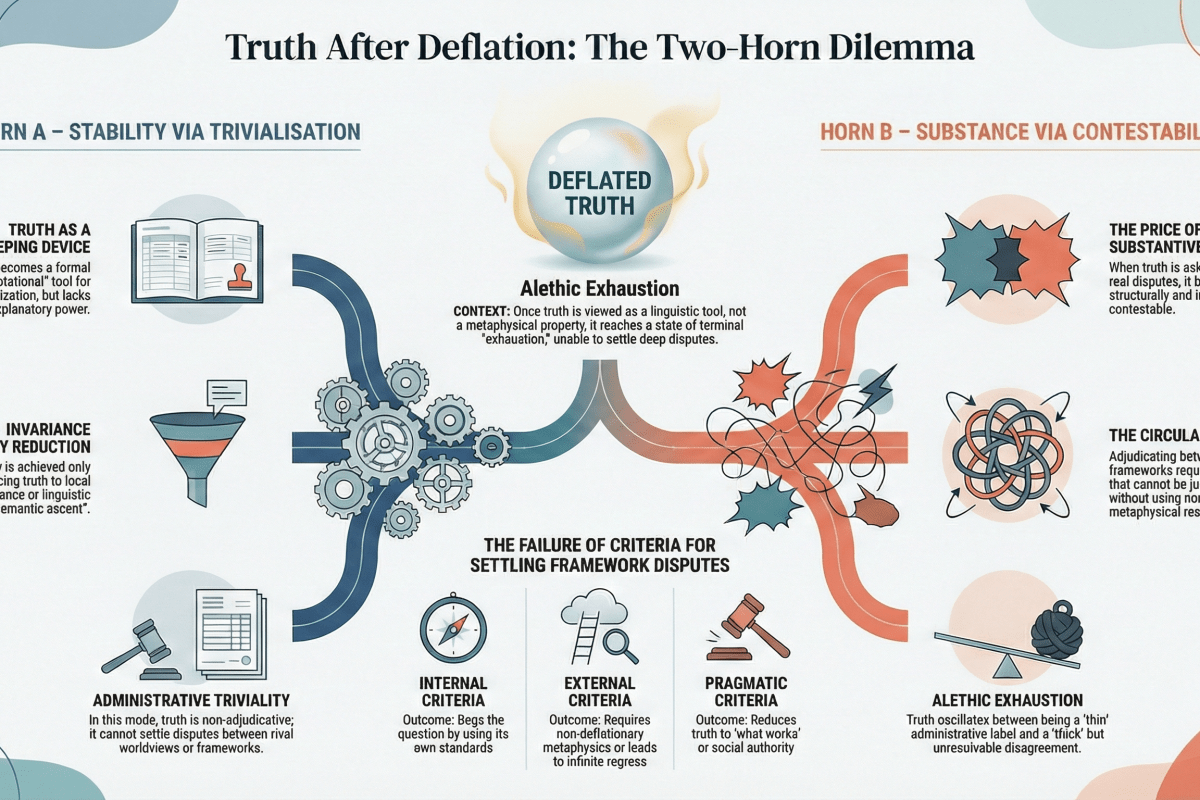
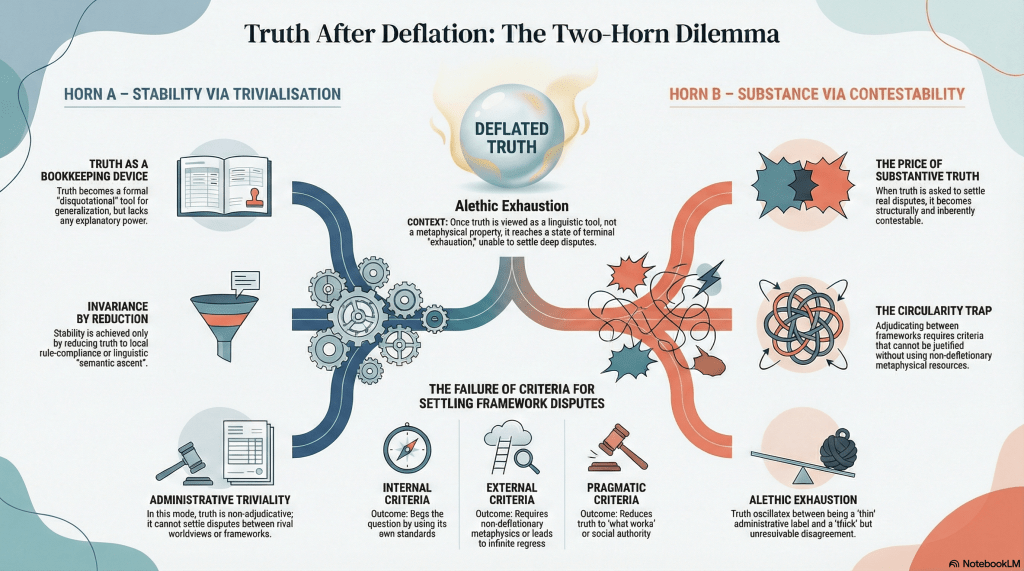


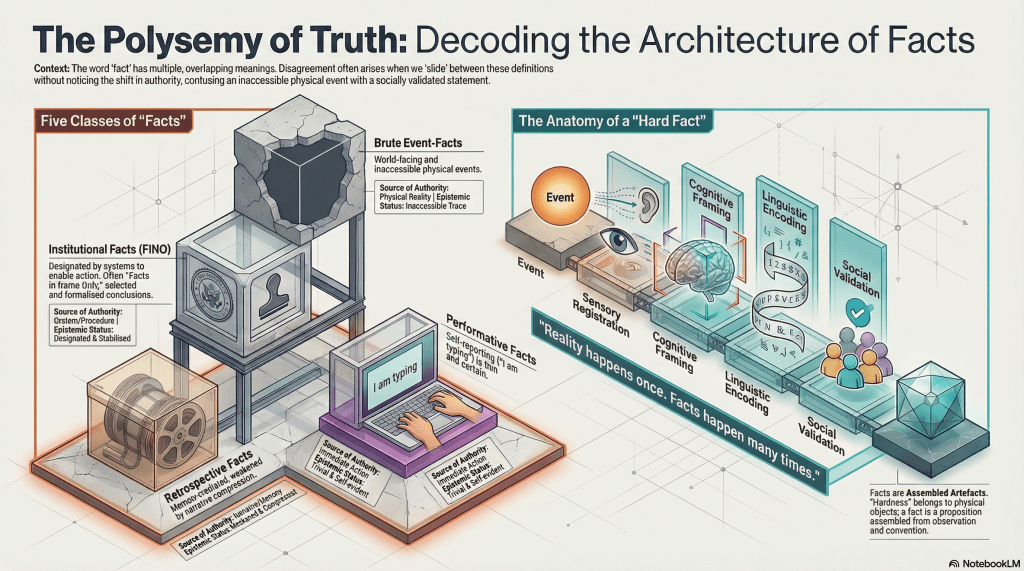

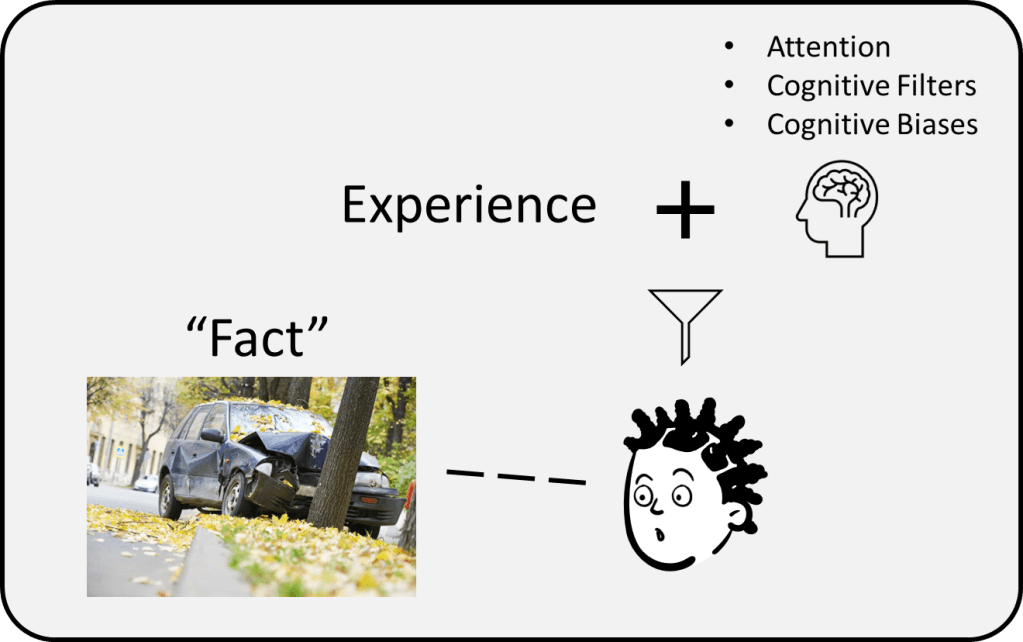
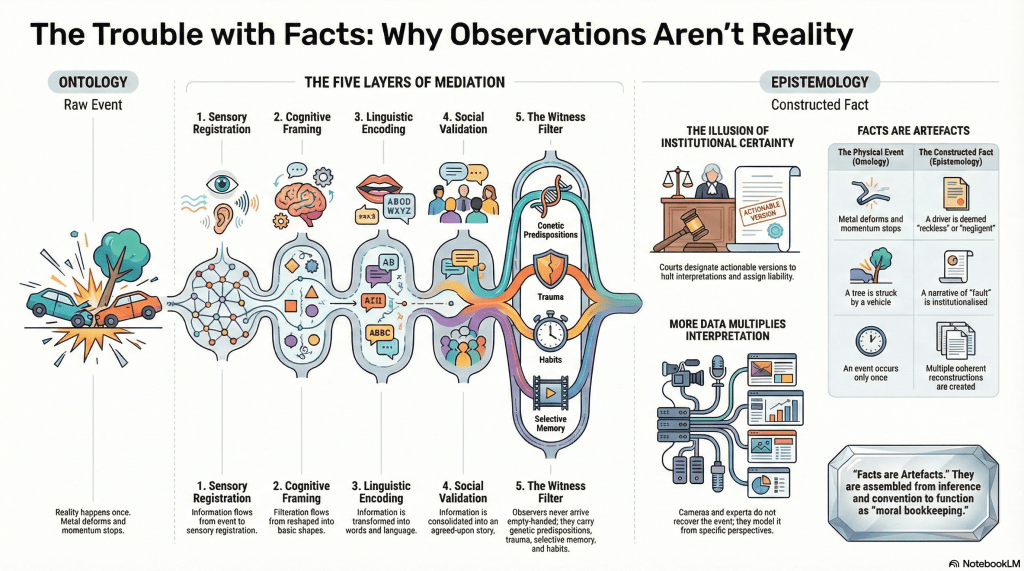
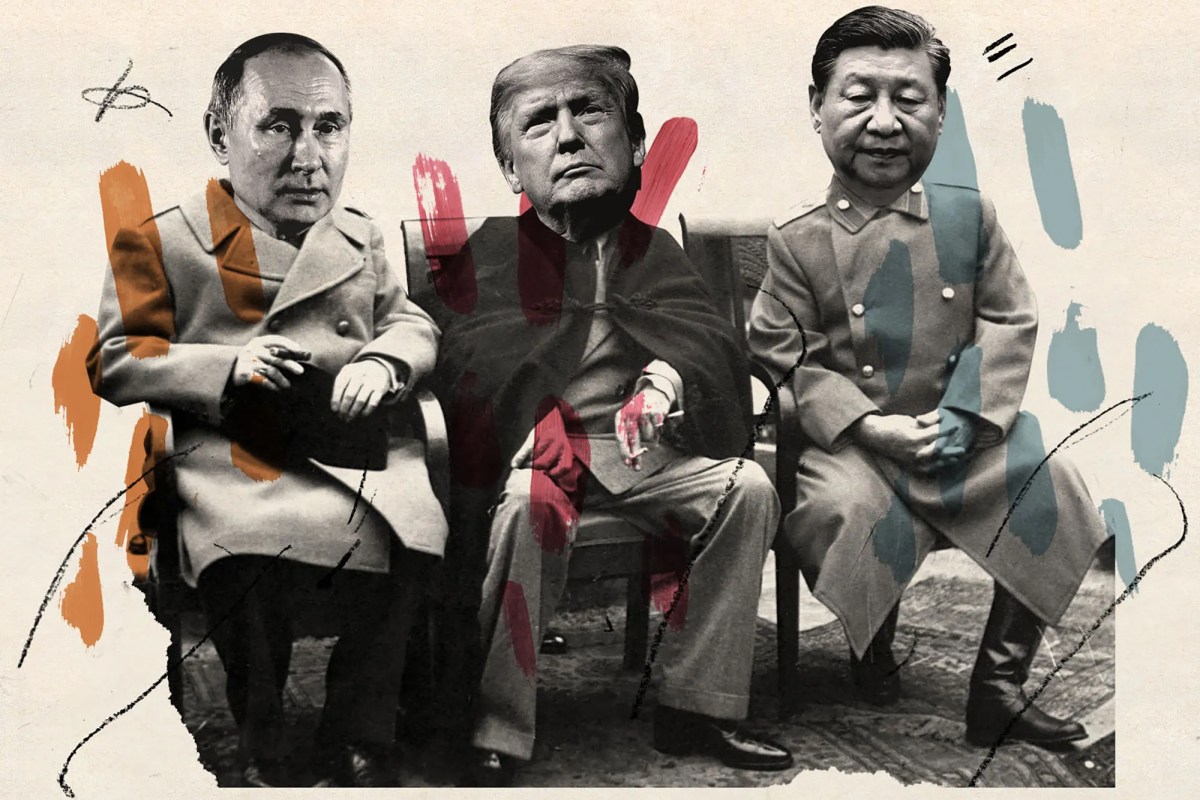
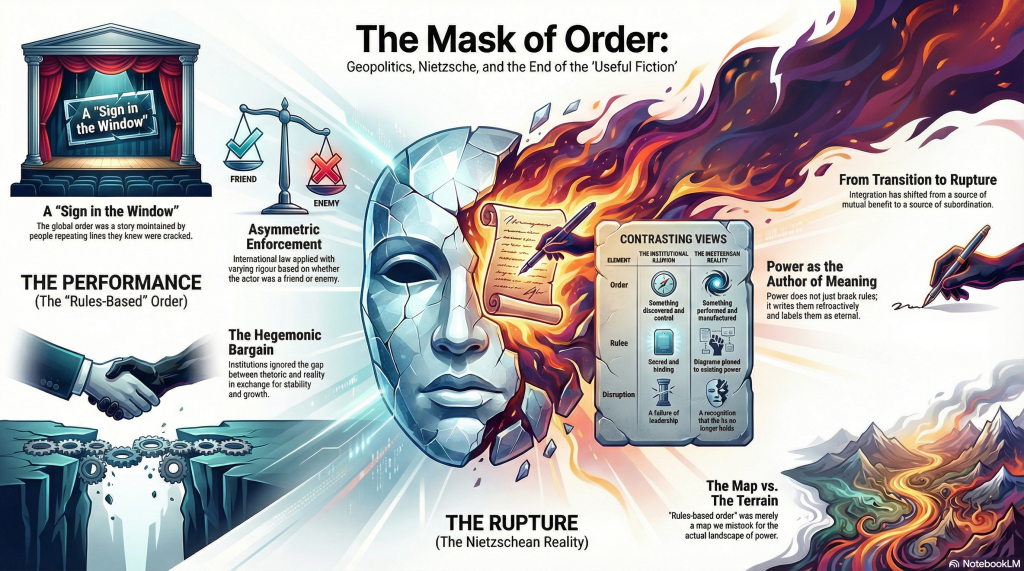



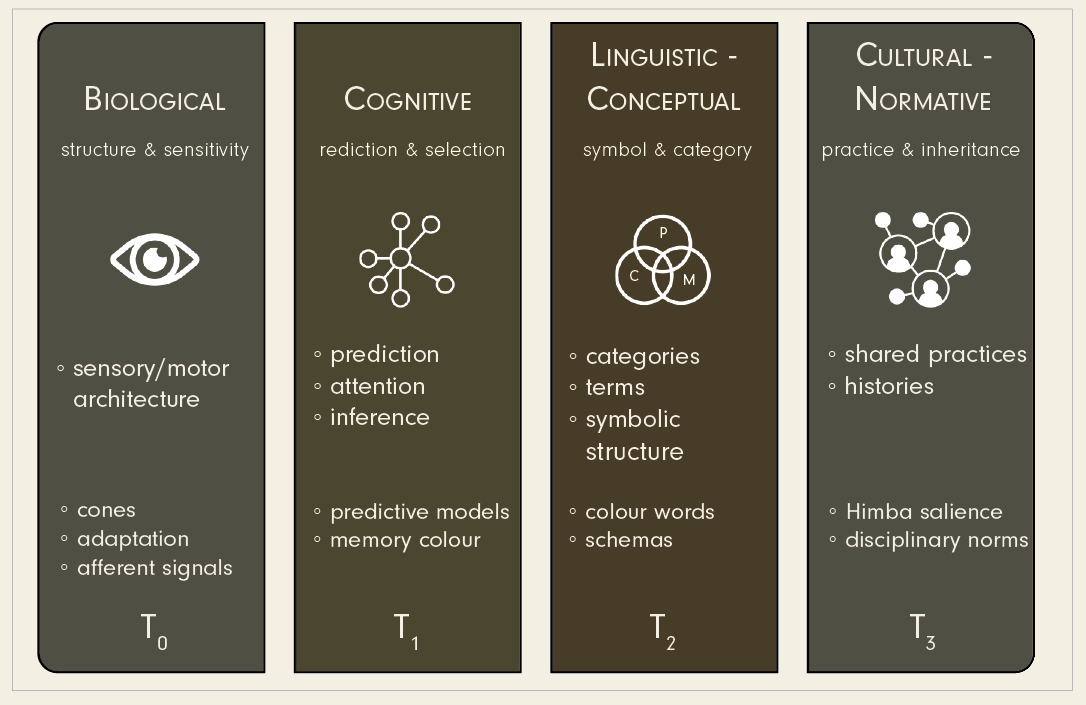

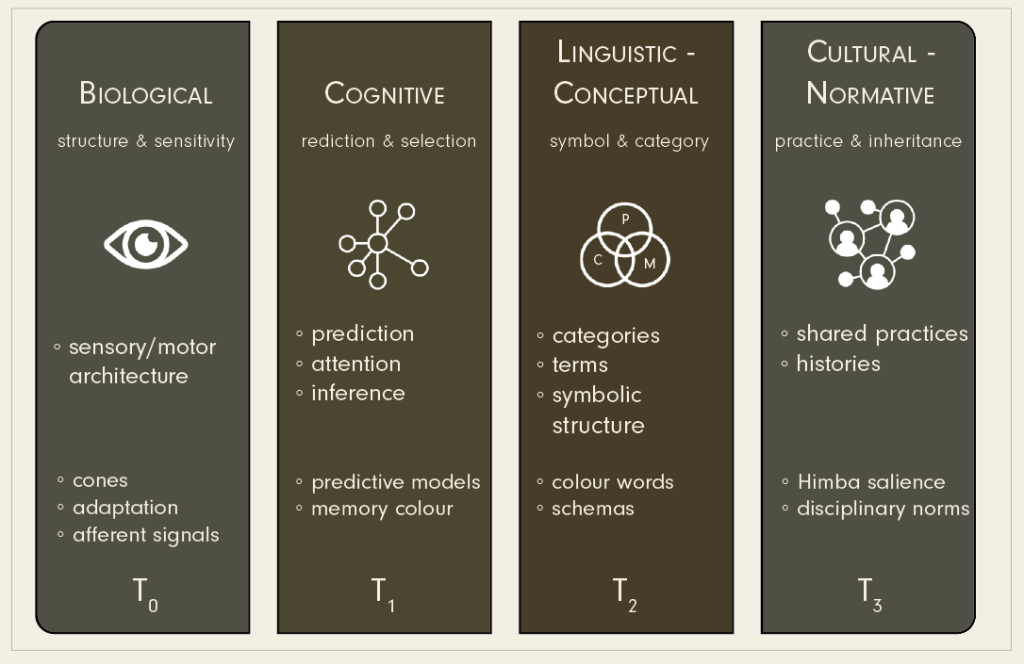


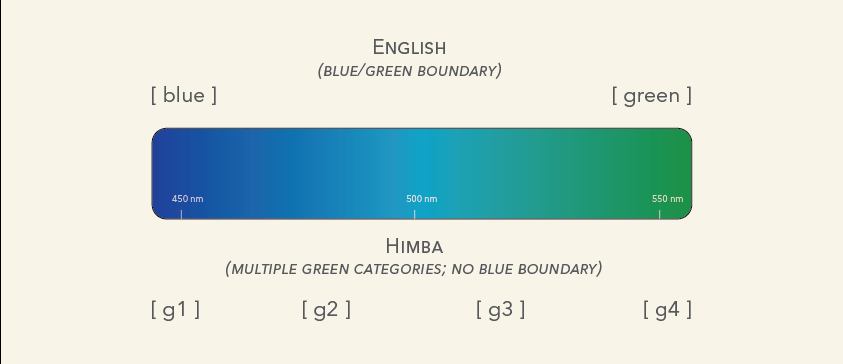
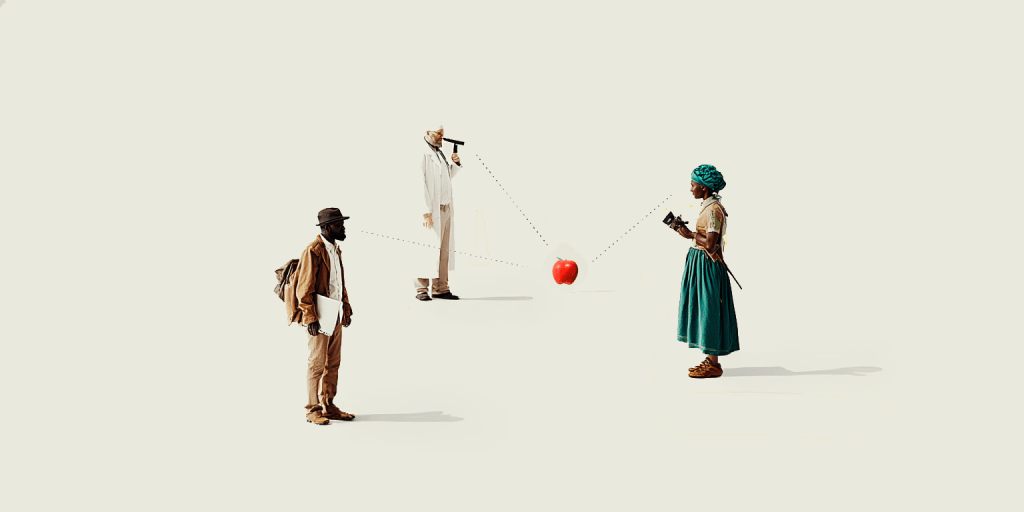


 Philosophics