Jason from Philosopher Muse suggested a connexion between Transductive Subjectivity and the work of Stephen Batchelor. I wasn’t familiar with Batchelor, so — as one does these days — I asked a GPT to give me the lay of the land. The machine obliged, and the result was interesting enough that it warranted a post of its own. This is it.
The risk I take is that the GPT gets it wrong. If so, call me out.
Audio: NotebookLM summary podcast of this topic.
Before anyone lights incense: I’m not suddenly a convert. Batchelor’s work and mine merely pass each other on adjacent footpaths. But the overlap is conceptually neat, and the divergence is even more telling.
Stephen Batchelor vs Transductive Subjectivity: A Brief Comparative Note
1. Shared Territory: The Self as Verb, Not Noun
Both Batchelor and Transductive Subjectivity reject the folk notion of a single, continuous metaphysical self.
Batchelor (Secular Buddhism): The self is an unfolding activity — impermanent, conditional, and without a stable essence. His “not-self” is a practice of disidentification from the imagined nugget of continuity we cling to.
Transductive Subjectivity: The self is a finite series: S₀ → S₁ → S₂ → … → Sₙ, each produced through the pressure of relational structures (R). Identity is what results when the world meets the organism. Nothing metaphysical required; just biology, cognition, language, and institutions doing their thing.
Overlap: Both positions dismantle the enduring pearl-of-self. Both frame identity as something generated, not possessed.
2. Divergent Aims: Inner Liberation vs Structural Clarity
This is where the paths fork.
Batchelor’s Agenda: Primarily ethical and therapeutic. The point of denying a fixed self is to reduce suffering, ease attachment, and cultivate a more responsive way of being.
TS’s Agenda: Metaphysical accuracy in the service of ethical clarity. If the self is a serial construction rather than a diachronic monolith, then retributive justice collapses under its own fictions. No self, no desert. No desert, no justification for revenge-based punishment.
Batchelor wants flourishing. I want rigour. Accidental cousins.
3. Methodological Differences: Distillation vs Reconstruction
Batchelor performs what you might call Buddhism sans metaphysics. A very Western manoeuvre:
keep impermanence
keep ethical insight
jettison karma, rebirth, cosmology
rebrand the remnants as a secular spiritual practice
Practitioners dislike this because he amputates the structural scaffolding that supported the doctrine.
TS, by contrast, doesn’t distil anything. It reconstructs selfhood from first principles:
No causa sui
Episodic, indexical selfhood (Strawson)
R→S transduction (MEOW)
No diachronic essence
No metaphysical ballast
If Buddhism aligns with TS, it’s incidental — the way two different mathematicians can discover the same function by entirely different routes.
4. Conceptual Architecture: Dependent Origination vs MEOW’s Tiers
Batchelor: leans on dependent origination as a philosophical metaphor — phenomena arise through conditions.
TS: models the exact channels of that conditioning via MEOW: T0 → biological signals T1 → cognitive architecture T2 → linguistic formats T3 → social-technical pressures
Where Batchelor says “everything is contingent,” TS says “yes, and here is the actual machinery.”
5. Different Stakes
Batchelor: freeing the person from clinging to an imaginary core.
TS: freeing ethics, law, and social design from pretending that metaphysical core exists.
One is therapeutic; the other is diagnostic.
A Key Point of Departure: Batchelor Works with Folk Psychology; TS Rejects Its Premises
There is one more divergence worth highlighting because it cuts to the bone of the comparison.
Batchelor accepts the phenomenological feel of the continuous self as a legitimate starting point. His work is therapeutic: he begins where the person is, in the lived experience of being “me,” and then encourages a gentle loosening of the grip on that intuition.
Transductive Subjectivity takes a different route entirely.
For TS, the continuous, diachronic self isn’t a psychological obstacle to be softened — it is a category mistake. A narrative compression artefact. A heuristic with pragmatic uses, yes, but no metaphysical legitimacy. Batchelor tries to transform our relation to the folk-self; TS denies that the folk-self was ever more than a convenient fiction.
Batchelor says: “You seem like a continuous self; now learn to hold that lightly.”
TS says: “You seem like a continuous self because the system is glossing over discontinuities. The sensation itself is misleading.”
In other words:
Batchelor redeems the experience.
TS disassembles the model.
He treats the “self” as something to relate to differently. TS treats the “self” as an ontological construct to be replaced with a more accurate one.
This is not a difference of ethical aim but of metaphysical foundation. Batchelor trims the folk psychology; TS declines the invitation altogether.
Closing Note
So yes — the connexion Jason spotted is real. But it’s genealogical, not derivative. We arrive at similar conclusions for different reasons and with different consequences.
Batchelor is pruning a tradition. Transductive Subjectivity is rebuilding the ontology.
And both, in their own way, make the continuity-self look like the rhetorical placeholder it always was.
Written entirely by ChatGPT after a chat about Stephen Batchelor (obviously)
The Enlightenment, we are told, was the age of Reason. A radiant exorcism of superstition. Out went God. Out went angels, miracles, saints, indulgences. All that frothy medieval sentiment was swept aside by a brave new world of logic, science, and progress. Or so the story goes.
Audio: NotebookLM podcast on this topic.
But look closer, and you’ll find that Reason didn’t kill God—it absorbed Him. The Enlightenment didn’t abandon metaphysics. It merely privatised it.
From Confessional to Courtroom
We like to imagine that the Enlightenment was a clean break from theology. But really, it was a semantic shell game. The soul was rebranded as the self. Sin became crime. Divine judgement was outsourced to the state.
We stopped praying for salvation and started pleading not guilty.
The entire judicial apparatus—mens rea, culpability, desert, retribution—is built on theological scaffolding. The only thing missing is a sermon and a psalm.
Where theology had the guilty soul, Enlightenment law invented the guilty mind—mens rea—a notion so nebulous it requires clairvoyant jurors to divine intention from action. And where the Church offered Hell, the state offers prison. It’s the same moral ritual, just better lit.
Galen Strawson and the Death of Moral Responsibility
Enter Galen Strawson, that glowering spectre at the feast of moral philosophy. His Basic Argument is elegantly devastating:
You do what you do because of the way you are.
You can’t be ultimately responsible for the way you are.
Therefore, you can’t be ultimately responsible for what you do.
Unless you are causa sui—the cause of yourself, an unmoved mover in Calvin Klein—you cannot be held truly responsible. Free will collapses, moral responsibility evaporates, and retributive justice is exposed as epistemological theatre.
In this light, our whole legal structure is little more than rebranded divine vengeance. A vestigial organ from our theocratic past, now enforced by cops instead of clerics.
The Modern State: A Haunted House
What we have, then, is a society that has denied the gods but kept their moral logic. We tossed out theology, but we held onto metaphysical concepts like intent, desert, and blame—concepts that do not survive contact with determinism.
We are living in the afterglow of divine judgement, pretending it’s sunlight.
Nietzsche saw it coming, of course. He warned that killing God would plunge us into existential darkness unless we had the courage to also kill the values propped up by His corpse. We did the first bit. We’re still bottling it on the second.
If Not Retribution, Then What?
Let’s be clear: no one’s suggesting we stop responding to harm. But responses should be grounded in outcomes, not outrage.
Containment, not condemnation.
Prevention, not penance.
Recalibration, not revenge.
We don’t need “justice” in the retributive sense. We need functional ethics, rooted in compassion and consequence, not in Bronze Age morality clumsily duct-taped to Enlightenment reason.
The Risk of Letting Go
Of course, this is terrifying. The current system gives us moral closure. A verdict. A villain. A vanishing point for our collective discomfort.
Abandoning retribution means giving that up. It means accepting that there are no true villains—only configurations of causes. That punishment is often revenge in drag. That morality itself might be a control mechanism, not a universal truth.
But if we’re serious about living in a post-theological age, we must stop playing dress-up with divine concepts. The Enlightenment didn’t finish the job. It changed the costumes, kept the plot, and called it civilisation.
Regular readers know I often write about identity, free will, and the narrative constraints of language. But I also explore these ideas through fiction, under the name Ridley Park.
In this short video, I unpack the philosophical motivations behind my stories, including:
Why reality is never as it seems
Why the self is a narrative convenience
What Heidegger’s Geworfenheit and Galen Strawson’s Causa Sui argument reveal about agency
And why language fails us – even when we think it serves
This isn’t promotional fluff. It’s epistemological dissent in a new format. Fictional, yes, but only in the sense that most of reality is, too.
A five-part descent into the illusion of autonomy, where biology writes the script, reason provides the excuse, and the self is merely the echo of its own conditioning.This is a follow-up to a recent post on the implausibility of free will.
You Cannot Originate Yourself
The causa sui argument, and the final collapse of moral responsibility
“If you cannot cause yourself, you cannot cause your choices. And if you cannot cause your choices, you cannot own them.”
Audio: NotenookLM podcast on this topic.
Everything until now has pointed to erosion:
Your choices are state-dependent.
Your identity is cumulative, not authored.
Your evaluations are judged by compromised observers.
But here, finally, we strike at the bedrock.
It isn’t merely that you are manipulated. It isn’t merely that you are misperceived. It’s that you never could have been free, even in theory.
Because you did not make yourself.
The Causa Sui Problem
To be ultimately morally responsible, you must be the origin of who you are.
You must have chosen your disposition.
You must have selected your values.
You must have designed your will.
But you didn’t.
You emerged:
With a particular genetic cocktail.
Into a particular historical moment.
Through particular developmental experiences.
With particular neurological quirks and vulnerabilities.
And at no point did you step outside yourself to say:
“I would like to be this kind of agent, with this kind of character.”
You were thrown — as Heidegger might say — into a situation not of your choosing, with equipment you didn’t request, subject to pressures you couldn’t anticipate.
And everything you think of as “yours” — your courage, your laziness, your generosity, your rage — is the unfolding of that original unchosen situation.
No Escape via Reflexivity
Some will protest:
“But I can reflect! I can change myself!”
But this, too, is a mirage.
Because:
The desire to reflect is conditioned.
The capacity to reflect is conditioned.
The courage to act on reflection is conditioned.
You didn’t author your ability to self-correct. You simply inherited it — like a river inheriting a particular gradient.
Even your rebellion is written in your blueprint.
Freedom by Degrees Is Not Freedom
The compatibilist fallback — that freedom is just “acting according to oneself” — collapses under causa sui.
Because the self that acts was never authored. It was configured by prior causes.
If you cannot be the cause of yourself, then you cannot be the cause of your actions in any ultimate sense.
Thus:
No ultimate credit for your virtues.
No ultimate blame for your vices.
Only causal flow, chemical procession, narrative stitching after the fact.
The criminal and the saint are both unlucky configurations of biology and circumstance.
TL;DR: No Self, No Sovereignty
To be responsible, you must be causa sui — the cause of yourself.
You are not.
Therefore, you are not ultimately responsible for your actions.
Therefore, free will — as traditionally imagined — does not exist.
There is choice. But there is no chooser behind the choice. Only the momentum of prior conditions, impersonating agency.
A five-part descent into the illusion of autonomy, where biology writes the script, reason provides the excuse, and the self is merely the echo of its own conditioning.This is a follow-up to a recent post on the implausibility of free will.
Audio: NotebookLM podcast on the topic.
“It’s not just that you’re a hallucination of yourself. It’s that everyone else is hallucinating you, too — through their own fog.”
The Feedback Loop of False Selves
You are being judged — by others who are also compromised
If you are a chemically modulated, state-dependent, narrativising automaton, then so is everyone who evaluates you. The moral courtroom — society, the law, the dinner table — is just a gathering of biased systems confidently misreading each other.
We are taught to believe in things like:
“Good character”
“Knowing someone”
“Getting a read on people”
But these are myths of stability, rituals of judgment, and cognitive vanity projects. There is no fixed you — and there is no fixed them to do the judging.
Judging the Snapshot, Not the Self
Let’s say you act irritable. Or generous. Or quiet. An observer sees this and says:
“That’s who you are.”
But which version of you are they observing?
The you on two hours of sleep?
The you on SSRIs?
The you grieving, healing, adjusting, masking?
They don’t know. They don’t ask. They just flatten the moment into character.
One gesture becomes identity. One expression becomes essence.
This isn’t judgment. It’s snapshot essentialism — moral conclusion by convenience.
The Observer Is No Less Biased
Here’s the darker truth: they’re compromised, too.
If they’re stressed, you’re rude.
If they’re lonely, you’re charming.
If they’re hungry, you’re annoying.
What they’re perceiving is not you — it’s their current chemistry’s reaction to your presentation, filtered through their history, memory, mood, and assumptions.
It’s not a moral lens. It’s a funhouse mirror, polished with certainty.
Mutual Delusion in a Moral Marketplace
The tragedy is recursive:
You act based on internal constraints.
They judge based on theirs.
Then you interpret their reaction… and adjust accordingly.
And they, in turn, react to your adjustment…
And on it goes — chemical systems calibrating against each other, mistaking interaction for insight, familiarity for truth, coherence for character.
Identity isn’t formed. It’s inferred, then reinforced. By people who have no access to your internal states and no awareness of their own.
The Myth of the Moral Evaluator
This has massive implications:
Justice assumes objectivity.
Culture assumes shared moral standards.
Relationships assume “knowing” someone.
But all of these are built on the fantasy that moral evaluation is accurate, stable, and earned.
It is not.
It is probabilistic, state-sensitive, and mutually confabulatory.
You are being judged by the weather inside someone else’s skull.
TL;DR: Everyone’s Lying to Themselves About You
You behave according to contingent states.
Others judge you based on their own contingent states.
Both of you invent reasons to justify your interpretations.
Neither of you has access to the full picture.
The result is a hall of mirrors with no ground floor.
So no — you’re not “being seen.” You’re being misread, reinterpreted, and categorised — by people who are also misreading themselves.
Why the cherished myth of human autonomy dissolves under the weight of our own biology
We cling to free will like a comfort blanket—the reassuring belief that our actions spring from deliberation, character, and autonomous choice. This narrative has powered everything from our justice systems to our sense of personal achievement. It feels good, even necessary, to believe we author our own stories.
But what if this cornerstone of human self-conception is merely a useful fiction? What if, with each advance in neuroscience, our cherished notion of autonomy becomes increasingly untenable?
Audio: NotebookLM podcast on this topic.
I. The Myth of Autonomy: A Beautiful Delusion
Free will requires that we—some essential, decision-making “self”—stand somehow separate from the causal chains of biology and physics. But where exactly would this magical pocket of causation exist? And what evidence do we have for it?
Your preferences, values, and impulses emerge from a complex interplay of factors you never chose:
The genetic lottery determined your baseline neurochemistry and cognitive architecture before your first breath. You didn’t select your dopamine sensitivity, your amygdala reactivity, or your executive function capacity.
The hormonal symphony that controls your emotional responses operates largely beneath conscious awareness. These chemical messengers—testosterone, oxytocin, and cortisol—don’t ask permission before altering your perceptions and priorities.
Environmental exposures—from lead in your childhood drinking water to the specific traumas of your upbringing—have sculpted neural pathways you didn’t design and can’t easily rewire.
Developmental contingencies have shaped your moral reasoning, impulse control, and capacity for empathy through processes invisible to conscious inspection.
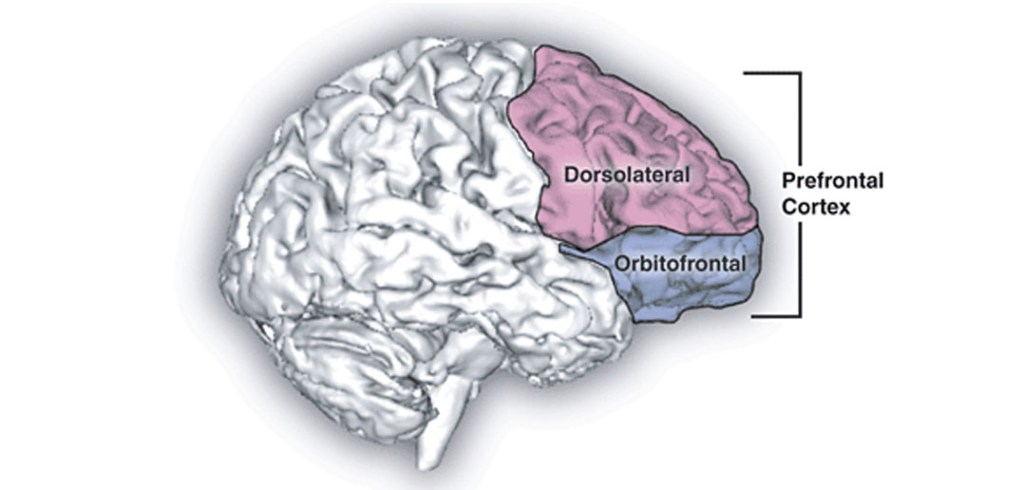
Your prized ability to weigh options, inhibit impulses, and make “rational” choices depends entirely on specific brain structures—particularly the dorsolateral prefrontal cortex (DLPFC)—operating within a neurochemical environment you inherited rather than created.
You occupy this biological machinery; you do not transcend it. Yet, society holds you responsible for its outputs as if you stood separate from these deterministic processes.
transcranial direct current stimulation over the DLPFC alters moral reasoning, especially regarding personal moral dilemmas. The subject experiences these externally induced judgments as entirely their own, with no sense that their moral compass has been hijacked
II. The DLPFC: Puppet Master of Moral Choice
The dorsolateral prefrontal cortex serves as command central for what we proudly call executive function—our capacity to plan, inhibit, decide, and morally judge. We experience its operations as deliberation, as the weighing of options, as the essence of choice itself.
And yet this supposed seat of autonomy can be manipulated with disturbing ease.
When researchers apply transcranial magnetic stimulation to inhibit DLPFC function, test subjects make dramatically different moral judgments about identical scenarios. Under different stimulation protocols, the same person arrives at contradictory conclusions about right and wrong without any awareness of the external influence.
Similarly, transcranial direct current stimulation over the DLPFC alters moral reasoning, especially regarding personal moral dilemmas. The subject experiences these externally induced judgments as entirely their own, with no sense that their moral compass has been hijacked.
If our most cherished moral deliberations can be redirected through simple electromagnetic manipulation, what does this reveal about the nature of “choice”? If will can be so easily influenced, how free could it possibly be?
III. Hormonal Puppetmasters: The Will in Your Bloodstream
Your decision-making machinery doesn’t stop at neural architecture. Your hormonal profile actively shapes what you perceive as your autonomous choices.
Consider oxytocin, popularly known as the “love hormone.” Research demonstrates that elevated oxytocin levels enhance feelings of guilt and shame while reducing willingness to harm others. This isn’t a subtle effect—it’s a direct biological override of what you might otherwise “choose.”
Testosterone tells an equally compelling story. Administration of this hormone increases utilitarian moral judgments, particularly when such decisions involve aggression or social dominance. The subject doesn’t experience this as a foreign influence but as their own authentic reasoning.
These aren’t anomalies or edge cases. They represent the normal operation of the biological systems governing what we experience as choice. You aren’t choosing so much as regulating, responding, and rebalancing a biochemical economy you inherited rather than designed.
IV. The Accident of Will: Uncomfortable Conclusions
If the will can be manipulated through such straightforward biological interventions, was it ever truly “yours” to begin with?
Philosopher Galen Strawson’s causa sui argument becomes unavoidable here: To be morally responsible, one must be the cause of oneself, but no one creates their own neural and hormonal architecture. By extension, no one can be ultimately responsible for actions emerging from that architecture.
What we dignify as “will” may be nothing more than a fortunate (or unfortunate) biochemical accident—the particular configuration of neurons and neurochemicals you happened to inherit and develop.
This lens forces unsettling questions:
How many behaviours we praise or condemn are merely phenotypic expressions masquerading as choices? How many acts of cruelty or compassion reflect neurochemistry rather than character?
How many punishments and rewards are we assigning not to autonomous agents, but to biological processes operating beyond conscious control?
And perhaps most disturbingly: If we could perfect the moral self through direct biological intervention—rewiring neural pathways or adjusting neurotransmitter levels to ensure “better” choices—should we?
Or would such manipulation, however well-intentioned, represent the final acknowledgement that what we’ve called free will was never free at all?
A Compatibilist Rebuttal? Not So Fast.
Some philosophers argue for compatibilism, the view that determinism and free will can coexist if we redefine free will as “uncoerced action aligned with one’s desires.” But this semantic shuffle doesn’t rescue moral responsibility.
If your desires themselves are products of biology and environment—if even your capacity to evaluate those desires depends on inherited neural architecture—then “acting according to your desires” just pushes the problem back a step. You’re still not the ultimate author of those desires or your response to them.
What’s Left?
Perhaps we need not a defence of free will but a new framework for understanding human behaviour—one that acknowledges our biological embeddedness while preserving meaningful concepts of agency and responsibility without magical thinking.
The evidence doesn’t suggest we are without agency; it suggests our agency operates within biological constraints we’re only beginning to understand. The question isn’t whether biology influences choice—it’s whether anything else does.
For now, the neuroscientific evidence points in one direction: The will exists, but its freedom is the illusion.
In this segment, I ponder the interplay between blame and Causa Sui. I’ll discuss the implications for moral responsibility as well as legal responsibility, which are not as in sync as one might imagine they might be.
Video: Blame & Causa Sui
To the uninitiated, Western legal systems have no pretensions about being about morality or justice. Legal systems are designed to maintain power structures and the status quo. They are deontological machines, making them prime targets for automation by the machine learning associated with artificial intelligence. This would also diminish the power of rhetoric over facts to some extent. But, I am no legal scholar, and all of this will have to wait for another segment.
I recently shared a video on causa sui and the basics of blame and blameworthiness, so I want to intersect those topics here.
Peter Strawson suggested that for humans, blame is a reactive response. It’s reflexive like having your knee jerk when tapped. Essentially, his position is that if blame didn’t naturally exist, we’d have to invent it, mirroring Voltaire’s quip, ‘If God did not exist, it would be necessary to invent Him’. Of course, this is because they serve the same power control purpose.
If God did not exist, it would be necessary to invent Him
Voltaire
To be fair, blame is closer to real than God, but the point remains. Strawson’s point is also that humans are saddled with blame and it’s not going anywhere no matter how nebulous it becomes in execution. It’s natural.
To me, this starts to sound suspiciously like a naturalistic fallacy. Humans seem to selectively cherry-pick which so-called natural tendencies they choose to defend. One might use nature to argue that female sexual availability begins at menstruation, and yet we have decided to ignore this and defer this on the grounds of civility. It’s obvious that we could consider blame to be an animal instinct we want to domesticate away, but because it serves other purposes, per Strawson’s perspective, it’s a useful tool. But what’s the causa sui challenge. Let’s quickly recapitulate.
Causa sui argues that one cannot be the cause of oneself, ex nihilo. Being full products of nature and nurture to adopt the lay parlance, any blameworthiness lies with the sources or creators. Since we are concerned with moral responsibility, we can eliminate nature forthrightly. Nature may be responsible—by many estimations approximately 40 per cent responsible—, it possesses no moral agency. And if the individual is not responsible, then we are left with the environment and society, including the social environment. Of course, the environment gets off the hook in the same manner as the genetic and hereditary factors of nature.
Before we consider society, let’s regard the individual.
Albeit the brain-as-computer is a bit facile, it’s still good enough for illustrative purposes. When you are born, your cognitive hardware is installed, as are your edge peripherals and update protocols. Any of these can become damaged through some degenerative processes, or external environmental factors, but since my interest is in optimistic rather than pessimistic scenarios, I’ll ignore these instances. Given that blameworthiness is directly related to presumed cognitive processing, factors that diminish these faculties, mitigate blameworthiness and factors than increase it, ameliorate it.
As a—quote—’normal’ child becomes an adolescent and then an adult, the probability it will become blameworthy, increases with age, ceteris paribus. A person with cognitive deficits or conditions such as aphasia or dementia decreases the probability of blame assignment. Even temporary impairment mitigates judgment—oh, she was drunk.
So, following the brain-as-computer analogy, your brain is a CPU with a self-updating cognitive operating system and instruction set. Essentially, there is also short and long-term memory. In the case of cognitive deficits, one of these components might be effectively broken. The CPU might process too slowly; it might misinterpret what it receives; there may be issues with the sense organs or the nerves that transport signals.
I’ve got a mate who, due to medical malpractice at birth, experienced nerve damage. Although his eyes and brain are normal, his optic nerve cannot carry signals very well, effectively leaving him blind. Neither can he taste nor smell. So there’s that.
But assuming that this processing and storage hardware are intact, the causa sui constraint still applies, but let’s spend some time evaluating societal interactions.
All inputs come from society—cultures and subcultures. Apart from misinterpreted processing scenarios, if a person doesn’t receive a particular moral instruction set, that person should surely be considered to be exempt from moral blame. It may be difficult to assess whether an instruction has been input. This is a reason why children are categorically exempted: they may not have received all of the expected moral codes, they may not have been stored or effectively indexed, and their processing hardware is still in development—alpha code if you will. Brain plasticity is another attribute I won’t spend much time on, but the current state of science says that the brain is still not fully developed even by age 30, so this is certainly a mitigating factor, even if we allow leeway for the causa sui argument.
I mention subculture explicitly because the predominant culture is not the only signal source. A child raised by, I don’t know, say pirates, would have an amended moral code. I am sure we can all think of different subcultures that might undermine or come at cross odds with the dominant culture, whether hippies, religious cultists, militia groups, racial purist groups, and so on.
So, a commonly held moral in the subdominant group may counter that of the prevailing one. An example that comes to mind is some religious organisations that do not agree with human medical intervention. There have been cases where parents have allowed a child to die from an otherwise curable condition. Although in the United States, there is a claim of freedom of religion—a claim that is spotty at best—, parents or guardians in situations like these have been convicted and sentenced for following their own moral codes. But as with all people, these people are as susceptible to the limitations of causa sui as the rest of us. They are not responsible for creating themselves, but moral responsibility was asserted based on the beliefs of the prevailing culture. Even besides the legal context, persons in the larger society would likely blame the parents for their neglect—though they may be praised for being resolute in their righteousness by their in-group. This just underscores that morality is a collection of socially constructed conventions rather than something more objective.
Returning to causa sui, let’s say a person commits an act that society would typically assign blame. Rather than exercise some act of retributive justice—a concept with no foundation in a causa sui universe—the course of action was remediation. In this case, the desired moral instruction would be delivered thereby seemingly making the moral offender blameworthy. But would they be?
Presumably, (for what it’s worth) psychologists would evaluate the subject for competency in maintaining the programming. In the case of the aforementioned religious parents, they may be threatened with retribution for not abiding by the superseding rules of the prevailing power structure.
Although I might personally allow some leeway even with the causa sui in full force and effect, but I can’t say that I have much faith in the ability of humans to make a correct assessment. My impression is that any assessment would be one of convenience than something sounder.
Perhaps I’ll produce a more robust segment on retributive justice, but my feeling is that retributive justice is an area that legal systems should avoid altogether. If necessary, focus on restorative justice, rehabilitation (or ‘habilitation’ as the case might be) and quarantine models to ensure any bad actors are contained away from society. Again, this puts individuals at the mercy of cultures they find themselves a part of. I am not going to delve into this any further save to remind the listener of gang initiation schemes where a person needs to kill a member of a rival gang to become a trusted member. This is their moral code—quite at odds with the mainstream.
So there you have it. Owing to causa sui constraints, a person cannot be ultimately responsible for their actions. My primary thesis is—apart from metaphorical equipment failures—that any moral responsibility falls wholly on the society or culture. Full stop. And this isn’t as foreign as one might first feel. Although for most people blame is natural, in an individualistic society, people are interested in finding the culprit. In collectivist cultures, any culprit might do. Perhaps I’ll share some stories in a future segment. Meantime, what are your thoughts on moral responsibility? Can someone be ultimately responsible? Some have said the ‘ultimate responsibility’ is a philosophical red herring and that we can still hold someone responsible, even if not in the ultimate sense, which causa sui disallows. Are you more in this camp? Is this enough to mete out so-called retributive justice? For me, retributive justice is a euphemism for vengeance, and justice is a weasel word. But that’s just me, and perhaps a topic for another segment.
Are there any topics you’d like me to cover? Leave a comment below.
When I was writing my review of Elbow Room, this categorical syllogism came to mind:
P1: All agents are responsible
P2: I am an agent
C: Therefore, I am responsible
Now I want to unpack it.
Podcast: Audio rendition of this page content
The first premise is that all agents are responsible. Of course, this hinges on how one defines agent and responsibility. It also depends on the scope, especially of the agent but to some extent also the scope of responsibility.
Leveraging the Causa Sui argument, the agent is a social construct and can only be responsible to what extent s/he has been programmed as well as the ability to maintain and process the programming effectively—so without bugs to continue with the parlance.
If the agent is immature or defective, expectations of responsibility are diminished.
If certain inputs were not given, there is no reason to assume a related command would be executed. This is why so much time and energy is spent on programming and evaluating children.
This first premise is predicated on the pathological need to blame. Unwritten behind the responsibility claim is that I feel compelled to blame. Blame requires responsibility, so if I want to blame someone, they must be responsible. In any given circumstances, I may feel the urge to blame anyone, so all agents [eligible people] are worthy of blame. There is no particular reason to exclude myself, so I too am blameworthy. What’s good for the goose is good for the gander, eh?
Goose and Gander. Strike that pose.
As PF Strawson said, even if moral responsibility couldn’t possibly exist, it would be invented because people need to blame. This is in line with Voltaire’s commentary on God.
Si Dieu n’existait pas, il faudrait l’inventer. If God did not exist, it would be necessary to invent him.
Voltaire
We can all look around and see how pervasive the god delusion is. Moral responsibility is even more insidious. In principle, moral gods were invented for just this purpose. An omnipresent judge was needed to keep the big house in check.
Where I Stand
From my perspective, I do feel that a person in the space of Dennett’s elbow room can have responsibility. Being a non-cognitivist, I have more difficulty accepting the arbitrary imposition of morality, but I understand the motivation behind it.
The problem I have is that mechanisms to ensure that the inputs and processes are all in order and there are no superseding instructions are not in place. Moreover, if the superseding instruction does not comport with the will of the power structure, it will be marginalised or ignored. This is a limitation of morality being a social construct, and none of this gets past the ex nihilo problem causa sui invokes, so we end up cursing the computer we’ve invented. O! monster of Frankenstein. O! Pygmalion.
Daniel Dennet is quite the prolific writer. He first published Elbow Room back in 1984. He published an updated version in 2015. I like Dan. He is a master storyteller and has a mind like a trap, archiving decades (and centuries) of information. The approach he takes is thoughtful and methodical, and I tend to agree with most of his positions. This isn’t one of them. Interestingly, I recently reviewed John Martin Fischer’s contribution to Four Views on Free Will, which is sympathetic to his position.
Dennett is a compatibilist. I am an incompatibilist—an impossibility, really—, but I wanted to understand his line of argumentation. Like Fischer, Dennett wants to claim that an agent does possess enough elbow room—wiggle room—to be able to be granted free will or moral responsibility, depending on where you prefer to draw the line.
Dennett tends to agree with my position that free will is a semantic pseudo-problem, but he doesn’t mind calling enough ‘good enough’. Given a situation and circumstances, we have enough latitude to consider any actions to be free—with the usual exemptions for non compos mentis situations, cognitive deficits, and duress. He minimises the impact of genetics and upbringing as insignificant.
Basically, he argues that what latitude we do have is sufficient and what more could one want? Anything more would be unnecessary and excessive. Of course, this is just him drawing an arbitrary line at a point he feels comfortable, claiming that anyone asking for more is being unrealistically unreasonable. This feels a bit like a preemptive ad hominem defence. If you want this, then you are just foolish and selfish.
Dennett does agree with the notion that the world might be deterministic, but even so, we are proximately special. He also leans on the observation that people seem hardwired for blame, so there must be something behind this—instead of considering that humans seem hardwired for many things, not all of which are socially beneficial.
We want to hold people responsible, so by extension, we need to consider ourselves to be responsible.
P1: All agents are responsible
P2: I am an agent
C: Therefore, I am responsible
But the problem is in the definition of agency (as well as the scope and meaning of responsibility and the assignment of responsibility to agents.
In the end, I remain unconvinced, primarily that he fails to overcome the Causa Sui argument.
This Causa Sui video has been a month in the making. To be fair, I took holiday for a week and a half, but it was still a lot of work. After some editorial commentary, the transcript is available below.
Commentary
The cows are back. Making videos on a budget is hard enough. With no budget, it’s harder still.
This started with a written transcript that was fed into Amazon’s Polly AI text-to-speech engine that’s seen many improvements lately. The results were output and saved as MP3 files that were imported into Movie Studio, a video editing application. I still use version 17, as I have been unhappy with the functionality of the newer versions. Even though they have been adding features and streamlining the interfaces, they seem to retire as many features as they add new ones, and the net result has not worked in my favour.
With an audio foundation in place, I scour the internet (and my hard drives) for visual content. Although I have purchased content in the past, this project contains all free assets. Admittedly, it would look better with paid-for assets as I forwent many nice visuals, it’s hard to justify on an unmonetised site.
Taking this approach, it’s a bit like patchwork with found objects. Having no creative team and possessing limited creative skills of my own, the original content is somewhat primitive. Even this could be improved, but that takes time.
I use a Bitmoji avatar to represent myself. This provides me with a quick way to capture poses and clothing options. When I feel like it, I’ll make small animations like eye blinks, but even this takes time.
I use Microsoft PowerPoint and Paint Shop Pro for image creation and editing. That’s pretty much it.
For this Causa Sui video, I feel it goes long in some areas and short in others. There are several points that I don;t resolve the way I expected, as I was distracted by other life events, and as I was compositing the final video, I noticed that I had started narrative treads and not closed them. In other cases, I had intended to focus intently on a point, and I just didn’t. But after all of the time—and this distracts from everything else I am trying to accomplish—, I just wanted to get this over the finish line. Perhaps I’ll create some shorter content to resolve these points.
In the end, I feel it still conveys the points I want to make, even if not as sharply. Give it a gander, and let me know what you think.
Transcription
In this segment of free will scepticism, we’ll discuss the causa sui argument of why a person cannot have the human agency necessary to be held ultimately responsible for their actions. We’ll also touch on counterarguments and possible social responses to persons exhibiting behaviours not in line with socially acceptable norms.
This is part of a series shining a light on the plausible scepticism if not impossibility of free will. If you are not already familiar with this space, I suggest you review some of the foundational content discussing Determinism, Indeterminism, and Luck; would-be agency and luck, and no-self, self, and selves. Of course, feel free to watch this and review the supporting content if you want to learn more details. Let’s get started.
Before we define causa sui and the argument underlying it, it’s important to note that it is agnostic as to whether the universe is deterministic or indeterministic. My position is that the universe is at least weakly deterministic, even if we do not and cannot determine what the mechanism is. Any perceived indeterminism is simply an absence of knowledge. Were we to gain this knowledge, the indeterminate intermediate process would become determinate.
As the question of determinacy or indeterminacy is irrelevant, so is the question of compatibility or incompatibility. In an incompatible deterministic model, luck might be an interesting side trip, but my position isn’t concerned with luck and would fold it into determinism with the rest of indeterminacy.
Full disclosure: Humans are susceptible to pareidolia, and my contention is that free will is an illusion in this vein. I have adopted the position of Daniel Dennett that consciousness is an emergent property of the brain in a similar manner that wet is an emergent property of water. Water itself being an emergent property of the admixture of hydrogen and oxygen. This is not to argue that consciousness is somehow not real, but I do argue that consciousness has no mystical metaphysical properties that the discipline of psychology seems to subscribe to it. Consciousness is real. Free will is a figment.
So, what is causa sui, and what’s the big deal.
Spinosa may have been the philosopher to have introduced or at least elevated the notion of causa sui to us in its current context. Galen Strawson’s perspective is heavily influenced by Nietzsche. We’ll come back to both of these blokes presently.
Causa sui is Latin. It means self-caused.
Causa means cause. Sui means self. Most of us are aware of the notion of suicide—slaying one’s self. Let’s assume there is no etymological connexion to its homophone in chop suey, though I’m taking dibs on an erudite punk rock band name, Chop Sui.
Now that we’ve defined causa sui as self-caused—, or at least translated it from Latin to English, sa cause, en français—we can look at how this is problematic.
The causa sui argument against human agency and free will is not new. In his book Beyond Good and Evil, Nietzsche writes,
The CAUSA SUI is the best self-contradiction that has yet been conceived, it is a sort of logical violation and unnaturalness; but the extravagant pride of man has managed to entangle itself profoundly and frightfully with this very folly. The desire for “freedom of will” in the superlative, metaphysical sense, such as still holds sway, unfortunately, in the minds of the half-educated, the desire to bear the entire and ultimate responsibility for one’s actions oneself, and to absolve God, the world, ancestors, chance, and society therefrom, involves nothing less than to be precisely this CAUSA SUI, and, with more than Munchausen daring, to pull oneself up into existence by the hair, out of the slough of nothingness.
Freidrich Nietzsche, Beyond Good and Evil
Note that Nietzsche invokes God. Keep in mind that even if you believe in gods and divine intervention, that doesn’t yield human agency; that would be divine will.
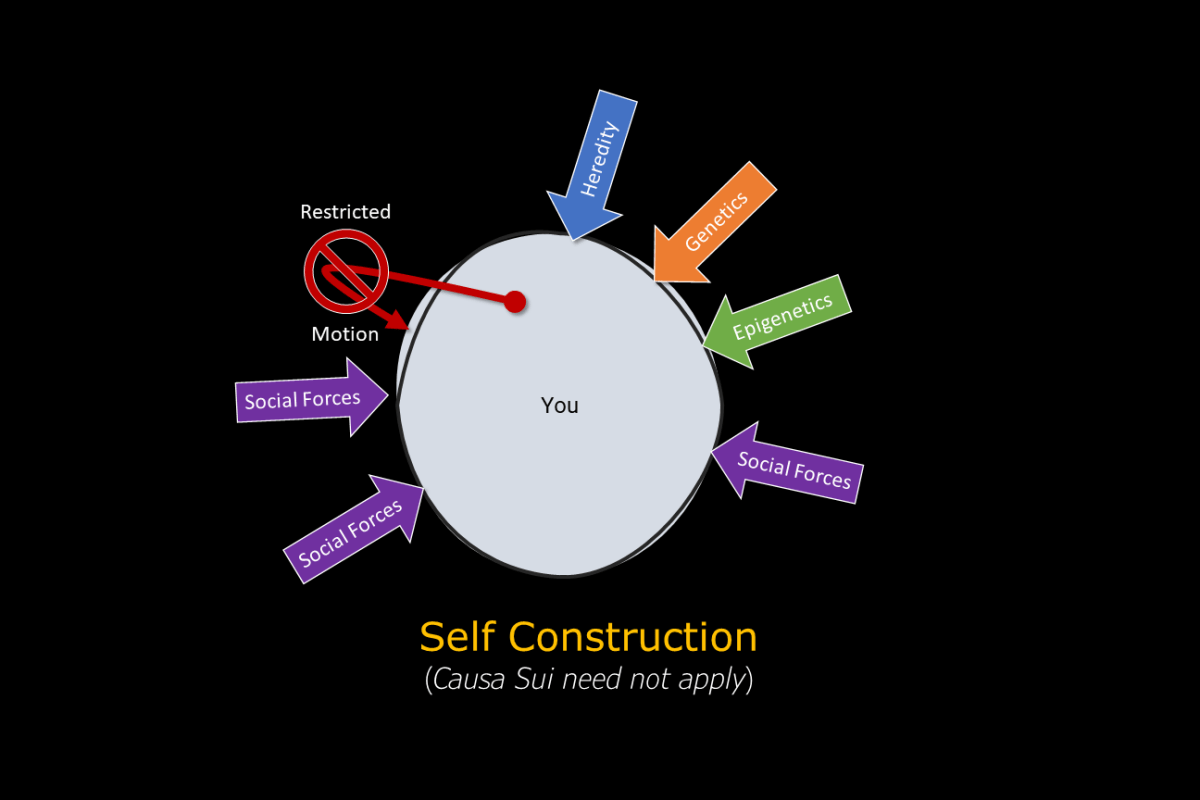
Quickly reviewing the backstory, a self—or sui in this parlance—is the product of nature and nurture. Nature manifests in the form of heredity, genetics, and epigenetics; nurture is parents, peers, society, and authority.
As people like Steven Pinker and Jonathan Haidt tell us, we come into this world with the operating system installed and a basic bootstrap programme. After this, we are autodidactic automatons. Of course, Pinker and Haidt would posit that humans are more than mere meat puppets, but that’s part and parcel of the causa sui point.
Elaborating further on this, at time-zero, the moment we take our first breath, we have not yet taken in any direct experiences from which to expand our base genetics. For the sake of illustration, let’s divide our universe into self and not-self. At the start our self has been given to us through no effort of our own. We’re the result of generations on generations of chromosomal exchange from some initial single-celled organism.
Then there’s nurture. One may argue that we have some experiences in utero, but these are substantially filtered. Once we see the light of the world, it’s showtime for real.
All that you touch
All that you see
All that you taste
All you feel.
Humans are input acquisition and storage machines. The brain is at once a difference and synthesis engine. Any outputs are a result of this process. Ostensibly, we are functions.
What humans are not are creation machines. Any so-called creation is just more synthesis. Even as we procreate to generate more humans, our dimorphism facilitates the progenerative blending of ova and spermatozoa. No creation, per se. In An Enquiry Concerning Human Understanding, Hume suggested that the idea of a unicorn was just a recomposition of the idea of a horse with that of a horn. That’s as far as human creativity goes.
The challenge with causa sui is that we cannot cause our ‘self’. Let’s explore some examples.
Let’s take as an example a successful physician. This physician was raised by someone, attended school, progressing to medical school, passed any necessary praxis, exams, and certifications, fulfilled whatever internships and residencies, and acquired some office space. Some years later, this physician bought a home, got a dog, and had some kids. I’ll stop here. You render your own mental picture.
Perhaps, instead, we look at a music virtuoso. A child prodigy, s/he attends Berklee and graduates before reaching 10 years of age. S/he starts YouTube, Insta, and TikTok channels with millions of followers, and earns millions. You take it from here. One more.
This last person is raised by a good family, but she ends up on the wrong side of the law and in prison. All friends say she’s kind, caring, and generous, but she was in the wrong place at the wrong time. At 20 she’s got a 20-year sentence to think it through. You can work this one through as well.
Let’s look into these scenarios and unpack these self-made individuals—or self-unmade if that’s how you’d prefer to characterise the last one.
Is our physician self-made? If so, how so? Let’s ignore the genetics and focus on the rest of the story. This person was sent to school. Local laws and parental concern all but ensured this. A certain teacher or teachers sparked an interest in medicine. Or perhaps it was from a book or television programme.
Perhaps a relative was ill and s/he became determined to help others.
This person was blessed with the appropriate cognitive abilities and their interest was fostered. The desire to succeed was instilled as was the drive and motivation. Nothing about this situation suggests causa sui action. Instead, everything is causa alii—caused by others, if I may misappropriate some Latin.
Any motivation was either genetically and physiologically inherent or acculturated or both. As the saying goes, you can’t get blood from a stone (or a turnip).
Of course, the second scenario plays out the same. Born with some natural ability. Could the parents not have nurtured this talent? Imagine this person was born with the propensity to be a virtuoso pianist yet never had come in contact with a piano? If a tree falls in the woods and no one was there to hear? How many people are in an analogous position?
Let’s turn to the dilemma of the prisoner. This person was instilled with whatever social cues she got. Perhaps they were exposed to bad influences. Perhaps their ‘processing unit’ is defective. Neither of these constitute causa sui events. As the saying goes, ‘she didn’t raise herself’.
Even if she did raise herself, she’d be excused as well. Some person raised by wolves in Avignon—or Tarzan of the Apes—is not expected to have acquired the rules of society.
Here’s an illustration:
First, there’s ‘sui’. That’s you.
But before you, there are the reagents. Ingredients.
Heredity.
Genetics.
Epigenetics.
Stuff.
The building blocks that make your physical ‘you’. And perhaps there are pre-natal environmental factors such as nutrition.
Once you are born, you begin to become a product of your environment as you absorb external forces. These might be the influence of your parents or siblings or other kit and kin.
Then you are exposed to teachers and peers. And society at large. And then there are perspectives formed by authority relationships.
We don’t even need to discuss the possible complexities and interactions between nature and nurture. These are interactive.
Perhaps you were genetically predisposed to grow no more than 168 centimetres, but you had poor nourishment, so this limit was never fully realised. Perhaps you have a blemish that makes you self-conscious. Perhaps, you’ve got a lisp or a limp. Perhaps you were in hospital due to an accident, and you lost a year at primary school. Perhaps a parent abandoned you and you were raised in a single-parent household. Perhaps as an infant both of your parents were killed by gunfire whilst watching an Independence Day parade in Highland Park Illinois in the United States of America.
Any of this might be true. But something that cannot be true is that you had any say in any of this. Causa sui. You cannot be a cause of yourself.
How did you become a virtuoso pianist?
Were you genetically predispositioned to have this talent? Probably. What if you weren’t driven to play? Again, what if you had never been introduced to piano but has this otherwise latent talent? Let’s say you are faced with a food choice for dinner. You’ve got pork chops, dog, or monkey brains. Personally, I’d forego all of these. If I were from some Asian countries, I may have a tough time deciding but only because they all seem delicious.
In economics, we discuss diminishing marginal utility for preferences. Faced with a choice, my preferences may differ depending on the situation. But given a situation where one has to make a choice repeatedly, each subsequent choice yields less utility or ‘happiness’.
You’re at a pub, and you mention that you’re a bit peckish. Your mate orders a pizza and offers you some slices. You haven’t eaten pizza in a while, so perhaps you eat a slice and are offered another when it’s gone. Your utility diminishes with each slice. The first one really hit the spot. The second one was pretty good too. You think twice about eating a third piece. And you forego the fourth piece altogether. Later in the evening, your mate with the hollow legs orders another pizza and offers to split it. You’re ever so slightly hungry, but you opt for pudding instead. This is your choice. But it’s not. It’s just that you’ve just eaten your fill of pizza and want something different.
Now the question is can you go against a craving? You are on a diet and are offered some dessert. You are craving it, but you exercise your free will and decline. Surely, this is free will, right? Not really. If you go for the dessert, your body is willing your action. But if you decline, it’s only because you have information that counters your craving. You need to look thin in a swimming suit at the weekend. Your choice will be guided by your assessment of prior and prospective considerations. You cannot make a choice absent these. Even if you decide to pick randomly or flip a coin. Firstly, the choice to flip is based on prior information. Secondly, the resultant choice is due to the coin rather than your free will.
Let’s summon Schopenhauer for a moment. He reminds us that whilst we can want what we will, we can’t will what we will.
This craving is not us. We aren’t in control. We only have control over whether we submit to the urge or not.
But that’s not correct either.
Picture this. You are at an ice cream vendor.
Chocolate or Vanilla
You always get chocolate, so you order chocolate. This is habit, not choice.
The vendor remembers they just got a shipment of passionfruit ice cream. Would you prefer that? It depends, but it doesn’t depend on you, save to say it depends on your experiences until now. If you’ve never had it before, it depends on your palate and whether you are open to new experiences. This is not something you have control over.
Let’s say your mates invite you to go skydiving. Again, you may seemingly be faced with a choice between declining the invitation and disappointing your mates. Whichever emotional response is stronger will guide your decision. This is based on experience. And this is important: even if you overrule your initial consideration, it’s because of the way you are that you are able to do that, but you had no say in the way you are. Each experience either leads you to a new experience or you experience something new and either like or dislike it.
Perhaps reading a certain book led you to enjoy reading. Given the decision to watch television or read, you may prefer to read. Some people do not enjoy reading, so given the choice, they’ll switch on the telly.
Galen Strawson formalised this by relating his so-called basic argument.
You do what you do, in any given situation, because of the way you are.
So in order to be ultimately responsible for what you do, you have to be ultimately responsible for the way you are—at least in certain crucial mental respects.
But you cannot be ultimately responsible for the way you are in any respect at all.
So you cannot be ultimately responsible for what you do.
What this is saying is that anything about you already influences what you do next and your choices. So, you as an entity may do something, engage in an activity, but it’s only because you’ve been programmed to do so on hardware you had no say in receiving.
To equate humans to computers is a little facile, but for our purposes, we can think of humans as analogous to processors or a mathematical function.
We are hardware with an onboard self-updating operating system. And we have software routines, all processed in our brains. In addition to capturing, processing, and storing data, this operating system and some of its software are also updated with experience, so we are getting updates and upgrades. Each of these might affect our next decision.
Sometimes input devices are faulty. Perhaps we are blind or colourblind. Perhaps we can’t hear or taste or smell. Each of these will affect in some manner what information we have to process.
In some cases, the processing unit itself is broken. With synaesthesia, we may see sounds, or smell colours.
But we may also just not process things correctly. Perhaps we can’t interpret social cues. Perhaps we can’t remember things. Or we have some other cognitive deficits. In these cases, we may have actually been exposed to socially accepted behaviours—don’t steal; don’t harm; obey traffic regulations, or whatever—, but we have difficulty processing these when the time comes. Or maybe our induction and deduction skills are diminished.
But my intent is not to make this about mental illness. The point is that persons considered to have full mental capacity and competency still have no ability to get outside of themselves to influence themselves. Full stop.
You may want to check out the video on agency that addresses what options society has in light of this situation. Keep in mind that I am not saying that you are stuck on a fateful path. We are not Oedipus. If you had not been exposed to the rules, then rehabilitation may be in order. If you may be a danger to yourself or the public, you may be sequestered or quarantined until such time you are no longer a risk. This introduces its own quandaries relating to retributive justice and challenges in policing the watchers, but these are beyond the scope of this segment.
The only escape from the idea of each human being the result of a closed system of nature and nurture is the notion of emergence that would say that the admixture of these ingredients would result in something new, that perhaps consciousness contains a sui somehow transcendent of the source elements, and this is where your human agency resides—sort of an emergent soul if you will. In the world of chemistry, the combination of sodium and chloride brings about table salt, having different emergent properties than the base ingredients, yet none of these properties is consciousness nor agency. Does this emergence work differently in the brain? This doesn’t sound plausible, but it is an idea to explore if you really feel compelled to argue agency exists in some form or fashion.
So, there you have it. You are you, but you don’t have any inherent agency. Or do you? Do you think there is any place for ‘sui’ to exist autonomously from your genetic and environmental makeup? If so, where is it, and how does it gain its independence.
Nota Bene
The causa sui cows. I had intended to work the cows into the video. In fact, I spend a decent amount of time trying to clean them up, but as I left on holiday and returned, I realised near the end that they got left on the cutting room floor—even though they are still used as cover art. Perhaps I’ll consider a feature-length production for these characters in future.







 Philosophics