I’ve only read the first four chapters of Iain McGilchrist’s The Matter with Things. My intent is to build up to how his ideas intersect with my workaday life in a future segment, but for now, I’ll summarise some main themes.
Podcast: Audio rendition of this page content (< 5 minutes)
The chapters I’ve read are
Some preliminaries: How we got here
Attention
Perception
Judgment
The next chapter is Apprehension.
Philosophically, or rather I have an interest in McGilchrist’s ontological model, but that appears not to arrive until the second volume, perhaps in chapters 24 or 25, respectively Space and Matter and Matter and Consciousness. Being that this underlaid my reluctance to engage with this book, I did take liberties and skimmed these chapters quickly in an attempt to discern whether he is a Realist or an Idealist.
Until recently, I’ve been a Realist with reservations, but now I consider myself instead to be an Idealist with reservations—though I may have fewer reservations, so perhaps I am moving in the right direction.
As a Realist with reservations, I felt that there was some underlying reality, but sense-perception and cognitive limitations limited access to it, so correspondence to it was necessarily limited.
As an Idealist with reservations, I feel that there is some underlying reality, and sense-perception and cognitive limitations limit access to it, so correspondence to it is still necessarily limited, so we generate an approximation.
I agree with Donald Hoffman’s assertion of Fitness Before Truth, in summary, that it is faster and more efficient to assess environmental fitness and take penalties where the assessment may have been a false positive. If one recoils in error from a coiled garden hose initially perceiving it to be a snake, the penalty is low. If a delay is incurred to assess some ‘snakeness’ truth value, we may have already been bitten. If we see something charging at us, better to avert and assess than to take time to discern. It’s of little consolation to consider, “Ah. I’m being mauled by a cheetah.” Better to have ducked and covered.
My chapter skimming was not enough to ascertain McGilchrist’s position. I’ll wait until I arrive there in due time. No need to spoil the ending. Given the book’s title, I am leaning toward Idealist, but I may be mistaken.
Moving on, these chapters build on each other. Not so much with narrative content as to represent the necessary chain of perceptual events: attention, perception, and judgment—in this order.
We cannot judge what we can’t perceive, and we can’t perceive what doesn’t come into the sense-perception space. McGilchrist reminds the reader that just because something is in a space where it can be perceived does not mean it can or will be perceived. He cites the example of the invisible gorilla in a basketball game study, which I’ll link to separately.
What we attend to is a matter of the situation and experience. Once we bring our attention to it, we can attempt to perceive it. Is it a snake or just a garden hose? Finally, we can make a judgment—it was just a garden hose. Silly old bear. Or, I sure am thankful my reflexes are lightning quick.
Winnie the Pooh: Silly Old Bear
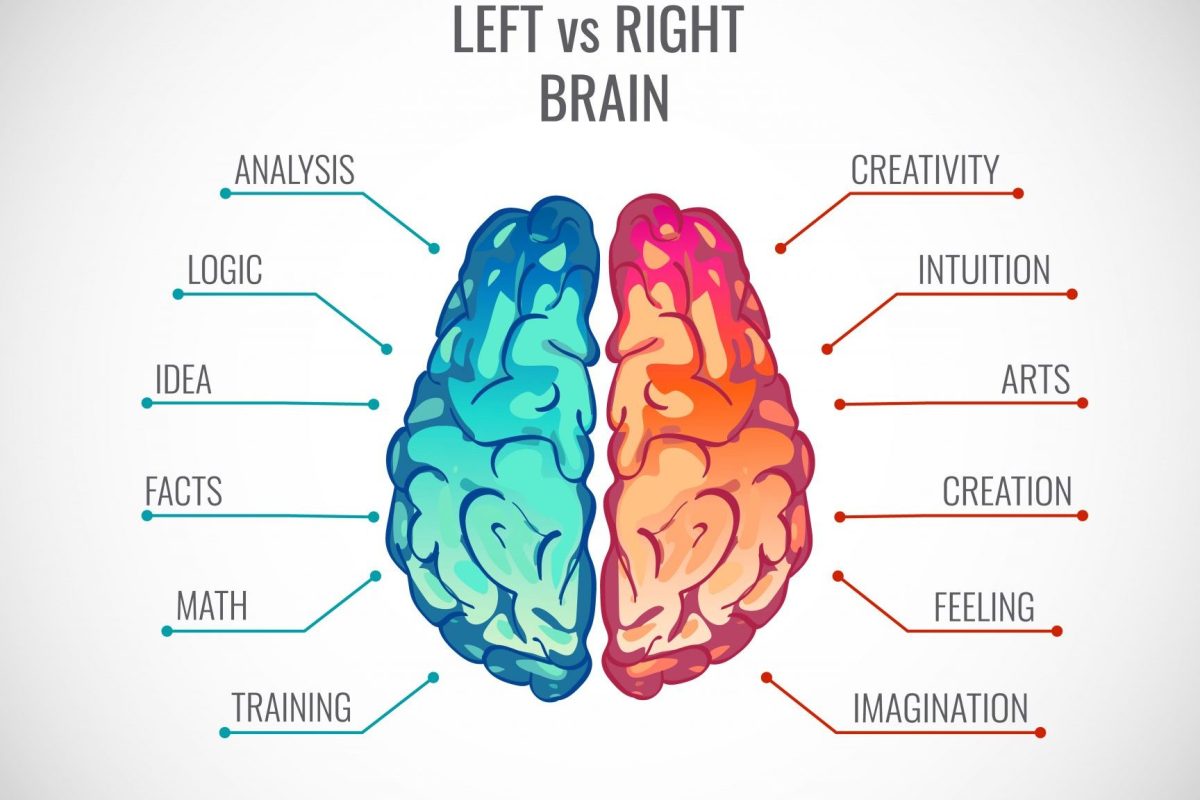
McGilchrist provides a plethora of examples, though most are tied to split-brain scenarios, which brings me to my last point. One of his theses is that left-right brain hemisphere differences are real and significant. Some had argued that the left-right representation is false, and he wants to take it back and regain that space by asserting arguments to the contrary.
I expect to discuss this more in an upcoming segment and apply my preliminary thoughts to my comprehension.
People outside of this space have been suggesting that I read Iain McGilchrist. I started by watching his YouTube content, but I was put off by two things. But first, let me say that I really enjoy listening to Iain speak. He’s an Oxford psychiatrist and just a font of information—full of knowledge to retrieve and synthesise on a whim.
So what’s the problem? First, McGilchrist is a Panpsychist. And although Galen Strawson, whom I adore, is also a Panpsychist, I just don’t relate to the notion that everything has consciousness. I might be able to get there through semantic acrobatics, but that’s just a cheap parlour trick. I don’t mind engaging in idealists, as I am partial to Analytic Idealism, and I don’t mind saying there is a consciousness that we are all part of—though admittedly, I feel that this is just another parlour trick I am somehow more apt to forgive. I believe there is material and this material is what we can measure and try to measure, but ostensibly it’s merely a poor reflection of the larger reality that may be described alternatively as consciousness or information depending on which theory you support.
I said there are two problems. The second is less fundamental and more practical. His latest book release, The Matter with Things, is a two-volume set that costs around £70 in Britain but is twice that in the US at around $150. Oh. And it’s almost 3,000 pages.
As it turns out, I’ve read the first two chapters. Some Preliminaries and Attention. So far, it’s been some setup and ground setting with some narratives about persons with split and damaged hemispheres in order to establish the relative function of each side of the human brain.
I am familiar with some of these case studies from other neuroscience literature I’ve read, but he has a nice way of expanding the narratives. Plus, he’s got some new ones.
I don’t expect that I’ll be documenting a play-by-play here, but I wanted to share what I am doing. I expect that the first volume will be more of the same. Perhaps the second volume will delve more into the metaphysical arena. Time will tell.
I decided to try my hand at reading. I came upon Peter Zapffe when I was reading The Conspiracy against the Human Race, and The Last Messiah is a relatively short essay. It’s under 25 minutes.
My first goal was to figure out how to pronounce Zapffe. As it happens, the terminal E is pronounced as a schwa. And that makes sense. My heritage, as it were, is Norwegian. My grandad was born in Norway, emigrating during the so-called World War 2. His family surname is Gade, with the E pronounced the same way, so the name is pronounced as /gäʹdə/, but Anglicised, it the A becomes a long vowel owing to the silent E, so it becomes /geɪd/.
What was new to me is that in Norwegian, Peter is pronounced /pɛt ə/ [as if spelt Petta] rather than /ˈpiːtɚ/ or perhaps /ˈpiːtɹ/ in some American renditions more familiar to English readers.
Here’s an audio version of my review of Deborah Bennett’s Logic Made Easy.
tl;dr If you’ve had some exposure to formal logic, this may be just the fresher you need. If you are not already familiar with the basics, I suggest you commence elsewhere,
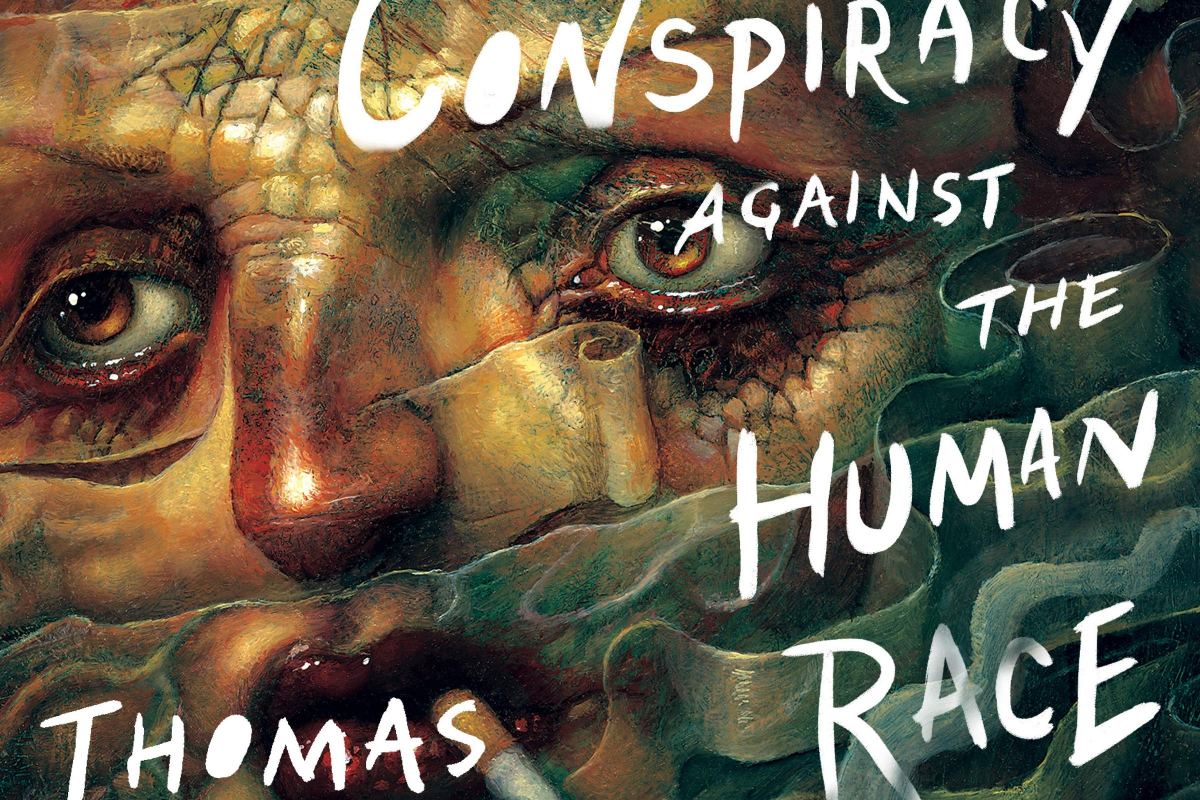
The Conspiracy against the Human Race is a work of non-fiction by horror author Thomas Ligotti. There is an audio podcast version and a YouTube video version. Feel free to leave comments in the space below or on YouTube.
Transcript
In this segment, I’ll be reviewing a book by Thomas Ligotti, The Conspiracy Against the Human Race, A Contrivance of Horror.
I haven’t done any book reviews, but since I tend to read a lot of books, I figure why not share my take and see how it’s received? If you like these reviews, click the like button and I’ll consider creating more.
Let’s get started.
First, I’ll be providing a little background, and then I’ll summarise some of the content and main themes. I’ll close with my review and perspective.
The author is Thomas Ligotti. He is a published writer in the horror genre in the vein of Lovecraft’s atmospheric horror. I’ve not read any of his work and haven’t read much fiction in ages.
The Conspiracy Against the Human Race is Ligotti’s first work of non-fiction. The book was originally published in 2010. I read the 2018 paperback version published by Penguin Books.
Conspiracy Against the Human Race falls into the category of Ethics and Moral Philosophy in a subcategory of pessimism. The main thesis of this book is that humans ought never to have been born. Following in the footsteps of anti-natalist David Benatar, who published Better Never to Have Been Born in 2007, Ligotti doubles down on Benatar’s position on the harm of coming into existence and argues that humans should just become extinct. Moreover, we should take out life in general.
In the book, Ligotti posits that consciousness was a blunder of nature and is the root of all suffering. He argues the derived Buddhist position of dukkha, which translates as Life is suffering. He establishes that most people are aware of this fact, but that we are nonetheless wired to be biased toward optimism through delusion and what a psychoanalyst might call repressed memories. Moreover, pessimists are a cohort not tolerated by society, who don’t want their delusions shattered.
Philosophically, Ligotti is a determinist. I’ve created content on this topic, but in a nutshell, determinism is the belief that all events are caused by antecedent events, leading to a chain of causes and effects stretching back to the beginning of time and bringing us to where we are now. If we were able to rewind time and restart the process, we would necessarily end up in the same place, and all future processes will unfold in a like manner.
Ligotti likes the metaphor of puppets. He employs puppets in two manners. Firstly, being the determinist he is, he reminds us that we are meat puppets with no free will. Our strings are controlled by something that is not us. This something ends up being Schopenhauer’s Will, reminding us that one can want what we will, but we can’t will what we will. This Will is the puppeteer. Secondly, puppets are soulless, lifeless homunculi that are employed in the horror genre to create unease by means of an uncanny association. He cites the work and philosophy of Norwegian author Peter Zapffe, who also elucidates human existence as a tragedy. Humans are born with one and only one right—the right to die. And death is the only certainty. The knowledge of this causes unnecessary suffering.
Quoting Ligotti,
“Stringently considered, then, our only natural birthright is a right to die. No other right has ever been allocated to anyone except as a fabrication, whether in modern times or days past. The divine right of kings may now be acknowledged as a fabrication, a falsified permit for prideful dementia and impulsive mayhem. The inalienable rights of certain people, on the other hand, seemingly remain current: somehow we believe they are not fabrications because hallowed documents declare they are real.”
Ligotti reminds us that consciousness is a mystery. We don’t really know what it is or what causes it other than it exists and we seem to have it, to be cursed with it. He adopts Zapffe’s position that consciousness is also responsible for the false notion of the self.
As all life is, humans are the result of an evolutionary process. Consciousness was just the result of an evolutionary blunder. He cites Zapffe and conveys that “mutations must be considered blind. They work, are thrown forth, without any contact of interest with their environment.”
Whilst pessimists view consciousness as a curse, optimists such as Nicholas Humphry think of it as a marvellous endowment.
He summarises the reason humans have it worse than the rest of nature:
“For the rest of the earth’s organisms, existence is relatively uncomplicated. Their lives are about three things: survival, reproduction, death—and nothing else. But we know too much to content ourselves with surviving, reproducing, dying—and nothing else. We know we are alive and know we will die. We also know we will suffer during our lives before suffering—slowly or quickly—as we draw near to death. This is the knowledge we “enjoy” as the most intelligent organisms to gush from the womb of nature. And being so, we feel shortchanged if there is nothing else for us than to survive, reproduce, and die. We want there to be more to it than that, or to think there is. This is the tragedy: Consciousness has forced us into the paradoxical position of striving to be unself-conscious of what we are—hunks of spoiling flesh on disintegrating bones.”
I’ll repeat that: Consciousness has forced us into the paradoxical position of striving to be unself-conscious.
He cites Zapffe’s four principal strategies to minimise our consciousness, isolation, anchoring, distraction, and sublimation
Isolation is compartmentalising the dire facts of being alive. So, he argues, that a coping mechanism is to push our suffering out of sight, out of mind, shoved back into the unconscious so we don’t have to deal with it.
Anchoring is a stabilisation strategy by adopting fictions as truth. We conspire to anchor our lives in metaphysical and institutional “verities”—God, Morality, Natural Law, Country, Family—that inebriate us with a sense of being official, authentic, and safe in our beds.
Distraction falls into the realm of manufactured consent. People lose themselves in their television sets, their government’s foreign policy, their science projects, their careers, their place in society or the universe, et cetera. Anything not to think about the human condition.
Sublimation. This reminds me of Camus’ take on the Absurd. Just accept it. Embrace it and incorporate it into your routine. Pour it into your art or music. Ligotti invokes Camus’ directive that we must imagine Sisyphus happy, but he dismisses the quip as folly.
Ligotti underscores his thesis by referencing the works of other authors from David Benatar to William James.
Interestingly, he suggests that people who experience depression are actually in touch with reality and that psychology intervenes to mask it again with the preferred veil of delusion and delf-deception. Society can’t operate if people aren’t in tune with the masquerade. Citing David Livingstone Smith in his 2007 publication, Why We Lie: The Evolution of Deception and the Unconscious Mind, Ligotti writes: “Psychiatry even works on the assumption that the “healthy” and viable is at one with the highest in personal terms. Depression, “fear of life,” refusal of nourishment and so on are invariably taken as signs of a pathological state and treated thereafter.”
Ligotti returns to the constructed notion of the self and presents examples of how a lack of self is an effective horror trope, citing John Carpenter’s The Thing and Invasion of the Body Snatchers.
He spends a good amount of time on ego-death and the illusion of self, a topic I’ve covered previously. He mentions Thomas Metzinger and his writings in several places including his Being No One, published in 2004, ostensibly reinforcing a position described as naïve realism, that things not being knowable as they really are in themselves, something every scientist and philosopher knows.
He delves into Buddhism as a gateway to near-death experiences, where people have dissociated their sense of self, illustrating the enlightenment by accident of U. G. Krishnamurti, who after some calamity “was no longer the person he once was, for now he was someone whose ego had been erased. In this state, he had all the self-awareness of a tree frog. To his good fortune, he had no problem with his new way of functioning. He did not need to accept it, since by his report he had lost all sense of having an ego that needed to accept or reject anything.” Krishnamurti had become a veritable zombie. He also cited the examples of Tem Horwitz, John Wren-Lewis, and Suzanne Segal, but I won’t elaborate here.
Russian Romantic author, Leo Tolstoy, famous for War and Peace and Anna Karenina, was another pessimist. He noticed a coping approach his associates had employed to deal with their morality.
Ignorance is the first. As the saying goes, ignorance is bliss. For whatever reason, these people are simply blind to the inevitability of their mortal lives. As Tolstoy said these people just did not know or understand that “life is an evil and an absurdity”.
Epicureanism comes next. The tactic here is to understand that we are all in here and no one gets out alive, so we might as well make the best of it and adopt a hedonistic lifestyle.
Following Camus’ cue, or rather Camus following Tolstoy and Schopenhauer, he suggests the approach of strength and energy, by which he means the strength and energy to suicide.
Finally, one can adopt the path of weakness. This is the category Tolstoy finds himself in, writing “People of this kind know that death is better than life, but not having the strength to act rationally—to end the deception quickly and kill themselves—they seem to wait for something.”
The last section of the book feels a bit orthogonal to the rest. I won’t bother with details, but essentially he provides the reader with examples of how horror works by exploring some passages, notably Radcliffe’s, The Mysteries of Udolpho; Conrad’s Heart of Darkness; Poe’s Fall of the House of Usher; Lovecraft’s Call of Cthulhu; and contrasting Shakespeare’s Macbeth and Hamlet.
This has been a summary of Thomas Logotti’s Conspiracy against the human race. Here’s my take. But first some background, as it might be important to understand where I am coming from.
I am a Nihilist. I feel that life has no inherent meaning, but people employ existentialist strategies to create a semblance of meaning, much akin to Zapffe’s distraction theme or perhaps anchoring. This said I feel that, similar to anarchism, people don’t understand nihilism. Technically, it’s considered to be a pessimistic philosophy because they are acculturated to expect meaning, but I find it liberating. People feel that without some constraints of meaning, that chaos will ensue as everyone will adopt Tolstoy’s Epicureanism or to fall into despair and suicide. What they don’t know is they’ve already fabricated some narrative and have adopted one of Zappfe’s first three offerings: isolation, which is to say repression); anchoring on God or country; or distracting themselves with work, sports, politics, social media, or reading horror stories.
Because of my background, I identify with Ligotti’s position. I do feel the suffering and anguish that he mentions, and perhaps I am weak and rationalising, but I don’t feel that things are so bad. I may be more sympathetic to Benatar’s anti-natalism than to advocate for a mass extinction event, though I feel that humans are already heading down that path. Perhaps this could be psychoanalysed as collective guilt, but I won’t go there.
I recommend reading this. I knocked it out in a few hours, and you could shorten this by skipping the last section altogether. If you are on the fence, I’d suggest reading David Benatar’s Better Never to Have Been. Perhaps I’ll review that if there seems to be interest. If you’ve got the time, read both.
So there you have it. That’s my summary and review of Thomas Ligotti’s The Conspiracy against the Human Race.
Before I end this, I’ll share a personal story about an ex-girlfriend of mine. Although she experienced some moments of happiness and joy, she saw life as a burden. Because she had been raised Catholic and embodied the teachings, she was afraid that committing suicide would relegate her to hell. In fact, on one occasion, she and her mum had been robbed at gunpoint, and her mum stepped between my girlfriend and the gun. They gave the gunmen what they wanted, so the situation came to an end.
My girlfriend laid into her mother that if she ever did something like that again and took a bullet that was her ticket out, she would never forgive her. As it turned out, my girlfriend died as collateral damage during the Covid debacle. She became ill, but because she was living with her elderly mum, she didn’t want to go to hospital and bring something back. One early morning, she was writhing in pain and her mum called the ambulance. She died later that morning in hospital, having waited too long.
For me, I saw the mercy in it all. She got her ticket out and didn’t have to face the hell eventuality. Not that I believe in any of that, but she was able to exit in peace. Were it not for the poison of religion, she could have exited sooner. She was not, in Tolstoy’s words, weak, so much as she had been a victim of indoctrination. I feel this indoctrination borders on child abuse, but I’ll spare you the elaboration. So, what are your thoughts on this book? Is there a conspiracy against humanity? Are optimists ruining it for the pessimists? What do you think about anti-natalism or even extinction of all conscious beings or the extreme case of all life on earth? Is Ligotti on to something or just on something?
Daniel Dennet is quite the prolific writer. He first published Elbow Room back in 1984. He published an updated version in 2015. I like Dan. He is a master storyteller and has a mind like a trap, archiving decades (and centuries) of information. The approach he takes is thoughtful and methodical, and I tend to agree with most of his positions. This isn’t one of them. Interestingly, I recently reviewed John Martin Fischer’s contribution to Four Views on Free Will, which is sympathetic to his position.
Dennett is a compatibilist. I am an incompatibilist—an impossibility, really—, but I wanted to understand his line of argumentation. Like Fischer, Dennett wants to claim that an agent does possess enough elbow room—wiggle room—to be able to be granted free will or moral responsibility, depending on where you prefer to draw the line.
Dennett tends to agree with my position that free will is a semantic pseudo-problem, but he doesn’t mind calling enough ‘good enough’. Given a situation and circumstances, we have enough latitude to consider any actions to be free—with the usual exemptions for non compos mentis situations, cognitive deficits, and duress. He minimises the impact of genetics and upbringing as insignificant.
Basically, he argues that what latitude we do have is sufficient and what more could one want? Anything more would be unnecessary and excessive. Of course, this is just him drawing an arbitrary line at a point he feels comfortable, claiming that anyone asking for more is being unrealistically unreasonable. This feels a bit like a preemptive ad hominem defence. If you want this, then you are just foolish and selfish.
Dennett does agree with the notion that the world might be deterministic, but even so, we are proximately special. He also leans on the observation that people seem hardwired for blame, so there must be something behind this—instead of considering that humans seem hardwired for many things, not all of which are socially beneficial.
We want to hold people responsible, so by extension, we need to consider ourselves to be responsible.
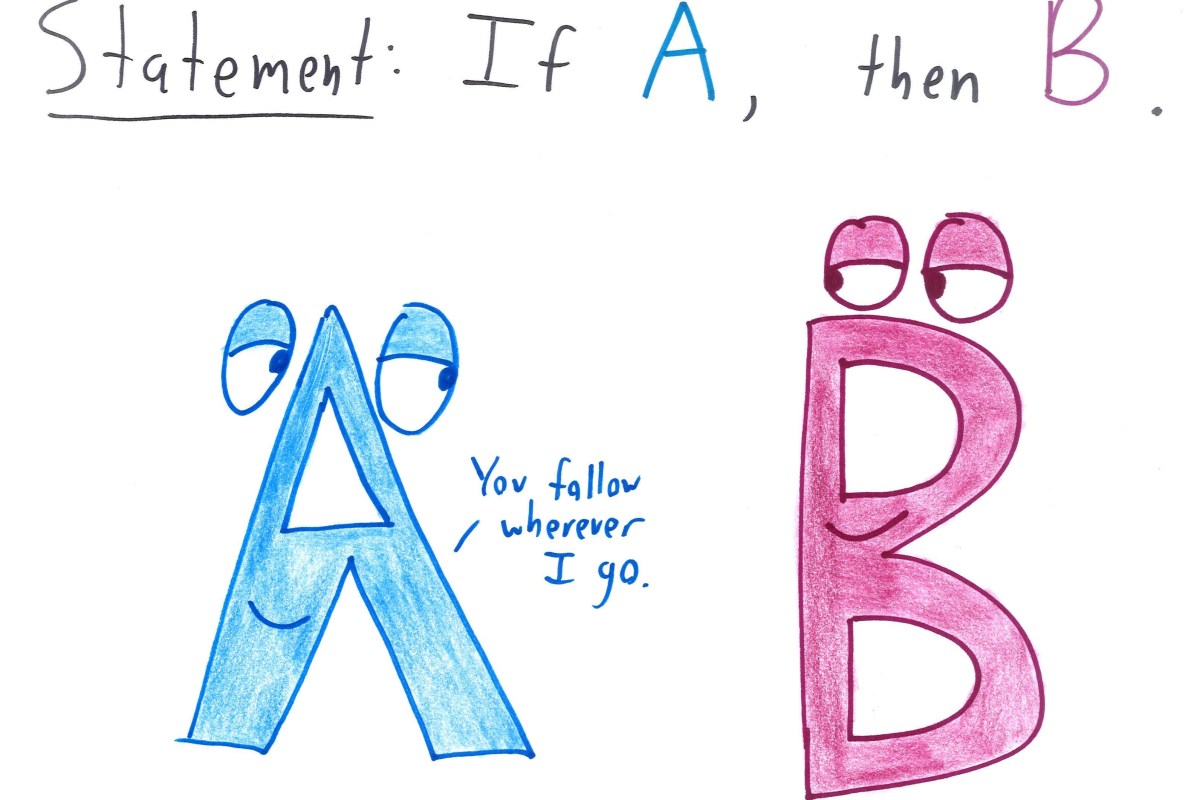
P1: All agents are responsible
P2: I am an agent
C: Therefore, I am responsible
But the problem is in the definition of agency (as well as the scope and meaning of responsibility and the assignment of responsibility to agents.
In the end, I remain unconvinced, primarily that he fails to overcome the Causa Sui argument.
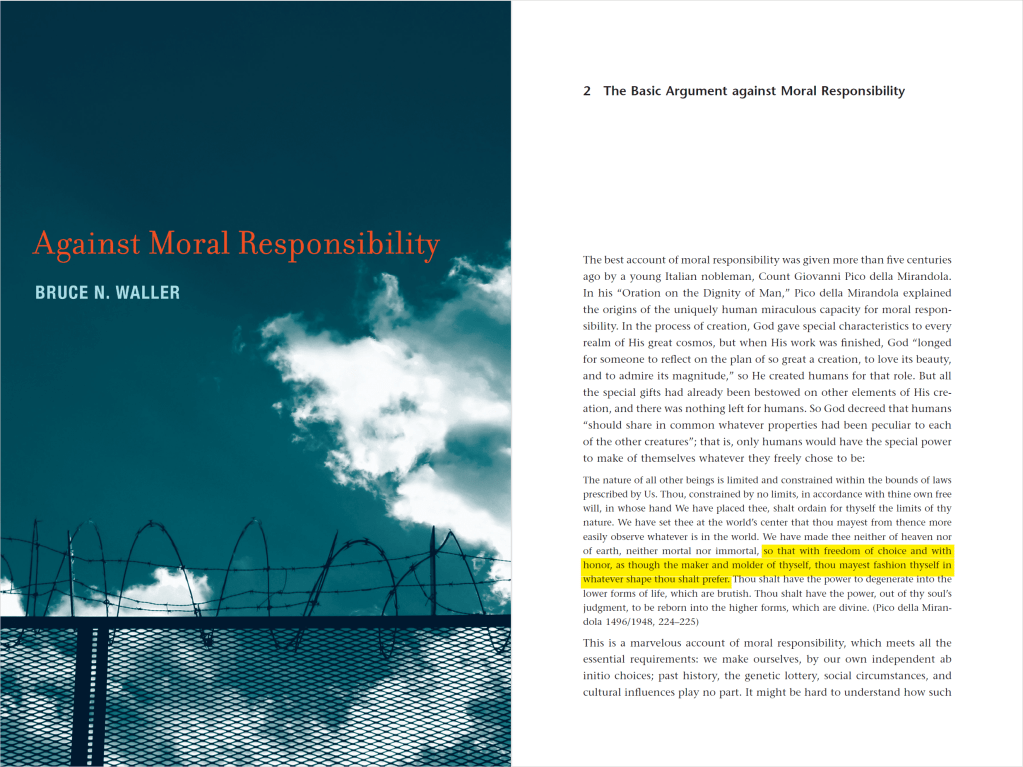
We have made thee neither of heaven nor of earth, neither mortal nor immortal, so that with freedom of choice and with honor, as though the maker and molder of thyself, thou mayest fashion thyself in whatever shape thou shalt prefer.
Bruce Waller
Bruce Waller, Against Moral Responsibility
Nothing really to add here now, but more on the way. Meantine, sharing this for reference.
Psychology is to neuroscience as astrology is to astronomy and alchemy is to chemistry
I’ve been referring to psychology as pseudoscience for years. I’ve even written about it. This evening, the leading pull quote came to me, so I Googled it and was not disappointed. Confirmation bias? Indeed.
I’m glad others have already broken ground here. It saves me from getting lost down another unpopular rabbit hole.
Neuropath book cover and passage by E. Scott Bakker, MacMillan, 2009
Why should I even care?
On one hand, it disturbs me that this discipline not only gets elevated well above its station, it also affects lives because, as astrology before it, but it also affects people’s lives whether they believe it or not. Psychology creates arbitrary categories, asserts specious definitions, and the weak-minded accept it as gospel. Sadly, intelligent people haven’t yet seen behind the curtain in a manner reminiscent of the countless hours Issac Newton wasted on alchemy or Descartes spent trying to prove God.
It feels that most people have finally abandoned alchemy, though I don’t dare look. But many people still believe in astrology, zodiac, and horoscopes.
The core of psychology is based on metaphysical claims of the mind. The physical aspects lie in the realm of neuroscience.
Not so fast
To be fair, neuroscience is still in its infancy, and there are still more things they don’t know than they do. Where astronomy is able to look at the universe through the James Webb Space Telescope, neurology is peering through binoculars—or perhaps only the hollow core of a paper towel roll.
Although fMRIs and such look to us as advanced as, say, the Janes Webb Space telescope as seen in the image below.
James Webb Space Telescope as metaphor for possibilities
The fidelity might be better conveyed by this star-gazing implement.
Peering through paper towel roll as analogue to available neuroscience implements
Moreover, the base understanding of processes and mechanisms is lacking.
Even so, it beats this analogy to psychology.
Reading Tea Leaves analogue to psychology
This image of Carina Nebula’s so-called Cosmic Cliffs demonstrated the resolution and clarity we might expect from neuroscience in future.
NASA
This image represents where neuroscience is today.
NASA, ESA, and The Hubble Heritage Team (STScI/AURA)
Even the moral sceptic is not immune from his own form of the wish to over-intellectualize such notions as those of moral responsibility, guilt, and blame. He sees that the optimist’s account is inadequate and the pessimist’s libertarian alternative inane; and finds no resource except to declare that the notions in question are inherently confused, that ‘blame is metaphysical’.
PF Strawson, Freedom and Resentment
Quote from Freedom and Resentment and Other Essays by PF Strawson
Part of my central thesis of non-agency is centred on the notion of blame, and it seems PF Strawson has a lot to contribute in this arena. In short, given my lack of belief of material human agency, I wish to investigate the connection between seemingly innate impulses to project blame and the absence of a blameworthy object.
In order to devote more time to researching and writing my thesis and less time editorialising elsewhere, I may post some shorter content such as these gems that I stumble upon along the way. This facilitates my desire to create and share content without the burden of devoting hours to render it. It also gives me places to come back to.
I only hope that you don’t blame me for doing so.
Meantime, indulge my recording my thoughts here in the public space.
What is blame?
We don’t have very precise definitions of blame, we have an intuitive sense of what it means. There is a subject (or object, as the case might be) that creates (or has been attributed to have created) an action that results in an interaction on an object (or process) with a subsequent effect and a notion of intentionality. But we have to parse casual effect, responsibility, and blame as they are not strictly equivalent. Let’s begin with a causal event.
I believe that on balance the causal event process and object interaction is uncontroversial. A billiard ball (Object A), through directed (or undirected) motion, collides (action) with a second billiard ball (Object B) with the subsequent effect of displacing the second ball.
What we can claim in this scenario is that A → B, A causes B to move. Except in the loosest of idiomatic speech, we can’t really extend this causal relationship to claim that A is responsible for B’s movement. Even further removed, one can’t claim that A is to blame for B’s movement.
Responsibility and blame are different moral claims attributed to an agent. I feel I am safe to claim that a billiard ball has no agency. Whilst human agency is defined as an individual’s capacity to determine and make meaning from their environment through purposive consciousness and reflective and creative action (Houston, 2010), an agent in a more general sense is a being with the capacity to act, and ‘agency’ denotes the exercise or manifestation of this capacity.
The word blame is infused with negative connotations. Praise is a loose antonym with positive connotations, but I won’t focus on it because it is not nearly as heavy and operates semantically differently. In any case, I feel justified to cross blame from the list of possible qualifiers for the billiard ball scenario.
Is A responsible for B? Again, I believe that most people do not assign responsibility to inanimate objects—notwithstanding animism, pantheism, and possibly panpsychism.
Here are some diagrammes.
Above, there is only cause and effect. We can intuit that the movement of Object A is not uncaused. Even so, it careens into Object B, causing it to move. And while one could say A is responsible for moving B, this would be non-standard English language use.
If one pulls back to catch a wider glimpse, one can see that the cause of Object A striking Object B, was a person striking Object A (possibly with a cue stick). Here, the casual event chain is the person causing A to strike B. Two cause-effect relationships at a macro level. However, in this case, we can also say that the person is responsible for the event to set A into motion. We can also say that the person caused B to move (by the way of Object A). Even here, blame would be inappropriate to assert.
We may be able to reframe the scenario slightly differently to get blame into the picture, but let’s take a short detour and create a praise situation. If Object B is hit into a pocket, we can praise the person. Perhaps this shot wins the game. The person is responsible for making the shot.
In scenario B, the person misses the shot. Moreover, Object A does collide with Object B, but perhaps Object B is the 8 ball, and it was not supposed to be pocketed yet. Or perhaps the cue ball deflects off of Object B causing A to scratch because it falls into a pocket. Either of these situations might cause the person to lose the match. A mate may blame this person for being responsible for the loss.
Before moving on, I’ll point out that one distinction that affords blame more weight than praise is the ongoing psychology. Whilst with praise, a person may reflect fondly on a positive event, there is not really a counter to a grudge in the case of blame. And while praise can be misattributed with benefits to social capital, misdirected blame can result in a loss of social capital with longer-term implications.
Perhaps someone unseen pushes you into another person causing them to be injured. You may have been the cause of this person being injured, but like the billiard ball, Object B, you are not morally responsible. Moreover, you may be the target of blame.
These are rather low-stakes scenarios. Imaging these as legal negligence or in a criminal setting. Innocent people are routinely convicted for crimes they never committed. Perhaps, they had been previously unaware of any of the actors or events, yet they are blamed and fined or incarcerated.
This isn’t my interest to discuss at the moment. This is a different scope, so let’s return to the main theme.
In the low-stakes billiards example we can say that the person seems to have agency. For trivial events, we can ignore whether this is more than seeming. In essence, we can ignore the antecedent event arrow that caused the person to be in a situation to have the opportunity to strike the ball in the first place. We’ll return to this later.