As with chickens, humans can learn through reinforcement AKA operant conditioning.
In this video clip, we see a chicken learning that pecking a red circle yields a payload of food. Yet there is a problem with this algorithm. I don’t expect this study was meant to elucidate this point, but I’ll continue.
Except for one instance where the blue circle was pecked to yield nothing, the chicken learned that packing the red yielded a treat and so became fixed on seeking the red. What the chicken did not explore where the other colours—beige, green, and yellow. Perhaps these might have had a larger payout or a ‘better’ reward. Perhaps even a penalty or punishment, but I’ll ignore that eventuality.
The point is that through operant conditioning, the chicken is habituated. I feel that this is a metaphor for many such habituations in humans. People are indoctrinated (habituated) into all sorts of beliefs and behaviours, from the organisation of social and political systems to economic systems.
When I see people defending Democracy as Churchill did as “the worst form of government, but the best so far,” I can’t help but consider the parallels: Democracy is the red dot; capitalism is the red dot.
This not being a self-help blog, I’ll mention is passing the routines we get ourselves into that are analogous to this chicken—wandering through the world as if with blinders. The difference between a rut and a grave is the depth or dimensions. Are you in a rut on your way to the grave?
This is all I wanted to say. No chickens were harmed during the production of this blog entry.
I wrote about this content in 2019, but I wanted to revisit it for a video as well as create a podcast audio version.
Video: YouTube version of this page content
Podcast: Audio rendition of this page content
In today’s segment, I am going to share my perspectives on the truth about truth. To start, I’ll let the audience know that I do not believe in the notion of truth. I feel the term is ill-defined especially in the realm of metaphysics and morality. I feel that when most people employ the word ‘truth’, what they mean to say is ‘fact.’ That a fire engine is red, for example, may be a fact, if indeed the fire engine happens to be red, but it is not true. This is a misapplication of the term. If you employ truth as a direct synonym for fact, then this is not what’s being discussed here, and perhaps your time might be better spent watching some content by the Critical Drinker.
My argument is that truth is not objective. Rather it is subjective and perspectival. I concede that there may be some objective truth out there somewhere, but it is not and will not ever be accessible to us because of limitations in our sense-perception faculties and cognitive limitations. Per Aristotle, we only have five senses with which we can connect to the world, and these senses are limited. If there is anything out there that would require another sense receptor—a sense receptor not available to us—, we would never be able to sense it, to even know of its existence. Perhaps the universe emits 100 sense signals, but we are only capable of receiving and translating five. We’d be oblivious to 95 per cent of reality.
I am not making any claims that this is the case, but human cognition is so limited, that we can’t even conceive of what another sense might be. If you can, please leave a comment.
To be clear, I am not talking about senses we know other species possess. Bats may have echolocation, and sharks may have electroreception. Some animals may have greater sensory acuity—superior vision and auditory senses, olfactory and gustatory, tactile, or whatever. Some can see into infrared or ultraviolet light spectra. Technology that includes biomimicry provides humans with microscopes for the microworld and telescopes for the macroworld. We have x-rays and sonar and radar, radios and televisions that extend our senses, but these provide no new sensory receptors.
Like the story of the blind people and the elephant, we are left grasping at parts. But even if we are able to step back to view the whole elephant, to hear the elephant, to touch and smell or even taste the elephant, if there is more to the elephant, we cannot know it. The same goes for ourselves.
I know that some people might inject gods or psychic or paranormal energy into this void, and sure, feel free, but I am looking beyond these pedestrian concepts. What else might there be?
But let’s depart this train and head in a different direction. I want us to focus on the senses we do have. For the typical human, sight is our primary arbiter of reality, at least as defined idiomatically. We tend to believe what we see, and what we see, we assume as real—even if we are later mistaken. I guess that wasn’t a unicorn or a pink elephant. I must have been hallucinating or dreaming. I could have sworn that was Auntie Em.
There are several competing theories around truth, but I’ll focus on the Correspondence theory, which is simply put, the notion that, proxying reality for truth, human perception corresponds with the real world. And a pragmatist might argue that’s close enough for the government.
Keep in mind that historically humans have contorted themselves into making calculations. Remember how long people had been tying themselves into knots to show planetary motion in a geocentric system creating epicycles and retrograde motion to map understanding to a perceived reality.
One might even argue that we’ve progressed. It wasn’t true or accurate then, but now it is. And perhaps it is. Let’s look at some illustrations.
NB: Due to an editorial mishap, this paragraph was dropped in the podcast, hence dropped from the video, which shared the podcast audio source. As such, this image was also not used in the video. This is unfortunate, as it was meant to introduce those with limited maths knowledge to the asymptotic curve, as described. Apologies, and I hope this serves to orient any travellers who may have lost their way at this point.
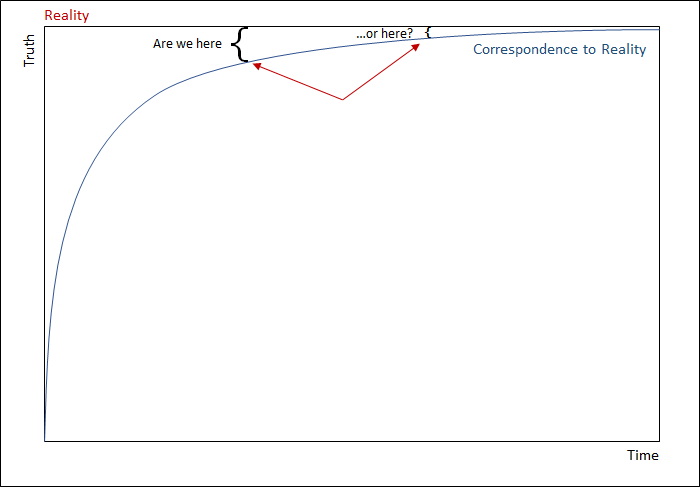
In this first illustration, we see Truth (or relative truthiness) on the Y-axis and Time on the X-Axis. On the top, we see a threshold representing Reality. In the plane, I’ve rendered an asymptotic curve, where over time, we get closer and closer to the Truth. But we never quite get there. More on this later.
The next illustration will help to demonstrate what’s happening.
Notice there is a gap between the curve and the Reality cap. For one thing, we don’t really know where we are relative to Reality. In the case of the geocentric system, we might have been at the leftmost space. Once we determined that the system is actually solar-centric, we might have moved right on the curve to close the gap. We might be tempted to defend that we’ve finally reached the truth, but we’d have been equally willing to make the same defence from the geocentric position, so we need to be mindful of the past.
Perhaps, this last example was too obvious. We feel comfortable staking a truth claim—or at least a claim of fact. So let’s look at another example.
Let’s re-use the same axes—Truth and Time—, but rather than an asymptotic curve, let’s presume something more polynomial in nature—or not particularly cyclic. Rather than retrograde motion in planets, let’s visit the supposed progress of Newtonian over Einsteinian physics.
This takes a bit more setup but bear with me. In this case, I have taken liberties and illustrated the Einsteinian physics gap to capture an inferior vantage on reality over Newtonian physics. Granted, I need to rely on a bit of suspension of disbelief, but in the bigger picture, I am trying to convey a scenario where some new paradigm puts the prior knowledge in perspective.
In this instance, both Newtonian and Einsteinian flavours of physics are based on a materialistic, particles-based model, which is where the modern physics consensus resides. But, let’s say that consensus changes in such a way that it is determined that something else underlies reality, say consciousness per Analytic Idealism as proposed by Bernardo Kastrup or per Integrated Information Theory (IIT) as advanced by Donald Hoffman and others. As with retrograde motion, we might end up finding that we were barking up the wrong tree. This might be a bit different because the particles are a directly perceived manifestation of the underlying consciousness, but I wanted to create a scenario where knowledge thought to have advanced actually regressed, but this wasn’t revealed until a new perspective was available.
Yet again, an important aspect of note is that we don’t actually know the distance between our perceptions and real Reality.
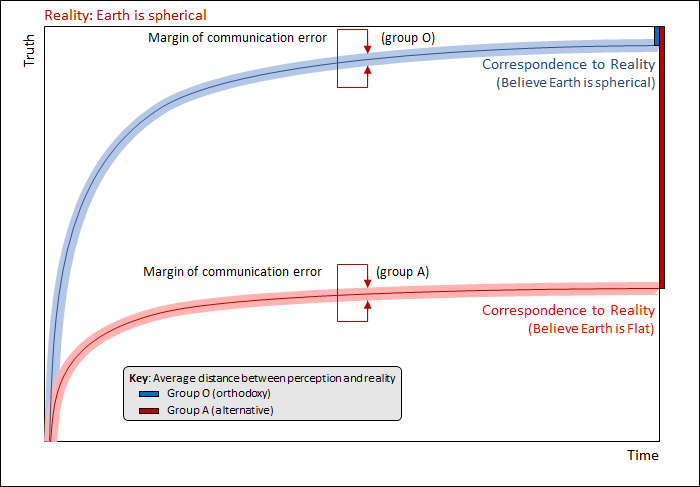
This last illustration builds upon the first asymptotic chart but has an in-built error margin meant to reflect language insufficiencies. There is some concept that people feel they grasp, but the consensus is not as unified as the group thinks.
I’ll share two examples, the first being the concept of justice. To me, Justice is what I deem a weasel word. It’s a word we commonly use, but it means different things to different people. To me, it’s a euphemism for vengeance by proxy, but for others, it transcends that and mirrors some impartial dispensation of just desert—some good old-fashioned law and order.
[Justice is] a euphemism for vengeance by proxy
Without getting stuck down some rabbit hole, my point is that if we aggregate these beliefs, the asymptotic curve represents an average consensus vantage rather than something as obvious as 2 plus 2 equals 4. On this note, allow me to clear the air.
Some viewers might be clamouring to say, “but 2 plus 2 equals four is true.” But this is tautologically true, which is to say that it’s true by definition. It’s a similar tautology to saying that it’s true that snow is white, or coal is black. We’ve already defined snow, white, coal, and black, so these may be facts, but they are true by definition.
Revisiting the chart, notice that there are two curves in the space. In this case, I illustrate competing truth claims from the perspective of an omniscient narrator. The case is whether the earth is an oblate spheroid or is flat. I am going to go out on a limb and assert the earth is spherical, as represented by the top blue curve—and we have some margin of error as to what that might mean. The bottom red curve depicts the perceived truth of the flat earthers, who also have some room for semantic error.
Given that I am presuming that I am in the right adopting the majority position—please be right—, the blue curve is closer to Reality than the red curve. Of course, in the event that the earth is really flat, then it proves my point that we don’t know where we are relative to truth, so we assume that the state of knowledge at any given time is what’s real.
Again, forgive my fanciful examples. Please don’t tell me that this spheroid versus planer earth is tautological too because you’d be correct, but I am already aware. They are just nonsensical illustrations. Nonetheless, I hope they’ve served to express a point.
I could have as well created curves that depicted two cohorts’ beliefs on the efficacy of tarot or astrology in predicting the future. I am sure that it might render somewhat like the last chart, but I’d also presume that both curves would have very low truth values as seen from an objective observer. Secretly, I hope tarot wins the truth battle.
Before I end our time together, I’d like to convey that for an Analytic Idealist, these charts might be more acceptable at face value. For a Realist, Naïve or otherwise, they may argue that this curve is not asymptotic and may in fact reach some tangency. I don’t happen to believe this is the case or I wouldn’t have spent my time assembling and presenting this. Time will tell. Or will it?
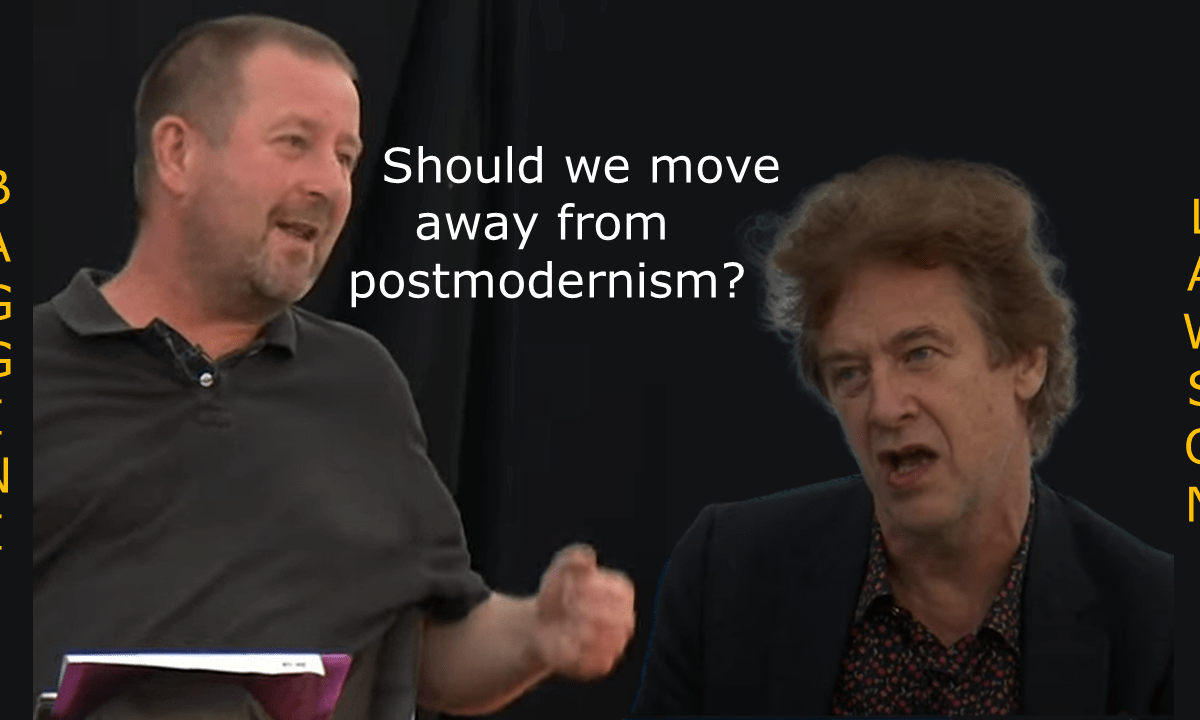
The theme of this Institute of Art and Ideas video is ‘Should we move away from postmodernism?‘
Podcast: Audio rendition of this page content
EDIT: Find my version of this content on YouTube:
Video: Postmodern Defence
At the start, I feel as usual, that the definition of postmodernism is nebulous, and the fora agree, methinks. Toward the end, Hilary Lawson concedes that key actors tied to the early postmodern movement denied being postmoderns, singling out Foucault and Derrida. More on this. Keep reading.
Julian Baggini, the bloke sat on the left and whose positions I am only getting familiar with, starts off the clip. He makes some points, some of which I agree with and others not so much.
He makes a play at claiming that there is some objective truth to be attained, following on with the statement that without this notion, it’s anything goes. I disagree with both of these assertions. Then he cites Thomas Nagel’s The View from Nowhere, wherein he posits that subjectivity and objectivity are extrema on a spectrum and that experience is somewhere in between. This conforms to my beliefs, but there are two provisos. First, the extremum of objective truth is unattainable, objectively speaking. Moreover, as I’ve written before, we have no way of adjudicating whether a given observation is truer than another. It seems that he leaves it that we don’t need to know the absolute truth to know “true enough”, but I think this is both a copout and wrong—but not too wrong for pragmatism to operate.
For example—not mentioned in the clip—, I can imagine that physicists feel that Einsteinian motion physics is truer than Newtonian physics, especially as we need to take measurements nearer to the speed of light. In my thinking, this might provide a better approximation of our notion of the world, but I can also conceive of an Ideal, non-materialistic perspective where both of these are rubbish from the perspective of truth. I feel that people tend to conflate truth with utility.
Julian makes an interesting point about semantics with the claim that “some people” define certain things in such a way as to not possibly be attainable and then claim victory. But what are his three examples? Free will, the self, and objectivity. If you’ve been following me, you’ll know that I might be in his crosshairs because I tend to be in the camp that sees these concepts as sketchy. And to be fair, his claim of defining something in a manner to keep a concept out of bounds is the other side of the same coin as defining something in such a way as to get it into bounds.
The self is different to free will insomuch as it’s a construction. As with any construction, it can exist, but it’s a fiction.
I’ve spoken at length about my position on free will, but I am fairly agnostic and don’t particularly care either way. I feel that the causa sui argument as it applies to human agency is more important in the end. The self is different to free will insomuch as it’s a construction. As with any construction, it can exist, but it’s a fiction. Without interacting with Julian or reading his published works on the self, if there are any, I don’t know how he defines it. And here we are discussing objectivity.
Given Nagel’s objective-subjective polarity, it seems they want to paint postmodernism as claiming that everything is subjective and that science (and religion) hold claims to objectivity. Hilary Lawson, the geezer on the right takes a position between extremes, but he denounces Julian’s claim about objective truth, noting that many people (especially of religious persuasions) make claims on Truth that are diametrically opposed, ostensibly labelling the same object simultaneously black and white. And the object for all intents and purposes is red.
I’ve gotten out of order, but Julie Bindel makes some good points on Feminism and suggests that the philosophical feminists—may I call them pheminists? No? OK then—such as Judith Butler have set women’s rights back by claiming that the category of ‘woman’ is invalid. Minni Salami defended Judith by noting that Butler has helped constructively in some ways and, citing Simone de Beauvoir, that woman is a category established by men to create The Other Sex. Still, Julie—not incorrectly—states that without a category, women (or whatever collective term one decides is representative) cannot be afforded legal protections—because law, as facile as it is, is all about categories and classes.
Hilary reenters the fray and states that it is not acceptable for one person to claim that their lived experience is all that is needed just because that is their truth. To be fair, this feels like a bit of a strawman argument. Perhaps I need to get out more, but I am not familiar with anyone credible making this claim.
I enjoyed watching this clip and processing the information. I hope you do as well. If you have any comments, I’d love to read them.
I am actively engaged in summarising Iain McGilchrist’s book, The Matter with Things, but I’ve been remiss in not sharing the introduction. Rather than do that, I’ve happened upon Iain reading these pages himself, hosted on his YouTube channel.
It’s about a half-hour long. In it, he establishes some main themes and rationales. As this book builds on his previous book, The Master and his Emissary, he shares references to that book rather than rehash it in this one. So whilst he expands on some ideas, he doesn’t necessarily go into the same depth and retread the same grounds. This won’t result in a loss of comprehension for the purposes of this book, but additional depth can be achieved by reading the former.
I love the panels, interviews, and insights presented on The Institute of Art and Ideas channels. In this segment, I am familiar with the host, Robert Lawrence Kuhn, who has put this all together, and two of the panellists, Iain McGilchrist and Donald Hoffman. I am not familiar with Eva Jablonka or Michelle Montague. This is an interesting conversation on consciousness, but I am commenting on McGilchrist’s position on love and how science can never capture the essence or dimensions of it because it is subjective and experiential. I’ve cued the video clip below to just prior to his response to provide he view with a set up.
As I’ve been saying for some decades now, I believe that love is a weasel word in the realm of justice and freedom. It’s an archetypal extreme, but it doesn’t mean anything more than trebled or analogical references.
McGilchrist resorts to the age-old, you don’t know it if you haven’t experienced it. This was famously captured by the US Supreme court’s take on pornography, “I can’t tell you what it is, but I know it when I see it.” This is used with God and faith as well. So, bollox, really. They’ve got nothing. And if you haven’t experienced it, then you aren’t a member of the club, and it’s your loss. Rubbish.
From the transcript, Iain tells the viewer (edited below for clarity),
“Love is a very real experience. and you only know it when you’ve had it. But it’s something that science can only refer to physical correlates of—rather ineffectively… But it’s not the same as knowing what love actually is.
“And the same is true of consciousness. It’s a subjective phenomenon, and as such, it’s not open to the kind of science that that i think is being required.”
Notice that this is the same defence asserted by religions. If you are seeking evidence, you are barking up the wrong tree. The evidence is that you can experience it, but this is not a shared experience. The shared experience occurs when people who feel they have had a similar experience can gather together and compare notes and share stories like they were participating in a 12-Steps program. Hullo, my name is Bukowski, and I’m an alcoholic.
Love is a delusion. Consider the notion of romantic love —just one of several purported flavours of love. What do we mean by this? We mean that we are very attracted to and emotionally attached to some other entity. Let’s limit this to other people. We care for this person and about what happens to this person, and we’d presumably like to remain a partner with this person. Generally, there would also be a sense that the other party reciprocates this feeling, but unrequited love is another aspect.
Given this state, we can measure hormonal changes, pupil dilation, and other physiological changes. And if we want to label this state love, then great. In practice, that’s what we’ve done. But so what? All we’ve really done is to take a bundle of descriptions and collated them into a nebulous term.
There are a couple of perspectives on this type of love. There is the person who senses their own feelings about their experience of love, as in “I love X”. Then there is a target of this love who may experience that they are loved by someone. Finally, there is the observer that might assess that Y loves X and or vice versa.
But what does this really mean? Is it just that Y like X very very much and has painted a picture of a future than includes this person? That Y has constructed some narrative storyline that includes X? That there is likely some lust involved in this particular flavour of love? Is love more than this? Is love more than just a shortcut? Is it just an acronym for “Likes Other Very Extremely”? Alright, I’ll stay out of the acronym construction business and end this just now.
In this segment, I ponder the interplay between blame and Causa Sui. I’ll discuss the implications for moral responsibility as well as legal responsibility, which are not as in sync as one might imagine they might be.
Video: Blame & Causa Sui
To the uninitiated, Western legal systems have no pretensions about being about morality or justice. Legal systems are designed to maintain power structures and the status quo. They are deontological machines, making them prime targets for automation by the machine learning associated with artificial intelligence. This would also diminish the power of rhetoric over facts to some extent. But, I am no legal scholar, and all of this will have to wait for another segment.
I recently shared a video on causa sui and the basics of blame and blameworthiness, so I want to intersect those topics here.
Peter Strawson suggested that for humans, blame is a reactive response. It’s reflexive like having your knee jerk when tapped. Essentially, his position is that if blame didn’t naturally exist, we’d have to invent it, mirroring Voltaire’s quip, ‘If God did not exist, it would be necessary to invent Him’. Of course, this is because they serve the same power control purpose.
If God did not exist, it would be necessary to invent Him
Voltaire
To be fair, blame is closer to real than God, but the point remains. Strawson’s point is also that humans are saddled with blame and it’s not going anywhere no matter how nebulous it becomes in execution. It’s natural.
To me, this starts to sound suspiciously like a naturalistic fallacy. Humans seem to selectively cherry-pick which so-called natural tendencies they choose to defend. One might use nature to argue that female sexual availability begins at menstruation, and yet we have decided to ignore this and defer this on the grounds of civility. It’s obvious that we could consider blame to be an animal instinct we want to domesticate away, but because it serves other purposes, per Strawson’s perspective, it’s a useful tool. But what’s the causa sui challenge. Let’s quickly recapitulate.
Causa sui argues that one cannot be the cause of oneself, ex nihilo. Being full products of nature and nurture to adopt the lay parlance, any blameworthiness lies with the sources or creators. Since we are concerned with moral responsibility, we can eliminate nature forthrightly. Nature may be responsible—by many estimations approximately 40 per cent responsible—, it possesses no moral agency. And if the individual is not responsible, then we are left with the environment and society, including the social environment. Of course, the environment gets off the hook in the same manner as the genetic and hereditary factors of nature.
Before we consider society, let’s regard the individual.
Albeit the brain-as-computer is a bit facile, it’s still good enough for illustrative purposes. When you are born, your cognitive hardware is installed, as are your edge peripherals and update protocols. Any of these can become damaged through some degenerative processes, or external environmental factors, but since my interest is in optimistic rather than pessimistic scenarios, I’ll ignore these instances. Given that blameworthiness is directly related to presumed cognitive processing, factors that diminish these faculties, mitigate blameworthiness and factors than increase it, ameliorate it.
As a—quote—’normal’ child becomes an adolescent and then an adult, the probability it will become blameworthy, increases with age, ceteris paribus. A person with cognitive deficits or conditions such as aphasia or dementia decreases the probability of blame assignment. Even temporary impairment mitigates judgment—oh, she was drunk.
So, following the brain-as-computer analogy, your brain is a CPU with a self-updating cognitive operating system and instruction set. Essentially, there is also short and long-term memory. In the case of cognitive deficits, one of these components might be effectively broken. The CPU might process too slowly; it might misinterpret what it receives; there may be issues with the sense organs or the nerves that transport signals.
I’ve got a mate who, due to medical malpractice at birth, experienced nerve damage. Although his eyes and brain are normal, his optic nerve cannot carry signals very well, effectively leaving him blind. Neither can he taste nor smell. So there’s that.
But assuming that this processing and storage hardware are intact, the causa sui constraint still applies, but let’s spend some time evaluating societal interactions.
All inputs come from society—cultures and subcultures. Apart from misinterpreted processing scenarios, if a person doesn’t receive a particular moral instruction set, that person should surely be considered to be exempt from moral blame. It may be difficult to assess whether an instruction has been input. This is a reason why children are categorically exempted: they may not have received all of the expected moral codes, they may not have been stored or effectively indexed, and their processing hardware is still in development—alpha code if you will. Brain plasticity is another attribute I won’t spend much time on, but the current state of science says that the brain is still not fully developed even by age 30, so this is certainly a mitigating factor, even if we allow leeway for the causa sui argument.
I mention subculture explicitly because the predominant culture is not the only signal source. A child raised by, I don’t know, say pirates, would have an amended moral code. I am sure we can all think of different subcultures that might undermine or come at cross odds with the dominant culture, whether hippies, religious cultists, militia groups, racial purist groups, and so on.
So, a commonly held moral in the subdominant group may counter that of the prevailing one. An example that comes to mind is some religious organisations that do not agree with human medical intervention. There have been cases where parents have allowed a child to die from an otherwise curable condition. Although in the United States, there is a claim of freedom of religion—a claim that is spotty at best—, parents or guardians in situations like these have been convicted and sentenced for following their own moral codes. But as with all people, these people are as susceptible to the limitations of causa sui as the rest of us. They are not responsible for creating themselves, but moral responsibility was asserted based on the beliefs of the prevailing culture. Even besides the legal context, persons in the larger society would likely blame the parents for their neglect—though they may be praised for being resolute in their righteousness by their in-group. This just underscores that morality is a collection of socially constructed conventions rather than something more objective.
Returning to causa sui, let’s say a person commits an act that society would typically assign blame. Rather than exercise some act of retributive justice—a concept with no foundation in a causa sui universe—the course of action was remediation. In this case, the desired moral instruction would be delivered thereby seemingly making the moral offender blameworthy. But would they be?
Presumably, (for what it’s worth) psychologists would evaluate the subject for competency in maintaining the programming. In the case of the aforementioned religious parents, they may be threatened with retribution for not abiding by the superseding rules of the prevailing power structure.
Although I might personally allow some leeway even with the causa sui in full force and effect, but I can’t say that I have much faith in the ability of humans to make a correct assessment. My impression is that any assessment would be one of convenience than something sounder.
Perhaps I’ll produce a more robust segment on retributive justice, but my feeling is that retributive justice is an area that legal systems should avoid altogether. If necessary, focus on restorative justice, rehabilitation (or ‘habilitation’ as the case might be) and quarantine models to ensure any bad actors are contained away from society. Again, this puts individuals at the mercy of cultures they find themselves a part of. I am not going to delve into this any further save to remind the listener of gang initiation schemes where a person needs to kill a member of a rival gang to become a trusted member. This is their moral code—quite at odds with the mainstream.
So there you have it. Owing to causa sui constraints, a person cannot be ultimately responsible for their actions. My primary thesis is—apart from metaphorical equipment failures—that any moral responsibility falls wholly on the society or culture. Full stop. And this isn’t as foreign as one might first feel. Although for most people blame is natural, in an individualistic society, people are interested in finding the culprit. In collectivist cultures, any culprit might do. Perhaps I’ll share some stories in a future segment. Meantime, what are your thoughts on moral responsibility? Can someone be ultimately responsible? Some have said the ‘ultimate responsibility’ is a philosophical red herring and that we can still hold someone responsible, even if not in the ultimate sense, which causa sui disallows. Are you more in this camp? Is this enough to mete out so-called retributive justice? For me, retributive justice is a euphemism for vengeance, and justice is a weasel word. But that’s just me, and perhaps a topic for another segment.
Are there any topics you’d like me to cover? Leave a comment below.
Philosophy is not my only interest. Music has always been a part of my life, and I was a professional musician in the 1980s in Los Angeles, when LA was the veritable centre of the musical universe as hair bands ruled the airwaves.
I was into progressive jazz fusion at the time, but my primary income came from being a recording engineer and producer. I worked on commercials, film tracks, albums, and demsos—lots of demos. Because of the 1984 Olympics, commercials were a big thing.
Besides the hair metal thing, LA had a solid punk showing. It wasn’t quite like London or New York, but it gave us bands like Black Flag, Redd Cross, Minutemen, and Circle Jerks, with whom I had the pleasure of working. Keith Morris had come from Black Flag (replaced by the inimitable Henry Rollins) and Greg Hetson came from Redd Cross (and would go onto Bad Religion).
Unfortunately, I worked on the Wonderful album after their musical hiatus. During the six weeks of recording, I was hired and fired three times with a friend Jim McMahon finishing the record and taking the album credit. I can’t confirm or deny whether chemical substances may have been involved.
I had started with Karat Faye, with whom I had then recently worked on Mötley Crüe’s Theatre of Pain album. Circle Jerks were seeking a sound more in line with the other headbangers, but that sound was not for them, they couldn’t really write for that genre, and they didn’t really have the chops. They should have just leaned into their roots.
Anyhoo
What’s this got to do with Amyl and the Sniffers? These Aussi cats rock old-school punk without skipping a beat. Straight beats, nice bass riffs, and a guitarist with the playing competence of Greg Hetson, which is just what this band needs. Stay true to your roots.
Amy’s voice and delivery are perfect for the genre, and the lyrical content is personal. This clip is excerpted from a nice KEXP interview, which is also available on YouTube. Follows is the setlist:
Some Mutts (Can’t Be Muzzled)
Hertz
Guided By Angels
Security
Knifey
Capital
I Don’t Need A Cunt (Like You To Love Me)
Maggot
I am not going to review these tunes, but all of them are top-notch and punk-fun. If you are into old-school punk, I can almost guarantee you’ll dig it.
If you know Amyl and the Sniffers or want to share your thoughts after a listen, I’d love to read your comments below.
I’ve finally returned to the second author of Four Views on Free Will. The first author was Robert Kane. Here, I was introduced to John Martin Fischer, who wrote a section on Compatibilism. I’ve never read anything by Fischer. Indeed, I have no familiarity with him or his work. Allow me to start by saying that I was not impressed. Before diving into the content, let’s just say that he was extremely repetitive and circumlocutive. I found myself questioning whether the book was assembled with duplicate pages. Hadn’t I just read that? I’ll spare the reader the examples.
I repeat myself when under stress
I repeat myself when under stress
I repeat myself when under stress
I repeat myself when under stress
— King Crimson, Indiscipline
The topic was 44 pages on compatibilism. The first 30 pages were compatibilism before he changed to his brainchild, semi-compatibilism. Full disclosure: I am not a compatibilist. My recollection is that the majority of contemporary philosophers are compatibilists. Joining Fischer are Dan Dennett, Frithjof Bergmann, Gary Watson, Susan R. Wolf, P. F. Strawson, and R. Jay Wallace. Historically, this cadre are joined by Hobbes, Locke, Hume, and Mill. This motley crew has been opposed by Peter van Inwagen and historical figures, Arthur Schopenhauer, William James, and Immanuel Kant.
Semi-compatibilism is the idea that regardless of whether free will and determinism are compatible, moral responsibility and determinism are.
At a meta-level, Fischer repeatedly—I’ll discontinue using this term as, like Fischer, it will become very, very repetitive—invoked law and common sense. Law is not a moral structure in search of truth. It’s a power structure employed to retain the status quo. And, as Voltaire quipped, ‘common sense is not so common.’ This is an argumentum ad populum (appeal to popularity) fallacy. It also relies on belief and perception. I suppose he’s not familiar with Descartes’ Meditations. It seems he is trying to forge Compatibilism into a cast of soft determinism with hopes that no one notices the switcheroo.
Fischer targets some quotes buy Kant, James, Wallace Matson, and Nietzsche with the general critique that they are expecting too much of an agent by expecting it to be the cause of its own actions. Nevermind, that he is guilty of just this in attempting to parse passive and active agents—passive being insentient dominos and active being conscious entities.
I’m not convinced that maths is a strong point. He sets up a hypothetical scenario where physics has proven that causal determinism is true, so 100 per cent of everything in the universe can be known with certainty. But then he does two things.
First, he exempts human agency—cuz reasons. Second, he creates a parallel scenario where 100 per cent might be 99 or 99.9 per cent.
Second, he claims that because he feels free, he must be free.
Similarly, it is natural and extraordinarily “basic” for human beings to think of ourselves as (sometimes at least) morally accountable for our choices and behavior. Typically, we think of ourselves as morally responsible precisely in virtue of exercising a distinctive kind of freedom or control; this freedom is traditionally thought to involve exactly the sort of “selection” from among genuinely available alternative possibilities alluded to above. When an agent is morally responsible for his behavior, we typically suppose that he could have (at least at some relevant time) done otherwise.
— Fischer, p. 46
Nothing is such that thinking doesn’t make it so.
It seems that when watching a movie for the third time, the victim who gets killed in the cellar won’t descend the stairs this time. Fisher must get perplexed when she does every time. Of course, he’d argue without evidence that an active agent would be able to make a different decision—even under identical circumstances. He insists that the agent possesses this free will.
Whilst sidestepping physicalism and materialism, he simply posits that consciousness is just different and not subject to other causal chain relationships—and that these cannot be deterministic even if everything else is.
I’m going to digress on his next point—that the person who knows not to cheat on taxes, and who does so anyway, is responsible as any normal person would be. Perhaps the person feels that the taxes are being used for illegal or immoral purposes and is taking the moral high ground by depriving the institution of these proceeds.
Around 2007 or so, I paid my taxes due minus about $5,000, which was the calculated amount of the per capita cost of the illegal and immoral Iraq invasion by the United States and its cadre of war criminals in charge. I attached a note outlining my opposition and rationale.
Some months later, the Internal Revenue department sent a legal request to my employer for the withheld sum. Payroll summoned me and conveyed that they were required to comply with the request. I told them my perspective and said if they could sleep with that on their conscience, then they were in their power. And so no nights of sleep were lost.
The point of this anecdote is to say that morals are social constructs. Clearly, Fischer is just an old-fashioned conformist. I suspect he thinks of Valjean as a bad person.
Like many if not most people, he employs a compos mentis approach, exempting persons of reduced cognitive capacity and those under duress or coercion, but he is not a proponent of the causa sui defence.
He has an entire subsection devoted to the libertarian notion of freedom. To recapitulate, he simply regurgitated all of the standard arguments and exempts the aforementioned agents and adds people under hypnosis, the brainwashed, and so on. Nothing to write home about—not here either.
In the next subsection, his focus is on consequences. He calls out Peter van Inwagen’s Consequence Argument.
Similarly, the skeptical argument about our freedom employs ordinary ideas about the fixity of the past and the fi xity of the natural laws (putatively) to generate the intuitively jarring result that we are not ever free, if causal determinism turns out to be true (something we can’t rule out apriori). If this skeptical argument is sound, it calls into question any compatibilist analysis of freedom (that is, freedom of the sort under consideration – involving the capacity for selection among open alternatives). If the argument is sound, then not only both the simple and refined conditional analysis, but any compatibilist analysis (of the relevant sort of freedom) must be rejected.
Fischer p. 53
He leans on Borges’ garden of forking paths and claims (without support) that although the past might be fixed, freedom is the ability to add to the future, citing Carl Ginet as the source of this notion. He misses the point that that’s what the future is, tautologically. It adds now to the past and generates a future. Choice is not necessary for this function to operate, but he continues to insist on invoking it.
Standard Frankfort examples are referenced as well as Locke. Here he wants to point out regulative control—but he skirts the question of where the volition comes from by saying ‘for his own reasons‘, as if these reasons are somehow meaningful. In the end, he recites the scenarios, performs some hand-waving, and summons his accord with Robert Kane’s “dual voluntariness” constraint on moral responsibility.
He leaves us with the thought that if the Consequence Argument were true, it would be compatibilism’s death knell, but it’s not true (in his mind), so all is well in Whoville. Crisis averted.
Source incompatibilism is next. His focus here is on the “elbow room” necessary to exercise free will.
Elbow Room is the title of a book by Daniel Dennett originally published in 1984 and republished in 2015. I’ve recently read this on holiday, but I haven’t had time to review it. Please stand by.
His approach in this subsection is to attack opposing perspectives as reductionist. Of course, he’s right, but they are no more reductionist than anything he’s suggested thus far. Besides, simply injecting favoured concepts to add to a model to make it compatible with one’s hypothesis doesn’t make it less reductionist. It just makes the model more convoluted.
Here he attempts to elevate consciousness into a special category in order to shield it from the physics of the universe. We can’t say for sure what consciousness is, but you can bet it’s a magical place where practically anything can happen. OK, that’s a bit of hyperbole.
He uses the metaphor of trying to assess how a television works by only studying the components. Of course, if that is all one did, one would be left with questions. But that is not where one stops. To be fair, neuroscience has come a long way since this was published in 2007. Neuroscientists are asking questions beyond the hardware.
He sets up a strawman by labelling total control as a chimaera as if anyone is arguing that if a theory doesn’t allow for total control, it will not be accepted. He does allow that…
We do not exist in a protective bubble of control. Rather, we are thoroughly and pervasively subject to luck: actual causal factors entirely out of our control are such that, if they were not to occur, things at least might be very different.
— Fischer, p. 68
We agree on this point, but I feel that he underestimates the remaining degrees of freedom after all of this is accounted for.
He attempts to create a mental model with vertical and horizontal lines. At least he admits that he does “not suppose [to] have offered a knockdown argument” because he doesn’t.
Finally, he wraps up this subsection by invoking Nietzsche’s famous Munchausen Causa Sui statement in Twilight of the Idols. He attacks this rationale as being “both ludicrous and part of commonsense.” He loves his commonsense.
Next, he wants to convince us, Why Be a Semicompatibilist? Semicompatibilism just needs enough elbow room to assert freedom. I suppose that’s the ‘semi‘ part. It feels to me an exercise in self-delusion.
The main idea behind semicompatibilism is to shrink the target size of compatibility and focus centrally on moral responsibility and agent control rather than the larger realm of free will.
Fischer makes what might be considered to be a religious argument. We should adopt this perspective because it feels better and is in our best interest. He cites Gary Watson’s view of using indeterminism to undermine determinism, but he feels that rather etiolates control rather than strengthening it because it “becomes unclear that our choices and actions are really ours.”
In the next subsection, he leads with the argument “that moral responsibility does not require regulative control, but only guidance control, and further that it is plausible that guidance control is compatible with causal determinism.” At least, this is the story he’s sticking to.
In Fischer’s “approach to guidance control, there are two chief elements: the mechanism that issues in action must be the “agent’s own,” and it must be appropriately “reasons-responsive.””
As for the “agent’s own” constraint, he simply notes that counterclaims exist, but he asserts that he doesn’t accept them.
In the final subsection, he writes about the Lure of Semicompatibilism. I do feel he is lured by the concept and makes light of the label. He advances the notion that “Kant believed that compatibility and incompatibilism are consistent“. Say what? But he takes a weaker position on this claim, using the Kant name-drop for cover.
As I said at the start, I don’t know anything about Fischer, but he is obsessed with legal theory as if it has any bearing on philosophical standing. Perhaps I’ll include a summary from a quick internet perusal. After I’ve wrapped this up. He mentions moral desert, which is a concept employed in matters of restorative and retributive justice.
The section concludes with a list of publications by him and others. Perhaps I’ll list them here in future as an addendum. For now, I’ll pop outside of this edit window and see what I can find on John Martin Fischer.
John Martin Fischer (born December 26, 1952) is an American philosopher. He is Distinguished Professor of Philosophy at the University of California, Riverside and a leading contributor to the philosophy of free will and moral responsibility.
This Causa Sui video has been a month in the making. To be fair, I took holiday for a week and a half, but it was still a lot of work. After some editorial commentary, the transcript is available below.
Commentary
The cows are back. Making videos on a budget is hard enough. With no budget, it’s harder still.
This started with a written transcript that was fed into Amazon’s Polly AI text-to-speech engine that’s seen many improvements lately. The results were output and saved as MP3 files that were imported into Movie Studio, a video editing application. I still use version 17, as I have been unhappy with the functionality of the newer versions. Even though they have been adding features and streamlining the interfaces, they seem to retire as many features as they add new ones, and the net result has not worked in my favour.
With an audio foundation in place, I scour the internet (and my hard drives) for visual content. Although I have purchased content in the past, this project contains all free assets. Admittedly, it would look better with paid-for assets as I forwent many nice visuals, it’s hard to justify on an unmonetised site.
Taking this approach, it’s a bit like patchwork with found objects. Having no creative team and possessing limited creative skills of my own, the original content is somewhat primitive. Even this could be improved, but that takes time.
I use a Bitmoji avatar to represent myself. This provides me with a quick way to capture poses and clothing options. When I feel like it, I’ll make small animations like eye blinks, but even this takes time.
I use Microsoft PowerPoint and Paint Shop Pro for image creation and editing. That’s pretty much it.
For this Causa Sui video, I feel it goes long in some areas and short in others. There are several points that I don;t resolve the way I expected, as I was distracted by other life events, and as I was compositing the final video, I noticed that I had started narrative treads and not closed them. In other cases, I had intended to focus intently on a point, and I just didn’t. But after all of the time—and this distracts from everything else I am trying to accomplish—, I just wanted to get this over the finish line. Perhaps I’ll create some shorter content to resolve these points.
In the end, I feel it still conveys the points I want to make, even if not as sharply. Give it a gander, and let me know what you think.
Transcription
In this segment of free will scepticism, we’ll discuss the causa sui argument of why a person cannot have the human agency necessary to be held ultimately responsible for their actions. We’ll also touch on counterarguments and possible social responses to persons exhibiting behaviours not in line with socially acceptable norms.
This is part of a series shining a light on the plausible scepticism if not impossibility of free will. If you are not already familiar with this space, I suggest you review some of the foundational content discussing Determinism, Indeterminism, and Luck; would-be agency and luck, and no-self, self, and selves. Of course, feel free to watch this and review the supporting content if you want to learn more details. Let’s get started.
Before we define causa sui and the argument underlying it, it’s important to note that it is agnostic as to whether the universe is deterministic or indeterministic. My position is that the universe is at least weakly deterministic, even if we do not and cannot determine what the mechanism is. Any perceived indeterminism is simply an absence of knowledge. Were we to gain this knowledge, the indeterminate intermediate process would become determinate.
As the question of determinacy or indeterminacy is irrelevant, so is the question of compatibility or incompatibility. In an incompatible deterministic model, luck might be an interesting side trip, but my position isn’t concerned with luck and would fold it into determinism with the rest of indeterminacy.
Full disclosure: Humans are susceptible to pareidolia, and my contention is that free will is an illusion in this vein. I have adopted the position of Daniel Dennett that consciousness is an emergent property of the brain in a similar manner that wet is an emergent property of water. Water itself being an emergent property of the admixture of hydrogen and oxygen. This is not to argue that consciousness is somehow not real, but I do argue that consciousness has no mystical metaphysical properties that the discipline of psychology seems to subscribe to it. Consciousness is real. Free will is a figment.
So, what is causa sui, and what’s the big deal.
Spinosa may have been the philosopher to have introduced or at least elevated the notion of causa sui to us in its current context. Galen Strawson’s perspective is heavily influenced by Nietzsche. We’ll come back to both of these blokes presently.
Causa sui is Latin. It means self-caused.
Causa means cause. Sui means self. Most of us are aware of the notion of suicide—slaying one’s self. Let’s assume there is no etymological connexion to its homophone in chop suey, though I’m taking dibs on an erudite punk rock band name, Chop Sui.
Now that we’ve defined causa sui as self-caused—, or at least translated it from Latin to English, sa cause, en français—we can look at how this is problematic.
The causa sui argument against human agency and free will is not new. In his book Beyond Good and Evil, Nietzsche writes,
The CAUSA SUI is the best self-contradiction that has yet been conceived, it is a sort of logical violation and unnaturalness; but the extravagant pride of man has managed to entangle itself profoundly and frightfully with this very folly. The desire for “freedom of will” in the superlative, metaphysical sense, such as still holds sway, unfortunately, in the minds of the half-educated, the desire to bear the entire and ultimate responsibility for one’s actions oneself, and to absolve God, the world, ancestors, chance, and society therefrom, involves nothing less than to be precisely this CAUSA SUI, and, with more than Munchausen daring, to pull oneself up into existence by the hair, out of the slough of nothingness.
Freidrich Nietzsche, Beyond Good and Evil
Note that Nietzsche invokes God. Keep in mind that even if you believe in gods and divine intervention, that doesn’t yield human agency; that would be divine will.
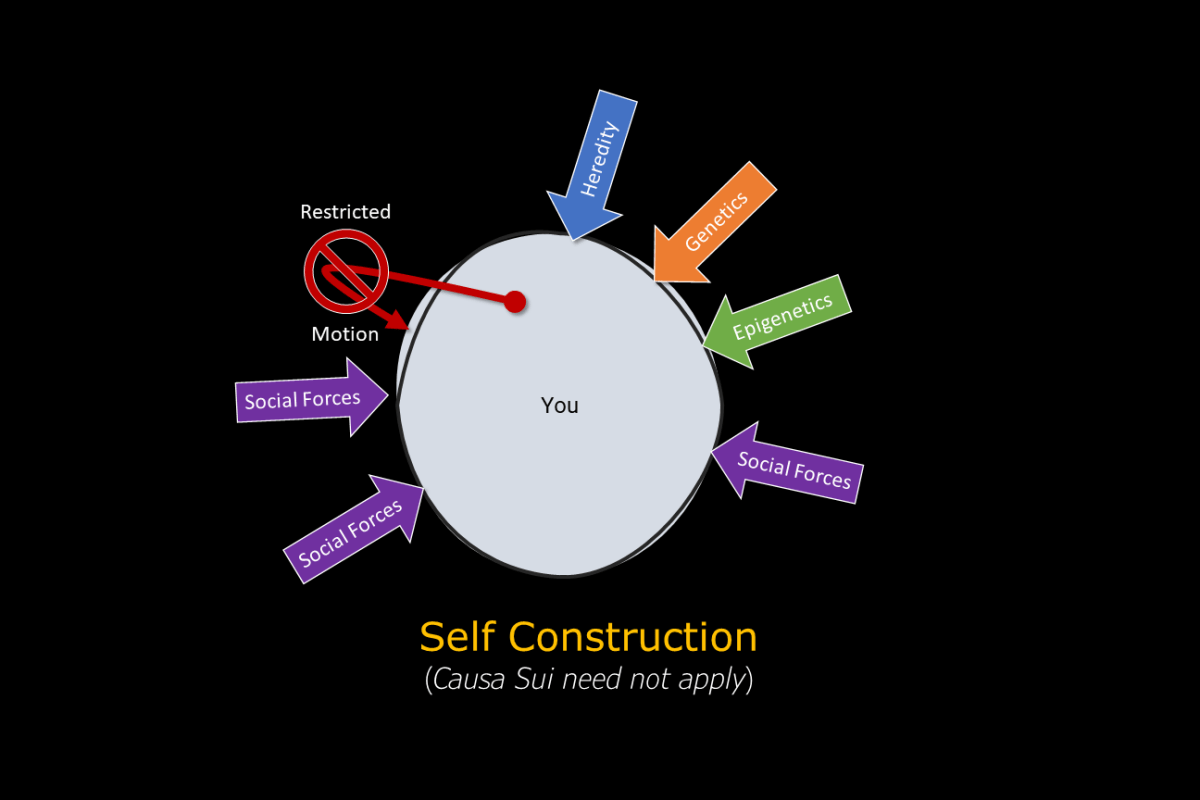
Quickly reviewing the backstory, a self—or sui in this parlance—is the product of nature and nurture. Nature manifests in the form of heredity, genetics, and epigenetics; nurture is parents, peers, society, and authority.
As people like Steven Pinker and Jonathan Haidt tell us, we come into this world with the operating system installed and a basic bootstrap programme. After this, we are autodidactic automatons. Of course, Pinker and Haidt would posit that humans are more than mere meat puppets, but that’s part and parcel of the causa sui point.
Elaborating further on this, at time-zero, the moment we take our first breath, we have not yet taken in any direct experiences from which to expand our base genetics. For the sake of illustration, let’s divide our universe into self and not-self. At the start our self has been given to us through no effort of our own. We’re the result of generations on generations of chromosomal exchange from some initial single-celled organism.
Then there’s nurture. One may argue that we have some experiences in utero, but these are substantially filtered. Once we see the light of the world, it’s showtime for real.
All that you touch
All that you see
All that you taste
All you feel.
Humans are input acquisition and storage machines. The brain is at once a difference and synthesis engine. Any outputs are a result of this process. Ostensibly, we are functions.
What humans are not are creation machines. Any so-called creation is just more synthesis. Even as we procreate to generate more humans, our dimorphism facilitates the progenerative blending of ova and spermatozoa. No creation, per se. In An Enquiry Concerning Human Understanding, Hume suggested that the idea of a unicorn was just a recomposition of the idea of a horse with that of a horn. That’s as far as human creativity goes.
The challenge with causa sui is that we cannot cause our ‘self’. Let’s explore some examples.
Let’s take as an example a successful physician. This physician was raised by someone, attended school, progressing to medical school, passed any necessary praxis, exams, and certifications, fulfilled whatever internships and residencies, and acquired some office space. Some years later, this physician bought a home, got a dog, and had some kids. I’ll stop here. You render your own mental picture.
Perhaps, instead, we look at a music virtuoso. A child prodigy, s/he attends Berklee and graduates before reaching 10 years of age. S/he starts YouTube, Insta, and TikTok channels with millions of followers, and earns millions. You take it from here. One more.
This last person is raised by a good family, but she ends up on the wrong side of the law and in prison. All friends say she’s kind, caring, and generous, but she was in the wrong place at the wrong time. At 20 she’s got a 20-year sentence to think it through. You can work this one through as well.
Let’s look into these scenarios and unpack these self-made individuals—or self-unmade if that’s how you’d prefer to characterise the last one.
Is our physician self-made? If so, how so? Let’s ignore the genetics and focus on the rest of the story. This person was sent to school. Local laws and parental concern all but ensured this. A certain teacher or teachers sparked an interest in medicine. Or perhaps it was from a book or television programme.
Perhaps a relative was ill and s/he became determined to help others.
This person was blessed with the appropriate cognitive abilities and their interest was fostered. The desire to succeed was instilled as was the drive and motivation. Nothing about this situation suggests causa sui action. Instead, everything is causa alii—caused by others, if I may misappropriate some Latin.
Any motivation was either genetically and physiologically inherent or acculturated or both. As the saying goes, you can’t get blood from a stone (or a turnip).
Of course, the second scenario plays out the same. Born with some natural ability. Could the parents not have nurtured this talent? Imagine this person was born with the propensity to be a virtuoso pianist yet never had come in contact with a piano? If a tree falls in the woods and no one was there to hear? How many people are in an analogous position?
Let’s turn to the dilemma of the prisoner. This person was instilled with whatever social cues she got. Perhaps they were exposed to bad influences. Perhaps their ‘processing unit’ is defective. Neither of these constitute causa sui events. As the saying goes, ‘she didn’t raise herself’.
Even if she did raise herself, she’d be excused as well. Some person raised by wolves in Avignon—or Tarzan of the Apes—is not expected to have acquired the rules of society.
Here’s an illustration:
First, there’s ‘sui’. That’s you.
But before you, there are the reagents. Ingredients.
Heredity.
Genetics.
Epigenetics.
Stuff.
The building blocks that make your physical ‘you’. And perhaps there are pre-natal environmental factors such as nutrition.
Once you are born, you begin to become a product of your environment as you absorb external forces. These might be the influence of your parents or siblings or other kit and kin.
Then you are exposed to teachers and peers. And society at large. And then there are perspectives formed by authority relationships.
We don’t even need to discuss the possible complexities and interactions between nature and nurture. These are interactive.
Perhaps you were genetically predisposed to grow no more than 168 centimetres, but you had poor nourishment, so this limit was never fully realised. Perhaps you have a blemish that makes you self-conscious. Perhaps, you’ve got a lisp or a limp. Perhaps you were in hospital due to an accident, and you lost a year at primary school. Perhaps a parent abandoned you and you were raised in a single-parent household. Perhaps as an infant both of your parents were killed by gunfire whilst watching an Independence Day parade in Highland Park Illinois in the United States of America.
Any of this might be true. But something that cannot be true is that you had any say in any of this. Causa sui. You cannot be a cause of yourself.
How did you become a virtuoso pianist?
Were you genetically predispositioned to have this talent? Probably. What if you weren’t driven to play? Again, what if you had never been introduced to piano but has this otherwise latent talent? Let’s say you are faced with a food choice for dinner. You’ve got pork chops, dog, or monkey brains. Personally, I’d forego all of these. If I were from some Asian countries, I may have a tough time deciding but only because they all seem delicious.
In economics, we discuss diminishing marginal utility for preferences. Faced with a choice, my preferences may differ depending on the situation. But given a situation where one has to make a choice repeatedly, each subsequent choice yields less utility or ‘happiness’.
You’re at a pub, and you mention that you’re a bit peckish. Your mate orders a pizza and offers you some slices. You haven’t eaten pizza in a while, so perhaps you eat a slice and are offered another when it’s gone. Your utility diminishes with each slice. The first one really hit the spot. The second one was pretty good too. You think twice about eating a third piece. And you forego the fourth piece altogether. Later in the evening, your mate with the hollow legs orders another pizza and offers to split it. You’re ever so slightly hungry, but you opt for pudding instead. This is your choice. But it’s not. It’s just that you’ve just eaten your fill of pizza and want something different.
Now the question is can you go against a craving? You are on a diet and are offered some dessert. You are craving it, but you exercise your free will and decline. Surely, this is free will, right? Not really. If you go for the dessert, your body is willing your action. But if you decline, it’s only because you have information that counters your craving. You need to look thin in a swimming suit at the weekend. Your choice will be guided by your assessment of prior and prospective considerations. You cannot make a choice absent these. Even if you decide to pick randomly or flip a coin. Firstly, the choice to flip is based on prior information. Secondly, the resultant choice is due to the coin rather than your free will.
Let’s summon Schopenhauer for a moment. He reminds us that whilst we can want what we will, we can’t will what we will.
This craving is not us. We aren’t in control. We only have control over whether we submit to the urge or not.
But that’s not correct either.
Picture this. You are at an ice cream vendor.
Chocolate or Vanilla
You always get chocolate, so you order chocolate. This is habit, not choice.
The vendor remembers they just got a shipment of passionfruit ice cream. Would you prefer that? It depends, but it doesn’t depend on you, save to say it depends on your experiences until now. If you’ve never had it before, it depends on your palate and whether you are open to new experiences. This is not something you have control over.
Let’s say your mates invite you to go skydiving. Again, you may seemingly be faced with a choice between declining the invitation and disappointing your mates. Whichever emotional response is stronger will guide your decision. This is based on experience. And this is important: even if you overrule your initial consideration, it’s because of the way you are that you are able to do that, but you had no say in the way you are. Each experience either leads you to a new experience or you experience something new and either like or dislike it.
Perhaps reading a certain book led you to enjoy reading. Given the decision to watch television or read, you may prefer to read. Some people do not enjoy reading, so given the choice, they’ll switch on the telly.
Galen Strawson formalised this by relating his so-called basic argument.
You do what you do, in any given situation, because of the way you are.
So in order to be ultimately responsible for what you do, you have to be ultimately responsible for the way you are—at least in certain crucial mental respects.
But you cannot be ultimately responsible for the way you are in any respect at all.
So you cannot be ultimately responsible for what you do.
What this is saying is that anything about you already influences what you do next and your choices. So, you as an entity may do something, engage in an activity, but it’s only because you’ve been programmed to do so on hardware you had no say in receiving.
To equate humans to computers is a little facile, but for our purposes, we can think of humans as analogous to processors or a mathematical function.
We are hardware with an onboard self-updating operating system. And we have software routines, all processed in our brains. In addition to capturing, processing, and storing data, this operating system and some of its software are also updated with experience, so we are getting updates and upgrades. Each of these might affect our next decision.
Sometimes input devices are faulty. Perhaps we are blind or colourblind. Perhaps we can’t hear or taste or smell. Each of these will affect in some manner what information we have to process.
In some cases, the processing unit itself is broken. With synaesthesia, we may see sounds, or smell colours.
But we may also just not process things correctly. Perhaps we can’t interpret social cues. Perhaps we can’t remember things. Or we have some other cognitive deficits. In these cases, we may have actually been exposed to socially accepted behaviours—don’t steal; don’t harm; obey traffic regulations, or whatever—, but we have difficulty processing these when the time comes. Or maybe our induction and deduction skills are diminished.
But my intent is not to make this about mental illness. The point is that persons considered to have full mental capacity and competency still have no ability to get outside of themselves to influence themselves. Full stop.
You may want to check out the video on agency that addresses what options society has in light of this situation. Keep in mind that I am not saying that you are stuck on a fateful path. We are not Oedipus. If you had not been exposed to the rules, then rehabilitation may be in order. If you may be a danger to yourself or the public, you may be sequestered or quarantined until such time you are no longer a risk. This introduces its own quandaries relating to retributive justice and challenges in policing the watchers, but these are beyond the scope of this segment.
The only escape from the idea of each human being the result of a closed system of nature and nurture is the notion of emergence that would say that the admixture of these ingredients would result in something new, that perhaps consciousness contains a sui somehow transcendent of the source elements, and this is where your human agency resides—sort of an emergent soul if you will. In the world of chemistry, the combination of sodium and chloride brings about table salt, having different emergent properties than the base ingredients, yet none of these properties is consciousness nor agency. Does this emergence work differently in the brain? This doesn’t sound plausible, but it is an idea to explore if you really feel compelled to argue agency exists in some form or fashion.
So, there you have it. You are you, but you don’t have any inherent agency. Or do you? Do you think there is any place for ‘sui’ to exist autonomously from your genetic and environmental makeup? If so, where is it, and how does it gain its independence.
Nota Bene
The causa sui cows. I had intended to work the cows into the video. In fact, I spend a decent amount of time trying to clean them up, but as I left on holiday and returned, I realised near the end that they got left on the cutting room floor—even though they are still used as cover art. Perhaps I’ll consider a feature-length production for these characters in future.
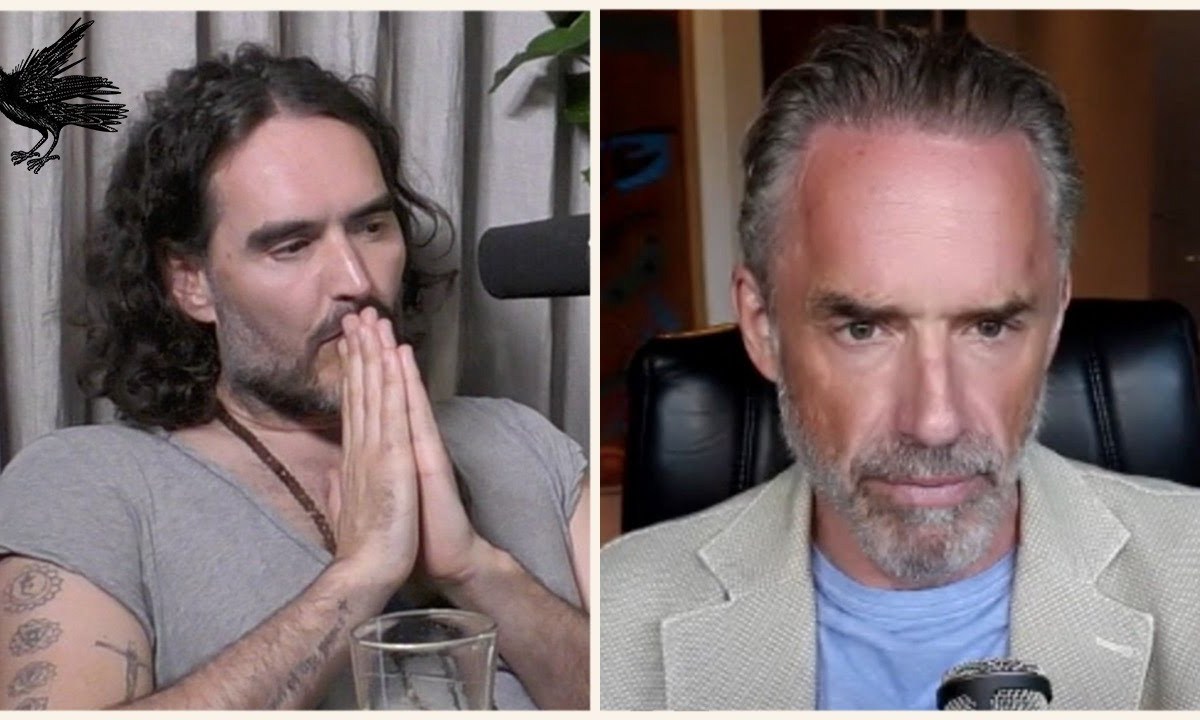
Jordan Peterson and Russell Brand chat for about 12 minutes on sex differences and personality, but that’s not where I want to focus commentary. What I will say is that Peterson continually conflates sex and gender, and I find that disconcerting for a research psychologist.
I’ve queued this video near the end, where Peterson delineates his conception of how the political right and left (as defined by him and the US media-industrial complex).
I feel he does a good job of defining the right, and he may have even captured whatever he means by left—radical left even—, but he doesn’t capture my concerns, hence I write.
To recap his positions,
Premises
We need to pursue things of value
Hierarchies are inevitable
[One has] to value things in order to move forward in life
[One has] to value things in order to have something valuable to produce
[One has] to value some things more than others or [they] don’t have anything like beauty or strength or…competence or…whatever…
If [one] value[s] [some domain] then [one is] going to value some [things in that domain] more than others because some are better
If [one] play[s] out the value in a social landscape, a hierarchy [will result]
A small number of people are going to be more successful than the majority
A very large number of people aren’t going to be successful at all
Conservative (Right)
Hierarchies are justifiable and necessary
Left
Hierarchies … stack [people] up at the bottom
[Hierarchies] tilt towards tyranny across time
Critique
I feel I’ve captured his position from the video transcript, but feel free to watch the clip to determine if I’ve mischaracterised his position. I have reordered some of his points for readability and for a more ordered response on my part.
To be fair, I feel his delivery is confused and the message becomes ambiguous, so I may end up addressing the ‘wrong’ portion of his ambiguous statement.
We need to pursue things of value
This is sloganeering. The question is how are we defining value? Is it a shared definition? How is this value measured? How are we attributing contribution to value? And do we really need to pursue these things?
Hierarchies are inevitable
Hierarchies may be inevitable, but they are also constructed. They are not natural. They are a taxonomical function of human language. Being constructed, they can be managed. Peterson will suggest meritocracy as an organising principle, so we’ll return to that presently.
[One has] to value things in order to move forward in life
This is a particular worldview predicated on the teleological notion of progress. I’ve discussed elsewhere that all movement is not progress, and perceived progress is not necessarily progress on a global scale.
Moreover, what one values may not conform with what another values. In practice, what one values can be to the detriment of another, so how is this arbitrated or mediated?
[One has] to value things in order to have something valuable to produce
I think he is trying to put this into an economic lens, but I don’t know where he was going with this line. Perhaps it was meant to emphasise the previous point. I’ll just leave it here.
[One has] to value some things more than others or [they] don’t have anything like beauty or strength or…competence or…whatever…
This one is particularly interesting. Ostensibly, I believe he is making the claim that we force rank individual preferences, then he provides examples of items he values: beauty, strength, competence, and whatever. Telling here is that he chooses aesthetic and unmeasurable items that are not comparable across group members and are not even stable for a particular individual. I won’t fall down the rabbit hole of preference theory, but this is a known limitation of that theory.
If [one] value[s] [some domain] then [one is] going to value some [things in that domain] more than others because some are better
We’ve already touched on most of this concept. The key term here is ‘better‘. Better is typically subjective. Even in sports, where output and stats are fairly well dimensionalised, one might have to evaluate the contributions of a single athlete versus another with lower ‘output’ but who serves as a catalyst for others. In my mental model, I am thinking of a person who has higher arbitrary stats than another on all levels versus another with (necessarily) lower stats but who elevates the performance (hence) stats of teammates. This person would likely be undervalued (hence under-compensated) relative to the ‘star’ performer.
In other domains, such as art, academics, or even accounting and all measurement bets are off.
If [one] play[s] out the value in a social landscape, a hierarchy [will result]
Agreed, but the outcome will be based on rules—written and unwritten.
A small number of people are going to be more successful than the majority
Agreed.
A very large number of people aren’t going to be successful at all
Agreed
Conclusion
The notion of meritocracy is fraught with errors, most notably that merit can be meaningfully assessed in all but the most simple and controlled circumstances. But societies and cultures are neither simple nor controlled. They are complex organisms. And as Daniel Kahneman notes, most merit can likely be chalked up to luck, so it’s all bullshit at the start.
In the end, Peterson and people like him believe that the world works in a way that it doesn’t. They believe that thinking makes it so and that you can get an is from an ought. Almost no amount of argument will convince them otherwise. It reminds me of the time Alan Greenspan finally admitted to the US Congress that his long-held adopted worldview was patently wrong.
Video: CSPAN: Oversight and Government Reform Committee Chairman, Rep. Henry Waxman and Former Fed Chairman Alan Greenspan Testimony
WAXMAN: “You found a flaw…”
GREENSPAN: “In the reality—more in the model—that I perceived is the critical functioning structure that defines how the world works, so to speak.”
WAXMAN: “In other words, you found that your your view of the world—your ideology—was not right. It was not what it had it…”
GREENSPAN: “Precisely. No, I… That’s precisely the reason I was shocked because I have been going for 40 years or more with very considerable evidence that it was working exceptionally well.”





 Philosophics